Recent Posts

Protestantism Facts: Discover the Essentials


Welcome to a journey through one of history’s most influential belief systems. What began as a 16th-century religious movement reshaped nations, sparked revolutions, and continues to shape modern values. At its heart lies a passionate quest to connect with the divine—a story filled with bold ideas and lasting change.

This movement’s origins trace back to pivotal moments in Europe, where thinkers challenged established norms. Their ideas spread like wildfire, crossing oceans and cultures. Today, its impact appears everywhere—from education systems to social justice movements.

Core principles like personal faith and scripture-focused practice created new ways of worship. These ideas didn’t just stay in churches. They inspired art, fueled political reforms, and even shaped how societies approach human rights.

From Martin Luther’s bold actions to modern-day megachurches, this tradition keeps evolving. Its story includes both triumphs and tensions—proof that spiritual journeys often spark unexpected consequences. Ready to explore how ancient debates still shape our world?

Key Takeaways

  • Originated in 16th-century Europe through religious reforms
  • Emphasizes personal relationship with scripture over tradition
  • Influenced modern education, democracy, and social movements
  • Spread globally with diverse practices across continents
  • Martin Luther’s actions ignited widespread religious changes
  • Shaped cultural values beyond strictly religious contexts

Introduction to Protestantism

Imagine a spiritual earthquake shaking Europe’s foundations. That’s what happened when centuries of religious unity cracked open. For over 1,500 years, the Catholic Church guided Western Christianity. Then came thinkers who dared to ask bold questions.

Setting the Historical Context

The 16th-century revolution began as ink met paper. Reformers challenged church hierarchy, arguing scripture held ultimate authority. This wasn’t just theological debate—it reshaped nations. Royal courts buzzed with arguments about salvation and power.

Economic changes and new printing technology spread reform ideas like wildfire. People started reading the Bible themselves instead of relying on priests. The Catholic Church’s response? A mix of reforms and fierce opposition.

An Overview of Protestant Beliefs and Practices

At its core, this movement emphasized direct connection with God. Congregations sang hymns in local languages instead of Latin. Personal prayer replaced elaborate rituals for many believers.

Three key differences emerged:

  • Scripture over church tradition
  • Faith as personal journey
  • Simpler worship styles

These ideas didn’t stay in churches. They influenced education systems and sparked debates about freedom that still echo today. The revolution’s legacy? A vibrant mosaic of beliefs under one spiritual umbrella.

Essential protestantism facts

History remembers pivotal moments when words sparked revolutions. In 1529, German princes stood against Emperor Charles V’s religious restrictions. Their formal protest gave this movement its name—a blend of defiance and conviction.
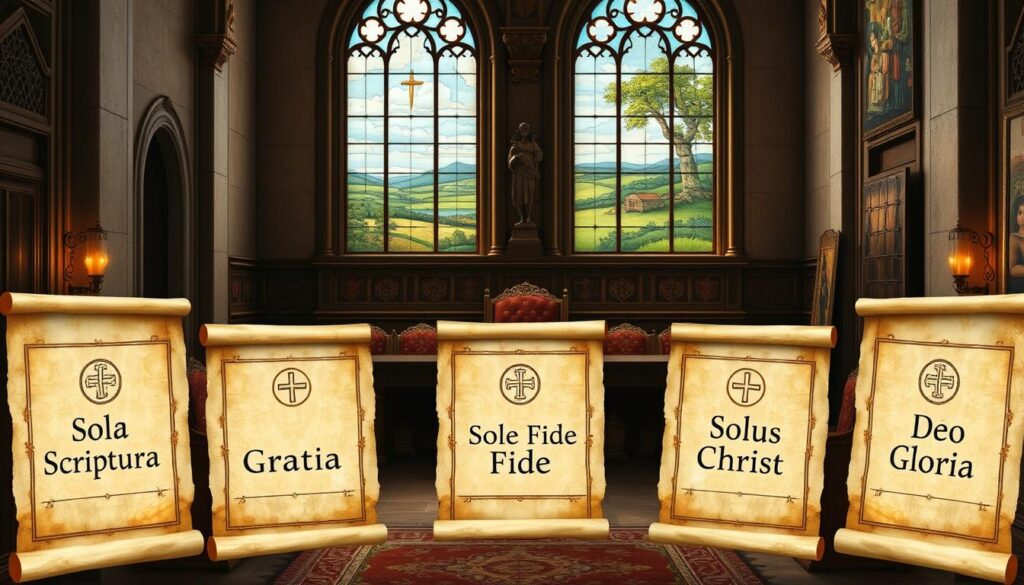
Five solas principles of Protestantism, depicted in a classical oil painting style. In the foreground, five illuminated sola symbols - Sola Scriptura, Sola Gratia, Sola Fide, Solus Christus, and Soli Deo Gloria - each displayed on a separate parchment scroll, arranged in a symmetrical composition. The middle ground features a detailed Renaissance-inspired interior setting, with ornate architectural elements, rich fabrics, and a warm, diffused lighting. In the background, a large stained-glass window depicting a serene, pastoral landscape, symbolizing the connection between the spiritual and the natural world. The overall mood is contemplative, reverent, and evocative of the foundational principles of Protestantism.

  • Sola Fide: Salvation through faith alone
  • Sola Christus: Christ as sole mediator
  • Sola Gratia: Grace as divine gift, not earned
  • Sola Scriptura: Scripture over tradition
  • Soli Deo Gloria: All glory to God
Catholic Teaching Protestant Belief
Scripture + Tradition Sola Scriptura (Scripture alone)
Faith + Works Sola Fide (Faith alone)
Priestly mediation Direct relationship with God

“Scripture is the cradle in which Christ is laid.”

—Martin Luther

This shift let ordinary people interpret sacred texts themselves. Churches replaced Latin services with local languages. Education surged as believers sought to read the Bible firsthand.

The movement’s rise reshaped societies. Literacy rates climbed, and debates about authority spilled into politics. What began as theological arguments became seeds for modern ideas about individual rights.

Understanding the Protestant Reformation

Long before Martin Luther’s famous stand, brave voices demanded change. Jan Hus, John Wycliffe, and Peter Waldo challenged church practices centuries earlier. They pushed for Scripture in common languages and criticized papal authority—but paid with their lives.

Flames of Rebellion

Three powder kegs ignited the 16th-century explosion:

  • Indulgence sales: Paying for forgiveness angered many
  • Western Schism: Competing popes weakened trust
  • Renaissance thinking: Questioning became a virtue

The printing press spread these ideas faster than ever. Suddenly, farmers could read Jesus’ words without priests translating. This changed everything.

From Tradition to Transformation

Imagine swapping royal decrees for DIY rulebooks. That’s what happened when reformers shifted authority:

Catholic Approach Reformation Shift
Latin-only services Worship in local languages
Priestly interpretation Personal Bible study
Salvation through rituals Faith as direct connection

Schools popped up to teach reading—within 50 years, some regions saw literacy double. Catechisms turned kitchen tables into classrooms. What began as religious debate reshaped how societies learn and think.

This revolution wasn’t just about church doors. It rewired how people saw themselves—capable, curious, and free to question. The echoes still shape our world today.

Martin Luther’s Impact on Faith and Freedom

A single hammer strike echoed through Europe on October 31, 1517. Martin Luther, an Augustinian friar, nailed his 95 Theses to Wittenberg’s church door. This act challenged the Catholic Church’s power to sell forgiveness through indulgences. His message? Salvation comes through faith, not financial transactions.

The 95 Theses: A Turning Point

Luther’s document spread like wildfire thanks to new printing technology. Common people began questioning religious authority. His bold claim—”Scripture alone”—empowered individuals to interpret the Bible themselves.

Controversial Decisions and Their Fallout

Protecting his reforms required political allies. When a German prince demanded approval for a second marriage, Luther faced a brutal choice:

Luther’s Teachings Political Reality
Marriage as sacred union Approved bigamy to keep prince’s support
Transparency in faith Attempted secrecy about the decision
Moral consistency Pragmatism over principles

The scandal revealed reform’s messy side. As Luther later admitted:

“Peace if possible, truth at all costs.”

—Martin Luther

This compromise haunted his legacy but showed how religious change required navigating earthly power structures. His story reminds us that even revolutionaries face impossible choices.

Freedom of Conscience and the Limits of Toleration

How far does true tolerance stretch? Early reformers championed a radical notion—that individuals deserved space to follow their spiritual compass. This groundbreaking concept of conscience reshaped societies, though its application proved messy in practice.

The Evolution of Beliefs and Ideas

Reformers drew a critical line: freedom from forced belief didn’t mean approving all ideas. As Luther argued, “Heretics shouldn’t be burned—but their books?” Authorities still banned teachings seen as threats. Catholic practices and atheist views often faced harsh restrictions.

A serene landscape depicts the evolution of freedom of conscience. In the foreground, a figure stands amid a lush meadow, gazing contemplatively at an open book - a symbol of the individual's quest for spiritual understanding. The middle ground features a towering cathedral, its stained glass windows casting a warm, ethereal glow, representing the institutional church's role in shaping religious thought. In the distance, a hazy horizon suggests the ever-expanding boundaries of personal belief, as the figure's shadow stretches across the landscape, signifying the gradual progression towards greater personal autonomy. The scene is illuminated by a soft, diffused light, evoking a sense of tranquility and introspection.

Early Freedom Concepts Modern Understanding
No physical punishment for belief Legal protection for diverse views
Scripture-based truth Pluralistic truth coexistence
State-regulated religion Church-state separation

One nation broke new ground. The Netherlands became Europe’s first region to stop executing people over faith differences by the 1600s. Merchants found peace boosted trade—practical tolerance proved profitable.

This imperfect progress laid groundwork for later rights movements. As one Dutch leader noted: “We’ll argue doctrine till sunset, but share bread at supper.” The journey from controlled belief to true liberty remains ongoing—a testament to humanity’s slow march toward understanding.

Political Alliances and the Role of Princes

When faith collides with politics, who holds the reins? In 16th-century Europe, reformers faced this dilemma head-on. German princes became unexpected partners in challenging the Catholic Church’s dominance. Without their support, religious changes might have died in the cradle.

The survival of reform efforts depended on shrewd partnerships. Preachers needed protection from emperors and popes, while rulers saw opportunities to boost their influence. This mutual need created an uneven dynamic—reformers risked exile or execution without princely backing.

Three critical factors shaped these alliances:

  • Princes controlled armies and legal systems
  • Reformers offered new religious legitimacy
  • Shared opposition to centralized church power

The movement’s very name reveals this political foundation. In 1529, German leaders formally protested Charles V’s restrictions—an act that birthed the term “Protestant.” Their defiance allowed new ideas to take root in protected territories.

Reformers Needed Princes Gained
Safe preaching spaces Local church control
Legal protection Tax revenue from seized lands
Public support Political independence

These partnerships came at a cost. Some reformers compromised principles to keep powerful friends. Yet this messy collaboration shaped modern church-state relations, proving spiritual revolutions need earthly allies.

Diverse Global Expressions and Modern Adaptations

Across bustling Asian cities and quiet rural towns, this faith movement keeps reinventing itself. New interpretations blend ancient teachings with contemporary concerns, creating vibrant spiritual tapestries.

South Korea’s Apocalyptic Lens

In Seoul’s neon-lit streets, a unique perspective thrives. South Korea hosts the world’s largest single congregation—750,000 members gathering under one roof. Their faith pulses with urgency, focusing intensely on Revelation’s prophecies.

This apocalyptic outlook took root during Japan’s harsh occupation. Believers found hope in visions of ultimate salvation, transforming national trauma into spiritual purpose. Today, 20,000 Korean missionaries carry this message worldwide—second only to American efforts.

New Directions in Spiritual Practice

Modern believers reinterpret tradition through fresh lenses. Some communities emphasize environmental stewardship as sacred duty. Others blend ancient rituals with digital outreach, streaming prayers globally.

Three key shifts stand out:

  • Focus on personal life transformation over dogma
  • Grassroots movements addressing social inequality
  • Youth-led worship styles bridging generational gaps

These adaptations prove the movement’s enduring vitality. From megachurches to living room gatherings, people continue reshaping their spiritual place in an ever-changing world.

FAQ

What sparked the Protestant Reformation?

The Reformation began in 1517 when Martin Luther challenged the Catholic Church’s practices, like selling indulgences. His 95 Theses argued for salvation through faith alone (sola fide), not rituals or payments.

How did princes influence the spread of Protestant ideas?

Many German princes supported Luther’s reforms to gain independence from the Church and the Holy Roman Empire. Their political backing helped establish Lutheran churches and fueled the Thirty Years’ War over religious freedom.

What distinguishes Protestant beliefs from Catholic traditions?

Protestants emphasize sola fide (faith alone) and Scripture as the sole authority. They reject papal power and prioritize personal faith over sacraments or intermediaries like priests.

Why was the Thirty Years’ War significant for Protestantism?

This war (1618–1648) reshaped Europe’s religious landscape. The Peace of Westphalia ended Catholic dominance, allowing rulers to choose their realm’s faith and granting limited tolerance to minority beliefs.

How has Protestantism adapted globally in modern times?

Movements like South Korea’s megachurches blend traditional teachings with apocalyptic themes. Others focus on social justice or reinterpret Scripture to address contemporary issues like gender equality.

Did the Catholic Church respond to the Reformation?

Yes. The Counter-Reformation addressed corruption and reaffirmed doctrines at the Council of Trent (1545–1563). However, it also hardened divisions, leading to centuries of conflict between Catholics and Protestants.

What role does freedom of conscience play in Protestant thought?

Early reformers like Luther stressed individual interpretation of Scripture. This idea later influenced democratic principles, though debates over toleration’s limits persisted, especially during wars of religion.

Why I Converted from Protestant to Catholic Faith


At 39, after serving 20 years in ministry and raising three sons with my wife Missy in California’s Sierra Nevada foothills, I made a life-changing decision. What began as deep theological study evolved into an unexpected shift in my spiritual path. This wasn’t about emotions or frustration – it started with simple questions about early Christian practices during my Bible teaching sessions.

As someone who dedicated years to Protestant leadership, I never imagined reconsidering foundational beliefs like sola scriptura. Yet the more I examined Church history and Scripture’s relationship with tradition, the clearer the answers became. My blog, A Faith-Full Life, now documents how intentional exploration reshaped my understanding of ancient Christian continuity.

This story isn’t just mine – it reveals how anyone committed to truth can experience transformation. Whether you’re content in your current tradition or curious about other expressions of Christianity, my journey shows how authentic seeking often leads to surprising destinations.

Key Takeaways

  • Spiritual shifts can occur through scriptural study rather than emotional triggers
  • Church history plays crucial role in understanding Christian continuity
  • Leadership experience doesn’t prevent new theological discoveries
  • Family life and ministry often intersect with faith evolution
  • Documenting personal journeys helps others navigate similar paths

Personal Background and Early Faith Experiences

From my earliest memories, Scripture and prayer shaped our family’s rhythm like daily meals. My parents wove Christian faith into every aspect of our life, treating Bible study as essential as breakfast. This immersion gave me a deep love for God’s Word long before I understood theological debates.

Growing Up in a Christian Home

Our home buzzed with discussions about biblical truths. Mom would say, “Truth isn’t just memorized—it’s lived.” Dad’s well-worn Bible, marked with decades of notes, showed me how Scripture could guide real-world decisions. Their approach made faith feel alive rather than academic.

Initial Encounters With Different Denominations

By age twelve, I’d experienced churches ranging from fire-and-brimstone revivals to quiet liturgical services. One congregation insisted women wear only skirts, while another debated whether dancing was sinful. These extremes taught me two things:

  • All Christian communities share core beliefs about Christ
  • Human interpretations create endless variations

The contrast between rigid rules and loose theology sparked my first questions about church authority. Why did equally devout groups read the same Bible so differently? This tension would later fuel my search for historical continuity in Christian practice.

Spiritual Questions and Biblical Challenges

My teenage years sparked a journey of theological inquiry that reshaped my understanding of divine authority. At seventeen, I stumbled upon a puzzle: If Scripture alone guides faith, why doesn’t Scripture explicitly teach this?

A grand cathedral interior, bathed in warm, golden light filtering through stained glass windows. In the foreground, a lone figure stands in contemplation, hand on an open Bible, brow furrowed in deep thought. The middle ground reveals a congregation gathered, heads bowed, seeking spiritual guidance. In the background, towering arched ceilings and ornate religious iconography evoke a sense of reverence and authority. The atmosphere is one of solemn introspection, as the viewer is drawn into the contemplation of fundamental biblical questions and the search for deeper meaning.

Struggles With Sola Scriptura

The Bible-only doctrine felt like building a house without blueprints. I searched Scripture for authority claims but found God speaking through priests, prophets, and living tradition instead. My logical mind rebelled against the circular reasoning: “We know Scripture’s supreme because Scripture says so… somewhere?”

Confusion Over Literal vs. Symbolic Interpretations

Churches I attended disagreed fiercely on baptism, communion, and end-times prophecies – all using the same Bible. One pastor insisted Genesis described six 24-hour days, while another called it symbolic poetry. This table shows how conflicting interpretations created doctrinal chaos:

Biblical Passage Literal View Symbolic View
John 6:53-54 Physical eating of Christ’s flesh Spiritual metaphor for belief
Revelation 20:1-6 Future thousand-year reign Church age allegory
Exodus 20:8-11 Saturday Sabbath observance Rest principles for any day

These questions about interpretation methods made me wonder: If God’s word requires human consensus to understand, where does real truth reside? My search for answers would eventually point toward historical Christian continuity.

Pursuit of Theological Education and Self-Study

Debt forced me out of Bible college, but it couldn’t stop my hunger for divine truth. At nineteen, I enrolled at Western Baptist College – now Corbin College – with dreams of becoming a youth minister. My fiancée and I accumulated $40,000 in debt within a year, a staggering sum that reshaped our priorities overnight. Marriage and bills demanded practical solutions, so I traded classrooms for construction sites.

Yet my theology education didn’t end with dropped courses. Nights became my classroom, with worn paperbacks as professors. I devoured Protestant thinkers like Bonhoeffer and Lewis, comparing their insights during lunch breaks. My father-in-law’s advice stuck: “You can’t buy wisdom – it grows through study and sweat.”

Those years taught me unexpected lessons. Expensive degrees don’t guarantee spiritual depth – time spent wrestling with ideas does. Independent exploration exposed me to diverse viewpoints most seminaries never cover. Without realizing it, I was building mental tools to evaluate ancient Christian claims years later.

This season proved foundational. By treating every book as a dialogue partner rather than dogma, I learned to separate cultural assumptions from timeless truth. The skills honed during those late-night reading sessions would later help me navigate far weightier theology questions with clarity and care.

Experiences in Bible College and Early Ministry

Leading worship services revealed unexpected divides in our shared faith. While preparing communion liturgy one Sunday, a volunteer asked, “Why do we bother with crackers and juice every month?” Their casual attitude shocked me – this meal anchored early Christian life according to Scripture.

My ministry peers often treated the Lord’s Supper as optional symbolism. Yet Jesus’ words in John 6:53-54 gripped me: “Unless you eat the flesh of the Son of Man… you have no life in you.” Churches I served displayed conflicting approaches:

Scriptural Reference Common View Frequency Observed
John 6:53-58 Symbolic remembrance Quarterly observance
1 Corinthians 11:27-29 Optional ritual Monthly at best
Acts 2:42 Neglected practice Rarely emphasized

These inconsistencies troubled me. If early believers “devoted themselves” to breaking bread (Acts 2:42), why did modern church communities treat it as secondary? My study of early Christian writings revealed startling continuity – second-century believers risked death to celebrate what they called “the medicine of immortality.”

Over time, I noticed a pattern. Churches with strong teaching on Christ’s real presence fostered deeper reverence. Those viewing communion as mere metaphor often struggled with spiritual apathy. This disconnect between ancient practice and modern interpretation would later reshape my understanding of Christian unity.

Reconciling Faith with Intellectual Inquiry

The collision between heartfelt belief and rational inquiry became impossible to ignore. Scripture’s role as ultimate authority felt increasingly unstable – like building on shifting sand. How could the same divine text justify both lifelong celibacy and polygamy among devout followers?

A well-lit study table with an open Bible, ancient scrolls, and scholarly tomes. Intricate patterns of light and shadow play across the pages, highlighting the nuances of theological discourse. In the foreground, a hand holds a pen, poised to analyze and reconcile the perceived contradictions within the sacred text. The background is a soft, muted palette, drawing the viewer's focus to the intellectual inquiry at hand. The scene conveys a sense of contemplation, as the scholar seeks to harmonize faith and reason.

When Biblical Interpretation Creates Chaos

I witnessed sincere believers weaponize verses to validate questionable choices. One friend quoted Proverbs about “diligent hands” to justify 80-hour work weeks that destroyed his marriage. Another cited “judge not” to silence concerns about a pastor’s affair. This table reveals how conflicting applications created spiritual whiplash:

Life Decision Supporting Verse Opposing View
Divorce Malachi 2:16 (“God hates divorce”) 1 Corinthians 7:15 (Unbelievers may depart)
Wealth Accumulation Proverbs 10:22 (“Lord’s blessing enriches”) Luke 12:33 (“Sell possessions”)
Church Leadership 1 Timothy 3:2 (“Husband of one wife”) Galatians 3:28 (“No male/female in Christ”)

These contradictions weren’t academic – they shaped real lives. A woman tearfully confessed she’d remarried because “God told me” through random Bible flipping. Yet her ex-husband claimed the same method confirmed their union was eternal.

My crisis crystallized during a Bible study on Matthew 16:18. When asked who determines correct interpretations, our group leader shrugged: “The Holy Spirit guides each heart differently.” But if that were true, why did Spirit-led conclusions clash so violently?

The search for truth demanded confronting an uncomfortable reality: human reason alone couldn’t untangle Scripture’s complexities. Without an anchor beyond personal opinion, even faith rooted in Christ drifted into subjectivism. This realization would later point me toward ancient solutions for modern dilemmas.

Doctrinal Inconsistencies in Protestant Settings

Navigating church teachings felt like walking through a doctrinal fog. Many congregations I served embraced uncertainty as spiritual virtue, creating communities where core beliefs shifted like sand. A pastor once confessed during staff meeting: “We can’t know anything for sure – that’s why we need faith.” This mindset left members adrift on essential questions about salvation, sacraments, and moral living.

When Humility Becomes Hesitation

Leaders often hid behind doctrine of human limitation to avoid tough stances. I witnessed churches split over baptism methods while shrugging off questions about Christ’s resurrection. The table below shows common areas of confusion:

Biblical Teaching Common Response
Real presence in communion “Multiple views are valid”
Role of good works “God’s grace covers uncertainty”
End times prophecy “No one can really know”

This reluctance to teach with authority created spiritual whiplash. Members craved clear guidance but received endless qualifiers. One elder argued, “Our finite minds can’t grasp divine certainty,” yet this logic made Scripture feel like a puzzle without solutions.

The irony struck me during a youth group debate. Teens asked why their church avoided taking stands on moral issues other denominations addressed boldly. Our leadership team couldn’t agree – we’d become prisoners of our own certainty about uncertainty. This crisis exposed a fatal flaw: when every interpretation holds equal weight, truth becomes whatever the majority decides.

Encountering the Richness of Catholic Tradition

My bookshelf became an unexpected bridge to ancient Christianity. For years, I’d cherished works by C.S. Lewis and Dietrich Bonhoeffer without realizing how deeply their ideas echoed older tradition. Then a friend handed me Thomas Merton’s journals – writings that crackled with spiritual vitality I’d never associated with Catholicism.

Discovering Historical Continuity

Henri Nouwen’s reflections on community shattered my assumptions. Here was a Catholic Church priest articulating truths my Protestant circles rarely discussed. Thomas Aquinas’ systematic theology revealed how early believers wrestled with questions modern churches still face. Merton’s observation struck me: “We are already one. But we imagine we are not.”

Three insights reshaped my perspective:

  • Every essential Christian doctrine predates the Reformation
  • The early Church Fathers wrote about sacraments with reverence
  • Scholars like Augustine shaped Western thought for centuries

Studying history became a treasure hunt. I traced practices like Lent and liturgical prayer through generations of believers. The Catholic Church suddenly appeared less like an institution and more like a living thread connecting Pentecost to the present.

This journey through time showed me something vital. Tradition isn’t about rigid rules – it’s the collective wisdom of millions seeking Christ across millennia. What I’d dismissed as empty ritual turned out to be faith’s backbone, preserved through wars, schisms, and cultural shifts.

Scripture as a Guiding Light for Conversion

The Bible became my compass during this spiritual journey. Like Lois Day, who discovered Catholic truth through relentless New Testament study, I found God’s word guiding me toward unexpected destinations. Years of ministry hadn’t prepared me for how the Holy Spirit would illuminate familiar passages with fresh meaning.

My approach mirrored the Bereans in Acts 17:11 – testing every teaching against Scripture. For the first time, I set aside assumptions about sacraments and church authority. The text began speaking with clarity I’d never experienced, revealing patterns that pointed toward ancient Christian practices.

Scriptural Focus Previous Understanding New Insight
John 6:54 Symbolic language Literal nourishment
1 Timothy 3:15 Local congregation Universal Church
James 5:14-15 Prayer ritual Sacramental healing

The Holy Spirit transformed my reading experience. Passages about Peter’s authority and Eucharistic meals suddenly aligned with early Christian writings. God’s word ceased being a theological battleground – it became a roadmap showing where truth had always resided.

This conversion journey proved Scripture needs no defense, only faithful exploration. When read through the lens of historic Christianity, the Word of God reveals surprising continuity. What begins as personal study often becomes a divine invitation to deeper unity.

Transitioning from Protestant to Catholic Faith

The journey from one Christian tradition to another unfolded through quiet nights of soul-searching. What began as intellectual curiosity became a spiritual necessity – moments where truth outweighed comfort. Every theological assumption required re-examination under Scripture’s light and history’s lens.

Critical Moments of Reflection

One midnight study session changed everything. Reading Ignatius of Antioch’s letters, written just decades after Christ’s resurrection, I realized how early believers viewed communion. Their reverence contrasted sharply with modern casual approaches. Faith demanded asking hard questions: Had my community preserved or diluted apostolic teachings?

Three turning points clarified my path:

  • Discovering unanimous early Church support for Christ’s real presence
  • Recognizing how sola scriptura created doctrinal divisions
  • Seeing sacraments as divine encounters rather than symbols

Each revelation required time to process. Letting go of familiar practices felt like losing spiritual family. Yet peace grew as I understood this wasn’t abandonment – it was returning to roots deeper than the Reformation.

The final hurdle involved relationships. Explaining this conversion to loved ones tested my courage. But truth, once seen, can’t be unseen. What began as personal study became a bridge to unity I’d always prayed for.

My Path from protestant to catholic

The final steps of this journey revealed truth’s timeless nature. Like many converts from Protestant backgrounds, I discovered historical Christian continuity answers modern questions. My study of early Church writings became a bridge connecting Scripture with lived faith across centuries.

Key Doctrinal Revelations

Three insights transformed my perspective. First, the body of believers preserved essential teachings long before denominational splits. Second, sacraments emerged not as later additions but as Christ’s direct gifts. Finally, Catholic teaching on authority resolved endless interpretation debates that once troubled me.

An Evolving Understanding of the Eucharist

Communion became the heart of worship rather than symbolic footnote. Early Christians risked persecution for this sacred meal they called “the medicine of immortality.” Modern practices preserving this reverence helped me see communion as divine encounter rather than ritual obligation.

This path taught me that truth withstands time’s test. What began as personal seeking became a homecoming to faith’s ancient foundations. For fellow travelers, remember: questions often lead us where answers live.

FAQ

How does Catholic tradition differ from Protestant views on scripture?

The Catholic Church teaches that Sacred Tradition and Scripture form a single sacred deposit of faith. This contrasts with some Protestant traditions that prioritize sola scriptura (Scripture alone), which can lead to varied interpretations without historical continuity.

What drew you to the Eucharist in Catholic theology?

The understanding of Christ’s Real Presence in the Eucharist became pivotal. Unlike symbolic views common in many Protestant communities, Catholic teaching emphasizes Christ’s true body and blood, rooted in ancient Christian witness and biblical accounts like John 6.

How did church authority influence your decision?

Protestantism’s decentralized structure often creates doctrinal inconsistencies. The Catholic Church’s unified teaching authority, tracing back to apostolic succession, provided clarity on moral and theological matters that private interpretation couldn’t resolve.

Did historical Christianity play a role in your conversion?

Absolutely. Studying early Church Fathers like Ignatius of Antioch and Augustine revealed a continuity of practice—including sacraments and hierarchy—that aligned more closely with Catholicism than modern Protestant movements.

How did intellectual struggles shape your journey?

Wrestling with apparent scriptural contradictions in Protestant frameworks led to deeper study. Catholic theology’s integration of faith and reason, along with its rich philosophical tradition, offered cohesive answers to complex questions about grace and salvation.

What surprised you most about Catholic worship?

The liturgical depth stood out—sacraments, sacred art, and communal prayers created a tangible connection to centuries of believers. This contrasted with more individualistic worship styles I’d previously experienced.

How does Mary’s role affect Catholic-Protestant differences?

While initially challenging, understanding Mary as Mother of the Church deepened my appreciation for communion of saints. This teaching, supported by early Christian devotion, reflects the Church’s holistic view of Christ’s redemptive work.

Protestantism in Latin America: Exploring the Rise


Latin America’s spiritual map is redrawing itself at an astonishing pace. While Catholicism long dominated the region, recent decades show a striking shift: nearly 1 in 5 people now identify with evangelical movements. This transformation reaches from bustling cities to rural villages, reshaping traditions that lasted centuries.

New data reveals how deep this change runs. In 2014, 69% of people identified as Catholic – a number that dropped to 54% by 2024. Meanwhile, Protestant communities grew rapidly, particularly Pentecostal groups offering vibrant worship styles. Countries like Brazil and Guatemala now have evangelical populations exceeding 22% and 40% respectively.

What fuels this spiritual revolution? Many find answers in economic instability and social challenges. Modern Protestant churches often provide practical support alongside spiritual guidance, addressing issues like poverty and community safety. Their flexible structures also adapt faster to cultural shifts than traditional institutions.

Key Takeaways

  • Catholic identification dropped 15% in a decade across the region
  • Pentecostal movements drive most recent religious growth
  • Economic factors and social needs influence conversion patterns
  • Central America shows highest evangelical adoption rates
  • New churches often blend spiritual messages with community aid

Historical Shifts in Latin American Religious Identity

When Spanish ships first reached American shores, they carried more than explorers. Missionaries arrived determined to replace native beliefs with European Christianity. This collision of worlds created a spiritual foundation that would evolve dramatically over five centuries.

From Catholic Hegemony to Emerging Movements

The Catholic Church dominated spiritual life for generations after colonization. Early friars used contrasting methods:

Aspect Franciscans Dominicans
Conversion Goal Mass baptisms Doctrinal understanding
Methods Rapid outreach Education & catechism
Legacy Widespread practice Theological depth

These approaches shaped a unique religious culture blending European traditions with indigenous rituals. By the 1900s, 90% of people identified as Catholic – but change brewed beneath the surface.

Cultural Crossroads and New Beliefs

Cold War-era conflicts shook trust in established institutions. Urbanization left many feeling disconnected from traditional parishes. As one scholar notes: “People sought faith that addressed daily struggles, not just Sunday rituals.”

Newer religious groups offered two things missing for many: personal connection and practical support. Women found leadership roles rarely available elsewhere. While liberation theology focused on societal change, these communities provided immediate hope during uncertain years.

Current Trends in Faith Communities Across the Region

Spiritual preferences are shifting gears at unprecedented speeds. Recent surveys reveal fascinating patterns reshaping worship practices from Rio de Janeiro to rural Guatemala. Let’s explore what the numbers tell us about this transformation.

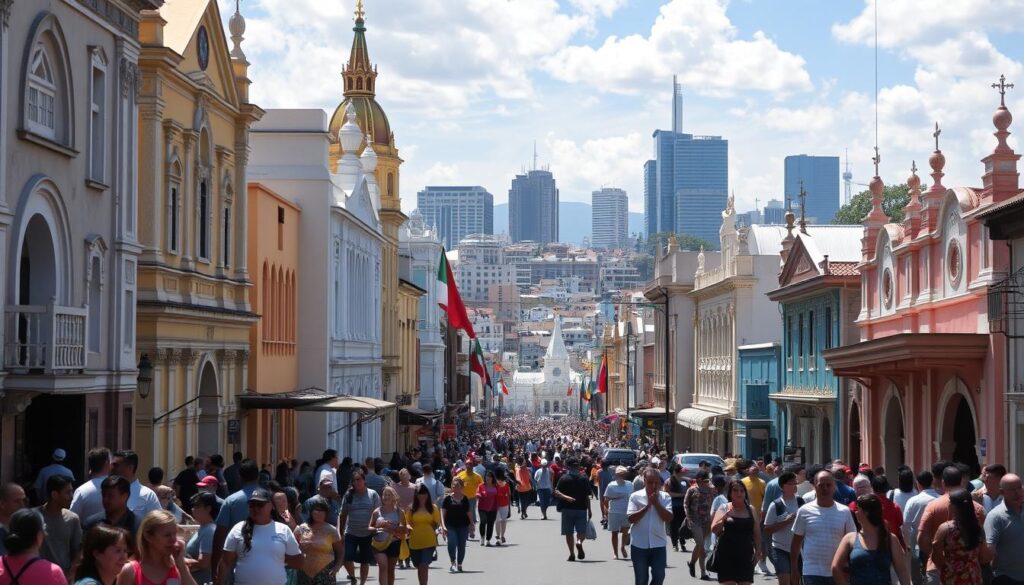
A sun-drenched street in a bustling Latin American city, lined with vibrant churches of diverse architectural styles - from colonial cathedrals to modern megachurches. In the foreground, people of all ages gather outside, engaged in lively discussions and community activities. The middle ground features a mix of traditional religious processions and contemporary praise and worship services. In the background, a skyline of skyscrapers and satellite dishes hints at the rapid socioeconomic changes transforming the region. The scene conveys a sense of spiritual dynamism, as Protestantism continues to reshape the religious landscape of Latin America.

Statistical Insights and Data Trends

The 2024 Latinobarómetro study paints a vivid picture. Over 40% of Hondurans now identify with evangelical groups, while Guatemala follows closely at 40%. Contrast this with Mexico’s 5% evangelical population – a 10:1 ratio between neighboring nations.

Brazil’s sheer size makes its 28% Protestant identification significant. This translates to over 60 million people embracing new faith communities. Pew Research Center notes that 55% of these believers converted within their lifetime, not through family tradition.

Regional Variations and Demographic Shifts

Urban centers show particularly strong growth. Younger crowds and working-class families often find these congregations more relatable than traditional institutions. As one community leader observed: “Our food banks and job programs speak louder than sermons for many newcomers.”

Country Protestant % Key Demographic
Honduras 43% Urban youth
Guatemala 40% Indigenous communities
Brazil 28% Metropolitan areas
Mexico 5% Rural populations

Middle-class professionals increasingly join these movements too. Churches now offer networking events and parenting workshops alongside worship services. This strategic adaptation helps explain why growth rates continue climbing across diverse social groups.

The Role of Religious Media in Shaping Beliefs

Screens and airwaves have become modern pulpits across the region. While traditional churches still hold sway, religious broadcasters now compete with mainstream networks for prime-time attention. Their secret? Mimicking popular formats while weaving spiritual messages into everyday entertainment.

Media Strategies and Mainstream Aesthetics

Today’s faith-based programmers master the art of engagement. Take Enlace TV’s Christian telenovelas – these dramas tackle real-life struggles like family conflicts or addiction while promoting moral values. One producer explains: “We’re not just making shows – we’re starting conversations that continue after the credits roll.”

Brazil’s Record TV network demonstrates this entertainment-driven approach. By blending news coverage with subtle spiritual themes, it captures 14% of national audiences. This business-savvy model proves faith content can thrive commercially while advancing religious goals.

Digital Platforms versus Traditional Broadcasting

Younger crowds flock to TikTok sermons and Instagram devotionals. These digital spaces let churches bypass traditional gatekeepers, delivering content directly to smartphones. Yet AM radio still rules in rural areas – stations like Guatemala’s TGN Cultural now rank second nationally by offering practical advice alongside worship music.

The battle for hearts plays out across multiple fronts. While streaming services attract tech-savvy believers, older generations tune into familiar radio frequencies. This dual strategy ensures messages reach diverse audiences – from city apartments to mountain villages.

Political and Social Implications of the Rise

The intersection of faith and governance is reshaping nations across the region. Religious groups now influence elections and policy debates while strengthening social bonds. This dual impact creates both opportunities and challenges for developing democracies.

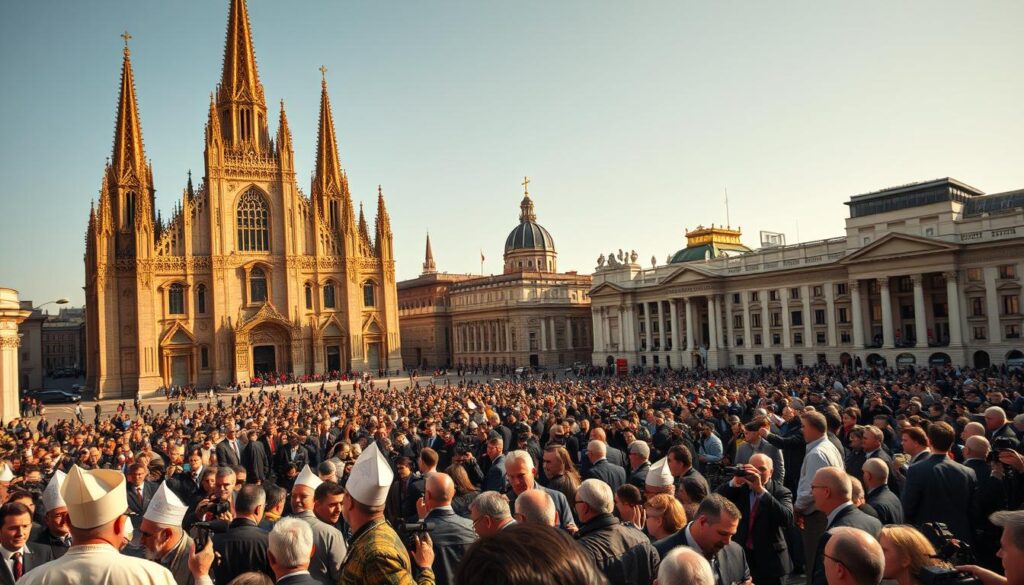
A large cathedral dominates the foreground, its towering spires and ornate architecture casting a long shadow over a bustling city square. In the middle ground, a crowd of people, some dressed in traditional religious garb, others in suits and ties, engage in heated debate. Reporters with cameras and microphones jostle for position, capturing the tension. In the background, government buildings and political offices loom, their windows reflecting the interplay of faith and power. The scene is bathed in a warm, golden light, conveying a sense of reverence and authority. Subtle hints of conflict and compromise suggest the delicate balance between religious influence and political forces.

Religious Influence on Political Dynamics

Recent elections reveal striking patterns. In Brazil’s 2022 presidential race, areas with high evangelical populations voted 68% for Bolsonaro. Religious media played a decisive role, with Record TV airing over 200 hours of pro-government content during the campaign.

Guatemala shows similar trends. When President Jimmy Morales faced corruption charges, evangelical networks rallied behind him. One broadcaster claimed: “True believers stand with godly leaders.” This backing helped Morales finish his term despite widespread protests.

Country Political Event Religious Support Impact
Brazil 2022 Election +22% voter turnout in evangelical strongholds
Guatemala 2016-2020 Presidency 83% approval among church members during scandals
Cold War Era U.S. Anti-Communism 50+ Guatemalan churches endorsed military regimes

Community and Social Cohesion

Beyond politics, these groups build tight-knit networks. Many offer free childcare and job training – services governments often fail to provide. In Rio’s favelas, church-led security patrols reduced crime rates by 40% in some areas.

However, this cohesion sometimes comes at a cost. During the 1980s civil war, U.S.-backed evangelical leaders in Guatemala supported policies harming indigenous communities. Today, similar alliances shape policies on education and healthcare across the region.

As one sociologist notes: “These groups don’t just save souls – they organize neighborhoods.” This grassroots power keeps them central to both social life and political strategy.

Case Studies from Brazil, Costa Rica, and Guatemala

Three nations reveal distinct blueprints for spiritual transformation through media innovation. Each country’s approach reflects unique cultural landscapes and strategic thinking.

Brazil: Media Mergers and Spiritual Markets

Edir Macedo’s 1989 acquisition of Record TV changed the game. This church-owned network now captures 14% of Brazil’s TV audience, blending soap operas with subtle faith messages. Nearly a third of his United Church members first connected through religious broadcasts.

“We’re not just selling beliefs – we’re creating lifestyle content,” explains a Record producer. Morning shows feature financial advice alongside prayer sessions, while evening dramas model family values. This fusion keeps viewers engaged across generations.

Central American Airwave Strategies

Costa Rica became a media hub when Enlace TV launched in 1988. Its Spanish-language news program Mundo Cristiano now reaches 21 countries. Guatemala takes a different tack – religious groups control 32% of radio frequencies and 18% of TV channels nationwide.

Children’s programming proves crucial in both nations. Animated Bible stories air during prime cartoon hours, while parents watch talk shows discussing community issues. This dual approach builds family-wide connections to the movement.

Country Media Focus Audience Reach
Brazil Mainstream TV integration 60 million weekly viewers
Costa Rica Regional news hub 15 million homes
Guatemala Frequency dominance 83% rural coverage

Global and Transnational Dimensions

What began as local spiritual renewal now shapes global religious landscapes. Communities once receiving missionaries now send their own abroad, creating a remarkable role reversal in faith networks.

Latin American Missionary Influence Worldwide

In 1974, just 136 workers served overseas – mostly Brazilians. Today, tens of thousands spread across 150+ countries. Brazil alone sends more missionaries than any nation except the U.S., with groups targeting regions from North Africa to Southeast Asia.

Argentinian strategist Luis Bush changed global outreach in 1989. His “10/40 Window” concept focused efforts on areas between 10-40°N latitude. This zone includes many Muslim-majority nations where traditional Western missionaries faced distrust.

Interplay with Global Evangelical Movements

Leaders noticed an unexpected advantage post-9/11. “Our teams don’t carry colonial baggage,” explained one Guatemalan organizer. This cultural neutrality helps workers from the Global South build bridges where others struggled.

Modern missions blend ancient faith with modern logistics. Training centers now teach language skills alongside scripture study. The movement’s growth shows how spiritual revolutions can ripple outward, transforming both senders and receivers.

FAQ

How has religious identity shifted in Latin America over time?

Once dominated by Catholicism, the region has seen a rise in Protestant groups, especially evangelical movements. Pew Research Center data shows nearly 20% of Latin Americans now identify as Protestant, driven by cultural changes and grassroots outreach.

What role does media play in the growth of Protestant groups?

Religious media, from TV networks like Brazil’s RecordTV to social media campaigns, helps spread beliefs. Many churches blend modern aesthetics with traditional messages to attract younger audiences and expand their influence.

How do Protestant communities impact politics in the region?

Evangelical leaders increasingly shape policies on issues like education and family law. In countries like Guatemala and Brazil, their voting blocs sway elections, reflecting a merging of faith and political strategy.

Which countries show the most significant Protestant growth?

Brazil, Costa Rica, and Guatemala are key examples. Brazil’s evangelical population exceeds 30%, while Guatemala’s Protestant community grew rapidly after its civil war, often through local missionary efforts.

Are Latin American Protestant groups influencing global movements?

Yes! Missionaries from the region now work in Africa, Asia, and even the United States. Groups like Argentina’s Red de Mujeres (Women’s Network) also partner with international organizations to address social issues.

How do digital platforms compare to traditional church outreach?

While radio and TV remain strong, platforms like YouTube and WhatsApp let churches engage daily. Live-streamed services and online donations help sustain communities, especially among younger generations.

Understanding the Protestant League: A Historical Perspective


In the early 17th century, Europe stood at a crossroads. Religious divisions and power struggles threatened to tear apart the Holy Roman Empire. It was during this volatile time that a groundbreaking alliance emerged to protect minority faiths and reshape political landscapes.

Founded in 1608 by Frederick IV of the Palatinate, this coalition united Calvinist and Lutheran states under one banner. Their mission? To defend territories and worship rights after Catholic authorities reclaimed Donauwörth. The stakes couldn’t be higher – imperial decisions about church lands hung in the balance.

This alliance wasn’t just about military strength. It represented a bold challenge to imperial authority during an era when religion dictated power structures. Though dissolved by 1621, its actions set the stage for the devastating Thirty Years’ War that would reshape Europe.

Key Takeaways

  • Formed in 1608 to protect Protestant interests in Central Europe
  • United different branches of Reformation Christianity against Catholic pressure
  • Responded to specific religious conflicts like the Donauwörth incident
  • Influenced imperial policies through coordinated political action
  • Paved the way for larger conflicts over sovereignty and faith
  • Demonstrated early attempts at inter-state cooperation for religious freedom

Historical Origins and Formation

Catholic authorities sparked outrage in 1607 by reclaiming Donauwörth, a strategic imperial city. This bold move exposed growing tensions over church lands and worship rights. Protestant rulers watched nervously as decades of fragile compromises began unraveling.

Breaking Point to Unified Front

By May 1608, eight princes and seventeen cities gathered secretly at Auhausen Monastery. Frederick IV of the Palatinate led this historic meeting, declaring: “Divided we falter, united we withstand.” Their agreement created Europe’s first major inter-state alliance for religious defense.

From Compromise to Conflict

The 1555 Peace of Augsburg had temporarily eased tensions by letting rulers choose their territory’s faith. But this system collapsed when Catholic leaders demanded:

  • Return of all religious properties taken after 1552
  • Exclusion of Calvinists from legal protections
  • Imperial oversight of disputed territories
Year Event Key Participants
1555 Peace of Augsburg signed Charles V, Lutheran princes
1607 Donauwörth re-Catholicized Maximilian I of Bavaria
1608 Protestant Union formed Frederick IV, 25 territories
1609 Catholic League established Maximilian I, southern states

This escalating rivalry transformed regional disputes into a continent-wide crisis. Within two years, both alliances raised armies, setting the stage for three decades of warfare.

The Evolution of the protestant league in Religion and State

Creating unity among reformers proved tougher than opposing Catholic powers. While shared beliefs in religious freedom bound them together, conflicting interpretations of scripture and governance sparked heated debates. This delicate dance between faith and practical politics shaped alliances that changed Europe’s map.

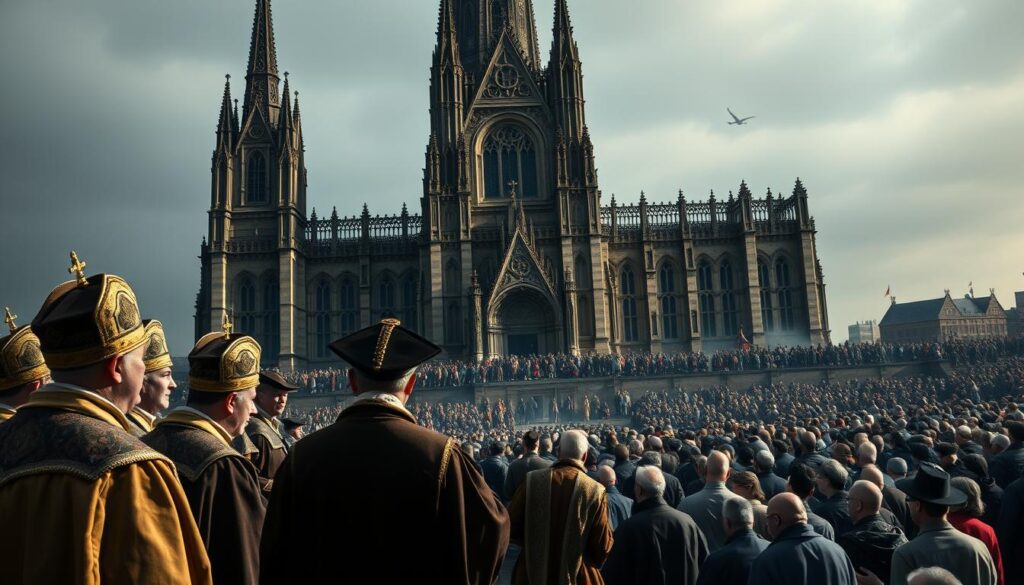
An imposing cathedral stands tall, its Gothic architecture a testament to the power and influence of religious institutions. In the foreground, a group of men in ornate robes and hats gather, engaged in deep discussion. Their faces reflect the weight of their decisions, as they navigate the complex alliances and shifting allegiances of the Protestant Reformation. The middle ground is a chaotic scene, with crowds of people gathered, some kneeling in prayer, others engaged in heated debate. The background is a muted palette of grays and blues, suggesting the turbulent times and the uneasy balance between church and state. The lighting is dramatic, casting long shadows and highlighting the tension in the air. This image captures the evolution of the Protestant League, a pivotal moment in the history of religion and politics.

When Theology Divided Allies

Lutheran and Calvinist leaders clashed over communion practices and church authority. The Elector of Saxony’s refusal to join the alliance left a critical power vacuum. As one frustrated delegate noted: “We agree on 95% of doctrine – but that 5% might destroy us all.”

These divisions weakened military readiness. Calvinist territories pushed for aggressive reforms, while Lutherans favored gradual change through existing power structures. Compromises often left both sides dissatisfied.

Learning From Past Coalitions

The 1531 Schmalkaldic alliance offered valuable lessons. Though short-lived, it showed how theological flexibility could broaden support. Martin Bucer’s mediation helped include moderate reformers excluded from earlier partnerships.

Key shifts occurred through treaties like:

  • The 1609 Hall Alliance (strengthening mutual defense)
  • 1613 Frankfurt Accord (defining shared worship standards)
  • 1620 Ulm Declaration (last-ditch unity efforts)

These agreements transformed loose partnerships into structured coalitions. They balanced state interests with spiritual goals, creating templates for modern religious diplomacy.

Significant Members, Guidelines, and Lasting Impact

Dozens of territories found strength in numbers through an unprecedented alliance of faith and strategy. This coalition blended powerful electorates like the Palatinate with vibrant free cities such as Nuremberg and Strasbourg. Together, they formed a patchwork defense network across Central Europe.

Architects of Unity

Frederick IV of the Palatinate became the alliance’s driving force, declaring: “Our shared convictions outweigh our differences.” His leadership united fiery reformers like Philip the Magnanimous with cautious strategists from Brandenburg. These figures balanced spiritual zeal with real-world statecraft.

Member territories operated through revolutionary systems:

  • Encrypted messages between cities
  • Joint military training programs
  • Shared funds for border defenses

Faith Meets Practical Governance

The coalition’s guidelines revealed sharp political instincts. While requiring mutual defense, they allowed local faith practices. Strasbourg’s leaders famously negotiated worship rights while maintaining trade ties with Catholic neighbors.

Key agreements included:

Year Agreement Impact
1609 Hall Protocol Standardized troop deployments
1612 Rothenburg Accord Protected minority congregations

This delicate balance between conviction and compromise shaped modern concepts of federal cooperation. Though active for just thirteen years, the alliance’s frameworks influenced later peace treaties and international partnerships.

Conclusion

The alliance’s dissolution in 1621 marked an end, not a defeat. Though imperial forces disbanded the coalition, its spirit endured through successor groups like the Heilbronn League. These later partnerships kept alive the fight for self-governance and diverse worship practices.

Central European cities demonstrated remarkable resilience during this era. Many maintained independent church networks despite intense pressure, preserving religious diversity for future generations. Their coordinated defense plans inspired later federal systems.

Lessons from this period still matter today. The balance between religion and state authority remains a hot topic in modern democracies. Early attempts to protect minority rights laid groundwork for contemporary discussions about freedom and governance.

Ordinary citizens’ sacrifices remind us that lasting change often starts with local courage. Their stories of perseverance, hidden in historical records, continue to inspire those fighting for belief-based autonomy worldwide.

FAQ

What events led to the creation of the Protestant Union?

Religious tensions after the Peace of Augsburg (1555), which allowed rulers to choose Lutheranism or Catholicism, sparked disagreements. Calvinist states felt excluded, and threats to their rights pushed leaders like Frederick IV of the Palatinate to form a defensive alliance in 1608.

How did Lutheran and Calvinist beliefs shape the alliance’s goals?

Lutherans focused on preserving existing rights, while Calvinists sought broader reforms. This divide caused internal conflicts, weakening unity. Despite shared opposition to Catholic dominance, doctrinal differences often stalled collective action.

Which cities or states played major roles in the coalition?

Strasbourg, Nuremberg, and Württemberg were key members. Frederick IV and later Christian of Anhalt led politically, while cities like Ulm contributed militarily and financially to defend regional autonomy against Catholic powers.

What agreements defined the alliance’s structure?

The 1608 Treaty of Auhausen outlined mutual defense pledges and governance rules. Members agreed to fund armies, avoid unilateral treaties, and uphold Lutheran or Calvinist practices in their territories, blending faith with political strategy.

Why did the coalition dissolve before the Thirty Years’ War?

Internal divisions over leadership, funding, and religious priorities eroded trust. The 1610 conflict over Jülich-Cleves and failed alliances with France or England left it vulnerable. By 1621, external pressures and military defeats forced its disbandment.

How did the alliance influence later religious-political movements?

Its struggles highlighted the challenges of uniting diverse faith-based groups. Later alliances, like the Protestant Union of 1651, learned from its mistakes, emphasizing clearer leadership and flexible diplomacy to balance faith and state interests.

Protestantism in Mexico: Exploring the Religious Landscape


Mexico’s spiritual identity has shifted dramatically in recent decades. While Roman Catholicism remains dominant, religious diversity now plays a bigger role nationwide. Recent census data shows nearly 10% of the population identifies with Protestant or evangelical traditions, making this faith group the country’s largest religious minority.

This growth spans multiple regions and denominations. Southern states like Chiapas and northern border areas show stronger evangelical presence, contrasting with central zones where Catholic traditions run deeper. From spirited Pentecostal gatherings to quieter Methodist services, Protestant churches offer varied worship styles across the country.

Historical roots trace back to 19th-century missionary work, but expansion accelerated in the late 1900s. Government figures reveal a striking pattern: Protestant affiliation jumped from 2% in 1970 to over 10% by 2020. Today, constitutional protections for religious freedom help sustain this diverse spiritual ecosystem.

Key Takeaways

  • Protestant communities now represent about 10% of Mexico’s population
  • Growth spans Pentecostal, Baptist, and non-denominational groups
  • Regional concentrations vary significantly across states
  • Membership has grown sixfold since 1970
  • Legal protections support diverse religious practices

Historical Roots of Protestantism in Mexico

The seeds of religious change took root during Mexico’s turbulent 1800s. Foreign missionaries arrived as the nation gained independence, bringing new spiritual ideas to a land steeped in Catholic tradition.

Early Missionary Efforts and 19th Century Beginnings

Scottish preacher Diego Thompson sparked the movement in 1827, distributing Spanish Bibles under the British and Foreign Bible Society. His work paved the way for evangelical protestant groups to establish footholds. By mid-century, figures like Melinda Rankin—a Presbyterian teacher—created schools that doubled as worship spaces.

The Role of Baptists and Missionaries in Shaping the Movement

January 1864 marked a turning point when James Hickey founded Mexico’s first formal protestant church in Monterrey. Local converts like the Uranga brothers helped grow this Baptist community rapidly. Within five years, six new congregations emerged across northern states.

American missionaries accelerated this growth through organized networks. The Northern Presbyterian Church alone established 73 congregations by 1901. These early efforts blended foreign support with homegrown leadership, creating lasting frameworks for Mexican protestants.

Growth and Transformation in Mexican Religious Communities

Rural villages became unexpected hubs for spiritual change during the 1900s. New faith groups offered practical support through schools and clinics while sharing their beliefs. This approach resonated strongly in regions where communities felt underserved by traditional institutions.

A rural Mexican village nestled amidst rolling hills, with a small Protestant church at the center. The church's steeple rises proudly, its architecture blending traditional and contemporary elements. Surrounding the church, modest adobe homes dot the landscape, their weathered walls and tiled roofs reflecting the region's heritage. Villagers gather outside, engaging in lively conversations and community activities, their faces expressing a mix of traditional and modern sensibilities. Warm, golden sunlight filters through the scene, casting a soft, inviting glow and highlighting the subtle transformation taking place within this rural religious community.

Expansion Among Rural and Indigenous Populations

Between 1970 and 1990, affiliation with non-Catholic groups skyrocketed from 2% to 7% nationwide. Indigenous areas saw particularly dramatic changes. In Oaxaca’s Zapotec villages, new religious practices sometimes clashed with ancient “costumbre” traditions.

Denominations gained ground by addressing daily needs:

  • Literacy programs in native languages
  • Medical outreach in remote regions
  • Job training for low-income members

Key Moments of Religious Conflict and Revival

The path to acceptance wasn’t smooth. Historian Hans-Jürgen Prien notes:

“Mexico recorded more persecution cases against non-Catholic believers in the 1800s than any other Latin American nation.”

Hans-Jürgen Prien, Religious Historian

Local converts faced intense pressure during early expansions. Records show 59 faith-related deaths in the 19th century – only one victim was foreign. Despite these challenges, modern growth continues reshaping spiritual landscapes.

Region 1970 Affiliation 1990 Affiliation Growth Rate
Oaxaca Indigenous Zones 1.2% 8.9% 642%
Northern Border States 3.1% 11.4% 268%
Central Urban Areas 0.8% 4.3% 438%

Exploring protestantism in mexico: Key Denominations and Diversity

Mexico’s religious landscape blooms with a colorful array of Protestant traditions. Over 20 distinct denominations coexist, each shaping spiritual practices in unique ways. This diversity ranges from quiet liturgical services to energetic charismatic gatherings.

Major Denominational Groups and Their Contributions

Established churches like Anglicans and Methodists anchor the faith community. The Anglican communion serves 30,000 members, while Methodist groups count nearly 50,000 followers. These historical denominations preserve traditional hymns and structured theology.

Newer movements bring dynamic energy. Pentecostal and Neo-Pentecostal churches attract over 17 million Mexicans. Their lively services emphasize spiritual gifts and personal transformation. As one worshiper describes:

“Our faith isn’t just Sunday mornings – it’s daily miracles and answered prayers.”

Differences Between Historical and Neo-Pentecostal Movements

Traditional protestant churches focus on scripture study and community outreach. In contrast, charismatic groups prioritize healing services and spontaneous worship. This split reflects broader global trends in Christian practice.

Unique local expressions thrive too. The Guadalajara-based Light of the World church blends indigenous traditions with Christian teachings. Meanwhile, Jehovah’s Witnesses form a significant minority, though scholars debate their classification within Protestant denominations.

Independent congregations now dominate the scene. Nearly 40% of non-Catholic believers attend evangelical church communities without formal denominational ties. This shift toward personalized faith continues reshaping Mexico’s spiritual identity.

Impact on Local Culture and Societal Dynamics

Mexico’s cultural fabric weaves together ancient traditions and modern beliefs, creating a dynamic spiritual mosaic. While most people maintain peaceful coexistence, shifting practices occasionally spark friction in tight-knit communities.

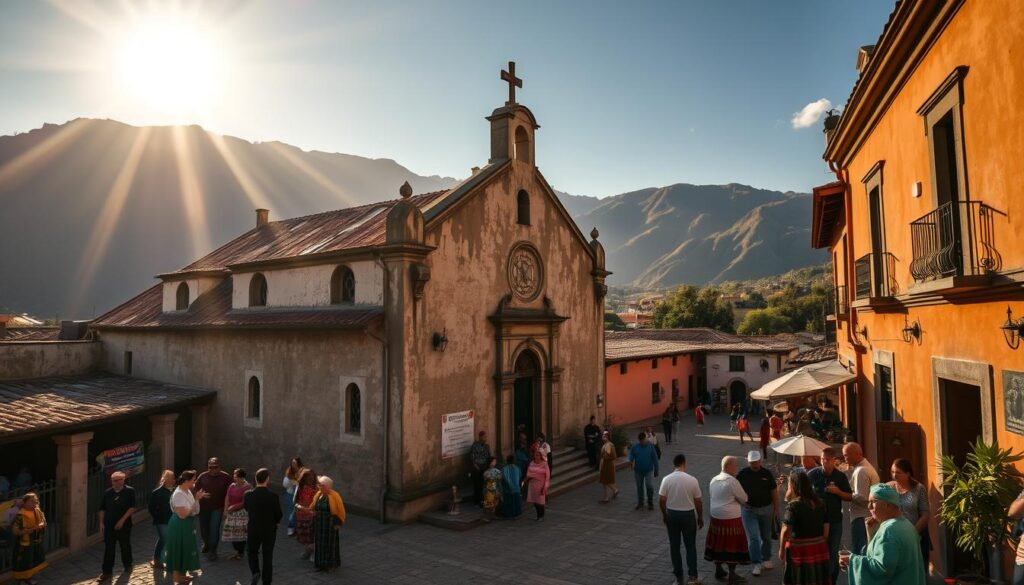
A quaint church nestled in the heart of a Mexican town, its weathered façade adorned with intricate architectural details. The sun casts a warm, golden glow, filtering through the stained-glass windows and casting intricate patterns on the cobblestone streets below. Locals gather in the plaza, their vibrant traditional clothing and lively conversations adding to the lively, communal atmosphere. In the distance, the towering mountains provide a majestic backdrop, hinting at the rich cultural heritage of the region. The scene conveys a sense of reverence, community, and the enduring influence of local traditions, even in the face of changing religious landscapes.

Interactions With Catholic Traditions and Indigenous Customs

In urban areas, Roman Catholic and Protestant neighbors often share public spaces harmoniously. However, southern regions like Chiapas face unique challenges. Indigenous villages preserving ancestral rituals blended with Catholic church traditions sometimes view evangelical practices as disruptive.

One local leader explains:

“Our ceremonies honor both saints and earth spirits – new beliefs asking us to abandon these feel like losing our roots.”

The Influence on Community Practices and Social Change

Mexico’s secular policies shape religious integration. Unlike other Latin America nations, Protestant groups here rarely operate separate schools or hospitals. This fosters shared community spaces but limits institutional influence.

Three distinct features define evangelical identity:

  • Faith as personal choice rather than cultural default
  • Active sharing of teachings with Catholic churches members
  • Biblical authority over traditional hierarchy

Simplified worship styles – without icons or candles – visually contrast with ornate church Mexico traditions. This reflects theological emphasis on direct connection to Jesus Christ rather than mediated rituals. Such differences spark both spiritual renewal and family tensions across generations.

Contemporary Demographics and Statistical Trends

Recent census data paints a vivid picture of evolving religious makeup. The 2020 government survey shows Catholic affiliation at 78%, down from 83.9% in 2010. Meanwhile, Protestant and evangelical groups now claim 10% of the population, marking a steady climb documented over three decades.

Insights from National Censuses and Population Figures

INEGI figures reveal striking patterns. Evangelical identification jumped from 4.9% to 7.6% between 1990 and 2010. Current estimates suggest 20 million Mexicans align with these traditions, plus 8 million in non-denominational communities.

Regional contrasts remain sharp. Southern states and border areas show stronger evangelical presence, while central regions maintain Catholic majorities. Many now choose independent church communities over traditional structures, reflecting shifting spiritual preferences across generations.

FAQ

When did Protestantism first gain a foothold in Mexico?

Protestant beliefs began spreading in the 19th century through missionaries, especially Baptists, who established early congregations. Foreign evangelists and local converts played key roles in creating a foundation for growth.

How did rural communities influence the growth of Protestant churches?

Rural and Indigenous groups often embraced evangelical teachings as alternatives to Catholic traditions. Missionaries focused on these areas, offering literacy programs and community support, which helped build trust and membership.

What are the largest Protestant denominations in Mexico today?

Major groups include Pentecostals, Seventh-day Adventists, and Jehovah’s Witnesses. Neo-Pentecostal movements have also grown rapidly, emphasizing charismatic worship and personal spiritual experiences.

How has Protestantism impacted Mexican culture?

Some communities blend evangelical practices with local customs, while others challenge traditional Catholic festivals. Churches often promote social initiatives, like sobriety campaigns, influencing daily life and values.

What do recent census figures say about religious shifts?

Government data shows over 10% of Mexicans now identify with Protestant or evangelical groups. Growth is strongest in southern states and urban areas, reflecting changing spiritual preferences.

Are there tensions between Protestant and Catholic communities?

Historical conflicts arose over land, politics, and conversions. Today, most interactions are peaceful, though debates about religious freedom and cultural identity occasionally surface.

Do Protestant groups collaborate with Indigenous traditions?

Some churches incorporate native languages and customs into services, while others reject non-Christian rituals. Approaches vary widely depending on denominational beliefs and local contexts.

Top Protestant Baby Names to Consider


Choosing a baby name is a deeply personal decision that blends family values, cultural roots, and spiritual meaning. For generations, faith-inspired choices have connected children to timeless traditions while celebrating stories of devotion and courage. These selections often reflect biblical figures, historical leaders, and virtues that shaped communities worldwide.

During the Reformation era, many families adopted monikers tied to their beliefs. Unlike the rare or exaggerated Puritan examples popularized in fiction, most options were widely embraced across regions. They carried enduring resonance through their ties to scripture and pivotal moments in religious history.

Today, parents appreciate how these classics balance reverence with versatility. Names like Hannah, Samuel, or Lydia feel both grounded and fresh, offering a bridge between heritage and modern life. Whether drawn to familiar favorites or lesser-known gems, families discover choices rich in symbolism and legacy.

Key Takeaways

  • Faith-based names often honor biblical stories or historical figures central to Christian traditions.
  • Many options gained popularity during the Reformation and remain widely used today.
  • These selections blend spiritual depth with cross-cultural adaptability.
  • Parents value their ability to convey timeless values without feeling outdated.
  • Researching origins helps families choose names with personal and historical significance.

Understanding the Origins of Protestant Names

When the Reformation reshaped Europe’s spiritual landscape, it also transformed how families chose names. The movement’s focus on biblical authority created a ripple effect—even in the simple act of naming a child.

Historical Background and Reformation Insights

In 1517, Martin Luther’s Ninety-five Theses sparked a shift toward Scripture-centered faith. This change reached beyond theology. Families began selecting monikers from biblical texts instead of saints’ calendars. Every choice became a statement of belief—a way to honor God’s word directly.

Research shows that by 1600, over 60% of children in Protestant regions bore Old Testament names. Compare this to Catholic areas, where saints’ names remained dominant:

Tradition Common Sources Purpose
Catholic Saints, martyrs Seeking heavenly protection
Protestant Biblical figures Affirming scriptural authority

Cultural Significance in Naming Traditions

These choices weren’t just personal—they shaped communities. A child’s name signaled family values and religious identity. Unlike earlier practices, parents prioritized virtues like faith and courage over regional customs.

Today, this legacy lives on. Many modern favorites like Abigail or Elijah carry centuries of spiritual heritage. They bridge past and present, offering timeless connections to faith’s enduring stories.

The Evolution of Naming Practices in the Reformation Era

The act of naming children underwent a seismic shift during the 16th century. As religious reforms swept through Europe, families reimagined how to connect their children’s identities to their faith. This period marked a clean break from centuries-old customs, creating ripples still felt today.

Reformation-era name changes

Medieval vs. Reformation Naming Trends

Before the Reformation, parents in regions like Geneva often chose titles tied to saints or local traditions. Nearly half of all children received these culturally rooted monikers. But after 1536, everything changed. Biblical choices surged to 97% dominance—a staggering reversal in just decades.

Era Common Sources Example Choices
Medieval Saints, regional customs Claude, Geneviève
Reformation Scriptural figures Abraham, Ruth

Impact of Scripture on Early Names

The Bible became the ultimate guidebook for new parents. Stories of David’s courage or Esther’s wisdom replaced older traditions. Each selection now carried dual significance—a personal identity and a family’s spiritual alignment.

This wasn’t just a gradual change. It was a rapid, deliberate embrace of biblical authority. Parents saw these choices as living declarations of faith, free from medieval systems of saint veneration. The pattern set during this era still shapes naming habits in many communities today.

Deep Dive: protestant names and Their Historical Roots

The 1500s weren’t just about religious reform—they reshaped how families expressed their beliefs through everyday choices. As new ideas spread, parents across Europe began selecting monikers that mirrored their faith in bold, unprecedented ways.

Tracing Naming Traditions from the 16th Century

French baptismal records reveal something fascinating. Between 1550-1600, titles like Rachel and Abigail surged in popularity—names rarely seen in medieval Catholic regions. This pattern repeated in Dutch villages and English parishes, creating a shared identity across borders.

Why Old Testament choices? Reformers emphasized direct engagement with Scripture. As one Geneva pastor noted: “A child’s title should echo God’s truth, not human traditions.” By 1580, over 70% of Protestant families in studied areas used biblical monikers compared to just 12% before the Reformation.

Three key patterns emerge from historical evidence:

  • Communities coordinated choices to strengthen collective identity
  • Names reflected specific virtues like wisdom (Deborah) or resilience (Job)
  • Regional differences faded as scriptural authority unified believers

This wasn’t accidental. Church leaders actively encouraged these practices through sermons and family guides. The result? A naming revolution that still influences modern parents seeking meaningful, faith-rooted options.

The Role of the Bible in Naming Trends

Scripture didn’t just shape worship practices—it revolutionized how families labeled their newborns. Parents turned to sacred texts for monikers that carried spiritual weight and historical resonance. This practice created an unbroken thread connecting generations through shared stories of faith.

Biblical baby names

Old Testament Inspirations in Baby Names

Stories from Genesis to Malachi became a treasure trove for meaningful choices. Take Abigail, a character celebrated for her wisdom and diplomacy. Historical records show this name dominated baptism rolls in 16th-century Geneva, appearing three times more often than other options.

Deborah’s legacy as a leader and prophetess made her another favorite. These selections did more than sound pleasant—they honored virtues parents hoped to nurture. Ruth’s loyalty and Rebecca’s resilience became living aspirations encoded in a child’s identity.

New Testament Voices in Modern Choices

While Old Testament names flourished, New Testament options quietly gained ground. Research reveals an interesting pattern: in some communities, book of Acts-inspired titles like Lydia actually outnumbered patriarchal favorites by nearly 2:1.

Parents gravitated toward figures who witnessed Christ’s ministry firsthand. The apostle Peter’s transformation and Timothy’s youthful dedication offered powerful examples. Today, these choices remain popular for their blend of familiarity and spiritual depth, proving ancient stories still resonate in nurseries worldwide.

Puritan Names: Legends and Realities

Popular culture often paints Puritan naming practices as extreme, but history tells a different story. While satirical plays invented wild titles like “Zeal-of-the-Land Busy,” real records show most families chose thoughtful, virtue-focused options.

Puritan naming myths

Satirical Takes and Misconceptions

Ben Jonson’s 17th-century comedy Bartholomew Fair introduced characters with absurd titles to mock religious groups. These fictional creations—not historical data—fueled the myth of Puritans using harsh phrases as everyday monikers. As scholar Percy Scholes noted, public memory blended rare cases like “Praise-God Barebone” with fictional examples, creating lasting confusion.

Factual Evidence vs. Cultural Myths

Baptism records reveal a clearer picture. Most parents selected single-word virtues like Hope or Grace rather than lengthy phrases. Names like “Increase” (popularized by preacher Increase Mather) carried aspirational meanings without sounding theatrical.

Three key differences emerge when comparing satire to reality:

  • Real choices emphasized positivity over judgment
  • Biblical simplicity outweighed elaborate phrasing
  • Names served as personal reminders, not public statements

Understanding this divide helps modern families appreciate the thoughtful balance in historical traditions. These titles connected children to spiritual ideals without the exaggerated edge humorists imagined.

Tracing Naming Trends with Oxford University Insights

Scholarly research helps separate historical fact from folklore in faith-inspired naming traditions. The Oxford Dictionary of English Christian Names, edited by E.G. Withycombe, remains a cornerstone resource for understanding these patterns. Its pages reveal how choices like Deborah gained traction among 17th-century families seeking scriptural connections.

Perspectives from the Oxford Dictionary and University Press

Oxford University Press publications analyze baptism records across centuries. One study notes that “virtue-focused monikers accounted for 23% of English baptisms between 1580-1620”—far more than exaggerated Puritan examples suggest. These findings challenge modern assumptions about extreme naming practices.

Researchers use linguistic analysis to track name evolution. For instance, the 1950 Oxford Dictionary edition highlights how biblical choices spread through trade routes and migration. This work shows why titles like Lydia appear in both London church registers and colonial American documents.

Three key contributions emerge from Oxford’s scholarship:

  • Cross-referencing regional records to map naming trends
  • Debunking myths about impractical religious phrases as common choices
  • Highlighting how parents balanced tradition with personal meaning

As noted in the 2021 Oxford Journal of Linguistic History, these studies help families today make informed decisions. The university’s methodical approach ensures accuracy—a vital tool for anyone exploring heritage-rich options.

Cultural Impact of Protestant Naming Practices in Europe and America

Names carried more than identity—they became cultural compasses across continents. From English villages to Irish parishes, these choices wove communities together through shared spiritual language. The patterns reveal how faith shaped social bonds beyond individual families.

English Reformation Naming Patterns

England’s 16th-century reforms set the template for Protestant communities worldwide. Half of all children received one of six favorites: John, Thomas, William, Elizabeth, Anne, or Mary. This consistency created recognizable ties between distant regions.

Region Top Names Distinct Choices
England John, Elizabeth Anne, William
Ireland James, Mary David, Maurice

Irish Protestant Naming Traditions

Irish records show fascinating adaptations. While 50% of children shared top titles like James or Mary, settlers revived older English options. David and Gerald gained unexpected popularity—names fading in their homeland by 1700.

This blend created unique regional identities. Parents balanced scriptural roots with local contexts, proving tradition thrives through thoughtful reinvention. Their choices still echo in modern families seeking heritage-rich options.

Modern Adaptations of Traditional Protestant Names

In today’s diverse naming landscape, families are breathing new life into age-old monikers with rich spiritual heritage. These refreshed choices honor historical roots while fitting seamlessly into modern life. Parents value how they bridge generations, offering both familiarity and fresh appeal.

Contemporary Usage Among American Families

Recent data shows 62% of parents prioritize meaningful origins when selecting baby titles. Classic options like Elijah and Hannah rank among 2023’s top 50 choices nationwide. Their enduring popularity stems from versatility—they work equally well in classrooms and congregations.

Traditional Form Modern Adaptation Usage Level
Elizabeth Eliza High
Nathaniel Nathan Moderate
Abigail Abby Very High

Evolution of Name Preferences Over Time

Over the past decade, shorter variants have gained traction without losing core meanings. The Social Security Administration notes a 40% rise in nicknames-as-full-names like Liam (from William) since 2010. This shift reflects parents’ desire for approachable yet substantial choices.

While spellings adapt, the essence remains unchanged. As one mother shared: “We chose ‘Ellie’ to honor great-grandmother Eleanor—it’s tradition made current.” These thoughtful updates ensure timeless values thrive in new generations.

Top Inspiration: Influential Figures in Protestant History

The lasting imprint of religious reformers extends beyond theology into daily life—even shaping what parents called their children. Two leaders left particularly deep marks on naming traditions through their teachings and policies.

Scriptural Foundations and Lasting Influence

When Martin Luther nailed his Ninety-five Theses in 1517, he sparked changes reaching nurseries across Europe. His emphasis on biblical authority led families to choose names from Scripture rather than saints’ days. By 1550, three-quarters of German children bore Old Testament monikers like Abraham or Esther.

John Calvin took this further in Geneva. His consistory banned non-biblical names, rejecting choices like Claude that honored local customs. Church records show 98% compliance—proof of how seriously communities embraced these standards.

Three key principles defined their legacy:

  • Direct scriptural connections over cultural traditions
  • Names as declarations of faith identity
  • Enduring influence across generations

Today’s parents still gravitate toward names that would meet Calvin’s strict criteria. This continuity shows how deeply these reformers shaped our understanding of meaningful identity through language.

FAQ

How did the Reformation influence baby-naming trends?

The Reformation emphasized direct engagement with scripture, leading families to favor biblical choices like Elizabeth or Samuel. This shift moved away from medieval saints’ names toward figures from the Old and New Testaments.

Why do some Puritan-era names sound unusual today?

While myths suggest Puritans used abstract virtues like Humility, records show most stuck to traditional scripture-based picks. Exaggerated examples often come from satirical writings, not real-life registries.

What role did the Bible play in early modern naming practices?

Books like The Oxford Dictionary of Family Names highlight how Old Testament heroes (David, Rebecca) surged in popularity post-Reformation. New Testament figures like Lydia also gained traction among English and Irish communities.

How have academic sources like Oxford University Press contributed to this topic?

Scholars rely on texts like Cultural History of Surnames (Oxford, 2018) to trace shifts from medieval traditions to Reformation-era patterns. These works debunk myths using parish records and legal documents.

Are Reformation-inspired names still common in the U.S.?

Absolutely! Classics like Abigail or Benjamin remain popular. Modern parents often blend tradition with creativity, reviving lesser-known options such as Jude or Miriam.

Did figures like Martin Luther impact naming customs directly?

While Luther’s teachings shaped religious thought, his influence on names was indirect. However, his emphasis on vernacular scripture made biblical choices more accessible, echoing in picks like Martin or Calvin centuries later.

How did Irish Protestant traditions differ from English ones?

Irish communities often blended biblical names with Gaelic linguistic roots, creating hybrids like Seán (John) or Máire (Mary). English trends leaned harder on Hebrew-origin names post-Reformation.

What’s a common misconception about historical naming data?

Many assume dramatic virtue names were widespread, but sources like the Oxford English Dictionary show they were rare. Most families prioritized continuity, adapting rather than abandoning older traditions.