Recent Posts

Nearby Protestant Churches: Find One Today


Looking for a spiritual home that blends tradition with modern support? Many faith communities rooted in Protestant traditions have served neighborhoods for generations. Some congregations even celebrate 100-year anniversaries, showcasing their lasting commitment to spiritual growth and social justice.

You’ll find diverse worship styles across denominations like Lutheran, Methodist, and Presbyterian. Each offers unique programs, from lively youth groups to food pantries addressing local needs. These communities balance time-honored practices with fresh approaches to faith, ensuring everyone feels included.

Choosing the right fit involves more than location. Consider service times, theological perspectives, and opportunities to connect through volunteer work or study groups. Many provide online resources to explore their mission before visiting.

Whether you’re new to faith or seeking a fresh start, these congregations welcome all backgrounds. They focus on building relationships while fostering spiritual growth through Sunday services, seasonal events, and outreach projects.

Key Takeaways

  • Local faith communities often combine decades of tradition with modern social initiatives
  • Denominations like Methodist and Presbyterian offer distinct worship styles and programs
  • Many congregations provide both spiritual guidance and practical community support
  • Service times, location, and theological alignment help narrow your search
  • Newcomer resources make joining a faith community accessible to everyone

Explore Your Local Protestant Community

Finding a place where beliefs and belonging intersect starts with open doors. Many faith groups now prioritize creating spaces where newcomers feel at home from day one. Friendly greeters often welcome visitors with informational packets, while casual coffee hours after services help forge early connections.

Welcome and What to Expect

Your first visit might surprise you. Modern congregations frequently use buddy systems or newcomer lunches to help people settle in. Small group gatherings – like book clubs or volunteer teams – offer low-pressure ways to build friendships while exploring shared values.

Community Values and Inclusivity

Recent developments show how faith communities evolve. The First Evangelical Lutheran Church made history in 2024 by affirming:

“We celebrate participation from all members of our diverse community… God loves each of us as we are.”

This mindset extends beyond Sunday services. Many groups actively address social justice through anti-racism initiatives and cultural awareness programs. They maintain core teachings while ensuring everyone feels respected as part of their spiritual family.

Understanding Protestant Worship and Service Times

Regular worship rhythms shape spiritual journeys in meaningful ways. Many congregations follow patterns developed over centuries while adapting to modern lifestyles. Let’s explore how these traditions come alive through scheduled gatherings and seasonal celebrations.
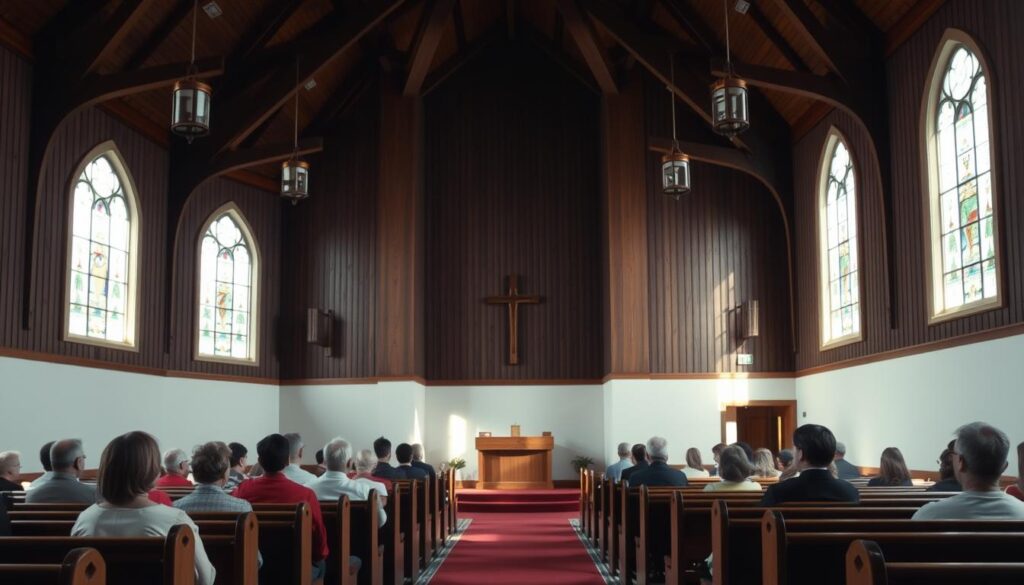
a serene Protestant church interior with wooden pews, soft natural lighting filtering through stained glass windows, a simple wooden pulpit and altar at the front, congregants in reverent contemplation during a Sunday morning service, a sense of quiet devotion and community filling the sacred space

Service Schedules and A.M. Gatherings

Most communities center their week around Sunday morning worship. The First Evangelical Lutheran Church hosts hybrid gatherings at 10:30 a.m., blending in-person and online participation. A typical service flows through four key elements:

  • Upbeat hymns and reflective prayers
  • Scripture readings from Old and New Testaments
  • Pastoral sermons connecting ancient texts to modern life
  • Communion shared monthly or during holy seasons

Early risers appreciate the 8:00 a.m. traditional services some locations offer, while latecomers benefit from repeated afternoon sessions. Multiple time slots help families balance spiritual commitments with busy schedules.

Special Services and Celebrations

Holy seasons bring expanded opportunities for connection. In 2025, the same congregation will mark Good Friday on April 13th and Easter Sunday Communion on April 20th – both at 10:30 a.m. Pastor Ilze Kuplens-Ewart notes:

“Our Easter sunrise service reminds us that hope always dawns anew.”

From Advent candlelight vigils to Pentecost praise festivals, annual events deepen communal bonds. Rotating pastors like Eric Schultz and Kevin Powell enrich services through diverse teaching styles – some favoring storytelling, others theological depth.

Find a protestantism church near me

Connecting with a faith community starts with knowing where to look. Many congregations now make discovery easy through interactive maps and virtual tours. The First Evangelical Lutheran Church, for example, shares real-time updates about parking and entry points through their social media channels.

How to Get Directions and Plan Your Visit

Most spiritual communities offer multiple ways to prepare for your first visit. Their websites often feature service calendars, parking maps, and even photos of gathering spaces. Some provide video greetings from pastors explaining what makes their community unique.

Resource Details Example
Online Directories Search filters for denomination/style LocalFaithConnect.org
Virtual Tours 360° views of worship spaces St. Mark’s Interactive Map
Service Previews Recorded sermons/music samples First Lutheran YouTube

Accessibility and Hybrid Service Options

Modern congregations prioritize inclusive experiences. At 116 Bond Street, the First Evangelical Lutheran community offers:

  • Ramped entrances and wheelchair-friendly seating
  • Live-streamed services with closed captions
  • Large-print bulletins available upon request

Hybrid participation continues to grow in popularity. One member shared: “Joining via Zoom lets my elderly parents participate without leaving home.” Many groups now assign staff members specifically to assist first-time visitors with technical setup.

Inside the Worship Experience

Step into a space where ancient traditions meet modern spiritual needs. Many congregations thoughtfully blend sacraments with creative expressions of faith, creating moments that resonate across generations.

Inclusive Rituals and Pastoral Guidance

Sacred practices like Holy Communion anchor the spiritual journey. Communities often share this ritual on first and third Sundays, with clear instructions for online participants. Pastor Nkanyiso Kingdom Maphumulo explains: “Our virtual communion kits help distant worshippers feel connected through shared symbols.”

Personal guidance strengthens these traditions. Leaders like Katharina Moeller offer one-on-one counseling while crafting sermons that bridge biblical wisdom with daily challenges. Baptisms and confirmation ceremonies become milestones celebrated by the entire community.

Embracing Diversity in Worship

Musical styles reveal this inclusive spirit. A single service might flow from centuries-old hymns to gospel beats, sometimes featuring groups like Junges Vokalensemble Hannover. Their German choir performances add global flair while maintaining theological depth.

Multilingual prayers and guest speakers from various cultures reinforce unity through diversity. As one member noted: “Hearing Scripture read in three languages reminds us faith transcends borders.” These intentional choices help people from all walks of life find belonging.

Church Events and Community Outreach

Local faith communities transform beliefs into action through vibrant gatherings and service projects. These activities create spaces where spiritual growth meets practical support, strengthening both members and neighborhoods.
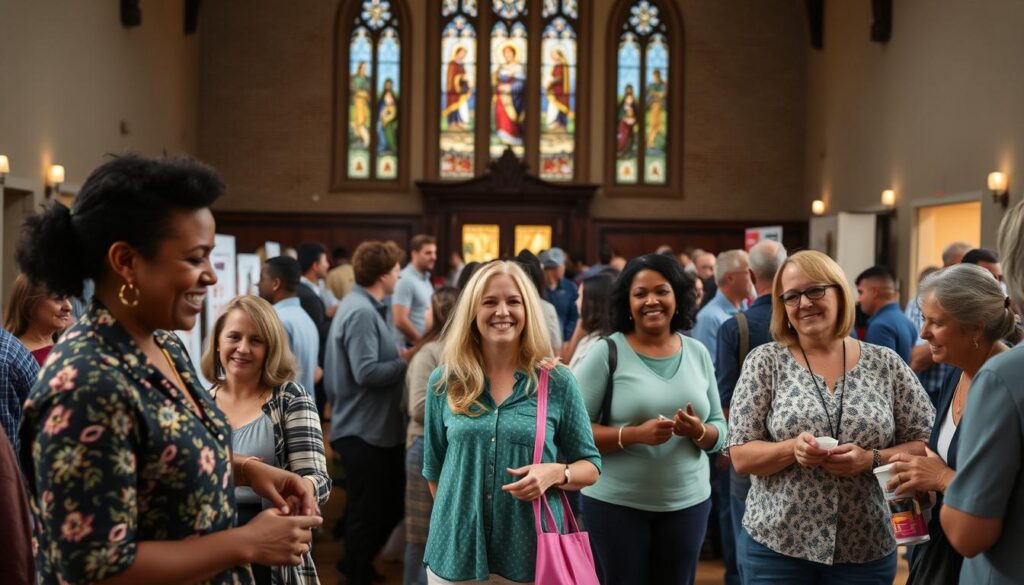
A vibrant community gathering, a church's outreach event unfolds. In the foreground, friendly faces warmly greet visitors, inviting them to explore booths showcasing local resources and volunteer opportunities. The middle ground bustles with families and neighbors mingling, sharing laughter and conversation over refreshments. In the background, the church's stately facade serves as a welcoming backdrop, its stained-glass windows casting a soft, reverent glow. Soft, diffused lighting creates an atmosphere of inclusivity and fellowship, as the event seamlessly blends the sacred and the secular, fostering a sense of unity and belonging within the community.

Local Events and Engaging Programs

Weekly Dinner Church gatherings blend nourishment and fellowship. At a recent meal, 18 participants shared roasted chicken, vegetable lasagna, and homemade desserts while learning new worship songs. Youth confirmation ceremonies honor milestones, like those celebrating Ben Wienecke and Nickolas Grammenz in 2025.

Special events often include:

Event Type Frequency Impact
Potluck Dinners Monthly Builds social connections
Confirmation Services Annual Celebrates spiritual growth
Centennial Celebrations Decadal Honors shared history

Bold Discipleship and Social Initiatives

Many Lutheran church communities lead advocacy efforts for 2SLGBTQIA+ rights. One congregation recently urged members to “Write your MP Now!” ahead of Pride 2025. Practical outreach includes Little Free Pantries stocked with non-perishables – simple boxes making big impacts.

Pastor Emma Schultz explains:

“Our food programs aren’t charity. They’re acts of solidarity with neighbors.”

These initiatives demonstrate how faith communities address current needs while staying rooted in timeless values.

Resources for Worship and Spiritual Enrichment

Modern faith communities meet people where they are—both physically and digitally. Many now offer robust online tools that deepen spiritual practices while maintaining personal connections. These resources ensure meaningful participation regardless of location or schedule constraints.

Online Worship Tools and Zoom Access

Participating in services has never been more flexible. Most congregations provide one-click Zoom access for Sunday gatherings and midweek prayer sessions. Tech teams often troubleshoot connection issues in real-time, ensuring smooth virtual experiences.

Key digital resources include:

Tool Purpose Availability
Service Bulletins Follow along with hymns and prayers Downloadable PDFs
Zoom Breakout Rooms Small group discussions post-service Sundays @ 11:30 a.m.
Tech Support Chat Instant help for login issues Live during services

Inspirational Sermons and Worship Media

Missed last week’s message? Archived services let you revisit powerful teachings anytime. The Lutheran community at 116 Bond Street shares full recordings with searchable transcripts—perfect for busy families or night-shift workers.

Pastor Sarah from a Minnesota congregation notes:

“Our sermon library helps members stay connected between Sundays. Many share clips during family devotion time.”

Seasonal playlists and discussion guides further enrich personal reflection. Explore topics like “Living Faith in a Digital Age” through curated study materials updated monthly.

Conclusion

Your journey toward spiritual connection and community impact begins with a simple step. Local faith groups create spaces where people explore beliefs while building relationships. Many host Sunday morning services alongside creative events addressing hunger, justice, and neighborhood needs.

Whether you connect through traditional 9:00 a.m. worship or modern hybrid formats, options abound. The Lutheran church community at 116 Bond Street shows how ancient rituals adapt to contemporary life – live-streamed services paired with food drives demonstrate this balance.

Weekly gatherings and seasonal events offer multiple entry points. From volunteering at community kitchens to joining online prayer groups, every service opportunity strengthens both personal faith and collective action.

Ready to start? Many congregations provide visitor guides and trial memberships. You’ll discover a supportive network where spiritual growth meets practical care – all within reach through in-person or digital participation.

FAQ

What should I expect during a Lutheran worship service?

Services often blend traditional hymns, scripture readings, and modern teachings. Many congregations prioritize inclusivity, with welcoming environments for families, singles, and visitors. Check specific a.m. schedules online for details.

How can I find local events hosted by Protestant communities?

Most churches share calendars on their websites or social media. Look for programs like Bible studies, outreach initiatives, or seasonal celebrations. Lutheran congregations often highlight bold discipleship projects and volunteer opportunities.

Are hybrid or Zoom services available for Sunday gatherings?

Yes! Many offer livestreamed a.m. services or recorded sermons. Websites like Lutheran Church–Missouri Synod or ELCA provide online tools, making it easy to participate remotely or access inspirational media later.

What attire is appropriate for visiting a Lutheran congregation?

Dress codes vary, but most prioritize comfort and authenticity. Some opt for casual wear, while others prefer business casual. Focus on feeling at home—communities value presence over outfits.

How do Protestant churches support neighborhood outreach?

Many organize food drives, mentorship programs, and partnerships with local charities. Lutheran groups often emphasize social justice, hosting events that unite diverse backgrounds through shared values.

Can I bring my kids to Sunday morning services?

Absolutely! Most provide childcare, youth programs, or family-friendly rituals. Ask about Sunday School schedules or inclusive activities designed to engage younger attendees.

Do Lutheran communities welcome newcomers from other faiths?

Yes—diversity is celebrated. Whether you’re exploring faith or seeking a spiritual home, congregations emphasize open dialogue, pastoral guidance, and a judgment-free environment.

How can I get directions to nearby Lutheran churches?

Church websites usually include maps, parking details, and accessibility info. Tools like Google Maps or denominational directories (e.g., LCMS Finder) also help locate vibrant communities near you.

Mastering Protestantism in Europa Universalis IV


Welcome to your ultimate guide for navigating religious transformations in Europa Universalis IV. Developed by Paradox Tinto and published by Paradox Interactive AB, this grand strategy game lets you rewrite history across four centuries. Whether you’re defending Catholic traditions or embracing new faiths, understanding religious mechanics can make or break your empire.

The 16th-century Reformation reshapes Europe’s political landscape in-game. Choosing between established doctrines and emerging beliefs creates thrilling challenges. Nations like France face critical decisions: convert early for bonuses, stay loyal for papal favor, or balance both while expanding colonies.

Religious choices impact stability, alliances, and long-term power. Will you spark continental discussions through bold reforms? Can you maintain trade networks while adopting controversial policies? This guide breaks down how faith intersects with diplomacy, warfare, and cultural development.

We’ll explore conversion triggers, church power mechanics, and nation-specific strategies. Learn to use religious unity for stability boosts and leverage reformed churches for military advantages. By blending historical accuracy with creative gameplay, you’ll craft empires that defy real-world timelines.

Key Takeaways

  • Religious decisions shape diplomatic ties and colonial expansion opportunities
  • Conversion timing affects stability costs and neighbor relations
  • Church power mechanics enable customizable national bonuses
  • Protestant and Reformed faiths offer distinct military vs. economic advantages
  • Center of Reformation placement influences regional religious spread
  • Balancing papal influence with reform demands creates unique playthroughs

EUROPA UNIVERSALIS and PARADOX INTERACTIVE are registered trademarks of Paradox Interactive AB. All other trademarks belong to their respective owners.

Exploring the Dynamics of Religious Change in Europa Universalis IV

Navigating religious shifts in Europa Universalis IV requires more than piety—it demands strategy. The game’s four-century timeline lets you reshape Europe through faith-driven decisions. Every choice ripples across diplomacy, warfare, and colonial ambitions.

Historical Context and the Reformation’s Impact on Gameplay

The 16th-century Reformation isn’t just a backdrop—it’s a gameplay catalyst. As Catholic authority weakens, new faiths offer unique bonuses. Nations gain church power to customize doctrines, from trade boosts to military morale.

The Art of War expansion deepens these mechanics. Religious wars become continent-spanning crises. Alliances shift as countries pick sides, mirroring real 30 Years’ War tensions. Balancing papal relations with reform demands creates thrilling general discussions among players.

How Shifting Faiths Affect Nation Building and Empire Strategy

Your state religion shapes everything. Converting early risks stability but unlocks colonization perks. Staying Catholic maintains papal benefits but limits reform options. France’s struggle exemplifies this—tradition versus innovation.

Colonial strategies shift dramatically. Protestant nations access different trade nodes and colonial policies. Internal management matters too: provinces with conflicting faiths drain resources, while religious unity boosts tax income.

Key considerations for empire builders:

  • Time conversions to minimize rebel uprisings
  • Use Centers of Reformation to sway neighboring regions
  • Align faith choices with long-term military or economic goals

Winning Strategies for protestantism eu4

Mastering faith-based gameplay in Europa Universalis IV requires blending bold decisions with smart resource management. Players must balance immediate risks against long-term rewards when reshaping their nation’s spiritual identity.

A grand table in a dimly lit war room, covered in a detailed map of Europe. Candles flicker, casting warm shadows across the surface. Figures representing armies and navies are strategically placed, hinting at ongoing campaigns. In the foreground, a commander examines battle plans, brow furrowed in concentration. The air is thick with the weight of history and the urgency of empire-building. Rays of sunlight pierce through high windows, illuminating the choices that will shape the fate of nations. This is the world of Europa Universalis, where mastering Protestantism is the key to expansion and dominance.

Timing Your Spiritual Transformation

Convert too early, and you risk economic collapse. Wait too long, and you miss key bonuses. Check your ruler’s administrative skill before initiating changes—higher stats reduce stability costs. Monitor neighboring countries’ faiths to predict alliance shifts.

Consider these factors when planning conversions:

  • Available monarch points for suppressing rebels
  • Current trade network vulnerability
  • Potential military alliances with same-faith nations

Maximizing Expansion Content Value

The Steam subscription service unlocks eight years of DLCs critical for religious gameplay. Major expansions like Emperor add mechanics for managing heretical princes, while immersion packs enhance nation-specific strategies.

Expansion Key Features Protestant Benefits
Common Sense Development mechanics Faster church power growth
Mandate of Heaven Age bonuses Improved conversion speed
Emperor Religious wars Stronger league alliances

Monthly subscribers gain immediate access to unit packs and music DLCs that enrich strategic general discussions about optimal playstyles. These tools help coordinate multi-front conversion campaigns while maintaining colonial ambitions.

Integrating Religious Policy with Empire Building

Building a thriving empire in Europa Universalis IV demands more than military might—it requires aligning spiritual governance with territorial ambitions. Religious decisions directly shape land ownership structures and colonial claims, creating ripple effects across your realm.

Managing Property, Respective Owners, and National Stability

The Rights of Man expansion transforms how faith interacts with territory. When converting provinces, local autonomy levels shift based on the property rights of nobles and clergy. Protestant nations must balance these changes to avoid rebellions.

Key estates often clash during religious transitions. Merchants demand trade protections, while religious leaders push for doctrinal purity. Successful rulers use church power mechanics from Common Sense to appease conflicting groups through targeted policies.

Utilizing Diplomatic Agreements, Trademarks, and In-Game Rights

Protestant alliances unlock unique diplomatic tools. The Great Power system lets you mediate disputes between respective owners of contested regions. One player noted: “Coordinating colonial ventures with same-faith allies creates unbreakable trade networks.”

Paradox Interactive’s attention to historical trademarks shines in religious mechanics. The Common Sense expansion’s development features let nations grow vertically through smart province investments—perfect for empires prioritizing religious unity over rapid expansion.

Strategic agreements with other reformed countries often yield better results than forced conversions. These partnerships maintain stability while securing rights to vital trade nodes and colonial territories.

Conclusion

Your strategic choices in Europa Universalis IV do more than alter church doctrines—they redefine alliances, trade networks, and colonial ambitions. This guide’s discussions reveal how faith transitions impact every layer of empire-building, from suppressing revolts to negotiating with rival powers. You’ve gained tools to turn spiritual shifts into engines for military dominance or economic prosperity.

The game’s sandbox design lets you explore what-if scenarios impossible in real history. Will your Protestant England dominate global trade? Could a Reformed Prussia outmaneuver Catholic superpowers? Each playthrough becomes a fresh experiment in balancing dogma with realpolitik across four turbulent centuries.

Whether maintaining traditions or embracing reform, remember: Europa Universalis IV rewards bold visionaries. Your decisions today shape tomorrow’s world map. So launch that colonial expedition, broker those alliances, and write history your way—one edict, one battle, one converted province at a time.

FAQ

How does adopting Protestantism affect diplomatic relations in Europa Universalis IV?

Choosing Protestantism can shift alliances and rivalries, especially with Catholic nations. It unlocks unique mechanics like church power and religious treaties, allowing tailored bonuses for military, economy, or stability. Managing relations with neighbors through diplomatic agreements becomes critical to avoid coalitions.

What role do property rights play in maintaining national stability?

A: Property respective owners systems influence estate loyalty and rebellion risks. Assigning land to nobles, clergy, or burghers impacts tax income and manpower. Balancing their demands through privileges or reforms ensures smoother empire-building during religious upheavals.

How do expansion packs enhance Protestant gameplay strategies?

DLCs like Wealth of Nations or Emperor add mechanics such as trade bonuses for Reformed faiths or customizable Protestant church aspects. Subscription services like Paradox Plaza or Steam provide access to these updates, refining strategies for religious conversion and warfare.

Can trademarks or intellectual property affect modding in Europa Universalis IV?

Mods must respect Paradox Interactive’s trademarks and content policies. While fan-created content is encouraged, redistributing copyrighted assets without permission violates user agreements. Always check Steam Workshop guidelines to ensure compliance when sharing mods.

How do religious policies interact with military expansion in the game?

Policies like enforcing unity or granting religious tolerance affect unrest and core-creation costs. Combining missionary strength with military campaigns helps consolidate conquered regions. Use diplomatic feedback from allies to avoid overextension during wars of faith.

What benefits do subscription services offer for Europa Universalis IV players?

Subscriptions on platforms like Xbox Game Pass or Paradox’s own service provide instant access to DLCs, including those focused on the Reformation. This lets players test strategies with expansion content before purchasing outright, optimizing long-term gameplay plans.

Protestant Worship: Connecting with Faith


Welcome to an exploration of spiritual traditions that have shaped communities for over 500 years. At its heart, this practice centers on a direct relationship with the divine—a revolutionary idea when it emerged during the Reformation era. Believers emphasize personal connection over rituals, guided by scripture as their ultimate authority.

These traditions grew from a desire to simplify spiritual life and return to biblical teachings. Core principles like grace through faith and the value of every believer’s role created a foundation still relevant today. Over 800 million individuals worldwide now identify with these practices, adapting them across cultures while preserving core truths.

What makes this approach unique? It prioritizes accessibility. Services often focus on teaching, prayer, and communal singing rather than formal ceremonies. This flexibility allows local congregations to shape experiences that resonate with their members’ needs and cultural contexts.

Key Takeaways

  • Rooted in 16th-century reforms emphasizing biblical authority
  • Focuses on personal spiritual connection over intermediaries
  • Celebrates the active role of all members in religious life
  • Combines traditional values with modern cultural adaptations
  • Engages over 800 million followers globally

Introduction to Protestant Worship

At the core of Christian practices lies a revolutionary idea: every person can approach the divine without intermediaries. This belief reshaped spiritual life during the Reformation, creating a direct relationship between individuals and their faith. Unlike older traditions that relied on institutional structures, this approach values personal conviction and scriptural guidance above formal ceremonies.

Central to this tradition is the principle of sola fide—faith alone as the path to grace. It rejects the notion that social status or religious titles determine one’s spiritual worth. A farmer and a scholar hold equal standing in prayer, reflecting the belief that divine connection belongs to all.

Gatherings in this tradition often blend simplicity with purpose. Services prioritize teaching, group singing, and shared reflection rather than elaborate rituals. Members actively contribute through readings, music, or leadership roles—a stark contrast to observer-focused ceremonies in other Christian branches.

While practices vary across denominations, common threads bind them. Biblical authority remains unchallenged, and communal activities strengthen both individual faith and collective bonds. From quiet prayer circles to vibrant hymn sessions, these expressions adapt to local cultures while preserving their theological roots.

Historical Origins of Protestant Worship

The roots of modern Christian practices stretch back to bold reformers who reshaped spiritual life. Long before the 16th century, groups like the Hussites in Bohemia and Waldensians in France questioned rigid church structures. They championed scripture in everyday language—a radical idea at the time.

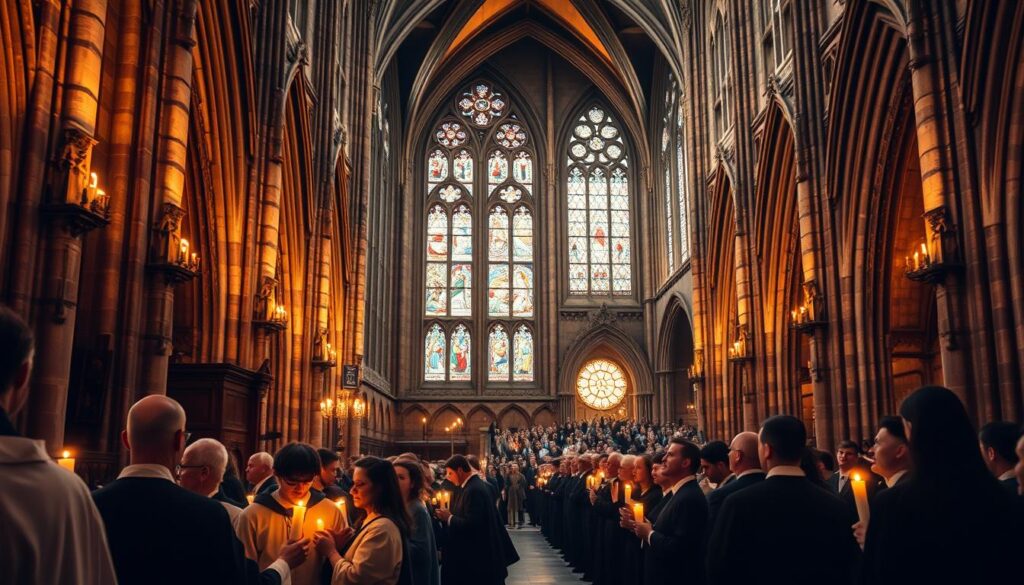
An ancient cathedral stands tall, its Gothic spires reaching skyward. In the foreground, worshippers in traditional robes gather in solemn procession, candles flickering in their hands. The middle ground reveals intricate stained-glass windows casting a kaleidoscope of colored light upon the ornate stone walls. In the background, a crowd of people spills out from the church's grand archways, their faces alight with fervent devotion. The scene is bathed in a warm, reverent glow, evoking the historical origins of Protestant worship and the enduring spirit of faith.

Proto-Protestant Movements

These early reformers laid groundwork by challenging papal authority. The Hussites, inspired by Jan Hus, demanded communion for all members—not just clergy. Similarly, Waldensians emphasized personal Bible study over institutional rituals. Their efforts kept reform ideas alive for generations.

The Reformation and Its Impact

Everything changed in 1517 when Martin Luther nailed his critiques to a church door in Wittenberg. His protest against indulgences ignited a continent-wide movement. By 1530, new denominations emerged from Sweden to Switzerland.

England’s break with Rome under Henry VIII added Anglicanism to this growing family of churches. Each branch developed unique traditions while sharing core Reformation principles. This diversity became a hallmark of Protestantism’s global spread.

Today, these historical shifts still shape how millions connect with faith. From Luther’s bold stand to grassroots Bible studies, the Reformation reshaped spiritual landscapes forever.

Key Figures Shaping Protestant Worship

Two revolutionary thinkers transformed spiritual practices through bold ideas that still echo today. Their work created distinct paths within the broader Christian movement, blending theological depth with practical reforms.

Martin Luther’s Legacy and the Ninety-Five Theses

Martin Luther, a fiery German monk, sparked change in 1517 by challenging church practices. He preferred “evangelical” over “Lutheran,” tying his work to the Greek euangelion (“good news”). His German Bible translation let ordinary people engage with scripture—a radical shift in religious access.

Luther’s focus on faith alone reshaped spiritual life. “Salvation comes through trust in God’s grace,” he argued, “not rituals or titles.” This idea turned worship into a personal journey rather than a transactional system.

“The true treasure of the church is the gospel of the glory and grace of God.”

Martin Luther

John Calvin and Reformed Traditions

John Calvin built systematic frameworks that spread across Europe. His Reformed churches emphasized God’s sovereignty and simple worship styles. Followers in Scotland, Hungary, and beyond adapted his teachings to local cultures while keeping core principles intact.

Reformer Key Contribution Regions Influenced
Martin Luther Vernacular Bible translation Germany, Scandinavia
John Calvin Systematic theology Switzerland, Netherlands, Scotland

Calvin’s colleagues like Huldrych Zwingli added new dimensions. Their collective work created a tradition of adaptable yet rooted practices. Today, over 80 million belong to churches shaped by these reformers’ visions.

Understanding Protestant Traditions and Beliefs

Five Latin phrases from the 1500s still shape millions of spiritual lives today. These core principles, called the Five Solas, form the backbone of Reformation theology. They answer fundamental questions about spiritual authority and divine connection in simple yet profound ways.

A serene Protestant church interior, bathed in soft, natural light from stained glass windows. Rows of simple wooden pews face a modest pulpit and altar, adorned with a cross and bare of ornate decoration. Sunlight streams through the windows, casting warm, reverent shadows across the space. The atmosphere is one of quiet contemplation and devotion, reflecting the understated, scripture-focused traditions of Protestant worship.

The Five Solas Explained

Sola Scriptura (“Scripture Alone”) places the Bible above human-made traditions. It means every teaching and practice must align with biblical truth. This principle empowered ordinary people to engage directly with sacred texts.

Sola Fide (“Faith Alone”) revolutionized ideas about salvation. It teaches that trust in Christ—not rituals or good deeds—grants eternal life. As one reformer wrote: We are saved by faith, not because of faith.

Three other solas complete the framework. Solus Christus declares Jesus as humanity’s only mediator. Sola Gratia emphasizes grace as God’s free gift, while Soli Deo Gloria redirects all honor to Him alone.

Together, these ideas create a cohesive system. They simplify spiritual life by focusing on divine gifts rather than human effort. From Sunday sermons to personal prayers, the Solas guide how believers live out their faith daily.

The Role of the Bible in Shaping Worship

A leather-bound book became the heartbeat of spiritual renewal during the Reformation. Martin Luther’s German Bible translation shattered barriers, letting farmers and scholars alike engage with God’s word. This shift turned churches into classrooms where scripture—not tradition—guided every decision.

Early reformers encouraged believers to question texts while honoring their divine origin. “The Bible is alive,” Luther declared, “it speaks to me every morning.” Congregations began examining passages together, sparking discussions that shaped both personal faith and community practices.

John Calvin’s 1536 arrival in Geneva brought radical changes. Stained-glass saints gave way to painted Bible verses on whitewashed walls. This visual revolution made scripture the focal point—a practice still seen in many churches today. Sermons became deep dives into biblical context rather than ceremonial recitations.

Modern services reflect this legacy. Over 75% of hymns in mainline churches draw lyrics directly from scripture. Pastors often build sermon series around single books like Psalms or Romans. As one worship leader notes: We don’t follow rituals—we follow the text.

From Sunday school curricula to baptismal vows, the Bible remains the blueprint. Its authority shapes everything from seating arrangements (facing pulpits) to service lengths (prioritizing teaching). This 500-year-old tradition proves truth can outlive trends when rooted in timeless words.

Defining “Protestant Worship” Practices

Across diverse Christian traditions, certain practices unite believers in shared devotion. These spiritual expressions focus on two central acts: baptism and communion. Many groups call them ordinances—symbolic actions rooted in Jesus’ teachings rather than mystical rituals.

Some denominations view these as sacraments, while others stress their role as obedient responses to scripture. A Lutheran pastor might sprinkle water during infant baptism, while a Baptist church immerses adults. Both follow biblical principles but interpret them differently.

Unlike traditions that tie rituals to salvation, these practices celebrate existing faith. As reformers argued: We are saved by faith, not because of faith. This distinction shapes how congregations approach spiritual disciplines—as joyful declarations, not requirements.

Three characteristics define these traditions:

  • Adaptability: African drumming or Appalachian hymns both honor scripture
  • Participation: Everyone joins prayers, songs, or readings
  • Cultural resonance: Services reflect local values without compromising doctrine

From Pentecostal gatherings to quiet Quaker meetings, the core remains unchanged. Whether sharing grape juice or wine, reciting creeds or spontaneous prayers, these practices keep ancient truths alive in modern hearts.

Liturgical Versus Non-Liturgical Worship Styles

Sunday mornings reveal a fascinating spectrum of spiritual expressions among Christian communities. Some congregations follow centuries-old patterns, while others embrace spontaneous forms of devotion. This difference often comes down to liturgical (high church) or non-liturgical (low church) approaches.

High Church Traditions

Liturgical churches value structured ceremonies rooted in history. Anglican, Episcopal, and Lutheran churches typically use ordained clergy robes, recite set prayers, and follow annual liturgical calendars. These denominations treat communion as a sacred ritual, often accompanied by symbolic elements like incense or processional crosses.

Low Church Approaches

Baptist and Pentecostal groups exemplify low church simplicity. Services might feature contemporary music, spontaneous prayers, and flexible sermon topics. One pastor notes: Our focus is heart preparation, not program perfection. Communion here often feels more like a memorial meal than a formal sacrament.

Feature High Church Low Church
Structure Fixed liturgy Flexible format
Clergy Attire Robes/stoles Casual dress
Sacraments Formal ceremonies Simple observance
Calendar Advent/Lent cycles Topical series

Both styles help believers connect with divine truth. Whether through ancient rituals or modern spontaneity, these churches show how varied paths can lead to shared spiritual goals.

Rituals of Baptism, Communion, and Dedication

Water and bread connect believers across centuries of tradition. Baptism practices vary among Protestant denominations, using immersion, pouring, or sprinkling. Groups like Lutherans practice infant baptism, viewing it as a covenant with God. Others, like Baptists, wait until individuals can profess faith personally.

The Lord’s Supper, also known as communion, unites congregations through shared remembrance. This sacred meal, also known as the Eucharist in many traditions, involves bread and wine symbolizing Christ’s body and blood. It serves as both a memorial and a celebration of unity.

These rituals adapt to cultural contexts while keeping biblical roots. Whether through infant dedication or believer’s baptism, each practice invites active participation. They remind communities of their shared journey and personal commitments to faith.

FAQ

How did the Reformation change Christian practices?

The Reformation shifted focus to Scripture as the ultimate authority, simplified rituals, and emphasized personal faith. Leaders like Martin Luther and John Calvin promoted congregational singing and preaching in local languages.

What are the core beliefs behind the Five Solas?

The Five Solas—sola scriptura (Scripture alone), sola fide (faith alone), sola gratia (grace alone), solus Christus (Christ alone), and soli Deo gloria (glory to God alone)—highlight reliance on God’s grace through Christ, not human effort.

Why is baptism significant in these traditions?

Baptism symbolizes spiritual rebirth and entry into the church community. While some groups practice infant baptism, others reserve it for believers old enough to profess faith personally.

How do high church and low church styles differ?

High church services, like Lutheran or Anglican, follow structured liturgies with sacraments. Low church gatherings, common in Baptist or Pentecostal circles, prioritize informal preaching, spontaneous prayer, and congregational participation.

What role does communion play in worship?

Communion, or the Lord’s Supper, commemorates Jesus’ sacrifice. Some view it as symbolic, while others believe in Christ’s spiritual presence. It unites believers in remembrance of His grace.

How does Scripture shape weekly services?

Sermons often explain biblical passages, guiding daily life. Readings from Old and New Testaments, hymns based on Psalms, and communal prayers root practices in God’s Word.

Are infant dedications common in all denominations?

Churches that reject infant baptism, like many evangelical groups, may hold dedication ceremonies. Parents commit to raising children in faith, asking the congregation for support.

Overcoming Protestant Guilt: A Liberating Guide


Have you ever felt weighed down by an invisible burden, even when trying your best to live with integrity? Many individuals grow up with religious teachings that unintentionally link faith to shame. This can create a cycle of self-doubt, where moral missteps feel magnified and forgiveness feels out of reach.

Contrary to common assumptions, biblical teachings focus on healing and restoration rather than condemnation. Concepts like repentance and grace are framed as pathways to wholeness—not tools for measuring worthiness. Yet, some religious environments emphasize strict self-evaluation, leaving people stuck in patterns of guilt.

This guide isn’t about rejecting ethics or dismissing personal growth. Instead, it’s a compassionate exploration of how to reframe your spiritual journey. We’ll unpack why feelings of inadequacy often surface around authority figures and how to distinguish between healthy conviction and paralyzing shame.

You’ll discover practical steps to embrace freedom without abandoning your values. Let’s explore how grace—available to everyone—can transform your relationship with faith and daily life.

Key Takeaways

  • Guilt rooted in shame differs from biblical teachings about growth and forgiveness
  • Religious authority figures can unintentionally amplify feelings of inadequacy
  • Grace is a gift, not something earned through perfection
  • Healthy faith balances accountability with self-compassion
  • Freedom comes from redefining your relationship with spiritual expectations

Understanding the Roots of Protestant Guilt

Why do some religious teachings leave lasting marks on our conscience? To answer this, we must travel back to a pivotal moment in history that reshaped Western spirituality. The ripple effects of theological debates from centuries ago still influence how many approach faith today.

Historical Origins and Reformation Context

When Martin Luther nailed his 95 Theses to a church door in 1517, he ignited more than theological debate. This act sparked a chain reaction, fracturing Christianity into thousands of denominations. As historian Hans Küng observed, Luther’s fiery tactics—like burning papal documents—set patterns of conflict that lingered for generations.

The Reformation shifted focus from collective rituals to personal accountability. Doctrines like predestination left believers questioning their spiritual standing. “The church became a battlefield of certainty,” one scholar notes, “where doubt felt like failure.”

Cultural and Social Influences

Before this period, faith was woven into community life. Afterward, individuals bore new responsibility to prove their devotion through behavior. The church’s role changed from guiding communities to policing personal morals.

Over time, political alliances turned religious groups into tools for social control. Historians highlight how this blend of spiritual and civic duty created invisible pressures. What began as liberation became, for many, a maze of self-judgment.

The Theological Foundations Behind Guilt

Theology often shapes our deepest fears and hopes in unexpected ways. At the heart of many spiritual struggles lies a paradox: teachings designed to uplift sometimes become chains of self-judgment. Let’s explore how core ideas about human nature and divine mercy evolved—and why they still resonate today.

Perspectives on Sin and Redemption

Martin Luther revolutionized Christianity by declaring salvation a gift rather than a reward. His doctrine of sola gratia (grace alone) aimed to free believers from earning God’s favor. Yet this radical idea carried an unintended consequence: if grace is unearned, human efforts feel meaningless. As one Lutheran scholar notes, “We’re taught we’re fully loved yet wholly flawed—a recipe for inner conflict.”

This tension appears in the phrase simul justus et peccator—simultaneously righteous and sinful. While meant to highlight dependence on grace, it often leaves people hyper-aware of shortcomings. The Catholic sacramental system once provided structured ways to resolve guilt, but Protestant reliance on faith alone shifted that burden inward.

The Role of Calvinism and Lutheranism

Calvinist teachings added another layer with predestination—the belief God chooses who receives salvation. Imagine living with constant uncertainty: “Am I among the elect?” This theology bred anxiety about proving one’s spiritual status through moral perfectionism.

Yet both traditions share a core truth: grace isn’t a transaction. As Martin Luther insisted, “God doesn’t love us because we’re good. We’re good because God loves us.” Modern believers still wrestle with balancing this cosmic generosity with very human self-doubt.

Impact of Religious Guilt in Daily Life

How does an overactive conscience color ordinary moments? For many, spiritual ideals meant to inspire become invisible weights in everyday interactions. Simple conversations about faith with family or friends can trigger self-doubt, as if carrying an internal scorecard of perceived shortcomings.

A despondent figure sits hunched in a dimly lit room, shoulders slumped under the weight of unrelenting religious guilt. Shadows cast by flickering candlelight create an oppressive atmosphere, highlighting the subject's inner turmoil. The room is sparsely furnished, with a simple wooden cross on the wall serving as a poignant reminder of the source of this individual's anguish. Muted earth tones and a somber color palette evoke a sense of heaviness and despair, while the figure's pained expression conveys the profound impact of religious guilt on their daily life.

Personal Reflections and Emotional Toll

Constant moral inventory-taking drains joy from life’s milestones. A person might avoid celebrating achievements, fearing pride contradicts humility. Others fixate on whether their charitable efforts “measure up” to peers, turning generosity into a source of shame.

This mindset strains relationships. One man shared, “I apologized constantly—even for honest mistakes—because I assumed others judged me as harshly as I judged myself.” Such patterns create emotional isolation, making it harder to accept love or forgiveness.

Decision-making suffers too. Choices about careers, finances, or parenting become minefields of “what ifs.” Paralysis sets in when every option feels morally risky. Over time, spontaneity fades—replaced by rigid routines that promise safety but starve the soul.

Breaking free starts by recognizing these patterns. Small acts of self-compassion, like reframing mistakes as growth opportunities, begin rewiring deep-seated habits. Healing isn’t about lowering standards but redefining what it means to live fully.

The Protestant Work Ethic’s Role in Shaping Identity

What if your worth became tied to how much you accomplish? This question lies at the heart of modern work culture’s invisible pressures. A blend of religious history and economic ambition created standards that still shape how many define success.

Weber’s Insights and Historical Data

In 1905, sociologist Max Weber published The Protestant Ethic and the Spirit of Capitalism, linking faith to productivity. He argued that Calvinist teachings transformed work into a spiritual duty. Believers saw thrift and labor as proof of divine favor—a mindset Weber claimed fueled capitalism’s rise.

But historians challenge this narrative. Fernand Braudel found thriving markets in 13th-century Catholic Venice, while Hugh Trevor-Roper noted similar work ethics in pre-Reformation societies. As economist Laurence Iannaccone states:

“The Protestant Ethic thesis survives more as cultural folklore than proven fact.”

Work Ethic and Responsibility in Society

Early American settlers like Captain John Smith enforced strict productivity rules, declaring “he that will not work, shall not eat.” These ideals evolved into today’s “hustle culture,” where self-worth often hinges on output. Many feel guilty taking breaks, fearing they’ll appear lazy or unworthy.

Modern research reveals surprising truths. Countries with Protestant roots don’t outwork others—Sweden’s 480-hour annual vacation average rivals Italy’s. Yet the myth persists, creating what Dr. Martin Luther King Jr. called “a dangerous focus on individual effort over systemic change.”

Breaking free starts by asking: Do I measure my value by what I produce—or who I become? The answer might reshape your relationship with work entirely.

Preaching, Teaching, and the Guilt Complex

Have you ever left a sermon feeling more burdened than uplifted? Many church services follow a pattern that first highlights human failure before mentioning divine compassion. This approach can wire our brains to associate faith with self-criticism rather than freedom.

A somber church interior, dimly lit by flickering candles. In the pulpit, a stern-faced preacher gestures emphatically, their face cast in shadow, conveying a message of guilt and judgment. The congregation, rendered in muted tones, sit with bowed heads, expressions of anguish and contrition. The stained-glass windows cast an ominous glow, reinforcing the heavy, oppressive atmosphere. A low-angle perspective heightens the authoritative presence of the preacher, while the use of a wide-angle lens emphasizes the overwhelming scale of the church and the crushing weight of the message. The scene evokes a sense of spiritual unease and the burden of unforgiving doctrine.

How Church Messaging Fuels Guilt

Traditional sermons often start by dissecting sin in graphic detail. Phrases like “you’re naturally wicked” or “God’s watching your every mistake” create spiritual performance anxiety. Over time, people begin scanning their lives for flaws whenever they enter sacred spaces—even without direct criticism.

Ministers sometimes unintentionally deepen this cycle. A pastor shared: “Members apologize for normal struggles when I visit—like enjoying a movie or buying coffee.” When teachings prioritize fear over grace, congregations internalize shame as part of their spiritual identity.

Shifting Focus from Punishment to Forgiveness

Forward-thinking churches are flipping the script. One congregation begins services by declaring “You’re loved before you do anything.” This simple shift helps people receive challenging messages without feeling attacked.

Biblical concepts of sin as “missing the mark” regain their original meaning—a call to grow, not grovel. Leaders who frame ethical choices through love’s transformative power see deeper engagement. As one member noted: “I finally feel strong enough to change, not just guilty for failing.”

Truth becomes liberating when wrapped in compassion. By leading with grace, churches help people break free from shame cycles while maintaining moral clarity.

Exploring Personal Narratives and Recovery

What happens when spiritual practices become cages instead of catalysts? For many, rituals meant to foster connection instead fuel cycles of self-doubt. Let’s walk through real journeys of those who reclaimed their stories.

Stories of Struggle and Transformation

Sarah, a teacher from Ohio, spent years seeking reassurance through repeated baptisms. “Each time, I hoped to feel ‘clean,’” she shared. “But the relief never lasted.” Her relationships suffered as she withdrew, convinced others would judge her perceived flaws.

Mark’s story reveals another layer. Raised in a strict faith community, he believed minor mistakes proved he was “spiritually broken.” Therapy helped him recognize manufactured shame. “My guilt wasn’t about morality—it was about control,” he realized. This awareness became his turning point.

Recovery often starts small. Many find freedom by:

  • Journaling to separate facts from fear-based narratives
  • Building friendships where vulnerability is safe
  • Reframing faith as a journey rather than a performance

Communities play a vital role. Support groups let people share experiences without judgment. As one member noted: “Hearing others’ stories showed me I wasn’t alone—or ‘defective.’” This collective healing reshapes how individuals view their life purpose.

Ultimately, these narratives share a common thread: lasting peace comes not from perfection but from embracing our shared humanity. As Sarah put it: “I finally understand love isn’t something I earn—it’s who I am.”

Breaking Free from “protestant guilt”

What if your spiritual journey could feel more like liberation than a checklist? True freedom begins when we stop treating faith as a scorecard and start seeing it as a relationship. Biblical teachings describe grace as a gift—something received, not achieved—which reshapes how we approach daily life.

Embracing Grace and Letting Go of Shame

Grace thrives where perfectionism falters. Start each morning with a simple reminder: “I’m loved as I am, not as I should be.” This mindset helps separate healthy conviction (“I want to grow”) from toxic shame (“I’ll never measure up”). Mindfulness practices like breath prayers or journaling anchor this truth during stressful moments.

Practical Steps Toward Emotional Freedom

Try these actions to reframe your spiritual health:

1. The 5-Minute Reset: Pause when overwhelmed. Ask: “Is this feeling helping me improve or trapping me in fear?”

2. Community Check-Ins: Share struggles with trusted friends who focus on growth, not judgment.

3. Redefine Success: Celebrate small acts of kindness rather than fixating on missteps.

Freedom grows when we exchange self-punishment for self-compassion. As you practice these steps, you’ll discover that living fully—flaws and all—becomes your most authentic act of faith.

FAQ

How did historical events shape views on morality and responsibility?

The Reformation era, led by figures like Martin Luther, redefined concepts of sin and salvation. Cultural norms merged with religious teachings, creating societal expectations around duty and self-discipline. This blend influenced how communities valued hard work and personal accountability.

What role did theology play in emphasizing personal fault?

Teachings from Lutheranism and Calvinism stressed human imperfection and the need for divine grace. While aiming to highlight redemption, these ideas sometimes overshadowed forgiveness, leading to hyper-focus on shortcomings. Concepts like predestination deepened feelings of unworthiness.

How does the work ethic connect to feelings of obligation?

Max Weber’s analysis linked religious values to economic behavior, framing productivity as moral virtue. Over time, this blurred the line between healthy ambition and toxic perfectionism. Many internalized success as a measure of worth, fueling cycles of self-criticism.

Can church teachings unintentionally promote shame?

Yes. Sermons focusing on sin without balancing grace can make individuals feel unworthy of love or acceptance. Stories like the Prodigal Son are meant to inspire hope, but misinterpretations may amplify fear of failure instead of emphasizing unconditional compassion.

What practical steps help move toward self-compassion?

Reframing narratives around grace—like embracing imperfection—can rebuild self-worth. Practices like mindfulness, therapy, or journaling help challenge ingrained beliefs. Building communities that prioritize empathy over judgment also fosters healing.

How did cultural attitudes amplify ideas of fault?

Societal norms often equated struggle with moral failure, especially in tight-knit communities. Family traditions, literature, and even early American values reinforced the idea that suffering was a sign of virtue, making it harder to seek help or express vulnerability.

Are modern movements addressing these emotional burdens?

Absolutely. Many faith leaders now emphasize mental health, while authors like Brené Brown discuss shame resilience. Churches are shifting toward inclusive messaging, and online groups provide safe spaces to share stories of overcoming rigid expectations.

Explore the History of Protestant Theocracy


How did spiritual beliefs shape nations? For centuries, some communities blended religious authority with political power in ways that still impact modern governance. This journey through time reveals how certain groups sought to create societies guided by their interpretation of divine will.

The concept merges church leadership with civil rule, distinct from secular governments. Unlike other faith-based systems, it specifically roots laws and social norms in Protestant Christian teachings. As Martin Luther once noted: “Having been made righteous, we do righteous deeds” – a philosophy that influenced early attempts to build holy communities.

This approach emerged during the Reformation as both strict and adaptable. While promoting traditional values, its economic policies varied widely between denominations. From radical reformers to mainstream movements, each group redefined how religion interacted with daily life and governance.

Key Takeaways

  • Blends religious principles with governmental authority
  • Originated during 16th-century Reformation movements
  • Economic practices differed between denominations
  • Influenced modern debates about faith in public life
  • Martin Luther’s teachings shaped early concepts

Historical Foundations and Early Influences

What happens when a monk’s pen shakes an empire? In 1517, Martin Luther sparked a revolution by challenging the Roman Catholic Church’s practices. His famous 95 Theses questioned indulgences and reshaped Europe’s spiritual landscape.

Contextualizing the Reformation

The 16th century was ripe for change. Many felt the church had strayed from its core teachings. Luther’s ideas spread like wildfire through pamphlets and sermons, reaching far beyond academic circles.

Martin Luther’s Impact and the 95 Theses

Luther didn’t just debate theology – he redefined power structures. His “Five Solas” emphasized scripture over papal authority, declaring: “Faith alone makes someone just.” This radical thinking gave rulers new ways to govern through faith.

After Luther’s excommunication, Protestant leaders emerged across Europe. Nordic kingdoms and England became testing grounds for blending worship with statecraft. These experiments shaped political systems for generations, proving ideas could outlast their creators.

Creation and the Rise of Theocratic Models

When religious reform reshapes politics, what new systems emerge? After Luther’s ideas spread, leaders across the Holy Roman Empire faced a pressing question: How could spiritual principles guide daily governance? Thinkers began crafting blueprints for societies where belief and power worked hand-in-hand.

Early Protestant Thought and Theological Shifts

The move from ritual-focused practices to personal faith changed everything. As reformer Martin Bucer argued: “A godly society requires both pure hearts and orderly streets.” This tension led to creative solutions for merging spiritual ideals with practical rule.

Three distinct approaches emerged during this period:

Leader Core Idea Governing Style
Luther Scripture as ultimate authority Rulers protect true faith
Zwingli Moral purity through law City councils enforce codes
Bucer Church-state collaboration Shared civic responsibility

Mountain villages often chose flexible systems that respected local customs. Busy trading cities preferred strict moral codes to maintain order. These experiments showed that successful governance required balancing theology with real-world needs – a lesson that would shape future movements.

Münster: The Radical Theocratic Experiment

What happens when a city tries to build heaven on earth? In 1533 Münster became ground zero for one of history’s most daring social overhauls. Anabaptist leaders Jan Matthys and John of Leiden seized control, promising a society reborn through strict biblical law.

Münster, 16th century. A medieval city under the grip of radical religious fervor. In the foreground, a mob of zealots gather in the town square, brandishing weapons and religious symbols. Smoke billows from burning buildings in the middle distance, while in the background, the imposing spires of the city's cathedral loom ominously. Harsh, angled lighting casts dramatic shadows, conveying a sense of unease and turmoil. The scene is one of religious fanaticism, civil unrest, and the violent overthrow of traditional authority, reflecting the radical theocratic experiment that gripped this German city during a tumultuous period of the Reformation.

Anabaptist Communism and Its Consequences

The reformers erased private wealth overnight. Coins vanished from markets as “all things became common property” – a bold move that drew both idealists and desperate people. Their radical vision extended beyond economics:

Aspect Policy Impact
Economy No private property Shared resources
Law Ten Commandments enforced Harsh penalties
Leadership Prophetic rule Public executions

Disobeying any commandment meant death. When Matthys died in battle, Leiden crowned himself king – marrying 16 women to fulfill his vision of biblical royalty.

Legacy of Jan Matthys and John of Leiden

The experiment collapsed in 1535 after Bishop Franz von Waldeck’s siege starved the city into surrender. Three iron cages still hang from Münster’s church tower, holding the rebels’ remains as warnings.

This case shows how quickly utopian dreams can unravel. Even though their state lasted just 18 months, it influenced later religious movements seeking perfect order. The Münster story reminds us that translating faith into law requires balancing ideals with human nature – a lesson that echoes through time.

Geneva and Zurich: Debating Theocratic Governance

How do you balance faith with freedom in a city’s laws? Switzerland’s 16th-century cities became laboratories for testing religious authority. While leaders claimed to separate church and state, their actions often blurred these lines.

Calvin’s Geneva and Moral Enforcement

John Calvin’s Geneva presents a puzzle. He wrote about keeping church and state distinct, yet the Consistory – a council of pastors and elders – held remarkable power. This group monitored citizens like neighborhood watch teams, enforcing strict codes:

  • Sunday labor bans enforced with fines
  • Fashion police checking sleeve lengths
  • Public shaming for “lewd” song lyrics

One rebel learned the hard way. When poet Jacques Gruet criticized Calvin’s rules, authorities executed him for blasphemy. As historian E. William Monter noted: “Geneva’s streets became morality classrooms.”

The Controversy over Zurich’s Theocratic Nature

Was Zwingli’s Zurich truly a faith-ruled city? Unlike Geneva’s overt control, Zurich’s council maintained final authority. Yet religious leaders heavily influenced laws about marriage, education, and public behavior.

Modern scholars remain divided. Some argue Zurich created a state-guided church system rather than pure theocracy. Others point to Zwingli’s 1523 mandate requiring biblical law as civic code – a textbook theocratic move.

These Swiss experiments show how easily spiritual ideals could shape secular power. Their legacy? A roadmap for balancing divine commands with human complexity.

Anglican Caesaropapism and Royal Control of Faith

How did a king’s personal crisis reshape national faith? When Henry VIII broke from Rome in 1534, he didn’t just create a new church – he forged a revolutionary system where monarchs held divine authority over both crown and altar. This bold move redefined England’s spiritual and political landscape for centuries.

A grand Anglican cathedral stands tall, its spires piercing the sky. Sunlight filters through stained glass windows, casting a warm glow upon the ornate interior. In the foreground, the monarch sits upon a throne, adorned in regal robes and crowned, symbolizing the divine right of kings and the unity of church and state. Intricate tapestries and ornate furnishings adorn the space, reflecting the wealth and power of the Anglican establishment. The atmosphere is one of solemn reverence, with a sense of the church's unyielding authority over the faithful. The scene evokes the historical ties between the Anglican Church and the British monarchy, a testament to the concept of Anglican Caesaropapism.

Henry VIII’s Break and the Acts of Supremacy

The 1534 Act declared the king “Supreme Head of the Church of England,” merging sacred and secular power. But this wasn’t just about Henry’s marriages. As historian Diarmaid MacCulloch notes: “The English Reformation began as political theater, but became constitutional reality.”

Three key changes emerged:

  • Royal control over church property and income
  • English Bible translations replacing Latin texts
  • Clergy swearing loyalty to the crown first

The Evolution of Church-State Roles

Mary I’s brief Catholic restoration (1553-1558) proved how fragile these changes were. Her violent attempts to undo reforms earned the nickname “Bloody Mary.” Elizabeth I’s 1559 settlement brought stability through compromise.

The new queen became “Supreme Governor” rather than “Head” – a title still used today. This clever wording respected theological concerns while maintaining royal oversight. Over years, this model influenced other countries through England’s growing global reach.

Unlike European systems where clergy led religion, England’s approach kept power with the throne. This unique state-church fusion remains part of Britain’s constitutional history, showing how one ruler’s decision can echo through time.

The Holy Experiment: Quakers in Pennsylvania

Can a colony thrive on peace and equality? William Penn answered this with America’s boldest social test. In 1681, the Quaker leader transformed a 29-million-acre land grant into a radical vision where rights and faith coexisted. Unlike New England’s strict settlements, Pennsylvania welcomed diverse beliefs through what Penn called “a holy experiment in brotherly love.”

William Penn’s Ideals of Tolerance and Freedom

Penn’s Frame of Government broke norms. It guaranteed voting rights to all male landowners – Quaker or not – and banned forced military service. As he declared: “Liberty without obedience is confusion, and obedience without liberty is slavery.” His constitution became a blueprint for balancing freedom with order.

The colony attracted persecuted groups like Mennonites and Huguenots. Schools opened to both genders, and Native Americans received fair land treaties. This approach shocked European observers accustomed to religious wars.

Balancing Economic Interests with Faith-Based Governance

Penn faced tough choices. To fund his ideals, he marketed Pennsylvania as “the best poor man’s country,” drawing 8,000 settlers by 1685. But prosperity brought conflicts:

Principle Practice
Nonviolence Armed frontier disputes
Equality Slaveholding common
Simplicity Luxury imports grew

By 1718, Quakers became minorities in their own colony. Political power shifted to non-Quaker settlers demanding secular laws. Though the experiment faded, its core ideas shaped America’s experience with religious pluralism – proving faith could guide without controlling every aspect of life.

Modern Reflections on “protestant theocracy” in State Governance

How do ancient faith traditions shape modern laws? Across Europe and beyond, several nations maintain official ties to Protestant Christianity while balancing contemporary values. These connections often reflect cultural heritage more than strict religious rule.

States Upholding Protestant Identity

England’s Anglican Church still crowns monarchs, while Nordic countries like Norway fund Lutheran ministries through taxes. Scotland’s Presbyterian roots influence education policies, and Tuvalu’s Calvinist principles guide environmental stewardship. These states show how historical faith can coexist with pluralistic society.

Denmark offers a revealing case. Its constitution requires monarchs to follow the Lutheran faith, yet daily governance remains secular. As one Copenhagen resident noted: “Our churches are full on Sundays, but parliament debates climate change, not theology.”

This blend of tradition and modernity raises questions. Can symbolic religious ties strengthen national identity without limiting freedoms? Iceland’s recent shift to fund multiple faiths equally suggests new models are emerging. The legacy of early reformers lives on – not in strict theocracies, but in countries wrestling with how faith informs shared values today.

FAQ

How did Martin Luther’s 95 Theses challenge existing church authority?

Martin Luther’s 95 Theses criticized practices like indulgences, arguing that salvation came through faith—not transactions. This undermined the Roman Catholic Church’s control, sparking debates about individual conscience versus institutional power.

What made Münster’s Anabaptist experiment so radical?

Led by Jan Matthys and John of Leiden, Münster combined religious fervor with communal ownership of property. Their attempt to create a “New Jerusalem” clashed with political rulers, leading to violent suppression and lasting warnings about mixing zealotry with governance.

How did Calvin’s Geneva enforce moral behavior?

Calvin established strict moral codes, policed by church elders. Activities like dancing or swearing faced penalties, blending spiritual discipline with civic law. This model influenced later ideas about religion’s role in shaping public ethics.

Was Henry VIII’s Anglican Church a form of theocracy?

While Henry VIII’s Acts of Supremacy placed him as head of the church, it prioritized royal power over theological purity. This “Caesaropapism” focused on political control rather than creating a fully faith-driven state.

How did William Penn blend faith and governance in Pennsylvania?

Penn’s “Holy Experiment” promoted Quaker values like tolerance while allowing economic freedom. His framework avoided forced conformity, showing how faith-inspired ideals could coexist with pluralism—a contrast to stricter theocratic models.

Do modern states still enforce Protestant identity?

Some nations, like England with its Anglican Church, retain symbolic ties. However, secular governance and religious diversity have largely replaced enforced doctrinal unity, reflecting shifts toward individual rights and multiculturalism.

What is Protestant Lutheranism? Exploring the Faith


In 1517, a German monk’s bold act sparked a religious revolution. This movement reshaped Christianity forever, blending ancient traditions with groundbreaking ideas about faith and salvation. Rooted in the Reformation, this tradition emphasizes Scripture as its ultimate authority while preserving core Christian teachings.

At its heart, this faith centers on grace through faith alone—a radical concept that challenged medieval religious norms. Followers maintain sacraments like communion, believing in Christ’s real presence while rejecting complex rituals. Their worship style balances reverence with accessibility, using liturgy that connects modern believers to centuries-old practices.

Church governance reflects a unique approach. Local congregations hold significant autonomy, yet remain united through shared confessions. The Book of Concord serves as their doctrinal foundation, compiling essential Reformation-era texts that still guide worship and teaching today.

Modern expressions of this faith continue evolving. Many congregations now address contemporary issues while preserving Reformation principles. From social justice initiatives to interfaith dialogue, these communities demonstrate how historical beliefs adapt to new challenges without losing their core identity.

Key Takeaways

  • Originated from 16th-century Reformation efforts challenging medieval church practices
  • Teaches salvation through faith rather than human effort
  • Maintains traditional sacraments with simplified interpretations
  • Uses historic confessions as primary doctrinal guides
  • Balances congregational autonomy with global denominational ties
  • Adapts ancient practices to modern spiritual needs

Introduction to Protestant Lutheranism

The 16th century brought a seismic shift in Christian thought that reshaped Europe’s spiritual landscape. At its core, this movement championed three revolutionary ideas: grace as God’s free gift, faith as humanity’s response, and Scripture as the ultimate guide. These principles became the bedrock of a tradition that still influences millions today.

Defining the Core Beliefs

Central to this faith is the conviction that no one earns divine favor. Followers teach that salvation comes solely through trust in Christ’s sacrifice, not rituals or good deeds. This “Scripture alone” approach directly challenged the Catholic Church’s emphasis on tradition and papal authority.

While rejecting certain medieval practices, congregations preserved ancient sacraments like baptism. Their worship style blended familiar liturgy with renewed focus on biblical preaching—a balance that still defines the evangelical Lutheran church experience.

The Historical Context of the Reformation

Social unrest and new printing technology helped spread reform ideas across 16th-century Europe. Political leaders seeking independence from Rome often supported these changes, creating space for alternative Christian communities to grow.

The 1521 Edict of Worms marked a turning point, officially dividing reformers from the Catholic Church. Yet this tradition maintained ties to the early church through creeds and sacraments, positioning itself as both revolutionary and rooted in history.

Historical Roots and the Reformation Movement

A theological professor’s quest for spiritual truth ignited one of Christianity’s most transformative periods. This 16th-century awakening began with personal struggles over salvation and grew into a continent-wide religious shift. At its center stood a scholar determined to reconcile ancient teachings with biblical truth.

A stately church interior, sunlight streaming through stained glass windows, casting a warm glow on the ornate pulpit and pews. In the center, Martin Luther stands resolute, his brow furrowed in deep contemplation as he holds the famous "95 Theses" document, its pages illuminated by the divine light. Surrounding him, a crowd of scholars and clergy, their faces etched with a mix of fascination and trepidation, bear witness to this pivotal moment in the Reformation. The air is thick with the weight of history, a tension palpable as the impact of Luther's bold act reverberates through the ages.

Martin Luther’s Role and the 95 Theses

As an Augustinian friar turned university lecturer, Martin Luther grappled with feelings of spiritual inadequacy. His studies led him to challenge common practices of the Catholic Church, particularly the sale of forgiveness certificates called indulgences. On October 31, 1517, he nailed ninety-five debate points to a church door in Wittenberg – an act comparing to posting campus announcements today.

The printing press transformed Luther’s academic arguments into viral content. Within months, translated versions of his theses spread across Europe. Common people began questioning religious authority while rulers saw opportunities for political independence from Rome.

The Impact of the Edict of Worms

By 1521, tensions reached breaking point. Church leaders demanded Luther recant his writings at a historic meeting known as the Diet of Worms. His refusal led to official condemnation through the Edict of Worms, banning his teachings across the Holy Roman Empire.

This declaration forced Luther’s supporters to organize independently. They developed new worship materials and church structures, laying foundations for what would become the Lutheran Church. The split created space for other reformers while preserving connections to early Christian traditions through creeds and sacraments.

Key Theological Principles in Lutheran Thought

At the heart of this Christian tradition lie two groundbreaking ideas that transformed how people understand salvation and spiritual authority. These principles answer life’s biggest questions: How do we connect with the divine? What gives our faith meaning?

Sola Scriptura and the Authority of Scripture

Sola scriptura—Latin for “Scripture alone”—declares the Bible as Christianity’s ultimate guidebook. This principle revolutionized religious practice by making the Word of God accessible to everyone, not just clergy. Church traditions matter, but they must align with biblical teachings.

Historical documents like the Augsburg Confession help interpret Scripture while guarding against modern distortions. As one reformer noted: “The Bible is the cradle where we find Christ.” This approach keeps teachings rooted in timeless truth rather than shifting cultural trends.

Justification by Faith Alone

The doctrine of justification offers a radical spiritual equation: Christ’s sacrifice + our faith = salvation. Human effort plays no role—God’s grace does all the heavy lifting. As Martin Luther famously struggled, “How can I, a sinner, stand before a holy God?”

Good works naturally flow from this life-changing belief. When the Holy Spirit transforms hearts, kindness and service become joyful responses—not desperate attempts to earn love. This truth comforts those weighed down by guilt, reminding them that Jesus Christ already completed the work.

These twin pillars—Scripture’s authority and grace-driven salvation—keep congregations anchored while addressing modern challenges. They explain why this faith tradition continues shaping lives five centuries after its founding.

Comparing Protestant Lutheranism with Other Christian Traditions

What makes Lutheran practices stand out in the Christian landscape? Their approach blends historical continuity with Reformation-era reforms, creating a distinct path among Christian denominations. This balance becomes clear when examining sacraments, governance, and theological emphases.

A vibrant, highly detailed illustration comparing the core beliefs and symbols of various Christian denominations. In the foreground, a lush, ethereal landscape with glowing stained glass windows representing different church architectures. In the middle ground, detailed icons, crosses, and religious symbols from Catholicism, Protestantism, Eastern Orthodoxy, and other traditions, arranged in an elegant, balanced composition. In the background, a dramatic sky with shafts of celestial light illuminating the scene, creating a sense of reverence and divine inspiration. The lighting is warm and soft, with a sense of reverence and contemplation. The overall mood is one of unity, diversity, and spiritual enlightenment.

Sacramental Views That Break the Mold

While many Protestant churches view communion as symbolic, Lutheran churches teach Christ’s real presence in the Eucharist. This contrasts with the Catholic Church’s transubstantiation doctrine and Reformed groups’ memorialist perspective. As one scholar noted: “The meal becomes a divine encounter, not just a ritual.”

Infant baptism reveals another key difference. Unlike Baptist traditions requiring personal faith declarations, these congregations practice child baptisms. They believe grace operates through the sacrament itself—a middle ground between Catholic sacramentalism and Protestant emphasis on individual choice.

Governance and Worship Style

Church structure offers fresh insights too. Lutheran churches blend local decision-making with regional oversight, avoiding both strict Catholic hierarchy and complete congregational independence. Their worship services often feature:

  • Traditional liturgies updated with vernacular language
  • Robust congregational singing
  • Scripture-focused sermons

This approach maintains historical ties while prioritizing accessibility—a hallmark of Protestant traditions shaped by the Reformation. Theological distinctions also emerge in discussions about free will, with Lutheran teachings emphasizing universal grace over Calvinist predestination concepts common in other Protestant denominations.

The Role of the Five Solas in Shaping Faith

Five revolutionary declarations reshaped Christianity’s DNA during the Reformation era. These sola statements became rallying cries against rigid religious systems, offering fresh ways to experience divine truth. Their influence still echoes in churches worldwide today.

Sola Gratia and Soli Deo Gloria

Sola gratia teaches that grace comes solely through divine generosity—no strings attached. As the Holy Spirit works in hearts, believers discover freedom from performance-based faith. This truth transforms how people view good works, seeing them as gratitude responses rather than spiritual transactions.

Soli Deo gloria shifts all credit to God’s account. Every act of service or worship exists to honor Jesus Christ, not human achievement. This principle empowers the priesthood of believers, reminding communities that all members share equal access to God’s grace.

Together, these solas create a spiritual ecosystem. Faith alone connects people to Christ, while scripture alone keeps teachings anchored. Modern worshippers still find these ideas revolutionary—a timeless blueprint for living grace-filled lives.

FAQ

What defines the core beliefs of this tradition?

Central teachings focus on grace, faith, and scripture. Key ideas include salvation through divine grace alone, the authority of the Bible, and the priesthood of all believers. The Five Solas—scripture, faith, grace, Christ, and God’s glory—shape its foundation.

How did the Reformation influence its development?

The 16th-century movement challenged practices like indulgences and papal authority. Martin Luther’s writings, such as the 95 Theses, sparked reforms emphasizing personal faith and accessible scripture. This reshaped European Christianity and inspired new worship models.

Why are the 95 Theses significant?

Posted in 1517, Luther’s critiques addressed church corruption and doctrinal issues like salvation through works. They ignited debates that led to broader reforms, establishing principles like justification by faith rather than rituals.

What role does "Sola Scriptura" play?

This principle asserts the Bible as the ultimate authority, not church tradition or leaders. It encourages individuals to engage directly with scripture, fostering a personal relationship with God without intermediaries.

How does it differ from Catholicism?

Key distinctions include rejecting papal authority and viewing sacraments as symbolic rather than transformative. It also emphasizes congregational participation and rejects mandatory clerical celibacy.

What is meant by "real presence" in communion?

Unlike symbolic views in some traditions, Lutherans teach that Christ is spiritually present in the Eucharist. This contrasts with Catholic transubstantiation but maintains a sacred, mystical element in the ritual.

How do the Five Solas guide worship practices?

They prioritize scripture readings, sermons explaining Biblical texts, and hymns celebrating grace and faith. Worship centers on communal learning and reflection rather than ritualistic ceremonies.

Are good works important in this faith?

While salvation comes through grace, acts of service flow naturally from gratitude. Works reflect faith but don’t earn divine favor—a balance between spiritual trust and active compassion.

How do global organizations support these communities?

Groups like the Lutheran World Federation foster collaboration, aid, and theological dialogue. They address social justice, humanitarian crises, and interfaith partnerships while preserving doctrinal unity.

Is there flexibility in interpreting doctrines today?

Some branches adapt to modern contexts, focusing on inclusivity and cultural relevance. Others maintain traditional teachings, creating diverse expressions within the broader framework of core beliefs.