Recent Posts

Exploring the Protestant Nicene Creed


For over 1,600 years, one statement of faith has shaped Christian worship and theological understanding. Born from intense debates about divine nature, this ancient text continues to guide millions of believers today. Its journey began in fourth-century councils that sought to clarify core Christian beliefs against rising controversies.

Church leaders first gathered in A.D. 325 to address challenges to traditional teachings. Their work created a foundation later expanded in A.D. 381, particularly regarding the Holy Spirit’s role. A significant addition emerged centuries later when Western churches emphasized the Spirit’s relationship to both Father and Son.

This enduring declaration does more than state doctrine—it unites diverse faith communities through shared convictions. By affirming the full divinity of Jesus Christ and the Trinity, it answers fundamental questions about God’s nature. Modern congregations still recite these words, connecting today’s worshippers with generations of believers.

Through this guide, you’ll uncover how historical conflicts shaped Christianity’s central teachings. We’ll examine why this text remains vital for Protestant churches and how its words bridge theological divides. Discover the living legacy of a creed that continues to define Christian identity worldwide.

Key Takeaways

  • Originated from fourth-century church councils addressing theological disputes
  • Established clear teachings about the Trinity and Christ’s divine nature
  • Revised over centuries to deepen understanding of the Holy Spirit
  • Serves as a unifying statement across Protestant denominations
  • Maintains relevance in modern worship and doctrinal education
  • Reflects early Christianity’s response to challenges like Arianism

Introduction to the Protestant Nicene Creed

Across countless Sunday services, a shared declaration unites diverse Christian communities in common belief. This ancient text serves as a spiritual anchor for 98.5% of Christians worldwide, cutting through denominational lines to affirm essential truths. From Roman Catholic cathedrals to Baptist chapels, its words echo through sanctuaries as a testament to unified faith.

What makes this statement remarkable is its balance of depth and clarity. It distills complex ideas about divine nature into phrases that resonate with both theologians and laypeople. As one pastor observed, “It gives us shared language to express mysteries bigger than our human understanding.”

The document’s strength lies in focusing on three pillars: the Trinity’s unity, Christ’s full divinity, and the Holy Spirit’s active role. These concepts form the bedrock of biblical teaching while avoiding sectarian debates. Churches value how it maintains doctrinal consistency without stifling denominational distinctives.

By reciting these words, modern believers join a 16-century conversation about God’s nature. The text’s enduring power comes from answering humanity’s deepest spiritual questions while inviting personal reflection. It remains not just a historical artifact, but a living bridge connecting generations of faithful hearts.

Historical Origins and Evolution of the Creed

How did early Christian leaders unite against divisive teachings? The answer lies in two pivotal meetings that shaped religious history. These gatherings addressed urgent questions about divine relationships while preserving unity across growing faith communities.
church councils historical artwork

Council of Nicaea: The 325 Foundation

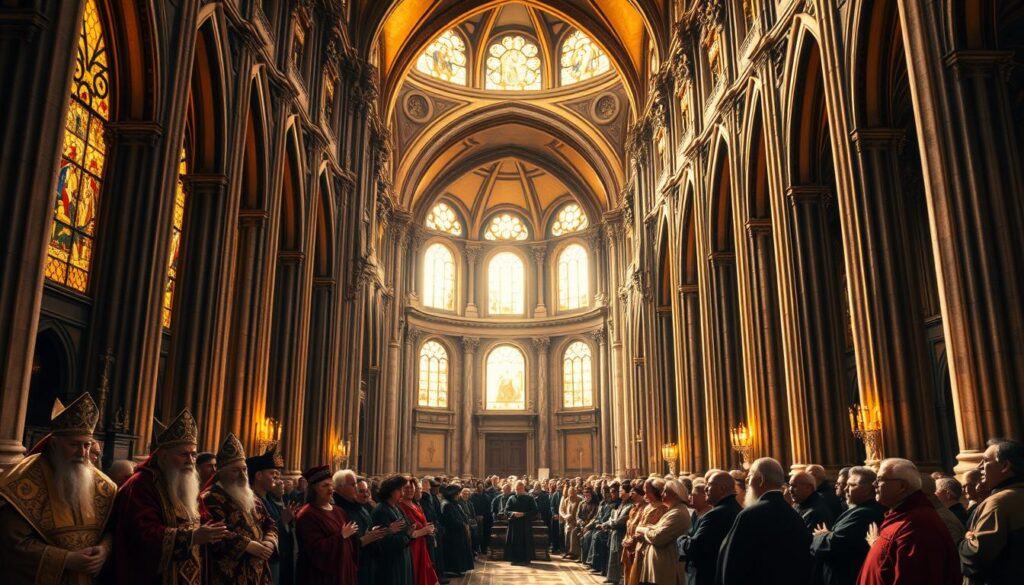
Roman Emperor Constantine summoned 300 bishops to modern-day Turkey in 325 AD. A fiery debate raged about whether Christ shared God’s eternal nature. Arius, a popular preacher, argued the Son was created later—a view many saw as undermining salvation’s power.

The council responded with bold clarity. They declared Father and Son “of one substance”, using the Greek term homoousios. This landmark decision became Christianity’s first universally accepted doctrine. One bishop noted, “We didn’t invent truth—we recognized what Scripture always taught.”

Council of Constantinople: Expansion in 381

New challenges emerged five decades later. While the 325 statement focused on Christ, believers needed clearer teachings about the holy spirit. The updated text affirmed the Spirit’s divinity and role in creation. It also strengthened language about Christ’s resurrection and eternal kingdom.

This revised version became standard across eastern and western churches. Remarkably, both councils occurred on sunny spring days—a practical choice allowing safe travel for delegates. Their collaborative spirit still inspires modern ecumenical efforts.

Defining the Creed’s Core Doctrines

At the heart of Christian theology lies a profound mystery expressed through precise language. This foundational text answers humanity’s oldest questions about divine relationships while maintaining doctrinal clarity. Its carefully chosen phrases create a theological framework embraced by diverse faith traditions.

Trinitarian Beliefs and the One God Concept

The text begins with a revolutionary idea: one God existing as three distinct persons. This concept avoids both mathematical confusion and oversimplification. As one scholar noted, “It’s like seeing sunlight split into colors through a prism—one source revealing multiple aspects.”

Person Divine Attribute Scriptural Connection
Father Almighty Creator “In the beginning, God created…”
Son Eternal Light “The light shines in darkness”
Holy Spirit Life-Giver “Breathed into them the breath of life”

Christological Statements and the Nature of the Son

Central to these teachings is Jesus’ dual nature—fully divine yet genuinely human. The phrase “begotten, not made” settled ancient debates about Christ’s origin. A fourth-century bishop explained, “A human father and son share the same nature—so do the divine Father and Son.”

This understanding shaped how believers view salvation. If Jesus weren’t fully God, his sacrifice couldn’t bridge heaven and earth. If he weren’t fully human, he couldn’t represent us. The text’s balanced approach continues guiding faith communities today.

Understanding the Protestant Nicene Creed in Contemporary Faith

Modern congregations find ancient words surprisingly relevant in today’s theological landscape. Over 85% of mainline denominations incorporate this historic text into their worship services, proving its adaptability across centuries. From urban megachurches to rural chapels, these time-tested phrases continue shaping spiritual identity.

modern church congregation creed recitation

Church leaders value how the text simplifies complex doctrines. “It’s like a theological GPS,” shares a Methodist educator. New believers gain clarity through its structured approach to the Trinity and salvation. Confirmation classes often use it to map core teachings about Christ’s role in human redemption.

While most traditional communities treat it as authoritative, some newer movements approach it differently. Non-denominational groups might call it “helpful but not binding,” prioritizing scripture alone. Yet even critics acknowledge its power to unite Christians across cultural divides.

The creed’s lasting strength lies in focusing on eternal truths rather than secondary issues. By connecting God’s nature to everyday life, it helps worshippers see divine fingerprints in ordinary moments. Sunday recitations become living bridges between ancient councils and modern spiritual journeys.

The Role of the Holy Spirit and the Filioque Controversy

One of the most pivotal developments in Christian theology unfolded through evolving descriptions of the divine breath that animates faith. The 381 Council of Constantinople transformed early understandings by giving the holy spirit equal standing with the Father and Son. This shift laid groundwork for both unity and future divisions.

Holy Spirit’s Position in the Creed

Church leaders in 381 crafted bold language to affirm the Spirit’s divinity. They declared him “the Lord and Giver of life”—a phrase elevating his role from vague force to distinct person. The text emphasizes shared worship, stating the Spirit is glorified with the Father and Son as one God.

This formulation answered practical concerns. Early believers needed clarity on whether to pray to the Spirit or merely through him. By linking the Spirit’s work to prophecy and creation, the statement became a compass for Christian experience.

The Debate Over the Filioque Clause

Centuries later, a single Latin word split churches. Western congregations added Filioque (“and the Son”) to describe the Spirit’s origin. A bishop from the time noted, “We seek to honor Christ’s words about sending the Spirit from the Father.”

Eastern churches saw this as overstepping scripture. The disagreement became symbolic of deeper tensions, contributing to the 1054 schism. Today, most Western denominations retain the phrase, believing it reflects biblical truths about divine relationships.

Understanding this debate helps modern believers appreciate how small details shape big beliefs. It reminds us that theological precision matters—not as wordplay, but as love letters to truth.

Comparative Analysis: 325 vs 381 Creed Versions

Two historic church gatherings produced distinct versions of Christianity’s most influential statement. The 56-year gap between these councils allowed theologians to refine teachings while addressing new questions about salvation’s mechanics.

Nicene Creed versions comparison chart

Textual Differences and Additions

The 381 update made God’s creative work more tangible. Where the original text called Him “Maker of all things visible and invisible,” the revised version added “heaven and earth” for clarity. This change helped ordinary believers connect divine power to their daily lives.

Christ’s story gained vivid details in the later version. The 381 text specifies his birth “by the Holy Spirit and of the Virgin Mary”—a direct response to doubts about Jesus’ humanity. It also names Pontius Pilate, anchoring salvation history to real-world events.

Element 325 Version 381 Version
Holy Spirit Brief mention “Lord and Giver of life”
Christ’s Death General reference Burial & crucifixion details
Creation “All things” “Heaven, earth, all things”

The Inclusion of ‘and the Son’

A small phrase sparked big debates centuries later. Western churches added Filioque (“and the Son”) to describe the Spirit’s origin. This tweak aimed to honor Christ’s role in sending the Spirit, based on Gospel accounts.

Eastern churches saw this as changing sacred tradition. One monk protested, “We mustn’t edit what the fathers prayed!” Though intended to clarify relationships within the Trinity, this addition became symbolic of growing divisions.

These textual shifts show how faith statements evolve to meet believers’ needs. By balancing precision with accessibility, both versions continue guiding worship worldwide.

Influence on Church Liturgy and Worship Practices

Each Sunday, millions voice ancient truths that bridge centuries of belief. These words shape sacred moments from baptisms to communion services, creating rhythm in Christian worship. Their power lies in connecting modern believers to foundational teachings through shared recitation.

Liturgical Recitations Across Traditions

Traditional congregations often include these affirmations during Eucharist celebrations. Lutheran and Anglican services place them after scripture readings, while Catholic Masses position them before communion. “Reciting together reminds us we’re part of something bigger,” notes a Presbyterian minister.

Eastern Orthodox churches chant the text during morning prayers, emphasizing its musical qualities. The phrase “one baptism” resonates particularly during christening ceremonies, linking new members to historic faith practices.

Contemporary Adaptations

Modern congregations creatively weave these declarations into worship. Some project the words on screens with nature backdrops, while others use call-and-response formats. Non-denominational groups might simplify language but keep core ideas about holy unity.

Youth services often pair recitations with interactive discussions. A Methodist worship leader shares: “We ask teens to rewrite lines in their own words—it sparks amazing conversations about what we truly believe.” This approach keeps the apostolic church’s legacy alive while speaking to new generations.

FAQ

How does the Creed describe the relationship between the Father, Son, and Holy Spirit?

It emphasizes their unity as one God in three persons, co-equal and eternal. The Son is “begotten, not made,” sharing the Father’s divine nature, while the Holy Spirit proceeds from both, affirming their shared glory and authority.

Why is the phrase “and the Son” (Filioque) significant in some traditions?

Added later by Western churches, this clause states the Holy Spirit proceeds from the Father and the Son. It sparked debates about the Spirit’s role and authority, creating lasting divisions between certain Christian denominations.

What role does the Virgin Mary play in the Creed’s teachings?

The text highlights Jesus’ humanity by noting he was “born of the Virgin Mary.” This underscores his dual nature—fully divine yet fully human—essential for understanding salvation and his resurrection.

How do modern churches incorporate the Creed into worship?

Many recite it during liturgies to affirm shared beliefs. Its use connects congregations to ancient traditions while reinforcing core doctrines like Christ’s resurrection, the apostolic church, and the promise of eternal life.

What distinguishes the 325 and 381 versions of the Creed?

The 325 text focused on Jesus’ divinity against Arianism. The 381 update expanded the Holy Spirit’s role, clarified the Trinity, and added phrases like “maker of heaven and earth,” solidifying teachings on creation and judgment.

Why is the Creed’s reference to “one baptism” important?

It unites believers across denominations under a common sacrament, symbolizing forgiveness and entry into the church. This line reinforces unity amid diverse practices, pointing to a shared hope in the resurrection of the dead.
The Protestant Ethic and the Spirit of Capitalism PDF


How did religious ideas shape today’s economy? This question lies at the heart of a groundbreaking book by Max Weber, one of sociology’s most influential thinkers. Originally published in 1904, his analysis explores how cultural values influenced the rise of modern economic systems. Over a century later, his ideas still spark debates about work, ethics, and society.

This introduction breaks down Weber’s complex theories into clear, relatable concepts. You’ll learn why his work remains a cornerstone of social science—ranked among the top ten most cited pre-1950 studies. We’ll also show you how to access the full text as a file, making it easier to explore his arguments firsthand.

Whether you’re a student or curious reader, this guide simplifies Weber’s connection between belief systems and economic behavior. Discover how historical ideas about diligence and thrift shaped Western capitalism—and why they matter in today’s global economy.

Key Takeaways

  • Max Weber’s work links religious values to modern economic practices
  • The text remains highly influential in sociology and economics
  • Accessible PDF versions help readers engage with original arguments
  • Weber’s theories explain cultural roots of work ethics
  • Debates about his ideas continue shaping academic discussions

Introduction to Max Weber and His Foundational Work

Few thinkers have bridged academic disciplines as boldly as Max Weber. This German scholar wore multiple hats—sociologist, economist, and political thinker—while reshaping how we analyze human behavior. His 1904 essays laid groundwork still shaping debates about cultural values and social progress.

Weber’s approach blended rigorous analysis with real-world insights. Unlike contemporaries focused solely on economic structures, he explored how belief systems mold financial practices. His research crossed borders, comparing how different faith traditions influenced economic growth patterns.

What made his work stand out? Three key strengths:

Scholar Primary Focus Key Contribution
Max Weber Cultural values Linking belief systems to economic behavior
Karl Marx Class struggle Materialist view of historical change
Émile Durkheim Social facts Studying society as external force

While Marx examined economic systems through class conflict, Weber asked deeper questions. How do personal convictions about work and success shape entire economies? His answers transformed sociological theory.

Today’s researchers still use Weber’s methods to study modern issues. From corporate ethics to gig economy trends, his interdisciplinary lens helps decode complex social patterns. As one professor notes: “He taught us to look beyond spreadsheets—human motivations drive markets.”

Historical Context: The Emergence of Modern Capitalism

Why did economic systems transform faster in 16th-century Europe than elsewhere? The answer lies in a perfect storm of belief systems meeting practical needs. As traditional social structures cracked, new ways of organizing work and wealth took root.

reformation economic impact

Religious Foundations and Early Economic Shifts

Northern Europe’s financial revolution grew from unexpected soil. Religious reformers emphasized personal responsibility and earthly productivity. This mindset turned daily work into spiritual practice.

Denomination Core Belief Economic Influence
Calvinists Predestination Wealth as divine favor
Lutherans Vocational duty Skilled labor valuation
Quakers Social equality Ethical business practices

These groups shared a radical idea: financial success could reflect moral standing. Savings became holy acts, while idleness turned sinful. Over time, these values built the engine of modern capitalism.

Weber’s Impact on Sociological Thought

The German scholar changed how we study social change. By connecting church doctrines to market behaviors, he revealed culture’s hidden role in economic growth. His work answered why some regions industrialized faster.

Before Weber, most experts focused on technology or resources. His analysis showed how human motivations drive progress. This approach still helps explain today’s global wealth patterns.

As historian Linda Gordon notes: “He taught us to read balance sheets through prayer books.” This perspective keeps sparking fresh research into how values shape markets.

Unpacking the Protestant Work Ethic

What transformed ordinary jobs into spiritual missions? The answer lies in a 16th-century revolution that reshaped how people viewed their daily labor. Religious reformers taught that divine purpose could be found outside monastery walls.

Key Characteristics of the Ethic

This moral code demanded more than just hard work. Followers believed their occupations served higher purposes. Three pillars defined this mindset:

Element Daily Practice Long-Term Impact
Discipline Fixed work schedules Increased productivity
Purpose Viewing tasks as holy Stronger work motivation
Frugality Reinvesting profits Capital accumulation

These habits created workers who saw their shops as altars. A cobbler might pray over leather, believing each stitch honored creation. Success became proof of virtue, not just skill.

Integration of Faith and Secular Vocation

The real breakthrough came when spiritual goals merged with marketplace activities. People stopped separating “church life” from “work life”. Every transaction became an act of stewardship.

This mindset solved an ancient problem: how to stay devout while earning money. The solution? Treat profit as fuel for community good, not personal luxury. Bankers built orphanages. Merchants funded schools.

Modern workplaces still show traces of this fusion. From Silicon Valley to Main Street, many professionals describe their careers as “callings”. As one historian observes: “We’ve kept the work habits but lost the prayer books.”

Deep Dive: protestant ethic and the spirit of capitalism pdf Overview

Digital access has transformed how we engage with classic texts. The digital file containing Weber’s groundbreaking essays now sits just clicks away on platforms like Archive.org. This accessibility lets curious minds explore his ideas without hunting through library stacks.

Accessing and Navigating the PDF

Modern readers benefit from features older scholars couldn’t imagine. The searchable file lets you jump to specific concepts like “worldly asceticism” instantly. Bookmarking tools help track key arguments across 200+ pages of dense text.

Talcott Parsons’ 1958 translation remains the gold standard. His added section titles act as road signs through complex terrain. Look for headings like “Luther’s Conception of Calling” to navigate Part 1’s core themes.

What Readers Can Expect from the Document

The essays unfold in two acts. First, Weber lays out his central puzzle about belief systems shaping economies. Then he dissects specific Protestant traditions’ economic impacts. Footnotes spill over pages 35-42, offering treasure troves for dedicated researchers.

Keep these tips handy:

  • Use CTRL+F to find frequent terms like “pp 104-107”
  • Highlight Parsons’ explanatory notes in yellow
  • Compare original German concepts with translations

As one digital archivist notes: “This book’s online availability bridges century-old ideas to modern analysis.” Whether you’re skimming or deep-diving, the file adapts to your learning style.

Key Concepts and Theoretical Insights from Weber

What invisible forces shape our daily work habits? Weber’s analysis reveals hidden patterns in how societies value productivity. His ideas help explain why some cultures prioritize efficiency over tradition.

Weber theoretical concepts

The Spirit of Capitalism Explained

Weber saw capitalism’s core as more than money hunger. He described it as a moral compass guiding economic behavior. Benjamin Franklin’s writings exemplified this mindset—treating time management like spiritual practice.

This approach transformed profit-seeking into a systematic discipline. Workers began viewing their jobs as sacred duties rather than mere survival tasks. The shift created self-reinforcing cycles of investment and growth.

Rationalization and Modernity

Modern life’s focus on efficiency stems from rationalization—Weber’s term for replacing magic with math. Factories adopted clock-based schedules. Businesses standardized processes once governed by tradition.

This cultural change had costs. Weber warned of “disenchantment” as practical logic overshadowed wonder. Yet these systems built today’s global markets. His theories remain tools for understanding tech-driven workplaces and gig economy trends.

The Role of Religious Ideologies in Economic Development

Why do certain belief systems spark economic revolutions while others prioritize spiritual contemplation? This question drove Weber’s cross-cultural research, revealing how core values shape financial behaviors. His work shows that money habits often mirror sacred texts more than policy papers.

Calvinism economic impact

Calvinism and Its Economic Implications

Calvinist teachings created a psychological engine for productivity. Followers believed their eternal fate was predetermined—yet searched for earthly clues about their salvation. This tension turned workplaces into proving grounds for divine favor.

Three key outcomes emerged:

  • Work became a form of worship, with efficiency seen as moral duty
  • Wealth accumulation served as “proof” of God’s approval
  • Frugality ensured resources funded community growth, not personal luxury

Weber’s analysis contrasted this with Eastern philosophies. Confucianism emphasized harmony with nature, while Taoism valued simplicity over material gain. These differences shaped distinct economic paths:

Region Religious Influence Economic Focus
Western Europe Calvinist anxiety Systematic capital growth
Imperial China Taoist balance Agricultural sustainability
South Asia Hindu caste system Specialized trade networks

This comparative approach transformed sociology religion studies. As one modern economist notes: “Weber taught us to read tax records as spiritual diaries.” His insights remain vital for understanding why some cultures embrace innovation while others preserve tradition.

Criticisms and Alternative Perspectives on Weber’s Thesis

What sparks more debate: cultural values or economic coercion? While Weber’s ideas reshaped sociology, they’ve faced tough questions. Scholars highlight gaps in methodology and competing explanations for capitalism’s rise.

Methodological and Economic Critiques

Economic historians challenge the Weber thesis with hard numbers. Henryk Grossman’s research reveals how 16th-century “bloody legislation” forced peasants into wage labor—laws punishing vagrancy more harshly than theft. This legal coercion, not religious motivation, built early capitalist systems.

A 2015 study by Davide Cantoni adds weight to these claims. Analyzing 600 years of German city data, he found no economic boost from Protestant areas. “Numbers don’t lie,” argues one critic. “Cultural factors alone can’t explain market shifts.”

Comparative Views with Marxist Theory

Karl Marx’s materialist approach offers sharp contrast to Weber’s analysis. Where Marx saw class struggle driving change, Weber states cultural values steered economic evolution. This debate still divides social scientists studying the United States‘ corporate culture.

Modern researchers blend both perspectives. As one economist notes: “You need Marx’s wrench and Weber’s compass to map capitalism’s journey.” This fusion helps explain why some regions adopted factory systems faster than others.

These critiques don’t dismiss the Protestant ethic thesis—they refine it. By testing Weber’s claims against new evidence, scholars keep his work relevant in ongoing discussions about power, belief, and progress.

FAQ

How did Max Weber influence sociological theories about economics?

Max Weber’s work connected cultural and religious ideas to economic behavior. His analysis of Calvinism’s role in shaping attitudes toward work and wealth reshaped how scholars study the roots of modern systems.

What historical factors contributed to the rise of capitalism?

Weber argued that shifts in religious thought, like the emphasis on hard work and thrift in certain Christian groups, created a cultural environment where profit-driven systems could thrive alongside changing social values.

How does faith intersect with professional life in Weber’s theory?

The idea of a “calling” transformed daily work into a moral duty. This mindset encouraged discipline and innovation, blending spiritual purpose with material success in ways that fueled economic growth.

What makes the PDF version of Weber’s text valuable for readers?

Digital copies often include annotations, historical context, and cross-references to related works. These tools help readers unpack complex arguments about cultural forces and financial practices.

How does rationalization relate to modern business practices?

Weber saw rationalization as the drive for efficiency and predictability in institutions. This concept explains why standardized processes and calculated risk-taking dominate contemporary economies.

Why do some scholars critique Weber’s views on religion and economics?

Critics argue he overemphasized cultural factors while downplaying class struggles or technological advances. Others compare his ideas to Marxist theories, which prioritize material conditions over belief systems.

What role did Calvinism play in shaping financial attitudes?

Calvinist teachings about predestination and earthly success created anxiety about salvation. Followers often sought signs of divine favor through disciplined labor and reinvestment, fostering habits aligned with market growth.

How accessible is Weber’s writing for new readers?

While his ideas are foundational, the text’s density can be challenging. Modern editions with introductions or companion essays help clarify terms like “iron cage” and their relevance today.

Protestantism: Definition and Historical Overview


In the early 1500s, a religious transformation swept through Europe. Reformers challenged traditional church teachings, sparking a movement that reshaped spiritual life across continents. This shift began as a push for change within Christianity, emphasizing personal faith and direct engagement with scripture.

The label now used for this movement traces back to 1529. At a pivotal meeting in Speyer, Germany, leaders formally opposed restrictions on religious freedom. Their bold stance gave birth to a name that would endure for centuries.

Today, this branch of Christianity stands alongside Catholicism and Eastern Orthodoxy as one of the faith’s major expressions. Its influence extends far beyond Sunday services, affecting education, art, and even forms of government. From small European towns to bustling global cities, its teachings have taken root in diverse cultures.

With nearly a billion followers worldwide, this tradition continues to evolve. Modern communities blend ancient practices with contemporary values, proving ideas born in the Reformation remain relevant. Let’s explore how a 16th-century protest grew into a worldwide spiritual force.

Key Takeaways

  • Began in 16th-century Europe as a reform movement within Christianity
  • Name originated from 1529 protest against religious restrictions
  • One of three primary branches of Christian tradition today
  • Shaped social systems and cultural development globally
  • Current followers represent about 30% of all Christians

Origins and Early History of Protestantism

Europe’s medieval spiritual landscape simmered with tension long before Luther’s famous protests. The Roman Catholic Church held immense power, but cracks began showing in its moral authority. Ordinary people grew frustrated with leaders who preached humility while living like royalty.

Seeds of Change Before Luther

By the 15th century, brave voices challenged church practices. English scholar John Wycliffe argued Scripture should be available in common languages. Czech reformer Jan Hus condemned the clergy‘s wealth gap, declaring: “Ecclesiastics must surrender worldly possessions!”

These early critics faced harsh consequences. Hus was burned at the stake in 1415, becoming a martyr for religious reform. Their ideas survived through handwritten pamphlets and secret meetings.

When Popes Sparked Outrage

The Catholic Church‘s leadership crisis reached new heights under Pope Alexander VI. His 1492 election involved bribes worth modern millions. Romans whispered about his lavish parties and children born out of wedlock.

Three troubling practices eroded trust:

  • Church positions sold to highest bidders
  • Forgiveness certificates (indulgences) marketed like tickets to heaven
  • Taxes funding papal palaces instead of helping the poor

Kings grew tired of Roman Catholic influence in their lands. German princes particularly resented sending money to Rome. This mix of spiritual concerns and political friction created perfect conditions for revolution.

protestantism definition world history: Key Concepts and Doctrines

Five revolutionary ideas transformed how people approached spirituality during the Reformation. These guiding principles, called the Five Solae, became pillars of theological thought. They answered fundamental questions about spiritual authority and personal connection with the divine.

The Framework of Faith

The Solae form a cohesive system of beliefs:

Principle Meaning Impact
Sola Scriptura Bible as ultimate authority Reduced reliance on church hierarchy
Sola Fide Salvation through faith alone Changed views on good works
Sola Gratia Grace as divine gift Emphasized God’s role in salvation
Solus Christus Christ as sole mediator Removed saints from worship focus
Soli Deo Gloria Glory belongs to God Shifted emphasis from human achievement

Personal Connection Over Protocol

This theology sparked a radical idea: every believer could approach God directly. As historian Philip Schaff noted, “The Protestant goes to the Word first” rather than through clergy. This “priesthood of all believers” concept:

  • Allowed personal Bible interpretation
  • Removed mandatory confession to priests
  • Empowered laypeople in spiritual matters

These teachings created lasting changes. Where Catholic practices emphasized rituals, Protestant doctrines focused on individual relationships with scripture. This shift still influences worship styles and church structures today.

Key Figures in the Protestant Reformation

Imagine hammering ideas to a church door and changing spiritual history forever. This bold act by a German monk ignited fires of change across Europe. Three pioneering thinkers shaped the movement’s direction through their writings and actions.

protestant reformation leaders

Martin Luther and the 95 Theses

On October 31, 1517, Martin Luther nailed his famous arguments to Wittenberg’s Castle Church. These 95 points criticized church fundraising through forgiveness certificates. “Why does the pope’s wealth exceed that of any rich man?” Luther asked in Thesis 86.

His academic challenge became a rallying cry. Printed on new Gutenberg presses, Luther’s ideas spread faster than church officials could contain them. By 1521, the former priest faced excommunication but refused to recant.

John Calvin, Zwingli, and Other Reformers

While Luther sparked change in Germany, John Calvin built systems in Switzerland. His 1536 Institutes outlined predestination – the belief God chooses who receives salvation. This theology shaped Presbyterian and Reformed churches.

Huldrych Zwingli took different approaches in Zurich:

Reformer Key Contribution Region
Zwingli Symbolic communion Switzerland
Calvin Predestination doctrine France/Switzerland
Luther Salvation through faith Germany

These reformers proved the movement wasn’t monolithic. From England’s Tyndale to Scotland’s Knox, each leader adapted ideas to local needs. Their collective efforts created lasting branches within Christian tradition.

Political and Social Impacts of the Reformation

A single protest in 1529 changed Europe’s political map forever. When German princes and city leaders stood against Roman Catholic demands, they sparked a chain reaction. Their defiance at the Diet of Speyer became the first domino in a series of changes reshaping societies.

The Role of the Diet of Speyer and European Politics

Emperor Charles V tried to silence reformers in 1529. His decision backfired when six princes and 14 cities declared: “In matters concerning God’s honor, we must obey God rather than men.” This bold stance:

  • Created the term “Protestant”
  • Strengthened local rulers’ authority
  • Inspired other groups to challenge Rome
Event Political Impact Social Consequence
1529 Protest German autonomy grew Religious freedom debates began
1555 Peace of Augsburg Rulers chose faith for territories Mixed communities faced tension

Nationalism, Religious Wars, and Social Change

The Reformation became a tool for national identity. Swedish and Dutch people used it to break from foreign rule. But clashes between groups turned violent. The Thirty Years’ War (1618-1648) killed millions and redrew borders.

Lasting changes emerged from the chaos:

  • Northern Europe leaned Protestant
  • Southern regions stayed Roman Catholic
  • Schools spread as people sought Bible literacy

By the 17th century, the movement had reshaped daily life. Local languages replaced Latin in churches. Ordinary citizens gained voice in spiritual matters—a shift that later influenced democratic movements worldwide.

The Spread and Evolution of Protestantism in the United States

Protestantism in early America

Religious freedom found fertile ground when European ideas crossed the Atlantic. English reformers seeking purity in worship laid foundations for America’s spiritual landscape. Their journey began with royal drama that reshaped a nation’s faith.

Puritan Beginnings and Early American Colonies

Henry VIII’s 1534 break from Rome created the Church of England, but not everyone approved. “We must cleanse God’s house from popish remnants!” declared Puritan leaders. These reformers split into two groups:

  • Separatists (Pilgrims) founded Plymouth in 1620
  • Nonseparatists established Massachusetts Bay Colony by 1630

Colonists carried Bibles instead of bishops, creating self-governing churches. By 1691, 75% of New England’s 90,000 settlers identified with Puritan ideals. Their strict practices shaped early American life.

Modern Denominational Diversity and Influence

Today’s religious map shows over 200 Protestant denominations. This variety stems from colonial experiments in spiritual freedom. Early Baptists in Rhode Island and Quakers in Pennsylvania proved different groups could coexist.

The First Amendment later mirrored this legacy. As historian Sydney Ahlstrom noted, “America became a greenhouse for growing new forms of Christianity.” From megachurches to storefront churches, this diversity remains a defining feature of American religious life.

Diverse Interpretations Among Protestant Denominations

Protestant denominations diversity

A rainbow of beliefs colors Protestant Christianity, with each denomination painting scripture through its own lens. While all share core Reformation principles, distinct teachings about sacraments and church leadership created unique spiritual families.

From Evangelicals to Reformed Traditions

Lutherans preserved Martin Luther’s original emphasis on faith alone. Reformed denominations adopted Calvin’s focus on God’s sovereignty. Baptists broke new ground by insisting on adult baptism – a practice first championed by 16th-century Anabaptists.

These differences often turned fiery. “Believer’s baptism isn’t just symbolic – it’s obedience to Christ’s command,” argued early Baptist leader Thomas Helwys. This stance directly challenged Roman Catholic Church traditions and even some Protestant denominations.

Modern groups demonstrate surprising variety:

  • Methodists blend personal holiness with social action
  • Presbyterians use elected elder governance
  • Pentecostals emphasize spiritual gifts

The term “Evangelical” often causes confusion. Unlike the Catholic Church‘s unified structure, this movement spans multiple denominations. It prioritizes scripture study and sharing faith through missions – practices seen in Baptist megachurches and Lutheran outreach programs alike.

Church leadership models reveal deeper differences. Some groups mirror Roman Catholic Church hierarchy with bishops. Others, like Congregationalists, let each church self-govern. This freedom to interpret Christian beliefs remains Protestantism’s defining trait – and its greatest challenge.

Historical Reflections on Protestant Teachings and Practices

New communication tools sparked a revolution in spiritual thinking during the 16th century. Martin Luther‘s ideas traveled faster than ever before, thanks to Johannes Gutenberg’s movable-type press. This innovation let ordinary people access scripture in their own languages for the first time.

The Role of the Printing Press and Scriptural Authority

Gutenberg’s invention became the Reformation’s megaphone. Over 200,000 copies of Luther’s writings circulated by 1520 – a viral spread for its time. The Roman Catholic Church had controlled Latin texts for centuries, but now German farmers could read Paul’s letters themselves.

This shift created lasting changes in religious practice:

  • Personal Bibles replaced priestly explanations
  • Debates about church teachings spread through pamphlets
  • Local languages became sacred through translation

Legacy of Protestant Reformation in Shaping Faith

Luther’s emphasis on personal faith still echoes in modern spirituality. “Why should we pay for God’s grace?” he challenged, reshaping how people viewed salvation. This focus on individual connection transformed worship styles across the Catholic Church and emerging Protestant groups alike.

Three enduring marks of the Reformation:

  • Direct access to scripture without mediators
  • Emphasis on inner conviction over rituals
  • Local control of religious institutions

Today’s diverse expressions of faith owe much to these 16th-century changes. From Bible study groups to online sermons, the Reformation’s core idea – that every believer matters – continues shaping spiritual practice worldwide.

FAQ

What sparked the Protestant Reformation?

Frustration with corruption in the Roman Catholic Church, like the sale of indulgences, led reformers like Martin Luther to challenge traditional practices. His 95 Theses in 1517 became a catalyst for widespread religious and social change.

How did Protestant beliefs differ from Catholic teachings?

Reformers emphasized salvation through faith alone (sola fide) and scripture as the ultimate authority (sola scriptura). They rejected papal supremacy and practices not directly supported by the Bible, such as praying to saints.

Why did the Diet of Speyer matter for Protestants?

In 1526, this assembly allowed German princes to choose their territories’ religion, creating space for Lutheran teachings to spread. A later meeting in 1529 condemned these reforms, leading to formal protests—hence the term “Protestant.”

How did the printing press help the Reformation?

A> Johannes Gutenberg’s invention enabled mass production of Bibles and reformist writings. Luther’s ideas spread rapidly, empowering ordinary people to engage with scripture and fueling debates across Europe.

What role did John Calvin play in shaping Protestantism?

Calvin’s teachings on predestination and church governance influenced Reformed traditions. His work in Geneva created a model for community-based worship and strict moral codes, impacting denominations like Presbyterians and Puritans.

How did the Reformation affect American religious culture?

Early colonists, such as the Pilgrims, sought to practice reformed faith freely. This laid the groundwork for diverse groups like Baptists and Methodists, shaping America’s emphasis on religious liberty and denominational pluralism.

Do all Protestant groups share the same practices?

No—denominations vary widely. For example, Evangelicals focus on personal conversion, while Anglicans retain liturgical elements. Baptism methods and church leadership structures also differ across communities.

What lasting impacts did the Reformation have globally?

It challenged centralized religious authority, promoted literacy through Bible translation, and influenced democracy by encouraging individual interpretation. These shifts reshaped Christianity and sparked movements for social and political reform.

The Protestant Experience in Northern Ireland


Exploring this community’s story means diving into a rich blend of faith, culture, and history. While often seen as a single group, its members form a vibrant patchwork of traditions and beliefs. Presbyterians make up the largest segment, followed closely by Anglicans and smaller denominations. Together, they create what scholars call a “majority of minorities” – united yet diverse.

From early settlements to modern times, these groups have shaped the region’s social fabric. Their journey includes periods of growth, conflict, and efforts toward peace. Cultural practices like Orange Order parades and church-led initiatives reveal how identity extends beyond Sunday services.

Economic contributions and political debates also play key roles in their narrative. The 20th century brought challenges, including societal shifts and transformative peace agreements. Today, younger generations navigate balancing heritage with evolving values in a changing world.

Key Takeaways

  • Presbyterians form the largest single denomination within this diverse community
  • Cultural traditions remain tightly woven into daily life and annual celebrations
  • 20th-century conflicts significantly impacted social structures and intercommunity relations
  • Modern efforts focus on reconciliation while preserving cultural identity
  • Demographic changes continue reshaping community dynamics in urban and rural areas

Historical Roots and Demographic Shifts

The story of Northern Ireland’s landscape and people is written in its fields and towns. English and Scottish settlers reshaped the region during the 17th-century plantation era. Their grid-like farms replaced traditional Irish clan systems, creating lasting cultural divides.

Early Settlement Patterns and Land Enclosure

By the 19th century, landlords consolidated scattered plots into orderly estates. The Potato Famine accelerated this change, emptying rural areas. Eastern districts became agricultural strongholds, while western zones saw population declines.

This transformation created visible patterns:

County Pre-1840s Landscape Post-Famine Reality
Londonderry Mixed farming communities Urban-centered development
Tyrone Subsistence crofts Consolidated estates
Down Forests/wetlands Productive farmland

Shifting Populations and Birth Rates

The 20th century brought new changes. Political tensions prompted many families near the border to relocate eastward. Today, Catholics form 40% of the population, with slightly higher birth rates sparking demographic debates.

Urban centers now reflect these shifts:

  • Belfast remains religiously mixed
  • Derry/Londonderry became predominantly Catholic
  • Armagh maintains balanced communities

Understanding the Protestant of Northern Ireland

In the heart of this region’s social structure lies a tapestry of faiths, each denomination adding its distinct hue. While often viewed as a unified bloc, the reality reveals intricate layers of belief and practice. This diversity shapes everything from local governance to neighborhood celebrations.

protestant community mosaic northern ireland

Religious Denominations and Community Mosaic

Presbyterians form the largest single group, representing over 20% of residents. Their emphasis on education and community leadership echoes through local institutions. The Anglican tradition follows closely, blending English heritage with regional customs developed over centuries.

Smaller groups like Methodists and Baptists create vibrant pockets of worship. Each brings unique traditions – from fiery revival meetings to quiet meditation practices. Together, they form what scholars describe as a “collage of conviction” within broader society.

Impact on Identity and Culture

Faith here extends beyond church walls into daily life. Orange Order parades pulse with historical symbolism, while Ulster-Scots language classes preserve linguistic roots. Musical traditions fuse hymns with folk tunes, creating sounds instantly recognizable to community members.

These expressions strengthen bonds within communities while sometimes deepening divides with neighbors. Yet new generations increasingly blend heritage with modern values, reshaping what it means to belong. Their evolving identity remains rooted in shared history while reaching toward inclusive futures.

Impact of the Troubles on Protestant Communities

The late 1960s erupted into a period of profound transformation as social tensions boiled over into open conflict. What began as demands for equal housing and voting rights soon spiraled into decades of violence that redefined community relationships.

Key Incidents and Violent Milestones

October 5, 1968, changed everything. When civil rights marchers defied a government ban in Derry, police batons cracked skulls under TV spotlights. This clash became the spark that lit the fuse. Just months later, loyalists ambushed activists at Burntollet Bridge while officers watched – a pattern repeated throughout the troubled years.

Year Event Impact
1968 Duke Street March Global exposure of police brutality
1969 Burntollet Attack Escalation of sectarian violence
1972 Bloody Sunday Military distrust peaks

Role of Paramilitary Groups and Law Enforcement

As paramilitary groups multiplied, neighborhoods became battlegrounds. Loyalist forces claimed to protect communities but often targeted civilians. The RUC police found themselves trapped – praised by some as defenders, condemned by others as oppressors.

British soldiers initially brought hope to fearful residents. But curfews and checkpoints soon turned welcome into resentment. One Belfast shopkeeper recalled: “We traded bombs for barbed wire – neither brought peace.”

By the 1990s, over 3,500 lives had been lost. The legacy remains etched in streets still divided by walls and in hearts still healing from wounds that no treaty can fully mend.

Cultural Mosaic and Segregation Patterns

Neighborhoods here tell stories without words, their boundaries etched in brick and memory. Nearly 50% of residents live in areas where nine out of ten neighbors share their background. This separation cuts deepest in urban centers, where peace walls now outnumber those from the conflict’s peak.

segregation peace walls northern ireland

Residential Segregation and Peace Walls

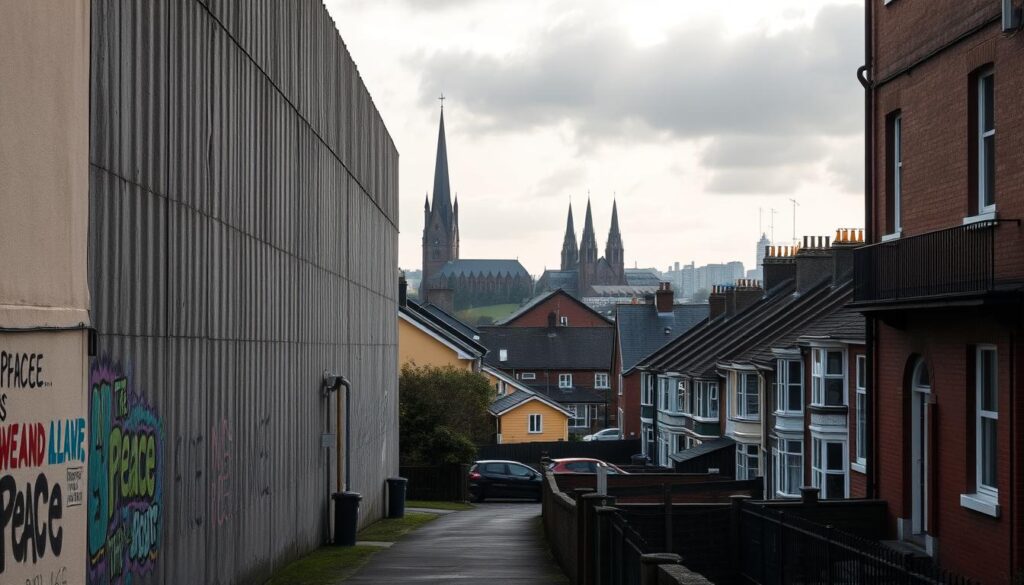
In Belfast’s working-class districts, towering barriers divide streets into parallel worlds. What began as temporary dividers now stand as permanent fixtures – 130 structures and counting. “You learn the invisible lines early,” shares a lifelong resident. “Cross the wrong alley, and you’re in another universe.”

These interface zones see limited mixing, with schools and shops often mirroring community divides. Public housing maps reveal stark patterns – clusters of red-brick homes ending abruptly at fortified walls.

Community Traditions and Celebrations

Within these separated spaces, cultural life thrives through drumming circles and mural-lined streets. July’s Orange Order parades transform neighborhoods into seas of banners and lambeg drums. Ulster-Scots festivals keep linguistic roots alive, while loyalist murals recount historical ties.

Yet new efforts emerge. Cross-community music projects now bridge divides, blending Protestant flute bands with Gaelic trad sessions. As one organizer notes: “Our rhythms differ, but the beat connects us.”

Economic and Urban Developments in Northern Ireland

Belfast’s skyline tells a story of reinvention. Perched at the head of Belfast Lough, this economic hub has transformed from industrial powerhouse to modern service center. Its deep-water port once launched legendary ships like Titanic, while today’s cranes build wind turbines and tech campuses.

Industrial Shifts and Urban Transformations

The last century saw traditional industries fade, replaced by healthcare and IT sectors. Former docklands now host glass-fronted offices, with the government investing in cross-community job programs. Urban renewal projects blend historic architecture with smart housing, creating neighborhoods that mirror the region’s evolving identity.

Brexit’s Impact on the Border and Local Economy

Since the UK’s EU exit, checkpoints dot the once-invisible border. Local businesses juggle new customs rules, while farmers face export delays. Cross-border trade dropped 13% in two years, pushing leaders to seek creative solutions. As part of the United Kingdom, the region navigates unique challenges balancing British ties and Irish neighbor relations.

FAQ

How did the Good Friday Agreement impact communities in the region?

The 1998 peace deal helped reduce violence by creating shared governance between nationalist and unionist parties. It also led to paramilitary disarmament and reforms in policing, though some divisions remain.

Why did population demographics shift over the 20th century?

Higher Catholic birth rates and Protestant emigration gradually changed the balance. Industrial decline in traditionally unionist areas like Belfast’s shipyards also influenced economic and social dynamics.

What cultural traditions define Protestant identity today?

Events like July’s Orange Order parades commemorate historical battles, while sports, music, and local dialects reflect shared heritage. These practices often highlight ties to Britain rather than Irish traditions.

How did paramilitary groups affect daily life during the Troubles?

Groups like the UVF and UDA carried out attacks in response to IRA campaigns, deepening fear and mistrust. Many neighborhoods became heavily militarized, with checkpoints and barriers separating communities.

Do peace walls still divide cities like Belfast?

Yes, over 100 physical barriers remain, mostly in working-class areas. While some see them as necessary for safety, others argue they reinforce segregation and slow reconciliation efforts.

How has Brexit influenced tensions around the border?

Trade checks between Great Britain and the region created economic friction. Unionists opposed special EU trade rules, fearing weakened UK ties, while nationalists saw risks to cross-border cooperation.

The Intriguing Story of Protestant Whiskey


Picture a crowded bar where ordering a drink sparks more than small talk—it reveals family roots and cultural loyalties. This scene captures the enduring legacy of a curious cultural myth that turned two Irish spirits into symbols of identity. Though rooted in fiction, the idea of “Protestant whiskey” versus its counterpart became a powerful social code for generations of Irish-Americans.

The tale begins with geography, not theology. One distillery operated in Northern Ireland, while another hailed from the Republic—a division that accidentally mirrored historical religious lines. But here’s the twist: both brands had leaders from mixed backgrounds. A Scottish Protestant founded what many consider the “Catholic” label, while the “Protestant” distillery employed masters from both faiths.

This myth thrived in American immigrant communities as a way to share heritage. Families passed down drink preferences like heirlooms, using glassware choices to quietly declare their story. Bars became stages where people expressed pride, pain, and belonging through simple orders—proof that cultural identity often lives in unexpected places.

Key Takeaways

  • The Protestant whiskey concept emerged from Irish-American immigrant experiences, not actual distillery practices
  • Geographic origins of brands fueled misconceptions about religious affiliations
  • Family traditions turned drink preferences into generational identity markers
  • Bar culture amplified these myths, influencing ordering habits nationwide
  • The story reveals how consumer choices can express cultural values
  • Historical facts often contradict popular beliefs about the brands’ origins

Historical Origins and Myths

The story of these iconic brands starts not with religion, but with geography and entrepreneurial spirit. What began as local businesses grew into legends through unexpected twists of history. Let’s explore how facts blended with folklore to create enduring narratives.

Early Beginnings and Distillery Legends

John Jameson, a Scottish-born businessman, bought Dublin’s Bow Street distillery in 1780. Though his Presbyterian background might suggest otherwise, this location tied his brand to southern Ireland’s Catholic regions. Meanwhile, Bushmills’ 1608 royal license from King James I became its claim to fame—despite opening its doors 176 years later.

Both operations defied simple categorization. Jameson’s “Catholic” distillery had Protestant leadership, while Bushmills’ Northern Irish company employed mixed-faith teams. Over the years, ownership shifted globally—from French conglomerates to Mexican liquor giants—erasing any original religious ties.

The Roots of Irish Whiskey Narratives

American immigrants reshaped these histories to fit their needs. They overlooked key truths: master distillers from both communities worked at each site. A table reveals the surprising realities behind the myths:

Aspect Jameson Bushmills
Founder’s Faith Protestant N/A (Royal License)
First Master Distiller Catholic Protestant
Current Owner French Firm Mexican Company
Workforce History Mixed Mixed

This contrast shows how stories outlasted facts. Families passed down simplified versions that felt truer than reality. Today, these distilled legends remain potent symbols in bar culture—proof that heritage often mixes memory with imagination.

protestant whiskey: Debunking Misconceptions and Cultural Myths

Ordering a drink shouldn’t require a history degree, yet America’s bars became battlegrounds for inherited myths. The 1996 Bushmills boycott revealed how deeply these stories stuck. San Francisco’s mayor famously poured bottles down drains, claiming unfair hiring practices – only to learn the distillery never asked about faith.

Jameson Bushmills debate

The Jameson and Bushmills Debate Explored

Let’s break down the boycott drama. Protesters argued Bushmills employed few Catholics, but company records showed mixed teams. “We judge people by their skills, not sacraments,” their spokesperson clarified. Sales barely dipped – most drinkers cared more about flavor than folklore.

Boycott Claim Reality
10% Catholic workforce No religious tracking
Protestant ownership Mexican parent company
Religious favoritism Mixed leadership since 1780

Religious Identity and Irish-American Traditions

Jack McGarry, a Belfast bartender, laughs at the U.S. obsession. “Back home, we drink both. This ‘us vs them’ idea only exists overseas.” Like corned beef dinners on St. Patrick’s Day, these preferences became American identity markers.

Families passed down ordering habits like secret handshakes. A grandfather’s “bit of Jameson” felt rebellious, while choosing Bushmills whispered northern roots. Though fiction, these rituals helped immigrants feel connected to a homeland many never knew.

Modern Perspectives and Cultural Significance

Today’s drinkers approach Irish spirits with fresh eyes, valuing craftsmanship over century-old rumors. Taste profiles now trump tribal loyalties, as mixologists guide patrons through flavor notes rather than folklore. This shift reflects broader changes in how we celebrate heritage while embracing modern truths.

Contemporary Trends in Whiskey Appreciation

Bars nationwide now host “blind sip tests” that surprise regulars. Many discover they prefer the grain-forward character of northern Ireland spirits, despite family traditions favoring southern styles. A recent comparison shows how preferences have evolved:

Aspect Traditional View Modern Approach
Selection Criteria Family allegiance Barrel aging process
Flavor Discussion Nonexistent Detailed tasting notes
Celebration Link St. Patrick Day stereotypes Authentic cultural events

Educational initiatives make a difference. Jack McGarry’s NYC bar replaces green beer with historical cocktails during March celebrations. “We share Ireland’s real stories through drinks,” he explains.

Heritage, Identity, and the Evolving Narrative

Professor Mary C. Kelly notes that corned beef dinners and brand loyalties served as armor for early immigrants. “These rituals helped marginalized communities feel rooted,” she says. Yet personal histories often contradicted the myths – like families blending multiple faiths while clinging to simplified stories.

Modern distilleries lean into this complexity. Their marketing highlights master blenders rather than maps, and collaborations between north and south brands quietly rewrite old narratives. As one bartender puts it: “The best spirit isn’t from a region – it’s the one that brings people together.”

Conclusion

Every glass poured tells two stories—one of liquid craftsmanship, another of human connection. While myths about Irish spirits once divided people, modern drinkers unite through shared appreciation. Experts agree—both labels deserve a place on any shelf.

This cultural legend reveals how immigrant communities used simple choices to preserve identity. What began as survival tactics became traditions that stood the test of time. Today, we honor that history best by tasting freely.

When selecting drinks, let your palate lead. Explore triple-distilled smoothness or malt-rich complexity. Share discoveries with friends—that’s the true way to celebrate heritage. As bar menus evolve, so does our understanding of what makes spirits meaningful.

Next time you raise a glass, toast the blenders who perfected these pours across centuries. Their skill transcends borders and old debates. After all, good Irish whiskey—like great stories—belongs to everyone.

FAQ

Is Bushmills really a "Protestant" brand?

While some stories claim Bushmills has religious ties, the distillery itself never officially aligned with any faith. These labels often stem from historical regional divides rather than actual company policies. Both its spirits and visitors come from diverse backgrounds today.

Why do people link Jameson to Catholic traditions?

This idea likely grew from Ireland’s complex history. Jameson originated in Dublin, a city with mixed cultural influences. Over time, informal storytelling—not factual records—shaped these perceptions. The brand now celebrates Irish heritage without emphasizing religious divides.

How did St. Patrick’s Day become tied to specific drinks?

Irish-American communities popularized festive traditions like pairing corned beef with certain liquors. Marketing campaigns later amplified these customs, creating a blend of nostalgia and cultural pride that shaped modern celebrations.

Do Northern Irish distilleries focus on different styles?

Regional techniques vary, but preferences aren’t strictly divided. For example, Bushmills uses triple distillation—a method also found in other areas. Modern drinkers prioritize flavor over old stereotypes, enjoying options from all parts of Ireland.

Are there "Catholic" or "Protestant" whiskey glasses?

No—this myth plays into outdated tropes. Glassware choices depend on personal taste or cocktail trends, not identity. Many bars now highlight shared appreciation for craftsmanship, moving beyond past divisions.

Why does corned beef pair with Irish liquors in the U.S.?

Irish immigrants adapted local ingredients, turning corned beef into a holiday staple. Over generations, this meal became a symbol of resilience and community, often enjoyed with spirits that evoked homeland memories.

Protestantism Explained: Key Facts in a Nutshell


Let’s explore one of Christianity’s most influential branches. Born from the 16th-century Reformation, Protestant faith reshaped religious history by challenging established church practices. At its core, it emphasizes direct connection to scripture and personal faith over traditional hierarchies.

Reformers like Martin Luther sparked this movement by questioning doctrines they saw as disconnected from biblical teachings. Their ideas spread rapidly, creating new ways to practice religion. Today, Protestant churches range from Baptist to Methodist, each with unique traditions united by shared principles.

What makes this faith distinct? Three pillars stand out: belief in salvation through faith alone, the authority of the Bible, and the priesthood of all believers. These ideas continue to shape communities worldwide, influencing culture and personal lives in visible ways.

From small-town congregations to global denominations, Protestant religion adapts while staying rooted in its history. Whether through vibrant worship styles or community outreach, its impact remains fresh and relevant in modern times.

Key Takeaways

  • Originated during the 16th-century Reformation as a break from traditional church structures
  • Core beliefs include salvation through faith and the Bible as ultimate religious authority
  • Encompasses diverse denominations like Lutherans, Baptists, and Pentecostals
  • Affects global culture through education, social movements, and community-building
  • Modern practices balance historical roots with contemporary approaches to worship

Understanding the Roots of Protestantism

The term “Protestant” itself echoes the defiance that shaped its 16th-century origins. In 1529, German rulers and city leaders took a bold stand against the Diet of Speyer’s attempt to crush Martin Luther’s reforms. Their protest wasn’t just political—it defended people’s right to interpret faith freely.

Historical Emergence and the Reformation

This movement began as a ripple that became a tidal wave. When princes challenged the Roman Catholic Church’s authority, they ignited debates about scripture’s role in daily life. Luther’s famous 95 Theses in 1517 questioned practices like indulgences, arguing salvation came through faith—not payments.

Over years, these ideas spread like wildfire. Printing presses carried Reformation texts across Europe. By the late 1500s, what started as local disputes reshaped entire nations’ religious identities.

Key Figures and Influential Leaders

Martin Luther wasn’t alone in this transformation. Figures like Huldrych Zwingli and John Calvin expanded Reformation ideas, creating new church models. “The true treasure of the church is the gospel,” Luther declared, emphasizing direct access to scripture over traditional rituals.

These leaders faced immense risks. Excommunication, political pressure, and even threats of violence couldn’t stop their mission. Their courage laid groundwork for diverse denominations that still thrive today.

The English and Cultural Context of Protestantism

America’s story can’t be told without its religious roots. Since colonial times, churches have shaped community values and civic life. Every U.S. president’s affiliation with Christian traditions highlights this enduring connection between religion and national identity.

Protestant influence American society

Faith’s Living Legacy

Protestant churches built more than Sunday schools – they forged America’s work ethic and volunteer spirit. Early congregations established colleges like Harvard and Yale, blending spiritual growth with education. This practical faith approach still influences how communities tackle social challenges today.

Recent years show surprising shifts. Nearly 30% of U.S. adults now claim no religious affiliation, surpassing Catholic and mainline Protestant groups. Yet spiritual values continue shaping government policies, from historic abolition efforts to modern disaster relief programs.

  • Distinct denominational cultures thrive across states – Baptists in Texas, Lutherans in Minnesota
  • 17% of Venezuela’s population now identifies with Protestant churches
  • Urban ministries adapt traditions to address homelessness and addiction

This evolving landscape proves religious institutions remain vital. They preserve heritage while reimagining outreach for new generations seeking purpose.

Protestantism in a Sentence: Core Explanation

What defines this branch of Christianity at its most basic level? At heart, it’s about direct spiritual access rather than institutional mediation. The movement rejects the Roman Catholic model where church hierarchy controls divine connection.

Three revolutionary ideas form its foundation. First: salvation comes through faith alone, not rituals. Second: every believer can interpret scripture personally. Third: the Bible outweighs tradition in religious authority.

Aspect Roman Catholic View Protestant View
Ultimate Authority Church + Scripture Scripture Alone
Salvation Path Faith + Works Faith Only
Religious Structure Central Hierarchy Local Congregations

This way of thinking sparked global change. From Lutherans to Baptists, denominations share these roots while developing unique practices. They avoid ornate rituals common in Roman Catholic services, focusing instead on scripture study.

Modern examples show this philosophy in action. Many churches let members lead prayers rather than relying solely on clergy. This approach reflects the belief that all believers form part of a collective priesthood.

The Roman Catholic Church and Protestant groups still differ sharply on these points. These distinctions shape worship styles, community roles, and even social policies worldwide.

Key Beliefs and Principles

At the heart of Protestant teachings lie two revolutionary ideas that changed Christianity forever. These concepts answer a simple question: how do people connect with God? The answers sparked a spiritual revolution still shaping worship today.

Protestant core beliefs

Justification by Faith Alone

The cornerstone of Protestant religion states salvation comes through trust in Christ, not rituals. This broke from systems requiring payments or specific acts to earn divine favor. As one reformer put it: “Grace isn’t a reward – it’s a gift.”

This belief empowers ordinary church members. They no longer need special permissions to seek forgiveness. Personal prayer and scripture study become direct pathways to spiritual growth.

The Priesthood of All Believers

Every Christian gets equal access to God under this principle. It rejects the idea that priests hold exclusive spiritual authority. Examples abound in modern churches:

Principle Meaning Impact
Justification by Faith Salvation through belief Personal spiritual freedom
Priesthood of Believers Direct divine connection Democratic church leadership

This way of thinking transformed worship practices. Services shifted from Latin to local languages. Congregations began choosing their leaders. Even children could read scripture in their own words.

Modern churches keep these ideas alive through Bible study groups and volunteer-led ministries. Whether in storefront chapels or megachurches, the Reformation’s core message remains: faith belongs to everyone.

Differences Between Protestant and Catholic Churches

Two Christian traditions have shaped global faith practices through their distinct approaches. Their differences extend beyond theology to how communities worship and organize. Let’s examine where these paths diverge most significantly.

Roman Catholic Church vs. Protestant Churches

The Roman Catholic Church and Protestant churches operate like different branches of the same tree. One key distinction? Who holds ultimate authority. Catholics follow the Pope’s guidance, while Protestants view scripture as their final rulebook.

Area Roman Catholic Protestant
Leadership Pope-centered hierarchy Local or denominational governance
Clergy Rules Celibate priests Married ministers common
Salvation Path Faith + sacraments Faith alone
Worship Style Liturgical rituals Varied, often informal

Authority and Doctrinal Contrasts

These groups read the same Bible but draw different conclusions. Roman Catholic teachings emphasize church tradition alongside scripture. Protestant groups prioritize personal Bible interpretation. This affects everything from holiday celebrations to daily spiritual practices.

Historical opposition sometimes turned violent. The Thirty Years’ War (1618-1648) devastated Europe over these disagreements. Modern tensions still surface in regions like Northern Ireland, though interfaith dialogue grows more common.

Sacraments show another divide. Catholics recognize seven holy rituals, while many Protestant churches observe only baptism and communion. These practices reflect deeper beliefs about how grace flows to believers.

Major Denominations and Movements

America’s religious landscape thrives on diversity, with Protestant groups offering distinct approaches to worship and community. From historic congregations to modern megachurches, these movements adapt timeless principles to contemporary needs.

Protestant denominations diversity

Southern Baptists and Evangelical Trends

The Southern Baptist Convention stands as the country’s largest Protestant denomination, with over 13 million members. Their influence stretches from Sunday pulpits to disaster relief efforts, maintaining Baptist traditions while addressing modern social issues.

Evangelical churches drive much of Protestantism’s growth today. A 2014 Pew Research study found 25% of U.S. adults identify as evangelical Protestants. These groups prioritize personal faith experiences and active outreach, creating highly engaged members who often participate in missionary work.

Denomination Key Focus Membership Trend
Southern Baptist Biblical literalism 13.2 million (2023)
United Methodist Social justice 5.4 million
Pentecostal Spiritual gifts Fast-growing

Modern challenges have sparked innovation. Many churches successfully transitioned worship services online during recent global shifts. This adaptability helps maintain connections with younger members who value digital access.

From Lutheran liturgical services to Pentecostal praise gatherings, denominational diversity lets people find communities matching their spiritual style. What unites them? Shared commitments to scripture’s authority and Christ-centered teachings.

Influential Protestant Figures and Leaders

Protestant leaders have always worn multiple hats – spiritual guides, community architects, and social reformers. Their influence stretches far beyond church walls into education systems, political movements, and neighborhood initiatives.

Trailblazers Who Changed History

Martin Luther’s translation of the Bible into German made scripture accessible to ordinary people. John Calvin’s Geneva became a laboratory for democratic church governance. These pioneers proved faith could reshape societies through:

  • Public education systems rooted in biblical literacy
  • Social welfare programs addressing poverty
  • Ethical frameworks for emerging democracies

Today’s Hands-On Ministry

Modern Protestant clergy maintain this practical tradition. During recent conflicts, over 3,000 ministers served as military chaplains. Their work extends to food pantries, addiction recovery programs, and disaster response teams.

Rev. Amanda Tyler, a Baptist minister in Houston, explains: “Our churches become community hubs – places where people find both spiritual hope and practical help.” This dual focus keeps congregations engaged with real-world needs.

Historical Impact Modern Equivalent
Luther’s Bible translation Multilingual worship materials
Wesley’s open-air preaching Podcast sermons and online services
Calvin’s community rules Neighborhood safety initiatives

From colonial times to today, Protestant churches have produced leaders who transform challenges into opportunities for service. Their legacy proves faith thrives when it rolls up its sleeves and gets to work.

Timeline of Protestant History

Religious transformation often unfolds through pivotal moments. The Protestant story spans five centuries of courage, conflict, and cultural change. Let’s walk through key dates that built this enduring legacy.

Foundations to Global Reach

1517 started the chain reaction when Martin Luther nailed his 95 Theses. Twelve years later, German princes made history at the 1529 Diet of Speyer – their protest coined the movement’s name by 1539. Through the 16th century, reformed ideas leaped borders, creating national churches from Edinburgh to Geneva.

The Thirty Years’ War (1618-1648) reshaped Europe’s religious map. By the end of this brutal conflict, Protestant traditions rooted deeply in many regions. Centuries later, immigrants carried these beliefs across oceans, planting new congregations in America’s soil.

Today’s diverse denominations trace their timelines back to these events. From colonial meeting houses to modern megachurches, this living history continues adapting while honoring its revolutionary roots.

FAQ

What sparked the Protestant Reformation?

The Reformation began in the 16th century when leaders like Martin Luther challenged Roman Catholic Church practices, emphasizing Scripture over tradition. This movement reshaped European religion and politics.

How do Protestant beliefs differ from Catholicism?

Protestants prioritize faith alone for salvation and reject papal authority. Unlike the Roman Catholic Church, they emphasize individual Bible interpretation and reject doctrines like purgatory.

Who were key figures in early Protestant history?

Martin Luther, John Calvin, and Huldrych Zwingli spearheaded the Reformation. Their writings and teachings laid the groundwork for denominations like Lutheranism and Calvinism.

What role does Protestantism play in American culture?

Groups like Southern Baptists and Evangelical Protestants have influenced education, social values, and politics. Their focus on personal faith shapes debates on topics like religious freedom.

What defines Evangelical Protestantism today?

Modern Evangelical movements stress Bible-based teachings, missionary work, and personal conversion. Leaders like Billy Graham expanded their influence through media and global outreach.

How did Protestantism spread globally?

A> Colonization, missionary efforts, and translations of the Bible into local languages helped Protestant churches grow. Today, Africa and Asia have some of the fastest-growing congregations.

Why do Protestant denominations vary so widely?

Differences in interpreting Scripture, worship styles, and governance led to splits. For example, Anglicans and Baptists disagree on baptism practices, while Methodists focus on social justice.

What’s the “priesthood of all believers”?

This principle asserts that every Christian can connect directly with God without needing clergy as intermediaries. It empowers laypeople to lead and interpret faith personally.