Recent Posts

Lady Fatima Catholic Church: Explore Its History and Significance


Discover a doorway into a 20th-century story that still inspires people worldwide.

The account begins in 1917 when three children reported visions of the Blessed Virgin Mary in Portugal. Their testimony led to careful Church review and a formal declaration in 1930 that the events were worthy of belief.

Over time the message shaped parish life, inviting families to simple acts like daily prayer and the Rosary. Popes and local bishops gave recognition, and in 1946 Pope Pius XII marked a key milestone with a coronation of the image.

This guide previews the main themes ahead: the message, miracle accounts, official judgment, and practical ways the story enriches faith today in the United States and around the world.

Key Takeaways

  • Introduction to the site and why it matters to people and parishes.
  • Who the three children were and how their witness shaped devotion.
  • How the Church evaluated the events and declared them credible.
  • Simple, practical responses like daily prayer and family devotions.
  • Major dates and recognitions, including actions by Pius XII.

What Is Our Lady of Fátima? A Friendly Overview for First-Time Readers

Our Lady of Fátima is a title given to the Virgin Mary after reported apparitions to three shepherd children in 1917. Those testimonies asked people to pray and to change their lives in small, practical ways.

The core message across each monthly visit was simple: pray the Rosary daily, do penance, and trust in God’s plan. The requests were meant to guide family prayer and personal conversion.

People from across the world grew interested because the calls were clear and easy to live. The children described a gentle figure who promised a sign and urged ongoing prayer.

The devotion centers on the Immaculate Heart and why that heart matters in prayer life. The Church has studied the events carefully over time, balancing testimony, pastoral care, and respectful discernment so families can adopt the practices with confidence.

Lady Fatima Catholic Church and Parish Life in the United States

Many U.S. parishes weave the Fátima tradition into daily life with practical devotions and public events.

How American parishes honor Mary under this title

Parishes schedule the Rosary every day, host Marian processions, and offer catechesis about the Immaculate Heart. Groups of men, women, and children meet for family Rosaries and volunteer ministries.

Common devotions and special visits

First Saturdays devotional practice traces to requests given to Sister Lúcia in 1925–1926. It centers on Communion of reparation and a focus on the devotion immaculate heart.

“Prayer, simple acts of reparation, and public devotion build parish life around hope and peace.”

Parish Activity Typical Schedule Who Participates Purpose
Daily Rosary Morning or evening Families, seniors Personal prayer
First Saturdays Monthly mornings All ages Reparation, consecration
Pilgrim Virgin visits Tour dates Parish community Veneration, public devotions
May 13 feast Annual celebration Everyone Catechesis and sacraments

The World Apostolate of Fatima, often called the Blue Army, helps parishes host the international pilgrim and organize the Fatima Tour for Peace. This apostolate fatima network links local devotion to a movement throughout world communities.

The 1917 Apparitions: From May to October in Fátima, Portugal

From May through October 1917 a small Portuguese village became the stage for a sequence of short, powerful encounters. The reports came in monthly, and the tone shifted from wonder to warning to promise.

May 13: A brilliant figure appears to the three children

On May 13 a figure described as brighter than the sun spoke to the three children. She began by asking for prayer and simple acts of devotion.

June 13: Pray the Rosary and honor the Immaculate Heart

The June meeting stressed the daily Rosary and devotion to the Immaculate Heart. The request aimed at family prayer and conversion.

July 13: Grave messages, a vision of hell, and prophecy

July 13 brought the most serious warnings. The children reported a vision hell and were told of consequences if people did not change.

August 19 at Valinhos: After imprisonment, the call to pray “a lot”

Following brief detention on August 13, the children met again at Valinhos on August 19. The emphasis was persistence in prayer despite pressure.

September 13: Promise of a miracle and heavenly visitors

On September 13 the visitors promised a sign. Reports say heavenly presences prepared the crowd for a coming event.

October 13: Identity revealed as “Lady of the Rosary”

October 13 culminated the series. Before a vast crowd the identity was given as the “Lady of the Rosary,” and a promised miracle occurred, drawing international attention.

“Daily prayer and reparation were linked to peace and conversion that reached beyond Portugal.”

Date Message Location Witness note
May 13, 1917 Initial appearance, call to prayer Cova da Iria Three children first encounter
June 13, 1917 Rosary, Immaculate Heart Cova da Iria Devotional instruction
July 13, 1917 Vision of hell; warnings Cova da Iria Serious prophetic message
October 13, 1917 Identity revealed; miracle Cova da Iria Massive public sign

Jacinta Marto and her cousins kept their testimony under intense scrutiny. Their courage helped the message spread, later drawing attention from leaders such as Pius XII.

The Miracle of the Sun: What Witnesses Reported on October 13, 1917

On October 13, 1917, a vast crowd at Cova da Iria described an event many called the miracle sun. Estimates range from 30,000 to 100,000 people who had gathered after heavy rain for a promised sign.
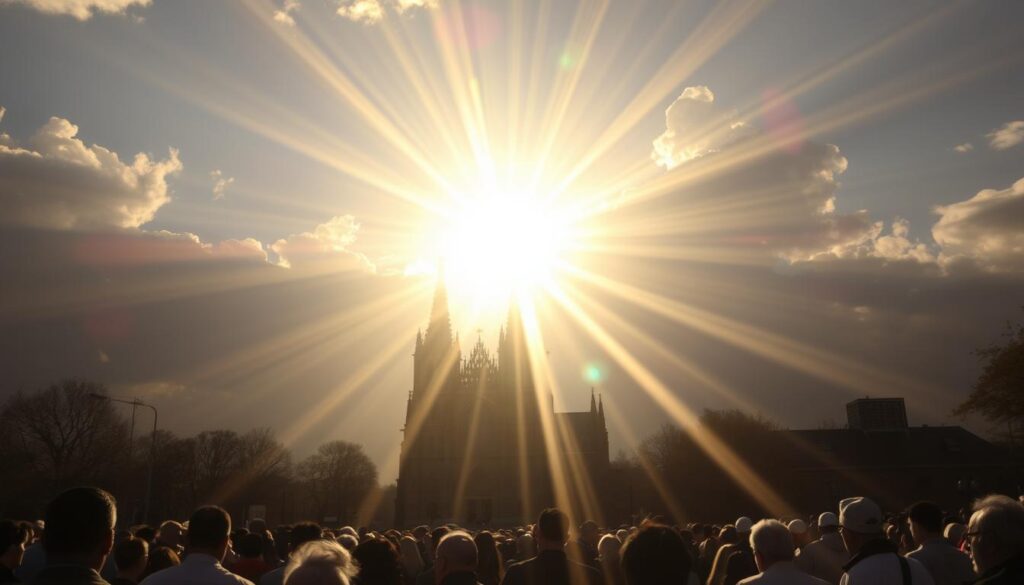
A bright, celestial phenomena in the sky over a Catholic church, with sunbeams radiating outwards in a dazzling display. The church is seen in the middle distance, its gothic architecture bathed in an otherworldly glow. In the foreground, crowds of people are gathered, awestruck expressions on their faces as they witness this miraculous event. The sun appears to pulse and dance, its light refracting through the atmosphere in mesmerizing patterns. Vibrant shafts of sunlight pierce the clouds, creating a sense of divine intervention. The mood is one of reverence and wonder, as if heaven and earth have momentarily converged.

“Sun danced” and multicolored lights: crowd accounts and press reports

Numerous witnesses said the sun appeared as an opaque, spinning disc. They described it casting multicolored lights that washed over the landscape as if the sun danced.

Newspapers and clergy collected many firsthand statements. Reports varied: some saw dramatic motion, others only colors, and some saw little or nothing.

Clothes dried instantly: details that astonished pilgrims

After the storm, many people reported that wet garments and muddy ground dried in moments. For those present, this quick drying strengthened the sense of a visible sign that day.

Skeptical perspectives and scientific context at the time

No observatory recorded a solar anomaly that day. Scientists proposed optical effects, retinal afterimages, or mass perception as possible explanations.

“Eyewitness testimony and sober inquiry both shaped how the event was reported and debated.”

Aspect Witnesses Notes
Appearance Opaque, spinning, colorful Many reported zig-zag motion
Physical effects Clothes and ground dried Followed heavy rain that morning
Scope 30,000–100,000 people Wide variation in individual experience

The three children—francisco jacinta among them—also said they saw holy figures who blessed the crowd. This mix of testimony, doubt, and faith helped make the episode a defining moment in a world still reeling from world war.

Who Were the Three Children? Francisco, Jacinta, and Lúcia

The three children at the heart of this story were cousins whose quiet faith drew global attention. Francisco and Jacinta Marto were very young and lived simple rural lives. Their witness and suffering left a strong mark on generations.

Francisco and Jacinta: short lives, heroic sanctity

Francisco Jacinta Marto died April 4, 1919, and Jacinta Marto died February 20, 1920. Both succumbed to the 1918 flu pandemic after offering days of prayer and small sacrifices. The Church beatified them on May 13, 2000, and canonized them on May 13, 2017.

Sister Lúcia: memoirs, doubts overcome, and lifelong mission

Sister Lúcia entered religious life in 1921. She wrote memoirs that describe First Saturdays and the request for consecration to the Immaculate Heart. She also admitted childhood doubts and later explained how prayer and penance strengthened her trust.

“Their simple fidelity invites children and adults to take small, daily steps of prayer for peace in the world.”

Person Key facts Legacy
Francisco Marto Died 1919; youthful witness Model of childlike trust
Jacinta Marto Died 1920; known for penance Patron of reparation prayers
Sister Lúcia Entered religious life 1921; author of memoirs Keeper and teacher of the message

The Three Secrets of Fátima Explained

Three brief messages given in July 1917 form a focused message about prayer, penance, and conversion. Each secret points readers away from speculation and toward daily practices tied to the Immaculate Heart.

First secret: a vision of hell and the plea for prayer

The first secret described a vision hell seen by the three children. It urged constant prayer, sacrifices, and rosary devotion for sinners.

That vision explains why parishes emphasize acts of reparation and simple daily prayers.

Second secret: warnings about war and conditions for peace

The second warned that if people continued to offend God, another, worse war could follow. It said russia would spread errors if not consecrated and asked for the Communion of reparation on the first Saturday of each month.

These requests tied personal conversion to hopes for peace in the world.

Third secret: release and pastoral interpretation

The third secret, published in 2000, described persecution of the faithful and the martyrdom of a “bishop in white.” The Holy See offered an interpretation that read the vision in light of twentieth-century suffering.

Reflection: the core aim of these messages is not dates but steady discipleship—prayer each day, care for the poor, and trust in the Virgin Mary.

Devotion to the Immaculate Heart of Mary

Devotion to Mary’s Immaculate Heart grew as a clear call to love and repair for a troubled world.

The Immaculate Heart symbolizes Mary’s pure love and her maternal role in guiding us to Jesus. It invites simple acts of compassion, forgiveness, and steady prayer.

First Saturdays: concrete steps

Sister Lúcia reported specific requests on December 10, 1925, and February 15, 1926. The First Saturdays devotion asks for:

  • Confession
  • Holy Communion
  • Recitation of the Rosary
  • Fifteen minutes of meditation in reparation

Reparation, consecration, and promises

On June 13, 1929, a vision asked for the consecration of Russia to the Immaculate Heart. The linked practices aim to bring peace to the world through patient love and small sacrifices.

Practice When Purpose Who
First Saturdays Monthly Reparation, healing Families, individuals
Daily Rosary Every day Union with Mary All ages
Consecration prayers As scheduled Peace and protection Parishes, groups
Fifteen-minute meditation Monthly Reflect on Jesus’ love Devotees

“Small, steady acts of love and prayer open hearts to lasting peace.”

Church Recognition: From the Bishop of Leiria to Global Veneration

Local authorities and pastors carried out a careful inquiry that turned private testimony into public recognition. The process showed how the faithful and the hierarchy could examine claims with respect and rigor. These steps clarified how people should relate to reported private revelations.
A serene, awe-inspiring depiction of the Blessed Virgin Mary, bathed in a soft, heavenly glow. In the foreground, the graceful figure of Mary, her face radiating compassion and serenity, hands gently clasped in prayer. Her robe, rendered in delicate folds of azure blue, cascades around her form. The middle ground features a subtly-lit, ornate church interior, with intricate Gothic arches and stained glass windows casting a warm, reverent ambiance. In the background, a celestial landscape unfolds, with glowing clouds and a shimmering, golden light source above, evoking a sense of divine presence and eternal grace.

1930 approval: “Worthy of belief” declaration

On October 13, 1930 Bishop José Alves Correia da Silva declared the events worthy of belief. The diocesan study gathered witness statements, medical notes, and pastoral reports. That formal statement gave families and parishes a reliable basis for public devotion.

Pontifical coronation by Pope Pius XII (1946)

Pope Pius XII issued a decree of canonical coronation on April 25, 1946. The actual coronation took place May 13, 1946 and was carried out by Cardinal Benedetto Aloisi Masella. This honor by pope pius affirmed popular devotion and helped devotion to the Immaculate Heart grow in many countries.

Minor basilica status and the Sanctuary of Our Lady

The Sanctuary received minor basilica status by the apostolic letter Luce superna on November 11, 1954. That designation signaled worldwide veneration and encouraged responsible pilgrimage. Pilgrims, families, and groups continue to connect their prayer life with the Blessed Virgin Mary and the witness of francisco jacinta marto.

Date Action Significance
October 13, 1930 Bishop’s declaration Local credibility; pastoral guidance
April 25–May 13, 1946 Coronation decree and ceremony Papal honor (Pius XII); global recognition
November 11, 1954 Minor basilica (Luce superna) Sanctuary elevated; encourages pilgrimage

Pope Pius XII, Pope John Paul II, and the Popes of Fátima

From coronations to canonizations, recent popes reinforced a living tradition tied to the May October 1917 encounters. Their actions framed public devotion and guided how the faithful remember the miracle sun and the call to the Immaculate Heart.

Pius XII: coronation decree and honoring the pilgrim faith

In 1946 Pope Pius XII issued the canonical coronation decree and later helped elevate the sanctuary to a minor basilica in 1954. These gestures gave official weight to popular pilgrim practice.

John Paul II: beatifications and a personal link

Pope John Paul II beatified Francisco and Jacinta on May 13, 2000. He also connected his survival of the 1981 assassination attempt to the protection of the Blessed Virgin, expressing deep personal gratitude.

The 2000 release of the third secret and the beatifications shaped modern pastoral interpretation and renewed interest in prayer for peace across the world.

Pope Francis and the 2017 centenary at the Sanctuary

Pope Francis visited the sanctuary in 2017 for the centenary, and he canonized Francisco and Jacinta that year. His homilies stressed conversion, family prayer, and devotion to the heart Mary.

“Successive popes have urged prayer, penance, and the Rosary as concrete paths to peace.”

  • Pius XII reinforced official reverence and global devotion.
  • John Paul II linked personal experience to Marian trust.
  • Pope Francis marked the centenary and emphasized ongoing prayer.

Lady Fatima Catholic Church: History and Significance for Today’s Catholics

A parish named for the Fátima devotion often becomes a local center for prayer, mercy, and catechesis.

The core message—daily Rosary, penance, and devotion to the Immaculate Heart—shapes parish life. It helps people live the Gospel in small, steady actions.

Historical steps like the 1930 diocesan approval and later papal support (notably by pope pius and others) give families confidence in public devotion.

The testimony of the children invites practical ministries: Rosary groups, First Saturdays, and works of mercy. These practices turn devotion into service and prayer into outreach.

“Small acts of reparation and steady prayer form a parish into a beacon of hope and mercy.”

Parish Practice Purpose Who
Daily Rosary Union with Mary and prayer for peace in the world Families, groups
First Saturdays Reparation tied to the devotion immaculate heart All ages
Penance and works of mercy Respond to warnings like the vision hell with compassion Parish ministries
Prayers for intentions Includes requests such as the consecration noted in Sister Lúcia (e.g., russia would) Clergy and laity

Popes and saints, from pope john paul to modern pastors, encourage this path. A parish that centers the heart mary and the immaculate heart mary helps people become faithful witnesses today.

The Message in Practice: Daily Prayer, the Rosary, and Offering Sacrifices

A daily rhythm of prayer makes the message practical for busy households. Start small and let the habit grow into family life. These steps suit men women, children, and seniors alike.

“Every day” prayer: simple steps for families, men and women, and children

Plan a Rosary time that fits your day—morning, lunch break, or bedtime. Use a phone reminder, a short guide, or a parish group to keep it consistent.

Teach kids using short mysteries, simple phrases, and a story about why the Rosary matters. Praise small steps so habit and joy grow together.

Intentions for peace, the Holy Father, and conversion of sinners

Offer sacrifices and small acts for key intentions: peace in the world, the Holy Father, and the conversion of sinners. Pair prayer with charity—donate time or money as an outward sign of reparation.

  • First Saturdays: Confession, Communion, Rosary, and 15 minutes of meditation—fit these into a family morning.
  • Simple sacrifices: Skip a treat, do an extra chore, or fast from social media for intention.
  • Keep steady: Use parish groups, alarms, and shared goals to hold one another accountable.

“Small, steady acts of prayer and reparation build resilience and hope in daily life.”

The International Pilgrim Virgin Statue and Tours in the United States

A traveling Marian image has long invited parish communities to deeper prayer and service. The international pilgrim virgin began as a replica entrusted to custodians who guide its visits throughout the world.

Origins and custodians

The original pilgrim accounts led to a pilgrim virgin statue designed for outreach. Dedicated volunteers and appointed custodians protect the statue, handle logistics, and coordinate respectful transport.

Fatima Tour for Peace: parish visits and resources

Parishes hosting the Fatima statue schedule veneration, the Rosary, talks, and confession. The Blue Army or apostolate fatima supplies formation packets, speakers, and media tools for each stop.

  • Typical events: veneration, Rosary, catechesis, confession.
  • Custodians ensure safe travel and respectful handling.
  • Tours foster unity and ongoing groups like Rosary circles and First Saturdays.

“The tour encourages parish renewal through prayer, formation, and communal devotion.”

The World Apostolate of Fatima (Blue Army): A Movement Across the World

A global lay movement grew to share a simple call: pray, offer small sacrifices, and live daily conversion. That organized effort became known as the world apostolate fatima, widely called the Blue Army.

Origins and early mission

The group formed in response to the July 1917 requests to pray and do penance. Volunteers and pastors promoted the Rosary and the First Saturdays devotion linked to the Immaculate Heart.

Membership, outreach, and parish support

Members pledge simple commitments: daily prayer, monthly reparation practices, and parish service. The world apostolate supplies formation materials, speakers, and event planning to dioceses throughout the world.

  • Supports the pilgrim virgin statue and international pilgrim virgin tours.
  • Provides catechesis, youth programs, and starter guides for local chapters.
  • Partners with pastors to deepen Marian devotion in balanced ways.

“Small, steady acts of prayer and service renew parish life and spread hope.”

Over decades the movement received endorsements from leaders such as pius xii and john paul. That support helped the apostolate reach families and parishes with practical tools for prayer and outreach.

Signs, Visions, and Discernment: Understanding Extraordinary Claims

Extraordinary claims call for calm inquiry, balancing witness reports with pastoral prudence.
A dark, foreboding landscape enveloped in a hazy, crimson glow. In the foreground, a twisted, demonic figure looms, its eyes burning with an unholy light. Shadowy tendrils writhe and coil, reaching out from the depths of a churning, hellish abyss. The middle ground is dominated by a towering, monstrous presence, its gaping maw unleashing a torrent of twisted, nightmarish visions. The background is shrouded in a swirling, hellfire-tinged mist, where the silhouettes of tortured souls can be glimpsed, screaming in agony. Dramatic chiaroscuro lighting casts deep, ominous shadows, heightening the sense of dread and unease. The entire scene conveys a overwhelming atmosphere of spiritual darkness and the presence of pure, unadulterated evil.

From “vision hell” to “sun danced”: how the Church evaluates

The local inquiry gathered many statements, medical notes, and press accounts. Investigators looked for consistency, motive, and alignment with doctrine.

Not every person saw the same details. That variation does not automatically disprove testimony. Human perception varies in mass events, and sober reviewers noted this fact.

Balancing faith, reason, and credible witness testimony

Discernment asks three simple questions: Are testimonies sincere? Do they agree with the faith? Do the fruits—prayer, charity, conversion—follow?

  • People matter: credible witnesses and pastoral care matter most.
  • Prudence protects the faithful from sensationalism while honoring real spiritual fruit.
  • The virgin mary role always directs attention to Christ and the sacraments.

“Focus on conversion, not on marvels; true devotion brings humility and unity.”

Early moderation of the children’s penances shows pastoral oversight in practice. Sister Lúcia later admitted doubts, which underscores how honest questioning can be part of faithful discernment.

In the end, signs invite a response: greater prayer for the immaculate heart and lives shaped by charity rather than chasing wonders across the world.

Sister Lúcia’s Later Years and Ongoing Requests

Sister Lúcia spent decades clarifying and passing on the message she first heard in July 1917. Her later visions and notes shaped how the faithful understood calls to prayer, penance, and consecration.

1929 (Tuy): A plea for consecration

On June 13, 1929 at Tuy, sister lucia reported a vision of the Holy Trinity with the Virgin Mary. In that encounter Mary asked explicitly for the consecration of Russia to the immaculate heart.

The request tied back to the original call for conversion given to the children in 1917. It framed consecration as a pastoral means to foster deeper conversion and prayer across the world.

1931 (Rianxo): Prayers and messages for leaders

In 1931 at Rianxo, Lúcia said Jesus taught two short prayers and conveyed messages for bishops and popes. These prayers became part of family devotion and parish practice.

Over time popes — including pope pius figures in the 20th century — acted on these pastoral movements with consecrations and liturgical support that reinforced devotion to the immaculate heart mary.

“Obedience and steady prayer, not spectacle, reveal the real power of these requests.”

Event Date Request
Tuy vision June 13, 1929 Consecration of Russia to the Immaculate Heart
Rianxo messages 1931 Two short prayers taught to Lúcia; messages for Church leaders
Link to July 1917 1917–1931 Consistency in calls to prayer, penance, and conversion

Pastoral significance: consecration invites communities to renewed prayer each day, acts of charity, and sacramental life. Lúcia’s lifelong fidelity encouraged Catholics to meet private revelations with obedience and prayerful discernment.

Why Fátima Still Matters: Peace, Conversion, and Hope after World War I

After world war trauma, the call to prayer and penance at Fátima reached people hungry for hope and moral repair. The appeal was simple: prayer each day and small acts of reparation linked to the Immaculate Heart.

October 1917 and the reports of a miracle sun galvanized public attention. Many found the story of the three children a model of courage in hard times.

Official recognition in 1930 and later papal acts—most notably by Pope Pius XII in 1946 and the 1954 basilica honor—helped the devotion spread. John Paul II and recent popes renewed interest during the 2017 centenary.

“Prayer and penance were offered as practical responses to violence and fear.”

Date Focus Who Practical Response
May–October 1917 Call to prayer, promise of sign Three children Daily Rosary, family prayer
October 1917 Public sign (miracle sun) Large crowd Renewed devotion, public veneration
1930–1954 Ecclesial recognition Bishops, popes (Pius) Pilgrimage, liturgical honors
2017 Centenary reflection Global faithful Renewed prayer for peace

Today the message invites steady devotion over anxiety. It points toward conversion, works of mercy, and consolation under the Virgin Mary as a source of hope for a wounded world.

Conclusion

We close with a clear, simple call: live the message by making prayer a daily habit, embracing conversion, and serving others in love. Remember the careful pastoral recognition in 1930 and later honors by Pius XII in 1946 and 1954, plus the link Pope John Paul II and Pope Francis affirmed in modern times.

Carry devotion to the Immaculate Heart and the heart Mary into parish and home life through First Saturdays and small sacrifices. Let the story of lady fatima inspire calm discernment and active hope for peace in the world. Trust God, join the sacraments, and share this faith-filled practice with others as a way to become a bearer of peace.

FAQ

What is Our Lady of Fátima and why is she important?

Our Lady of Fátima refers to the Marian apparition first reported in May–October 1917 in Fátima, Portugal. She urged prayer, penance, and devotion to the Immaculate Heart of Mary. Millions have found comfort, hope, and a call to conversion in the messages, which include requests for the Rosary, reparation, and consecration for peace.

Who were the three children who saw the apparitions?

The visionaries were siblings Francisco and Jacinta Marto and their cousin Lúcia dos Santos. Francisco and Jacinta died young and were later canonized for their holiness. Sister Lúcia entered religious life and recorded detailed memoirs that became key sources about the events and messages.

What happened on October 13, 1917 — the Miracle of the Sun?

Thousands of witnesses at the Cova da Iria reported extraordinary solar phenomena: the sun appeared to “dance,” emit multicolored light, and move erratically. Many said their wet clothing dried instantly. Contemporary press and investigators documented widespread astonishment; skeptics offered meteorological or mass-psychology explanations.

What are the Three Secrets of Fátima?

The Three Secrets, revealed over time by Sister Lúcia, include a vision of hell, warnings about war and the spread of errors from Russia (with conditions for peace), and a third vision released by the Vatican in 2000. The third was interpreted in light of 20th-century persecutions and attacks on the Church.

What does devotion to the Immaculate Heart of Mary mean?

Devotion to the Immaculate Heart emphasizes Mary’s love, sorrow, and intercession. It includes practices such as the First Saturdays devotion, reparative prayers, consecration, and daily Rosary. The devotion connects personal holiness with prayers for peace and the conversion of sinners.

How did the Church officially respond to the apparitions?

In 1930 the Bishop of Leiria judged the events “worthy of belief.” The site later gained status as a major sanctuary, and Pope Pius XII crowned the Marian image. Popes including John Paul II and Francis have affirmed Fátima’s spiritual significance and supported pilgrimages and devotions.

What role did Pope Pius XII and Pope John Paul II play regarding Fátima?

Pope Pius XII promoted Fátima devotion and issued a pontifical coronation. Pope John Paul II credited Our Lady of Fátima with saving his life after the 1981 assassination attempt and beatified Francisco and Jacinta; he marked the message’s call for prayer and peace in his ministry.

How do parishes in the United States honor the Fátima message?

Many U.S. parishes observe the May 13 feast, celebrate First Saturdays, pray the daily Rosary, and host pilgrim statues such as the International Pilgrim Virgin. Parish programs often include family prayer guides, processions, and educational talks about conversion and reparation.

What is the International Pilgrim Virgin Statue and its purpose?

The International Pilgrim Virgin Statue represents the Marian image associated with Fátima and travels to parishes worldwide to promote the message of prayer, penance, and conversion. Custodians organize visits to encourage devotion, prayer for peace, and acts of reparation.

What is the World Apostolate of Fátima (Blue Army)?

The World Apostolate of Fátima, often called the Blue Army, began as a lay movement promoting the requests made at Fátima. It coordinates prayer campaigns, consecrations, and pilgrimages throughout the world to foster fidelity to the Rosary and devotion to the Immaculate Heart.

How should families and individuals practice the Fátima message today?

Simple daily steps include praying the Rosary, offering short acts of reparation, observing First Saturdays when possible, and teaching children about prayer and sacrifice. Intentionally praying for the Holy Father, peace, and conversion of sinners keeps the message practical and life-giving.

Did the apparitions predict global events like wars or the rise of ideology?

The second secret referenced continued conflict and warned that “Russia would spread her errors,” interpreted historically as a warning about atheistic communism and ideology contributing to war and unrest. The texts link prayer, consecration, and conversion with the possibility of peace.

How does the Church investigate extraordinary claims like visions and signs?

Ecclesial investigation balances witness testimony, theological coherence, and pastoral fruits. Bishops evaluate apparitions’ consistency with Catholic teaching, the moral character of seers, and whether devotion fosters authentic holiness and charity before offering official recognition.

Are there skeptical or scientific explanations for what people saw at Fátima?

Yes. Some researchers cite optical phenomena, atmospheric effects, or group suggestibility to explain the Miracle of the Sun and related reports. Others point to numerous independent eyewitness accounts and press coverage that make the event historically noteworthy.

Where can pilgrims visit to learn more or to venerate the shrine?

The Sanctuary of Our Lady of Fátima in Portugal remains the primary pilgrimage site, with a minor basilica and extensive devotional facilities. Many parishes host pilgrim images and organize tours, and the World Apostolate of Fátima provides resources for visits across the United States and beyond.
Ascension Catholic Church: Inspiring Worship and Fellowship


Welcome to a warm, welcoming community where people of many ages and backgrounds grow together in faith. We are imperfect, friendly, and joyful as we learn to live our beliefs with real actions.

Our parish focuses on being neighborly and generous. Christ sits at the center of worship, service, and everyday care. That focus shapes Sunday gatherings, weekday programs, and outreach that reaches beyond our walls into the wider world.

Find practical pathways for growth — from prayer groups to service teams — designed to help you belong and to deepen your spiritual life. Meeting others here often turns a single visit into lasting friendship and connection.

Key Takeaways

  • Welcoming place: a diverse community for people of all ages.
  • Christ-centered mission: shapes worship, learning, and service.
  • Practical support: programs that meet real needs locally and beyond.
  • Clear next steps: attend a service, meet the hospitality team, or join a small group.
  • Lifelong growth: formation and ministries for children, teens, adults, and seniors.

Welcome to a Christ-Centered, Neighborly Community

We gather as a mixed group of ages and stories, learning to live our faith together.

Who We Are: A Unified, Diverse People Growing in Faith

Meet a parish family of people who bring different gifts and lives, united by a desire to grow closer to Christ. We value honesty, welcome, and steady spiritual growth for children, teens, and adults.

Putting Faith in Action: Welcoming, Friendly, and Generous

See how we greet newcomers, support families, and offer clear ways to get involved throughout the year. Ministries like hospitality, outreach, and prayer help you serve and form lasting bonds.

At the Heart of Everything: Life in Christ and Fellowship

Christ shapes our worship and daily care, guiding programs that meet real needs on the North Side and beyond. Continued prayer keeps us in communion, especially as we remember elders, scholars, and school families.

“We grow together by serving one another and praying as a community.”

  • Find practical resources and friendly fellowship.
  • Join small groups and parish events to turn Sundays into everyday friendship.

Worship, Sacraments, and Events at Ascension Catholic Church

Our worship life gives people room to meet God, find support, and grow in everyday faith. Services combine clear preaching, sacred music, and quiet prayer so the grace of the day carries into daily life.

A majestic Catholic church, its towering spire reaching skyward, bathed in warm, golden light filtering through stained glass windows. In the foreground, a congregation of worshippers, their faces filled with reverence, hands clasped in prayer, the sacred space echoing with the swell of an organ and the harmonious voices of the choir. The middle ground captures the altar, adorned with ornate crucifixes and candles, the tabernacle glowing with the presence of the divine. The background reveals the intricate architectural details, the ornate columns, and the intricate carvings that inspire awe and devotion. An atmosphere of profound spirituality and unwavering faith permeates the scene, capturing the essence of worship, sacraments, and the vibrant community at Ascension Catholic Church.

Mass and Music: Prayerful Worship that Lifts the Spirit

Experience reverent Mass with uplifting music that helps you pray deeply. Liturgy and song are shaped to connect belief and action.

Sacraments and Spiritual Guidance for Every Season of Life

Prepare for key milestones—Baptism, Reconciliation, Eucharist, Confirmation, Matrimony, and Anointing of the Sick—backed by pastoral support. Clergy and lay leaders offer spiritual direction and practical care when life is hard.

Year-Round Gatherings that Build Community and Peace

Join seasonal events, small groups, and service projects that foster true friendship. Outreach efforts bring compassion beyond our doors into the wider world.

  • Connect worship to daily life through liturgy and sacred music.
  • Find pastoral care for elders, students, and school families.
  • Volunteer to live the parish mission beyond Sunday.
Offering Who It Serves Typical Time
Weekend Mass & Music All ages Sunday mornings
Sacramental Preparation Families & individuals By appointment & classes
Community Gatherings Neighbors & volunteers Seasonal events / evenings

“May our continued prayer keep us in communion with one another during challenging times.”

Feast of the Assumption of Mary: Hope for Our People and Our World

On August 15th we honor Mary’s Assumption, a day that points our hearts to hope.

The Assumption teaches that, at the close of her life, Mary was taken up body and soul into heaven. This truth was solemnly declared as a dogma of faith by Pope Pius XII in 1950. It gives us a sign of our own destiny in Christ.

What the Church Teaches: The Assumption and Our Future in Christ

Understand the heart of the assumption mary: Mary’s sharing in resurrection life points us toward hope. Where she has gone, we trust we will follow in the fullness of life with God.

Bilingual Mass Schedule This Day

Join us for liturgy and song on this important feast day. Masses will be celebrated at:

Time Language Focus
12:00 Noon English Mass with music and community prayer
7:00 PM Spanish Evening Mass with music and family welcome
All are invited to pray for peace and hope

Living the Feast: A Call to Faith, Peace, and an End to Violence

This feast asks us to say “yes” to God as Mary did. Let it deepen our faith and move us to pray for peace and an end to gun violence in our neighborhoods.

Supporting the Vulnerable: Elders, Scholars, and School Families

We will remember elders, scholars, and school families in our prayers and outreach. Please consider offering practical support or a simple visit to those who need care.

“May this day inspire concrete acts of mercy, bring peace to our streets, and end conflict both near and far.”

Conclusion

Join us as we move from celebration into practical steps for the new year. Visit Mass at 12:00 Noon (English) or 7:00 PM (Spanish), meet our hospitality team, or ask about sacraments and ministries.

Let Mary’s hope shape how you pray and serve. Make one simple plan for the year: pick a way to grow and one friend to invite. Small steps add up to real change.

Keep praying for peace and an end to violence. Support elders, students, and school families with time or practical help. Stay connected through worship, small groups, and service so Sunday hope reaches the wider world.

FAQ

What kinds of worship and music can I expect at Ascension Catholic Church?

You will find prayerful liturgies with traditional and contemporary music that uplift the spirit. Services include sung responses, choir-led hymns, and instrumental accompaniment designed to support prayer and reflection.

How does this community welcome new families and visitors?

Visitors receive a warm greeting at the door and are invited to fellowship after Mass. Volunteer greeters and hospitality teams help newcomers find seating, information, and ways to get involved.

What sacraments and spiritual guidance are available for different life stages?

The parish offers baptism, reconciliation, first Communion, confirmation, marriage preparation, anointing of the sick, and regular pastoral counseling. Programs support children, young adults, parents, and seniors.

When is the bilingual Mass for the Feast of the Assumption of Mary?

On that feast day there is a bilingual schedule with a noon Mass in English and a 7:00 PM Mass in Spanish, both enhanced by music and congregational participation.

How does the parish promote peace and respond to violence in the wider world?

The community prays for peace, supports outreach programs, and partners with local organizations to assist those affected by conflict. Events and talks promote nonviolence and reconciliation.

Are there year-round events that help build community and support neighbors?

Yes. The parish hosts seasonal festivals, study groups, volunteer drives, and social events that create fellowship and serve local families, elders, and students.

What opportunities exist for families with school-age children?

Families can join faith formation classes, school support groups, and family-friendly liturgies. There are also tutoring programs and campus ministry partnerships to aid students.

How does the parish assist vulnerable members like the elderly?

Ministries provide visitation, meal deliveries, transportation to appointments, and sacramental support to ensure elders stay connected and cared for.

Can I volunteer or donate to specific parish programs?

Absolutely. Volunteers are welcome in hospitality, education, outreach, music, and maintenance. Donations support food pantries, scholarship funds, and local relief projects.

How can I stay informed about Mass times, events, and special feasts?

The parish posts schedules on its official website, social media channels, and printed bulletins. Signing up for the newsletter or parish app delivers updates directly to your inbox or phone.

Welcome to St George Catholic Church: Spiritual Home


Welcome to a warm, faith-filled community founded in 1954 and rooted in the Gospel. St. George invites families, newcomers, and longtime members to pray, grow, and belong together.

Here you will find clear information about Mass times in English, Spanish, and Vietnamese, plus Confession, Adoration, and holy day schedules. Our parish blends traditions and languages to foster unity in a busy, diverse neighborhood.

Meet clergy and deacons who walk with you through the sacraments and outreach programs. Learn about our heritage and ways to serve, like pantry outreach and volunteer groups, all aimed at living the Gospel daily.

Key Takeaways

  • A welcoming parish home where worship and community meet.
  • Mass and devotion schedules in multiple languages for busy lives.
  • Clergy and staff ready to guide sacramental and spiritual needs.
  • Outreach programs that put faith into action locally.
  • Practical details to visit, return, or get involved with parish life.

St George Catholic Church at a Glance

Discover a warm parish where families, newcomers, and long-time members gather in faith and service.

Who We Are

Mission: Bringing people closer to God through the Gospel.

We are a welcoming catholic church that serves families and individuals from many cultural backgrounds. Our parish life centers on Sunday worship, weekday prayer, and ministries in English, Spanish, and Vietnamese.

Our Clergy Leadership

Parish leadership includes dedicated pastors and deacons who provide sacramental preparation and pastoral care. Contact clergy for Baptism, First Communion, Confirmation, weddings, and counseling.

Role Names Primary Duties
Pastor Rev. Deebar Yonas, S.V.D.; Rev. Trung Mai, S.V.D. Spiritual leadership, sacramental oversight, parish vision
Parochial Vicar Rev. Vinh T. Trinh, S.V.D. Assists pastors, leads liturgies, pastoral visits
Deacons Alfredo Vargas; Enrique Serrano; Roberto Villatoro; Juan Ramirez Ayala Pastoral care, outreach, liturgical ministries
  • Multicultural ministry: Liturgies and programs in three languages.
  • Hospitality: Newcomer steps to register and join small groups.
  • Service: Outreach and volunteer opportunities for all ages.

Worship, Sacraments, and Hours at st george catholic church

Whether you need an early morning Mass or an evening bilingual liturgy, this section lists current service times and access hours.

Weekend Masses: Saturday evening services include 5:00 p.m. (English) and a 7:00 p.m. Vietnamese Mass. Sunday options span early to late: 7:00 a.m. (Spanish), 8:30–9:45 a.m. slots in English and Vietnamese, mid-morning and midday English and Spanish celebrations, and an evening Spanish Mass to fit busy schedules.

A sunlit interior of a traditional Catholic church, with a detailed worship schedule displayed on a wooden bulletin board in the foreground. The board features columns listing the daily mass times, confession hours, and other service schedules in an elegant, hand-written calligraphic font. Soft light filters through stained glass windows, casting a warm, reverent glow across the scene. The middle ground reveals pews and kneelers, while the background showcases the ornate altar, pulpit, and other architectural elements that evoke the solemn grandeur of a historic place of worship. The overall atmosphere is one of peaceful contemplation and devotion.

Weekday and School Masses

Weekday Masses run early mornings Monday through Friday, with a bilingual Tuesday evening Mass at 7:00 p.m. Fridays include a dedicated school Mass in the morning. These services help families and students anchor the day in prayer.

Devotions, Adoration, and Confession

Holy Days offer an 8:00 a.m. Mass and a bilingual evening liturgy at 7:00 p.m. First Friday devotions and seasonal Adoration include extended daytime and evening windows on Thursdays and Fridays.

Confession is available multiple times: weekday evening sessions, Saturday afternoon bilingual hours, and by appointment for convenience and privacy.

Access and Staff

During Jubilee Year 2025 the building opens Monday–Friday from 4:00–9:00 p.m. for prayer and visits. For sacramental records, Mass intentions, or ministry sign-ups, contact the parish office. Find further information and staff contacts after Mass or during business hours.

Parish Life, Programs, and How to Get Involved

Parish life offers many ways to grow in faith, serve neighbors, and find lasting friendships.

Ministries welcome people of all ages. Families and youth find classes, small groups, and age-specific events that fit busy routines.

Ministries for families, youth, and multicultural parish life

Find a place to belong: programs for children, teens, young adults, parents, and seniors help strengthen faith and daily life.

Join multicultural choirs and language-based small groups. Community events celebrate unity through music, food, and service.

Help for the Needy — Pantry Needs

Support neighbors by donating items the pantry needs now. Drop-offs make a big difference.

Item Priority Notes
Canned corn High Preferred low-sodium when possible
Green beans High Family-size cans welcome
Cereal High Whole-grain options appreciated
Canned meat High Tuna, chicken, or beef
Canned fruit Medium In juice, not syrup
Jelly Medium Grape and strawberry common needs
Saltine crackers Medium Family packs preferred
Rice High 1–5 lb bags
Dry beans High Black, pinto, or navy beans
Soap, toothpaste, shampoo, deodorant High Travel-size for blessing bags
  • Volunteer in liturgy, hospitality, and outreach teams.
  • Enroll children in faith formation; confirm dates with the parish office.
  • Organize a family service day: deliver donations and write notes for recipients.
  • Newcomers can attend a welcome session after Mass to meet leaders and sign up.
  • Contact the office for background checks and safe-environment training.

Conclusion

Make time for quiet prayer or active service, since our schedule is built to fit real life. Weekend and weekday Masses are offered in English, Spanish, and Vietnamese. Confession is available Thursday–Saturday, and Adoration runs Thursday–Friday with First Friday devotion times.

During Jubilee 2025 the building is open Monday–Friday, 4:00–9:00 p.m., so evening visits are easy after work or school. Holy Days include morning and bilingual evening liturgies.

We invite you to pray, serve, and grow with St. George as your spiritual home in the catholic church. Check parish communications for any schedule updates and the latest hours.

Bring pantry donations to the drop-off area and speak with clergy or staff after Mass to register or join a ministry. We look forward to seeing you at Mass.

FAQ

What are the weekend Mass times, and are services offered in multiple languages?

Weekend Masses include English and Spanish celebrations, with a Vietnamese Mass on designated Sundays. Typical schedule lists a Saturday vigil and several Sunday services to accommodate families and individuals. Check the parish office or website for the current weekly roster and any holiday adjustments.

When are weekday and school Masses held?

Weekday Masses are usually offered in the morning to fit school and work schedules. Schools affiliated with the parish often gather for a mid-morning liturgy on selected weekdays. Contact the parish office for the exact times and any variations during academic breaks.

How can I find Holy Day Mass times, Eucharistic Adoration, and devotional schedules?

Holy Day Mass times and special devotions such as Eucharistic Adoration are posted ahead of major feasts and seasons. The parish bulletin and the office provide up-to-date information, including evening adoration hours during jubilee or special observances.

When is the sacrament of reconciliation available, and are bilingual confessors available?

Confession is scheduled weekly with additional times before major liturgies. Bilingual priests typically hear confessions in English and Spanish; Vietnamese options depend on clergy availability. Call the parish office to confirm a bilingual schedule or to request an appointment.

What are the building and office hours for visitors and families?

The church opens daily for prayer and scheduled services, while the parish office maintains regular weekday hours for registration, sacramental records, and pastoral requests. Evening access during special years or events may extend hours—check the parish calendar or phone the office to plan your visit.

Who is the pastor and how can I contact parish staff for ministries or pastoral care?

The pastor and parish staff lead liturgy, faith formation, and outreach. Office staff can connect you with ministry leaders, the youth coordinator, or the bereavement team. Call the parish office or use the official email listed on the website to reach the appropriate staff member.

What family and youth ministries are available, and how do I get involved?

Ministries include faith formation for children, youth groups, marriage preparation, and adult study groups. Families can volunteer with hospitality, catechesis, or community events. Sign-up forms are available at the parish office and during ministry fairs after Masses.

Are there multicultural programs and services for diverse parish communities?

The parish supports multicultural outreach through language-specific liturgies, cultural celebrations, and targeted ministries. Leaders coordinate events that welcome families from varied backgrounds—contact the office to join planning or to request support in a specific language.

How can I contribute to the parish food pantry and what items are most needed?

The pantry accepts nonperishable goods, personal care items, and baby supplies. Current high-need items include canned proteins, rice, pasta, and shelf-stable milk. Drop donations during office hours or at collection points after Mass; the parish bulletin posts urgent needs and seasonal drives.

How do I register as a parishioner, request sacraments, or update my family information?

Registration and sacramental requests are handled by the parish office. Bring or email required documents, and staff will guide you through baptism, confirmation, marriage, and record updates. Many forms are available on the parish website for convenience.

Alliance Catholic Church: Embracing Spirituality in the US


Welcome to our service page. This guide helps visitors find worship times, sacraments, formation, ministries, and ways to connect with the parish community in Alliance and nearby Hemingford.

Weekend Masses are simple to join: Holy Rosary (Alliance) on Saturday at 5:00 pm and Sunday at 10:00 am, with a Spanish Mass the second Sunday at 5:00 pm. St. Bridget in Hemingford celebrates Sunday at 8:00 am.

Practical tools are available, including the Bulletin, Ministry Schedule, Full Calendar, Online Giving, and Watch Live for those at home. Pastoral care like Anointing of the Sick is posted with the schedule for timely support.

Families and newcomers can explore PSR (K–8), OCIA, the parish school (preschool–grade 5), and recent sacraments such as First Eucharist and Confirmation. Discover ministries from altar servers to outreach teams and find easy ways to get involved.

Key Takeaways

  • Find weekend Mass times and a Spanish Mass option on the second Sunday.
  • Access Bulletin, Ministry Schedule, Full Calendar, and Online Giving online.
  • Pastoral care and Anointing of the Sick are available and scheduled.
  • Formation paths include PSR, OCIA, and parish school programs.
  • Watch Live if you cannot attend in person and stay connected to faith.
  • New visitors can use the I’m New resources to plan their first visit.

Alliance Catholic Church Services and Community

Stay up to date with liturgies, schedules, and ways to serve so you can plug into parish life quickly.

Bulletin delivers weekly updates on liturgies, announcements, and parish initiatives. Check it each week for changes to Mass times, formation sessions, and volunteer needs.

Ministry Schedule lists assignments for readers, altar servers, Eucharistic ministers, and musicians. Volunteers can review their slots and prepare confidently.

  • Follow the parish Facebook page for reminders, photos, and invitations to service projects and prayer events.
  • Use the Full Calendar to plan around feast days, holy days, and parish gatherings.
  • Online Giving makes regular support simple and secure, even while traveling, and funds outreach and worship needs.

Weekend rhythms include Holy Rosary Saturday evening and Sunday at 10:00 am, St. Bridget on Sunday morning, and a Spanish Mass the second Sunday at 5:00 pm. For pastoral care like Anointing of the Sick, check the schedule when urgent support is needed.

If you are exploring a new parish, introduce yourself through the I’m New resources to find groups and welcome opportunities. All schedules and contacts stay current via the Bulletin and Full Calendar—please share this page so neighbors can join too.

Alliance Catholic Church: Worship, Sacraments, and Community Life

Find the weekend Mass and pastoral services that fit your family’s schedule and spiritual needs.

Current Mass Schedule in Alliance and Hemingford

Holy Rosary (Alliance): Saturday 5:00 pm and Sunday 10:00 am.

St. Bridget (Hemingford): Sunday 8:00 am.

These weekend liturgies offer options so families can choose a time and location that fits their plans.

A grand cathedral interior, bathed in warm, golden light streaming through stained glass windows. In the foreground, a wooden pulpit stands prominently, adorned with intricate carvings. Rows of elegant oak pews line the nave, leading the eye towards the main altar, where a decorative crucifix and candles flicker. In the background, an ornate pipe organ towers, its pipes reflecting the radiant illumination. The atmosphere exudes a sense of reverence and solemnity, inviting the faithful to engage in worship and reflection.

Spanish Mass Availability on the Second Sunday

Spanish Mass meets on the second Sunday each month at 5:00 pm at Holy Rosary. All are welcome to attend and worship in Spanish.

Anointing of the Sick and Pastoral Care

Anointing of the Sick is available for those facing surgery, serious illness, or advanced age. See the Full Calendar for scheduled times or contact the parish office for urgent needs.

Stay Connected: Bulletin and Ministry Schedules

Consult the Bulletin for weekly updates and use the Ministry Schedule to prepare for lector, altar server, Eucharistic minister, and music roles.

Plan Your Visit: Full Calendar and “I’m New” Resources

View the Full Calendar for holy days, devotions, and formation events. Visit the I’m New page for directions, contact details, and simple steps to join the community.

Watch Live and Participate from Home

If you are traveling or homebound, Watch Live to join worship online. E-Giving is also available to support parish ministries and outreach.

  • Maintain a steady rhythm of Sunday Mass and seasonal devotions to grow your faith.
  • Preparation dates for First Eucharist and confirmation appear in the Bulletin and Calendar.
  • Ministry volunteers should check assignments and arrive early to support worship.

Faith Formation, Confirmation, and Education Opportunities

Discover programs that guide young people and adults toward sacramental milestones and lifelong discipleship.

https://www.youtube.com/watch?v=6EdZ-r8xYX0

PSR (K–8) Sunday Morning Formation

PSR meets Sundays, 9:00–10:00 am from September through May. Classes welcome public-school and parish-school families. New families may register any time; annual registration is highlighted at the Faith Formation Class Registration ’25–’26 event on Sept. 10.

OCIA: Journey to Baptism, Confirmation, and Eucharist

OCIA begins each September and continues a few weeks after Easter. Sessions invite seekers, sponsors, and parishioners to explore Scripture, prayer, doctrine, and liturgy together.

Program Schedule Age / Grades Notes
PSR (K–8) Sundays 9:00–10:00 am (Sept–May) K–8 Open registration; family formation events
OCIA Begins September; ends after Easter Adults & teens preparing Sponsors welcome; scripture & liturgy focus
Parish School Academic year Preschool–Grade 5 Scholarships and financial aid available

Celebrating the Sacraments and Growing in Community

Recent milestones: First Eucharist was celebrated April 27 at 2:00 pm and Confirmation took place May 18. These events map a clear path for families preparing children and teens.

  • Use the Full Calendar and Bulletin to track class breaks, retreats, and parent meetings.
  • Contact the parish office for registration help and scholarship details.
  • Teens post-confirmation can join ministries to deepen service and leadership.

Ministries, Parish Leadership, and Ways to Give

From planning worship to caring for the homebound, parish committees shape life and ministry every day.

A grand, ornate Catholic church interior with a central altar and intricate architectural features. Warm, golden lighting illuminates the intricate woodcarvings, stained-glass windows, and polished marble floors. In the foreground, a group of parishioners gather, engaged in discussion and prayer, representing the active ministries of the church. The middle ground showcases parish leadership, such as priests and deacons, guiding the congregation. In the background, alcoves and side chapels offer spaces for quiet reflection and individual worship. An atmosphere of reverence, spirituality, and community pervades the scene.

Serve and Lead: Parish Council, Finance Council, and Liturgy Committee

Parish Council advises the pastor on pastoral priorities. It discerns needs, sets long-range goals, and invites people with gifts to lead.

Finance Council oversees budget planning, forecasting, and controls to protect parish resources and long-term stability.

Liturgy Committee plans seasonal worship and coordinates readers, servers, cantors, and music for well-prepared liturgies.

Active Ministries: From Altar Servers to Music Ministers

Ministries include Altar Servers, Lectors, Eucharistic Ministers, Ushers, Music Ministers, PSR catechists, youth leaders, prayer chain teams, and many more.

Teens and adults are encouraged to train as lectors or greeters. Teachers and catechists can connect classroom skills to parish education and formation.

Support the Mission: Online Giving and Campaigns

E-Giving makes regular offertory and special gifts simple. Capital Campaign donations fund facilities and mission needs.

“Consistent gifts, large or small, sustain worship, formation, and outreach.”

Check the Ministry Schedule and contact the parish office to ask about training, background checks, and the next orientation. New parish visitors are welcome to join and find a role in this caring community.

Conclusion

Make this weekend a time to reconnect—attend in person or join our live stream. Mass times: Holy Rosary Saturday 5:00 pm, Sunday 10:00 am (Spanish on the second Sunday at 5:00 pm), and St. Bridget Sunday 8:00 am. Use Watch Live if you are homebound or traveling.

Visiting a new parish? Visit the I’m New page for directions, parking tips, and quick ways to meet staff and volunteers.

Families can register for PSR, explore OCIA, and connect with the parish school. Check the Bulletin and Full Calendar for updates on sacraments and formation.

Join ministries, consider leadership roles, and set up Online Giving to support worship, formation, and outreach. For sacraments or pastoral care, including Anointing of the Sick, contact the parish office for timely help.

All are welcome to pray, serve, and belong. Please share this page with neighbors, and we hope to see you at Mass—may your week be grounded in prayer, service, and the joy of the Gospel.

FAQ

What are the regular Mass times for the parish serving Alliance and Hemingford?

Weekend and weekday Mass schedules vary by location. Typically, there are Saturday vigil and multiple Sunday Masses, plus a weekday Mass midweek. Check the parish bulletin or website for current times before planning your visit.

Is there a Spanish-language Mass available?

Yes. A Spanish Mass is offered on the second Sunday of the month. Confirm the exact time through the parish calendar or contact the parish office for any seasonal changes.

How can I arrange an anointing of the sick or request pastoral care?

Call the parish office as soon as possible to request the sacrament or pastoral visit. Emergency numbers are provided for after-hours situations, and clergy make regular hospital and home visits when notified.

Where can I find the weekly bulletin and ministry schedules?

The weekly bulletin and ministry rotas are posted on the parish website and available in the narthex. You can also sign up for email updates or pick up a printed copy after Mass.

How do I plan my first visit and find newcomer resources?

Visit the “I’m New” page on the parish site for parking info, what to expect at Mass, childcare details, and contact info for staff who can help you get connected.

Can I watch Mass online if I can’t attend in person?

Many liturgies are livestreamed or recorded for later viewing. Links appear on the parish homepage and social media channels, so you can participate from home.

What age groups does the PSR program serve, and when does it meet?

PSR serves children in kindergarten through eighth grade, usually meeting on Sunday mornings during the school year. Registration info and calendars are available through the faith formation office.

What is OCIA and how do I join the process for baptism, confirmation, or Eucharist?

OCIA (Order of Christian Initiation of Adults) guides adults and older children preparing for baptism, confirmation, and first Eucharist. Contact the faith formation coordinator to enroll or for more details about sessions and sponsors.

Does the parish offer school education and are scholarships available?

The parish supports preschool through elementary programs and may partner with local Catholic schools. Financial aid and scholarship information is available through the school office and diocesan resources.

How are First Eucharist and Confirmation preparation handled?

Preparation includes classroom instruction, prayer activities, and parent meetings. Candidates typically attend PSR or sacramental prep classes and complete required retreats or service projects.

What youth ministry and adult faith opportunities exist?

Youth ministry includes middle and high school groups, retreats, and service projects. Adults can join Bible studies, small faith-sharing groups, and sacramental preparation sessions. Check the ministry calendar for schedules.

How can I serve in parish leadership or on committees?

Volunteer openings for parish council, finance council, and the liturgy committee are posted annually. Contact the parish office or speak with a staff member to learn about application and discernment processes.

What active ministries can I join if I want to serve at Mass?

Ministries include altar servers, lectors, extraordinary ministers of Holy Communion, ushers, and music ministers. Training is provided, and ministry coordinators will match schedules to your availability.

How do I make a contribution or support special campaigns?

The parish accepts gifts in person, by mail, and through secure online giving on its website. Information about capital campaigns and stewardship opportunities is available from the parish business office.

The Catholic Church’s Core Beliefs Explained


This friendly guide offers a plain-language overview of central teachings and how they shape daily life in parishes and homes across the United States and around the world.

The Nicene Creed summarizes a long message about God, Jesus, and the Holy Spirit. It stands as a touchstone that every christian often recites at Mass.

At its heart is the claim that salvation flows from Jesus’ saving death and resurrection and his promise to remain with the community of believers.

Structure matters: bishops are seen as successors to the apostles and the pope as successor to Saint Peter. The Eucharist remains the principal sacrament celebrated in the Mass.

Today, about 1.27–1.41 billion baptized members belong to the Latin Church and 23 Eastern churches. This fact shows a global presence and long continuity.

Read on to connect belief with practice and to see simple ways that faith becomes a living relationship for each person and family.

Key Takeaways

  • The Nicene Creed sums up core message shared in worship.
  • Faith centers on Jesus’ death, resurrection, and ongoing presence.
  • Structure includes bishops and the pope as apostolic successors.
  • The Eucharist is central to worship and daily spiritual life.
  • Over a billion baptized members form a global community.

Core Catholic Beliefs at a Glance: God, Jesus Christ, the Holy Spirit, and the Church

At the heart of Catholic teaching sits a concise summary of faith that shapes worship and daily choices. It names God as one and reveals how life, hope, and duty flow from that truth.

One God in Three Persons: Father, Son, and Holy Spirit

Unity and mystery are expressed as three distinct Persons. This confession centers on relationship within God and guides communal prayer.

Jesus Christ: true God and true man, his saving death and resurrection

Jesus Christ is the eternal Son who shared human life, suffered, and rose to bring salvation for men. His passion and rising open a way to renewed life for every believer.

The Holy Spirit and the one, holy, catholic, and apostolic Church

The holy spirit is called “the giver of life,” active in sacraments and teaching. The catholic church stands as a community rooted in apostolic succession and shared practice.

Resurrection, salvation, and the life of the world to come

The creed looks ahead to judgment, resurrection, and heaven. This hope shapes moral choices now and frames a vision for life in the world and beyond.

Scripture and Sacred Tradition: How Catholics Receive and Live the Faith

Two streams—Scripture and living Tradition—meet to preserve and pass on the faith.

The Bible is read as God’s inspired Word, held inside a wider living memory kept by generations of believers. Sacred Tradition carries preaching, prayers, and practices handed down by apostles and bishops.

Magisterium serves as the teaching office that interprets both sources. Its role is to safeguard the deposit of faith so the apostolic message stays clear and whole.

A key fact of history is that early leaders helped define the biblical canon and preserved texts through monasteries and libraries. That careful work kept Scripture safe for later readers.

A majestic cathedral interior, with ornate stained glass windows casting warm, filtered light. In the foreground, an open bible rests upon a lectern, its pages shimmering with intricate illuminations. Behind it, a towering crucifix dominates the space, its carved figure radiating a sense of sacred reverence. In the middle ground, a group of worshippers kneel in prayer, their faces reflecting the contemplative atmosphere. In the background, the apse is adorned with intricate carvings and mosaics, evoking the richness of Catholic tradition. The scene conveys a harmonious blend of scripture and sacred heritage, inviting the viewer to reflect on the enduring foundations of the faith.

The living link

From the first centuries onward, bishops continued apostolic ministry by handing on teaching and sacraments. In parish life, Mass, sermons, and catechesis form the ordinary place for every christian to hear, learn, and live the Word.

  • Scripture and Tradition work together, not in rivalry.
  • The Magisterium interprets to guard clarity across cultures.
  • That framework keeps faith growing with continuity and care.

Worship and the Sacraments: Meeting Jesus in the Mass and Daily Life

Mass gathers a parish to hear scripture, share thanks, and receive spiritual nourishment.

The Mass is the principal act of worship. Here the community hears God’s Word and offers thanksgiving through the Son in the holy spirit.

The Catholic Mass: hearing the Word and giving thanks in the Eucharist

At consecration, a priest leads the prayer that makes Christ present for all. People listen, sing, and receive spiritual food that shapes daily life.

Real Presence in the Eucharist: bread and wine become the body and blood of Christ

Catholics hold that bread and wine become the body and blood of Christ. This Real Presence nourishes a living bond with Jesus and with one another.

The sacrament of reconciliation: confessing sins and receiving healing

“If you forgive the sins of any, they are forgiven.” — John 20:23

Sacrament reconciliation offers mercy and spiritual repair. Scripture also urges believers to “confess your sins to one another” (James 5:16).

Living the Catholic way: baptism, confirmation, matrimony, holy orders, anointing of the sick

Seven sacraments guide people at every stage: Baptism, Confirmation, Eucharist, Penance, Anointing, Matrimony, and Holy Orders. Each sacrament meets real needs and sends people back into daily work, family, and service.

Rite Purpose Everyday effect
Baptism New life in Christ Community belonging
Eucharist Nourishment by body and blood Strength for duty and mercy
Penance Forgiveness of sins Peace and moral repair
Anointing Comfort in illness Hope and support

Worship continues beyond Sunday in daily prayer and simple acts of charity. These ways help carry Christ’s presence into every corner of life.

Mary and the Saints: Love, Intercession, and Christian Friendship

Honoring Mary and saints helps ordinary people connect daily life with a wider spiritual family.

A serene and ethereal scene of saints gathered in a celestial realm. In the foreground, the Blessed Virgin Mary stands gracefully, a soft glow emanating from her figure. Around her, a chorus of saints - both familiar and lesser-known - kneel in reverence, their faces radiating a sense of peace and devotion. The middle ground is filled with a warm, golden light, imbuing the scene with a sense of the divine. In the background, a ethereal landscape of clouds and stars creates a sense of timelessness and otherworldliness. The overall mood is one of tranquility, love, and the unifying power of faith.

Why Mary is called Mother of God and honored in faith

Mary is honored as mother of Jesus and thus Mother of God. This title shows her special role in salvation history. Teaching names her Immaculate Conception and Assumption as ways God prepared her to receive the Word by the power of the holy spirit.

Praying with saints: asking for intercession, not worship

Believers ask mary pray and ask other saints to bring needs before God, much like asking a friend to pray. This intercession supports daily prayer and strengthens love for God and neighbor.

“When we ask for a saint’s prayers, we join a larger family of faith.”

  • Saints are models of holiness and practical discipleship.
  • Veneration honors them; worship belongs to God alone.
  • Sacred art and images lift minds and inspire prayers.

Conclusion

This guide ends by inviting each person to meet jesus christ anew in prayer, Scripture, and the sacraments. That encounter shapes daily life and builds a lasting relationship with Father, Son, and holy spirit.

The Eucharist is the bread of life: in Mass bread and wine become Christ’s body and blood. That gift feeds mission, heals sins, and points toward salvation and heaven.

Around the earth, saints and Mary, our spiritual Mother, support the journey. Visit a parish, speak with a priest or join a local ministry to reconnect with worship, prayers, and service.

Take a simple step today: find a place nearby, share a welcome, and let sacrament and community renew your faith and life.

FAQ

What are the core teachings in "The Catholic Church’s Core Beliefs Explained"?

This overview presents faith centered on one God in three persons — Father, Son, and Holy Spirit — and highlights Jesus Christ as both fully divine and fully human. It covers his life, saving death, and resurrection, the role of the Spirit, and the Church’s mission to guide believers toward salvation and eternal life.

How can I understand "Core Catholic Beliefs at a Glance: God, Jesus Christ, the Holy Spirit, and the Church"?

This snapshot explains the Trinity, the mystery of Jesus’ person and redemptive work, the Spirit’s presence in believers, and why the Church is called one, holy, catholic, and apostolic. It also outlines hope in the resurrection and the promise of life to come.

What is meant by "One God in Three Persons: Father, Son, and Holy Spirit"?

This doctrine teaches a single divine nature shared by three distinct persons. Each person is fully God, yet there is one divine will and one divine essence. The Trinity shapes prayer, worship, and how people relate to God.

Who is "Jesus Christ: true God and true man," and why does his death matter?

Jesus is understood as both divine and human, sent to restore the broken relationship between God and humanity. His suffering, death, and resurrection redeem people from sin and open the way to new life and union with God.

What role does "The Holy Spirit and the one, holy, catholic, and apostolic Church" play?

The Spirit guides the Church, preserves teaching, and empowers believers for ministry. The four marks — one, holy, catholic, apostolic — describe the Church’s unity, sanctity, universality, and foundation on the apostles’ witness.

What is meant by "Resurrection, salvation, and the life of the world to come"?

Resurrection means new, transformed life after death. Salvation refers to being saved from sin and its effects through grace. Together they point to hope in eternal communion with God beyond earthly life.

How are Scripture and Tradition related in "Scripture and Sacred Tradition: How Catholics Receive and Live the Faith"?

The Bible and sacred Tradition together transmit God’s revelation. The Magisterium — the Church’s teaching authority — preserves and explains that deposit so communities and individuals can live by it faithfully.

What does "The Bible, Sacred Tradition, and the Magisterium safeguarding the deposit of faith" involve?

It involves Scripture as God’s inspired word, Tradition as the living memory of the apostles, and the Magisterium as the interpreter that ensures consistent, authentic teaching across generations.

How is worship shown in "Worship and the Sacraments: Meeting Jesus in the Mass and Daily Life"?

Worship centers on communal liturgy and personal prayer. The sacraments mark key moments of grace, especially the Eucharist, where believers gather to hear God’s word and give thanks for Christ’s presence.

What happens at "The Catholic Mass: hearing the Word and giving thanks in the Eucharist"?

The Mass includes readings from Scripture, a homily, prayers, and the Eucharistic celebration. It is a communal act of thanksgiving that recalls Jesus’ sacrifice and nourishes spiritual life through his real presence.

What is "Real Presence in the Eucharist: bread and wine become the body and blood of Christ"?

This belief holds that, by God’s power, the bread and wine truly become Christ’s body and blood while keeping the appearances of bread and wine. It affirms intimate union with him through reception of the sacrament.

How does "The sacrament of reconciliation: confessing sins and receiving healing" work?

Reconciliation offers a confidential encounter with a priest to name sins, express sorrow, and receive absolution. It restores relationships with God and community through repentance and penance.

What about "Living the Catholic way: baptism, confirmation, matrimony, holy orders, anointing of the sick"?

These sacraments mark stages of life and service. Baptism brings new life, confirmation strengthens, matrimony and holy orders configure people for family and ministry, and anointing offers comfort and healing in illness.

Why do people venerate Mary in "Mary and the Saints: Love, Intercession, and Christian Friendship"?

Mary is honored as Mother of God and model disciple. Veneration recognizes her unique role and asks for her prayers, not worship. She points believers to Christ and to faithful living.

How do Catholics view "Praying with the saints: ask Mary to pray, the intercession of holy men and women (not worship of images)"?

Asking saints to pray is like asking friends to pray for you. It acknowledges that those united with God can intercede. Respect for images or statues serves as reminders of holy lives, not objects of worship.

Queen of Peace Catholic Church: Inspiring Faith and Fellowship


Welcome to this service page for a warm, Eucharist-centered Roman Catholic community in Houston. We invite you to join worship, learn, and serve with us. This short intro helps you find Mass schedules, confession times, office hours, and contact details with ease.

Weekend Mass and weekday times are listed so you can plan a visit today. Confession is offered on Tuesday and Thursday evenings and Saturday afternoon. Parish office hours, phone, and email are provided for registration, Mass intentions, and bilingual support in English y Español.

Whether you are new or returning, this page points you to ministries, faith formation, and ways to get involved. Find practical steps for joining, giving online, and accessing sacramental resources.

Key Takeaways

  • Clear Mass and confession schedules for easy planning.
  • Parish office hours, phone, and email for quick contact.
  • Bilingual support in English y Español for worship and services.
  • Guidance for registration, Mass intentions, and online giving.
  • Opportunities to join ministries and faith formation.

Welcome to Queen of Peace — A Friendly Place to Grow in Faith

Come as you are—find a welcoming place where worship, learning, and service meet in everyday life. Queen peace is a Eucharist-centered faith community rooted in the Roman Catholic tradition.

From your first visit, you will be greeted like family. We invite all brothers sisters to share in sacraments, formation, and ministry.

“We welcome newcomers with clear next steps: attend Mass, say hello after liturgy, and register so you feel at home.”

  • Attend Mass in English y Español.
  • Meet staff and volunteers who can guide your next steps.
  • Join a ministry to grow friendships and serve others.
Next Step Language Support Who to Contact
Attend weekend Mass English y Español liturgies Parish office or greeter
Register as a member Bilingual staff help Registration desk or online form
Join a ministry Groups meet in both languages Ministry coordinator

Mass, Confession, and Parish Office Hours

Find clear service times and contact details on this page so you can plan worship and visits with confidence. Below are our regular Mass times, confession hours, and office availability for visitors and parishioners.

A majestic Catholic church set against a warm, golden sunset sky. The towering spires and ornate architecture create an awe-inspiring presence. In the foreground, a tranquil scene of parishioners entering the church for Mass, their faces reflecting the peaceful devotion. To the side, a discreet sign displays the mass and confession schedule, inviting the faithful to partake in the sacraments. The overall atmosphere is one of reverence, community, and the comforting embrace of the Queen of Peace.

Weekend Mass Times — English and Español

  • Saturday: 5:00 pm (English), 7:00 pm (Español)
  • Sunday: 9:00 am (Español), 11:00 am (English), 1:00 pm (Español), 3:00 pm (Español)

Weekday Mass Schedule — Tuesday through Friday

  • Tuesday: 12:00 pm (English) and 7:00 pm (Español)
  • Wednesday: 12:00 pm (English)
  • Thursday: 12:00 pm (English) and 7:00 pm (Español)
  • Friday: 12:00 pm (English) and 7:00 pm (Español)

Confession Times at the Church

Confession is offered three times each week to support regular reception of the sacrament.

  • Tuesday 8:00–9:00 pm
  • Thursday 8:00–9:00 pm
  • Saturday 3:00–4:00 pm

Parish Office Hours and Visit Information

Office Hours Location Contact
Mon 1:00–4:30 pm; Tue–Fri 9:00 am–4:30 pm (closed 12:00–2:00 pm) 3011 Telephone Rd., Houston, TX 77023 (mailing: 2317 Craigmont St.) Phone: (713)-921-6127
Email: qop@qophouston.com

Families and Spanish speakers will find bilingual support at liturgies and the office. Stop by after a weekday Mass to meet staff and volunteers.

“Check with the office for seasonal changes during holy days and special events.”

queen of peace catholic church Mission and Community Values

Our mission is Eucharist-centered and rooted in the Roman Catholic tradition. We strive to live the gospel of Jesus Christ and share the gifts of the Holy Spirit in daily life.

Eucharist-Centered and Roman Catholic Tradition

The Eucharist shapes our worship, formation, and service. It is the source and summit that guides Sunday liturgy and weekday outreach.

Prayer, teaching, and works of mercy flow from that center. These practices help us meet real needs in our neighborhood.

Welcoming All Brothers and Sisters to Faith, Sacraments, and Service

  • Encounter Christ in the sacraments and grow through faith formation at every age.
  • Parish life is led by the Holy Spirit, calling members to discover and share their gifts.
  • We foster belonging through ministries, small groups, and bilingual support in English and Español.
  • Invite others: bring a friend, meet a greeter, and find one way to serve this month.

“Belonging leads to discipleship—join worship, form your faith, and serve with a joyful heart.”

Ministries That Help You Belong and Serve

Find a ministry that fits your life and helps you grow in faith and service. Each program offers a clear way to join, learn, and serve with friendly leaders and practical training.

A majestic, stained-glass depiction of the Queen of Peace, her serene countenance radiant with divine grace. Soft, warm lighting filters through the multicolored panes, casting a heavenly glow upon her gentle features. In the foreground, her regal mantle drapes elegantly, adorned with intricate embroidery and the symbol of the dove, embodying the peace she embodies. The middle ground showcases a tranquil sanctuary, with ornate altars and pews that invite the faithful to worship. In the background, a celestial backdrop of cloud-like wisps and golden rays emanate a sense of reverence and transcendence. This image evokes a profound atmosphere of spiritual refuge and the promise of belonging within the ministries of the Queen of Peace Catholic Church.

Children’s Ministry (Infant–Grade 5)

Support for parents: age-appropriate catechesis, safe environment training, and family events make faith formation simple and joyful.

Youth Ministry (Grades 6–12)

Teens meet for fellowship, retreats, and service projects that build leadership and faith. Retreats and mission days help young people put faith into action.

Adult Ministry (Age 18+)

Small groups, Bible studies, and service teams fit busy schedules. College students, parents, and seniors find meaningful ways to serve and grow.

Liturgical Ministries

Serve at Mass as a lector, extraordinary minister, altar server, usher, or greeter. Training and safe environment protocols are provided to every volunteer.

Music Ministry

Singers and instrumentalists lead worship in English and Spanish choirs. Music teams enrich liturgies and invite new members to join rehearsals.

  • Quick links on the parish site make sign-up easy.
  • Bilingual options ensure full participation for English and Spanish speakers.
  • The Photo Gallery captures ministry moments and invites you to see parish life up close.

“Start by visiting the ministry page, complete an interest form, and meet a coordinator to get started.”

Faith Formation, Sacraments, and Spiritual Resources

Find clear, practical resources here to guide your sacramental life and daily prayer. These tools help new and returning members prepare for liturgy and grow in faith each week.

How to Receive Communion and Grow in the Sacramental Life

Sacraments 101: How to Receive Communion explains preparation, reverence, and proper reception so you can participate fully at Mass.

If you are discerning Baptism, First Communion, Confirmation, or Marriage, the parish team will guide you through timelines and next steps. Contact the parish office for scheduling and materials.

“Growing in sacramental life helps faith move from ceremony into daily practice.”

Daily Readings, Saint of the Day, and Formed

Daily Readings are posted on our site to help you pray with Scripture and follow the Church’s liturgical rhythm.

The Saint of the Day feature introduces inspiring holy men and women and offers short reflections you can use with family or in small groups.

Formed provides on-demand Catholic studies, documentaries, talks, and children’s content. Set a weekly family time to watch, reflect, and pray together.

Resource What it Offers How to Access
Sacraments 101 Step-by-step preparation for Communion and other sacraments Parish website download or office packet
Daily Readings Scripture for daily prayer and Mass reflection Posted daily on parish site and bulletin
Formed Video studies, kids’ programs, documentaries Sign up via parish link; family-friendly plans
Saint of the Day Short bio and reflection for spiritual growth Daily feature on site and social feeds

If you have questions about receiving Holy Communion or need sacramental prep, contact the parish office. Bilingual materials and staff support both English and Spanish speakers.

Get Connected: Registration, Online Giving, and Parish Life

Find simple steps to register, give online, and plug into parish life this week. Joining connects you to sacramental preparation, ministry news, and weekly communications.

Parish Registration: Join the Family

Registering as a parishioner links you to sacramental schedules and ministry teams. Registraciones en Linea — Click Here / Presione aqui is available in English and Español to start the process.

New parishioners receive help finding groups like Bible study, service teams, or choir. Email qop@qophouston.com if you need assistance.

Online Giving, Bulletin, and Upcoming Events

Online Giving makes support simple with one-time or recurring gifts for ministries and outreach. The weekly bulletin highlights readings, the pastor’s message, and volunteer openings.

Use the events calendar to plan retreats, holy day schedules, and service projects. To request a Mass intention for a loved one, call 713-921-6127 or visit the parish office during business hours.

“Stewardship is discipleship—your time, talent, and treasure help our community grow.”

  • Register online in English or Español to receive parish updates.
  • Bookmark the bulletin and events pages to stay engaged each week.
  • Contact the office for Mass intentions, registration help, and bilingual support.

Contact and Visit Queen of Peace

Plan your visit with ease: here are the key contacts, addresses, and tips to help you connect. Use these details to call ahead, mail paperwork, or ask about accessibility and parking.

A grand, stately Catholic church nestled within a lush, verdant landscape. The majestic structure rises majestically, its ornate facade adorned with intricate carvings and towering spires reaching towards the heavens. Sunlight filters through stained glass windows, casting a warm, ethereal glow upon the tranquil scene. In the foreground, a peaceful courtyard invites visitors to linger, with benches and fountains creating a serene oasis of contemplation. The overall atmosphere exudes a sense of reverence, inviting the faithful to connect with the divine and experience the spiritual essence of this sacred place.

Addresses

Worship location (physical): 3011 Telephone Rd., Houston, TX 77023.

Parish offices (mailing): 2317 Craigmont St., Houston, TX 77023.

Phone and Email

Call (713)-921-6127 during office hours or email qop@qophouston.com for records, registrations, or ministry connections.

Mass Intentions and Office Hours

To schedule a Mass intention, phone the office or stop in during open hours and staff will help select a date.

  • Office hours: Mon 1:00–4:30 pm; Tue–Fri 9:00 am–4:30 pm (closed 12:00–2:00 pm).
  • If you plan a first visit, arrive a few minutes early to find parking and meet hospitality ministers.
  • For sacramental emergencies, call the main number and follow prompts for urgent assistance.

Bilingual Support

English y Español assistance is available for calls, emails, and in-person visits to ensure clear communication for every parishioner.

“Share prayer requests with our staff so we can accompany you in intercession and, when appropriate, include intentions in parish prayer chains.”

Conclusion

, Join our bilingual parish family to deepen prayer life, serve neighbors, and celebrate the Eucharist together.

We welcome newcomers and returning members to Mass, confession, and clear steps for registration and formation. Ministries for children, youth, and adults offer ways to share gifts and grow in faith.

Explore resources like Sacraments 101, Daily Readings, and Formed. Consider online giving to support outreach and parish life.

Have questions or need help? Call (713)-921-6127 or email qop@qophouston.com. Visit us at 3011 Telephone Rd., Houston, TX 77023.

We look forward to seeing you at Mass this week. Bring a friend and discover fellowship, hope, and ongoing spiritual growth.

FAQ

What are weekend Mass times in English and Español?

Weekend Masses are offered in both English and Spanish to serve our diverse community. English liturgies typically include a Saturday vigil and multiple Sunday Masses. Spanish Mass times are set to meet the needs of Spanish-speaking parishioners. Check the parish bulletin or website for the current schedule and any holiday changes.

When are weekday Masses held?

Weekday Masses run Tuesday through Friday, usually in the morning to fit busy schedules. These daily liturgies provide a quiet chance for prayer and reflection. For exact times and special feast day services, consult the parish calendar or call the office.

How can I go to confession?

Confessions are scheduled weekly and may include Saturday afternoons and by appointment. The sacrament is available in both English and Spanish when possible. If you need a private time outside posted hours, contact the parish office to arrange a convenient slot.

What are the parish office hours and how do I visit?

The parish office maintains regular weekday hours for registration, sacramental requests, and pastoral support. Walk-ins are welcome during listed hours, but appointments help ensure staff availability. Phone and email contact details are posted on the parish site for planning a visit.

What is the mission and core identity of this parish?

The parish centers its life on the Eucharist and the Roman Catholic tradition. It aims to nurture faith, welcome all brothers and sisters, provide the sacraments, and encourage service in the local community. Programs support spiritual growth and active participation in parish life.

How does the parish welcome newcomers and families?

New members can register online or visit the parish office to join the community. Welcome packets, orientation events, and family programs help newcomers connect. Ministries for all ages provide opportunities to build friendships and serve together.

What ministries are available for children and youth?

Children’s ministry serves infants through grade 5 with religious education and activity-based formation. Youth ministry supports grades 6–12 with faith formation, retreats, service projects, and social events designed to deepen commitment and leadership.

What adult formation opportunities exist?

Adult ministry offers Bible study, small faith groups, sacramental preparation, and service teams. Programs focus on ongoing spiritual growth, leadership training, and practical support for living a faith-filled life.

How can I join liturgical or music ministries?

Liturgical ministries include altar servers, lectors, extraordinary ministers, ushers, and hospitality teams. The music ministry welcomes singers and instrumentalists for choirs and ensembles. Contact the music director or ministry coordinator for rehearsal schedules and joining requirements.

How do I receive Communion and prepare for sacraments?

Communion is reserved for baptized Catholics in a state of grace. Sacramental preparation for first Communion, Confirmation, marriage, and baptism is offered through parish programs. Reach out to the faith formation office to register and learn required steps and timelines.

Where can I find daily readings, saint information, and faith resources?

Daily readings and saint profiles are available through parish communications and recommended platforms like USCCB.org and FORMED.org. The parish often shares links and study guides to help households engage with Scripture and devotional resources.

How do I register with the parish and stay informed?

Parish registration is simple: complete the online form or stop by the office. Registered members receive the bulletin, event notices, and sacramental records. Keeping contact information up to date ensures you get timely news about programs and volunteer needs.

Can I give online and where do I find the parish bulletin?

Yes, online giving is available for recurring and one-time gifts via the parish website. The weekly bulletin posts announcements, ministry schedules, and upcoming events. Printed copies are typically distributed at Mass and available at the parish center.

What are the church and parish office mailing addresses?

The physical address of the worship site and the mailing address for the parish office are listed on the parish contact page. Use the mailing address for correspondence, sacramental paperwork, and donations if needed. Call the office to confirm mailing details.

How do I contact the parish for requests like Mass intentions?

Phone and email are the best ways to request Mass intentions, schedule baptisms, or arrange weddings. The parish office staff can guide you through available dates, donation guidelines, and required paperwork. Check the contact page for direct lines and staff emails.

Is bilingual support available in English y Español?

Bilingual support is provided for many parish services, including worship, sacramental preparation, and pastoral care. Spanish-language resources and staff or volunteers help ensure families can participate fully. Contact the office to request language assistance for events or meetings.

How do I get involved in community service and outreach?

Ministries and outreach programs regularly host food drives, social assistance, and volunteer opportunities. Serve on a team, join a service project, or contribute to outreach collections. The bulletin and announcements list current needs and sign-up procedures.

Where can I find schedules for special liturgies and feast day celebrations?

Special liturgy schedules appear in the parish bulletin and on the website ahead of major seasons like Advent, Lent, and holy days. Subscribe to email alerts or check social channels for updates on times, volunteer needs, and related events.