Recent Posts

Exploring the Catholic Church’s Presence in Russia


For over a thousand years, spiritual traditions have woven through the fabric of Eastern Europe’s largest nation. The Catholic Church has played a quiet yet persistent role in this story, adapting to shifting political winds and cultural changes. Today, its followers represent less than 1% of the population, but their impact stretches far beyond numbers.

Recent surveys reveal fascinating details about these communities. Nearly half of adherents pray daily – a rate nearly triple that of other major religious groups. Ethnic diversity marks these congregations, with nearly half identifying as ethnically Russian alongside German, Armenian, and Eastern European members.

This spiritual journey hasn’t been easy. From imperial restrictions to Soviet-era persecutions, Catholic communities faced immense challenges. Yet they preserved traditions through underground networks and family rituals. Modern believers now navigate complex relationships with both government policies and majority religious institutions.

Key Takeaways

  • Less than 1% of Russia’s population identifies with this ancient faith tradition
  • Ethnic diversity defines modern congregations across the country
  • Daily prayer rates significantly outpace other religious groups
  • Historical challenges shaped unique survival strategies
  • Current communities balance tradition with modern realities
  • Church organization reflects both local and global connections

Historical Origins of the Catholic Church in Russia

Diplomatic overtures by a visionary princess set in motion a centuries-long dance between Eastern and Western Christianity. In the 10th century, Princess Olga of Kyiv made history by sending envoys to Holy Roman Emperor Otto I. This bold move sparked the first organized attempts to bridge spiritual divides across Europe’s emerging kingdoms.

Early Missionary Efforts and Contacts

Bishop Adaldag of Bremen took charge of this groundbreaking mission, appointing monk Libutius as spiritual leader for the Rus’. Tragically, Libutius died before reaching his destination. His successor Adalbertus faced worse – fleeing after local resistance turned deadly for his companions.

These early conversion efforts reveal a stark truth. Missionaries risked everything to spread their faith in unfamiliar territory. Their struggles laid bare the complex relationship between religious authority and political power in medieval Europe.

The Role of Princess Olga and Early Emissaries

Prince Vladimir later sent his own emissaries to Rome, catching papal attention. Popes John XV and Sylvester II responded with three diplomatic missions to Kyiv. But the most dramatic chapter came in 1002, when a Saxon archbishop and 18 followers met violent ends while preaching.

This clash of competing Christian traditions shaped future conflicts. As Western clergy pushed eastward, tensions with the Russian Orthodox Church began simmering. These encounters created patterns that would influence religious history for generations.

Conversion and Early Encounters between East and West

Long before formal divisions split Christianity, the lands of Rus’ became a crossroads for competing spiritual traditions. While later generations would see clear lines between Roman Catholic and Orthodox Church practices, 10th-century believers navigated a fluid religious landscape.
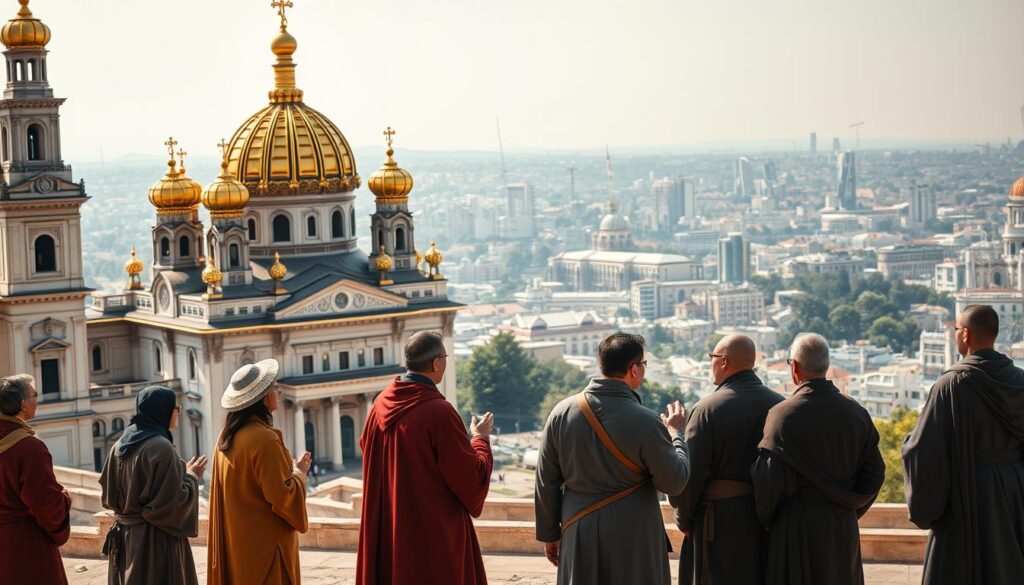
A grand cathedral stands tall, its golden domes and ornate facades reflecting the intermingling of Eastern and Western traditions. In the foreground, robed figures engage in animated discussion, their gestures conveying the exchange of ideas and beliefs. The scene is bathed in warm, diffused light, evoking a sense of timeless contemplation. In the distance, a bustling city skyline hints at the wider context of this cultural crossroads, where the paths of East and West have converged. The composition captures the spirit of discovery, the clash of civilizations, and the search for common ground in this pivotal moment of history.

Embassies from Rome and Early Proselytization

Prince Vladimir’s legendary search for faith wasn’t just folklore. Historical records confirm his envoys visited German churches representing Western Christianity. These scouts reported back about rituals they found less captivating than Byzantine services.

The famous chronicle account describes emissaries being “awestruck” by Hagia Sophia’s grandeur. This cultural mismatch shaped Rus’ spiritual direction. Though Roman Catholic missionaries kept trying, their efforts faced uphill battles against established traditions.

Conflicts and Cooperation in Medieval Rus’

Tensions between Christian branches began simmering long before 1054. The 9th-century Photian schism created rifts that influenced Vladimir’s decision. Byzantine clergy emphasized shared roots with Rus’ people, while Western bishops struggled with language barriers.

Despite competition, surprising cooperation occurred. Some churches blended elements from both traditions before strict divisions hardened. These early relations show how politics and faith intertwined in shaping a nation’s spiritual identity.

The Evolution of catholicism russia Through the Centuries

As the first millennium ended, religious boundaries in Eastern Europe began crystallizing into divisions that would shape centuries of conflict. Church leaders increasingly framed theological disagreements as matters of spiritual survival rather than scholarly debate.

Shifting Perceptions of Spiritual Authority

Metropolitan Ivan II set the tone in 1089 by rejecting a papal unity proposal. His detailed letter outlined differences in sacraments and leadership structures. This established a pattern of formal opposition that later hierarchs would expand.

Archbishop Nifont’s 12th-century decree shocked many believers. He declared:

“A mother seeking Catholic baptism for her child commits equal sin as one visiting pagan sorcerers.”

This radical stance reveals how Orthodox leaders viewed Western practices. Three key factors fueled this hostility:

  • Growing political alliances with Constantinople
  • Disputes over liturgical practices
  • Competition for converts in border regions
Leader Position Action Impact
Metropolitan Ivan II Rejected papal unity 1089 letter Formalized opposition
Archbishop Nifont Novgorod Equated Catholic/Pagan rites Deepened cultural divide
Metropolitan Isidor Kyiv 1430s Rome contact Ended 400-year isolation

By the 15th century, these developments created lasting barriers. The Russian Orthodox Church saw itself as guardian of true Christian tradition, while viewing the Catholic Church through lenses of suspicion. This mindset would influence interfaith relations for 800 years.

The Role of Catholic Orders and Crusades in Shaping History

Medieval Europe’s religious landscape was shaped by both sword and sermon. The Catholic Church employed military campaigns and peaceful missions to expand its influence, creating lasting tensions with Orthodox Christians. These efforts left deep marks on cultural memory and political relationships.
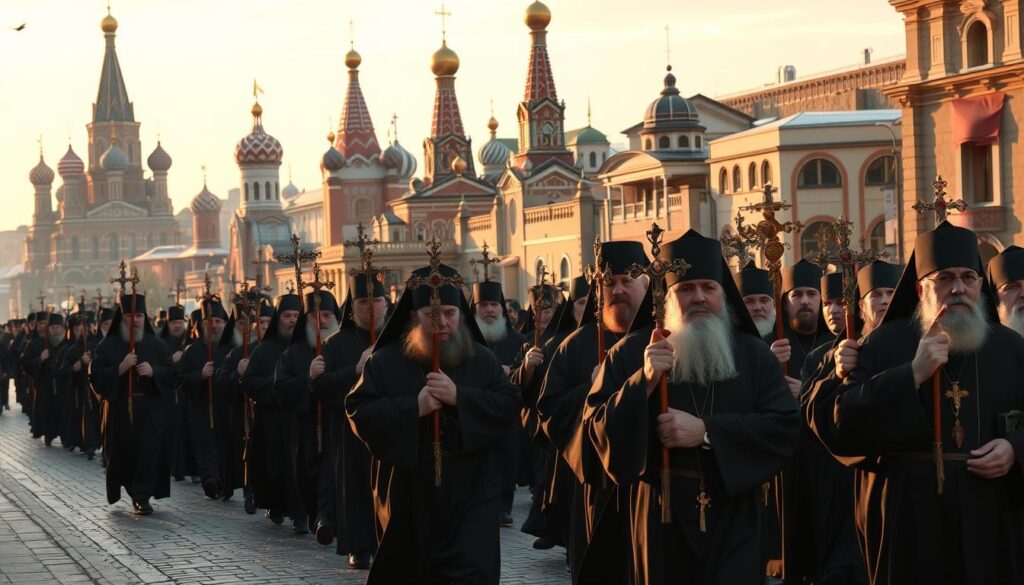
A solemn procession of Catholic orders marches through the streets of a historic Russian city, their robes and habits casting long shadows in the golden light of dusk. In the foreground, a group of monks bearing ornate crosses and reliquaries lead the way, their faces etched with determination. In the middle ground, a throng of brothers and sisters follow, their steps in sync as they chant ancient prayers. The backdrop is a tapestry of onion-domed cathedrals and towering fortresses, a testament to the intricate history of the Catholic Church's presence in this land. The scene evokes a sense of reverence, power, and the enduring influence of these religious orders in shaping the course of Russia's past.

Teutonic Knights and Northern Crusades

The Teutonic Knights stormed northwestern towns like Pskov and Novgorod in the 13th century. Locals resisted fiercely – not just over faith, but taxes. As one chronicler noted: “Better our own princes’ rule than foreign coffers.”

Sweden’s King Magnus Eriksson continued this pattern in the 1330s. His “crusades” masked land grabs, fueling Russian distrust of Western motives. Lithuania’s 1387 conversion to Catholicism created a powerful rival bloc next door.

Influence of Dominicans and Jesuits

Not all expansion involved violence. Pope Alexander IV sent Dominican friars to central regions in the 1300s. These clergy focused on education, establishing schools alongside churches.

Later Jesuit missionaries adopted local customs, showing flexibility in their efforts. This dual approach – force and persuasion – set the stage for complex relations in the Russian Empire era. As Pope Pius later observed: “Truth travels best on two roads – reason and example.”

Catholic Dioceses and Ecclesiastical Structures in Russia

Russia’s Catholic communities are supported by a network of dioceses stretching from Europe to Asia. At its heart lies the Moscow Archdiocese, overseeing three suffragan dioceses in Saratov, Irkutsk, and Novosibirsk. This structure ensures spiritual care across 11 time zones, from bustling cities to remote Siberian towns.
A sprawling map of Russia, its vast expanse stretching across the frame. Dotting the landscape, a network of Catholic dioceses and ecclesiastical structures emerge, their stately cathedrals and ornate spires standing in contrast to the surrounding vistas. The image is bathed in a warm, golden light, casting a reverent glow over the scene. In the foreground, intricate details of these religious institutions come into focus, their architectural styles and religious iconography showcasing the unique character of the Catholic Church's presence in this Eastern European nation. The overall composition conveys a sense of the breadth and depth of the Catholic faith's enduring influence within the Russian Federation.

Latin Church Jurisdictions and Parishes

The Latin Church serves most Catholics through 200+ parishes. Each suffragan diocese covers strategic regions:

  • Saratov: Volga River basin communities
  • Irkutsk: Siberian mining towns
  • Novosibirsk: Central Asian border areas

Sakhalin Island forms its own apostolic prefecture – a recognition of its unique needs as Russia’s easternmost territory.

Eastern Rites and the Byzantine Exarchate

The Russian Greek Catholic Church maintains Byzantine traditions while honoring papal authority. With only 3,000 members, this minority within a minority faces special challenges. Since 2004, Latin-rite Bishop Joseph Werth has doubled as their ordinary – a practical solution for limited resources.

Though small, these Eastern-rite communities preserve ancient liturgies. As one parishioner notes: “Our faith connects us to both Rome and our ancestors’ spiritual roots.”

Impact of the

Today’s Catholic communities quietly shape spiritual landscapes through everyday actions. Their daily prayer rates – three times higher than other religious groups – reveal deep personal commitments. These practices sustain traditions in kitchens and living rooms as much as in formal worship spaces.

Modern challenges test these tight-knit groups. Government regulations require careful navigation, while cultural differences create unique opportunities. Many parishes now blend multiple languages in services, reflecting their diverse membership.

The Catholic Church maintains influence through education and charity work. Soup kitchens and language classes build bridges across communities. These efforts showcase faith in action rather than doctrinal debates.

Looking ahead, younger generations bring fresh energy to ancient rituals. Their digital fluency helps preserve traditions while adapting to new realities. This balance between heritage and innovation may define the community’s future path in the nation’s evolving spiritual mosaic.

FAQ

How did early missionary efforts shape the Catholic Church’s presence in Russia?

Early missionaries, like those sent by Princess Olga of Kyiv, built bridges between Eastern and Western Christian traditions. Their work laid the groundwork for later religious exchanges, even as political tensions sometimes overshadowed spiritual connections.

What role did the Teutonic Knights play in Russia’s religious history?

The Teutonic Knights, active during the Northern Crusades, sought to spread Latin Christianity into Baltic and Slavic regions. Their campaigns often clashed with local rulers and the Russian Orthodox Church, leaving a legacy of both conflict and cultural exchange.

How did the Great Schism affect Catholic-Orthodox relations in medieval Rus’?

The 1054 split between Rome and Constantinople deepened theological and political divides. While trade and diplomacy continued, differences in practices like liturgy and clerical authority created lasting barriers between communities.

What are Eastern Catholic Churches, and do they exist in Russia?

Eastern Catholic Churches follow Byzantine traditions while recognizing papal authority. In Russia, small communities like the Byzantine Exarchate maintain this unique identity, though they face challenges in a majority-Orthodox society.

How did the Jesuits influence religious life in the Russian Empire?

Jesuit missionaries established schools and promoted dialogue with Orthodox thinkers during the 16th–18th centuries. Their focus on education and intellectual engagement left a lasting mark, even after their expulsion by Catherine the Great.

What happened to Catholic parishes under Soviet rule?

The Soviet regime suppressed religious institutions, confiscating churches and imprisoning clergy. Many Catholic parishes went underground, preserving rituals in secret until the late 1980s, when restrictions eased.

How have recent popes engaged with the Russian Orthodox Church?

Pope John Paul II prioritized ecumenical dialogue, while Pope Francis has collaborated with Patriarch Kirill on issues like Ukraine. These efforts aim to heal centuries-old rifts, though differences remain on topics like jurisdiction and doctrine.

Are there still tensions between Catholic and Orthodox communities today?

While cooperation has grown, disputes over property and missionary activity occasionally arise. Both sides emphasize shared values, but historical grievances and modern politics still influence interactions.

What is the status of the Greek Catholic Church in Russia?

The Greek Catholic Church, which blends Eastern rites with loyalty to Rome, has faced restrictions in Russia. Its small congregations often operate discreetly, navigating complex relationships with both state and Orthodox authorities.

How do Catholic dioceses function within Russia’s legal framework?

Catholic dioceses must register with the government, which regulates religious activity. While they can worship openly, proselytizing is limited, and leaders often balance faith with cautious diplomacy to avoid conflicts.
Catholicism and Transubstantiation: A Closer Look


At the heart of Catholic worship lies a sacred practice that has shaped believers for centuries. This ritual centers on the bread and wine used during Mass—elements that hold extraordinary meaning for millions. Though often misunderstood, this ancient teaching remains foundational to how Catholics experience their faith today.

The concept we’re exploring goes beyond symbolic gestures. It touches on what many consider the “greatest mystery” of their spiritual journey. Through centuries of reflection and prayer, the Catholic Church has preserved this belief as a vital connection to divine presence.

Modern discussions about this topic often spark curiosity. Some wonder how ordinary items could carry such profound significance. Others seek clarity amid cultural shifts that challenge traditional views. Our exploration will address these questions while honoring the depth of this practice.

In the coming sections, we’ll trace this teaching’s roots in scripture and its development through history. We’ll also examine why understanding it matters now more than ever—both for personal growth and community unity. Let’s begin this journey with open minds and respectful hearts.

Key Takeaways

  • Discover the historical roots of a central Catholic worship practice
  • Understand the difference between symbolic and sacred meanings
  • Learn how ancient traditions remain relevant in modern faith
  • Explore common questions about Eucharistic beliefs
  • Recognize the importance of ongoing religious education

Introduction: The Living Mystery of the Eucharist

What appears as simple bread and wine on the altar holds a truth that reshapes reality itself. This sacred meal isn’t just a reminder of ancient events—it’s a living encounter that feeds both soul and community.

Exploring the Sacramental Elements

Ordinary wheat and grapes become extraordinary through prayer. The Church teaches these elements become Christ’s body and blood while keeping their physical qualities. This change isn’t magic—it’s a sacrament, where visible signs convey invisible grace.

“The most blessed Eucharist contains the whole spiritual good of the Church, namely Christ Himself.”

Second Vatican Council

The Role of Faith in the Celebration

Recognizing the real presence requires more than sight. As the Council noted, the Eucharist is the “source and summit” of Christian life. Believers approach not just with logic, but with faith that transforms how they receive this gift.

Preparation matters. Clean hearts and focused minds help people connect deeply with this mystery. It’s not about perfect understanding—it’s about trusting the love behind the invitation.

Understanding “catholicism transubstantiation” in the Catholic Faith

A core teaching reveals how ordinary elements become spiritually significant through prayer. During Mass, believers witness what appears as simple bread becoming something far greater. This sacred moment centers on a fundamental change recognized by faith rather than physical observation.

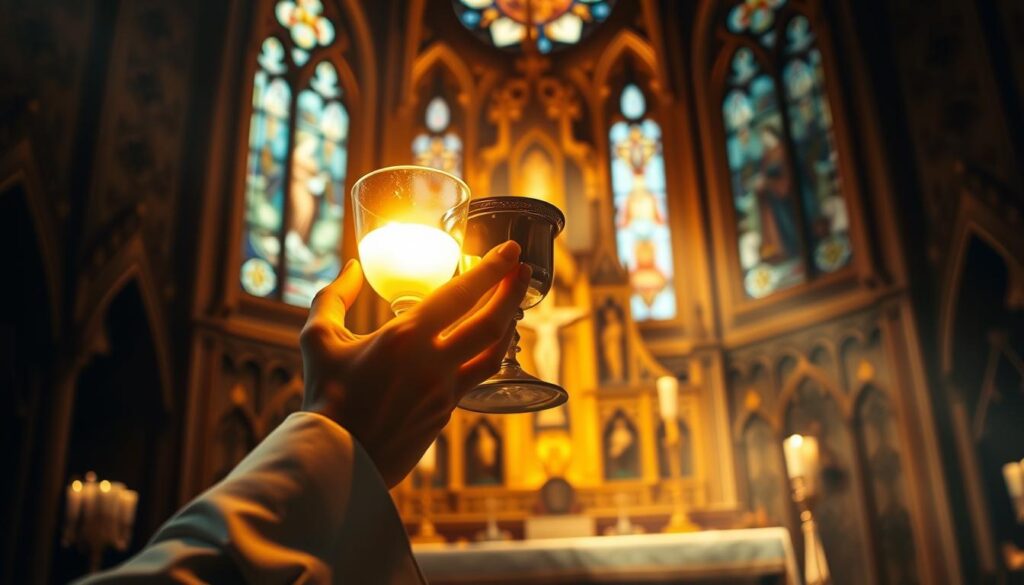
A solemn, ethereal scene depicting the Catholic sacrament of transubstantiation. In the foreground, a priest's hands hold aloft a glowing, golden chalice, the Eucharistic substance within radiating an otherworldly luminescence. Soft, warm lighting casts a heavenly glow, as if illuminated by divine grace. In the background, an ornate, Gothic-style altar adorned with intricate carvings and stained glass windows, symbolizing the sacred ritual taking place. The atmosphere is one of reverence and mysticism, capturing the profound spiritual transformation at the heart of Catholic doctrine.

Definition and Theological Significance

The Church describes this transformation as a change of substance. While the bread’s appearance remains, its deepest reality becomes Christ’s body. Similarly, the wine’s essence transforms into his blood, though its taste and color stay unchanged.

“By the consecration, the whole substance of the bread becomes Christ’s body—this change the Church rightly calls transubstantiation.”

Council of Trent

This teaching emphasizes spiritual reality over visible alteration. The term “substance” here refers to what something truly is, not just how it looks or feels. It’s like recognizing a friend’s voice on the phone—the form changes, but the person remains fully present.

Common questions often arise: Does the bread bleed? No—the change occurs at the level of substance, not physical properties. This belief strengthens the connection between Christ’s historical sacrifice and its living remembrance today. Through this mystery, worshipers experience divine closeness in a uniquely tangible way.

Biblical Foundations of the Real Presence of Christ

Jesus’ teachings about his presence in the bread and wine leave little room for symbolic interpretation. In John’s Gospel, he states plainly: “My flesh is real food, my blood real drink”. When listeners struggled with this concept, he doubled down rather than soften his words.

The Last Supper accounts reinforce this literal understanding. Matthew, Mark, and Luke all record Jesus holding unleavened bread saying: “This is my body”. He uses present-tense language—“is” rather than “represents”—establishing immediate connection between the elements and his sacrifice.

Gospel Event Key Words
Matthew 26:26 Bread Blessing “This is my body”
Mark 14:23 Cup Sharing “This is my blood”
Luke 22:19 Memorial Command “Do this in remembrance”
1 Cor 11:27 Warning “Guilty against body & blood”

“Whoever eats my flesh and drinks my blood remains in me, and I in them.”

John 6:56

Paul’s letter to Corinth shows early Christians took these words seriously. He warns against unworthy reception, implying they understood the meal as more than metaphor. This matches Jesus’ call for total communion—feeding on rather than merely remembering.

These passages form a scriptural chain linking covenant promises to sacramental reality. Through flesh and drink blood imagery, they invite believers into transformative participation with divine life.

Insights from Early Church Fathers and Their Testimonies

Long before formal doctrines took shape, Christian leaders preserved sacred truths through their writings. Their words reveal a consistent teaching about the Eucharist’s profound change—a belief rooted in apostolic times.

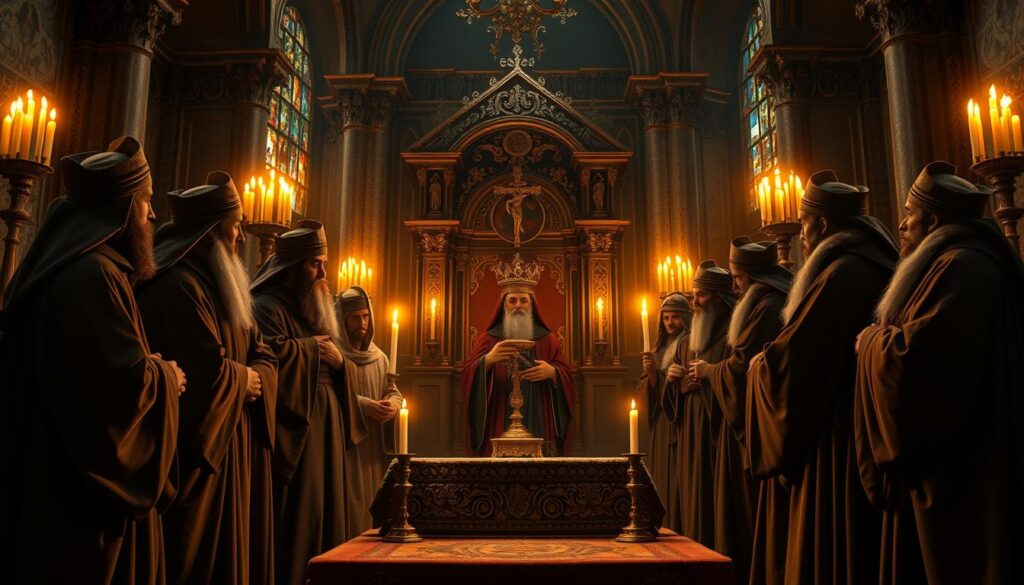
Solemn gathering of early Church Fathers in a dimly lit, ornate cathedral interior. Figures in flowing robes and headdresses stand reverently around an ornate altar, gazing upon the Eucharist elements. Warm candlelight flickers, casting deep shadows and imbuing the scene with a profound, mystical atmosphere. The Fathers' expressions convey deep contemplation and reverence as they partake in this sacred ritual, steeped in the rich theological tradition of the nascent Christian faith. Ornate architectural details, stained glass, and religious iconography fill the background, further enhancing the reverent ambiance.

Teachings of St. Justin Martyr and St. Ignatius

St. Justin Martyr’s second-century writings clarify how early Christians viewed the sacred meal. He explains: “The food becomes the flesh and blood of Jesus by the power of His words.” This wasn’t symbolic language—it reflected real nourishment for both body and soul.

“They abstain from the Eucharist… because they deny it is the flesh of our Savior.”

St. Ignatius of Antioch

Ignatius, writing even earlier, treated Eucharistic faith as non-negotiable. His warnings against dissenters show how central this mystery was to Christian identity.

Perspectives from St. Cyril, Ambrose, and St. Gregory

Later thinkers deepened this foundation. St. Cyril of Jerusalem urged believers: “Don’t see just bread and wine—they’re Christ’s body and blood.” His words mirror Jesus’ own declarations at the Last Supper.

St. Ambrose used striking language: “Nature itself changes through blessing… This is Christ’s true Flesh.” Meanwhile, St. Gregory of Nyssa coined “metastoikeiosas”—a Greek term meaning elements are restructured at their core.

Together, these early church fathers built a bridge between biblical accounts and later theological clarity. Their shared emphasis on change shows this wasn’t medieval invention, but lived truth passed through generations.

The Council of Trent and Clarification of Eucharistic Dogma

Amid 16th-century religious upheaval, the Catholic Church faced urgent questions about its core teachings. Protestant reformers challenged traditional views of the Eucharist, prompting leaders to clarify beliefs through the Council of Trent. This gathering became a turning point for defining sacred practices.

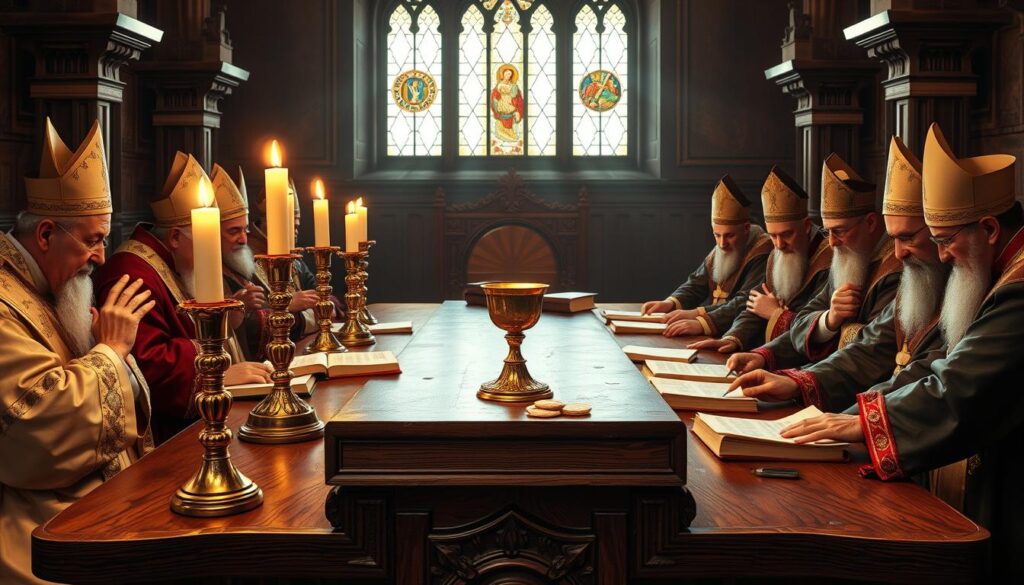
A solemn conclave of Catholic bishops and theologians, seated around a grand oak table, engaged in intense discussion. Ornate candlesticks cast a warm, reverent glow, illuminating their pensive expressions as they pore over ancient tomes and parchments. In the center, a golden chalice and communion wafers symbolize the core of their deliberations - the dogma of transubstantiation. Stained glass windows filter ethereal light, imbuing the scene with a sense of spiritual gravity. Elaborate ecclesiastical robes and architectural details evoke the grandeur of the 16th-century Council of Trent, where the Catholic Church solidified its stance on the Eucharist.

Reformer View Key Difference
Zwingli & Calvin Symbolic presence “In sign” only
Martin Luther Consubstantiation Christ coexists with elements
Melancthon Temporary presence Returns to bread/wine after Mass
Trent’s Response Full substance change “Whole reality” transformed

Council Decisions and Official Declarations

The 1551 decree left no room for doubt: “Christ is truly, really, and substantially present” under the appearances of bread and wine. This teaching reaffirmed that consecration alters the elements’ deepest reality while keeping physical traits intact.

“That wonderful conversion of the whole substance—the species alone remaining—we call transubstantiation.”

Council of Trent

By using precise terms like “substance”, Trent emphasized invisible transformation over visible signs. The council didn’t invent new ideas but codified centuries of reflection. Its language honored mystery while creating clear boundaries for belief.

Today, these definitions help Catholics navigate modern questions. They remind believers that the body and blood of Christ aren’t metaphors but living gifts—a truth worth preserving across generations.

The Evolution of Eucharistic Theology Through the Ages

The story of Eucharistic theology unfolds like a living conversation across centuries. As cultures shifted and new questions emerged, the Church refined its understanding while holding fast to sacred truths. This journey reveals both enduring belief and thoughtful adaptation to changing times.

Reformation Challenges and Diverse Interpretations

The 16th century brought seismic shifts in religious thought. Reformers like Martin Luther rejected traditional views of the bread and wine, calling them “Aristotelian word games.” England’s Test Act (1672-1828) even barred public office to those affirming this ancient teaching.

Yet these challenges sparked deeper reflection. The Church clarified that the change during Mass isn’t physical alteration but spiritual reality. As debates raged, ordinary worshippers continued approaching the altar with quiet reverence—a testament to lasting faith in Christ’s presence.

Modern Reflections on Ancient Teachings

Today’s believers inherit rich traditions while facing fresh questions. Some wonder how medieval terms apply to 21st-century spirituality. Others find new ways to connect with rituals first practiced in candlelit catacombs.

The core truth remains unchanged: what appears as simple bread and wine still nourishes communities worldwide. Through ongoing dialogue and prayer, this ancient practice continues shaping lives—proving timeless truths can thrive in any time.

FAQ

What does the Catholic Church teach about the Real Presence of Christ in the Eucharist?

The Church teaches that during Mass, the bread and wine truly become the body and blood of Jesus through consecration. This change in substance, while the appearance remains, allows believers to encounter Christ’s living presence in a unique way.

How does the Bible support the belief in Christ’s body and blood in Communion?

Passages like John 6:53-56, where Jesus says, “Unless you eat my flesh and drink my blood, you have no life in you,” highlight this truth. The Last Supper accounts in the Gospels also emphasize His command to repeat this sacred meal.

Did early Christians believe in the Real Presence before the term "transubstantiation" was used?

Yes! Writings from figures like St. Justin Martyr (2nd century) describe the Eucharist as the “flesh and blood” of Jesus. Early liturgies and teachings consistently affirmed this mystery, even before formal theological terms were established.

What role did the Council of Trent play in defining Eucharistic teachings?

The Council clarified doctrines in response to Reformation challenges, reaffirming that Christ’s body and blood are “truly, really, and substantially” present. It emphasized the priest’s role in the consecration and the importance of reverence for the sacrament.

How did the Reformation influence the Catholic Church’s understanding of the Eucharist?

Debates over symbolism versus literal presence led to deeper theological reflection. The Church reaffirmed ancient beliefs while addressing misunderstandings, stressing unity between Scripture, tradition, and sacramental life.

Why does the Eucharist still look like bread and wine if it becomes Christ’s body and blood?

The Church teaches that while the substance changes, the physical qualities (like taste or appearance) remain. This allows the mystery to be received in faith, not through physical senses alone—a gift inviting trust in God’s hidden work.

Discover the Fascinating Facts of Catholicism


For nearly 2,000 years, one spiritual tradition has united billions across continents and cultures. Rooted in the teachings of Jesus Christ and carried forward by His Apostles, this religion has shaped civilizations while maintaining its core principles. Today, it stands as the world’s oldest continuously operating institution, guiding over 1.3 billion followers in their daily lives.

From its humble beginning in ancient Judea to its global presence today, this faith has weathered empires, revolutions, and societal shifts. Its teachings have inspired breathtaking art, groundbreaking science, and enduring moral frameworks that continue influencing modern life. The Church’s commitment to education and charity remains unmatched, operating thousands of schools and humanitarian programs worldwide.

What makes this tradition so enduring? How has it adapted while preserving ancient rituals? As we explore its rich history, you’ll uncover surprising connections between past and present. You’ll see how generations have found meaning in its timeless practices and how its message continues resonating in our rapidly changing world.

Key Takeaways

  • Origins trace back to Jesus Christ and the Apostles nearly two millennia ago
  • Maintains unbroken traditions while adapting to modern global challenges
  • Operates the world’s largest network of schools and charitable organizations
  • Influences art, philosophy, and social structures across continents
  • Blends ancient rituals with contemporary spiritual guidance

Ancient Beginnings and Historical Highlights

Centuries before becoming a global force, Catholic tradition took shape through pivotal moments. Early followers faced persecution until Emperor Constantine’s Edict of Milan in 313 AD granted religious freedom. This landmark act transformed Christianity from hidden gatherings to public worship.

Foundations of the Early Church

Roman Emperor Theodosius made Christianity the state religion in 380 AD. This decision created an organized system of bishops and priests. Church leaders developed rituals still practiced today, blending Jewish roots with Greco-Roman culture.

The Role of the Printing Press in Preserving Scripture

Johannes Gutenberg changed religious history in 1455. His printing press produced the first mass-printed book – the Latin Bible. This innovation let ordinary people access sacred texts directly, reducing reliance on clergy for interpretation.

Milestone Year Impact
Edict of Milan 313 AD Legalized Christian worship
State Religion Declaration 380 AD Established church authority
Gutenberg Bible 1455 Democratized scripture access

Printed Bibles sparked literacy growth across Europe. Monasteries became early publishing hubs, preserving knowledge through turbulent times. This technological leap helped standardize Catholic teachings before denominational splits occurred.

Reformations, Rituals, and Liturgical Traditions

A single monk’s defiance reshaped Christianity’s trajectory forever. The 16th century saw spiritual renewal clash with long-standing traditions, creating ripples still felt today.

Martin Luther and the Transformation of the Church

German priest Martin Luther voiced concerns that ignited the Protestant Reformation. His 95 Theses challenged practices he believed exploited people’s devotion for gain. Luther’s bold Bible edits removed seven books he considered conflicting with core teachings.

This reformer nearly excluded Revelation too, sparking debates about scriptural authority. His actions created lasting divisions while pushing the Catholic Church to address internal issues.

Traditional Penance and Unique Worship Practices

Friday penance remains central to Catholic life, often through meat abstinence. Exceptions occur during major celebrations called Solemnities – joyful pauses in devotional practices.

Liturgical garments tell visual stories. The chasuble, worn over priests’ stoles, embodies love covering spiritual authority. As scripture says: “Over all these, put on love.” These symbols keep ancient wisdom alive in modern worship’s heart.

FAQ

How did the Catholic Church begin?

The Church traces its roots to Jesus Christ, who appointed St. Peter as the first pope. Early followers spread teachings across the Roman Empire, establishing communities that grew into a global faith.

Why was the printing press important to Catholicism?

Johannes Gutenberg’s invention in the 15th century allowed mass production of the Bible, including the Latin Vulgate. This made scripture more accessible and fueled both education and debates during the Protestant Reformation.

How did Martin Luther influence the Church?

Luther’s 95 Theses in 1517 challenged certain practices, sparking the Protestant Reformation. His actions led to reforms within Catholicism, like the Council of Trent, which clarified doctrines and rituals.

What role does penance play in Catholic worship?

Penance, including confession to a priest, emphasizes repentance and forgiveness. It’s a sacrament that reinforces spiritual renewal and accountability, rooted in centuries of tradition.

Are there unique Catholic rituals still practiced today?

Yes! Traditions like Eucharistic adoration, Lenten fasting, and liturgical seasons (e.g., Advent) remain central. Many rituals blend ancient symbolism with communal prayer, connecting believers across generations.

Catholicism vs Christianity: A Comprehensive Comparison


Many people wonder how two major faith traditions with shared roots can have distinct practices and teachings. While both groups hold core beliefs like the Trinity and Jesus’ resurrection, their approaches to worship and doctrine reveal fascinating contrasts. Understanding these nuances helps foster respect and clarity in spiritual discussions.

Over 1.2 billion individuals globally identify with the Catholic tradition, including nearly a quarter of Americans. These communities share foundational teachings about salvation and Christ’s divinity. However, differences in authority structures, sacraments, and interpretations of scripture create meaningful divides.

This guide breaks down key distinctions in approachable terms. We’ll explore historical origins, leadership models, and views on salvation. You’ll also discover how practices like communion and prayer vary between these traditions. Whether you’re exploring your own path or seeking to understand others, this comparison offers valuable insights.

Key Takeaways

  • Both traditions share core beliefs in Jesus’ divinity and salvation through faith
  • Distinct views on church authority create significant theological differences
  • Sacraments and worship practices vary widely between the two groups
  • Historical developments shaped their unique approaches to scripture interpretation
  • Understanding these contrasts promotes meaningful interfaith dialogue

Historical Foundations of Catholicism and Christianity

Let’s travel back through the centuries to uncover how ancient spiritual movements shaped modern religious practice. The story begins with humble beginnings and grows into a global legacy that still impacts billions today.

Seeds of Faith in Ancient Times

The Catholic Church traces its roots to Jesus’ teachings and the work of His apostles. Early followers faced harsh persecution for nearly 300 years under Roman rule. Everything changed when Emperor Constantine legalized Christian worship in 313 AD, marking a turning point in religious history.

From Underground Movement to Global Institution

By 380 AD, Emperor Theodosius declared the Roman Catholic Church as the empire’s official religion. This decision created a structured hierarchy that unified believers across vast territories. Missionaries carried these teachings far beyond Rome’s borders over time, planting the seeds for future churches worldwide.

Not everyone agreed on how to practice their faith. Debates about leadership roles and scriptural interpretations grew louder through the years. These discussions eventually led to major divisions, including the split between Eastern Orthodox and Roman Catholic traditions centuries later.

Understanding this shared history helps explain why different Christian groups exist today. While their paths diverged over time, all maintain connections to those early gatherings of believers from 2,000 years ago.

Core Beliefs and Doctrines

Central to these traditions is a profound agreement on sacred truths that shape worship and daily life. Followers across denominations find common ground in ancient declarations about God’s nature and humanity’s relationship with the divine.

Understanding the Trinity and Divinity of Jesus

Both groups affirm the Trinityone God existing as Father, Son, and Holy Spirit. Early creeds like the Nicene formulation capture this mystery: “We believe in one Lord, Jesus Christ, the only Son of God.” This shared belief underscores Christ’s dual nature as fully divine and fully human.

Scriptural foundations for this doctrine appear throughout the New Testament. Jesus’ statement “I and the Father are one” (John 10:30) remains a cornerstone text. The resurrection accounts further reinforce His divine authority over life and death.

Key Scriptural Interpretations

While united on core truths, approaches to biblical understanding reveal distinct perspectives. Many Protestant communities emphasize sola scriptura – scripture as the ultimate authority. Others value church tradition as a complementary guide to interpretation.

Aspect Shared Ground Distinct Approaches
Divine Nature Trinity affirmed Emphasis on Marian doctrines varies
Salvation Through Christ alone Role of sacraments debated
Authority Bible as inspired Tradition’s weight differs

The Apostles’ Creed serves as a unifying summary of essential beliefs. Its declarations about Christ’s birth, death, and resurrection create a theological framework embraced by diverse communities. These shared truths continue to guide worship and spiritual practice worldwide.

The Role of Salvation: Faith, Grace, and Works

Understanding salvation’s mechanics reveals deep contrasts between major Christian traditions. While both affirm Christ’s central role, their paths diverge when explaining how believers receive eternal life. These differences shape worship practices, spiritual disciplines, and community expectations.

Justification Through Grace

The Council of Trent (1545-1563) settled a fiery debate: Can faith alone save someone? Catholic teachings answer no, viewing salvation as a lifelong process requiring sacraments and moral effort. Protestants counter with Ephesians 2:8-9: “By grace you have been saved through faith… not a result of works.”

A tranquil church interior bathed in warm, golden light. In the foreground, an ornate altar adorned with intricate carvings and candles, symbolizing the role of faith and grace in salvation. In the middle ground, a stained-glass window depicting a divine figure, radiating a sense of divine presence. In the background, a congregation of worshippers, their faces reflecting contemplation and reverence, representing the importance of works in one's spiritual journey. The overall atmosphere is serene, inviting the viewer to reflect on the interconnectedness of faith, grace, and works in the pursuit of salvation.

Significance of Good Works

Here’s where rubber meets road. One tradition sees good works as essential for maintaining salvation, while another views them as natural outcomes of genuine faith. Catholics participate through rituals like confession and communion. Most Protestants celebrate these acts as symbolic reminders, not spiritual requirements.

Aspect Tradition A Tradition B
Sacraments Necessary channels Symbolic gestures
Works’ Role Maintain grace Demonstrate faith
Scriptural Focus James 2:14-26 Ephesians 2:8-9

This tension isn’t new. Reformers argued grace needs no human help, while others emphasized faith’s active nature. Both groups agree salvation starts with God’s gift—but disagree sharply on what happens next.

Sacraments and Religious Practices

Sacred rituals shape spiritual journeys in distinct ways across faith communities. These traditions mark life’s milestones while reinforcing core beliefs through symbolic actions.

Lifecycle of Sacred Rituals

The Catholic Church structures spiritual growth through seven sacraments. These include:

  • Baptism for newborns
  • First Communion ceremonies
  • Confirmation during adolescence

Infant baptism involves sprinkling holy water to cleanse original sin. Families celebrate First Communion when children receive the Eucharist for the initial time. Teens confirm their faith through special church ceremonies.

Modern Worship Expressions

Many Protestant groups focus on two primary practices. Believer’s baptism occurs when adults or older youth choose faith through full immersion. Communion services memorialize Jesus’ last supper rather than recreating it.

Practice Catholic Approach Protestant View
Baptism Infant sacrament Adult ordinance
Communion Transubstantiation Symbolic remembrance
Confession Priest-mediated Direct to God

These differences stem from varying interpretations of scripture’s authority. While the Catholic Church maintains formal sacraments, other churches emphasize personal spiritual experiences. Both approaches seek to connect believers with divine grace through meaningful practices.

Authority and Leadership in the Church

Leadership structures create visible divides among believers. The Catholic Church maintains a top-down model rooted in centuries of tradition. Other groups favor decentralized systems that empower local congregations.

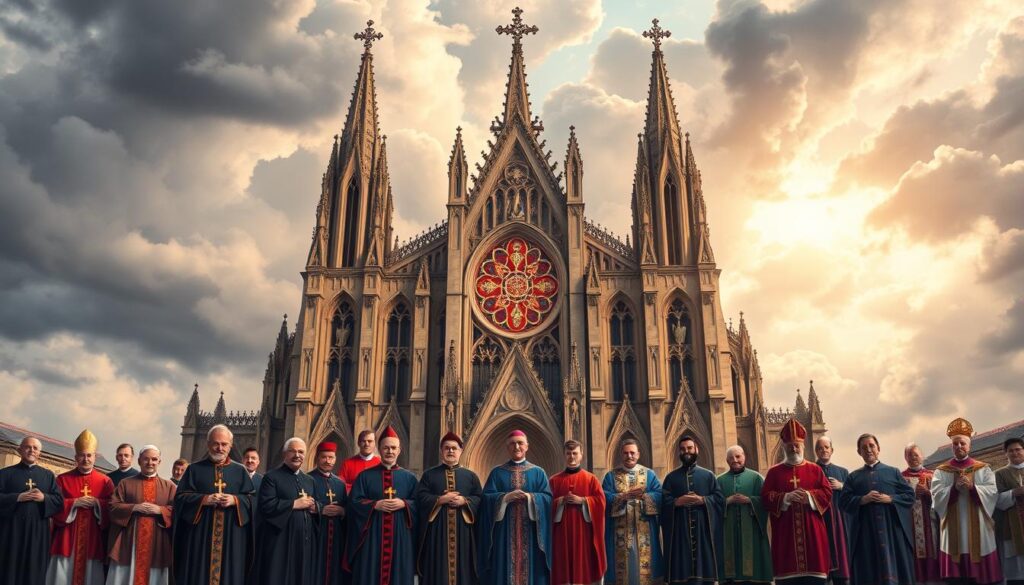
a detailed illustration of the catholic church authority structure, featuring a grand cathedral with ornate Gothic architecture and towering spires against a dramatic cloudy sky. in the foreground, a group of robed and mitered bishops and cardinals, each with a distinct facial expression and pose, standing in a formal arrangement that conveys a sense of hierarchy and power. the middle ground shows priests and deacons in various ceremonial vestments, carrying religious objects and symbols. in the background, a grand stained glass window casts a warm, ethereal glow over the scene, while the overall composition suggests a solemn, reverent atmosphere.

The Papacy and Church Hierarchy

At the summit stands the Pope, bearing titles like Vicar of Christ and Supreme Pontiff. Catholics believe his authority flows directly from Jesus through apostolic succession. This hierarchy extends through cardinals, archbishops, bishops, and local priests.

The doctrine of papal infallibility remains controversial. When officially defining faith matters, Catholics accept his rulings as error-free. Most Protestant denominations reject this concept entirely, citing biblical references to Christ as the only perfect mediator.

Comparison of Clergy Roles

Priests serve unique functions across traditions:

Role Catholic Practice Protestant Approach
Leadership Ordained mediators Guiding facilitators
Celibacy Required Optional
Sacraments Essential channels Symbolic acts

Protestant ministers emphasize the priesthood of all believers, encouraging direct prayer without clerical intermediaries. This contrast shapes how communities interpret scripture, resolve disputes, and maintain spiritual disciplines.

Scriptural Canon and Biblical Differences

Not all Bibles are created equal—some contain extra chapters and books. While both traditions cherish the New Testament, their Old Testament collections tell different stories. This divergence stems from ancient debates about which writings hold divine authority.

A vast library of ancient religious texts, with towering shelves of scriptures from various Christian denominations. In the foreground, a table showcases the distinct canonical differences between Catholicism and other Christian faiths, illuminated by warm, directional lighting. The scene has a scholarly, contemplative atmosphere, inviting the viewer to explore the nuanced theological distinctions reflected in the diverse array of sacred literature.

Differences in Holy Bible Canons

The Catholic Church includes seven additional texts called deuterocanonical books. These works like Tobit and Maccabees appear in Catholic Bibles but not Protestant ones. A 16th-century council solidified this divide by declaring these writings essential.

“If anyone does not accept these entire books as sacred Scripture… let them be anathema.”

Council of Trent (1546)

The Impact of the Apocrypha

Protestant reformers removed these books, arguing they lacked historical consistency. This decision reinforced their sola scriptura principle—biblical texts alone guide church teachings. Meanwhile, Catholic tradition values these writings for insights into prayer practices and afterlife beliefs.

Bible Version Old Testament Books New Testament Books
Catholic 46 (includes Apocrypha) 27
Protestant 39 27

Both groups fully agree on the 27 New Testament books. The clash centers on how tradition shapes scriptural understanding. One sees sacred writings as a living conversation, while the other prioritizes original texts alone.

catholicism vs christianity: A Direct Comparison

At the heart of both traditions lies a shared story of redemption that unites millions worldwide. While their spiritual journeys follow different routes, they converge at essential crossroads of belief and practice.

Key Similarities and Divergences

Both groups affirm foundational truths about God’s nature. They agree on:

  • The Trinity’s mysterious unity
  • Christ’s miraculous birth and resurrection
  • Humanity’s need for divine rescue from sin

Where paths diverge, the differences reshape daily spiritual life. Consider these contrasts:

Aspect Shared Belief Distinct Approaches
Salvation Through Christ Faith alone vs. sacraments + works
Authority Scripture’s importance Bible vs. Bible + tradition
Prayer To God Through saints vs. direct access

Mary’s role highlights another key difference. One tradition celebrates her as spiritual mother, while others focus solely on her historical significance. This shapes how people seek intercession in prayers.

Sacraments like confession stir debate too. Some view them as essential channels of grace, others as symbolic reminders. These practices influence how people experience forgiveness for sin.

Despite variations, both traditions guide people toward deeper faith. Understanding these nuances helps believers appreciate shared roots while respecting distinct spiritual expressions.

Interpretation of Tradition and Doctrinal Authority

Spiritual guidance often stems from ancient wisdom and evolving practices. The authority of tradition plays a vital role in shaping beliefs for many communities. Historic councils like Vatican II reinforced this view, declaring sacred traditions equal to scripture in guiding the faithful.

Living Wisdom Through Generations

The Catholic teachings emphasize tradition as a dynamic force. Documents like the Catechism provide clear summaries of core principles. Updated in 1992, this text became a cornerstone for modern believers under Pope John Paul II’s leadership.

How does the church teach these enduring truths? Through both written words and lived practices passed down centuries. This dual approach helps maintain unity while addressing contemporary spiritual needs.

Balancing tradition with scripture remains a distinctive way of preserving doctrinal integrity. The Catechism serves as a compass, blending ancient insights with current understandings of divine authority. This living document continues to shape how communities apply timeless teachings to modern life.

FAQ

How do beliefs about salvation differ between Catholics and other Christians?

Catholics emphasize grace, faith, and good works as essential for salvation, while many Protestant traditions teach salvation through faith alone. The Catholic Church views sacraments like baptism and confession as channels of divine grace, whereas some Christian groups focus more on personal faith in Jesus Christ.

Why does the Catholic Church recognize seven sacraments when others don’t?

The seven sacraments—like Eucharist and marriage—are rooted in sacred tradition and early church teachings. Other Christian denominations, such as Baptists or Methodists, often recognize fewer sacraments, prioritizing practices directly tied to Jesus’ teachings in the New Testament.

What role does the Pope play in Catholicism compared to other churches?

The Pope is seen as the spiritual successor to Saint Peter and holds authority over doctrine and church governance. Most Protestant churches reject papal authority, instead relying on local clergy or congregational leadership guided by Scripture alone.

Why do Catholics pray to Mary and saints?

Catholics view Mary and saints as intercessors who can pray to God on their behalf. This practice stems from sacred tradition and the belief in the communion of saints. Many Protestant groups avoid this, focusing prayers solely on God through Jesus Christ.

How do interpretations of the Bible differ between Catholics and Protestants?

Catholics include the Apocrypha (deuterocanonical books) in their Old Testament and rely on church tradition for interpretation. Protestants follow the 66-book canon and prioritize sola scriptura (“Scripture alone”), rejecting extra-biblical traditions as doctrinal sources.

Do Catholics and Protestants share the same view of the Trinity?

Both affirm the Trinity—Father, Son, and Holy Spirit—as central to their faith. However, Catholics emphasize mysteries of faith upheld by church teaching, while Protestants often ground their understanding strictly in biblical texts like Matthew 28:19.

Why is confession to a priest necessary in Catholicism?

Catholics believe priests act in persona Christi (in the person of Christ) to absolve sins, based on John 20:23. Most Protestants confess directly to God, citing 1 Timothy 2:5, which emphasizes Jesus as the sole mediator between God and humanity.

How did the Protestant Reformation shape differences in worship practices?

Reformers like Martin Luther rejected certain Catholic practices, such as Latin Mass and indulgences. This led to simplified worship styles in Protestant churches, focusing on preaching, congregational singing, and Scripture reading rather than liturgical rituals.

Discover the Essentials of Catholic Doctrine


What defines the spiritual foundation of over a billion believers worldwide? At its heart lies a carefully preserved system of teachings that has guided lives for centuries. This framework blends ancient wisdom with timeless truths about humanity’s relationship with the divine.

Central to these teachings is the belief in a triune God—Father, Son, and Holy Spirit—working together for humanity’s salvation. The Church views grace not just as a concept, but as God’s active love shaping daily choices. Through practices like prayer and sacraments, followers nurture virtues like faith, hope, and charity.

Many wonder how these ideas connect to modern life. The answer lies in their practical application: moral decisions, community bonds, and personal growth all stem from this spiritual blueprint. Whether you’re deepening your understanding or exploring new perspectives, grasping these principles offers clarity.

Key Takeaways

  • Core teachings focus on the Trinity, salvation, and humanity’s divine purpose
  • Grace serves as both divine love and its transformative impact on believers
  • The Church maintains authority in preserving theological truths across generations
  • Teachings influence daily decisions through virtues like charity and hope
  • Understanding these principles bridges historical tradition with modern faith practices

Understanding the Foundations of Catholicism Doctrine

Where do the roots of a global faith’s teachings begin? For centuries, the Apostles’ Creed has served as a spiritual compass. New members recite its words during baptism, affirming core beliefs passed down through generations.

Historical Origins and Biblical Roots

The creed’s foundation stretches back to Jesus’ first followers. Early Church leaders used it to teach converts about:

  • The Trinity’s divine mystery
  • Christ’s sacrifice and resurrection
  • Humanity’s need for salvation

Biblical texts like Genesis and Paul’s letters shaped these ideas. Stories of creation and redemption became guideposts for understanding humanity’s relationship with God. Saints like Augustine later explored how grace transforms human weakness.

Sacred Tradition and the Magisterium

Beyond written texts, oral teachings preserved vital truths. This living tradition works alongside Scripture like two hands clasped in prayer. The Church’s teaching authority ensures interpretations stay true to their original meaning.

Through councils and papal guidance, leaders address modern questions while honoring ancient wisdom. This balance allows faith to remain relevant without losing its eternal core.

Key Beliefs and Practices in Catholic Teaching

How do ancient spiritual truths shape modern religious practice? For millions, the answer lies in a living connection between belief and action. These teachings form a roadmap for navigating life’s challenges while maintaining spiritual focus.

The Core Doctrinal Tenets

At the heart of this framework stand three pillars: the Trinity’s mysterious unity, Christ’s redeeming sacrifice, and humanity’s call to holiness. These ideas aren’t abstract theories—they’re meant to transform how believers view relationships, suffering, and purpose.

A serene, stained-glass-inspired scene depicting the seven sacraments of the Catholic Church. In the foreground, intricate symbols representing baptism, confirmation, Eucharist, penance, anointing of the sick, holy orders, and matrimony are illuminated by soft, warm lighting. The middle ground features a majestic cathedral interior, with ornate columns and arches casting dramatic shadows. In the background, a heavenly glow radiates through the stained-glass windows, creating an atmosphere of reverence and divine presence. The composition is balanced and harmonious, conveying the essence of Catholic sacramental theology.

The Church’s explanation of divine grace offers practical guidance. As one theologian noted,

“God’s love becomes tangible through sacred rituals that mark life’s pivotal moments.”

The Significance of the Sacraments

Seven sacred rituals bridge earthly existence and eternal life. Baptism washes away original sin, while Confirmation deepens spiritual maturity. The Eucharist—considered the “source and summit” of faith—transforms bread and wine into Christ’s presence through transubstantiation.

Reconciliation mends broken relationships, and Anointing brings comfort during illness or near death. Marriage and Holy Orders celebrate vocational service, whether through family bonds or priestly ministry. These practices remind believers that prayer and community sustain spiritual growth.

From birth to final judgment, these teachings provide continuity. They address life’s biggest questions while pointing toward heaven—not as a distant reward, but as the fulfillment of humanity’s deepest longing for divine connection.

The Role of the Papacy and Church Authority

How does a single leader guide a global faith community? This question lies at the heart of understanding the papacy, a role rooted in ancient traditions yet constantly adapting to modern needs. Unlike secular power structures, this model of authority emphasizes service over control.

Servant Leadership and Biblical Foundations

Jesus redefined leadership during the Last Supper. When addressing disputes among His apostles, He stated:

“Let the greatest among you become as the youngest, and the leader as one who serves”

(Luke 22:26). This principle shines in His interaction with Peter. Though Satan would test all twelve disciples, Christ specifically prayed for Peter’s faith to endure—charging him to “strengthen your brethren” afterward.

This moment established a pattern. The pope isn’t a ruler but a spiritual anchor, ensuring unity through challenging times. Like Peter, modern pontiffs focus on teaching and encouraging rather than commanding.

Peter’s Legacy: From Apostle to Pope

Peter’s unique role created a blueprint for succession. Early Christians recognized the need for consistent church authority to prevent fragmentation. Today’s papacy maintains this through:

  • Guiding doctrinal clarity
  • Addressing contemporary ethical questions
  • Modeling humility in leadership

Critics often misunderstand papal power. It’s not about dominance but preserving truth while serving diverse communities—a balance first modeled by a fisherman-turned-rock of the early Church.

Doctrine vs. Discipline: Clarifying Common Confusions

Why do some aspects of faith remain fixed while others adapt over time? This question often sparks lively discussions about what truly defines a belief system. At the core lies a critical distinction between permanent truths and practical guidelines meant to serve communities.

A vibrant stained-glass window depicting the interplay of Catholic doctrine, discipline, and distinction. In the foreground, intricate patterns and symbolic imagery representing the core tenets of the faith. In the middle ground, solemn figures in religious robes, gesturing towards the central themes. In the background, a majestic cathedral, bathed in warm, ethereal light, conveying a sense of timeless reverence and spiritual harmony. The composition strikes a balance between the intellectual rigor of doctrine, the disciplined practice of the faith, and the distinct identity of the Catholic Church, all seamlessly woven together in a visually captivating and contemplative work of art.

Defining Unchangeable Doctrines

Doctrines form the bedrock of faith—timeless teachings traced back to Jesus and the apostles. These truths about moral principles and divine revelation remain unchanged across centuries. For example, the all-male priesthood isn’t a policy choice but a matter of sacred tradition rooted in Christ’s actions.

“The Church has no authority whatsoever to ordain women,”

Pope John Paul II emphasized, highlighting how certain doctrines transcend human decision-making. Such teachings require full acceptance rather than debate.

The Evolving Nature of Church Practices

In contrast, disciplines address practical needs and can shift with cultural contexts. Take priestly celibacy—a respected practice but not an unalterable rule. Early Church leaders demonstrated this flexibility when they revised dietary rules established at the Council of Jerusalem (Acts 15:28-29).

Scripture grants authority to adjust these guidelines through verses like Matthew 18:18. This balance preserves core beliefs while allowing pastoral responses to new challenges. Understanding this difference helps explain why some things change while others stand firm.

Engaging in Catholic-Protestant Dialogue

Why do discussions between Catholics and Protestants often feel like chasing answers in a maze? Both traditions share core Christian beliefs but differ in ways that spark endless questions. Effective dialogue requires patience, strategy, and a focus on root issues rather than surface-level debates.

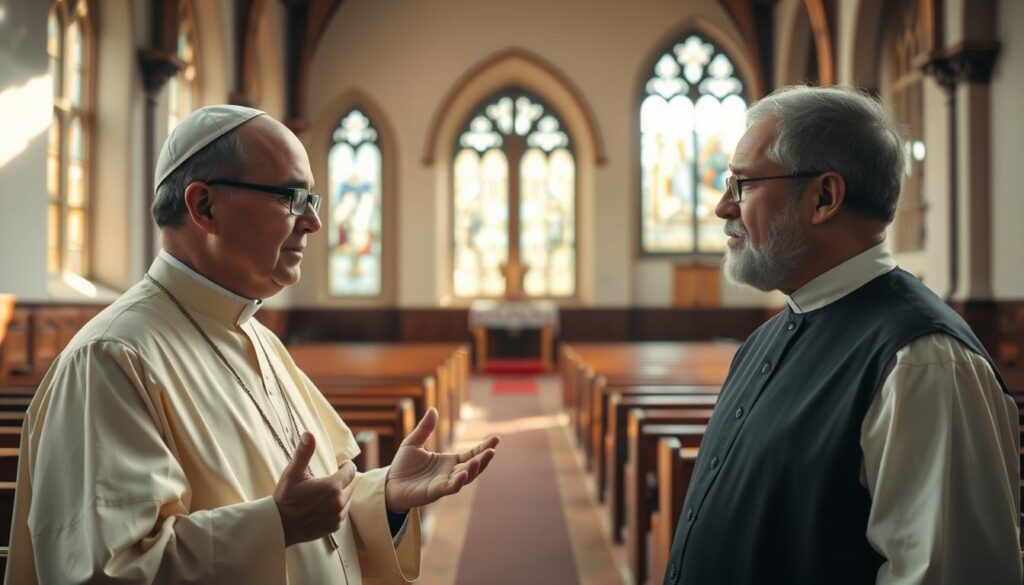
A respectful dialogue between a Catholic priest and a Protestant minister, set in a sun-dappled church interior. The foreground features the two figures, their expressions earnest yet calm, gesturing in thoughtful discussion. The middle ground showcases stained glass windows casting a warm, reverent glow. In the background, rows of oak pews and an ornate altar suggest a sacred, historic space. Soft natural lighting and a muted color palette evoke a sense of contemplation and mutual understanding. The overall scene conveys the essence of Catholic-Protestant dialogue - a thoughtful exchange within a revered religious setting.

Navigating Complex Questions with Grace

Imagine trying to answer 20 questions at once—this “shotgun approach” leaves everyone overwhelmed. A better way starts with identifying the central problem: Who holds authority to interpret Scripture definitively? As one apologist notes:

“Resolving the papacy question addresses 80% of other disputes—it’s the skeleton key of Christian unity.”

This doesn’t mean ignoring other views. It means creating space for meaningful explanation rather than rapid-fire replies. Most believers aren’t called to be theologians but seekers of truth within a faith community.

Balancing Depth and Breadth in Apologetics

Successful discussions prioritize depth over quantity. Instead of tackling every doctrinal difference, focus on how authority shapes understanding:

  • The Catholic view of Church leadership as Christ’s enduring gift
  • Protestant reliance on individual interpretation of biblical texts
  • The practical impact these approaches have on moral questions

This method avoids exhaustion while honoring both traditions. By approaching conversations with humility—and remembering the goal is understanding, not conquest—dialogue becomes a place for growth rather than conflict.

Conclusion

How does timeless wisdom remain relevant in a changing world? The answer lies in the church’s ability to balance enduring truths with compassionate practice. Guided by the Holy Spirit, this spiritual framework offers stability without stagnation—a living tradition that answers modern questions while honoring ancient roots.

Sacraments like confirmation and the Eucharist show how abstract doctrines shape daily life. These rituals aren’t just symbolic acts—they’re invitations to experience divine love through community and personal growth. Even as cultural norms shift, core teachings about human dignity and purpose remain unwavering.

Healthy discussion strengthens faith when approached with humility. Whether exploring scripture’s authority or learning from saints’ examples, spiritual growth thrives in spaces where curiosity meets tradition. This journey isn’t about having all answers—it’s about walking together toward deeper understanding, one faithful step at a time.

FAQ

How does the Catholic Church reconcile Sacred Tradition with Scripture?

The Church views Sacred Tradition and Scripture as complementary sources of divine revelation. Both flow from the same source—God’s communication to humanity—and are interpreted through the guidance of the Holy Spirit by the Magisterium, ensuring unity in teaching.

Why are sacraments central to Catholic practice?

Sacraments like Baptism and Eucharist are visible signs of God’s grace, instituted by Jesus to strengthen faith and unite believers with Him. They mark key moments in spiritual life, offering tangible encounters with His love and mercy.

What biblical basis supports the Pope’s authority?

Catholics point to Matthew 16:18–19, where Jesus names Peter the “rock” of His Church and grants him authority. This role is seen as continuing through Peter’s successors, fostering unity and guiding believers in truth.

Can Church teachings ever change?

Core doctrines, such as the Trinity or Resurrection, remain unchanging. However, disciplines like fasting rules or liturgical practices can adapt over time to serve the faithful better while preserving the faith’s essence.

How should Catholics approach dialogue with Protestants?

With humility and clarity! Focus on shared beliefs in Christ while addressing differences with charity. Understanding Scripture and history helps build bridges without compromising truth.

What role does the Magisterium play in interpreting faith?

The Magisterium—the Pope and bishops—serves as the Church’s teaching authority. Guided by the Holy Spirit, it safeguards apostolic teachings and ensures consistency in matters of faith and morals across generations.

Catholicism and Yoga: Finding Balance and Harmony


Millions of Americans today seek ways to connect physical wellness with spiritual growth. One practice sparking thoughtful conversations combines gentle movement with mindful breathing – a tradition with ancient roots now embraced worldwide. For those balancing religious devotion with holistic health, questions often arise about compatibility.

Recent data shows over 36 million people in the U.S. participate in this activity, drawn to its stress-relief benefits and flexibility training. Faith communities increasingly explore how physical disciplines can deepen prayer life while honoring core beliefs. Spiritual leaders emphasize the importance of discernment when blending practices from different traditions.

This exploration isn’t about simple answers but understanding nuances. Some worshippers find harmony through modified approaches that align with their values. Others discover renewed appreciation for their own faith’s rich history of contemplative practices. Experts suggest thoughtful reflection helps individuals make choices that nurture both body and soul.

Key Takeaways

  • Over 36 million Americans participate in yoga-related activities annually
  • Spiritual leaders emphasize discernment when combining practices
  • Modified approaches help align physical discipline with faith values
  • Historical contemplative traditions exist within many belief systems
  • Personal reflection aids in balancing wellness and religious identity

Embracing the Journey: An Introduction to Faith and Movement

As stress levels rise, seekers are turning to ancient traditions that unite motion and meditation. This exploration goes beyond trendy workouts—it’s about rediscovering how physical awareness can open doors to sacred connection.

Setting the Context in Modern Spirituality

Modern spiritual explorers often crave practices that engage both body and soul. A theology professor recently shared how leading sessions in a university chapel revealed surprising harmony: “The sacred space amplified our focus—participants felt their stretches became prayers in motion.”

Reflections on the Role of Physical and Spiritual Practice

Historical roots matter. For centuries, faith traditions have used movement—like pilgrimage walks or kneeling prayer—to deepen devotion. Today’s adaptations honor this legacy while addressing modern needs:

  • Intentional breathing exercises that mirror contemplative prayer rhythms
  • Flowing sequences that encourage gratitude for the body’s capabilities
  • Moments of stillness that create space for divine dialogue

Institutions now blend these approaches, recognizing that physical practices can enrich traditional worship. As one practitioner noted: “When I move with purpose, my mind quiets—that’s when I feel most connected to something greater.”

Catholicism and Yoga: Bridging Faith and Practice

In an era where 60% of adults blend spiritual practices from multiple traditions, thoughtful dialogue emerges about aligning physical disciplines with religious identity. This journey requires examining roots while honoring personal convictions.

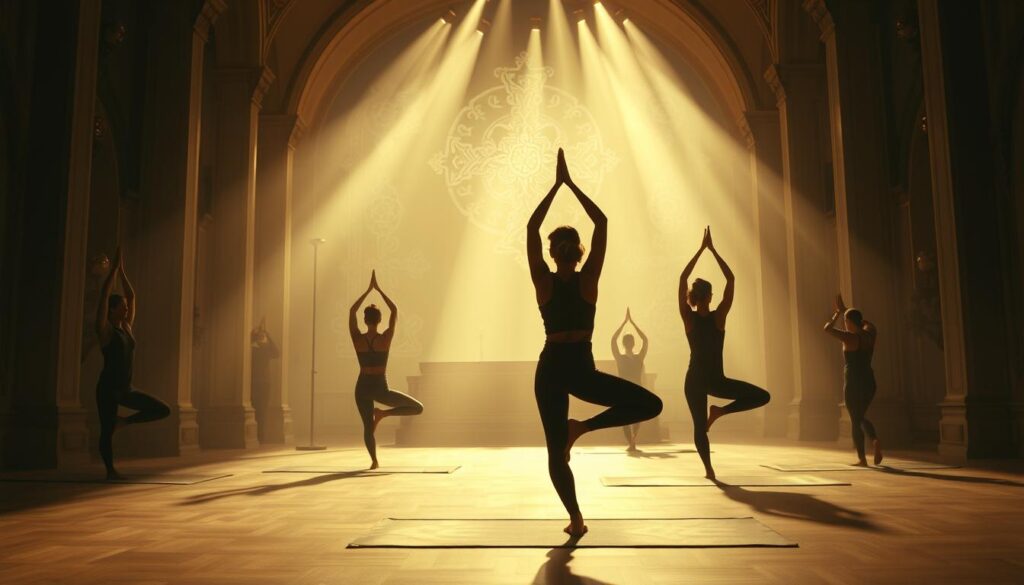
Graceful yoga practitioners in a serene, dimly lit sanctuary, bathed in warm, golden lighting. Intricate Catholic symbols and motifs subtly woven into the background, creating a harmonious fusion of spiritual traditions. The postures reflect contemplation, balance, and the interconnectedness of body and soul. Soft, muted tones convey a sense of reverence and introspection. Captured with a cinematic, shallow depth of field, emphasizing the focal point of the yoga poses and the sacred symbolism. The overall atmosphere evokes a profound sense of unity between the practices of Catholicism and Yoga.

Ancient Roots Meet Modern Faith

The Sanskrit word “yoke” carries dual meaning—linking spiritual unity and physical effort. Second-century texts like Patanjali’s Sutras outline eight pathways toward union, including ethical living and meditation.

Some theologians question whether this yoke concept aligns with Christian teachings about surrendering to divine will. “Christ’s invitation in Matthew 11 isn’t about effort—it’s about grace,” notes a seminary professor.

Movement as Sacred Language

Certain postures originate from stories about Hindu gods, like Warrior poses tied to Shiva’s mythology. This symbolism raises questions for those prioritizing doctrinal clarity.

Many modern practitioners adapt flows, focusing on breathwork over spiritual narratives. A retreat leader shares: “We rename poses—‘Mountain’ becomes ‘Praying Hands’—to foster Christ-centered mindfulness.”

Living the Dialogue Today

Groups like Ignatian Spirituality & Yoga reimagine ancient teachings through a Christian lens. Their sessions pair meditation on Scripture with gentle stretches.

Critics argue that consciousness-merging goals conflict with preserving individual identity in divine relationships. Yet supporters highlight parallels with mystics like St. Teresa of Ávila, who described union as “two candles becoming one light.”

Balancing Tradition, Theology, and Modern Practice

As holistic health gains popularity, questions arise about maintaining religious integrity. Spiritual disciplines now face fresh scrutiny through theological lenses. How do physical routines interact with sacred beliefs? The answer lies in thoughtful examination of actions and intentions.

Navigating Critiques & Spiritual Authenticity

St. Thomas Aquinas observed that actions carry inherent meaning beyond personal goals. This principle challenges modern approaches to ancient exercises. A 2021 study revealed 43% of participants experienced unexpected spiritual shifts during fitness programs originally pursued for flexibility.

Comparing Contemplative Prayer and Yogic Meditation

Christian traditions offer rich alternatives for unifying body and soul. Ignatian spirituality’s Examen prayer mirrors meditative focus while anchoring thoughts in Scripture. Consider these distinctions:

Aspect Contemplative Prayer Meditative Practice
Focus Divine presence Universal consciousness
Posture Kneeling/sitting Asana sequences
Goal Communion with God Self-realization
Framework Sacramental theology Eastern philosophy

Programs like Pietra Fitness demonstrate how movement can align with specific belief systems. Their modified flows replace traditional terms with faith-based language, addressing concerns about symbolic meanings.

Conclusion

Modern seekers face thoughtful choices when blending physical disciplines with spiritual commitments. The path forward remains deeply personal—a balance between honoring tradition and embracing wellness. Some find harmony through modified programs focusing solely on breathing and movement, while others prefer faith-based alternatives.

Discernment proves essential. Consulting trusted mentors helps align practices with core beliefs. Many discover value in exploring both supportive perspectives and thoughtful critiques within their community.

New options emerge regularly, from Scripture-centered exercise routines to meditation programs rooted in sacred texts. These adaptations allow individuals to strengthen their bodies while deepening spiritual connections.

Ultimately, the goal transcends any single method. Whether through modified classes or alternative regimens, the focus remains on holistic growth—nurturing physical health while cultivating a richer relationship with the divine.

FAQ

Can physical postures enhance spiritual growth in a faith-based context?

Movement and posture can serve as tools to deepen focus, calm the mind, and create space for reflection. Many find that intentional physical practices, when aligned with prayer or meditation, foster a stronger connection to their spiritual journey.

How do contemplative traditions in prayer compare to meditative practices?

Both emphasize stillness, inner awareness, and seeking union with the divine. While methods may differ—such as centering prayer’s focus on sacred words versus mindfulness of breath—the shared goal is transcending distractions to encounter deeper truths.

Are there theological concerns about blending movement with worship?

Some traditions emphasize discernment to ensure practices align with core beliefs. Open dialogue with spiritual leaders and intentional adaptation of exercises can help maintain harmony between physical discipline and faith values.

Can mindfulness coexist with a life rooted in religious tradition?

Yes. Mindfulness, when framed as cultivating presence and gratitude, complements many teachings about stewardship of the body and living intentionally. It becomes a bridge between daily actions and sacred purpose.

What role does community play in integrating movement and spirituality?

Shared practices—like group prayer walks or guided retreats—strengthen bonds and provide accountability. They also create opportunities to explore how collective energy uplifts individual and communal devotion.

How do modern believers navigate historical critiques of non-traditional practices?

Education and discernment are key. Understanding the origins of practices, filtering them through theological lenses, and prioritizing personal conviction help reconcile external methods with internal faith commitments.