Recent Posts

Catholicism: Understanding the Practices and Beliefs


Step into a spiritual tradition that has shaped cultures and inspired billions across the globe. With roots tracing back to the teachings of Jesus and the Apostles, this faith unites over 1.3 billion individuals through shared values and timeless rituals. Its influence extends far beyond religious spaces, weaving into art, education, and social justice efforts worldwide.

At the heart of this global community lies a structured spiritual framework. Guided by the Pope and the Holy See, followers participate in sacred ceremonies that mark life’s milestones. These traditions—from weekly gatherings to sacraments like baptism—create rhythms that deepen personal connections to the divine.

Daily spiritual life here isn’t just about rules; it’s a journey of growth and service. Many find meaning through acts of charity, prayer routines, and studying ancient texts. These habits foster both individual purpose and collective bonds within local parishes.

Whether you’re new to exploring spiritual traditions or seeking deeper understanding, this guide illuminates how centuries-old wisdom meets modern life. Discover how sacred rituals and community values continue to shape lives in every corner of the world.

Key Takeaways

  • The global community spans over 1.3 billion members across diverse cultures
  • Seven sacraments guide major life events and spiritual milestones
  • Service to others forms a core part of daily spiritual living
  • Weekly Mass unites members through prayer and shared traditions
  • Leadership structure traces back to the Pope and Vatican City

Foundations and Global Impact of Catholicism

At the core of this spiritual path lies a living blueprint that shapes lives across six continents. These timeless principles fuel everything from personal prayer routines to large-scale humanitarian efforts, connecting ancient wisdom with modern challenges.

Scriptural and Doctrinal Roots

The teachings find their source in sacred texts and generations of reflection. Jesus Christ’s words in Matthew’s Gospel set the standard:

“Love the Lord your God with all your heart… and love your neighbor as yourself”

This dual focus on divine connection and human compassion forms the bedrock of daily living for millions.

Commandments, Beatitudes, and Works of Mercy

Practical guidance comes through three key elements:

  • Ten Commandments: The first three rules strengthen one’s bond with the sacred, while the remaining seven outline ethical relationships
  • Beatitudes: Eight spiritual attitudes like humility and peacemaking that redefine true success
  • Works of Mercy: Fourteen actionable ways to serve others, from feeding the hungry to comforting the grieving

These principles drive real-world change. Over 600 hospitals and 6,500 schools in the United States alone trace their origins to this call for service. Through food banks, disaster relief, and educational programs, the church continues addressing pressing needs in every community it serves.

Deep Dive into catholicism practices and beliefs

Guiding principles shape how millions live their faith through weekly routines and annual celebrations. These patterns connect personal devotion with communal traditions, creating a spiritual roadmap for modern life.
A richly detailed, ornately decorated Catholic holy days calendar hanging on a stone wall, illuminated by warm candlelight. In the foreground, the calendar is embellished with intricate religious imagery, gold filigree, and the names of major feast days and saints. The middle ground features a stained glass window depicting a biblical scene, casting colorful light across the scene. In the background, a vaulted cathedral ceiling with shadowy alcoves creates a contemplative, reverent atmosphere. The lighting is soft and chiaroscuro, evoking the sacred, timeless nature of Catholic traditions and practices.

Understanding Catholic Teachings and Precepts

The Church’s precepts offer practical steps for spiritual growth. Members commit to Sunday Mass and six special holy days of obligation in the United States:

  • January 1: Honoring Mary’s divine motherhood
  • August 15: Celebrating her bodily assumption into heaven
  • December 25: Marking Christ’s birth with joyful worship

From age 14, believers abstain from meat on Lenten Fridays. Adults under 60 fast on Ash Wednesday and Good Friday—eating one full meal plus two smaller snacks.

The Role of Holy Days and Penance in Daily Life

Sacred seasons transform ordinary time into spiritual journeys. During Lent, many choose to:

  • Attend weekly Stations of the Cross
  • Donate to local food pantries
  • Practice daily Scripture reflection

These penitential practices aren’t about punishment but renewal. As one parish leader explains: “We empty ourselves to make room for grace.” This approach helps believers balance structure with personal spiritual needs throughout the year.

Understanding the Seven Sacraments

Sacred rituals mark key moments in a believer’s journey, blending divine grace with human experience. These seven spiritual milestones anchor personal growth while uniting communities through shared traditions.

Sacraments of Initiation and Their Significance

The journey begins with baptism, where water and sacred words welcome newborns into faith. Teens then affirm their beliefs through confirmation, receiving the Holy Spirit‘s gifts via blessed oil. “This anointing isn’t just symbolic,” explains Father Michael. “It ignites spiritual courage for life’s challenges.”

Holy Communion completes initiation as believers receive the body and blood of Christ. Weekly gatherings transform bread and wine into what many describe as “soul food” for daily living.

Sacraments of Healing and Vocational Consecration

When struggles arise, two sacraments healing offer renewal. Reconciliation mends broken relationships through honest conversation with clergy. Anointing brings comfort during illness through prayer and oil.

Life-changing choices find meaning in holy orders and marriage. Whether committing to religious service or lifelong partnership, these vows create sacred bonds that shape families and communities alike.

Rituals, Gestures, and Liturgical Life

Physical actions breathe life into spiritual connections during worship. Every movement in sacred gatherings carries layers of meaning, uniting communities through shared expressions of devotion.
A dimly lit Catholic church interior, the warm glow of candles illuminating the ornate altar and sanctuary. Priests in flowing robes perform the sacred Mass rituals, their gestures and movements steeped in centuries of tradition. Congregants kneel reverently, hands clasped in prayer, their faces alight with a sense of devotion and spiritual connection. The air is thick with the scent of incense, the chants and responses of the liturgy echoing off the vaulted ceilings. A shaft of sunlight streams through a stained glass window, casting a kaleidoscope of colors across the scene. The overall atmosphere is one of solemn reverence and timeless spiritual communion.

The Structure and Meaning of Mass

Sunday worship follows a four-part rhythm developed over centuries. The priest leads the assembly through Scripture reflections and sacred meals. This structure mirrors early Christian gatherings described in the Acts of the Apostles.

Part Focus Key Elements
Entrance Community Gathering Procession, opening hymn, greeting
Liturgy of the Word Divine Message Bible readings, homily, prayers
Liturgy of the Eucharist Sacred Meal Bread/wine offering, consecration, communion
Dismissal Mission Renewal Blessing, sending forth

During the Eucharistic prayer, the priest repeats Jesus Christ’s words from the Last Supper. Many describe this moment as “heaven touching earth” through simple bread and wine.

Common Gestures and the Sign of the Cross

Believers speak through motion as much as words. Making the Sign of the Cross involves:

  • Touching forehead while saying “Father”
  • Moving hand to chest for “Son”
  • Left then right shoulder for “Holy Spirit”

Folded hands during prayer show focus, while bowing honors the altar. A parish member shares: “These gestures help my faith move from head to heart.” Genuflecting before the tabernacle acknowledges the Holy Spirit‘s enduring presence in sacred spaces.

The Historical Journey and Organizational Structure

Tracing its roots to ancient fishermen and tax collectors, this global family grew into one of history’s most enduring institutions. Over two millennia, simple gatherings evolved into a network spanning nations and cultures. What began as a small community now unites 1.3 billion through shared spiritual heritage.

From Apostolic Origins to the Modern Church

The church built its foundation on three pillars: sacred texts, regional leadership hubs, and living traditions. Early believers looked to bishops—successors of the Apostles—to preserve teachings across generations. This structure ensured consistent guidance while adapting to new challenges.

The Papacy, Roman Curia, and Global Influence

At the worldwide level, the Pope serves as spiritual head supported by the Roman Curia. This governing body operates like a cabinet, with departments overseeing liturgy, education, and clergy matters. Together, they maintain unity while respecting local customs—a balancing act refined over centuries.

Through wars, scientific revolutions, and social changes, this tradition-anchored institution continues shaping lives. Its ability to honor ancient roots while engaging modern authority questions remains key to its enduring relevance.

FAQ

What are the seven sacraments in the Catholic Church?

The seven sacraments are Baptism, Confirmation, Holy Eucharist, Penance/Reconciliation, Anointing of the Sick, Holy Orders, and Matrimony. They mark key moments in spiritual life, from initiation to healing and vocational commitment.

Why is the Sign of the Cross important during Mass?

This gesture invokes the Holy Trinity—Father, Son, and Holy Spirit—and symbolizes faith in Christ’s sacrifice. It’s used in prayers, blessings, and as a personal reminder of unity with the Church.

How does the Catholic Church view the role of the Pope?

The Pope, as Bishop of Rome, is seen as the successor to St. Peter and the spiritual leader of the global Church. He guides doctrine, promotes unity, and oversees the Roman Curia to manage the Church’s mission.

What’s the purpose of sacraments like Anointing of the Sick?

The Anointing of the Sick offers spiritual strength and physical healing for those facing illness or death. It emphasizes God’s grace and the community’s support through prayer and the laying on of hands.

How do Holy Days of Obligation shape Catholic practice?

Days like Christmas and Easter require Mass attendance to honor key events in Jesus’ life. They deepen faith through communal worship and reflection on central teachings like the Resurrection.

What distinguishes sacraments of initiation from healing?

A: Baptism, Confirmation, and Holy Eucharist welcome believers into the Church. Penance and Anointing restore spiritual health, addressing sin, suffering, and the need for reconciliation.

Why do Catholics emphasize works of mercy?

Inspired by Jesus’ teachings and the Beatitudes, acts like feeding the hungry or comforting the sick reflect love for others. They’re seen as living out faith through service and compassion.

How does the structure of Mass reflect Catholic beliefs?

Mass includes the Liturgy of the Word (Scripture readings) and Liturgy of the Eucharist (Communion). This mirrors the belief in Christ’s presence in both Scripture and the consecrated bread and wine.
Catholicism and Divorce: Understanding the Church’s Position


Marriage holds a sacred place in the Catholic faith, seen as a lifelong commitment between partners. While the Church teaches that this bond cannot be broken, many believers face challenges when relationships become strained. This guide explores how faith communities address marital difficulties while upholding their core values.

Research shows that 34% of American Catholics have experienced divorce, though regular churchgoers report lower rates. The Church recognizes that separation may sometimes be necessary for safety or well-being. This nuanced approach balances doctrine with compassion, offering support even in complex situations.

You’ll learn how teachings about marriage shape community practices and what options exist for those navigating broken relationships. We’ll clarify common misunderstandings and highlight resources available through parishes. Every story matters, and this article aims to help you stay connected to your spiritual home during life’s toughest moments.

Key Takeaways

  • The Church views marriage as permanent but acknowledges practical realities
  • Pastoral support remains available even after marital breakdown
  • Separation is permitted in cases involving harm or danger
  • Regular church attendance correlates with lower divorce rates
  • Faith communities provide guidance for maintaining spiritual connections
  • Legal divorce doesn’t automatically affect participation in Church life

Overview of catholicism divorce

Many Catholic couples enter marriage with unwavering dedication, yet life’s complexities sometimes unravel even the strongest bonds. The Church’s teachings emphasize permanence, but modern relationships face pressures unseen in previous generations.

Defining the Main Issues

At the heart of this challenge lies a delicate balance. Church doctrine maintains that valid marriages are indissoluble, while recognizing that separation might be necessary for safety or emotional health. This creates practical questions for those navigating broken relationships:

Aspect Civil Divorce Church Perspective
Legal Status Recognized by state Doesn’t dissolve sacramental union
Remarriage Permitted Requires annulment process
Community Role No restrictions Full participation allowed

Confusion often arises about sacraments and social standing. A parish priest recently shared:

“We walk with people through their pain, not away from them. Your place in our faith family remains secure, even when marriages don’t.”

Why This Topic Matters Today

Modern Catholics juggle traditional values with 21st-century realities. Nearly 1 in 3 marriages end in legal separation nationwide, creating pastoral needs that demand thoughtful responses.

Parishes now offer specialized support groups and annulment guidance teams. These resources help individuals reconcile their spiritual identity with personal circumstances. Open dialogue fosters understanding, replacing stigma with compassionate solutions.

As family structures evolve, the Church’s approach demonstrates how timeless truths can meet contemporary challenges. This balance helps maintain both doctrinal integrity and a welcoming community for all believers.

The Biblical and Historical Foundation of Marriage

The concept of lifelong union finds deep roots in sacred texts and early Christian traditions. These sources shaped how communities understand commitment through changing times.

A serene, dimly lit church interior with intricate stained glass windows casting warm, colored light. In the foreground, a bride and groom stand facing each other, their hands clasped, expressions solemn yet joyful as they exchange vows. Behind them, a wooden altar adorned with candles and flowers, symbolizing the sacred union. In the background, pews filled with reverential onlookers, capturing the solemnity and timelessness of the biblical foundation of marriage.

Scriptural Insights on Marriage Permanence

Jesus’ teachings in Matthew’s Gospel set the cornerstone: “What God has joined together, let no one separate” (Matthew 19:6). This echoes Genesis’ vision of two becoming “one flesh” – a union surpassing legal contracts.

Early followers faced practical challenges. Paul’s letters urged couples to seek reconciliation, even in strained relationships. The message stayed clear: marriage reflects divine love’s unbreakable nature.

The Role of Early Church Teachings

By the 3rd century, leaders like Tertullian condemned separation practices. Councils later formalized these views, as shown below:

Biblical Reference Key Teaching Historical Impact
Matthew 19:6 Indissolubility Basis for annulment process
Genesis 2:24 Unity principle Shaped sacramental theology
1 Corinthians 7:10-11 Reconciliation focus Reduced divorce rates by 900 AD

A 10th-century bishop noted:

“Marriage mirrors Christ’s bond with His church – steadfast through all trials.”

These foundations explain why the church maintains its stance today. Historical documents like the Council of Florence’s 1439 decree reinforced marriage as a sacred practice, blending spiritual truths with communal wisdom.

Catholic Church’s Teaching on Marriage as a Lifelong Bond

The Catholic Church teaches that marriage forms an unbreakable spiritual bond, creating a single entity from two individuals. This concept originates in Genesis, where Scripture describes spouses becoming “one flesh” through divine design. The Council of Florence’s 1439 declaration solidified this view, defining marriage as a sacrament mirroring Christ’s eternal union with His Church.

Understanding this distinction helps clarify why the Church maintains its position:

Aspect Sacramental Union Civil Marriage
Origin Divine covenant Legal agreement
Dissolution Ends only at death Dissolvable by court
Purpose Reflects Christ-Church bond Social/legal partnership

A parish priest from Chicago explains:

“We don’t abandon people in difficult marriages – we help them find grace in the struggle.”

The Roman Catholic Church emphasizes that valid marriages require free consent and understanding. Even separated couples remain sacramentally united. This teaching encourages partners to seek reconciliation while providing pastoral care during hardships.

Though civil divorce addresses legal matters, it doesn’t erase the spiritual connection. The Church’s stance protects the sacredness of marital vows while offering compassionate support. Families facing challenges often find strength through parish-based counseling and prayer communities.

Understanding Civil Divorce vs. Catholic Annulment

Legal separations and spiritual resolutions often get tangled in confusion. Let’s untangle these distinct paths with clarity and care.

Key Differences Between the Two Processes

Civil divorce handles practical matters like property splits and custody. It’s a government action that changes your legal status but leaves spiritual questions unanswered.

Factor Civil Divorce Catholic Annulment
Authority State courts Church tribunal
Focus Legal separation Sacramental validity
Outcome Ends legal union Declares no marriage existed

The annulment process digs deeper than court papers. Church tribunals check if both partners truly understood their vows when exchanging rings. Were they free from hidden fears or pressures?

“We’re not erasing history – we’re examining whether all marriage essentials were present from day one,” explains a tribunal advocate from Ohio.

You can complete civil divorce first without Church penalties. But remarrying in the Church requires that declaration of nullity. This safeguard protects the sacredness of vows while offering hope for new beginnings.

The Catholic Annulment Process Explained

Understanding Church procedures helps individuals navigate complex marital situations with clarity. The annulment process examines whether a marriage met essential spiritual requirements from its start.

A formal, dignified interior of a Catholic church. In the foreground, a desk with an open book, quill, and parchment, representing the administrative process of annulment. In the middle ground, two figures, a priest and a layperson, engaged in discussion, symbolizing the consultation aspect of the annulment procedure. The background features ornate altar pieces, stained glass windows, and candles, creating a reverent, solemn atmosphere. Warm, golden lighting illuminates the scene, emphasizing the sacred nature of the event. The composition conveys the gravity and solemnity of the Catholic annulment process.

Essential Requirements for a Valid Marriage

Church law outlines specific conditions for sacramental unions. Five elements must be present for a Catholic marriage to be binding:

Requirement Purpose Common Issues
Free Consent No pressure or deception Coerced agreements
Understanding Grasp lifelong commitment Hidden addictions
Openness to Children Accept parental role Secret birth control

A tribunal advocate notes:

“We’re detectives of the heart, not judges. Our goal is truth, not blame.”

Clarifying Common Misconceptions

Many fear annulments invalidate shared memories or children’s legitimacy. Neither is true. The process simply determines if all marriage essentials existed initially.

Contrary to rumors, Church tribunals don’t favor wealth or status. Each case undergoes rigorous review with witness interviews and document checks. Most processes take 12-18 months, ensuring thorough evaluation.

Remember: Civil divorce handles legal matters, while annulment addresses spiritual validity. Both can coexist without conflict in Church teaching.

Navigating the Tribunal Process: What to Expect

Beginning the annulment journey can feel overwhelming, but knowing the roadmap eases anxieties. The Church designed this process to carefully examine marriages while supporting individuals spiritually. Start by contacting your parish office or local diocesan tribunal – they’ll provide forms and explain next steps.

A solemn, dimly lit church interior, with sunlight filtering through stained glass windows. In the foreground, a panel of robed clergymen sit at a long wooden table, engaged in a serious discussion. Behind them, an ornate altar and religious iconography lend an air of gravitas to the proceedings. In the middle ground, a petitioner stands before the tribunal, their expression a mix of apprehension and reverence. The background is hazy, the focus drawn to the central drama unfolding. A sense of reverence and formality permeates the scene, reflecting the gravity of the church's tribunal process.

Steps in the Tribunal Process

You’ll first complete detailed questionnaires about your relationship history. These forms explore your courtship, wedding preparations, and challenges during marriage. Honest answers help tribunals assess whether essential marriage elements were present.

Phase Key Action Timeline
Initial Contact Submit petition & witness list 1-4 weeks
Documentation Complete marriage history forms 2-6 months
Review Tribunal examines evidence 6-12 months
Decision Bishop approves outcome 1-3 months

A “defender of the bond” ensures fair evaluation by arguing for the marriage’s validity. Your former spouse receives notification but doesn’t need to participate. Witnesses who knew you both provide crucial perspectives through written statements or interviews.

“We’re not here to judge lives – we’re seeking truth with compassion,” shares a tribunal coordinator from Texas.

Most cases take 12-24 months, with fees often scaled to income. If denied, you can appeal or reapply with new evidence. Remember, this process honors your spiritual journey while upholding the Church’s teachings on sacred unions.

Can a Divorced Catholic Remarry?

Finding hope after marital breakdown remains a pressing concern for many faithful individuals. The Church provides clear guidelines while offering compassionate support for those seeking new beginnings.

Paths to Sacramental Unions

Civil remarriage is legally possible, but sacramental unions require specific conditions. Without an annulment, Catholic ceremonies remain unavailable. This process examines whether essential elements were missing in the original vows.

A declaration of nullity allows remarriage within the Church, as if the previous union never existed sacramentally. Start this process early – parishes recommend beginning before planning new commitments. Tribunals typically need 12-24 months to review cases thoroughly.

Those who remarry without annulments face no expulsion from faith communities. While considered irregular under Church teaching, they’re still welcomed with open arms. Many dioceses now offer specialized ministries to help navigate these complex situations.

Remember: Annulments don’t erase shared memories or children’s legitimacy. They simply assess whether the marriage met spiritual requirements from the start. With proper guidance, individuals can rebuild lives while maintaining their spiritual home.

FAQ

How does the Catholic Church view divorce?

The Church teaches that marriage is a lifelong sacramental bond. While civil divorce may address legal matters, it doesn’t dissolve the spiritual union. Members are encouraged to seek guidance from their parish or tribunal for support.

What’s the difference between civil divorce and a Catholic annulment?

A civil divorce ends a legal marriage, but an annulment examines whether the union met sacramental requirements from the start. The process involves a tribunal review under the Code of Canon Law to determine validity.

Can someone who’s divorced receive holy communion?

Divorced individuals who haven’t remarried or entered a new relationship may receive communion. Those in subsequent unions without an annulment are asked to abstain, but pastoral care is available to explore options.

What role does the community play in supporting divorced members?

Parishes often offer ministries, counseling, or groups like DivorceCare to provide emotional and spiritual care. The Church emphasizes compassion while upholding its teachings on marriage.

Are children affected by an annulment considered illegitimate?

No. An annulment doesn’t impact the legitimacy of children, who remain recognized and loved within the faith community. The process focuses solely on the marriage’s sacramental validity.

How long does the annulment process take?

Timelines vary, but most cases take 12–18 months. Factors like case complexity, diocese resources, and witness cooperation influence this. Your parish priest or tribunal can provide local estimates.

Can a divorced Catholic remarry in the Church?

Yes, if an annulment is granted or the previous spouse has passed away. Remarriage without these steps isn’t permitted, but pastors can help navigate paths toward healing and sacramental participation.

What if a couple married outside the Church seeks annulment?

Non-Catholic marriages may still require a declaration of nullity if one or both parties were baptized. The tribunal evaluates factors like free consent and understanding of vows.

Catholicism Through the Ages: A Captivating Timeline


Let’s explore a story that stretches across continents and centuries. The Catholic Church began as a small group of believers and grew into one of humanity’s most enduring institutions. From ancient rituals to modern reforms, its journey reflects both steadfast tradition and remarkable adaptability.

You’ll see how early Christian communities laid foundations that still support over 1.4 billion followers today. Through wars, artistic revolutions, and social shifts, this global faith shaped education systems, healthcare networks, and cultural masterpieces. Its teachings traveled further than the Roman Empire ever did.

This timeline isn’t just about dates – it’s about people. Discover how leaders navigated political storms while preserving core beliefs. See how cathedrals became classrooms and prayers turned into policies. We’ll make complex ideas simple, showing why this living tradition remains relevant in our fast-changing world.

Key Takeaways

  • The Catholic Church maintains 1.4+ billion followers worldwide
  • Historical events continuously shaped religious practices and doctrines
  • Balanced preservation of core beliefs with cultural adaptation
  • Significant influence on art, education, and social systems globally
  • Connects ancient rituals to modern spiritual needs
  • Offers accessible exploration of complex theological concepts

Introduction to Catholic Heritage

Imagine holding a key that unlocks two millennia of human achievement. This guide helps you explore how spiritual beliefs shaped societies, inspired masterpieces, and built systems we still use today. You’ll see connections between ancient prayers and modern hospitals, medieval manuscripts and current laws.

Your Map Through Time

Think of this as your friendly roadmap through complex stories. We’ll show how a Roman Catholic community in Jerusalem grew into a global network of 24 distinct churches. These groups work together across 3,500 dioceses, yet keep their unique traditions alive.

Beyond Sunday Services

The Catholic Church’s influence reaches far beyond worship spaces. Consider these impacts on daily life:

  • Monks saved classical texts during wars, preserving philosophy and science
  • Cathedral schools evolved into today’s university system
  • Early hospitals followed monastic care models

Art lovers recognize this heritage in soaring Gothic arches and Mozart’s melodies. Lawmakers still debate ideas from St. Thomas Aquinas about justice and human rights. By understanding these connections, you’ll see why the church remains a force in our modern world.

The Early Church: Foundations and Apostolic Roots

What does it take to turn a small group of followers into a global movement? In the decades after Jesus Christ‘s resurrection, his disciples faced this challenge head-on. Their work created the blueprint for what we now recognize as the Catholic Church.

A bustling early church community, gathered in a modest stone structure bathed in warm, golden light. Worshippers in flowing robes converse animatedly, their faces expressing devotion and fellowship. In the foreground, elders lead a solemn ceremony, the scene imbued with a sense of reverence and spiritual connection. Sunlight streams through stained glass windows, casting kaleidoscopic patterns on the worn, wooden pews. The atmosphere is one of community, faith, and the enduring legacy of the apostolic roots of Christianity.

Seeds of Belief: The Apostolic Era

The years 33-100 AD saw explosive growth. Apostles like Peter and Paul traveled tirelessly, planting faith communities across the Mediterranean. They adapted teachings from the New Testament to local cultures while keeping core doctrines intact.

Key developments emerged during this age:

Event Location Impact
Pentecost (33 AD) Jerusalem Holy Spirit empowers apostles
Paul’s missions (45-60 AD) Asia Minor/Greece Spread to Gentile communities
Peter in Rome (60-68 AD) Roman Empire Established leadership center

Communities That Changed the World

Early believers met in homes, sharing meals and prayers. Jerusalem’s Jewish Christians worshipped differently than Corinth’s Greek converts, yet both followed the same church structure. The breaking of bread (Eucharist) became their sacred bond.

These groups faced persecution but grew rapidly. By 100 AD, thriving communities stretched from Egypt to Spain. Their unity in diversity set patterns still seen in today’s Catholic Church.

Development of Catholic Doctrine in Antiquity

How did scattered writings become sacred scripture? The answer unfolded over four centuries as early Christians shaped their Catholic doctrine through prayerful debate and inspired leadership. This era transformed oral teachings into a unified faith system that still guides millions today.

Scriptural Traditions and Early Canon Formation

Imagine early believers debating which letters deserved shelf space beside Torah scrolls. By 95 AD, Clement of Rome referenced eight New Testament books in his teachings. Within 15 years, Polycarp recognized fifteen texts as authoritative.

The process accelerated across generations:

  • Ignatius of Antioch validated seven books by 115 AD
  • The Muratorian Canon (170 AD) excluded four later-accepted texts
  • Irenaeus championed 21 books by 185 AD

Final approval came through councils – Laodicea (363 AD) confirmed 26 books, while Hippo and Carthage (393-397 AD) sealed the 27-book New Testament we know. This careful curation became the tradition that unites the Catholic Church worldwide.

The Transition from Jewish Roots to Distinct Beliefs

Early Christians walked a tightrope between honoring Jewish heritage and proclaiming radical new beliefs. Leaders like Irenaeus developed frameworks showing how Jesus fulfilled prophecies while establishing fresh truths. Their work birthed core concepts:

“The Word became flesh,” wrote John, capturing Christ’s dual nature debated for centuries. Through spirited councils and personal sacrifices, the church clarified doctrines about the Trinity and salvation by grace. These decisions shaped a Catholic doctrine that resonated across cultures while keeping apostolic roots alive.

Influence of the Roman Empire and Legalization of Christianity

The fourth century reshaped Christianity’s destiny through imperial power. What began as underground gatherings became church structures mirroring Rome’s efficiency. This fusion of faith and governance created pathways for global influence still felt today.

A grand cathedral stands tall, its towering spires reaching towards the heavens. Sunlight streams through stained glass windows, casting a warm, reverent glow upon the ornate interior. In the foreground, a group of robed figures - bishops, priests, and worshippers - gather in solemn ceremony, their faces etched with devotion. The scene evokes the powerful synthesis of Roman imperial grandeur and the burgeoning Christian faith, a testament to the pivotal moment when the once-persecuted religion became enshrined within the structures of power. Majestic columns and intricate carvings hint at the cultural and architectural influence of the Roman legacy, while the reverent hush and sacred rituals speak to the profound spiritual transformation sweeping across the ancient world.

Constantine’s Game-Changing Moves

Emperor Constantine flipped the script in 313 AD with the Edict of Milan. Suddenly, Christians could worship openly after centuries of persecution. His conversion paved the way for:

  • Massive basilicas replacing hidden catacombs
  • Church leaders gaining legal protection
  • Missionaries using Roman roads for rapid spread
Event Year Impact
Edict of Milan 313 AD Legalized Christian worship
First Council of Nicaea 325 AD Standardized core beliefs
Edict of Thessalonica 380 AD Made Christianity state religion

When Faith Met State Power

Theodosius I’s 380 AD decree brought new challenges. As the official Roman Catholic church gained privileges, leaders balanced spiritual missions with political demands. The Catholic Church now managed:

  • Land ownership across provinces
  • Education systems for new converts
  • Diplomatic relations between regions

This period laid foundations for medieval Europe’s power structures. Through imperial support, the church became a unifying force in a fragmenting world, blending ancient traditions with emerging Roman Catholic practices.

Evolution of Worship, Liturgy, and Sacramental Life

Sacred rituals have always shaped how communities connect with the divine. Early believers transformed simple meals into powerful ceremonies that still guide spiritual life today. This journey from whispered prayers to grand liturgies reveals a living faith adapting to human needs across eras.

Detailed ecclesiastical evolution: A sacred progression through time. In the foreground, a tableau of Catholic sacraments - baptism, communion, confirmation, penance, anointing, marriage, and holy orders - each depicted in classical, illuminated style. In the middle ground, a grand cathedral interior, sunlight streaming through stained glass, worshippers kneeling in reverence. In the background, a timeline of architectural styles, from Romanesque to Gothic to Baroque, tracing the changing forms of Catholic worship over centuries. Dramatic chiaroscuro lighting, rich jewel-toned palette, a sense of timeless devotion and ceremonial grandeur.

The Emergence of the Mass and Daily Celebrations

By 394 AD, the Catholic Church made Mass a daily practice. What began as shared bread in homes became structured worship echoing through stone cathedrals. “Do this in memory of me” took physical form as priests consecrated bread and wine, sustaining believers through famine and feast alike.

This meal became medicine for the soul. Daily celebrations offered comfort during Rome’s collapse, turning ordinary moments into encounters with grace. Though transubstantiation wasn’t formally defined until later, early Christians sensed holiness in these gatherings.

The Development of the Sacraments

Seven sacred milestones emerged to mark life’s journey:

  • Baptism evolved from river immersions to candlelit ceremonies
  • Anointing rituals expanded to comfort the sick and dying
  • Marriage vows gained spiritual significance beyond legal contracts

Each sacrament became a doorway – washing newborns, healing bodies, uniting couples. By 526 AD, prayers for the dying formalized into Extreme Unction, showing care for souls facing death. These practices turned daily life into a dance with the divine, every step blessed by the church.

Apostolic Succession and the Papacy

How does a 2,000-year-old leadership model stay vital in modern times? The answer lies in a living chain connecting today’s believers to the original apostles. This unbroken line forms the backbone of the Catholic Church‘s global mission.

The Role of St. Peter and Early Bishops

Jesus’ words to Peter in Matthew 16:18 – “You are Peter, and on this rock I will build my church” – set the stage. Early communities looked to bishops as spiritual heirs of the apostles. By 607 AD, Emperor Phocas recognized Boniface III as “pope,” cementing Rome’s central role.

These leaders weren’t just administrators. They preserved core teachings while addressing new challenges. The church structure they created allowed local customs to flourish under shared doctrines.

Concept of Apostolic Authority in the Church

What makes a bishop’s guidance valid? The Catholic Church points to consecration rituals tracing back to the first apostles. This faith in continuous succession ensures unity across 3,500 dioceses today.

The pope’s role evolved from spiritual leader to global voice. Yet the essence remains: a shepherd guiding the flock, just as Peter did. This system blends ancient roots with modern governance, keeping the Roman Catholic tradition alive for new generations.

FAQ

How did Constantine influence Christianity’s growth?

Constantine’s Edict of Milan in 313 CE ended persecution and allowed public worship. This shift helped spread the faith and integrate it into Roman culture, leading to its eventual status as the empire’s official religion.

What is apostolic succession?

Apostolic succession refers to the unbroken line of bishops tracing back to Jesus’ apostles. This tradition ensures continuity in teaching and leadership, central to the Church’s authority and unity.

How did Jewish traditions shape early beliefs?

Early followers of Jesus were part of Jewish communities, blending rituals like Passover with new teachings. Over time, practices like baptism and Sunday worship emerged, creating a distinct identity.

When did the Mass become a regular practice?

The Mass evolved from informal gatherings in homes to structured liturgies by the 4th century. Daily celebrations grew as churches were built, emphasizing communal prayer and the Eucharist.

Why is St. Peter significant to the papacy?

St. Peter, seen as the first pope, symbolizes unity and leadership. Early bishops of Rome claimed his legacy, shaping the papacy’s role as a spiritual and administrative center.

What sacraments existed in the early Church?

Baptism and the Eucharist were central from the start. Other rites like confirmation and confession developed later, formalizing ways to experience grace and community connection.

Protestantism vs Catholicism: Understanding the Divide


Christianity’s rich history spans countless traditions, yet few divisions capture modern attention like Protestant and Catholic branches. These two faith traditions shaped Western culture for centuries, each developing unique approaches to scripture, worship, and spiritual authority. While their shared roots in early Christianity remain evident, historical conflicts and theological debates created lasting distinctions.

Recent surveys reveal fascinating shifts in how believers perceive these divisions. A Pew Research study shows most American Protestants now emphasize similarities over differences with Catholicism. This evolving perspective contrasts sharply with past centuries marked by doctrinal disputes and cultural separation.

Understanding these traditions requires exploring their origins. The 16th-century Reformation sparked Protestant challenges to established church practices, emphasizing individual interpretation of scripture. Meanwhile, Catholicism maintained its hierarchical structure and sacramental focus. Today, regional variations and modern interpretations add complexity to their relationship.

Contemporary discussions often highlight unexpected common ground. Shared values like community service and moral teachings bridge historical gaps for many followers. Yet core differences in beliefs about salvation, religious authority, and sacraments continue shaping distinct identities.

Key Takeaways

  • Protestant and Catholic traditions share Christian roots but diverged through historical events and theological debates
  • Modern believers often perceive more similarities than differences between these faith groups
  • Worship styles and church leadership structures remain key distinguishing factors
  • Geographic distribution influences how each tradition developed region-specific practices
  • Ongoing dialogues address both shared values and unresolved doctrinal questions

Historical Origins of Protestantism and Catholicism

Christianity’s journey from unified beginnings to branching traditions began with shared roots. Early believers built communities around teachings passed down from Jesus’ apostles. Over time, cultural influences and theological debates shaped distinct paths.

Foundations in Early Christianity

The term “catholic” first described Christianity’s universal mission, not an institution. Ancient texts like the Apostles’ Creed (150 CE) emphasized unity: “one holy, catholic church.” Roman culture later molded Western practices into what we now call the Roman Catholic Church.

Reformation Sparks Change

By the 1500s, frustrations with church practices reached a breaking point. Martin Luther’s 95 Theses in 1517 challenged indulgences and papal authority. This protest grew into the Protestant Reformation, led by reformers like Zwingli and Calvin.

Period Catholic Church Protestant Reformation
Early Centuries Developed sacraments & hierarchy
Middle Ages Dominant religious force
16th Century Faced internal criticism New church structures emerged

While reformers initially sought change within existing systems, conflicts over scripture interpretation and financial practices made separation inevitable. The Roman Catholic tradition maintained its global structure, while Protestant groups embraced localized leadership.

Key Doctrinal Differences

Theological distinctions continue to define modern religious identities. While both groups share Christian foundations, their interpretations of core concepts reveal enduring contrasts. These differences shape worship styles, community life, and personal spirituality.

A grand cathedral stands tall, its gothic spires piercing the heavens. In the foreground, two figures - one in crimson robes, the other in simple black garb - face each other, engaged in a thoughtful discussion. The lighting is warm and soft, casting a contemplative mood. In the background, stained glass windows depicting scenes of faith and devotion cast colorful patterns across the marble floors. The composition captures the essence of the doctrinal divide between Protestants and Catholics, their beliefs and traditions juxtaposed yet coexisting within the hallowed space.

Grace vs. Human Effort in Salvation

Both traditions agree salvation comes through grace, but their views diverge sharply beyond this point. Catholic teaching sees good works as essential expressions of faith that help purify believers. Many Catholics view actions like charity or sacraments as ways to grow closer to God.

Protestant reformers emphasized justification by faith alone. They argued human efforts can’t earn divine favor. Recent surveys show surprising shifts – 52% of U.S. Protestants now blend both views, believing faith and deeds work together for salvation.

Rituals and Spiritual Priorities

Worship practices mirror these theological divides. Catholic Mass centers on the Eucharist, considered a direct channel of grace. The ritual reenacts Christ’s sacrifice through consecrated bread and wine.
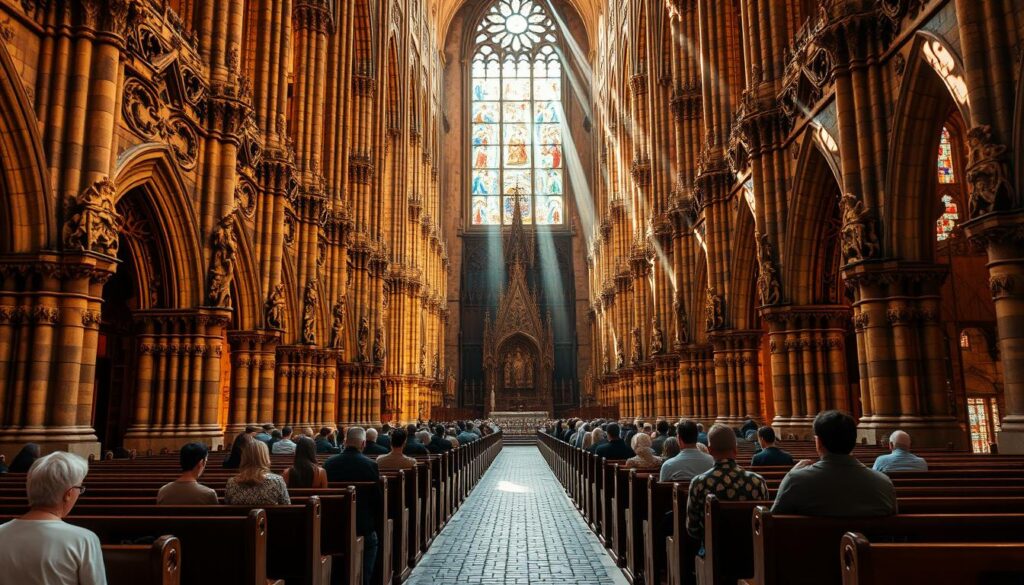
Most Protestant services prioritize scripture teaching over sacraments. Sermons often explain how biblical truths apply to daily life. This reflects their belief that faith grows through understanding God’s word rather than ritual observance.

The Role of Church Authority and Tradition

How communities discern divine guidance creates one of Christianity’s most visible divides. These contrasting approaches to leadership and truth-seeking continue shaping worship experiences and doctrinal decisions today.

Authority of the Pope vs. Independent Church Structures

Catholic doctrine positions the pope as Christ’s earthly representative. This leadership role carries spiritual weight – followers believe the Holy Spirit protects papal teachings on faith and morals from error. “The Roman Pontiff enjoys infallibility when defining doctrines,” states Vatican Council documentation.

Protestant communities reject centralized authority structures. Most denominations let local congregations or regional bodies interpret scripture. This independence allows flexibility but can lead to varied interpretations of biblical messages.

Scripture and Tradition: How They Complement or Conflict

Catholic teachings draw from two wells: biblical texts and sacred tradition. The Magisterium – the church‘s teaching office – preserves practices passed down through centuries. This includes Marian devotions and sacramental rituals not explicitly detailed in the Bible.

Many Protestants champion scripture as the ultimate guidebook. Yet modern surveys reveal nuance – 52% of U.S. Protestants now value both Bible and tradition. Only 46% strictly adhere to sola scriptura principles from Reformation times.

These differing approaches affect contemporary debates. When new ethical questions arise, Catholics consult established authority channels. Protestant groups often re-examine biblical texts directly, creating diverse responses across denominations.

Cultural and Geographical Influences on Faith

Local customs and landscapes mold religious practices as much as doctrine does. A Peruvian Catholic might blend indigenous traditions with Mass rituals, while an American Protestant could prioritize personal Bible study. These variations show how faith adapts to its environment.

A dimly lit cathedral interior, stained glass windows casting kaleidoscopic patterns on the stone walls. In the foreground, an ornate altar adorned with religious iconography, candles flickering. In the middle ground, worshippers of diverse cultural backgrounds kneeling in reverence, their expressions a tapestry of devotion. The background reveals a grand, arched ceiling, intricate carvings and frescoes depicting scenes from Christian history, blending influences from various regional traditions. Soft, warm lighting illuminates the scene, creating an atmosphere of sacred contemplation, where the diverse cultural threads of the faith converge.

Regional Variations and Historical Shifts

Protestant groups developed distinct flavors across continents. The Anglican tradition reflects England’s political history, while Pentecostal churches often embrace expressive worship styles. Over 200 denominations now exist, from structured Lutherans to casual nondenominational communities.

Region Dominant Tradition Cultural Adaptation
Latin America Catholicism Syncretism with indigenous beliefs
Scandinavia Lutheran Protestantism Emphasis on social welfare systems
American South Baptist groups Community-focused revival meetings

Migration patterns reshaped religious maps. Irish immigrants spread Catholicism in 19th-century America. Meanwhile, missionary work established Presbyterian groups in South Korea. These movements created hybrid traditions that still evolve today.

Modern denominations often reflect regional values. In Brazil, charismatic worship dominates many churches. German Lutherans might view scripture through Reformation-era principles. This diversity makes faith both a personal journey and a part of collective identity.

Exploring what is the difference between protestantism and catholicism

Foundational teachings shape how millions experience faith daily. While shared doctrines unite believers, practical applications reveal fascinating contrasts in spiritual journeys.

A detailed illustration showcasing the core beliefs that distinguish Catholicism and Protestantism. In the foreground, a pair of open hands symbolize the fundamental differences in their theological approaches, with Catholic beliefs represented by ornate, intricate patterns and symbols, while Protestant beliefs are depicted through minimalist, austere lines. In the middle ground, stained glass windows cast a warm, reverent glow, highlighting the contrasting aesthetics and architectural styles of their respective places of worship. In the background, a soaring cathedral and a simple, unadorned church stand as architectural embodiments of their divergent spiritual philosophies, captured through a cinematic, atmospheric lighting that evokes a sense of timelessness and reverence.

Paths to Eternal Life

Catholics believe sacraments act as divine channels. Baptism initiates spiritual rebirth, while regular Mass attendance maintains grace. Confession cleanses sins through priestly mediation. These rituals form stepping stones toward salvation.

Protestants believe Christ’s sacrifice finalized redemption. Faith alone unlocks eternal life, though many see good works as gratitude’s natural response. “We’re saved by grace through faith,” explains a Lutheran pastor, “not checklists.”

Shared Foundations, Different Expressions

Both traditions celebrate:

  • The Trinity’s mysterious unity
  • Jesus’ miraculous birth
  • Redemption through crucifixion
  • Bodily resurrection’s promise

Where they diverge matters most in daily practice. Catholic worship centers on sacraments administered by clergy. Protestant services prioritize scripture teaching accessible to all. This shapes how communities experience God’s presence.

Modern believers often blend elements from both traditions. Many Catholics now emphasize personal Bible study. Some Protestants adopt contemplative prayer practices. These cross-pollinations show faith’s evolving landscape while honoring ancient roots.

Beliefs on Salvation, Good Works, and Justification

Current discussions about spiritual redemption reveal fascinating shifts in Christian thought. While historical doctrines laid clear boundaries, modern believers often blend ideas from different traditions.

Evolving Perspectives on Eternal Life

Recent surveys show American Protestants nearly split on salvation requirements. About 46% emphasize faith alone, while 52% believe both good works and belief matter. This contrasts with Catholic consistency – 80% maintain deeds and faith work together for redemption.

White evangelicals stand out as doctrinal traditionalists. Two-thirds (67%) strictly follow Reformation-era sola fide principles. Yet across all U.S. Christians, 62% agree both spiritual trust and ethical actions shape salvation journeys.

These patterns highlight changing religious landscapes. Many now see grace as divine partnership rather than transaction. As believers reinterpret ancient teachings, new bridges form between once-divided traditions.

FAQ

How did the Protestant Reformation reshape Christianity?

The Protestant Reformation, led by figures like Martin Luther in the 16th century, challenged Catholic teachings on authority, grace, and salvation. It sparked new church structures, rejected papal supremacy, and emphasized scripture as the primary source of spiritual truth.

Do Protestants and Catholics view salvation differently?

Yes. Protestants believe salvation comes through faith alone in Jesus Christ, while Catholics teach salvation involves faith and participation in sacraments and good works. This debate over justification remains a core divide.

Why does the Catholic Church emphasize the Pope’s authority?

Catholics see the Pope as the successor to Saint Peter, holding spiritual authority passed down from Christ. Protestants reject this, favoring independent church governance and viewing scripture as the ultimate authority.

How do scripture and tradition interact in both traditions?

Catholics regard scripture and sacred tradition as equal sources of divine revelation. Protestants follow sola scriptura (“scripture alone”), rejecting traditions not explicitly rooted in the Bible.

Have regional factors influenced Protestant and Catholic practices?

Absolutely. Catholicism dominates in Southern Europe and Latin America, while Protestantism thrives in Northern Europe and North America. Local cultures often shape worship styles, holidays, and community roles.

What worship differences exist between Protestant and Catholic services?

Catholic Mass centers on the Eucharist, seen as Christ’s literal body. Protestant services prioritize preaching, hymns, and symbolic communion. Liturgical styles also vary, from high-church Anglicanism to informal evangelical gatherings.

How do beliefs about Mary and saints differ?

Catholics venerate Mary as the Mother of God and ask saints to intercede with prayers. Most Protestants honor Mary but reject her mediatory role, focusing solely on Christ for forgiveness and guidance.

Are sacraments viewed the same in both traditions?

No. Catholics recognize seven sacraments, including confession and marriage, as channels of grace. Protestants typically observe only baptism and communion, viewing them as symbolic acts of obedience.

Do good works matter for salvation in both faiths?

Catholics see works as expressions of faith that cooperate with grace. Protestants argue works flow from salvation but don’t earn it—grace is a free gift through Christ’s sacrifice.

How do Protestants and Catholics engage today?

Many collaborate on social justice or interfaith dialogue, though doctrinal divides persist. Groups like Lutherans and Catholics have resolved historical disputes, but differences over authority and sacraments remain.

Exploring the Roots of English Catholicism


For over 1,400 years, spiritual traditions have shaped communities across Britain and beyond. It all began in 597 AD when Augustine of Canterbury arrived in Kent on a mission from Rome. This pivotal moment created lasting ties between local believers and the global Catholic Church.

These early foundations survived wars, political shifts, and cultural changes. Though King Henry VIII severed Rome’s authority in 1534, the faith endured underground. Today, over 6 million members across England and Wales keep these traditions alive.

What makes this story relevant today? Many American religious practices trace their lineage to these historical events. From liturgy to community structures, echoes of English Catholic heritage resonate in modern worship spaces nationwide.

Key Takeaways

  • Augustine of Canterbury established Rome’s first official connection in 597 AD
  • Henry VIII’s 1534 break with Rome reshaped religious history
  • Modern membership exceeds 6 million in England and Wales
  • Historical patterns influence contemporary American practices
  • Distinct traditions developed through centuries of adaptation

Introduction to the Trend Analysis Report

A seismic shift in religious practice is reshaping England’s spiritual landscape. For the first time since the Reformation, Roman Catholic Church attendance now outpaces Anglican participation nationwide. Young adults under 35 lead this historic reversal, with London parishes reporting especially crowded Sunday services.

This article explores how these changes cross the Atlantic. Traditional practices from English Catholic communities are gaining traction in the United States, influencing everything from political debates to university theology programs. Converts seeking clear doctrine in uncertain times fuel much of this growth.

Three key factors emerge from recent surveys:

  • 64% of new U.S. converts cite moral clarity as their primary motivator
  • Urban centers see 22% higher retention rates among young parishioners
  • Historic English liturgical traditions now shape 31% of American diocesan practices

The report combines census data with interviews from clergy and lay leaders. It reveals how centuries-old traditions meet modern spiritual needs, creating a surprising bridge between old and new worlds.

Current Trends in english catholicism in the US

A growing wave of public figures is rediscovering ancient spiritual anchors. From Capitol Hill to Hollywood studios, notable Americans are joining the Catholic Church, often citing intellectual rigor inherited from 19th-century English thinkers. “The Oxford Movement’s emphasis on truth transcends time zones,” notes one theology professor.

A grand cathedral interior, stained glass windows casting warm hues onto the ornate pews and marble floors. In the foreground, a diverse congregation of worshippers - from young families to elderly parishioners - seated in quiet contemplation. The middle ground features a priest delivering a sermon, his robes flowing as he gestures with reverence. In the background, a choir sings hymns that echo through the vaulted ceilings, their voices carried on beams of heavenly light. The scene conveys a sense of timeless tradition, as well as an evolving community embracing contemporary practices and demographics within the enduring framework of English Catholicism.

Recent converts like Senator JD Vance and actor Shia LaBeouf follow a pattern seen since the 1990s. Political strategist Newt Gingrich and commentator Laura Ingraham paved the way, drawn to what they call “unshakable moral foundations.” This trend mirrors England’s Victorian-era revival, where intellectuals sought clarity amid cultural upheaval.

Three factors drive this shift:

  • 42% of converts under 40 prioritize historical continuity
  • English theological works see 18% annual sales growth in the United States
  • Urban parishes report 30% membership increases since 2020

These developments reveal deeper currents. As screenwriter Russell Brand recently observed, “Ancient traditions offer surprising tools for modern chaos.” The pattern suggests many people today crave structured spirituality that connects past wisdom to present challenges.

Historical Foundations and Early Evangelization

Long before Augustine’s mission, Christian roots grew deep in British soil. By the 3rd century, believers gathered in secret as Roman soldiers patrolled nearby roads. St. Alban’s brave stand against persecution marked Britain’s first recorded martyrdom – a spark that ignited lasting devotion.

Romano-British leaders shaped the church’s early structure. Bishop Restitutus traveled to France for the Council of Arles in 314, showing local communities valued global connections. When Rome withdrew its armies decades later, these spiritual networks kept faith alive through turbulent years.

Celtic Christians developed unique traditions as isolation grew. Their monks created intricate prayer cycles, while priests used standing stone crosses instead of grand cathedrals. These adaptations helped communities survive Saxon invasions and political chaos.

This blend of resilience and creativity defined British spiritual history. For centuries, believers balanced Roman teachings with local needs – a pattern repeating through later reforms. Their ability to preserve core truths while embracing change offers lessons for modern faith journeys.

The Role of the Roman Catholic Church in England and Beyond

England’s spiritual journey with Rome reveals a story of power and paradox. The Roman Catholic Church shaped laws and leaders here while facing dramatic splits. Pope Adrian IV – born Nicholas Breakspear – became history’s only English pontiff in 1154. His brief reign opened doors for English influence in global church affairs.

A grand cathedral of Roman Catholic architecture stands tall, its towering spires reaching towards the heavens. Intricate stone carvings and stained glass windows adorn the facade, casting a warm, reverent glow. In the foreground, devout worshippers kneel in prayer, their faces illuminated by flickering candles. The middle ground reveals ornate altars and religious iconography, while the background showcases the church's expansive interior, filled with ornate columns and vaulted ceilings. The scene evokes a sense of history, tradition, and the enduring spiritual influence of the Roman Catholic Church across England and beyond.

Cardinal Stephen Langton later proved how faith shapes nations. His mediation between King John and the Catholic Church led to Magna Carta’s creation in 1215. This “Great Charter” mixed spiritual ideals with political reality, showing how leaders balanced local needs with Rome’s authority.

Three key patterns define this relationship:

  • Global leadership roles for English clergy
  • Creative tension between national identity and universal teachings
  • Lasting impacts on legal and social systems worldwide

Today’s Church of England debates mirror past struggles. Modern thinkers still draw from this tradition when addressing moral questions. As one historian notes, “Our shared spiritual heritage helps bridge divides – both local and global.”

Figure Role Global Impact
Pope Adrian IV Only English pope Expanded Rome’s diplomatic reach
Cardinal Langton Magna Carta architect Shaped constitutional governance
Modern clergy Policy advisors Influence international human rights debates

This interplay between Church of England traditions and worldwide Catholic teachings continues today. From university debates to UN conferences, ideas born from these historic tensions still shape our world.

Anglo-Saxon Conversion and the Beginnings of Faith

A strategic partnership between Rome and local leaders sparked lasting change in 597 AD. Pope Gregory I handpicked 40 priests led by Augustine of Canterbury for a groundbreaking mission. Their arrival in Kent marked the first papal effort to build a permanent church structure north of the Alps.

Queen Bertha proved crucial to their success. The Frankish Christian ruler had kept her faith alive in her husband’s pagan kingdom. Her existing chapel became Augustine’s base, blending Roman practices with local traditions over time.

This collaboration created a blueprint still used today. Missionaries adapted Roman teachings to Anglo-Saxon culture while maintaining core doctrines. The Canterbury archbishopric became a model for global evangelization efforts.

Figure Role Legacy
Augustine First Archbishop Established papal authority
Queen Bertha Local supporter Bridged cultural divides
Gregory I Strategic planner Pioneered adaptive missions

These efforts shaped religious education for centuries. Benedictine monks developed schools that mixed spiritual training with practical skills. Their methods remain a part of modern seminary programs across the United States.

Medieval and Renaissance Impacts on the Church

Medieval communities thrived through spiritual hubs that doubled as social engines. Monasteries like Shaftesbury Abbey became multitasking powerhouses—offering medical care, schooling, and shelter to travelers. These centers laid groundwork for modern parish outreach programs across the U.S.

A medieval cathedral stands majestic, its soaring Gothic architecture bathed in warm, golden light. Intricate stone carvings adorn the façade, depicting biblical scenes and the triumphs of the church. Through the stained glass windows, shafts of multicolored light stream in, casting a reverent glow over the ornate interior. Rows of wooden pews line the central aisle, leading the eye towards the ornate altar and the towering stained glass apse. Worshippers kneel in contemplation, their robes and vestments adding to the timeless ambiance. Outside, a cobblestone courtyard is framed by tall, buttressed walls, hinting at the church's pivotal role within the surrounding community during the medieval and Renaissance eras.

Pilgrimages and Iconic Shrines

Footsteps of faith shaped England’s landscape. After Richeldis de Faverches’ 1061 vision, Walsingham became Europe’s Nazareth. Canterbury Cathedral drew crowds for centuries following Thomas Becket’s dramatic 1170 martyrdom. These sites inspired devotion routines still seen in American prayer groups today.

Educational and Monastic Contributions

Oxford’s medieval halls buzzed with friars debating theology. Dominican and Franciscan houses transformed these schools into knowledge factories. Their teaching methods live on in U.S. seminary programs, blending scripture study with community service.

Monks didn’t just pray—they innovated. Medieval religious communities advanced farming techniques and preserved ancient texts. One historian notes: “Their scriptoriums kept wisdom alive through Europe’s darkest times.” Modern parishes mirror this by combining worship with food banks and job training.

These medieval patterns explain why many churches today prioritize holistic care. From hospital foundations to scholarship funds, the church continues its 1,000-year mission of serving body and soul together.

The Tudor Reformation and Catholic Resistance

A royal decree in 1534 shattered England’s religious foundations. Henry VIII’s Church of England break from Rome triggered one of history’s most dramatic spiritual upheavals. Over 900 monasteries vanished between 1536-1541 – institutions that had shaped communities for a thousand years.

Dissolution of the Monasteries

The king’s commissioners seized properties housing 12,000 religious workers. Imagine entire networks vanishing overnight:

  • 4,000 monks lost their homes
  • 2,000 nuns faced sudden displacement
  • 3,000 friars scattered across Europe

These closures erased physical reminders of the Catholic Church‘s presence. Stone abbeys became quarries, their treasures melted down for coinage. Yet this destruction sparked unexpected creativity in worship practices.

Survival of the Recusants

Defiant families kept traditions alive through ingenious methods. “Priest holes” in manor homes hid visiting priests during government raids. Wealthy households funded secret chapels behind false walls – some still exist today.

Three survival strategies kept faith alive:

  1. Sending sons to European seminaries for training
  2. Creating coded messages in embroidery and art
  3. Holding midnight Masses in barns and cellars

This underground network lasted 250 years until the 1791 Relief Act. The Church of England‘s opposition ironically strengthened Catholic resolve, creating patterns of resistance that still influence religious freedom debates in America today.

Influence of British Converts: Newman, Manning, and Waugh

The 19th century sparked an unexpected revival through brilliant minds switching spiritual paths. John Henry Newman and Henry Edward Manning – former Anglican leaders – became Catholic champions. Their conversions ignited a golden age where over 80% of Britain’s Catholic thinkers were converts from other traditions.

Newman’s journey created a blueprint still followed today. His autobiography Apologia Pro Vita Sua gives modern seekers like J.D. Vance a roadmap for reconciling faith with intellectual rigor. As one theology student notes, “Newman showed how tradition and reason can dance together.”

Literary giants added cultural muscle to this movement. Writers like Evelyn Waugh and Graham Greene crafted stories blending Catholic themes with gripping narratives. Their novels challenged secular norms while topping bestseller lists – proving faith and art could thrive together.

Three lasting impacts emerged from this 1840-1960 renaissance:

  • New models for explaining religious conversion
  • High-quality literature defending traditional values
  • Fresh energy for parish education programs

These figures didn’t just change churches – they reshaped debates across the Atlantic. Their ideas about moral truth now fuel discussions in American universities and media. As Patrick Allitt observed, their legacy proves how new perspectives can revitalize ancient traditions.

Contemporary Demographic Shifts and Cultural Influences

Modern faith communities are evolving through two powerful forces: energized young adults and vibrant immigrant traditions. These changes reshape how parishes connect with diverse groups while honoring historical roots.

Youth Engagement and Parish Renewal

Young people are breathing new life into worship spaces. Many join social justice projects or lead tech-driven outreach efforts. A London parish recently tripled its under-35 attendance through TikTok faith discussions.

Impact of Immigrant Communities

Post-2009 migration patterns brought fresh perspectives to local churches. Central European traditions now blend with English practices in shared festivals and bilingual services. Similar cultural fusions appear in U.S. cities, where immigrant-led parishes often report higher volunteer rates.

These shifts show how global connections strengthen community bonds. As one priest noted, “Shared values bridge generations and borders.” This dynamic exchange ensures ancient traditions meet modern needs.

FAQ

How did British Catholic history influence faith practices in the United States?

British traditions, like parish structures and devotional practices, shaped early American Catholic communities. Immigrant groups from England later blended these customs with local culture, creating unique expressions of worship.

What role did the Roman Catholic Church play in medieval education?

Monasteries served as centers of learning, preserving ancient texts and teaching theology, philosophy, and science. Figures like Bede the Venerable advanced scholarship, laying groundwork for universities.

Why were pilgrimages significant in medieval Britain?

Sites like Walsingham attracted believers seeking spiritual renewal. These journeys reinforced community bonds and funded local economies, while saints’ shrines became symbols of divine connection.

How did the Tudor Reformation impact Catholic communities?

Henry VIII’s dissolution of monasteries stripped resources, but recusant families secretly preserved rituals. This resistance kept traditions alive until legal toleration in the 19th century.

What contributions did converts like John Henry Newman make?

Newman’s writings defended theological truths and bridged Anglican-Catholic dialogue. His leadership in the Oxford Movement revitalized intellectual engagement with the faith.

How are immigrant communities reshaping parishes today?

Groups from Latin America, Asia, and Africa bring vibrant traditions, multilingual services, and festivals. This diversity fosters renewal while challenging churches to address cultural integration.

What strategies engage younger generations in modern parishes?

Programs like youth ministries, social justice initiatives, and digital outreach meet their desire for community and purpose. Adapting music and messaging also helps connect faith to daily life.

Why did Anglo-Saxon rulers adopt Christianity?

Political alliances and missionary efforts, such as Augustine of Canterbury’s mission in 597, persuaded leaders. Conversion unified kingdoms under a shared spiritual framework tied to Rome.

Branches of Catholicism: A Comprehensive Guide


Welcome to your guide exploring Christianity’s rich tapestry of beliefs and practices. For over 2,000 years, followers of Jesus Christ have built communities with distinct ways of worship, leadership, and spiritual life. Today, these traditions form a vibrant mosaic spanning continents and cultures.

You’ll find Roman Catholicism at the heart of this story, with its global community of 1 billion members. But that’s just one thread in a larger fabric. From Eastern Orthodoxy’s ancient rituals to Protestantism’s emphasis on personal faith, each group reflects unique answers to big questions about tradition and authority.

Why did Christianity split into different groups? Events like the Great Schism of 1054 reshaped the religious landscape. Later, the Protestant Reformation sparked new ways of thinking about the church’s role. This article breaks down these milestones without heavy jargon, making complex history easy to grasp.

By the end, you’ll recognize what unites these traditions—and what makes each one special. Whether you’re curious about worship styles or leadership structures, we’ve got you covered. Let’s dive in!

Key Takeaways

  • Christianity includes multiple traditions beyond Roman Catholicism
  • Major historical events shaped today’s religious landscape
  • Differences often center on leadership and interpretation of teachings
  • Shared beliefs in Jesus Christ unite all branches
  • Worship styles vary from structured rituals to personal practices

Introduction to the Branches of Catholicism

Imagine walking into a global family reunion where distant cousins share core values but express them uniquely. That’s Christianity today—1.3 billion Roman Catholics sit alongside Eastern Orthodox communities and Protestant groups, all tracing their roots to Jesus’ teachings. Scholar Bart D. Ehrman notes this stunning variety: missionaries living in poverty, televangelists reaching millions, and Appalachian preachers handling snakes during worship.

What binds these groups? A belief in Christ’s divinity and the Trinity. Yet interpretations vary widely. Some emphasize ancient traditions like incense-filled liturgies, while others focus on personal Bible study. These differences emerged through centuries of cultural exchanges, political shifts, and theological debates.

You’ll notice patterns in how churches operate. The Roman Catholic structure revolves around papal authority, while Orthodox communities prioritize collective decision-making. Protestant denominations often let local congregations interpret scripture independently. This spectrum of leadership styles shapes everything from holiday celebrations to social outreach programs.

History reveals why a Greek Orthodox service feels worlds apart from a Southern Baptist gathering. The Great Schism of 1054 split Eastern and Western Christianity over doctrinal disputes. Later, the Reformation challenged centralized power structures, birthing new worship formats. Each era added layers to Christianity’s evolving story.

Rather than weakening the faith, this diversity proves its resilience. From Ethiopian Orthodox rituals preserved for millennia to modern megachurches, Christianity adapts while keeping its central message: redemption through Christ’s love.

What is a branch of catholicism?

Have you ever wondered how one faith can take so many forms across the globe? Christianity’s family tree grows through distinct traditions, each shaped by centuries of cultural evolution and theological reflection. These groups share core beliefs in Christ’s teachings but express them through unique practices and structures.

A grand cathedral with intricate Gothic architecture, towering spires, and stained glass windows casting a warm, reverent glow. In the foreground, a group of Catholic bishops and cardinals, robed in crimson and white, gathered in a semicircle, deep in discussion. Their faces express a sense of solemn authority and spiritual guidance. The middle ground features ornate, carved wooden pews and an ornate altar, while the background is filled with a dimly lit, cavernous interior, evoking a sense of history and tradition. The lighting is soft and atmospheric, creating a sense of reverence and contemplation.

At the heart of differences lies authority. Roman Catholics look to the Pope as their spiritual leader, while Eastern Orthodox communities rely on collective decisions by patriarchs. Protestant groups often empower local congregations to interpret scripture independently. “Our unity exists in Christ,” notes theologian Richard Rohr, “but our expressions of faith reflect humanity’s beautiful complexity.”

Sacraments reveal another layer of diversity. Some traditions celebrate seven sacred rituals, others focus on baptism and communion. These practices aren’t just ceremonies—they’re lived expressions of doctrine that connect believers to divine grace.

Understanding these variations helps you see how Christianity adapts while maintaining its essence. From incense-filled Orthodox liturgies to vibrant Protestant worship services, each tradition offers a unique path to spiritual truth rooted in shared theology.

Historical Perspectives on Catholic Denominations

History’s turning points shaped Christianity like rivers carving canyons. Two earth-shaking events—the Great Schism of 1054 and the Protestant Reformation—created lasting divides still visible today.

The East-West split began with a fiery debate over leadership. Eastern churches rejected the Pope’s authority, arguing that no single leader should hold supreme power. This clash over the filioque clause—a phrase added to the Nicene Creed—still separates Orthodox and Catholic communities after nearly a millennium.

Fast-forward to 1517: Martin Luther’s hammer strikes echo across Europe. His 95 Theses challenged church practices like indulgence sales, declaring salvation came through faith alone. This sparked the Protestant Reformation, birthing new denominations that prioritized personal Bible study over papal decrees.

Earlier splits also left marks. In 451 CE, the Council of Chalcedon divided churches over Christ’s nature. Oriental Orthodox groups favored a unified divine-human essence, creating distinct traditions in Egypt and Ethiopia.

Three key patterns emerge from these upheavals:

  • Leadership disputes often triggered lasting divisions
  • Reformers sought to “purify” practices they saw as corrupted
  • Theological debates about Christ’s nature reshaped worship styles

These historical fractures explain why a Lutheran service feels different from an Armenian Apostolic liturgy. Each tradition carries forward decisions made in critical moments, preserving unique interpretations of shared truths.

Key Features of the Roman Catholic Church

What holds together a spiritual community spanning 1 billion members across 200 nations? The answer lies in distinct structures shaping Catholic identity. This global network thrives through clear leadership models and sacred rituals passed down generations.

Papal Authority and Leadership

The Pope sits at the center of Catholic governance as Bishop of Rome and St. Peter’s successor. Catholics believe his ex cathedra statements on faith carry divine protection from error. This authority flows through cardinals, bishops, and priests—a hierarchy ensuring consistent teachings worldwide.

Significance of Sacraments and Tradition

Seven sacred rituals mark life’s spiritual milestones. From baptism’s cleansing waters to last rites’ comforting oil, these practices connect believers to God’s grace. “The sacraments are actions of the Holy Spirit,” explains the Catechism, “making believers more like Christ.”

Sacrament Purpose Life Stage
Baptism Spiritual rebirth Infancy/adulthood
Eucharist Communion with Christ First communion
Confirmation Strengthening faith Adolescence
Matrimony Sacred union Marriage
Holy Orders Clergy consecration Vocational call

Ancient tradition guides modern practice. Writings from Augustine and decisions by councils like Vatican II carry equal weight with Scripture. This blend of old and new keeps the catholic church rooted yet responsive—a living bridge between past and present.

Insights into the Eastern Orthodox Church

Step into an Orthodox church and you’re transported through centuries of spiritual tradition. This ancient Christian community maintains practices unchanged since the Roman Empire’s eastern half. Its 1054 split from Western Christianity created distinct worship styles and leadership models.

A majestic Eastern Orthodox liturgy unfolds in a grand cathedral, the space bathed in warm, golden light filtering through stained glass windows. The ornate iconostasis stands tall, adorned with intricate Byzantine-style icons. Priests in flowing vestments move with reverence, their voices raised in solemn chant. Worshippers kneel in prayer, their faces cast in a contemplative glow. Billowing clouds of incense drift through the air, adding to the mystical ambiance. The composition captures the timeless spiritual essence of the Eastern Orthodox tradition, immersing the viewer in a transcendent moment of sacred ceremony.

The Eastern Orthodox Church operates through self-governing national bodies. Greek, Russian, and Serbian Orthodox groups share core beliefs while adapting to local cultures. Their unity comes from shared sacraments and reverence for early church councils.

Emphasis on Icons and Liturgy

Golden icons glow in candlelight during Orthodox services. These sacred images aren’t decorations—they’re called “windows into heaven.” Believers kiss icons of Christ or saints, seeking connection with divine grace through physical acts of devotion.

Orthodox liturgy engages all five senses:

  • Choirs chant ancient hymns in harmony
  • Incense swirls toward vaulted ceilings
  • Priests wear jeweled vestments during processions

This immersive worship lasts hours, inviting participants to experience faith through movement and ritual. The Eastern Orthodox approach sees beauty as a pathway to spiritual truth.

The Journey of Theosis and Mysticism

Orthodox spirituality centers on theosis—becoming more like God through grace. This lifelong process combines prayer, sacraments, and ethical living. Mystics practice hesychasm, silent repetition of the Jesus Prayer to achieve inner stillness.

“Theosis transforms our entire being,” explains theologian John Meyendorff. Unlike Western Christianity’s focus on legal concepts of salvation, the Orthodox Church emphasizes mystical union. Believers see salvation as healing humanity’s broken relationship with the divine.

Through these practices, the Eastern Orthodox tradition preserves Christianity’s mystical roots while addressing modern spiritual hunger.

The Protestant Reformation’s Influence on Catholic Denominations

A cathedral interior bathed in warm, golden light, with stained glass windows casting intricate patterns on the marble floors. In the foreground, a group of people engaged in lively debate, their expressions reflecting the intensity of the Protestant Reformation. In the middle ground, a lone figure stands before an ornate altar, symbolizing the divide between traditional Catholic doctrine and the newfound ideas challenging it. The background is shrouded in a soft, ethereal haze, conveying the sense of a pivotal moment in history unfolding. The scene is captured with a cinematic wide-angle lens, emphasizing the grandeur and significance of the event.

Imagine ideas so powerful they redraw spiritual maps. The 16th-century Protestant Reformation did exactly that, challenging centuries of religious norms. At its core stood two radical principles: sola scriptura (Scripture alone) and sola fide (faith alone). These concepts rewrote rules about who gets to interpret divine truth.

Martin Luther lit the fuse in 1517 by nailing his 95 Theses to a church door. His writings, like The Babylonian Captivity of the Church, argued salvation comes through grace, not human effort. This struck at Catholic teachings about sacraments and good works. Suddenly, every believer could approach God directly—no priest required.

Three seismic shifts reshaped Christianity:

  • Bible translation into common languages
  • Rejection of papal authority
  • Simplified worship services

The Catholic Church responded with its own reforms. Councils clarified doctrines and addressed corruption. Meanwhile, Protestant groups multiplied—Lutherans, Calvinists, Anabaptists—each adding new perspectives.

Today, these debates still matter. Many churches blend elements from both traditions, while others hold firm to distinct identities. As theologian Timothy George observes: “The Reformation isn’t over—it’s still reforming how we understand faith.”

Oriental Orthodoxy: Preserving Early Christian Traditions

Across Africa and the Middle East, ancient Christian communities thrive with practices unchanged for 1,500 years. The Oriental Orthodox churches trace their roots to the earliest followers of Jesus, maintaining theological paths less traveled by mainstream Christianity.

Miaphysite Christology and Cultural Identity

At their core lies miaphysite doctrine—the belief that Christ’s divine and human natures merged into one. This view, solidified after rejecting the 451 CE Council of Chalcedon, sets them apart from other Orthodox churches. “Our faith isn’t divided,” explains Coptic Pope Tawadros II. “Christ acts through a single, unified essence.”

Six vibrant traditions form this family:

  • Egypt’s Coptic Church with its lunar calendar
  • Ethiopian Orthodoxy’s unique biblical canon
  • Armenian Apostolic rituals shaped by national identity

These communities blend deep theology with cultural heritage. Ethiopian services feature drum-led hymns, while Syrian Orthodox liturgy uses Aramaic—Jesus’ native tongue. Through war, persecution, and modernization, they’ve guarded traditions that offer living links to Christianity’s formative centuries.

FAQ

How does the Eastern Orthodox Church differ from the Roman Catholic Church?

The Eastern Orthodox Church emphasizes icons and ancient liturgy in worship, rejects the Pope’s universal authority, and disagrees on the Filioque clause in the Nicene Creed. Unlike Catholics, Orthodox Christians view theosis (union with God) as central to salvation.

What role do sacraments play in Roman Catholic beliefs?

Roman Catholics believe sacraments like Holy Communion and Baptism are visible signs of God’s grace. They use bread and wine transformed into Christ’s body and blood during Mass, a practice rooted in tradition and scripture.

Why did the Protestant Reformation impact Catholic denominations?

Leaders like Martin Luther challenged doctrines such as papal authority and indulgences, leading to new Christian groups. This forced the Catholic Church to address reforms during the Council of Trent while retaining core beliefs and practices.

How does Oriental Orthodoxy preserve early Christian traditions?

Oriental Orthodox churches, like the Coptic and Armenian Apostolic, uphold Miaphysite Christology, which emphasizes Christ’s unified divine-human nature. Their liturgies and customs reflect ancient practices tied to regional cultural identity.

What is the significance of papal authority in Catholicism?

The Pope, as Bishop of Rome, is considered the successor of St. Peter and the Church’s supreme leader. His role includes guiding doctrine, interpreting tradition, and uniting global Catholics under a shared hierarchy.

How do Eastern Orthodox views on salvation differ from Western Christianity?

Eastern Orthodoxy focuses on theosis—a transformative process of becoming like God through prayer and sacraments. This contrasts with Western emphasis on legal concepts like justification, highlighting a mystical approach to salvation.