Recent Posts

Where Does Catholicism Come From? Uncover the Roots


The story of the Catholic Church begins with a humble foundation rooted in ancient traditions. Many believers trace its origins to the life of Jesus Christ and his closest followers. These early teachings spread through dedicated apostles who carried his message across diverse regions.

A pivotal moment occurred during Pentecost, when the Holy Spirit empowered Christ’s disciples to share their faith boldly. This event marked the birth of organized ministry efforts. Over time, communities grew into structured institutions under Roman influence.

The Roman Catholic Church evolved through centuries of cultural exchanges and theological debates. Its leadership model, centered on papal authority from Saint Peter, became a defining feature. This system blended spiritual guidance with practical governance.

From Jerusalem to global outreach, the church adapted to political shifts and philosophical ideas. Greek thought and Jewish customs shaped its early doctrines. Today, it stands as one of the world’s most influential religions, impacting billions through rituals, teachings, and traditions.

Key Takeaways

  • The Catholic Church traces its spiritual roots to Jesus Christ and the apostles
  • Pentecost symbolizes the formal start of its public ministry
  • Papal succession claims an unbroken line from Saint Peter
  • Roman governance structures influenced early church organization
  • The faith integrates elements from Greek and Jewish traditions
  • Growth from local gatherings to worldwide institution took centuries

Historical Foundations of Catholicism

At the heart of Catholic tradition lies a direct connection to its first-century origins. The New Testament serves as the primary record of events that shaped this global faith, documenting how spiritual leadership evolved through generations.

The Original Teachers and Their Mission

Central to the Catholic Church’s identity is Jesus Christ’s selection of twelve followers. These apostles received specific training to spread his message after his resurrection. Their work gained momentum during Pentecost, when believers say the Holy Spirit empowered them to launch public ministries.

Passing the Torch Through Generations

Church leaders teach that modern bishops inherit spiritual authority from those first disciples. This concept of unbroken succession helps maintain doctrinal consistency. A key moment appears in Matthew’s Gospel, where Jesus tells Peter: “You are the rock on which I’ll build my church.”

Three pillars support this historical framework:

  • Written accounts in sacred texts
  • Continuous leadership through ordained ministers
  • Shared practices across diverse cultures

This system not only preserved early teachings but also allowed the faith to adapt while staying rooted in its core truth. Through challenges and changes, these foundations helped shape a unified religious institution.

Exploring “where does catholicism come from”

To grasp the origins of the Roman Catholic Church, we must explore its cultural and theological crossroads. Early believers blended spiritual teachings with practical wisdom from surrounding societies, creating a faith that resonated globally.
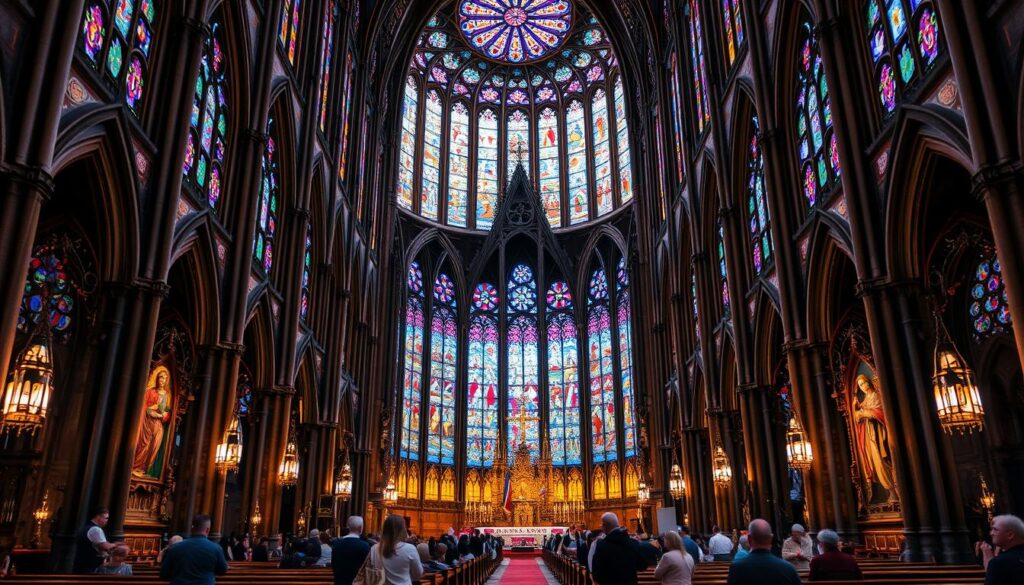
A grandiose cathedral stands majestically, its intricate Gothic architecture a testament to the cultural influences that have shaped Catholicism. Vibrant stained glass windows cast a kaleidoscopic glow, illuminating the interior with a reverent ambiance. In the foreground, ornate religious iconography and symbols adorn the walls, each representing the diverse cultural traditions that have been woven into the fabric of the faith. The middle ground features worshippers engaged in solemn rituals, their faces etched with a sense of devotion and contemplation. The background reveals a bustling city skyline, a reminder of the global reach and enduring legacy of Catholicism, shaped by the cultural tapestry of its history.

Cultural and Theological Perspectives

The word “Catholic” means universal – a perfect description of its mission. Leaders adapted core teachings to local customs while maintaining essential doctrine. This balancing act allowed the religion to grow without losing its identity.

Three key influences shaped its development:

Influence Source Contribution Lasting Impact
Greek Philosophy Frameworks for understanding God and ethics Systematic theology development
Roman Law Models for church governance Hierarchical structure
Jewish Traditions Scriptural foundations Sacraments and liturgy

Greek thinkers like Plato helped explain complex spiritual concepts. Roman organizational skills built durable institutions. Jewish roots provided continuity with ancient prophecies.

This blend of ideas created a religion that could speak to diverse populations. By honoring multiple traditions, the Catholic Church became both adaptable and enduring – qualities that fueled its worldwide growth.

The Birth of the Early Christian Community

A remarkable transformation reshaped history when a group of uncertain followers became bold pioneers. Fifty days after Easter, their collective faith ignited during an event that would define spiritual communion for centuries.

Pentecost and the Formation of the Church

The Catholic Church marks Pentecost as its explosive beginning. Acts of the Apostles describes windswept flames resting on disciples, granting them multilingual abilities to share teachings across cultures. This gathering birthed the first organized Christian assembly.

Previously hesitant followers suddenly preached confidently in crowded streets. Their message resonated with diverse crowds, creating instant connections. The Holy Spirit‘s arrival transformed private grief into public purpose.

This supernatural experience forged three critical elements:

  • Clear methods for preserving Jesus’s original message
  • Strategies for expanding beyond Jewish communities
  • Standards to identify authentic teachings

Early believers pooled resources, sharing meals and prayers daily. Their radical generosity attracted thousands within weeks. By century’s end, this model reached major Roman cities through traveling missionaries.

The church maintained unity through letters and visits between communities. Shared rituals like baptism created bonds across distances. These practices laid groundwork for today’s global communion of 1.3 billion members.

Evolution of Church Organization and Governance

By the second century, a new system of leadership began taking shape in Christian communities. What started as informal gatherings transformed into an organized institution with clear chains of command. This shift mirrored the Roman Empire’s administrative genius while preserving spiritual priorities.
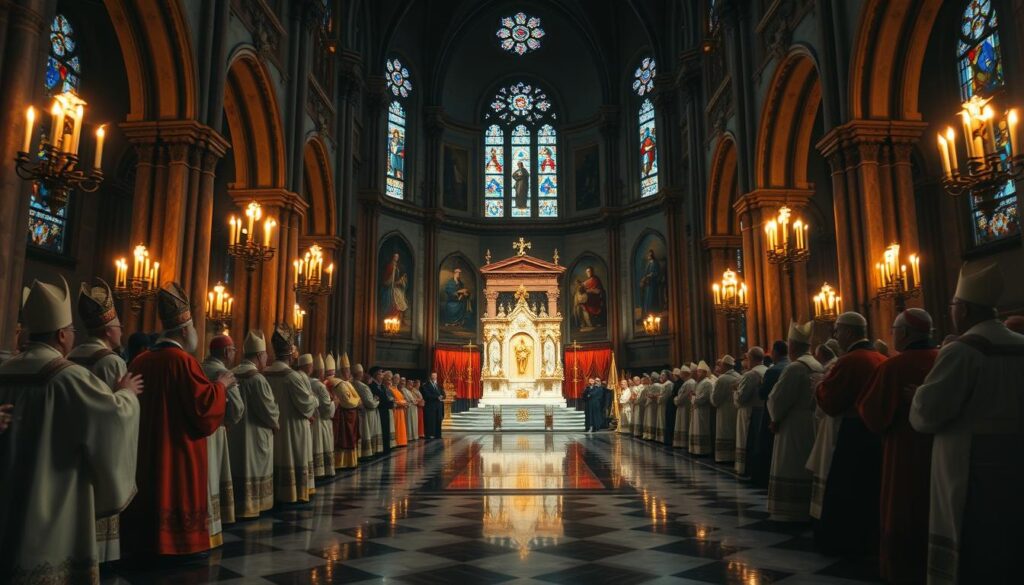
A grand cathedral interior, dimly lit by flickering candlelight, with intricate stone arches and stained glass windows casting multicolored patterns across the ornate marble floor. In the foreground, a procession of bishops and cardinals in resplendent robes and headpieces, symbolizing the evolution of the Catholic Church's hierarchy and governance over the centuries. The middle ground features an ornate throne, representing the papacy and the centralization of power within the Church. In the background, a series of frescoes or tapestries depicting key moments in the Church's history, tracing the development from its early beginnings to the present day. An atmosphere of reverence, tradition, and the weight of centuries-old legacy permeates the scene.

The Emergence of the Bishopric and Papacy

Early believers initially shared leadership among multiple elders. By 150 AD, most communities adopted a single bishop model. These leaders gained authority to resolve disputes and standardize teachings through regional meetings called synods.

Major cities naturally became hubs of influence. Bishops in urban centers like Alexandria and Antioch guided nearby congregations. Catholic historian Eamon Duffy notes:

“Rome’s bishop became the final referee in theological debates by the 200s AD.”

Three factors propelled this change:

  • Growing membership requiring efficient administration
  • Need for consistent doctrine across regions
  • Political ties to imperial infrastructure

The bishop of Rome gradually gained prominence through claims of Peter’s martyrdom there. This authority evolved into the papacy – a unique office combining spiritual guidance and organizational power. By aligning with Roman administrative patterns, the church built stability during turbulent times.

This structured hierarchy allowed Christianity to maintain unity while expanding globally. The system proved durable enough to outlast the empire that helped shape it.

The Impact of the Roman Empire on Early Christianity

Ancient superhighways and common tongues became unexpected allies in faith’s journey. The Roman Empire provided a unique environment where spiritual ideas could travel faster than ever before. Its advanced systems created pathways for belief systems to connect distant communities.

Pax Romana and the Spread of the Faith
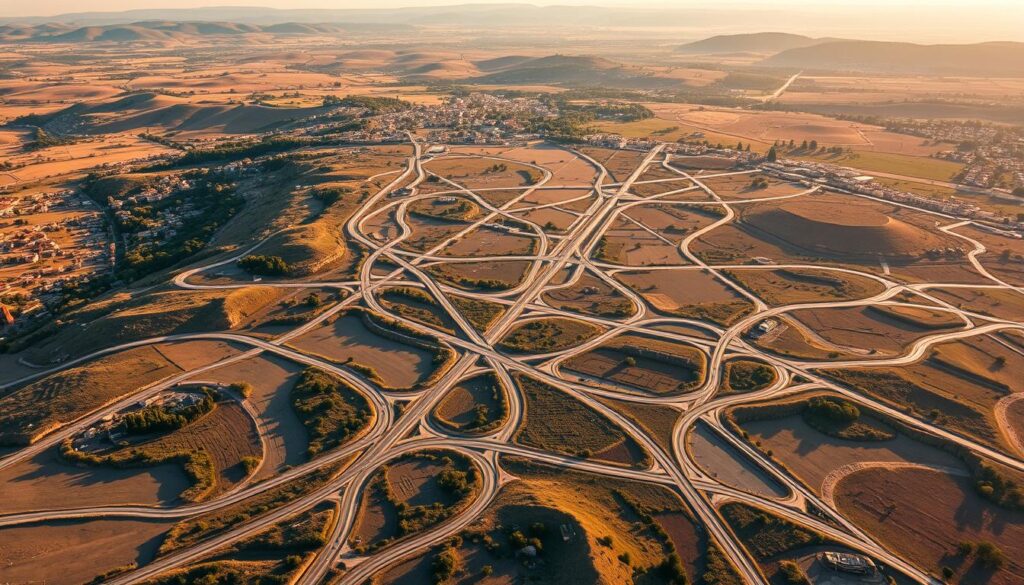
A vast network of well-paved roads stretches across the ancient Roman Empire, connecting major cities and facilitating the efficient movement of goods, people, and ideas. The camera captures this intricate web from a high vantage point, showcasing the strategic placement of roads that converge at key junctions and branch out to the far corners of the empire. The scene is bathed in a warm, golden light, casting long shadows that accentuate the geometric patterns of the roads. In the background, the rolling hills and valleys of the landscape provide a picturesque backdrop, hinting at the diverse landscapes that the Roman infrastructure spanned. This image serves as a visual metaphor for the unifying influence of the Roman Empire, which laid the groundwork for the spread of early Christianity throughout the Mediterranean world.

Rome’s famous peace period transformed religious expansion. For nearly 200 years, the Pax Romana let missionaries move safely across territories. Soldiers patrolled roads, while shared laws reduced tribal conflicts that once blocked cultural exchange.

Three imperial advantages supercharged the church’s growth:

Roman Advantage Impact Outcome
Road Network Enabled rapid missionary travel 40+ communities by 1st century
Common Greek Unified communication Consistent teachings
Urban Centers Concentrated audiences Faster conversions
Legal Protections Allowed assembly rights Stable congregations

Coastal cities like Corinth and Ephesus became springboards for new believers. Missionaries used Roman ships to cross the Mediterranean, reaching Jewish diaspora communities first. By 100 AD, these efforts planted churches from Spain to Syria.

The empire’s structure gave the Roman Catholic tradition its early shape. What began as scattered house meetings grew into a world religion, thanks to history’s first multinational system.

Canonical Foundations and Sacred Tradition

Finalizing sacred texts became a defining task for early church leaders. Between the 4th and 5th centuries, councils worked to unify beliefs across growing communities. Their decisions shaped the Catholic Church’s enduring identity.

Scriptural Heritage and Early Creeds

Church councils carefully sorted through countless religious writings. The Council of Rome (382 AD) first listed approved New Testament books we recognize today. This process ensured only texts reflecting apostolic truth became scripture.

Jerome’s Vulgate translation (391 AD) gave Latin-speaking regions a standard Bible. Later, the Council of Carthage (397 AD) confirmed the final canon. These steps prevented conflicting teachings and strengthened doctrinal authority.

Alongside written texts, oral traditions preserved essential practices. The Catholic Church calls this dual foundation “Scripture and Tradition.” Together, they guide worship and belief while honoring ancient roots.

This careful work created stability during turbulent times. Modern believers still use these 4th-century decisions as their spiritual compass. The results show how faith adapts while staying anchored in core doctrine.

FAQ

How did Jesus Christ and the Apostles shape Catholicism?

Catholicism traces its spiritual roots to Jesus Christ, who commissioned His Apostles to spread His teachings. The New Testament documents their mission, and early leaders like Peter—considered the first pope—established communities that evolved into the Roman Catholic Church. Their teachings on sacraments, worship, and authority remain central today.

What is apostolic succession, and why does it matter?

Apostolic succession refers to the unbroken lineage of bishops, starting with the Apostles, who preserve the Church’s teachings. Figures like Ignatius of Antioch emphasized this continuity, ensuring doctrinal unity. This tradition reinforces the authority of the pope and bishops in guiding the Church’s doctrine and governance.

How did the Roman Empire influence early Christianity?

The Pax Romana’s stable infrastructure allowed missionaries to spread the faith across regions. Emperor Constantine’s Edict of Milan (313 CE) legalized Christianity, merging Roman culture with Christian theology. This relationship shaped practices like Christmas and Easter, blending local traditions with Catholic doctrine.

What role did Pentecost play in forming the Church?

Pentecost, described in Acts 2, marks the Holy Spirit’s descent upon the Apostles, empowering them to preach. This event birthed the first Christian community in Jerusalem, establishing shared worship, communal living, and sacraments like baptism. It’s celebrated as the Church’s “birthday.”

When did the papacy become a central authority?

The bishop of Rome (later called the pope) gained prominence by the 4th century, as leaders like Leo I asserted spiritual authority. Claims of Peter’s martyrdom in Rome bolstered the papacy’s role in resolving disputes, defining creeds, and unifying churches under Roman Catholic governance.

How did early creeds and scripture solidify Catholic beliefs?

Councils like Nicaea (325 CE) produced creeds to counter heresies, clarifying beliefs in the Trinity and Christ’s divinity. The Church also canonized the Bible, combining Old Testament texts with New Testament writings. Sacred Tradition, upheld alongside scripture, remains vital to Catholic doctrine under the pope’s guidance.

Why does the Catholic Church venerate saints and Mary?

Early Christians honored martyrs as holy intercessors, a practice that grew into saint veneration. The Virgin Mary’s role as Jesus’ mother earned her titles like “Mother of God” at Ephesus (431 CE). These traditions reflect Catholicism’s emphasis on communion between earthly and heavenly believers.
Understanding the Meaning of Catholicism


The roots of the Catholic Church stretch back to a single Greek word: katholikos, meaning “universal.” First used by Ignatius of Antioch in 110 AD, this ancient term laid the groundwork for a religion that now spans continents and cultures. Imagine a small Mediterranean community growing into a global family of 1.3 billion people – that’s the story we’ll explore together.

Why did this idea of universality become so powerful? Early Christians wanted to emphasize unity across diverse communities. The blend of Greek words kata (about) and holos (whole) created more than just a name – it shaped a vision for connection. This definition still guides the Church’s mission today, from local parishes to worldwide outreach programs.

You’ll discover how art, philosophy, and social justice efforts grew from these ancient beginnings. We’ll look at stunning cathedrals, timeless traditions, and modern initiatives that show Catholicism’s living legacy. Whether you’re new to the subject or deepening your knowledge, this guide makes complex ideas easy to grasp.

Key Takeaways

  • The term “Catholic” comes from Greek words meaning “universal” or “whole”
  • First officially used in early 2nd-century Christian writings
  • Grew from small communities to the world’s largest Christian group
  • Combines spiritual practices with cultural and artistic traditions
  • Continues to address modern issues through its global network

Introduction to the History and Significance of Catholicism

Spanning two millennia, the Catholic Church has shaped civilizations while preserving ancient wisdom. As a cornerstone of the Christian religion, it connects modern believers to first-century Palestine through unbroken traditions. Few institutions have influenced the world so profoundly – in art, education, and social justice.

This global faith began with twelve apostles and now serves 1.3 billion people. Through centuries of change, it maintained core teachings while adapting to new cultures. Key events like Emperor Constantine’s conversion (312 AD) and Vatican II (1962-1965) reshaped its role in society.

Event Year Impact
Edict of Milan 313 AD Legalized Christianity
Great Schism 1054 Split Eastern/Western churches
Gutenberg Bible 1455 Spread Catholic texts
Vatican II 1962-1965 Modernized practices

The Church’s tradition of learning preserved ancient texts during Europe’s Dark Ages. Monastic scribes copied Aristotle’s works while missionaries built schools across continents. Today, Catholic universities like Georgetown continue this legacy.

From Gothic cathedrals to hospital systems, the Church’s contributions touch daily life. Its teachings on human dignity inspired abolition movements and civil rights campaigns. This living history shows how faith evolves while staying rooted in ancient truths.

Etymology and Definition of Catholicism

Language shapes beliefs, and few words carry richer history than “Catholic.” This term began as a Greek puzzle piece – katholikos, blending kata (concerning) and holos (whole). Early Christians crafted this linguistic mosaic to describe a faith meant for everyone, everywhere.

Greek Origins and Linguistic Roots

Imagine second-century believers choosing words like architects. They paired katholikos with ecclesia – Greek for “called-out assembly.” Together, these terms formed “Catholic Church“: a universal community set apart for sacred purpose.

The definition spread like wildfire. As Christianity moved west, katholikos became Latin’s catholicus. This adaptation kept the original vision intact while crossing cultural borders. Missionaries carried both the word and its universality to new lands.

Evolution of the Term in Christian Context

By the fourth century, the term marked a crucial distinction. St. Augustine wrote of “what has been believed everywhere, always, by all” – capturing the essence of catholic. This idea fueled global outreach, from medieval monasteries to modern hospitals.

Today’s Catholic identity still echoes those Greek roots. The church maintains its worldwide mission while honoring ancient linguistic precision. Like a living language, it grows without losing its original grammar of faith.

The Historical Evolution of the Catholic Church

From a handful of followers in Jerusalem to a global spiritual network, the Catholic Church has navigated centuries of change. Its story unfolds through bold decisions, cultural shifts, and unshakable commitment to tradition.

A grand cathedral with towering spires and ornate architectural details stands tall, its stained glass windows casting a warm, ethereal glow. In the foreground, a procession of robed figures carrying ornate crosses and candles symbolizes the enduring traditions of the Catholic Church. The middle ground reveals intricate carvings and statues depicting key historical moments and figures, while the background features a panoramic view of a bustling city skyline, highlighting the church's enduring presence and influence over the centuries. The scene is illuminated by a soft, diffused lighting that creates a sense of reverence and solemnity, capturing the essence of the Catholic Church's rich historical legacy.

Key Milestones from the Early Church to Today

The first believers faced persecution but built lasting foundations. By 380 AD, Christianity became Rome’s official religion. This shift opened doors for church growth across the ancient world.

Medieval monks preserved knowledge while missionaries spread faith. The 16th-century Reformation sparked renewal efforts. Vatican II (1962-1965) modernized practices without losing core beliefs.

Turning Point Year Significance
Edict of Milan 313 Ended Christian persecution
Council of Nicaea 325 Defined core doctrines
East-West Schism 1054 Split Christianity
Vatican II 1962-1965 Engaged modern society

These moments show how the Catholic Church adapts while honoring its roots. From Gothic cathedrals to social justice programs, its history remains alive in today’s challenges.

Insights from Early Church Fathers

Two trailblazing leaders helped cement the church‘s identity during its formative years. Their writings and sacrifices created blueprints for Christian unity that still guide believers today.

Ignatius of Antioch and Polycarp’s Contributions

Ignatius of Antioch revolutionized Christian thought with a single phrase. As he faced martyrdom in 110 AD, he wrote:

“Wherever the bishop appears, there let the people be – just as wherever Jesus Christ is, there is the Catholic Church.”

This bold statement tied local congregations to universal truth. Ignatius saw bishops as living links to the original apostles – a concept that shaped church structure for centuries.

Polycarp carried this vision forward. A direct disciple of John the Apostle, he led the Smyrna community with unwavering faith. His famous letter declared:

“To all dioceses of the holy church in every place.”

Both men died defending their beliefs. Their martyrdoms became powerful examples of commitment. More importantly, their teachings established patterns of authority and unity that helped scattered churches function as one body.

Through their writings, these early fathers showed how diverse communities could share common practices. They proved that faith thrives when rooted in both tradition and courageous leadership.

The Role of Doctrinal Development in Shaping Catholicism

Imagine early Christians grappling with complex spiritual questions. How did ideas from Jesus’ teachings become formal doctrine? This process of doctrinal development acts like a bridge, connecting ancient beliefs to modern understanding.

A dimly lit cathedral interior, stained glass windows casting a warm glow. In the foreground, a weathered, leather-bound book rests on an ornate wooden lectern, pages open to reveal intricate calligraphic script. Behind it, a group of robed figures, deep in contemplation, represent the centuries-old tradition of Catholic doctrinal development. The middle ground features ornate, carved stone columns supporting a vaulted ceiling, creating a sense of grandeur and timelessness. In the background, a mural depicts key moments in the Church's history, a visual representation of the evolving nature of Catholic theology. The scene conveys a reverent, meditative atmosphere, reflecting the gravity and significance of the doctrinal process that has shaped the faith over generations.

From Apostolic Tradition to Formal Doctrine

The Church didn’t invent new beliefs. Instead, it clarified what apostles taught. Take the Trinity – though never named in Scripture, Theophilus of Antioch first used the term around 180 AD. Church councils later refined this teaching to counter misunderstandings.

Why does this matter? Core ideas like salvation or sacraments needed precise language as Christianity spread. Local traditions and cultural shifts demanded clear answers. Through debates and councils, leaders preserved truth while addressing new challenges.

This work continues today. Papal letters and global meetings update how teachings apply to modern life. As one bishop noted:

“The deposit of faith remains constant, but our grasp of it deepens.”

Doctrinal development isn’t about change – it’s about clearer expression. Like polishing a diamond, the Church helps believers see timeless truths in fresh light.

Exploring “catholicism meaning” in Christian Doctrine

Across the spectrum of Christian belief, one term sparks both unity and debate: Catholic. While many associate it with Rome, numerous churches claim this identity through shared roots in early Christian practice. This diversity reveals a rich tapestry of interpretations about what makes a community truly universal.

A grand catholic cathedral, its spires reaching towards the heavens, bathed in the warm glow of the setting sun. The intricate gothic architecture, adorned with ornate carvings and stained glass windows, stands as a testament to the universality and apostolicity of the church. The interior is illuminated by the soft, diffused light filtering through the multicolored panes, casting a serene and contemplative atmosphere. In the foreground, a group of worshippers kneel in reverence, their faces alight with the spiritual essence of the space. The scene conveys the timeless and profound nature of the Catholic faith, a unifying force that transcends borders and generations.

Defining Universality and Apostolicity

The Catholic Church’s heartbeat lies in two principles: reaching all people (universality) and maintaining direct ties to Jesus’ first followers (apostolicity). As fourth-century theologian Vincent of Lérins wrote:

“We hold that which has been believed everywhere, always, by all.”

Eastern Orthodox and Lutheran communities apply these ideas differently. All cite the Nicene Creed’s “one holy catholic church,” yet disagree on which group embodies it fully. Roman Catholics emphasize papal authority, while Methodists focus on spiritual continuity with early believers.

This tension creates fascinating overlaps. Anglican scholar C.S. Lewis once noted:

“The Church exists for nothing else but to draw men into Christ.

Modern denominations showcase how unity in diversity works. Byzantine liturgies, African drum masses, and Latin American processions all express the same core faith. What binds them? A shared conviction that Christ’s message transcends cultural boundaries while requiring tangible connections to apostolic roots.

Understanding these concepts helps explain why the Christian religion maintains both global reach and localized expressions. It’s not about sameness, but about preserving essential truths while embracing human variety.

The Structure and Authority of the Roman Catholic Church

Navigating the complex structure of the Roman Catholic Church reveals a carefully designed system balancing spiritual authority with global administration. This framework supports over 1.3 billion members through local parishes and international councils alike.

Understanding the Papal Leadership

The Pope serves as both spiritual guide and organizational leader. Elected by cardinals, this role traces back to St. Peter’s original commission. Modern pontiffs combine ancient traditions with contemporary challenges, working closely with regional bishop conferences.

The Organizational Hierarchy and Councils

Below the papacy, cardinals oversee archdioceses while priests manage local communities. Major councils like Vatican II demonstrate how the Roman Catholic Church refreshes practices while maintaining core teachings. This layered structure ensures both unity and cultural adaptability across 3,000 dioceses worldwide.

From parish committees to the Vatican’s departments, every level contributes to shared decision-making. This system has guided the Church’s authority for centuries, proving flexible enough to address modern social issues while preserving historical foundations.

FAQ

What does the term "Catholic" mean in Christianity?

The word “Catholic” comes from the Greek katholikos, meaning “universal.” It reflects the belief that the Church embraces all people and teachings rooted in Jesus Christ’s mission. This universality unites Roman Catholics and other Christian communities under shared doctrines.

How did early Church leaders shape Catholic teachings?

Figures like Ignatius of Antioch emphasized unity under bishops and the Eucharist as central to faith. Their writings defended apostolic traditions, which later formed the foundation for formal doctrines like the Nicene Creed and papal authority.

Why is the Pope considered the leader of the Roman Catholic Church?

Catholics believe the Pope inherits spiritual authority from Saint Peter, whom Jesus called the “rock” of His Church. The Pope guides doctrine, interprets Scripture, and ensures consistency in teachings across global dioceses through councils like Vatican II.

How does the Catholic Church maintain unity across cultures?

Through its hierarchical structure—bishops, priests, and deacons—the Church upholds standardized practices like Mass and sacraments. Apostolic succession ensures teachings remain aligned with early Christian traditions, fostering shared identity despite cultural diversity.

What role do councils play in Catholic doctrine?

Councils, such as Trent or Vatican I, address theological debates and clarify beliefs. They reinforce doctrines like transubstantiation or Mary’s Immaculate Conception, ensuring the Church adapts while staying true to its apostolic roots.

How does Catholicism differ from other Christian denominations?

The Roman Catholic Church emphasizes sacraments, Marian devotion, and papal infallibility. Unlike many Protestant groups, it views tradition and Scripture as equal sources of authority, guided by the Magisterium’s interpretations.

Why is baptism important in Catholic practice?

Baptism cleanses original sin and initiates individuals into the Church. It reflects Jesus’ command to “make disciples of all nations,” symbolizing rebirth and membership in the global body of believers.

Does Catholicism Believe in Evolution?


For over a century, the relationship between religious teachings and scientific discovery has sparked curiosity worldwide. Many wonder how ancient spiritual traditions engage with modern ideas like biological evolution. The Catholic Church offers a compelling example of harmony between faith and science, maintaining thoughtful dialogue rather than conflict.

Historical records show consistent openness to scientific inquiry. In 1929, Catholic authorities clarified that acceptance of evolutionary theory remains “perfectly free” for believers. This position gained strength through papal endorsements, including Pope Benedict XVI’s 2007 statement dismissing the idea of incompatibility as “absurd.” Church teachings distinguish between physical processes and spiritual truths, allowing room for both scientific evidence and theological understanding.

This approach reflects a deeper Catholic tradition of valuing human reason alongside divine revelation. Rather than fearing scientific progress, Church leaders have encouraged exploration of nature’s mysteries. The result? A vibrant space where believers can appreciate evolutionary biology while maintaining their spiritual commitments.

Key Takeaways

  • The Catholic Church officially recognizes evolutionary theory as compatible with Christian belief
  • Papal statements since 1929 affirm freedom to accept scientific explanations of biological development
  • Church teachings distinguish between material processes and spiritual creation
  • Historical documents show consistent support for scientific inquiry
  • Catholic philosophy integrates human reason with religious truth
  • Evolutionary science and faith address different aspects of human existence

Historical Perspectives on Catholic Thought

Long before modern debates, Catholic scholars engaged evolutionary ideas with surprising openness. When Darwin’s Origin of Species appeared in 1859, many theologians saw science as revealing God’s creative methods rather than challenging belief.

Early Voices of Harmony

By 1874, St. John Henry Newman wrote:

“I see nothing in the theory of evolution inconsistent with an Almighty Creator.”

This perspective became mainstream through influential resources. The 1909Catholic Encyclopediacalled evolution “in perfect agreement” with Christian teachings.

Momentum in Modern Times

Early 20th-century materials reached millions. The Question Box, distributed to students, declared Catholics “free to accept evolution.” Church leaders emphasized that time-tested truths and scientific discovery could coexist.

This historical foundation shows the Catholic faith never required choosing between biology and theology. Instead, it cultivated space where people could explore nature’s wonders while honoring spiritual mysteries.

Core Catholic Doctrines on Creation and the Soul

Catholic teaching presents a nuanced view of humanity’s origins, blending scientific understanding with spiritual truth. The Church identifies three perspectives on creation: special creation (direct divine action), developmental creation (guided natural processes), and materialistic evolution (random chance alone). Vatican I affirmed God created the universe ex nihilo—from nothing—while leaving room for biological development under divine care.

A detailed, dramatic depiction of the Catholic doctrine on the creation of the human soul. Centered is a glowing, ethereal figure representing the divine spark of life, surrounded by intricate religious iconography and symbolism. In the foreground, angelic figures gaze upon the scene with reverence, while in the background, a vaulted cathedral ceiling arches overhead, casting warm, heavenly light. The overall atmosphere is one of mysticism, spirituality, and the profound mystery of the soul's divine origin.

Special Creation versus Developmental Creation

While recognizing natural processes in physical development, Catholic doctrine draws a clear line at human uniqueness. Our bodies might share ancestral ties with other lifeforms, but our spiritual soul marks a radical departure. As Pope Pius XII stated:

“The Catholic faith obliges us to hold that souls are immediately created by God.”

This teaching preserves the sacredness of human life while embracing scientific inquiry about bodily origins.

The Unique Role of the Human Soul

What makes human beings distinct isn’t our biology but our capacity for love, reason, and divine connection. Unlike other creatures, we receive individually created souls that transcend material existence. This belief anchors human dignity—our worth comes not from evolutionary progress, but from being spiritual beings shaped in God’s image.

The Church’s position allows appreciation for nature’s complexity while safeguarding timeless truths. Through this balance, Catholics find harmony between laboratory discoveries and sanctuary prayers.

Modern Debate: does catholicism believe in evolution

Recent decades have witnessed groundbreaking discoveries reshaping our understanding of life’s origins. Church leaders actively engage with these advancements, recognizing their potential to deepen appreciation for creation. This ongoing conversation highlights how spiritual wisdom adapts to new insights without compromising core principles.

Bridging New Evidence with Eternal Truths

Pope John Paul II marked a turning point in 1996, addressing scientists with clarity:

“Today… new findings lead us toward recognizing evolution as more than a hypothesis.”

This statement acknowledged mounting evidence from genetics, paleontology, and cosmology. It reflected the Church’s commitment to truth-seeking across disciplines.

The 2004 International Theological Commission document expanded this view. Approved by Cardinal Ratzinger, it explained how Darwinian mechanisms align with divine guidance. Such teachings demonstrate that biological processes and sacred purpose aren’t rivals but complementary perspectives.

Modern Catholic thought celebrates scientific rigor while safeguarding human uniqueness. Church documents emphasize that material explanations don’t diminish spiritual realities. Instead, they reveal the intricate methods through which life develops.

This balanced approach empowers believers to explore nature’s wonders confidently. By embracing science and faith as partners, the Church fosters meaningful dialogue about humanity’s place in creation’s grand story.

Influential Church Statements and Documents

Papal teachings have carefully guided Catholic engagement with evolutionary science. These documents reveal a thoughtful approach to reconciling biological discoveries with spiritual truths.

A dimly lit, ornate wooden desk with a collection of ancient-looking papal encyclicals and documents on the subject of evolution. The tomes have worn leather bindings and gold-embossed titles, exuding an air of historical significance. Soft, warm lighting from a nearby candle casts a gentle glow, creating an atmosphere of scholarly contemplation. The desk is situated in a shadowy, book-lined study, hinting at the weighty theological debates that have surrounded this topic within the Catholic Church.

Pope Pius XII’s Humani Generis and Its Impact

In 1950, Pope Pius XII issued Humani Generis, marking a turning point. This encyclical allowed investigation into human physical origins while safeguarding core beliefs:

“The Catholic faith obliges us to hold that souls are immediately created by God.”

The document distinguished between biological processes and spiritual creation. It encouraged scholars to explore evolutionary hypotheses without compromising theological essentials.

Pope John Paul II and Contemporary Insights

Pope John Paul II expanded this dialogue in 1996. Addressing the Pontifical Academy of Sciences, he declared evolution “more than a hypothesis” due to overwhelming evidence. His statement highlighted:

  • Acceptance of common ancestry for human bodies
  • Affirmation of divine soul creation
  • Support for interdisciplinary research

This approach demonstrated the Church’s commitment to both scientific rigor and spiritual wisdom. The Pontifical Academy continues fostering dialogue between researchers and theologians today.

Interpreting the Book of Genesis in Context

Understanding Genesis requires more than a surface reading—it invites exploration of ancient literary styles. The Catholic Church encourages believers to approach these sacred texts with both reverence and intellectual curiosity.

Chronological versus Topical Readings

Pope Pius XII offered crucial guidance:

“What is the literal sense of a passage is not always as obvious… as it is in the works of our own time.”

This insight opens two faithful approaches:

  • Chronological: Views creation days as sequential 24-hour periods
  • Topical: Organizes events by theme rather than calendar time

The topical method reveals brilliant structure. Days 1-3 address a formless world through light, sky, and land. Days 4-6 fill this ordered universe with stars, creatures, and humankind.

This framework harmonizes with scientific timelines. Earth’s ancient age and humanity’s gradual emergence needn’t conflict with spiritual truths. The story of Adam and Eve becomes less about biology and more about our relationship with the Creator.

Modern Catholics find freedom in these interpretations. Whether reading Genesis as poetry or sacred history, the core message remains: every man and woman carries divine purpose. By respecting ancient context, we answer today’s questions without compromising timeless faith.

Science, Nature, and Divine Intervention

Catholic thought reveals a layered approach to understanding creation. It shows how divine action and natural processes work together like threads in a tapestry. This perspective helps believers see scientific discoveries as glimpses into God’s masterplan.

Understanding Primary and Secondary Causality

A dimly lit, ornate cathedral interior with intricate stained glass windows. In the foreground, two figures - one representing primary causality (a stylized, ethereal representation of divine providence) and the other secondary causality (a more grounded, natural depiction of evolutionary processes). They are engaged in a thoughtful dialogue, their poses and expressions conveying a sense of harmony and balance. The middle ground features elegant architectural elements like columns and arches, while the background is shrouded in a subtle, contemplative haze, evoking a sense of sacred contemplation.

The Church distinguishes two levels of causation. Primary causality refers to God as the ultimate author of existence—the architect who designs the whole universe. Secondary causality involves the laws and processes governing daily events.

Consider Shakespeare’s Hamlet. Polonius dies because Hamlet stabs him (secondary cause). Yet the playwright orchestrated the entire plot (primary cause). Both explanations coexist without conflict. As the Catholic Encyclopedia notes:

“Natural development through implanted laws glorifies divine wisdom more than constant miracles would.”

This framework makes room for evolutionary mechanisms like genetic mutations. Natural selection becomes part of the secondary causes God uses to shape life. The universe operates through consistent physical laws, reflecting divine reliability.

Human beings uniquely embody both causalities. Our bodies develop through biological processes, while our spiritual nature stems directly from God. This dual basis for existence unites faith and reason.

Studying nature becomes an act of worship—a way to appreciate God’s ingenuity. Through this lens, scientific breakthroughs deepen rather than challenge spiritual wonder. The Church invites us to marvel at both the brushstrokes and the Artist.

Addressing Common Questions About Evolution and Faith

Many wonder how evolutionary science aligns with spiritual truths about humanity’s origins. Let’s explore three key concerns with clarity and compassion.

Clarifying Misconceptions on Human Evolution

A common worry suggests shared ancestry with primates reduces human worth. Catholic teaching offers a refreshing perspective: our dignity flows from spiritual souls, not physical origins. As theologian Dr. Deborah Haarsma notes:

“Our capacity for love and moral choice reflects God’s image—qualities no fossil record can capture.”

Another concern involves Genesis accounts. The Church emphasizes these texts reveal why we exist, not how life developed. This distinction allows harmony between scriptural wisdom and scientific timelines.

Some ask if natural processes exclude divine care. Catholic scientists like Fr. Georges Lemaître (who proposed the Big Bang theory) show how studying nature deepens faith. As The Catechism states:

“The beauty of creation reflects the infinite beauty of the Creator.”

Finally, questions about death’s origins find resolution in Church doctrine. Biological processes naturally include lifecycles, while spiritual immortality remains God’s special gift. This understanding preserves both scientific integrity and theological depth.

Conclusion

In the ongoing dialogue between faith and science, the Catholic Church stands as a bridge rather than a barrier. Its teachings affirm that exploring life’s physical origins through scientific methods enriches rather than diminishes spiritual wonder. As Pope Benedict XVI emphasized, framing these fields as conflicting choices reflects “an absurdity” – a perspective echoed by modern Catholic scientists and theologians alike.

Central to this harmony is the doctrine of humans as persons created in God’s image. While biological processes shape our physical form, the Church maintains that spiritual souls represent a divine gift distinguishing humanity. This belief, reaffirmed by the International Theological Commission, safeguards human dignity without rejecting evolutionary theories.

Organizations like the Pontifical Academy of Sciences continue fostering dialogue between researchers and religious leaders. Their work demonstrates how empirical discoveries about DNA or fossil records complement rather than challenge sacred truths. John Paul II notably championed this approach, urging believers to see scientific inquiry as a path to deeper awe.

Today’s Catholics navigate this balance with confidence, embracing both laboratory insights and timeless doctrines. By recognizing God’s hand in natural processes and human uniqueness, the Church offers a framework where reason and revelation coexist – proving truth needs no division between chapel and microscope.

FAQ

What is the Catholic Church’s stance on biological evolution?

The Church acknowledges scientific evidence for evolution but emphasizes God’s role as Creator. Pope Pius XII’s 1950 encyclical *Humani Generis* allowed exploration of evolutionary theories, provided they align with the creation of spiritual souls by God.

How does the Church reconcile Adam and Eve with human evolution?

Catholic teaching affirms that human persons created in God’s image possess immortal souls. While biological origins may involve evolution, the soul’s divine origin remains central. The International Theological Commission clarifies this distinction between body and soul.

Did Pope John Paul II support evolutionary science?

Yes. In 1996, Pope John Paul II stated evolution is “more than a hypothesis,” urging dialogue between faith and science. He highlighted that God’s plan governs natural laws, including developmental processes in nature.

Does the Book of Genesis conflict with evolutionary theory?

The Church interprets Genesis symbolically, focusing on theological truths like creation’s purpose. A chronological reading isn’t required; instead, it emphasizes humanity’s unique role and dependence on God.

Can Catholics accept the Big Bang theory?

Absolutely. The Pontifical Academy of Sciences recognizes the Big Bang as compatible with Catholic doctrine. Georges Lemaître, a priest-physicist, first proposed the theory, showing harmony between faith and cosmology.

What role does the soul play in Catholic views of human origins?

The spiritual soul distinguishes humans from other beings. Even if the body evolved, the soul’s direct creation by God ensures humans reflect His image, as taught in *Humani Generis* and later documents.

How does the Church define ‘primary causality’ in creation?

Primary causality refers to God as the ultimate source of existence, while secondary causality involves natural processes like evolution. This framework allows science to explore mechanisms without excluding divine purpose.

Are there Catholic scientists who support evolutionary theory?

Many Catholic scientists, including geneticist Fr. Nicanor Austriaco and paleontologist Teilhard de Chardin, integrate evolutionary science with faith. The Church encourages such scholarship, provided it upholds human dignity and divine sovereignty.

How has the Church addressed challenges to creation theology?

Through documents like *Humani Generis* and statements by the Pontifical Academy of Sciences, the Church distinguishes material origins from spiritual truths. It rejects materialist interpretations but welcomes science that respects God’s role.

The Changing Face of Catholicism: Exploring Growth Patterns


What does modern religious life look like for over 1.4 billion people worldwide? Recent reports from the Vatican reveal steady changes in how communities engage with faith traditions. The 2025 Pontifical Yearbook shows a 1.15% rise in Catholic adherents since 2022, reaching 1.406 billion globally. This consistent growth mirrors patterns seen in recent years, sparking conversations about shifting spiritual landscapes.

Tracking these trends involves more than counting church attendance. Analysts examine birth rates, migration flows, and cultural shifts influencing religious identity. Some regions report rapid increases in followers, while others face membership declines. These variations create a complex picture of faith in motion.

Understanding these patterns helps both scholars and communities prepare for future challenges. This exploration will highlight how technology, generational values, and regional priorities shape membership numbers. We’ll also look at clergy distribution and conversion rates affecting the church’s global footprint.

Key Takeaways

  • The worldwide Catholic community grew by 16 million members between 2022 and 2023
  • Growth rates remain steady at 1.15%, matching trends from previous years
  • Regional differences significantly impact expansion or decline patterns
  • Demographic tracking combines birth rates, migration data, and cultural factors
  • Changing membership numbers influence religious leadership and resource allocation

Global Trends in Catholic Growth

Global Catholic communities show striking contrasts across continents. While some areas surge with new members, others maintain steady patterns shaped by local cultures and birth rates.

Continental Growth Leaders

Africa’s 3.31% annual increase stands out dramatically. This growth adds 9 million people to the Catholic population since 2022 – equivalent to filling 180 football stadiums. The Democratic Republic of Congo now counts 55 million faithful, surpassing entire European nations combined.

Steady Versus Stagnant Regions

The Americas retain their position as the church’s stronghold:

  • Brazil alone accounts for 13% of global Catholics
  • Mexico and Colombia show consistent 1.2% annual increases
  • U.S. numbers remain stable at 70 million

Asia’s 0.6% growth masks fascinating local stories. The Philippines continues as Asia’s Catholic heartland, while Vietnam sees rising conversion rates among young professionals.

Vatican Statistics in Action

Recent yearbook data reveals strategic insights:

Region Growth Rate Total Catholics
Africa 3.31% 281M
Americas 0.9% 672M
Europe 0.2% 287M

These numbers guide clergy assignments and multilingual resources. As one Vatican analyst noted: “Population shifts require us to rethink traditional mission strategies.”

Examining the Question: is catholicism growing

Recent statistics reveal how religious communities evolve through numbers and action. The 2022-2023 biennium shows a 1.15% global increase in followers, but regional stories differ wildly. Church leaders now balance celebration and strategy as they respond to shifting demographics.

Analysis of Growth Patterns Over the Biennium

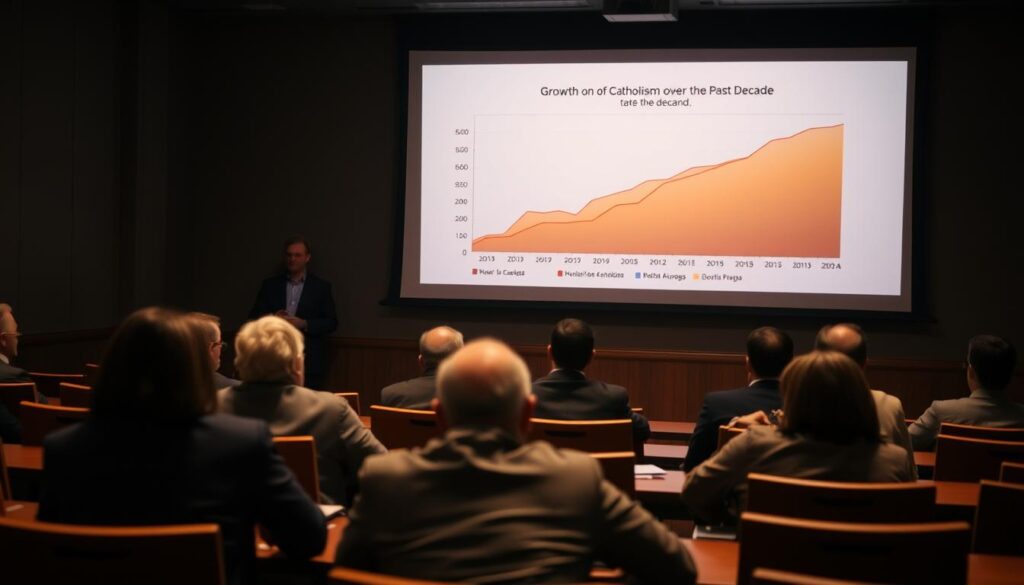
A dimly lit conference room, wooden tables, and chairs arranged in neat rows. On the projection screen, a detailed line graph displays the growth trends of Catholicism over the past decade. The graph is highlighted with warm, muted tones, conveying a sense of seriousness and analysis. In the foreground, a group of people, their faces obscured, lean in, studying the data intently. The lighting is soft, casting subtle shadows, creating a contemplative atmosphere. The scene evokes a sense of careful examination and thoughtful discussion around the evolving landscape of the Catholic faith.

Africa’s 3.31% surge contrasts sharply with Europe’s 0.2% uptick. This two-year period saw structural changes supporting expansion:

  • Seven new dioceses created across high-growth areas
  • Three episcopal sees upgraded to Metropolitan status
  • One Apostolic Administration became a full diocese

These adjustments help manage communities in regions adding millions annually. The Democratic Republic of Congo’s 55 million members now surpass several European nations combined.

Factors Influencing Church Expansion

Four key elements shape membership changes:

  1. Birth rates: African nations see 4+ children per family
  2. Migration: Hispanic populations spread traditions globally
  3. Cultural values: Asia’s young professionals explore faith options
  4. Resource allocation: New dioceses target member clusters

While some areas face decline, others bloom through unique local conditions. Political stability and economic factors also play roles, creating complex growth mosaics. As one Vatican planner noted: “Our maps constantly redraw themselves.”

Shifting Roles in the Church

Leadership structures within religious organizations are transforming as membership patterns evolve. Recent statistics reveal surprising changes in clergy numbers that reflect broader cultural shifts.

Bishops, Priests, and the Changing Clergy Landscape

The Catholic Church added 77 bishops worldwide last year – a 1.4% increase. This growth occurred across all continents except Oceania, where leadership numbers held steady. “More bishops help us guide expanding communities,” explains a Vatican spokesperson.

Priest counts tell a different story. While Africa (+2.7%) and Asia (+1.6%) saw gains, other regions faced declines:

Region Priest Change
Europe -1.6%
Americas -0.7%
Oceania -1.0%

Permanent deacons now number over 51,000 – a 2.6% surge. These lay leaders increasingly handle weddings, baptisms, and parish administration. Their growth helps maintain daily church life where priests are scarce.

Seminarian numbers paint a worrying picture. Global totals dropped 1.8%, with only Africa showing improvement. This decline could affect future priest availability, particularly in areas already struggling with clergy shortages.

These shifts highlight how regional growth impacts religious leadership. As one expert notes: “Vocational trends mirror where people actively engage with faith traditions worldwide.” The church now faces complex decisions about training programs and resource distribution.

Modern Conversions and Evolving Faith

A quiet revolution reshapes spiritual journeys across America. Dioceses like Fort Worth report 72% more adult baptisms since 2023, with young professionals driving this surge. “I needed roots deeper than coffeehouse worship,” shares Sydney Johnston, a 28-year-old convert from Texas.

A diverse congregation gathered in a modern Catholic church, sunlight streaming through stained glass windows. In the foreground, a mix of generations - young families, millennials, and older parishioners - engaged in quiet reflection and prayer. The middle ground features a mix of traditional and contemporary design elements, blending old and new. In the background, a welcoming entryway with an open door, symbolizing the church's openness to new believers. The mood is one of tranquility, community, and a sense of spiritual renewal, capturing the evolving nature of modern Catholic conversions.

Conversion Trends Among Young Adults

Three key factors draw millennials to Catholic churches:

  • Historical connections spanning 2,000 years
  • Structured rituals offering stability
  • Countercultural resistance to modern trends

The pandemic created unexpected time for reflection. Many explored online resources while home, discovering ancient traditions through digital doors. Over 75% of new members in North American parishes now arrive through web-based inquiries.

The Impact of Digital Outreach

YouTube creators like Cameron Bertuzzi attract thousands weekly. His video debates about church history rack up 500K views monthly. “Viewers crave substance,” he notes. “They’re tired of self-help sermons.”

Parishes adapt by expanding RCIA programs. Some churches now offer hybrid classes blending in-person and online learning. This flexibility helps working professionals balance faith exploration with busy schedules.

As one Chicago priest observes: “Our new members bring fresh energy. They ask tough questions but crave authentic community.” These shifts suggest lasting changes in how people engage with spiritual homes across North America.

Conclusion

The global Catholic landscape reveals a tapestry of growth and contraction. Religious sisters now number 589,423 worldwide, though their distribution tells two stories. Europe saw a 3.8% decline in these women leaders last year, while Africa’s ranks grew by 2.2%. These shifts mirror broader population trends across both regions.

Church communities face new realities as membership patterns evolve. Nearly one-third of religious women serve in Europe, but their numbers dwindle as Asian and African congregations expand. This changing spread impacts daily parish life, from school staffing to healthcare ministries.

Looking ahead, leaders balance resource allocation between thriving and struggling areas. Efforts to support Africa’s 14% share include training programs and multilingual materials. Meanwhile, digital tools maintain connections in regions with aging populations.

Modern migration patterns and social attitudes reshape traditional structures. The church’s adaptability – through local initiatives and global partnerships – will define its role in coming years. As centers of influence shift southward, ancient traditions meet contemporary challenges in unexpected ways.

FAQ

How has the Catholic population changed globally in recent years?

According to Vatican statistics, the worldwide Catholic population grew by 1.1% between 2020 and 2022, reaching over 1.38 billion. Growth remains strongest in Africa and Asia, while Europe and North America see slower rates.

Which regions are driving growth in the Catholic Church today?

Africa leads with a 3% annual growth rate, followed by Asia at 1.5%. Countries like the Democratic Republic of Congo, Nigeria, and the Philippines now account for nearly 30% of global baptisms.

What challenges does the Church face with clergy numbers?

While the total number of priests increased slightly to 462,388 in 2022, Europe saw a 14% decline since 2010. Many dioceses now rely on priests from Africa and Asia to fill vacancies.

Are young adults still converting to Catholicism?

Digital outreach through platforms like Ascension Presents and Word on Fire has helped engage younger audiences. Over 40% of new U.S. converts in 2023 were under 35, though retention rates remain a focus.

How does the Vatican Yearbook track demographic shifts?

The Annuario Pontificio uses parish registrations, sacramental records, and national census data to map membership trends. Recent editions highlight urbanization impacts, with 60% of Catholics now living in cities.

What role do women play in modern Catholic growth strategies?

Women lead 85% of parish catechetical programs globally and comprise 70% of lay missionaries. Organizations like the Catholic Women’s League increasingly shape evangelization efforts in growing regions.

What is Roman Catholicism? A Friendly Guide


With over 1.3 billion followers across six continents, this ancient spiritual tradition shapes lives and cultures worldwide. Rooted in teachings traced to the Apostles, it stands as one of Christianity’s oldest continuous traditions, blending timeless rituals with a deeply layered organizational framework.

Central to its identity is the papal system, led by the bishop of Rome. The Vatican serves as both spiritual compass and administrative hub, guiding matters of faith for diverse communities from Manila to Mexico City. This structure has remained remarkably consistent through centuries of social change.

Seven sacraments, devotion to saints, and emphasis on communal worship distinguish its practices from other Christian churches. Yet its influence extends beyond theology—medieval cathedrals, Renaissance art, and modern social justice movements all bear its imprint.

Why does this institution matter today? From shaping moral debates to preserving ancient manuscripts, its role in global heritage remains unmatched. We’ll unpack how tradition and adaptability let it thrive in our rapidly evolving world.

Key Takeaways

  • Over 1.3 billion members make this faith the largest Christian denomination globally
  • Direct historical ties to early Christian communities through apostolic succession
  • Unique structure combines local parishes with centralized Vatican leadership
  • Seven sacraments and Marian devotion distinguish its spiritual practices
  • Significant influence on Western art, education, and ethical frameworks
  • Balances ancient traditions with modern social engagement

Origins and History of Roman Catholicism

The roots of this global faith stretch back to ancient streets where early believers forged a spiritual legacy. Letters from apostles and archaeological finds reveal how small house churches grew into an enduring institution.

Apostolic Beginnings

First-century writings show vibrant communities forming after Jesus Christ‘s resurrection. St. Paul‘s New Testament letter to Roman believers—written around AD 57—details their struggles and hopes. Early bishops like Clement of Rome later emphasized Peter’s leadership there, creating a direct line of authority through apostolic succession.

By the second century, Rome’s status as imperial capital boosted its religious influence. Church leaders preserved tradition through turbulent times, maintaining unity as other Christian groups fractured.

Medieval Growth and Schism

The year 1054 marked a turning point. Theological disputes over the Nicene Creed and papal power split Eastern and Western believers. This schism formalized differences between Roman and Orthodox practices that still exist today.

Medieval monasteries became centers of learning while cathedrals rose across Europe. Crusades and royal alliances expanded the church’s political role, transforming it from underground movement to cultural cornerstone.

Foundational Beliefs and Doctrines

At the heart of this ancient faith lies a dynamic interplay between time-honored practices and spiritual truths. These principles guide daily life while connecting believers to centuries of theological wisdom.

Sacred Traditions and Scripture

Catholic doctrine draws from two rivers of revelation: biblical texts and church tradition. Unlike groups that prioritize Scripture alone, this approach sees the New Testament and sacred customs as complementary. St. Irenaeus famously described this threefold foundation as “Scripture, succession, and faith handed from apostles.”

A grand cathedral interior bathed in warm, golden light, ornate columns and arched ceilings adorned with intricate religious iconography. In the foreground, a procession of robed clergy carrying ornate candles and crosses, their faces serene and reverent. Surrounding them, a congregation of worshippers in pews, heads bowed in prayer. In the background, towering stained glass windows depicting the likenesses of Catholic saints, their serene expressions conveying a sense of timeless spirituality. The atmosphere is one of solemn contemplation and profound devotion, capturing the essence of Catholic tradition and belief.

Central to worship is the belief in transubstantiation—the transformation of bread and wine into Christ’s body and blood during Mass. This literal interpretation of Jesus’ Last Supper words reflects the church’s emphasis on tangible holiness.

The Role of Saints and Miracles

Devotion to the Virgin Mary stands out among Catholic practices. Believers celebrate her sinless conception and bodily ascent to heaven, events not detailed in Scripture but preserved through tradition. Saints occupy similar reverence as spiritual mentors, with many praying to these holy figures for guidance.

The church maintains strict protocols for confirming supernatural events. Sites like Lourdes attract millions seeking healing, though only 70 miracles there meet official criteria since 1858. This careful validation process balances faith with rational inquiry.

Overview of Church Structure and Leadership

Distinctive organizational patterns define this global faith community. Its framework combines spiritual authority with administrative precision, creating a system that’s lasted nearly two millennia.

Papal Authority and Infallibility

At the pinnacle stands the pope, believed to inherit spiritual power from St. Peter. Since 1870, Vatican I declared papal infallibility when speaking ex cathedra—Latin for “from the chair” of Peter. A Vatican official clarifies: “This doesn’t mean the pope can’t make mistakes. It applies only to definitive teachings on faith or morals.”

Such declarations remain rare. Only two ex cathedra statements exist—the Immaculate Conception (1854) and Mary’s Assumption (1950). Cardinals serve as the pontiff’s closest advisors, wearing scarlet robes symbolizing readiness to defend faith “even unto blood.”

Hierarchy and Governance

The Roman Catholic Church operates through three sacred orders: bishops, priests, and deacons. Bishops govern dioceses as apostolic successors, ordaining new clergy while maintaining unity with Rome. Archbishops oversee larger regions, while cardinals focus on Vatican governance.

Local parishes connect this vast network. Priests lead worship and sacraments, adhering to celibacy rules rooted in apostolic times. Contrasting with Orthodox traditions, this requirement underscores dedication to spiritual fatherhood over biological family ties.

Behind the scenes, the Roman Curia manages global operations. Departments like the Congregation for the Doctrine of Faith safeguard teachings, while others coordinate missions or liturgy. This intricate system balances centralized authority with grassroots spiritual care across 3,000 dioceses worldwide.

Key Practices and Sacraments in the Roman Catholic Church

Sacred rituals shape daily life for millions of believers, connecting them to centuries of spiritual heritage. These visible signs of divine grace guide major life moments while nurturing ongoing faith journeys.

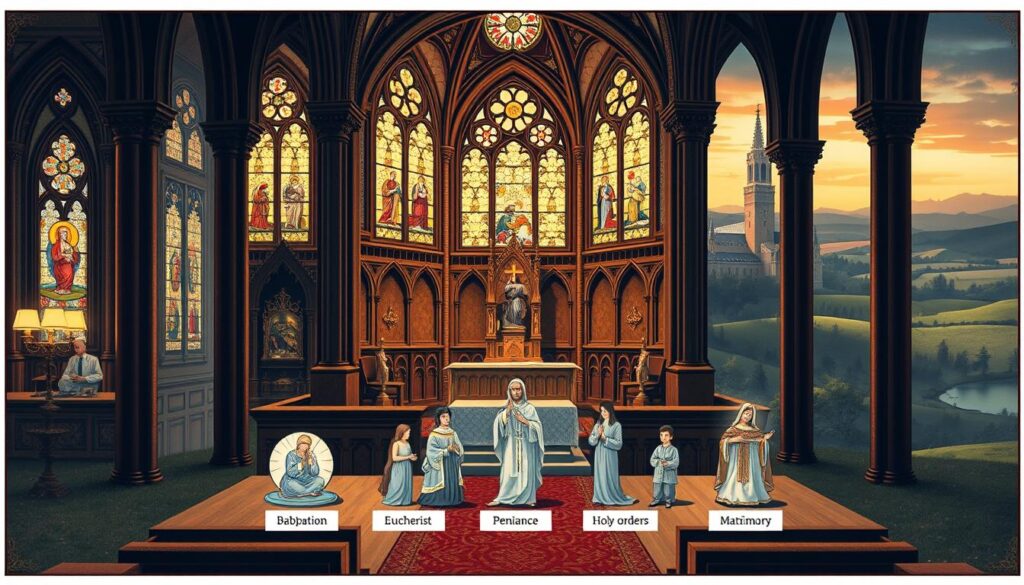
A detailed illustration of the seven sacraments of the Roman Catholic Church. In the foreground, a central scene depicts the key sacraments - baptism, confirmation, eucharist, penance, anointing of the sick, holy orders, and matrimony - each represented by a symbolic icon or figure. The middle ground features an ornate, gothic-style church interior with stained glass windows casting warm, reverent lighting. In the background, a serene landscape with rolling hills and a distant cathedral spire, conveying the grandeur and timelessness of Catholic tradition. The overall atmosphere is one of solemnity, reverence, and the sacred rituals that define Catholic spiritual life.

The Seven Sacraments

Seven sacraments serve as milestones marking spiritual growth. Each offers unique blessings, from cleansing original sin in baptism to healing the terminally ill through last rites. The Eucharist remains central—believers receive communion weekly, affirming Christ’s presence through transubstantiation.

Sacrament Purpose Typical Age
Baptism Spiritual rebirth Infancy/adulthood
Confirmation Strengthening faith Teen years
Reconciliation Moral renewal Any age
Marriage Lifelong union Adulthood
Holy Orders Clergy dedication Adulthood

Liturgy and Devotional Practices

Mass follows structured liturgy blending Scripture readings with ancient prayers. Many parishes hold Eucharistic Adoration, where consecrated hosts rest in ornate monstrances for meditation. The rosary—a bead-based prayer chain—helps devotees reflect on biblical events while honoring Mary.

Annual obligations like Easter communion trace back to 1215’s Fourth Lateran Council. Private confession maintains relevance too—over 70% of U.S. Catholics participate yearly according to recent surveys. These practices bridge personal spirituality with communal tradition.

Core Identity: what is roman catholicism and its Global Influence

Nearly one in seven people worldwide belong to this faith community, shaping societies through spiritual values and tangible action. Its teachings ripple through classrooms, hospitals, and legislative chambers, blending ancient wisdom with modern challenges.

A vast cathedral's grand facade, adorned with ornate spires and intricate stone carvings, stands as a testament to the enduring influence of Roman Catholicism. In the foreground, a diverse congregation gathers, their faces reflecting the global reach of the faith. The mid-ground reveals a network of cathedrals, monasteries, and holy sites spanning continents, while the background is a mosaic of cultural landmarks and landmarks, symbolizing the integration of Catholicism into the fabric of societies worldwide. Soft, warm lighting casts a reverential glow, conveying the sense of timeless tradition and spiritual majesty that characterizes the global Catholic influence.

Cultural and Social Impact

The Catholic Church’s fingerprints appear in unexpected places. Renaissance painters like Michelangelo drew inspiration from biblical stories, while composers like Mozart scored masses still sung today. Gothic cathedrals—stone symphonies of faith—remain architectural marvels attracting millions annually.

Beyond art, this institution pioneered universal education. Over 140,000 schools worldwide educate 61 million students, regardless of belief. Catholic hospitals serve 1 in 6 patients globally, demonstrating faith through service.

Sphere of Influence Historical Example Modern Impact
Art & Architecture Chartres Cathedral (1194) UNESCO World Heritage Sites
Education Medieval universities 94 U.S. Catholic colleges
Social Teaching Rerum Novarum (1891) Climate change advocacy

Ethical frameworks developed by thinkers like Aquinas still shape debates about human rights and economic fairness. Recent popes have addressed artificial intelligence ethics, proving ancient traditions adapt to new frontiers.

From protecting migrant rights to preserving ancient texts, this global community bridges past and present. Its voice remains vital in conversations about human dignity across cultures and generations.

Interactions with Other Christian Traditions

Christian communities have navigated complex relationships for centuries, balancing shared beliefs with distinct practices. While divisions persist, modern efforts focus on building bridges across theological differences.

Schisms and Doctrinal Disagreements

The Great Schism of 1054 split Eastern and Western churches over papal authority and creed wording. Orthodox leaders rejected Rome’s claim to universal jurisdiction, creating separate structures that endure today.

Sixteenth-century reformers like Luther challenged tradition’s role in salvation. Protestant churches emerged, emphasizing Scripture alone over sacraments. These denominations reshaped Europe’s religious landscape through new worship styles and governance models.

Pathways to Ecumenism

Vatican II revolutionized Catholic relations with other Christian churches in the 1960s. The council declared: “Many elements of sanctification exist outside visible Church structures,” recognizing other means of spiritual growth.

Joint initiatives now address poverty and climate change. Over 75% of U.S. Catholic parishes partner with Protestant churches on food banks and disaster relief. Shared baptismal rites help overcome historical issues.

Key obstacles remain—papal authority and sacramental theology top the list. Yet annual prayer weeks unite denominations, proving collaboration outweighs centuries-old disputes.

Modern Developments and Reforms

The 1960s ushered in transformative winds of change through Roman Catholic communities worldwide. Sweeping updates reshaped worship styles, community roles, and global relationships while preserving core teachings.

A New Chapter in Church Life

Vatican II (1962-65) revolutionized daily church practices. Mass shifted from Latin to local languages, inviting broader participation. Lay members gained active roles in liturgy and parish matters, fostering deeper engagement.

Pope John Paul II became a global symbol of hope during his 27-year papacy. His support for Poland’s Solidarity movement helped dismantle communist regimes, proving faith’s power in political change. Mission growth surged in Africa and Asia under his leadership.

Modern challenges test the institution’s resilience. Clergy shortages in Western nations contrast with booming seminaries elsewhere. Recent scandals demand renewed focus on transparency and accountability. Yet the church continues adapting—embracing digital outreach while upholding ancient sacramental life.

FAQ

How does Roman Catholicism differ from other Christian denominations?

The Catholic Church emphasizes apostolic succession, recognizing the Pope and bishops as successors of Christ’s apostles. It also upholds Sacred Tradition alongside Scripture, along with teachings like the Virgin Mary’s Immaculate Conception and the seven sacraments, which many Protestant groups do not share.

What role do sacraments like Communion and Confirmation play?

A: Sacraments like the Eucharist (Communion) and Confirmation are seen as outward signs of divine grace. They mark spiritual milestones, such as receiving the Holy Spirit or reaffirming faith, and are central to Catholic worship and community life.

How has the Pope’s authority shaped Catholic doctrine?

The Pope, as head of the Roman Catholic Church, holds supreme teaching authority. Teachings on issues like papal infallibility—defined at the First Vatican Council—reinforce his role in guiding doctrine, such as Pope John Paul II’s contributions to bioethics and social justice.

Why are saints and the Virgin Mary important in Catholic teachings?

Saints, including the Virgin Mary, are viewed as intercessors and models of holiness. Veneration of saints reflects the belief in the communion between living believers and those in heaven, rooted in New Testament teachings about the “cloud of witnesses.”

What caused divisions between Catholicism and other Christian churches?

Key splits, like the Great Schism of 1054 and the Protestant Reformation, arose from disputes over papal authority, liturgical practices, and doctrines like justification. Modern ecumenical efforts, such as Vatican II, aim to bridge these gaps.

How do Catholic practices like confession and liturgy deepen faith?

A: Confession (Reconciliation) allows believers to seek forgiveness through clergy, while structured liturgy—like the Mass—connects worshipers to ancient traditions. These practices foster spiritual discipline and communal unity.

How did Vatican II modernize Catholic practices?

The Second Vatican Council (1962–1965) introduced reforms like Mass in local languages, greater lay participation, and dialogue with other faiths. It redefined the Church’s role in the modern world, emphasizing social justice and religious freedom.

What is the significance of marriage in Catholic life?

A: Marriage is a sacrament reflecting Christ’s union with the Church. It emphasizes lifelong commitment, mutual support, and openness to family life, guided by teachings on natural law and sacramental grace.

Catholicism and In Vitro Fertilization: What You Need to Know


Since the first successful in vitro fertilization procedure in 1978, modern medicine has helped millions of families grow. Over eight million children worldwide now owe their existence to this technology. Yet for those following Catholic teachings, these scientific advances present complex moral questions.

The Church’s perspective centers on protecting human life from its earliest stages. Three official documents published between 1987 and 2008 outline clear concerns about common fertility treatments. These teachings emphasize the sacred bond between marriage and natural conception while addressing ethical challenges posed by laboratory-created embryos.

Many couples face heartbreaking choices when struggling with infertility. This guide explores how religious principles intersect with medical realities. We’ll break down the Church’s key objections, examine statistical outcomes of fertility procedures, and highlight alternative paths supported by Catholic doctrine.

Key Takeaways

  • The Catholic Church formally opposes most assisted reproductive technologies
  • Major concerns focus on embryo loss and marital unity
  • Church teachings developed through three key documents over 30 years
  • Over 8 million children have been born via IVF worldwide
  • Faith-based support exists for couples facing infertility
  • Medical advances require careful ethical evaluation

Introduction to Catholic Perspectives on IVF

Over 1 in 6 American couples now face fertility struggles, driving a $8 billion industry for solutions. Religious teachings approach this crisis with empathy, recognizing the raw ache of unfulfilled desire for parenthood. Ancient texts echo modern pain—from Rachel’s desperate plea “Give me children!” to Sarah’s decades-long wait for Isaac.

Infertility Challenges and the Desire for a Child

The inability to conceive often feels like a physical and spiritual wound. Scripture honors this struggle through figures like Hannah, who wept through years of empty arms before bearing Samuel. Today’s married couples similarly wrestle with grief that no amount of affection can erase.

Church leaders affirm the goodness of wanting a child, calling it “a natural expression of marriage.” However, they caution that longing doesn’t justify all medical interventions. Like choosing between poisoned water and thirst in a desert, the path forward requires wisdom.

The Role of Marital Love and Procreation

Sacred unions carry two purposes: bonding partners and creating life. Physical intimacy becomes a language speaking both love and openness to miracles. When conception happens in labs rather than bedrooms, this dual meaning fractures.

Imagine planting seeds in a community garden versus a corporate farm. Both grow plants, but one nurtures relationships while the other prioritizes results. Catholic teachings argue that how we welcome life matters as much as the life itself—a stance shaping their critique of common fertility treatments.

Historical Foundations: Scripture and Early Church Writings

Long before modern fertility clinics, sacred stories shaped how communities understood family-building. These narratives reveal timeless truths about patience, ethics, and the human person’s inherent value.

Biblical Narratives of Infertility and Hope

Sarah’s laughter turned to joy at age 90 when she bore Isaac. Hannah’s tearful prayers produced Samuel, a prophet who changed Israel. These women faced empty arms for decades before receiving their gift of motherhood.

A dimly lit, medieval-style painting depicting biblical scenes of miraculous conceptions. In the foreground, a humble bedroom scene with a glowing Virgin Mary and the infant Jesus. In the middle ground, the elderly Elizabeth cradling the newborn John the Baptist. In the background, a hazy, ethereal landscape with angels and celestial beings hovering above. The composition uses chiaroscuro lighting to create a sense of sacred, reverent atmosphere. The figures are rendered with a classical, Renaissance-inspired realism, heightening the sense of historical and religious significance.

Scripture also warns against manipulating conception. Lot’s daughters used deception to continue their family line—a choice condemned in Genesis. Their story shows that methods matter as much as outcomes.

Biblical Figure Time Period Key Teaching
Sarah 1800 BCE Divine timing over human urgency
Hannah 1100 BCE Prayer as spiritual response to infertility
Lot’s Daughters 1900 BCE Ethical limits in pursuing parenthood

Tradition of Marital Conception in Early Teachings

Early Christians saw childbirth as a sacred partnership between spouses and God. Saint Augustine wrote that children should be “begotten through loving union, not manufactured like pottery.” This teaching emphasized respect for life’s natural beginnings.

Church leaders consistently taught that every woman and child carries divine worth. As Clement of Alexandria noted: “The family mirrors heaven’s love when created through holy commitment.” These principles still guide moral evaluations of reproductive choices today.

Church Teachings and Magisterial Documents on IVF

Modern fertility treatments present complex ethical questions that religious authorities have addressed through detailed guidance. Three pivotal documents form the foundation of official teaching, offering clarity amid evolving medical possibilities.

Insights from Donum Vitae and Evangelium Vitae

The 1987 Donum Vitae introduced a critical distinction: medical help enabling natural conception aligns with moral principles, while methods replacing marital intimacy do not. This document compares ethical interventions to repairing a bridge versus building an entirely new structure.

Eight years later, Evangelium Vitae highlighted practical concerns. Standard techniques often create multiple human embryos, with many discarded or frozen. Imagine planting ten seeds knowing seven will be destroyed—this waste conflicts with beliefs about life’s sacredness.

Understanding Dignitas Personae on Bioethical Questions

The 2008 Dignitas Personae updated statistics, revealing stark realities. Even top clinics experience 80% embryo loss per vitro fertilization cycle. For every successful birth, numerous lives never progress beyond microscopic stages.

These documents collectively stress that good intentions don’t justify harmful methods. As one theologian noted: “We can’t build families through systems treating children as products.” The teaching invites couples to seek solutions honoring both love and life’s dignity.

Exploring “catholicism and ivf”: Key Doctrines and Ethical Dilemmas

Modern reproductive methods spark intense ethical debates about how life begins. At the heart lies a critical question: does medical intervention support or replace the sacred act of creating life? This distinction shapes religious evaluations of fertility treatments.

A serene natural landscape with lush foliage and a glowing sunset sky serves as the backdrop. In the foreground, a couple stands in deep contemplation, their expressions reflecting the weight of an ethical dilemma. Hovering above them, a translucent image of a fetus represents the conflict between natural conception and emerging reproductive technologies. Warm, golden lighting illuminates the scene, creating a pensive, thought-provoking atmosphere. The lens is angled to capture the figures in a thoughtful, introspective pose, conveying the complexity of the issues surrounding Catholicism and in vitro fertilization.

The Ethical Conflict Between Natural Conception and Technological Intervention

Faith traditions emphasize that becoming parents involves more than biological results. The marital act itself carries spiritual meaning—a physical expression of love open to life’s mystery. When laboratories handle conception, this deeply personal journey shifts to sterile environments managed by technicians.

Language reveals underlying values. Terms like “embryo selection” and “genetic material” reduce children to medical outcomes. One theologian observes: “We don’t manufacture souls.” This perspective argues that reproductive technology risks treating people as projects rather than gifts.

Ethical guidelines distinguish between aiding nature and overriding it. Fertility drugs that enhance natural cycles differ fundamentally from procedures that sidestep marital intimacy. The Church maintains that every person deserves respect from conception onward—a principle challenging methods involving discarded embryos.

Couples face tough choices between desire and doctrine. While science offers solutions, faith calls for reflection: Can we honor life’s sanctity while pursuing parenthood? The answer often lies in balancing compassion with timeless values.

Moral and Ethical Implications in the IVF Process

The journey from laboratory conception to childbirth involves hidden ethical crossroads. While medical advances offer hope, they also create complex dilemmas about human life’s intrinsic value. Let’s explore why certain practices clash with core moral principles.

A pensive scientific examination of the ethical concerns surrounding human embryos. In the foreground, a team of researchers meticulously studying a cluster of delicate embryonic cells, their expressions solemn and thoughtful. In the middle ground, a series of holographic diagrams and data visualizations hovering above the lab bench, illuminating the complexities of the IVF process. The background is dimly lit, casting an air of gravity and contemplation, as if the weight of the moral implications hangs heavy in the laboratory air. Soft, directional lighting accentuates the reverence and care with which the scientists approach their task. A sense of profound responsibility and the need to navigate ethical waters with utmost caution permeates the scene.

Sanctity of Life and the Treatment of Human Embryos

Creating multiple embryos raises urgent questions. Fertility clinics often produce 10-15 potential lives per cycle, yet over 90% never implant or survive. This high attrition rate mirrors a harsh reality: most lab-created embryos become statistical casualties.

Selection processes intensify ethical concerns. Technicians grade embryos like products, choosing which to transfer based on viability scores. As one bioethicist notes: “We’ve turned life’s beginnings into a quality-control checklist.” This approach conflicts with beliefs that every human life holds equal worth from fertilization onward.

Issues Surrounding Embryo Disposition and Selective Reduction

Frozen storage compounds moral challenges. Over a million embryos sit in U.S. freezers—some abandoned, others destined for research. This suspended existence contradicts teachings about respecting life’s natural progression.

Selective reduction adds another layer. When multiple embryos implant successfully, doctors may terminate less-developed ones. The procedure—using potassium chloride injections—directly ends developing life. For many, this mirrors elective abortion’s ethical weight.

Even initial steps like sperm collection spark debate. Required methods often violate teachings about marital intimacy’s sacred context. These interconnected issues reveal why some view fertility treatments as conflicting with foundational values about life’s dignity.

The Impact of Scientific Advances and the Reproductive Technology Industry

Modern medicine’s race to solve fertility challenges has sparked a booming industry with complex consequences. In the U.S., reproductive technology operates with minimal oversight, creating ethical gaps between profit motives and family well-being.

Balancing Innovation with Traditional Values

Many clinics prioritize success rates over safety. Powerful fertility drugs frequently lead to risky multiple pregnancies—a case where medical ambition outpaces natural limits. Women face heightened health dangers while carrying four or more babies simultaneously.

The average $10,000 price tag per technology-driven attempt places financial strain on hopeful parents. This unregulated market often treats human life as a product line rather than a sacred journey. As one ethicist notes: “Assembly-line approaches to conception reduce miracles to transactions.”

Religious teachings caution against viewing technology as a cure-all. Life’s creation deserves reverence beyond industrial control. While innovation offers hope, it must respect timeless values about human dignity and natural processes.

FAQ

Why does the Catholic Church oppose IVF?

The Church teaches that life is sacred from conception and that procreation should arise from the loving union of spouses. IVF often involves creating multiple embryos outside the marital act, risking their destruction or manipulation, which conflicts with human dignity.

Are there alternatives to IVF for Catholic couples struggling with infertility?

Yes! Methods like NaProTechnology focus on identifying and treating underlying causes of infertility while aligning with Church teachings. Natural family planning and ethical medical treatments are also encouraged to support conception within marriage.

How does IVF impact the dignity of human embryos?

Embryos are viewed as unique human lives with inherent worth. IVF often results in surplus embryos being frozen, discarded, or used for research, which the Church sees as a violation of their right to life and protection.

Can IVF ever be morally acceptable in Catholicism?

No. Even with good intentions, the process separates procreation from the marital act and risks harming embryos. The Church emphasizes that the ends (having a child) do not justify means that disrespect life or marital unity.

What does the Church say about “selective reduction” in IVF pregnancies?

Reducing multiple embryos to one or two often involves ending lives, which the Church strongly condemns. This practice contradicts the belief that every life, regardless of circumstances, deserves protection.

How do documents like Donum Vitae address reproductive technology?

A: Donum Vitae clarifies that techniques replacing the marital act (like IVF) are morally unacceptable. It stresses that science must respect ethical boundaries, ensuring human life is never treated as an object.

Does the Church support fertility treatments that don’t involve IVF?

Absolutely. Treatments restoring a couple’s natural fertility, such as surgery or hormone therapy, are encouraged. These methods honor the connection between love and life without technological interference.

What if a Catholic undergoes IVF before understanding Church teaching?

The Church encourages seeking forgiveness through sacramental reconciliation. It also calls for compassion, recognizing the deep pain of infertility and the complexity of these decisions.