Recent Posts

Celebrate Catholicism’s Holy Week: A Spiritual Journey


Every spring, millions of believers worldwide prepare for a profound seven-day observance that shapes their faith and renews their spiritual life. This sacred period marks the final stretch of Lent while building toward Christianity’s most joyous celebration. From waving palm branches to lighting candles in darkened churches, each ritual invites participants to walk alongside ancient events that still resonate today.

The journey begins with crowds cheering a humble leader’s arrival, then shifts to somber reflection on sacrifice. By week’s end, jubilant shouts of “He is risen!” echo through sanctuaries. These layered traditions—honored across generations—create a powerful rhythm that many describe as transformative.

What makes this time of year so impactful? It’s more than historical reenactment. The liturgies and personal practices help believers connect deeply with core truths about love, suffering, and hope. Whether you’re new to these observances or seeking fresh perspective, understanding their meaning can enrich your experience.

Key Takeaways

  • Marks the final days of Lent and leads into Easter celebrations
  • Blends ancient rituals with personal spiritual reflection
  • Includes Palm Sunday, Good Friday, and Easter Vigil observances
  • Offers emotional connection to foundational Christian events
  • Practiced globally with cultural adaptations

Understanding Holy Week in Catholic Tradition

Across continents, communities pause their routines to relive a story that shaped faith for two millennia. This sacred period starts with palm-waving processions and builds toward candlelit vigils, blending ancient customs with personal devotion. Believers describe it as stepping into a living storybook where every ritual carries layers of meaning.

The seven-day journey mirrors Jesus’ final days in Jerusalem. It begins with cheers of welcome, shifts to shared meals, and reaches its climax in solemn remembrance. These observances aren’t just history lessons—they’re invitations to experience sacrifice and renewal firsthand.

Why does this time draw millions yearly? The answer lies in its power to unite people across generations. From reading biblical accounts to washing feet like the disciples, each act reinforces connections to spiritual roots. As one priest notes, “We don’t just watch—we join the story.”

This period also marks the finish line of Lent’s forty-day preparation. Fasting gives way to feasting, mourning transforms into joy. The emotional rollercoaster—from Good Friday’s grief to Easter’s triumph—mirrors life’s own ups and downs, making its lessons universally relatable.

Through processions, prayers, and shared meals, participants find fresh perspectives on timeless truths. Whether lighting candles or singing hymns, everyone contributes to a collective rhythm that’s lasted centuries. It’s this mix of personal reflection and communal celebration that keeps the tradition vibrant year after year.

The Significance of Palm Sunday

Church doors swing open as worshippers clutch fresh greenery, launching a sacred journey that blends celebration with solemn anticipation. This day begins Palm Sunday, where cheers of hope meet whispers of coming sacrifice.

Symbolism of Palm Branches and Triumphal Entry

Imagine dusty roads suddenly carpeted with palm branches—nature’s red carpet for a king riding a donkey. This scene from Matthew 21:1-11 wasn’t random theater. In ancient times, palms symbolized victory and peace. Roman generals received palm fronds after winning battles. Here, they honor a different kind of conqueror.

Modern processions keep this alive. “We wave palms like they did 2,000 years ago,” explains Father Michael from Chicago. “It’s our way of saying ‘You’re still our king today.’” The branches later get woven into crosses, connecting Sunday’s joy to Friday’s sorrow.

Historical and Biblical Context

Jesus’ entry into Jerusalem fulfilled Zechariah 9:9’s prophecy about a humble king arriving on a donkey. But the crowd missed the paradox—their warrior Messiah came unarmed. Biblical scholar Dr. Emily Thompson notes: “They wanted a political hero. He offered spiritual liberation.”

This tension still resonates. As palms rustle in church aisles, believers confront the same question: What kind of king will we follow? The answer shapes not just holy week, but daily lives of faith.

Catholicism Holy Week: Traditions & Celebrations

The air buzzes with anticipation as believers worldwide prepare to step into sacred traditions passed down through generations. Four pivotal ceremonies anchor this spiritual journey, each inviting active participation in age-old narratives. From Manila’s sun-baked streets to Rome’s candlelit basilicas, these days transform ancient stories into visceral experiences.
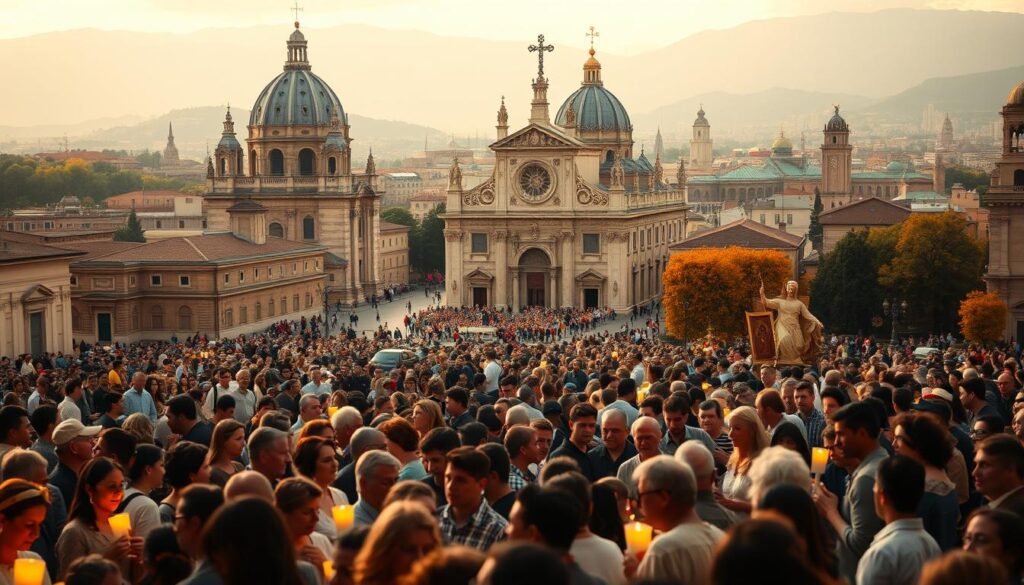
A grand, global celebration of Catholicism's most sacred week. In the foreground, a diverse crowd of worshippers gather in solemn reverence, their faces illuminated by the warm glow of candlelight. In the middle ground, grand cathedrals and basilicas rise majestically, their ornate facades adorned with intricate carvings and stained glass windows. The background is a tapestry of cultural traditions, with processions, parades, and vibrant festivities unfolding against a backdrop of rolling hills, historic cityscapes, and vibrant foliage. The scene is bathed in a soft, golden light, evoking a sense of timelessness and spiritual transcendence.

Parish communities become living theaters during this time. Dramatic readings echo through sanctuaries while fragrant incense rises with collective prayers. “We’re not spectators—we’re part of the story,” shares Maria Gonzalez, a liturgical coordinator in Texas. Her team coordinates processions where children scatter flower petals alongside adults carrying life-sized crosses.

Cultural expressions add vibrant hues to shared observances:

Region Tradition Significance
Spain Silent processions with hooded penitents Emphasizes personal reflection on sacrifice
Philippines Street reenactments of Christ’s Passion Encourages community-wide engagement
Mexico Palm weaving workshops Connects families through craft and prayer

These practices do more than retell history—they forge unbreakable bonds. Neighborhoods unite to build floral carpets in Guatemala or stage Passion Plays in Bavaria. As daylight fades on Holy Saturday, millions collectively hold their breath before the Easter fire’s spark announces renewal. Through shared rituals, the celebration becomes both deeply personal and magnificently universal.

Holy Wednesday: Preparation and Betrayal

Shadows lengthen across the spiritual journey as believers reach a pivotal midpoint. This day holds dual significance—personal reflection and a sobering reminder of human frailty.

The Story of Spy Wednesday

Scripture paints a tense scene: Judas Iscariot negotiates with religious leaders while others prepare Passover. Luke 22:6 captures the moment: “He consented and watched for an opportunity to hand Jesus over to them when no crowd was present.” This secret pact earned the day its nickname—Spy Wednesday.

Why does this event still sting? Judas wasn’t a stranger. He shared meals and miracles with Jesus. As theologian Dr. Rachel Peters observes: “The betrayal came from inside the family. That’s what makes it universally relatable.”

Churches use this time for heart-checks. Many host reconciliation services where believers:

  • Reflect on personal choices
  • Seek forgiveness through prayer
  • Prepare spiritually for Easter Triduum

The day’s irony isn’t lost on worshippers. While Judas plotted in shadows, Mary of Bethany anointed Jesus with costly perfume—a contrast between greed and devotion. This push-pull dynamic invites self-examination: Where do our loyalties truly lie?

As sunlight fades on Wednesday, a quiet resolve builds. Altars are stripped bare. Hearts make space for what’s coming—a sacred three-day journey from darkness to dazzling light.

Maundy Thursday: Last Supper and Service

The atmosphere shifts as twilight descends on this sacred evening. Believers gather worldwide for rituals that blend intimate fellowship with profound spiritual truths. Maundy Thursday—also called Holy Thursday—centers on two revolutionary acts: sharing a final meal and performing humble service.
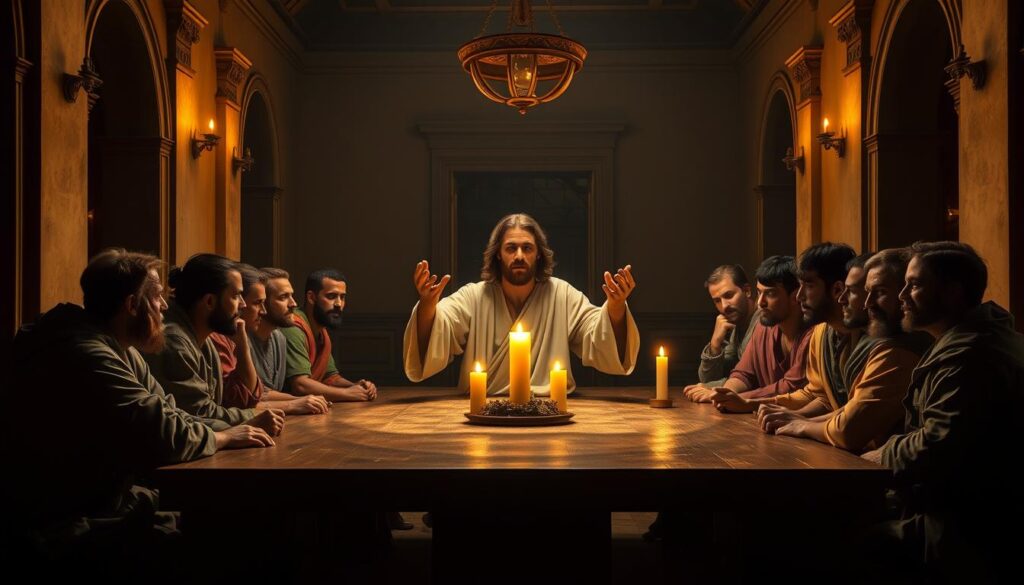
A dimly lit Renaissance-style interior, bathed in warm, golden candlelight. At the center, a long wooden table where Jesus and his twelve disciples gather for the Last Supper. Jesus, in a flowing robe, extends his hands in a gesture of blessing, his expression serene and contemplative. The disciples, rendered in detailed portraiture, lean in, their faces etched with a mix of reverence, concern, and quiet contemplation. In the background, arched doorways and ornate columns hint at the grandeur of the setting, while muted shadows create a sense of intimacy and solemnity. The overall mood is one of profound spiritual significance, reflecting the solemn occasion of Maundy Thursday.

Institution of the Eucharist and Foot Washing Ceremony

At the Evening Mass of the Lord’s Supper, churches recreate history’s most transformative dinner. Jesus’ words—“This is my body… my blood”—still echo through sanctuaries as bread and wine become sacred symbols. “Every Eucharist connects us to that original supper,” explains Father Mark, a Chicago priest.

The second act stuns modern crowds as much as ancient disciples. Clergy kneel to wash congregants’ feet, mirroring Jesus’ shocking gesture. “He flipped power dynamics upside down,” notes theologian Dr. Sarah Lin. This ritual challenges everyone to lead through service, not status.

Transition into the Easter Triduum

As the Last Supper liturgy concludes, Lent officially ends. Bells fall silent. Altars stand bare—a visual cue that the journey intensifies. The Easter Triduum begins, three days focusing on sacrifice and resurrection.

Parishes prepare unique traditions:

  • Blessing oils used throughout the year
  • Creating “altars of repose” adorned with flowers
  • Nighttime adoration prayers

These practices bridge Jesus’ final teachings to his ultimate act of love. As candles flicker in darkened churches, participants sense they’re stepping into sacred history—not just remembering it.

Good Friday: Sacrifice and Reflection

A hush falls over churches worldwide as believers confront Christianity’s most solemn day. Good Friday centers on quiet reverence, drawing millions into shared contemplation of sacrifice. Unlike other observances, altars stand bare—no Mass, no bells—just raw reflection on love’s ultimate cost.
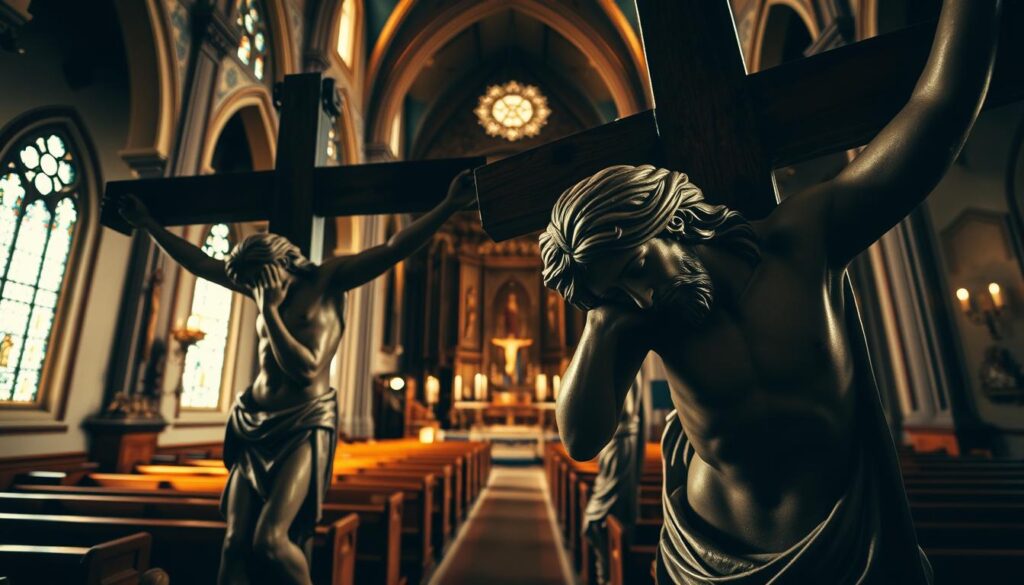
A dramatic, low-angle shot of the Stations of the Cross in a Catholic church. The foreground features ornate, life-sized statues of Christ carrying the cross, his face contorted in agony. The middle ground shows the church's interior, with rows of wooden pews and stained glass windows casting a warm, somber glow. In the background, the high, vaulted ceiling and ornate altar create a sense of grandeur and reverence. The lighting is dramatic, with shadows accentuating the sculptures' textures and expressions. The overall atmosphere is one of solemnity, sacrifice, and deep spiritual reflection.

Walking the Path of Suffering

Fourteen stops. Fourteen moments to feel the weight of suffering. The Stations of the Cross transform sanctuaries into spiritual journeys, with participants retracing Jesus’ final hours. “We don’t just read about the Passion—we walk it together,” says Sister Angela from Boston.

Honoring the Cross’s Power

During the Celebration of the Passion, congregations approach a simple wooden cross—touching, kneeling, weeping. This ancient ritual, called the Veneration, turns symbols into sacred encounters. Churches distribute Communion using hosts blessed the night before, linking Thursday’s meal to Friday’s death.

Fasting traditions deepen the day’s gravity. Many skip meals, mirroring Christ’s physical suffering. Yet darkness never wins. As candles rekindle Saturday night, Friday’s grief becomes Easter’s hope—a reminder that passion always leads to renewal.

FAQ

What is the importance of Palm Sunday?

Palm Sunday marks Jesus’ entry into Jerusalem, celebrated with palm branches to honor His welcome. It begins a period of reflection on sacrifice and renewal, leading into the Easter Triduum.

Why do Catholics reenact the foot washing ceremony?

The ritual, performed during the Evening Mass of the Lord’s Supper on Maundy Thursday, mirrors Jesus’ act of humility. It emphasizes service, love, and unity among believers.

How is Good Friday observed?

Through solemn liturgies, veneration of the cross, and Stations of the Cross, Catholics commemorate Christ’s suffering. Silence and prayer mark this day of sacrifice.

What does the Easter Vigil involve?

Held after sunset on Holy Saturday, the vigil includes candlelight processions, Scripture readings, and baptisms. It culminates in celebrating Christ’s resurrection at dawn.

What is “Spy Wednesday”?

This term refers to Holy Wednesday, recalling Judas’ betrayal. Many parishes hold Tenebrae services, focusing on repentance and preparation for the Paschal Mystery.

Why is the Last Supper central to Maundy Thursday?

It commemorates Jesus instituting the Eucharist and priesthood. The Mass of the Lord’s Supper invites worshippers to reflect on community and Christ’s enduring presence.
Catholicism vs Roman Catholicism: What’s the Difference?


Many people use the terms “Catholic” and “Roman Catholic” as if they mean the same thing. But here’s a surprising fact: they actually describe different aspects of a shared faith tradition. This mix-up often hides the vibrant diversity within the global Catholic community.

The Catholic Church isn’t a single uniform group. It includes over 20 distinct rites and churches worldwide. These groups all share core beliefs, sacraments, and loyalty to Rome. However, they celebrate their faith through unique traditions, languages, and cultural practices.

For example, Maronite Catholics in Lebanon or Syro-Malabar Catholics in India follow ancient liturgical customs. These differ from the more familiar Roman rite. Yet all are united under the Pope and the same foundational teachings.

Understanding these distinctions helps us appreciate how faith adapts to local cultures while staying true to its roots. Let’s explore how these terms evolved and why they matter for millions of believers today.

Key Takeaways

  • “Catholic” and “Roman Catholic” aren’t interchangeable terms
  • The Church includes over 20 unique rites worldwide
  • All groups share core beliefs and recognize the Pope’s authority
  • Differences appear in worship styles and cultural traditions
  • Unity comes from shared sacraments and apostolic succession

Understanding the Foundations of Catholicism and Roman Catholicism

When exploring the Catholic faith, two concepts stand out as organizational cornerstones. These elements allow for both global unity and regional diversity. Let’s unpack the framework that holds this ancient tradition together.

Defining Key Terms and Traditions

Father John Hardon’s Catholic Dictionary clarifies that a Rite determines “how we worship,” covering everything from prayers to ceremonial details. These practices trace back to early Christian communities. For example:

  • Byzantine Rite services feature standing worship and incense
  • Roman Rite Masses often use kneeling and Gregorian chant

“A Church is an assembly ordered under bishops, whether worldwide or local,” notes Hardon’s definition. This explains why we speak of both the universal Catholic Church and particular Churches like the Chaldean Catholic Church in Iraq.

The Role of the Catholic Church and Its Universality

St. Robert Bellarmine captured the essence: “One faith, shared sacraments, and recognition of the Pope’s leadership” create unity. This structure allows:

Aspect Rite Church
Focus Worship style Community structure
Examples Roman, Alexandrian Maronite, Syro-Malabar
Governance Follows liturgical rules Led by local bishops

This system maintains core beliefs while letting traditions adapt. Whether attending a Roman Catholic parish in Chicago or an Ethiopian Catholic service in Addis Ababa, members share the same sacraments and papal connection.

Exploring Liturgical Traditions and Rites

Liturgical diversity forms the heartbeat of global Catholic practice. While sharing core beliefs, communities express faith through distinct worship styles that span centuries and continents.

A grand cathedral interior, bathed in warm, golden light from stained glass windows. Ornate altars and statues of saints stand in reverence, surrounded by rows of wooden pews. Priests in flowing robes perform a solemn liturgy, their movements graceful and rhythmic. Incense wisps drift through the air, creating an atmosphere of mysticism and tranquility. Congregants kneel in prayer, their faces reflecting a deep sense of devotion and connection to the sacred traditions unfolding before them. The architecture and decor evoke a timeless, hallowed ambiance, capturing the essence of Catholic liturgical practices.

The Roman Rite and Its Evolution

The Roman Rite serves over 1.3 billion believers worldwide. Its classic form, the Tridentine Mass, took shape after the Council of Trent (1545-1563). Pope St. Pius V standardized this liturgy to preserve unity during Reformation challenges.

St. Gregory the Great refined these practices in the 6th century. His work earned the rite its nickname: Usus Antiquior (Ancient Usage). Elements like the Eucharistic Prayer trace back to Rome’s first Christian communities.

“The liturgy is a living connection to our spiritual ancestors,” wrote Pope St. Gregory. “Through it, we touch hands across time.”

An Overview of Eastern Liturgical Practices

Eastern traditions offer different paths to the same sacred truths. The Byzantine Rite uses Greek or Slavonic languages, while the Alexandrian tradition features Coptic chants. These rites follow unique liturgical calendars that shape daily spiritual life.

Tradition Language Calendar Distinct Feature
Byzantine Greek/Slavonic Revised Julian Iconostasis use
Antiochian Syriac/Arabic Gregorian Incense emphasis
Ambrosian Latin Roman Long Advent season

From Dominican friars to Ukrainian Greek Catholics, these practices prove faith thrives in many forms. All maintain communion with Rome while celebrating local spiritual heritage.

Key Theological and Doctrinal Differences

The Catholic faith’s unity shines through its diverse expressions. While Eastern and Roman believers share identical foundations, their theological approaches reveal fascinating nuances. These differences highlight how ancient truths adapt to cultural contexts without compromising doctrine.

Core Dogmas and Sacramental Life

All Catholics affirm the same dogmas of faith, from Mary’s Immaculate Conception to purgatory. Eastern traditions often frame these teachings through poetic imagery rather than legal definitions. For example, purgatory might be described as “the final purification through divine love” instead of a temporal state.

The seven sacraments unite both traditions, though names differ. Eastern Catholics call Confirmation “Chrismation” and celebrate it immediately after baptism. Marriage becomes the “Crowning” sacrament, symbolizing eternal union. Even the Eucharist shows variation:

  • Roman theology emphasizes the Words of Institution
  • Eastern rites focus on the epiclesis (Holy Spirit invocation)

The Role of the Pope vs. Eastern Governance

Eastern Catholics maintain self-governance through patriarchs and synods. The Maronite Church, for instance, follows its own canon law while recognizing the Pope as Christ’s Vicar. This system preserves ancient structures described by St. Ignatius of Antioch:

“Where the bishop is, there let the people gather, as where Christ is, there is the Catholic Church.”

Roman diocesan bishops oversee parishes directly. Eastern communities instead answer to regional leaders who collaborate with Rome. Both models ensure communion while honoring distinct histories.

catholicism vs roman catholicism: Similarities and Common Ground

Beneath surface-level differences in worship styles, Eastern and Roman Catholics share an unshakable spiritual foundation. This unity becomes clear when we examine their core beliefs and practices.

A grand cathedral with ornate Byzantine-style architecture, its domes and arches adorned with glittering mosaics. Sunlight streams through stained glass windows, casting a warm, reverent glow on the scene. In the foreground, Eastern Catholic clergy in vibrant vestments perform a solemn liturgy, their movements graceful and deliberate. Incense wisps drift through the air, mingling with the rich tones of chanting. The atmosphere is one of timeless tradition, where the spiritual and the earthly converge in a harmonious display of Eastern Catholic devotion.

Shared Creed and Essential Beliefs

Both groups recite the Niceno-Constantinopolitan Creed from 381 AD. Byzantine Catholics use the original Greek version without the “Filioque” clause about the Holy Spirit’s origin. Despite this wording difference, all affirm the same Trinity doctrine and Christ’s divinity.

Great saints like John Chrysostom and Athanasius bridge both traditions. These early Church Fathers shaped Catholic theology through writings still studied worldwide. Their legacy shows how Eastern and Western thought developed together.

Common Sacraments and Historical Roots

Seven sacraments unite all Catholics, though names vary. Roman Catholics experience Confirmation years after baptism, while Eastern Catholics receive Chrismation immediately. Both forms confer the Holy Spirit’s gifts through sacred oils.

“The various liturgical traditions are bound together through apostolic succession,” notes Vatican II documents. “They equally enjoy dignity within the Church.”

This sacramental unity allows Roman Catholics to attend Eastern Divine Liturgies for Sunday obligations. Shared history stretches back to Christianity’s first thousand years when East and West collaborated on doctrine. Today, both groups maintain communion with Rome while celebrating distinct cultural expressions.

Historical and Cultural Perspectives

Christian history reveals a vibrant tapestry where shared roots bloom into diverse spiritual expressions. This journey through time shows how communities maintained unity while nurturing distinct identities.

A Shared Millennium of History

For over a thousand years, Eastern and Western believers walked side by side. They honored the same saints, debated theology at joint councils, and shaped core doctrines together. St. John Cassian bridged worlds by bringing Egyptian monastic wisdom to Europe, inspiring Western orders like the Dominicans.

Unique Cultural Expressions and Liturgical Languages

Eastern Catholics celebrate saints like Ephrem of Nisibis through Syriac hymns and Byzantine chant. Their liturgical language choices – from Arabic to Old Slavonic – keep ancient spiritual tradition alive. Maronite communities honor St. Jacob of Serugh’s poetry, while Byzantine eastern catholics recite prayers composed by St. Gregory Palamas.

These cultural treasures remind us that faith thrives through local music, art, and storytelling. Yet all paths lead back to Rome – a testament to enduring unity within beautiful diversity.

FAQ

What’s the main difference between Catholicism and Roman Catholicism?

The term “Catholicism” broadly refers to the global faith community united under the Pope. “Roman Catholicism” specifically describes the tradition following the Roman Rite, the largest liturgical practice within the Church. Eastern Catholic Churches, like the Maronite or Ukrainian Greek, are also part of the Catholic Church but follow distinct rites.

Do Roman Catholics and Eastern Catholics share the same beliefs?

Yes! Both groups affirm core teachings like the Nicene Creed, sacraments, and the Pope’s authority. Differences lie in liturgical styles, governance, and cultural traditions. For example, Eastern Catholics often allow married priests, while Roman Catholic priests typically take vows of celibacy.

Why does the Roman Catholic Church emphasize the Pope’s role?

Roman Catholics view the Pope as the successor of St. Peter and the Vicar of Christ, ensuring unity in doctrine. Eastern Catholic Churches, while respecting papal authority, often govern through synods or patriarchs, reflecting their historical and cultural contexts.

Are there differences in how sacraments are celebrated?

Sacraments like Baptism and Eucharist are universal, but practices vary. Roman Catholics use unleavened bread in the Eucharist, while many Eastern Churches use leavened bread. Liturgical languages also differ—Latin in the Roman Rite vs. Greek, Arabic, or Church Slavonic in Eastern traditions.

Is the Roman Catholic Church the only “Catholic” Church?

No. The Catholic Church includes 24 autonomous Churches, with the Roman Catholic Church being the largest. Eastern Catholic Churches, such as the Syro-Malabar or Chaldean Catholic Church, maintain their own liturgies and traditions while remaining in full communion with Rome.

How do cultural traditions influence worship practices?

Cultural heritage shapes liturgy, music, and rituals. For instance, Roman Catholic Masses often feature Gregorian chant, while Eastern Catholic services might include Byzantine hymns or incense processions. These variations reflect the Church’s adaptability to local customs over centuries.

Are there theological disagreements between the groups?

Both uphold the same dogmas defined by councils like Trent and Vatican I. Minor differences exist in theological emphasis—for example, Eastern Catholics may focus more on mysticism, while Roman Catholics prioritize scholastic theology. These nuances coexist within shared doctrine.

Discover the Fascinating Origins of Roman Catholicism


What began as a small group of followers in ancient Palestine grew into one of the most impactful religious movements in human history. This faith tradition started with the teachings of Jesus Christ and gradually spread across continents, shaping societies and spiritual practices. Over centuries, it evolved into a structured institution that now guides over 1.3 billion people worldwide.

Early Christian communities faced persecution yet preserved their beliefs through shared rituals and leadership. By the 4th century, these groups unified under a central authority in Rome. This organizational shift allowed the church to standardize doctrines and expand its influence during Europe’s formative years.

Today, this global faith blends ancient traditions with modern challenges. Its leaders continue addressing moral questions while maintaining continuity with 2,000 years of spiritual heritage. From art to education, its cultural footprint remains visible across civilizations.

Key Takeaways

  • Grew from a 1st-century Jewish sect to the world’s largest Christian denomination
  • Centralized leadership under the pope shaped doctrinal consistency
  • Major historical events like the Council of Nicaea defined core beliefs
  • Played crucial roles in shaping Western law, education, and culture
  • Maintains continuous traditions dating back to early Christianity
  • Combines scriptural authority with evolving interpretations

Ancient Beginnings and the Birth of a Faith

A modest gathering of 120 individuals laid the groundwork for a global spiritual legacy. These early believers, united by their experiences with Jesus Christ, saw themselves as reformers within Judaism rather than founders of a new religion. Their shared meals and prayers formed the bedrock of practices still central to Christian faith today.

The Early Christian Communities

The first followers lived communally in Jerusalem, sharing resources and worshipping daily. Acts 2:44-47 describes this idealistic phase: “They had everything in common… breaking bread with glad and sincere hearts.” Yet tensions surfaced quickly:

  • Language barriers divided Aramaic and Greek speakers
  • Debates arose about ritual requirements for converts
  • Leadership roles emerged among the original apostles

Formation of Core Beliefs

Two revolutionary ideas defined this movement. First, the resurrection convinced followers that Jesus held divine authority. Second, the Last Supper became the model for sacred rituals. As John’s Gospel states: “The Word became flesh and made his dwelling among us” – cementing the incarnation doctrine.

These concepts transformed a local Jewish group into a church destined to cross cultural boundaries. Within decades, their message spread through trade routes, planting seeds for what would become a worldwide community of believers.

The New Testament and Its Role in Shaping Beliefs

Imagine holding a collection of letters that became the cornerstone of a global faith. The New Testament didn’t just document early Christian experiences—it actively molded how believers organized, worshipped, and defended their identity. These texts became both compass and constitution for communities stretching from Jerusalem to Rome.

A solemn, reverent scene of ancient New Testament scriptures resting on an ornate, weathered wooden table. Soft, warm lighting casts a gentle glow, evoking a sense of timeless wisdom and spiritual contemplation. Intricate, aged parchment pages with elegant calligraphic script are framed by intricate leather bindings, hinting at the profound theological truths contained within. A sense of quiet, meditative stillness pervades the composition, as if the viewer has been granted a moment of intimate access to these hallowed texts that have shaped the beliefs of countless faithful over the centuries.

Scriptural Foundations

The Book of Acts reveals how leaders filtered truth from false teachings. When disputes arose, they returned to core principles: “Guard what has been entrusted to you” (1 Timothy 6:20). This urgency birthed clear standards for doctrine and behavior.

Paul’s letters tackled practical challenges head-on:

  • Establishing local leadership structures
  • Defining qualifications for teachers
  • Preserving unity amid cultural differences

Ephesians 1:23 describes the church as “Christ’s body, the fullness of him who fills everything.” This cosmic vision shaped how communities saw their purpose—not as isolated groups, but as parts of a divine plan.

By emphasizing authority rooted in apostolic teaching, the New Testament created a self-correcting system. Leaders couldn’t invent new ideas—they had to align with what “was once for all handed down” (Jude 3). This framework still guides theological decisions today.

Defining Authority: From Apostolic Succession to Bishops

As the early church expanded beyond Jerusalem, leaders faced a critical question: how to preserve unity across growing communities. The answer came through authority structures rooted in direct connections to Jesus’ original followers. This system became the glue holding diverse congregations together.

Apostolic Tradition and Early Doctrines

St. Irenaeus revolutionized church governance by creating a three-part foundation for truth:

Pillar Description Purpose
Scriptures New Testament writings Standardized teachings
Episcopal Centers Churches founded by apostles Geographical authority hubs
Sacred Tradition Oral & practical teachings Living interpretation guide

This approach ensured communities in Antioch or Rome could verify doctrines against “the rule of faith” – a shared core of beliefs passed from the apostles.

Emergence of Structured Leadership

By 110 CE, Ignatius of Antioch championed monoepiscopacy – single bishops leading each church. His letters reveal why:

  • Prevented conflicting interpretations
  • Streamlined decision-making
  • Maintained ritual consistency

Early bishops served as both spiritual guides and community organizers. They mediated disputes, managed resources, and guarded against teachings that strayed from apostolic tradition. This structure proved vital as Christianity spread through the Roman Empire’s complex cultural landscape.

Origin Roman Catholicism: The Transformation of Early Christianity

The journey from a local movement to a worldwide faith began with bold decisions that reshaped religious history. Leaders faced a critical challenge: balancing ancient traditions with new cultural realities. Their solutions laid the groundwork for what we now recognize as the Roman Catholic tradition.

A grand cathedral's facade, its towering spires and ornate arches standing as a testament to the transformation of early Christianity. The scene is bathed in a warm, golden light, casting a reverent glow on the scene. In the foreground, a congregation of worshippers gathers, their robes and faces reflecting the evolving nature of this ancient faith. The middle ground reveals intricate mosaics and stained-glass windows, depicting biblical scenes that have captivated the faithful for centuries. In the background, the city skyline hints at the growing influence of this new religious movement, as it spreads its roots throughout the urban landscape. The overall impression is one of grandeur, reverence, and the profound impact of the early church's transformation.

Breaking Barriers for Broader Belonging

Imagine being among the first leaders deciding whether non-Jewish converts needed ancient rituals. The Council of Jerusalem (49-51 CE) answered this by welcoming Gentiles without requiring circumcision. This watershed moment turned a small Jewish sect into a faith open to all cultures.

Key changes fueled this transformation:

  • Apostle Paul championed inclusion, calling Jewish law “a shadow of what was to come”
  • Early writers like Ignatius coined the term “Catholic Church” around 110 CE – meaning “universal”
  • Communities developed shared rituals while adapting to local customs

As scholar Paula Fredriksen observed:

“A unified translocal church was a notion created not by social reality but by the demands of rhetoric.”

This ideal of unity helped diverse groups feel part of onechurch, even when practices differed regionally.

By the second century, this vision transformed scattered groups into a connected network. The Roman Catholic identity emerged gradually through these practical compromises and bold theological leaps.

The Rise of the Roman Papacy and Its Historical Significance

Rome’s ascent as Christianity’s central hub unfolded through unexpected twists. Jewish traders first brought the faith to the empire’s capital in the 40s CE, sparking debates that caught imperial attention. When Emperor Claudius expelled Jewish leaders in 49 CE over “Chrestus” disputes, he accidentally scattered Christian teachers across the Mediterranean.

A grand cathedral's facade rises majestically against a dramatic, storm-swept sky. Sunlight filters through stained glass windows, casting a warm, reverent glow upon the ornate, marble-clad architecture. In the foreground, a procession of robed figures ascends the grand steps, their faces obscured by deep hoods, conveying a sense of solemn authority. Flanking them, towering columns and ornamental flourishes suggest the accumulation of power and influence over centuries. The scene evokes the historical ascent of the Roman Papacy, its growing dominance shaping the spiritual and political landscape of medieval Europe.

Peter, Paul, and the Roman Connection

Nero’s persecution in 64 CE created lasting symbolism when both Peter and Paul met their deaths in Rome. Though neither founded the local church, their martyrdoms gave the city unique prestige. As theologian Eamon Duffy notes:

“No other community could claim such direct links to Christianity’s founding figures.”

Later bishops cleverly highlighted this heritage to strengthen their authority. By 200 CE, Rome’s leaders began asserting special status based on Peter’s supposed role as first bishop.

Imperial Backing Changes Everything

Constantine’s 312 CE conversion revolutionized the church’s position. The emperor poured resources into Rome, building grand basilicas where martyrs had died. This table shows how political support transformed religious institutions:

Factor Pre-Constantine Post-Constantine
Legal Status Persecuted minority Protected religion
Resources Hidden meeting places State-funded buildings
Leadership Role Local bishops Pope as imperial ally

The Roman Catholic Church gained unprecedented power through this partnership. By 380 CE, it became the Roman Empire‘s official religion, shaping European history for centuries.

Ecumenical Councils and Doctrinal Consolidation

Picture 300 bishops traveling dusty roads to Nicaea in 325 CE, armed with scrolls and heated opinions. These weren’t casual meetings—they were spiritual showdowns where Christianity’s core beliefs took shape. Four major councils over 126 years transformed chaotic debates into unified doctrine, creating a roadmap still followed by billions today.

Defining Moments in Church History

The Council of Nicaea made history by declaring Christ “of one substance with the Father.” This bold statement crushed Arian claims that Jesus was created, not eternal. Later councils faced tougher puzzles:

  • Constantinople (381 CE) clarified the Holy Spirit’s divinity
  • Ephesus (431 CE) affirmed Mary as “God-bearer”
  • Chalcedon (451 CE) solved the human-divine nature debate

Imagine bishops debating for months over single Greek words like hypostasis (essence). As theologian Jaroslav Pelikan noted: “Tradition is the living faith of the dead; traditionalism is the dead faith of the living.” These councils balanced both—honoring ancient teachings while addressing new questions.

Impact on Theological Orthodoxy

Chalcedon’s 451 CE meeting became a turning point for leadership. When Pope Leo I’s Tome was read aloud, bishops reportedly cried: “Peter has spoken through Leo!” This moment boosted Rome’s role as doctrine’s final referee.

Council Key Decision Lasting Effect
Nicaea Christ’s full divinity Nicene Creed
Chalcedon Dual nature of Christ Eastern-Western split

These gatherings did more than settle arguments—they built systems for resolving future disputes. By blending scriptural study with collective wisdom, the councils created a foundation that’s weathered 1,600 years of challenges.

Institutional Development: Structure and Organization

Behind every global community stands a framework that keeps it united. The Roman Catholic Church developed systems allowing both central guidance and local flexibility. This balance between tradition and adaptation fuels its enduring presence across nations and eras.

The Holy See and Roman Curia

At the heart of this structure sits the Holy See, governing through departments called dicasteries. These offices handle everything from doctrine to interfaith dialogue. The Roman Curia acts like a spiritual support team, helping the pope manage the institution’s worldwide operations.

The Role of Religious Orders

Monastic communities and teaching orders add unique strengths to the Church. Franciscans focus on poverty relief, while Jesuits pioneer education. These groups answer directly to the pope, creating a flexible network within the larger structure.

Bishops serve as regional anchors, linking global teachings to local needs. Their dioceses operate like spiritual neighborhoods, each with schools, charities, and worship spaces. This layered system—global vision paired with grassroots action—keeps the institution relevant across changing times.

FAQ

How did early Christian communities shape the Church’s foundation?

Early believers gathered in homes, sharing teachings passed down from Jesus’ apostles. Over time, these groups developed shared rituals like baptism and the Eucharist, creating a unified identity despite persecution. Their resilience laid the groundwork for organized worship and doctrine.

What role does the New Testament play in Catholic beliefs?

The New Testament’s Gospels, letters, and Acts became scripture, guiding core teachings like salvation through Christ. The Church later affirmed these texts as divinely inspired, using them to resolve debates and solidify doctrines such as Jesus’ divinity.

Why is apostolic succession central to Church authority?

Leaders like bishops were seen as successors to the apostles, ensuring teachings stayed true to Jesus’ message. This system, rooted in Matthew 16:18, emphasized the Pope’s role as Peter’s heir, unifying believers under a single spiritual leadership.

How did Christianity transition from a Jewish sect to a global faith?

Early followers like Paul preached beyond Jewish communities, welcoming Gentiles. By the 4th century, Emperor Constantine’s conversion and the Edict of Milan (313 AD) ended persecution, allowing the faith to spread widely across the Roman Empire.

What impact did Constantine’s conversion have on the Church?

His support brought legal protection, resources, and imperial influence. Christianity shifted from a persecuted minority to a state-backed institution, shaping its public role, architecture, and integration with Roman culture.

How did ecumenical councils shape Catholic doctrine?

Councils like Nicaea (325 AD) addressed theological disputes, defining beliefs such as the Trinity. These gatherings, led by bishops and the Pope, reinforced orthodoxy and created creeds still recited in worship today.

What structures define the Church’s organization today?

The Holy See, led by the Pope, governs through the Roman Curia. Religious orders like the Franciscans and Dominicans focus on missions, education, and charity, contributing to the Church’s global reach and spiritual diversity.

Does Catholicism Believe in Reincarnation?


Many spiritual seekers wonder how ancient concepts like rebirth align with mainstream religious teachings. For those exploring the Catholic Church’s stance, this question often sparks curiosity. Let’s clarify this topic through official teachings and theological insights.

Christian doctrine centers on a single earthly life followed by eternal union with God. This contrasts sharply with reincarnation theories involving multiple lives. Church authorities have consistently rejected such ideas, emphasizing Christ’s resurrection as humanity’s ultimate hope.

Historical records show early councils explicitly addressing rebirth concepts. Modern catechisms reaffirm this position, prioritizing the soul’s direct journey to divine judgment. Why does this matter today? As interfaith dialogue grows, understanding these distinctions helps avoid doctrinal confusion.

We’ll explore how Scripture and tradition shape this perspective while addressing modern spiritual questions. Whether you’re deepening your faith or simply curious, this guide offers clear answers about eternal life in Catholic teaching.

Key Takeaways

  • Official Church teachings reject reincarnation as incompatible with Christian beliefs
  • Resurrection and eternal life form the core of Catholic afterlife theology
  • Historical decisions from Church councils maintain this stance across centuries
  • Modern catechisms clarify the soul’s single earthly existence
  • Understanding these differences aids interfaith discussions

Introduction to Catholic Perspectives on Life, Death, and the Afterlife

At the heart of Catholic belief lies a unique vision of existence that shapes how followers understand their ultimate purpose. Human beings, according to Church teaching, are unified body and soul – inseparable elements that define our identity. This union gives earthly life profound significance, as every choice impacts our eternal journey.

“The ‘resurrection of the flesh’ means not only that the immortal soul will live on after death, but that even our ‘mortal body’ will come to life again.”

Catechism of the Catholic Church

Death isn’t an endpoint in this framework, but a transition. When physical life ends, the soul faces particular judgment while awaiting the final resurrection. This teaching offers hope – our current experiences matter eternally, and our bodies aren’t disposable shells.

Three key ideas shape this perspective:

  • One earthly existence determines eternal destiny
  • Bodily resurrection completes God’s creation plan
  • Heaven represents perfected communion with the divine

The Church’s truth claims about resurrection differ radically from systems proposing multiple lives. By emphasizing a single, meaningful journey, Catholic doctrine affirms human dignity and responsibility. Our choices today ripple into eternity through divine mercy and justice.

does catholicism believe in reincarnation

Surprising survey data reveals a gap between Church doctrine and modern spiritual trends. While the Catholic Church maintains a clear stance against reincarnation, over one-third of its American members think differently. Let’s examine this contradiction through recent statistics and theological context.

A grand Catholic cathedral, its towering spires reaching towards the heavens, bathed in warm, golden light. In the foreground, a stained-glass window depicting a scene of reincarnation, with souls ascending and descending through ethereal realms. The middle ground features pews filled with reverent worshippers, their faces reflecting a mix of contemplation and curiosity. In the background, a vast, ornate altar stands as a testament to the church's teachings and traditions. The scene exudes an air of mysticism and contemplation, inviting the viewer to ponder the complex relationship between Catholicism and the concept of reincarnation.

A 2018 Pew Research study found 36% of U.S. Catholics accept ideas about multiple lifetimes – up from 25% in 1990. This trend raises questions about cultural influences on religious identity. Three key factors emerge:

  • Growing exposure to Eastern philosophies through media and education
  • Blending of New Age concepts with traditional practices
  • Limited understanding of resurrection theology

“The Christian faith has always rejected reincarnation as incompatible with the definitive nature of God’s creative act and the redemptive work of Christ.”

Congregation for the Doctrine of the Faith

Church leaders emphasize that resurrection isn’t spiritual recycling. It’s a transformative event where body and soul reunite eternally. Unlike systems proposing endless rebirth cycles, Christian hope centers on perfected communion with God after one earthly journey.

Why does this disconnect matter? When 29% of general Christians and 36% of Catholics in the United States embrace conflicting views, it signals both curiosity and catechetical challenges. The Church’s position stems from core beliefs about human dignity – each life holds unique, eternal significance that can’t be “rerun” through different bodies.

Upcoming sections will unpack the biblical roots and philosophical reasoning behind these teachings. For now, remember: official doctrine remains unwavering, but cultural shifts keep this conversation alive in parish halls nationwide.

Biblical Foundations: Resurrection Versus Reincarnation

Scriptural narratives offer profound insights into life’s ultimate questions. The Bible presents resurrection as a transformative event, distinct from systems proposing endless rebirth cycles. Central to this teaching is Hebrews 9:27: “People are destined to die once, and after that to face judgment.” This single-life framework leaves no room for multiple earthly journeys.

Scriptural Insights and Key References

When Jesus referenced Elijah’s return in connection with John the Baptist, He clarified this wasn’t reincarnation. Luke’s Gospel explains John operated “in the spirit and power of Elijah”—a prophetic succession, not a recycled soul. Only Christ’s identity transcends time, as He declared: “I am from above; you are of this world” (John 8:23).

Resurrection accounts emphasize continuity. Jesus’ risen body bore crucifixion wounds, proving His physical restoration. Unlike theories of souls migrating to new bodies, Christian hope rests on glorified flesh reunited with spirit. This mirrors Paul’s teaching: “The dead will be raised imperishable” (1 Corinthians 15:52).

The Role of Jesus Christ and John the Baptist

John’s ministry previewed Christ’s mission without sharing His divine nature. While both called for repentance, only Jesus existed before birth—a truth reinforcing His unique role. The Baptist’s work fulfilled Malachi’s prophecy about Elijah’s return, yet his spirit wasn’t Elijah’s reborn soul.

Biblical resurrection preserves personal identity. Lazarus emerged from the tomb in his same body, just as all will be raised in theirs. This contrasts sharply with reincarnation’s anonymous rebirths. For believers, eternal life means perfected unity with God—not endless cycles of earthly lives.

Philosophical and Theological Debates on the Nature of the Soul and Body

At the core of Catholic anthropology lies a profound understanding of human identity. Unlike systems viewing the body as temporary housing, Church teaching presents an integrated vision where physical and spiritual realities form one complete person.

The Composite Nature of the Human Person

Think of the soul as the blueprint shaping your unique humanity. This life-giving principle transforms biological matter into a living, thinking human person. As Cardinal Joseph Ratzinger observed, our “mysterious ‘I’” emerges from this inseparable partnership.

Three key principles define this union:

  • The soul activates the body’s potential for reason and love
  • Each spiritual essence perfectly matches its physical counterpart
  • Separation at death remains temporary until resurrection

“A human soul without a body is a tragedy.”

Catholic Teaching

Critiques of Reincarnation from a Catholic Viewpoint

If souls could jump between bodies, personal identity would unravel. Your childhood memories, relationships, and growth depend on your original body-soul pairing. Transplanting consciousness into another body would create a different individual entirely.

This explains why resurrection matters. Glorified bodies reunite with perfected souls, preserving who we truly are. Reincarnation theories stumble by treating bodies as interchangeable vehicles rather than essential parts of our eternal story.

Modern spiritual trends often miss this depth. True fulfillment comes not from endless rebirths, but from the hope that “we will all be changed” (1 Corinthians 15:51) – transformed, yet unmistakably ourselves.

Implications of Reincarnation Beliefs in Contemporary Christian Thought

Modern spiritual trends spark debates about how alternative ideas shape core values. When belief reincarnation enters Christian circles, it challenges foundational views about purpose and accountability.

A serene, dimly lit church interior bathed in warm, golden light. In the foreground, a figure stands in contemplation, their head bowed, hands clasped in a gesture of reverence. The middle ground features ornate stained glass windows, casting kaleidoscopic patterns of color onto the worn stone floor. In the background, a sense of grandeur and timelessness, with towering arched ceilings and intricate architectural details, evoking a profound sense of human dignity and moral responsibility. The atmosphere is one of introspection, solemnity, and the weight of spiritual deliberation.

Impact on Moral Responsibility and Human Dignity

Cardinal Francis Arinze called reincarnation a “major challenge” to Christian identity. His warning highlights a critical conflict: multiple lives dilute the urgency of moral choices. Why strive for holiness today if tomorrow offers another chance?

“Reincarnation is irreconcilable with the Christian belief that a human person lives one life, for which they’re fully responsible.”

Vatican Document

Three key concerns emerge:

  • Erodes the unique status of human beings by equating them with animals
  • Weakens personal accountability through endless “do-over” cycles
  • Diminishes the value of Christ’s sacrifice as humanity’s singular path to redemption

Imagine a world where actions lack eternal weight. A teenager might think, “I’ll fix my mistakes next time.” This mindset clashes with Christian teachings about life’s sacred brevity. Our choices ripple beyond this moment into everlasting significance.

The way we view humanity matters. Blurring lines between people and creatures ignores our role as image-bearers of God. Eternal hope rests not in future rebirths, but in resurrection – where flawed bodies become perfected vessels of divine glory.

Modern Data and Perspectives on Reincarnation Among U.S. Catholics

Recent studies highlight a curious shift in spiritual views across American parishes. While traditional teachings remain clear, modern believers increasingly explore ideas outside official doctrine. This tension becomes evident when examining recent surveys and cultural trends.

A modern, data-driven illustration of reincarnation beliefs among U.S. Catholics. In the foreground, a data visualization depicting statistical trends and survey results, using a clean, minimalist style. In the middle ground, a diverse group of people in contemporary attire, representing the diverse perspectives and backgrounds of American Catholics. The background features a softly blurred, ethereal landscape evoking themes of the afterlife and spiritual transformation. Warm, natural lighting casts a contemplative, introspective mood. Shot with a wide-angle lens to capture the breadth of the scene. The overall composition conveys a sense of informed, data-driven exploration of a complex, multi-faceted topic.

Survey Results and Demographic Trends

A 2018 Pew study revealed 36% of U.S. Catholics accept reincarnation – up from 25% in 1990. This 11-point jump signals growing interest in Eastern-inspired spirituality. Similar patterns emerge globally, with 28% of French citizens embracing these concepts according to University of London research.

Country Year Belief Percentage Source
United States 1990 25% Gallup
United States 2018 36% Pew Research
France 2010s 28% University of London

The Vatican addressed this trend through a 2023 conference titled “Reincarnation and the Christian Message.” Scholars and clergy gathered to reaffirm resurrection theology amid cultural shifts. Meanwhile, books like Elizabeth Clare Prophet’s “Reincarnation: The Missing Link in Christianity” gain traction by blending Gnostic ideas with Christian terms.

Church leaders face dual challenges: countering misinformation while explaining why resurrection matters. As one bishop noted: “Our teachings offer hope through transformation, not repetition.” This 21st-century crossroads demands clear guidance to help people navigate competing spiritual claims.

Conclusion

Understanding eternal destiny requires navigating complex spiritual landscapes. The resurrection stands as Christianity’s cornerstone hope – a radical promise that transcends theories of cyclical rebirth. While some blend belief systems, Church doctrine maintains one earthly life shapes our eternal path.

Jesus Christ’s victory over death offers transformative renewal, not repetitive cycles. Our body and spirit form an inseparable whole – a truth making reincarnation incompatible with Christian anthropology. Eternal heaven awaits those united with God, perfected in love beyond earthly limits.

This perspective elevates human dignity. Each moment carries eternal weight through choices made in faith. As modern spiritual searches continue, the Church’s message remains clear: resurrection promises glorious fulfillment, not endless do-overs. Hope lies not in future lives, but in Christ’s power to redeem our singular journey.

FAQ

What is the Catholic Church’s official stance on reincarnation?

The Church explicitly rejects reincarnation. It teaches that each human lives one earthly life, followed by eternal judgment. The Catechism of the Catholic Church (paragraph 1013) emphasizes the uniqueness of bodily existence and the soul’s immediate encounter with God after death.

How does resurrection differ from reincarnation in Christian theology?

Resurrection involves the reunion of the soul with a glorified body at the end of time, as seen in Jesus’ rising from the dead. Reincarnation suggests cyclical rebirths, which contradict the belief in a single, purposeful life leading to eternal union with God.

Are there biblical passages that oppose reincarnation?

Hebrews 9:27 states, “It is appointed for man to die once, and after that comes judgment.” This directly challenges ideas of multiple lives. Similarly, 1 Corinthians 15:20-22 highlights Christ’s resurrection as the model for believers, not repeated earthly existences.

Why does the Church emphasize the unity of body and soul?

Catholic teaching holds that humans are a body-soul composite. Reincarnation implies the soul could inhabit different bodies, undermining the dignity of the physical form. This unity is central to sacraments like the Eucharist, where Christ’s glorified body is central.

Do any Catholics today privately accept reincarnation?

Surveys, like those from the Pew Research Center, show some U.S. Catholics blend personal beliefs with Church doctrine. However, these views aren’t theologically aligned with official teachings, which prioritize the resurrection and final judgment.

How does reincarnation affect views of moral responsibility?

The Church teaches that moral choices in this life have eternal consequences. Reincarnation’s cyclical nature could dilute accountability, whereas Catholicism stresses the urgency of living virtuously in a single, irreplaceable lifetime.

Did early Christian writings ever discuss reincarnation?

Some Gnostic groups explored the idea, but it was condemned by Church Fathers like Origen. The Council of Constantinople (553 AD) rejected teachings that souls preexisted or could transmigrate, solidifying the Church’s stance against it.

Catholicism: A Branch of Christianity?


With over 1.4 billion followers globally, the Catholic Church stands as the largest organized religious group in the world. Its roots stretch back nearly two millennia, shaping art, politics, and spiritual thought across continents. But how does this ancient institution fit within modern Christian traditions?

This exploration begins with early Christian communities and traces how distinct practices developed. We’ll look at shared foundations like scripture and sacraments while acknowledging unique aspects of Catholic doctrine. The Church’s structure – 24 self-governing divisions united under papal leadership – reveals both unity and diversity.

Modern debates often focus on whether labels like “branch” or “denomination” apply to such a historic faith community. Our analysis uses historical records, theological comparisons, and current demographic data to clarify these relationships. You’ll discover how cultural shifts and interfaith dialogues continue reshaping this conversation today.

Key Takeaways

  • The Catholic tradition represents the largest single body within global Christianity
  • Shared origins with early Christian communities create theological connections
  • Distinctive practices coexist with common Christian foundations
  • 24 autonomous churches operate under papal authority
  • Contemporary discussions address both unity and diversity in Christian traditions

Introduction to Catholicism and Its Christian Context

The term “Catholic” carries ancient roots, tracing back to a Greek word meaning “universal”. Saint Ignatius of Antioch first described this global faith community in 110 AD, envisioning a church spanning cultures and nations. This vision still shapes Catholic identity today.

https://www.youtube.com/watch?v=GccWLK_Xfrs

What Defines Catholicism?

Central to Catholic belief is the Nicene Creed, affirming core teachings like the Trinity and Christ’s divinity. The church claims direct lineage from Jesus’ apostles through papal succession. Seven sacraments – including baptism and communion – mark key spiritual milestones.

Sacred Tradition holds equal weight with scripture, creating a unique blend of ancient practices and evolving interpretations. This dual authority distinguishes Catholic doctrine from other Christian groups.

An Overview of Christianity

All Christians share foundational beliefs about Jesus Christ as savior. However, interpretations vary widely across 45,000+ denominations. Some prioritize scripture alone, while others value historical traditions.

Catholics see their church as Christianity’s original expression. Yet they recognize shared values with Protestant and Orthodox communities. This tension between unity and diversity fuels ongoing theological dialogues.

Historical Origins of the Catholic Church

Rooted in ancient events, the Catholic Church identifies Pentecost as its spiritual birthday. According to tradition, this moment fifty days after Jesus Christ‘s resurrection saw the Holy Spirit empower His followers to spread their message globally.

Detailed interior of a grand, historical Catholic church. Vaulted ceilings with ornate arches and intricate stone carvings. Rows of wooden pews line the central aisle, leading to a magnificent high altar with towering stained glass windows. Soft, warm lighting illuminates the space, casting a reverent atmosphere. In the foreground, a lone worshipper kneels in prayer, their silhouette contrasted against the vibrant, colorful stained glass. The scene exudes a sense of timeless tradition and the weight of the church's rich heritage.

Apostolic Foundations

Early leadership centered on Peter, whom believers recognize as the first pope. The Gospel of Matthew records Jesus declaring: “You are Peter, and on this rock I will build my church.” This passage forms the basis for claims of unbroken papal authority spanning two millennia.

Apostolic succession became vital to maintaining doctrinal consistency. Leaders traced their authority through generations of bishops, creating visible continuity with the original disciples. This system helped standardize practices across growing communities.

The Evolution Through the Roman Empire

Persecution marked Christianity’s first three centuries. Everything changed when Emperor Constantine issued the Edict of Milan in 313 AD, granting legal status to believers. By 380 AD, the faith became the Roman Empire‘s official religion under Emperor Theodosius.

Imperial recognition transformed the church‘s structure. Bishops adopted administrative roles mirroring Roman governance. This blending of spiritual and civic authority shaped global outreach strategies still evident today.

Defining Catholic Doctrine and Core Beliefs

Central to understanding Catholic teachings is the Nicene Creed, a fourth-century statement summarizing essential beliefs. This ancient text unites followers through shared affirmations about the Trinity and Christ’s resurrection. Unlike some Christian groups, the Catholic Church balances scripture with Sacred Tradition – a living transmission of spiritual wisdom passed through generations.

The Nicene Creed and Doctrinal Statements

The Creed serves as a theological anchor, expressing foundational doctrine accepted by most Christians. However, Catholic teachings extend beyond this through decisions by ecumenical councils and papal declarations. The Magisterium – the church’s teaching authority – interprets divine revelation, ensuring consistency across centuries.

This system maintains that both Bible and Tradition flow from the same “sacred deposit of truth”. It allows for developing understandings while preserving core principles. For instance, doctrines about Mary’s Immaculate Conception emerged gradually before becoming formalized in 1854.

Key Dogmas Explained

Seven sacraments form the rhythm of Catholic life, from baptism to last rites. These rituals embody the belief that God’s grace works through physical signs. The Eucharist holds particular significance, with doctrine teaching that bread and wine become Christ’s actual presence during Mass.

Other distinctive teachings include purgatory’s purification process and the pope’s limited infallibility. Salvation combines divine grace with human cooperation – a “faith working through love” approach. Mary’s veneration reflects her unique role in salvation history, though not worship.

The Role and Authority of the Pope

At the heart of Catholic leadership stands a figure recognized worldwide – the Pope. This unique position blends spiritual guidance with institutional authority, tracing its origins to Jesus’ declaration to Peter: “You are Peter, and on this rock I will build my church” (Matthew 16:18). The Catholic Church views this moment as establishing an unbroken chain of leadership spanning two millennia.

a close-up portrait of the pope, seated on a grand throne in an ornate cathedral interior, wearing opulent papal robes and regalia, his face radiating a sense of authority and divine right, a beam of heavenly light casting a halo-like glow around his head, the background filled with intricate architectural details and religious imagery, conveying the pope's exalted position and the Catholic Church's unwavering power and influence

Papal Supremacy and Succession

The concept of apostolic succession forms the backbone of papal authority. Each Pope inherits what believers consider Peter’s mantle as Bishop of Rome. This succession creates a living link between modern worshipers and early Christian communities.

In 1870, the First Vatican Council clarified papal infallibility. This doctrine states the Pope cannot err when defining matters of faith ex cathedra (from the chair of Peter). Such pronouncements remain rare, with only two instances since the council.

Historical Perspectives on the Papacy

Early Roman Christian groups initially operated with multiple leaders. By the mid-2nd century, a single bishop emerged – cementing Rome’s central role as Christianity spread. Political shifts after Constantine’s conversion boosted the bishop’s influence beyond spiritual matters.

Today’s Roman Catholic leadership balances ancient traditions with modern diplomacy. While other Christian denominations favor decentralized governance, the papacy provides unified direction for 1.4 billion adherents. Recent Popes have used this platform to address global issues from climate change to economic inequality.

Structure and Organization of the Catholic Church

Global religious institutions rarely match the Catholic Church‘s intricate organizational design. This centuries-old system blends centralized leadership with regional flexibility, creating a unique balance between unity and diversity.

At its core, the Church operates through 24 self-governing communities. The Latin Church leads with 1.36 billion members, while 23 Eastern Catholic Churches preserve ancient rites like Byzantine and Maronite traditions.

Hierarchical Framework

The Roman Catholic leadership pyramid starts with the Pope, supported by 5,430 bishops worldwide. Cardinals – often archbishops – advise on global matters through the Roman Curia. This administrative hub in Vatican City manages everything from doctrine to diplomacy.

Local governance shines through 3,500 dioceses. Each bishop oversees parishes staffed by 406,996 priests and 51,433 deacons. This structure allows consistent teachings while accommodating cultural differences in worship styles.

Role Key Responsibilities Global Count (2023)
Pope Universal church leadership 1
Cardinals Elect new pope, advise on policy 223
Bishops Diocese management 5,430
Priests Parish leadership & sacraments 406,996

Unlike Protestant groups favoring local control, the Roman Catholic Church maintains this tiered system. Parish priests serve as community anchors, while the Curia ensures global coordination – proving ancient systems can adapt to modern needs.

Worship Practices and Liturgical Traditions

Imagine walking into a centuries-old cathedral as incense swirls around vibrant stained glass. This sensory experience captures the heart of Catholic worship, where ancient rituals meet modern devotion. These traditions form both spiritual nourishment and cultural identity for millions.

A grand cathedral interior, sunlight streaming through stained glass windows, illuminating rows of wooden pews. In the foreground, a priest in ornate vestments presides over a solemn mass, surrounded by kneeling parishioners deep in prayer. The middle ground features an ornate altar adorned with candles, crucifixes, and religious iconography. In the background, a choir sings hymns, their voices echoing through the cavernous space. The atmosphere is one of reverence, contemplation, and timeless tradition.

The Mass and Sacraments

At every Catholic Church service, the Eucharist takes center stage. Believers see this ritual as reliving Christ’s sacrifice through consecrated bread and wine. “This is my body,” priests recite, enacting what followers call transubstantiation.

Seven sacraments structure spiritual journeys from birth to death. Baptism welcomes newborns, while confirmation strengthens teens’ faith. Marriage unites couples, and holy orders commission clergy. Each practice uses physical elements – water, oil, rings – to signify divine grace.

Roman and Eastern Rites

While united in belief, Catholic communities celebrate differently worldwide. The Roman Rite uses Latin traditions with local languages. Eastern rites like Byzantine feature standing worship and elaborate icons.

Rite Primary Language Liturgical Features Regions
Roman Local vernacular Kneeling, organ music Global
Byzantine Church Slavonic Standing worship, incense Eastern Europe
Alexandrian Coptic/Arabic Ancient hymns, clapping North Africa

Daily prayer rhythms include rosary beads and morning psalms. Many followers combine communal Mass with personal meditation. These layered traditions create a unique spiritual tapestry within global Christianity.

Religious Symbols, Statues, and Places of Worship

Step into any Catholic church worldwide, and you’ll immediately notice vibrant symbols sparking contemplation. Stained glass windows bathe worshippers in colored light, while marble statues of saints stand like silent mentors. These elements form a visual language guiding believers through sacred stories.

Marian devotion shines through gold-leafed altars dedicated to Jesus’ mother. Shrines like Mexico’s Basilica of Guadalupe draw millions annually. “The faithful implore Mary’s intercession,” explains the Catechism, “not as divine worship but as maternal bond.” Rosary beads and lit candles often accompany these prayers.

Architectural features serve specific spiritual purposes. The tabernacle’s golden doors safeguard consecrated Eucharist hosts. Confessionals offer private reconciliation spaces. Walkways feature Stations of the Cross mosaics, inviting reflection on Christ’s final hours.

Unique symbols mark Catholic identity:

  • Red Sacred Heart imagery emphasizing divine love
  • Papal crossed keys symbolizing spiritual authority
  • White liturgical vestments during Easter celebrations

This rich symbolism contrasts with many Protestant spaces favoring plain crosses. The Catholic Church maintains that images direct attention heavenward rather than receiving worship themselves. As Vatican II clarified: “The honor paid to sacred images is ‘respectful veneration’, not adoration.”

Through these tangible expressions, the church bridges earthly and divine realms. Every statue, stained glass scene, and incense swirl becomes a doorway to deeper prayer – transforming stone and pigment into spiritual compass points.

Catholic Social Teaching and Its Global Impact

Across bustling cities and remote villages, a quiet revolution of compassion unfolds daily. The Catholic Church channels ancient principles into modern action through its social doctrine. At the core lie seven corporal and spiritual works of mercy – feeding the hungry, educating the marginalized, and healing the sick.

This faith community operates over 220,000 institutions worldwide. Nearly 150,000 schools and 5,300 hospitals form the backbone of its outreach. These efforts make the church the largest non-governmental provider of education and healthcare across the world.

Volunteers and religious orders drive initiatives addressing poverty and injustice. From Manila to Milwaukee, soup kitchens and scholarship programs demonstrate practical love in action. Environmental stewardship projects now expand traditional mercy works to include care for our planet.

The Catholic Church’s global network shows how spiritual values can shape societies. By prioritizing human dignity over profit, these efforts continue reshaping communities through the church’s enduring commitment to service.

FAQ

How does the Roman Catholic Church differ from other Christian denominations?

The Roman Catholic Church emphasizes apostolic succession, papal authority, and sacraments like the Eucharist as central to faith. Unlike many Protestant denominations, it teaches that salvation involves both faith and good works, guided by tradition and Scripture.

Why does Catholicism place such importance on Mary and the saints?

Catholics believe Mary holds a unique role as the Mother of God, and saints are seen as intercessors who inspire holiness. This practice stems from early Christian traditions of honoring martyrs and seeking their prayers, rooted in the communion of saints doctrine.

What role does the Pope play in Catholic doctrine?

The Pope is considered the successor of St. Peter and the visible head of the Church. He holds authority to define teachings on faith and morals, a concept called papal infallibility, which applies only in specific, formal circumstances.

Are Catholic teachings based solely on the Bible?

Catholicism relies on both Scripture and Sacred Tradition, as outlined in documents like the Catechism of the Catholic Church. Teachings on purgatory, the Immaculate Conception, and papal authority derive from traditions passed down through centuries.

How do Catholic worship practices reflect its beliefs?

The Mass, centered on the Eucharist, embodies the belief in Christ’s real presence. Sacraments like Baptism and Confession highlight grace as transformative, while liturgical rites connect worshipers to ancient Christian rituals.

What is the Catholic stance on social issues like poverty or justice?

Catholic social teaching emphasizes human dignity, solidarity, and care for the marginalized. Encyclicals like Rerum Novarum address workers’ rights, reflecting the Church’s mission to apply Gospel values to global challenges.

Do Catholics worship statues or symbols?

No—statues, icons, or crosses are used as aids for veneration, not worship. They honor the people or truths they represent, similar to how family photos remind us of loved ones. Worship is reserved for God alone.

Meditation in Catholicism: A Spiritual Practice


Many spiritual seekers find peace through quiet reflection, but Catholic meditation offers a unique path rooted in sacred tradition. Unlike methods focused on self-improvement, this practice centers on cultivating a living dialogue with the Divine. Saint Augustine’s timeless words—“Our heart is restless until it rests in You”—capture its essence perfectly.

This ancient approach blends structured prayer with spontaneous moments of connection. Through Scripture or spiritual writings, believers engage both mind and heart to nurture their relationship with God. It’s less about achieving inner silence and more about discovering grace in everyday life.

What makes this practice stand out? It transforms ordinary moments into opportunities for growth. Whether during morning devotions or while washing dishes, followers learn to recognize God’s presence in all things. This dual focus—formal and informal—helps strengthen faith through consistent, intentional awareness.

Saints like Teresa of Ávila and Ignatius of Loyola developed practical frameworks for this journey. Their teachings emphasize how sustained connection with the Divine reshapes perspectives, priorities, and actions. The result? A deeper understanding of one’s purpose and a renewed capacity to serve others.

Key Takeaways

  • Focuses on building a personal relationship with God rather than self-focused techniques
  • Combines structured prayer with spontaneous spiritual awareness throughout daily life
  • Uses sacred texts and contemplative practices to deepen understanding of divine love
  • Encourages recognizing God’s presence in both quiet reflection and ordinary activities
  • Draws from centuries of wisdom developed by Catholic mystics and theologians

Understanding the Roots of Catholic Meditation

Centuries of spiritual pioneers shaped this sacred practice into what it is today. Their insights reveal how divine connection thrives through both structure and surrender.

The Role of Prayer and Spiritual Tradition

St. Teresa of Avila compared deep prayer to friendship – “frequently taking time alone with Him who loves us.” This relational approach transforms rituals into living conversations. Unlike self-focused techniques, these traditions anchor seekers in external truth found in Scripture and Church teachings.

St. Thomas Aquinas called contemplation a “simple gaze on truth.” His words remind us that authentic spiritual growth comes not from effort alone, but through grace. Even seasoned practitioners like St. Teresa relied on books for years, proving structured learning fuels rather than hinders divine connection.

Historical Insights from Saints and Mystics

Each saint brought unique gifts to this tradition. St. Ignatius of Loyola’s Spiritual Exercises taught believers to engage all five senses when reflecting on Gospel stories. Meanwhile, St. John of the Cross explored the soul’s journey toward mystical union with God.

These diverse methods share one core truth: genuine transformation overflows into service. As St. Teresa discovered, sustained relationship with God naturally bears fruit in compassion and virtue. Their collective wisdom remains a roadmap for modern seekers craving depth beyond quick-fix spirituality.

Foundations of the Catholic Interior Life

Transforming everyday thoughts into sacred conversations marks the journey of faith. Fr. Reginald Garrigou-LaGrange described this shift as moving from self-talk to divine dialogue: “Instead of seeking himself in everything…man tends to seek God in everything.” This inner revolution turns ordinary moments into encounters with grace.

A serene Catholic contemplation scene set in a dimly lit, ornate cathedral interior. In the foreground, a robed figure kneels in deep prayer, illuminated by the soft glow of candles. In the middle ground, stained glass windows cast colorful patterns of light, creating a sense of tranquility. The background features towering stone columns and ornate architectural details, suggesting a sacred, reverent atmosphere. The lighting is warm and atmospheric, with strategic highlights on the figure's face and hands. The composition emphasizes the solitary, introspective nature of the practice, inviting the viewer to participate in the spiritual contemplation.

Exploring Mental Prayer and Contemplation

Mental prayer blends active reflection with receptive stillness. It starts by engaging the mind and heart with Scripture or spiritual truths, like studying a loved one’s letters. Over time, this effort gives way to contemplation—a gift where words fade into silent communion.

Think of it as learning a language: first you memorize phrases, then fluency emerges naturally. Saints compare this progression to friendship deepening into marriage—a relationship with God that transforms how we see ourselves and others.

Building a Relationship with God

True connection thrives on balance. God’s presence fills both cosmic wonders and coffee cups. By seeking Him in both, we discover our soul’s purpose: not self-improvement, but becoming who we’re made to be.

This journey isn’t about forcing spiritual highs. As one mystic wrote, “Contemplation is God’s kiss—given when He chooses.” Our role? Show up daily, trust the process, and let divine love reshape our mind and heart from within.

Meditation in Catholicism: Techniques for Beginners

Starting a spiritual journey can feel overwhelming, but structured methods make divine connection accessible. Begin by clearing obstacles: seek sacramental reconciliation if needed and gather resources like a Bible or trusted spiritual book. Schedule an uninterrupted hour—preferably during Eucharistic Adoration—to immerse yourself fully.

Step-by-Step Guide to Starting Your Practice

Stage Action Time
Preparation Begin with a prayer for openness 5 minutes
Reading Slowly absorb 1-2 Scripture verses 15 minutes
Reflection Ponder how the text speaks to your life 20 minutes
Response Speak to God about insights gained 10 minutes
Closing Thank God and set one actionable resolution 10 minutes

Integrating Scripture and Spiritual Reading

Choose passages that spark curiosity or comfort. Fr. Jacques Philippe advises: “Don’t rush—let words sink in like rain softening soil.” When a phrase resonates:

  • Pause and reread it aloud
  • Ask: “What is God revealing here?”
  • Journal thoughts or prayers that arise

Classic resources like The Imitation of Christ provide timeless wisdom. Pair these with Gospel stories about Jesus Christ’s teachings to create a balanced practice. Over time, this guide helps transform rushed moments into sacred time.

Integrating Meditation and Contemplation in Daily Life

Merging intentional focus with open-hearted stillness transforms daily routines into sacred encounters. These complementary practices work like spiritual breathing—active reflection inhales truth, while contemplative silence exhales divine connection.

A tranquil scene depicting the differences between meditation and contemplation. In the foreground, a person sits cross-legged in a serene lotus position, eyes closed, hands resting gently on their lap, embodying the focused, inward attention of meditation. In the middle ground, another person kneels with their gaze lifted, hands open in a gesture of receptivity, symbolizing the open, receptive state of contemplation. The background features a softly lit, minimalist space with natural elements like plants and a simple wooden bench, creating a calming, introspective atmosphere. The lighting is soft and diffused, casting a warm, golden glow that enhances the meditative ambiance. The overall composition conveys the complementary yet distinct practices of meditation and contemplation, inviting the viewer to consider how they might integrate these spiritual disciplines into daily life.

Understanding the Differences Between Meditation and Contemplation

Meditation engages the mind actively, like studying a love letter word by word. You might explore a Gospel scene—the loaves and fishes miracle—pondering the disciples’ worries or Christ’s compassion. St. John of the Cross calls contemplation “God’s secret embrace,” where thoughts settle like dust in sunlight, leaving only awe.

Practice Focus Outcome
Meditation Analyzing Scripture, applying truths Clearer understanding
Contemplation Resting in God’s presence Deeper communion

Experiencing Divine Presence in Silence

Silence isn’t empty—it’s where love speaks loudest. Start with five minutes daily, perhaps after reading Scripture. Let a phrase like “Be still and know” (Psalm 46:10) anchor your focus. When distractions arise, gently return to that sacred word.

This way of prayer flows naturally. As one Carmelite nun shared: “It’s like sitting with a dear friend—words fade, but the bond grows.” Try pairing morning meditation on Christ’s teachings with evening moments of silent gratitude. Over time, you’ll spot divine fingerprints in laundry piles and traffic jams alike.

Tools and Steps for Organized Catholic Meditation

Building a sustainable spiritual rhythm requires both intention and practical tools. Structured approaches help transform fleeting inspiration into lasting habits of grace. Like training for a marathon, consistency in prayer grows through small, daily choices that honor sacred time.

A serene, dimly lit interior with wooden pews and a marble altar in the background. In the foreground, a collection of Catholic meditation tools - a rosary, a crucifix, a prayer book, and a votive candle arranged in a thoughtful, organized manner. Soft, warm lighting casts a gentle glow, creating a contemplative atmosphere. The scene is captured from a slightly elevated angle, emphasizing the sense of reverence and focus. The overall composition conveys a sense of order, structure, and a dedicated spiritual practice.

Practical Preparations and Spiritual Checklists

Creating sacred space starts with simplicity. Choose a corner free from distractions—a chair, a small table for your Bible, and perhaps a candle. Slow, deliberate actions signal to your heart: “This time matters.” Fr. Henri Caffarel wisely noted how “calm movements break life’s hurried rhythm,” preparing both body and soul.

Preparation Step Key Action
Environment Select quiet location (church preferred)
Materials Gather Bible, journal, spiritual book
Spiritual Readiness Examine conscience; seek reconciliation if needed
Time Block Protect 30-60 minutes daily

Establishing a Consistent Prayer Routine

Commitment outweighs motivation. Whether mornings before work or evenings after dinner, fixed schedules create holy anchors. Follow this seven-step guide to maintain order while leaving room for spontaneity:

Step Action Prayer Example
1. Preparation Light candle; slow breaths “All glory to You, my God”
2. Invitation Read Scripture passage twice “Speak, Lord—I’m listening”
3. Reflection Journal striking phrases “What are You showing me?”
4. Response Conversation with God “Help me love others better”

Remember: structure serves relationship. As one monk shared, “Routines aren’t chains—they’re bridges to freedom.” Stay faithful to the practice, and let divine love handle the rest.

Conclusion

Walking the path of spiritual growth requires more than good intentions—it demands faithful persistence. Saints like Teresa of Avila and John of the Cross remind us that divine friendship grows through daily attention, not dramatic experiences. Their writings teach us to value consistency over intensity, trusting that every moment spent in God’s presence shapes our souls.

This sacred practice differs from secular methods by focusing on relationship rather than self-mastery. While feelings may come and go, the truth remains: we’re called to show up authentically, whether in structured prayer or quiet contemplation. Frustration often arises when we mistake this journey for a destination rather than a lifelong conversation.

For those seeking depth, Carmelite spirituality offers timeless wisdom. Books by these spiritual masters and connections with monastic communities provide practical guidance. Remember—the goal isn’t perfection but patient openness to grace. As we walk this path, ordinary moments become windows into eternal love, transforming how we live and serve others.

FAQ

How is Catholic meditation different from secular mindfulness practices?

Unlike secular mindfulness, Catholic meditation focuses on deepening a relationship with God through prayer, scripture, and reflection. It emphasizes inviting divine grace into the heart rather than just achieving personal calm. Figures like St. Teresa of Avila highlight its goal: union with Christ through love and surrender.

What role do saints like St. John of the Cross play in guiding this practice?

Saints provide timeless wisdom on navigating the spiritual journey. St. John of the Cross, for example, taught how to embrace “dark nights” of the soul as paths to purification. Their writings, such as The Interior Castle, remain practical guides for balancing mental prayer and trust in God’s mercy.

Can beginners integrate scripture effectively into their routine?

Absolutely! Start with short passages, like the Gospels or Psalms. Reflect on a scene from Jesus’ life—imagine His compassion or teachings. This “Ignatian method” helps make scripture a living dialogue. Pair this with moments of silence to listen for God’s voice in your heart.

How does contemplation differ from active prayer forms?

Contemplation is less about words and more about resting in God’s presence. While meditation might involve thinking about a parable, contemplation is a quiet openness to His love. St. Teresa described it as “nothing else than a close sharing between friends”—a gift that deepens over time.

What practical steps help maintain consistency in prayer routines?

Set a specific time each day, even just 10 minutes, and create a sacred space—a corner with a crucifix or candle. Use resources like the Rosary or devotional books to structure your focus. Most importantly, approach it with humility, trusting that God honors your effort, not perfection.

How can families incorporate these practices into daily life?

Simple habits like morning offerings, grace before meals, or evening examen prayers foster shared spirituality. Discussing a Bible story with children or pausing for silent gratitude together builds a foundation of faith. Remember, small acts of love become pathways to divine connection.