Recent Posts

Apologetics: Empowering Your Catholic Faith


Have you ever struggled to explain core beliefs when someone questions your spiritual views? You’re not alone. Many believers feel unprepared for conversations about their religious practices or traditions. This guide offers a compassionate approach to sharing your convictions with clarity and kindness.

At its heart, this practice isn’t about debates or proving others wrong. It’s about understanding the “why” behind what we believe and communicating it with genuine care. You’ll learn how historical context, scripture, and tradition work together to form a resilient foundation for your spiritual journey.

We’ll explore practical methods to address common questions while maintaining respect for different perspectives. From everyday conversations to deeper theological discussions, you’ll gain tools to express your views confidently without compromising warmth or openness.

Key Takeaways

  • Develop confidence in discussing spiritual matters through understanding core principles
  • Learn to balance factual knowledge with compassionate communication
  • Discover historical context that strengthens modern-day belief systems
  • Master techniques for addressing challenging questions respectfully
  • Access trusted resources for ongoing growth in religious understanding

Introduction to Catholic Apologetics

When someone asks about your beliefs, do you feel ready to share the reasons behind them? Many people confuse apologetics with saying “I’m sorry,” but it actually comes from the Greek word apologia. This term means giving a thoughtful explanation for what you believe.

Think of this practice as building bridges instead of walls. It combines historical wisdom, Scripture, and philosophy to address modern questions about life’s purpose. The goal isn’t to win arguments but to help others see the beauty of faith through clear, kind dialogue.

Here’s how Catholic approaches differ from general religious discussions:

Focus Approach Primary Goal
Christian faith foundations Education over debate Show logical consistency
Historical continuity Respectful listening Deepen understanding

The Catholic Church emphasizes sharing why teachings make sense in daily life. For example, sacraments aren’t just rituals—they’re encounters with divine love. This perspective helps answer questions about tradition while honoring personal experiences.

Good apologetics always starts with friendship. It recognizes that most people want truth, not fights. By blending facts with compassion, you create space for genuine curiosity to grow.

Foundations of apologetics catholicism

Three pillars form the bedrock of meaningful faith discussions. These elements work together to create a clear, evidence-based approach to sharing spiritual convictions. Unlike abstract debates, this method uses historical facts and logical reasoning to build understanding.
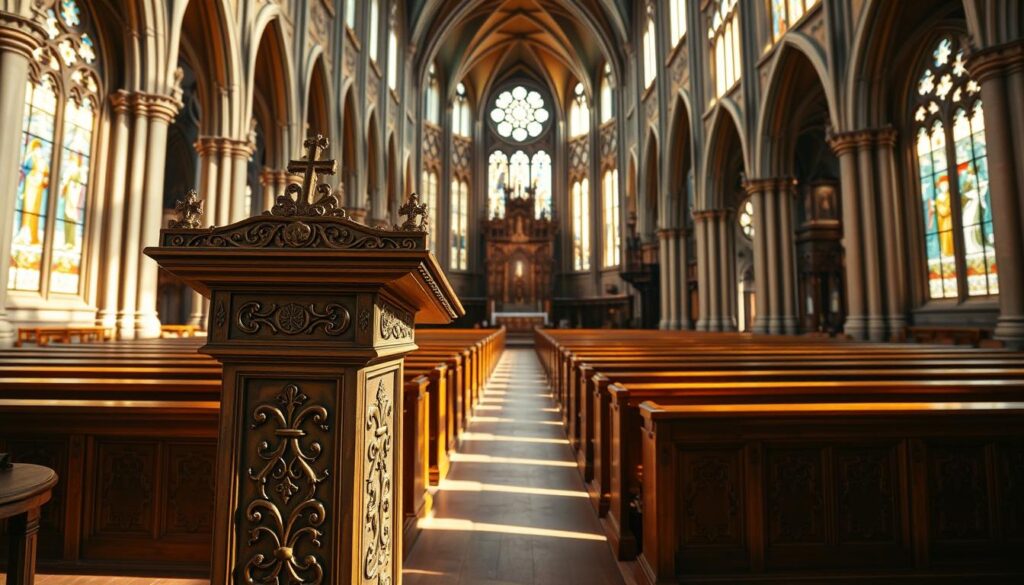
A grand cathedral with ornate Gothic architecture, bathed in the warm glow of stained glass windows. In the foreground, a lectern stands, adorned with intricate carvings and symbolic motifs, inviting the viewer to engage in the intellectual exploration of Catholic apologetics. The middle ground features rows of wooden pews, casting long shadows that hint at the weighty foundations of this tradition. In the background, towering arched ceilings and ornate altars suggest the grandeur and solemnity of the Catholic faith. The scene conveys a sense of reverence, contemplation, and the pursuit of deeper spiritual understanding.

The first pillar examines universal questions about existence. It explores philosophical arguments for a divine Creator while addressing human experiences like free will and purpose. This foundation helps connect everyday wonder about life to rational inquiry.

Next comes the study of Christianity’s historical roots. Scholars analyze ancient documents and archaeological findings that support events like Christ’s resurrection. As one historian noted: “The New Testament records align with verifiable first-century accounts.”

The final pillar focuses on institutional continuity. It traces how early Christian communities developed into today’s global Church through leadership succession and preserved teachings. This historical thread shows why traditions remain relevant across generations.

Together, these principles demonstrate how faith and reason strengthen each other. They provide tools to address modern doubts while honoring timeless truths.

Preparing Your Spiritual and Intellectual Ground

Your spiritual journey begins with the simplest step: reaching for the book you already own. Many homes have at least one Bible—often tucked between photo albums or displayed as a family heirloom. This sacred text holds answers to life’s biggest questions, but only if we let its pages breathe.

Cleaning the Dust Off the Bible

That layer of dust? It’s more common than you think. Start by physically wiping the cover—a symbolic act showing readiness to engage. Then flip directly to Matthew’s Gospel. These stories form Christianity’s beating heart, offering faith foundations through Jesus’ teachings and actions.

Establishing a Daily Reading Routine

Consistency beats marathon sessions. Choose a specific time—morning coffee breaks or bedtime wind-downs work well. Fifteen minutes daily lets the New Testament’s messages seep into your way of thinking naturally. Keep a notebook nearby to jot down phrases that spark curiosity or comfort.

This practice isn’t about memorizing verses. It’s letting ancient wisdom shape your modern life. Over weeks, you’ll notice patterns and truths emerging—tools that’ll feel familiar when conversations turn spiritual. Remember, even well-loved books started as unopened treasures.

Exploring The New Testament for Apologetic Insights

The New Testament isn’t just ancient text—it’s your playbook for meaningful spiritual conversations. Imagine holding a collection of letters and stories that shaped history while answering today’s toughest questions about life and purpose.

A tranquil study filled with old leather-bound books, stained-glass windows casting warm hues, and a wooden desk where a scholar ponders the insights of the New Testament. The foreground showcases a weathered Bible, a quill pen, and parchment notes. The middle ground features bookshelves lined with theological tomes, while the background reveals a serene landscape outside the window, symbolizing the contemplation of divine truths. Soft, directional lighting creates an atmosphere of reverence and intellectual discovery, inviting the viewer to explore the richness of apologetic insights found within the pages of the New Testament.

St. Jerome nailed it centuries ago: “Ignorance of Scripture is ignorance of Christ.” This truth becomes clear when you study how Jesus handled challenges. He answered skeptics with razor-sharp logic wrapped in compassion—like when Pharisees tried trapping Him with loaded questions about taxes.

Notice three patterns in these sacred writings:

Book Approach Modern Application
Gospels Story-driven answers Use relatable examples
Acts Cultural adaptation Tailor explanations
Epistles Doctrinal clarity Address specific doubts

Paul’s letters show how early believers tackled issues we still face. When Corinthian Christians argued about marriage, he balanced divine principles with practical wisdom. This “grounded truth” approach works wonders when discussing modern ethical dilemmas.

Try these practical steps:

  • Highlight fulfilled prophecies when explaining Christianity’s Jewish roots
  • Use Acts 17 as a model for connecting with secular audiences
  • Memorize key resurrection accounts to counter historical doubts

As you dig deeper, you’ll discover the New Testament doesn’t just defend faith—it invites the whole world into a life-changing story. That’s why these writings remain fresh and relevant, even after two millennia.

Diving into the Gospels: Matthew, Mark, Luke, and John

Have you ever wondered how four accounts of the same story can offer unique insights? The Gospels form a vibrant mosaic of Christ’s life, each revealing distinct facets of His divine mission. These texts serve as both historical records and spiritual guides, offering endless depth for those seeking truth.

Understanding the Synoptic Gospels

Matthew, Mark, and Luke share a common framework often called the “Synoptic view.” Think of them as three camera angles capturing the same event. Matthew connects Jesus to Jewish prophecies, perfect for discussions about biblical continuity. His genealogy and Sermon on the Mount showcase Christ as the promised Messiah.

Mark races through key events with punchy details. His Gospel speaks to action-oriented readers who value “show, don’t tell” storytelling. Watch how Jesus heals the sick and challenges religious leaders—ideal for practical faith demonstrations.

Luke’s medical background shines through precise timelines and empathy for outsiders. His accounts of the Good Samaritan and Prodigal Son provide powerful material for social justice conversations. These three perspectives together create a rich, multidimensional portrait of Christ’s earthly ministry.

The Unique Perspective of John’s Gospel

John’s writing feels like gazing at a stained-glass window—every scene glows with symbolic meaning. Instead of repeating familiar stories, he unveils Christ’s divine nature through seven “I AM” statements and extended dialogues. The opening verses alone (“In the beginning was the Word”) offer profound theological depth.

This Gospel answers modern questions about identity and purpose. When skeptics ask, “Who does Jesus think He is?” John’s account provides clear, poetic answers. His focus on belief over chronology makes it invaluable for addressing philosophical doubts.

Set aside 15 minutes daily to read one Gospel per week. Jot down how each writer tailors their message to different audiences. You’ll soon notice patterns that strengthen both your understanding and ability to share spiritual truths effectively.

Studying the Acts and Epistles for Context

What if your answers to tough questions were written centuries ago? The New Testament’s later books hold practical wisdom for modern spiritual conversations. After exploring Jesus’ life in the Gospels, Acts shows how His followers shared this message across cultures.

A dimly lit study, filled with ancient parchments and leather-bound tomes. A desk of dark, weathered wood sits in the center, its surface cluttered with handwritten notes, maps, and a well-worn Bible. The warm glow of a single candle illuminates the scene, casting long shadows and a contemplative atmosphere. In the background, shelves line the walls, housing a vast collection of scrolls and volumes, each a testament to the rich history and context of the New Testament. The space exudes a sense of scholarly pursuit, inviting the viewer to delve into the deep well of knowledge and understanding that lies within.

Luke’s sequel to his Gospel reads like a travelogue of faith in action. Watch Peter address Jewish crowds using Scripture, then see Paul engage Greek thinkers with philosophical reasoning. This diversity teaches us to adapt our approach without changing core truths.

Bridging the Gospels and Epistles

Paul’s letters tackle real issues faced by early believers—many mirror today’s challenges. Romans unpacks salvation’s mechanics, while 1 Corinthians addresses morality and spiritual gifts. These writings form a blueprint for maintaining unity amid diversity.

Try this manageable study plan:

  • Read Acts first—it’s Gospel-length and sets the stage
  • Move to Romans for doctrinal foundations
  • Explore 1 Corinthians for practical guidance
  • Save Revelation for last as a grand finale

Ephesians shines when discussing the Church’s role in society. Its vision of unity amidst different backgrounds remains revolutionary. As you read, note how early Christians balanced truth with love—a model for all people seeking meaningful dialogue.

Embracing the Catechism for Church Teachings

What if one book could unlock the full picture of your spiritual journey? The Catechism of the Catholic Church acts like a master key, organizing centuries of wisdom into clear, connected teachings. Released in 1992, this landmark text became the first universal guide of its kind in four hundred years.

Think of it as a spiritual GPS. While the New Testament contains all essential truths, they’re spread across various books and contexts. The Catechism maps these teachings into four pillars:

Pillar Focus Practical Impact
The Creed Core beliefs Answers “What do we believe?”
The Sacraments Sacred rituals Explains “How we encounter grace”
Moral Life Ethical living Guides “How to choose wisely”
Christian Prayer Divine connection Teaches “How to grow spiritually”

Seven hundred pages might sound intimidating, but the numbered paragraphs let you explore topics like a choose-your-own-adventure book. Start with sections addressing questions you often hear. You’ll discover how doctrines interlock like puzzle pieces forming a beautiful whole.

Keep a highlighter handy for insights about daily faith practices. The text’s clear language helps explain complex ideas without jargon. Over time, you’ll notice patterns that strengthen both personal understanding and conversations with others.

Organizing and Interpreting Scripture through Tradition

How can ancient texts stay relevant across centuries? The answer lies in balanced interpretation guided by living wisdom. While personal Bible study fuels spiritual growth, Scripture itself warns against isolating verses from their broader context.

Public Interpretation vs. Personal Opinion

Imagine reading a 2,000-year-old letter without knowing its original purpose. That’s why 2 Peter 1:20-21 reminds us: “No prophecy of Scripture is a matter of one’s own interpretation.” The Holy Spirit inspired biblical authors, and that same Spirit guides the Church’s collective understanding today.

Here’s the key distinction: Personal reflections enrich faith, but authoritative teaching preserves unity. When individuals reinterpret passages without context, confusion follows. Over 45,000 Christian denominations now exist—many from well-meaning but isolated readings.

The solution? Ground your interpretation in tradition and community. Christ appointed teachers to help people grasp Scripture’s full picture. Like puzzle pieces forming one image, biblical truths make most sense when viewed through the Church’s God-given lens.

FAQ

How does studying the New Testament strengthen my ability to defend the faith?

The New Testament offers direct insights into Jesus’ teachings, miracles, and resurrection. By understanding these texts, you gain clarity on core beliefs like salvation, grace, and the Church’s mission. This knowledge equips you to explain Christian truths with confidence and accuracy.

Why is daily Bible reading important for engaging in dialogue with others?

Regular Scripture study deepens your relationship with God and sharpens your understanding of His Word. This habit helps you recognize themes, context, and connections across the Bible, making it easier to address questions or challenges about theology, morality, or Church history.

What makes John’s Gospel unique compared to Matthew, Mark, and Luke?

John’s Gospel focuses on Christ’s divinity and includes symbolic narratives like the Wedding at Cana and the “I AM” statements. Its theological depth provides rich material for explaining concepts like the Incarnation and the Trinity, which are central to Christian belief.

How do the Acts and Epistles help bridge the Gospels with Church teachings today?

Acts reveals the early Church’s growth, while the Epistles address practical challenges faced by believers. Together, they show how Jesus’ message was lived out in diverse cultures, offering timeless principles for addressing modern objections to the faith.

Why is the Catechism a valuable tool for discussing Church doctrines?

The Catechism compiles centuries of wisdom, Scripture, and tradition into a clear framework. It helps you articulate complex teachings—like the sacraments or moral life—in a way that’s consistent, logical, and rooted in both revelation and reason.

How can I avoid personal bias when interpreting Scripture?

The Church emphasizes reading the Bible within the context of sacred tradition and guided by authoritative teachings. Engaging with trusted commentaries, saints’ writings, and Church documents ensures your interpretations align with the unity of Christian truth.
Does Catholicism Believe in the Trinity?


At the heart of Christian worship lies a concept that shapes every prayer, sacrament, and ritual. The holy trinity represents one divine essence expressed through three distinct persons – a foundational truth that guides spiritual practice. This principle isn’t just theological theory but a lived reality for millions worldwide.

Central to the catholic church’s teachings, this threefold nature forms the bedrock of sacraments like baptism. New members join the community by invoking all three aspects of divinity together. Such rituals reveal how trinitarian belief permeates both doctrine and daily devotion.

While called a mystery, this doesn’t mean confusion or secrecy. Instead, it acknowledges divine truths surpassing full human comprehension. Through faith and reflection, believers engage with this reality that’s both ancient and ever-new.

Our exploration will show how this teaching influences worship styles, community identity, and personal spirituality. We’ll trace its historical roots while highlighting modern applications that keep the concept vibrant and relevant.

Key Takeaways

  • The Trinity doctrine serves as Christianity’s core belief system
  • Catholic practices like baptism directly reference trinitarian principles
  • “Mystery” describes divine truths rather than unsolvable riddles
  • This teaching connects historical tradition with contemporary worship
  • Understanding the Trinity unlocks deeper meaning in sacraments

Introduction to the Mystery of the Holy Trinity

Catholic teachings revolve around a divine mystery that unites three distinct persons in one God. This sacred truth isn’t a puzzle to solve but a reality to embrace through prayer and reflection. As the Catechism states:

“The Church professes one God in three Persons – Father, Son, and Holy Spirit – sharing the same divine nature.

Overview of the Trinity in Catholicism

The blessed trinity reveals God’s nature as both unified and relational. Though distinct in roles, the Father, Son, and Spirit share complete equality. Their eternal bond shows how love flows freely within the divine community.

Significance in the Christian Faith

This mystery trinity shapes how believers live their faith. It models perfect unity amid diversity, inspiring Christians to build relationships rooted in mutual respect. Every sacrament echoes this threefold pattern, making divine love tangible.

While human minds can’t fully grasp this truth, it invites us into deeper wonder. The holy trinity isn’t a distant concept – it’s the heartbeat of spiritual growth and communal worship.

Understanding the Doctrine of One God in Three Persons

Christian theology reveals a stunning truth – perfect unity and diversity coexist within divinity. The three persons share one divine nature, creating a sacred dance of relationship and oneness. This isn’t math to solve but a mystery inviting awe.

At the core lies a vital distinction: nature versus persons. As the Catechism explains:

“The divine Persons do not share divinity but are each wholly God – one undivided essence with distinct relational identities.”

Think of sunlight – its heat, light, and energy differ yet stem from one source. Similarly, the Father, Son, and Spirit each fully embody divinity while relating uniquely. Their distinct persons express eternal love flowing between them.

This teaching safeguards against two errors. It prevents imagining three gods (polytheism) while rejecting the idea of God wearing different “masks” (modalism). Instead, it affirms both unity and genuine diversity within god three.

Human language strains to capture this reality. We grasp personhood through separation, but divine nature transcends limits. The Trinity shows that true unity thrives through relationship, not uniformity – a model for how communities can flourish.

Biblical Foundations of the Trinity

Scripture forms the living blueprint for understanding God’s threefold nature. Ancient texts lay the groundwork, while later writings unveil divine relationships hidden in plain sight. Together, they reveal a story of unity that deepens across centuries.

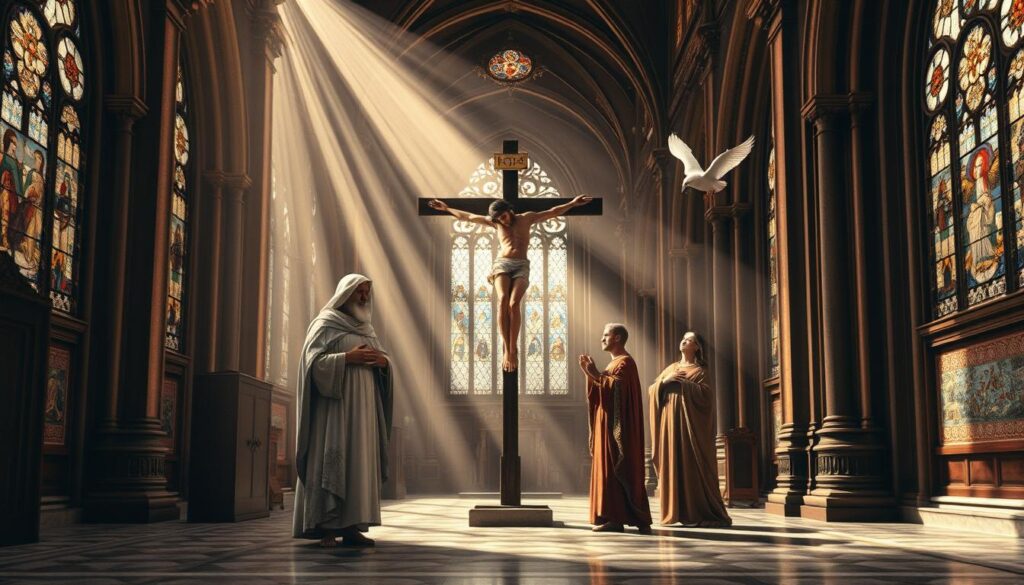
A classical religious oil painting depicting the Holy Trinity: God the Father as an elderly man, the Son Jesus Christ crucified, and the Holy Spirit as a dove. The scene is set in a grand church interior with ornate gothic arches, stained glass windows, and shafts of warm, heavenly light. The figures stand on a marble floor, with shadows and highlights adding depth and volume. The color palette is rich and muted, with a solemn, reverent atmosphere. The composition draws the viewer's gaze towards the central figure of Christ, emphasizing the Biblical foundations of the Catholic doctrine of the Holy Trinity.

Old Testament Insights on God’s Oneness

Israel’s sacred writings thunder with declarations of one God. Isaiah 44:6 leaves no doubt:

“I am the first and I am the last; besides me there is no god.”

Yet subtle clues suggest more beneath the surface. The HebrewElohim– a plural noun – appears over 2,000 times for the singular Creator.

Creation narratives whisper of collaboration: “Let us make mankind in our image” (Genesis 1:26). Prophetic visions show divine messengers bearing God’s authority. These glimpses prepare hearts for fuller revelation without contradicting monotheism’s core.

New Testament Revelations on the Triune Nature

John’s Gospel bursts open the mystery: “In the beginning was the Word… and the Word was God” (1:1). Here, Son and Father share eternal existence. At Jesus’ baptism, all three Persons appear – voice from heaven, incarnate Word in water, Holy Spirit descending like a dove.

Christ’s final command seals the pattern: “Baptize them in the name of the Father, Son, and Holy Spirit” (Matthew 28:19). Through actions and teachings, the New Testament weaves separate threads into one radiant truth – three distinct yet inseparable expressions of divine love.

Historical Development of Trinitarian Thought

Christian communities spent centuries wrestling with a divine puzzle – how to express three sacred persons within one God. This journey through time shows how early believers balanced scriptural truth with philosophical language.

Early Church Debates and Scriptural Context

Theophilus of Antioch first used “Trinity” around A.D. 170, writing:

“The three days before luminaries are types of the Trinity – God, His Word, and His wisdom.”

Early thinkers faced a tightrope walk. They needed to honor Judaism’s belief in one God while explaining Christ’s divinity. Disputes erupted over terms like “substance” and “essence” to describe divine unity.

Time Period Key Development Impact
2nd Century Theophilus coins “Trinity” First formal terminology
4th Century Council of Nicaea Affirmed Christ’s divinity
16th Century Reformation Era Luther/Calvin upheld doctrine

These debates weren’t academic exercises. They shaped how the world understands God’s nature. By the Reformation, leaders like Calvin saw Trinity as non-negotiable:

Modern believers inherit this rich legacy. The way we worship today reflects ancient struggles to protect core truths about creation‘s Author. Through councils and creeds, the Church preserved mystery while making it accessible across cultures.

Processions and Relations in the Godhead

Eternal origins define relationships within the divine reality. The Council of Florence mapped this sacred architecture through two processions and four relations. These aren’t events in time but timeless expressions of God’s inner life.

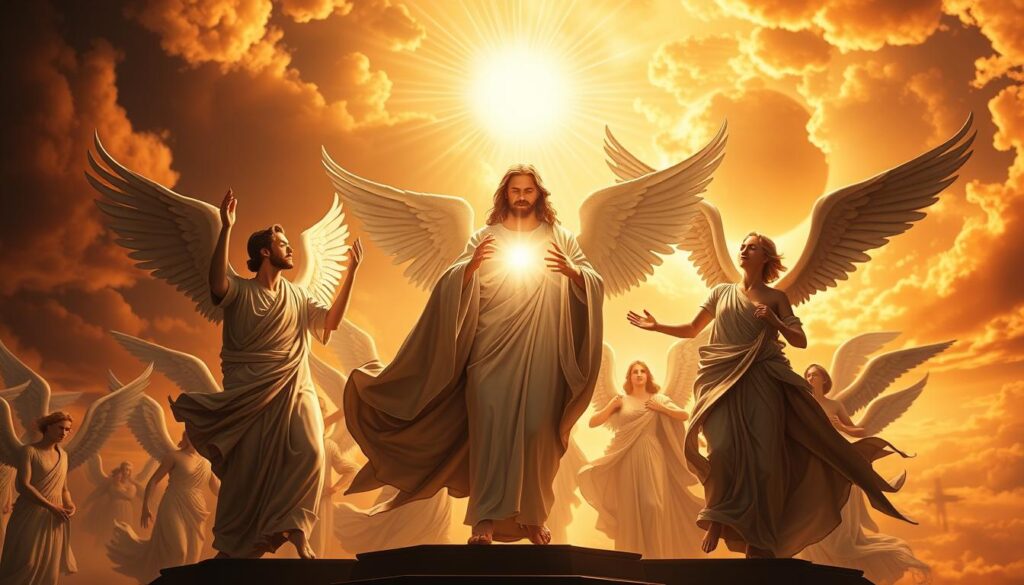
Elaborate divine procession of the Holy Trinity, executed in a classical, allegorical style. In the foreground, a luminous central figure representing the Godhead, radiating celestial light. Flanking it, two secondary figures - the Son and the Holy Spirit - in flowing, ethereal robes, engaged in a mystical dance of unity and harmony. The middle ground features a host of angelic attendants, their wings outstretched in reverence. The background depicts a sublime, heavenly landscape bathed in a warm, golden glow, evoking a sense of the transcendent and the eternal. The composition is balanced, the lighting is dramatic, and the overall mood is one of profound spiritual majesty and contemplation.

The Generative Procession of the Son

The Father’s intellect gives rise to the second person through eternal generation. Like a thought emerging from a mind, the Son proceeds from the Father as perfect self-expression. This makes Christ the divine Word – not created but eternally begotten.

This relationship forms the first procession. As flames generate light without diminishing their source, the Father’s essence remains undivided. The Son and Father share one nature while maintaining distinct identities.

The Spirative Procession of the Holy Spirit

Love’s breath flows between Father and Son as the Holy Spirit proceeds from both. Unlike generation, this spiration reflects shared will rather than intellect. The Spirit embodies their mutual bond – a living testament to divine unity.

While the Son is begotten, the Spirit is breathed forth. This distinction preserves unique roles within the Godhead. As the Council taught:

“The Spirit proceeds from the Father and the Son – not made, nor created, but proceeding.”

Together, these processions weave three persons into one inseparable reality. They show how divine relationships thrive through giving and receiving without division.

does catholicism believe in the trinity

Every Catholic sacrament pulses with threefold sacred energy. From baptismal vows to Eucharistic prayers, worship patterns mirror divine relationships. This rhythm flows through the holy spirit‘s work, the father son bond, and their shared divine nature.

three persons, one god - a holy trinity represented by three human figures, standing in a dignified pose, their faces partially obscured in soft, warm lighting, set against a muted, ethereal background evocative of religious iconography and devotional art. The figures are dressed in robes and garments suggestive of Catholic or Christian tradition, their expressions serene and contemplative, conveying a sense of divine presence and sacred mystery. The composition is balanced and harmonious, with the three figures arranged in a triangular formation, symbolizing the unity and interconnectedness of the Father, the Son, and the Holy Spirit.

The Church teaches three persons god united in essence, not separate beings. As the Catechism clarifies:

“The divine persons don’t divide divinity – each fully possesses the one, undivided nature.”

This truth shapes practical faith. Mass liturgies invoke all three Persons equally. Baptismal formulas name father son and holy spirit together. Even personal prayers often conclude by honoring this triad.

Misconception Catholic Teaching
Three separate gods One God in three persons
Changing divine modes Eternal relational distinctions
Unequal status Co-equal, co-eternal nature

Early councils like Nicaea cemented this understanding. They affirmed the son‘s full divinity against those claiming he was created. Later teachings confirmed the holy spirit proceeds from both Father and Son.

This doctrine isn’t abstract theology. It explains how love flows within three persons god – a model for human relationships. Through sacraments and scripture, Catholics experience this mystery that words can’t fully capture.

The Role of Councils and Creeds in Defining the Trinity

Historical milestones shaped how communities grasp divine relationships. Early believers wrestled with expressing three sacred persons within one God, leading to landmark decisions that still guide worship today.

Insights from Nicaea and Constantinople

In A.D. 325, the Council of Nicaea affirmed the Son God shares full divinity with the Father. Leaders rejected claims that Christ was created, declaring Him “light from light, true God from true God.”

Constantinople (A.D. 381) completed this vision by confirming the divinity holy spirit. This council crafted creedal lines stating the Spirit “with Father and Son is worshiped and glorified.” Together, these gatherings framed core truths about divine unity.

Contributions of Lateran and Florence

The Fourth Lateran Council (1215) reinforced blessed trinity teachings against emerging heresies. Centuries later, Florence (1439) clarified how all three persons share the same divine essence. As the catechism catholic church notes:

“The Trinity is One… each person is wholly God yet distinct in relationship.”

Through time, these councils turned mystery into accessible truth. Their creeds remain recited worldwide, connecting modern believers to ancient wisdom about one God in eternal communion.

FAQ

What is the core Catholic belief about the Trinity?

The Church affirms one God in three coequal, coeternal Persons: Father, Son, and Holy Spirit. This central mystery of faith reveals a divine communion of love while maintaining God’s absolute unity.

How does Scripture support the Trinity?

The New Testament highlights the Son’s relationship with the Father (John 1:1) and the Spirit’s role as Advocate (John 15:26). Baptismal formulas like Matthew 28:19 also emphasize the triune nature.

Why is the Holy Spirit called the “Lord and Giver of Life”?

The Spirit proceeds from the Father and the Son, breathing divine life into creation and the Church. This spirative procession reflects His role in sanctifying believers and unifying the Body of Christ.

Did early Christians always understand the Trinity?

Early councils like Nicaea (325 AD) and Constantinople (381 AD) clarified misunderstandings, defining Christ’s divinity and the Spirit’s place in the Godhead. These creeds remain foundational to Catholic teaching.

How can three Persons be one God?

While human language falls short, the Church teaches that the Father, Son, and Spirit share one divine essence but are distinct through their relationships. Their unity lies in perfect love, not separation.

What’s the significance of the Filioque clause?

Added to the Nicene Creed, it affirms the Holy Spirit proceeds from both the Father and the Son. This emphasizes the unity of the Trinity and the Son’s full divinity.

How does the Trinity impact Catholic worship?

A> Sacraments like Baptism invoke all three Persons, and prayers often conclude with Trinitarian praise (e.g., “Glory to the Father…”). The Eucharist also reflects Christ’s offering to the Father through the Spirit.

Roman Catholicism Beliefs: A Comprehensive Guide


Welcome to a friendly exploration of one of the world’s most enduring spiritual traditions. With over 1.4 billion followers globally, the Catholic Church stands as Christianity’s largest branch. Its teachings have shaped art, law, and culture for two thousand years, blending ancient wisdom with modern relevance.

This guide unpacks the core principles that unite millions of believers. You’ll discover how traditions passed down from Jesus’ apostles evolved into a global community led by the Pope. We’ll simplify complex ideas like sacraments and social justice, showing how they guide everyday life.

The faith thrives through both scripture and lived experience. From weekly Mass to humanitarian efforts, its practices bridge ancient rituals with contemporary challenges. You’ll see how these elements create a spiritual roadmap for individuals and communities alike.

Key Takeaways

  • World’s largest Christian denomination with 1.4+ billion members
  • Rooted in teachings dating back to Jesus and the apostles
  • Combines scripture with centuries of theological development
  • Seven sacraments shape spiritual growth and community life
  • Modern efforts focus on social justice and global outreach

Introduction to Roman Catholicism

Explore a religious heritage that unites over a billion people worldwide. At its heart lies a spiritual family stretching back to the first followers of Jesus, committed to serving others while honoring sacred traditions.

Defining the Catholic Faith

The term “Catholic” originates from the Greek word for “universal”, a name first used in the 2nd century. This reflects the church’s mission to embrace diverse cultures as one spiritual community. Members believe their practices and teachings directly continue the work of Jesus’ original disciples, guided by bishops seen as modern successors to the apostles.

The Global and Historical Context

From Rome to rural Kenya, the Catholic Church has grown into the planet’s most widespread Christian group. Over 60% of followers now live in Africa, Asia, and Latin America—a dramatic shift from earlier European dominance. This growth stems from centuries of missionary work, cultural adaptation, and responses to social needs.

Historically, the church preserved ancient knowledge through medieval monasteries and pioneered educational systems. Today, it addresses modern issues like climate change while maintaining rituals like the Mass. Its ability to balance timeless values with evolving societies explains its enduring global influence.

Historical Foundations of the Catholic Church

The story of Christianity’s largest institution begins with humble origins and world-changing events. From dusty roads in ancient Judea to marble halls in Rome, early followers transformed spiritual sparks into lasting traditions.

A vast cathedral in the Renaissance style, its façade adorned with intricate carvings and towering spires reaching towards the heavens. In the foreground, a procession of robed clergy and faithful worshippers, their faces filled with reverence and devotion. The interior of the church is bathed in the warm glow of candlelight, revealing ornate altars, stained glass windows, and the majestic, gilded altar piece. The scene exudes a sense of timeless tradition and the weight of centuries of history, reflecting the enduring legacy of the Catholic Church.

Apostolic Origins and Early Christianity

Twelve ordinary men became extraordinary leaders after Jesus Christ entrusted them with spreading his message. The New Testament shows how these apostles faced persecution while building underground communities. Everything changed at Pentecost—the fiery moment when believers received divine guidance to launch their public mission.

First-century followers met in homes, sharing meals and prayers secretly. By the 4th century, Emperor Constantine’s Edict of Milan gave them legal protection. This shift allowed the church to construct basilicas and expand its influence across continents.

The Evolution Through Empire and Middle Ages

When Christianity became Rome’s official religion in 380 AD, it gained power but faced new challenges. Medieval thinkers like Augustine shaped theology while monks preserved ancient texts. Five key cities—Rome, Constantinople, Alexandria, Antioch, and Jerusalem—became spiritual hubs governing regional practices.

The church thrived by adapting to different eras. It built universities during Europe’s “Dark Ages” and mediated conflicts between kingdoms. Through plagues and wars, its rituals and leadership structures kept communities united across generations.

Sacred Tradition and Scriptural Authority

At the heart of Catholic practice lies a dynamic partnership between ancient wisdom and divine revelation. This relationship forms a spiritual compass guiding millions through life’s complexities.

The Role of Sacred Scripture

The church views the Bible as God’s love letter to humanity—not frozen in time, but alive through ongoing interpretation. As one bishop famously noted, “Scripture breathes when read through the church’s living heart.” This approach prevents isolated readings that might drift from core teachings.

Sacred tradition acts like a family recipe passed through generations. It preserves essential truths while allowing cultural adaptation. Together with Scripture, it creates a complete picture of divine revelation. The Magisterium—the church’s teaching authority—ensures these elements remain harmonized across centuries.

“Both Scripture and Tradition must be accepted and honored with equal devotion and reverence.”

Dei Verbum (Vatican II Document)

This threefold foundation—Bible, Tradition, and teaching office—provides stability amid changing societies. It allows the global community to address modern ethical questions while staying rooted in apostolic origins. Through this balance, spiritual guidance remains both timeless and timely.

The Seven Sacraments Explained

Life’s most meaningful moments often carry sacred significance. Seven special rituals mark key stages in spiritual growth, connecting believers to divine grace through tangible actions. These practices form a spiritual roadmap from birth to eternal life.

A grand and ornate Catholic church interior, illuminated by warm natural light streaming through stained glass windows. In the foreground, seven intricate, gilded icons depicting the seven sacraments of the Roman Catholic Church: baptism, confirmation, Eucharist, penance, anointing of the sick, holy orders, and matrimony. Each icon is rendered with exquisite detail, showcasing the rich symbolism and historical significance of these sacred rites. The middle ground features a central altar flanked by rows of wooden pews, creating a sense of reverence and contemplation. In the background, a vaulted ceiling and ornate architectural features evoke the grandeur and timelessness of the Catholic tradition.

Baptism, Eucharist, and Confirmation

Baptism welcomes newborns and converts with water and prayer. This initiation washes away original sin, echoing Jesus’ immersion in the Jordan River. Many families celebrate with white garments and godparent commitments.

The Eucharist transforms weekly worship. Ordinary bread and wine become sacred nourishment during Mass. Catholics believe this meal sustains souls like food fuels bodies.

Confirmation typically occurs during adolescence. Through oil and laying of hands, participants receive the Holy Spirit’s courage. This rite empowers youth to become active faith ambassadors.

Reconciliation, Matrimony, Anointing, and Holy Orders

Reconciliation offers healing through confession. Believers voice regrets privately to priests, receiving forgiveness and practical guidance. Many describe feeling lighter after this cleansing ritual.

Marriage becomes sacred through mutual vows. Couples promise lifelong support, mirroring Christ’s devotion to humanity. Their union becomes a living symbol of divine love.

Final rites provide comfort during illness through anointing. Holy Orders sets apart clergy through solemn ceremonies. As the Council of Trent affirmed, these acts work through God’s power—not human perfection.

Papal Authority and Leadership

Guiding 1.4 billion people requires a leadership model that spans centuries. The pope stands at the center of this mission, serving as both spiritual shepherd and global diplomat. His role blends ancient traditions with modern responsibilities, creating a unique bridge between past and present.

The Legacy of Saint Peter

Jesus’ words to Peter in Matthew’s Gospel set the stage:

“You are Peter, and on this rock I will build my church.”

Catholics view this moment as the birth ofpapal authority. Each pope inherits Peter’s mantle as the church’s visible foundation stone.

This unbroken chain stretches across 267 successors. From Roman catacombs to Vatican palaces, leaders have adapted Peter’s mission to their eras. Pope Leo XIV continues this legacy today, balancing doctrinal stewardship with urgent global concerns.

Modern Papacy and its Influence

Today’s pope navigates climate crises and refugee emergencies while maintaining ancient rituals. The Vatican’s dual status as religious hub and sovereign state amplifies his voice. World leaders frequently seek his counsel on ethical dilemmas and peace efforts.

Modern papacy uses tools like encyclicals to address pressing issues. These documents shape policies in hospitals, schools, and charities worldwide. Yet the core remains unchanged—a commitment to unity and compassion rooted in two millennia of tradition.

Through social media and international visits, the pope connects with diverse cultures. This approach keeps the Roman Catholic Church relevant while honoring its sacred origins. The office proves that ancient institutions can evolve without losing their soul.

The Impact of the Second Vatican Council

a grand cathedral interior with ornate gothic architecture, stained glass windows, and a majestic altar at the far end. The walls are adorned with intricate carvings and frescoes depicting religious scenes. The lighting is warm and diffused, creating a reverent atmosphere. In the foreground, a large circular table is surrounded by figures in ceremonial robes, engaged in deep discussion. The scene captures the historic Second Vatican Council, a pivotal moment in the evolution of the Roman Catholic Church, as religious leaders gather to deliberate on reforms and modernization.

A spiritual earthquake reshaped modern faith communities in the 1960s. The Second Vatican Council (1962-1965) modernized practices while preserving core values. Bishops from 116 countries gathered to help the church speak meaningfully to a changing world.

Worship transformed overnight. Mass shifted from Latin to local languages, letting congregations understand prayers fully. This change turned observers into active participants, deepening personal connections to rituals.

Three key shifts emerged:

  • Laypeople gained meaningful roles in ministries and decision-making
  • Dialogue with other religions replaced isolationist attitudes
  • Social justice became central to spiritual practice

The council’s documents urged compassion over strict rules. As one bishop noted, “Windows were opened to let fresh air into the church.” This approach helped address postwar challenges like nuclear fears and urbanization.

Today, Vatican II’s legacy thrives through interfaith food banks and youth-led prayer groups. Its balance of tradition and adaptation keeps the global community united yet responsive. The council proved ancient institutions could evolve without losing their soul.

Core Roman Catholicism Beliefs

At the heart of Catholic doctrine lies a spiritual compass for daily living. The Nicene Creed beautifully summarizes this roadmap—a 4th-century statement still recited worldwide. It affirms one God in three persons and the church’s role as a unifying force across generations.

Sacred texts form this faith’s foundation. Followers honor the Hebrew Bible’s wisdom while embracing New Testament revelations. Together, they reveal a God deeply invested in human life, from creation to eternal promise.

Seven sacraments make divine grace tangible. Baptism initiates spiritual journeys, while the Eucharist nourishes souls weekly. These rituals aren’t ancient relics—they’re living teachings that shape modern ethical choices and community bonds.

The Catholic Church champions human dignity through action. Its social doctrine inspires hospitals, schools, and climate initiatives. As Pope Francis reminds us, “True worship shows itself in loving service.” This blend of creed and compassion keeps the faith vibrant across 2,000 years.

FAQ

What defines the core teachings of the Catholic Church?

The Church emphasizes Sacred Scripture, Sacred Tradition, and the Magisterium as foundational. Key teachings include the Trinity, salvation through Jesus Christ, and the sacraments as channels of grace.

How does papal authority shape Catholic practices?

The pope, as successor to Saint Peter, holds supreme spiritual authority. He guides doctrine, ensures unity, and interprets faith in modern contexts, influencing global worship and moral teachings.

Why are the sacraments central to Catholic life?

Sacraments like Baptism and Eucharist mark spiritual milestones, offering grace and strengthening faith. They connect believers to Christ and the Church community through visible rituals.

What role did the Second Vatican Council play?

Vatican II (1962–1965) modernized practices, encouraged lay participation, and fostered interfaith dialogue. It updated liturgy, like allowing Mass in local languages, to deepen engagement.

How does Sacred Tradition differ from Scripture?

Sacred Tradition includes teachings passed orally from the apostles, while Scripture is the written Word. Both work together under the Church’s guidance to preserve divine revelation.

What is the significance of apostolic succession?

It ensures bishops’ authority traces back to Jesus’ apostles, maintaining doctrinal continuity. This unbroken lineage validates clergy roles and sacraments’ authenticity.

How does the Church address modern social issues?

It upholds teachings on human dignity, advocating for justice and peace. Topics like marriage, life ethics, and poverty are guided by Scripture and natural law, adapting pastoral approaches.

Discover the Vibrant Catholic Community in India


Step into a world where ancient spirituality intertwines with modern devotion. Across this diverse nation, millions practice a faith rooted in traditions stretching back nearly two millennia. With over 23 million followers, this community forms Asia’s second-largest Christian population, blending global religious practices with local cultural richness.

Historical records trace this faith’s origins to 52 CE, when Saint Thomas the Apostle reportedly arrived on India’s southwestern coast. Today, three distinct church traditions—Latin, Syro-Malabar, and Syro-Malankara—coexist across 174 dioceses. From Kerala’s palm-fringed churches to Delhi’s urban parishes, each region adds unique flavors to shared beliefs.

Beyond worship spaces, this community drives social progress through 10,000+ educational institutions and healthcare centers. Their efforts bridge gaps in rural development while preserving cultural identity through art, festivals, and multilingual liturgy. This harmonious fusion of Eastern and Western traditions creates a spiritual experience unlike any other.

Key Takeaways

  • Over 23 million followers make this one of Asia’s largest Christian communities
  • Three church traditions operate across 174 dioceses and 10,701 parishes
  • Roots date back to the 1st century, with continuous practice for 1,970+ years
  • Distinctive blend of Eastern and Western liturgical traditions thrives nationwide
  • Operates thousands of schools, hospitals, and social service organizations
  • Cultural integration creates unique devotional art and multilingual practices

Overview of the Indian Catholic Landscape

India’s Catholic community paints a vivid picture of faith thriving in diversity. With 23 million followers, they form nearly half the country’s Christian population. Though just 1.57% of the total population, their impact stretches far beyond numbers.

Southern states showcase the strongest presence. In Kerala, 18.6% of people identify as Christian, while Goa boasts 26%. Tamil Nadu follows with 6%. These regions host centuries-old churches alongside modern institutions.

State Christian Population Key Features
Kerala 18.6% Ancient Syrian Christian roots
Goa 26% Portuguese colonial heritage sites
Tamil Nadu 6% Growing urban parishes

The Catholic Church operates 20% of private schools and 30% of medical centers nationwide. From Mumbai slums to tribal northeast villages, their services reach all faiths.

Three unique traditions coexist under one structure: 174 dioceses manage 10,701 parishes. Latin rites blend European influences, while Syro-Malabar and Syro-Malankara practices preserve Eastern roots. This harmony defines India’s Catholic identity.

Historical Journey of Catholicism in India

Long before Europe embraced Christianity, the shores of modern-day Kerala witnessed the birth of a spiritual legacy. In 52 AD, Saint Thomas the Apostle arrived at Muziris, a bustling port town. His groundbreaking work laid the foundation for communities that still thrive today.

The early believers, called Nasrani, blended apostolic teachings with local customs. They created vibrant traditions—like using oil lamps in worship—that felt familiar yet faith-filled. By the fourth century, Persian bishops began guiding these groups, linking them to global Christian networks.

Century Key Development Cultural Impact
1st Saint Thomas’s arrival First Christian settlements
4th Persian leadership begins Eastern liturgical practices
8th Local kingdom alliances Protected religious freedom

Over 1,900 years, these communities adapted to shifting rulers—from Hindu dynasties to Mughal emperors. Remarkably, their faith remained unbroken. When Portuguese missionaries arrived centuries later, they found established churches, not empty spiritual ground.

This enduring history makes India home to one of Earth’s oldest Christian traditions. From ancient palm-leaf manuscripts to modern-day festivals, the Nasrani legacy continues shaping the country’s spiritual landscape.

Early Christian Encounters in India

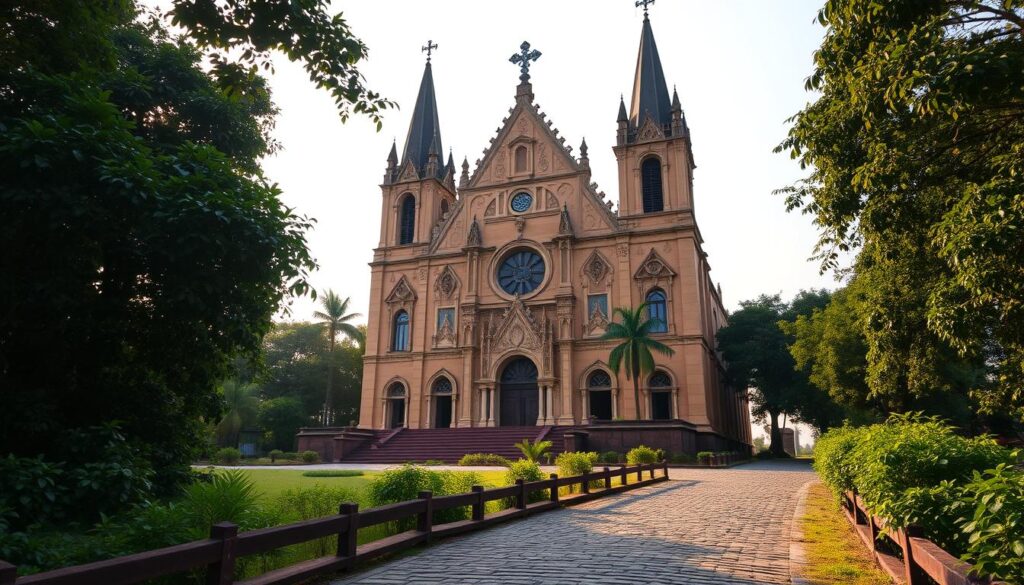
A grand, ancient Christian church stands proudly amidst lush, verdant foliage, its majestic spires reaching towards the heavens. The ornate facade, adorned with intricate carvings and stained glass windows, casts a warm, golden glow in the soft, diffused sunlight. In the foreground, a cobblestone path winds its way, leading the viewer towards the impressive structure, hinting at the rich history and cultural significance of this sacred site. The overall atmosphere evokes a sense of timeless reverence and the enduring presence of the early Christian faith in the Indian subcontinent.

Centuries before European missionaries set foot on Indian soil, vibrant Christian communities were already flourishing along its coasts. These groups traced their spiritual roots to the groundbreaking work of Saint Thomas the Apostle, who arrived in 52 CE. His journey established seven churches across coastal regions, creating Asia’s first Christian networks outside Roman influence.

Apostle Thomas and the Formation of Early Communities

Local traditions describe how Thomas adapted his teachings to resonate with existing cultures. Communities blended Eastern Syriac liturgy with regional practices, developing a unique identity over time. By the 8th century, their growing number led to recognition as a metropolitan province under Patriarch Ishoyab III—a rare honor for non-European believers.

The Synod of Diamper and East Syriac Traditions

Everything changed in June 1599 when Portuguese missionaries convened the Synod of Diamper. Seeking to consolidate Latin power, Archbishop Menezes imposed reforms that altered ancient practices. Traditional East Syriac rituals faced suppression, sparking resistance from communities fiercely proud of their 1,500-year heritage.

Though the synod created divisions, it couldn’t erase centuries of spiritual resilience. Today, these early encounters remind us how faith adapts while preserving its core—a lesson etched into India’s coastal churches and timeless traditions.

Impact of Portuguese Missionaries on Catholic Expansion

When Portuguese ships first touched Indian shores in 1498, they brought more than trade goods. Vasco da Gama’s sea route discovery opened floodgates for religious transformation. Missionaries arrived with a dual mandate—spread faith and secure colonial influence.

Arrival of Vasco da Gama and Initial Encounters

The 16th century saw European powers rewrite spiritual maps. Portuguese missionaries quickly established bases along western coasts. Their work created both alliances and clashes with existing Saint Thomas Christians.

Early encounters revealed cultural divides. While local believers used Syriac rituals, newcomers pushed Latin traditions. This tension shaped church administration for generations.

Establishment of Iconic Churches like Santhome

Nothing symbolizes Portuguese legacy better than Chennai’s Santhome Basilica. Built over Saint Thomas’ tomb in 1523, it became a spiritual magnet. Francis Xavier spent months here in 1545, fueling devotion through his ministry.

Rebuilt in 1896 with Gothic spires, the church blends European design with local materials. Its evolution from humble chapel to grand basilica mirrors missionary ambitions. As one traveler noted: “These stone walls whisper centuries of prayers and power struggles.”

Through churches and colonial policies, Portugal left an indelible mark. Their efforts fused spiritual zeal with political strategy, creating foundations that still shape worship today.

Evolution of Catholic Structures and Dioceses

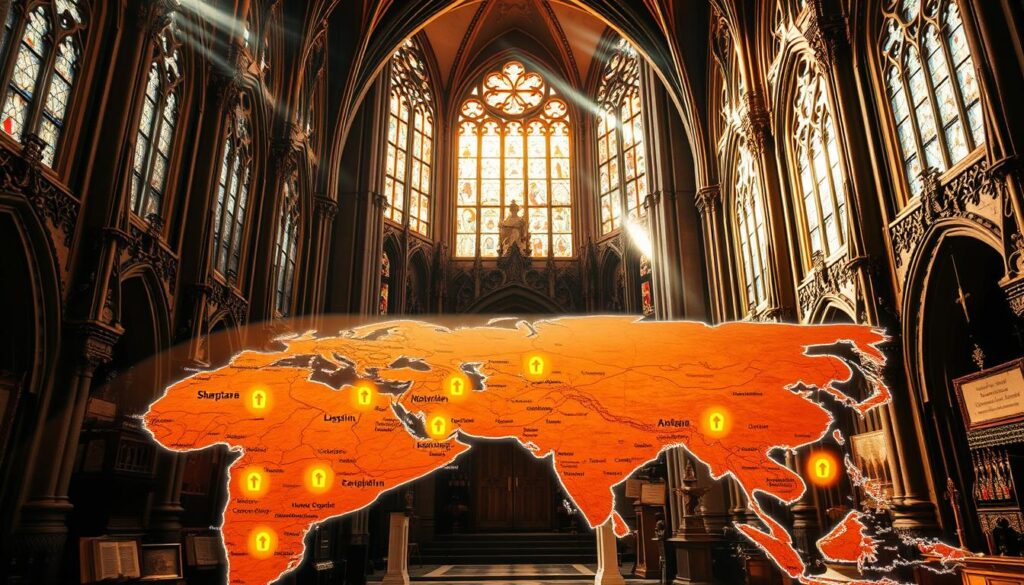
An ornate, gothic cathedral stands tall, its spires reaching towards the heavens. Sunlight filters through stained glass windows, casting a warm, ethereal glow. In the foreground, a map unfolds, tracing the evolution of Catholic dioceses across the Indian subcontinent, each marked with a glowing icon. The background is a tapestry of history, with ancient scriptures and religious artifacts adorning the walls. The overall atmosphere is one of reverence, tradition, and the gradual expansion of the Catholic faith, reflecting the vibrant community and its enduring legacy.

Imagine a spiritual network spanning continents before modern travel existed. In 1329, the Diocese of Quilon became Asia’s first Roman Catholic diocese—a bold move showing the church’s long-term vision. This small coastal region laid groundwork for what would become one of the world’s most complex religious administrations.

Goa transformed into a powerhouse by 1557, governing territories from South Africa to China. Its rise reflected Portuguese ambitions: “We didn’t just build ships—we built systems to sustain faith across oceans,” noted historian Maria Fernandes. Three key developments shaped this growth:

Year Event Impact
1329 Quilon diocese established First permanent Catholic structure
1534 Goa becomes suffragan see Links African/Asian territories
1944 Bishops Conference forms Unites regional leadership

The church’s work balancing colonial power with local needs created unique solutions. By 2023, 174 dioceses coordinate activities through 30 provinces—a system born from centuries of adaptation. This structure lets diverse traditions thrive while sharing resources.

Modern governance took shape when bishops first met in 1944. Their conference became vital for addressing challenges like education access and interfaith dialogue. Today, these leaders prove centralized systems can respect regional differences—a lesson many organizations study.

Diversity within Indian Catholic Denominations

India’s spiritual mosaic shines through its Catholic community, where three distinct rites coexist under one universal faith. 78.3% follow Latin traditions, while 19.7% practice Syro-Malabar customs, and 2% belong to the Syro-Malankara Church. This blend creates a living tapestry of worship styles across Kerala and beyond.

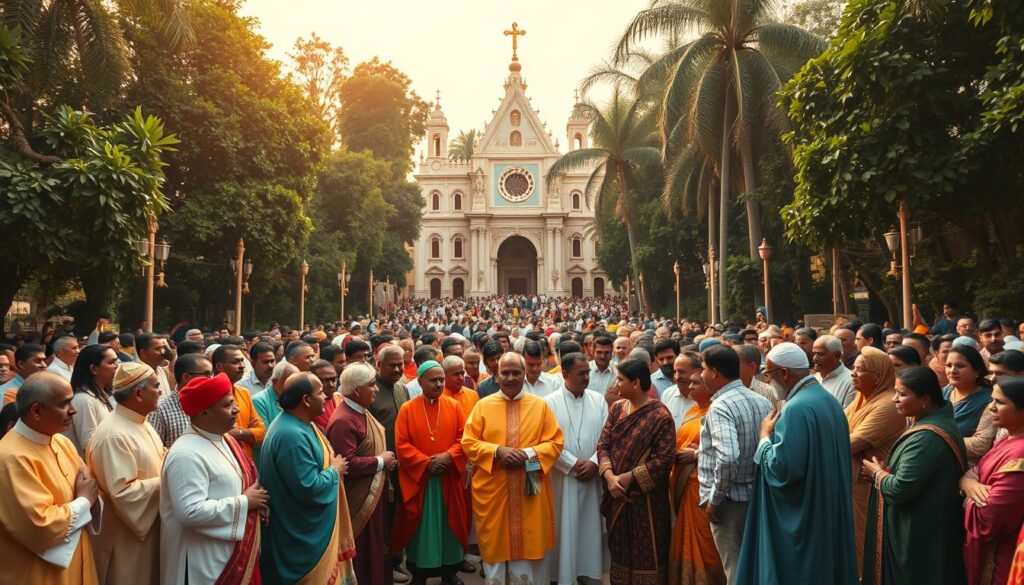
A diverse gathering of Catholic denominations in India, captured in a vibrant, photojournalistic style. In the foreground, priests and worshippers from various ethnic and cultural backgrounds stand united, their robes and vestments creating a kaleidoscope of colors. In the middle ground, a grand cathedral rises, its ornate architecture blending European and Indian influences. The background is filled with lush foliage and a warm, golden light, creating a sense of harmony and spiritual tranquility. The scene is shot with a wide-angle lens, emphasizing the scale and inclusivity of the Indian Catholic community.

Latin Rite Influence and Global Connections

The Latin Church traces its roots to 16th-century Portuguese missionaries. Their Roman liturgical practices—like Mass in local languages—forge strong ties with the global catholic church. Today, this rite operates 7,000+ parishes, making it the largest part of India’s Catholic world.

Syro-Malabar and Syro-Malankara Traditions

Ancient East Syriac rituals thrive in the Syro-Malabar Catholic Church, preserving traditions from Saint Thomas’s era. Their vibrant liturgy uses Malayalam and incense during worship. Meanwhile, the Syro-Malankara Church blends Syrian Orthodox heritage with Catholic communion, adopting elements like elaborate processions.

Rite Followers Origin Unique Feature
Latin 78.3% Portuguese missions Global liturgical alignment
Syro-Malabar 19.7% 1st-century traditions East Syriac chants
Syro-Malankara 2.0% 1930s reunion Syro-Antiochian rites

Though members freely attend each other’s services, most stay within their birth tradition. This harmony of ancient and modern practices shows how faith adapts while keeping its core alive.

Fusion of Catholic and Indian Cultural Practices

Faith in this diverse nation wears many vibrant hues, blending traditions into something uniquely beautiful. Communities seamlessly weave local customs into their spiritual lives, creating worship styles that feel both familiar and fresh.

Ritual Harmony Across Beliefs

Morning rituals often reveal this cultural crossroads. Families light oil lamps—a Hindu symbol of wisdom—beside Christian icons. Churches drape deities in flower garlands, mirroring temple practices. These shared gestures build bridges between faiths.

Festivals showcase creative fusions. Christmas processions feature kolam floor art designs, while Easter meals include regional spices. Such adaptations make religion feel like home, connecting ancient roots to modern life.

This spiritual blend strengthens community bonds. Over 70% of parishes incorporate local music or dance into services. As one worshiper shared: “Our practices honor tradition while celebrating what unites all people.” This harmony turns places of worship into cultural crossroads that uplift the entire country.

FAQ

How did St. Francis Xavier influence Catholic growth in India?

St. Francis Xavier played a key role in spreading the faith through missionary work along India’s west coast. His efforts established schools and churches, strengthening ties between local communities and global Catholic networks.

What distinguishes the Syro-Malabar Church from other Catholic traditions?

The Syro-Malabar Catholic Church follows East Syriac rites, blending ancient Indian cultural practices with liturgical traditions. It’s one of two Eastern Catholic Churches in India, reflecting centuries of localized worship styles.

How did Portuguese rule shape Catholic history here?

Portuguese explorers like Vasco da Gama introduced Latin Rite practices, building iconic structures such as Santhome Basilica in Chennai. Their arrival also led to clashes with existing Christian communities over religious authority.

Are Hindu customs part of Indian Catholic worship?

Yes! Many parishes incorporate rituals like oil lamps, flower offerings, or bhajan-style hymns into Mass. This fusion creates a unique spiritual identity rooted in both faiths’ cultural heritage.

What role do Catholic schools play in modern India?

Institutions like Loyola College and St. Xavier’s schools prioritize education and social upliftment. They serve students of all religions, fostering interfaith dialogue while maintaining strong academic reputations.

How many Catholics live in India today?

Roughly 20 million Catholics form 1.5% of the population. Major communities thrive in Kerala, Goa, Tamil Nadu, and metropolitan cities like Mumbai, where dioceses actively engage in charity and advocacy work.

Why is the Synod of Diamper significant?

The 1599 synod standardized practices among Kerala’s Christians under Portuguese oversight. While it unified liturgical rules, it also sparked tensions with older East Syriac traditions still preserved today.

Catholicism’s Global Footprint: Population Insights


How has one of the world’s oldest institutions maintained its influence across continents? Over the past century, the Catholic community has grown from 291 million to over 1.3 billion members, according to Vatican records. This growth reflects not just spiritual devotion but also shifting cultural landscapes.

Recent studies by the Pew Research Center show this faith now represents nearly half of all Christians worldwide. While Europe once dominated these numbers, today’s believers are increasingly concentrated in Africa, Asia, and Latin America. These changes reveal fascinating patterns about migration, birth rates, and societal values.

Tracking these trends helps us understand broader global dynamics. Organizations like the World Christian Database highlight how demographic shifts impact everything from humanitarian efforts to political alliances. The church’s role extends beyond spirituality—it shapes education, healthcare, and community development worldwide.

Why does this matter? Whether you’re studying cultural evolution or planning international programs, recognizing these patterns offers valuable insights. Let’s explore how centuries-old traditions adapt to modern realities while maintaining their core identity.

Key Takeaways

  • Catholic membership tripled since 1910, reaching 1.3 billion by 2021
  • Represents 48% of Christians globally despite geographic redistribution
  • Major growth now occurs in Africa and Latin America instead of Europe
  • Pew Research and Vatican sources provide complementary data
  • Demographic shifts influence cultural and policy decisions worldwide

Historical Foundations and Global Expansion

From its roots in ancient Mediterranean communities to modern megachurches, the Catholic Church has built a unique organizational framework. This network connects diverse traditions through shared leadership while preserving local practices.

Early Growth and Legacy

The church’s structure emerged gradually. Early Christians organized around bishops, with the Bishop of Rome gaining prominence as a unifying figure. By the 4th century, this system helped spread teachings across Europe and North Africa.

What makes this institution stand out? Unlike other ancient organizations, it blended centralized leadership with cultural flexibility. Missionaries adapted rituals to local customs while maintaining core beliefs.

Evolution of Church Structure

Today’s Catholic Church operates as a federation of 24 autonomous churches. The Latin Church forms the largest group, while 23 Eastern Catholic Churches preserve ancient Syrian, Byzantine, and Coptic traditions. All recognize the Bishop of Rome’s authority.

Vatican II reshaped perspectives in the 1960s. Leaders declared Eastern communities “true Churches” rather than just ritual variants. This affirmed their equal status while strengthening global unity.

The World Christian Database notes this structure enabled remarkable resilience. Through political changes and social revolutions, the church maintained schools and hospitals worldwide. Its 200,000+ institutions serve communities regardless of religious affiliation.

Demographic Shifts in the Catholic Church

What does a century of global change look like for a faith community? Between 1910 and 2010, Catholic membership tripled to 1.1 billion people, yet their share of humanity barely shifted. This balancing act—growing exponentially while keeping pace with worldwide trends—reveals unexpected resilience.

Comparative Trends Over the Century

In 1910, nearly half of all Christians identified with this tradition. Fast-forward 100 years: that figure held steady at 50%, even as Christianity spread to new regions. “The consistency is staggering,” notes a Pew Research Center report. “Like running alongside a speeding train without falling behind.”

Europe’s role changed dramatically. Once home to two-thirds of followers, it now accounts for just 24%. Meanwhile, Latin America quietly became the anchor—holding steady at 39% of the global total since 1910. Researchers credit higher birth rates and cultural integration for this shift.

Tracking these patterns isn’t simple. Political upheavals and evolving census methods create gaps in historical records. The Pew Research Center combines surveys, sacramental registries, and migration data to build accurate models. Their work shows how faith communities mirror broader societal changes—from industrialization to urbanization.

Why does this century-long view matter? For planners and policymakers, it highlights durable cultural forces. While membership numbers rise and fall, the Church’s proportional presence acts like a compass—steady amid humanity’s stormy seas.

Regional Distribution of catholicism population

The global map of faith communities has been redrawn. Where once European cathedrals defined this tradition, today’s vitality pulses through tropical rainforests and bustling Asian cities.

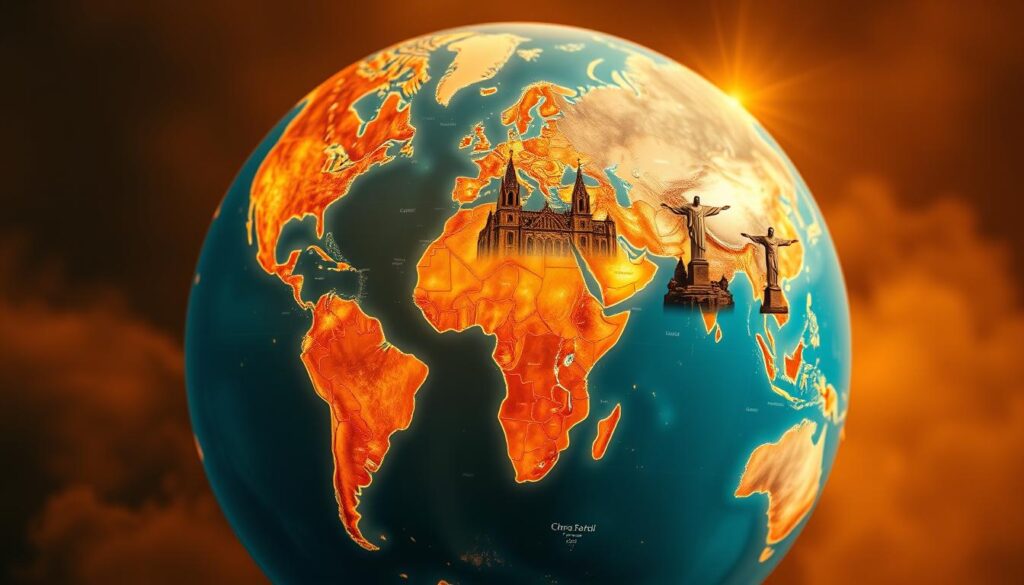
A globe illuminated by warm, golden light, with various regions highlighted to depict the global distribution of Catholicism. The foreground features a detailed map of the world, with each continent clearly delineated and shaded to represent the Catholic population density. The middle ground showcases prominent Catholic landmarks, such as St. Peter's Basilica, the Sagrada Familia, and the Christ the Redeemer statue, positioned strategically to provide a sense of scale and religious significance. The background is a soft, atmospheric haze, creating a sense of depth and emphasizing the global reach of the Catholic faith.

Powerhouses of the Global South

Latin America and the Caribbean now anchor nearly 40% of all followers. Brazil and Mexico alone account for over 200 million believers. Cultural integration explains much of this endurance—festivals like Mexico’s Día de los Muertos blend indigenous practices with spiritual traditions.

Africa’s growth story astonishes demographers. From just 1% in 1910, the continent now hosts 171 million followers. The Democratic Republic of Congo exemplifies this shift, rising from colonial-era missions to Africa’s third-largest Catholic community.

Changing Dynamics in Established Regions

Europe’s share halved since 1910, though cultural influence remains strong. Meanwhile, the Asia-Pacific region tripled its percentage. The Philippines stands out—its 86 million members make it the world’s third-largest Catholic country.

North America’s growth comes primarily through migration. Key patterns include:

  • Spanish-speaking communities reinforcing US membership
  • Canadian parishes adapting to multicultural cities
  • Urban centers becoming hubs for diverse traditions

These shifts shape global priorities. As one Vatican observer noted: “Our leadership tables now need maps that stretch beyond Rome’s cobblestone streets.”

Key Factors Influencing Growth and Decline

Understanding why faith communities grow or shrink requires looking beyond numbers. Economic shifts, cultural evolution, and human movement all shape religious landscapes in surprising ways.

Socioeconomic and Cultural Drivers

Urbanization and education often reshape spiritual connections. In Brazil, Catholic identification fell from 74% to 65% in just ten years as cities expanded. Similar patterns emerged in Mexico, where better access to education correlated with changing beliefs.

Women’s empowerment plays a crucial role. As families delay marriage and prioritize careers, traditional religious practices often adapt. “Modern life demands new ways to engage,” notes a Rio de Janeiro community leader. “Empty pews push us to rethink outreach.”

Migration and Changing Identities

Cross-border movement reshapes religious demographics dramatically. Over half of U.S. immigrants identify with this tradition, creating vibrant multicultural parishes. Nearly 30% of American members today were born elsewhere—triple the national average.

This diversity brings both energy and challenges. Second-generation immigrants often blend customs from their parents’ homeland with local practices. Meanwhile, evangelical groups and secular worldviews compete for attention in crowded spiritual marketplaces.

These dynamics show how faith intersects with public life. From education policies to healthcare initiatives, understanding these shifts helps communities stay relevant in changing times.

Impact on Public Life and Global Culture

Beyond Sunday services, Catholic institutions shape daily life for millions worldwide. From classrooms in Manila to clinics in Nairobi, these organizations bridge gaps where governments struggle to reach.

A grand cathedral stands tall, its spires reaching towards the heavens. In the foreground, a network of Catholic social services unfolds - soup kitchens, homeless shelters, and schools, all working in harmony to uplift the community. The middle ground showcases a diverse array of people, from all walks of life, seeking aid and finding solace in the outstretched arms of the church. In the background, a bustling cityscape hums with activity, a testament to the far-reaching influence of the Catholic social services network, woven into the fabric of global culture and public life. Soft, warm lighting bathes the scene, creating an atmosphere of compassion and hope. The camera angle is slightly elevated, allowing the viewer to take in the grandeur and scope of the network's impact. This image captures the essence of Catholicism's global footprint, where faith and service intertwine to shape communities and leave an indelible mark on the world.

Education, Healthcare, and Social Services

The Church operates 1 in 5 global schools, serving over 60 million students annually. Its healthcare network treats 120 million patients each year through:

Institution Type Global Count Primary Regions
Hospitals 5,000+ Africa, Latin America
Elementary Schools 95,000 Asia, Europe
Orphanages 10,000 Global South

These efforts create ripple effects. In the Philippines, Catholic schools train 75% of public school teachers. Brazilian church-run clinics provide free care to 12 million annually. “We don’t ask for baptism certificates,” notes a Nairobi hospital director. “Our doors open to all.”

The Holy See’s diplomatic ties amplify this work. Through 183 country agreements, it coordinates disaster relief and refugee support. Recent partnerships helped deliver COVID vaccines to 45 nations.

Cultural influence appears in unexpected places. Mexico’s healthcare laws mirror Catholic social teachings on human dignity. European climate policies often align with Vatican environmental statements. This global footprint shows how faith-based networks shape societies far beyond religious practice.

Methodological Insights from Global Data Studies

Why do official numbers tell different stories about the same community? Measuring religious affiliation involves navigating cultural nuances, tax systems, and survey designs. A Pew Research Center analyst explains: “Even basic questions like ‘Are you Catholic?’ mean different things in São Paulo versus Seoul.”

A dimly lit study filled with the warm glow of a desk lamp, surrounded by neatly organized stacks of research papers, demographics charts, and a laptop displaying intricate data visualizations. In the foreground, a researcher's hands carefully annotate a world map, tracing patterns and trends across continents. The atmosphere is one of focused, analytical inquiry, evoking the meticulous process of uncovering insights from global religious data.

CIA Factbook vs. Pew Research Center Data

Government reports and independent surveys often clash. Germany’s church tax system tracks precise membership records, while Brazil’s estimates vary wildly:

Data Source Methodology Coverage Sample Case
CIA Factbook Government reports Broad estimates Mexico: 91.89%
Pew Research Surveys Cultural context Mexico: 83.9%
Latinobarometro Regional polling Latin America Brazil: 57%

Survey Analysis and Census Comparisons

Question wording changes everything. The phrase “active member” cuts Brazil’s numbers by 11% versus simple affiliation questions. Timing matters too—post-holiday surveys show higher religious identification.

Mexico’s 2010 census revealed a 8% gap versus CIA figures. Researchers attribute this to cultural pride in heritage versus actual practice. As one demographer notes: “In some regions, checking ‘Catholic’ is like checking ‘American’—it’s about identity, not weekly mass.”

Projections and Future Demographic Scenarios

Tomorrow’s spiritual landscape will look radically different. By 2050, nearly half of all followers could live in just ten nations—from Congo to the Philippines—as global membership surpass 1.6 billion. This transformation reshapes how communities worship, organize, and engage with society.

Impact of Immigration Trends

Migration patterns are redrawing faith maps. The U.S. could gain 15 million members by mid-century, fueled by Hispanic communities and African immigrants. Urban centers like Houston and Chicago now host multilingual parishes blending Nigerian hymns with Mexican traditions.

Europe faces contrasting realities. While Germany’s numbers drop 6%, Poland maintains stable membership through diaspora networks. Younger generations increasingly identify with cultural heritage rather than weekly practice—a trend mirrored globally.

Shifts in Global Demographic Power

Africa’s 146% growth surge will make it home to 22% of all followers by 2050. Angola and Uganda join Congo as emerging hubs, while Asia’s 63% rise centers on Filipino and Vietnamese communities. Latin America remains steady, with Brazil and Mexico anchoring 25% of global membership.

These changes challenge traditional leadership models. As one Vatican strategist notes: “Our future requires understanding Lagos as deeply as Lisbon.” The data paints a clear picture—vitality now blooms where diversity meets youthful energy.

FAQ

How large is the global Catholic population today?

Roughly 1.3 billion people identify as Catholic worldwide, making it the largest Christian denomination. Brazil, Mexico, and the Philippines are among the countries with the highest numbers of adherents.

What factors drove the historical growth of Catholicism?

Missionary work, colonization, and cultural integration expanded the Church’s reach. Institutions like schools and hospitals also reinforced its influence, particularly in Latin America and Africa.

How have Catholic demographics shifted in the last century?

While Europe’s share of adherents has declined, regions like sub-Saharan Africa and Asia-Pacific have seen growth. Urbanization and changing birth rates play significant roles in these trends.

Which regions have the strongest Catholic presence today?

Latin America remains the most concentrated region, followed by Europe. Africa’s Catholic community is growing rapidly, while the U.S. maintains a stable but aging demographic.

How do socioeconomic factors influence Catholic growth?

Poverty, education access, and healthcare disparities often correlate with higher adherence. Conversely, secularization in wealthier nations has contributed to membership declines.

What role does the Church play in public life globally?

Catholic institutions operate tens of thousands of schools, hospitals, and charities worldwide. These services often fill gaps in government-provided social support, especially in developing nations.

How reliable are sources like the Pew Research Center for Catholic data?

Pew’s surveys and the CIA World Factbook are widely respected, but methodologies differ. Pew emphasizes self-identification, while census data may undercount unregistered believers.

Could immigration reshape future Catholic demographics?

Yes. Migration from high-growth regions like Africa to secularizing areas like Europe may slow declines. Cultural retention among diaspora communities will also shape these trends.

Discover the Principles of Liberal Catholicism


What happens when ancient spiritual traditions meet modern democratic ideals? This question defined a groundbreaking movement that reshaped religious thought in 19th-century Europe. Rooted in France and Belgium, this approach sought to harmonize deep spiritual commitment with progressive social values.

Visionaries like Felicité de Lamennais sparked debates still relevant today. They championed freedom of conscience and education reforms while honoring sacred rituals. Their ideas created ripples beyond church walls, influencing voting rights and civic responsibility.

These thinkers faced fierce opposition for advocating church-state separation. Yet their legacy shows how faith communities can engage with shifting cultural landscapes. Their story isn’t just history – it’s a roadmap for balancing tradition with societal progress.

Key Takeaways

  • 19th-century movement blending spiritual traditions with democratic values
  • Pioneered church-state separation and religious freedom concepts
  • Key figures included French thinkers like Lamennais and Lacordaire
  • Advocated for expanded voting rights and public education
  • Shaped modern discussions about faith’s role in civic life
  • Demonstrated tensions between institutional authority and reform

Historical Context and Foundations

Amidst political upheaval, a spiritual revolution took root in France. Hugues Felicité Robert de Lamennais, a fiery thinker, gathered supporters like Henri Lacordaire to challenge rigid structures. Their mission? To unite sacred practices with emerging democratic values.

The French and Belgian Beginnings

In 1830 Paris, Lamennais launched L’Ami de l’Ordre newspaper. Its banner declared “God and Liberty” – a daring fusion of faith and progress. The author demanded voting reforms, church-state separation, and free education through print.

Belgium answered this call first. By 1831, their new constitution guaranteed freedoms these reformers championed. This fact proved ancient tradition could blend with modern liberalism without losing identity.

Early Liberal Catholic Milestones
Country Key Figure Achievement Year
France Lamennais Founded reform newspaper 1830
Belgium National Congress Adopted progressive constitution 1831
Rome Gregory XVI Issued condemnation 1832

Papal Responses and Doctrinal Debates

Rome struck back hard. Pope Gregory XVI’s 1832 Mirari vos encyclical denounced these ideas as dangerous. Bishops warned priests against mixing faith with democratic politics.

Yet Lamennais’ movement kept growing. Supporters argued true faith required addressing social needs. This clash between reform and authority would shape religious debates for decades.

Core Doctrines and Theological Shifts

How do ancient beliefs adapt to modern governance? This question fueled groundbreaking theological reforms. Thinkers reimagined faith’s role in public life while preserving sacred traditions.

A grand cathedral's interior, bathed in warm, golden light filtering through stained glass windows. Ornate altars and statues stand as symbols of traditional Catholic doctrine. Yet, in the foreground, shadowy figures emerge, deep in contemplation, signifying a shift in theological thought. Subtle contrasts and tensions between old and new, orthodoxy and progressivism, create a visually striking scene that captures the evolution of Catholic thought and the changing landscape of belief.

Separation of Church and State in Theory

Reformers saw independence as vital for spiritual growth. “A free church thrives best in free societies,” argued one bishop. They believed political liberalism could strengthen faith communities, not weaken them.

This approach let laypeople engage fully in civic matters. Religious teaching emphasized personal conscience over institutional control. It became a bridge between sacred rituals and democratic participation.

Evolving Liturgical Practices and Religious Teaching

Worship styles adapted to emphasize social justice. Education reforms made theology more accessible to ordinary people. Traditional sacraments gained new layers of meaning tied to human dignity.

Traditional vs Reformed Theological Perspectives
Aspect Traditional View Reformed Approach
Authority Centralized hierarchy Shared spiritual leadership
Social Role Maintain status quo Drive ethical change
Scripture Literal interpretation Contextual application
Human Dignity Original sin focus Inherent worth emphasis

These shifts balanced timeless truths with contemporary needs. They showed how spiritual life could shape political things without domination. The movement proved faith could evolve while keeping its soul intact.

Contemporary Perspectives on liberal catholicism

What does the future hold for faith communities navigating modern social divides? A groundbreaking study reveals seismic shifts in religious leadership trends. The Catholic Project’s research shows how priestly identities have transformed across generations.

Interview Insights and Generational Shifts

Younger priests now overwhelmingly identify as traditionalists. Only 14% of new ordinands describe themselves as moderate – a stark contrast to the 68% progressive majority from fifty years ago. “We’re seeing three distinct waves,” explains one study editor. “Vietnam-era reformers, John Paul II traditionalists, and post-9/11 ultra-conservatives.”

Priestly Identity Changes Over Time
Generation Years Active Dominant Theology
Vatican II Era 1960s-1980s Progressive Social Justice
John Paul II 1980s-2000s Orthodox Teaching
Post-Benedict XVI 2010s-Present Traditional Conservatism

Modern Critiques and Enduring Influence

This decline in progressive voices raises questions about social engagement. While Pope Francis pushes climate action, young conservative catholics often prioritize abortion opposition over environmentalism. “It’s not rejection of justice,” argues a seminary instructor, “but different priorities shaped by cultural wars.”

Older liberal catholics warn about losing reform momentum. Yet their legacy persists through interfaith partnerships and poverty initiatives. As one retired priest noted: “True service transcends labels – it’s about showing up where need meets faith.”

“The data doesn’t show disengagement, but redirected energy toward spiritual renewal rather than political activism.”

– Study Co-Author

Political, Cultural, and Social Impacts

Modern faith communities face a critical question: How does spiritual tradition drive societal transformation? Michael Sean Winters of the National Catholic Reporter offers a bold answer: “We never went away and never could go away.” This resilience shines through intergenerational efforts to merge sacred values with contemporary justice movements.

A vibrant street scene depicting Catholic social justice activism. In the foreground, a diverse group of people marching with placards and banners calling for economic equality, racial justice, and environmental stewardship. The middle ground features a historic church, its steeple reaching skyward, symbolic of the faith-based roots of the movement. In the background, a city skyline with modern high-rises, representing the broader societal context. Warm, golden light filters through, creating a sense of hope and determination. The overall atmosphere conveys a spirit of collective action, grounded in the teachings of the Catholic Church.

The Role of Social Justice and Policy in Modern Society

Gray-haired reformers and college theology students now march side by side. You’ll find them advocating for climate action through the Green New Deal or joining racial justice protests. Retired sisters and bishops still lead poverty initiatives, proving commitment outlasts clerical trends.

Executive editor Heidi Schlumpf observes: “These activists wear multiple hats – parish volunteers one day, policy advocates the next.” Their work bridges Sunday sermons and Monday’s legislative battles, showing how faith fuels civic engagement.

Legacy, Change, and Future Implications

While younger priests lean conservative, lay leaders fill the gap. Catholic universities have become hubs for progressive theology courses. This shift mirrors broader cultural debates about immigration and economic fairness.

The movement’s survival hinges on blending tradition with fresh approaches. As one theology professor notes: “Our students want sacramental depth and systemic change.” This dual focus could redefine Catholic influence in coming decades, ensuring ancient values speak to modern struggles.

Conclusion

Balancing timeless beliefs with societal change remains a tightrope walk for modern believers. The liberal catholicism movement demonstrated how spiritual depth could fuel civic progress. Its decline among clergy offers lessons for today’s polarized world.

The dwindling number of priests embracing progressive social engagement presents a paradox. As one editor notes: “We gained doctrinal clarity but lost vital bridges to secular reformers.” Lay movements now carry this legacy through poverty relief and climate action.

Younger men entering religious life often prioritize orthodoxy over political activism. Yet universities keep the reform spirit alive through ethics courses and interfaith partnerships. This shift mirrors broader debates about tradition’s role in fast-changing societies.

True faith thrives when honoring roots while nurturing new growth. As liberalism evolves, the challenge remains: How can sacred values address modern crises without compromising core principles? The answer may lie in blending ancient wisdom with fresh approaches.

FAQ

What sparked the early development of progressive Catholic thought?

Ideas emerged in 19th-century France and Belgium, influenced by political revolutions and calls to adapt Church engagement with modern democratic ideals.

How did Vatican leadership address theological debates in the past?

Figures like Pope Leo XIII and Pius X issued documents critiquing certain interpretations, emphasizing alignment with traditional teachings on authority and doctrine.

Why is the church-state relationship central to these discussions?

Advocates historically pushed for greater autonomy of civil institutions, challenging older models where religious and political power were deeply intertwined.

Have worship styles shifted alongside theological ideas?

Some communities embraced vernacular languages or inclusive practices post-Vatican II, though reforms often vary by region and local leadership.

Do younger generations view these topics differently today?

Surveys suggest many prioritize issues like environmental care and equity, reflecting broader cultural values while still valuing spiritual traditions.

How does social justice intersect with faith in current movements?

Activists frequently cite teachings on human dignity to support efforts like poverty reduction, immigration reform, and peacebuilding initiatives.

What challenges might this outlook face moving forward?

Tensions persist between adaptation and preservation, particularly regarding authority structures, moral teachings, and intergenerational expectations.