Recent Posts

Catholicism and Halloween: Exploring the Unexpected Link


When you hear the word “Halloween,” spooky costumes and candy might come to mind. But this festive tradition has roots far deeper than trick-or-treating. The term itself comes from All Hallow’s Eve, the night before All Saints Day—a sacred celebration honoring every saint in heaven, known and unknown.

Many families today feel torn between seasonal fun and faith values. What most don’t realize is that this holiday originated as a holy preparation for one of the Church’s most important feasts. Like Christmas Eve leading into Christmas, October 31st serves as a spiritual gateway to a day of reverence.

The connection becomes clearer when we explore the word “hallow.” Derived from Old English, it means “holy”—the same term used in the Lord’s Prayer. This linguistic link reveals how cultural traditions often grow from sacred soil, even when their modern forms seem secular.

Reclaiming this history offers families meaningful ways to blend celebration with faith. Through simple practices like discussing saints’ stories or attending Mass, the season transforms into a chance to teach lasting spiritual lessons. Let’s uncover how this vibrant tradition became a bridge between joy and devotion.

Key Takeaways

  • Halloween originates from All Hallow’s Eve, the vigil before All Saints Day
  • The term “hallow” connects directly to sacred language in the Lord’s Prayer
  • Modern celebrations often overlook the holiday’s liturgical significance
  • Families can blend tradition with faith through intentional celebrations
  • October 31st serves as spiritual preparation like Christmas Eve does for Christmas

Tracing the Origins of Catholicism and Halloween

Long before pumpkin carving became popular, autumn nights held deeper meaning in Rome. Two medieval popes reshaped how believers honor saints, creating traditions that still echo today.

Historical Background of All Hallows’ Eve

In 731 AD, Pope Gregory III made a lasting decision. He moved the Feast of All Saints from May 13th to November 1st after dedicating a chapel to saints in St. Peter’s Basilica. This established October 31st as the vigil day – a time for spiritual preparation common before major celebrations.

Nearly a century later, Pope Gregory IV expanded this local Roman practice. He declared November 1st a universal feast day for the entire Church. This papal decree transformed what began as a city tradition into a global observance.

Papal Influences on the Liturgical Calendar

The date change wasn’t about replacing older festivals. Church leaders prioritized practical needs – aligning celebrations with harvest seasons and travel-friendly weather. Evening prayers before feast days became customary, blending worship with community gatherings.

Three key impacts emerged:

  • Medieval believers saw October 31st as natural preparation time
  • Local cultures developed unique vigil practices
  • Immigrants later carried these traditions worldwide

This liturgical foundation explains why many modern customs – from candle lighting to remembering loved ones – carry traces of ancient faith practices.

The Significance of All Saints Day in Catholic Tradition

Imagine a celebration where millions honor both famous and forgotten holy lives. This vibrant reality unfolds every November 1st during All Saints Day, a holy day of obligation requiring Mass attendance like Sundays. The Church invites believers to celebrate spiritual superheroes – from household names like St. Peter to unsung heroes who lived quiet lives of radical love.
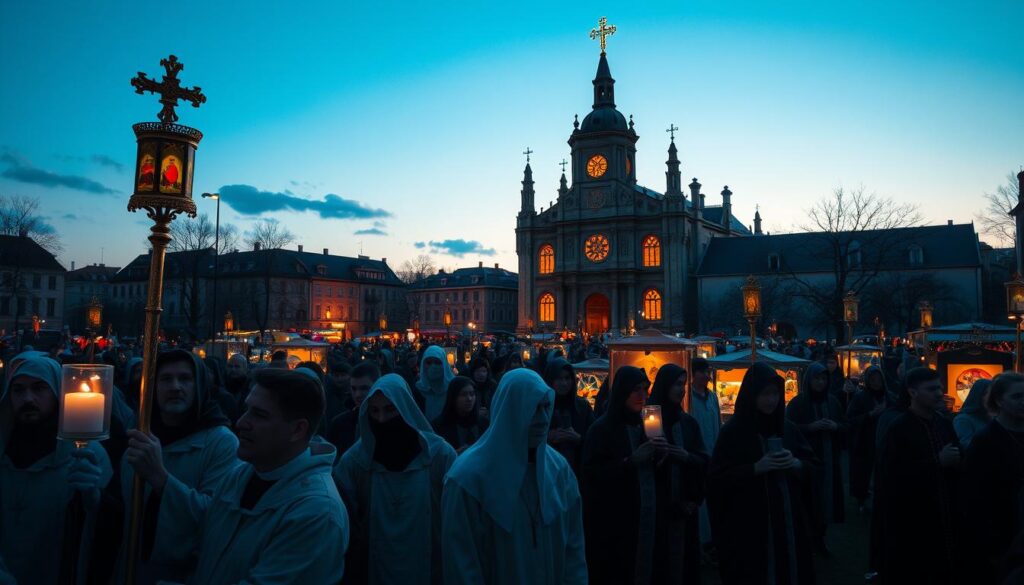
A vibrant scene of All Saints Day celebrations in a traditional Catholic setting. In the foreground, a procession of robed figures carrying ornate candles and religious icons, their faces solemn and reverent. In the middle ground, a grand cathedral with stained glass windows glowing in the evening light, surrounded by a bustling town square filled with vendors selling seasonal treats and decorations. In the background, a cloudless sky tinged with the warm hues of dusk, creating a serene and spiritual atmosphere. The lighting is soft and muted, casting a contemplative mood over the entire scene. Capture the reverence, community, and timeless traditions of this significant Catholic holiday.

Honoring Saints and the Communion of Saints

This feast day reveals Christianity’s beautiful paradox: ordinary people achieving extraordinary holiness. As one early Christian writer noted:

“The saints were human like us – they simply loved God more than their weaknesses.”

The celebration connects three dimensions of faith through the Communion of Saints:

Church Group Description Role in Allhallowtide
Militant (Living) Believers on earth Pray for others
Triumphant (Saints Heaven) Holy souls in glory Intercede for us
Suffering (Purgatory) Souls being purified Receive our prayers

This holy day does more than remember the past. It offers living hope – if grocery clerks and teachers can become saints, so can we. Families often share stories of patron saints during meals, making heavenly realities feel personal and achievable.

The tradition also answers a deep human longing. As Pope Francis once observed: “We weren’t made for comfort – we were made for greatness.” All Saints Day redefines that greatness not as fame, but as faithful love shining through daily life.

Pope Gregory III and the Transfer of Feast Days

An eighth-century chapel renovation sparked a tradition lasting over 1,300 years. Pope Gregory III changed Christian history in 731 AD by moving the Feast of All Saints to November 1st. This shift honored his new chapel in St. Peter’s Basilica dedicated to all heavenly saints—a decision still shaping autumn celebrations today.

From May 13th to November 1st

Why abandon May’s spring date? November offered practical advantages. Cooler weather eased travel for pilgrims visiting Rome. Harvests provided ample food for communal feasts. Most importantly, the new date aligned with the chapel’s dedication—a spiritual milestone for medieval believers.

Gregory III’s nine-year papacy strengthened Church unity through such reforms. Fixing the feast on the day November 1st created consistency across growing Christian territories. This move also birthed Allhallowtide—the three-day observance starting October 31st.

Rome’s Role in Shaping Religious Celebrations

As Christianity’s headquarters, Rome dictated how feasts evolved globally. Pope Gregory transformed a local tradition into universal practice. By 835 AD, November 1st became mandatory for all churches—showcasing papal authority to standardize worship.

This timing disproves later myths about pagan influences. Since Gregory III’s decree came 300 years before Norse autumn festivals, it confirms the feast’s purely Christian roots. His chapel remains a physical reminder of how one decision shaped centuries of sacred tradition.

European Traditions and Their Impact on Modern Celebrations

Modern Halloween celebrations mirror a vibrant tapestry of old-world practices. Three European cultures wove their unique customs into what we now recognize as seasonal staples.
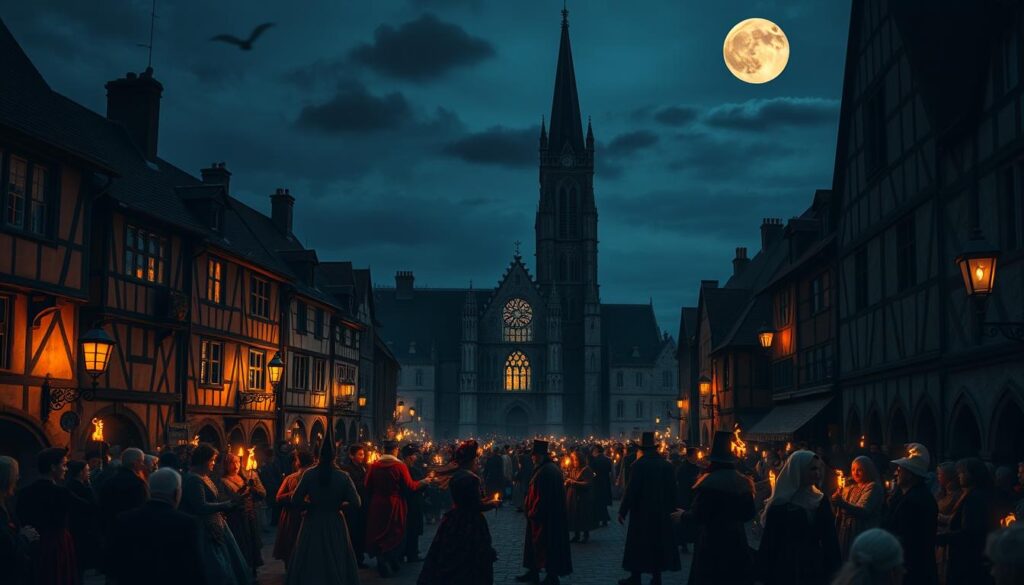
A dimly lit medieval European town square, bathed in the soft glow of flickering torchlight and candles. In the foreground, a group of revelers dressed in elaborate costumes and masks, dancing and celebrating in the streets. In the middle ground, a towering gothic cathedral stands sentinel, its stained glass windows casting colorful shadows. In the background, a full harvest moon rises over the distant hills, casting an eerie, otherworldly atmosphere. The scene evokes a sense of ancient tradition, mysticism, and the blending of pagan and Christian elements that defined the evolution of European Halloween customs.

Costume Customs and the Origins of Trick-or-Treating

French believers started dressing as saints during Allhallowtide processions. This religious costume tradition evolved into playful disguises when immigrants reached American shores. Children began embodying both holy figures and imaginative characters.

Irish families carved turnips to guard against restless spirits. The glowing faces symbolized prayers for souls in purgatory. Pumpkins replaced turnips in America’s fertile soil, blending practicality with creativity.

Tradition Origin Modern Practice
Costumes French saintly processions Creative character outfits
Jack-o’-Lanterns Irish turnip carvings Pumpkin decorations
Treating English soul cake requests Candy exchanges

England’s “souling” practice inspired today’s trick-or-treating. Villagers promised prayers for the dead in exchange for baked goods. This sacred barter system became America’s candy-fueled tradition through cultural blending.

These customs merged seamlessly in 19th-century immigrant communities. While adapting to new surroundings, families preserved their faith’s core values. What began as spiritual practices now spark joy across generations.

The Intersection: catholicism and halloween in Contemporary Faith

In a world where plastic skeletons outnumber prayer cards, many believers wrestle with embracing October 31st. The key lies in rediscovering the holiday’s sacred heartbeat—a call to celebrate eternal truths through joyful traditions.

Reclaiming a Holy Celebration

Families can honor their heritage by blending faith with fun. Start by attending All Hallows’ Eve Mass—a powerful way to anchor the night in worship. One parish priest suggests:

“Light a candle after trick-or-treating. Name each flame after a saint who inspires your family.”

Three practical strategies help distinguish sacred roots from secular noise:

  • Choose costumes reflecting holy figures or virtues
  • Share stories of patron saints during candy sorting
  • Visit gravesites to pray for departed loved ones

Many Catholics celebrate Halloween unaware of its liturgical depth. By explaining how jack-o’-lanterns symbolized Christ’s light defeating darkness, parents transform pumpkin carving into faith formation. Community events like saint-themed parties or prayer walks offer alternatives to commercialized festivities.

When Catholics celebrate intentionally, they reclaim October 31st as spiritual preparation—not a night to fear. As one grandmother shared: “We bake soul cakes while discussing heaven’s heroes. The kids learn that joy and holiness go hand-in-hand.”

Debunking Misconceptions and Clarifying the Myths

Many assume spooky traditions connect to ancient pagan festivals. Let’s untangle fact from fiction using historical evidence.

A dimly lit, moody scene of Halloween myths and misconceptions being debunked. In the foreground, a table with various occult objects - a crystal ball, tarot cards, and a black cat - but these are revealed to be ordinary household items. In the middle ground, shadowy figures representing common Halloween superstitions - black cats, witches, and ghosts - are being illuminated by a warm, golden light, exposing their mundane nature. The background depicts a cozy, old-world library setting, with bookshelves lining the walls, hinting at the scholarly approach to unraveling these myths. The lighting is a mix of soft, ambient illumination and dramatic chiaroscuro, creating an atmosphere of intrigue and revelation. The overall tone is one of rational inquiry and the dispelling of spooky legends.

Separating Pagan Myths from Catholic Truths

The idea that October 31st borrows from Celtic festivals crumbles under scrutiny. All Saints Day existed for 300 years before any written claims about pagan links appeared. As church historian Fr. Augustine Thompson notes:

“The November 1st date was chosen for practical reasons—not spiritual compromise.”

Anti-Catholic groups during the Reformation spread false origins stories to discredit believers. These myths gained traction when Irish immigrants faced prejudice in 19th-century America. Their harmless traditions—like carving vegetables—were wrongly labeled “occult.”

Addressing Secular Influences on the Holiday

Modern distortions emerged as commercialization grew. Stores began selling horror-themed decor in the 1970s, shifting focus from spiritual preparation. Yet the faith’s core remains untouched.

Three ways secular culture altered perceptions:

  • Movies replaced saint stories with slasher films
  • Candy companies prioritized sales over symbolism
  • Schools removed religious context from activities

Understanding these shifts helps families reclaim the holiday’s true origins. Simple ways to counter secular influences include discussing All Saints’ Eve traditions or hosting light-themed parties. Truth outlasts trends when we honor history with intention.

A Step-by-Step Guide to a Faithful Halloween Celebration

Transform October 31st into a meaningful spiritual journey with simple faith practices. These traditions help families honor sacred roots while enjoying seasonal fun. Begin by viewing the evening as joyful preparation for November’s holy days.

Start With Worship

Many parishes offer evening Mass on All Hallows’ Eve. Attending as a family grounds the night in community prayer. This practice mirrors how Christmas Eve services precede December 25th celebrations.

Bring children in costumes reflecting saints or virtues. After Mass, discuss how these holy figures faced fears with faith. This connects modern dress-up to timeless values.

Create Prayer Moments

Set up a home altar with candles and saint images. Light one while sharing stories of departed loved ones. Simple phrases like “St. Michael, pray for us” teach kids to seek heavenly help.

End the night with a family blessing. Pray: “May we walk with the saints in light.” These small acts turn candy-filled hours into encounters with eternal hope.

FAQ

How did All Hallows’ Eve become linked to Catholic traditions?

All Hallows’ Eve (October 31) originated as the vigil before All Saints Day, a holy day established by Pope Gregory III in the 8th century. It was a time to honor saints and pray for departed loved ones, blending faith with cultural customs over time.

Why is All Saints Day important in Catholic practice?

All Saints Day (November 1) celebrates the communion of saints—those in heaven and the faithful on earth. It’s a reminder to seek their intercession and reflect on living a holy life, rooted in the Church’s teachings.

Did Pope Gregory III change the date of a major feast?

Yes! Pope Gregory III moved the feast honoring saints from May 13 to November 1, dedicating a chapel in Rome to all saints. This shift helped merge existing autumn traditions with Catholic liturgy.

Are Halloween costumes connected to Catholic history?

Some European customs, like wearing disguises, may have roots in medieval practices where people dressed as saints or spirits to symbolize the battle between good and evil. Over time, this evolved into playful costumes.

Can Catholics celebrate Halloween in a faith-focused way?

Absolutely! Many attend Mass for All Saints Day, pray for departed souls, or host gatherings that blend fun with reminders of eternal life. It’s about balancing joy and reverence.

Is Halloween inherently pagan?

No—the holiday’s core ties to All Saints Day are deeply Catholic. While secular influences exist, the Church’s focus remains on celebrating saints and remembering the faithful departed.

How does All Souls Day differ from Halloween?

All Souls Day (November 2) specifically prays for souls in purgatory, while Halloween serves as the festive vigil before honoring saints. Both days emphasize prayer and eternal hope.

What role did Rome play in shaping these celebrations?

Rome’s liturgical calendar reforms, like moving feast days, helped unify Christian practices across Europe. Local traditions blended with these changes, creating rich, layered celebrations.

How can families incorporate prayer into Halloween?

Lighting candles for loved ones, sharing stories of saints, or praying the Rosary for the departed are simple yet meaningful ways to keep faith central during festivities.
Catholicism in Spanish: A Cultural and Spiritual Journey


Welcome to a vibrant exploration of faith and language! This guide uncovers how religious traditions shape societies through art, language, and shared values. You’ll discover how centuries-old practices continue to influence modern life across Spanish-speaking regions.

Known as “catolicismo” in Spanish, this global belief system connects over 32 million members in Spain alone. The Spanish Episcopal Conference oversees 70 dioceses, blending ancient rituals with contemporary spiritual life. But this journey goes beyond church structures – it’s about understanding the living traditions that color daily experiences.

Why focus on Spain? For over a thousand years, this nation has perfected the art of merging faith with culture. From Santiago’s pilgrimage routes to Valencia’s fire festivals, spiritual expressions become community celebrations. You’ll learn not just translations, but the stories behind sacred spaces and seasonal traditions.

Our friendly approach makes complex ideas simple. Whether you’re studying language or exploring heritage, we’ll break down terms like “parroquia” (parish) or “adviento” (Advent) while revealing their cultural weight. Ready to see how faith shaped cathedrals and inspired poets? Let’s begin!

Key Takeaways

  • Spanish religious terms carry deep historical meaning beyond direct translations
  • Spain’s 70 dioceses showcase unique blends of medieval and modern practices
  • Major festivals often combine spiritual significance with local traditions
  • Understanding church vocabulary enhances cultural appreciation
  • Architectural wonders like cathedrals tell stories of evolving faith

Examining “catholicism in spanish”: Definitions and Insights

Language shapes faith experiences in profound ways. Let’s unpack essential terms and sounds that bridge spiritual concepts across cultures. This practical guide helps you speak about religious ideas with confidence.

Glossary of Key Terms and Translations

The core term “catolicismo” serves as your anchor. This masculine noun covers everything from sacraments to church leadership. Build your word list with related phrases:

  • Católico (Catholic) – Adjective describing people or traditions
  • Iglesia católica – Official name for the Catholic Church
  • Fe católica – Specific beliefs distinguishing this faith

Understanding Pronunciations and Usage

Master these sounds to avoid confusion. English speakers say “kuh-THAH-luh-siz-um” (/kəˈθɒləˌsɪzəm/), while Spanish pronunciation flows as “kah-toh-lee-SEEZ-moh.” Remember the grammar rules:

  • Always use el catolicismo – The definite article stays
  • No plural form exists for this concept
  • Combine with location words: Catolicismo europeo (European Catholicism)

Regional flavors add spice to conversations. In Mexico, you might hear “la doctrina católica” during debates, while Spaniards reference “tradiciones católicas” in historical contexts. Practice with sample sentences:

“El catolicismo influyó en el arte colonial” (Catholicism influenced colonial art)

Historical Roots and Evolution of Catholic Practices in Spain

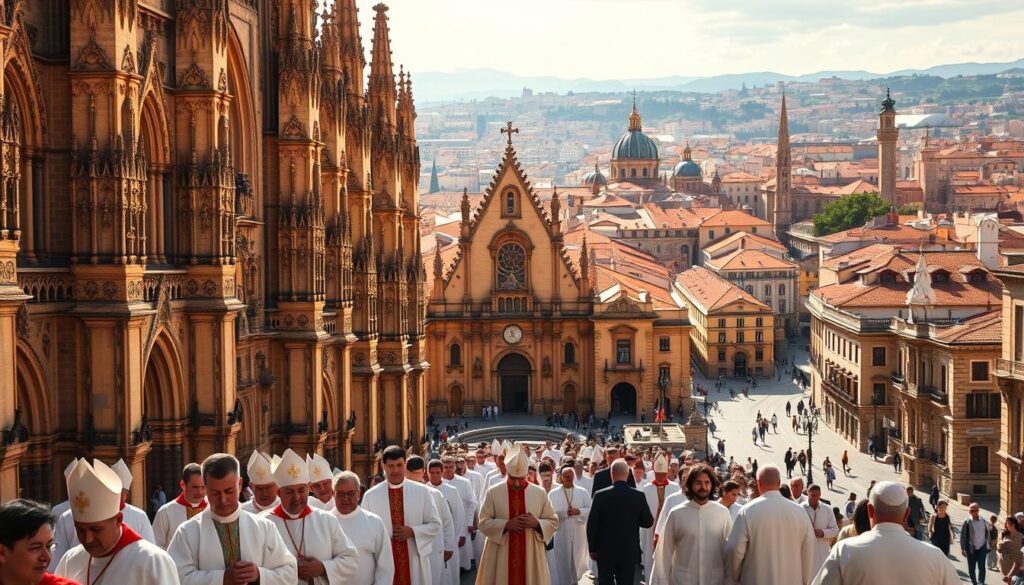
A grand, ornate cathedral in the heart of a historic Spanish city, its gothic spires and elaborate façade bathed in warm, golden light. In the foreground, a procession of robed clergy and devout worshippers, their faces reflecting the solemn reverence of centuries-old Catholic traditions. The middle ground reveals intricate stained-glass windows and ornate altars, while the background scene showcases the sprawling cityscape, its winding cobblestone streets and terracotta rooftops hinting at the deep cultural and spiritual heritage of this region. The overall composition evokes a sense of timeless grandeur and the enduring influence of Catholicism in shaping the Spanish national identity.

Spain’s spiritual landscape grew from ancient seeds. Early Christian communities possibly formed during Roman rule, with traditions strengthening under Visigothic kings. These rulers shifted from Arian beliefs to Roman Catholicism in 589 AD, weaving faith into law and culture.

Medieval Battles and Religious Identity

The 711 Muslim invasion sparked eight centuries of cultural clashes. Northern Christian kingdoms developed unique rituals during the Reconquista. By 1492, Catholic monarchs unified the peninsula, using religion to build national pride.

Church power peaked with the Spanish Inquisition. This system enforced orthodoxy through dramatic trials. Meanwhile, missionaries carried Roman Catholic practices worldwide, making Spain a global religious influencer.

From Dictatorship to Democracy

The 20th century brought dramatic changes. During the Civil War, the Roman Catholic Church backed Franco’s regime. After Vatican II reforms, tensions grew between conservative leaders and progressive clergy.

Modern Spain balances tradition with secular values. The 1978 Constitution ended state religion status while preserving the church’s cultural role. Today, cathedrals stand beside modern institutions, showing faith’s evolving place in society.

“Our history lives in every procession and prayer,” notes Madrid historian Elena Gómez. “But our future requires understanding this complex legacy.”

Cultural Traditions, Architectural Heritage, and Spiritual Pilgrimages

Spain’s streets and stones whisper stories of devotion. From candlelit processions to mountain-top monasteries, faith becomes tangible through time-honored traditions and breathtaking buildings.

Festivals, Processions, and Pilgrimages

Holy Week transforms cities into open-air theaters. In Seville, 58 processions parade pasos (religious floats) dating to the 1500s. Hooded nazarenos carry these treasures while crowds chant saetas – raw flamenco prayers.

The Camino de Santiago remains Europe’s ultimate spiritual hike. Over 100,000 modern pilgrims walk ancient routes yearly. Many seek meaning through blistered feet and starry nights at rustic hostels.

Iconic Cathedrals and Sacred Monuments

Spain’s skyline spikes with stone masterpieces. Toledo Cathedral showcases Gothic grandeur with its 15th-century altarpiece – a golden Bible in wood. Barcelona’s Sagrada Família reimagines tradition with rainbow-stained glass and melting spires.

Architectural Wonder Style Unique Feature
Santiago Cathedral Romanesque Botafumeiro incense burner
Seville Cathedral Gothic Christopher Columbus’ tomb
Sagrada Família Modernist 18 spiral towers
Burgos Cathedral French Gothic Star-vaulted ceilings

Monasteries like Montserrat keep centuries-old chants alive. Visitors touch the Black Madonna’s orb – a tradition linking modern hands to medieval hopes. These sites aren’t museums but living bridges between past and present.

Conclusion

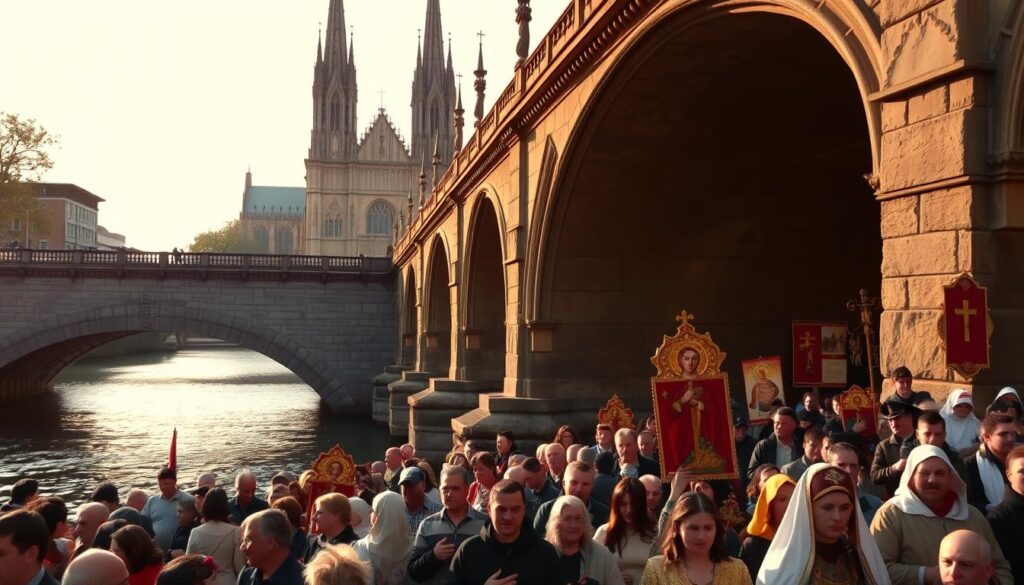
A majestic stone bridge spanning a tranquil river, its arches adorned with intricate Gothic carvings. In the background, a grand cathedral with soaring spires and ornate facades, its stained glass windows glowing in the warm afternoon light. In the foreground, people of all ages gather, their faces reflecting a deep sense of reverence and community, as they participate in a vibrant religious procession, carrying ornate religious icons and banners. The scene is bathed in a soft, golden glow, conveying a sense of timelessness and the enduring power of faith to unite a culture.

Our journey through Spain’s spiritual landscape reveals a fascinating cultural tapestry. While 92% of citizens remain baptized members, daily practice tells a dynamic story – only 19% attend weekly services. This contrast highlights how ancient traditions adapt to modern life.

Language learners gain unexpected rewards here. Mastering terms like “adviento” or “parroquia” unlocks deeper connections with art, literature, and local conversations. Even non-religious travelers benefit when recognizing cathedral symbolism or festival origins.

Spain’s 70 dioceses showcase this blend of past and present. Though priest numbers have dropped by 21% since 1975, pilgrimage routes like the Camino de Santiago attract record crowds. Major festivals thrive as living history lessons, blending sacred roots with community pride.

Understanding these layers makes every Spanish interaction richer. Whether discussing Gaudí’s architecture or Seville’s processions, you’ll spot cultural echoes of faith. This knowledge becomes a bridge – connecting curious minds to shared stories across generations and borders.

Keep exploring how language carries heritage. Each phrase learned honors centuries of tradition while building meaningful dialogues today. That’s the true power of cultural fluency.

FAQ

How has Spanish culture shaped Catholic traditions globally?

Spanish culture deeply influenced global Catholic practices through missionary work, art, and festivals like Semana Santa. Its blend of indigenous and European customs created unique rituals still celebrated worldwide.

What role did the Reconquista play in Spain’s religious identity?

The Reconquista (711–1492) unified Christian kingdoms, strengthening ties between the Roman Catholic Church and Spanish monarchy. This period solidified Spain’s identity as a Catholic nation, shaping its laws and cultural values.

Are there specific Spanish terms essential for understanding Catholic practices?

Key terms include “misa” (Mass), “peregrinación” (pilgrimage), and “advocación mariana” (Marian devotion). Proper pronunciation, like “ka-to-lee-sees-mo” for catolicismo, helps engage authentically with Spanish-speaking communities.

Which Spanish landmarks symbolize Catholic heritage?

Sites like Barcelona’s Sagrada Família, Santiago de Compostela Cathedral, and Seville’s Giralda Tower reflect centuries of architectural devotion. These monuments attract millions seeking spiritual and historical connections.

How do modern Spanish Catholics balance tradition and contemporary life?

Many blend ancient customs, like pilgrimages to El Camino de Santiago, with modern social activism. The Church also addresses current issues while preserving rituals such as Easter processions and local patron saint festivals.

Catholicism and Heresy: Understanding the Debate


How does a global religious institution maintain unity across centuries while addressing disagreements about sacred truths? This article explores how foundational teachings have been protected and debated within one of the world’s oldest faith communities.

The Catholic Church emphasizes clarity in matters of faith, particularly through formal definitions like Canon 751. This guideline describes certain rejections of doctrine as more than simple errors—they require conscious defiance by baptized members. Such distinctions help preserve theological consistency while acknowledging honest questions.

Historical records show three main categories of divergence: complete abandonment of belief (apostasy), organizational separation (schism), and selective denial of teachings (heresy). Each category carries different consequences, reflecting varied impacts on community cohesion.

From ancient councils to modern dialogues, challenges to official positions often arise during cultural shifts. These moments test both institutional resilience and believers’ commitment to shared principles. Our exploration will highlight how debates shape—rather than weaken—religious identity over time.

Key Takeaways

  • Official definitions distinguish between honest doubt and deliberate rejection of core teachings
  • Four criteria determine formal heresy under Church law
  • Historical disputes often reflected broader cultural tensions
  • Clear differences exist between heresy, apostasy, and schism
  • Theological debates frequently emerge during periods of social change

Historical Roots and Evolution

How did debates about spiritual truth shape communities over centuries? The early Christian faith thrived on passionate discussions, with first-century believers grappling with questions about divine mysteries. Diverse interpretations of sacred texts sparked lively exchanges, often leading to new doctrinal clarifications.

For over 700 years after Rome’s fall, religious disagreements rarely turned violent. Jesuit scholar David Collins notes only one recorded heretic execution during this time. But by the 12th century, rulers began treating theological dissent as criminal. States partnered with religious authorities, creating strict penalties for those challenging official teachings.

Three key shifts changed how people addressed differences:

  • Early communities viewed alternate ideas as exploration, not rebellion
  • Medieval leaders used laws to enforce unity
  • Modern scholars now see value in historical diversity

The Albigensian Crusade (1209-1229) marked a turning point. Civil authorities started executing dissenters, a practice lasting until 1826 in Spain. This hardening stance reflected growing church authority and society’s fear of division.

Today, historians recognize that many “heretical” groups preserved ancient traditions lost in mainstream practice. Their stories remind us that spiritual truth often emerges through respectful dialogue, not just declarations.

Defining Heresy in the Catholic Tradition

What makes a belief cross from simple error to formal rejection? Church authorities use precise criteria to evaluate disagreements about spiritual truth. This system helps separate honest mistakes from deliberate challenges to core principles.

A vast cathedral interior, ornate and stained-glass-illuminated, with a central altar surrounded by solemn figures in clerical robes. In the foreground, a lectern displaying ancient tomes and manuscripts, symbolizing the theological debates and distinctions of Catholic heresy. The middle ground features shadowy silhouettes of individuals, representing the divisions and disputes within the faith. The background is shrouded in a hazy, contemplative atmosphere, conveying the weighty gravity of the subject matter. Soft, warm lighting casts an introspective glow, while the overall composition evokes a sense of historical significance and the complex tapestry of Catholic doctrine.

Formal vs Material Heresy

A formal heretic knowingly opposes Church teaching after understanding its divine origin. Imagine someone rejecting a clearly explained doctrine while fully aware of its authority. This conscious choice carries greater consequences than accidental misunderstandings.

Material heresy describes well-meaning errors. Picture a person raised in isolation who misinterprets complex theological ideas. Their mistaken belief lacks willful defiance, making it less severe in Church eyes.

Degrees and Classifications of Heresy

The Catholic tradition sorts doctrinal errors into four levels. The first involves direct contradictions of defined dogmas. Next come ideas approaching heresy—like theories that nearly undermine key teachings but avoid outright denial.

Third-level errors conflict with theological consensus without challenging core doctrine. Finally, some views simply raise suspicions without clear evidence. This layered approach allows tailored responses, from gentle correction to formal sanctions.

By recognizing intentions and knowledge levels, the Church maintains unity while addressing honest questions. As one scholar notes: “Truth thrives when we distinguish rebellion from confusion.”

Key Doctrines Challenged Throughout History

Throughout history, certain spiritual concepts have sparked intense debate among believers. Core teachings about divine mysteries often became battlegrounds for understanding revealed truth. The Trinity’s complex nature, for instance, faced simplification attempts by groups like the Arians. They argued Christ wasn’t fully divine—a view rejected as undermining sacred unity.

Christ’s dual nature proved equally contentious. Nestorian thinkers proposed separating His human and divine aspects, while Monophysites believed divinity absorbed humanity. Both positions clashed with official teaching about perfect unity. These debates show how finite minds grapple with infinite realities.

Sacramental practices also drew scrutiny. Some medieval groups saw communion bread as symbolic, not Christ’s true presence. Others questioned why priests alone could perform Mass rituals. Such challenges forced clearer explanations of sacred symbols’ power.

Papal authority remained a flashpoint through centuries. Reformers like Luther later argued scripture alone (sola scriptura) should guide faith, not church traditions. While not labeled heresies today, these Protestant views reshaped Christian dialogue forever.

As one theologian observes: “Our deepest truths often emerge through respectful tension.” Each challenge ultimately strengthened doctrinal precision while honoring humanity’s quest to understand divine mysteries.

Major Heresies in Early Christianity

Early Christian communities faced intense debates that shaped their core beliefs. Between the 2nd and 5th centuries, four teachings particularly tested doctrinal unity. These ideas mixed spiritual traditions with popular philosophies of their time.

Gnostic Movements and Docetism

The Gnostic group taught that physical matter trapped divine sparks. They believed secret knowledge—not faith—saved the soul. This movement directly opposed teachings about creation’s goodness.

Docetists took this further. They claimed Christ’s human form was a ghostly illusion. If true, this would make his crucifixion meaningless. As one bishop argued: “A phantom savior can’t redeem real people.”

Monophysitism and Arianism

Arius sparked controversy in the 4th century by calling Jesus God’s first creation. His followers claimed Christ wasn’t fully divine. This middle position confused many believers about salvation’s nature.

Monophysites later overcorrected another error. They taught Christ’s divinity swallowed his humanity completely. This made him unable to represent man in redeeming humankind.

Heresy Core Belief Impact Council
Gnosticism Matter is evil; salvation through secrets Undermined creation theology Local synods
Docetism Christ’s body was illusionary Challenged crucifixion’s reality Early Church writings
Arianism Christ as supreme creature Threatened Trinity doctrine Nicaea (325)
Monophysitism Single divine nature in Christ Weakened human redemption Constantinople (381)

These disputes led to clearer statements about Christ’s dual nature. While their originators were called heretic, their questions helped refine orthodox teachings for future generations.

The Impact of Church Councils on Heresy

How did ancient gatherings shape the core beliefs millions follow today? Early Christian leaders faced critical moments where disputed views threatened unity. Their solutions became cornerstones of spiritual identity.

A grand cathedral interior, the soaring arches and stained glass windows casting a warm, reverent glow. At the center, a panel of robed figures - bishops, scholars, and theologians - engaged in deep discussion, their faces etched with the weight of their deliberations. The air is thick with the hush of contemplation, as the council's decisions shape the future of the faith. In the shadows, the specters of heresy loom, their influence felt through the intensity of the debate. A single beam of light pierces the gloom, illuminating the gravity of the moment - the impact of these councils, etched in history.

Council of Nicaea and Constantinople

The 325 Nicaea meeting tackled Arian claims denying Christ’s full divinity. Over 300 bishops declared the Son “of one substance” with the Father. This bold statement preserved the Trinity concept central to Christian faith.

Constantinople’s council in 381 expanded these ideas. Leaders affirmed the Holy Spirit’s divine role, countering groups that saw it as mere energy. The updated Nicene Creed became Christianity’s most universal truth statement.

Decisive Doctrinal Resolutions

Ephesus (431) settled debates about Mary’s title as Theotokos (“God-bearer”). This affirmed Christ’s unified divine-human nature. Later, Chalcedon (451) rejected both divided natures and merged identities in Jesus.

One historian notes: “These councils turned confusion into clarity through collective wisdom.” By addressing specific challenges, they strengthened the church’s ability to maintain doctrinal unity across generations.

Through careful debate, these gatherings demonstrated how spiritual authority could guide believers toward shared understanding. Their decisions still shape worship and teaching worldwide.

Catholic Church’s Response and Canon Law Reforms

Modern religious institutions balance tradition with contemporary understanding through evolving guidelines. The Catholic Church updated its approach in 1983 with Canon 751, defining doctrinal rejection after baptism as obstinate denial of divinely revealed truths. This legal framework distinguishes between those knowingly opposing teachings and others misunderstanding complex doctrines.

A grand cathedral's interior, sunlight streaming through stained glass windows, casting a warm glow on the ornate altar and pulpit. At the center, a gathering of robed clergy poring over ancient tomes, debating canon law reforms, their expressions thoughtful and intent. Shadowy figures in the background, observing the proceedings with a sense of reverence and anticipation. The scene evokes a solemn, contemplative atmosphere, befitting the weighty matters under discussion - the Catholic Church's response to the challenges of heresy and the need to update its legal framework.

Four categories now guide responses: manifest (publicly visible) and occult (private) rejections, plus formal versus material errors. Formal rejection triggers automatic separation from the community, while material cases call for education. As one canon lawyer notes: “Our duty isn’t punishment but restoring understanding.”

Recent reforms emphasize dialogue before discipline. Leaders first engage those questioning teachings through respectful discussion. Only persistent public challenges to core beliefs—like the nature of sin or sacraments—invite stronger measures. Private doubts often receive pastoral support instead of penalties.

These changes reflect broader shifts in spiritual leadership. Medieval-era confrontational methods gave way to processes valuing conscience and growth. Today’s approach recognizes that faith journeys sometimes involve detours rather than deliberate rebellion.

Influential Figures in the Debate on Heresy

Throughout history, passionate thinkers have shaped religious debates through bold ideas. Arius, a fourth-century man from Alexandria, challenged mainstream views by claiming Christ wasn’t fully divine. His teachings sparked decades of controversy, requiring three major councils to resolve.

Some individuals like Pelagius raised eyebrows with unconventional views about human nature. Though labeled a heretic, his questions about free will still influence ethical discussions today. Martin Luther’s 16th-century reforms initially drew sharp criticism, yet his ideas later reshaped Christian dialogue.

Not all challengers sought rebellion. Thomas Aquinas wisely noted: “Error becomes dangerous when wrapped in eloquence.” His balanced approach distinguished honest inquiry from stubborn defiance, helping people navigate complex spiritual questions.

These stories remind us that truth-seeking often involves tension. While some person might be called heretic in their time, their questions sometimes reveal new layers of understanding. As debates continue, history shows dialogue often bridges divides better than declarations.

FAQ

What’s the difference between formal and material heresy?

Formal heresy involves knowingly rejecting a truth taught by the Church. Material heresy, however, occurs when someone unknowingly holds a belief conflicting with doctrine due to ignorance or misunderstanding.

How did early councils like Nicaea shape Christian beliefs?

The Council of Nicaea (325 AD) clarified core teachings, such as affirming Christ’s divinity against Arianism. These councils unified believers by resolving disputes and establishing foundational creeds still used today.

Why were movements like Gnosticism considered dangerous?

Gnosticism claimed secret knowledge beyond Scripture, denying Christ’s humanity. This undermined the Church’s authority and the belief in salvation through Christ’s physical life, death, and resurrection.

How does canon law address doctrinal disagreements?

Canon law outlines processes for correcting errors, from dialogue to formal corrections. Reforms over centuries emphasize both safeguarding truth and encouraging reconciliation with those in error.

What role did figures like Augustine play in combating heresy?

Early theologians like Augustine defended orthodox teachings through writings and debates. Their works clarified doctrines on grace, original sin, and Christ’s nature, influencing Church teaching for centuries.

Can someone accidentally commit heresy?

Yes. Material heresy applies to those unaware their belief conflicts with doctrine. The Church distinguishes this from formal heresy, which requires deliberate rejection of known teachings.

Why do doctrines like the Trinity face repeated challenges?

Concepts like the Trinity stretch human understanding, leading some to simplify or reinterpret them. The Church reaffirms these mysteries as central to faith, even when debates arise.

The Origins of Roman Catholicism: Its Founder


How did a small group of believers in ancient Jerusalem grow into the world’s largest Christian institution? The answer lies in a blend of sacred tradition and historical evolution. Many trace the roots of the Catholic Church to Pentecost, when early followers of Jesus Christ gathered after his resurrection. This event marked the birth of a faith community that would shape civilizations.

Traditional teachings emphasize that Jesus himself established the Church, appointing Peter as its first leader. Over centuries, this spiritual foundation merged with cultural shifts and leadership changes. Historians, however, often highlight a gradual development—from scattered congregations to a unified institution centered in Rome.

This guide unpacks these perspectives. We’ll explore how apostles like Peter spread teachings across the Mediterranean. You’ll also discover how later leaders refined practices and doctrines, blending ancient rituals with new challenges. Whether you’re curious about theology or history, understanding these origins offers fresh insights into a 2,000-year legacy.

Key Takeaways

  • The Catholic Church traces its spiritual roots to Jesus Christ and Pentecost.
  • Saint Peter is traditionally viewed as the first leader appointed by Jesus.
  • Historical research suggests organizational growth over centuries.
  • Early Christian communities evolved into a centralized institution.
  • Sacred tradition and scholarly analysis shape modern understanding.

Understanding the Roman Catholicism Founder

Who actually laid the groundwork for this global faith community? This question divides scholars and believers alike. While sacred tradition points to divine origins, historical analysis often reveals a more complex story.

Historical Perspectives and Interpretations

French biblical expert Alfred Loisy once observed:

“Jesus proclaimed the Kingdom, and it was the Church that arrived.”

Alfred Loisy

This sharp contrast highlights a key debate. Did Jesus aim to build an organized institution, or did his followers reshape his teachings over time?

The Catholic Church maintains that Jesus directly established its structure during his lifetime. Ancient texts describe Peter receiving spiritual authority, forming what many see as early papal leadership. This view ties modern practices to first-century decisions.

Most researchers, however, see a slower transformation. Early Christian groups operated independently for generations. Only after 300 years did unified structures emerge. Archaeological finds show varied rituals across regions before standardization.

Three main viewpoints shape this discussion:

  • Theological: Focuses on spiritual continuity from Jesus to today’s Church
  • Historical: Traces organizational changes through ancient records
  • Cultural: Examines how Roman governance influenced Christian administration

These approaches aren’t mutually exclusive. Many modern scholars blend sacred texts with societal context. By balancing tradition with evidence, we gain richer insights into this 2,000-year journey.

Tracing the Early Roots of the Catholic Church

What transformed a regional spiritual movement into a worldwide religious force? The answer lies in the unique conditions of the first-century Mediterranean world. A combination of advanced infrastructure and cultural connectivity allowed ideas to travel faster than ever before.

A grand Roman basilica stands tall, its ornate facade bathed in warm, golden light. Crowds of early Christians gather at its steps, their robes flowing as they ascend. In the middle ground, a procession of clergy winds through the streets, carrying ornate crosses and banners. In the distance, the city's skyline rises, dotted with domes and spires, reflecting the growing influence of the emerging Christian faith within the Roman Empire. The scene exudes a sense of reverence and historical significance, capturing the pivotal moment when the church began its rapid expansion across the ancient world.

From Judea to the Roman Empire

The empire’s network of roads and safe sea routes acted like ancient highways for faith. Soldiers, merchants, and travelers carried new teachings from Jerusalem to bustling cities. Greek became the common tongue, letting diverse groups discuss complex spiritual concepts easily.

Early believers faced a crucial challenge: adapting Jewish traditions to Gentile cultures. Communities in Antioch blended local customs with shared rituals. Alexandria’s scholars added philosophical depth to simple parables. Rome’s legal-minded members shaped organizational frameworks.

Three factors supercharged this growth:

  • Urban hubs: Cities provided meeting places and diverse audiences
  • Shared governance: Roman administrative models inspired church structure
  • Cultural exchange: Local traditions enriched core practices

By the fourth century, what began as house gatherings became an institution mirroring imperial efficiency. Bishops adopted regional oversight roles similar to provincial governors. This blending of spiritual vision and practical organization created lasting foundations.

Jesus Christ and the Birth of a Movement

What ideas sparked a movement that reshaped global spirituality? At its core lies a three-year journey through dusty villages and crowded markets. A carpenter-turned-teacher shared stories that challenged social norms and offered radical hope.

The Life and Teachings of Jesus

The New Testament paints vivid scenes: healing the sick, dining with outcasts, calming storms. Jesus’ life modeled compassion over rules, mercy over judgment. His parables about lost coins and good neighbors revealed God’s love in everyday terms.

Twelve ordinary men became his students. Fishermen learned to lead. Tax collectors transformed into truth-tellers. This diverse group received clear instructions: “Go and make disciples of all nations.” Their training blended practical lessons with spiritual depth.

The Significance of the Resurrection

Empty tombs changed everything. Followers who’d scattered in fear became bold proclaimers. The resurrection validated Jesus’ claims, turning despair into unshakable faith. Without this event, his teachings might have faded like other ancient philosophies.

Early believers gathered secretly, sharing bread and wine as he’d shown them. These rituals grew into the Church‘s heartbeat—visible reminders of sacrifice and renewal. Over time, simple meals became sacred ceremonies connecting millions across continents.

Three lasting impacts emerged:

  • Hope: Death lost its finality
  • Community: Shared beliefs created global bonds
  • Purpose: Followers found meaning in service

This spiritual revolution began with one man’s life and grew through stories told over campfires. Today, two billion people trace their faith to those transformative events in first-century Palestine.

The Role of Peter and Apostolic Leadership

How did one fisherman become central to a global spiritual legacy? The story of Saint Peter bridges ancient traditions with modern practices. While history offers fragmented clues, his symbolic role shaped how communities organized their faith.

Saint Peter’s Influence on Early Rome

Matthew’s Gospel records Jesus telling Peter:

“You are Peter, and on this rock I will build my church.”

Matthew 16:18

This moment became the bedrock for claims about thepope’s spiritualauthority. Early texts suggest Peter visited Rome, but he didn’t start its first Christian group. By the time he arrived, believers already met in homes along the Tiber River.

His martyrdom under Nero, however, cemented Rome’s status. Later leaders linked the city’s importance to Peter’s final resting place. The Bishop of Rome gradually became seen as Peter’s direct successor—a claim that still defines leadership structures today.

The Foundation of Apostolic Succession

Three key ideas transformed Peter’s legacy into an organizational system:

  • Continuity: Later bishops argued their power flowed unbroken from Peter
  • Unity: A single leader could resolve disputes across regions
  • Legitimacy: Connecting to apostles gave decisions divine weight

By the 3rd century, lists tracing the Bishop of Rome back to Peter appeared. This succession concept helped standardize practices from Spain to Syria. Though modern scholars note gaps in early records, the symbolic power of this lineage remains unmatched.

Peter’s story shows how memory and need shape institutions. What began as informal respect for a martyr evolved into a blueprint for centralized spiritual authority.

Formation of the First Christian Community

What united a small group of Jewish followers in Jerusalem after their leader’s departure? The first Christian community began as a tight-knit circle of 120 believers, gathering in homes to share meals and prayers. Their faith centered on Jesus’ resurrection and messianic role—ideas that reshaped traditional Jewish beliefs while preserving sacred customs.

early christian community jerusalem, a bustling scene of devotion and fellowship in the ancient city. a group of believers gathered in a modest stone structure, bathed in warm, golden light filtering through small windows. in the foreground, men and women sit in rapt attention, listening intently to a speaker gesturing with fervor. middle ground shows others engaged in quiet conversation, a sense of camaraderie and shared purpose palpable. the background reveals the city skyline, with distant domes and minarets hinting at the diversity of the region. the atmosphere is one of reverence, community, and the early stirrings of a faith that would soon spread throughout the world.

Jewish Roots and Early Beliefs

These pioneers saw themselves as fulfilling Hebrew prophecies, not abandoning them. They attended synagogue on Sabbath but met Sundays to honor Jesus’ resurrection. Acts 2:44 describes their radical community: “All who believed were together and had all things in common.”

Three practices defined their identity:

  • Shared resources: Members sold property to support needy believers
  • Baptism: Initiation ritual symbolizing spiritual rebirth
  • Communal meals: Re-enactments of Jesus’ final supper with disciples

Their beliefs blended old and new. They kept kosher laws but taught salvation through Christ. Torah study continued, now paired with stories of Jesus’ miracles. This hybrid approach helped the church grow while staying rooted in familiar traditions.

Within two decades, Sunday worship became standard—a quiet revolution marking their gradual separation from mainstream Judaism. Yet their beginning as a Jewish reform movement left enduring marks on Christian theology and practice.

Early Organization and Community Structure

How did scattered groups transform into an organized spiritual network? The answer lies in practical problem-solving and visionary decisions. Early believers faced growing pains as their numbers swelled across diverse regions.

Early church leadership structure, a scene of ancient Christian community gathered around a central figure, likely an elder or bishop, delivering a sermon or teaching. The setting is a modest stone church interior, with simple wooden benches and a raised dais at the front. Warm natural lighting filters through stained glass windows, casting a contemplative atmosphere. The congregation, dressed in simple robes and tunics, listens intently, reflecting the solemnity and devotion of the early Christian tradition. The central figure, robed in a long cloak, gestures with hands outstretched, conveying a sense of authority and spiritual guidance. The overall composition captures the intimate, grassroots nature of the early church leadership and organization.

The Evolution of Church Leadership

Initially, local groups relied on respected volunteers. These charismatic leaders taught scriptures and settled disputes. But rapid growth created challenges:

  • Disagreements over rituals and teachings
  • Resource distribution across cities
  • Maintaining consistent practices

By 150 CE, a clear pattern emerged. Single bishops began overseeing urban congregations. This authority structure mirrored Roman civic organization, creating recognizable leadership roles.

Period Leadership Style Key Features
30-50 CE Charismatic Informal teachers & miracle workers
50-150 CE Collegial Elders & deacons sharing duties
150+ CE Episcopal Single bishop per city

Insights from the Council of Jerusalem

The first major church meeting in 50 CE solved a critical issue. Could non-Jewish converts skip ancient rituals? After heated debate, leaders agreed:

“We should not make it difficult for Gentiles turning to God.”

Acts 15:19

This landmark decision did more than welcome new members. It established a model for resolving conflicts through collective authority. Later bishops would use similar councils to address complex theological questions.

By 200 CE, the church had developed standardized roles. Metropolitan bishops supervised regional networks, ensuring unity across growing communities. These changes laid groundwork for the global religious structure we recognize today.

The Spread of Christianity in the Roman Empire

What fueled Christianity’s explosive growth across ancient cities? Within a century, the movement transformed from a marginalized group to a Mediterranean-wide phenomenon. By 100 CE, over 40 vibrant communities stretched from Spain to India, thriving in urban hubs where ideas mixed freely.

Adoption and Expansion in Urban Centers

The religion first resonated with society’s overlooked members. Enslaved individuals and laborers found hope in teachings of equality and eternal dignity. Wealthy women soon followed, using their resources to host gatherings and fund missionary journeys.

Rome’s advanced infrastructure became an unexpected ally. Well-maintained roads allowed messengers to travel safely between cities. Common Greek dialects helped share complex ideas across cultures. As one bishop noted:

“Our letters bind distant communities like threads in a tapestry.”

Persecution backfired spectacularly. Instead of crushing the movement, it created resilient networks. Underground worship strengthened bonds between believers. Stories of martyrs’ courage inspired curiosity, drawing more converts into the fold.

By the third century, the church had mastered cultural adaptation. Syrian congregations incorporated local music into hymns. North African groups blended traditional storytelling with biblical parables. This flexibility ensured the religion‘s survival through shifting political tides.

Pivotal Moments in Institutional Development

What solidified early Christian practices into lasting institutions? The fourth and fifth centuries marked a turning point. Imperial support transformed the church from scattered communities into an organized force. This period saw two key developments that defined religious life for centuries.

Ecumenical Councils That Shaped Doctrine

Emperors and bishops worked together to unify beliefs. The Council of Nicaea (325 CE) tackled debates about Jesus’ divine nature. Over 300 leaders crafted the Nicene Creed—a statement still recited worldwide. These meetings blended spiritual authority with political strategy.

The Rise of Monastic Traditions

Meanwhile, desert hermits pioneered new ways to live their faith. Saint Benedict’s rules for communal prayer and work spread across Europe. Monasteries became centers of learning, preserving ancient texts while shaping medieval doctrine.

Together, councils and monks created frameworks that endure today. They balanced divine inspiration with practical systems—a hallmark of the church’s 2,000-year journey.

FAQ

Who is considered the founder of the Catholic Church?

The faith traces its origins to Jesus Christ, whose teachings and resurrection inspired His followers. Early leadership under figures like Saint Peter helped shape its structure, with later institutional growth rooted in apostolic tradition.

Why is Saint Peter significant in Catholic history?

Regarded as the first bishop of Rome, Peter symbolizes unity and authority. His role as a leader among the apostles laid groundwork for the concept of papal succession, linking modern leadership to early Christian roots.

How did early Christianity transition from a Jewish sect to a global religion?

After Jesus’ death, His followers spread His message across the Roman Empire. Gentile inclusion, debated at events like the Council of Jerusalem, and urban growth transformed it into a distinct faith separate from Judaism.

What role did the Resurrection play in shaping beliefs?

The Resurrection became central to Christian theology, affirming Jesus as divine. This event fueled missionary zeal and solidified hope in eternal life, forming the core of early teachings still upheld today.

How did apostolic succession influence church structure?

Leaders like Peter and Paul appointed successors to maintain doctrinal consistency. This chain of authority evolved into bishops overseeing regions, ensuring unity amid expanding communities and diverse challenges.

What was the Council of Jerusalem’s impact?

This pivotal meeting addressed whether Gentile converts needed to follow Jewish laws. The decision to relax these requirements opened the faith to broader audiences, accelerating its spread beyond Judea.

Why did monastic traditions emerge in the Church?

Monasticism arose as a response to societal changes and a desire for spiritual depth. Communities like those led by Saint Benedict preserved knowledge, modeled devotion, and influenced social services for centuries.

How did urban centers aid Christianity’s growth?

Cities like Antioch and Ephesus provided networks for trade and communication. Early believers used these hubs to share teachings, establish congregations, and adapt messages to diverse cultures effectively.

Uncover the Rich History of Roman Catholicism


Let’s explore a story that shaped nations and inspired generations. For over two thousand years, a global spiritual community has guided millions through faith, tradition, and service. This journey begins with humble origins and grows into one of humanity’s most enduring institutions.

The Catholic Church today unites 1.4 billion people across every continent. Its reach spans art galleries, universities, and neighborhood parishes. From ancient rituals to modern charities, its influence touches countless aspects of daily life.

You’ll see how early believers faced challenges and opportunities. Through empires rising and falling, this faith adapted while keeping its core message. Leaders emerged who changed the course of politics, science, and social justice.

Discover how 24 unique traditions work together under one spiritual umbrella. Each contributes to a vibrant tapestry of worship styles and cultural expressions. Together, they form a network of over 3,500 local communities worldwide.

Key Takeaways

  • Global spiritual network serving 1.4 billion members
  • Blends ancient traditions with modern social initiatives
  • 24 distinct worship styles united under shared beliefs
  • Shaped Western art, education, and ethical frameworks
  • Maintains local presence through 3,500+ dioceses

Introduction: An Ultimate Guide to Roman Catholicism

Unlock the secrets of a 2,000-year-old tradition that still guides millions worldwide. This guide helps you navigate the catholic church’s remarkable journey from small gatherings to a global network of faith. Whether you’re curious about ancient rituals or modern outreach programs, we’ve got you covered.

Purpose and Scope of This Guide

Our roadmap explores three key areas:

  • How theological ideas shaped art and education
  • The growth of local communities into worldwide ministries
  • Modern social programs addressing contemporary challenges

You’ll discover connections between sacred music and Renaissance politics, or how medieval monasteries influenced today’s hospitals. We break down complex topics into bite-sized explanations perfect for first-time explorers.

Understanding the Importance of Catholic History

Why does this matter? The church’s story is woven into humanity’s greatest achievements. Gothic cathedrals redefined architecture. Monks preserved classical knowledge during turbulent times. Missionaries created writing systems for unwritten languages.

By studying these developments, you gain new perspectives on:

  • Ethical frameworks guiding modern societies
  • Interfaith dialogue shaping global peace efforts
  • Charitable work feeding 12 million people annually

This isn’t just about the past – it’s a living tradition shaping our shared future. Ready to begin your journey?

Apostolic Origins and Early Foundations

How did a small group of followers spark a worldwide movement? The answer lies in foundational events that shaped spiritual leadership for centuries. At its heart stands a carpenter-turned-teacher and his chosen messengers.

Jesus Christ and the Apostolic Mission

Jesus of Nazareth handpicked twelve students to continue his work. These apostles received clear instructions: “Go and make disciples of all nations.” Their mission gained momentum after Pentecost, when believers say divine power transformed frightened fishermen into bold preachers.

This event marks the church’s public launch. Within decades, communities sprang up across the Mediterranean. Early leaders faced persecution but kept expanding their network through:

  • Shared meals celebrating Jesus’ last supper
  • Letters guiding distant congregations
  • Appointing local overseers (later called bishops)

The Legacy of Saint Peter

Among the twelve, Peter emerged as a central figure. Jesus famously told him: “You are Peter, and on this rock I will build my church.” This statement fuels the Catholic belief that Peter became the first bishop of Rome – a role now held by the pope.

While historians debate Peter’s exact travels, tradition holds that he helped establish Rome’s Christian community. Today’s popes trace their spiritual authority through an unbroken line from Peter, creating a unique leadership model among Christian groups.

The Birth of a Global Faith

A spiritual revolution quietly transformed the ancient world. By 100 AD, over 40 vibrant Christian groups stretched from North Africa to South Asia. These weren’t just meeting places – they became hubs of hope reshaping how people understood community and purpose.

A vibrant scene of early Christian communities in the Roman Empire, illuminated by warm, natural light streaming through ancient windows. In the foreground, a group of devout believers engaged in reverent prayer, their faces serene and focused. In the middle ground, a priest or elder delivers a sermon, his robes flowing as he gestures with conviction. The background reveals a humble, yet beautifully decorated interior, with intricate mosaics, ornate columns, and a sense of timeless spirituality. The atmosphere is one of devotion, community, and the dawning of a new era of faith.

Formation of Early Christian Communities

The faith spread like wildfire through city markets and trade routes. While most churches started within the Roman Empire, daring believers planted communities in Armenia’s mountains and India’s spice ports. Slaves often heard the message first, then wealthy women used their homes as secret worship spaces.

Sunday gatherings became the heartbeat of this movement. What began as Jewish Sabbath additions evolved into unique rituals celebrating Jesus’ resurrection. Shared meals turned into sacred ceremonies, creating bonds stronger than family ties.

Leaders emerged to guide these growing groups. Bishops organized aid during plagues while teachers developed new ways to explain complex ideas. This network of local communities with global connections laid the groundwork for what would become the Roman Catholic Church’s worldwide structure.

From Persian market towns to Egyptian river ports, these early believers proved a radical truth: faith could cross any border. Their bold experiments in communal life still inspire how modern churches serve their neighborhoods today.

Defining Roman Catholicism History: Key Milestones

Critical moments reshaped Christianity’s path from underground movement to cultural cornerstone. These turning points established structures still guiding believers today. Let’s explore how bold decisions and heated debates forged a lasting spiritual legacy.

Timeline from Apostolic Era to Medieval Period

Emperor Constantine changed everything in 313 AD. His Edict of Milan stopped persecution, letting Christians worship openly. For the first time, believers could build permanent gathering spaces.

The church gained imperial muscle in 380 AD. Emperor Theodosius declared Nicene Christianity Rome’s official religion. This merger of spiritual and political power created Europe’s first faith-based governance model.

Leaders formalized their structure at the 451 AD Council of Chalcedon. While affirming Rome’s primacy, they granted Constantinople second-place status. This balance between central authority and regional hubs still defines the catholic church’s global operations.

Long before these imperial decrees, bishops laid groundwork through collaboration. By 200 AD, regional meetings helped standardize practices across growing communities. These synods became prototypes for today’s ecumenical councils.

Consolidation of Papal Authority and the Roman Curia

The roots of today’s Vatican hierarchy stretch back to pivotal fourth-century decisions. Between 350-500 AD, spiritual leaders in Rome transformed from local shepherds to global influencers. This shift didn’t happen overnight – it grew through strategic support for unified beliefs during heated theological debates.

A grand cathedral's interior, bathed in warm, golden light filtering through stained glass windows. In the foreground, a majestic papal throne stands elevated, adorned with ornate carvings and rich fabrics. Seated upon it, a regal, robed figure radiates authority and divine right. Surrounding the throne, a gathering of cardinal's garbed in crimson, their expressions conveying reverence and submission. In the background, the opulent trappings of the Roman Curia unfold, tapestries, frescoes, and grand architectural features alluding to the consolidation of papal power. An atmosphere of solemn ceremony and unquestioned dominion permeates the scene.

Rise of Papal Primacy

Roman bishops gained trust by resolving conflicts across Christian communities. When groups disagreed about core teachings, they increasingly turned to Rome’s leaders. One fifth-century pope boldly claimed: “The care of the whole church was placed on Peter alone.”

This idea took root through practical actions. Popes sent letters clarifying doctrines and mediating disputes. Their consistent backing of widely accepted beliefs made Rome the go-to source for spiritual guidance. By 500 AD, the bishop of Rome had become Christianity’s chief referee.

The Role of the Holy See

The administrative engine behind this growth emerged as the Roman Curia. This network of councils and departments handled everything from foreign relations to local parish concerns. Specialized groups managed:

Department Function Impact
Congregation for Doctrine Guarded teachings Standardized beliefs
Apostolic Penitentiary Handled complex cases Centralized decision-making
Prefacture of the Household Managed resources Strengthened operations

This system let the Holy See balance two roles effectively. The pope serves both as local leader for Rome’s faithful and global shepherd for 1.4 billion members. This dual structure remains central to the catholic church’s operations worldwide.

The Influence of Councils and Doctrinal Debates

Imagine a room where ancient leaders shaped beliefs still followed today. From heated debates to unanimous votes, these gatherings defined what billions would believe for centuries. Their decisions settled cosmic questions and earthly power struggles alike.

A majestic cathedral, its towering spires reaching towards the heavens, stands as a testament to the influence of the ecumenical councils. Light streams through ornate stained glass windows, casting a warm, reverent glow over the solemn gathering of robed figures debating doctrine and shaping the future of the Roman Catholic Church. In the foreground, a scribe meticulously records the proceedings, capturing the weight of each word and decision. The background is filled with a swirling haze of historical significance, the echoes of past councils and the gravity of their impact felt in every corner of the grand edifice.

Impact of Ecumenical Councils

Emperor Constantine started a bold tradition in 325 AD. He called the first ecumenical council at Nicaea to resolve disputes about Jesus’ divine nature. The resulting creed became Christianity’s foundation, though not everyone agreed. Arian Christians split off, creating rival communities across Europe and Asia.

The Council of Ephesus (431 AD) tackled another mystery: how divine and human natures coexisted in Christ. Leaders declared Mary “God-bearer,” affirming Jesus’ full humanity and divinity. This decision unified most believers but angered groups in Persia and Egypt.

Council Year Key Decision Lasting Impact
Nicaea 325 Affirmed Christ’s divinity Created Nicene Creed
Ephesus 431 Defined Christ’s dual nature Strengthened Marian devotion
Chalcedon 451 Confirmed papal authority Centralized church leadership

Chalcedon’s 451 AD meeting proved most consequential for the catholic church’s structure. “Peter has spoken through Leo,” declared bishops, cementing Rome’s supreme role. This framework let the church maintain consistent doctrine across expanding territories.

Through these councils, bishops balanced local needs with universal truth. Their collective wisdom created a playbook still used today – debating fiercely, then uniting behind shared beliefs. This process turned abstract ideas into practical guides for daily faith.

Medieval Transformations and Monasticism

A quiet revolution in communal living reshaped medieval Europe. Spiritual seekers created self-sufficient communities that balanced prayer with practical work. Their innovations would preserve knowledge and reshape entire societies.

The Rule of St. Benedict

In 530 AD, a monk crafted guidelines that changed religious life forever. Benedict’s simple motto – “Pray and work” – offered structure without rigidity. His Rule scheduled each day with equal time for worship, study, and manual labor.

This balanced approach spread rapidly across orders. Unlike earlier extremes of asceticism, Benedictine communities became models of sustainable spiritual practice. By 800 AD, nearly every European monastery followed these principles.

Monastic Contributions to Western Civilization

These communities became medieval powerhouses. Monks didn’t just copy ancient texts – they improved farming tools, developed musical notation, and pioneered water systems. Their scriptoria preserved 90% of surviving classical literature during turbulent times.

Three key areas show their lasting impact:

  • Education: Created Europe’s first library networks
  • Economy: Introduced crop rotation techniques
  • Culture: Developed Gregorian chant traditions

The catholic church relied on these centers to train clergy and advise bishops. Through wars and plagues, monasteries remained islands of stability. Their dual focus on spiritual growth and earthly service continues inspiring modern religious orders worldwide.

Renaissance, Reformation, and Counter-Reformation

The 16th century reshaped religious landscapes through seismic shifts and spirited responses. As new ideas spread across Europe, the catholic church faced its greatest challenge yet. This era saw bold calls for change and equally determined efforts to preserve unity.

Impact of the Protestant Reformation

Martin Luther’s 1517 protests ignited the protestant reformation, challenging papal authority like never before. Over 20,000 Protestant congregations formed within decades, each interpreting scripture independently. This fracture created lasting divisions in Western Christianity.

Bishops scrambled to address growing dissent. Some leaders embraced dialogue, while others doubled down on traditional structures. The resulting split reshaped worship styles, governance models, and even national identities across Europe.

Catholic Revival Movements

In response, the roman catholic church launched its own renewal campaign. The Council of Trent (1545-63) clarified doctrine and standardized practices. New religious orders like the Jesuits became global missionaries, blending spiritual zeal with intellectual rigor.

Local parishes revived community engagement through art and education. Charity networks expanded, feeding the poor while reinforcing traditional teachings. These reforms strengthened the church’s ability to adapt without abandoning core principles.

FAQ

What role did Saint Peter play in early Christianity?

Saint Peter is recognized as the first bishop of Rome and a foundational leader of the early church. Tradition holds that Jesus entrusted him with spiritual authority, shaping the papacy’s development over centuries.

How did early Christian communities spread globally?

Early believers carried teachings across the Roman Empire through missionary work, trade routes, and cultural exchange. Persecution and resilience strengthened their unity, laying groundwork for a worldwide faith.

Why are ecumenical councils significant in Catholic doctrine?

Councils like Nicaea and Trent addressed theological disputes, clarified beliefs, and standardized practices. They reinforced unity under the Holy See while adapting to cultural and intellectual shifts.

How did monasticism influence Western civilization?

Monastic orders, such as the Benedictines, preserved ancient texts, promoted education, and advanced agriculture. Their disciplined lifestyle became a model for spiritual and communal growth.

What sparked the Counter-Reformation?

In response to Protestant critiques, the church initiated reforms through the Council of Trent. It reaffirmed sacraments, improved clergy training, and launched renewal movements like the Jesuits.

What is the significance of the Holy See?

The Holy See serves as the central governing body of the church, led by the pope. It oversees doctrine, diplomacy, and global Catholic institutions, ensuring doctrinal consistency and unity.

How did the Protestant Reformation impact Catholic practices?

It prompted revisions in liturgy, clergy education, and transparency. Art and architecture also evolved to reflect renewed spiritual fervor during the Counter-Reformation era.

Why is the apostolic era crucial to Catholic identity?

This period established core teachings, sacraments, and church structure. Direct links to Jesus’ apostles reinforce claims of historical continuity and divine authority.

Catholicism’s Origins: A Comprehensive Guide


What began as a small group of believers in ancient Jerusalem grew into the world’s largest Christian tradition. The Catholic Church traces its spiritual roots to Jesus Christ’s teachings and the dramatic events following his ministry. Followers believe this global faith took shape during Pentecost, when the Holy Spirit empowered early Christians to spread their message.

From these humble beginnings, the Church evolved through centuries of challenges and transformations. Roman persecution tested early believers, while later imperial support helped solidify its structure. Bishops emerged as spiritual leaders, claiming direct ties to Christ’s original apostles.

The Pope’s unique role developed from Saint Peter’s legacy, creating a central authority that endures today. Cultural exchanges and theological debates shaped practices still observed by 1.3 billion Catholics worldwide. This journey reveals how ancient traditions adapt while maintaining core beliefs.

Key Takeaways

  • The Catholic Church identifies Pentecost as its foundational moment
  • Grew from localized groups to a global community spanning 2,000 years
  • Blends sacred traditions with historical developments
  • Leadership structure connects modern clergy to Jesus’ apostles
  • External forces like Roman politics influenced growth patterns
  • Maintains continuity while adapting to cultural changes

Historical Foundations of Catholicism

In the shadow of Roman temples, Jewish synagogues became unexpected birthplaces for a revolutionary faith movement. Early believers navigated complex cultural landscapes while maintaining core spiritual practices from their Jewish heritage.

Early Religious Context and Jewish Influence

The first followers of Jesus operated within a Jewish religious framework, interpreting ancient scriptures through fresh perspectives. Synagogues served as hubs where people debated prophecies about the Messiah. This blending of tradition and innovation created fertile ground for a new religion.

Archaeologists find evidence of shared worship spaces in cities like Ephesus and Corinth. Believers initially kept Jewish holidays while adding rituals like communal meals. Sunday gatherings gained prominence as resurrection celebrations replaced Sabbath focus.

Formation of the Christian Community

By 100 AD, over 40 groups practiced this evolving faith across Mediterranean trade routes. Leadership structures emerged naturally – elders managed resources while traveling teachers connected distant church networks.

Gentile converts sparked debates about cultural adaptation. Should non-Jewish followers keep dietary laws? Leaders ultimately prioritized spiritual unity over ethnic customs. This decision shaped the development of a universal belief system accessible to diverse people.

Letters between communities reveal how early Christians organized charity work and resolved disputes. These practical steps laid groundwork for the church’s enduring institutional structure during challenging times.

The Journey from Jesus Christ to Early Christianity

Across dusty roads and fishing villages, a spiritual revolution took root through one teacher’s transformative words. Jesus Christ reshaped ancient concepts of faith while preparing followers for a mission that would outlive empires.

Christ’s Teachings and the Great Commission

At the heart of this movement lay radical ideas about love as divine truth. Stories like the Good Samaritan challenged social norms, while parables about forgiveness offered new paths to spiritual freedom.

Twelve ordinary men became extraordinary leaders through direct mentorship. The apostles witnessed miracles and learned to heal the sick, forming the first network of Christian teachers. Their training culminated in a world-changing directive:

“Go therefore and make disciples of all nations” (Matthew 28:19). This command propelled believers beyond familiar territories, sparking history’s most enduring spiritual expansion.

After Jesus’ resurrection, the church faced its first leadership test. Pentecost’s fiery descent transformed frightened disciples into bold preachers. Their sermons in Jerusalem’s streets drew thousands, proving spiritual conviction could thrive without earthly armies.

The New Testament preserves these explosive early years through letters and gospels. From baptism rituals to communion practices, foundational traditions took shape under apostolic guidance – creating blueprints still followed two millennia later.

The Role of Saint Peter and Apostolic Succession

Leadership in the early Church found its cornerstone in a fisherman turned spiritual guide. Saint Peter’s journey from Galilean disciple to foundational figure shaped Christianity’s governance model, blending divine calling with practical organization.

Peter as the Rock: Biblical Insights

Jesus’ declaration to Peter in Matthew 16:18 – “You are Peter, and on this rock I will build my church” – established more than symbolic wordplay. This moment defined Peter’s authority as chief among apostles, a status later bishops would inherit through consecration.

A majestic, ornate Catholic cathedral interior, bathed in warm, golden light filtering through stained glass windows. In the center, a grand, awe-inspiring figure of Saint Peter stands, resplendent in flowing robes and holding the symbolic keys to the Kingdom of Heaven. His expression is one of divine authority, commanding reverence. Surrounding him, a glowing halo accentuates his saintly status. In the background, subtle depictions of the papal tiara and other symbols of the Papacy convey the notion of apostolic succession and the unbroken lineage of spiritual leadership within the Catholic Church.

Historical records show Peter ministered in Rome during Nero’s rule. His martyrdom there around 64 AD cemented the city’s status as Christianity’s administrative heart. When Peter ordained Linus as successor, he launched an unbroken chain of leadership continuing through Pope Leo XIV today.

The Evolution of Papal Authority

Early Christian writers like Irenaeus emphasized Rome’s unique role, arguing unity with its bishop guaranteed doctrinal purity. By 200 AD, Roman bishops began settling disputes between distant congregations, gradually expanding their influence.

The First Vatican Council’s 1870 declaration on papal infallibility didn’t invent new power but clarified existing beliefs. Modern popes balance ancient traditions with contemporary issues, serving as both spiritual guides and institutional anchors for 1.3 billion believers worldwide.

Exploring the origin of catholicism

Ancient texts and modern archaeology reveal how early believers blended spiritual truths with practical community-building. This dynamic process created lasting frameworks for preserving teachings while adapting to new challenges.

Sacred Tradition and Apostolic Foundations

Saint Irenaeus identified three anchors for Christian belief in the 2nd century. The church relies on Scripture, apostolic leadership succession, and living tradition passed through generations. These elements work together like three legs supporting a stool.

Early communities maintained unity through shared practices. The apostles appointed bishops to guard against conflicting ideas. This system ensured teachings remained consistent across regions and cultures.

Historical Interpretations and Scholarly Debates

Modern researchers examine ancient letters and artifacts to test traditional accounts. Some discoveries confirm details about early worship practices. Others reveal unexpected diversity in local customs.

Aspect Traditional View Scholarly Insights
Leadership Structure Direct succession from apostles Gradual organizational development
Sacraments Unchanged since apostolic times Evolved from Jewish rituals
Scriptural Authority Complete by 100 AD Finalized over 300 years

These discussions help believers appreciate both divine guidance and human elements in their faith. The church continues balancing historical discoveries with timeless spiritual truths.

Development of Church Hierarchy and Structure

As Christian communities spread across ancient trade routes, practical needs shaped lasting organizational patterns. Local leaders balanced spiritual guidance with administrative duties, creating systems that still influence modern practices.

A grand cathedral's interior, bathed in warm, golden light filtering through stained glass windows. Ornate, carved wooden pews and a towering altar stand, conveying the solemn majesty of the Catholic Church's hierarchical structure. Bishops, dressed in ceremonial robes, stand in a procession, their faces grave and dignified, symbolizing the gradual development of the church's leadership over the centuries. The scene exudes a sense of historical weight and reverence, capturing the essence of the church's evolving organizational hierarchy.

Rise of the Bishops and Local Leadership

Early church groups initially relied on elders for guidance. By 200 AD, single bishops oversaw all clergy in their cities. This shift mirrored Roman governance, helping maintain unity across growing congregations.

Metropolitan bishops emerged in key cities like Antioch and Alexandria. Their authority extended to surrounding regions, creating networks resembling imperial provinces. Historian Eamon Duffy notes Rome became a doctrinal “court of appeal” by the 3rd century.

The Council of Jerusalem and Early Governance

The first major council occurred around 50 AD. Apostles and elders gathered to resolve disputes about Gentile converts. Their decision set a pattern for collective problem-solving through prayer and discussion.

Regional meetings multiplied as the church expanded. Bishops collaborated on challenges like persecution responses and resource sharing. These synods laid groundwork for today’s diocesan system while preserving local flexibility.

Influence of the Roman Empire and Early Legalization

Imperial decrees transformed a persecuted sect into a dominant faith. Roman governance provided frameworks that helped structure Christian communities across vast territories.

Constantine’s Impact and the Edict of Milan

After winning a critical battle in 312, Emperor Constantine credited his victory to divine intervention. This moment marked a turning point for Christians facing three centuries of sporadic persecution. The 313 Edict of Milan granted legal protections, allowing open worship and property ownership.

A grand marble hall in ancient Rome, sunlight streaming through ornate windows, illuminating the gathered crowd. In the foreground, two distinguished Roman officials stand, signing a parchment - the Edict of Milan, which grants religious tolerance and restores confiscated Christian properties. Senators and military leaders observe solemnly, marking a pivotal moment in the shift towards Catholicism's acceptance within the Roman Empire. The opulent, classically-inspired architecture frames the scene, conveying the authority and significance of this historic decision. Muted tones and rich textures evoke the gravity of the occasion, a turning point that would shape the future of Christianity.

Constantine’s support brought resources like tax exemptions and grand basilicas. His call for the Council of Nicaea in 325 set a precedent for resolving doctrinal disputes through collective decision-making.

By 380, Emperor Theodosius elevated Christianity to the Roman Empire’s official religion. This shift created new challenges, blending spiritual authority with state power. The Church adopted imperial titles and administrative practices, shaping its hierarchy for centuries.

This imperial partnership established patterns of cooperation and conflict between religious and political leaders. These dynamics continue influencing how the Roman Catholic Church engages with governments across the world.

The story of this global faith shows how small sparks can ignite enduring flames. From village gatherings to worldwide ministries, believers carried forward a spiritual legacy shaped by both divine purpose and human experience.

Early communities laid foundations through shared meals and courageous witness. Their commitment created networks that weathered persecution and cultural shifts. Today’s church structure still echoes the apostles’ practical wisdom in organizing diverse followers.

Modern believers inherit rich traditions while facing new challenges. The balance between ancient practices and contemporary needs remains vital. Through centuries of change, core teachings about love and redemption continue guiding 1.3 billion members worldwide.

This journey reminds us that enduring faith thrives through adaptation. The global community built over two millennia stands as testament to spiritual resilience – a living bridge between past convictions and future possibilities.

FAQ

How did Jewish traditions shape early Catholicism?

Jewish practices like communal worship, scripture study, and ethical teachings deeply influenced early Christian communities. Many rituals, such as Passover connections to Easter, evolved into Catholic traditions over time.

What role did Saint Peter play in establishing the Church?

Catholics believe Jesus designated Peter as the foundational leader of His Church, citing Matthew 16:18. This belief supports the concept of apostolic succession and the Pope’s spiritual authority as Peter’s successor.

Why was the Council of Jerusalem significant?

This 1st-century council resolved debates about Gentile converts, setting precedents for Church governance. It showcased collaborative decision-making among apostles and elders, shaping future ecumenical councils.

How did Constantine affect Catholicism’s growth?

Constantine’s Edict of Milan (313 AD) legalized Christianity, ending persecutions. His support enabled church construction, standardized doctrines like the Nicene Creed, and strengthened institutional structures.

What distinguishes Sacred Tradition from Scripture?

Catholics view Sacred Tradition as teachings passed orally from apostles, complementing biblical texts. This includes sacraments, Marian doctrines, and papal authority, which developed through centuries of practice.

When did bishops gain centralized authority?

By the 2nd century, bishops like Ignatius of Antioch emerged as regional leaders. The title became linked to apostolic succession, with dioceses mirroring Roman administrative regions for organizational efficiency.

Did early Christians always agree on doctrines?

No—early debates over Christ’s divinity, grace, and sacraments led to ecumenical councils. Figures like Augustine and Tertullian shaped theology through their responses to controversies like Arianism and Donatism.