Recent Posts

The Catholic Perspective on Abortion: Key Considerations


Understanding the faith tradition’s stance on pregnancy termination involves exploring centuries of theological reflection. The Church teaches that human dignity begins at conception, a principle rooted in its view of life as sacred. This belief shapes its moral framework for addressing modern ethical challenges.

Historical documents and modern catechisms align on core values. For example, the 1992 Catechism of the Catholic Church emphasizes protecting life “from the first moment of existence.” These teachings reject procedures aimed at ending early-stage pregnancies, framing them as violations of natural law.

Three key areas clarify this position: philosophical definitions of personhood, biological understandings of conception, and pastoral responses to complex situations. The Church acknowledges evolving science but maintains unwavering doctrinal foundations.

Many wonder how these teachings apply to real-world scenarios. While official doctrine remains firm, individual Catholics often wrestle with personal circumstances. This tension between doctrine and lived experience creates ongoing dialogue within religious communities.

Key Takeaways

  • Core teachings emphasize life’s sanctity starting at conception
  • Historical and modern documents show doctrinal consistency
  • Personhood definitions combine theology and philosophy
  • Pastoral care addresses complex individual situations
  • Science informs but doesn’t override moral principles

Introduction to Catholic Teachings on Abortion

Central to Catholic doctrine is the belief that human life begins at conception, shaping its view on pregnancy decisions. This principle appears in writings from ancient Christian communities and remains unchanged today.

“Since the first century the Church has affirmed the moral evil of every procured abortion. This teaching has not changed and remains unchangeable.”

Church leaders reinforce this through documents likeRespect For Unborn Human Life, emphasizing consistent opposition across 2,000 years.

Two pillars support this stance:

  • Natural law reasoning about life’s inherent value
  • Divine revelation about human dignity

These ideas create a moral framework distinguishing direct actions from indirect outcomes. Procedures specifically intending to end a pregnancy are prohibited. However, medical treatments that unintentionally affect fetal development might be allowed under strict conditions.

The teaching stresses that biological fertilization marks the start of personhood. From that moment, every embryo holds equal worth and requires protection. This clarity guides both personal ethics and institutional policies.

Historical Overview of Catholicism and Abortion

Tracing the roots of religious thought on life’s beginnings reveals ancient foundations. Early Christian authors like Tertullian and Basil of Caesarea condemned ending pregnancies in their writings. Texts such as the Didache and Epistle of Barnabas called it immoral, setting a clear tradition.
A grand cathedral interior, dimly lit by stained glass windows. Ornate wooden pews and an ornately carved altar dominate the foreground, casting long shadows across the stone floor. In the middle ground, robed figures stand in solemn contemplation, their expressions grave as they pore over ancient tomes and scrolls. The background fades into a hazy, vaulted ceiling, hinting at the weight of centuries of theological discourse on the subject of abortion. The scene conveys a sense of reverence, history, and the gravity of the topic at hand.

Early Church Writings and Traditions

Fourth- and fifth-century thinkers debated when life truly starts. Gregory of Nyssa argued for conception as the starting point, while Lactantius leaned on Aristotle’s “delayed ensoulment” idea. Despite these differences, all agreed: intentional termination violated moral law.

Medieval and Renaissance Perspectives

Medieval scholars like Thomas Aquinas blended philosophy with theology. His Aristotelian views suggested souls entered bodies later—yet he still opposed early-term procedures. Renaissance debates refined these ideas but never wavered on core principles. As one theologian noted, “Protecting life remained non-negotiable, even amid scientific curiosity.”

This unbroken chain of church teaching abortion opposition shows adaptability within consistency. While understanding of biology evolved, the commitment to life’s sanctity stayed firm.

Fundamental Beliefs in Catholic Doctrine

The foundation of Catholic teaching rests on an unshakable principle: every human life holds equal value from its earliest moments. This conviction shapes ethical decisions and creates clear moral boundaries.

Natural Law and the Sanctity of Life

Natural law philosophy teaches that certain truths are universal. Medical research supports this view—one leading embryology text states:

“A new, genetically distinct human organism forms at fertilization.”

Scripture reinforces this through themes of divine care for life in the womb. While not directly addressing termination, biblical texts emphasize protecting the vulnerable.

Human dignity isn’t earned through growth stages or capabilities. A developing child possesses inherent worth, whether two cells or two years old. Size and dependency levels don’t determine value.

The right to life flows from human nature itself, not external approval. Governments can’t grant or remove this basic entitlement. It exists from the moment life begins.

These ideas form a consistent ethical lens. They guide responses to modern challenges while honoring centuries of reflection on existence’s sacredness.

Understanding the Church’s Official Teachings on Abortion

To grasp the church teaching on this sensitive issue, we must examine two primary sources: doctrinal statements and legal codes. These frameworks work together to shape ethical guidance for believers.

The Catechism and Magisterial Documents

The Catechism of the Catholic Church leaves no ambiguity. It labels procured abortion as a “grave evil” that violates divine law. Papal writings like Evangelium Vitae reinforce this stance, calling it an attack on human dignity.
A grand cathedral interior, dimly lit by stained glass windows, casting a reverent atmosphere. In the foreground, a priest stands at a podium, hands extended, conveying the Church's official teachings on the sanctity of life and the moral weight of abortion procedures. Elegant wooden pews fill the middle ground, occupied by a congregation listening intently. The background showcases intricate stone arches and ornate religious iconography, reinforcing the solemnity of the setting. Soft, directional lighting illuminates the scene, highlighting the gravity and importance of the topic being discussed.

Canon Law and the Penalties

Canon law outlines consequences for violating these principles. Canon 1397 states that obtaining an abortion results in automatic excommunication. This applies only if the person knowingly chooses the action and meets specific criteria.

Three key points clarify the teaching:

  • Direct termination is never permitted, even to save a life
  • Penalties aim to encourage repentance, not punishment
  • Moral responsibility considers both action and intention

While these rules seem strict, the Catholic Church emphasizes mercy. Leaders encourage reconciliation through sacraments while upholding doctrinal truths.

Catholicism and Abortion: Official Church Insights

The Roman Catholic Church provides clear guidance through papal documents addressing modern ethical dilemmas. Pope John Paul II’s 1995 encyclical Evangelium Vitae remains pivotal, stating:

“Direct abortion… always constitutes a grave moral disorder, since it is the deliberate killing of an innocent human being.”
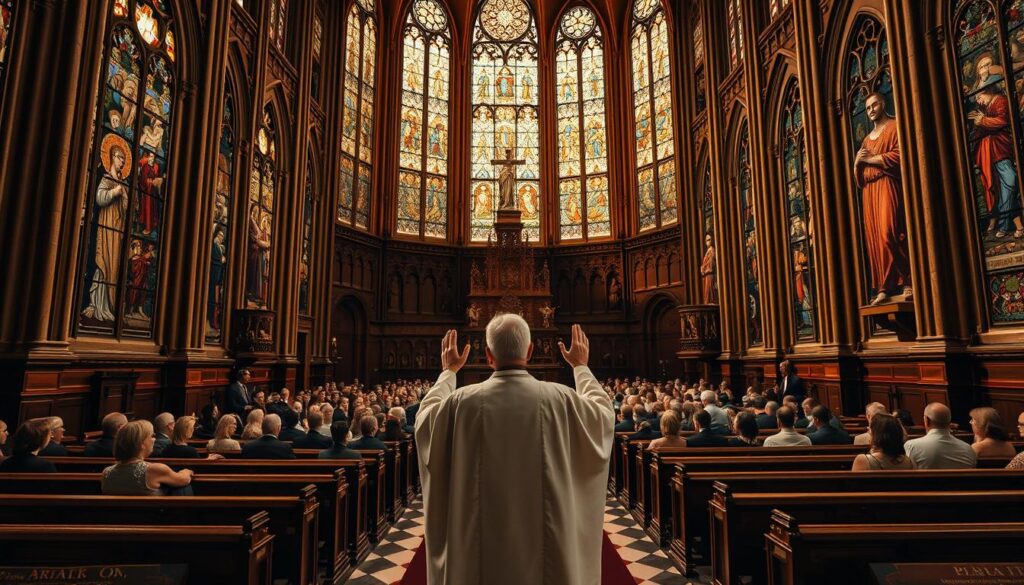
A grand cathedral interior, with intricate stained glass windows casting a warm, reverent glow. In the foreground, a priest stands at an ornate pulpit, hands raised in a gesture of wisdom and authority. Behind him, rows of wooden pews fill the nave, occupied by a congregation listening intently. The walls are adorned with ornate religious iconography, reinforcing the solemnity of the space. Dramatic lighting from above casts dramatic shadows, adding a sense of gravitas to the scene. The overall atmosphere is one of solemnity, contemplation, and the weight of the church's teachings on the complex issue of abortion.

This church teaching positions life protection as a universal truth accessible through reason. It’s not just religious doctrine but a call to defend human rights recognized across cultures. The document urges believers to promote laws safeguarding unborn children while respecting diverse viewpoints.

Three principles shape this approach:

  • Moral truth exists independently of personal beliefs
  • Civil law should reflect basic human dignity standards
  • Dialogue bridges faith perspectives and secular ethics

Church leaders emphasize that opposing teaching abortion isn’t about imposing beliefs. It’s advocating for protections anyone can understand through logical reflection. This framework helps Catholics engage constructively in public debates while staying true to their convictions.

By grounding arguments in shared human values, the Church aims to build common ground. Its teachings invite people of all backgrounds to reconsider how societies value vulnerable lives.

The Principle of Double Effect and Moral Dilemmas

Medical ethics often face tough choices where saving one life might unintentionally affect another. The principle of double effect helps navigate these situations by focusing on intentions versus outcomes. It allows actions with both good and bad results, provided certain conditions are met.

Direct Versus Indirect Scenarios

This ethical framework requires four key elements:

  • The action itself must be morally acceptable
  • The primary goal is to achieve the good outcome
  • The negative effect isn’t used to reach the positive result
  • The benefits outweigh the unintended harm

Consider a pregnancy complicated by aggressive cancer. Removing the uterus saves the mother’s life but results in fetal loss. Here, the surgery’s purpose isn’t termination – it’s disease treatment. The embryo’s death becomes a tragic side effect, not the objective.

Scenario Intention Outcome Moral Evaluation
Direct termination End pregnancy Fetal death Prohibited
Cancer treatment Remove diseased tissue Fetal death Permissible
Ectopic pregnancy care Prevent organ rupture Embryo loss Ethically justified

This distinction matters in real-world care. Doctors can address life-threatening conditions while upholding ethical standards. The principle acknowledges heartbreaking realities without compromising core values.

Navigating the Debate on Ensoulment

When does a developing life gain spiritual significance? This question has shaped theological discussions for centuries. While beliefs about soul infusion vary, religious teachings maintain clear ethical boundaries.

Historical Theories of Ensoulment

Ancient thinkers proposed staggered timelines for soul embodiment. Aristotle’s delayed ensoulment theory suggested rational spirits entered male fetuses at 40 days, females at 90. Medieval scholars like Aquinas adapted these ideas, yet still condemned early termination.

Modern Scientific Understandings

Today’s embryology confirms life begins at conception. However, debates continue about personhood’s starting point. A 1974 Vatican document noted: “Biological growth and moral status remain distinct questions.”

Three key insights emerge:

  • Historical thought allowed varied timelines for spiritual life
  • Modern science tracks physical development precisely
  • Ethical teachings prioritize protection from earliest stages

These perspectives coexist in ongoing dialogue. They remind us that mystery often accompanies profound truths about human existence.

FAQ

What does the Catholic Church teach about abortion?

The Church affirms that life begins at conception and considers abortion a grave moral evil. This stance is rooted in natural law, Scripture, and magisterial documents like the Catechism of the Catholic Church, which states that every human life has inherent dignity.

How has the Church’s view on abortion evolved historically?

Early Christian writings, such as the Didache, condemned practices harming unborn children. By the medieval period, thinkers like Thomas Aquinas debated ensoulment, but the Church consistently upheld the sanctity of life. Modern teachings clarify that life’s protection starts at fertilization.

Are there exceptions for abortion in Catholic doctrine?

The Church prohibits direct abortion, even in difficult circumstances. However, procedures that indirectly result in fetal death (e.g., saving a mother’s life via cancer treatment) may be permissible under the principle of double effect, provided the intent isn’t to terminate pregnancy.

What penalties apply to those involved in abortion?

Canon Law (Canon 1398) states that individuals who procure abortion incur automatic excommunication. Reconciliation is possible through sacramental confession, emphasizing repentance and healing. The Church also advocates compassion for those affected.

How does science influence the Church’s stance on ensoulment?

While historical debates focused on when a soul enters the body, modern biology confirms that human development starts at conception. The Church now emphasizes this scientific clarity to affirm that embryos deserve full moral respect from their earliest stages.

Does the Church support mothers facing unplanned pregnancies?

Yes. Organizations like Project Rachel offer emotional and spiritual support, reflecting Pope John Paul II’s call to “be not afraid.” The Church encourages alternatives like adoption while advocating for societal changes to support families in need.

Why does natural law matter in this discussion?

Natural law, central to Catholic ethics, teaches that moral truths are knowable through reason. Protecting life aligns with humanity’s intrinsic purpose, making abortion a violation of both divine and rational order. This principle guides the Church’s unwavering defense of the unborn.

Catholicism Chat: Engage with the Faith Community


Discover a digital space where spiritual growth and connection thrive. Our platform brings together individuals eager to explore religious teachings, share personal experiences, and build meaningful relationships. Whether you’re seeking answers or offering insights, every voice matters here.

This monitored environment ensures respectful dialogue while fostering genuine connections. Trained volunteers maintain a welcoming atmosphere where participants aged 14+ can discuss beliefs safely. You’ll find compassionate listeners and thoughtful perspectives from diverse backgrounds.

Many users describe this service as their daily source of encouragement. One member shared: “I finally found people who understand my spiritual questions without judgment.” The combination of modern technology and timeless values creates unique opportunities for mutual support.

Key Takeaways

  • Connect with supportive individuals who value spiritual growth
  • Participate in monitored discussions that prioritize respect
  • Accessible to teens and adults seeking faith-based conversations
  • Volunteer moderators ensure alignment with core values
  • Technology bridges distances to strengthen religious connections

Introducing Our Faith Community

Join a digital community built on shared spiritual values and mutual respect. This space welcomes those seeking deeper connections through faith-based conversations. Whether you’re sharing personal journeys or exploring religious teachings, every voice contributes to collective growth.

Room Purpose and Guidelines

Our platform focuses on three pillars: social connection, spiritual sharing, and respectful dialogue. Members discuss everything from daily faith practices to historical church traditions. Personal details like phone numbers or parish names stay private to protect everyone’s safety.

English serves as our common language to ensure clear communication. Real names or recognizable variations help build trust. As one regular participant notes: “Using my actual name made conversations feel more genuine from day one.”

Conduct, Courtesy, and Respect for All Beliefs

Kindness forms the foundation of every interaction. Moderators trained in conflict resolution monitor discussions daily. They gently guide conversations back to constructive paths when needed.

People from various religious backgrounds bring fresh perspectives while exploring Catholic teachings. Harassment or profanity results in immediate removal. This approach maintains an environment where spiritual curiosity thrives without judgment.

Join Our catholicism chat

Step into a welcoming online environment where spiritual curiosity meets supportive dialogue. Our platform helps individuals explore religious teachings while connecting with others on similar journeys.

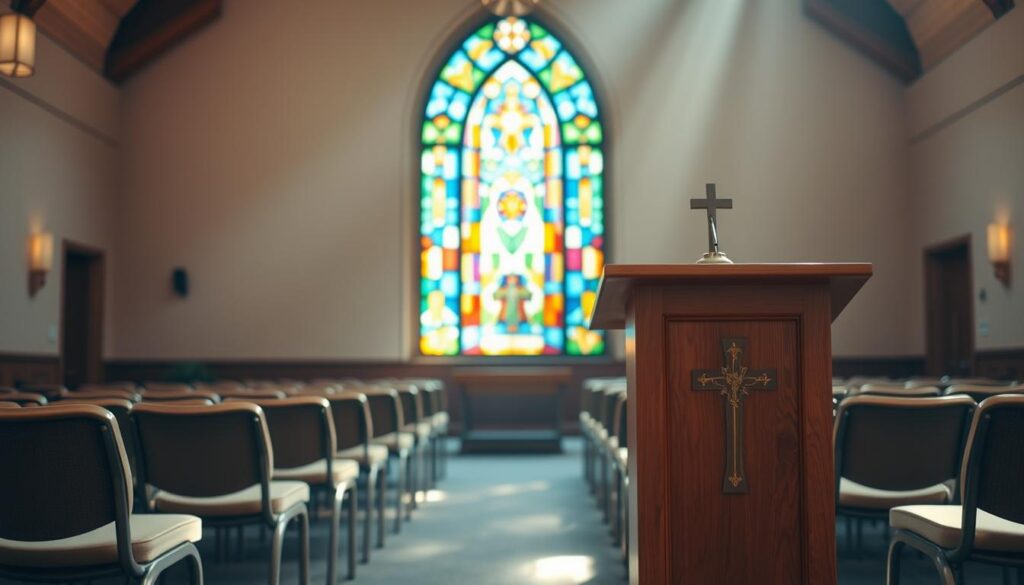
A warm and inviting community gathering space, bathed in soft, natural lighting. In the foreground, a simple and elegant wooden podium, adorned with a modest cross. Surrounding it, rows of comfortable chairs in a semicircle, creating an atmosphere of inclusivity and fellowship. In the middle ground, a large, stained-glass window casts a kaleidoscope of colors, symbolizing the rich diversity of the faith community. The background features subtle, muted tones, conveying a sense of serenity and contemplation, inviting visitors to engage with the community and its guiding principles.

How to Engage and Share Your Questions

Getting started takes just three steps: confirm you’re 14+, agree to our guidelines, and dive into discussions. Many find immediate connections by introducing their interests – whether studying scripture or seeking prayer partners.

The service allows open conversations about daily faith practices and deeper theological topics. One participant shared: “I received thoughtful answers about sacraments within hours of joining.” Moderators keep exchanges focused while encouraging diverse viewpoints.

Ensuring Safety and Real Name Usage

We require full names to build trust and accountability. Trained staff review all reports of inappropriate behavior within 24 hours. This system creates authentic interactions while protecting privacy – no locations or parishes are shared publicly.

Wildfire Fellowship, Inc. maintains strict age verification and content policies. Volunteer moderators explain rule changes through announcements, ensuring everyone understands expectations. Their decisions help sustain this unique space for spiritual growth across generations.

Navigating Your Faith and Life Questions

Find clarity in life’s complex moments through guided spiritual discussions. Our community helps members explore teachings while addressing real-world challenges. From daily practices to major decisions, you’ll discover thoughtful perspectives rooted in tradition.

Exploring Catholic Teachings and Beliefs

Members frequently discuss how Church traditions apply to modern life. Common topics include sacraments like confession and their role in personal growth. One participant asked: “How does reconciliation help families heal after arguments?”

Life Situation Church Teaching Practical Application
Interfaith marriage Sacramental validity Pre-marital counseling options
Parish conflicts Community reconciliation Diocese mediation services
Political engagement Social justice principles Volunteer opportunities

Addressing Life’s Big Questions with Spiritual Insight

Many seek advice about returning to the Catholic Church after difficult experiences. A recent member shared: “My parish priest helped me reconnect through monthly coffee meetings.” These stories highlight how spiritual support evolves with life changes.

Discussions often cover balancing work and prayer routines. Members exchange ideas about explaining faith to children or coworkers. Practical solutions emerge through shared experiences rather than rigid answers.

Seasonal topics like Easter preparation spark conversations about personal renewal. Participants explore how ancient traditions remain relevant in today’s fast-paced world. This blend of timeless wisdom and modern application helps deepen understanding.

Accessing Support, Counseling, and Group Sharing

A serene sanctuary with warm lighting and a calming atmosphere. In the foreground, a person sits cross-legged, eyes closed, hands resting peacefully on their lap, exuding a sense of contemplation and inner peace. Behind them, a group of individuals gather in a circle, engaged in open and supportive discussion. The background features soft, muted tones, with subtle religious symbols or iconography, creating a sense of spiritual connection and guidance. The composition is balanced, with a sense of harmony and tranquility, conveying the essence of "Accessing Support, Counseling, and Group Sharing" within the Catholic faith community.

Our platform extends beyond digital conversations to offer multiple pathways for spiritual care. Whether facing personal struggles or seeking deeper connections, members find tailored assistance through three core offerings.

Utilizing the Phone Helpline and One-on-One Counseling

The confidential phone support service connects you with trained listeners daily from 8 AM to 10 PM EST. Many callers appreciate discussing sensitive matters privately, like one who shared: “Talking through my faith doubts helped me regain perspective.”

For complex challenges, professional counselors provide personalized guidance. These sessions address specific needs like marriage conflicts or returning to Church practices. All advisors respect Catholic teachings while offering practical solutions.

Participating in Group Sessions for Faith Discussions

Weekly “It’s Good to Talk” meetings create safe spaces for shared learning. Recent topics included explaining sacraments to children and managing work-life-prayer balance. Participants often discover new approaches through others’ experiences.

Structured group activities help those rebuilding spiritual routines. A regular attendee noted: “Hearing how others prepare for confession gave me courage to try it myself.” Moderators ensure discussions stay focused and uplifting.

Service Best For Availability Key Benefit
Phone Support Immediate guidance Daily Private conversations
Counseling Personal challenges By appointment Tailored solutions
Group Sessions Shared learning Weekly Community wisdom

These options adapt to different schedules and comfort levels. Our team helps you choose the right support for your current spiritual journey. Every service maintains strict confidentiality and aligns with Church values.

Conclusion

Your spiritual path becomes clearer when walked with others. Our volunteer-powered community exists to lighten life’s burdens through shared faith experiences. Whether reconnecting with the Catholic Church or deepening your practice, every step matters.

Real people stand ready to help. Trained listeners and priest advisors offer guidance through life’s twists – from parish transitions to personal doubts. One volunteer shares: “Seeing someone rediscover their spiritual joy reminds me why we do this.”

This journey thrives on honest questions and practical support. Access reliable information through group discussions or private chats while building connections that last. Your search for meaning finds company here.

Together, we create spaces where faith grows naturally. Local churches become welcoming homes when people feel valued. Join others turning beliefs into lived truth, one conversation at a time.

FAQ

What is the purpose of joining this faith community?

Our platform connects individuals seeking guidance, fellowship, and honest conversations about Catholic teachings. It’s a space to explore beliefs, ask questions, and grow spiritually alongside others on similar journeys.

How do I ensure my privacy during discussions?

We prioritize safety by encouraging real names for accountability, but personal details remain confidential. Moderators monitor conversations to maintain respect and uphold community guidelines.

Can I discuss personal struggles or life challenges here?

Absolutely. Whether you’re facing ethical dilemmas, relationship issues, or spiritual doubts, our trained counselors and supportive members offer nonjudgmental guidance rooted in Catholic values.

Are one-on-one counseling services available?

Yes. Our licensed counselors provide confidential phone sessions to address individual needs. You can also join group discussions to share experiences and gain collective wisdom.

How do I participate in group faith-sharing sessions?

Visit the “Group Sessions” page to view schedules and topics. Registration is simple—choose a session that aligns with your interests and join via the provided link or parish location.

What if I disagree with certain teachings or traditions?

Open dialogue is encouraged! Ask questions respectfully, and our community—including clergy and educators—will help clarify teachings. Understanding grows through thoughtful conversation.

Can I connect with a local parish through this platform?

Definitely. We partner with parishes nationwide to help you find nearby Mass times, events, or volunteer opportunities. Just share your location (optional) to access local resources.

Catholicism in the US: Understanding Its History and Influence


Exploring the roots of one of America’s most influential faith traditions reveals a story of perseverance and adaptation. From humble beginnings in colonial settlements to shaping modern society, Catholic communities have grown into a vibrant force. Today, nearly 1 in 4 Americans identifies with this faith, reflecting its enduring presence.

Early followers faced challenges, yet their dedication laid foundations for institutions still thriving today. Schools, hospitals, and social programs emerged as cornerstones of community support. Waves of immigrants from Europe and Latin America later infused new traditions, creating a diverse spiritual tapestry.

The Church’s role extends beyond worship. It has influenced debates on education reform, healthcare access, and civil rights. While membership numbers have shifted in recent decades, the legacy remains deeply embedded in cultural values and public life.

Key Takeaways

  • Approximately 19-25% of Americans identify with this faith tradition today
  • Immigration patterns significantly shaped community growth and cultural practices
  • Catholic institutions helped build America’s education and healthcare systems
  • Early practitioners overcame persecution to establish lasting influence
  • Recent surveys show changing membership trends within modern congregations

Historical Roots and Colonial Beginnings

Colonial America’s religious tapestry was woven with threads of Catholic tradition from multiple European powers. While Protestant groups dominated much of the Eastern seaboard, diverse faith communities quietly took root across the continent.

Seeds of Faith in New Worlds

Maryland emerged as a bold experiment in 1634. Founded by Lord Baltimore, it became a rare safe haven for English Catholics escaping persecution. Nearly a century later, Pennsylvania surprised many by welcoming Catholic settlers despite its Quaker origins.

Spanish missionaries left an even earlier mark. They established San Miguel Mission in 1610 – now recognized as the oldest standing church in the country. French explorers meanwhile built vibrant communities along strategic waterways, blending European traditions with frontier life.

Cultural Crossroads

Three distinct colonial approaches shaped early religious landscapes:

Colony Founder Key Contribution
Maryland Lord Baltimore First English Catholic refuge
Spanish Missions Franciscan friars Oldest continuous parishes
French Territories Explorers & traders Mississippi River communities

By 1785, only 25 priests served 25,000 faithful nationwide. This scarcity made lay leadership crucial. Colonial Catholics navigated strict laws but planted institutions that would flourish after the American Revolution.

Catholic Pioneers and Founding Figures

Visionary leaders emerged as America transitioned from colonies to nationhood, blending spiritual guidance with civic responsibility. Two members of the Carroll family stood at this crossroads, shaping both religious and political landscapes.

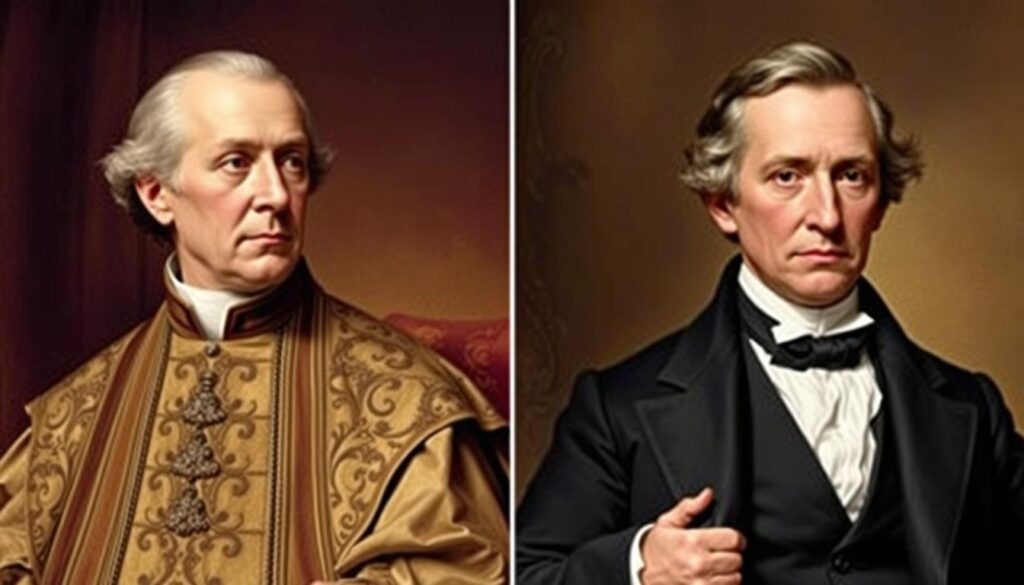
Two stately portraits side-by-side, depicting John Carroll and Charles Carroll, prominent Catholic pioneers in early America. John, the first Catholic bishop in the United States, gazes thoughtfully, clad in ornate clerical robes. Charles, a Founding Father and signatory of the Declaration of Independence, poses confidently in a tailored suit, his face exuding determination. Soft, warm lighting illuminates their features, creating a sense of reverence. The backgrounds feature subtle period-appropriate details, such as wooden paneling and ornamental flourishes, placing the subjects firmly in the historical context. An air of significance and gravitas surrounds these two influential Catholic figures who played pivotal roles in shaping the nation.

Architect of American Catholicism

John Carroll revolutionized religious life after the Revolution. Appointed as Prefect Apostolic in 1784, he became the first leader of Catholic communities across the new nation. His crowning achievement? Founding Georgetown University in 1789 – still thriving as America’s oldest Catholic university.

When Pope Pius VI named him the first American bishop in 1789, Carroll’s diocese stretched from Georgia to Maine. He championed education, declaring “Knowledge and piety must grow together” – a philosophy still guiding Catholic institutions.

Patriot With a Pen

Across the political arena, Charles Carroll made history as the sole Catholic signer of the Declaration of Independence. Owning 60,000 acres, he leveraged his wealth to fund revolutionary causes. His famous quip – “We’ve crossed the Rubicon” – captured the revolution’s irreversible momentum.

The Carroll legacy extended through the Constitutional Convention. Two Catholic delegates – Daniel Carroll and Thomas Fitzsimons – helped draft governing principles protecting religious freedom. Their work laid groundwork for the First Amendment’s guarantees.

Expansion Through Immigration and 19th Century Growth

America’s cities transformed into spiritual hubs during the 1800s as ships disgorged weary travelers at Eastern ports. Between crowded tenements and factory jobs, these newcomers built something extraordinary – a religious network that would redefine urban landscapes.

Immigrant Waves: Irish, German, and Beyond

The 1840s brought desperation and hope. Ireland’s potato famine pushed over a million starving families toward New York harbor. Simultaneously, German Catholics fled political chaos, carrying their traditions to Midwest cities like Cincinnati.

By 1850, these groups formed the largest Christian denomination nationwide. The numbers stunned observers – seven million faithful by 1890, triple the figure from thirty years prior. Ethnic parishes became lifelines, offering native-language services and cultural solidarity.

Immigrant Group Peak Arrival Cultural Legacy
Irish 1845-1855 Urban parish networks
German 1840s-1880s Liturgical societies
Italian/Polish Post-1890 Festival traditions

Later arrivals from Italy and Poland added new flavors to this mix. Chicago’s Holy Trinity parish became Polonia’s heart, while New York’s Little Italy buzzed with feast-day processions. Remarkably, nearly 700,000 Americans chose to join the Catholic Church voluntarily during this century.

This immigrant surge didn’t just fill pews – it reshaped how communities organized. From soup kitchens to parochial schools, the church became a cornerstone of upward mobility. The foundations laid here still support diverse congregations today.

The Role of Catholic Churches in American Communities

Steeples reaching toward the sky marked more than sacred spaces – they symbolized community lifelines. For generations, these institutions have acted as neighborhood hearts, pumping vitality into cities and towns through practical compassion.

Community Outreach and Social Services

Walk into any parish today, and you’ll find food pantries humming alongside prayer groups. Over 16,000 congregations nationwide operate like Swiss Army knives of support. They offer:

Service Impact Year Established
Parochial Schools Educated 1.6M students (2023) 1840s
Hospital Systems 1 in 7 US patients served 1820s
Immigrant Centers 500+ language programs 1890s

New arrivals in the 1900s often found their first friends at church basements. “We didn’t just save souls – we saved families,” remarked a 1920s Brooklyn priest. Volunteers taught English while connecting workers to jobs.

This legacy of social justice continues today. Many parishes now host:

  • Free medical clinics open weekends
  • After-school STEM programs
  • Disaster response teams

From rebuilding after hurricanes to stocking neighborhood fridges, these efforts show faith in action. As one deacon put it: “Our doors open outward.”

Architectural and Cultural Landmarks

From coast to coast, stone spires and golden domes rise as testaments to faith and cultural identity. These structures blend artistic vision with spiritual purpose, creating spaces that inspire both devotion and wonder.

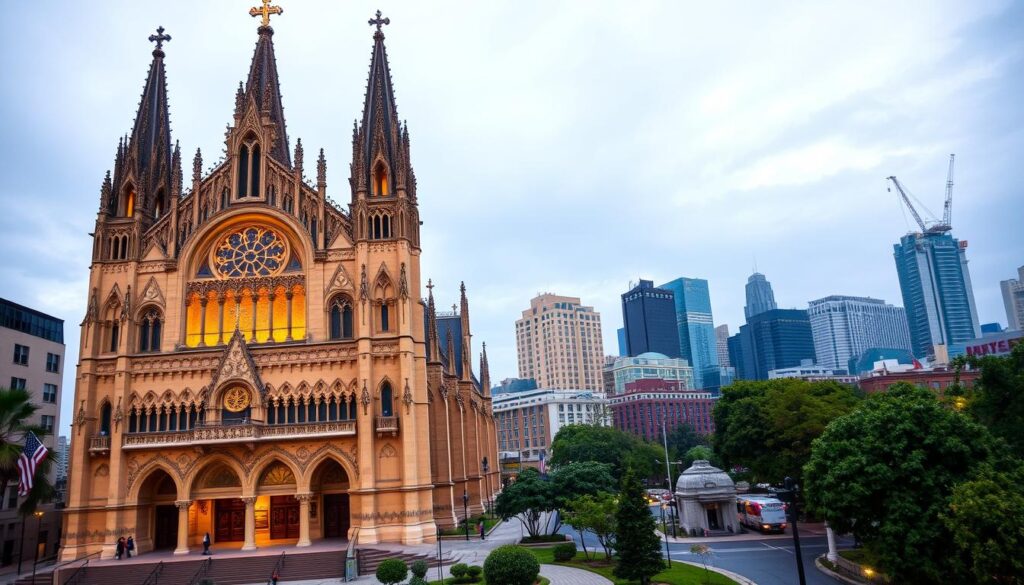
A grand cathedral standing tall, its spires and domes reaching towards the heavens. Intricate facades adorned with ornate carvings and stained glass windows that cast a warm, reverent glow. In the foreground, a grand entryway with towering columns and arched doorways, inviting visitors to enter and bask in the sacred ambiance. The middle ground features lush greenery and well-manicured gardens, complementing the timeless elegance of the architectural masterpiece. In the background, a cityscape of modern skyscrapers and bustling streets, a testament to the lasting influence of Catholic heritage in the United States. Soft, directional lighting illuminates the scene, creating a sense of awe and reverence.

Iconic Churches, Missions, and Basilicas

St. Patrick’s Cathedral in New York City captures 19th-century ambition with its 330-foot towers. Completed in 1878, this Gothic Revival marvel used marble from Massachusetts and Connecticut. Over 3 million visitors now walk its aisles yearly.

The Basilica of the National Shrine in Washington D.C. holds a different record. As North America’s largest Catholic church, its 79,000-square-foot interior glows with 14,000 golden tiles. One worker famously called it “a love letter in stone to the faithful.”

Landmark Location Architectural Style Key Fact
Basilica of the National Shrine Washington D.C. Byzantine Revival Largest in North America
St. Patrick’s Cathedral New York Gothic Revival 1878 completion
Mission San Juan Capistrano California Spanish Colonial Founded 1776
San Xavier del Bac Arizona Baroque Active since 1797

Spanish missionaries left lasting marks through place names. Cities like San Francisco and Los Angeles carry their original religious titles. Over 20 California communities still use “San” or “Santa” prefixes from 18th-century missions.

Modern buildings continue this legacy. The 2015 Cathedral of Christ the Light in Oakland mixes glass and wood, proving tradition evolves. As one architect noted: “Great churches speak the language of their times while echoing eternity.”

Development of the American Diocesan System

A network of spiritual leadership took shape across America during the 19th century. Bishops worked to unify practices through three historic Plenary Councils of Baltimore (1852, 1866, 1884). These meetings standardized religious education and created frameworks still used today.

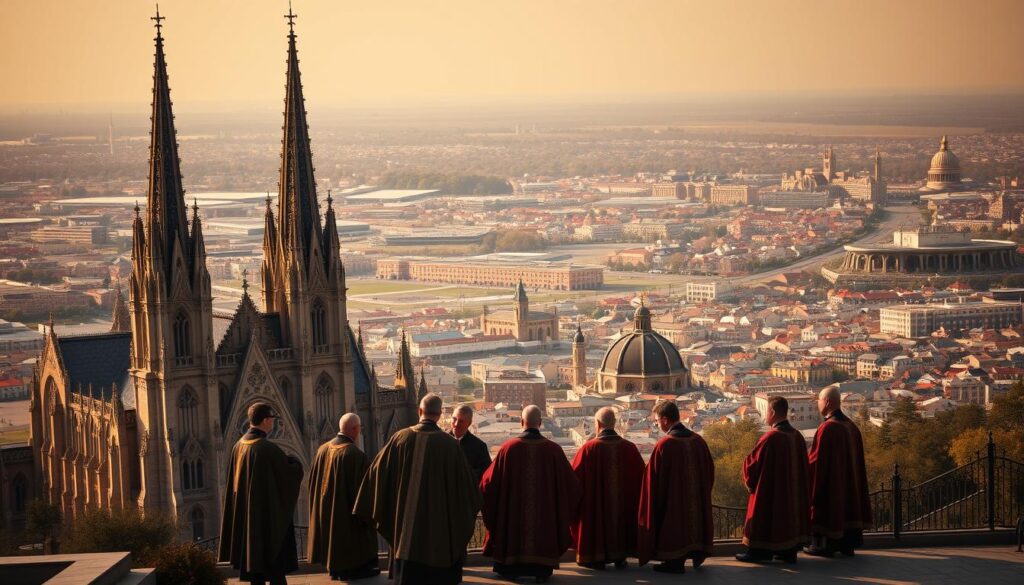
A grand cathedral stands tall, its gothic spires reaching towards the heavens. In the foreground, a group of priests in ornate robes gather, discussing the intricate workings of the American diocesan system. The middle ground reveals a sprawling network of churches, each a beacon of faith within their respective communities. In the background, a cityscape of bustling urban centers and quaint rural towns, all bound by the unifying presence of the Catholic Church. Soft, warm lighting casts a reverent glow, conveying the solemn yet vital role of this ecclesiastical hierarchy in shaping the spiritual and social fabric of the United States.

The councils’ most famous achievement? The Baltimore Catechism. This question-and-answer guide taught generations their faith basics. One educator called it “the book that built Catholic America.”

Council Year Key Decision Lasting Impact
1852 Standardized liturgy National unity
1866 School mandates Education expansion
1884 University founding Catholic intellectual hub

Today’s structure includes 200 dioceses – third-largest globally. Local bishops adapt teachings to regional needs while maintaining core principles. The United States Conference of Catholic Bishops coordinates nationwide efforts, from social justice to education.

This flexible system weathered immigration waves and cultural shifts. As one historian notes: “It’s like a tree – roots in tradition, branches reaching new heights.” From frontier missions to digital outreach, the framework continues evolving while preserving its mission.

Modern Perspectives on Catholicism in the United States

America’s religious landscape continues evolving, with Catholic communities adapting to new cultural realities. A 2025 Pew study reveals striking changes – adherents dropped from 24% to 19% of the population since 2007. Yet vibrant transformations are reshaping worship spaces and traditions nationwide.

Shift in Demographics and Evolving Practices

Hispanic believers now form nearly 40% of the Catholic population. This growth sparked Spanish-language masses in 4,500+ parishes. Cultural celebrations like Mexico’s Las Posadas processions and Filipino Simbang Gabi dawn masses now brighten December calendars.

Community Tradition Parishes Adopted
Mexican-American Las Posadas 2,100+
Filipino-American Simbang Gabi 1,400+
Vietnamese-American Tet Masses 600+

Younger generations blend traditional faith with modern approaches. Over 60% of millennial Catholics personalize spiritual practices while maintaining community ties. Churches answer with livestreamed services and TikTok faith challenges.

Influence on Contemporary Religious Policies

Leadership now prioritizes issues resonating with diverse followers. Many Catholics push for climate action and immigration reform through parish programs. As one Chicago deacon noted: “Our pews hold global stories – our policies must reflect that.”

The Catholic Church remains a social cornerstone despite membership shifts. Food pantries serve 5 million annually, while disaster relief teams mobilize within hours. This active compassion keeps communities anchored through changing times.

Impact on American Politics and Social Justice

Faith communities have long shaped national conversations through moral leadership and civic action. Their influence extends from voting booths to legislative halls, blending spiritual values with public service.

Political Engagement and Advocacy by Catholics

John Kennedy’s 1960 presidential victory marked a turning point. As the first Roman Catholic commander-in-chief, he challenged stereotypes about faith and governance. His success opened doors for future leaders across party lines.

Decades later, Catholic bishops amplified their political voice. They championed social justice causes while addressing ethical debates around life and family. These efforts sparked dialogue in communities and congressional offices alike.

Patriotism during global conflicts also shifted perceptions. Service in World War I and II showcased loyalty, melting prejudices against believers. Military chaplains and homefront volunteers became symbols of unity.

Today, many parishes continue this legacy. They bridge faith and civic duty through voter drives and policy forums. As one activist noted: “Our values don’t stop at the church door.”

FAQ

Who was the first Catholic bishop in America?

A: John Carroll became the first bishop in 1789. He founded Georgetown University and shaped the early church’s structure, emphasizing education and interfaith collaboration.

How did Catholic immigrants shape 19th-century America?

Waves of Irish, German, and Italian immigrants built parishes, schools, and social networks. They faced discrimination but strengthened the church’s presence through cultural festivals and labor advocacy.

What role did Catholics play in the American Revolution?

A: Charles Carroll, a signer of the Declaration of Independence, symbolized Catholic patriotism. His leadership helped dispel anti-Catholic biases and align the faith with American ideals.

Are there famous Catholic landmarks in the U.S.?

Yes! The Basilica of the National Shrine in Washington, D.C., and California’s historic missions showcase stunning architecture. These sites blend cultural heritage with spiritual significance.

How does the church address social justice today?

The U.S. Conference of Catholic Bishops advocates for immigration reform, poverty relief, and racial equality. Many parishes run food banks, shelters, and educational programs to support local communities.

Why was Maryland important for early Catholics?

Founded as a haven for English Catholics, Maryland passed the 1649 Toleration Act. This law allowed religious freedom, though tensions with Protestant settlers persisted.

How has the diocesan system evolved?

From one diocese in 1789, the church now has nearly 200. This growth reflects population shifts, with new dioceses in the South and West addressing modern demographic changes.

Did Catholics face historical prejudice?

Yes. Anti-Catholic laws existed in some colonies, and 19th-century groups like the Know-Nothings opposed immigrants. The 1960 election of John F. Kennedy marked a turning point in acceptance.

Cremation and Catholic Faith: Understanding the Intersection


When facing end-of-life decisions, many Catholic families seek ways to honor their loved ones while staying true to their spiritual values. The Catholic Church offers guidance rooted in reverence for the human body as a sacred creation, reflecting its teachings about resurrection and eternal life.

For centuries, traditional burial was the norm, symbolizing hope in bodily resurrection. Today, the Church acknowledges cremation as an option if chosen respectfully—not to reject core beliefs. This balance allows families to navigate modern challenges while upholding dignity for the deceased.

Central to this discussion is Genesis 3:19: “Remember, man, you are dust, and to dust you shall return.” This passage shapes Catholic practices, emphasizing that how we treat mortal remains matters deeply. While cremation is permitted, scattering ashes or keeping them at home remains discouraged to maintain reverence.

Contemporary Catholics often weigh practical concerns like cemetery costs against their desire to honor Church teachings. Pastoral leaders emphasize that final choices should reflect faith in resurrection rather than convenience alone. Through open dialogue, families find meaningful ways to celebrate life while respecting sacred traditions.

Key Takeaways

  • The Catholic Church prioritizes respect for the human body as part of its resurrection theology
  • Traditional burial remains preferred, but cremation is permitted with specific guidelines
  • Modern teachings reflect an evolution from historical prohibitions while maintaining core beliefs
  • Families should choose end-of-life practices that honor both faith traditions and personal circumstances
  • Ashes must be treated with same reverence as bodily remains, following Church protocols

Historical Evolution of Catholic Funeral Practices

Catholic burial customs have always mirrored core spiritual values while adapting to societal changes. Early Christians embraced traditional interment, inspired by Christ’s own entombment. This practice became a visible expression of hope in bodily resurrection.

Ancient Traditions and Cremation Prohibitions

For over 1,500 years, the Church discouraged burning remains. Roman persecutors used fire to mock Christian resurrection beliefs, as noted by Fr. William J. Devlin: “Pagans cast martyrs’ bodies into flames to undermine faith in eternal life.” Burial emerged as both a sacred ritual and defiance against oppression.

Shifts in Church Stance from Centuries to Today

Practical needs reshaped policies in 1963. Overcrowded cemeteries and rising costs led to conditional acceptance of cremation—provided it didn’t reject resurrection theology. The 1983 Code of Canon Law later clarified guidelines, ensuring ashes receive dignified treatment akin to whole bodies.

Time Period Key Characteristics Primary Influences
Early Centuries Burial as spiritual resistance Persecution & theological identity
1963 Shift Limited cremation allowance Sanitation, space, & family needs
Post-1983 Formalized reverence guidelines Balancing tradition with modern realities

This evolution shows how timeless truths meet changing circumstances. Leaders prioritized both doctrinal integrity and compassionate response to the faithful’s needs.

The Catholic Church’s Approach to Cremated Remains

Modern Catholic guidelines balance tradition with compassion, offering clear directions for honoring loved ones. Recent updates clarify how to maintain reverence while addressing practical needs.

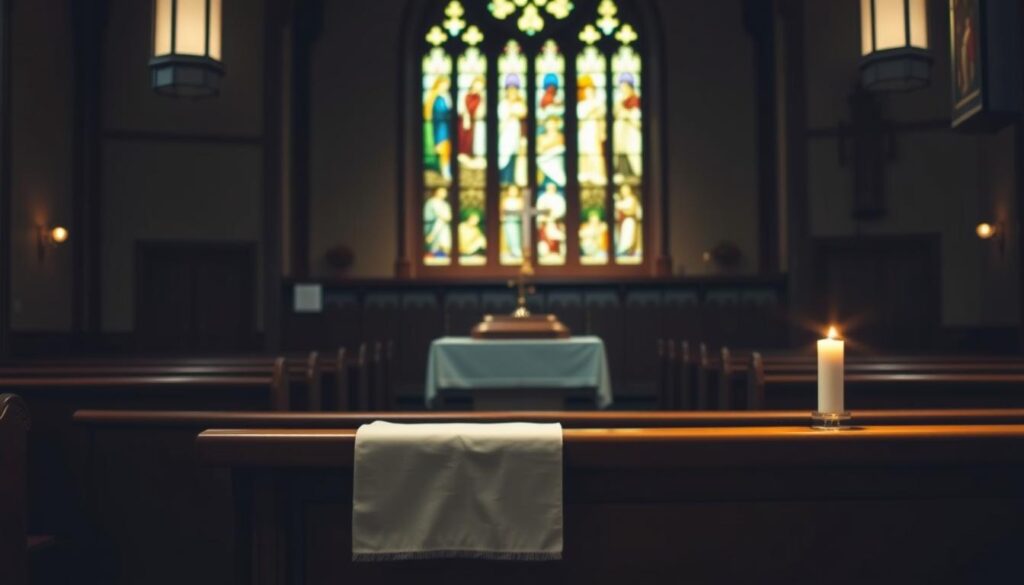
A catholic church interior, dimly lit with soft, warm lighting. In the foreground, a simple wooden altar with a plain white cloth. On the altar, a dignified urn containing cremated remains, its surface reflecting the flickering candlelight. The middle ground features a pew, its wooden slats smooth and worn, facing the altar. In the background, stained glass windows filter in muted colors, casting an ethereal glow. The overall atmosphere is one of reverence and solemnity, befitting the sacred nature of the cremated remains and their respectful placement within the church.

Guidelines for Handling Remains with Dignity

The Church teaches that ashes require the same respect as whole bodies. According to Vatican directives, scattering remains outdoors or storing them at home remains prohibited. Instead, families must place urns in blessed locations like cemeteries or church columbaria.

In 2023, exceptions emerged allowing minimal portions of ashes to be kept in meaningful places. As Cardinal Fernández noted: “This adaptation respects cultural needs while safeguarding sacred principles.” Containers must prevent accidental dispersal and avoid decorative use.

Funeral Rites and Sacred Traditions

Traditional services adapt seamlessly when using urns. The funeral Mass proceeds with cremated remains present, covered in a white pall symbolizing baptismal purity. Essential elements include:

  • Vigil prayers at the wake
  • Liturgical procession with the urn
  • Final commendation at the burial site

Parish priests often collaborate with funeral homes to ensure proper protocols. This approach maintains theological integrity while comforting grieving families through familiar rituals.

Cremation and Catholicism: Beliefs, Practices, and Implications

At the heart of Catholic teachings lies a profound respect for the human body as sacred. This principle shapes decisions about honoring loved ones while maintaining hope in divine promises.

Theological Significance of the Resurrection Body

Central to Christian faith is the belief that God reunites soul and glorified form at the end of time. The 2016 Vatican instruction affirms: “Cremation doesn’t limit God’s power to restore life.” While physical decay occurs naturally, the Church emphasizes trust in spiritual renewal beyond earthly limits.

Respecting the Human Body in Life, Death, and Beyond

Every person, body and soul, reflects divine creation. This truth guides treatment of remains—whether buried or cremated. Proper care demonstrates reverence for life’s sacred journey and rejects materialistic views of existence.

Families navigating these choices find strength in Church teachings that balance compassion with eternal truths. By honoring both faith and practical needs, they create meaningful tributes aligned with resurrection hope.

FAQ

What is the Catholic Church’s current stance on cremation?

The Church permits it but emphasizes that cremated remains must be treated with the same respect as a body. They should be stored in a sacred place, like a cemetery, rather than kept at home or scattered.

Why did the Church prohibit cremation in earlier centuries?

Early teachings emphasized the resurrection of the body, and some feared cremation rejected this belief. Cultural ties to pagan rituals also influenced the ban, which was lifted in 1963 after theological reflection.

Can a funeral Mass be held with cremated remains present?

Yes. The funeral rites can include a service with the ashes, provided they’re in a dignified container. However, the Church encourages having the body present for the Mass when possible.

How does the Church connect burial practices to faith in resurrection?

Traditional burial reflects the belief that the human body is a temple of the Holy Spirit. Honoring it in death symbolizes hope for its renewal in eternal life, as taught in Scripture.

Are families allowed to keep ashes at home?

The Church advises against this. Keeping remains in a sacred place, like a columbarium or grave, ensures communal reverence and aligns with the dignity owed to the deceased.

What role do funeral rites play in Catholic tradition?

These rituals honor the deceased, comfort loved ones, and affirm the soul’s journey to God. They also unite the community in prayer, reinforcing shared beliefs about life beyond death.

Why is scattering ashes discouraged?

Scattering can imply a lack of permanence or respect for the body. The Church teaches that cremated remains should rest in a consecrated space to reflect ongoing spiritual connection.

How have modern attitudes influenced Catholic funeral practices?

While traditions remain central, flexibility has grown. Many now choose cremation for practical reasons, but the focus on liturgical practices and reverence for the body endures.

The Importance of Mary in Catholic Faith and Tradition


For centuries, the Mother of Jesus has held a profound place in Catholic spirituality. Her role extends far beyond historical reverence, shaping core doctrines that anchor believers’ relationship with God. This article explores how her unique position bridges theology and lived faith.

Central to Catholic teaching is the belief that she was conceived without original sin. Known as the Immaculate Conception, this doctrine highlights her singular purpose in salvation history. Her title as the New Eve reflects her obedience to God’s plan, contrasting with humanity’s first disobedience.

Mariology—the study of her life and legacy—reveals how she models perfect discipleship. From Scripture to modern-day prayers like the Rosary, her influence remains vibrant. This guide unpacks both ancient traditions and their relevance for today’s faithful.

Key Takeaways

  • Mary’s sinless conception sets her apart in Catholic theology.
  • The title “New Eve” symbolizes her role in God’s plan of salvation.
  • Mariology connects her earthly life to eternal spiritual truths.
  • Devotional practices reflect her ongoing impact on worship.
  • Understanding her role deepens appreciation for Catholic teachings.

Introduction to Marian Devotion in Catholic Tradition

The Catholic Church’s reverence for the Blessed Virgin Mary forms a cornerstone of its spiritual life. This devotion isn’t just about prayers—it weaves theology, art, and community into a vibrant tapestry of faith.

Overview of Her Role in Christianity

More than the historical mother of Jesus, the Blessed Virgin Mary embodies ongoing spiritual guidance. Believers see her as a compassionate intercessor, bridging humanity and divine grace. Her presence echoes in liturgies, sacred art, and personal meditations worldwide.

Setting the Context for Faith and Tradition

Pope Benedict XVI once noted that studying her role requires “different and complementary viewpoints.” This approach ties Marian devotion to broader themes like Christ’s mission and the Church’s identity. Early Christians honored her quietly, but over time, these practices grew into profound theological frameworks.

“Mariology cannot be performed in isolation from other disciplines.”

Pope Benedict XVI

Today, this layered understanding helps Catholics connect ancient traditions to modern spiritual journeys. Whether through the Rosary or feast days, her legacy remains a living force in worship.

Historical Foundations of Marian Beliefs

The roots of Marian devotion run deeper than many realize. By the mid-3rd century, Egyptian Christians were already honoring the Mother of God through prayers and art. This early veneration laid the groundwork for beliefs that would shape centuries of worship.

A grand cathedral's interior, bathed in warm, golden light filtering through stained glass windows. Ornate stone columns and arches frame the scene, evoking a sense of reverence and history. In the foreground, a large, intricately carved statue of the Virgin Mary stands, her serene expression and delicate features radiating a maternal, divine presence. Surrounding her, intricate religious iconography and tapestries depict key moments in the life of Mary, the Mother of God, illuminating the deep, historical foundations of Marian beliefs and devotion within the Catholic faith. The overall atmosphere conveys a profound sense of spirituality, tradition, and the enduring significance of the Blessed Virgin in Christian theology and worship.

Early Church Perspectives and Prayers

One ancient prayer stands out: the Sub tuum praesidium. Dating to 250 AD, it begins, “We fly to your protection,” showing trust in the Blessed Virgin Mary’s intercession. Early believers initially focused on martyrs but soon recognized her unique role linking biblical promises to Christ’s mission.

Church Fathers like Origen shaped this understanding. His term Theotokos (“God-bearer”) became central to theology. These thinkers saw her as more than a historical figure—she embodied God’s plan unfolding through generations.

The Evolution to Contemporary Devotion

Over time, practices adapted while keeping core truths. The Sub tuum praesidium inspired later devotions like the Rosary. Communities worldwide added local traditions, from processions to iconography, yet always pointed back to her spiritual motherhood.

This continuity matters today. When modern Catholics pray to the Virgin Mary, they join a chain of faith stretching to catacomb-church days. Her legacy remains both ancient and alive—a testament to enduring spiritual bridges.

The Role of Mary in Catholic Doctrine

Catholic teachings about the Mother of Jesus aren’t just historical footnotes—they’re living truths shaping how believers grasp salvation. These doctrines reveal her unique partnership with God’s plan while deepening understanding of Christ’s mission.

https://www.youtube.com/watch?v=-GrcgodsUNM&pp=ygUGIzY5ZGF5

Doctrine as Reflected in the Catechism

The Catechism of the Catholic Church clarifies that calling her “Mother of God” isn’t poetic language. It affirms Jesus’ divine-human unity. She didn’t create God’s nature but gave earthly life to the Son who existed before time.

Title Meaning Impact on Faith
Theotokos “God-bearer” (Council of Ephesus) Affirms Christ’s divinity
New Eve Reversed original disobedience Shows human cooperation with grace
Spiritual Mother Guides believers to her Son Models discipleship for all

Mary’s Position in the Economy of Salvation

God didn’t need human help to save humanity—yet He invited her participation. Her “yes” at the Annunciation wasn’t passive agreement. It launched Christ’s redemptive work through her body and soul.

This cooperation mirrors how ordinary people today partner with grace. The Catechism frames her role as essential but not equal to Jesus’. Like a prism bending light, she directs attention to her Son’s sacrifice.

mary in catholicism: Practice and Belief

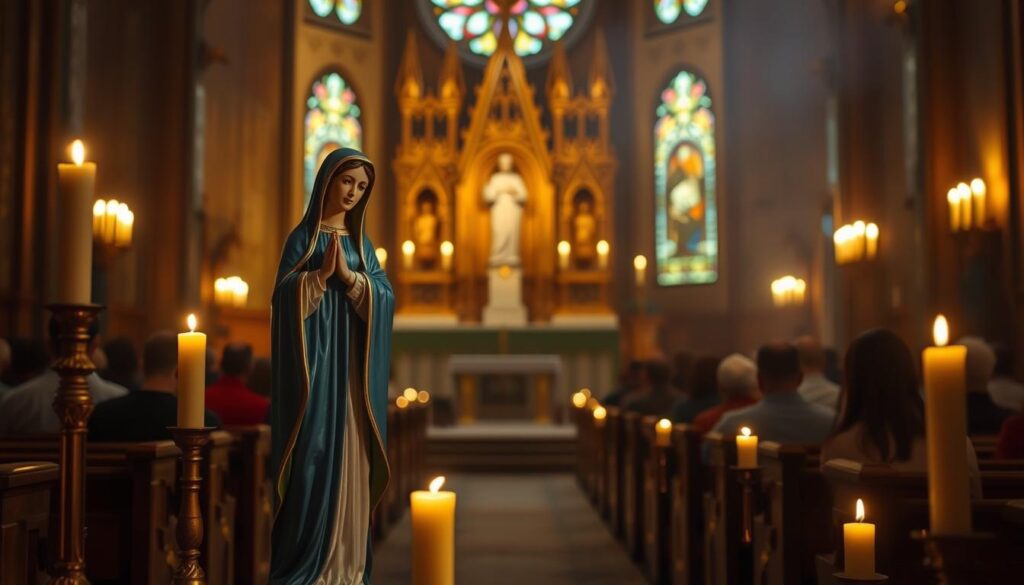
From whispered Rosaries to vibrant processions, Catholic traditions bring theology to life through tangible practices. These rituals honor the Blessed VirginA dimly-lit Catholic church interior, illuminated by the soft glow of candlelight. In the foreground, a figure of the Blessed Virgin Mary stands in a reverent pose, her hands clasped in prayer. She is adorned in a flowing blue robe and a delicate veil. Behind her, the altar is adorned with ornate carvings and golden accents, casting a warm, sacred atmosphere. In the middle ground, a group of worshippers kneel in pews, their heads bowed in devotion. The background is hazy, with stained glass windows casting colored light onto the scene. The overall mood is one of reverence, solemnity, and the profound spiritual connection between the Blessed Virgin and her devoted followers.

Popular Marian Devotions and Liturgical Practices

The Rosary remains a cornerstone of daily prayer, weaving together Scripture and meditation. Many Catholics also embrace Acts of Reparation, seeking healing through the Virgin Mary’s intercession. Consecration rituals, like those inspired by St. Louis de Montfort, invite total surrender to her guidance.

Devotion Purpose Example
First Saturdays Reparation for sins Communion and Rosary on consecutive Saturdays
Seven Sorrows Empathetic reflection Meditating on Mary’s grief at Christ’s crucifixion
Three Hail Marys Daily protection Morning/evening prayers for spiritual safety

Feasts, Festivities, and Iconography

Major feast days like the Assumption (August 15) unite global Catholics in celebration. Churches often display Our Lady of Guadalupe images, blending local culture with universal faith. Stained glass windows depicting the Annunciation turn stone walls into storybooks of grace.

“The Rosary is the ‘weapon’ for these times.”

St. Padre Pio

These traditions prove that devotion to Mary isn’t stuck in history books. It’s a living dialogue between heaven and ordinary lives—one prayer bead, feast day, and fresco at a time.

The Marian Dogmas: Divine Motherhood and Beyond

At the heart of Catholic theology lie four foundational truths about Christ’s mother that shape both doctrine and devotion. These Marian dogmas—defined over centuries—reveal her unique partnership in salvation while safeguarding core beliefs about Jesus Himself.

A grand Catholic cathedral with ornate Gothic architecture, its spires reaching skyward. Sunlight streams through stained glass windows, casting a warm, reverent glow. In the foreground, a central altar adorned with intricate carvings and statues, including a serene, maternal figure of the Virgin Mary. Her expression radiates divine grace and compassion. In the background, pews filled with worshippers, heads bowed in reverence. The atmosphere is one of spiritual wonder and devotion, befitting the Marian dogmas that define this sacred space.

Understanding Theotokos and Dogma of Mother of God

The title Theotokos (“God-bearer”) sparked a theological revolution at the 431 Council of Ephesus. By affirming Mary as Mother of God, bishops defended Christ’s dual nature—fully divine and human. This dogma became a shield against heresies that questioned Jesus’ unity as Savior.

The Doctrines of Immaculate Conception, Perpetual Virginity, and Assumption

Three other teachings complete the four Marian pillars. The Immaculate Conception (1854) declares she was born without original sin—a pure vessel for God’s Son. Her perpetual virginity underscores Christ’s miraculous birth and her total dedication. Finally, the Assumption (1950) celebrates her bodily ascent to heaven, foreshadowing believers’ resurrection.

Dogma Defined Significance
Theotokos 431 AD Affirms Christ’s divinity
Immaculate Conception 1854 Preserved from sin
Perpetual Virginity Early Church Miraculous birth
Assumption 1950 Bodily glorification

Together, these truths form a spiritual mosaic. As Pope Pius XII observed, they show how “the Mother of God illuminates the Church’s path.” Far from abstract ideas, they help Catholics grasp God’s extraordinary plan—one where human cooperation with grace changes history.

Scriptural and Theological Foundations for Mary’s Role

Biblical texts form the bedrock of Catholic teachings about Christ’s mother. These passages reveal how her cooperation with divine plans shaped salvation history. Far from being symbolic, they anchor theological truths in God’s revealed word.

Key Biblical Passages Supporting Marian Doctrines

Luke’s Gospel sets the stage. When the angel Gabriel announces, “The Holy Spirit will come upon you” (Luke 1:35), it establishes her unique mission. This moment shows how human birth became the gateway for God’s incarnation.

Scripture Passage Theological Insight Role in Salvation
John 1:14 “The Word became flesh” Affirms divine-human unity through her
Galatians 4:4 “Born of a woman” Shows God’s plan required human partnership
Genesis 3:15 “Woman’s offspring” Foreshadows her victory over evil

Elizabeth’s greeting—“Mother of my Lord” (Luke 1:43)—confirms her identity even before Jesus’ ministry began. This recognition highlights how her role transcends biology, pointing to Christ’s divinity.

Paul’s letter to the Galatians emphasizes the Son of God entering history through ordinary birth. These texts weave together to show God’s preference for working through willing hearts rather than distant miracles.

“What was achieved in the Mother of Jesus was begun in the promises of Genesis.”

From Genesis to the Gospels, Scripture paints a consistent picture. Her story isn’t added later—it’s woven into salvation’s fabric from the start.

Mariology and Its Interconnection with Christology

Exploring the Mother of God’s role isn’t just about her story—it lights up core truths about Jesus Christ. Pope John Paul II put it simply: Her presence helps us grasp the “mystery of Christ and his Church.” This bond shows why you can’t study one without the other.

Reflections on the Hypostatic Union and Christ’s Dual Nature

The title Mother of God isn’t just honorary. It safeguards the truth that Jesus is fully divine and human. Her motherhood anchors the hypostatic union—the belief that Christ’s two natures exist in one person.

Think of it like a doorway. Through her, believers step into deeper understanding of God becoming man. This connection isn’t ancient history. It shapes how Catholics experience grace today, knowing heaven touched earth through a woman’s “yes.”

Every time we honor her, we’re really pointing to Jesus Christ. As the Council of Ephesus taught centuries ago, loving the Mother means celebrating the Son’s saving work even more.

FAQ

Why is the Blessed Virgin Mary called the "Mother of God"?

The title Theotokos (God-bearer) was affirmed at the Council of Ephesus in 431 AD. It emphasizes that Jesus Christ, her son, is fully divine and human. This dogma highlights her unique role in salvation history as the one who bore the incarnate Son of God.

What does the Immaculate Conception mean?

Proclaimed by Pope Pius IX in 1854, this doctrine teaches that the Blessed Virgin was preserved from original sin from the moment of her conception. It underscores her purity and readiness to become the Mother of Christ.

How does the Assumption of Mary relate to Catholic belief?

Defined by Pope Pius XII in Munificentissimus Deus (1950), this dogma states that the Blessed Virgin was taken body and soul into heaven after her earthly life. It reflects her unique participation in Christ’s resurrection and eternal glory.

Are Marian devotions required for Catholics?

While not mandatory, practices like the Rosary or honoring feast days (e.g., the Solemnity of the Immaculate Conception) are encouraged. The Catechism stresses that devotion to her always points believers toward deeper union with Christ.

What’s the significance of Mary’s perpetual virginity?

This teaching, affirmed by early Church Fathers and councils, affirms that she remained a virgin before, during, and after Christ’s birth. It symbolizes her total consecration to God’s plan and the miraculous nature of the Incarnation.

How does the Second Vatican Council view Marian devotion?

In Lumen Gentium, the Council emphasized her role as a model of faith and intercessor. It integrated her veneration into the broader context of worship, ensuring it aligns with Scripture and Tradition.

What biblical passages support Marian doctrines?

Key texts include Luke 1:28 (“Hail, full of grace”) and John 19:26-27, where Christ entrusts her to the Church. These passages underpin teachings like her Immaculate Conception and spiritual motherhood.

How is Mary connected to Christ’s divine and human natures?

The hypostatic union—Christ’s dual nature as fully God and fully human—relies on her motherhood. By giving birth to Jesus, she bridges humanity and divinity, making redemption possible.

Discover the Origins of Catholicism: When Was It Founded?


What shaped the beginnings of the world’s largest Christian denomination? Many point to a pivotal moment in history around AD 30, tied to the life of Jesus Christ. According to tradition, His teachings and the work of His apostles laid the groundwork for what would become a global religion.

The early church grew from small gatherings of believers into a structured institution. Over time, leaders refined its teachings and practices, creating a distinct identity. By the 4th century, it had become central to the Roman Empire’s spiritual life.

This growth wasn’t accidental. The apostles’ missionary efforts, combined with evolving cultural needs, helped spread their message. Today, over 1.3 billion people identify with this faith—a testament to its enduring influence.

Understanding these origins requires looking beyond simple dates. It’s about tracing how beliefs, traditions, and communities intertwined across centuries. Let’s explore how this journey began and what makes it unique.

Key Takeaways

  • The roots of the Catholic Church connect to events surrounding Jesus Christ’s life in the 1st century.
  • Early Christian communities evolved into a structured institution over hundreds of years.
  • Cultural and political shifts in the Roman Empire shaped the church’s development.
  • The apostles’ teachings remain central to its theology and practices.
  • Modern Catholicism reflects centuries of adaptation while maintaining core traditions.

Historical Landscape of Early Christianity

Imagine living in a world where your beliefs could get you arrested—or worse. For nearly three centuries, followers of Jesus faced this reality under Roman Empire rule. Authorities viewed their gatherings as threats, leading to brutal crackdowns. Yet these challenges forged a resilient identity that outlasted empires.

Context of Persecution and Transformation

From Nero’s fiery reign to Diocletian’s ruthless edicts, early church members risked everything. Martyrs became symbols of faith, inspiring others through their courage. Underground networks developed, sharing scriptures and support across regions.

Everything shifted when Constantine claimed victory in 312 AD, attributing it to Christian divinity. His Edict of Milan (313 AD) granted tolerance—though not official status. This turning point allowed public worship and church construction, ending 280 years of secrecy.

Expansion Amidst Adversity

Persecution oddly fueled growth. Stories of steadfast believers attracted curious people, while missionaries adapted messages to local cultures. By 380 AD, Emperor Theodosius declared Christianity the state religion, cementing its place in Mediterranean life.

Through catacomb meetings and coded symbols, the church laid foundations for global influence. Its survival proves how conviction can reshape history—even when the odds seem impossible.

The Role of Jesus Christ and Apostolic Foundation

How did a small group of followers become architects of a global movement? The answer lies in Jesus Christ’s radical message and the tireless work of His disciples. Their actions after His death transformed scattered believers into a unified spiritual force.

A grand cathedral with ornate spires and intricate arches, illuminated by soft, warm lighting. In the foreground, a group of men in flowing robes and sandals, their faces earnest and reverent, gathered around a central figure with an aura of serenity and wisdom. The scene depicts the Apostles, the foundation of the Catholic Church, as they receive their divine mission from Jesus Christ, the savior. The background features a serene landscape, with rolling hills and a distant horizon, symbolizing the global reach and enduring legacy of this sacred institution. Rendered in a classical, painterly style, with attention to historical accuracy and emotional resonance.

Foundational Teachings in the New Testament

The New Testament captures Jesus’ core principles—love, forgiveness, and redemption. Stories like the Sermon on the Mount shaped early Christian ethics. Paul’s letters to growing churches clarified doctrines, addressing debates about faith versus works.

One pivotal moment occurs in Matthew 16:18, where Jesus tells Peter: “You are Peter, and on this rock I will build my church.” Catholics view this as establishing leadership continuity through apostles.

The Legacy of the Apostles

After Jesus’ death, His disciples faced a critical task: preserving His vision while adapting to new cultures. The Book of Acts shows Peter and Paul debating rules for Gentile converts—a blueprint for inclusive growth.

By creating baptism rituals and communion practices, the apostles gave structure to worship. They also appointed local leaders, ensuring teachings stayed consistent across regions. This framework became the bedrock for later church governance.

Their legacy lives in every Catholic Mass. As one early Christian text states: “Stand firm, hold fast to the traditions you were taught.”

Understanding the Formation of the Early Church

How did scattered groups of believers transform into a cohesive spiritual network? The answer lies in three pillars hidden within ancient texts: shared beliefs, leadership structures, and a commitment to unity. These elements emerged naturally as communities navigated challenges of distance and cultural differences.

The Blueprint in Ancient Texts

New Testament letters reveal surprising organization. Paul’s instructions to Timothy show authority taking shape:

“Guard what has been entrusted to you.”

Similarly, Jude urges readers to

“contend for the faith handed down.”

These passages highlight efforts to preserve core teachings across regions.

The apostles didn’t just preach—they built systems. Local leaders were appointed to oversee worship and resolve disputes. This created consistency in practices like baptism and communion, even as communities adapted to local customs.

By the late 1st century, a pattern emerged. Letters circulated between congregations, reinforcing common ground. Shared meals became sacred rituals. Financial support flowed between cities during famines. These actions wove isolated groups into a tapestry of mutual care.

This organic growth laid the groundwork for later structures. What began as house meetings evolved into a global church with defined roles and traditions. The apostles’ vision of unity amid diversity became its lasting hallmark.

Exploring “catholicism founded”: Key Milestones and Influences

How did a fragmented spiritual movement become a unified global institution? The answer lies in three groundbreaking ideas from a 2nd-century thinker. While early Christians focused on survival, visionaries began crafting systems to preserve their identity across generations.

A grand catholic cathedral, its majestic pillars rising tall and proud, adorned with intricate carvings and ornate details. The warm, golden light filters through stained glass windows, casting a reverent glow upon the soaring arches and ornate altars. In the foreground, the sturdy, fluted columns stand as steadfast guardians, their Corinthian capitals reaching skyward, symbolizing the unwavering authority and tradition of the Catholic Church. The middle ground reveals the ornate, sculpted facades, each alcove and niche a testament to the rich artistic heritage. The background fades into a hazy, atmospheric perspective, evoking a sense of timelessness and the weight of centuries of history. This image embodies the enduring power and influence of the Catholic Church, a visual representation of its foundational pillars.

Defining the Term and Its Historical Context

By 180 AD, Bishop Irenaeus of Lyon proposed a revolutionary framework. He argued true authority came from three sources:

  • New Testament scriptures
  • Bishops tracing leadership to apostles
  • Sacred traditions passed through generations

This “rule of faith” helped standardize practices across regions. The term “catholic”—meaning universal—gained traction as communities embraced shared beliefs. By the 3rd century, this approach distinguished mainstream groups from smaller sects.

Irenaeus’ system gave bishops crucial roles as guardians of doctrine. Episcopal centers in Rome, Antioch, and Alexandria became hubs for resolving disputes. This structure allowed flexibility while maintaining core teachings—a balance that shaped the church’s growth over centuries.

These developments didn’t happen overnight. They emerged through debates, persecutions, and cultural exchanges. The resulting blend of scripture, tradition, and leadership created a foundation that still guides millions today.

Influence of the Roman Empire and Constantine

Power struggles and spiritual revolutions rarely mix—unless you’re Constantine the Great. His reign marked a time when imperial might and religious vision collided, reshaping the church forever. What began as political strategy became a legacy still felt in modern worship spaces.

A grand basilica with ornate architecture, bathed in warm, golden light streaming through stained glass windows. In the foreground, Emperor Constantine the Great sits upon an ornate throne, flanked by his advisors, signing the historic Edict of Milan, which granted religious tolerance and legitimacy to Christianity throughout the Roman Empire. The scene is imbued with a sense of reverence and significance, capturing a pivotal moment in the rise of Catholicism and its integration into the fabric of the Roman world.

The Edict of Milan and Changing Times

In 313 AD, Constantine did something unheard of: he made Christianity legal across the Roman Empire. This decree didn’t just stop persecution—it turned the church from underground movement to public institution overnight. Suddenly, believers could build grand basilicas instead of hiding in catacombs.

The emperor’s next move proved even bolder. He summoned 300 bishops to the Council of Nicaea in 325 AD. Their goal? Unite squabbling Christian factions under one creed. This meeting produced foundational statements still recited in Roman Catholic services today.

Constantine’s actions sparked three lasting changes:

  • Imperial funds flowed into church construction
  • Sunday became a state-recognized day of rest
  • Christian leaders gained authority in civic matters

By aligning with the church, emperors secured loyalty from growing Christian populations. This partnership laid groundwork for Rome’s later role as the heart of Roman Catholic tradition. As one historian notes: “The cross and the crown became inseparable—for better or worse.”

Pagan Influences and Adaptations in Early Catholicism

Cultural blending often leaves fingerprints on religious traditions. Scholars note that early Roman Catholic practices sometimes mirrored elements from neighboring pagan religions. This intersection sparks debates about adaptation versus authenticity in the development of Christian worship.

Borrowed Rituals and Ceremonies

Critics highlight striking similarities between certain Roman Catholic rituals and ancient pagan practices. The Eucharist’s emphasis on consuming Christ’s body and blood echoes Mithraic “theophagy” rites. One historian observes:

“Ritual meals symbolizing divine union appeared across Mediterranean religions long before Christianity.”

Church leaders argue these parallels reflect shared human symbolism rather than direct borrowing. They maintain the Mass transforms existing cultural traditions into vehicles for Christian truth.

Parallels with Pagan Traditions

Marian devotion draws comparisons to Egyptian goddess Isis worship. Both figures were portrayed as:

  • Divine mothers offering protection
  • Intercessors between humanity and higher powers
  • Symbols of idealized femininity

Similarly, the veneration of saints mirrors the Roman pantheon’s specialized deities. The Roman Catholic Church counters that saints differ fundamentally—they’re not gods but holy examples. As theologian Mark Bonocore notes: “Christianity contextualized familiar concepts to point people toward Christ.”

These discussions reveal how beliefs evolve within cultural contexts. While critics see syncretism, the Church emphasizes purposeful reinterpretation of shared human experiences.

The Evolution of Catholic Doctrine and Tradition

How did early Christian practices grow into a detailed system of rituals and teachings? This journey from New Testament foundations to structured doctrine unfolded over centuries, shaped by cultural shifts and theological debates. Let’s explore how core beliefs took form and gained lasting significance.

Development of Sacraments and Theology

The New Testament mentions baptism and communion but leaves room for interpretation. Early believers gradually expanded these practices into seven sacraments, including confirmation and marriage. By the 12th century, theologians like Peter Lombard formalized this system, linking each ritual to spiritual growth.

Key doctrines emerged through similar processes. For example:

  • Papal authority grew from Peter’s symbolic role in Scripture
  • Marian devotion blended biblical references with early traditions
  • Confession evolved from public admissions to private reconciliations

Church councils played a crucial role. The Council of Trent (1545-1563) declared tradition and Scripture equally vital for faith. This decision addressed reformers’ critiques while preserving practices like saint veneration. As one bishop noted: “Truth flows through two streams—both divine in origin.”

Over time, practices such as indulgences and purgatory gained theological backing. Leaders argued these concepts reflected God’s mercy, even if not explicitly biblical. Today, these beliefs remain central to Catholic identity, demonstrating how tradition adapts while honoring its roots.

Key Figures and Their Impact on Roman Catholicism

History remembers those who shaped worlds. In the Roman Catholic Church, visionary leaders turned challenges into stepping stones for growth. Their decisions still echo through modern worship spaces and global policies.

Contributions of Early Church Leaders

Sixth-century Pope Gregory I revolutionized religious administration. He:

  • Standardized liturgical music (Gregorian chant)
  • Sent missionaries to Anglo-Saxon England
  • Strengthened papal authority over European bishops

As successors to the apostles, these leaders balanced spiritual duties with practical needs. Francis of Assisi later redefined monastic life by embracing poverty. His Friars Minor brought fresh energy while staying within church structures.

Influence of Charlemagne and Other Notables

When Charlemagne knelt before Pope Leo III in 800 AD, it changed everything. The coronation:

  • Established popes as political power brokers
  • Linked the church to European governance
  • Revived Roman imperial imagery through titles like Pontifex Maximus

This partnership between throne and altar shaped medieval Europe. As historian Thomas Noble notes: “Charlemagne didn’t just protect the Roman Catholic Church—he made it indispensable to royal legitimacy.”

Controversies and Debates in Catholic History

Throughout its long history, the Catholic Church has navigated complex debates about its teachings and practices. Critics and supporters alike raise questions about how traditions evolved—and whether they align with early Christian roots. Let’s explore these discussions that continue to shape understanding of the church’s journey.

Debates Over Doctrinal Integrity

Some scholars argue that certain practices, like papal authority, developed over time rather than originating with the apostles. Second Timothy 4:3-4 warns of people turning from truth to myths—a passage critics cite when discussing doctrinal shifts. Defenders counter that core beliefs remain unchanged, supported by ancient writings and archaeological evidence.

Modern Critiques and Historical Rebuttals

Today, questions focus on topics like saint veneration or ritual adaptations. Detractors claim these elements borrow from non-Christian sources. The Catholic Church responds by emphasizing continuity in faith, noting how traditions reflect deeper spiritual truths. Recent discoveries in early Christian texts offer fresh insights, fueling dialogue about authenticity and adaptation.

These debates remind us that history is rarely simple. Whether examining ancient writings or modern critiques, understanding requires balancing reverence with honest inquiry.

FAQ

Did Jesus Christ start the Roman Catholic Church?

Jesus Christ is central to the Church’s teachings, but the Roman Catholic Church developed over centuries. Early Christian communities, led by apostles like Peter and Paul, laid its foundation. Formal structures, like bishops and sacraments, grew later as believers spread across the Roman Empire.

How did the Roman Empire shape Catholicism?

The Roman Empire’s infrastructure helped spread Christianity. Emperor Constantine’s Edict of Milan (AD 313) ended persecution, allowing the faith to thrive. Later, the empire’s decline led the Church to take on political roles, blending spiritual and worldly authority.

Were pagan traditions absorbed into early Catholic practices?

Some rituals, like winter festivals, were adapted to align with Christian teachings. For example, Christmas coincided with pagan solstice celebrations. These adaptations helped converts transition while preserving core beliefs like baptism and the Eucharist.

What role do bishops play in Church history?

Bishops became key leaders after the apostles’ deaths, claiming succession from Peter. They unified doctrine, resolved conflicts, and guided communities. Over time, the Bishop of Rome (the Pope) gained prominence as the Church’s central authority.

When did the New Testament influence Catholic theology?

The New Testament’s writings, like Paul’s letters, shaped early teachings. By the 4th century, Church councils formalized which books were scripture. This canon became the bedrock for sacraments, liturgy, and moral guidelines still used today.

How did Charlemagne impact Roman Catholicism?

Charlemagne, crowned Holy Roman Emperor in AD 800, strengthened ties between the Church and European rulers. He promoted education, standardized liturgy, and defended Christian lands, merging faith with medieval governance.

Why is apostolic succession important?

Apostolic succession—the unbroken line of bishops from the apostles—ensures continuity in teachings and authority. It’s a cornerstone of Catholic identity, linking modern practices to Jesus’ original disciples.

What controversies shaped Catholic doctrine?

Early debates over Christ’s divinity (e.g., Arianism) led to councils like Nicaea (AD 325), which defined core beliefs. Later issues, such as the Reformation, sparked reforms but reaffirmed traditions like the sacraments and papal authority.