Recent Posts

What is Catholicism? Beliefs, Practices & More


With roots stretching back to the first century, the tradition now known as Roman Catholicism remains a cornerstone of spiritual life for millions. This branch of Christianity maintains a unique connection to ancient traditions while shaping modern culture through its teachings and institutions.

Central to its structure is the papacy, a leadership model tracing authority to Saint Peter. Over 1.3 billion people across continents participate in sacraments and rituals that have evolved through centuries. The Church’s influence extends beyond religious practice, having profoundly impacted art, education, and social systems worldwide.

Seven sacraments form the foundation of spiritual life for adherents, from baptism to last rites. Clergy members guide communities through these rites while interpreting scripture and tradition. This balance between ancient customs and contemporary relevance continues to define the faith’s enduring presence.

From Gothic cathedrals to grassroots charities, Catholic institutions leave visible marks on global landscapes. The Vatican City serves as both spiritual headquarters and diplomatic entity, illustrating the Church’s dual role in sacred and secular affairs.

Key Takeaways

  • Represents the largest Christian denomination, with followers on every continent
  • Maintains direct historical ties to early Christian communities through apostolic succession
  • Shaped Western legal systems, artistic movements, and educational frameworks
  • Operates through a hierarchical structure led by the Pope and bishops
  • Combines scriptural study with evolving theological interpretations
  • Manages extensive global networks of schools, hospitals, and social services

Introduction to Catholicism

At the heart of Roman Catholic practice lies a dynamic interplay between ancient customs and living faith. This spiritual framework connects believers across generations through shared rituals and teachings maintained by the Church.

The Role of Tradition and Faith

Sacred Tradition operates as a living channel rather than historical artifact. It works alongside scripture to form a complete understanding of divine revelation. Early theologian St. Irenaeus outlined this dual foundation, emphasizing three pillars:

Source Description Purpose
New Testament Core scriptural texts Reveal Christ’s teachings
Episcopal Centers Apostolic-founded churches Maintain doctrinal unity
Apostolic Tradition Unbroken teaching lineage Guide interpretation

An Overview of the Roman Catholic Identity

Roman Catholic communities balance universal principles with distinct practices. The apostolic succession concept ensures leadership traces directly to Jesus’ original followers. This creates continuity in sacraments and doctrine.

Daily life for adherents involves more than ritual observance. It requires active participation in a global community shaped by two millennia of spiritual heritage. From parish activities to worldwide outreach, this identity remains both local and universal.

Historical Evolution and Key Moments

From humble beginnings in Jerusalem’s shadowed alleys to global prominence, Catholicism’s journey mirrors humanity’s spiritual quest. This faith tradition weathered persecution, shaped empires, and reinvented itself across eras while preserving core teachings.
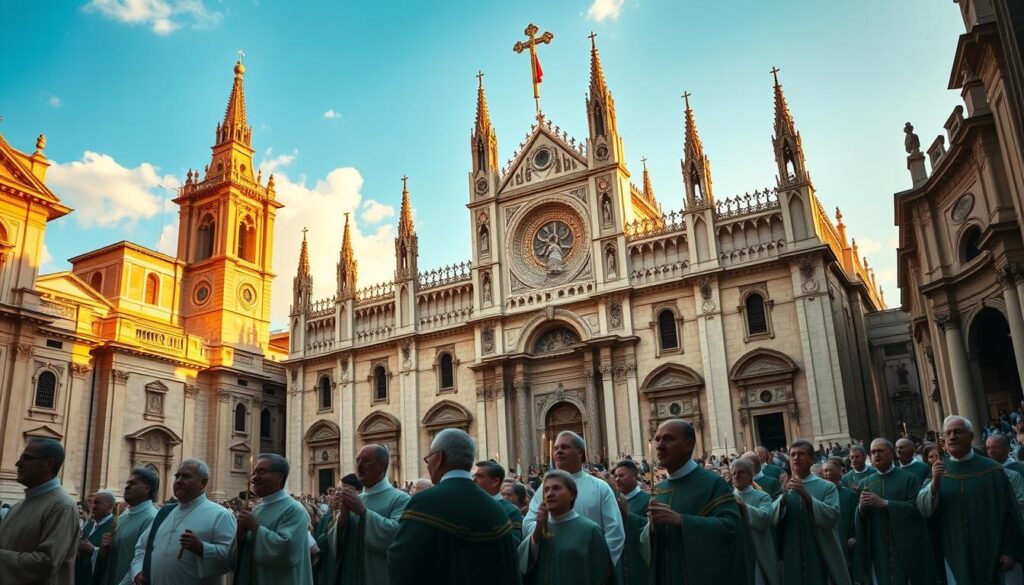
A grand cathedral in the Italian Renaissance style, its ornate facade bathed in warm, golden light. Towering spires and intricate stone carvings reaching towards the heavens, symbolizing the enduring legacy of the Catholic Church. In the foreground, a procession of robed clergy, each holding a ceremonial candle, their faces solemn and reverent. In the background, a tapestry of historic moments unfolds - the coronation of a pope, the signing of an important edict, the construction of a new basilica. The scene radiates a sense of timelessness and tradition, capturing the rich tapestry of Catholic history.

Early Church Foundations and Apostolic Traditions

The first-century Christian community transformed rapidly after Christ’s crucifixion. Acts of the Apostles shows disciples evolving from frightened outcasts to organized missionaries. By 100 CE, leadership structures emerged to maintain doctrinal unity across growing congregations.

Emperor Constantine’s 313 CE Edict of Milan marked a turning point. Legal recognition allowed public worship spaces and standardized rituals. Early councils like Nicaea (325 CE) established foundational creeds still recited today.

Milestone Events: Second Vatican Council and Beyond

The 20th-century Second Vatican Council revolutionized Catholic engagement with modernity. Over four years (1962-1965), 2,800 bishops reimagined the Church’s role in a changing world. Key shifts included:

  • Recognizing truth in non-Christian religions
  • Promoting worship in local languages
  • Encouraging collaboration with other faiths

This historic gathering bridged ancient traditions with contemporary challenges. Its documents continue guiding the Church through 21st-century social and technological changes.

What is Catholicism Beliefs

The Holy Trinity stands as the bedrock of Roman Catholic theology. This doctrine describes one God in three persons: Father, Son, and Holy Spirit. Early Christians struggled to explain this mystery, leading to councils that shaped foundational creeds.

“I believe in God, the Father Almighty… and in Jesus Christ, His only Son… conceived by the Holy Spirit.”

– Apostles’ Creed

Roman Catholic teachings emphasize Jesus Christ as fully divine and human. His death and resurrection form the ultimate sign of God’s love, offering salvation from original sin. This inherited condition traces back to Adam and Eve’s disobedience, creating humanity’s need for redemption.

Key Doctrine Purpose Daily Impact
Grace Divine assistance for holiness Guides moral choices
Resurrection Bodily renewal at world’s end Offers hope beyond death
Faith & Works Path to eternal life Inspires service to others

Through sacraments and prayer, adherents seek transformation. The Church teaches that good works express faith, unlike Protestant views on salvation. This balance shapes everything from charity work to personal ethics.

Eternal life remains the ultimate goal, with Christ’s second coming as the final fulfillment. These teachings unite 1.3 billion believers across cultures, creating shared purpose amid diverse traditions.

Structure and Organization of the Church

The organizational framework of the Roman Catholic Church combines spiritual leadership with intricate governance systems. At its peak stands the Pope, recognized as Christ’s earthly representative. This pyramid-like structure ensures unified guidance for millions while accommodating regional diversity through local dioceses.
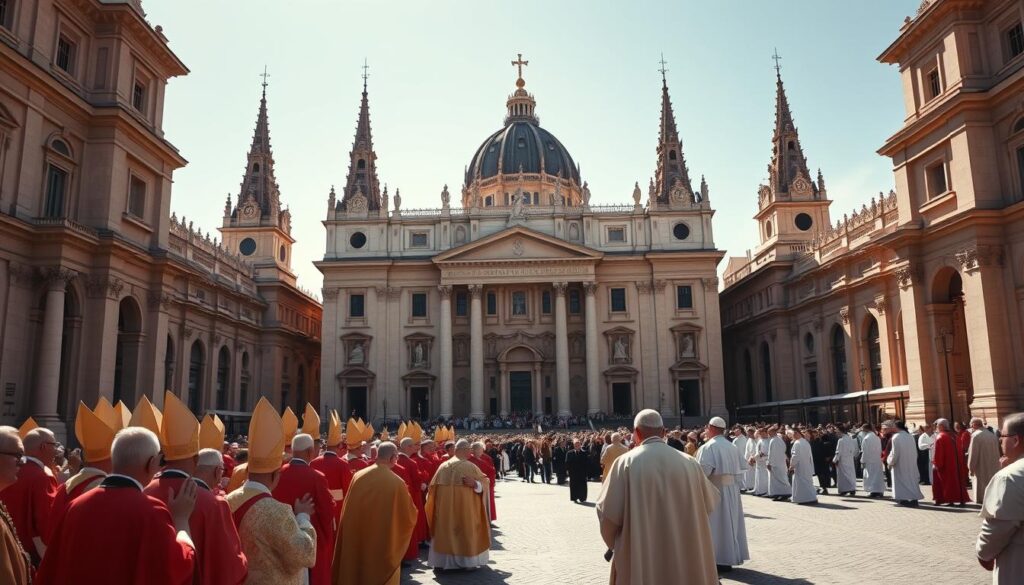
A grand cathedral in the Gothic architectural style, its towering spires and ornate facades casting long shadows across a sunlit plaza. In the foreground, a procession of clergy in ceremonial robes - bishops, cardinals, and at the center, the Pope, radiating an aura of authority and spiritual power. The middle ground reveals a bustling scene of parishioners, their faces upturned in reverence, while the background is dominated by the imposing, tiered structure of the church hierarchy, each level representing the distinct roles and responsibilities within the Catholic faith. Crisp, realistic lighting illuminates the intricate details, conveying a sense of timeless tradition and the enduring influence of the Catholic Church.

Papal Authority and the Holy See

The Pope’s authority stems from apostolic succession, granting him jurisdiction over doctrine and morals. Vatican City serves as his operational base, housing the Roman Curia – a network of departments managing global operations. Key divisions include:

Curial Department Focus Area Global Impact
Congregation for Clergy Priest training Ensures pastoral care standards
Dicastery for Evangelization Missionary work Expands Church presence
Doctrinal Office Faith integrity Guards theological consistency

Cardinals serve as the Pope’s closest advisors, wearing distinctive red attire symbolizing readiness to defend faith. Their most critical duty unfolds during papal elections, where they gather in the Sistine Chapel’s sealed conclave.

Hierarchical Roles: Cardinals, Bishops, and Clergy

Archbishops oversee provinces containing multiple dioceses, while bishops manage individual regions. Parish priests form the frontline, administering sacraments and guiding communities. The Church maintains celibacy requirements for clergy, viewing total devotion as essential for effective ministry.

Deacons support priests in liturgical and charitable tasks, often handling community outreach. Laypeople complete this structure, participating through worship and volunteer roles. Together, these orders create a living network sustaining Catholicism’s global mission.

Catholic Sacraments, Doctrines, and Traditions

Sacred rituals shape the rhythm of Catholic life, marking spiritual milestones from birth to eternal rest. These practices unite communities through visible expressions of faith while nurturing personal connections with the divine.
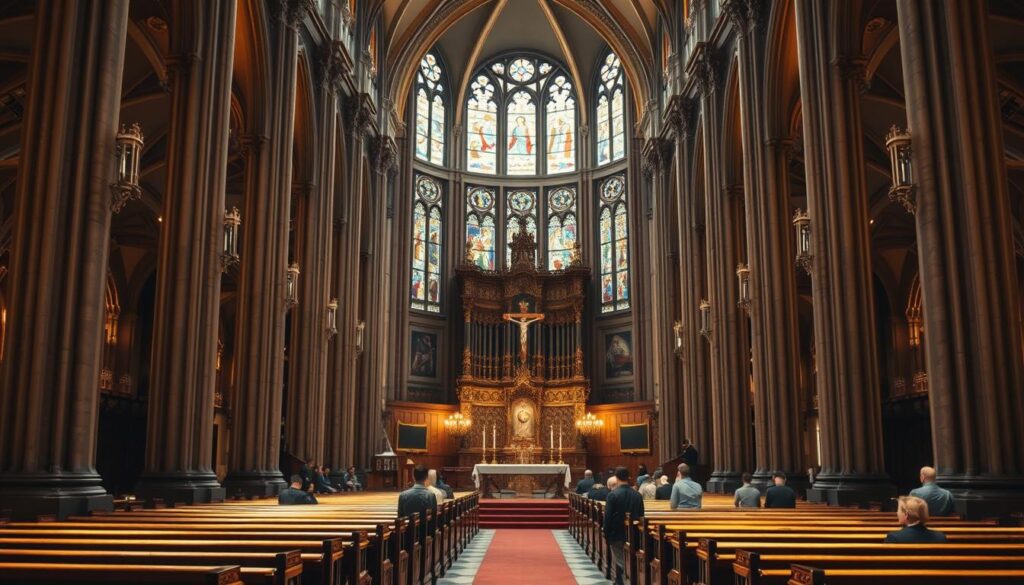
A grand cathedral interior, bathed in warm, reverent lighting. At the center, an ornate altar adorned with sacred symbols - chalices, candles, and a crucifix. Rows of wooden pews stretch out before it, as worshippers kneel in quiet contemplation. Stained glass windows cast a kaleidoscope of colors, evoking the holy sacraments - baptism, communion, confession, confirmation, marriage, and the anointing of the sick. Towering columns support the vaulted ceilings, their intricate carvings and mosaics depicting the stories of Catholic faith. An atmosphere of solemn reverence and timeless tradition pervades the scene, inviting the viewer to experience the rituals and beliefs at the heart of Catholicism.

The Seven Sacraments Explained

Seven sacred rites guide believers through life’s pivotal moments. Each serves as a visible sign of spiritual grace, rooted in Christ’s teachings. Here’s how they function:

Sacrament Purpose Key Symbol
Baptism Cleanse original sin Holy water
Confirmation Strengthen faith Chrism oil
Eucharist Divine nourishment Consecrated bread
Reconciliation Moral renewal Absolution words
Marriage Lifelong union Wedding rings
Holy Orders Clergy dedication Laying on hands
Anointing Healing comfort Blessed oil

Distinctive Doctrinal Beliefs and Practices

The Eucharist stands central to worship. Catholics believe in transubstantiation – bread and wine becoming Christ’s actual presence during Mass. This miracle occurs through priestly consecration prayers passed down through centuries.

Confession maintains spiritual health. Believers confess sins to priests, receiving absolution through Christ’s authority. This practice emphasizes accountability and renewal.

Rituals, Rites, and the Role of Saints

Liturgical seasons like Advent and Lent structure the year with fasting and reflection. Saints serve as heavenly allies, their feast days inspiring acts of service. Many parishes host processions honoring local patron figures.

Rosary prayers and candlelit vigils create tangible connections to the sacred. These traditions blend ancient symbolism with modern devotion, engaging both mind and senses in worship.

Modern Impacts and Social Teachings

Today’s Catholic Church navigates complex global challenges while upholding timeless values. Its social teachings address systemic inequality, advocating for human dignity across economic and political systems.

Justice Beyond Borders

For over 130 years, papal encyclicals have shaped a distinctive approach to fairness. From workers’ rights to climate action, these documents challenge structures harming vulnerable populations. Pope Leo XIV revitalized this mission, telling young Catholics they embody hope for “a different world.”

Recent efforts focus on bridging wealth gaps between nations. The Church promotes ethical trade practices and supports displaced communities through global networks. This work reflects core principles of solidarity and shared responsibility.

Balancing Tradition and Reality

While teachings on family life remain clear, daily practice often varies. Over half of U.S. Catholics report using contraception despite official guidance. Many still value spiritual traditions while adapting to modern relationship norms.

Youth engagement offers new energy. Massive gatherings with Pope Leo XIV show younger generations embracing social justice causes. They’re reimagining faith’s role in tackling issues like digital ethics and environmental care.

Through this dynamic interplay, the Church continues shaping global conversations. Its ability to unite ancient wisdom with contemporary needs keeps its message relevant across cultures and generations.

FAQ

How does the Roman Catholic Church define papal authority?

The papacy is central to Catholicism, with the Pope serving as the spiritual successor to Saint Peter. This doctrine emphasizes unity under the Holy See, guiding teachings on faith, morals, and church governance.

What role do sacraments like Baptism and Communion play?

Sacraments like Baptism and Eucharist are sacred rituals that mark key moments in a believer’s journey. They’re seen as visible signs of God’s grace, fostering spiritual growth and community bonds.

How did the Second Vatican Council change Catholic practices?

The Second Vatican Council (1962–1965) modernized traditions, encouraging active participation in the liturgy and interfaith dialogue. It shifted focus to social justice while preserving core doctrines like apostolic succession.

Why is social justice emphasized in Catholic teachings?

Rooted in Jesus Christ’s teachings, the Church advocates for dignity, equality, and care for marginalized groups. Encyclicals like Pope Francis’ *Laudato Si’* highlight environmental stewardship and poverty alleviation.

What distinguishes Roman Catholicism from other Christian denominations?

Key differences include belief in papal infallibility, devotion to Mary and saints, and adherence to seven sacraments. The Magisterium (teaching authority) also ensures doctrinal consistency across global parishes.

How does apostolic succession shape church hierarchy?

Bishops, ordained through holy orders, trace their authority back to the original apostles. This unbroken chain ensures continuity in teachings, rituals, and leadership roles like cardinals and clergy.

Are saints still relevant in modern Catholic worship?

Saints serve as intercessors and role models, celebrated through feast days and personal devotions. Figures like Saint Francis of Assisi inspire actions aligned with the Church’s social gospel.
Marriage in Catholicism: Understanding the Traditions


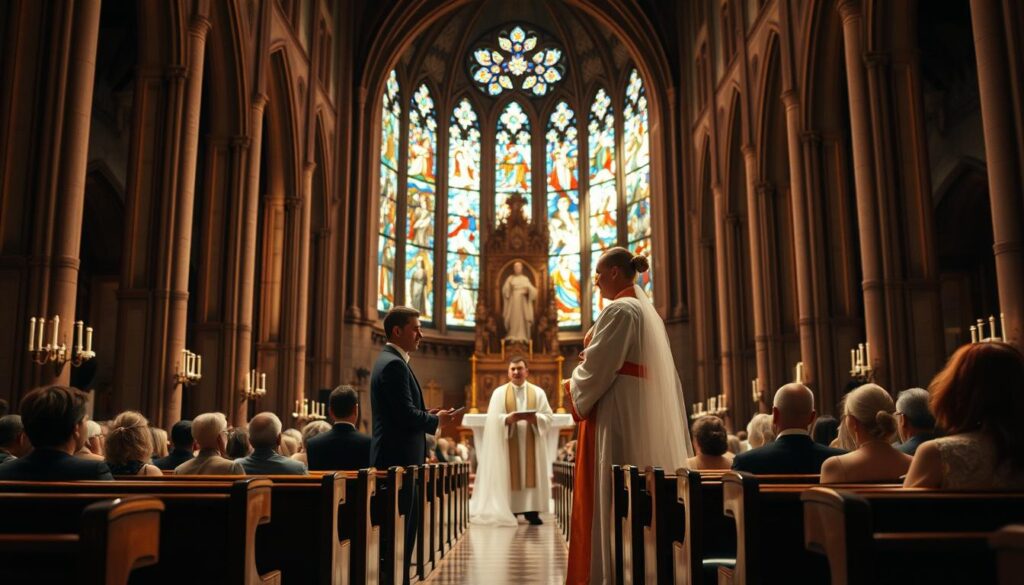
When two people commit to a lifelong partnership through the Catholic Church, they’re embracing more than a ceremony. This sacred union represents a faith-based covenant rooted in centuries of spiritual practice. Unlike civil unions, Catholic matrimony is viewed as a sacramental bond blessed by Christ—a promise that extends beyond legal agreements.

The Church teaches that this partnership serves two purposes: supporting each other’s growth and nurturing children in the faith. Even when one spouse isn’t Catholic, the sacrament remains valid with proper preparation. Many couples find comfort in knowing their vows are woven into a larger spiritual tapestry.

Preparation often includes guidance from clergy and discussions about shared values. These steps ensure both partners understand the depth of their commitment. By focusing on mutual respect and divine purpose, the tradition creates a foundation built to last.

Key Takeaways

  • Catholic matrimony is a sacrament, emphasizing spiritual unity over legal formalities.
  • The Church recognizes unions between Catholics and non-Catholics with proper approvals.
  • Preparation involves faith-based counseling to strengthen the couple’s bond.
  • Marriage serves dual roles: supporting spouses and raising children in the faith.
  • Vows are seen as lifelong commitments blessed by Christ.

Foundational Beliefs and Historical Background

Early Christian communities navigated complex views about partnerships. While Jewish traditions honored unions as vital to adult life, new debates emerged. Some groups like Gnostics rejected physical bonds entirely, prompting church leaders to defend the sacredness of husband-wife commitments.

Early Christian Perspectives and Practices

Saint Paul’s letters reveal fascinating tensions. He praised celibacy but acknowledged practical realities: “It is better to marry than to burn with passion.” For centuries, couples exchanged vows anywhere—no priests or churches required. Mutual consent formed the core of these bonds.

Church Fathers like Augustine later shaped theology. They affirmed unions as good yet elevated celibacy for those called to it. This duality influenced teachings for generations, balancing spiritual ideals with human needs.

The Evolution of Church Matrimonial Traditions

By medieval times, structured ceremonies began replacing informal agreements. Communities sought clearer guidelines to protect sacred promises. Over 1,000 years, simple verbal contracts grew into liturgical celebrations witnessed by clergy and congregations.

This shift reflected deeper values. Public ceremonies emphasized accountability, while preparation programs emerged to strengthen couples’ faith foundations. Today’s traditions honor this legacy—blending ancient wisdom with modern support systems.

Exploring marriage in catholicism: Sacrament and Sacred Practices

A solemn Catholic marriage ceremony takes place in a grand cathedral. In the foreground, the bride and groom stand before a robed priest, exchanging vows with reverent expressions. The couple is bathed in warm, soft lighting, capturing the sacred and intimate nature of the occasion. In the middle ground, rows of wooden pews are occupied by family and friends, their faces serene and attentive. Stained glass windows line the walls, casting a kaleidoscope of colored light that imbues the scene with a mystical, otherworldly ambiance. The towering, ornate altar stands as the focal point, symbolizing the divine presence and the gravity of the sacrament being celebrated.

At the heart of Catholic unions lies a sacred act that transforms vows into something eternal. This sacrament isn’t just a ritual—it’s a divine bond recognized as one of the Church’s seven pillars of faith. Unlike ordinary events, these ceremonies weave spiritual meaning into every gesture and word.

The Significance of the Sacrament in Catholic Wedding Ceremonies

A sacramental marriage reflects Christ’s unwavering love for His followers. It’s a covenant, not a contract—a promise upheld by faith rather than legal terms. Contracts expire; covenants endure.

This distinction shapes how couples prepare. They explore shared spiritual goals with clergy, ensuring their partnership aligns with Church teachings. The ceremony itself includes ancient prayers and blessings, linking modern pairs to generations past.

Aspect Covenant Contract
Basis Divine promise Legal agreement
Duration Lifelong Time-bound
Focus Spiritual unity Material obligations

Understanding Sacred Spaces and Ritual Requirements

Every Catholic wedding must take place in a consecrated location—usually a parish church. These spaces symbolize God’s active role in the union. Beach weddings or backyard vows aren’t permitted without special approvals.

If one partner isn’t Catholic, bishops may allow the ceremony in another Christian church. But the site must still honor worship traditions. This rule preserves the sacrament’s sacred nature while respecting mixed-faith families.

By gathering in these holy settings, couples invite their community to witness and support their journey. The Church’s strict guidelines ensure every detail points toward eternity, not just the present moment.

Scriptural Foundations and Theological Insights

The Bible paints a vivid picture of sacred unions, starting with Adam and Eve’s partnership in Genesis and ending with Revelation’s celestial wedding imagery. This narrative arc reveals God’s design for lifelong bonds—a theme echoed across prophets, psalms, and Christ’s teachings.

Biblical Basis of Marriage and Nuptial Blessings

Genesis describes the first union as two becoming “one flesh,” while Ephesians 5 compares husband-wife love to Christ’s devotion to His followers. The Catechism reinforces this: “God himself is the author of marriage,” crafting it as a divine blueprint for human connection.

Jesus elevated these bonds during the Wedding at Cana, performing His first miracle to honor a couple’s celebration. His presence there underscores the sacredness of family life. For two baptized partners, their vows mirror Christ’s eternal promise to the Church.

Biblical Event Symbolic Meaning Modern Application
Creation of Eve Unity in diversity Spouses complementing each other
Wedding at Cana Divine blessing Grace for daily challenges
Ephesians 5 Sacrificial love Putting family needs first

Roles of Jesus and the Church in Defining Marriage

Through His teachings, Jesus transformed simple partnerships into sacramental covenants. The Church upholds this vision by guiding couples through preparation programs. These sessions often explore how to raise children in faith while nurturing mutual spiritual growth.

Nuptial blessings during ceremonies remind everyone present: “This union symbolizes Christ’s bond with the Church.” By living out this calling, families become living testimonies of God’s love—a truth as relevant today as in biblical times.

Navigating Practical Steps for a Catholic Wedding

Planning a Catholic wedding involves both spiritual preparation and practical steps. Understanding these requirements early helps couples create meaningful celebrations while honoring church traditions.

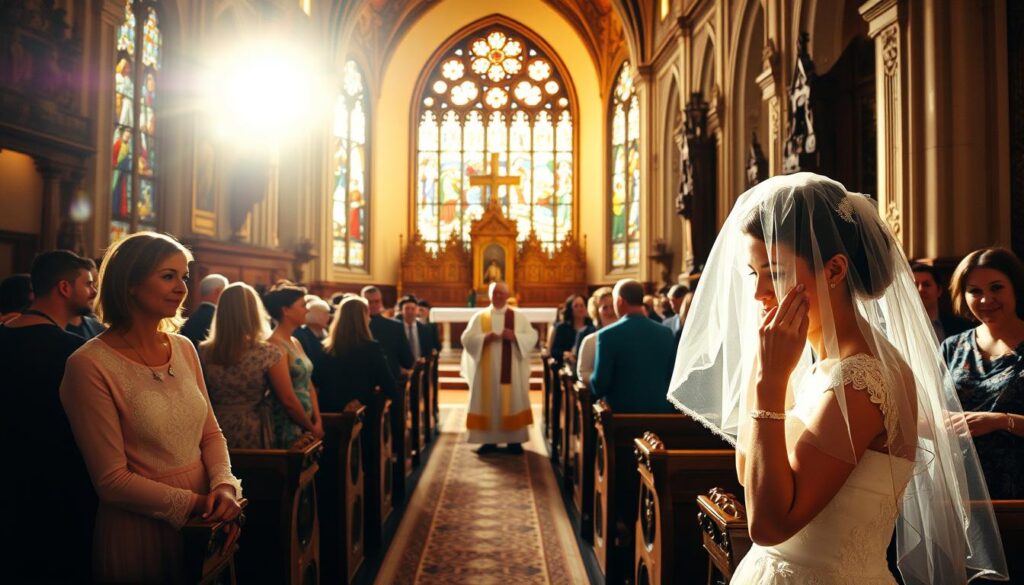
A sunlit, ornate Catholic church interior, with intricate stained glass windows and ornate wooden pews. In the foreground, a bride carefully adjusts her delicate lace veil, surrounded by attendants helping with the final touches on her elegant white gown. In the middle ground, a priest stands before an ornate altar, preparing for the ceremony. In the background, family members and guests arrive, their faces filled with anticipation and joy. The scene is bathed in warm, golden lighting, creating a sense of reverence and solemnity.

Initial Church Contact and Wedding Planning

The first step for those who want to get married is contacting their parish immediately after engagement. Many churches require at least six months of preparation—so reach out before booking venues or setting dates. This timeline allows time for paperwork, counseling, and spiritual growth.

Flexibility exists in where you complete marriage preparation. Students often finish requirements at their college parish but get married in their hometown church. This approach works well for couples managing transitions or long-distance planning.

Marriage Preparation and Documentation Requirements

Preparation goes beyond administrative tasks. Programs typically include mentorship from priests or deacons, discussions about faith roles, and tools for conflict resolution. Couples explore how to maintain spiritual unity, especially with a non-Catholic spouse.

Key promises include raising children in the Catholic faith. While conversion isn’t required, both partners must respect this commitment. In the U.S., the sacramental ceremony also serves as the legal union—no separate civil marriage needed.

By following these steps, many couples find the process strengthens their relationship. It transforms wedding planning from a checklist into a journey of shared purpose.

Conclusion

Building a life together through the Church’s sacramental vision transforms daily love into sacred purpose. This journey invites couples to grow not just as partners but as witnesses to divine grace in ordinary moments.

The Church’s preparation process—from mentorship to promises about raising children—creates guardrails, not barriers. These steps help pairs build resilience, whether navigating interfaith dynamics or family planning decisions.

While Confirmation isn’t mandatory, embracing sacraments like it unlocks deeper spiritual tools. Grace flows freely when hearts remain open to growth, both during the ceremony and beyond.

Every vow taken in a Catholic faith community ripples outward. By nurturing their bond, spouses strengthen families and inspire others. What begins at the altar becomes a lifelong call to reflect Christ’s love through service and joy.

For those considering this path: the traditions aren’t about rules. They’re about writing your story into the Church’s eternal narrative—one rooted in hope, purpose, and belonging.

FAQ

Why is a Catholic wedding considered a sacrament?

The Church views matrimony as a sacred covenant reflecting Christ’s bond with His followers. This sacramental union invites couples to grow in faith together while receiving divine grace to strengthen their lifelong commitment.

Can a Catholic marry someone who isn’t baptized?

Yes, but it requires permission from the local bishop. The Catholic partner must promise to uphold their faith and strive to raise children within the Church. Open communication with clergy early in planning is key.

What’s involved in marriage preparation programs?

Often called “Pre-Cana,” these sessions address communication, conflict resolution, and spiritual growth. Many parishes also require assessments like FOCCUS to help couples explore shared values and goals before their big day.

Are outdoor ceremonies allowed in the Catholic faith?

Typically, weddings must occur inside a consecrated space like a parish church. However, some dioceses grant exceptions for outdoor settings with prior approval from the bishop. Always consult your priest first.

How does annulment differ from divorce?

An annulment examines whether essential elements for a valid sacramental union were present at the time of the wedding. It’s a Church process, not a legal one, and doesn’t affect civil divorce status.

What if one spouse isn’t Catholic?

Interfaith unions are possible with a dispensation. The non-Catholic partner doesn’t need to convert, but both must respect each other’s beliefs. Many parishes offer resources to help navigate spiritual differences.

How long does planning a church wedding usually take?

Most dioceses recommend starting 6–12 months ahead. This allows time for preparation courses, completing paperwork like baptismal certificates, and coordinating with the parish’s event calendar.

Catholicism Around the World: A Country-by-Country Guide


Welcome to a journey through one of humanity’s most enduring spiritual traditions. This guide offers a fresh look at how faith unites millions across borders while adapting to local customs. From bustling cities to remote villages, you’ll see how communities celebrate shared beliefs in strikingly different ways.

Did you know Brazil has more followers of this faith than any other nation? Or that the Philippines hosts Asia’s largest community? We’ll explore these demographic trends and uncover what makes each region’s practices unique. You’ll learn how colonial history shaped rituals in Latin America and why African nations are experiencing rapid growth.

Modern challenges like urbanization and shifting social values add new layers to ancient traditions. Yet annual events like Holy Week still draw massive crowds worldwide. This blend of timeless devotion and contemporary life makes the faith’s story endlessly fascinating.

Key Takeaways

  • Brazil and Mexico lead in total followers, while Vatican City remains the spiritual hub
  • Cultural fusion creates distinct celebrations, from Mexican Día de los Muertos to Italian feast days
  • Over 40% of all Christians identify with this tradition globally
  • Colonial history continues to influence religious practices across three continents
  • Urban centers increasingly shape how younger generations engage with spiritual heritage

Overview of Global Catholicism

With roots stretching back two millennia, this spiritual tradition now connects 1.39 billion people worldwide. Its growth began when early missionaries planted seeds of belief in ancient Rome – a story written in courage and sacrifice.

Historical Foundations and Early Growth

The apostles Peter and Paul brought their message to Rome’s streets in the first century. Their martyrdom sparked a movement that would outlive emperors. Centuries later, a decisive partnership formed when Pope Leo III crowned Charlemagne in 800 AD. This union of crown and cross fueled the Holy Roman Empire’s expansion.

Church leaders adapted Roman roads and trade routes to spread their teachings. Monastic communities became hubs of learning and culture. By the 13th century, Gothic cathedrals rose skyward – stone testaments to growing influence.

Key Milestones in Church History

Four landmark events shaped modern practice:

  • 325 AD: Council of Nicaea defined core beliefs
  • 1054: East-West split created new branches
  • 1545: Counter-Reformation addressed criticisms
  • 1962: Vatican II updated rituals for modern times

These turning points show how the church balances tradition with change. As one historian noted: “Ancient rituals meet new challenges while keeping the essence intact.” Today’s global network reflects two thousand years of adaptation – and counting.

Exploring “catholicism by country”

From adobe chapels in the American Southwest to royal courts in medieval Europe, faith traditions took unique shapes across borders. Let’s explore how geography and history created distinct spiritual landscapes.

A sweeping global map of Catholicism, illuminated by intricate stained glass-inspired overlays depicting the religious practices and cultural traditions of different countries. The foreground features a central world map, with glowing icons and symbols representing the presence and influence of Catholicism across diverse nations. The middle ground showcases detailed, stylized vignettes of iconic Catholic architecture, festivals, and religious ceremonies from various regions. The background is a rich tapestry of ornate, kaleidoscopic patterns and textures, evoking the vibrant diversity and shared heritage of the faith. Soft, warm lighting imbues the scene with a sense of reverence and timelessness, inviting the viewer to explore the global reach and local expressions of Catholicism.

Historical Milestones in Different Nations

Early Spanish settlers constructed San Miguel Chapel in 1610 – now the oldest standing church in the U.S. This adobe structure became a cornerstone for North American spiritual life. Meanwhile, Poland’s 966 AD conversion under King Mieszko I forged a national identity still visible today.

Region Key Event Impact
Philippines 1521 royal conversion Asia’s largest Catholic population
Mexico 16th-century missions 90% Catholic majority today
DR Congo 20th-century growth 35 million+ followers

Modern Demographic Shifts

While European church attendance declines, Africa’s faithful multiply rapidly. Nigeria gained 20 million adherents since 2000. Brazil remains a stronghold with 123 million followers, though Pentecostal groups now challenge this dominance.

Urbanization reshapes practices too. Younger generations blend ancient rituals with digital prayer groups. As one Vatican observer noted: “The faith survives not through rigidity, but by breathing with each culture it touches.”

Top Catholic Populations: Data and Trends

Numbers tell powerful stories about faith’s global footprint. Let’s explore where ancient traditions meet modern demographics through fresh statistics and surprising patterns.

National Figures That Define Faith

Brazil wears the crown with 105.3 million adherents – more people than Germany’s total population. Mexico follows closely with 91.2 million, while the Philippines completes the top trio at 86 million. These numbers reveal colonial history’s lasting impact:

  • Italy maintains Europe’s strongest presence (42 million)
  • Vatican City claims 100% affiliation
  • Equatorial Guinea surprises with 93.52% adherence

Beyond Headcounts: Active Participation

Total numbers only paint part of the picture. Weekly Mass attendance shows where faith burns brightest:

Nation Weekly Attendees % of Total
Philippines 47 million 55%
Mexico 45 million 49%
DR Congo 37.5 million 87%

This data spotlights Africa’s rising influence. While Europe claims high percentage rates, active participation increasingly thrives south of the equator. As one demographer notes: “Faith’s heartbeat now pulses strongest in tropical latitudes.”

Urbanization reshapes traditions too. Young Brazilians blend smartphone apps with candlelit processions, proving ancient practices adapt to new realities. The numbers confirm – spiritual vitality flows where cultures embrace change while honoring roots.

Cultural and Historical Influences on the Church

Powerful partnerships between rulers and religious leaders forged lasting spiritual legacies. These collaborations shaped art, laws, and daily life across continents, leaving fingerprints we still see today.

The Legacy of the Holy Roman Empire

When Pope Leo III placed the crown on Charlemagne’s head in 800 AD, history changed course. This church-state partnership became a blueprint for spreading faith through political power. The Holy Roman Empire’s reach extended from European castles to African coastlines.

A majestic cathedral stands tall, its Gothic architecture soaring towards the heavens. Sunlight filters through stained glass windows, casting a warm, reverent glow upon the intricate carvings and ornate altars within. In the foreground, worshippers kneel in prayer, their devotion palpable in the hushed silence. The middle ground reveals ornate pews and elaborately decorated walls, a testament to the Catholic Church's cultural and historical influence. The background is a tapestry of towering spires and buttresses, the very embodiment of the Holy Roman Empire's enduring ecclesiastical power.

Missionaries traveled protected trade routes, building chapels where Roman roads once ended. By the 13th century, Gothic cathedrals stood where pagan temples had fallen. The empire’s support helped create:

Region Historical Event Lasting Impact
Central Europe Carolingian Renaissance Monastic schools preserved knowledge
Congo Basin 1491 royal conversion 35 million+ adherents today
New Spain 16th-century missions Fusion of indigenous/Christian art

Colonial Impacts and Indigenous Traditions

European empires carried their faith like seeds, planting churches from Quebec to Manila. French colonizers left lasting marks in Vietnam’s cathedrals and Louisiana’s Mardi Gras. But local cultures grew through the cracks.

In the Congo River basin, Portuguese missionaries found unexpected success. After converting King João I’s family, his successor declared: “Our land shall mirror Rome’s devotion.” Today, vibrant processions blend ancestral drums with Latin hymns.

This cultural mixing created unique traditions:

  • Mexican Day of the Dead altars with saints’ statues
  • Filipino Simbang Gabi dawn masses with rice cakes
  • Haitian Vodou ceremonies honoring Catholic saints

Modern leaders increasingly recognize these blends as strength, not compromise. As one Vatican scholar noted: “Faith becomes universal when it speaks every culture’s language.”

Spotlight on Leading Nations in Catholic Traditions

Global faith communities thrive through unique cultural expressions. These six nations demonstrate how spiritual traditions evolve while maintaining core beliefs, creating vibrant tapestries of worship.

A grand cathedral's towering spires pierce the sky, surrounded by bustling city streets teeming with life. In the foreground, a procession of robed clergy and faithful parishioners wind through the cobblestone plaza, their solemn expressions conveying the gravity of their devotion. Sunlight filters through stained glass windows, casting a warm, reverent glow over the scene. In the distance, other iconic Catholic landmarks - basilicas, monasteries, and cathedrals - dot the hilly urban landscape, united in their representation of the faith's enduring influence. An aura of tradition, history, and spiritual contemplation permeates the image, capturing the essence of leading Catholic nations on the global stage.

Powerhouses of Devotion

Brazil’s 105.3 million adherents form the largest Catholic population worldwide. Rainforest villages blend indigenous rituals with sacraments, while Rio’s Christ the Redeemer statue watches over soccer-crazed cities. Local festivals often feature samba processions alongside traditional hymns.

Mexico’s 91.2 million faithful showcase ancient roots. Mayan-inspired altars for Día de Muertos display skull-shaped sweets beside saint statues. Mariachi bands regularly perform Las Mañanitas during feast days, filling plazas with trumpet-led tributes.

The Philippines stands out in Asia with 86 million followers. Text message prayer chains circulate daily, and Manila’s 16th-century churches host smartphone-lit candle offerings. “Faith here moves as fast as our internet,” notes a Manila archdiocese spokesperson.

Contrasts in Practice

North America’s United States presents surprises – 67 million adherents maintain vibrant parishes despite Protestant majorities. Mega-churches share neighborhoods with historic cathedrals, reflecting religious diversity.

Italy’s 42 million Catholics preserve centuries-old traditions. Vatican-linked art restorers work beside nuns brewing espresso in monastery cafés. Meanwhile, the Democratic Republic Congo’s 37 million followers fuel growth through coffee trade profits funding rural chapels.

Nation Unique Feature Community Impact
Brazil Amazon rituals 65% attend monthly Mass
DR Congo Coffee-funded churches 87% weekly attendance
Philippines Digital prayer networks 92% self-identify as Catholic

Catholicism’s Evolving Role in Modern Society

Spiritual landscapes are shifting faster than ever. The Catholic Church now navigates a world where ancient traditions meet modern skepticism. While some regions see vibrant growth, others face unprecedented tests of relevance.

When Numbers Tell Two Stories

Germany’s 22.1 million adherents paint a complex picture. Only 14% attend weekly services – that’s 3.1 million actively practicing. Contrast this with the Netherlands, where 35% identified with the faith last century. Today? Just 17% remain.

Brazil’s situation highlights another paradox. Home to the world’s largest Catholic population, only 8% regularly attend Mass. Urbanization and alternative spiritual movements reshape engagement patterns globally.

Yet adaptation continues. Digital ministries now reach millions, while social justice initiatives address contemporary concerns. As one Vatican leader recently observed: “Our challenge isn’t counting believers, but making belief count.”

FAQ

Which country currently has the largest Catholic population?

Brazil holds the world’s largest Catholic population, with over 120 million followers. Mexico and the Philippines follow closely, reflecting strong historical ties to European missionary efforts.

How did the Holy Roman Empire shape Catholic traditions in Europe?

The Holy Roman Empire unified political and religious power, spreading Latin liturgy and church governance. This legacy still influences practices in Germany, Austria, and parts of Central Europe today.

What role did colonization play in spreading Catholic communities globally?

Spanish and Portuguese colonizers established missions across Latin America, Africa, and Asia. These efforts blended European rituals with local customs, creating unique traditions in places like the Democratic Republic of Congo and Peru.

How is the United States’ Catholic community evolving?

While the U.S. has over 70 million Catholics, attendance has declined since 2000. Immigration from Latin America and the Philippines now drives growth, reshaping parish dynamics.

Why does Italy remain central to Catholic identity despite secularization trends?

Italy hosts Vatican City, the Church’s spiritual headquarters. Pilgrimages to Rome and traditions like Easter celebrations keep Catholicism deeply woven into national culture, even as secular attitudes rise.

How do indigenous practices influence Catholicism in countries like Mexico?

Mexican traditions like Día de los Muertos (Day of the Dead) blend pre-Hispanic rituals with Catholic feast days. This syncretism appears in art, festivals, and local patron saint devotions.

What challenges does the Church face in maintaining its global presence?

Secularism, clergy shortages, and demographic shifts test growth. However, Africa’s rising Catholic population—projected to reach 460 million by 2050—offers a counterbalance to declines in Europe.

Unraveling the Divide: Greek Orthodox vs. Catholicism


Christianity’s rich history holds many stories of unity and division. Among the most significant splits occurred nearly a thousand years ago, shaping two major branches of the faith. This separation wasn’t sudden but grew from centuries of evolving cultural, linguistic, and theological perspectives.

Despite their shared roots in early Christianity, these traditions developed unique practices and beliefs. The historical split in 1054 marked a turning point, driven by debates over leadership and doctrinal interpretations. Yet both branches still honor the same foundational teachings about Jesus, the Trinity, and sacraments.

Understanding their similarities and distinctions offers insight into how faith adapts across cultures. While one emphasizes centralized authority, the other values collective decision-making. These differences influence everything from worship styles to holiday celebrations.

This guide explores how these ancient paths diverged while maintaining core spiritual truths. You’ll learn how historical events shaped modern practices and why millions still cherish these traditions today.

Key Takeaways

  • Two major Christian branches separated in 1054 due to cultural and theological differences
  • Both share core beliefs like the Trinity and sacraments but differ in leadership structures
  • Language barriers and regional practices contributed to the division
  • Modern followers maintain distinct worship styles while honoring shared history
  • Understanding these traditions reveals Christianity’s cultural adaptability

Overview of Greek Orthodox vs Catholicism

Two ancient Christian paths share deep roots but walk distinct journeys. Their story begins with unity—centuries of collaborative decisions shaping core beliefs. By exploring their structures and shared history, we uncover how these traditions grew apart while keeping foundational truths intact.

Defining Each Tradition

The Catholic Church recognizes the Pope as its supreme leader, headquartered in Rome. This global community values centralized authority, with teachings flowing through a clear hierarchy. Over 1.3 billion followers participate in rituals like the Latin Mass, guided by unified doctrine.

Eastern Orthodox communities operate differently. Self-governing churches under regional patriarchs make collective decisions. Bishops hold equal standing, reflecting a “first among equals” approach. This structure preserves cultural diversity while maintaining theological consistency across nations.

Shared Foundations in Early Church Councils

Both traditions anchor their faith in seven historic councils from 325-787 AD. These meetings established critical doctrines about Christ’s dual nature and the Trinity. They also agreed on sacraments like baptism and communion, viewing them as sacred encounters with divine grace.

Veneration of saints, Mary’s role as God-bearer, and iconic art unite these branches. Yet differences emerge in interpreting authority—where one sees papal infallibility, the other emphasizes communal discernment. These nuances shape modern worship while honoring ancient roots.

Historical Foundations and Schisms

Religious splits often stem from slow-burning tensions rather than sudden clashes. By 751 AD, the Byzantine Empire’s retreat from Rome severed political ties that once united Christian regions. This separation allowed cultural and linguistic divides to deepen between Eastern and Western believers.

A dimly lit medieval cathedral, the intricate stained glass windows casting a warm glow over the ornate interiors. In the foreground, two robed figures stand in heated discussion, their gestures and expressions conveying the tension of a theological divide. Behind them, a crowd of worshippers observe the scene, their faces reflecting the gravity of the historical moment. The ambient lighting creates a sense of reverence and solemnity, as if capturing the very foundations of the Great Schism that would ultimately separate the Eastern and Western Christian traditions.

The Great Schism of 1054

What many call a single event was actually the boiling point of centuries-long disagreements. Language barriers proved critical—Greek thinkers and Latin scholars often misinterpreted each other’s theological terms. A famous example? The phrase “Filioque” (Latin for “and the Son”) sparked debates about the Holy Spirit’s origin, highlighting translation risks.

The roman catholic churches and eastern orthodox communities grew apart in governance styles too. While Rome centralized power under papal authority, Eastern leaders preferred collective decision-making among bishops. These structures reflected broader cultural values shaping their spiritual identities.

Factor Eastern Approach Western Approach
Language Greek theological terms Latin doctrinal texts
Governance Regional patriarchs Papal hierarchy
Theological Focus Mystical experience Legal precision

Political shifts also played a role. As Byzantium lost influence in the West, communication breakdowns made compromise harder. By 1054, differing views on the Pope’s position created an irreparable rift—one still felt across the Christian world today.

Doctrinal Beliefs and Theological Distinctions

How do ancient teachings stay relevant across centuries? Both traditions answer this question differently while upholding sacred truths. Their approaches to doctrine reveal contrasting visions of spiritual growth.

Core Doctrines in Each Tradition

The Roman Catholic perspective sees faith as a living seed. Leaders believe the Catholic Church matures in its understanding through the Holy Spirit’s guidance. This allows new teachings to emerge, like branches growing from an ancient tree.

In contrast, the Orthodox Church views doctrine as a preserved flame. Its essence remains unchanged since apostolic times. While language adapts, the core nature of truth stays fixed—like a gemstone cut to reflect light differently without altering its substance.

Development of Dogmas and Modern Critiques

Rome’s acceptance of doctrines like papal infallibility illustrates its developmental approach. These ideas aren’t seen as new creations but as clarified truths. Critics argue this risks adding layers not found in early Christianity.

Orthodox thinkers prioritize guarding mystery over systematizing beliefs. Doctrinal statements mainly define boundaries against heresy. As one theologian noted, “We don’t explain the fire—we simply mark the fireplace.” This philosophy maintains continuity with ancient practices while allowing cultural expression.

Authority and Church Governance

Leadership structures shape how communities grow and adapt. In Christianity, two distinct models define decision-making processes and spiritual direction. These systems reflect deep-rooted values about unity, diversity, and divine connection.

Papal Supremacy vs. First Among Equals

The pope holds unique status in one tradition, serving as the visible head of the global church. Teachings state he possesses universal jurisdiction, meaning his rulings apply to all believers worldwide. Decisions made officially (ex cathedra) are considered irreversible—even by councils.

Another perspective values collective wisdom. Leaders here honor a historical figure as “first among equals,” but no single bishop controls others. Regional churches govern themselves while maintaining shared beliefs. This approach keeps power distributed rather than centralized.

Role of Bishops and Ecumenical Councils

Councils play different roles in each system. One tradition sees them as advisory bodies that support papal authority. The other treats councils as the highest expression of church unity, where bishops collaborate as equals.

Key differences emerge in practice:

  • Centralized leadership vs regional independence
  • Final decisions resting with one person vs group consensus
  • Universal rules vs culturally adapted practices

Both systems aim to preserve spiritual truth while navigating human complexities. Their contrasting methods reveal diverse interpretations of ancient teachings about community and divine guidance.

Liturgical Traditions and Worship Practices

Worship styles reveal how communities express their deepest beliefs. While sharing ancient roots, two major Christian traditions developed unique approaches to sacred rituals over time. Their practices today reflect contrasting views on preserving tradition versus adapting to modern life.

A dimly lit sanctuary, bathed in the warm glow of flickering candles. In the foreground, a wooden table adorned with intricate liturgical icons depicting scenes from the life of Christ and the saints. Atop the table, a golden chalice and freshly baked bread, the centerpiece of the Greek Orthodox Eucharistic celebration. The middle ground reveals the ornate iconostasis, a partition screen adorned with sacred images, separating the sanctuary from the main worship space. In the background, the vaulted ceilings and ornate frescoes evoke a sense of timeless, reverent tradition. The scene conveys a solemn, contemplative atmosphere, inviting the viewer to experience the richness of Greek Orthodox liturgical practices.

Evolution of the Roman Catholic Mass

The Second Vatican Council (1962-1965) revolutionized worship for many believers. Priests began facing congregations rather than altars, while Latin gave way to local languages. These changes made services more accessible but created noticeable differences from pre-1900s practices.

Modern Catholic churches often feature contemporary music and simplified rituals. Unleavened communion bread remains central, symbolizing purity through its connection to Jewish Passover traditions. Children typically receive first communion around age seven, marking a conscious step in spiritual life.

Orthodox Liturgical Consistency and Use of Icons

Ancient chants and incense-filled spaces define worship in many Eastern communities. Icons adorn walls as visual prayers, believed to connect worshippers with heavenly realities. Leavened bread appears in communion, representing Christ’s living presence through its risen texture.

Infants receive sacraments immediately after baptism, emphasizing God’s grace as freely given. This practice contrasts with Western age-based milestones, showing different understandings of spiritual readiness. Through unchanged rituals, these churches maintain tangible links to early Christian worship patterns.

Key Controversies: The Filioque and Divine Procession

What difference can a single word make in shaping centuries of faith? The filioque debate reveals how linguistic choices can spark profound theological divides. This centuries-old disagreement centers on how believers describe the Holy Spirit’s origin—a detail with ripple effects across Christian thought.

A grand cathedral interior, ornate and reverential, dimly lit by shafts of golden light streaming through stained glass windows. At the center, two robed figures stand in animated debate, their gestures and expressions conveying the weight of the filioque controversy - the dispute over the procession of the Holy Spirit, a theological divide between Eastern Orthodox and Catholic Christianity. The background is shrouded in mysterious shadows, evoking the profound spiritual and historical significance of this schism. The scene is rendered with a sense of solemn gravity, inviting the viewer to ponder the complexities of this enduring theological dispute.

Understanding the Filioque Clause

The Latin term filioque (“and the Son”) first appeared in Western versions of the Nicene Creed around 6th-century Spain. By 1274, it became official Catholic teaching that the Holy Spirit proceeds from both the Father and Son. Eastern churches fiercely opposed this addition, arguing it altered Jesus’ explicit statement in John 15:26: “The Spirit… proceeds from the Father.”

Critics highlight two main concerns:

  • Changing creedal text without ecumenical approval
  • Risking imbalance in Trinitarian relationships

Implications for the Holy Trinity

At its core, this debate asks: Does the Spirit proceed from the Father alone or through both divine persons? One tradition worries this phrasing minimizes the Spirit’s distinct role. As a 20th-century theologian noted: “Trinity isn’t math—it’s a dance where each partner moves uniquely.”

Modern scholars suggest translation nuances play a role. The Greek ekporeuomenon implies ultimate origin, while Latin procedit allows broader interpretation. Though dialogue continues, this word remains a symbolic divide—proof that even shared faith can wear different cultural lenses.

Understanding the Role of the Holy Spirit and Grace

Grace, a cornerstone of Christian belief, is interpreted uniquely across traditions. These differences reveal how communities experience divine connection while honoring shared spiritual roots.

Two Views of Divine Influence

The Roman Catholic perspective describes grace as both uncreated (God’s presence) and created (a gift enabling merit). This dual understanding shapes practices like sacraments, where believers participate in God’s work through tangible means.

In contrast, the Orthodox Church teaches grace isn’t separate from God’s nature—it’s His active energies permeating creation. Following teachings from Gregory Palamas, they distinguish between God’s unknowable essence and His knowable actions. Grace becomes a living relationship rather than a transactional gift.

Both traditions agree grace transforms human life. But their approaches reflect distinct priorities: one emphasizes cooperation with divine will, while the other focuses on mystical union. These views continue shaping worship patterns and personal spirituality today.

FAQ

What caused the split between the Orthodox and Catholic Churches?

The Great Schism of 1054 resulted from disputes over papal authority, theological differences like the Filioque clause, and cultural divides between Eastern and Western Christianity.

How do views on the Holy Spirit differ between these traditions?

Catholics believe the Holy Spirit proceeds from the Father and the Son, while Orthodox Christians hold the Spirit proceeds from the Father alone—a key theological divide rooted in early Church debates.

Why does the Catholic Church emphasize papal supremacy?

Roman Catholicism teaches the Pope has universal jurisdiction as Christ’s successor, while Orthodox churches view bishops as equals, with the Patriarch being “first among equals” without absolute authority.

How do worship practices differ in these traditions?

Catholic Mass evolved with rituals like unleavened bread, while Orthodox liturgy retains ancient forms, including leavened bread and prominent use of icons as windows to the divine.

What is the Filioque controversy about?

The Filioque clause, added to the Nicene Creed by the Catholic Church, sparked conflict by altering the wording about the Holy Spirit’s origin—a change rejected by Orthodox leaders as unauthorized.

Do both traditions recognize the same sacraments?

Yes, both celebrate seven sacraments, like baptism and communion, but differ in practices—such as Catholic confirmation vs. Orthodox chrismation—and interpretations of grace’s role in salvation.

How do beliefs about Mary and saints compare?

Catholics affirm the Immaculate Conception of Mary as dogma, while Orthodox honor her purity without formalizing it as doctrine. Both venerate saints but approach intercession differently.

What role do ecumenical councils play today?

Catholics recognize 21 councils, including Vatican II, while Orthodox only accept the first seven, reflecting differing views on doctrinal development and church governance over centuries.

Is Purgatory a belief shared by both traditions?

No. Catholics teach purification in Purgatory before heaven, while Orthodox emphasize a soul’s journey after death without a defined intermediate state.

Can Orthodox and Catholics receive communion in each other’s churches?

Generally, no. Despite shared sacraments, the lack of full unity means intercommunion is rare, though dialogue continues to address these historic divisions.

Understand the Key Tenets of Catholicism


Welcome to a journey through the heart of Catholic teachings! At its core, this faith centers on love—for God, others, and oneself. The foundation rests on Jesus’ words in Matthew 22: “Love the Lord your God with all your heart” and “love your neighbor as yourself.” These aren’t rigid demands but invitations to deeper spiritual growth.

The Catechism of the Catholic Church explains how these commandments shape daily life. The Ten Commandments, for example, expand this love into practical guidance. The first three focus on honoring God, while the remaining seven foster respect for community. As Pope John Paul II noted, Church law exists to guide, not control—a compass for those seeking meaning.

Many assume the faith revolves around strict regulations. In reality, most guidance comes through pastoral support and timeless wisdom. Doctrine isn’t about restriction but clarity—a way to align actions with compassion. Theology here weaves grace and responsibility into a cohesive worldview.

With over a billion members globally, the Catholic Church emphasizes unity through shared values. Its teachings adapt ancient truths to modern challenges, offering tools for personal and communal flourishing. Whether you’re exploring or deepening your faith, this framework encourages growth, not guilt.

Key Takeaways

  • Catholic teachings prioritize love of God and neighbor as their foundation.
  • The Ten Commandments provide practical applications of these core values.
  • Church law serves as guidance, not a list of punishments.
  • Doctrine offers clarity and direction for ethical living.
  • Misconceptions about rigidity overlook the role of pastoral care.
  • The faith balances ancient traditions with modern relevance.

Core Beliefs and Doctrines in the Catholic Church

At the heart of Catholic teachings lie timeless principles that shape everyday life. These ideas aren’t just ancient texts—they’re living guides for building relationships with God and others. Let’s explore how foundational concepts like the Ten Commandments and Beatitudes remain deeply relevant today.

God’s Two Great Commandments and the Ten Commandments

The Catechism of the Catholic Church describes the Ten Commandments as “rules for freedom” (CCC 2057). The first three focus on loving God—like honoring His name and keeping Sundays sacred. The remaining seven teach us to love our neighbor through actions like respecting parents and protecting life.

For example, “You shall not steal” (CCC 2401) isn’t just about theft. It encourages fairness in workplaces and communities. These teachings aren’t rigid demands but invitations to create harmony. As Jesus taught, all commandments flow from loving God and others wholeheartedly.

Beatitudes and the Works of Mercy

The Beatitudes offer hope when life feels heavy. Phrases like “Blessed are the peacemakers” (Matthew 5:9) remind us that struggles can lead to spiritual growth. They pair perfectly with the Works of Mercy—practical ways to live these values.

Corporal Works like feeding the hungry or visiting the sick address physical needs. Spiritual Works, such as comforting the grieving or forgiving injuries, heal hearts. Together, they show how doctrine becomes action. As the Catechism notes, these works help “fulfill Christ’s command to love” (CCC 2447).

Through these teachings, the Catholic Church provides structure while empowering the faithful to serve creatively. Whether through daily kindness or lifelong commitments, every act of love builds a better world.

Essential catholicism rules for a Faithful Life

Building a meaningful spiritual life involves practical steps woven into daily routines. The Church offers clear precepts and sacramental milestones to help believers grow closer to God and their community.

A grand cathedral's interior, bathed in warm, reverent light from stained glass windows. In the foreground, ornate chalices, wafers, and candles symbolize the Catholic sacraments. Priests garbed in flowing robes administer these rites, their faces serene. In the middle ground, worshippers kneel in prayer, hands clasped, expressions of devotion. The background reveals a grand altar, adorned with intricate carvings and religious iconography, capturing the solemn grandeur of Catholic holy days.

Overview of the Precepts of the Church

These five guidelines create a rhythm for spiritual health. They’re like guardrails—keeping us focused without limiting our journey. Here’s what they look like:

Precept Purpose
Sunday Mass & holy days Strengthens community ties
Annual confession Renews spiritual clarity
Easter Communion Deepens connection to Christ
Fasting/abstinence Builds self-discipline
Church support Fuels global outreach

For example, resting on Sundays isn’t about strict rules. It’s a chance to recharge and reflect. As the Catechism notes, these practices help “bind believers together in shared purpose” (CCC 2041).

Sacraments and Holy Days of Obligation

The seven sacraments mark life’s key moments—from birth to marriage. They’re grouped into three categories:

Category Sacraments Life Stage
Initiation Baptism, Confirmation, Eucharist Foundational growth
Healing Reconciliation, Anointing Spiritual renewal
Service Holy Orders, Matrimony Vocational calling

In the U.S., six holy days of obligation punctuate the year:

  • January 1: Mary, Mother of God
  • Ascension Thursday (40 days after Easter)
  • August 15: Mary’s Assumption
  • November 1: All Saints’ Day
  • December 8: Immaculate Conception
  • December 25: Christmas

Fasting rules are simple but meaningful. Adults skip one meal on Ash Wednesday and Good Friday. Everyone over 14 avoids meat on Lenten Fridays. These practices turn ordinary days into moments of solidarity.

Canon Law: Historical Developments and Modern Reforms

For nearly 2,000 years, canon law has guided communities while adapting to cultural shifts. This living tradition balances ancient wisdom with modern pastoral needs, creating a framework that supports both spiritual growth and practical governance.

Evolution from Ancient Canons to the 1983 Code

Early Christian communities used simple guidelines like the Didache (1st century) to address disputes. By the 12th century, scholars organized these laws into systematic collections. Four key eras shaped today’s Code of Canon Law:

Period Years Key Development
Jus Antiquum 33–1140 Local councils created foundational rules
Jus Novum 1140–1563 First universal legal codes emerged
Jus Novissimum 1563–1918 Council of Trent standardized sacraments
Jus Codicis 1918–present Modern codes streamlined Church governance

The 1983 revision simplified processes while preserving core principles. As one Vatican scholar noted, “Good law protects both truth and those seeking it.”

Matrimonial Nullity and Contemporary Legal Reforms

Pope Francis’ 2015 reforms made marriage annulments more accessible. Key changes include:

  • Local bishops can now approve some cases
  • Faster timelines for urgent situations
  • Reduced costs for petitioners

“Mercy requires us to remove unnecessary barriers,” explained the Pontiff. These updates honor marriage’s sacredness while addressing modern relational complexities.

Liturgical Law and Its Impact on Worship

From the 1963 Sacrosanctum Concilium to recent Mass translations, liturgical laws shape how billions pray. Recent updates include:

Document Year Effect
Summorum Pontificum 2007 Expanded traditional Mass access
Traditionis Custodes 2021 Recentered post-Vatican II norms

These adjustments show how authority maintains unity while respecting diverse spiritual needs.

Living Out Catholic Doctrine in Everyday Life

Faith isn’t just Sunday rituals—it’s woven into daily choices. The Church offers two complementary guides: doctrine for understanding truth and law for shaping habits. While doctrine invites reflection, laws create shared rhythms that unite communities.

When Personal Conviction Meets Church Teaching

Consider a business owner inspired by Catholic social doctrine. They might offer healthcare benefits or fair wages—not because a law demands it, but from grasping human dignity. Similarly, Lenten abstinence from meat isn’t about punishment. It’s a voluntary penance aligning hearts with others’ needs.

The Catechism encourages this balance. For instance, teaching on marriage’s sacredness guides couples even without strict laws about birth control. Here, conscience formation through prayer matters most.

Faith That Moves Mountains—and Communities

From food banks to fair housing efforts, Catholic works of mercy address modern struggles. The Holy Spirit fuels this activism, turning ancient doctrine into neighborhood solutions. A parish supporting migrant families exemplifies teaching made tangible.

Whether through fasting or advocating justice, every act rooted in love builds bridges. As the Catechism reminds us: “Charity transforms rules into relationships.”

FAQ

What are the Ten Commandments’ role in Catholic teaching?

The Ten Commandments guide moral behavior, reflecting God’s covenant with humanity. They form the foundation for ethical decisions, emphasizing love for God and neighbor. The Catechism of the Catholic Church highlights their timeless relevance in shaping a faithful life.

How often must Catholics attend Mass?

Catholics are required to attend Mass every Sunday and on holy days of obligation, like Christmas or Easter. This fulfills the Church’s precept to honor God’s day and participate in the Eucharist, a central act of worship.

What changes did the 1983 Code of Canon Law introduce?

The 1983 Code modernized Church governance, emphasizing pastoral care over strict legalism. It simplified marriage annulment processes and clarified roles for laypeople. These reforms aimed to align canon law with Vatican II’s vision of inclusivity.

Why is confession important for receiving Communion?

Confession reconciles believers with God and the Church, especially after grave sins. The sacrament of Penance ensures spiritual readiness to receive the Eucharist, as taught in the Catechism. Catholics are urged to confess at least once a year.

How does Catholic doctrine address social justice?

Catholic social teaching emphasizes dignity, solidarity, and care for the vulnerable. Works of mercy, like feeding the hungry, put faith into action. The Church encourages advocacy for fairness, reflecting Christ’s love in community life.

Are fasting rules the same for all Catholics?

Fasting and abstinence apply to those aged 14–59, except for health reasons. On Ash Wednesday and Good Friday, one full meal and two smaller meals are permitted. Local bishops may adjust rules, as seen in the 1983 Code.

What defines a valid Catholic marriage?

A valid marriage requires free consent, openness to children, and adherence to canon law form (e.g., a priest or deacon as witness). Recent reforms under Pope Francis streamlined annulment procedures to address pastoral needs sensitively.

How do holy days of obligation vary globally?

While some days (like Christmas) are universal, others differ by country. For example, the US observes six holy days, whereas Italy includes Epiphany. Local bishops’ conferences set these dates, reflecting cultural and liturgical traditions.

Catholicism: A Cult or a Legitimate Religion?


Religious debates often spark intense emotions, especially when questioning long-standing traditions. For centuries, discussions about spiritual authority and doctrine have divided faith communities. Some argue specific practices cross into manipulative territory, while others defend their cultural and theological significance.

This debate gained momentum during the Protestant Reformation, which challenged centralized religious power structures. Modern conversations echo these historical tensions, blending personal accounts with academic research. Stories from strict faith environments highlight concerns about control, yet scholars note key differences between mainstream religions and recognized cults.

Analyzing this topic requires nuance. Historical context, theological frameworks, and individual experiences all shape perceptions. What seems restrictive to some represents deep devotion to others. These conflicting views make blanket judgments unreliable.

The global impact of this discussion remains significant. Over a billion individuals identify with this tradition worldwide, making fair evaluation crucial. Labels affect how communities understand their spiritual identity and relationship with institutions.

Key Takeaways

  • Historical religious reforms continue influencing modern debates about spiritual authority
  • Personal experiences vary widely within faith communities
  • Scholars identify both overlaps and distinctions with cult characteristics
  • Cultural context plays a vital role in interpreting religious practices
  • Objective analysis requires examining multiple perspectives

Historical Foundations and Doctrinal Roots

Faith communities evolve through centuries of tradition and conflict. The Catholic Church built its identity through theological debates and institutional reforms. Early leaders shaped practices still observed today, blending scripture with evolving interpretations.

Building Blocks of Belief

Over 1,500 years of development created a complex system of rituals and rules. Councils like Nicaea (325 CE) established core doctrine, while later decisions reinforced hierarchical authority. This structure unified diverse communities under centralized leadership.

Reformation Reactions

The 16th-century Protestant movement forced dramatic responses. At Trent, leaders doubled down on traditional teachings, rejecting reforms. Vatican II later surprised many by reaffirming these positions. As one bishop noted, “Tradition anchors us through changing tides.”

Modern scholars highlight how early decisions still influence worship styles and power dynamics. These historical choices fuel today’s debates about spiritual freedom versus institutional control.

Personal Narratives from Inside a Closed Community

Behind the walls of strict religious groups, daily life often follows patterns outsiders find difficult to comprehend. The Saint Benedict Center’s story offers a window into how shared beliefs can reshape identities and relationships.

Life at the Saint Benedict Center

Founded in 1940 as a Catholic student hub, this Boston group transformed under Father Leonard Feeney’s leadership. By 1948, members adopted uniform clothing: black suits for men and matching skirts for women. Former residents describe homes where parents surrendered children to communal care, sometimes for months at a time.

Aspect Practice Impact
Family Structure Children raised by assigned caregivers Broken parent-child bonds
Appearance Identical outfits for all members Loss of personal identity
Communication Restricted outside contact Social isolation

Emotional and Familial Impacts

Children faced harsh rules, including bans on speaking to biological parents. One survivor recalled, “We learned fear before we learned faith.” Many women and men struggled for years to rebuild fractured family ties after leaving.

The community’s 1953 collapse left lasting scars. Former members report anxiety in decision-making and difficulty trusting institutions. These stories remind us how spiritual devotion can sometimes overshadow individual wellbeing.

Examining the Debate: is catholicism a cult

Defining religious movements proves challenging when cultural familiarity colors perception. Walter Martin’s framework for identifying groups as cults emphasizes doctrinal divergence from mainstream Christianity. His 1960 work states:

“Any major deviation from orthodox Christianity relative to cardinal doctrines”

A heated debate unfolds, illuminated by warm, focused lighting. In the foreground, two individuals stand facing each other, their expressions intense as they engage in a lively discussion. The middle ground features a semicircular arrangement of chairs, suggesting a formal setting for the debate. In the background, a wall-mounted display projects visuals that complement the discourse, creating an atmosphere of intellectual rigor. The scene conveys a sense of critical analysis, with the audience's rapt attention adding to the gravity of the moment.

Voices from Within

Memoirs reveal patterns matching recognized cult tactics. One author describes childhood rules forbidding medical care during sacramental emergencies. Another book details confession practices used to monitor family loyalty. These accounts highlight:

  • Mandatory disclosure of personal doubts
  • Restricted access to external information
  • Public shaming for questioning traditions

Academic Double Standards

Researchers acknowledge structural parallels with groups like Mormons while avoiding specific labels. Dr. Janja Lalich notes: “Large institutions often escape scrutiny through social acceptance.” A 2022 study found:

Cult Criteria Catholic Practice Jehovah’s Witnesses
Exclusive salvation claims Extra Ecclesiam nulla salus 144,000 elect
Leadership authority Papal infallibility Governing Body

This selective analysis raises questions about consistency in religious studies. The way communities implement doctrine matters more than membership numbers when evaluating potential harm.

Cultural and Liturgical Traditions: Misconceptions and Realities

Many modern observers mistakenly attribute Catholic traditions to pagan influences. Historical research reveals surprising connections to older spiritual practices rooted in sacred texts. Let’s explore how ancient rituals evolved into contemporary worship patterns.

The Origins of Rituals and Celebrations

Sunday worship dates back to apostolic times. Early Christians gathered on the “Lord’s Day” (Revelation 1:10) to commemorate Jesus’ resurrection. This practice began decades before Roman sun-worship gained popularity.

December 25th’s date stems from Jewish-Christian calculations rather than pagan festivals. Scholars trace it to the Annunciation celebration on March 25th – exactly nine months before Christmas. Roman sun cults actually honored their god on August 9th, not winter solstices.

Incense use in worship appears in Exodus 30:8 and Revelation 5:8. These biblical roots challenge claims of pagan borrowing. As historian Michael Hesemann notes: “First-century synagogue practices shaped many Catholic traditions.”

Modern misunderstandings often arise from confusing cultural adaptations with core beliefs. While some surface-level things changed over times, the essential faith elements remained consistent. Critical analysis separates factual history from persistent myths.

Recognizing these origins helps evaluate claims objectively. When studying religious day-to-day rituals, context matters more than surface similarities. True understanding comes from tracing traditions to their original dates and purposes.

Authority, Dogma, and the Structure of the Catholic Church

Religious institutions often balance spiritual guidance with organizational structure. The Roman Catholic Church maintains a unique framework that combines ancient traditions with modern governance. This system has drawn both admiration and criticism over centuries.

A grand cathedral with ornate Gothic architecture, its towering spires piercing the sky. In the foreground, a group of robed clergy standing in solemn procession, their faces shrouded in reverence. The middle ground reveals a vast interior, illuminated by shafts of warm, golden light filtering through stained glass windows. Massive stone columns support the vaulted ceiling, a testament to the power and authority of the Roman Catholic Church. The background showcases a complex hierarchy of ecclesiastical figures, each occupying a specific role within the church's intricate power structure.

Absolute Obedience and Hierarchical Control

Canon law outlines strict expectations for members. Code 212 requires “absolute obedience” to clergy, while Canon 333 blocks appeals against papal decisions. Cardinal Ratzinger’s writings emphasize that conscience cannot override official teachings.

The Church’s Basic Catechism states sacraments are “chief means of salvation.” Baptism specifically gets called “necessary” for spiritual cleansing. Critics argue this creates reliance on institutional rituals rather than personal faith.

Comparisons with Other Religious Organizations

Many groups share similar authority models. The table below shows how different traditions approach leadership and doctrine:

Organization Leadership Model Salvation Doctrine
Roman Catholic Papal hierarchy Sacraments required
Southern Baptist Congregational Faith alone
Mormon (LDS) Prophet-led Works + ordinances

This comparison reveals varied approaches to spiritual authority. While the Roman Catholic system appears more centralized, most religions maintain some form of doctrinal structure. The key difference lies in how communities implement these frameworks.

Comparing Catholic and Protestant Traditions

Christian traditions often share more common ground than casual observers realize. While theological debates grab headlines, most worshippers experience faith through shared rituals and scriptures. This overlap becomes clear when examining core practices across denominations.

A detailed comparison chart showcasing the key differences between Catholic and Protestant traditions. The chart is presented on a wooden table, illuminated by warm, natural lighting from a large window. The background features a muted, neutral-toned wall, creating a calm and contemplative atmosphere. The chart itself is meticulously designed, with clean typography, distinct columns, and visually striking icons or symbols representing the respective beliefs and practices. The overall composition conveys a sense of balanced, scholarly analysis, inviting the viewer to thoughtfully consider the nuances between these two major Christian denominations.

Shared Beliefs and Diverging Practices

Protestant and Catholic churches worldwide both affirm foundational Christian teachings. They worship the same Trinity and use scripture canonized by early Catholic Church councils. Many celebrate holidays like Christmas using dates established through Catholic tradition.

Key differences emerge in three areas:

  • Authority: Protestant groups reject papal leadership while maintaining Catholic-derived church structures
  • Sacraments: Most recognize fewer formal rituals than Catholic tradition requires
  • Interpretation: Individuals often interpret scripture directly rather than through clergy guidance

This comparison opens new window into how faith communities evolve. Churches that split during the Reformation kept 78% of Catholic liturgical elements according to Yale research. Yet they reshaped these practices around local leadership models.

The global spread of Christianity shows both traditions adapting to cultural contexts. From Brazilian megachurches to German cathedrals, shared roots create unexpected connections. Understanding these links helps explain why accusations about specific groups often miss broader historical patterns.

Modern Implications: Faith, Media, and Public Perception

Digital platforms have transformed how spiritual communities engage with society. Television networks and online spaces now shape religious dialogues in unprecedented ways, creating both unity and tension among believers.

Media Narratives and Cultural Critiques

Major Christian broadcasters like TBN and CBN face scrutiny for downplaying historical divides. When networks open new windows of cooperation with Catholic groups, critics argue they erase Reformation-era sacrifices. “Martyrs died over these differences,” notes one theologian, “not mere semantics.”

Social media opens fresh debates through viral testimonies and scholarly threads. Platforms let people share personal journeys from strict traditions to modern practices. These stories reach global audiences, challenging old assumptions.

Recent years show evangelical leaders partnering with Catholic charities and schools. While some celebrate this unity, others see compromise. As one pastor observes: “True progress respects history while building bridges.”

The internet age opens a complex window into faith exploration. Young believers now access centuries-old documents alongside contemporary critiques. This dual exposure helps people form nuanced views beyond media soundbites.

These developments reveal a changing spiritual landscape. How communities navigate tradition and innovation may define religious discourse for coming years. The world watches as ancient institutions meet digital-age challenges.

FAQ

How does Catholicism differ from groups labeled as cults?

The Roman Catholic Church emphasizes a 2,000-year-old global tradition, sacraments, and structured theology. Unlike cults, it encourages critical thought, integrates with broader society, and allows members to maintain family ties while practicing faith.

What role does the Council of Trent play in Catholic doctrine?

The Council of Trent (1545–1563) clarified teachings on salvation, scripture, and sacraments during the Reformation. It solidified doctrines like transubstantiation and reinforced the Church’s authority, shaping modern Catholic identity.

Are Catholic rituals rooted in ancient practices?

Many traditions, like the Eucharist or Lent, trace back to early Christianity. These rituals evolved over centuries, blending biblical teachings with cultural influences, and remain central to worship and communal identity.

How do Catholic teachings on authority compare to other religions?

The Church’s hierarchy, led by the Pope, emphasizes apostolic succession. While similar to Orthodox or Anglican structures, it contrasts with Protestant groups that prioritize individual interpretation of scripture.