Recent Posts

What Sets Anglican and Catholic Faiths Apart?


Two global Christian traditions share ancient roots but walk distinct paths. While both trace their origins to early Christianity, their journeys through history reveal unique approaches to worship, leadership, and spiritual practice. These differences matter to millions who find meaning in their respective communities.

The English Reformation shaped one tradition’s identity, blending Catholic heritage with Protestant ideas. This created a middle way that values ancient rituals while embracing reform. Across the ocean, another tradition maintained centralized leadership rooted in Rome. Both groups cherish sacraments and scripture but interpret authority differently.

Modern believers often notice contrasts in church governance first. One group follows a global network of self-governing churches, while the other answers to a single spiritual leader. These structures influence how communities adapt to cultural changes and address contemporary issues.

Shared beliefs about Jesus and the Trinity unite these faiths, yet practices like prayer styles and clergy roles highlight their uniqueness. Understanding these distinctions helps explain why people choose one tradition over another – and what keeps them connected through centuries of change.

Key Takeaways

  • Both traditions share ancient Christian roots but developed unique identities
  • Historical reforms created different approaches to leadership and worship
  • Sacraments remain central, but interpretations of authority vary
  • Church governance structures differ significantly between the two
  • Modern practices reflect adaptation to cultural changes
  • Shared core beliefs continue to unite these global faith communities

Historical Foundations of Anglican and Catholic Traditions

Historical events and theological debates forged separate identities within a common faith. Both traditions grew from seeds planted during Christianity’s spread across Europe, adapting to local cultures while keeping core beliefs intact.

Early Church Influences

Roman soldiers and Celtic monks first brought Christian teachings to Britain. By the 2nd century, communities blended Roman organizational methods with Celtic spirituality. This mix created worship styles that valued both structure and personal connection to faith.

The Impact of the Reformation

Political clashes in the 16th century reshaped England’s religious landscape. Unlike other European reforms, England’s changes focused on restoring independence rather than starting anew. Ancient practices like liturgy and church leadership remained, now paired with reformed theological ideas.

Aspect Historical Development Key Influence
Governance Local leadership networks Roman administrative models
Reformation Approach Restoration of autonomy Political tensions with Rome
Cultural Adaptation Celtic-Roman synthesis Indigenous spiritual practices

This blend of old and new explains why some churches kept stained glass and choirs while updating their teachings. Over 1,500 years, these traditions show how faith evolves while honoring its roots.

English Reformation and the Birth of Anglican Identity

A surprising mix of royal drama and spiritual awakening reshaped England’s religious landscape. While political conflicts sparked change, centuries of theological debate laid the groundwork for a new national faith.

Henry VIII and the Break with Rome

Henry VIII’s famous split from the Roman Catholic Church began as a personal crisis but became a turning point. Though his quest to annul a marriage drew attention, reformers like John Wycliffe had already questioned papal authority for 300 years. The king’s 1534 Act of Supremacy declared him head of the Church of England, shifting power from Rome to London.

This wasn’t just about royal convenience. Henry ordered English Bibles in churches and dismantled monasteries, redistributing their wealth. His actions blended political control with spiritual reform, creating a church that kept Catholic rituals but rejected foreign oversight.

The Elizabethan Settlement

Queen Elizabeth I transformed her father’s political experiment into lasting theology. Her 1559 settlement required Sunday services using the Book of Common Prayer – a way to unite people across beliefs. This compromise allowed:

  • Traditional church structure with bishops
  • Scripture-focused worship in English
  • Flexibility in personal beliefs

By balancing Catholic practices with Protestant ideas, Elizabeth’s Church of England became a model for religious stability. Her approach prevented the violent conflicts seen in Europe, proving faith could evolve through law even though traditions remained cherished.

anglican vs catholicism: A Doctrinal Comparison

Christian belief systems reveal their core identities through how they define essential teachings. While both groups share ancient creeds about God and salvation, their approaches to doctrine showcase contrasting philosophies. One tradition prioritizes scriptural clarity, while the other embraces expanded teachings shaped over centuries.
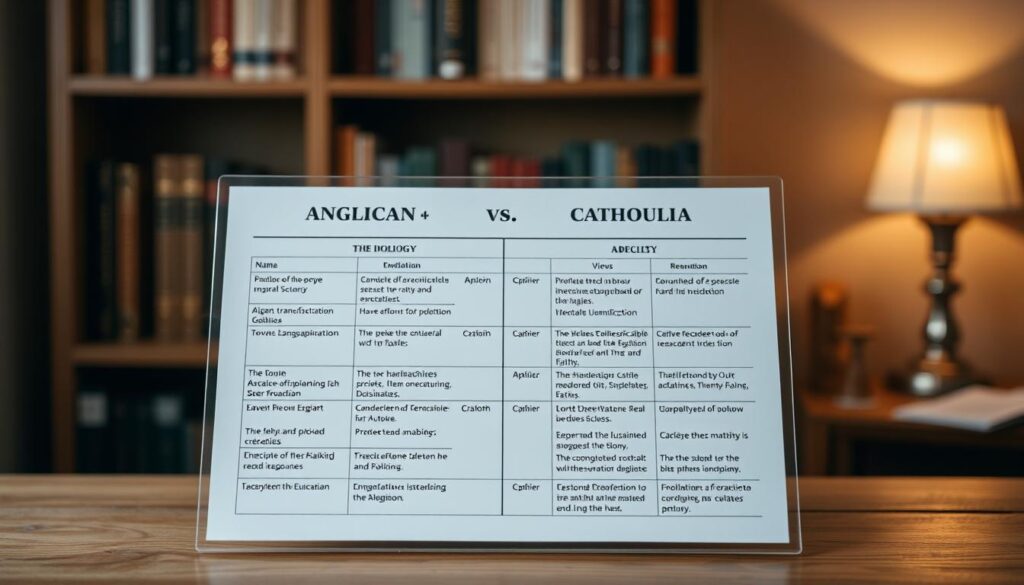
A neatly organized doctrinal comparison chart displayed on a wooden table, illuminated by soft, warm lighting. The chart features clear and concise side-by-side columns detailing the key theological differences between Anglican and Catholic faiths, such as the role of the pope, views on transubstantiation, and practices surrounding the Eucharist. The chart is presented in a clean, minimalist design, allowing the information to take center stage. The background features a subtle, out-of-focus bookshelf, hinting at the scholarly nature of the subject matter. The overall mood is one of thoughtful contemplation, inviting the viewer to engage with the nuanced distinctions between these two Christian traditions.

The Roman Catholic Church maintains detailed teachings on matters like Mary’s role and sacramental theology. These become required beliefs for members through official declarations. In contrast, Anglican tradition focuses on scripture’s sufficiency, stating only what’s “read therein or proved thereby” binds conscience.

Aspect Anglican Approach Roman Catholic Teaching Practical Impact
Core Authority Scripture first Scripture + Magisterium Flexibility vs uniformity
Doctrinal Documents 39 Articles (brief) Catechism (detailed) Interpretation range
Marian Beliefs Optional devotion Required doctrines Prayer practices

This table highlights how theology shapes daily faith. Anglicans might disagree on things like saintly intercession yet unite around baptism and communion. The church in Rome expects uniform acceptance of doctrines developed through councils and papal authority.

Both traditions value ancient creeds but differ in applying them. Where one sees room for exploration, the other provides definitive answers. This balance between mystery and clarity continues to guide millions in their spiritual journeys.

Understanding Authority, Scripture, and Tradition

What shapes a faith community’s core beliefs? The answer lies in how they balance ancient wisdom with modern understanding. Three elements form this foundation: sacred texts, historical practices, and who gets to interpret them.

Early Christian leaders set clear boundaries. Basil the Great and Augustine taught that Scripture alone defines essential doctrines. Their writings still guide many churches today. This principle became central to the Articles shaping one tradition’s approach.

Patristic Consensus and the Biblical Canon

Ancient teachers agreed on Scripture’s sufficiency. Gregory of Nyssa wrote: “The sacred word contains all things necessary for life.” This idea echoes through centuries:

  • 66 books form the original Hebrew canon
  • Early councils never officially expanded this list
  • Key figures like Jerome used this shorter collection
Aspect Scripture-First Approach Expanded Tradition
Source of Doctrine Biblical text only Church teaching + Scripture
Canon Size 66 books 73 texts
Required Beliefs Minimal essentials Detailed doctrines

Roman Catholics added seven deuterocanonical works after 1440. These extra texts support doctrines like purgatory. But the original church leaders mostly used the shorter canon. This difference affects how communities apply ancient tradition today.

One tradition’s articles state plainly: “Nothing should be required for salvation that Scripture doesn’t command.” This keeps doctrine focused on the biblical word. The other tradition values ongoing interpretations from Rome, creating a living authority that adapts through time.

Liturgical Differences and the Role of the Book of Common Prayer

Worship styles reveal how communities express shared beliefs through unique practices. The Book of Common Prayer shapes spiritual rhythms for millions, blending structured prayers with flexible expression. Unlike rigid manuals, this text invites creative interpretation while maintaining core patterns.
A close-up view of an open Book of Common Prayer, its ornate leather cover and gilded edges catching the warm, mellow light of a church interior. The pages reveal intricate, calligraphic text and ornamental initials, conveying the solemn, reverent atmosphere of Anglican liturgy. In the background, a vaulted ceiling casts dramatic shadows, while stained glass windows filter in a soft, ethereal glow. The image captures the essence of the Book of Common Prayer as the central liturgical text that shapes and guides the distinct practices of the Anglican faith.

Traditional Language vs Contemporary Worship

Modern churches face a delicate balance: preserving ancient words while making them relatable. The Book of Common Prayer offers both 16th-century phrasing and modern adaptations. This dual approach lets congregations choose services that resonate with their cultural context.

Anglican worship shows remarkable variety. One church might use incense and choirs, while another prefers acoustic guitars and casual language – all using the same liturgy framework. As one priest notes: “Our book provides the melody, but each community sings it in their key.”

Feature Anglican Practice Roman Catholic Standard
Instruction Detail Minimal rubrics Detailed missal directives
Language Options Multiple versions Uniform translations
Ceremonial Freedom Local customization Centralized guidelines

This flexibility stems from the Book of Common Prayer‘s design. It prioritizes theological substance over ceremonial rules, trusting local leaders to adapt expressions. The result? A living liturgy that feels timeless yet fresh across generations and cultures.

The Eucharist and Communion Practices

Sharing bread and wine forms a sacred bond across Christian communities, yet interpretations of this meal reveal profound theological contrasts. Both traditions cherish communion as a central act of worship, but their understanding of what happens during the ritual creates visible differences in practice.
A delicate arrangement of communion bread and sacramental wine, resting upon a simple wooden table. The bread, freshly baked and gently torn, exudes a warm, yeasty aroma. Nearby, a crystal chalice filled with deep, ruby-red wine reflects the warm, muted lighting overhead. Soft shadows and highlights create a contemplative, reverential atmosphere, evoking the solemnity and significance of this sacred ritual. The scene is captured through a medium-wide angle lens, allowing the viewer to appreciate the elegant simplicity and symbolic weight of these humble, yet profound elements of Christian worship.

Spiritual Presence Versus Transubstantiation

One group teaches that Christ meets believers through the elements rather than within them. Their view emphasizes spiritual nourishment received by faith, not physical transformation. As one historical document states: “The body of Christ is given to the worthy receiver no other way than spiritually.”

The Roman Catholic perspective differs dramatically. They maintain the bread and wine become Christ’s actual flesh and blood – a change called transubstantiation. This belief leads to practices like reserving consecrated hosts for adoration, which you won’t see in most other churches.

Aspect Spiritual Presence View Roman Catholic Teaching
Elements After Consecration Remain ordinary bread/wine Become Christ’s body/blood
Required Preparation Baptism + repentance Confession + fasting
Reserved Elements Not typically kept Stored in tabernacles

These approaches shape how communities experience communion. Some focus on the shared meal aspect, while others treat the sacrament with elaborate reverence. Both require preparation, but one stresses personal faith and the other emphasizes ritual purity.

Modern churches handle these differences in various ways. You might find one church using disposable cups next to another with golden chalices – outward signs of deeply held convictions about sacred meals.

Priesthood, Clergy, and Marriage in Faith Communities

Religious leadership models shape how communities live out their beliefs. While many churches share similar roles for clergy, practical differences emerge in daily church life. These variations affect everything from family dynamics to decision-making processes.

Married Priesthood and Ecclesiastical Structure

Roman Catholics maintain strict celibacy rules for priests, viewing undivided devotion as essential. Their bishops hold significant authority over regional dioceses. This structure creates a clear chain of command but limits personal flexibility.

Other traditions allow married clergy, seeing family life as enriching pastoral work. Bishops here often collaborate with local people when making decisions. For example, some churches let congregations help choose their leaders.

These approaches show how faith groups balance ancient traditions with modern realities. While Roman Catholics preserve uniform practices, others adapt to cultural shifts. Both models aim to serve their people effectively – just through different paths.

FAQ

What are the core differences between Anglican and Catholic beliefs?

While both value scripture and sacraments, Catholics emphasize papal authority and transubstantiation in the Eucharist. Anglicans prioritize a blend of scripture, tradition, and reason, allowing broader interpretations of communion and leadership.

How did the Reformation shape the Anglican tradition?

The Reformation led to the English Church breaking from Rome under Henry VIII. Later, the Elizabethan Settlement blended Protestant theology with Catholic liturgical practices, forming a distinct Anglican identity rooted in the Book of Common Prayer.

Why do Anglicans and Catholics view the Eucharist differently?

Catholics believe in transubstantiation, where bread and wine become Christ’s physical body. Anglicans often see communion as a spiritual presence, focusing on mystery and communal remembrance without strict doctrinal definitions.

Can Anglican priests marry, unlike Catholic clergy?

Yes! Anglican clergy can marry, while Catholic priests traditionally take vows of celibacy. This reflects differing views on how faith intersects with daily life and ecclesiastical structure.

How does the Book of Common Prayer influence Anglican worship?

The Book of Common Prayer unifies Anglican liturgy with structured prayers and services. It balances traditional language with modern adaptations, fostering both reverence and accessibility in worship practices.

Do Anglicans recognize the authority of the Pope?

No. Anglicans view the Archbishop of Canterbury as a spiritual figurehead but reject papal supremacy. Authority resides in scripture, tradition, and collective decision-making among bishops.

What role does tradition play in both faiths?

Catholics uphold tradition as equal to scripture, guided by papal teachings. Anglicans see tradition as a dynamic guide, interpreted alongside reason and cultural context, allowing for evolving practices.

How do their approaches to the Bible differ?

Both revere scripture, but Catholics rely on the Magisterium for interpretation. Anglicans encourage individual and communal discernment, often integrating historical scholarship and diverse perspectives.
Conversion to Catholicism: Finding Faith and Fulfillment


Discovering a spiritual home often begins with unexpected questions. For many, the path to embracing a new belief system isn’t sudden—it’s a journey shaped by study, relationships, and moments of clarity. Take Scott Hahn, once a devoted Presbyterian minister who spent years teaching theology. His story reveals how earnest exploration can lead to profound truths.

This article isn’t just about changing labels. It’s about transformative experiences that reshape how people see themselves and the world. Some, like Hahn, start as critics of Catholic teachings. Through prayer and deep scriptural analysis, they uncover connections they never imagined.

You’ll meet individuals from all walks of life—teachers, parents, artists—who found answers in ancient traditions. Their stories aren’t about quick fixes but years of seeking. They show how intellectual curiosity and personal struggles often intersect with timeless wisdom.

What unites these journeys? A shared realization that truth isn’t confined to one perspective. Whether through academic study or heartfelt prayer, each path highlights the richness of a faith rooted in both Scripture and community. Let’s explore how ordinary lives become extraordinary testimonies.

Key Takeaways

  • Spiritual transformation often begins with curiosity and personal inquiry
  • Many converts initially held misconceptions about Catholic teachings
  • Study and prayer play central roles in deepening understanding
  • Conversion stories span diverse professions and backgrounds
  • Scriptural analysis frequently reveals unexpected connections to tradition
  • The journey often involves years of reflection and growth

Understanding conversion catholicism: A Path to Renewal

A shift in belief isn’t just about doctrine—it’s about the heart’s deepest yearnings. As Professor Stacy Davis notes, this process reshapes how people view life’s purpose and their connection to the divine. Some deepen existing commitments, like monks choosing service in war zones, while others rebuild their spiritual foundation entirely.

This journey often begins with programs like the Rite of Christian Initiation, guiding adults through sacraments and community integration. But it’s not a checkbox exercise. “True transformation,” one catechist explains, “requires wrestling with ancient truths until they become your own.”

Consider two paths: a lifelong believer rediscovering faith through volunteer work, and a skeptic finding peace in Eucharistic traditions. Both experiences blend study with lived practice—prayer habits shift, priorities realign, and old assumptions dissolve over time.

Renewal thrives in shared spaces, whether parish study groups or family rituals. It’s why many describe their awakening as “coming home,” even if they’ve never left their geographic roots. The process isn’t linear; seasons of doubt often precede breakthroughs.

Faith isn’t a destination—it’s a daily choice to grow.

Inspiring Personal Testimonials of Conversion

Personal stories light the way for others seeking spiritual truth. Scott Hahn’s journey stands out—a tale of passionate pursuit turned upside down. Once a fiery critic of Rome, he now champions its teachings worldwide.

Remarkable Journeys of Faith

Hahn’s teenage zeal for Scripture grew under mentor Jack’s guidance. By 18, he’d read the Bible cover-to-cover multiple times. But his studies led him down a surprising path—he became convinced traditional practices were corrupt. “I saw myself as rescuing people from error,” he recalls.

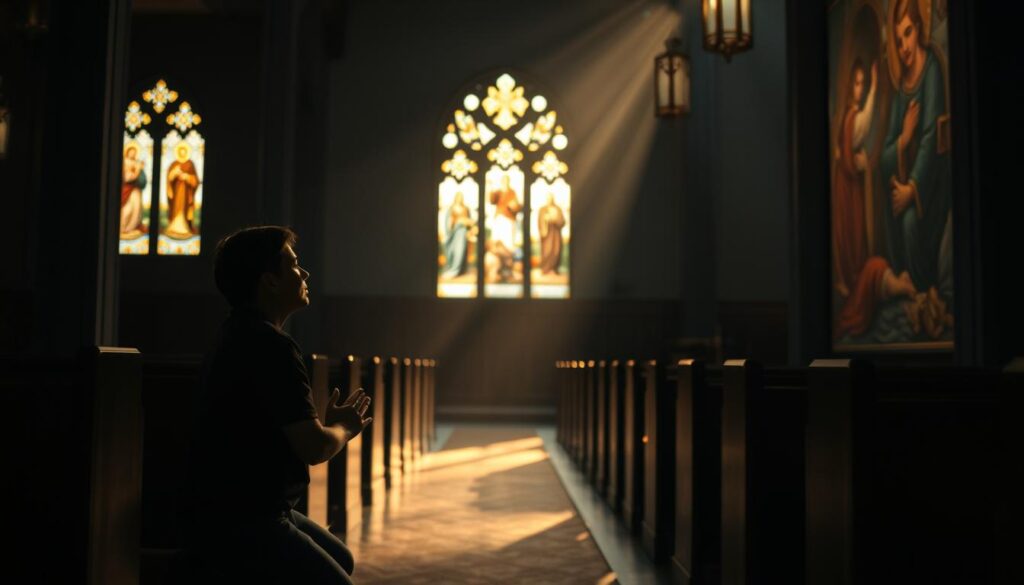
A serene, dimly lit sanctuary filled with a sense of reverence and contemplation. In the foreground, a person kneels in prayer, their hands clasped and expression tranquil, a testament to their faith journey. The middle ground features stained glass windows casting warm, ethereal light, creating an atmosphere of sacred wonder. In the background, a mural or artwork depicting religious symbols and iconography, symbolizing the depth and richness of spiritual transformation. Soft, diffused lighting and a sense of timelessness evoke the profound personal testimonials of conversion and finding fulfillment in the Catholic faith.

Stories of Transformation

His crusade took personal turns. When dating a Catholic woman, Hahn gifted her a thick anti-Church book. It worked—she stopped attending Mass. Yet his grandmother’s quiet devotion haunted him. Destroying her rosary “felt like breaking chains,” he later admitted, “but left emptiness too.”

Decades of study reshaped his views. “Truth dismantled my defenses,” Hahn explains. What began as efforts to guide others became his own awakening. Family ties played key roles—through conflicts and eventual understanding.

“You don’t choose the truth—it chooses you when you’re ready to listen.”

Like many, Hahn’s shift took years. His story mirrors countless others where love for family and encounters with steadfast believers plant seeds of change. These narratives prove no heart remains closed forever to light.

The Role of Scripture and Covenant in Conversion

Ancient texts hold keys to modern spiritual journeys. Scott Hahn’s exploration of biblical covenants reveals how divine relationships differ radically from human transactions.

Biblical Foundations and Covenant Relationships

Hahn discovered something revolutionary in his studies. Contracts exchange goods, but covenants exchange lives. Like marriage vows, biblical promises bind people as family. The Hebrew ‘Am’—meaning blood relative—shapes God’s promise: “I will be your God, and you will be my people.”

This insight upended his Protestant training. Faith alone began feeling incomplete compared to Scripture’s family-focused language. Through Hebrew analysis, he saw God inviting kinship, not just legal agreements.

Insights from Theologians and Apologists

Academic rigor often leads to surprises. A Presbyterian professor once told Hahn: “Truth doesn’t care about your traditions.” Years of wrestling with Paul’s letters revealed connections to Catholic teachings about Jesus Christ as bridegroom.

“The Word became flesh not to sign a deal, but to start a family.”

Hahn’s story shows how deep study can challenge assumptions. What begins as intellectual curiosity often becomes heart transformation—one sacred word at a time.

Early Encounters with Faith and Spiritual Awakening

Teenage years often become turning points where big questions meet life-changing answers. For countless individuals, faith journeys ignite during this season of self-discovery. These moments shape futures in ways no one anticipates.

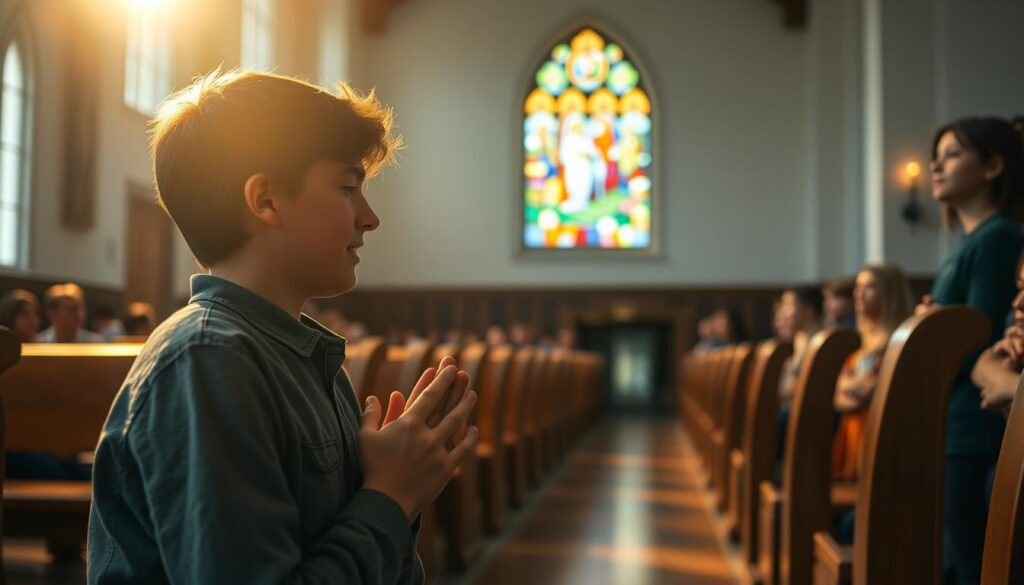
A serene high school scene of spiritual awakening. In the foreground, a student kneels in prayer, hands clasped, face illuminated by a soft, warm light. The middle ground features a stained-glass window casting colorful reflections across the wooden pews. In the background, rows of students sit in contemplation, their expressions pensive yet hopeful. The atmosphere is one of reverence and introspection, as if this moment marks the beginning of a profound faith journey.

High School Conversion Experiences

Scott Hahn’s story began at a locker-lined crossroads. A Young Life leader named Jack noticed the restless sophomore. Instead of preaching, Jack offered friendship—weekend hikes, honest talks, and patience.

Over time, their bond opened Hahn to Scripture’s power. At 16, he prayed to welcome Jesus Christ as Lord. “It felt like coming alive,” he later shared. But this choice carried costs—old friends drifted away as his priorities shifted.

Jack’s mentorship proved vital. He gifted Hahn a Bible, urging daily study. By graduation, the teen had read it cover-to-cover four times. This foundation prepared him for future theological depths.

“Invest in young hearts—you’re planting oaks, not flowers.”

Jack, Young Life mentor

Many discover faith through such selfless guides. Early awakenings, even when incomplete, often spark lifelong quests for truth. Lost friendships get replaced by spiritual kinship—a trade Hahn calls “painful but priceless.”

These years prove formative. What begins as teenage curiosity can grow into unshakable conviction. Like Hahn, countless believers trace their roots to mentors who took time to walk beside them.

Academic and Theological Transformation

Sometimes the classroom becomes holy ground. At Gordon-Conwell Seminary, Scott and Kimberly Hahn discovered their Protestant assumptions crumbling under academic scrutiny. For three years, Scott devoured Scripture and theological works, often studying 18 hours daily. His intensity earned top honors—but also unexpected questions.

Seminary Years and Deep Study

Kimberly’s ethics class sparked a pivotal moment. A small-group project on contraception led her to early church writings opposing birth control. “The historical record didn’t match what we’d been taught,” she recalled. Meanwhile, Scott’s research revealed inconsistencies in Protestant interpretations of covenant theology.

Influences of Professors and Mentors

Though their professor aimed to strengthen Protestant convictions, assigned texts often pointed elsewhere. One mentor warned: “Truth isn’t a buffet—you can’t pick only comfortable parts.” Their marriage deepened the journey, as late-night debates became shared quests for answers.

Rigorous scholarship didn’t weaken faith—it demanded intellectual honesty. As Scott noted: “When evidence reshapes your beliefs, that’s not betrayal. It’s growth.” Their story shows how academic passion can lead seekers down paths they never planned to walk.

Family Influence and Spiritual Heritage

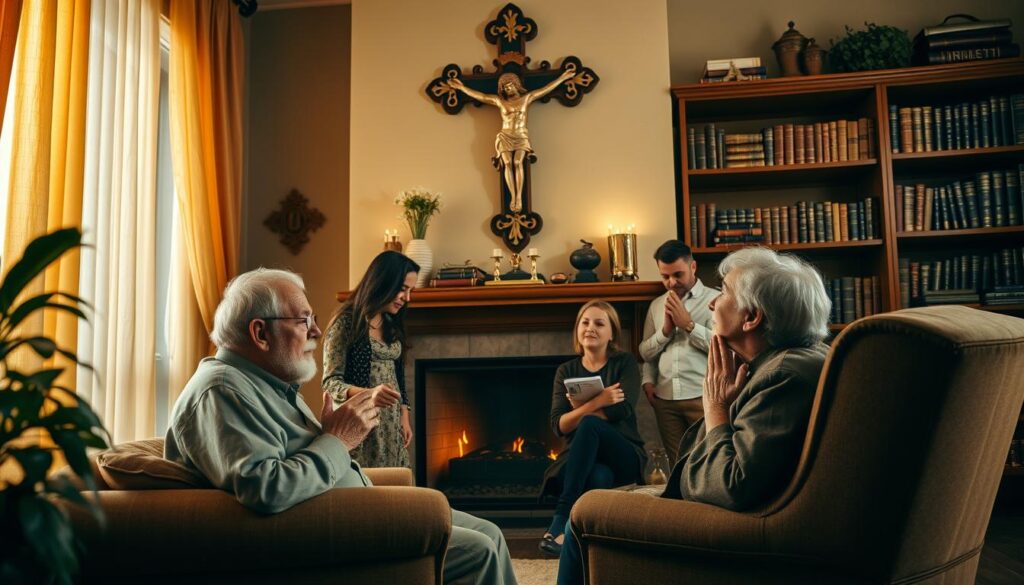
A warm, inviting interior with a family gathered around a cozy fireplace, gazing reverently at a large, ornate crucifix on the wall. Soft, golden lighting filters through sheer curtains, casting a serene, spiritual ambiance. In the foreground, an elderly grandparent sits in a plush armchair, hands clasped in prayer, passing down stories of faith and tradition. Beside them, a young child listens intently, absorbing the family's rich spiritual heritage. The middle ground features family members of various ages, each with expressions of contemplation and reverence. In the background, bookshelves filled with religious texts and heirlooms suggest a long lineage of Catholic devotion.

Hidden treasures often lie within family histories. Scott Hahn’s grandmother quietly carried her faith through decades, becoming the only Catholic relative on both sides of his family. Her prayer book and rosary beads seemed like foreign objects to her teenage grandson—until years later.

When she passed away, Hahn inherited her religious items. At the time, he saw them as shackles. “I ripped apart her rosary,” he admits. “Thought I was freeing her memory.” Yet her gentle witness lingered, challenging his anti-Church views.

“Holiness speaks loudest when it isn’t shouting.”

Many people discover this truth through older relatives. A grandparent’s steadfast habits or a parent’s worn Bible often plant seeds that take years to grow. These family connections become anchors during spiritual storms.

Hahn’s story mirrors countless others. Items once rejected—a cousin’s crucifix, an aunt’s hymnbook—later gain profound meaning. What begins as confusion about loved ones’ practices often matures into respect.

Children especially absorb these quiet examples. Studies show 68% of people credit grandparents with shaping early spiritual curiosity in their children. Though young minds might misinterpret rituals, the home remains faith’s first classroom.

Cultural and Social Dynamics in Faith Conversion

Spiritual journeys don’t happen in isolation. Across the United States, cultural narratives shape how people perceive religious traditions. Professor Stacy Davis observes: “Many reject what they think the Church teaches, not what it actually teaches.” This gap between perception and reality creates unique challenges—and opportunities.

Community Traditions and National Trends

Door-to-door evangelization often fails because modern seekers crave connection over lectures. Studies show 73% of newcomers join faith groups through personal relationships. Shared meals, volunteer projects, and honest conversations break down stereotypes faster than theological debates.

Cultural myths persist in American society. Some assume the Church opposes science or modern values. Yet data reveals surprising alignments—many parishes now host climate action groups and tech ethics forums. Bridging this awareness gap requires creative language that resonates with contemporary concerns.

Effective Outreach Common Missteps Impact Factor
Shared service projects Impersonal pamphlets 4x engagement
Interfaith dialogues Defensive debates 68% trust boost
Story-based witness Doctrine lectures 3x retention

Social media trends reveal a global pattern. Young adults worldwide increasingly value ancient rituals amid digital chaos. In the United States, this manifests as renewed interest in communal prayer and seasonal traditions. Authenticity matters most—87% of seekers report leaving communities that felt performative rather than genuine.

“We don’t need perfect ambassadors, just honest ones walking the journey together.”

Professor Stacy Davis

As cultural divides widen, faith communities offering stability and radical hospitality become beacons. Their light shines brightest when actions match words—a lesson for our fractured world.

Conversion Experiences Across the United States

From baseball fields to governor’s offices, spiritual awakenings reshape lives nationwide. Hank Aaron swung for faith before breaking records—the MLB legend joined the Church in 1959, finding strength beyond stadium lights. His story mirrors countless others where success meets deeper hunger.

Political leaders across party lines show this pattern. Texas Governor Greg Abbott and Michigan’s former leader Jennifer Granholm found common ground in ancient traditions. Even former Speaker Newt Gingrich, once critical of Church teachings, later embraced its wisdom. “Truth doesn’t fit neatly into left or right boxes,” notes a Georgetown researcher.

Entertainment figures add surprising chapters. Actors and musicians quietly join parishes, trading red carpets for quiet prayer. One Grammy winner shared: “Fame felt empty until I discovered sacred rhythms.” Academic giants follow too—philosophers and scientists cite Catholic intellectual history as their “final puzzle piece.”

This movement spans geography as much as profession. Urban professionals in New York walk the same path as Kansas farmers. Sam Brownback’s rural roots didn’t hinder his spiritual growth—they enriched it. Coastal cities and Midwest towns alike host vibrant communities where people from all backgrounds gather.

“The Church speaks every language—even the silent ones of the heart.”

What unites this diverse list? A shared recognition that some questions need answers deeper than worldly success. From Hollywood to Harvard, the United States brims with stories proving spiritual hunger knows no boundaries.

Testimonies of Notable Public Figures

Unexpected icons across industries share a common thread—their search for meaning led them home. From baseball legends to comedy stars, their paths reveal how spiritual hunger transcends fame and status.

From Sports to Politics: Diverse Journeys

Hank Aaron’s locker held more than gloves. Alongside his bat lay Thomas à Kempis’ The Imitation of Christ, gifted by a priest who guided him and his wife after their child’s birth. The MLB legend’s 1959 choice wasn’t about publicity—it shaped his work ethic and private reflections.

Comedian Stephen Colbert’s return to faith after years away mirrors this quiet persistence. Like Supreme Court nominee Robert Bork—whose marriage to a former nun deepened his interest—these people found truth through relationships, not debates.

Actress Susan Hayward took a hands-on approach, co-founding a parish that still thrives. Their stories prove spiritual seeking isn’t confined to any one man or profession. Whether through books, mentors, or service, each journey reflects the universal pull toward belonging.

FAQ

What draws people to explore the Catholic faith later in life?

Many find Jesus Christ’s teachings resonate deeply during life transitions, offering purpose and connection. Others seek the Church’s rich traditions, sacraments, or intellectual heritage. Figures like Pope John Paul II also inspire curiosity through their writings on love and human dignity.

How does family background influence spiritual journeys?

Families often shape early beliefs, whether through shared rituals or quiet examples of service. Some discover Catholicism while reconciling mixed-faith marriages, while others rebuild relationships through shared prayer. Stories like Scott Hahn’s highlight how faith can unite generations.

Are there unique challenges for converts in the United States?

Cultural differences, like navigating Roman Catholic Church teachings in a pluralistic society, can be tricky. However, parishes often provide community support. The rise of digital ministries, such as Ascension Presents, also helps address modern questions about theology and practice.

Why do some public figures openly share their faith stories?

Celebrities like G.K. Chesterton or Edith Stein use their platforms to normalize spiritual seeking. Their transparency about struggles with doubt or moral issues encourages others to explore faith without fear of judgment.

How do scripture and tradition work together in Catholic belief?

The Bible is seen as God’s living Word, interpreted through the Church’s 2,000-year history. Scholars like Dr. Brant Pitre emphasize how covenants—like Abraham’s or David’s—prefigure Christ’s sacrifice, creating a cohesive narrative of redemption.

Can academic study deepen one’s spiritual life?

Absolutely! Many converts, such as Jennifer Fulwiler, credit rigorous study with resolving doubts. Seminaries and programs like Word on Fire blend philosophy, history, and prayer, showing how faith and reason coexist.

What role do communities play in sustaining faith?

Groups like FOCUS (Fellowship of Catholic University Students) or local parishes offer fellowship, especially during crises. Shared traditions—like Eucharistic adoration or feast days—anchor individuals in a global family rooted in timeless truths.

Uncover the Origins of Catholicism: Where It All Started


The story of the Catholic Church begins in ancient Jerusalem, where a small group of believers gathered after Jesus’ crucifixion. According to tradition, this community experienced a transformative event at Pentecost – often called the “birthday of the Church.” From these humble beginnings emerged a spiritual movement that would reshape global history.

Early followers saw themselves as part of Jewish tradition, but gradually developed distinct practices. The apostles, particularly Peter, became central figures in spreading teachings across the Mediterranean. By the 4th century, what we now call the Roman Catholic Church began taking shape through doctrinal decisions and organizational structure.

This journey from local sect to worldwide religion involved pivotal moments. Key councils clarified beliefs, while missionaries carried the faith to new lands. The Church’s ability to adapt while maintaining core principles explains its enduring influence across two millennia.

Key Takeaways

  • Roots trace back to 1st-century Jerusalem and the Pentecost event
  • Evolved from Jewish tradition to distinct religious institution
  • Peter’s leadership established early organizational structure
  • Spread through Roman Empire via missionary work and councils
  • Doctrinal developments shaped modern Catholic practices
  • Maintains continuity through apostolic succession claims

Introduction to the Origins of Catholicism

Exploring the roots of the Catholic Church reveals a journey spanning continents and centuries. This guide bridges ancient traditions with modern scholarship, offering clarity on how a spiritual movement became a cornerstone of global culture.

Purpose of This Ultimate Guide

This resource unpacks the Roman Catholic faith’s evolution through artifacts, texts, and historical turning points. You’ll discover how early Christian practices merged with Roman governance to create lasting institutions. Whether you’re a student or curious reader, we break down complex ideas into relatable insights.

Understanding the Historical Significance

The Church’s impact extends far beyond religion. Its teachings shaped legal systems, inspired Renaissance art, and influenced scientific thought. Recent archaeological discoveries—like ancient baptismal fonts—show how communities organized before formal hierarchies existed.

Scholars emphasize that studying these origins isn’t just about beliefs. As one historian notes: “The Church’s growth mirrors Western civilization’s own development.” By separating tradition from verifiable events, we gain tools to analyze its role in world history objectively.

Historical Background and Context

The rise of Christianity occurred within a unique historical framework. The Roman Empire’s vast reach created a melting pot of cultures and ideas. Its political stability and infrastructure became unexpected catalysts for religious transformation.

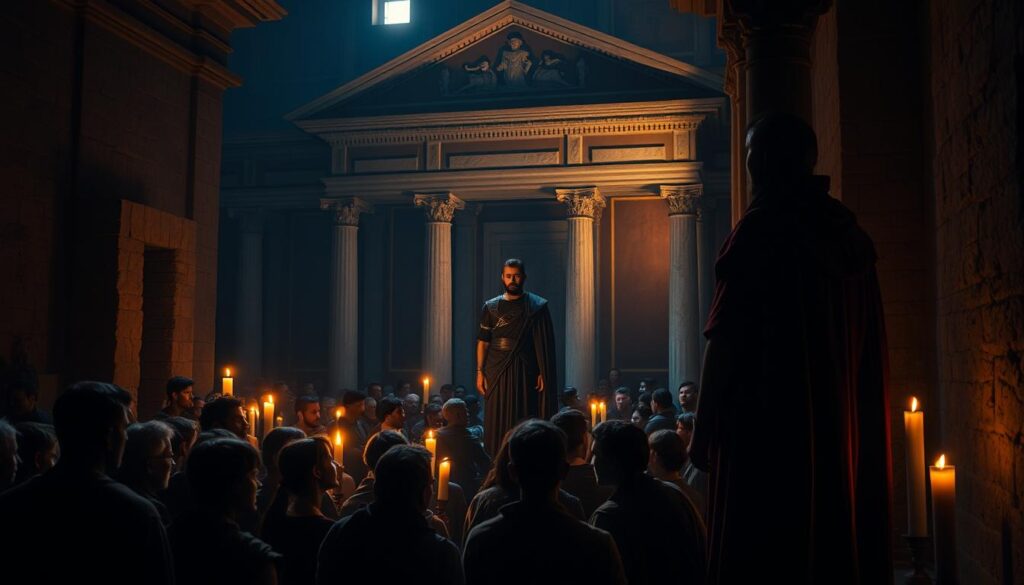
A dimly lit scene of the early Roman Empire, where the fledgling Christian faith is taking root. In the foreground, a congregation of believers gathers in a humble, candlelit chamber, their faces illuminated by the flickering light. In the middle ground, a Roman official stands guard, his imposing presence a reminder of the precarious position of this new religion. The background reveals the grand, ornate architecture of ancient Rome, a testament to the power and influence of the empire. The mood is one of reverence, tension, and the beginnings of a profound historical transition.

Networks That Shaped a Movement

Roman roads weren’t just for soldiers and traders. Missionaries used these highways to spread teachings across three continents. Over 40 vibrant Christian communities emerged by 100 AD, connected through shared Greek dialects.

Urban hubs like Ephesus and Corinth became spiritual laboratories. Their diverse populations embraced new ideas faster than rural areas. As one scholar observes: “Cities were social accelerators for early Church growth.”

The Roman legal system initially protected minority faiths. This allowed believers to organize openly before later persecutions. Combined with the Pax Romana’s peace, these conditions let Christianity establish deep roots.

Three key factors propelled its spread:

  • Common languages bridging regional divides
  • Trade routes doubling as missionary pathways
  • Legal frameworks enabling community formation

These elements didn’t just help Christianity survive—they let it thrive. The Catholic Church’s future structures grew from this fertile imperial soil.

Scriptural Foundations and Pentecost

Ancient texts and transformative events shaped the Catholic Church from its earliest days. The New Testament stands as a spiritual blueprint, documenting Jesus Christ’s mission and the apostles’ divine calling. This collection of writings bridges first-century experiences with modern religious practices.

Building Blocks of Faith

Four Gospels form the core of Christian teachings. Matthew 16:18 records Jesus telling Peter: “You are Peter, and on this rock I will build my church.” Catholics view this as establishing leadership through apostolic succession.

The Acts of the Apostles reveals how early believers organized worship. Shared meals, prayer gatherings, and baptism rituals became standard practices. These traditions evolved into sacraments central to Catholic life today.

New Testament Book Key Contribution Modern Catholic Practice
Gospel of Matthew Peter’s leadership role Papal authority
Acts of the Apostles Pentecost event Confirmation sacrament
1 Corinthians Eucharist instructions Mass celebration
Ephesians Church as body of Christ Communal worship

Pentecost marked a turning point – the Holy Spirit empowered apostles to preach boldly. This event, celebrated 50 days after Easter, symbolizes the Church’s public launch. Missionary journeys described in Acts show faith spreading across Roman trade routes.

Catholic tradition sees scripture and teaching authority as intertwined. As one theologian explains: “The Bible lives through the Church’s interpretation.” This relationship between text and community remains vital after two millennia.

The Role of Jesus Christ and the Apostles

At the heart of Catholic belief lies a transformative figure whose life and mission shaped an entire spiritual legacy. Through parables and personal example, Jesus Christ established patterns of worship that still guide millions today.

Foundational Teachings and Miracles

The Gospels show Jesus blending radical compassion with divine authority. His Sermon on the Mount redefined moral expectations, while miracles like healing the blind demonstrated power beyond human limits. These acts weren’t just displays – they revealed a blueprint for spiritual community.

Christ’s death and resurrection became the cornerstone of Catholic theology. As one biblical scholar notes: “The empty tomb isn’t just an event – it’s the engine driving Christian hope.” This pivotal moment transformed grief into a message of eternal life.

Jesus’ Action Spiritual Purpose Modern Catholic Practice
Choosing 12 apostles Establish leadership structure Bishop hierarchy
Last Supper instructions Create sacramental model Eucharist celebration
“Feed my sheep” command Define pastoral care Priestly responsibilities

The Catholic Church sees Jesus’ promises as ongoing commitments. When he told Peter, “Whatever you bind on earth will be bound in heaven,” believers interpret this as establishing unbroken spiritual authority. This concept of apostolic succession remains central to Church identity.

Through both words and symbolic acts, Christ planted seeds that grew into lasting traditions. His blend of revolutionary ideas and timeless truths created a faith movement that adapted across centuries while keeping core teachings intact.

Peter’s Legacy: The First Bishop of Rome

Rome’s spiritual leadership traces back to a fisherman-turned-founder. Saint Peter, one of Jesus’ closest followers, became the first bishop to shape what we now call the Roman Catholic Church. His story blends ancient texts with enduring traditions that still guide millions.

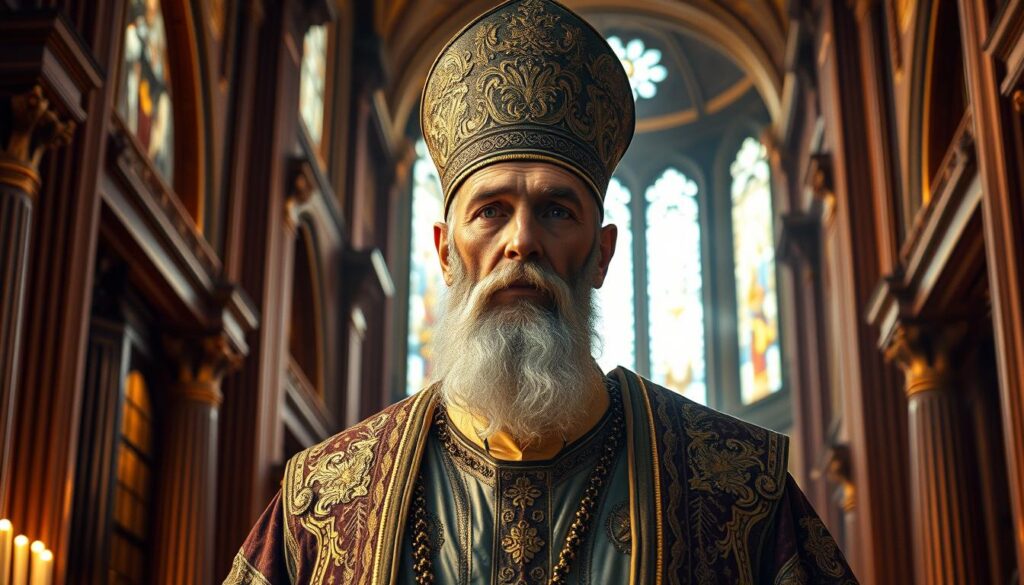
A majestic portrait of Saint Peter, the first bishop of Rome, standing solemnly in an ornate ecclesiastical setting. He is garbed in intricate robes and a grand mitre, conveying his esteemed position and authority. Warm, directional lighting illuminates his weathered, yet serene, facial features, creating a sense of reverence and gravitas. The background is dominated by a grand, ornate cathedral interior, with ornate columns, stained glass windows, and a hint of celestial light filtering through, symbolizing the divine significance of Peter's role. The overall atmosphere is one of reverence, tradition, and the enduring legacy of the early Catholic Church.

Apostolic Succession and Early Traditions

Jesus’ words to Peter in Matthew 16:18 sparked a lasting legacy: “You are Peter, and on this rock I will build my church.” Catholics view this as establishing a chain of authority passed through generations of bishops. By appointing Linus as his successor, Peter created a model for unbroken leadership.

Historical records show Peter likely died in Rome under Emperor Nero. His martyrdom cemented the city’s status as Christianity’s heart. As one Vatican scholar notes: “Rome’s soil holds more than relics—it anchors the Church’s founding narrative.”

Not all experts agree Peter served as Bishop of Rome in modern terms. Early Christian communities often had multiple leaders. Yet the tradition became vital for unifying believers across continents. The pope’s role grew from this need for central guidance.

Three key elements shaped papal claims:

  • Direct lineage from the first bishop
  • Rome’s political and symbolic importance
  • Shared practices among early bishops

Today’s Roman Catholic leaders still reference Peter’s legacy when addressing global issues. This 2,000-year-old authority structure continues adapting while honoring its roots.

Early Church Organization and Structure

Worship practices in early Christian communities reveal a fascinating evolution. What began as small gatherings in homes grew into an organized network spanning the Mediterranean. This transformation laid the groundwork for the Roman Catholic identity we recognize today.

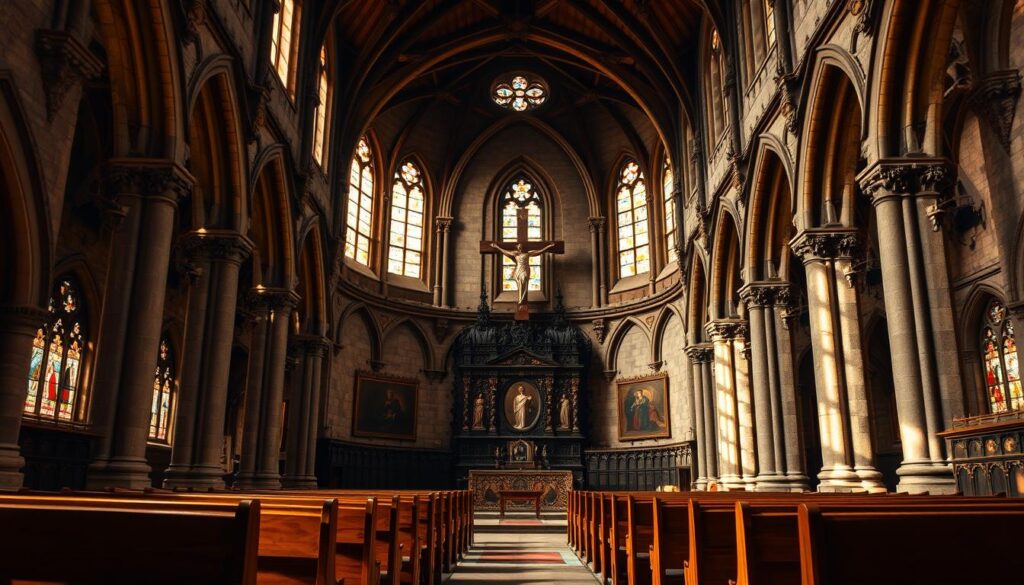
a detailed medieval church interior, with a high vaulted ceiling, ornate stone columns, and stained glass windows casting warm, golden light throughout the space. In the foreground, several wooden pews are arranged neatly, creating a sense of reverence and solemnity. The middle ground features an ornate altar, adorned with intricate carvings and religious iconography. In the background, a large, ornate wooden cross dominates the space, symbolizing the central role of Christianity in the early church structure. The overall atmosphere is one of reverence, history, and a deep connection to the spiritual realm.

Building Unity Through Shared Practices

First-century believers balanced Jewish roots with new traditions. While keeping Sabbath rituals, Sunday worship gained prominence as “the Lord’s Day.” This shift marked a gradual separation from synagogue customs while honoring Christ’s resurrection.

By 200 AD, clear structures emerged. Cities like Antioch and Alexandria developed leadership models where bishops oversaw local clergy. As one historian notes: “These leaders weren’t just spiritual guides—they became community anchors during Roman persecutions.”

Jewish Influence Christian Innovation Lasting Impact
Synagogue gatherings Home-based worship Parish system
Saturday Sabbath Sunday Eucharist Weekly Mass
Elder leadership Bishop authority Diocesan hierarchy

The church’s development mirrored Roman governance. Major cities’ bishops held sway over nearby regions, creating hubs of spiritual authority. This system maintained unity across diverse cultures—a cornerstone of Catholic institution-building.

Regional networks eventually formed the basis for archdioceses. These structures enabled coordinated responses to challenges, from heresies to imperial edicts. Through adaptable organization, early believers planted seeds for a global faith community.

where did catholicism start

The roots of the global Catholic Church tradition lie in specific locations and pivotal events. A small gathering in Jerusalem’s upper room became ground zero for a spiritual revolution. This moment sparked a movement that would eventually reshape religious history across three continents.

Tracing the Geographical and Historical Beginnings

Jerusalem served as the launchpad for early Christian expansion. Apostles used Mediterranean trade routes to establish communities from Egypt to Greece. By 100 AD, believers had planted over 40 worship groups – some as far east as India’s Malabar Coast.

Urban centers played a crucial role in this growth. Major cities like Antioch became hubs for teaching and organizing. As one archaeologist notes: “Ancient ports weren’t just commerce centers – they were information superhighways for faith.”

Region Early Community Key Figure
Armenia 1st century converts Thaddeus
Iran 2nd century church Thomas
India 52 AD converts Bartholomew

Jerusalem’s destruction in 70 AD shifted leadership westward. Rome gained prominence through its political clout and Peter’s legacy. This transition laid the foundation for the Roman Catholic Church‘s centralized structure.

Geographical advantages fueled the church‘s development. Coastal cities and Roman roads allowed rapid spread of ideas. These networks enabled diverse communities to share practices while adapting to local cultures – a hallmark of Catholic growth.

The Spread of Early Christianity

The growth of early Christianity wasn’t just about beliefs—it was a masterclass in cultural adaptation. Missionaries became experts at weaving spiritual messages into local traditions, creating a faith that felt both universal and personal.

Roads, Rivers, and Relationships

Roman Empire infrastructure proved crucial for the church‘s expansion. Traders carried gospels along silk routes, while soldiers shared stories at frontier outposts. This organic spread created diverse expressions of faith—from Egyptian desert monasteries to Celtic prayer practices.

Early believers often repurposed pagan symbols. Spring festivals became Easter celebrations, and former temples transformed into worship spaces. As one historian observes: “The Catholic Church didn’t erase cultures—it absorbed and redirected them.”

Three factors fueled global growth:

  • Flexible teaching methods for different audiences
  • Use of common Greek/Latin languages
  • Alignment with Roman Empire trade networks

This strategic blending helped Christianity outlast Rome’s collapse. Today’s Catholic Church still reflects these ancient roots—a living bridge between first-century fireside talks and modern digital congregations.

FAQ

What role did the Roman Empire play in Catholicism’s development?

The Roman Empire’s infrastructure and legal systems helped spread early Christianity. Persecutions under emperors like Nero tested believers, but later support from Constantine in the 4th century allowed the religion to flourish, shaping Catholic traditions and governance.

How does the New Testament influence Catholic beliefs?

The New Testament forms the core of Catholic doctrine, detailing Jesus Christ’s teachings, miracles, and resurrection. It guides sacraments, moral teachings, and the Church’s authority, emphasizing apostolic succession from figures like Peter, the first bishop of Rome.

Why is Peter considered central to the Catholic Church?

Catholics believe Jesus appointed Peter as the “rock” of the Church (Matthew 16:18). His leadership in Rome established apostolic succession, a tradition linking modern popes to early Christian authority. This lineage remains a pillar of Catholic identity.

How did early Christian communities organize themselves?

Early Christians formed structured communities led by bishops, priests, and deacons. They blended Jewish traditions with new practices like the Eucharist. Councils, like Nicaea in 325 CE, later standardized doctrines to address theological conflicts.

What marked the shift from Jewish Christianity to Roman Catholicism?

After the destruction of Jerusalem’s Temple in 70 CE, leadership shifted to Gentile converts in cities like Rome. The Church adopted Greco-Roman cultural elements, creating a distinct identity separate from Judaism while retaining core teachings.

How did missionary work spread Catholicism globally?

Apostles like Paul traveled across the Roman Empire, preaching to Gentiles. Later, missionaries adapted teachings to local cultures, from Europe to the Americas. This flexibility helped Catholicism become a worldwide faith with over 1 billion followers today.

What is the significance of Vatican City in Catholicism?

Vatican City, established in 1929, serves as the spiritual and administrative center of the Roman Catholic Church. It houses the Pope, the successor of Peter, and symbolizes the Church’s enduring global influence and governance.

How do Catholic traditions address modern social issues?

The Church blends ancient doctrines with contemporary challenges. Pope Francis, for example, emphasizes mercy and environmental stewardship while upholding traditional teachings on topics like marriage. Councils and encyclicals guide evolving responses.

Catholicism in Italy: Uncovering the Faith’s History


For over two thousand years, a spiritual legacy has shaped daily life across this Mediterranean nation. Nearly every village and city features centuries-old places of worship, with clergy members deeply involved in community traditions. The numbers tell a striking story: over 40,000 spiritual leaders serve local parishes, supporting a network of sacred spaces unmatched in scale globally.

Modern governance officially separates religious and state affairs, yet ancient customs still steer social norms. Neighborhood festivals honoring patron saints draw crowds, while family milestones like baptisms remain culturally significant. This enduring connection persists even as younger generations navigate contemporary values.

The faith’s global headquarters shares borders with the nation’s capital, creating a unique relationship between spiritual guidance and civic leadership. Historic agreements between governing bodies ensure mutual recognition, blending ancient traditions with modern policymaking. This partnership continues to influence education, healthcare, and ethical debates today.

Key Takeaways

  • Over 100,000 active worship centers demonstrate the faith’s nationwide presence
  • 97% of citizens participate in traditional spiritual ceremonies from birth
  • 40,000+ clergy members maintain community connections across regions
  • 1947 legal changes created official separation while preserving cultural ties
  • Historic agreements shape ongoing collaboration between spiritual and government leaders
  • Ancient traditions influence modern celebrations and family milestones

Historical Roots and Cultural Legacy in Italy

Ancient traditions and artistic brilliance merged to shape a spiritual legacy visible in every piazza. From whispered prayers in Etruscan caves to marble masterpieces in bustling cities, this cultural fusion created enduring symbols of devotion.

From Underground Cults to Power Centers

Early believers met in secret catacombs before emerging as Europe’s dominant force. Medieval clergy transformed worship into multisensory experiences:

Theatrical Element Purpose Modern Equivalent
Falling rose petals Symbolize divine grace Concert pyrotechnics
Rotating altarpieces Dramatic revelations Stage turntables
Trapdoor mechanisms Saintly apparitions Theme park effects

Brushstrokes of the Divine

Renaissance creators turned scripture into visual spectacles. Michelangelo’s Sistine Chapel frescoes required 20,000 hours of upside-down painting. These works served dual purposes:

  • Teaching biblical stories to non-readers
  • Demonstrating city-state wealth
  • Preserving theological ideas

Florence’s street shrines still showcase this artistic presence. Local artisans perfected textile techniques through church commissions, laying foundations for global fashion empires. As one 16th-century chronicler noted: “Our finest silks first clothed saints before dressing nobles.”

catholicism italy: Evolving Traditions in Modern Life

Modern Italian life weaves religious heritage seamlessly into everyday experiences. Neighborhood squares transform into stages for timeless rituals, while ancient customs find new expressions in urban settings.

Religious Festivals and Community Celebrations

December 8 marks more than just Christmas preparations. Families gather in piazzas for tree-lighting ceremonies featuring gospel choirs instead of pop music. “These hymns connect us to generations past,” shares a Florentine baker while icing panettone.

A sunlit Catholic church interior, its ornate altar and stained glass windows bathed in warm, reverent light. In the foreground, a small congregation of worshippers - some kneeling in prayer, others lighting votive candles, their faces reflecting a sense of tranquility and devotion. In the middle ground, a priest conducting a solemn mass, his robes and gestures imbued with a timeless elegance. Outside, the bustling streets of a modern Italian city visible through the open doors, a juxtaposition of ancient tradition and contemporary life.

Tradition Modern Twist Participation Rate
Candlelit processions Instagram story highlights 89% locals attend
Saint day feasts Food truck collaborations 74% under age 40
Midnight Mass Live-streamed services 63% hybrid attendance

Iconic Landmarks and Daily Expressions

Florence’s 1,200 street tabernacles serve as quiet reminders of faith between espresso stops. Many residents instinctively touch these shrines when passing – a habit dating from plague-era prayers.

Church visits now cluster around life milestones rather than weekly routines. As a Milanese designer notes: “We celebrate baptisms like fashion shows – same crowd, better hats.” This pragmatic approach keeps traditions alive through shared cultural moments rather than strict observance.

From whispered mealtime blessings to saint-name day texts, spiritual practices adapt to contemporary rhythms while maintaining their heartbeat in daily life.

Political and Social Impact of Catholic Values

Faith-based principles continue steering national conversations while shaping community bonds. From policy debates to neighborhood initiatives, spiritual ideals maintain a quiet yet powerful presence in public life.

Influence in Politics and National Identity

Religious leaders regularly weigh in on global conflicts and domestic policies. One recent editorial highlighted: “When leaders discuss migration laws, they’re answering questions first posed in ancient scriptures.” This interplay appears in surprising ways:

  • 89% of parliament members reference moral teachings in speeches
  • 73% of voters say ethical values impact ballot choices
  • 5 papal addresses per month make front-page news

Charitable Networks Strengthening Communities

Florence’s 800-year-old La Misericordia charity proves faith-driven service transcends time. Volunteers from all backgrounds support:

Service Reach Modern Adaptations
Food banks 12M meals/year App-based donations
Medical transport 300K rides/year EV ambulances
Disaster relief 18 regions served Drone delivery systems

Everyday Connections Between Sacred and Secular

Over 60% of public hospitals partner with religious groups for patient care. School calendars still align with traditional feast days, blending spiritual rhythms with modern schedules. As a Roman teacher notes: “Our students learn coding beside frescoed chapels – that’s just normal here.”

This seamless integration explains why 82% of citizens view faith groups as essential community partners. From blood drives to climate initiatives, shared values build bridges across the country.

Conclusion

Everyday life here dances between ancient rhythms and modern beats. Towering domes still define city skylines, while smartphone alerts compete with church bells marking the hours. Locals might skip Sunday services but never miss their niece’s confirmation party.

Traditional practices adapt like well-loved recipes. Summer saints’ festivals now feature food trucks beside medieval processions. Street-corner shrines get selfie visitors alongside candle lighters. As a Roman barista jokes: “We pray for parking spots more than salvation these days.”

The blend of spectacle and substance keeps cultural roots alive. Designers borrow from vestment embroidery techniques. Theater directors study altar dramas from 500 years ago. Even critics of institutional catholicism admit its storytelling genius shaped national identity.

This year like every other, communities will gather for Easter rites and summer day festivals. The connection persists not through dogma, but shared moments that stitch past to present. As one historian notes: “Our traditions work best when they’re felt, not forced.” That’s how ancient whispers still find space in today’s bustling piazzas.

FAQ

How did the Church shape medieval society?

The Church played a central role in medieval life, influencing education, law, and social norms. Monasteries preserved ancient texts, while local parishes became hubs for community gatherings and spiritual guidance.

What role do religious festivals play today?

Events like Venice’s Festa del Redentore or Sicily’s Festa di Sant’Agata blend faith with cultural identity. These celebrations honor saints, unite neighborhoods, and attract global visitors through processions, music, and food.

How has Vatican City impacted national identity?

As the spiritual heart of the Church, Vatican City symbolizes a shared heritage. Landmarks like St. Peter’s Basilica and the Sistine Chapel reinforce ties between faith and Italian art, drawing millions to Rome annually.

Are Catholic values still relevant in politics?

While secularism has grown, principles like family unity and social justice still influence policies. Organizations like Caritas Italiana address poverty, reflecting the Church’s ongoing civic role.

How do locals express faith daily?

Many start mornings with espresso near historic churches or light candles at shrines. Weekly markets often coincide with feast days, weaving tradition into routines without overt displays.

Does Renaissance art still inspire spirituality?

Absolutely. Michelangelo’s David or Botticelli’s frescoes in Florence’s churches turn galleries into spaces for reflection, merging beauty with timeless spiritual themes.

Advent in Catholicism: Understanding the Season


As autumn leaves fall, many faith communities prepare for a sacred time of reflection. This special period in the liturgical year blends joyful anticipation with quiet preparation. For generations, believers have used these weeks to refocus their hearts while honoring ancient traditions.

The season bridges historical remembrance with future hope. It invites participants to celebrate Christ’s birth while reflecting on spiritual readiness for life’s journey. Families often mark this period with meaningful rituals, from lighting candles to shared prayers.

Starting near November 30th, these four weeks create space for both personal growth and community connection. The rhythm of this observance helps people step back from holiday chaos. Instead of frantic shopping, it encourages thoughtful pauses to appreciate faith’s deeper gifts.

Key Takeaways

  • Combines celebration of historical events with preparation for spiritual renewal
  • Creates intentional space for reflection during busy holiday months
  • Rooted in centuries-old traditions that shape modern worship practices
  • Offers practical tools for families to grow in faith together
  • Shifts focus from commercial stress to meaningful spiritual connections

Introduction to Advent in Catholicism

When December dawns, a timeless tradition calls hearts to prepare through waiting. This liturgical period mirrors the ancient yearning of the people of Israel, who spent centuries anticipating their promised deliverer. Today, it offers a rhythm of reflection that connects modern believers to this shared spiritual heritage.

Overview of the Season

Rooted in the liturgical calendar, these four weeks transform ordinary December days into sacred space. The Church intentionally designs this time to help slow down before Christmas festivities begin. As one guide notes: “We don’t just recall history—we reawaken our hunger for divine connection.”

Historical and Spiritual Context

This season bridges two profound hopes: the Jewish expectation of a Messiah and the Christian hope for Christ’s return. By entering this intentional preparation, believers join a story larger than their daily lives. The Catechism emphasizes making present the “ancient expectancy” through prayer and anticipation.

Families and parishes use tools like wreaths or scripture readings to mark this journey. These practices turn homes into spaces of joyful celebration mixed with quiet readiness. In our fast-paced modern world, this rhythm offers a countercultural invitation to pause and reflect.

The Meaning and Origin of Advent

The word “Advent” carries centuries of spiritual anticipation within its syllables. Its roots reveal a beautiful invitation—not just to wait, but to move toward something greater. This period invites reflection on how divine promises shape human history and personal faith journeys.

A serene, dimly lit composition showcasing the Latin roots of the word "Advent". In the foreground, an open book with antique, weathered pages displays the Latin term "adventus", its letters elegantly scribed. In the middle ground, a wreath of evergreen branches and candles, symbolic of the Advent season, casts a warm, flickering glow. The background reveals a backdrop of ancient stone architecture, hinting at the rich history and tradition behind the Christian celebration. The overall scene evokes a sense of reverence, contemplation, and the timeless essence of this sacred time of year.

Latin Roots: “Ad + Venire” Explained

Breaking down the term, “ad venire” combines Latin words meaning “to come toward.” This phrase captures the season’s essence: believers aren’t stationary observers but active participants in a sacred approach. One scholar notes: “The language itself mirrors our spiritual journey—leaning into hope rather than passively expecting it.”

Understanding this linguistic foundation shifts perspectives. It transforms the arrival from a single event into an ongoing way of living. Just as travelers prepare for a journey, this season encourages hearts to make space for what’s coming.

Advent as the Season of Arrival

Christ’s birth in Bethlehem forms only part of the story. The arrival extends to his presence in daily life and the promised future renewal. Families lighting candles or reading scriptures aren’t just remembering history—they’re nurturing a living connection.

This threefold sense of anticipation—past, present, and future—keeps traditions vibrant. By embracing this layered meaning, modern believers find fresh relevance in ancient practices. It turns December into a time of active preparation, where every wreath candle or prayer becomes a step toward deeper spiritual awakening.

Customs, Symbols, and Liturgical Significance

As winter’s chill sets in, homes and churches glow with symbolic light. These traditions carry centuries of meaning, transforming simple objects into tools for spiritual connection. Each custom invites reflection, blending history with hope.

Advent Wreaths and Candle Traditions

Long before electric lights, families gathered around flickering flames. The Advent wreath traces its roots to medieval Germany, where people lit candle-topped wreaths to push back winter’s darkness. Christians later reshaped this practice, weaving in biblical symbolism.

The circular shape mirrors God’s endless love. Evergreen branches whisper of life that outlasts winter. Four candles mark the weeks, their colors shifting like dawn’s light. Three purple ones glow first, second, and fourth Sundays—a hue of royalty and repentance. The pink third-week candle bursts in like joy, shouting: “Celebration’s near!”

Liturgical Colors and Their Spiritual Meanings

Purple drapes altars and clothes during this season, echoing Lent’s reflective mood. But here, it’s less about sorrow—more about preparing hearts for wonder. As one priest explains: “We’re tuning our souls to heaven’s frequency.”

Rose hues on Gaudete Sunday act like a halftime cheer. They remind believers that waiting isn’t passive—it’s active hope. This color shift mirrors nature’s winter-to-spring turn, urging hearts to hold on for brighter days ahead.

Spiritual Preparation and Reflective Practices

As holiday lights twinkle, many find their deepest peace in quiet moments of devotion. This sacred season invites believers to swap seasonal stress for soul-nourishing rhythms. Through ancient practices renewed each year, ordinary December days become pathways to spiritual awakening.

Prayer, Reflection, and Scripture

Daily prayer routines anchor the season’s rhythm. Morning moments with Scripture or evening examen reflections help hearts stay attuned to divine whispers. One parish leader shares: “Simple prayers repeated daily can reshape our entire December journey.”

Isaiah’s prophecies and John the Baptist’s messages take center stage in readings. These texts fuel hope while challenging complacency. Many find fresh meaning in Mary’s story too—her “yes” at the Annunciation models perfect readiness.

Sacraments like confession offer tangible ways to renew hearts. Extended parish reconciliation hours make this preparation accessible. As one worshiper notes: “Clearing inner clutter creates space for Christmas joy to truly land.”

Intentional pauses counter holiday rush. Lighting a candle during coffee breaks or savoring silence before sunrise carves sacred space. These small acts help align daily lives with the season’s deeper purpose—a heart open to wonder.

Exploring Advent Catholicism and the Liturgical Year

The Church’s annual cycle of worship turns like a compass needle, always pointing hearts toward divine mysteries. This liturgical year begins not in January but with hopeful preparation, creating a spiritual “reset button” for believers worldwide.

A meticulously detailed liturgical year calendar, illuminated with warm, muted tones. In the foreground, a parchment-like surface displays the intricate patterns and symbols of the church calendar, each season highlighted with reverence. The middle ground features ornate, gilded accents and ornamental flourishes, evoking the grandeur of ecclesiastical tradition. In the background, a soft, hazy glow emanates, creating an atmosphere of contemplation and spiritual reflection. The overall composition strikes a balance between the historical significance and the timeless elegance of the Catholic liturgical year.

Renewing Faith Through Worship

Advent begins between November 27-December 3 each year, lasting 22-28 days. This variability means some weeks feel more packed than others—a design that mirrors life’s unpredictable time demands. The four Sundays create stepping stones:

Sunday Theme Color Focus
First Hope Purple Prophetic promises
Second Peace Purple John the Baptist
Third (Gaudete) Joy Rose Mary’s journey
Fourth Love Purple Bethlehem arrival

Parishes worldwide sync their Sunday Advent readings, creating unity across continents. A Chicago priest notes: “When we light the wreath candles, we join a flame that circles the globe.”

Gaudete Sunday: Midpoint Celebration

The third week brings a vibrant shift—rose vestments replace purple, and readings emphasize joy. This Sunday Advent tradition dates to medieval times when Lenten-style fasting paused for celebration.

Choirs often sing louder, bells ring brighter, and sermons focus on Mary’s Magnificat. The change isn’t just decorative—it’s theological punctuation. As one worshiper shared: “When the pink candle glows, you feel Christmas leaning in to whisper hello.”

Advent in Daily Life and Family Traditions

Twinkling lights and evergreen scents signal a shift in home rhythms during this sacred season. Families across America blend cherished customs with creative new practices to mark the four Sundays of preparation. These traditions turn living rooms into spaces where faith grows alongside festive decor.

A cozy living room on a winter evening, the soft glow of a fireplace illuminating the scene. In the foreground, a family gathers around a decorated Advent wreath, its four candles flickering. Stockings hang from the mantelpiece, and a Christmas tree stands tall in the corner, adorned with twinkling lights and handmade ornaments. The family, dressed in warm, festive attire, shares a moment of reflection and connection, their faces filled with a sense of anticipation and wonder. The atmosphere is one of warmth, tradition, and the spirit of the Advent season.

Decorating, Tree Traditions, and Home Celebrations

When to bring out the Christmas tree becomes a family conversation each year. Some households transform their home completely on the first Sunday, while others add decorations gradually:

Timing Approach Spiritual Focus
First Sunday Full tree setup Symbolic fresh start
Weekly additions Lights → ornaments → star Progress toward joy
Gaudete Sunday Tree unveiling Celebrating halfway mark

A parent from Ohio shares: “We hang one handmade ornament each night after dinner prayers. It keeps our family mindful of the season’s purpose.” Many today use Advent calendars with Scripture verses or acts of kindness to deepen daily life.

The third Sunday’s rose-colored theme inspires unique celebrations. Some host “Gaudete gatherings” with carol singing or cookie exchanges. These moments balance holiday bustle with the Advent time’s reflective heart, helping families honor both tradition and spiritual growth.

Modern Perspectives on Preparing for Christmas

In our notification-filled world, believers face a beautiful challenge: honoring timeless hope while texting schedules. This season’s heartbeat pulses with dual anticipation—celebrating Jesus Christ’s historical birth while staying alert for his promised return. Unlike holiday rush, this way of waiting transforms ordinary days into sacred preparation.

Adapting Ancient Customs for Today’s World

Modern lives demand fresh approaches to age-old traditions. Families now light digital wreaths during video calls or share daily devotions via apps. Parishes stream evening prayers for commuters and host community gift drives through social media. These innovations keep the season’s core intact while meeting people where they are.

The Role of Community and Outreach

Preparing for Jesus Christ’s second coming naturally spills into serving others. Many churches pair Advent calendars with food pantry donations—each day’s prayer matched with a canned good. Youth groups organize blanket drives while discussing how ancient prophecies shape modern community care. This way of living turns hope into action.

By blending old and new, believers create spaces where people encounter joy beyond tinsel. Whether through smartphone reminders for quiet reflection or neighborhood caroling events, each practice plants seeds for God’s coming kingdom—in hearts and our world.

FAQ

What is Advent in the Catholic Church?

It’s a four-week season of spiritual preparation for celebrating Jesus’ birth at Christmas and anticipating His promised return. This time focuses on prayer, reflection, and hope.

Why does the Church use an Advent wreath?

The wreath’s circular shape symbolizes eternal life, while its four candles represent hope, peace, joy, and love. Lighting one each week helps families mark the journey toward Christmas.

What do purple and rose liturgical colors mean during this period?

Purple signifies penance and longing for Christ’s arrival. Rose, used on Gaudete Sunday, signals a shift toward joyful anticipation as Christmas draws near.

How can individuals deepen their faith during these weeks?

Many focus on daily prayer, Scripture readings (like Isaiah’s prophecies), and acts of charity. These practices quiet the heart to embrace the season’s true meaning.

What makes Gaudete Sunday special?

The third Sunday emphasizes joy with a rose-colored candle and readings that highlight rejoicing. It reminds believers that Christ’s light overcomes darkness.

Are home traditions part of Catholic Advent observance?

Yes! Families often light wreath candles together, display nativity scenes, or use calendars with daily reflections. These rituals create shared moments of faith and anticipation.

How do modern Catholics balance ancient customs with busy lives?

Communities blend timeless practices—like evening prayer or outreach programs—with digital resources (apps, virtual reflections) to stay connected to the season’s purpose amid modern demands.

Catholicism in China: Exploring the Faith’s Journey


Religious traditions often face unique challenges when crossing cultural boundaries. One faith’s remarkable story unfolds across dynastic eras, political shifts, and modern transformations. A recent international conference in Rome highlighted this ongoing journey, marking 100 years since a pivotal moment in its history.

The 1924 Shanghai Council reshaped how this global community operates within East Asian contexts. Scholars at the 2024 centennial event examined how early 20th-century reforms laid groundwork for today’s practices. Cardinal Pietro Parolin and Bishop Joseph Shen Bin joined Pope Francis in reflecting on progress made since those groundbreaking decisions.

Modern statistics reveal surprising growth despite complex circumstances. Over 12 million believers now participate in sacramental life across mainland regions, with all clergy leadership unified under Rome. This harmony follows decades of careful diplomacy between spiritual and governmental authorities.

Key Takeaways

  • 1924 Shanghai Council initiated major reforms for local leadership development
  • Recent Vatican conference highlights ongoing global scholarly interest
  • All current bishops maintain formal ties with Rome
  • 12 million adherents practice faith under evolving social conditions
  • Cultural adaptation remains central to the community’s resilience

Historical Roots and Evolution of the Catholic Church in China

The story of faith communities often weaves through unexpected historical crossroads. Long before modern diplomatic dialogues, early spiritual connections took root during the Yuan dynasty. Missionaries from distant lands began planting seeds of belief, creating vibrant communities that blended ancient traditions with new teachings.

Early Missionary Arrivals and Cultural Exchange

Foreign priests arrived as early as the 13th century, drawn by trade routes and curiosity. Their work gained momentum centuries later when the 1842 Treaty of Nanjing reshaped interactions. This agreement opened coastal cities like Shanghai to outsiders, allowing spiritual messengers to establish schools, hospitals, and worship spaces.

By 1900, nearly 900 foreign missionaries worked alongside 470 local priests. This partnership fueled remarkable growth – from scattered groups to over 740,000 believers in under 100 years. Cultural exchanges flourished as communities adapted rituals to honor both faith and heritage.

From Unequal Treaties to the Rise of Indigenous Leadership

The 19th century’s political changes brought challenges alongside opportunities. While treaties granted missionaries legal protections, tensions sometimes flared. The Boxer Rebellion (1899-1901) saw tragic violence against believers, including dozens of clergy deaths.

Yet resilience prevailed. Local leaders emerged stronger, blending foreign teachings with Chinese identity. This shift laid groundwork for future self-governance, proving communities could thrive through both foreign support and homegrown vision.

The Impact of Missionary Efforts and Western Influence

Cultural bridges often form through unexpected encounters between civilizations. One remarkable example began when Matteo Ricci arrived in Guangdong province during the Ming dynasty. This Italian Jesuit scholar didn’t just spread beliefs – he redefined cross-cultural dialogue through language mastery and philosophical exchange.

A dimly lit interior of a Jesuit mission in 17th century China. In the foreground, Matteo Ricci, the renowned Italian missionary, stands dressed in traditional Chinese scholar's robes, engaged in deep discussion with a group of local officials. Shelves of ancient texts and scrolls line the walls, casting a warm, scholarly glow. Through a window in the middle ground, a glimpse of bustling Chinese street life, a blend of Eastern and Western influences. The background features a vaulted ceiling, ornate architectural details, and a crucifix, symbolizing the convergence of Catholicism and Chinese culture. The scene conveys a sense of contemplation, cultural exchange, and the profound impact of Ricci's missionary efforts on the spread of Western ideas in China.

Transformative Roles of Pioneers Like Matteo Ricci

Ricci’s genius lay in blending East and West. He translated Confucian classics into Latin, revealing China’s intellectual depth to Europe. His respect for local traditions extended to accepting ancestral rites – a controversial stance that later influenced global church policies.

High-profile conversions demonstrated his approach worked. Officials like Xu Guangqi embraced his teachings, proving that shared knowledge could open hearts. As one Ming scholar noted:

“He speaks our truths while sharing his own – a true bridge between worlds.”

Key Reforms and Milestones in Church Councils

Centuries later, Pope Benedict XV’s 1919 encyclical Maximum Illud echoed Ricci’s principles. It urged missionaries to respect national identities, stating:

“The church grows not by erasing cultures, but by nurturing them.”

Aspect Ricci’s Method (1580s) 20th Century Approach (1919)
Cultural Adaptation Integrated ancestral rites Emphasized local leadership
Scholarly Focus Translated Confucian texts Promoted indigenous clergy training
Global Impact Changed Europe’s view of China Redefined worldwide mission strategies

These reforms helped transition from foreign-led missions to locally-rooted communities. Today, this legacy lives through clergy who honor both spiritual traditions and cultural heritage.

Political Challenges and Religious Persecution

Major political shifts after 1949 reshaped spiritual life across the nation. New leadership viewed international religious ties as threats to national sovereignty. This sparked a series of confrontations that would redefine faith practices for generations.

The Emergence of the Chinese Catholic Patriotic Association (CCPA)

The Chinese government expelled Vatican diplomat Archbishop Riberi in 1951, cutting formal religious diplomacy. Officials then launched the Three Autonomies Movement, demanding churches operate without foreign influence. Clergy faced impossible choices – abandon global connections or risk punishment.

By 1957, the CCPA became the state-approved religious body. This organization answered directly to the Communist Party‘s Religious Affairs Bureau. Its creation formalized a divide between government-sanctioned worship and underground communities loyal to Rome.

Consequences of Communist Policies on Church Freedom

September 1955 saw shocking raids across Shanghai. Over 200 clergy and believers were arrested overnight, including Bishop Ignatius Kung. His three-decade imprisonment became a rallying symbol for persecuted faithful.

These policies forced believers into complex dual identities. As one survivor recalled:

“We kept our rituals hidden like precious seeds – waiting for better soil.”

Today, this legacy continues shaping how communities balance official rules with spiritual commitments.

Catholicism China: Modern Trends and Diplomatic Relations

Global diplomacy continues to reshape spiritual landscapes in unexpected ways. Pope Francis recently marked a milestone by addressing a 2024 international conference celebrating 100 years since the first Plenary Council. His video message emphasized unity while acknowledging Bishop Joseph Shen Bin’s controversial 2023 appointment – a move balancing Vatican principles with practical diplomacy.

A serene, dimly lit cathedral interior, ornate stained glass windows casting a warm glow. In the foreground, two figures in formal attire - a Vatican cardinal and a Chinese diplomat - shake hands in a symbolic gesture of diplomatic relations. The background features a large, ornate cross and the hushed reverence of the sanctuary. Soft, dramatic lighting accentuates the solemn occasion, conveying a sense of historical significance and the delicate balance of faith and geopolitics.

Papal Engagements and International Conferences

The centennial event brought scholars from five continents to discuss faith development. “Dialogue builds bridges, not walls,” Francis stated, echoing Matteo Ricci’s cross-cultural legacy. This gathering highlighted progress since the 1924 reforms while addressing modern hurdles like state-appointed clergy.

Challenges and Opportunities in Contemporary Leadership

Bishop Ma Daqin’s decade-long house arrest shows the personal costs of prioritizing Vatican loyalty. His 2012 detention after resigning from the Patriotic Association remains a sticking point in diplomatic relations. Meanwhile, Pope Benedict XVI’s 2007 call for “authentic religious freedom” still guides negotiations today.

Key Issue Francis’s Approach Benedict’s Legacy
Bishop Appointments Post-facto recognition Insisted on Vatican authority
Diplomatic Strategy Flexible dialogue Clear doctrinal lines
Religious Freedom Pragmatic progress Non-negotiable principle

These strategies reveal evolving tactics to maintain spiritual unity while navigating complex political waters. As one attendee noted:

“Our shared history teaches patience – change often comes through persistent conversation.”

Cultural Integration and Ongoing Conflicts

Cultural blending often sparks both harmony and tension. Communities navigating dual identities face unique challenges in preserving traditions while embracing new beliefs. These dynamics become especially clear when examining spiritual practices across generations.

The Chinese Rites Controversy and Its Lasting Legacy

A grand Chinese Catholic cathedral stands majestically, its traditional Chinese roof tiles and ornate facades blending seamlessly with the Gothic architectural elements. In the foreground, a group of worshippers clad in traditional Chinese garments kneel reverently before the altar, their faces reflecting a peaceful synthesis of Eastern and Western spiritual traditions. Rays of warm, golden light filter through stained glass windows, casting a serene, contemplative atmosphere over the scene. In the background, the bustling streets of a historic Chinese city provide a vibrant, culturally-rich backdrop, hinting at the ongoing integration and occasional tensions between Catholicism and Chinese culture.

For 300 years, a fiery debate shaped how communities practiced their faith. Dominican missionary Juan Bautista Morales ignited the conflict in 1645 by challenging ancestral honor rituals. His objections led Rome to ban these practices, calling them incompatible with religious teachings.

This decision created unexpected consequences. The Chinese translation of “dragon” as long – a positive symbol – clashed with biblical imagery of evil. As one scholar noted:

“We turned cultural icons into theological landmines.”

The Vatican reversed its stance in 1939, but the damage lingered. Families struggled to reconcile spiritual life with cultural roots, creating divisions that still echo today.

Balancing Traditional Festivals with Catholic Practices

Modern believers creatively merge heritage with faith. In Hong Kong, where religious freedom thrives, communities reimagine festivals like Qingming (Tomb-Sweeping Day). Instead of burning incense, many now light candles or offer flowers at ancestors’ graves.

Traditional Practice Catholic Adaptation Cultural Significance
Ancestral tablets Memorial prayer cards Honoring family history
Mooncake gifts Charity donations Celebrating Mid-Autumn unity
Dragon dances Parish processions Community celebration

A Hong Kong parish leader explains:

“Our faith enriches Chinese culture – it doesn’t erase it.”

This approach helps maintain cultural continuity while nurturing spiritual life across generations.

The Role of Conferences and Scholarly Engagement

Global gatherings of scholars often reveal untold stories of faith communities. Three 2024 conferences marked a century since groundbreaking reforms shaped spiritual leadership. Events in Milan, Rome, and Macau highlighted how international dialogue continues fueling progress.

Reflections on the 100-Year Legacy Councils

The 1924 Shanghai Council transformed leadership structures when all bishops were foreign missionaries. Today, over 12 million believers benefit from locally ordained priests. May’s Rome conference featured Cardinal Parolin discussing this shift:

“True growth comes when roots deepen in native soil.”

Academic Perspectives from Chinese and Global Researchers

Macau’s June symposium showcased cross-border collaborations. Scholars compared 1930s foreign-led clergy to modern life church initiatives training local leaders. A Beijing researcher noted:

“Shared learning helps bridge past and present.”

These exchanges prove that while geography shapes practice, universal bonds endure through open dialogue.

FAQ

When did Catholicism first arrive in China?

The faith traces its roots to the Tang Dynasty (7th–9th centuries), but organized missionary work began in the 16th century with Jesuit pioneers like Matteo Ricci. His approach blended respect for local traditions with theological teachings, creating early cultural bridges.

How did Communist policies affect religious freedom?

After 1949, the government established the Chinese Catholic Patriotic Association (CCPA) to oversee church activities independently of the Vatican. This led to restrictions on clergy appointments and worship practices, though underground communities continued practicing their faith.

What is the current status of Vatican-China relations?

Recent years saw progress, including a 2018 provisional agreement on bishop appointments. While tensions remain over authority and governance, Pope Francis has prioritized dialogue to foster unity among divided Catholic communities.

How do Catholics in China balance tradition with local culture?

Historical debates like the Chinese Rites Controversy shaped this balance. Today, many integrate ancestral customs with sacraments, though challenges persist in aligning state-approved practices with global Catholic norms.

What role do international conferences play today?

Events like the 2023 Vatican-China symposium encourage scholarly exchanges on theology and governance. These platforms aim to address historical grievances while exploring collaborative solutions for the church’s future.

Are there recognized saints from China?

Yes! In 2000, Pope John Paul II canonized 120 martyrs persecuted during the Boxer Rebellion. Their veneration remains a sensitive topic, reflecting both spiritual heritage and complex historical narratives.

How has indigenous leadership evolved in recent decades?

Since the 1950s, the CCPA promoted clergy trained within China. While some bishops maintain unofficial ties to the Holy See, others operate fully under state oversight—a duality that continues to spark debates about legitimacy and unity.