Recent Posts

What Does the Catholic Church Believe In?


Exploring the foundations of Catholic teaching reveals a rich tapestry woven from Scripture and Sacred Tradition. These dual pillars form a complete framework for understanding core principles that have guided millions for centuries. At its heart lies the conviction that every person carries inherent dignity, being created in the image of God (Genesis 1:27).

The Apostles’ Creed serves as a compass for these teachings, articulating essential mysteries like the Holy Trinity and Christ’s resurrection. This ancient declaration remains central to worship and spiritual practice, connecting modern believers to two millennia of tradition.

While acknowledging humanity’s noble origins, Catholic doctrine also addresses our need for divine grace. The concept of original sin explains humanity’s struggle to fulfill its spiritual destiny without God’s help. This balance between human potential and heavenly assistance shapes unique perspectives on salvation and daily living.

This guide will unpack how these ideas compare with other Christian traditions, particularly regarding the relationship between faith and actions. Through clear explanations of complex theology, we’ll show how ancient wisdom remains relevant in contemporary life.

Key Takeaways

  • Catholic teachings blend biblical wisdom with centuries of sacred tradition
  • The Apostles’ Creed outlines essential doctrines like the Trinity and resurrection
  • Human dignity and spiritual growth form core aspects of Catholic anthropology
  • Distinctive views on grace set Catholic theology apart from some Protestant traditions
  • Complex concepts become accessible through real-world applications

Foundations of Catholic Faith

The pillars of Scripture and Tradition stand as the bedrock of Catholic belief and practice. This dual foundation shapes spiritual growth while preserving truths passed down through generations.

Core Doctrines and Sacred Traditions

Catholic theology draws equally from Sacred Scripture and Sacred Tradition, viewing both as essential channels of divine revelation. The Apostles’ Creed serves as a spiritual anchor, recited during baptism to affirm essential teachings. As St. Augustine noted, “This creed is the Church’s shield against error” – a declaration unchanged since early Christian times.

The Biblical and Historical Basis

Church Fathers like Ignatius of Antioch and Augustine connected Old Testament prophecies to New Testament fulfillment. Their writings show how:

  • Genesis’ creation account informs views on human dignity
  • Psalms foreshadow Christ’s redemptive mission
  • Paul’s letters clarify grace’s role in Christian life

Seven ecumenical councils helped preserve these teachings through centuries. This living tradition continues guiding moral choices and worship practices today, creating continuity between ancient wisdom and modern faith journeys.

Exploring What Does Catholicism Believe In

Catholic teachings on human nature present a balanced view of dignity and redemption. Every person carries inherent worth through being made imago dei – God’s living image. This spiritual blueprint forms the basis for social teachings defending life at all stages.
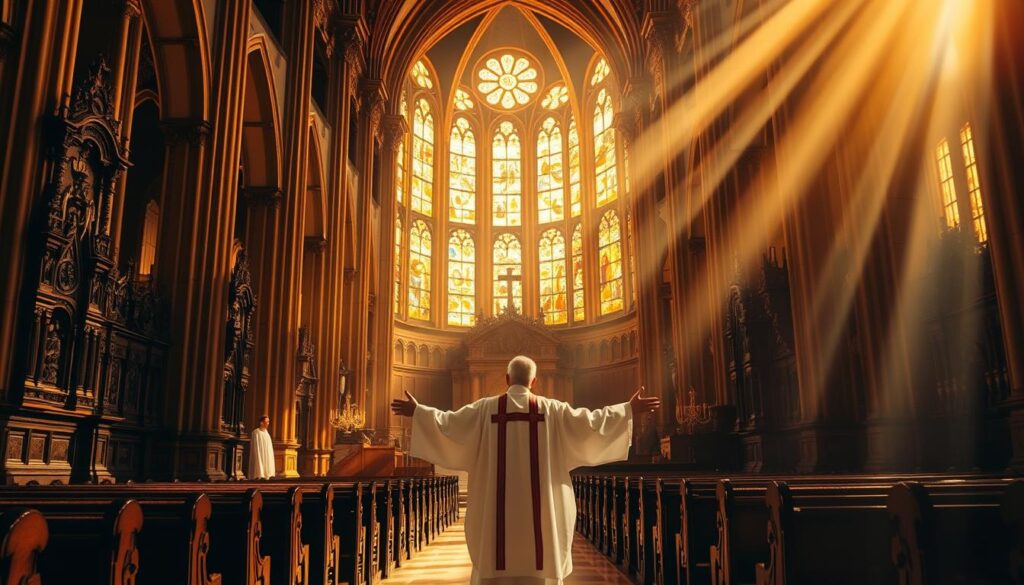
A grand cathedral interior bathed in warm, golden light from stained glass windows. Ornate altars, intricate carvings, and rows of wooden pews speak to the rich Catholic tradition. In the foreground, a priest stands before the congregation, his arms outstretched in a gesture of reverence and revelation. Rays of light pour down, illuminating the sacred space and creating an atmosphere of reverence and contemplation. The scene evokes a sense of timeless spirituality and the enduring power of Catholic faith.

The Role of Tradition and Revelation

Divine truth reaches believers through two channels: Scripture and Sacred Tradition. The Church’s Magisterium safeguards this deposit of faith, ensuring consistent interpretation across generations. As St. Vincent of Lérins noted, authentic teaching must align with “what has been believed everywhere, always, by all.”

Original sin created a gap between human potential and divine purpose. Grace bridges this divide through Christ’s sacrifice, restoring humanity’s capacity for holiness. This transformative power fuels efforts for justice and compassion worldwide.

Source of Truth Role Example
Scripture Written revelation Gospel accounts
Tradition Lived faith practices Liturgical rituals
Magisterium Teaching authority Papal encyclicals

Modern applications of these principles appear in healthcare ethics and refugee advocacy. By honoring each person’s sacred origin, Catholic communities address contemporary challenges while preserving ancient wisdom.

The Central Role of Jesus Christ in Catholic Doctrine

At the heart of Catholic teaching pulses the profound mystery of Jesus Christ. His life bridges heaven and earth, offering a path to salvation through divine love. This truth shapes every aspect of spiritual practice, from Sunday Mass to personal devotion.

Jesus as Redeemer and Savior

Christ’s dual nature—fully human and fully divine—anchors Catholic understanding of redemption. As St. Paul writes, “In him all things hold together” (Colossians 1:17). His death and resurrection healed humanity’s broken relationship with God, a truth celebrated daily in Eucharistic rituals.

This act of sacrifice made Jesus the ultimate redeemer, restoring access to grace for all people. Catholics see him as both compassionate brother and cosmic savior, transforming lives through sacraments and scripture.

His Teachings and Miracles

The Gospels record over 30 miracles demonstrating Christ’s authority over nature and suffering. Healing the blind and feeding multitudes weren’t just acts of power—they revealed God’s desire for human flourishing.

Key teachings like the Beatitudes provide a blueprint for holiness. “Love your enemies” and “Feed the hungry” remain guiding principles for modern believers. Through prayer and service, Catholics nurture a living connection with Jesus that shapes their eternal destiny.

Grace, Faith, and the Journey of Christian Life

Catholic spirituality thrives on divine gifts that transform ordinary lives into sacred journeys. This section explores how heavenly assistance and human effort intertwine to shape spiritual growth.
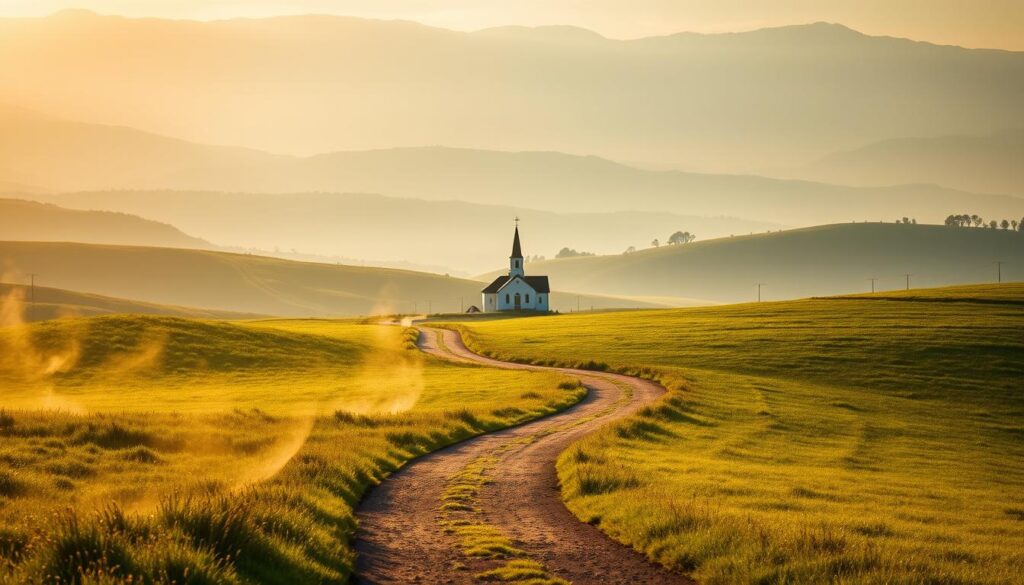
A serene landscape unfolds, illuminated by a warm, golden light. In the foreground, a winding path leads through lush, verdant meadows, symbolizing the journey of faith. Wisps of mist drift across the scene, adding an ethereal quality. In the middle ground, a humble church stands as a beacon, its steeple reaching heavenward, representing the grace and spiritual guidance that anchors the journey. Behind it, rolling hills recede into the distance, their silhouettes bathed in a soft, hazy glow, suggesting the expansive, transcendent nature of the Christian life. The atmosphere is one of tranquility, hope, and the quiet conviction of a faith-filled pilgrimage.

Understanding Grace and Human Nature

Grace operates like spiritual sunlight – freely given yet requiring openness to receive. The Catechism describes it as “God’s life within us”, healing brokenness while respecting free will. Three primary forms guide believers:

Type of Grace Purpose Example
Sanctifying Makes soul holy Baptismal renewal
Actual Inspires good actions Helping a stranger
Sacramental Strengthens through rituals Eucharist reception

These gifts don’t override human nature but elevate it. As St. Augustine observed, “Our hearts are restless until they rest in You” – grace answers this longing without force.

Faith in Action Through Charity and Good Works

The theological virtues – faith, hope, charity – form the engine of Christian life. Charity (love) becomes faith’s visible expression. Soup kitchens and prison ministries aren’t just nice gestures – they’re love made tangible.

Common misunderstandings arise here. Good works don’t earn salvation but naturally flow from genuine faith. A farmer doesn’t create apples by polishing them – the fruit grows because the tree is healthy.

Modern applications abound:

  • Volunteering at pregnancy centers
  • Advocating for fair wages
  • Protecting religious freedom

Through these actions, Catholics partner with grace – not as robots programmed for good deeds, but as willing collaborators in God’s renewal project.

Nurturing a Deep Relationship with God Through Prayer
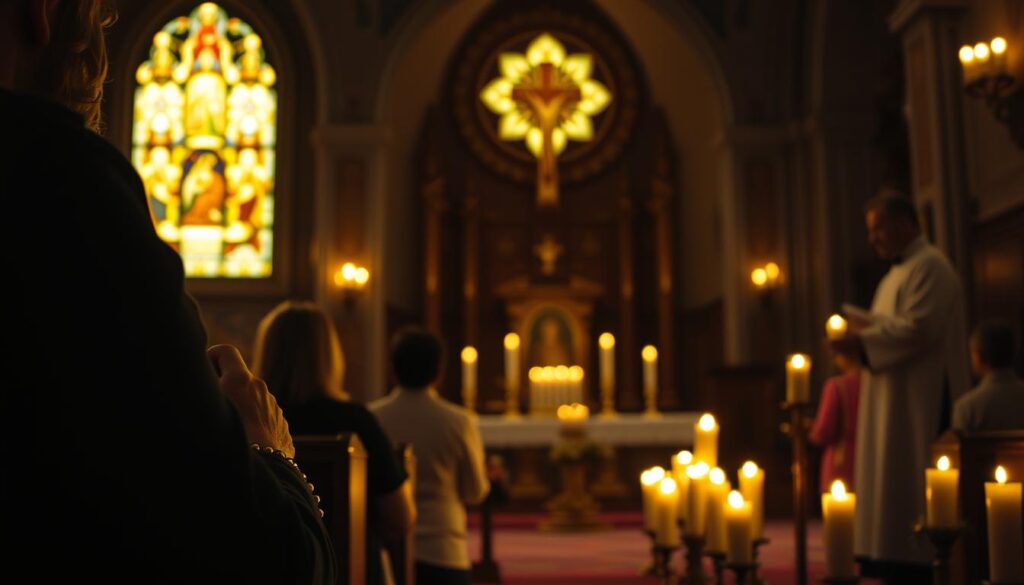
A dimly lit Catholic church interior, the warm glow of candles illuminating the ornate altar and stained glass windows. In the foreground, a devout parishioner kneels in prayer, rosary beads clasped in hands. The middle ground features a small group of worshippers, heads bowed, immersed in quiet contemplation. In the background, a priest stands before the congregation, leading them in a solemn ceremony. Soft, diffused lighting creates an atmosphere of reverence and serenity, reflecting the deep spiritual connection between the faithful and their faith.

Prayer forms the living bridge between earthly struggles and heavenly hope in Catholic spirituality. St. John Damascene called it “the raising of mind and heart” – a dynamic conversation where human longing meets divine love. This sacred exchange transforms routine moments into encounters with eternity.

Prayer as Communion and Personal Encounter

At its core, prayer represents more than requests or rituals. St. Thérèse of Lisieux described it as “a surge of the heart” – raw, authentic connection. Three primary forms nurture this relationship:

Prayer Type Purpose Practice Example
Vocal Shared worship Liturgy of the Hours
Meditation Scripture reflection Rosary mysteries
Contemplation Silent presence Adoration chapel visits

The heart becomes sacred ground in this process. As the Catechism teaches, this hidden center decides whether we choose life-giving connection or spiritual isolation.

Developing a Consistent Prayer Life

Building lasting habits starts with small steps:

  • Morning offering upon waking
  • Mealtime blessings with family
  • Nightly examination of conscience

Traditional prayers like the Our Father offer theological depth in simple words. A parishioner might say, “Reciting these ancient words links me to generations of believers.” When distractions arise, spiritual directors suggest breath prayers – short phrases synchronized with breathing rhythms.

“God thirsts that we may thirst for Him.”

St. Augustine

Communal support through retreats or prayer groups strengthens personal practice. These connections remind believers they’re never alone in their spiritual journey.

The Sacramental Life: Signs, Rituals, and Spiritual Renewal

Sacraments form the spiritual heartbeat of Catholic practice, transforming ordinary moments into encounters with divine grace. These sacred rituals use physical elements like water, oil, and bread to convey spiritual realities beyond human sight.

God’s Visible Gifts for Life’s Journey

The Church celebrates seven sacraments that mark key milestones in faith development. Baptism washes away original sin through water and the Trinitarian formula: “I baptize you in the name of the Father, and of the Son, and of the Holy Spirit.” This initiation rite makes individuals new creations in Christ.

At Mass, the Eucharist becomes Christ’s body and blood through consecration prayers. Catholics call this transformation transubstantiation – a mystery where bread and wine retain physical properties but change in spiritual essence. As the Catechism states, this sacrament is “the source and summit of Christian life.”

Sacrament Purpose Visible Sign
Baptism Spiritual rebirth Water
Confirmation Strengthening faith Chrism oil
Eucharist Divine nourishment Bread & wine
Reconciliation Merciful forgiveness Absolution words
Anointing Healing & comfort Holy oil
Marriage Loving covenant Wedding vows
Holy Orders Service leadership Laying on hands

Sacred Objects and Daily Holiness

Sacramentals extend sacramental grace into everyday life. Blessed items like rosaries or holy water remind believers of God’s presence in ordinary moments. Unlike sacraments, these practices don’t confer grace directly but prepare hearts to receive it.

The Church teaches that sacraments work ex opere operato – through Christ’s power, not human worthiness. A priest’s personal holiness doesn’t affect baptism’s validity, just as a muddy stream still reflects sunlight. This principle ensures God’s gifts remain accessible to all.

Catholic Teachings and the Impact of Historical Councils

Sixteenth-century Europe witnessed a pivotal moment in catholic theology as the Council of Trent (1545-1563) addressed doctrinal challenges from the Protestant Reformation. This ecumenical council clarified teachings on salvation while preserving core truths about divine grace and human response.

The Council of Trent and the Doctrine of Justification

Trent’s decree rejected the idea that good works earn salvation, stating: “None of those things that precede justification… merit grace.” Instead, it defined justification as both forgiveness and spiritual renewal – a transformative process requiring cooperation with God’s gifts. The council affirmed that while faith initiates salvation, faith works together with charity to sustain it.

Insights from Church Fathers and Catholic Theologians

Early thinkers like Augustine laid groundwork for Trent’s teachings, emphasizing grace’s primacy. Centuries later, catholic theologians revealed surprising common ground. Pope Benedict XVI noted Luther’s “faith alone” formula aligns with Catholic teaching when paired with active love.

Aspect Catholic View Protestant View
Justification Process with human cooperation Instant declaration
Grace Source Sacraments & works Faith alone
Final Authority Magisterium & Scripture Sola Scriptura

Modern dialogues continue refining these understandings. The magisterium maintains Trent’s core principles while applying them to new theological questions – proving historical councils remain living guides for spiritual truth.

Modern Catholic Perspectives and Global Outreach

Modern Catholic communities bridge ancient traditions with digital-age innovation, creating vibrant networks of faith. Recent gatherings like Pope Leo XIV’s address to 1 million young believers highlight this dynamic balance. “You are the sign a different world is possible,” he declared, capturing the Church’s vision for spiritual renewal amid contemporary challenges.

Youth Engagement and the Significance of Community

World Youth Day festivals have become global phenomena, blending prayer with cultural exchange. Young adults find community works through service projects and social media groups. These efforts reflect the Catholic view that every person contributes uniquely to building God’s kingdom.

Parishes now use TikTok and podcasts to share timeless teaching. A youth minister in the United States notes: “Meeting others where they are – physically and spiritually – makes faith relatable.”

Contemporary Reforms, Media, and Global Impact

The Church addresses modern crises through clergy accountability measures and refugee support programs. Media outreach strategies maintain Sacred Tradition while using cutting-edge tools. Streaming Masses reach homebound believers, proving ancient rituals thrive in new contexts.

Global initiatives prioritize works of mercy – feeding the hungry, sheltering migrants. As one nun serving war zones observes: “In God’s order, loving others remains our highest calling across time.” These efforts show how digital spaces and sacred places unite to reveal things God continues to do through His people.

FAQ

How does Catholic theology balance Scripture and Tradition?

The Catholic Church teaches that Sacred Scripture and Sacred Tradition form a single deposit of faith. Both are seen as essential for understanding God’s revelation, guided by the Holy Spirit through the Magisterium. This approach ensures teachings remain consistent with apostolic roots.

Why is the Council of Trent significant for Catholics?

The Council of Trent (1545–1563) clarified doctrines challenged during the Protestant Reformation. It emphasized the necessity of both faith and good works for salvation, reaffirmed sacraments, and addressed issues like justification. Its teachings remain foundational in Catholic doctrine.

What role do sacraments play in spiritual renewal?

Sacraments like Baptism and the Eucharist are visible signs of God’s grace. They strengthen one’s relationship with Christ, forgive sins, and unite believers to the Church. Catholics view them as channels of divine life, rooted in Jesus’ teachings and miracles.

How does prayer deepen a Catholic’s connection to God?

Prayer is seen as a personal encounter with God, fostering trust and humility. Through consistent practices like the Rosary or liturgical worship, Catholics seek guidance, express gratitude, and grow in charity. It’s a way to align one’s heart with God’s purpose.

What is the Catholic view on salvation and human effort?

Salvation is a gift of grace through Christ’s death and resurrection. However, Catholics believe humans cooperate with grace through faith, moral choices, and acts of love. This synergy reflects St. Paul’s teaching that “faith works through love” (Galatians 5:6).

How does the Church address modern social challenges?

Through global outreach, education, and advocacy, the Church addresses issues like poverty and injustice. Initiatives often emphasize community, human dignity, and the common good. Recent reforms under Pope Francis highlight environmental care and youth engagement.

Why do Catholics emphasize Mary and the saints?

Mary and the saints are seen as models of holiness who intercede for believers. Veneration reflects unity in the Communion of Saints, a spiritual family spanning heaven and earth. This practice honors their witness without diminishing Christ’s unique role as Savior.

How does the Eucharist unite Catholics worldwide?

The Eucharist, called the “source and summit” of Catholic life, symbolizes Christ’s sacrifice and resurrection. Receiving it during Mass strengthens communal bonds and reminds believers of their mission to share God’s love across cultures and generations.
Discover the Mystical Traditions of Catholicism


Have you ever wondered how everyday believers connect with the divine in profound ways? Across centuries, spiritual practices rooted in faith have offered pathways to deeper communion with God. These traditions aren’t just relics of the past—they remain vibrant tools for modern seekers longing to grow closer to the Holy Trinity.

Many assume intense spiritual experiences are reserved for saints or clergy. But the truth is far more hopeful: every baptized person is invited to explore a richer relationship with the Father, Son, and Holy Spirit. Through prayer, sacraments, and contemplation, ordinary lives can become extraordinary journeys of discovery.

This guide reveals how timeless methods help believers recognize God’s presence in daily life. You’ll learn from the wisdom of spiritual giants while finding practical steps to apply their insights. Whether through quiet reflection or active service, these practices transform how we love, pray, and engage with the world.

Key Takeaways

  • Spiritual depth is accessible to all believers, not just religious figures
  • The Holy Trinity actively invites personal connection through prayer and sacraments
  • Historical practices remain relevant for modern faith journeys
  • Contemplation helps recognize divine presence in everyday moments
  • Mystical traditions enhance both personal growth and service to others

Introduction to Mystical Catholicism

What does it mean to experience a deeper connection with God in daily life? Many assume profound spiritual encounters require dramatic visions or secluded monasteries. Yet the heart of this tradition lies in ordinary moments – receiving communion, praying quietly, or serving others. At its core, it’s about growing closer to Christ through practices available to everyone.

Defining Practices Rooted in Relationship

Church teachings emphasize that spiritual growth leads to “intimate union” with God through sacraments like the Eucharist. As the Catechism notes, this bond isn’t reserved for a select few. While extraordinary graces might appear in some lives, all believers receive invitations to deepen their faith. Mysticism here means participating in sacred rituals that bridge heaven and earth.

From Medieval Monasteries to Modern Kitchens

Historical accounts often highlight saints’ dramatic experiences, but early Christian writings show everyday people seeking divine closeness. Today, this pursuit remains vital. Busy parents, students, and professionals discover that contemplative prayer transforms routine tasks into holy encounters. Modern seekers find ancient practices help them recognize God’s work in relationships, challenges, and simple joys.

This approach demystifies the idea of spiritual elitism. Whether lighting a candle after work or reflecting on Scripture during a commute, small acts nurture union with the Divine. The goal isn’t mystical fame – it’s loving responsiveness to a God who meets us where we are.

Experiencing Spiritual Union Through Prayer and Contemplation

How do ordinary moments become gateways to divine connection? True spiritual growth often blooms when we shift from saying prayers to becoming prayer. This journey involves both radiant closeness and seasons of quiet struggle, each drawing us nearer to God’s heart.

A dimly lit sanctuary, the air heavy with the scent of incense. A solitary figure kneels in prayer, their face illuminated by the warm glow of candlelight. Stained glass windows cast kaleidoscopic patterns on the walls, casting a contemplative mood. The architecture is ornate, with soaring arches and intricate carvings, suggesting the profound and mystical nature of the space. A sense of reverence and stillness pervades the scene, inviting the viewer to join in a moment of deep spiritual reflection.

Intimate Union with Christ and the Holy Spirit

Prayer transforms when we stop talking at God and start listening with our souls. The Holy Spirit works in these quiet spaces, helping us exchange wish lists for wonder. As one 16th-century mystic observed:

“In the inner stillness where words fail, love speaks without sound.”

This sacred union grows through simple habits. Lighting a candle before reading Scripture. Sitting silently after receiving communion. These acts create room for God to reshape our hearts.

Navigating the “Dark Night of the Soul”

St. John of the Cross described periods when prayer feels like shouting into an empty sky. But this spiritual dryness serves a purpose. Like winter preparing soil for spring, the dark night purges our need for emotional rewards.

Aspect Consoling Prayer Dark Night
Emotional State Comfort, joy Dryness, longing
Perception of God Near, responsive Hidden, silent
Spiritual Purpose Building trust Deepening faith

During these challenging seasons, consistency matters most. Keep showing up. Trust that God works in hidden ways. What feels like abandonment is actually an invitation to love Him beyond feelings.

The Wisdom of the Saints: Legacy and Sacred Teachings

Saints across centuries have left roadmaps for spiritual growth that still light our paths today. Their writings and lives show how ordinary people can achieve extraordinary closeness to God. Through diaries, letters, and prayers, they teach us to recognize divine whispers in daily moments.

Insights from St. Maria Faustina Kowalska

St. Faustina’s diary reveals how God’s love transforms the soul. She described a vision where “the Three Divine Persons were One in essence yet distinct.” This experience fueled her mission to share Christ’s mercy. Pope St. John Paul II called her “a gift to our time” during her canonization.

Her teachings emphasize that spiritual union isn’t about special powers—it’s surrendering our hearts completely. As she wrote: “When we’re united to One Person of the Trinity, we join all Three through perfect love.”

The Enduring Message of St. John and Other Mystics

St. John of the Cross offers practical wisdom for spiritual dry spells. His “dark night” concept teaches that God often works most powerfully when He feels absent. This purification prepares souls for deeper connection.

Saint Key Teaching Spiritual Focus
St. Faustina Divine Mercy Trust in God’s forgiveness
St. John of the Cross Dark Night Growth through struggle
St. Thérèse Little Way Holiness in small acts

These saints remind us that spiritual growth takes time. Their collective message? God meets us where we are—whether in radiant joy or quiet longing—and shapes our hearts through every experience.

Incorporating Mystical Practices into Daily Catholic Life

How can ordinary routines become sacred pathways? Simple habits reshape how we encounter God in work, relationships, and quiet moments. These practices help souls recognize divine fingerprints everywhere—from morning coffee to evening commutes.

A dimly lit Catholic chapel, sunlight streaming through stained glass windows, illuminating a worshiper kneeling in quiet contemplation, rosary beads in hand. In the middle ground, a row of pews faces an ornate altar, candles flickering, the air infused with the scent of incense. In the background, intricate religious iconography adorns the walls, creating an atmosphere of reverence and spiritual connection. The scene conveys a sense of personal devotion and the integration of mystical practices into the rhythm of daily life.

Practical Tips for Deepening Faith and Union

Start with fifteen minutes of silent prayer each morning. Let this time be less about requests and more about listening. As one spiritual director advises: “Stillness trains hearts to hear whispers over shouts.”

Surround yourself with people living intentional spiritual lives. Shared faith amplifies grace—you’ll notice God’s work in others’ kindness or wisdom. This mutual encouragement makes divine love feel tangible.

Practice Daily Application Spiritual Fruit
Contemplative Prayer Silent focus on Scripture phrase Deeper trust
Sacramental Living Mindful preparation for Communion Stronger unity
Holy Indifference Accepting consolations/dryness equally Purified motives

Embrace seasons when prayer feels dry. These periods strengthen faith beyond emotional highs. Remember: God works in souls even when He feels distant.

Let the Beatitudes guide daily choices. Hold doors open. Listen without interrupting. Each small act becomes music harmonizing with heaven’s rhythm. Through consistent practice, ordinary life becomes extraordinary worship.

Church Foundations: Tradition, Sacraments, and the Holy Spirit

How does a two-thousand-year-old institution remain vital for spiritual seekers today? The answer lies in its divine blueprint. Jesus Christ established the Church as a living bridge between heaven and earth, empowering it through the Holy Spirit’s constant presence since Pentecost. This foundation ensures every generation accesses God’s grace through sacraments and sacred teachings.

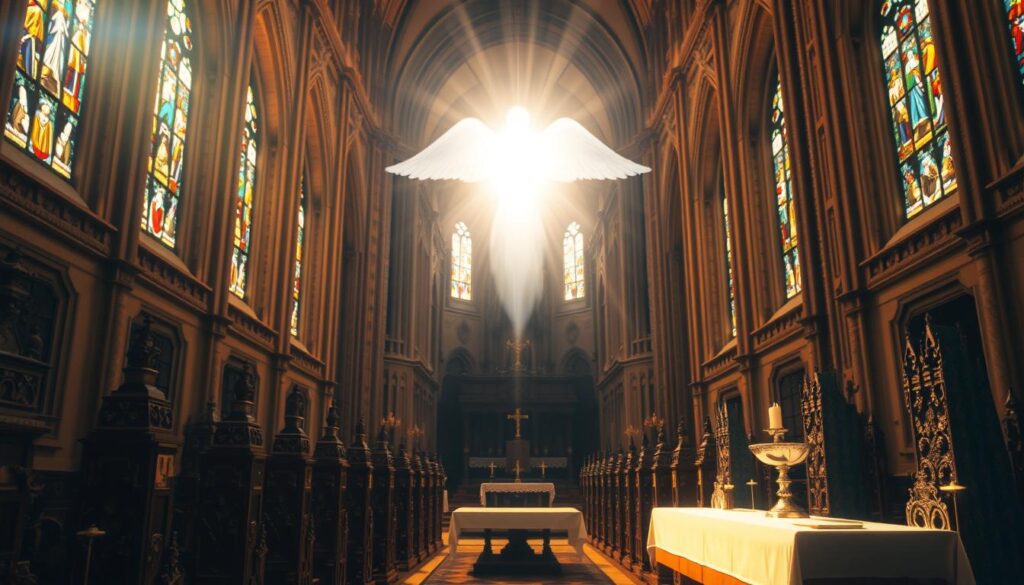
A grand cathedral interior, illuminated by warm, golden light filtering through stained glass windows. In the foreground, a glowing, ethereal presence representing the Holy Spirit hovers above the altar, casting a divine radiance upon the sacred sacraments below - the bread and wine of Communion, the baptismal font, and other symbolic objects. The middle ground features ornate, carved pews and intricate architectural details, conveying a sense of timeless reverence. In the background, the vaulted ceiling and distant apse recede into shadows, evoking a transcendent, mystical atmosphere. The scene exudes a profound spiritual essence, capturing the foundational role of tradition, sacraments, and the Holy Spirit within the Catholic faith.

Understanding the Hierarchical Legacy and Divine Commission

Christ entrusted His mission to the apostles, who passed their authority to bishops through apostolic succession. The Pope, as Peter’s successor, guides this one universal Church in preserving truth. As one early Church father wrote:

“Where the bishop is, there let the people gather – just as where Christ is, there is the Catholic Church.”

Sacraments like the Eucharist and Reconciliation fuel spiritual growth. They’re not symbolic gestures – they’re transformative encounters with God’s grace. Through these channels, the Holy Spirit repairs damage caused by sin and strengthens believers for their daily work.

The Church’s teachings act as guardrails against deception. Bishops worldwide collaborate with the Pope to interpret Scripture and Tradition, ensuring unity across time. This structure prevents faith from becoming a matter of personal opinion, anchoring it instead in Christ’s original vision.

Sacrament Spiritual Work Grace Received
Eucharist Union with Christ Nourishment for the soul
Reconciliation Healing from sin Renewed strength
Confirmation Empowerment Gifts of the Spirit

Regular participation in sacraments creates a rhythm of grace. It turns ordinary actions into holy moments, helping believers recognize God’s work in their lives. This time-tested system remains Christ’s gift to all seeking authentic spiritual growth.

Conclusion

What if everyday moments held keys to divine connection? Author Gary Jansen, called a “mystic” by Catholic radio host Jennifer Fulwiler, shows how accessible spiritual depth truly is. His work reminds us that mysticism isn’t reserved for distant monasteries—it blooms in laundry rooms, commutes, and quiet kitchen prayers.

Our experiences of God’s presence grow richer when we embrace small, consistent practices. Liturgical seasons become living invitations rather than rituals. As Jansen’s books suggest, this looks different for each soul—a parent finding grace in bedtime stories, a nurse seeing Christ in patients, or a student discovering union through study breaks.

True mysticism reshapes how we approach both joy and suffering. It’s not about extraordinary visions but ordinary faith lived with open hearts. Year by year, these habits transform lives into sacred journeys where every moment whispers with divine possibility.

The path forward? Start where you are. Let daily work become prayer. Trust that your unique story matters in God’s grand design. After all, eternity meets us right here—in the messy, beautiful now.

FAQ

What defines mystical practices in Catholic tradition?

These practices focus on deepening one’s relationship with God through prayer, contemplation, and surrendering to the Holy Spirit. They emphasize personal experiences of divine love and union, as seen in the lives of saints like St. John of the Cross and St. Teresa of Ávila.

How can I experience spiritual union through prayer?

Start with silent meditation, Scripture reading, and heartfelt dialogue with Christ. The journey often involves embracing both joy and challenges, such as the “dark night of the soul,” where trust in God’s presence grows even amid spiritual dryness.

What role do saints like St. Maria Faustina play in mystical teachings?

St. Maria Faustina’s revelations on divine mercy highlight God’s boundless compassion. Similarly, St. John of the Cross emphasized surrender and purification. Their writings guide believers toward humility, trust, and radical love for God and others.

Can mystical practices fit into a busy modern life?

Yes! Simple acts like brief morning prayers, reflecting on sacred teachings during breaks, or offering daily tasks to God foster spiritual growth. Even small moments of intentionality can deepen faith and connection with the Holy Spirit.

How do sacraments like the Eucharist support mystical union?

The sacraments are tangible encounters with God’s grace. Receiving the Eucharist, for example, unites believers with Christ’s sacrifice and resurrection, nourishing the soul and strengthening one’s capacity for divine love and service.

What does the “dark night of the soul” mean?

Coined by St. John of the Cross, this term describes a period of spiritual emptiness or doubt. Though painful, it’s seen as a purification process where God transforms the soul, leading to deeper trust and reliance on His presence beyond feelings.

Catholicism in the US: Exploring the Faith’s Impact


From colonial roots to modern-day influence, the Catholic Church has played a transformative role in shaping America’s social fabric. With over 72 million members nationwide, this faith community represents nearly a quarter of the population—a testament to its enduring presence across generations. What began as a small network of believers now stands as the country’s largest single Christian denomination, reflecting centuries of growth and adaptation.

The story of this religious tradition is deeply tied to waves of immigrants who brought vibrant traditions and built thriving communities. Their legacy lives on through iconic institutions—schools, hospitals, and universities—that remain pillars of American life today. Over 16,000 congregations now operate under the guidance of regional dioceses and the United States Conference of Catholic Bishops, which helps shape both spiritual and civic priorities.

Yet challenges persist in the 21st century. Declining participation rates and debates over social issues test the church’s ability to connect with younger generations. Despite these hurdles, its impact on education, healthcare, and justice initiatives continues to resonate, creating a dynamic relationship between faith and national identity that evolves with each era.

Key Takeaways

  • Over 72 million Americans identify with this faith, making it the nation’s second-largest religious group
  • Historical growth spans from colonial-era minorities to today’s extensive network of 16,000+ congregations
  • Immigrant communities laid the foundation for enduring educational and healthcare institutions
  • Governance occurs through 200 dioceses coordinated by the national bishops’ conference
  • Modern challenges include addressing attendance trends and contemporary social concerns
  • Catholic organizations remain vital contributors to public infrastructure and civic life

Introduction to Catholicism in the US

One in four Americans today identifies with this faith tradition, according to a 2020 Gallup poll. This vibrant community blends ancient rituals with modern American values

You’ll discover worship services in English, Spanish, French, and even Latin—a nod to both immigrant roots and global connections. From Irish neighborhoods in Boston to Mexican-American parishes in Texas, regional traditions showcase how local cultures enrich shared beliefs.

“Our strength lies in unity through diversity,” observes a diocesan leader. “The same Mass connects farmworkers in California and lawyers in Manhattan.”

The table below highlights key demographic features:

Ethnic Group Percentage of Catholic Population Notable Traditions
Hispanic/Latino 34% Our Lady of Guadalupe celebrations
European descent 47% St. Patrick’s Day parades
Asian/Pacific Islander 6% Filipino Simbang Gabi
African American 4% Gospel Masses

Over 200 dioceses coordinate activities nationwide, while Eastern Catholic Churches maintain distinct liturgies. The Basilica in Washington D.C.—North America’s largest Catholic church—symbolizes this faith’s enduring presence across the country.

From food festivals to college scholarships, Catholic institutions touch daily life in countless ways. This adaptability helps explain why 72 million people still claim this heritage despite modern challenges.

Historical Overview of Catholicism in America

Long before the Declaration of Independence, spiritual pioneers planted seeds of faith across the continent. Spanish and French explorers built the first chapels, blending European traditions with local cultures.

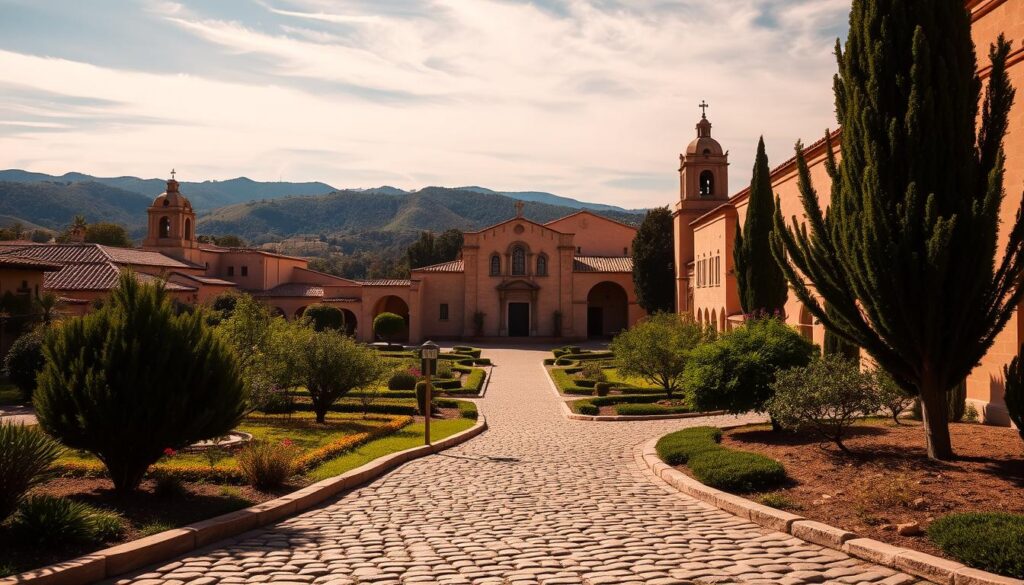
A serene landscape of majestic Spanish missions nestled against a backdrop of rolling hills and a clear, azure sky. The ornate, sun-dappled façades of the adobe structures stand tall, their intricate arches and bell towers casting elegant shadows across the lush, verdant gardens surrounding them. In the foreground, a cobblestone path winds through the tranquil courtyards, inviting the viewer to step back in time and experience the rich cultural heritage of early Catholicism in the Americas. Soft, diffused lighting illuminates the scene, creating a warm, inviting atmosphere that captures the enduring spiritual legacy of these historic sanctuaries.

Colonial Foundations and Early Practices

Dominican friars celebrated the first Catholic Mass on U.S. soil in 1526—83 years before Jamestown’s founding. San Miguel Mission in Santa Fe still holds services today, making it the nation’s oldest active parish.

Missionaries transformed landscapes from Florida to California. They taught farming techniques while establishing 21 permanent settlements by 1650. French Catholics left their mark too, designing cities like New Orleans with central church squares.

Impact of the American Revolution

Only 35,000 Catholics lived in the colonies during the 1770s—yet their contributions shaped history. Charles Carroll risked his fortune signing revolutionary documents, while Commodore John Barry became the Navy’s “Father.”

The war’s outcome brought unexpected benefits. Constitutional religious freedoms let Catholics build schools and hospitals openly. By 1800, Baltimore’s cathedral symbolized their growing acceptance in the young nation.

The Early Catholic Experience in the Thirteen Colonies

Colonial America’s religious landscape presented unique opportunities and obstacles for early believers. While most colonies enforced Protestant dominance, two regions became safe havens—Maryland and Pennsylvania.

Sanctuaries of Faith: Maryland’s Bold Experiment

Maryland’s story began with Cecil Calvert, a Catholic nobleman who established North America’s first religious tolerance law in 1649. His Maryland Toleration Act protected Trinitarian Christians—a radical concept when Puritan colonies punished heresy.

By 1785, over 15,800 believers called Maryland home. Wealthy families like the Carrolls built private chapels when public churches faced restrictions. Charles Carroll, later a Declaration of Independence signer, managed vast estates while secretly supporting clergy.

When Fear Overcame Freedom

Other colonies treated Catholics with suspicion. New York’s 1,500 believers faced test oaths barring them from voting or holding office. A Philadelphia printer once warned: “Papist plots threaten our liberties!”

Colony Catholic Population (1785) Key Figures
Maryland 15,800 Charles Carroll
Pennsylvania 7,000 William Penn
New York 1,500 St. Peter’s Church founders

“We worshipped in attics and barns,” wrote a Jesuit missionary. “Yet our numbers grew—like wheat springing from frozen ground.”

Only 25 priests served all thirteen colonies. They traveled disguised as merchants, celebrating Mass in homes. Despite these struggles, these communities planted seeds for future churches that would reshape the nation’s spiritual map.

Catholic Church Structure and Dioceses in the United States

The framework connecting America’s Catholic communities combines centuries-old traditions with modern organizational strategies. This system stretches from neighborhood parishes to national leadership, creating a network that supports over 70 million believers.

From Carroll’s Vision to Modern Networks

John Carroll’s 1789 appointment as Baltimore’s bishop marked the start of formal church governance. His single diocese has multiplied into 200 regional divisions today. Each operates like a spiritual hub, managing parishes that average 3,000 members.

Region Dioceses Key Cities
Northeast 45 New York, Boston
Midwest 55 Chicago, St. Louis
South 60 Houston, Miami
West 40 Los Angeles, Denver

National Coordination, Local Leadership

The United States Conference of Catholic Bishops helps dioceses collaborate on shared goals. President Timothy Broglio notes: “Our structure allows both local creativity and national unity.” Bishops meet annually to address issues like education reforms and community outreach.

While parishes remain grassroots centers for worship, dioceses handle larger projects. Recent years have seen mergers in areas with priest shortages—12% of parishes consolidated since 2010. Yet new immigrant communities spur diocese expansions in the Southwest and South.

Influence of Immigrant Communities and Ethnic Heritage

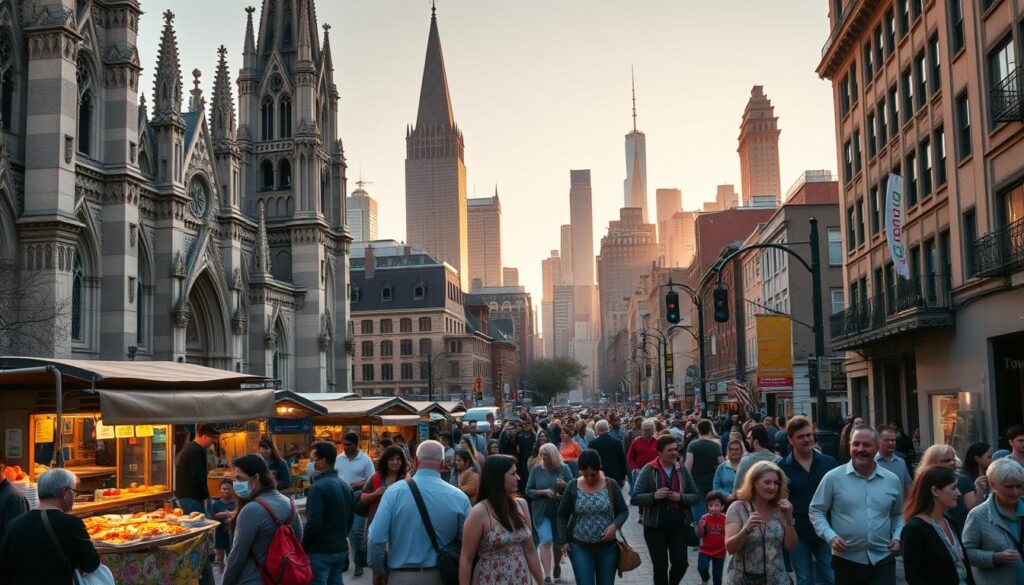
A bustling Catholic immigrant community in the heart of New York City. In the foreground, parishioners gather outside a stately cathedral, its towering spires and intricate facades reflecting the old-world elegance of their European heritage. Vendors sell wares and street food, their stalls adorned with vibrant colors and textures. In the middle ground, diverse families stroll the lively streets, their conversations and laughter mingling with the sounds of a local street band. The background is filled with the iconic skyline of Manhattan, its skyscrapers casting long shadows that create a warm, golden-hour glow over the scene. An atmosphere of faith, community, and the preservation of cultural traditions permeates the entire image.

America’s religious landscape transformed dramatically as waves of newcomers reshaped Catholic identity. The 1840s Irish potato famine sparked a pivotal shift—over 1 million arrived by 1850, tripling the catholic population in three decades. Their legacy? A network of schools and labor unions that lifted communities nationwide.

German settlers brought Old World traditions to industrial hubs. Milwaukee’s “Holyland” district still features churches with spires rivaling Bavarian cathedrals. One immigrant’s diary reveals: “We sang hymns in our tongue while building America’s railroads.”

“We built more than churches—we built a home,” remarked an Irish priest in New York’s Five Points neighborhood.

Later groups added vibrant threads to this tapestry. By 1900, Italian festivals filled New York streets with saints’ processions, while Polish parishes in Chicago showcased golden-domed architecture. These communities often clashed over resources—German and Irish leaders initially resisted sharing power with southern European arrivals.

Today’s story continues with Hispanic families revitalizing urban parishes. Their devotion to traditions like Las Posadas keeps the faith dynamic, proving immigration remains central to the church’s evolution.

Cultural Contributions and Catholic Traditions

America’s map tells a story of faith through city names and campus spires. Spanish missionaries and French settlers left marks that shape communities from coast to coast, while religious orders built schools that became national treasures.

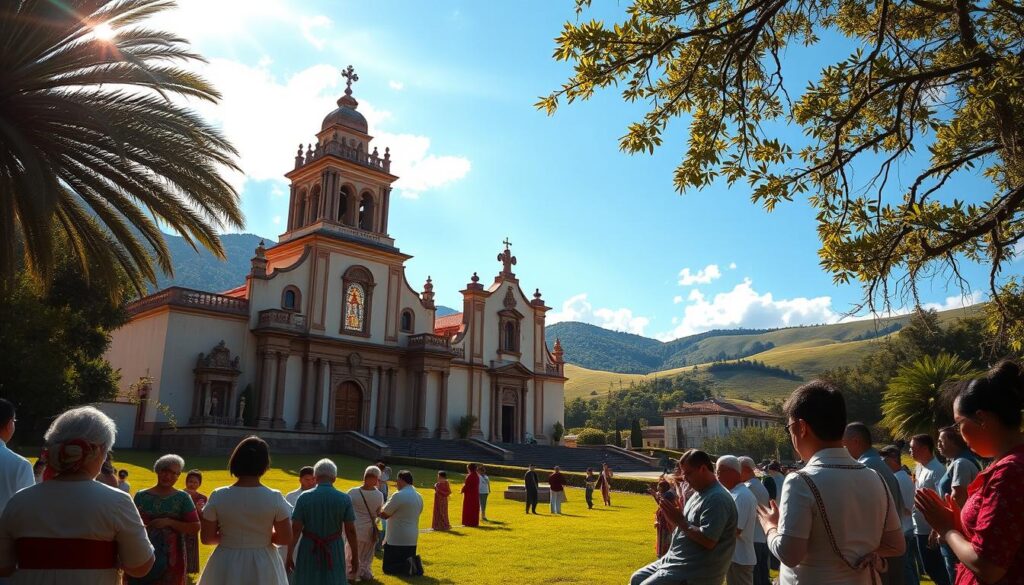
A grand Spanish colonial mission nestled amidst a lush, verdant landscape. The ornate facade, adorned with intricate carvings and a towering bell tower, stands in stark contrast to the rolling hills and azure sky. Sunlight filters through stained glass windows, casting a warm, reverent glow upon the scene. In the foreground, devout worshippers in traditional attire kneel in prayer, their faces serene and contemplative. The air is thick with the scent of incense and the sounds of choral hymns, creating an atmosphere of profound spirituality and cultural heritage. This image captures the essence of Catholicism's enduring influence and the vibrant traditions that have become woven into the fabric of the American experience.

Spanish Missions and French Influences

Drive through California, and you’ll pass cities bearing saints’ names—Los Angeles (The Angels) and San Francisco (St. Francis). Franciscan missionaries led by Junípero Serra established 21 coastal missions in the 1700s. These outposts taught farming methods and introduced adobe architecture still admired today.

French Catholics shaped the Midwest and South differently. St. Louis’s Cathedral Basilica echoes Parisian design, while New Orleans’ Catholic roots birthed Mardi Gras traditions. A historian notes: “They blended piety with practicality—churches doubled as trading posts.”

Legacy of Catholic Educational Institutions

Jesuit priests launched America’s first Catholic college—Georgetown University—in 1789. Their model combined philosophy classes with ethics training, creating leaders like Supreme Court justices and Nobel laureates. Today, over 200 Catholic colleges operate nationwide.

Institution Founded Notable Alumni
Georgetown University 1789 Bill Clinton
University of Notre Dame 1842 Condoleezza Rice
Boston College 1863 John Kerry

Elementary and high schools followed, with 6,000+ institutions currently serving 1.6 million students. New York’s Regis High School, founded in 1914, still offers free Jesuit education to gifted teens. These schools prioritize service, with 85% requiring community volunteer hours.

Key Figures in American Catholic History

Visionary leaders have shaped America’s religious landscape through bold actions and enduring legacies. John Carroll, the nation’s first Catholic bishop, laid foundations in 1789 that still support communities today. His work creating Georgetown University blended faith with education—a model followed nationwide.

Charles Carroll’s signature on the Declaration of Independence proved devotion to country and creed could coexist. As the only Catholic signer, this wealthy Marylander broke barriers during revolutionary times. His cousin John later built church structures still used by American bishops.

The 20th century brought new milestones. John F. Kennedy’s 1960 election as the first Catholic president silenced doubts about political acceptance. Meanwhile, Cardinal James Gibbons became a bridge between Rome and growing immigrant populations.

Archbishop John Ireland championed integration, urging English-language education despite opposition. These pioneers show how Catholic leaders balanced tradition with progress—forging paths that continue inspiring the faithful across the United States.

FAQ

How did the American Revolution impact Catholic communities?

The American Revolution boosted religious freedom, allowing Catholics to practice openly. Figures like Charles Carroll, a signer of the Declaration of Independence, helped reduce anti-Catholic bias and integrate the faith into the new nation.

Where did early Catholic communities thrive in the Thirteen Colonies?

Maryland and Pennsylvania became hubs for early Catholic settlers. Maryland’s 1649 Toleration Act protected religious minorities, while Pennsylvania’s Quaker-led tolerance attracted diverse groups, including Catholics.

What role does the USCCB play in the Catholic Church?

The United States Conference of Catholic Bishops (USCCB) guides doctrine, social justice efforts, and national policies. It unites dioceses under shared goals like education, immigration reform, and ethical healthcare practices.

How did immigrant groups shape American Catholicism?

Irish, Italian, German, and Hispanic immigrants enriched traditions, festivals, and parish life. They built schools, hospitals, and charities, blending cultural heritage with Catholic teachings to address urban poverty and labor rights.

What is the legacy of Catholic educational institutions?

Schools like Georgetown University (1789) and networks like Notre Dame emphasized academic excellence and moral formation. Parochial schools also provided accessible education, especially for immigrant families.

Who were key figures in early American Catholic history?

John Carroll, the first U.S. bishop, founded Georgetown and organized dioceses. St. Elizabeth Ann Seton pioneered Catholic schools, while Cesar Chavez later merged faith with labor activism.

How did anti-Catholic sentiment affect early believers?

Colonial-era laws barred Catholics from voting or holding office. Prejudice peaked with the 19th-century “Know-Nothing” movement, which falsely accused Catholics of disloyalty to America.

What cultural influences did Spanish missions leave?

Spanish missions in California and the Southwest introduced Catholicism to Indigenous communities. They shaped regional architecture, feast days like Our Lady of Guadalupe, and agricultural practices.

Powerful Catholicism Quotes for Spiritual Reflection


For centuries, sacred words from faith leaders have guided believers through life’s challenges. These timeless insights—from early Church thinkers to modern theologians—offer wisdom that still resonates today. Their messages about truth, sacrifice, and divine love continue to shape spiritual journeys worldwide.

Consider Tertullian’s declaration: “The blood of the martyrs is the seed of the Church.” This bold statement captures faith’s enduring power. Modern voices like Archbishop Fulton Sheen add depth, noting how misunderstandings often cloud perceptions of religious traditions.

G.K. Chesterton’s observation reveals faith’s complexity: “There are 10,000 reasons all amounting to one reason.” His words remind us that spiritual truth often defies simple explanations. These carefully chosen phrases serve as companions for daily reflection, offering comfort during trials and clarity in moments of doubt.

From Saint Augustine’s confessions to Pope Francis’ modern teachings, this collection spans two millennia of spiritual insight. Each quote acts like a new window into eternal truths about human purpose and divine connection. Discover how these words can strengthen your prayer life and deepen your understanding of sacred principles.

Key Takeaways

  • Explore wisdom from 2,000 years of faith tradition
  • Gain fresh perspectives on love, sacrifice, and redemption
  • Find daily inspiration from saints and modern leaders
  • Understand how timeless truths apply to modern life
  • Discover phrases that offer comfort and guidance

Embracing Daily Inspiration through catholicism quotes

Ancient wisdom continues to light the path for modern seekers, connecting eras through shared truths. These enduring words act like compasses—guiding through storms of doubt and celebrating moments of grace.

Historical Significance of the Quotes

Early thinkers shaped faith’s foundation through fiery trials. Tertullian’s declaration about martyrs’ blood fueling growth emerged during Roman persecutions—a bold vision of hope amid violence. Centuries later, Augustine challenged believers: “If you believe what you like… you’re following yourself, not the Gospel.” His words still warn against cherry-picking truths.

G.K. Chesterton’s 20th-century observation about “furious opposites” in faith mirrors our world’s complexities. These voices didn’t just speak to their time—they planted seeds for future generations.

Modern Interpretations and Personal Reflections

Today’s leaders bridge ancient wisdom with current struggles. Father Mike Schmitz reimagines Christ’s strength: “Not a teddy bear, but a grizzly.” Bishop Robert Barron reframes Easter as an “explosion” reshaping lives. Their fresh takes open new windows into familiar teachings.

Engaging with these ideas sparks personal growth. A medieval mystic’s words about divine love might comfort someone facing loss. A modern theologian’s insight could shift how we approach work or relationships. This living tradition connects us to a global family across time—proof that sacred truths adapt without fading.

The Role of Prayer, Fasting, and Sacramental Life

Foundational spiritual habits transform routine actions into pathways of grace. These practices anchor believers, turning ordinary moments into encounters with the sacred. Let’s explore how ancient wisdom and modern insights shape this journey.

Insights from Scripture and Tradition

G.K. Chesterton reimagined prayer as more than mealtime ritual. He declared: “I say grace before sketching, painting, swimming… and grace before I dip the pen in the ink.” This vision turns creativity into worship. Saint Ignatius of Loyola deepened this idea, linking obedience to love: “It is not hard to obey when we love the one whom we obey.”

Fasting traditions reveal similar depth. Early believers saw voluntary sacrifice as soul purification—a way to sharpen spiritual focus. Modern voices echo this, framing self-denial as rebellion against distraction.

Practical Applications in Daily Living

Sacramental rhythms offer tangible connection points. Weekly Mass becomes a new window into divine presence. Regular confession transforms guilt into growth. These habits build resilience against life’s storms.

Try pairing morning prayer with coffee rituals. Replace scrolling with Scripture during commutes. Small acts—like blessing coworkers silently—weave sacred threads through ordinary days. As Chesterton showed, every action can become prayer when done with intention.

Timeless Wisdom from Reputed Catholic Figures

Sacred voices from history’s hallways still echo through modern lives. Their words form bridges between ancient devotion and today’s challenges, offering guidance that feels both familiar and revolutionary.

A serene, dimly lit interior of a medieval church sanctuary. The foreground features a hand-carved wooden lectern adorned with intricate religious iconography. In the middle ground, stained glass windows cast a warm, ethereal glow upon a collection of leather-bound books and parchments, each inscribed with elegant calligraphic quotes from renowned Catholic saints. The background recedes into shadowy, contemplative space, creating a sense of timeless, spiritual tranquility. The overall atmosphere evokes a profound reverence for the wisdom and insights of these revered religious figures.

Inspirational Quotes by Saints and Theologians

Saint John Paul II’s call to be “athletes for Christ” reframes faith as active pursuit. His insight about the Gospel needing cultural dialogue remains urgent: “The Church holds back, the Gospel falls silent.” Centuries earlier, Saint Thomas Aquinas cut through confusion: “Study philosophy not to know men’s thoughts, but truth’s essence.”

Saint Augustine’s lion metaphor roars with confidence: “Truth defends itself.” Maximilian Kolbe’s Marian devotion challenges modern reservations: “Love Mary boldly—you’ll never surpass Jesus’ love for her.” These thinkers didn’t just share ideas—they lived them.

Learnings from Modern Catholic Voices

Saint Francis of Assisi’s radical poverty whispers a new window into resisting materialism. His example asks: What comforts might we surrender to serve better? Meanwhile, Aquinas’ balance of faith and reason equips believers for today’s debates about science and spirituality.

John Paul II’s leadership through political upheaval shows how timeless principles navigate changing worlds. These figures prove holiness isn’t perfection—it’s ordinary people choosing grace daily. Their words aren’t relics, but roadmaps for anyone seeking deeper purpose.

Catholic Social Teaching and Cultural Impact

Timeless principles shape modern society through a lens of justice and human dignity. These ideas challenge political divides while offering concrete solutions for today’s struggles.

Influence on Family, Community, and Society

G.K. Chesterton’s bold vision cuts through cultural noise: “We want a church that will move the world.” This call to action fuels efforts addressing poverty and inequality. Archbishop Chaput’s reminder about identity—“We’re Catholics first”—anchors believers in turbulent political waters.

Family life forms society’s bedrock. Fulton Sheen’s insight about marriage reveals its transformative power: “When a man loves… he must become worthy.” This ideal inspires parents to model virtue and nurture faith-filled homes.

Sphere Key Teaching Cultural Impact
Family Sacred marriage bonds Strengthens intergenerational faith
Community Protect vulnerable members Builds inclusive neighborhoods
Society Economic justice Challenges exploitative systems

These teachings open a new window into solving modern issues. From workplace ethics to immigration policies, they provide tools for building compassionate communities. The Church’s voice remains vital in debates about human worth and collective responsibility.

Understanding the Depth Behind Each Quote

Timeless truths become richer when we explore their roots and layers. Like stained glass windows, they reveal different colors when light shines through various angles of history and belief.

Context and Historical Backdrop

G.K. Chesterton’s observation about “furious opposites” in Christian doctrine emerged during early 20th-century debates. His words mirror a world wrestling with scientific progress and spiritual hunger. Consider how Saint Augustine’s miracle definition—“contrary to what we know about nature”—bridged 4th-century faith and reason discussions.

A dimly lit interior, soft chiaroscuro lighting casting dramatic shadows. In the foreground, an ornate, antique wooden table supporting a tattered leather-bound book, its pages open to reveal handwritten spiritual quotes in an elegant calligraphic script. In the middle ground, a stained glass window filters in muted, jewel-toned light, casting colorful reflections across the scene. The background is shrouded in a contemplative, almost mystical atmosphere, hinting at the profound theological depth underlying the displayed quotes.

Historical settings shape meaning. When Peter Kreeft states “meeting Jesus changes a person,” he continues a 2,000-year conversation about transformation. These ideas weren’t born in vacuum—they answered specific challenges while speaking to universal human experiences.

Exploring Theological and Spiritual Layers

Hans Urs von Balthasar’s insight about “becoming your gift to God” reveals faith’s dynamic nature. It’s not just about receiving truth—it’s active partnership. This new window into spiritual growth shows how divine love invites response.

Four last things theology—death, judgment, heaven, hell—infuses urgency into everyday choices. As Chesterton noted, holding tension between opposites (mercy/justice, freedom/obedience) creates holistic wisdom. These layers help believers navigate modern complexities without losing ancient anchors.

Every phrase becomes a mirror reflecting both immediate needs and eternal realities. Whether facing personal struggles or global crises, these multidimensional truths offer light for each step forward.

Incorporating Spiritual Reflection into Daily Life

Morning alarms and coffee routines can become sacred rituals when infused with intention. Spiritual wisdom thrives not in grand gestures, but in ordinary moments shaped by awareness.

A serene, softly-lit room with a cozy armchair and side table. Warm, natural light filters through a large window, casting a gentle glow. On the table, a leather-bound journal, a pair of reading glasses, and a single lit candle, its flame flickering gently. The walls are adorned with religious iconography - a crucifix, a statue of the Virgin Mary, and framed Catholic artwork. The atmosphere is one of quiet contemplation, inviting the viewer to pause, reflect, and connect with their spiritual side.

Meditation, Prayer, and Personal Growth

Start your day with Fulton Sheen’s insight: “It takes three to make love—you, your spouse, and God.” Let this truth color interactions before breakfast. Post lunch, revisit Chesterton’s call to see life as gift: “All goods look better when they look like gifts.”

Father Mike Schmitz’s challenge turns commutes into preparation time. When traffic tests patience, recall his warning: “Jesus will call you out.” Evening walks gain depth with Teresa of Avila’s mantra: “Let nothing disturb you… God never changes.”

Try this simple pattern:

  • Choose one phrase each morning
  • Repeat it during transition moments
  • Journal reactions before bed

This practice opens new windows into familiar days. Over time, grocery lines become prayer spaces. Work emails transform into chances for grace. The body remembers truth faster than the mind—let muscle memory guide you toward light.

Memorized words act like emergency flares during storms. When stress hits, whispered wisdom reshapes reactions. What begins as discipline becomes second nature—a quiet revolution in how we move through life’s ordinary magic.

Interfaith Perspectives and Comparative Reflections

Across spiritual traditions, common threads weave a tapestry of shared human longing. These connections reveal how diverse paths often point toward similar truths about compassion, justice, and our place in the world.

Dialogue Between Faiths and Shared Values

Major religions agree on core principles more than many realize. The Golden Rule appears in Hinduism’s “Do nothing to others that would cause pain” and Islam’s “None of you believes until he loves for his brother what he loves for himself.” Such parallels remind us that wisdom transcends labels.

Shared commitments to love and truth create bridges between communities. Buddhist teachings on suffering echo Jewish psalms about hope in darkness. Sikh langar meals and Christian soup kitchens both address hunger through service. These practices show how people across faiths tackle life’s challenges with similar tools.

Exploring differences deepens understanding too. A Muslim’s prayer rug, a Hindu’s meditation mat, and a Catholic kneeler all serve the same purpose—creating sacred space. Recognizing these universal patterns helps us appreciate both diversity and unity in spiritual journeys.

FAQ

How do Catholic teachings apply to daily challenges?

Teachings emphasize virtues like patience, charity, and humility through prayer, sacraments, and acts of service. Figures like St. Thérèse of Lisieux highlight “doing small things with great love” as a path to holiness in ordinary moments.

Why are fasting and prayer linked in spiritual growth?

Fasting fosters self-discipline, while prayer deepens reliance on God. Together, they purify intentions and align hearts with divine will, as St. Augustine noted: “Pray as though everything depended on God. Work as though everything depended on you.”

What role do saints play in understanding faith?

Saints like St. Francis of Assisi or St. Teresa of Calcutta model lived faith. Their words and actions offer relatable examples of mercy, sacrifice, and trust in God’s plan, bridging ancient wisdom with modern struggles.

How does Catholic social teaching address today’s issues?

It promotes human dignity, solidarity, and care for creation. Pope Benedict XVI emphasized that “the Church cannot neglect the service of charity,” urging communities to address poverty, injustice, and environmental stewardship through Gospel values.

Can non-Catholics find value in these teachings?

Absolutely. Themes like love, forgiveness, and justice resonate across faiths. St. John Paul II encouraged interfaith dialogue, stating that “truth is not threatened by differences but enriched”—a call to shared moral action.

How does meditation deepen spiritual reflection?

Meditation, as St. Ignatius of Loyola taught, helps quiet the mind to discern God’s voice. Pairing Scripture or quotes with contemplative prayer fosters self-awareness and aligns daily choices with eternal truths.

What’s the significance of sacraments in daily life?

Sacraments like the Eucharist or Reconciliation offer grace for transformation. As St. Thomas Aquinas wrote, they “heal, strengthen, and nourish” the soul, turning routine moments into encounters with the divine.

Catholicism’s Impact on German Culture and Identity


For centuries, religious traditions have woven themselves into the fabric of daily life across Central Europe. Nearly 1 in 4 residents still identify with a specific faith community, though participation rates tell a more complex story. Recent data shows only 6% of members actively engage in weekly services – a striking contrast to historical norms.

This exploration reveals how centuries-old practices continue influencing modern celebrations, art, and social values. From vibrant Bavarian festivals to quiet village traditions, these cultural fingerprints remain visible even as society evolves. The numbers paint a vivid picture: over 400,000 individuals formally ended their affiliations in 2023 alone.

Regional differences add depth to this narrative. Areas like the Rhineland maintain stronger connections to spiritual heritage compared to urban centers. Meanwhile, former East German regions show markedly different patterns shaped by 20th-century history.

Understanding these shifts helps decode broader European trends. As membership declines but cultural imprints persist, communities grapple with preserving identity while adapting to modern values. This tension forms the heartbeat of today’s social landscape.

Key Takeaways

  • 24% of the population maintains formal religious affiliation despite changing practices
  • Weekly participation rates have dropped to just 6% among members
  • Over 920,000 individuals left their faith communities between 2022-2023
  • Cultural traditions remain strong in regions like Bavaria
  • Urban areas and former East Germany show distinct secularization patterns
  • Historical influences continue shaping modern celebrations and values

Historical Foundations and Cultural Contributions

The roots of Germany’s cultural landscape stretch back through centuries of spiritual influence, where sacred institutions shaped society’s very framework. Monastic communities laid groundwork for modern education—medieval cathedral schools evolved into prestigious universities like Heidelberg and Freiburg. These centers preserved knowledge through political storms, blending faith with academic rigor.

Early Influences and Deep-rooted Traditions

For over 1,000 years, local churches served as community anchors. They established Europe’s first hospitals and orphanages—models for today’s social services. Seasonal festivals like Corpus Christi processions still color town squares, merging faith with regional pride.

An Overview of Catholic Heritage

Pilgrimage routes such as the Cologne-to-Kevelaer path remain cultural touchstones. The 6.848 billion euros collected in 2022 through church tax funds museums, music programs, and historic preservation. This financial muscle sustains traditions even as participation shifts.

Year Catholic Membership Weekly Mass Attendance Church Tax Revenue
2003 25.5 million 15.2% 4.1 billion €
2023 19.5 million 6.2% 6.8 billion €

Bishops’ conference reports reveal a stark 20-year trend—6 million fewer members since 2003. Yet the church’s imprint persists in language, art, and labor laws. Its social teachings inspired Germany’s worker protections and market ethics, proving ideas often outlast attendance numbers.

Catholicism in Germany: Cultural Identity and Community Influence

Regional faith practices paint a vivid picture of Germany’s evolving spiritual landscape. Take the Diocese of Görlitz – this border community near Poland boasts a 13.9% Mass attendance rate, nearly triple the national average. Yet just 300 miles west, Aachen’s churches see only 4.2% of members regularly participating. What explains such dramatic contrasts?

A grand Catholic cathedral stands tall, its ornate spires piercing the sky. Worshippers clad in traditional garments fill the pews, heads bowed in reverent prayer. Sunlight streams through stained glass windows, casting a warm, ethereal glow over the scene. The air is thick with the scent of incense and the swell of an organ's hymn. In the middle ground, a procession of clergy and choir members processes down the central aisle, their robes and vestments flowing gracefully. In the background, the bustling streets of a historic German city bustle with life, a testament to the deep-rooted presence of Catholicism in the nation's cultural identity and community.

The Role of the Church in Shaping National Values

Smaller communities like Görlitz thrive through cultural cross-pollination. Their proximity to Poland’s strong Catholic traditions creates a reinforcing effect. “Shared festivals and pilgrimages keep our identity vibrant,” notes a local parish leader. These areas often blend spiritual practices with regional customs, creating unique expressions of faith.

Urban centers face different challenges. Industrial hubs like Aachen saw factory work reshape community ties. As steel mills replaced village squares, weekly Mass became less central to social life. Still, Catholic ethics influence debates about healthcare reform and climate action – even among non-practicing Germans.

Traditions and Modern Adaptations in Religious Practice

Three key adaptations help churches stay relevant:

  • Digital outreach through livestreamed services and faith-based apps
  • Contemporary music blending hymns with popular genres
  • Interfaith partnerships addressing homelessness and refugee support

Traditional festivals like Corpus Christi processions now draw curious tourists alongside devout worshippers. This cultural crossover keeps ancient rituals alive while introducing them to new audiences. Meanwhile, Catholic schools and hospitals continue serving over 1.2 million students and patients annually – proving institutional influence extends far beyond Sunday services.

Current Trends, Reforms, and Statistical Insights

Modern societal changes are reshaping long-standing religious affiliations across regions. Recent reports from the German Bishops’ Conference show 402,694 members formally exited in 2023—a 23% drop from the previous year’s record numbers. While this suggests slowing departures, deeper challenges persist.

Membership Decline and Shifts in Mass Attendance

Only 38 new priests joined the clergy last year, down from 45 in 2022. This shortage strains communities already grappling with 6.2% weekly attendance rates. Younger members increasingly cite financial concerns, with 9% income-based church tax driving exit decisions.

Impact of Church Tax, Exits, and Synodal Reforms

Three factors dominate departure discussions:

  • Tax obligations affecting household budgets
  • Ongoing abuse crisis management
  • Demands for structural reforms through the Synodal Way

Despite Vatican pushback, German bishops pursue changes to celibacy rules and leadership roles. “People want transparency,” notes a Cologne parish council member. “When institutions feel outdated, exits follow.”

Comparative Analysis of Diocesan Variations

Diocese 2023 Exits Mass Attendance Priests Ordained
Munich 51,203 5.1% 7
Cologne 38,491 4.8% 5
Erfurt 4,872 11.3% 2

Eastern regions like Erfurt show stronger retention, contrasting sharply with western urban centers. Projections suggest church tax payers could halve by 2060, forcing creative solutions for maintaining community services.

Conclusion

As communities navigate modern challenges, spiritual institutions grapple with maintaining relevance while honoring tradition. Bishop Georg Bätzing’s recent statement captures this tension perfectly: “Reforms alone won’t solve the church crisis, but the crisis will worsen without them.” With over 1.7 million exits since 2019, the comprehensive crisis facing these communities demands creative solutions.

Regional differences tell a hopeful counter-narrative. Areas near Poland maintain stronger participation rates, while western cities see faster decline. The bishops conference reports these variations highlight how local culture shapes practice – some dioceses retain triple the national average for services.

Through schools and hospitals, the church still impacts daily life for millions. Nearly 1.2 million students attend faith-based institutions yearly. This institutional presence ensures cultural influence persists even as membership numbers drop.

The Synodal Way reforms attempt to balance modern values with tradition. While tensions remain about governance changes, these efforts show communities adapting rather than disappearing. As the next decade unfolds, this evolution will shape how historical institutions contribute to contemporary identity.

FAQ

How has Catholicism shaped Germany’s cultural identity?

The faith’s influence spans centuries, embedding traditions like Christmas markets, Easter customs, and regional festivals into daily life. Monasteries and cathedrals also stand as architectural symbols of its historical role in shaping art, education, and social values.

Why are many Germans leaving the Catholic Church?

Recent scandals, debates over reforms, and the mandatory church tax have driven a surge in exits. Over 522,000 people formally left in 2022 alone, reflecting frustration with institutional policies and declining trust in leadership.

What role does the church tax play in membership trends?

Members pay 8–9% of their income tax as a church fee, which funds diocesan operations. However, this system has become contentious, with many opting to leave officially to avoid the financial burden amid broader disagreements with the church’s direction.

How are dioceses addressing declining engagement?

The German Bishops’ Conference has initiated synodal reforms focusing on transparency, lay participation, and modernizing teachings. Some dioceses experiment with digital services or relaxed Mass formats, though progress remains uneven across regions.

Are Catholic traditions still relevant in modern Germany?

While sacraments like baptisms or weddings retain cultural significance, weekly Mass attendance has dropped below 10%. Younger generations often blend traditional practices with personal spirituality, reflecting a shift toward individualized faith expressions.

How does Germany’s Catholic crisis compare to other countries?

Exit rates here outpace many European nations, partly due to the unique church tax system. However, debates over clergy abuse, gender equality, and governance reforms mirror global challenges facing the Vatican’s authority.

Catholicism and Cremation: What You Need to Know


For centuries, the Catholic Church held strong views about honoring the departed. Traditional teachings emphasized burial as the only acceptable way to respect the human body, seen as a sacred creation. This stance stemmed from ancient theological principles and a desire to distance the faith community from pagan rituals that involved burning remains.

Attitudes began shifting in 1963 when the Church updated its position. While still preferring burial, it allowed cremation under specific conditions. This change reflected modern realities like limited cemetery space and evolving family preferences. Today, many followers choose this option while striving to align it with their religious beliefs.

Current guidelines emphasize treating ashes with reverence. The Church insists they be stored in sacred spaces, not scattered or kept at home. These rules aim to maintain respect for the body’s role in spiritual teachings about resurrection and eternal life.

Key Takeaways

  • The Church transitioned from banning cremation to allowing it in 1963
  • Traditional teachings link bodily integrity to resurrection beliefs
  • Ashes must be treated with dignity and placed in consecrated ground
  • Modern acceptance balances practical needs with theological values
  • Families should consult local parishes when planning arrangements

Historical Perspectives on Cremation in the Catholic Church

The relationship between the Catholic Church and cremation has evolved significantly over hundreds of years. Early teachings prioritized traditional burial as the sacred way to honor the deceased, rooted in resurrection theology. This approach also countered pagan Roman practices that mocked Christian martyrs.

Traditional Beliefs and Early Opposition

For centuries, the Church viewed cremation as incompatible with core beliefs. Ancient Romans burned Christian martyrs’ bodies to challenge their hope in bodily resurrection. This history made burial a powerful symbol of faith – preserving the body for its promised renewal at the end of time.

Church leaders emphasized that intact remains best reflected spiritual teachings about life after death. Cremation became associated with pagan rituals and denial of resurrection, leading to its outright ban for members.

Evolution of Church Teachings and the 1963 Shift

A major shift occurred when the Vatican updated its stance in 1963. Practical challenges like limited cemetery space and rising costs prompted reconsideration. The Church now permits cremation if chosen for practical reasons – not to reject resurrection beliefs.

This change balanced ancient teachings with modern needs. Guidelines require ashes to be treated with the same respect as full remains, stored in consecrated locations. The update showed how timeless teachings could adapt to new realities while maintaining theological integrity.

Catholicism on Cremation: Modern Guidelines and Practices

Modern Catholic practices blend ancient traditions with contemporary needs. Updated rules allow families to make practical choices while honoring spiritual values. The Church’s approach balances respect for the human body with compassion for modern realities.

A serene Catholic chapel interior, with warm lighting casting a soft glow on the polished marble floor and ornate wooden pews. In the foreground, a simple yet elegant cremation urn rests on a pedestal, flanked by flickering candles and delicate floral arrangements. The middle ground features a stained glass window depicting a heavenly scene, while the background showcases an altar adorned with religious iconography. The overall atmosphere conveys a sense of reverence, reflection, and the sacred rituals surrounding the modern Catholic approach to cremation.

Understanding the Official Church Stance

The 1983 Code of Canon Law clarified that choosing cremation doesn’t conflict with Christian beliefs. Leaders emphasize this practice doesn’t hinder God’s power to resurrect the body. A 2016 Vatican document reaffirmed burial as the preferred option but permitted cremation when done respectfully.

Aspect Traditional Burial Cremation Guidelines
Church Preference Strongly encouraged Permitted with conditions
Handling of Remains Buried intact Ashes stored in sacred space
Permitted Reasons N/A Cost, space, family needs

Adapting to Contemporary Funeral Needs

Many families choose cremation today due to limited cemetery space or financial concerns. The Church allows this provided decisions reflect faith in resurrection rather than reject it. Ashes must be placed in consecrated ground – never scattered or kept at home.

Local parishes help navigate these guidelines while respecting personal circumstances. This flexibility shows how timeless teachings adapt to new challenges without compromising core values.

Funeral Rites and Ceremonial Traditions

Catholic funeral traditions provide a sacred framework to honor loved ones while affirming beliefs about eternal life. These time-honored practices guide families through grief while celebrating the deceased’s spiritual journey.

The Structure of a Traditional Catholic Funeral

The Church organizes funeral rites into three meaningful stages. The Vigil, often called a wake, allows family members to gather for prayers and shared memories. This initial step creates space for emotional healing within the faith community.

Central to the process is the Funeral Mass, celebrated in the parish church. The body present or cremated remains rest near the altar, covered with a white pall symbolizing baptismal purity. Scripture readings and Eucharistic celebration anchor this solemn service.

Role of the Funeral Mass and Committal Service

During the Mass, priests emphasize Christ’s victory over death through Gospel messages. Family members often participate through readings or bringing offerings to the altar. This active involvement strengthens communal bonds while honoring the departed.

The final service occurs at the burial site, where prayers accompany the body or ashes to their resting place. This committal ritual provides closure while reaffirming hope in resurrection – a cornerstone of Catholic teaching about eternal life.

Respectful Handling and Preservation of Cremated Remains

Honoring loved ones extends beyond memorial services to how we care for their physical remains. The Church provides clear directions to maintain dignity while addressing modern preferences. These guidelines help families make choices aligned with spiritual values.

A serene, dimly lit room with ornate, sacred resting places for cremated remains. Soft, warm lighting casts a reverent glow, illuminating the intricate details of the urns and memorial vaults. In the foreground, a row of carved, polished marble receptacles stand in solemn dignity. Behind them, a curved alcove with gilded accents and stained glass windows lends an air of reverence. The background fades into a hazy, contemplative atmosphere, evoking a sense of tranquility and respect for the departed. The composition is balanced, with a sense of architectural harmony guiding the viewer's gaze through the space.

Practices for Sacred Resting Places

Cremated remains must be placed in consecrated locations like Catholic cemeteries or church columbarium niches. These sacred places ensure ongoing respect through community remembrance and proper upkeep. Many parishes now offer dedicated spaces for urns, blending tradition with space-saving solutions.

Prohibited Practices and Guidelines for Ashes

The Church strictly forbids scattering ashes or dividing them among family members. A 2023 update allows keeping a tiny portion in places of personal significance – like ancestral homes – with bishop approval. This rare exception requires avoiding any non-religious symbolism.

Permitted Practices Prohibited Actions
Burial in cemetery plots Scattering remains
Columbarium placement Home display (most cases)
Minimal keepsakes (with approval) Making memorial jewelry

Keeping ashes at home remains discouraged except in special cultural situations. Church leaders emphasize that proper interment shows respect for the body’s role in resurrection beliefs. Always consult local clergy when planning final arrangements.

Conclusion

Navigating end-of-life decisions within the Catholic faith requires balancing time-honored beliefs with today’s realities. The Church’s guidance on honoring the human body—viewed as a sacred vessel—remains central, even when families choose cremation.

Modern practices allow flexibility while upholding core teachings about resurrection and eternal life. By requiring ashes to rest in consecrated spaces, the Catholic Church maintains reverence for the body’s role in spiritual journey.

Families planning memorials should consult their local parish to align arrangements with faith traditions. This ensures funeral rites reflect both personal needs and communal beliefs about life’s sacred purpose.

The Church’s evolving stance demonstrates how ancient truths adapt to contemporary challenges. Whether through burial or cremation, Catholic teachings affirm dignity in death and hope in Christ’s promise of renewal.

FAQ

Why did the Catholic Church historically oppose cremation?

Early teachings emphasized burial to honor the body as a temple of the Holy Spirit. The Church also sought to distance itself from pagan rituals that involved burning remains. Belief in bodily resurrection reinforced the preference for traditional burial.

When did the Church begin permitting cremation?

The 1963 Vatican II reforms allowed cremation if it didn’t deny Christian beliefs about eternal life. Guidelines were later refined in 1997 and 2016, emphasizing respectful treatment of ashes and proper burial practices.

Can cremated remains be present during a Funeral Mass?

Yes. Since 1997, the Church permits cremated remains at funeral rites, provided they’re in a dignified container. The focus remains on honoring the deceased’s dignity and faith in resurrection.

Are there restrictions on storing or scattering ashes?

The Church requires ashes to be kept whole in a sacred place, like a cemetery or columbarium. Scattering, dividing remains, or keeping them at home is prohibited to uphold respect for the body’s sacred role.

How does cremation align with belief in resurrection?

Catholic teachings affirm that God’s power transcends physical decay. Whether buried or cremated, the faithful trust in divine restoration of the body and soul in eternal life.

Can families choose cremation for practical reasons?

Absolutely. Financial constraints, environmental concerns, or family preferences are valid reasons, as long as practices follow Church guidelines. Discussing plans with a priest ensures alignment with faith traditions.