Recent Posts

Exploring the Significance of Mary in Catholicism


For centuries, the Mother of God has held a special place in spiritual traditions worldwide. Within the Catholic Church, her role extends far beyond historical accounts, shaping theology and personal devotion. This article explores how her influence developed through Scripture, early Church teachings, and cultural practices.

Biblical references lay the groundwork for understanding her unique position. Early Christian communities honored her as a symbol of faithfulness, a theme that deepened over time. Church councils later formalized doctrines, emphasizing her connection to divine mysteries.

Many wonder why devotion to the Virgin Mary remains central today. The answer lies in her dual role as both heavenly intercessor and relatable human figure. From ancient catacomb art to modern prayer practices, this veneration reflects evolving spiritual needs.

In contemporary America, Marian traditions continue to inspire. Parishes celebrate feast days with processions, while families pass down prayers like the Rosary. These customs bridge generations, keeping her legacy alive in daily faith experiences.

Key Takeaways

  • Mary’s title as “Mother of God” originated in early Church councils
  • Biblical foundations support her unique role in Christian theology
  • Devotional practices evolved naturally over 2,000 years
  • Common misconceptions stem from misunderstandings of Church teachings
  • Modern U.S. Catholics maintain vibrant Marian traditions
  • Art and liturgy reflect her ongoing spiritual significance

Introduction: The Role of Mary in the Catholic Faith

Within Roman Catholic tradition, devotion to the Blessed Virgin Mary stands as a unique spiritual practice. Unlike ordinary saintly honors, her veneration—called hyperdulia—reflects her unparalleled role in salvation history. The Catholic Church teaches this special reverence never competes with worship reserved for God alone.

Popes have nurtured Marian devotion while guiding believers toward authentic expressions. As one Vatican document states:

“True honor flows from faith, not superstition—it magnifies Christ through his mother.”

This distinction preserves theological clarity while allowing diverse cultural practices.

Consider how Marian traditions differ from other Christian approaches:

Veneration Type Recipient Purpose
Latria God Divine worship
Hyperdulia Virgin Mary Honor for her unique role
Dulia Saints Respect for holiness

Over 1,000 titles like Mother of God and feast days reveal her enduring impact. From the Rosary to Michelangelo’s Pietà, these expressions help believers connect faith with daily life. They bridge ancient teachings and modern spirituality through tangible traditions.

Historical Roots of Marian Veneration

Long before grand cathedrals rose, humble underground spaces held clues to early Christian devotion. Hidden art and symbols in burial chambers reveal how believers honored the Mother of Jesus during times of persecution.
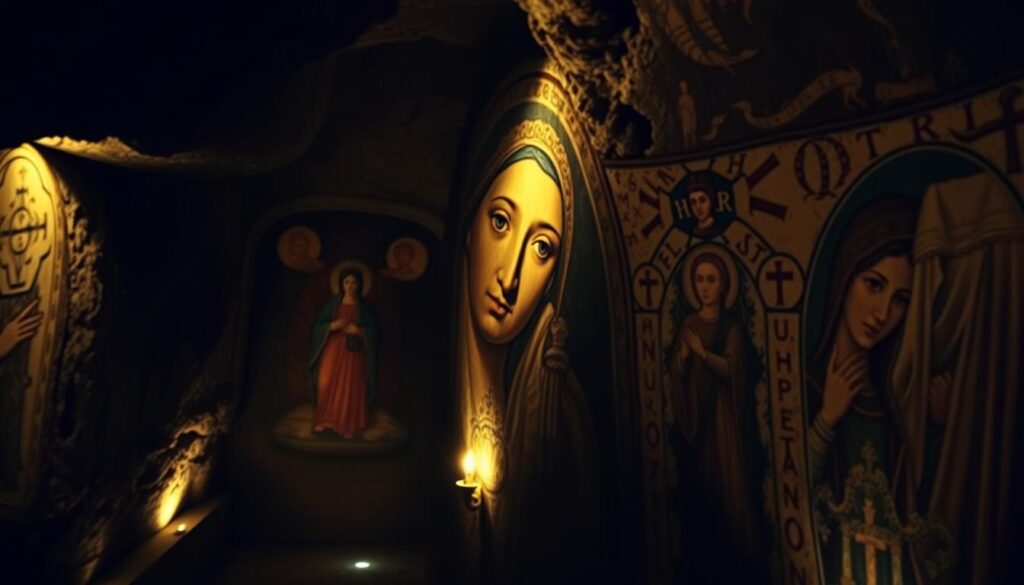
A dimly lit catacomb interior, adorned with ancient mural paintings depicting the Virgin Mary. The walls are covered in intricate, weathered frescoes, with soft, diffused lighting illuminating the sacred imagery. In the foreground, the gentle, serene expression of the Mother of God gazes out, her features rendered with reverence and devotion. The middle ground reveals surrounding religious symbols and iconography, while the background fades into the shadows, evoking a sense of timelessness and mystery. The overall atmosphere is one of profound spiritual contemplation, reflecting the historical roots of Marian veneration in Catholic tradition.

Early Catacomb Paintings and Symbols

The Priscilla catacombs in Rome showcase the oldest known image of the Blessed Virgin. Dating to 150 AD, this fresco depicts her holding the Christ Child while a prophet points to a star—a visual nod to messianic promises. Nearby, St. Peter’s Basilica excavations revealed another 2nd-century artwork linking Mary with apostolic figures.

These underground galleries served dual purposes. They provided burial sites while preserving faith expressions. Simple symbols like stars and scrolls accompanied Marian imagery, showing Roman Catholic ancestors understood her theological importance early on.

The Development of Marian Churches

After Emperor Constantine legalized Christianity in 313 AD, devotion moved above ground. The 5th century saw explosion of Marian churches following the Ephesus Council’s declaration. Three Roman landmarks still stand today:

Church Name Location Century Built Significance
Santa Maria Maggiore Rome 5th First major Marian basilica
Santa Maria Antiqua Roman Forum 5th Oldest Christian monument there
Santa Maria in Trastevere Trastevere 4th-6th Claims earliest Marian title

These sacred spaces became pilgrimage hubs, blending art with liturgy. Their mosaics often showed the Virgin Mary enthroned—a powerful reminder of her enduring role across time and cultures.

Biblical Foundations for Mary’s Significance

Scriptural connections between ancient symbols and New Testament events reveal profound layers of meaning. The mother of God emerges through patterns linking key figures across biblical history. These ties show how early believers saw divine plans unfolding through tangible signs.

Old Testament Echoes in New Testament Narratives

Elizabeth’s reaction to the Blessed Virgin Mary mirrors David’s awe before the Ark of the Covenant. Both exclaimed with reverence: “How can the ark/Lord’s mother come to me?” (2 Samuel 6:9, Luke 1:43). This parallel positions Mary as the living Ark carrying Christ—the ultimate covenant.

Event Old Testament New Testament Symbolic Meaning
Sacred Encounter Ark brought to Jerusalem Mary visits Elizabeth Divine presence embodied
Joyful Response David dances (2 Sam 6:14) John leaps (Luke 1:44) Celebration of salvation
Three-Month Stay Ark dwells with Obed-edom Mary remains with Elizabeth Extended blessing period

Other Old Testament symbols deepen this connection. The Burning Bush’s unconsumed flames prefigure the Virgin Mary bearing God without losing purity. Genesis 3:15’s “woman” battling the serpent finds fulfillment in her role as spiritual warrior.

These patterns weren’t later inventions. First-century Christians recognized them while reading Scripture through Christ’s life. As one scholar notes: “The Blessed Virgin Mary becomes the bridge joining ancient promises to their fulfillment.”

The Theological Dimensions Behind Mary’s Role

Early Christian thinkers unlocked profound truths about divine plans through careful study. Their insights reveal how the mother of God became central to spiritual understanding, shaping beliefs across generations.
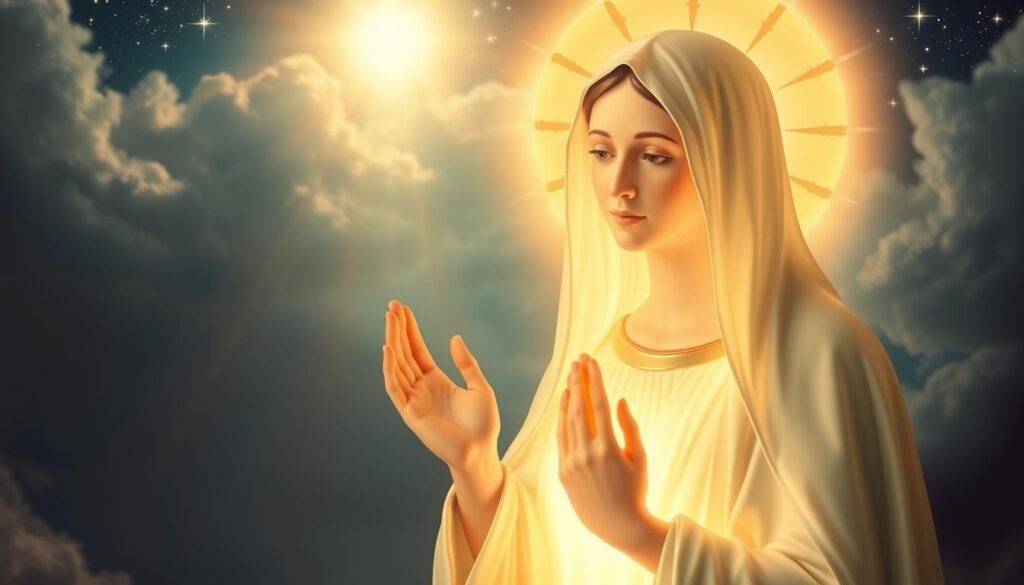
A serene, ethereal depiction of the theological foundations underlying Mary's role in Catholicism. In the foreground, a luminous, translucent figure of the Virgin Mary, her gaze tranquil and her hands raised in a gesture of intercession. Surrounding her, a halo of warm, golden light, symbolizing her divine status. In the middle ground, a tapestry of religious iconography and symbolism - the cross, the rosary, the lily - woven together to represent the deep theological underpinnings of her veneration. In the background, a celestial landscape, with wispy clouds and shimmering stars, conveying the heavenly realm from which Mary's significance derives. The overall scene is suffused with a sense of reverence, contemplation, and the mystical connection between the earthly and the divine.

New Eve and Spiritual Intercessor

Justin Martyr’s groundbreaking idea in the 2nd century framed the blessed virgin as the “New Eve.” Where Eve’s choice brought separation, Mary’s “yes” restored unity. Irenaeus expanded this, showing her obedience made Christ’s incarnation possible:

“As Eve was seduced by an angel’s word to flee God, Mary received angelic news to bear divine life.”

Irenaeus of Lyons

This theological foundation ties directly to Jesus Christ. Since he’s fully God and human, his mother’s role carries unique weight. Pope John Paul II captured this mystery beautifully:

“To the wonderment of nature you bore your Creator!”

Redemptoris Mater

Her intercessory role springs from Calvary’s foot. When Christ entrusted her to John, she became a spiritual mother to all. This faith tradition emphasizes collaboration—her prayers support but never replace Christ’s mediation.

Modern theologians explore how the blessed virgin models perfect grace response. Her story invites believers to mirror trust in God’s unfolding plans.

catholicism mary: Understanding the Title “Mother of God”

What does it truly mean to call someone the Mother of God? This ancient title hinges on a radical truth: Jesus Christ isn’t two separate beings. He’s one divine person with complete human and divine natures. The Council of Ephesus settled this in 431 AD to protect core Christian beliefs.
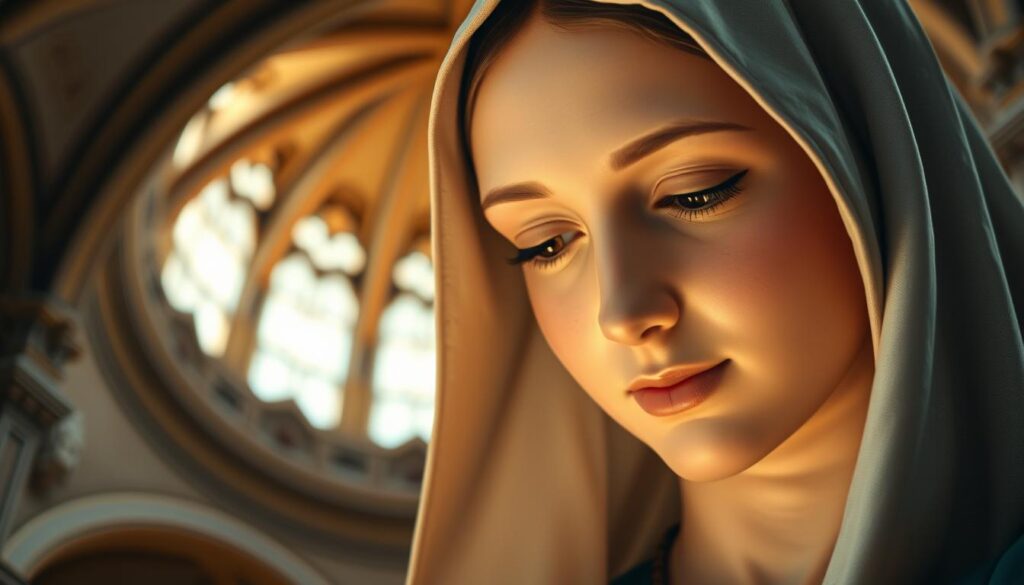
A serene, close-up portrait of the Blessed Virgin Mary, her gaze tranquil and loving. Diffused, warm lighting illuminates her delicate features, casting a soft, reverential glow. In the background, a vaulted cathedral ceiling with ornate, Gothic-inspired architecture creates a sense of sacred space. The composition emphasizes Mary's maternal role, her gentle expression conveying the profound theological significance of her title, "Mother of God." Rendered in a realistic, yet subtly idealized style, the image evokes a profound sense of devotion and reverence.

Church leaders faced a critical question: Could Mary’s motherhood apply only to Christ’s humanity? Their answer reshaped history. As the council declared:

“If anyone denies God became flesh through birth from the Holy Virgin… let them be condemned.”

This wasn’t about elevating a human figure. It confirmed Jesus’s unity as God-man. When Mary gave birth, she welcomed one person—not a mix of two identities. The Catechism of the Catholic Church clarifies: “What the faith professes about Mary flows from what it believes about Christ.

Some early Christians struggled with this concept. The Nestorian heresy claimed Christ had split personas. But the Council of Ephesus showed this broke salvation’s logic. If Jesus weren’t fully unified, his life couldn’t heal human nature.

Modern believers often find comfort here. Recognizing Mary as Mother of God reminds us Christmas celebrates God entering time—not just a holy teacher’s birth. This title remains a compass, pointing always to the miracle of divine love made touchable.

Doctrinal Development and Ecumenical Councils

How did ancient debates about divine mysteries shape today’s spiritual practices? Four key teachings about the Mother of God emerged through centuries of prayerful reflection. These doctrines—rooted in Scripture—were clarified at critical moments when faith needed clear guidance.

The Council of Ephesus and Theotokos

In 431 AD, bishops gathered to address a dangerous idea. Some claimed Christ existed as two separate persons—one human, one divine. The Council of Ephesus responded decisively:

“Mary gave birth not to a man later united with God, but to the Word made flesh.”

This declaration of Theotokos (“God-bearer”) protected core truths. It affirmed Jesus’ unified nature while honoring his mother’s unique role. The Catechism Catholic teachings later reinforced this, showing how her title points directly to Christ’s identity.

Council Year Key Focus Outcome
Ephesus 431 Christ’s unified nature Theotokos definition
Vatican II 1962-65 Modern faith application Mother of the Church title

Second Vatican Council Insights

The 1960s brought fresh perspectives. The Second Vatican Council highlighted Mary as a model for all believers. Documents described her active participation in God’s plan—not just passive acceptance.

Pope John Paul II expanded these ideas in his 1987 letter Redemptoris Mater. He urged Catholics to see her as a companion in faith journeys. Her trust in uncertain times became a blueprint for modern discipleship.

These councils show a beautiful balance. They deepened understanding of holy mysteries while keeping Christ central. As the Second Vatican Council noted: “True devotion consists not in empty emotion, but in faith-filled action.”

Marian Devotion in Art, Music, and Literature

Artistic expressions have shaped spiritual connections for generations. From stained glass windows to sacred hymns, creative works offer unique ways to experience faith traditions. These forms not only honor the Blessed Virgin but also teach core beliefs through beauty and melody.

Iconography and Symbolism

Medieval artists filled cathedrals with symbols celebrating the Virgin Mary. Gothic arches framed rose windows depicting her as Queen of Heaven, while lilies represented purity. Landmarks like Notre-Dame de Paris became stone prayers, their spires pointing toward divine mysteries.

Devotional Songs and Prayers

Monks chanted Ave Maris Stella by candlelight, their voices weaving through ancient cloisters. These melodies later inspired global traditions—from Mexican mañanitas to Filipino flores de Mayo. Even today, the Rosary’s rhythmic prayers connect believers across time and cultures.

Through art and song, devotion to the Blessed Virgin remains vibrant. These creative expressions invite both reflection and celebration, keeping spiritual legacies alive in modern hearts.

FAQ

Why is the title "Mother of God" central to understanding Mary’s role?

The title “Mother of God” (Theotokos) was affirmed at the Council of Ephesus in 431 AD. It emphasizes that Jesus is fully divine and human, and Mary’s role in bearing Christ confirms her unique place in salvation history. This teaching safeguards the unity of Christ’s two natures.

How does the Old Testament foreshadow Mary’s significance?

Figures like Eve, the Ark of the Covenant, and prophecies such as Isaiah 7:14 are seen as symbolic parallels. These connections highlight Mary’s purity and her mission to bring forth the Messiah, fulfilling God’s promises to His people.

What does the Second Vatican Council say about devotion to Mary?

The Second Vatican Council reaffirmed Mary’s role as “Mother of the Church” and emphasized her example of faith. It encouraged honoring her while clarifying that worship belongs to God alone, balancing reverence with theological clarity.

How is Mary described as the “New Eve” in Catholic teaching?

Just as Eve’s disobedience brought sin, Mary’s “yes” to God (Luke 1:38) undoes this through obedience. This analogy, rooted in early Church writings, portrays her as a spiritual mother who cooperates in Christ’s redemptive work.

What role does art play in Marian devotion?

Art, such as icons of the Virgin and Child, visually communicates her humility and connection to Christ. From medieval hymns to Renaissance paintings, these works inspire prayer and reflect her enduring influence on culture.

Are prayers to Mary considered worship?

Catholics distinguish between veneration (honor) and worship. Prayers like the Rosary or Hail Mary ask for her intercession, trusting she brings needs to Jesus. Worship, however, is reserved for God alone.

How did early Christians honor Mary?

Catacomb paintings and symbols like the “Star of the Sea” date to the 2nd century. Churches dedicated to her, such as Santa Maria Maggiore in Rome, later became centers for pilgrimage and theological reflection.
Understanding the Seven Sacraments in Catholicism


Welcome to a journey through the core spiritual practices that shape Catholic life. These sacred rituals are far more than symbolic gestures—they’re divine encounters that anchor believers to God’s presence. Rooted in centuries of tradition, they mark pivotal moments in a person’s relationship with their faith community and the divine.

Imagine these practices as bridges between heaven and earth. Each one combines physical actions—like water, oil, or bread—with profound spiritual meaning. They don’t just represent grace; they make it tangible. Through them, Catholics experience healing, growth, and connection at every life stage.

Why do these rituals matter so much? They transform ordinary moments into sacred milestones. From a baby’s first blessing to final prayers for the departed, they weave faith into daily existence. The Catholic Church teaches that these acts strengthen believers, helping them live out their spiritual calling with purpose.

This isn’t about checking boxes on a religious list. It’s about encountering God through touch, taste, and shared tradition. Whether celebrating new beginnings or seeking forgiveness, these practices remind us that the sacred lives in the here and now.

Key Takeaways

  • Sacred rituals serve as tangible connections to spiritual grace in Catholic tradition
  • Physical elements like water and oil carry deep symbolic meaning
  • These practices mark life’s most significant spiritual milestones
  • Rituals strengthen both personal faith and community bonds
  • They’re experienced through multiple senses, making faith visceral
  • Modern Catholics continue finding relevance in ancient traditions

Introduction to Catholic Sacraments

What makes these sacred acts different from other religious practices? Unlike symbolic ceremonies, Catholic sacraments actually deliver divine grace through tangible actions. Think of them as spiritual power-ups—visible signs that create invisible transformations in a person’s life.

The Catholic Church organizes these sacred acts into three groups. Initiation rites start the faith journey—think welcoming rituals and first commitments. Healing practices restore spiritual health during tough times. Service sacraments equip believers to support others through marriage or leadership roles.

These traditions form a global spiritual language. Whether in Texas or Tanzania, the same core rituals connect believers. Shared experiences like baptismal waters or communion bread create unity across cultures. This bond traces back to Jesus’ teachings, making sacraments timeless bridges between heaven and daily life.

Why do physical elements matter so much? They embody a key truth—God meets people through ordinary stuff. Water cleanses, oil strengthens, bread nourishes. Each material becomes a vehicle for grace, blending the physical and spiritual realms.

More than rituals, sacraments shape Catholic identity. They mark growth spurts in faith and strengthen community ties. Through these sacred encounters, believers experience God’s presence in life’s pivotal moments—from joyful beginnings to challenging transitions.

The Seven Sacraments in Catholicism: A Comprehensive Overview

Catholic tradition organizes its sacred practices into three purposeful groups. These act like spiritual stepping stones, guiding believers through life’s journey. Each category meets specific needs—starting faith, restoring strength, and answering calls to serve.

Initiation rites build faith’s foundation. Baptism washes away original sin, Confirmation deepens spiritual gifts, and the Eucharist connects believers to Christ’s sacrifice. Together, they transform newcomers into full community members through christian initiation.

When challenges arise, sacraments healing offer renewal. Reconciliation mends relationships through forgiveness, while Anointing brings comfort during illness. Both remind Catholics that divine mercy flows endlessly, even in dark moments.

Two practices focus on serving others. Matrimony unites couples in love that mirrors Christ’s care for the Church. Holy Orders sets apart leaders who guide communities. These sacraments service turn personal commitments into acts of collective faith.

Category Sacred Rites Core Purpose
Initiation Baptism, Confirmation, Eucharist Establish spiritual identity
Healing Reconciliation, Anointing Restore wholeness
Service Matrimony, Holy Orders Empower vocational callings

This structure mirrors how faith grows—from first steps to lifelong service. Upcoming sections will explore each practice’s unique role in nurturing Catholic spirituality.

Baptism: Welcoming Into the Faith

Have you ever wondered how a simple splash of water can mark the start of a spiritual journey? This elemental act lies at the heart of sacrament baptism, Catholicism’s gateway to divine connection. Through flowing streams or gentle pours, believers receive sanctifying grace—a cleansing from original sin and rebirth as God’s children.

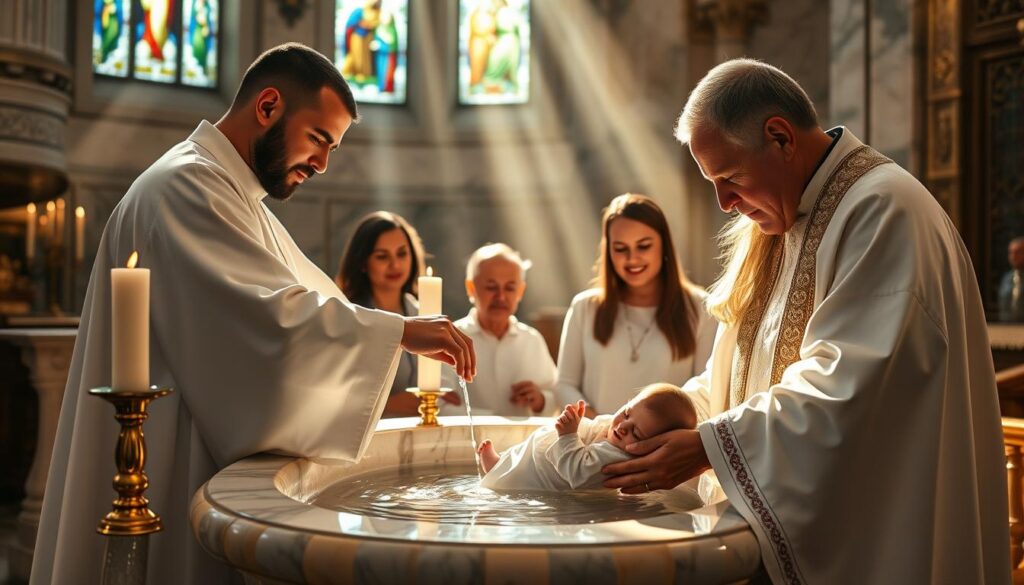
A Catholic baptismal ritual unfolds, the sacred font's tranquil waters reflecting the soft candlelight. A priest, robed in flowing white vestments, carefully pours the blessed liquid over the forehead of a newborn child, welcoming them into the faith. Sunlight streams through stained glass windows, casting a warm, reverent glow across the marble sanctuary. The infant's parents and godparents stand nearby, expressions of joy and wonder upon their faces, as the ceremony ushers in a new member of the church. An atmosphere of solemnity and spiritual rebirth permeates the scene.

The ritual’s power comes from its layered symbolism. Water doesn’t just wash—it drowns old ways of living. “The person emerges renewed,” explains one priest, “like Christ rising from the tomb.” Whether immersing a child or adult convert, the Church sees this moment as irreversible spiritual birth.

Most Catholic families celebrate sacrament baptism during infancy, but the practice welcomes all ages. What surprises many? The Church honors baptisms from most Christian groups. That shared name spoken over the water—“Father, Son, Holy Spirit”—creates bonds across denominational lines.

Parents and godparents play crucial roles here. Their promises guide the baptized through life’s twists. As the priest pours blessed water, everyone present becomes part of a story bigger than themselves—a tradition stretching back two millennia, yet fresh as today’s sunrise.

Eucharist: Nourishment for the Soul

At the heart of Catholic worship lies a meal that transcends time. The Eucharist isn’t just another sacrament—it’s the living heartbeat of faith. Catholics believe this sacred meal literally becomes Christ’s presence through transubstantiation, where bread and wine transform into divine nourishment.

“The Eucharist is where heaven kisses earth,” explains Father Michael, a parish priest. “We don’t just remember the Last Supper—we re-live it.”

Celebrating First Holy Communion

Most children receive their first communion around age seven after months of preparation. They learn how the priest’s words during Mass make ordinary elements extraordinary. This milestone follows first confession, teaching young believers that grace requires both receiving and cleansing.

Daily Practice of Holy Communion

Unlike one-time initiation rites, this sacrament offers daily renewal. Regular participants often describe it as “soul fuel”—spiritual energy for life’s challenges. To receive properly, Catholics must:

Preparation Step Purpose
1-hour fast Focus on spiritual hunger
Examination of conscience Ensure receptiveness
Peaceful disposition Welcome divine presence

Many parishes offer morning Masses, making holy communion accessible before work or school. This rhythm turns faith from Sunday event to daily conversation—a tangible way to carry sacredness into ordinary time.

Confirmation: Empowering Through the Holy Spirit

What transforms childhood faith into lifelong commitment? This sacred moment completes initiation by awakening spiritual gifts first received at baptism. Through ancient rituals, participants claim their faith as personal choice rather than inherited tradition.

Symbolism and Tradition

The laying on of hands connects modern believers to early Christians. Bishops or priests extend this apostolic practice, invoking the holy spirit’s power. Chrism oil’s sweet scent lingers as a visible seal—marking recipients as Christ’s ambassadors.

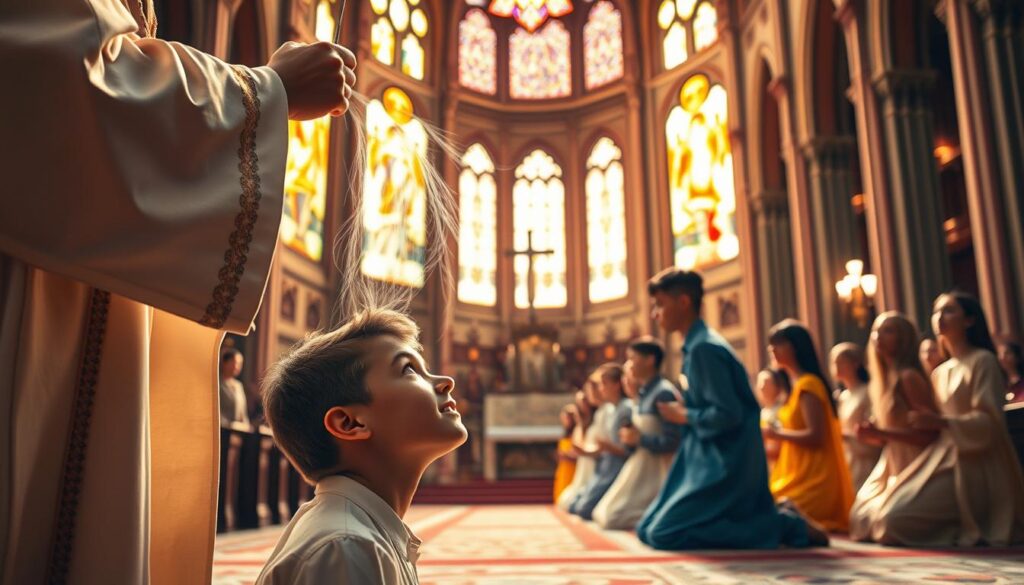
A vibrant, well-lit scene showcasing the sacrament of Confirmation. In the foreground, a young person kneels humbly, their face uplifted as the bishop's hand rests upon their head, anointing them with holy chrism oil. Wisps of ethereal light radiate from the bishop's hand, symbolizing the descent of the Holy Spirit. In the middle ground, other confirmands kneel reverently, their expressions solemn yet filled with a sense of spiritual empowerment. The background depicts a grand, ornate cathedral interior, with stained glass windows casting warm, golden hues throughout the space, evoking a profound atmosphere of sacred sanctity.

“Confirmation isn’t graduation—it’s enlistment,” says Sister Maria. “The confirmed become active defenders of their faith.”

Age, Preparation, and Rite

Most receive this sacrament confirmation around age thirteen—a bridge between childhood and spiritual maturity. Two years of preparation typically include:

Preparation Step Purpose
Weekly classes Deepen doctrinal understanding
Service projects Live out Gospel values
Retreat experiences Strengthen personal prayer life

Sponsors guide candidates, mirroring baptismal godparents. Choosing a saint’s name creates spiritual kinship—like Teresa for courage or Francis for creation care. When the bishop anoints each forehead, whispers of “be sealed” echo through generations, commissioning new witnesses for modern times.

Reconciliation: Healing Through Confession

Imagine carrying invisible weights that suddenly lift—this is the relief many feel after confession. Through this sacred practice, believers mend broken connections with God and community. Unlike solitary guilt, it offers structured grace through honest self-reflection and guided healing.

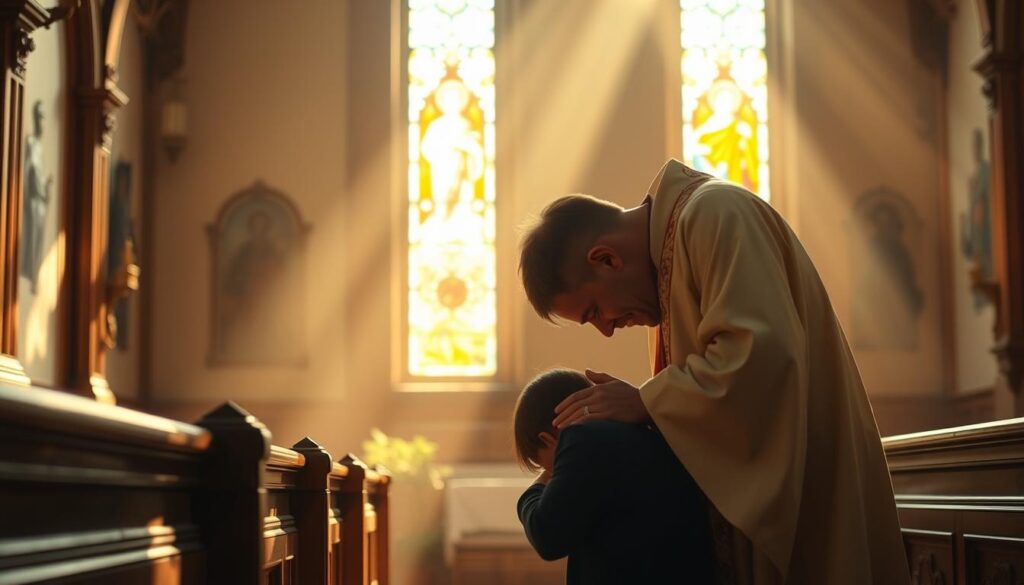
A serene Catholic confessional with a warm, soft-lit interior. In the foreground, a penitent kneels before a priest, head bowed in contrition. The priest, garbed in traditional vestments, leans forward with a compassionate expression, offering words of absolution and guidance. Sunlight filters through stained glass windows, casting a reverent glow on the scene. The background is a hushed, meditative space, with ornate wooden pews and religious iconography lining the walls, conveying a sense of sacred restoration and healing.

Steps in the Sacrament

The journey begins with an examination of conscience—quiet reflection on thoughts and actions. In the confessional, individuals name their sins aloud to a priest, who serves as both listener and spiritual coach. “Think of me as a mirror,” one cleric explains, “reflecting God’s mercy, not human judgment.”

Three key moments define the rite:

  • Confession: Specific naming of wrongs committed
  • Penance: Personalized prayer or acts restoring balance
  • Absolution: The freeing words: “I absolve you from your sins”

Pathway to Spiritual Renewal

Frequency varies—some seek monthly reconciliation, others during Lent or Advent. Regular participants often describe it as “divine therapy” for the soul. A Chicago parishioner shares: “Walking out lighter keeps me returning—it’s like a fresh start button.”

Approach Practice Benefit
Weekly Deepens self-awareness Prevents small faults from growing
Seasonal Aligns with liturgical rhythms Renews commitment during holy periods

Confidentiality remains absolute—priests cannot disclose conversations, even under legal pressure. This safety net encourages raw honesty, transforming shame into liberation. As one bishop reminds us: “God’s mercy outshines any mistake. Your worst chapter isn’t your final page.”

Anointing of the Sick: Embracing Grace in Illness

When life feels fragile, this sacred practice offers more than comfort—it transforms suffering into spiritual connection. The anointing sick ritual isn’t just for final moments. It strengthens those facing surgery, chronic pain, or age-related decline, reminding them they’re never alone in their struggle.

A priest performs the sacrament anointing using blessed oil, tracing crosses on the forehead and hands. These gestures echo Christ’s healing touch, linking personal trials to his Passion. “The oil isn’t magic,” explains Father Thomas, “but a visible sign of invisible grace pouring in.”

Children old enough to grasp its meaning can receive this blessing too. Unlike old perceptions of “last rites,” modern practice encourages repeated use whenever health declines. Families often report renewed peace—even amid ongoing treatments—after witnessing the ceremony.

Hospitals and homes become sacred spaces during the rite. As prayers fill the room, the sick person becomes living testimony to faith’s power in dark times. This ancient tradition proves that hope persists where medicine meets mystery.

FAQ

What is the purpose of Confirmation in the Catholic Church?

Confirmation strengthens believers’ bond with the Church and deepens their connection to the Holy Spirit. It empowers individuals to live out their faith courageously, often marked by the laying on of hands and anointing with chrism oil.

At what age do Catholics typically receive First Holy Communion?

Children usually celebrate their First Holy Communion around age seven or eight, after completing catechism classes. This milestone emphasizes understanding the Eucharist as spiritual nourishment and Jesus’ presence in the bread and wine.

How does Reconciliation help Catholics spiritually?

Reconciliation offers forgiveness of sins through confession, contrition, and absolution. It restores one’s relationship with God and the Church, fostering inner peace and a renewed commitment to living a moral life.

Who can receive the Anointing of the Sick?

This sacrament is for anyone facing serious illness, surgery, or old age. It provides physical and spiritual healing, uniting the person’s suffering with Christ’s sacrifice and offering grace for strength and comfort.

What role do Holy Orders play in the Church?

Holy Orders ordains men as deacons, priests, or bishops to serve the Church community. Through this sacrament, they receive authority to lead worship, administer sacraments, and guide others in their spiritual journeys.

Why is Baptism considered essential for Catholics?

Baptism cleanses original sin, initiates individuals into the Church, and marks them as children of God. The rite uses water and Trinitarian prayers to symbolize rebirth into a life of faith and grace.

How does Matrimony reflect Catholic teachings on love?

Matrimony unites a couple in lifelong commitment, mirroring Christ’s love for the Church. The vows and blessings emphasize mutual support, openness to children, and a shared journey toward holiness.

The Essential Rules of Catholicism


What holds together a global community of over one billion people across centuries? The answer lies in the spiritual framework that shapes Catholic life. Contrary to popular belief, the Church’s guidance focuses less on rigid regulations and more on fostering a relationship with God. As Msgr. William King notes, the structure exists to support believers, not overwhelm them.

Pope John Paul II emphasized that the Church’s foundation rests on Scripture and tradition, not just legal codes. The 1983 Code of Canon Law, for example, prioritizes charity and spiritual growth over strict rule-keeping. This approach reflects Jesus’ core message: love God and neighbor above all else.

Many wonder how ancient teachings remain relevant today. The answer lies in their purpose—guiding individuals toward fulfillment rather than controlling behavior. From sacraments to moral principles, these practices connect modern believers to a 2,000-year legacy of faith.

Key Takeaways

  • Catholic guidelines prioritize spiritual growth over strict rule-following
  • Church law supports biblical teachings rather than replacing them
  • Historical development shaped today’s balanced approach to faith practices
  • Love remains the central principle behind all Catholic traditions
  • Core requirements focus on worship, community, and personal devotion

Foundations of Catholic Faith and Canon Law

At the heart of Catholic belief lies a simple yet transformative principle: love as the ultimate guide. Jesus distilled centuries of Jewish law into two commands in Matthew’s Gospel—wholehearted love for God and neighbor. These words shape every aspect of Church teaching, from sacraments to social justice.

Biblical Roots and the Two Great Commandments

The Catechism of the Catholic Church (CCC 2055) calls Christ’s words “the synthesis of the entire Law.” This framework helps believers prioritize actions that honor divine connection and human dignity. Early Christians saw these dual loves as the key to interpreting older traditions, creating continuity between ancient wisdom and modern practice.

The Role of the Ten Commandments in Catholic Living

While the two great commandments provide direction, the Ten Commandments offer practical steps. The first three focus on honoring God through worship and reverence. The remaining seven address community relationships, from family bonds to truthful communication.

Loving God Loving Neighbor CCC Reference
Exclusive worship Family respect 2084-2246
Sacred speech Life protection 2142-2317
Sabbath observance Honest dealings 2168-2503

Church authority emphasizes these guidelines aren’t restrictions but pathways to freedom. By framing the commandments through love’s lens, the Catechism (CCC 2084-2557) shows how ancient texts remain vital for ethical decisions today.

Understanding the “rules of catholicism” in Daily Life

How do ancient spiritual traditions translate into modern daily practice? The Precepts of the Church offer clear markers for maintaining faith rhythms while balancing contemporary responsibilities. These five practical commitments help Catholics stay connected to their spiritual roots without becoming overwhelmed.

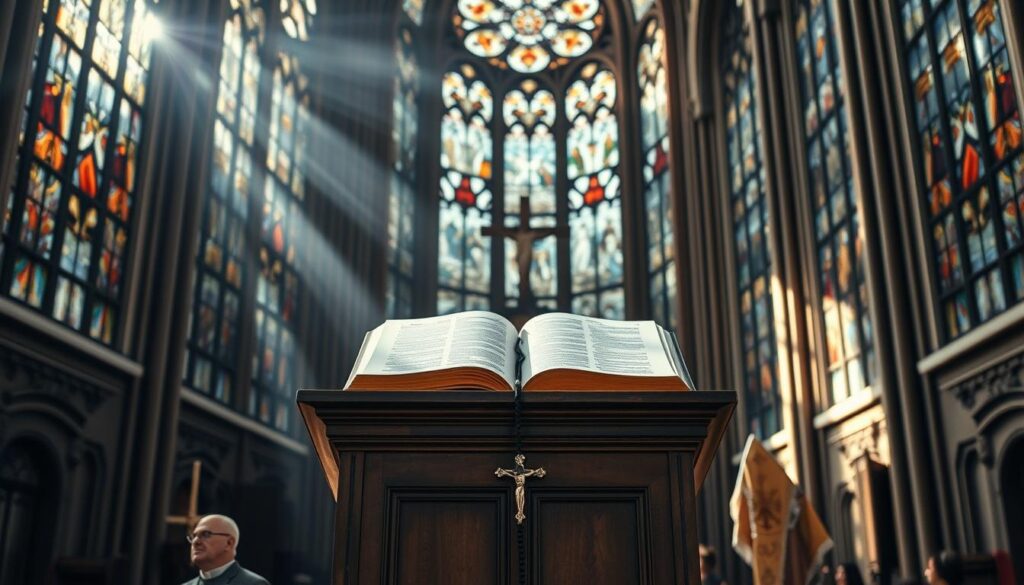
A stained-glass cathedral interior, sunlight streaming through ornate windows, illuminating a large wooden lectern at the center. Upon the lectern, an open book depicting Catholic precepts and canon law, surrounded by symbols of religious authority - a crucifix, rosary beads, and a bishop's mitre. The space is solemn, reverent, and imbued with a sense of timeless tradition, inviting contemplation of the essential rules of Catholicism that guide the faithful in their daily lives.

The Precepts of the Church and Their Significance

The Catechism of the Catholic Church outlines essential practices that support spiritual growth. Sunday Mass attendance forms the weekly anchor, while annual confession and Easter Communion renew core relationships with God. Seasonal fasting and financial support for Church needs complete this framework of obligation.

Originally six in number, these guidelines adapted over time. The removed precept about marriage restrictions now falls under canon law provisions. This evolution shows how the Church balances tradition with pastoral care.

How Canon Law Shapes Catholic Practice

Derived from the Greek word for “measuring rod,” canon law provides structure without stifling faith. The Code of Canon Law (1983) organizes Church governance while prioritizing soul-focused outcomes. As Pope Benedict XVI noted, “Ecclesial communion requires visible structures to sustain unity.”

Historical Practice Modern Adaptation Purpose
Yearly confession requirement Encouraged monthly practice Spiritual renewal
Strict fasting rules Age-appropriate guidelines Self-discipline
Tithing mandates Proportional giving Community support

Church authority to create these standards flows from its role as interpreter of divine revelation. Far from arbitrary rules, the precepts and code canon help Catholics worldwide maintain consistent faith practices across generations.

By framing obligations as invitations rather than demands, the Catechism transforms routine actions into meaningful spiritual encounters. This approach keeps ancient wisdom relevant in today’s fast-paced world.

Exploring Catholic Sacraments and Ritual Practices

Sacred rituals form the heartbeat of Catholic spiritual practice, connecting believers to divine grace through tangible actions. These seven sacraments act as spiritual milestones, marking life’s most meaningful moments while nurturing faith.

The Sacraments of Initiation, Healing, and Service

New Catholics begin their journey through three initiation rites. Baptism (CCC 1213) washes away original sin, while Confirmation (CCC 1285) deepens the Holy Spirit’s presence. The holy Eucharist becomes the lifelong anchor, with weekly Mass allowing Catholics to receive holy communion and unite with Christ’s sacrifice.

When life brings challenges, sacraments of healing offer renewal. Monthly confession helps believers receive sacrament of reconciliation (CCC 1422), restoring inner peace. During serious illness, anointing brings physical and spiritual comfort through sacred oils and prayers.

Observance of Holy Days, Fast, and Abstinence

Beyond Sunday Mass, six holy days of obligation shape the U.S. liturgical calendar. These include Christmas (Dec 25) and Mary’s Assumption (Aug 15), days when Catholics celebrate key events in salvation history.

Holy Day Date Significance
Immaculate Conception December 8 Honors Mary’s sinless birth
All Saints’ Day November 1 Celebrates heavenly saints
Ascension Thursday 40 days post-Easter Marks Jesus’ return to heaven

Lenten practices like fasting (one meal plus two small snacks) and abstinence (no meat) apply differently by age. As the Catechism teaches, these disciplines create space for prayer while honoring Christ’s sacrifices.

Doctrine vs. Law: Grace, Mercy, and Church Discipline

Many people wonder how the Church balances timeless truths with practical governance. At its core, Catholic life thrives through a harmony of divine truth and compassionate guidance. Teachings rooted in Scripture and tradition provide the “why,” while canonical standards offer the “how” for living faith authentically.

Distinguishing Church Teaching from Canonical Rules

Sacred doctrine forms the unchanging foundation—truths about God’s nature, sacraments, and moral principles. Canon law, by contrast, adapts to support these truths through structural practices. For example, the requirement to attend Mass comes from Christ’s command to “do this in memory of me,” while specific Mass times reflect practical needs.

The Church’s disciplinary measures always aim to restore, not punish. Annulment processes and pastoral care for divorced Catholics demonstrate this balance. As Pope Francis reminds us, “Mercy is the Church’s first truth.” Canonical frameworks exist to safeguard both spiritual growth and community unity.

This dynamic relationship keeps faith vibrant across generations. Doctrine grounds believers in eternal wisdom, while adaptable guidelines meet real human needs. Together, they create a living tradition that honors both truth and tenderness.

FAQ

How do Catholic doctrines differ from Canon Law?

Catholic doctrines are core teachings rooted in Scripture and Tradition, like the Trinity or the Eucharist. Canon Law organizes Church practices, governance, and sacraments. While doctrines remain unchanged, Canon Law can adapt to support faith life.

Why do Catholics emphasize the Ten Commandments?

The Commandments form a moral blueprint for Catholics, reflecting God’s covenant with humanity. They guide relationships with God and others, as Jesus highlighted in the Two Great Commandments: love God and neighbor.

What are Holy Days of Obligation?

These are key feast days, like Christmas or the Assumption, when Catholics attend Mass. They honor central mysteries of faith, such as Christ’s birth or Mary’s role, and deepen spiritual commitment.

How often must Catholics go to confession?

The Church requires confession at least once yearly if aware of serious sin. Many Catholics go monthly for spiritual renewal, aligning with the Catechism’s call for regular reconciliation.

What are the Precepts of the Church?

These five practices include attending Sunday Mass, fasting during Lent, confessing annually, receiving Communion at Easter, and supporting the Church. They maintain a baseline for active faith.

How does Canon Law impact marriage?

Canon Law outlines requirements like free consent, preparation, and a Catholic ceremony. It ensures marriages align with Church teaching while protecting the sacrament’s sacredness.

Why do Catholics fast during Lent?

Fasting (one full meal plus two small meals) on Ash Wednesday and Good Friday fosters self-discipline and solidarity with those in need. It’s a penitential act tied to spiritual renewal.

Can the Church update its rules?

Core doctrines remain unchanged, but Canon Law can be revised. For example, Pope Francis updated procedures for annulments in 2015 to better serve the faithful while upholding teaching.

What sacraments are required for Catholics?

Baptism, First Communion, and Confirmation are initiation sacraments. Reconciliation and Anointing of the Sick heal spiritually. Matrimony and Holy Orders are vocational sacraments of service.

Is attending Mass weekly mandatory?

Yes, unless prevented by illness or caregiving. Sunday Mass honors Christ’s Resurrection and nourishes faith through the Eucharist, a key Precept of the Church.

Catholicism vs Evangelical Christianity: Key Distinctions


Christianity’s rich tapestry includes countless traditions, but few comparisons spark as much curiosity as those between two major branches. While both groups share foundational teachings like the Trinity and Jesus Christ’s divinity, their paths diverge in meaningful ways. Understanding these variations helps explain how faith communities evolve while staying rooted in shared principles.

The Roman Catholic Church traces its origins to ancient times, emphasizing sacraments and church authority. In contrast, Evangelical traditions emerged during the Protestant Reformation, prioritizing personal spiritual experiences. These distinct approaches shape everything from worship styles to interpretations of scripture.

This guide explores how these communities approach salvation, biblical authority, and spiritual practices. We’ll uncover how historical events like the Reformation created lasting theological divides. Rather than judging which path is “better,” we’ll highlight how each tradition meets believers’ unique needs.

Whether you’re exploring your own beliefs or seeking to understand others, this comparison offers clarity. Let’s dive into the heart of what unites – and distinguishes – these influential expressions of Christian faith.

Key Takeaways

  • Both traditions share core Christian doctrines but differ in practices and authority structures
  • Catholicism emphasizes sacraments and church tradition, while Evangelicals focus on personal conversion
  • The Protestant Reformation directly influenced Evangelical approaches to scripture interpretation
  • Differences in worship styles reflect distinct theological priorities
  • Understanding these variations fosters better interfaith dialogue and personal discernment

Overview of the Comparison

Imagine two neighbors tending the same garden but using different tools – that’s how Catholic and Evangelical approaches to faith coexist within Christianity. Both groups cherish Christ’s teachings yet cultivate their spiritual lives through distinct methods. This section clarifies common misunderstandings while mapping out what truly sets these traditions apart.

Understanding the Core Differences

Many people mistakenly assume one group isn’t “truly Christian.” In reality, both affirm Jesus as Savior. The difference lies in how they express this belief. Catholics lean on ancient rituals and church hierarchy, while Evangelicals prioritize personal Bible study and spontaneous worship.

Consider these contrasts:

Aspect Catholic Approach Evangelical Approach
Historical Roots Direct lineage from early apostles 16th-century Reformation origins
Authority Church tradition + Scripture Scripture alone
Salvation Grace through sacraments Personal conversion experience

Article Objectives and Scope

This comparison isn’t about declaring winners. We’ll explore why your Catholic cousin values Mass rituals while your Evangelical coworker shares “testimonies” during lunch breaks. You’ll gain tools to understand both church communities better – whether you’re visiting a candlelit cathedral or a modern megachurch.

We’ll tackle key questions: How do these groups view spiritual authority? What makes their worship styles feel worlds apart? By focusing on these differences, we foster mutual respect among believers who share the same roots but branch out uniquely.

Historical Roots and Developments

Time travel through Christian history reveals how two major traditions took shape. One grew from ancient roots, while the other sprouted during a period of dramatic change. Let’s explore how these distinct timelines created lasting spiritual legacies.

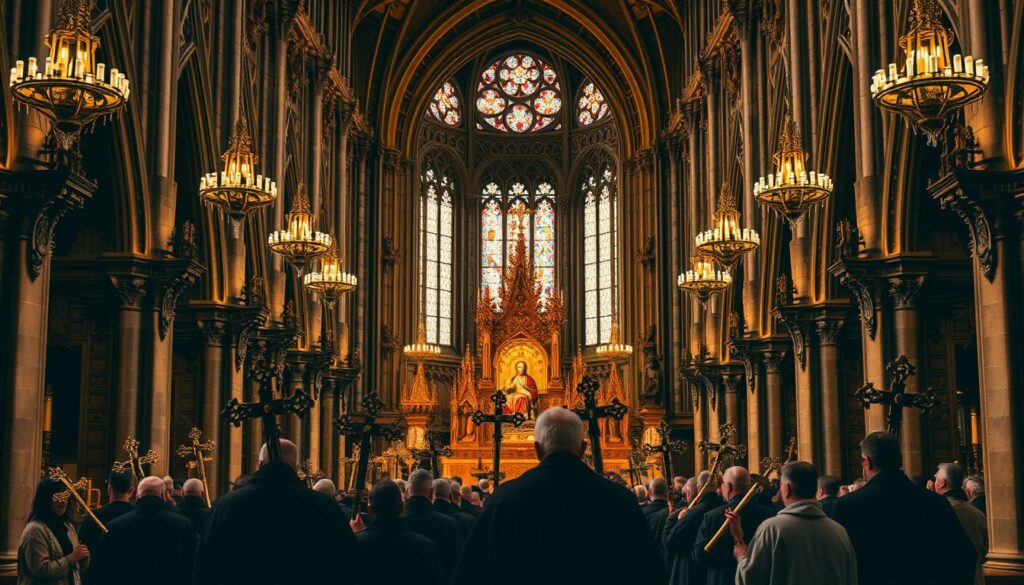
a grand cathedral with ornate Gothic architecture, stained glass windows, and intricate stone carvings, illuminated by warm, golden lighting from antique chandeliers, conveying a sense of reverence and timeless tradition; in the foreground, a procession of robed figures carrying ornate crosses and candles, their faces obscured in shadow, as they move down the central aisle towards an elaborate altar at the far end; the scene suggests the solemn rituals and ceremonies of historical Christian faith.

The Catholic Church’s Ancient Origins

The Catholic Church traces its leadership to a lakeside moment in Galilee. According to Matthew 16:19, Jesus told Peter: “I will give you the keys of the kingdom of heaven.” This declaration established what believers consider an unbroken chain of leadership spanning twenty centuries.

For over 1,500 years, this institution shaped Western culture and society. Its monasteries preserved knowledge during the Middle Ages. Its cathedrals became landmarks of faith and artistry. The church’s teachings influenced everything from royal coronations to daily routines.

The Rise of Evangelicalism and the Reformation

Everything changed when a German monk nailed his complaints to a church door in 1517. Martin Luther’s protests sparked the Protestant Reformation – a movement demanding scriptural focus over tradition. This birthed core ideas like “Scripture alone” that still guide Evangelicals today.

The table below shows key historical milestones:

Period Catholic Church Evangelical Movement
1st-15th century Developed sacraments and papal authority
16th century Faced Reformation challenges Embraced sola scriptura principle
18th-19th century Maintained traditional structures Expanded through revival meetings

Great Awakenings later added emotional worship styles and personal conversion experiences to Evangelical practice. These developments created a faith tradition that thrives in modern settings – from urban storefront churches to global mission fields.

Doctrinal Foundations: Scripture and Tradition

Picture two librarians preserving ancient texts – one keeps every scroll, while the other focuses on the original manuscripts. This analogy captures how Christian groups handle divine truth. Their approaches to spiritual guidance reveal deep-rooted theological perspectives.

Catholic Emphasis on Sacred Tradition

The Catholic Church treats faith like a family heirloom passed through generations. Sacred Tradition – oral teachings tracing back to Jesus’ apostles – holds equal weight with the Bible. This explains why Catholic Bibles contain 73 books, including texts like Tobit and Wisdom of Solomon that Martin Luther later questioned.

Evangelical Focus on Sola Scriptura

Reformation leaders championed scripture alone as Christianity’s sole authority. Their Bibles feature 66 books, excluding writings not found in ancient Hebrew texts. This principle empowers believers to interpret God’s word personally, without mandatory church guidance.

Aspect Catholic View Evangelical View
Source of Truth Bible + Tradition Bible only
Biblical Books 73 66
Interpretation Church-led Individual-led

These differences shape real-world decisions. A Catholic might cite papal teachings on social issues, while an Evangelical asks, “Where’s that in Scripture?” Both approaches aim to honor God – through communal wisdom or personal biblical study.

The Impact of the Reformation on Beliefs

Imagine a librarian reorganizing shelves by removing certain titles – that’s what happened when Reformation leaders reshaped Christianity’s literary foundation. This seismic shift didn’t just rearrange pages; it rewrote how millions engage with their faith.

Redefining Sacred Texts

Martin Luther’s Bible became 7 books lighter than its Catholic counterpart. Out went Tobit and Maccabees – texts he deemed less essential for spiritual guidance. Even New Testament writings like James faced scrutiny, with Luther calling its message “straw” compared to Gospel truths.

Biblical Category Removed Books Disputed NT Texts
Old Testament Tobit, Judith, Wisdom of Solomon
New Testament Hebrews, James, Revelation

This editorial boldness stemmed from sola scriptura – the belief that Scripture alone holds divine authority. Where church leaders once mediated biblical understanding, Protestants championed personal interpretation through prayer and study.

The ripple effects transformed spiritual life:

  • Birth of vernacular Bibles accessible to laypeople
  • Shift from Latin Mass to sermon-centered worship
  • Rise of diverse denominations interpreting texts uniquely

Luther’s legacy lives on when believers open personal Bibles rather than relying solely on clerical guidance. This empowerment extended beyond theology, fueling revolutions in education and self-governance that shaped modern democracies.

Exploring Core Beliefs and Authority

Think of spiritual guidance like house keys – some trust a master locksmith, while others make their own copies. This contrast shapes how different Christian groups approach truth and leadership. At the heart lies a crucial question: Who holds the authority to interpret divine messages?

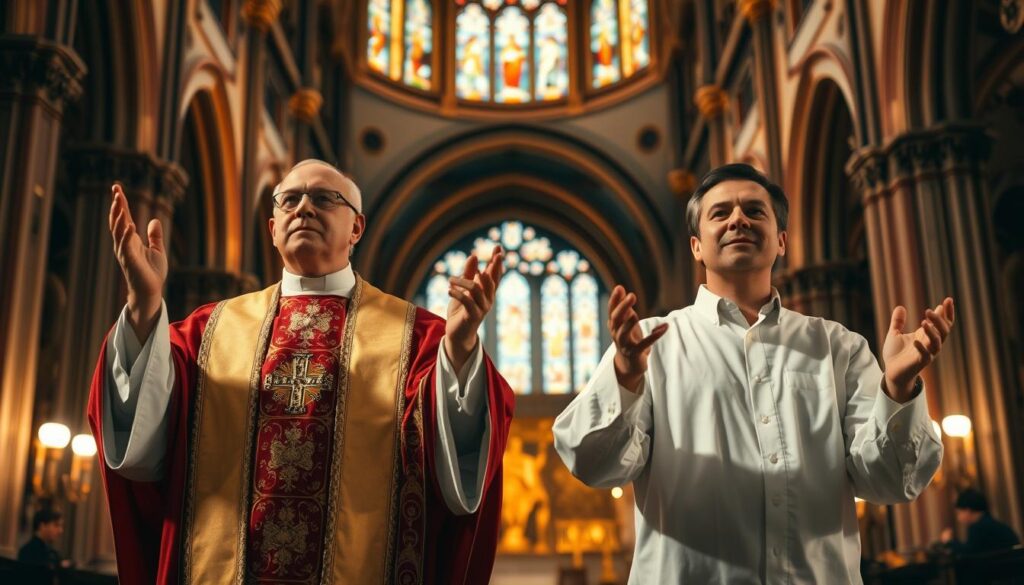
A grand cathedral's interior, its ornate arches and stained glass casting a warm glow. In the foreground, a Catholic priest in resplendent robes stands solemnly, hands raised in benediction. Beside him, a more plainly dressed Evangelical minister gestures emphatically, their differing expressions and poses conveying the contrast in their approaches to spiritual authority. Subtle shadows and highlights lend depth and drama, while the background fades into a sense of reverence and contemplation.

Divine Revelation and the Role of the Church

For one tradition, Jesus’ words to Peter in Matthew 16:18 form an unbroken chain of leadership. “You are Peter, and on this rock I will build my church,” serves as the foundation for institutional guidance. Followers believe the Holy Spirit continuously aids leaders in preserving sacred revelation through both Scripture and oral teachings.

Another perspective champions personal spiritual empowerment. Every believer becomes their own theologian through direct Bible access. This approach views hierarchical structures as unnecessary middlemen in one’s relationship with God.

Authority Aspect Institutional View Personal View
Source of Truth Scripture + Sacred Tradition Scripture alone
Leadership Papal succession Local congregations
Decision Making Centralized teachings Individual conviction

These contrasting approaches affect daily faith practices. Some consult church documents for moral guidance, while others search Scripture independently. Both methods aim to honor divine revelation but through different lenses of authority.

The table above shows how structural differences shape spiritual journeys. Whether through ancient rituals or personal Bible studies, believers seek truth within their understanding of God’s communication methods.

catholicism vs evangelical: A Comparative Look

Imagine two architects using the same blueprint but constructing vastly different homes. This analogy captures how Christian communities develop distinct spiritual practices while sharing core doctrines. Though both groups affirm foundational truths like the Trinity and Christ’s resurrection, their applications diverge in meaningful ways.

A dramatic comparison of Catholic and Evangelical Christian belief systems, depicted in a triptych format. The left panel showcases ornate Catholic iconography - stained glass, statues, and elaborate vestments. The middle panel features a simple Evangelical church, with a wooden cross and minimal décor. The right panel depicts each faith's core tenet - Catholic transubstantiation and Evangelical sola scriptura. Cinematic lighting casts dramatic shadows, creating a contemplative, reverent atmosphere. Rendered with photorealistic detail, the composition invites the viewer to ponder the nuances of these two influential Christian traditions.

Direct Contrasts in Belief Systems

One striking difference centers on spiritual mediation. Many Catholics believe sacraments and church leadership are essential for connecting with God. In contrast, Evangelicals emphasize direct access through personal prayer and Scripture study. This shapes how each group approaches daily faith practices.

The concept of salvation reveals another key point. For one tradition, it’s a lifelong journey involving sacraments and good works. The other views it as a decisive moment of faith commitment. These perspectives influence everything from baptism rituals to end-of-life preparations.

Consider these additional contrasts:

  • Mary’s role: Venerated as heavenly advocate vs. honored as Jesus’ earthly mother
  • Spiritual authority: Church teachings + Scripture vs. Scripture alone
  • Worship style: Structured liturgy vs. spontaneous praise

These theological differences create unique spiritual cultures. One values ancient rituals that unite generations of believers. The other thrives on personal testimonies and modern worship music. Both paths aim to honor Christ – they simply speak different dialects of the same faith.

The Role of the Holy Spirit and Personal Relationship with Jesus

Picture a gardener watering plants – one uses an intricate irrigation system, while another relies on rainclouds. Both achieve growth through water, just as believers nurture their personal relationship with Jesus through different spiritual “watering methods.”

One tradition sees the Holy Spirit as a direct life source. “Walk with God like you’re holding His hand daily,” many believers say. This approach values spontaneous prayer and Bible meditation as primary ways to strengthen one’s relationship with Christ.

Another perspective views divine connection through structured channels:

Consider these contrasting approaches:

Aspect Spontaneous Guidance Structured Nurturing
Prayer Style Conversational Liturgical
Scripture Use Personal interpretation Church-supported study
Sacraments Symbolic acts Means of grace

Both paths aim to deepen one’s personal relationship with Jesus. One thrives on emotional intimacy during worship songs, while another finds connection through Eucharist rituals. As one pastor noted: “The Holy Spirit works in highways and backroads – both lead home.”

These differences explain why some prefer quiet Bible studies while others cherish incense-filled services. Yet shared devotion to Christ unites these expressions of faith across all relationship-building practices.

Worship Practices: Liturgy vs. Contemporary Styles

Imagine two choirs singing the same hymn – one follows sheet music precisely, while the other improvises harmonies. This contrast captures how Christian communities express devotion through distinct worship rhythms. These approaches shape spiritual experiences while honoring shared convictions.

Formal Rituals in the Mass

One tradition structures worship like a sacred dance with centuries-old steps. The Eucharist remains central, celebrated through precise gestures and recited prayers. Incense swirls as congregations follow liturgical calendars, finding comfort in rituals that connect them to generations past.

Casual Fellowship in Services

Another community treats worship as a vibrant conversation. Services often begin with upbeat music led by bands, followed by practical sermons applying Scripture to daily life. Testimonies and altar calls create spaces for spontaneous spiritual moments.

Both styles nurture a sense of connection. One finds beauty in timeless traditions, the other in relatable modern expressions. Whether through chanting psalms or raising hands during praise songs, these practices remind believers that faith thrives in diverse forms of reverence.

FAQ

What’s the main difference in how Catholics and Evangelicals view authority?

Catholics rely on Sacred Tradition and the Church’s teachings alongside Scripture, while Evangelicals emphasize Sola Scriptura (Scripture alone) as the sole authority for faith and practice.

Do both groups believe salvation comes through faith?

Evangelicals stress faith alone for salvation, while Catholics teach that salvation involves faith and participation in sacraments like baptism and the Eucharist, guided by good works.

How do worship styles differ between the two?

Catholic services follow structured liturgies like the Mass, centered on the Eucharist. Evangelical gatherings often prioritize contemporary music, sermons, and informal fellowship focused on a personal connection with Jesus.

Why do Catholics pray to saints?

Catholics view saints as intercessors who can pray to God on their behalf. Evangelicals typically pray directly to God, emphasizing a personal relationship without mediators.

Is the Holy Spirit’s role the same in both traditions?

Both believe the Holy Spirit guides believers, but Evangelicals often highlight His role in personal conversion and daily life. Catholics connect the Spirit more closely to sacraments and Church unity.

What sparked the divide between these groups?

The Protestant Reformation challenged Catholic doctrines like papal authority and justification by works. Evangelicals later emerged, prioritizing Scripture, evangelism, and a born-again experience.

Do Evangelicals observe sacraments like Catholics?

Evangelicals practice baptism and Communion as symbolic ordinances, not sacraments conveying grace. Catholics recognize seven sacraments as essential channels of God’s grace.

How does each group view the Bible?

Catholics include deuterocanonical books in their Old Testament, while Evangelicals follow the Protestant canon. Both value Scripture but interpret it differently—Catholics through Church teaching, Evangelicals through personal study.

Catholicism Sins: What You Need to Know


Living a life aligned with spiritual values requires understanding core beliefs. For those in the Catholic Church, recognizing what separates individuals from divine connection shapes daily choices. This framework isn’t about fear—it’s a roadmap to deeper faith and personal growth.

The Church’s teachings categorize actions based on their impact on spiritual well-being. Some choices create minor fractures in relationships, while others risk severing ties to grace. These distinctions help believers prioritize healing through reflection and community support.

Modern life adds complexity to age-old principles. This guide simplifies doctrine to show how timeless wisdom applies today. You’ll learn practical ways to strengthen your journey toward salvation, whether you’re deepening lifelong beliefs or exploring spiritual foundations.

Key Takeaways

  • The Church’s teachings aim to foster spiritual freedom, not guilt
  • Sin categories help assess impacts on divine relationships
  • Redemption is always accessible through conscious effort
  • Modern challenges require adapting historical principles
  • Community plays a vital role in forgiveness processes
  • Self-reflection strengthens connection to faith traditions

The Theology Behind Catholicism Sins

Faith practices start by recognizing humanity’s inherited spiritual condition. This understanding shapes how believers approach their relationship with the divine. At birth, every person enters the world needing spiritual renewal—a concept tied to original sin.

Understanding Original Sin and Renewal

Baptism serves as the first step toward transformation. Through this sacrament, individuals receive sanctifying grace—a supernatural gift that heals the soul. This grace isn’t earned but freely given, bridging the gap created by human limitations.

Three key effects of sanctifying grace:

  • Restores divine connection lost through sin
  • Empowers acts of love and compassion
  • Prepares the soul for eternal life

Divine Mercy’s Transformative Power

Even when grace is lost, restoration remains possible. The Church teaches that God’s mercy flows through sacraments like confession. These channels offer fresh starts, reflecting the sacrifice made for humanity’s redemption.

Sacrament Role in Grace Impact on Soul
Baptism Initial reception Cleanses original sin
Confession Restoration Repairs broken bonds
Eucharist Sustenance Strengthens divine life

This system isn’t about punishment but growth. Through consistent practice, believers maintain their spiritual health while embracing mercy’s endless opportunities.

Exploring catholicism sins in the Modern World

Modern life creates fresh tests for those striving to align daily choices with timeless values. Smartphones, social platforms, and shifting cultural attitudes reshape how moral failures manifest while introducing new ethical gray areas.

A dimly lit, modern cityscape with towering skyscrapers and neon-lit billboards. In the foreground, a group of people facing moral dilemmas - a businessperson contemplating a shady deal, a young adult struggling with a crisis of conscience, and a family grappling with a difficult decision. The middle ground features a catholic church, its stained glass windows casting an ethereal glow. In the background, a crowd of people navigating the bustling streets, each lost in their own moral quandaries. The scene is bathed in a somber, contemplative tone, with muted colors and dramatic chiaroscuro lighting, evoking the complexities of modern Catholic sins.

Impact on Daily Life and Spirituality

Every swipe, click, and conversation carries spiritual weight. Workplace shortcuts, streaming content choices, and online interactions often challenge traditional teachings about human dignity. Many overlook how routine decisions affect their inner peace and community bonds.

Consider these common modern struggles:

Traditional Issue Modern Equivalent Spiritual Risk
Gossip Social media shaming Damages community trust
Dishonesty Digital identity masking Erodes personal integrity
Immodesty Oversharing private moments Reduces human dignity

Church teachings act like guardrails against society’s “always-on” mentality. They help believers recognize when convenience conflicts with eternal truths. Regular self-reflection becomes crucial when cultural norms shift faster than ever.

Practical steps for modern spiritual health:

By viewing technology and trends through a lens of compassion, individuals can engage the world without losing their moral footing. The path forward blends ancient wisdom with thoughtful adaptation.

Differentiating Mortal Sins and Venial Sins

Moral choices in faith traditions carry varying spiritual weights. The Church provides clear guidance to help believers navigate these distinctions. Scripture states: “All wrongdoing is sin, but there is sin that does not lead to death” (1 John 5:17). This foundational truth shapes how we understand spiritual accountability.

Criteria for Determining Mortal Sin

Three elements must align for an act to qualify as mortal. First, the matter must involve grave wrongdoing—actions directly opposing divine law. Second, the person must fully understand the action’s seriousness. Third, there must be complete willingness to commit the act despite this knowledge.

Factor Mortal Sin Venial Sin
Matter Grave offense Less serious
Consent Full intention Partial awareness
Impact Severs grace Weakens faith

Examples and Explanations of Venial Sins

Daily life presents smaller missteps that don’t rupture divine connection. These might include:

  • Harsh words spoken in frustration
  • Brief envy of a neighbor’s success
  • Forgetting a promised prayer

While these require reflection, they differ from mortal sins like violence or betrayal. Regular self-examination helps maintain spiritual clarity amid life’s complexities.

The Impact of Confession, Grace, and Redemption

Spiritual renewal begins when we acknowledge our need for healing. The Church offers a path to rebuild fractured relationships through sacred practices that bridge human imperfection and divine love. At the heart of this journey lies a simple truth: growth requires both humility and action.

A serene Catholic cathedral, its stained glass windows casting a warm, ethereal light. In the foreground, a penitent kneels before a priest, their faces expressing the solemnity of confession. The middle ground reveals a halo of divine grace emanating from the priest's outstretched hand, illuminating the penitent's countenance with a sense of absolution. The background depicts a peaceful, contemplative atmosphere, with rows of empty wooden pews and the flickering glow of votive candles, conveying the profound impact of the sacrament of reconciliation.

The Power of Confession in Restoring Grace

Confession acts like a reset button for the soul. Through this sacrament, believers receive forgiveness that mirrors Christ’s promise: “Whose sins you forgive are forgiven them” (John 20:23). It’s not just about listing wrongs—it’s about reconnecting with grace that fuels transformation.

Aspect Before Confession After Confession
Spiritual State Separated from grace Restored to divine life
Emotional Weight Guilt and shame Peace and freedom
Future Choices Vulnerable to sin Strengthened resolve

Three key benefits emerge from this practice:

  • Clears conscience through sanctifying grace
  • Provides guidance to avoid repeating mistakes
  • Releases fear of eternal separation

Many hesitate to confess deeply personal struggles. Yet priests hear these stories daily, offering compassion rather than judgment. What feels like embarrassment becomes liberation—10 minutes of courage outweigh years of spiritual stagnation.

Regular participation in confession builds resilience. It turns fleeting guilt into lasting change, helping believers walk lighter on their way toward redemption. This isn’t about earning love but accepting it fully, flaws and all.

Unpacking the Seven Deadly Sins in Catholic Teachings

Human struggles with moral failings have been categorized for centuries to guide spiritual growth. Since Pope Gregory the Great’s 6th-century list, these patterns help believers recognize behaviors that distance them from divine connection. Geoffrey Chaucer’s Canterbury Tales later brought these concepts to wider audiences, showing their timeless relevance.

Pride, Envy, and Lust Under Close Scrutiny

Pride, often called the deadliest vice, twists self-worth into superiority. It makes personal desires override higher principles. Envy follows—whether resenting others’ possessions or spiritual gifts. Both forms poison relationships and cloud gratitude.

Lust reduces people to objects rather than sacred beings. This distortion ignores the deeper purpose of human connection. The antidotes? Humility softens pride’s grip, kindness counters envy, and chastity redirects lust toward respectful love.

Gluttony, Greed, and Sloth: A Deeper Look

Gluttony isn’t just overeating—it’s any excess that numbs spiritual awareness. Greed hoards resources while others lack necessities. Sloth, more than laziness, avoids prayer and moral responsibilities.

Temperance balances consumption, generosity shares blessings, and diligence fuels purposeful action. These virtues restore order when human weaknesses threaten spiritual health.

Vice Virtue Action
Pride Humility Seeks others’ input
Envy Kindness Celebrates others’ joy
Lust Chastity Values whole-person respect
Gluttony Temperance Chooses moderation
Greed Generosity Shares resources freely
Sloth Diligence Prioritizes spiritual duties

Social and Personal Consequences of Sin

Choices ripple outward, shaping more than just individual destinies. Every decision carries weight in our connections with loved ones, neighbors, and faith communities. What begins as personal struggle often grows into shared burdens when left unaddressed.

A crowded city street at dusk, the buildings casting long shadows. In the foreground, a group of people isolated and disconnected, their faces troubled and downcast. In the middle ground, a person kneeling in the street, head in hands, surrounded by a swirling mass of dark energy. In the background, a towering cathedral, its stained glass windows glowing with an eerie, otherworldly light. The atmosphere is somber, the lighting dramatic, hinting at the weight and consequences of sin. A cinematic, chiaroscuro scene capturing the social and personal toll of moral transgressions.

Effects on Faith, Family, and Community

Personal failures weaken our capacity for authentic relationships. A parent skipping religious education harms their child’s spiritual foundation. Workplace dishonesty erodes trust in entire teams.

Four critical failures carry grave communal impacts:

  • Neglecting children’s faith formation
  • Spreading harmful rumors about others
  • Regularly missing communal worship
  • Withholding fair pay from workers

These actions fracture people’s trust in institutions and each other. A shop owner underpaying staff creates generational poverty cycles. Gossip destroys reputations, making reconciliation harder.

Communities thrive when members prioritize collective well-being. Simple choices—like attending services or paying fair wages—strengthen society’s moral fabric. Through conscious effort, we build hope instead of division.

Navigating Controversial Moral Issues and Sexual Sins

Modern believers face complex questions where personal choices intersect with ancient teachings. The Church provides clear guidance on actions affecting spiritual health, especially in areas sparking cultural debate. These principles aim to protect human dignity while fostering authentic love.

Understanding Moral Boundaries and Confession Stakes

Certain intimate acts carry grave spiritual risks when misaligned with divine design. Thomas Aquinas taught that even passionate kissing before marriage becomes mortal sin if driven by lust. This standard applies to other actions like contraceptive use—which may prevent conception or end early life unintentionally.

Dress choices matter too. Immodest clothing like leggings or short shorts can tempt others toward lust, creating shared spiritual harm. Same-sex relationships and marital intimacy outside natural design also conflict with teachings on sacred bonds.

Confession offers freedom from guilt tied to these struggles. While society often dismisses such sins, the Church emphasizes their eternal consequences. Regular sacramental healing helps believers avoid hell while growing in virtue.

These teachings aren’t about shame—they’re lifelines for those seeking deeper connection. By honoring boundaries, individuals protect their relationships with God and others. Every choice becomes a step toward light or shadow.

FAQ

What’s the difference between mortal and venial sins?

Mortal sins sever your relationship with God through grave acts committed with full intent, like murder or adultery. Venial sins weaken grace but don’t destroy it—think gossip or minor dishonesty. Thomas Aquinas emphasized that mortal sin requires serious matter, full knowledge, and deliberate consent.

How do the seven deadly sins affect spiritual growth?

Pride, envy, lust, and others act as roots of harmful behavior, blocking holiness. For example, pride distorts humility, while greed fuels selfishness. Overcoming these through prayer and virtue helps align your heart with divine love, as St. John highlights in his teachings on spiritual renewal.

Why is confession vital for restoring grace?

Confession offers healing by reconciling you with God and the Church. Through contrition and absolution, sanctifying grace—the soul’s divine life—is renewed. This sacrament, rooted in Christ’s mercy, helps repair personal and communal bonds damaged by wrongdoing.

Can societal pressures influence what’s considered sinful?

Yes. Modern issues like materialism or unethical tech use challenge traditional morals. The Church urges discernment, asking believers to weigh actions against love for God and neighbor. St. Augustine’s “disordered loves” concept explains how misplaced desires lead to harmful choices.

How does original sin impact daily life?

Inherited from Adam and Eve, original sin introduces a tendency toward selfishness. Baptism restores grace, but ongoing struggles with temptation remind us to rely on prayer, sacraments, and charity to reflect Christ’s light in a broken world.

Are sexual sins always considered mortal?

Not always. While acts like adultery or pornography often meet the mortal criteria, factors like consent or ignorance matter. The Catechism stresses that lust becomes sinful when it reduces others to objects—contrary to the call to love as Christ does.

How can one avoid falling into habitual sin?

Regular examination of conscience, sacraments, and accountability in faith communities help break cycles. St. Paul’s advice to “take every thought captive” encourages replacing negative patterns with acts of service, prayer, and gratitude.

What role does divine mercy play in redemption?

Mercy is central—Jesus’ sacrifice offers endless forgiveness to those who repent. As Pope Francis teaches, God’s love isn’t earned; it’s a gift. Even grave failures can become stories of redemption when met with humility and trust in grace.

What Are the Sacraments of Catholicism?


At the heart of Catholic spiritual life lie sacred practices designed to deepen one’s relationship with God. These rituals, rooted in scripture and tradition, serve as bridges between the divine and the everyday. Through symbolic actions and prayers, believers experience tangible connections to spiritual truths that shape their faith journey.

The Catholic Church identifies seven core practices, each with distinct purposes and meanings. Grouped into initiation, healing, and service categories, they guide individuals through life’s milestones. Baptism welcomes new members, while the Eucharist strengthens community bonds through shared worship. Confirmation reinforces personal commitment to spiritual growth.

Some rituals, like marriage or holy orders, mark lifelong commitments. Others, such as reconciliation, offer ongoing renewal. Every sacrament combines physical elements—water, oil, bread—with invisible grace, creating moments where heaven and earth intersect. This blend of action and mystery unites Catholics across generations and cultures.

Key Takeaways

  • Seven sacred rituals form the foundation of Catholic spiritual practice
  • Three categories organize the sacraments: initiation, healing, and service
  • Visible symbols accompany invisible spiritual transformations
  • Some sacraments occur once, while others renew faith regularly
  • Shared practices connect global Catholic communities
  • Each ritual reflects Christ’s teachings and Church traditions

Defining the Sacraments: An Overview

Catholic rituals transform ordinary moments into divine encounters through tangible symbols. These sacred acts blend physical materials with spiritual realities, making grace accessible in daily life. Unlike simple traditions, they carry divine power to shape souls and strengthen faith.

Understanding Sacramental Grace

Imagine water washing away imperfections or bread nourishing the spirit. These actions show how God’s help flows through rituals. Baptism uses immersion to symbolize rebirth, while the Eucharist turns simple meals into encounters with Jesus Christ’s living presence.

The Role of Visible Rites in Faith

Oil anointings, whispered confessions, and clasped hands at weddings—each rite mirrors heaven’s touch. The Catholic Church teaches that matter matters because God became human. Sacraments aren’t spells but invitations: divine love meets human openness, creating lasting change.

Through these practices, believers don’t just remember sacred stories. They relive them. A sip of wine becomes participation in eternity, and a spoken vow echoes divine promises. This is faith made visible, hope made tangible.

Baptism: The Gateway to a Life of Faith

The journey into Catholic spiritual practice begins with a transformative rite marking spiritual rebirth. This initiation ceremony opens doors to faith development and communal belonging. Unlike other rituals, it leaves an eternal imprint on the soul.

A close-up view of a Catholic baptism ritual, capturing the sacred act of blessing a newborn with holy water. The priest's hand gently pours the clear, shimmering liquid over the infant's head, as the child's eyes are closed in peaceful contemplation. Soft, warm lighting illuminates the scene, casting a reverent glow on the participants. In the background, the ornate baptismal font stands as a symbol of the child's spiritual rebirth, while elegant stained-glass windows filter the natural light, creating a serene, ethereal atmosphere. The image conveys the profound significance of this sacrament, marking the beginning of a life of faith.

Symbolism and Ritual of Baptism

Water flows through this sacred act as a powerful metaphor. It represents both burial of past imperfections and emergence into renewed life. As the priest pours holy water three times, participants hear the Trinitarian formula—a verbal seal on their divine adoption.

Infants often receive this sacrament, symbolizing grace received before personal understanding. Adults preparing for baptism undergo catechesis, deepening their commitment to spiritual growth. Both forms celebrate God’s invitation to join His family.

The ritual creates permanent membership in the Church, recognized across Christian traditions. Whether through sprinkling or immersion, the action unites believers worldwide. One ancient teaching summarizes its power: “We become what we receive—children of light.”

Through baptism, original sin washes away as the Holy Spirit ignites new purpose. This foundational step shapes every future spiritual milestone, anchoring believers in their identity as cherished heirs of divine promise.

Eucharist: The Heart of Catholic Worship

In Catholic communities worldwide, one sacred meal stands above others in its power to unite and nourish. This sacrament, celebrated daily in countless churches, transforms simple ingredients into divine sustenance. Through Holy Communion, believers encounter Christ’s living presence while strengthening bonds with fellow worshippers.

https://www.youtube.com/watch?v=34pSVZxRW8M&pp=0gcJCfwAo7VqN5tD

Celebrating Holy Communion

Children typically prepare for their First Communion around age seven. After learning about forgiveness through Reconciliation, they approach the altar with reverence. The priest’s consecration prayer changes bread and wine into Christ’s body and blood—a mystery called transubstantiation.

Regular participation in this ritual offers ongoing spiritual renewal. Many Catholics receive Holy Communion weekly or even daily, finding strength for life’s challenges. As one ancient hymn declares: “Become what you receive, and receive what you are—the body of Christ.”

The Real Presence in the Eucharist

Unlike symbolic interpretations, Catholic teaching insists Jesus Christ becomes truly present in consecrated elements. This belief shapes how communities approach the altar—with awe and preparation. Shared participation creates unity, reminding believers they’re part of something eternal.

The Eucharist also connects modern worshippers to biblical events. Every Mass echoes Christ’s Last Supper while making his sacrifice spiritually present again. This dual nature—memorial and miracle—fuels Catholic devotion across generations.

Confirmation: Strengthening Through the Holy Spirit

Young believers step into mature spiritual roles through an ancient Church tradition. This initiation completes their baptismal journey, equipping them with divine tools for lifelong faith practice. Unlike childhood rituals, confirmation invites active participation in spiritual growth.

A grand cathedral interior, bathed in warm, ethereal lighting. At the altar, a priest stands, hands raised in blessing over a group of young people kneeling before him. The participants, dressed in formal attire, exhibit expressions of reverence and solemnity. Intricate stained glass windows cast kaleidoscopic hues across the scene, evoking a sense of divine presence. Ornate religious iconography and architecture frame the ritual, elevating the significance of this sacramental moment. Soft beams of light filter through the air, heightening the sacred atmosphere as the faithful undergo the rite of Confirmation, strengthening their connection to the Holy Spirit.

Rituals and Symbolism in Confirmation

Most Catholics receive this sacrament between age seven and sixteen. The ceremony features two powerful symbols: a bishop’s hands resting on the candidate’s head and fragrant chrism oil tracing a cross on their forehead. These actions mirror apostolic traditions dating back to early Christianity.

Choosing a confirmation name allows personal connection with a saint’s legacy. This patron becomes a guide for moral decisions and spiritual challenges. As the oil dries, participants hear life-shaping words: “Be sealed with the gifts of the Holy Spirit.”

The ritual creates permanent spiritual strengthening—like baptism’s invisible mark. Through anointing, believers gain courage to live their convictions boldly. Many describe feeling renewed purpose to serve others and defend their beliefs.

This once-in-a-lifetime event ties local parishes to global Catholic unity. Bishops often officiate, symbolizing the Church’s collective support for each confirmed member. The gifts received—wisdom, understanding, and fortitude—become lifelong companions on the path of discipleship.

Exploring What Are the Sacraments of Catholicism

Across continents and cultures, shared spiritual practices mark key moments in believers’ journeys. These sacred actions create unity among 1.3 billion adherents through common symbols and promises. Unlike ordinary traditions, they carry divine power to reshape lives.

A grand cathedral with stained glass windows casting a warm, reverent glow. At the center, a congregation of diverse believers from around the world partaking in the Catholic sacraments - baptism, communion, confirmation, and more. Celestial beams of light radiate from the altar, symbolizing the unifying power of these sacred rites. In the foreground, hands clasped in prayer, faces uplifted in devotion. Ornate religious iconography adorns the walls, a tapestry of faith connecting all who gather. This scene captures the global unity and timeless traditions of the Catholic Church.

The seven sacraments act like spiritual milestones. Baptism starts the journey, while Holy Orders guides some toward leadership. Each ritual meets believers where they are—celebrating births, healing wounds, or blessing unions.

Aspect Sacraments Other Symbols
Purpose Create spiritual reality Represent ideas
Effectiveness Divine power at work Human-made meaning
Origin Established by Christ Developed over time
Scope Universal for all people Local or cultural

Jesus himself shaped these practices as direct channels of grace. The Catechism of the Catholic Church states:

“Sacraments are efficacious signs of grace… they confer the grace they signify.”

From infancy to final breaths, these rituals support every phase. Oil soothes the sick, while shared bread strengthens communities. Visible elements—water, flames, rings—make eternal truths touchable.

Local languages fill churches worldwide, but the core actions remain unchanged. A Filipino child’s First Communion mirrors a Brazilian elder’s Last Rites. This consistency builds bridges across borders, proving faith transcends geography.

Sacraments of Healing: Reconciliation and Anointing of the Sick

In moments of struggle, Catholic traditions offer pathways to restoration through sacred rituals. These practices address both spiritual wounds and physical trials, providing divine support when believers feel most vulnerable.

Understanding Confession and Penance

The sacrament of Reconciliation, often called Confession, invites Catholics to seek forgiveness for sins through heartfelt dialogue. By confessing missteps to a priest, participants receive guidance and absolution, restoring their connection to spiritual community.

Penance—assigned prayers or actions—helps believers grow from past mistakes. Many approach this ritual weekly before Communion, while others prioritize penitential seasons like Lent. Regular practice fosters ongoing renewal, proving mercy remains available to all who show sincere remorse for sins.

The Comfort of Anointing in Times of Illness

When facing serious illness or surgery, the Anointing of the Sick brings tangible hope. A priest anoints the forehead and hands with blessed oil, praying for strength and peace. This ancient rite unites physical suffering with Christ’s Passion, transforming pain into spiritual purpose.

Once reserved for life’s final hours, this sacrament now comforts anyone enduring significant health challenges. Elderly individuals and ill children old enough to understand its meaning often experience renewed courage through its sacred symbols.

FAQ

How does Baptism connect to becoming part of the Catholic Church?

Baptism uses water to cleanse original sin and initiate believers into the Church. It’s the first step in a lifelong journey of faith, uniting individuals with Christ and the community.

Why is the Eucharist called the “Real Presence” of Jesus?

Catholics believe the bread and wine consecrated during Mass become Christ’s body and blood. This transformation, called transubstantiation, allows worshippers to receive His grace and love directly.

What role does the Holy Spirit play in Confirmation?

Confirmation strengthens believers through the Holy Spirit’s gifts, like wisdom and courage. The anointing with chrism oil symbolizes spiritual maturity and commitment to living the faith boldly.

How does Reconciliation heal relationships with God?

Confession offers forgiveness for sins through the priest’s absolution. Penance and contrition restore grace, rebuilding trust in God’s mercy and fostering inner peace.

When is the Anointing of the Sick typically administered?

This sacrament comforts those facing serious illness, surgery, or aging. Oil and prayers invite healing—physical or spiritual—and remind the person of Christ’s closeness in suffering.

What’s the purpose of Holy Orders in the Church?

Holy Orders ordains priests, deacons, and bishops to lead worship, preach, and serve the community. It perpetuates Christ’s mission through apostolic succession and sacramental ministry.

How does Matrimony reflect God’s love for the Church?

Catholic marriage mirrors Christ’s covenant with His people. The vows unite husband and wife in lifelong fidelity, with grace to support each other and raise children in faith.

Can children receive all seven sacraments?

Baptism, Eucharist, and Confirmation are typically received in childhood or adolescence. Reconciliation begins around age 7, while Holy Orders and Matrimony await adulthood.

Why are symbols like oil or water used in sacraments?

Visible elements like oil (anointing) or water (baptism) make God’s grace tangible. These rituals engage the senses, deepening believers’ connection to divine mysteries.

How do sacraments strengthen family life?

Sacraments like Matrimony or Eucharist unite families in shared faith. They provide grace to navigate challenges, celebrate joys, and grow in love for God and one another.