Recent Posts

What is Anglo Catholicism? Exploring This Christian Tradition


Christianity holds countless expressions of faith, and one of its most intriguing branches blends ancient rituals with Anglican identity. This tradition, rooted in deep historical ties, emphasizes sacraments, liturgy, and continuity with early Christian practices. Let’s explore its unique role within the Church of England and beyond.

Emerging in the 19th century, this movement sought to revive pre-Reformation spiritual practices while maintaining Anglican governance. Followers believed they were restoring authentic Christian worship, merging medieval devotion with reformed theology. Their efforts created a vibrant spiritual path that still thrives today.

Central to this tradition is the idea of historical connection. Leaders emphasized continuity with early church teachings, prioritizing sacraments like the Eucharist and valuing ornate worship styles. These practices aimed to reflect what they saw as the “true” Catholic faith—preserved not through papal authority but through Anglican tradition.

Key Takeaways

  • This tradition bridges ancient Catholic practices with Anglican identity.
  • It originated in the 19th century but draws from earlier Christian roots.
  • Sacraments and liturgical beauty are central to its worship style.
  • Followers view themselves as preserving historic Christian teachings.
  • The Church of England serves as its primary structural foundation.
  • Modern challenges include balancing tradition with contemporary needs.

Introduction to Anglo-Catholicism

Within the Anglican tradition, a vibrant movement blends ornate worship with deep sacramental focus. This approach draws from pre-Reformation roots while embracing Anglican governance. Followers see themselves as guardians of historic Christian practices, creating a spiritual home for those drawn to mystery and ritual.

Defining the Tradition

This branch of the Church of England emphasizes continuity with early Christian teachings. Members value liturgy, sacraments like the Eucharist, and devotion to saints. Unlike Roman Catholicism, they maintain independence from papal authority while sharing many theological views.

Central to their identity is the belief in the “Real Presence” of Christ in communion. They also practice Marian devotion and pilgrimage, mirroring Catholic traditions. However, their structure remains firmly Anglican, balancing reform with ancient customs.

Understanding Its Unique Place in Anglicanism

This tradition acts as a bridge between Protestant simplicity and Catholic grandeur. It appeals to those seeking:

  • Sacramental depth without strict hierarchy
  • Historical connections to early Christianity
  • Flexibility within Anglican governance
Aspect Roman Catholicism Anglo-Catholicism Mainstream Anglicanism
Authority Papal supremacy Church of England Local bishops
Liturgy Latin Mass (traditional) High-church rituals Simpler services
Devotions Rosary, saints Similar practices Less emphasis

This middle way allows followers to experience Catholic spirituality while preserving Anglican identity. As one priest notes, “We’re not borrowing traditions—we’re reclaiming our heritage.”

Historical Roots and Development

Long before modern denominations took shape, England’s spiritual landscape nurtured practices that would later define a unique Christian path. This tradition’s foundations stretch back to Augustine of Canterbury’s mission in 597 CE—a connection followers see as proof of their authentic Catholic heritage.
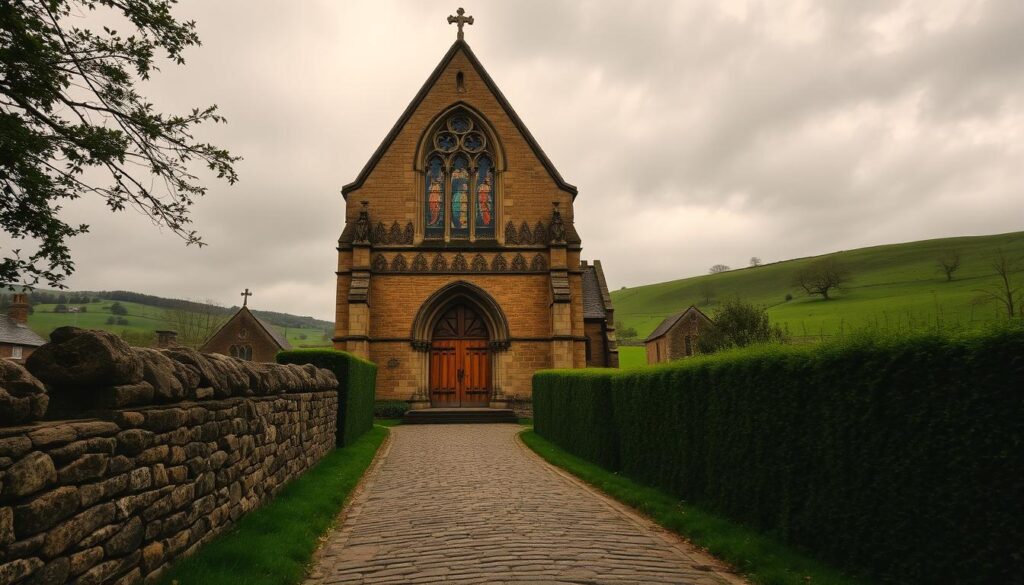
a medieval church in the English countryside, surrounded by rolling hills and lush greenery. The church's ornate Gothic architecture stands tall, with intricate stone carvings and stained glass windows that cast a warm, ethereal glow. In the foreground, a cobblestone path leads to the church's heavy oak doors, flanked by weathered stone walls and tall, manicured hedges. The sky above is a soft, overcast hue, adding to the serene and contemplative atmosphere. The scene evokes a sense of timeless tradition and reverence, capturing the historical roots and development of Anglo-Catholicism in England.

Medieval Foundations and Pre-Reformation Identity

Early English worship blended local customs with broader Christian practices. By the 10th century, monasteries like Glastonbury became centers of devotion that mixed Roman influences with distinctly English styles. These traditions laid groundwork for what some call a “native Catholicity”—rooted in ancient faith yet separate from later papal authority.

The Church of England maintained this balance for centuries. Henry VIII’s break with Rome in the 1530s changed politics more than theology. His Ten Articles of 1536 kept key teachings: Christ’s Real Presence in communion, confession, and honoring saints.

Reformation Era Tensions

Later monarchs pushed Protestant ideas, creating friction. Edward VI introduced simplified services, while Elizabeth I’s reforms blended old and new. Yet many parishes quietly preserved rituals like candlelit altars and priestly vestments.

This complex history gave 19th-century reformers historical footing. As one scholar noted, “They weren’t inventing—they were dusting off England’s original Catholic tradition.” Their work bridged medieval piety with Anglican structure, shaping a movement that still thrives today.

Key Beliefs and Practices

At the heart of this tradition lies a profound reverence for sacred rituals that connect believers to divine mysteries. These practices blend ancient Christian spirituality with Anglican flexibility, creating a distinctive path for worship and daily living.

Sacramental Theology and the Real Presence

Central to their belief is the real presence of Christ in the Eucharist. Unlike Roman Catholic teachings about transubstantiation or mainstream Anglican receptionism, followers embrace the mystery. As one priest explains, “We kneel before the blessed sacrament knowing Christ meets us here—no philosophical formulas needed.”

Seven sacraments form spiritual lifelines, not just symbols. Baptism, confirmation, and marriage are seen as genuine channels of grace. Private confession and anointing the sick remain vital, mirroring Catholic practices while honoring Anglican autonomy.

The Role of Liturgy and Devotional Practices

Every Sunday, the altar becomes a sacred stage. The bread and wine receive ceremonial care matching Roman Catholic standards. Worshippers might cross themselves or kneel during services, reflecting their sacramental worldview.

Daily devotions extend beyond church walls. Many pray the rosary or light candles for departed loved ones. This balance—personal faith with tangible rituals—defines their spiritual rhythm. A lay member shares, “Our liturgy isn’t performance—it’s how we touch eternity.”

The Oxford Movement and Tractarian Legacy

The 19th century brought a spiritual revolution within the Church of England. A group of Oxford scholars launched a campaign to reclaim ancient Christian roots through writings called Tracts for the Times. Their ideas reshaped Anglican identity forever.

Spark of a Spiritual Awakening

John Keble lit the fuse in 1833 with his sermon condemning “National Apostasy.” This fiery address protested government interference in church matters. Fellow Oxford thinkers joined him, arguing Anglicanism belonged to the historic Christian family—not Protestant reformers.

Giants of Theological Thought

John Henry Newman became the movement’s star thinker. His eloquent tracts defended sacraments and apostolic succession. Though his 1845 conversion to Roman Catholicism shocked followers, it clarified boundaries. As he wrote, “Truth lies in seeing connections where others see divisions.”

Edward Pusey provided stability during turmoil. His deep scholarship helped Anglo-Catholic practices take root. Meanwhile, Keble’s poetry inspired beautiful worship styles still used today.

Leader Role Key Contribution Legacy
John Keble Spiritual catalyst 1833 National Apostasy sermon Revived sacramental focus
John Henry Newman Theological architect Tract 90 on church authority Redefined Anglican identity
Edward Pusey Academic anchor Defended Anglican validity Secured long-term influence

These visionaries proved the Church of England could honor ancient traditions while staying independent. Their work turned altars into sacred spaces and liturgies into timeless encounters. The Oxford Movement’s impact still echoes in stained-glass windows and whispered prayers today.

Distinctive Elements of Anglo-Catholic Worship

Imagine walking into a space where every sight, sound, and scent draws you deeper into sacred mystery. This immersive experience defines worship in this tradition, blending physical expressions with spiritual depth.
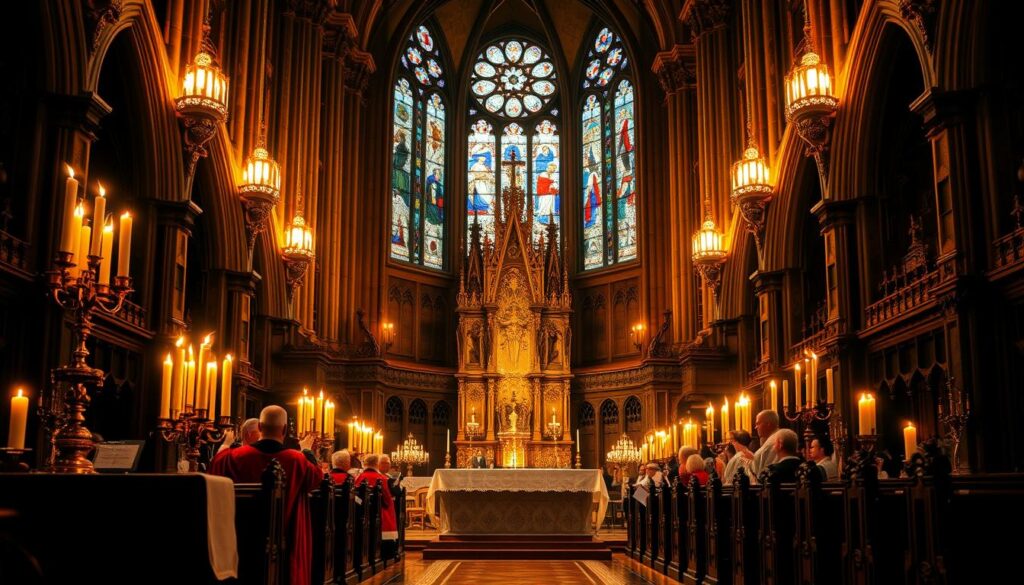
An elaborate Anglo-Catholic sanctuary bathed in warm, candlelit ambiance. In the foreground, an ornate altar adorned with ornate candlesticks, a golden cross, and fine linens. Clergymen in rich vestments perform a solemn liturgical ritual, their movements graceful and reverent. The middle ground reveals a grand reredos with intricate carvings and gilded accents. Stained glass windows cast a kaleidoscope of colored light, imbuing the scene with a sense of divine mystery. The background features ornate wooden pews and towering columns, creating a majestic, otherworldly atmosphere. Soft choral music fills the air, adding to the profound spirituality of the moment.

Use of Incense, Vestments, and Rituals

Swirling incense clouds symbolize prayers rising to heaven. Priests wear colorful vestments matching the church calendar—purple for reflection, gold for celebration. Bells ring during holy communion, marking Christ’s presence at the altar.

Seasonal colors transform worship spaces visually. Advent’s deep blue calls for preparation, while Easter white shouts resurrection joy. These elements create a liturgy that feels timeless yet alive.

Celebrating the Eucharist with Reverence

Every movement matters during the Eucharistic prayer. Priests lift the bread and wine with deliberate care, honoring the blessed sacrament. Worshippers kneel, whisper prayers, or cross themselves—physical responses to divine grace.

Special devotions like Benediction focus entirely on the consecrated host. As one member shares, “It’s not about rituals—it’s our way of meeting God face-to-face.” Private confession offers personal renewal, blending Catholic roots with Anglican warmth.

Through these practices, ancient faith finds fresh expression. The liturgy becomes a bridge—connecting earthly senses to heavenly realities while keeping community ties strong.

Anglo Catholic Worship and the Book of Common Prayer

Liturgical books often become battlegrounds for theological identity—and few texts illustrate this better than the Book of Common Prayer. While Thomas Cranmer’s 16th-century masterpiece shaped Anglican worship, its Protestant roots create fascinating tensions for communities seeking Catholic spirituality.
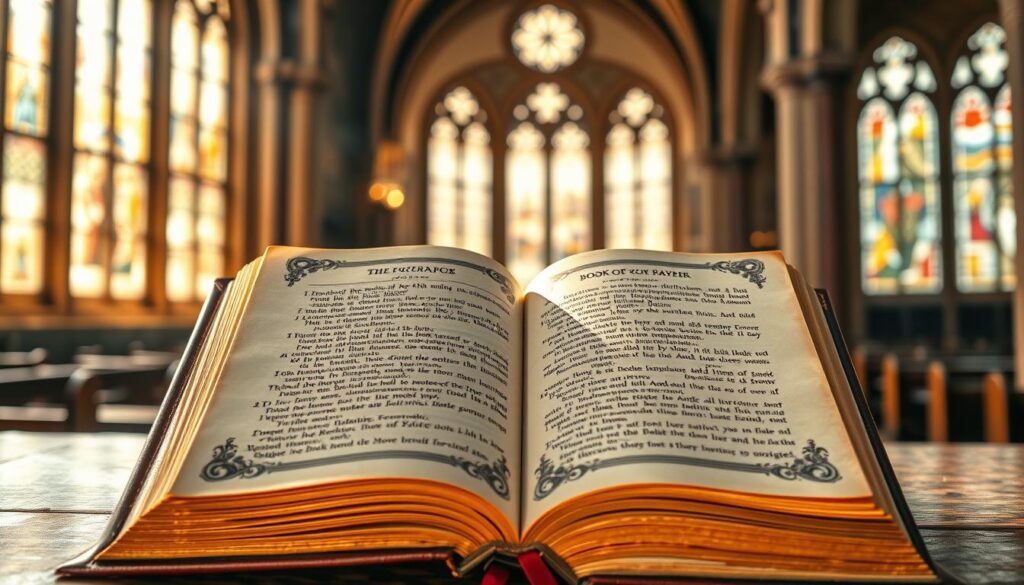
A gilded leather-bound book with ornate calligraphic lettering on the cover, opened to reveal intricately designed pages of the Book of Common Prayer liturgy. The pages are illuminated by soft, warm lighting, casting a reverent glow across the weathered parchment. In the background, a sunlit church interior with stained glass windows casts a serene, ethereal atmosphere. The overall scene evokes the timeless tradition and mystique of Anglo-Catholic worship.

Liturgical Variations in Practice

Walk into two Anglo-Catholic parishes, and you might hear different versions of the same prayer book. Some churches stick strictly to Cranmer’s text, finding beauty in its poetic cadence. Others add elements like Roman Catholic Proper Prefaces or Eastern Orthodox hymns. As one priest jokes, “We’re liturgical mixologists—shaking tradition with creativity.”

The Book of Common Prayer poses unique challenges. Cranmer designed its services to reflect Reformed theology, emphasizing scripture over sacraments. Yet Anglo-Catholics reinterpret phrases like “heavenly banquet” to affirm the Real Presence. This dance between text and meaning defines their worship style.

Modern Anglican resources like Common Worship offer new flexibility. Many parishes now blend:

  • Traditional prayer book language
  • Expanded Eucharistic prayers
  • Devotions to saints

Despite these adaptations, the common prayer tradition remains foundational. Even when using Roman rites, most services keep Cranmer’s structure. A lay leader explains, “Our prayer book is like a family recipe—we add spices, but the base stays the same.” This balance preserves Anglican identity while nurturing Catholic spirituality.

Modern Developments and Internal Debates

Navigating modern challenges while preserving ancient traditions remains a defining tension for this spiritual movement. As society evolves, communities grapple with questions that test their core identity.

The Ordination of Women and Progressive Shifts

The late 20th century brought seismic changes. Many Anglican provinces began ordaining women as priests, sparking heated debates. Traditionalists argued this broke with historic practice, while progressives saw it as justice unfolding.

Some congregations left the Church of England, forming breakaway groups. Others stayed, seeking unity amid disagreement. Today, female priests lead parishes worldwide—a shift reshaping worship and leadership roles.

Balancing Tradition and Contemporary Theology

Communities now walk a tightrope between reverence for tradition and modern relevance. Many maintain sacramental focus while addressing issues like climate change or LGBTQ+ inclusion.

Creative solutions emerge: livestreamed liturgies connect younger generations, while ancient prayers address current crises. As one leader notes, “Our roots ground us—they don’t chain us.” This dance between old and new keeps the tradition alive in changing times.

FAQ

How does Anglo-Catholicism differ from other Anglican traditions?

Anglo-Catholicism emphasizes liturgical richness, sacraments, and continuity with early Christian practices. It often includes rituals like Eucharistic adoration, devotion to saints, and a focus on the Real Presence in communion, setting it apart from more reformed Anglican branches.

What role did the Oxford Movement play in shaping Anglo-Catholicism?

The Oxford Movement, led by figures like John Henry Newman in the 19th century, revived Catholic theology within the Church of England. It emphasized apostolic succession, sacraments, and ancient traditions, laying the foundation for modern Anglo-Catholic practices.

Do Anglo-Catholics believe in the Real Presence during communion?

Yes, many affirm the Real Presence of Christ in the Eucharist. This belief, rooted in sacramental theology, sees the bread and wine as more than symbols—they’re vehicles of divine grace, though interpretations vary among individuals.

How does the Book of Common Prayer fit into Anglo-Catholic worship?

The Book of Common Prayer remains central but is often enriched with additional rituals, prayers, or gestures. Anglo-Catholics might include elements like genuflection or Marian devotions while maintaining the prayer book’s structure.

Why are vestments and incense common in Anglo-Catholic services?

These practices reflect a commitment to sacramental worship and continuity with historic Christian liturgy. Vestments symbolize priestly roles, while incense represents prayers rising to God, creating a sensory experience of reverence.

What are modern debates within Anglo-Catholicism?

Issues like the ordination of women and LGBTQ+ inclusion have sparked discussion. Some seek to preserve traditional teachings, while others advocate for progressive reforms, creating tension between tradition and contemporary values.

Did the English Reformation erase Catholic practices in England?

While the Reformation simplified worship, Anglo-Catholicism later revived many pre-Reformation traditions. Elements like sacramental theology and liturgical beauty were reemphasized, blending Protestant and Catholic identities.

How do Anglo-Catholics view Mary and the saints?

Many honor the Blessed Virgin Mary and saints through prayers, feast days, and icons, seeing them as intercessors. This devotional practice aligns with Catholic tradition but is less common in other Anglican groups.
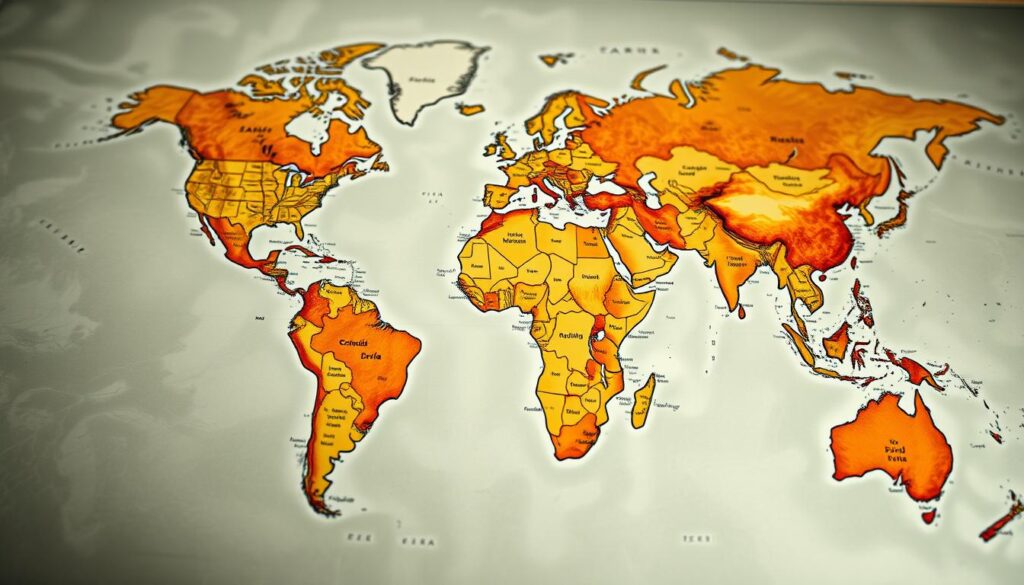
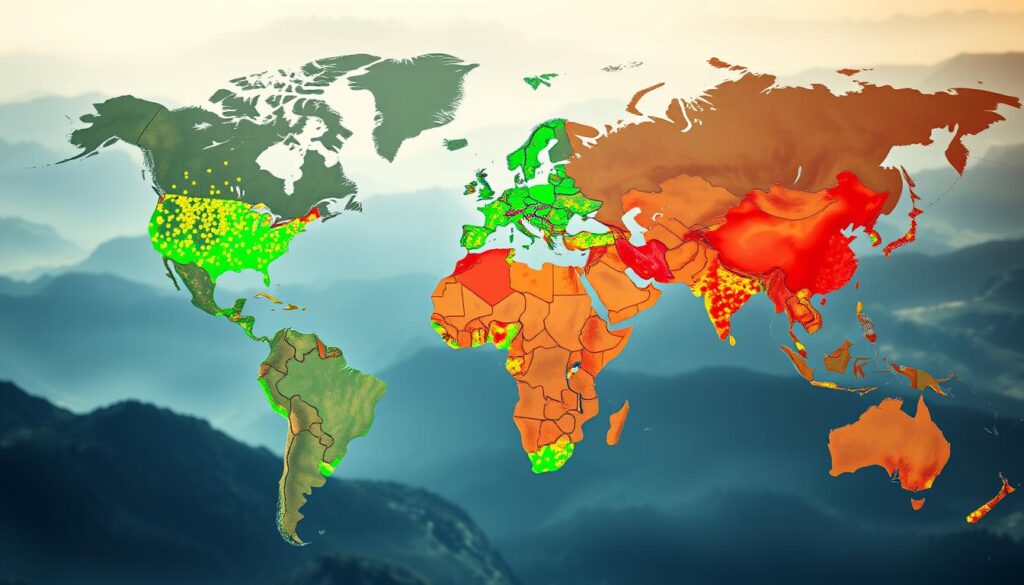
Catholicism World Map: Uncover the Global Spread of the Religion


Let’s explore how one of history’s most influential faiths grew from ancient roots to touch nearly every corner of Earth. Today, over 1.375 billion people identify with this tradition, forming the largest single Christian denomination. That’s roughly 17.6% of humanity connected through shared beliefs and practices.

From its beginnings in the Middle East, this spiritual community now thrives in diverse cultures. The Pew Research Center notes fascinating shifts in demographics, with growth hotspots in Africa and Latin America. Meanwhile, historic strongholds in Europe maintain rich traditions despite changing societal trends.

What makes this growth possible? A network of 225,406 parishes and 134,098 mission stations supports followers worldwide. Over 5,000 bishops and 400,000 priests guide communities, from Vatican City’s 100% adherence to nations with smaller but vibrant minorities.

Modern migration patterns and cultural exchanges keep reshaping this religious landscape. Our visual guide highlights these dynamics, revealing how historical events and current realities intertwine. Ready to see how faith transcends borders?

Key Takeaways

  • 1.375 billion followers make this the largest Christian denomination globally
  • 17.6% of Earth’s population identifies with these spiritual traditions
  • Over 225,000 parishes support communities across 134+ nations
  • Demographic shifts show rapid growth in Global South regions
  • Historical events and modern migration shape distribution patterns

Global Overview of Catholicism

Global religious demographics reveal fascinating stability in Catholic adherence amidst massive population changes. The Catholic Church grew from 291 million followers in 1910 to 1.1 billion by 2010 – tripling in size while maintaining 16-17% of Earth’s total population.

Historical Growth and Demographic Shifts

What makes this expansion remarkable? The Pew Research Center shows Catholic numbers kept pace with global population explosions. While Europe’s share decreased, Africa and Asia saw surges. This balancing act explains why percentages stayed steady despite regional upheavals.

Here’s what many find surprising: Catholics grew from 48% to 50% of the Christian population worldwide since 1910. Migration patterns and birth rates created new strongholds while traditional areas maintained influence.

Comparative Global Statistics

The World Christian Database highlights key comparisons through time:

Year Catholics % of Christians % of Global Population
1910 291M 48% 17%
2010 1.1B 50% 16%

This table shows how the Catholic Church expanded its reach while adapting to demographic realities. The Pew Research Center notes these patterns continue shaping global Christianity today.

Interpreting the catholicism world map

Maps tell stories beyond borders, and the distribution of religious communities reveals unexpected patterns. Visual tools help us spot trends that numbers alone might miss—like how cultural history shapes modern belief systems.

A detailed world map depicting the global centers of Catholic population, with vivid colors and a realistic, cartographic style. The foreground showcases the major Catholic hubs across the continents, with cities and regions highlighted in warm tones. The middle ground features intricate country borders and terrain, conveying a sense of geographic scale. The background subtly fades into a soft, ethereal atmosphere, creating a contemplative mood. Crisp, high-resolution rendering with a cinematic, wide-angle lens perspective, capturing the grand scale and scope of the Catholic faith's worldwide reach.

Key Figures and Visual Insights

Brazil’s 115 million Catholics make it the faith’s largest national community. Mexico follows closely with 101 million, showing Latin America’s enduring influence. The Philippines surprises many as Asia’s Catholic stronghold with 89 million followers.

North America and Africa complete the top five:

Country Catholics % of Nation
United States 75M 22%
DR Congo 60M 42%

While raw numbers impress, percentages reveal deeper truths. Vatican City naturally shows full adherence, but Timor-Leste’s 97% rate proves widespread cultural adoption. Research centers highlight how Brazil’s 53% Catholic share differs from Poland’s 87% in a smaller population.

These visual contrasts explain why analysts study both quantity and concentration. From European heartlands to growing African communities, the global Catholic presence keeps evolving through migration and local traditions.

Methodology and Data Sources

Accurate numbers form the backbone of understanding religious trends. Let’s examine how experts track spiritual communities across continents.

Insights from PEW Research and CIA Factbook

The Pew Research Center leads in religious demographics. Their surveys interview over 100,000 people globally. “Our multi-year studies combine census data with self-reported beliefs,” notes a Pew analyst. This approach captures both official records and personal identities.

Government sources add another layer. The CIA Factbook verifies figures through national reports. For example, Brazil’s 123 million followers appear in both Pew surveys and Brazilian census data. These cross-checks reduce errors.

Germany offers unique precision. Churches there track members through tax records. This system provides exact numbers unavailable elsewhere. About 26 million Germans appear on official Catholic registries.

Data Source Key Contribution Coverage
World Christian Database Historical trends Global projections
Latinobarometro Latin American focus 18 countries
Census Records Government-verified National counts

The World Christian Database predicts 1.27 billion followers by 2025. Meanwhile, groups like the Forum on Religion & Public Life compare methodologies. This teamwork ensures balanced reporting across regions.

Why does this matter? Multiple sources prevent skewed perspectives. When Pew Research, census data, and local surveys agree, we gain confidence in the numbers shaping our understanding of faith communities.

Regional Distribution and Shifting Demographics

The geography of faith communities has transformed dramatically in modern times. A century-long shift moved spiritual centers from traditional strongholds to emerging regions. This change reflects population growth, cultural adaptation, and missionary efforts across continents.

A detailed world map depicting the regional distribution and shifting demographics of Catholicism. The foreground shows vibrant dots and heat maps indicating the concentration of Catholic populations across continents. The middle ground features stylized country borders and geographic features, with colors and textures conveying a sense of data visualization. The background showcases a subtle, atmospheric landscape with a soft, muted palette, providing a sense of depth and context. The lighting is natural and diffused, creating a sense of depth and dimensionality. The overall tone is informative, data-driven, and visually compelling, suitable for illustrating the "Regional Distribution and Shifting Demographics" section of the article.

Growth Trends in Latin America and the Caribbean

Latin America now hosts 39% of global adherents, up from 24% in 1910. While absolute numbers grew, the Pew Research Center reveals a twist: only 72% of locals identify with this tradition today versus 90% in 1910. Urbanization and new religious movements reshape spiritual preferences.

Expanding Presence in Sub-Saharan Africa

Africa’s Catholic community exploded from 1% to 16% of worldwide followers since 1910. Over 171 million Africans now participate, with countries like DR Congo leading growth. This surge matches the continent’s rapid population expansion.

Changing Statistics in Europe and Asia-Pacific

Europe’s share plummeted from 65% to 24% as birth rates declined. Meanwhile, Asia-Pacific nations like Papua New Guinea tripled their numbers. The Philippines remains a key anchor with 89 million followers.

Region 1910 Catholic Population 2010 Catholic Population % Change
Europe 65% 24% -63%
Latin America 24% 39% +62%
Sub-Saharan Africa <1% 16% +1,500%
Asia-Pacific 5% 12% +140%

These shifts show how migration and local practices reshape spiritual landscapes. Research centers track these patterns to understand our evolving world population.

Infrastructure and Global Impact of the Catholic Church

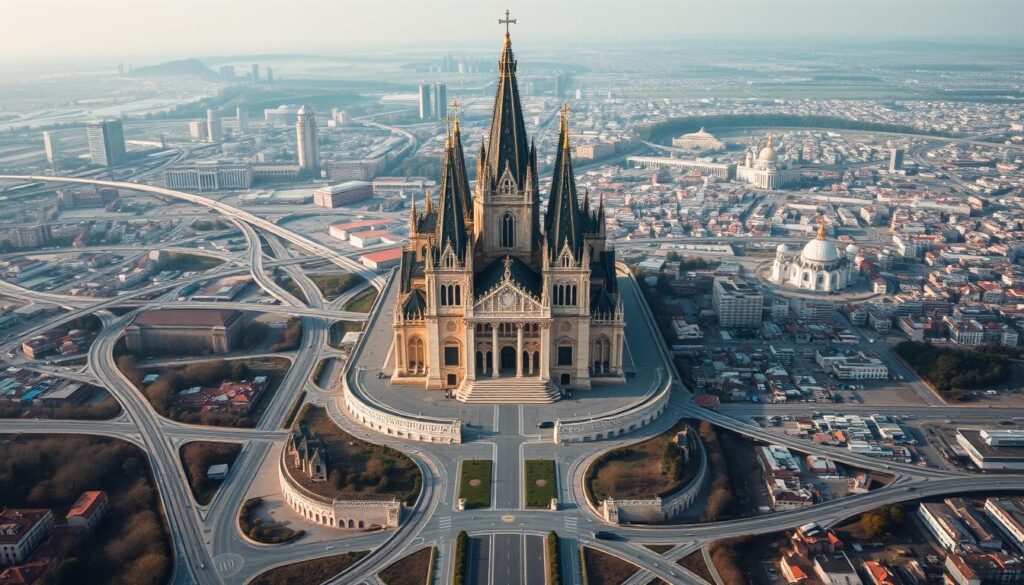
The Catholic Church maintains a spiritual and operational network unmatched in human history. Over 225,000 parishes form its backbone, supported by 134,098 mission stations reaching remote communities. This structure connects diverse traditions, from the Western Latin Church to 23 Eastern Catholic Churches that preserve unique rituals while sharing full communion with the Bishop of Rome.

A majestic cathedral stands tall, its spires piercing the sky like beacons of faith. Surrounding it, a sprawling network of roads, railways, and communication lines weave a tapestry of global connectivity, representing the Catholic Church's expansive infrastructure. Aerial viewpoints reveal the intricate web of churches, seminaries, and administrative hubs that span continents, conveying the scope of the religion's worldwide presence. Soft, diffused lighting bathes the scene in a reverent glow, capturing the grandeur and influence of the Catholic Church's global impact. The image exudes a sense of order, organization, and the unwavering determination to spread the faith across the world.

Parish Networks and Mission Stations

Only 3,241 mission stations have resident priests, revealing the challenge of serving isolated areas. The remaining 130,857 rely on visiting clergy or local leaders. This system allows the church to maintain presence in regions from Amazon villages to Himalayan towns.

Clergy Statistics and Community Outreach

Over 5,300 bishops guide 407,872 priests worldwide—nearly 280,000 serve local dioceses, while 128,000 belong to religious orders. They’re joined by 49,000 permanent deacons and 658,000 nuns and brothers who run schools and clinics.

The church’s social impact shines through numbers:

  • 5,000 hospitals treat patients regardless of faith
  • 95,000 elementary schools educate future generations
  • 10,000 orphanages provide safe havens

These efforts make the Catholic Church the largest non-government provider of education and healthcare globally. Its infrastructure bridges ancient traditions with modern community needs, proving faith and service often share the same address.

U.S. Catholic Demographics and Public Life

America’s religious landscape tells a story of constant renewal. While 24% of U.S. adults identify with this tradition today, the Catholic population balances gains and losses through surprising channels.

Immigration’s Transformative Role

New arrivals fuel demographic stability. Over half of all migrants to the United States practice this faith – that’s 52% bringing cultural traditions from abroad. Latin America supplies 76% of these immigrants, reshaping local communities.

The numbers speak volumes: 30% of American adherents (22.2 million people) were born elsewhere. This foreign-born share doubles the national average, creating vibrant multicultural parishes.

The Switching Phenomenon

Stability hides a quiet crisis. Pew Research finds one in ten adults left the faith – more departures than conversions. The Forum on Religion & Public Life notes this trend challenges long-term growth.

Yet hope arrives through young families. Many immigrants maintain strong ties, while second-generation members often blend traditions. This dynamic exchange keeps the United States central to global religious developments.

FAQ

Which countries have the largest Catholic populations?

Brazil, Mexico, and the Philippines top the list, with the U.S. and Italy following closely. Latin America alone accounts for nearly 40% of the global Catholic population, according to Pew Research Center data.

How fast is the faith growing in Sub-Saharan Africa?

Sub-Saharan Africa has seen a 130% increase in Catholics since 1980, driven by high birth rates and active missionary work. Countries like Nigeria and the Democratic Republic of Congo are key growth hubs.

What sources are used to track global Catholic demographics?

Studies from Pew Research, the CIA World Factbook, and the Vatican’s Annuario Pontificio provide data on membership, parish networks, and regional trends. Surveys often cross-reference census reports for accuracy.

Why is Europe’s Catholic population declining?

Lower birth rates, secularization, and religious switching have reduced Europe’s share of Catholics from 65% in 1910 to 24% today. Countries like Germany and France report significant drops in regular church attendance.

How does immigration shape U.S. Catholic demographics?

Hispanic immigrants now make up 40% of U.S. Catholics, revitalizing parishes in states like Texas and California. However, religious disaffiliation among younger generations poses challenges for retention.

What role does the Vatican play in global Catholic outreach?

The Holy See oversees 1.3 billion members through dioceses, clergy, and social programs. Its influence extends to education, healthcare, and advocacy, with over 221,000 parishes worldwide supporting communities.

How Catholicism Helps Us Understand and Cope with Suffering


Life’s toughest moments often leave us searching for answers. Why do we face pain? Where can we find purpose in hardship? For centuries, spiritual traditions have offered frameworks to navigate these questions with hope.

Scripture reveals that struggle wasn’t part of humanity’s original blueprint. Early texts describe a world where peace reigned before human choices altered our path. Yet even in brokenness, a loving response emerged—a promise of renewal through selfless sacrifice.

This perspective teaches that our hardest experiences can become doorways to growth. By uniting personal trials with sacred stories, individuals discover strength beyond themselves. Communities worldwide share testimonies of finding light in darkness through shared rituals and compassionate service.

Practical tools like reflective prayer and intentional service help reframe daily struggles. These approaches don’t erase pain but reveal its potential to cultivate resilience and connection. As one modern believer shared, “Carrying my burdens with purpose changed everything.”

Key Takeaways

  • Struggles entered human experience through historical turning points, not divine intent
  • Sacred narratives provide hope for ultimate healing and renewal
  • Personal challenges can be spiritually united with transformative stories
  • Practical rituals help reframe difficulties as opportunities for growth
  • Community support plays vital role in navigating life’s storms
  • Service to others often brings unexpected meaning during tough seasons

The Theology of Suffering in Catholicism

Facing hardship, many seek answers beyond the physical realm. This faith tradition offers a unique lens to view life’s toughest challenges through sacred history and divine promises.

Understanding Original Sin and Its Impact on Pain

At humanity’s beginning, harmony reigned between people and their Creator. Early teachings reveal a world free from pain and loss. But choices made by our ancestors shifted this reality.

The concept of Original Sin explains why hardship exists today. It wasn’t part of the original design but entered through human actions. This broken relationship affects everyone, creating a gap only divine love can bridge.

The Promise of Resurrection and Eternal Life

Here’s where hope shines brightest. Scripture assures believers that death isn’t the final word. “What is sown perishable will be raised imperishable,” declares 1 Corinthians 15:42-43.

Through the Son’s sacrifice, followers receive a stunning guarantee. Temporary struggles prepare us for an eternal reality where tears and pain disappear. The resurrection of the body marks God’s ultimate restoration plan – a new beginning beyond earthly limits.

This vision transforms how we view daily battles. Every challenge becomes a stepping stone toward heavenly glory. As one theologian noted, “Our present trials are preparing us for unimaginable joy.”

Exploring catholicism suffering: Spiritual Guidance Through Trials

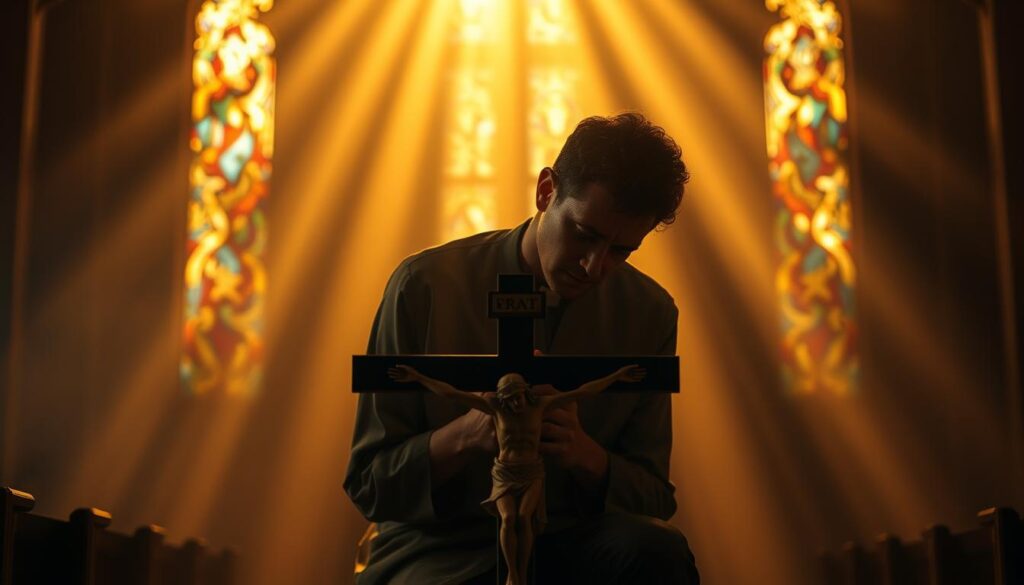
When storms hit, spiritual traditions offer maps to navigate the tempest. One transformative concept reshapes how we perceive adversity—turning anguish into active compassion.

A devout Catholic figure, their face etched with pain yet radiating a serene, otherworldly glow, kneels in a dimly lit chapel. Rays of warm, golden light filter through stained glass, casting a heavenly aura. In the foreground, a crucifix stands as a symbol of redemptive suffering, its outstretched arms mirroring the figure's posture in a pose of spiritual surrender. The background fades into a hazy, contemplative atmosphere, evoking a sense of profound introspection and the transcendent power of faith to transform even the darkest trials into a journey of spiritual love.

Redemptive Suffering as an Act of Love

Imagine your deepest pain becoming a bridge for someone else’s healing. This is the heart of redemptive love—joining personal struggles to Christ’s sacrifice. “We don’t walk through fire alone,” explains a modern spiritual guide. “Our trials become prayers when offered for others.”

This practice transforms isolation into connection. By consciously uniting hardships with the cross, believers participate in a sacred exchange. What feels broken becomes a way to mend hearts worldwide.

Scriptural Foundations and Catechism Insights

Saint Paul’s letters reveal a stunning truth: “In my flesh I complete what is lacking in Christ’s afflictions” (Colossians 1:24). The Catechism echoes this, teaching that suffering gains meaning when united to divine love.

Key principles emerge:

  • Human struggles can spiritually nourish others when offered intentionally
  • Grace makes possible what human effort cannot achieve alone
  • Every challenge becomes a classroom for Christ-like compassion

As one parishioner shared, “Learning this changed my anger into purpose—my pain now helps people I’ll never meet.” Through ancient wisdom and modern practice, trials become unexpected pathways to love.

Redemptive Suffering: Embracing Pain as a Path to Salvation

What if your deepest struggles could lighten someone else’s burden? This radical idea lies at the heart of transforming anguish into spiritual fuel. By consciously uniting our challenges with sacred purpose, ordinary hardships become extraordinary channels of grace.

Offering Our Struggles as a Living Sacrifice

Saint Paul’s words in Romans 12:1 spark a revolution in perspective: “Offer your bodies as living sacrifices—this is true worship.” Daily inconveniences and major crises alike gain eternal significance when intentionally dedicated to divine love.

Consider this comparison:

Worldly View Spiritual Perspective Eternal Impact
Pointless pain Prayer in action Helps others spiritually
Isolated struggle Communion with Christ Strengthens Church unity
Wasted suffering Redemptive offering Advances salvation history

Union with Christ Through Daily Challenges

Colossians 1:24 reveals a stunning truth—we complete “what is lacking in Christ’s afflictions” through our trials. This doesn’t diminish His sacrifice but invites us into sacred teamwork. As one modern mystic observed, “Our coffee spills and cancer battles both become holy when offered with love.”

Three transformative effects occur when we unite our pain with Christ:

  • Personal healing through purpose-filled endurance
  • Spiritual growth in compassion and resilience
  • Communal blessings across generations

Through this mystical bond, even minor irritations participate in God’s restoration plan. The Church teaches that no offered struggle goes unused—each becomes spiritual currency in heaven’s economy of mercy.

Real-Life Reflections: Faith, Trials, and Spiritual Transformation

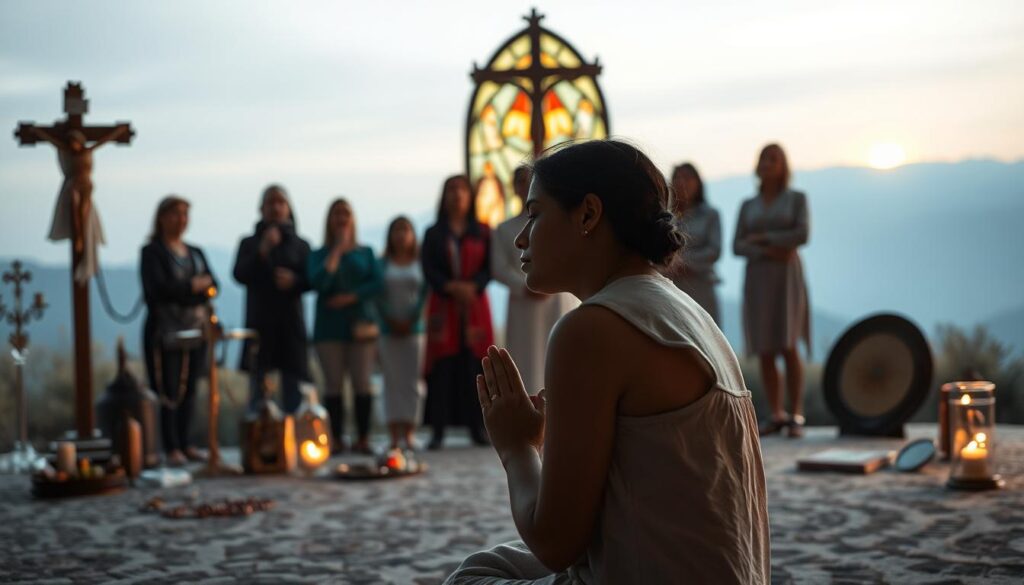
Everyday heroes show us how pain can spark profound change. Their stories remind us that light often shines brightest in life’s darkest valleys. Through ordinary struggles, extraordinary transformations unfold.

A serene, contemplative scene of faith testimonies. In the foreground, a person kneels in prayer, their face illuminated by a warm, soft light. Behind them, a group of people stand together, their expressions radiating hope and resilience. The middle ground features an array of religious symbols and artifacts, including a crucifix, rosary beads, and a stained-glass window. The background is a tranquil, ethereal landscape, with a faint hint of a heavenly glow on the horizon. The overall atmosphere is one of reverence, introspection, and the transformative power of faith during times of trial and suffering.

Personal Testimonies of Redemption and Hope

Audrey Anderson’s grandmother Lucy—affectionately called “Grams”—faced brain cancer, lung cancer, and a needed hip replacement. Each morning, she prayed the rosary, dedicating beads to her grandchildren. “Her pain became our family’s prayer chain,” Audrey recalls. Relatives drifted back to their faith, moved by her quiet strength.

Doctors found no tumors during Grams’ brain surgery—a healing Audrey calls “a love letter from heaven.” Now living with chronic illness herself, Audrey texts friends during flare-ups: “What can I pray for today?” She’s seen job offers appear, relationships mend, and health improve—all through prayers she offers while hurting.

How Suffering Inspires Community and Charity

Pain often builds bridges between people. Families rally around hospital beds. Churches organize meal trains. Strangers become prayer warriors. “My worst days connect me to others’ needs,” says Audrey. This ripple effect turns isolation into purpose.

Three ways trials strengthen communities:

  • Shared struggles create empathy that money can’t buy
  • Prayer networks form around those facing similar challenges
  • Healed wounds become guideposts for others lost in darkness

As Grams’ story proves, our battles aren’t wasted when we let them love others. Suffering becomes sacred work—a way to hold hope for the whole world.

Catholic Approaches to Suffering in Modern Challenges

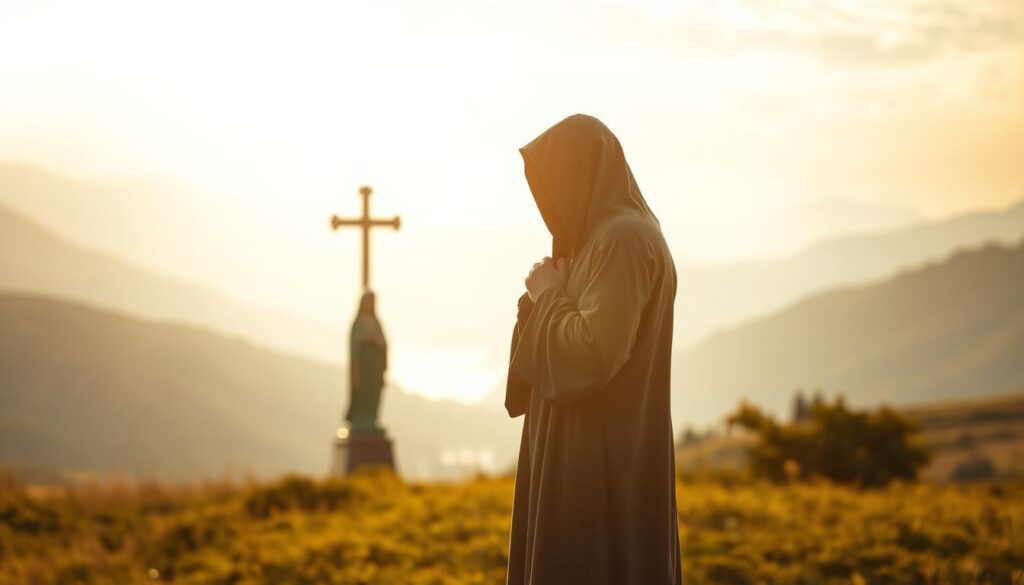
Global crises test faith in unexpected ways. The recent pandemic forced believers worldwide to wrestle with age-old questions about pain’s purpose. How does ancient wisdom speak to modern plagues? The answer lies in seeing trials as invitations to co-create hope.

A serene spiritual landscape, bathed in warm, ethereal light. In the foreground, a solitary figure in a hooded robe, hands clasped in contemplation, representing the individual's introspective journey through the challenges of the pandemic. In the middle ground, a symbolic representation of the Catholic faith - a cross or a Madonna statue - offering solace and guidance. The background depicts a tranquil, natural setting, such as a rolling hillside or a serene lake, conveying a sense of peace and renewal. The overall mood is contemplative, hopeful, and reflective, capturing the essential Catholic approach to finding meaning and strength in times of suffering and adversity.

Lessons from the Covid-19 Pandemic and Beyond

When hospitals overflowed and lockdowns isolated millions, many asked: “Is this suffering part of God’s plan?” Church teachings responded clearly. Pandemics reflect creation’s brokenness from humanity’s first rebellion—not divine intent. As one bishop explained, “Viral spread is a scar from Original Sin, not a sentence from heaven.”

The crisis became a classroom for redemptive love. Families turned quarantine boredom into prayer hours. Healthcare workers offered their exhaustion for patients’ healing. “My mask became a prayer cloth,” shared a nurse from Chicago. Even loneliness gained meaning when united with Christ’s passion.

Three key insights emerged:

  • Global suffering reveals our shared need for mercy
  • Personal sacrifices can spiritually nourish strangers worldwide
  • God transforms collective pain into grace-filled solutions

This approach transforms despair into action. As parishes delivered groceries and hosted virtual prayer chains, they proved ancient practices still heal modern wounds. The Catechism’s truth shone brighter: No struggle is wasted when offered with love.

Looking ahead, believers carry this lesson. Whether facing climate disasters or social unrest, they remember—every trial can become part of heaven’s healing symphony. The pandemic taught that our smallest offerings echo across eternity.

Practical Steps to Embrace and Transcend Suffering

Daily challenges become sacred journeys when met with intentional faith practices. These time-tested tools help transform ordinary struggles into spiritual fuel for personal growth and communal healing.

Engaging in Prayer, Mass, and Confession

Weekly Mass offers a powerful moment to unite your trials with Christ’s sacrifice. During the offertory, mentally place your burdens on the altar alongside the bread and wine. “This simple act turns pain into prayer,” notes a parish priest from Ohio.

Regular confession clears spiritual blockages that hinder grace. Removing sins through this sacrament strengthens your ability to bear difficulties well. Many find renewed purpose in hardships after experiencing reconciliation’s cleansing power.

Integrating Fasting and the Rosary into Daily Life

The rosary serves as an anchor during storms. As fingers move through beads, imagine placing specific struggles into Mary’s hands. A cancer survivor shares: “Praying ‘Hail Marys’ while nauseous from chemo became my lifeline to hope.”

Pair involuntary suffering with voluntary sacrifices. Skip snacks to pray for hungry families. Offer headaches for others’ healing. These small acts train your heart to see discomfort as love in action.

From saints to modern believers, those who embrace these practices discover a profound truth. Every offered struggle – whether chronic pain or daily irritations – becomes part of God’s healing work. Through simple, faithful steps, our crosses become bridges of love for others.

FAQ

How does original sin relate to pain and hardship?

The concept of original sin explains how brokenness entered the world, affecting humanity’s relationship with God. This separation brings challenges like pain and loss, but faith teaches that grace can transform these struggles into pathways for spiritual growth.

What role does resurrection play in facing life’s trials?

Belief in resurrection offers hope that earthly struggles are not the end. Eternal life with God reframes temporary pain, encouraging believers to trust in divine purpose even amid suffering.

How can daily struggles deepen our connection to Christ?

By uniting personal hardships with His sacrifice on the cross, individuals participate in His redemptive work. This act of love transforms ordinary afflictions into sources of spiritual strength and solidarity with others.

Why is community important during difficult times?

Shared trials often inspire acts of charity and mutual support. Personal stories of hope remind us that no one suffers alone, reflecting the Church’s call to bear one another’s burdens with compassion.

How did the Covid-19 pandemic highlight the value of faith?

Global challenges like the pandemic revealed the power of prayer and service. Many found strength in sacraments, even from afar, and renewed their commitment to serving vulnerable members of society.

What practical steps help people find meaning in pain?

Regular prayer, sacraments like confession, and devotional practices such as the Rosary foster resilience. Fasting and reflection also create space to recognize grace at work, even in darkness.

How does offering up suffering benefit others?

Viewing hardships as a “living sacrifice” mirrors Christ’s love. This mindset turns pain into intercession, allowing individuals to contribute to the healing and salvation of those around them.

Catholicism Timeline: Tracing the Faith’s Journey


For nearly 2,000 years, the Catholic Church has shaped civilizations, inspired art, and guided billions. As the world’s oldest continuously operating international institution, its story intertwines with humanity’s greatest achievements and challenges. From humble beginnings in ancient Judea to its global presence today, this faith community has weathered persecution, fostered learning, and redefined spirituality.

This journey begins with Jesus of Nazareth and his apostles, whose teachings sparked a movement that would outlive empires. Early followers faced Roman opposition but gradually gained recognition, becoming a cornerstone of European culture. The church’s growth led to monumental councils, like Nicaea and Trent, which solidified core beliefs still held by 1.3 billion people.

Through the Middle Ages, the Catholic Church preserved knowledge, built universities, and commissioned masterpieces like Michelangelo’s Sistine Chapel. It also faced divisions, such as the East-West Schism and Protestant Reformation, that reshaped Christianity. Each era brought new leaders—Augustine, Francis of Assisi, Teresa of Calcutta—who renewed its mission.

Today, the Catholic Church remains a force for charity, education, and interfaith dialogue. By exploring its past, we uncover how ancient traditions adapt to modern questions while maintaining spiritual roots. Let’s walk through pivotal moments that defined this enduring institution.

Key Takeaways

  • The Catholic Church is the oldest continuously functioning global institution, influencing world events for nearly two millennia
  • Major councils and documents established core teachings that guide over a billion followers today
  • Art, education, and healthcare systems grew from church-led initiatives across centuries
  • Historical challenges like the Protestant Reformation led to lasting changes in practice
  • Modern leadership continues addressing social issues while preserving ancient traditions

Introduction to the Catholicism Timeline Overview

This guide helps you navigate the church’s dramatic transformations through five major splits. Each division reshaped Christian beliefs and left lasting marks on global history.

Purpose and Scope of the Guide

We break down complex events into clear moments that changed the Catholic Church forever. You’ll see how early followers adapted their faith across continents while keeping core teachings alive.

Key Historical Milestones at a Glance

Year Event Impact
144 CE Marcionism First major break from mainstream teachings
1054-1449 East-West Schism Split with Orthodox Churches over leadership
1517 Protestant Reformation Created 200+ Christian denominations

These turning points show how the Catholic Church evolved through challenges. From Roman-era debates to medieval power struggles, each crisis sparked new ways to uphold ancient traditions in a changing world.

Roots of Catholic Faith and the Early Church

The story of Christian belief begins with ordinary people doing extraordinary things. Fishermen, tax collectors, and travelers became the first torchbearers of a movement that would reshape spiritual history.

A grand cathedral's interior, bathed in warm, golden light filtering through stained glass windows. In the foreground, worshippers kneel in reverent prayer, their faces aglow with devotion. The middle ground showcases intricate, carved wooden pews and ornate, marble columns supporting a vaulted ceiling. In the background, a grand altar stands, adorned with religious iconography and flanked by tall, flickering candles. The atmosphere exudes a sense of timeless, sacred tradition, capturing the essence of the early Church's spiritual practices.

Seeds of Spiritual Revolution

Jesus Christ’s inner circle—the twelve apostles—received a world-changing task. Their mission? To spread his message of love and redemption across nations. This Great Commission became the bedrock of faith communities from Jerusalem to Rome.

Pentecost marked the spark that lit the fire. When the Holy Spirit descended fifty days after Easter, timid followers transformed into bold preachers. They healed the sick, spoke in tongues, and built the first Christian networks.

Early believers faced a tricky balance. They honored Jewish roots while developing new practices:

  • Shared meals replaced temple sacrifices
  • Baptism became the initiation rite
  • Letters from apostles guided distant congregations

Persecution only strengthened their resolve. Roman authorities saw their communal living as suspicious, but church members risked everything to preserve Christ’s teachings. Secret symbols like the fish (ichthys) helped them identify allies.

By the second century, bishops emerged as spiritual successors to the apostles. This chain of leadership—still central to Catholic practice today—ensured consistency in doctrine across growing communities. What began as a small sect became a global force, one baptism and broken loaf of bread at a time.

Apostolic Age and Founding of the Catholic Church

The first century CE witnessed ordinary fishermen and tentmakers shaping a spiritual revolution. Through perilous journeys and bold decisions, early leaders built networks that would sustain the Catholic Church for millennia.

Pillars of Faith and Sacrifice

Stephen’s death in 34 AD became Christianity’s first martyrdom story. His stoning in Jerusalem showed how far believers would go for their faith. This courage fueled growth even under Roman oppression.

Paul’s 46 AD missionary trips changed everything. Partnering with Barnabas, he carried Jesus’ message beyond Jewish circles. Gentile communities embraced this inclusive vision, creating diverse worship spaces across three continents.

The 50 AD Council of Jerusalem marked a turning point. Leaders declared Gentile converts free from strict dietary laws and circumcision rules. This decision untethered Christianity from its Jewish roots, allowing global expansion.

Nero’s persecution (64 AD) tested the young church severely. Tradition holds that both Peter and Paul died in Rome during this purge. Their sacrifices cemented leadership structures – Peter as first bishop of Rome, Paul as theologian to nations.

By 100 AD, the last apostle John passed away. His writings in the New Testament completed scripture foundations. Through fire and blood, these pioneers built an institution that still guides billions today.

Formation and Canonical Scriptures in Early Christianity

How did scattered letters become sacred texts? Early believers faced this puzzle as they sifted through writings claiming divine authority. The New Testament we know today emerged through careful discernment across four centuries, blending apostolic wisdom with evolving traditions.

A serene, dimly lit interior of an ancient library. In the foreground, a group of scholars in robes and sandals intently poring over scrolls and manuscripts, deep in discussion. The middle ground reveals shelves of weathered, leather-bound books, casting long shadows. Beams of warm, golden light filter through high windows, illuminating the hazy atmosphere. In the background, an ornate, carved wooden table serves as the centerpiece, surrounded by more scholars engaged in quiet contemplation. The scene evokes a sense of reverence and the weight of history, as these early Christians debate and shape the canon of the New Testament.

Development of the New Testament Canon

Paul’s letters to fledgling churches (50-58 AD) became foundational scripture before ink dried. These urgent messages addressed real problems – factionalism in Corinth, legalism in Galatia – while shaping core doctrines like grace and resurrection.

Mark’s Gospel (70 AD) captured Peter’s eyewitness accounts of Jesus. Matthew and Luke expanded the story in the 80s, blending oral traditions with Hebrew prophecies. John’s mystical account (100 AD) added theological depth, completing the fourfold witness.

Early worship services buzzed with diverse texts. Some communities favored the Didache’s practical guidelines, others reveled in Revelation’s visions (95 AD). By 150 AD, Latin translations helped standardize readings across the Western Church.

The Council of Rome (382 AD) settled debates decisively. Pope Damasus I’s list identified 27 books as divinely inspired, separating them from popular but unverified works. This moment crystallized the Catholic Church’s biblical identity while honoring centuries of collective discernment.

The Ante-Nicene Period and Early Challenges

How did a persecuted movement become a unified global church? The years 100-325 AD tested early believers with fiery debates and life-or-death choices. In 110 AD, Ignatius of Antioch coined “Catholic Church” to describe Christianity’s universal nature. This bold label separated mainstream belief from splinter groups claiming secret truths.

A dimly lit sanctuary, the air thick with the scent of incense. In the foreground, a group of early Christians gathered, faces etched with determination as they navigate the challenges of their newfound faith. Shadows loom in the background, hinting at the persecution and adversity they face. The lighting is moody, a soft, golden glow illuminating the scene, casting dramatic shadows across the weathered stone walls. The composition is balanced, drawing the viewer's eye towards the central figures, their expressions conveying the weight of their struggles. An atmosphere of somber reflection pervades the scene, capturing the essence of the Ante-Nicene period and the early challenges faced by the burgeoning Christian community.

  • Marcion’s rejection of Old Testament scriptures
  • Valentinus’ complex spiritual hierarchies
  • Montanists’ ecstatic prophecies

Leaders like Justin Martyr fought back with reason. His 155 ADFirst Apologyshowed how Christianfaithaligned with Greek philosophy. “We worship the Creator of all,” he wrote, bridging cultural divides.

Martyrs became living proof of conviction. When flames engulfed 86-year-old Polycarp in 156 AD, witnesses reported smelling baking bread – a symbol of Christ’s sacrifice. Such stories fortified communities against persecution.

Tertullian’s genius reshaped theology forever. By 200 AD, he crafted Latin terms like Trinitas (Trinity) that clarified core Catholic Church teachings. His work gave believers precise language to defend their beliefs against critics.

Through crisis came clarity. These early struggles forged the church’s identity, proving truth could thrive even under fire.

Constantine’s Influence and the Legalization of Christianity

A single night vision altered the course of religious history forever. In 312 AD, Emperor Constantine reportedly saw the Chi-Rho symbol before the Battle of Milvian Bridge. His troops painted this Christian emblem on their shields, claiming victory against overwhelming odds. This event marked Rome’s first imperial nod to the growing church.

The 313 Edict of Milan changed everything. It granted legal status to Christianity across the Roman Empire, ending three centuries of persecution. For the first time, believers could worship openly without fearing death. This policy also protected other faiths, creating unprecedented religious diversity.

Constantine’s generosity fueled the Catholic Church’s growth. He gifted Rome’s Lateran Palace to Pope Miltiades in 321 AD, transforming it into Christianity’s administrative hub. This lavish complex gave the church physical roots in the world’s most powerful empire.

By 324 AD, Constantinople emerged as a Christian capital. Designed as a “New Rome,” it blended imperial grandeur with faith-centered architecture. The city became a beacon for Eastern Christianity, shaping spiritual traditions still alive today.

Constantine’s work set lasting precedents. His involvement in church councils showed how political power could shape religious doctrine. This partnership between throne and altar would define European Catholic Church dynamics for centuries.

Ecumenical Councils and Doctrinal Milestones

Gathering in ancient cities, bishops shaped Christianity’s core identity through fiery debates. These meetings answered urgent questions about Jesus Christ‘s nature and the church‘s role as truth-keeper. Their decisions still guide worship for over a billion believers today.

Council of Nicaea: Unity Through Clarity

In 325 AD, 300 bishops confronted the Arian heresy denying Christ’s divinity. The resulting Nicene Creed became Christianity’s universal statement of belief. It declared Jesus “true God and true man,” settling arguments that threatened to split the Catholic Church.

Constantinople to Trent: Refining Sacred Truths

Later councils built on this foundation. Constantinople (381 AD) affirmed the Holy Spirit’s divine status, completing the Trinity doctrine. Ephesus (431 AD) honored Mary as God-bearer, while Chalcedon (451 AD) clarified Christ’s dual nature in precise terms.

The Council of Trent (1545-63) later reformed practices while upholding ancient teachings. Together, these gatherings show how the Catholic Church balances timeless faith with evolving understanding. Their creeds remain recited worldwide, connecting modern believers to those early debates about God’s body and spirit.

FAQ

How did Peter and Paul contribute to the early Catholic Church?

Peter, recognized as the first pope, and Paul, a key missionary, spread teachings of Jesus Christ across the Roman Empire. Their work established foundational communities and traditions that shaped the Church’s growth.

What role did the Council of Nicaea play in Catholic beliefs?

The Council of Nicaea (325 AD) addressed doctrinal disputes, affirming Jesus’ divinity in the Nicene Creed. This creed remains central to Catholic faith and unified Christian beliefs during the Roman Empire’s religious shifts.

Why is the New Testament canon important to Catholicism?

The canon, formalized by early Church leaders, provided a unified scriptural foundation. It preserved teachings of Jesus and the apostles, ensuring consistency in sacraments like baptism and the Eucharist across centuries.

How did Constantine’s rule impact Christianity?

Constantine legalized Christianity in 313 AD through the Edict of Milan, ending persecution. His support allowed the faith to flourish, leading to church-building and the Council of Nicaea’s landmark decisions.

What were key outcomes of the Council of Trent?

The Council of Trent (1545–1563) addressed Protestant Reformation critiques by reaffirming doctrines like transubstantiation and clarifying teachings on indulgences. It strengthened Catholic identity through reforms and education.

How did early Christians handle challenges before legalization?

Before Constantine, communities faced persecution but maintained practices like baptism and Eucharist secretly. Writings from figures like Ignatius of Antioch defended beliefs in resurrection and Church unity.

What distinguishes Catholic traditions from other Christian groups?

The Catholic Church emphasizes apostolic succession, sacraments, and the authority of the pope. Teachings like the Immaculate Conception and dogmas defined at councils set it apart in Christianity’s history.

Catholicism WOW: Uncover the Mysteries


When Kevin Smith’s Dogma hit theaters in 1999, it sparked a firestorm. The comedy dared to reimagine religious symbols, blending satire with questions about tradition. At its core was a fictional campaign called “Catholicism WOW,” aiming to refresh the Church’s image with ideas like the lighthearted “Buddy Christ” statue.

The movie didn’t just entertain—it challenged viewers. By poking fun at rigid structures, it asked how faith could stay relevant. While some called it blasphemous, others saw a clever critique of outdated practices.

Smith’s work became a cultural touchstone. Fans debated whether humor could coexist with reverence. The film’s bold concepts even leaked into real-world discussions about modernizing religion.

Today, Dogma remains a fascinating case study. It shows how art can push boundaries while respecting personal beliefs. Its legacy? Proving that even controversial ideas can inspire meaningful dialogue.

Key Takeaways

  • Kevin Smith’s 1999 film sparked debates about faith and modernization
  • Fictional “Catholicism WOW” campaign blended humor with social critique
  • Balancing satire and respect remains a topic of discussion today
  • Audiences connected with reimagined religious symbols like “Buddy Christ”
  • The movie’s themes still influence conversations about tradition vs. change

Revisiting Dogma’s Cultural Impact

Twenty-five years after its release, Kevin Smith’s Dogma still stands as a lightning rod for discussions about faith in modern media. The film blended A-list talent with bold ideas, creating a cocktail of humor and theological debate that few movies dared to attempt.

Kevin Smith’s Bold Take on Faith and Film

Smith assembled an unlikely dream team for his 1999 project. Matt Damon and Ben Affleck played fallen angels, while Alanis Morissette’s silent God and George Carlin’s progressive cardinal flipped traditional expectations. The movie’s $10 million budget – Smith’s largest at the time – funded interdimensional battles and a memorable Jersey Shore showdown.

The Role of Satire in Challenging Traditional Beliefs

Through absurd scenarios like exploiting Church loopholes to reverse damnation, the film asked serious questions. Chris Rock’s forgotten apostle delivered biting commentary on religious exclusion, while Salma Hayek’s muse character bridged ancient myths with modern struggles.

Not every gag aged perfectly – the infamous “Shit Demon” still divides fans. But Smith’s mix of slapstick and sincerity created space for viewers to laugh while examining their own beliefs. The movie’s anniversary proves its themes of institutional critique and personal spirituality remain urgent today.

Exploring catholicism wow: Redefining Faith and Style

Modern religious dialogue often grapples with visual storytelling’s power to shape belief systems. The fictional “Catholicism WOW” campaign from Dogma proposed radical changes to sacred symbols, sparking debates about tradition versus accessibility in spiritual messaging.

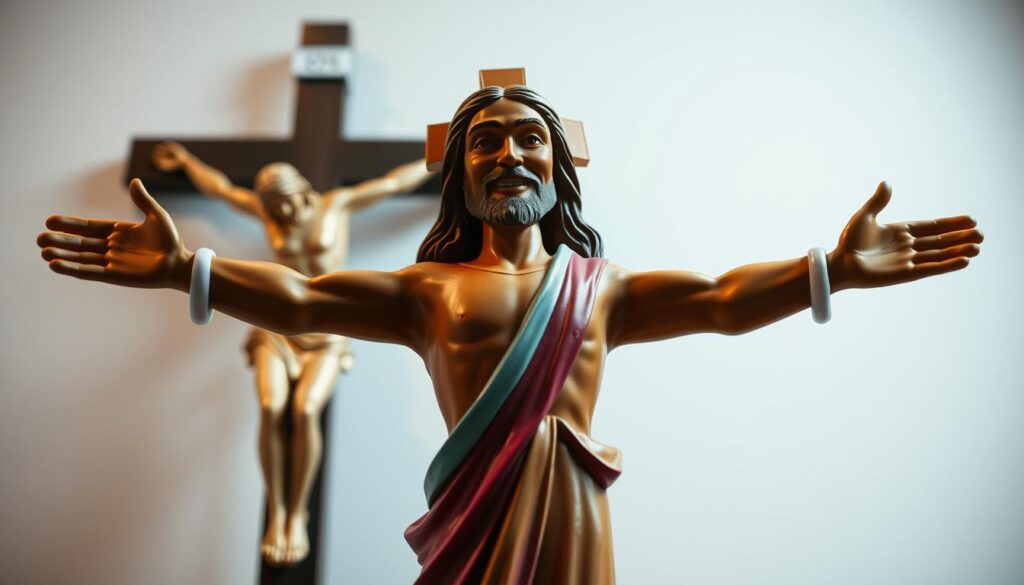
A close-up shot of a modern "Buddy Christ" statue standing confidently, its arms outstretched in a welcoming gesture, juxtaposed against a traditional crucifix in the background. The Buddy Christ is rendered in a vibrant, stylized manner, with a cheerful expression and bold colors, while the crucifix is depicted in a more somber, realistic style. The lighting is soft and diffused, creating a contemplative atmosphere that invites the viewer to ponder the contrast between the two religious representations. The composition emphasizes the juxtaposition, drawing the eye to the striking differences in form, expression, and symbolism between the two figures.

How the New Imagery of Faith Resonates in Modern Times

George Carlin’s Cardinal Glick argued traditional symbols needed a refresh: “Christ didn’t come to earth to give us the willies”. This fictional rebranding mirrors real-world efforts to make spiritual concepts feel approachable. Churches today experiment with digital art and interactive installations to engage younger audiences.

The Evolution from the Crucifix to Buddy Christ

The shift from sacrificial imagery to upbeat symbols raises key questions. While the crucifix represents profound sacrifice, Buddy Christ offers instant positivity. Theological experts note: “Friendly symbols risk simplifying complex spiritual truths”.

Symbol Meaning Modern Reception
Traditional Crucifix Sacrifice & redemption 57% find it meaningful*
Buddy Christ Encouragement & approachability 41% prefer updated versions*

*2023 Pew Research Center survey on religious symbolism

This tension between ancient traditions and contemporary communication styles continues shaping how institutions present timeless messages. The key lies in balancing reverence with relatability – a challenge as old as faith itself.

Religious Satire and Personal Belief in America

For many Americans, spiritual identity forms through unexpected collisions of tradition and rebellion. Thirteen years of Catholic schooling taught me rituals without resonance – weekly Masses felt like attendance checks, not sacred moments. The real faith-building happened in quiet resistance.

A Personal Journey from Catholic School Memories to Self-Created Faith

I crafted my own divine team: God became “a chill cheerleader who texted occasionally”, while Jesus transformed into an anti-establishment activist. This DIY spirituality focused on practical ethics – helping neighbors mattered more than memorizing catechism. When Kevin Smith’s film arrived, its humor felt like validation: “Finally, someone gets it!”

Analyzing the Humor and Critique of Institutional Religion

Satire became my secret decoder ring for religious questions. The movie’s jokes about Church loopholes mirrored real frustrations with institutional priorities. As abuse scandals emerged, laughter turned to action – many left pews but kept their moral compasses.

Comedy offers safe ground for tough conversations. Through absurd characters and situations, people explore doubts without abandoning cultural roots. This balancing act – honoring tradition while demanding better – defines modern spiritual journeys across America.

Conclusion

The conversation Dogma started 25 years ago isn’t over. Kevin Smith still mentions potential sequels multiple times a year, though most remain daydreams. Yet the movie’s real legacy lives in weekly discussions about balancing tradition with modern life.

The film showed humor could tackle sacred topics without disrespect. Its fictional “Catholicism WOW” campaign became a real-world reference point for updating religious communication. People now use these ideas when debating how institutions can stay relevant.

What keeps Dogma fresh after all this time? It’s the way it makes space for doubt and devotion to coexist. The story reminds us that questioning beliefs can strengthen personal faith – a message that still resonates as society evolves.

As new generations discover the film, its core truth endures: spiritual growth often happens through laughter, not lectures. In a world craving authenticity, Dogma‘s version of compassionate critique feels more vital than ever.

FAQ

How did Kevin Smith’s film Dogma challenge traditional Catholic views?

Kevin Smith’s 1999 film Dogma used satire to question rigid religious structures, blending humor with critiques of dogma. By portraying angels, demons, and flawed divine rules, it sparked debates about faith’s role in modern culture while staying rooted in Smith’s Catholic upbringing.

What makes satire effective in discussing religion?

Satire allows creators like Kevin Smith to highlight contradictions in institutional practices without dismissing faith itself. By using humor, films like Dogma invite audiences to reflect on tradition while fostering dialogue about personal spirituality versus organized doctrine.

Why did Dogma replace traditional symbols like the crucifix with “Buddy Christ”?

The “Buddy Christ” statue in Dogma symbolized a shift toward accessible, lighthearted imagery. It critiqued how commercialization can dilute sacred symbols while suggesting faith could evolve to feel more relatable in contemporary society.

How did Kevin Smith’s Catholic background shape his films?

Growing up Catholic influenced Smith’s storytelling, blending reverence with rebellion. Films like Dogma reflect his struggle to reconcile childhood teachings with adult skepticism, creating narratives that honor faith while challenging its institutional flaws.

Can humor coexist with genuine religious critique?

Yes. Smith’s work shows humor can dissect serious topics without mockery. By poking fun at bureaucracy within the Catholic Church, his films encourage viewers to separate spiritual truth from human-made structures, fostering deeper introspection.

Catholicism and Transgender: Navigating the Intersection


Over 1.2 billion people worldwide belong to a faith tradition that shapes lives through ancient teachings and modern practices. In America alone, more than 70 million members gather in parishes from coast to coast. Yet today, many face new questions about how traditional beliefs intersect with evolving understandings of human identity.

This conversation touches hearts in pews and pulpits alike. While official documents don’t directly address gender diversity, many wonder how to balance doctrine with compassion. Families share stories of loved ones seeking acceptance without abandoning cherished spiritual homes.

Across the country, faith leaders are exploring ways to support their entire community. Some parishes now host listening sessions, while others train staff on inclusive language. These efforts aim to honor both religious teachings and the dignity of every person walking through church doors.

Key Takeaways

  • The global faith community faces complex questions about identity and belonging
  • Many religious institutions are developing new approaches to pastoral care
  • Personal stories highlight both challenges and opportunities for understanding
  • Practical solutions are emerging at local levels across the country
  • Open dialogue helps balance tradition with contemporary realities

Through respectful conversation, communities can build bridges where doctrine meets daily life. This journey requires patience, empathy, and a shared commitment to walking together in faith.

Understanding the Historical and Doctrinal Context

For nearly two thousand years, the church’s structure has shaped how communities live their faith. From local parishes to global leadership, this framework guides decisions affecting millions. Let’s explore how historical roots influence modern conversations about identity.

The Roots of Catholic Church Structure and Teachings

The church traces its leadership to St. Peter, with the Pope overseeing 33 provinces and 195 U.S. dioceses. Bishops carry out teachings through local policies, creating varied approaches across regions. This system balances ancient traditions with contemporary needs.

Key documents like the Catechism provide doctrinal foundations. Updated regularly, they address moral questions while honoring centuries-old theology. As one bishop noted, “Our role is to interpret, not invent.”

Doctrinal Stances on Gender and Sexual Orientation

Traditional teachings view gender as determined at birth, linking biological sex to spiritual identity. The Catechism describes same-sex attraction as “objectively disordered,” while urging compassion. These positions spark ongoing debates about inclusion.

Document Key Point Impact
Catechism (1994) Defines marriage as male-female union Guides sacramental policies
1986 Letter Calls same-sex attraction “disordered” Shapes pastoral care methods
2015 Vatican Decision Denied transgender godparent role Highlighted policy tensions

Pope Francis’s “Who am I to judge?” remark softened the tone but didn’t change doctrine. Today, many parishes seek ways to welcome diverse members while honoring teachings. The challenge remains balancing timeless truths with evolving understandings.

Community Experiences and Personal Narratives

Behind every theological discussion lie human stories that shape our understanding of belonging. These accounts reveal how individuals reconcile personal truths with spiritual traditions.

A close-knit family gathered in a warm, softly lit living room, their faces radiating a sense of belonging and contentment. In the foreground, a mother and father embrace their transgender child, their expressions filled with unconditional love and understanding. In the middle ground, siblings and grandparents sit together, their hands intertwined, creating a tapestry of faith and acceptance. The background is hazy, conveying a sense of safety and sanctuary, as if the family has created a sacred space within their home. The overall mood is one of profound connection, where differences are celebrated, and the strength of family ties transcends any labels or preconceptions.

Real-Life Stories of Faith and Transition

One religious leader’s journey began when his child attempted suicide during high school. “We faced an impossible choice,” he shared. Years of prayer led them to realize their child’s authentic self wasn’t lost – just expressed differently.

Many young people describe feeling trapped between self-expression and community acceptance. A Georgetown University student’s experience shows how embracing identity can rebuild fractured relationships. “When I stopped hiding, my parents saw the real me,” she explains.

Family Perspectives and Lived Challenges

Parents often describe initial shock turning into fierce advocacy. One mother recalls: “Our parish became our lifeline when we learned to separate fear from faith.” Families frequently discover deeper connections through these journeys.

Practical challenges emerge in daily life. Some parents worry about children’s safety in faith spaces, while others navigate healthcare decisions. Yet countless stories show how love bridges divides – one conversation at a time.

These narratives prove that supporting loved ones doesn’t weaken spiritual bonds. Instead, they reveal how compassion strengthens communities when people choose understanding over judgment.

Exploring Issues in catholicism transgender Encounters

Faith communities across America face pressing questions about inclusion and tradition. How religious institutions address these matters impacts both spiritual lives and community bonds. Let’s examine three critical areas shaping current discussions.

Church Policies and Institutional Challenges

Religious organizations navigate complex terrain between doctrine and modern realities. While some dioceses promote welcoming environments, others enforce strict membership rules. Recent cases show teachers losing jobs after legal marriages, highlighting policy inconsistencies.

This patchwork approach leaves many members uncertain about their standing. As one advocate notes, “People deserve clarity about where they belong.” Leadership teams often struggle to interpret broad guidelines for local contexts.

Experiences within Parishes and Ministry Programs

Many faith groups now develop creative outreach through specialized ministries. These programs help individuals feel valued while honoring tradition. Some parishes host support circles, while others train volunteers in compassionate communication.

Health care remains a key concern for families. Catholic medical centers sometimes clash with professional standards when providing gender-related services. This tension affects both patients and caregivers seeking ethical solutions.

Insights on Health Care, Support, and Advocacy

Over 50% of religiously-affiliated youth seeking gender care report discrimination fears. Progressive organizations work to bridge this gap through education and resource sharing. Their efforts help communities balance spiritual values with essential support needs.

Key initiatives include:

  • Training programs for clergy on mental health first aid
  • Partnerships with medical professionals following WPATH guidelines
  • Legal advocacy protecting members’ rights in faith-based institutions

These practical steps demonstrate how communities can uphold traditions while growing in understanding. Through open dialogue and shared compassion, many find paths forward that honor both faith and human dignity.

Navigating Theology, Doctrine, and Gender Identity

Theological discussions about identity often spark deep reflection within faith communities. These conversations challenge long-held assumptions while revealing new ways to interpret sacred texts. Let’s explore how ancient wisdom meets modern understandings of human diversity.

A dimly lit, ornate cathedral interior. In the foreground, two robed figures - a priest and a theologian - engaged in intense theological discourse, their expressions thoughtful and earnest. The priest gestures with one hand, the theologian's brow furrowed in contemplation. Soft, warm lighting from stained glass windows casts a reverent glow, creating an atmosphere of solemn inquiry. In the background, rows of wooden pews recede into the shadowy, cavernous space, hinting at the weight and history of the institution they represent. Muted tones of gray, ochre, and gold predominate, adding to the air of quiet contemplation.

The Impact of Traditional Teachings on Modern Transgender Issues

Many religious teachings view gender as determined at birth, creating tension with contemporary insights. This perspective stems from interpretations of creation narratives and natural law principles. Some leaders argue these views protect family structures, while others see exclusionary impacts.

Traditional View Progressive Response Common Ground
Binary gender model Recognition of diverse identities Human dignity focus
Biological determinism Brain science findings Compassionate care
Doctrinal preservation Pastoral flexibility Community unity

Emerging Theological Interpretations and Progressive Voices

New perspectives are reshaping conversations about faith and identity. “God’s creation includes spectrum, not just categories,” suggests theologian Dr. Maria Sanchez. These approaches honor both tradition and scientific understanding of gender identity development.

Medical research shows brain structures may influence self-perception. Historical records reveal people living outside binary norms for centuries. This evidence challenges notions of “gender ideology” as modern invention.

Many communities now emphasize core values like love and acceptance. “Our faith calls us to walk with, not judge,” shares a parish outreach coordinator. These efforts help individuals feel valued while maintaining spiritual connections.

Conclusion

At the heart of every faith journey lies the courage to embrace both tradition and transformation. Progressive voices within religious communities affirm what DignityUSA’s declaration states: every person reflects divine love through their authentic self. Over 400 Catholic organizations now echo this message of radical acceptance.

Families navigating these paths show how love strengthens faith rather than weakens it. Medical experts confirm that compassionate care for trans individuals aligns with ethical health practices. Many parishes now use this knowledge to create safer spaces through updated policies and support groups.

Pope Francis’s emphasis on mercy inspires creative solutions. Some churches train ministers in inclusive language, while others host dialogues about identity. These efforts help communities honor timeless values while addressing modern realities.

The road ahead requires patience, but countless stories prove change happens one open heart at a time. When faith communities choose understanding over fear, they build bridges that uplift everyone’s spiritual life.

FAQ

What is the Catholic Church’s official stance on gender identity?

The Church teaches that every person is created in God’s image and deserves dignity. However, it upholds traditional teachings on binary gender tied to biological sex. Some parishes and ministries, like New Ways Ministry, advocate for broader inclusion of transgender individuals.

How do transgender Catholics navigate faith communities?

Many find support through affirming parishes or organizations such as DignityUSA. Others face challenges, including exclusion from sacraments. Personal stories often highlight resilience in balancing faith with gender identity.

Has Pope Francis addressed transgender issues?

Pope Francis emphasizes compassion, urging the Church to avoid discrimination. In 2023, he approved allowing transgender individuals to be baptized under certain conditions, signaling a nuanced approach while maintaining doctrinal boundaries.

Can transgender individuals access healthcare in Catholic institutions?

Policies vary. Some Catholic hospitals provide gender-affirming care, while others follow ethical guidelines restricting it. Advocacy groups like Catholic Health Association encourage dialogue on balancing care with religious teachings.

How do families reconcile faith with a child’s gender transition?

Families often seek guidance from inclusive ministries or therapists. Organizations like Fortunate Families offer resources to navigate acceptance, spiritual growth, and community support without compromising core beliefs.

Are there theological debates about gender identity in Catholicism?

Yes. Scholars like Fr. James Martin call for greater LGBTQ+ inclusion, while traditionalists stress alignment with natural law. Emerging voices explore Scripture and tradition to reinterpret gender within faith contexts.

Do transgender Catholics face barriers in parish life?

Some report rejection in ministries or sacramental participation. However, dioceses like San Diego and Chicago have implemented outreach programs to foster belonging while respecting doctrine.