Recent Posts

Bishop Barron’s Guide to Catholicism


In an age where ancient traditions meet digital innovation, one religious leader stands out for bridging timeless wisdom with modern communication. Robert Emmet Barron, founder of the global ministry Word on Fire, has transformed how spiritual teachings connect with today’s seekers. His documentary series and online presence have redefined evangelization, earning him the nickname “bishop of the Internet” among followers.

Barron’s approach combines intellectual depth with relatable storytelling. With over 151 million YouTube views and 3 million Facebook followers, he makes complex theological ideas accessible without watering them down. This balance attracts both lifelong believers and those exploring faith for the first time.

What sets his work apart is how he addresses modern spiritual needs. He critiques superficial approaches to religion, urging deeper engagement with sacred traditions. His Parisian academic training shines through in content that respects doctrine while speaking to contemporary issues like secularism and social media culture.

Young adults particularly resonate with his message. By meeting people where they are—on smartphones and streaming platforms—he’s building a vibrant community hungry for authentic connection. This guide explores how his methods offer a blueprint for meaningful religious outreach in the digital era.

Key Takeaways

  • Pioneered digital strategies making ancient teachings relevant to modern audiences
  • Attracted over 151 million video views through accessible theological content
  • Addresses growing spiritual hunger with intellectually rigorous yet approachable messaging
  • Blends academic expertise from Parisian institutions with mass media savvy
  • Created a model for religious organizations to engage tech-connected generations

Overview of Bishop Barron’s Mission and Media Legacy

Born in Chicago to Irish-American parents, Robert Barron discovered his passion for theology through unexpected sources. As a teenager at Fenwick High School, he stumbled upon Thomas Aquinas’ writings—an encounter that shaped his future. This early fascination with philosophical depth later fueled his mission to make ancient wisdom resonate in modern times.

Biography Highlights and Early Initiatives

In 2000, Bishop Barron took a bold step by founding Word on Fire Catholic Ministries. This non-profit became his vehicle for merging scholarly rigor with mass communication. His academic training in Paris added intellectual weight to projects designed for everyday viewers.

Digital Outreach and Impact on the Modern Faith Community

Bishop Barron’s media breakthrough came in 2007 with a viral video analyzing moral themes in Martin Scorsese’s The Departed. This creative approach—linking pop culture with spiritual lessons—became his signature style. Soon, his programs appeared on major networks like WGN America and EWTN.

Today, Word on Fire’s YouTube channel and podcasts connect with millions globally. Followers appreciate how complex doctrines become relatable through film reviews and documentary series. This strategy builds communities beyond church walls, proving faith can thrive in digital spaces.

Formation and Theological Foundations

The intellectual journey that shaped this influential religious figure began with rigorous academic training. His path through prestigious institutions laid the groundwork for a unique approach to sharing spiritual insights.

a highly detailed and realistic digital painting of a classroom setting with wooden desks, chairs, and bookshelves lining the walls, illuminated by warm, diffused natural lighting streaming through large windows. In the foreground, a group of students in formal academic attire are engaged in deep discussion, their faces animated as they ponder theological concepts. In the middle ground, a professor stands at the head of the class, gesturing emphatically while referencing a large chalkboard covered in intricate diagrams and equations. The background features a towering, ornate wooden crucifix and stained-glass windows, creating a sense of reverence and spirituality befitting a center of theological education. The overall atmosphere is one of intellectual rigor, thoughtful contemplation, and a reverence for the divine.

Early Life, Education, and Spiritual Awakening

Robert Barron started at the University of Notre Dame before transferring to Mundelein Seminary. Selected as a Basselin Scholar at the Catholic University of America, he earned philosophy degrees by 1982. These studies sharpened his ability to address modern challenges to faith.

His spiritual curiosity ignited through encounters with Thomas Aquinas. This medieval thinker’s ideas became lifelong companions, later shaping Barron’s ability to connect ancient wisdom with contemporary questions.

Academic Training and Ecclesiastical Milestones

In Paris, Barron earned his Doctorate in Sacred Theology in 1992. His groundbreaking dissertation compared Aquinas’ work with modern theologian Paul Tillich. This fusion of classical and contemporary thought became his trademark.

Ordained as a priest in 1986, he spent 23 years teaching at the University of St. Mary of the Lake. Fluent in four languages, he crafted lessons that made complex doctrines relatable—skills now seen in his books and digital content.

His tenure at the Pontifical University St. Mary’s campus transformed theological education. Students recall how he made Aquinas’ 13th-century ideas feel urgent for 21st-century seekers.

Rise as a Media Evangelist

The digital age demanded fresh ways to share spiritual wisdom. One ministry answered this challenge by merging sacred messages with cutting-edge technology. Its approach transformed religious communication, reaching millions through screens and speakers.

Breakthroughs in Television, Podcasts, and Social Media

October 2010 marked a historic shift when Word on Fire debuted its weekly TV program. This show became the first national religious series hosted by a priest in six decades. Fans tuned in for deep dives into film analysis and cultural commentary.

The ministry’s YouTube videos changed the game completely. Over 1,000 video commentaries have racked up 84 million views. These short clips make complex ideas snackable without losing depth.

Platform Content Type Reach
Television Weekly show National broadcast
Podcast Faith & culture talks 10M+ downloads
YouTube Video commentaries 84M+ views

Creating a Global Platform with Word on Fire

The headquarters in Rochester tells the story visually. Glass walls showcase movie posters beside saint portraits. This mix reflects the ministry’s core philosophy – faith meets modern culture.

Weekly podcasts and YouTube videos now form a complete media ecosystem. Followers choose their favorite format while getting the same rich content. This strategy keeps the Word Fire burning across generations.

Young creators draw inspiration from this model. They see how quality production and smart storytelling make ancient truths feel urgent today. The ministry proves spiritual content can thrive in competitive digital spaces.

Exploring catholicism bishop barron: A Case Study on His Ministry
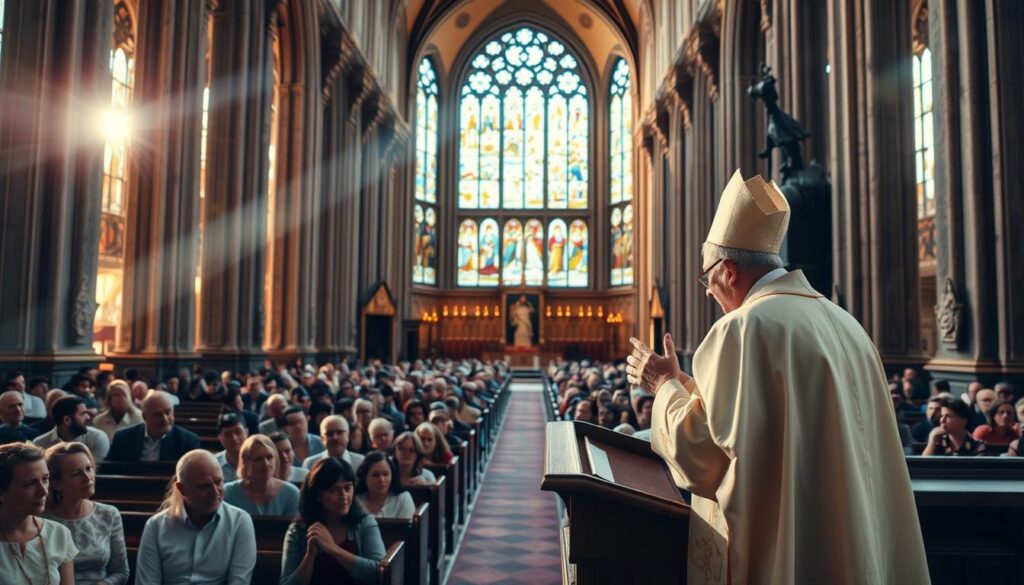
A grand cathedral with stained glass windows, sunlight streaming through, casting a warm, reverent glow. In the foreground, a bishop stands at a pulpit, gesturing with purpose as he delivers a sermon to a rapt congregation. The middle ground reveals rows of pews, filled with people of all ages, their faces alight with spiritual contemplation. In the background, ornate architectural details and ornaments evoke the rich history and tradition of the Catholic faith. The scene exudes a sense of reverence, devotion, and the transformative power of evangelization.

A global journey through sacred sites became the catalyst for modern spiritual renewal. The 2011 documentary filmed across 16 nations didn’t just showcase cathedrals—it reignited faith journeys through cinematic storytelling. One viewer described the experience as “finally seeing the puzzle pieces click into place,” leading to his life-changing conversion.

Strategies Behind His Evangelization Model

This ministry thrives by treating culture as fertile ground rather than enemy territory. Film analyses and art discussions become gateways to deeper truths, meeting people where their interests already lie. The founder often compares this approach to St. Paul’s Athenian sermon—connecting timeless messages to local landmarks.

Nick Chancey’s story exemplifies the model’s power. After watching the series, he realized “there was only one pathway forward.” Such transformations stem from content that respects viewers’ intelligence while sparking curiosity. The team at Word Fire Catholic Ministries crafts each video and article as both invitation and challenge.

Growth continues despite broader declines, proving vibrant tradition outshines “beige” alternatives. As engagement numbers show, modern seekers crave substance served with creativity—not diluted teachings. This case study reveals how ancient fires can warm new generations when tended with media savvy and cultural fluency.

Impact on Contemporary Catholic Culture

Modern spiritual hunger meets ancient wisdom in unexpected places. Young men—a group often absent from pews—now flock to online faith content, with Bishop Barron attracting over 60% male viewership on YouTube. This demographic shift reflects a broader search for meaning among college-educated audiences.

Bridging Secular and Sacred Spaces

Cultural figures like Jordan Peterson play an unexpected role in this revival. Though not religious himself, Peterson’s biblical analyses spark curiosity that algorithms often steer toward Barron’s teachings. This digital handoff introduces secular listeners to structured theology through relatable gateways.

Barron’s 2016 World Youth Day keynote showcased his unique appeal. By blending intellectual rigor with cultural fluency, he connects with people feeling adrift in modern life. His approach transforms abstract doctrines into actionable life frameworks.

The result? A growing community of followers finding purpose through screens. As Jordan Peterson fans explore faith’s depths, and World Youth Day attendees carry insights home, a new generation discovers ancient truths can anchor modern lives.

FAQ

What role does Word on Fire play in modern faith communities?

Founded by Robert Barron, Word on Fire uses documentaries, podcasts, and social media to make theological ideas accessible. Its YouTube channel and programs like the “Catholicism” series engage millions globally, blending tradition with digital innovation.

How has Pope Francis influenced Barron’s approach to ministry?

As auxiliary bishop of the Archdiocese of Los Angeles, Barron aligns with Pope Francis’s emphasis on outreach. His work focuses on dialogue with secular culture, seen in collaborations with figures like Jordan Peterson and Ben Shapiro.

What educational background supports Barron’s theological work?

Barron studied at the Pontifical University of St. Thomas Aquinas in Rome, earning a doctorate in sacred theology. This academic rigor shapes his ability to explain complex teachings, from Aquinas’s philosophy to modern ethical debates.

Why is Barron considered a leader in youth evangelization?

Through platforms like World Youth Day and viral YouTube videos, he addresses topics like atheism and pop culture. His relatable style helps younger audiences connect faith with everyday life.

How does the Word on Fire team operate from its California headquarters?

The team produces content like the “Pivotal Players” documentary, hosts conferences, and manages a podcast network. Their work supports parishes and individuals seeking deeper engagement with Catholic teachings.

What distinguishes Barron’s evangelization model?

He combines intellectual depth with media savvy, using platforms like Twitter and Instagram to reach diverse audiences. His strategies emphasize beauty, truth, and storytelling to revitalize interest in religion.
Catholicism Documentary: Uncover the Faith’s Fascinating Traditions


Modern storytelling has transformed how ancient spiritual practices reach global audiences. A groundbreaking 10-episode series, filmed across 15 countries, uses cinematic techniques to showcase centuries-old rituals in vivid detail. This visual journey captures sacred spaces and traditions with stunning clarity, making complex theology feel approachable.

Executive producer Mike Leonard brings decades of broadcast expertise to this project, blending scholarly insights with breathtaking visuals. The production team visited over 50 locations, from remote monasteries to iconic cathedrals, creating an immersive experience. Their work bridges historical reverence with modern media’s power to educate and inspire.

Faith-based films now serve as dynamic tools for sharing spiritual heritage. They connect viewers to global communities while preserving cultural narratives at risk of fading. Through interviews and rare footage, these projects reveal how timeless beliefs adapt to contemporary life.

Key Takeaways

  • Modern documentaries use cinematic techniques to showcase ancient traditions
  • A 10-episode series spans 15 countries and 50+ historic locations
  • Expert storytelling blends theology with visual artistry
  • Films bridge education and spiritual connection for global audiences
  • High-definition cinematography preserves endangered cultural practices

Exploring the Global Canvas of Catholicism

From historic holy sites to bustling metropolises, this visual journey maps spiritual pathways across six continents. Cameras sweep through Jerusalem’s ancient streets where early believers walked, then zoom to Uganda’s thriving communities singing hymns in local dialects. Each location tells a unique story of adaptation and devotion.

Breathtaking Locations: From the Sacred Lands to Urban Hubs

Stone pathways in France’s Lourdes sanctuary contrast with Mexico City’s golden altars draped in marigolds. The series highlights St. Peter’s Square during papal blessings and Kolkata’s narrow lanes where volunteers continue Mother Teresa’s mission. Urban centers like New York reveal how skyscrapers frame neighborhood parishes holding midnight Mass.

Cultural Traditions Across Continents

Spanish processions feature elaborate floats carried by robed penitents, while Filipino families create palm frond sculptures for Palm Sunday. In India, nuns blend traditional dance with prayer services. These practices show how local culture shapes spiritual expression while honoring shared beliefs.

From African drum ceremonies to Polish folk hymns, the series celebrates how communities worldwide weave their heritage into worship. This tapestry of traditions proves faith’s power to unite across languages and landscapes.

Inside the catholicism documentary: Faith, Life, and Legacy

Bridging ancient teachings with digital-age communication, this visual project reimagines religious education. Through vibrant storytelling, it reveals how timeless truths connect with modern life experiences. The production serves as both historical record and spiritual compass for contemporary audiences.

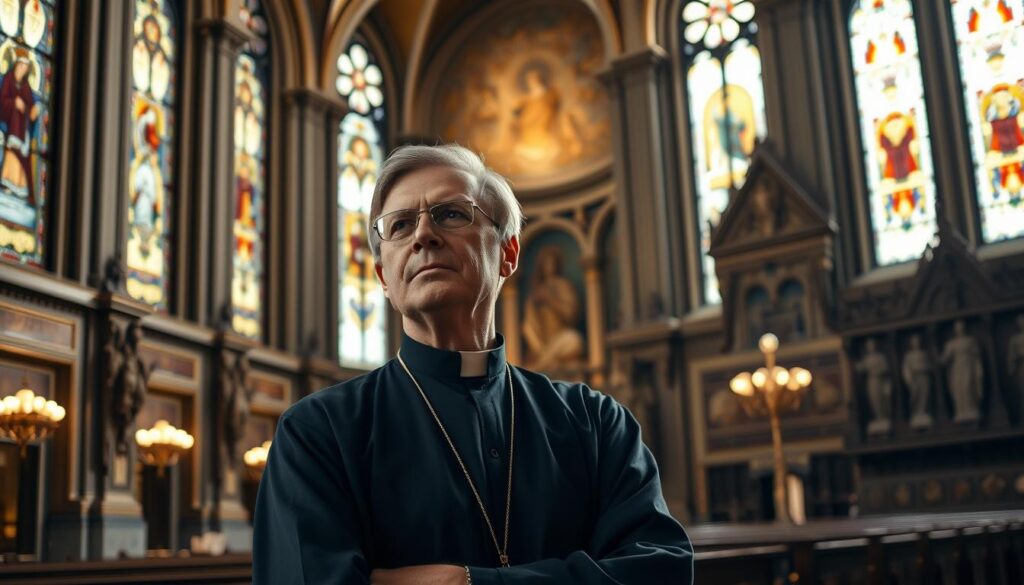
A high-quality documentary series showcasing the rich tapestry of Catholicism, with renowned theologian Robert Barron as the engaging host. The scene depicts Barron in a contemplative pose, dressed in clerical attire, against a backdrop of grand cathedrals, stained glass windows, and ornate religious iconography. Soft, warm lighting illuminates the setting, conveying a sense of reverence and spirituality. The composition is balanced, with Barron positioned centrally, inviting the viewer to join him on a journey of discovery into the faith's captivating traditions and enduring legacy.

Bishop Robert Barron’s Vision and Modern Evangelism

Robert Barron combines academic rigor with media savvy to make theology relatable. As founder of Word on Fire ministries, he translates complex concepts like transubstantiation into digestible insights. His approach mirrors how early Christians used Roman roads – leveraging modern channels to spread enduring messages.

The Chicago priest’s episodes tackle philosophy through vivid examples. One segment compares Aquinas’ cosmological arguments to finding footprints on a beach. Another uses street interviews to explore how people perceive divine love today.

Episode Highlights: Miracles, Myths, and the Power of Media

Standout chapters dissect biblical stories through multiple lenses. The “Saints Alive” episode profiles historical figures alongside modern heroes serving food banks. Viewers journey from St. Peter’s basilica to Appalachian parishes, witnessing faith’s impact across eras.

A two-part exploration of Jesus’ parables uses drone footage of Middle Eastern landscapes. This technique grounds spiritual lessons in their original geographical context. Producers juxtapose ancient texts with urban art installations celebrating gospel values.

The Art of Storytelling in Uncovering Catholic Heritage

The series transforms abstract doctrines into tangible narratives. Marian teachings come alive through Mexican Day of the Dead celebrations. Eucharistic theology unfolds via bread-making traditions in French monasteries.

By blending scholarship with human-interest stories, creators make 2,000 years of tradition feel immediate. As Barron notes: “Great stories don’t explain – they invite.” This philosophy shapes every frame, turning viewers into active participants rather than passive observers.

Innovative Perspectives on Catholic Art and Imagination

Artists are redefining spiritual expression through bold reinterpretations of sacred themes. Fordham University student Henry Sullivan sparked conversations with his film “Questions on the Catholic Imagination(s)”, blending Cardinal Timothy Dolan’s insights with avant-garde creations. This fresh approach reveals how ancient symbols gain new life in modern contexts.

Reimagining Faith: Classical Inspirations Meet Contemporary Creativity

Sullivan’s 20-minute project showcases unexpected connections between tradition and innovation. The documentary highlights New York’s 2018 Met Gala, where haute couture met medieval vestments in the “Heavenly Bodies” exhibit. Over 1.6 million visitors witnessed fashion designers rework religious motifs into wearable art.

Cardinal Dolan explains in the film: “True creativity begins with listening – to whispers of the divine in ordinary moments.” This philosophy fuels artists who transform sacramental ideas into street murals, digital installations, and interactive exhibits.

Art Installations and Iconography: Bridging Tradition and Modernity

Andy Warhol’s “Revelation” series demonstrates how childhood faith influences groundbreaking work. His screen-printed saints and neon cross sculptures reveal hidden connections between Pittsburgh parishes and pop art. Young creators follow this path, using VR technology to reconstruct ancient cathedrals as immersive experiences.

Aspect Traditional Approach Modern Interpretation
Materials Stained glass & marble LED lights & 3D prints
Themes Biblical narratives Social justice issues
Audience Church congregations Urban gallery visitors

New York’s Fordham University fuels this movement through grants and exhibition spaces. Their Center on Religion and Culture supports projects that make spiritual concepts accessible to diverse communities. As Sullivan proves, fresh perspectives can turn age-old truths into compelling modern stories.

Conclusion

Visual storytelling has become a vital bridge connecting ancient traditions with modern seekers. The groundbreaking series airing on PBS stations nationwide does more than entertain – it transforms cityscapes into spiritual classrooms. From Fordham University’s creative hubs to Manhattan’s bustling streets, New York emerges as both backdrop and participant in this cultural dialogue.

These productions mirror the legacy of BBC’s “Civilisation” while tackling today’s pressing questions about life and mortality. Through vivid narratives, they make centuries-old wisdom accessible to all viewers. Young filmmakers and seasoned theologians alike find common ground in preserving sacred work for future generations.

The phrase “New York is my campus” takes on deeper meaning when cathedrals double as lecture halls. By blending art with scholarship, these stories offer hope to those wrestling with death‘s mysteries and life’s purpose. They prove faith traditions can thrive in our digital age – not through lectures, but through shared human experiences.

FAQ

What locations are featured in the series?

The documentary spans iconic sites like New York’s St. Patrick’s Cathedral, France’s Chartres Cathedral, and sacred spaces in Jerusalem. It blends urban hubs with historic landmarks to showcase the faith’s global roots.

How does Bishop Robert Barron approach modern evangelism?

Bishop Barron combines theology with digital media, using storytelling to make ancient traditions relatable. His work emphasizes engaging younger audiences through platforms like YouTube and podcasts.

Are cultural traditions outside Europe highlighted?

Yes! The series explores vibrant practices in Latin America, Africa, and Asia. From Filipino processions to Nigerian Mass celebrations, it reveals how local cultures shape Catholic worship worldwide.

Does the documentary address controversial topics?

Thoughtfully. It examines historical challenges and modern debates, like the Church’s role in social justice, while balancing criticism with stories of hope and renewal.

How is art used to explain Catholic heritage?

The series connects classical masterpieces—like Michelangelo’s Pietà—with contemporary installations. This contrast shows how creativity continues to inspire spiritual reflection across generations.

What makes this series different from other faith-based films?

Its blend of cinematic visuals, global perspectives, and Bishop Barron’s accessible teaching style sets it apart. Episodes tackle miracles, saints, and daily faith struggles without shying from complexity.

Can non-Catholics enjoy this documentary?

Absolutely. While rooted in Catholic teachings, it welcomes curious viewers by focusing on universal themes—community, suffering, and joy—through a richly human lens.

Catholicism and Judaism: A Fascinating Interfaith Dialogue


Imagine two ancient faiths sharing roots yet walking distinct paths for centuries. This story begins in the first century CE, when a spiritual movement emerged from Jewish traditions and evolved into what we now call Christianity. The bond between these religious communities remains unlike any other interfaith relationship—marked by both tension and profound connection.

For nearly 2,000 years, this partnership has shifted dramatically. Early conflicts gave way to modern efforts where leaders from both sides work toward mutual respect. A defining moment came in 1986 when Pope John Paul II visited Rome’s Great Synagogue, calling Jewish people “our dearly beloved brothers” and even “elder brothers” in faith. This gesture reshaped how these groups interact today.

Our journey will explore how shared history and theology create common ground despite differences. You’ll discover how ancient texts connect both traditions and see modern initiatives fostering cooperation. We’ll break down complex ideas into easy-to-grasp concepts, perfect for anyone curious about religion’s role in bridging divides.

Key Takeaways

  • Christianity originated within Jewish traditions during the 1st century CE
  • The Catholic-Jewish relationship has evolved from conflict to collaboration
  • Pope John Paul II’s 1986 speech marked a historic shift in interfaith relations
  • Shared scriptures and values continue to shape dialogue efforts
  • Modern initiatives focus on education and joint social justice projects

Historical Foundations and Early Interactions

The story of two world religions began as a single spiritual family. In first-century Palestine, a group of Jewish teachers reinterpreted ancient prophecies while keeping traditional practices. These early believers saw themselves as part of their people’s ongoing journey, not founders of a new faith.

Roots in Common Ground

For decades, followers worshipped side-by-side in synagogues. They read the same scriptures and celebrated Passover together. The Jewish diaspora’s network of communities helped spread new teachings across Roman trade routes.

Paul’s dramatic shift from persecutor to preacher changed everything. His letters argued that non-Jewish converts didn’t need full ritual observance. This idea created both growth and friction as groups gradually separated.

Milestones That Shaped History

Event Time Period Impact
Jesus’ ministry 30-33 CE Teaches within Jewish tradition
Paul’s missions 50-60 CE Spread teachings to Gentile cities
Temple destruction 70 CE Accelerates religious divergence
Council of Jamnia 90 CE Jewish leaders define official scriptures

Over three centuries, what began as a local movement became a global faith. Yet shared roots in Hebrew tradition left permanent marks on both communities’ prayers, ethics, and sacred stories.

Foundational Beliefs and Theological Heritage

Two spiritual traditions share a library of sacred stories that shape their understanding of the divine. At the heart of this connection lies the Hebrew Bible – called the Old Testament by Christians – which provides shared narratives from Genesis to Malachi.

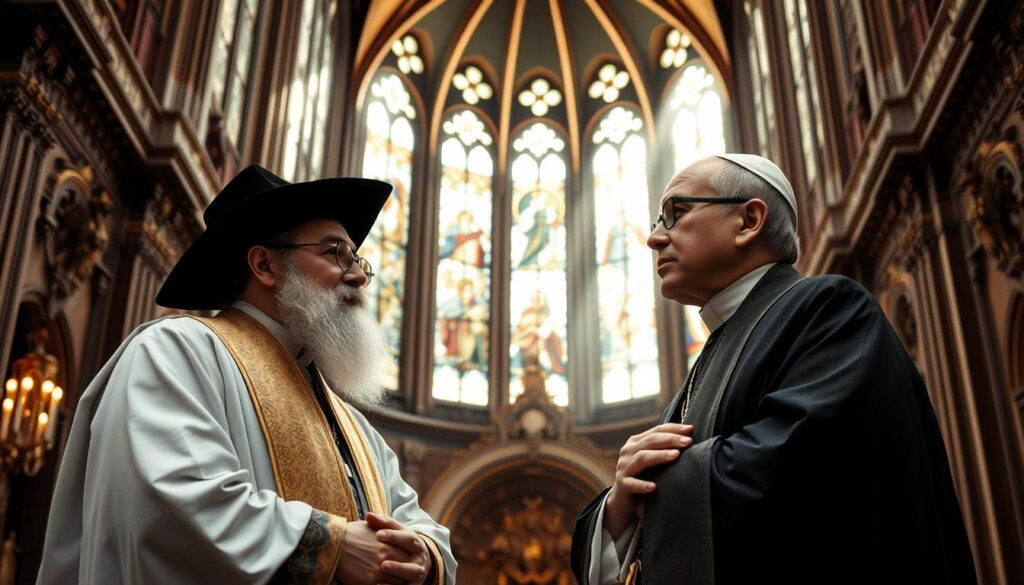
A grand cathedral's interior, where sunlight streams through stained glass, illuminating two figures in deep contemplation. One, robed in the traditional garb of a rabbi, the other in the vestments of a Catholic priest. They stand side by side, engaged in earnest dialogue, their expressions reflecting a profound shared understanding of their theological heritage. The ornate, yet serene, setting serves as a backdrop, hinting at the centuries-old connection between these two faiths. The scene exudes a sense of reverence, wisdom, and the timeless pursuit of spiritual enlightenment.

Scriptures That Bridge Traditions

The Torah and Prophets form a common language for both faiths. Stories of Abraham’s covenant and Moses’ teachings appear in weekly worship services across these communities. This literary heritage fuels ethical discussions about justice and compassion today.

From Roots to Branches

A groundbreaking 20th-century statement changed everything: “God’s covenant with Jewish people remains valid.” This declaration reversed centuries of assumption that one faith replaced the other. Church leaders now describe their tradition as “grafted branches” growing from ancient roots.

Paul’s olive tree metaphor captures this relationship perfectly. Wild shoots (Gentile believers) draw life from the cultivated tree (Jewish heritage). Modern dialogues explore how both religions uphold monotheism and messianic hope while differing on Jesus’ role.

One mystery remains unsolved: How divine salvation works across these sister faiths. As one official document states, “This truth stands unquestioned – the details belong to God.” This humility fuels ongoing conversations about shared values and respectful differences.

Evolution of Catholic-Jewish Relations Through the Ages

When Emperor Constantine embraced Christianity in 313 CE, he sparked a revolution that reshaped religious power across three continents. The Edict of Milan transformed a persecuted movement into an imperial favorite, creating ripple effects that still influence interfaith relations today.

From the Roman Empire to the Middle Ages

Roman emperors now wore crosses instead of laurels. By 380 CE, Christianity became the state religion, forcing Jewish communities into a new reality. The Catholic Church shifted from hiding in catacombs to influencing laws and social norms.

Pope Gregory the Great’s 598 decree captured this tension perfectly: “Protect their right to exist, but limit their influence.” His policies allowed Jewish worship while banning interfaith marriages and property ownership. This paradox defined relations for centuries – protection with strings attached.

Event Year Impact
Edict of Milan 313 Legalized Christianity
Theodosian Code 380 Made Christianity official
Gregory’s Papal Bull 598 Established guarded coexistence

Cultural Exchanges and Shifting Power Dynamics

Medieval markets buzzed with unexpected partnerships. Jewish doctors treated bishops, while Christian scholars studied Hebrew texts. These unofficial collaborations flourished despite official restrictions.

Three surprising areas where people bridged divides:

  • Medical knowledge sharing in Spain’s translation schools
  • Joint banking networks across Italian city-states
  • Philosophical debates in French synagogues

Yet power imbalances persisted. Local rulers often ignored papal protections, creating patchwork policies across Europe. This era’s contradictions – cooperation amid control – still shape how faith communities work together in our modern world.

Impact of Persecution and Anti-Semitic Policies

Dark chapters in religious history reveal patterns of oppression that shaped communities for centuries. The Catholic Church enforced policies during the Middle Ages that isolated Jewish populations through laws and violence. Mandatory badges imposed in 1215 marked individuals publicly, while economic bans pushed families into poverty.

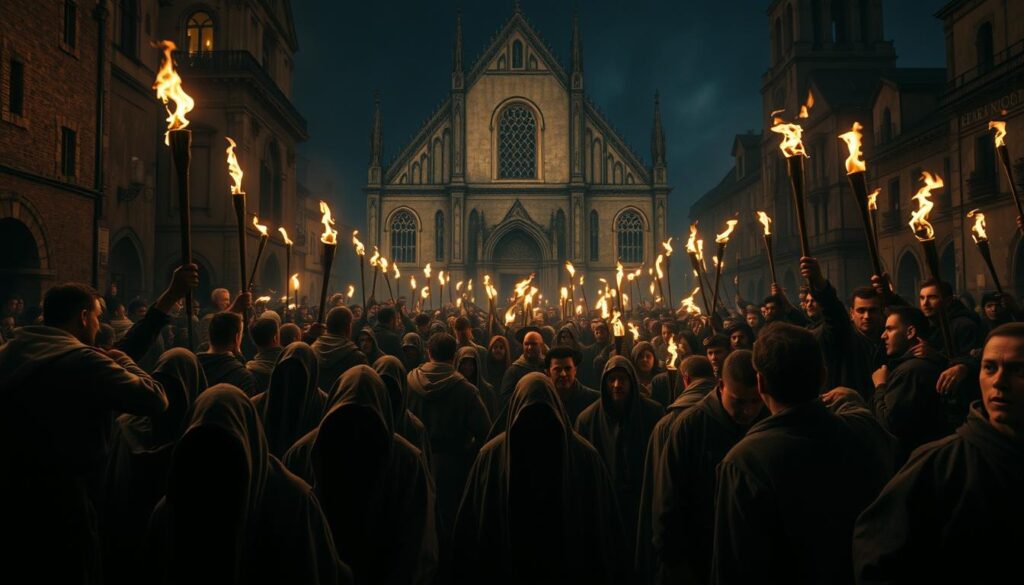
A crowded medieval town square, dimly lit by flickering torchlight. In the foreground, a group of cowering, robed figures represent the persecuted Jewish population, their faces etched with fear. In the middle ground, a mob of angry, torch-bearing townspeople advance menacingly, their expressions twisted with hatred. In the background, the imposing facade of a grand cathedral looms, symbolizing the influence of the Catholic Church. The scene is suffused with a somber, ominous atmosphere, conveying the historical tragedy of religious intolerance and violence.

Medieval Inquisition and Forced Conversions

Pope Sixtus IV’s 1478 approval of the Spanish Inquisition unleashed terror across Iberia. Agents targeted conversos—Jewish converts accused of secret practices—using torture to extract confessions. Thousands faced execution or property seizures in what became a time of widespread fear.

The 1492 expulsion order forced 160,000 Jews to abandon homes they’d built over generations. Many boarded ships without knowing their destination, creating refugee crises from North Africa to Italy. This scattering of Sephardic communities still influences cultural traditions today.

Understanding the Trauma of Expulsions and Ghettos

Pope Paul IV’s 1555 decree confined Jews to cramped urban quarters behind locked gates. Rome’s ghetto became a part of daily life for three centuries, with curfews and limited healthcare. Overcrowding turned these areas into firetraps during epidemics.

These policies created deep psychological wounds. As one historian notes, “Walls around neighborhoods became walls around memories.” Modern interfaith efforts address this legacy by acknowledging past wrongs while building trust through education and shared social projects.

Nostra Aetate and the Modern Shift in Attitudes

A 20th-century document rewrote 1,900 years of religious history in just 1,500 words. The Second Vatican Council’s 1965 Nostra Aetate declaration turned age-old assumptions upside down, creating new pathways for interfaith understanding.

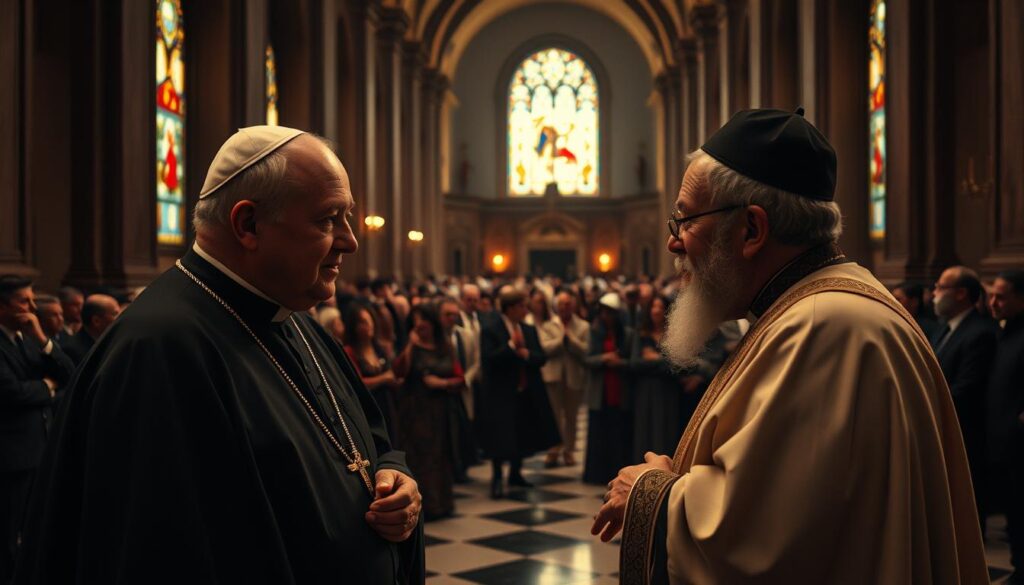
A dimly lit cathedral interior, stained glass windows casting warm hues across polished marble floors. In the foreground, two figures - a Catholic priest and a Jewish rabbi - engaged in deep discussion, their faces reflecting thoughtful contemplation. The middle ground reveals a crowd of diverse individuals, some nodding, others gesturing animatedly, symbolizing the shift in attitudes following the Nostra Aetate declaration. The background fades into a soft, hazy atmosphere, evoking a sense of reverence and the weight of history. Cinematic, low-angle lighting lends an air of significance to the scene, capturing the profound impact of this landmark interfaith dialogue.

The Significance of the 1965 Declaration

This groundbreaking statement did more than condemn antisemitism—it reshaped theological foundations. Church leaders declared: “What happened in [Christ’s] passion cannot be charged against all Jews… nor the Jews of today.” This erased the toxic deicide myth that fueled persecution for centuries.

The document’s boldest move? Recognizing God’s eternal covenant with Jewish people. No longer would teachings suggest one faith replaced the other. As one rabbi observed, “They stopped seeing us as museum pieces and started seeing us as living partners.”

Changing Narratives in Catechesis and Preaching

Religious education materials underwent dramatic revisions after 1965. Sunday school curricula removed phrases like “perfidious Jews,” while seminary training included Holocaust studies. The table below shows key changes mandated by Nostra Aetate:

Aspect Pre-1965 Approach Post-1965 Reform
Scripture Interpretation Blamed Jewish leaders for crucifixion Emphasized Roman role & theological context
Interfaith Relations Conversion-focused dialogue Mutual learning partnerships
Liturgical Language Good Friday prayers for “perfidious Jews” Revised prayers emphasizing shared heritage

These reforms sparked real-world collaboration. Joint food banks began appearing in urban centers, while interfaith couples found warmer welcomes. The Second Vatican Council’s vision continues shaping how communities work together on issues like immigration reform and climate action today.

Catholicism Judaism: Contemporary Interfaith Dialogue

In recent decades, catholic-jewish relations have blossomed into organized partnerships. What began as tentative conversations now thrives through formal committees and joint projects. These efforts turn shared values into real-world impact.

Foundations for Lasting Cooperation

The 1977 Secretariat for Catholic-Jewish Relations changed the game. This permanent office ensured ongoing dialogue between faith leaders. Its work led to three official discussion groups tackling theology, social issues, and education.

Action Beyond Words

Today, local communities team up on food drives and refugee support. Over 80% of interfaith programs now include Holocaust education. As one organizer notes, “Remembering history helps us protect human dignity today.”

These efforts prove that understanding grows when people work side-by-side. From classroom partnerships to disaster relief, ancient traditions find common ground in modern challenges.

FAQ

How do Catholicism and Judaism share historical roots?

Both faiths trace their origins to Abraham and the covenant with God. The Old Testament serves as a sacred text for Jews and a foundational part of Catholic teachings, emphasizing shared prophets, laws, and ethical traditions.

What role did the Second Vatican Council play in Catholic-Jewish relations?

The 1965 declaration Nostra Aetate transformed the relationship by rejecting antisemitism and affirming Judaism’s unique spiritual heritage. It encouraged dialogue and collaboration, setting a new tone for interfaith understanding.

How did medieval policies affect Jewish communities?

Forced conversions, expulsions, and ghettos during the Middle Ages caused lasting trauma. The Catholic Church has since acknowledged these injustices, working to address historical wounds through education and reconciliation efforts.

What modern initiatives strengthen Catholic-Jewish dialogue?

Interfaith committees like the Holy See’s Commission for Religious Relations with Jews promote joint projects, interfaith prayer services, and educational programs. In the U.S., partnerships often focus on social justice and Holocaust remembrance.

Why is the Old Testament important to both faiths?

It preserves the covenant between God and Israel, providing moral teachings and prophecies central to Jewish identity. Catholics view it as preparation for the New Testament, highlighting continuity in God’s plan for humanity.

How did Pope John Paul II influence interfaith relations?

He made historic gestures, like visiting Rome’s synagogue and recognizing the State of Israel. His teachings emphasized repentance for past persecution and celebrated Judaism as Christianity’s “elder brother” in faith.

What challenges remain in Catholic-Jewish dialogue today?

Issues include addressing lingering stereotypes, balancing theological differences, and fostering grassroots collaboration. Both communities prioritize education to combat prejudice and build mutual respect.

Understanding Catholicism: A Friendly Guide


What makes the Catholic faith one of the world’s most enduring belief systems? For over 2,000 years, this tradition has connected generations through teachings rooted in Jesus Christ’s mission. At its core, Catholicism centers on a simple yet profound idea: love. Love for God and love for others shape every aspect of this spiritual journey.

The Church traces its origins to Christ’s Apostles, who shared His message across continents. This unbroken chain of wisdom—called the Deposit of Faith—remains alive through the Pope, bishops, and global communities. It’s not just about rules or rituals. Catholicism invites people into a living relationship with God, nurtured through prayer, worship, and acts of service.

Two commandments anchor this path: loving God fully and caring for neighbors selflessly. These principles come alive in Sacred Scripture (the Bible) and Holy Tradition, which together reveal God’s plan. Whether through Sunday Mass or helping those in need, believers express their faith in tangible ways.

Today, over 1.3 billion people find purpose in these teachings. From ancient cathedrals to modern cities, the Church continues to offer hope and connection. Ready to explore how this vibrant tradition shapes lives? Let’s begin our journey.

Key Takeaways

  • Catholic teachings originate from Jesus Christ and have been preserved for two millennia
  • The faith emphasizes loving God and others as its central mission
  • Sacred Scripture and Holy Tradition work together to guide believers
  • Active practices like prayer and service bring beliefs to life
  • Catholicism remains globally relevant through adaptable yet consistent traditions

The Roots and History of Catholicism

How did a scattered group of disciples transform into a global spiritual force? The answer lies in the history of early Christianity. After Jesus Christ’s resurrection, His followers faced uncertainty. Yet within decades, they built a thriving network of communities across the Roman world.

Foundations in Early Christianity

The Acts of the Apostles shows believers evolving from fearful disciples to bold organizers. They created systems to preserve Christ’s teachings while adapting to new cultures. The Holy Spirit, described as guiding this growth, helped communities discern truth from falsehood.

By 200 AD, leaders like St. Irenaeus formalized three safeguards for authentic faith:

  • New Testament writings
  • Bishops as successors to the Apostles
  • Living traditions shaping worship and doctrine

Continuity from the Apostolic Era

Major cities became spiritual hubs. Alexandria, Antioch, and Rome hosted episcopal centers where bishops maintained teaching consistency. This apostolic succession created an unbroken chain linking modern clergy to Peter and the original Twelve.

The Roman Catholic Church didn’t emerge overnight. It grew through careful preservation of core beliefs while addressing new challenges. Today’s practices—from Sunday Mass to Easter celebrations—still echo patterns established in those formative centuries.

Key Figures Shaping Catholic Doctrine

Throughout history, certain individuals have left an indelible mark on the Church’s path. Their unique approaches to faith and governance created lasting impacts still felt today.

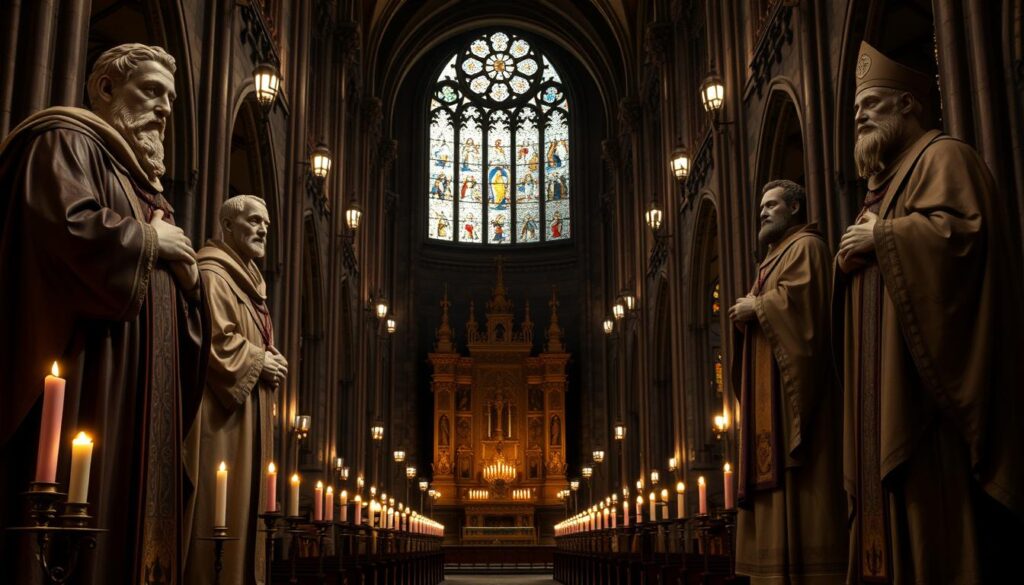
A grand cathedral interior, dimly lit by flickering candles and stained glass. In the foreground, larger-than-life statues of prominent Catholic figures stand resolute, their robes and vestments meticulously detailed. Figures like Thomas Aquinas, Augustine of Hippo, and Ignatius of Loyola gaze sternly, conveying the weight of their theological contributions. In the middle ground, ornate altars and pulpits loom, hinting at the rituals and ceremonies that have unfolded within these hallowed walls. The background fades into shadowy recesses, suggesting the centuries of doctrine and tradition that have shaped the Catholic faith.

Charlemagne and His Legacy

This medieval ruler blended political power with spiritual vision. By 800 AD, he’d united much of Europe under Christian principles. His crowning as Holy Roman Emperor strengthened the Church’s authority, making faith central to law and education.

Charlemagne funded monasteries that preserved ancient texts. He required priests to improve literacy rates – a bold move that shaped religious understanding for centuries.

St. Gregory the Great and St. Francis of Assisi

Two saints redefined service in different eras. Gregory, a 6th-century pope, streamlined Church operations during plague outbreaks. He established:

  • Standardized worship practices
  • Social programs for the poor
  • Gregorian chant traditions

Six centuries later, Francis chose radical simplicity. His famous prayer – “Lord, make me an instrument of your peace” – became a blueprint for humble service. Over 120 religious orders now follow his example.

Figure Role Key Contribution
Charlemagne Emperor United Church and state authority
St. Gregory Pope Created administrative systems
St. Francis Mystic Modeled poverty-centered spirituality

These leaders prove doctrine grows through action. Their lives show how timeless truths adapt to meet each generation’s needs.

Understanding Catholicism: Core Beliefs and Classics

At the heart of Catholic practice lies a treasure chest of spiritual wisdom. This collection—called the Deposit of Faith—combines Scripture and Tradition passed down from Christ’s Apostles. Like a family heirloom, it remains unchanged while gaining new meaning for each generation.

Guiding Light: The Catechism

The Catechism of the Catholic Church acts as a roadmap for modern believers. Updated in 1992, it organizes teachings into four practical areas:

  • Core beliefs about God and salvation
  • Moral principles for daily choices
  • Worship practices and sacraments
  • Methods for deepening prayer life

This 2,865-paragraph text isn’t just for scholars. Many parishes use simplified versions to help members grow in their spiritual journey. As Cardinal Ratzinger (later Pope Benedict XVI) noted: “The faith demands to be known, loved, and lived.”

Ancient Words, Modern Relevance

Centuries-old creeds still unite Catholics today. The Apostles’ Creed, recited at baptisms and Mass, packs essential teachings into twelve brief statements. Its opening words—“I believe in God, the Father Almighty”—echo through cathedrals and living rooms alike.

These tools create harmony across cultures and eras. Whether studying the Catechism or praying the Creed, believers connect to truths that have nourished souls for two millennia.

Exploring the Sacraments and the Liturgy

How do ancient practices remain vital in modern faith? For Catholics, the answer lies in seven sacred rituals that transform ordinary moments into encounters with the divine. These sacraments form a spiritual roadmap, guiding believers through life’s milestones with grace and purpose.

The Seven Sacraments Explained

Each sacrament addresses a core human need – from cleansing sin to celebrating love. They’re not mere symbols but visible signs of invisible grace, rooted in Jesus’ teachings. The Church traces their authority back to Christ’s command to His Apostles.

Sacrament Purpose Biblical Basis
Baptism Spiritual rebirth John 3:5
Eucharist Divine nourishment John 6:54
Confirmation Strengthening faith Acts 8:17
Penance Merciful healing John 20:23
Anointing Comfort in illness James 5:14

A dimly lit cathedral interior, sunlight streaming through stained glass windows, casting a warm, reverent glow. In the foreground, a priest in ornate vestments performs a solemn liturgical ceremony, surrounded by altar servers and worshippers in pews. Intricate carvings, ornate candelabras, and a magnificent altar dominate the middle ground, while the background features towering columns, vaulted ceilings, and a sense of profound spiritual presence. The scene evokes a deep sense of tradition, reverence, and the awe-inspiring nature of Catholic sacraments and liturgy.

The Beauty of the Eucharist

At every Mass, Catholics believe ordinary bread and wine become the body and blood of Christ. This miracle of transubstantiation fulfills Jesus’ command: “Whoever eats my flesh has eternal life” (John 6:54). The Eucharist isn’t a metaphor – it’s communion with God Himself.

The liturgy transforms worship into a multisensory experience. Incense, music, and shared prayers create unity across time and space. In a world that often questions faith, these rituals offer soul-deep nourishment, connecting believers to something eternal.

Living the Catholic Faith in Daily Life

What does it look like to walk the talk of Catholic beliefs? It starts with seeing every moment as a chance to reflect Christ’s love. Being Catholic means living faith through action – turning grocery runs into kindness missions and workdays into justice opportunities.

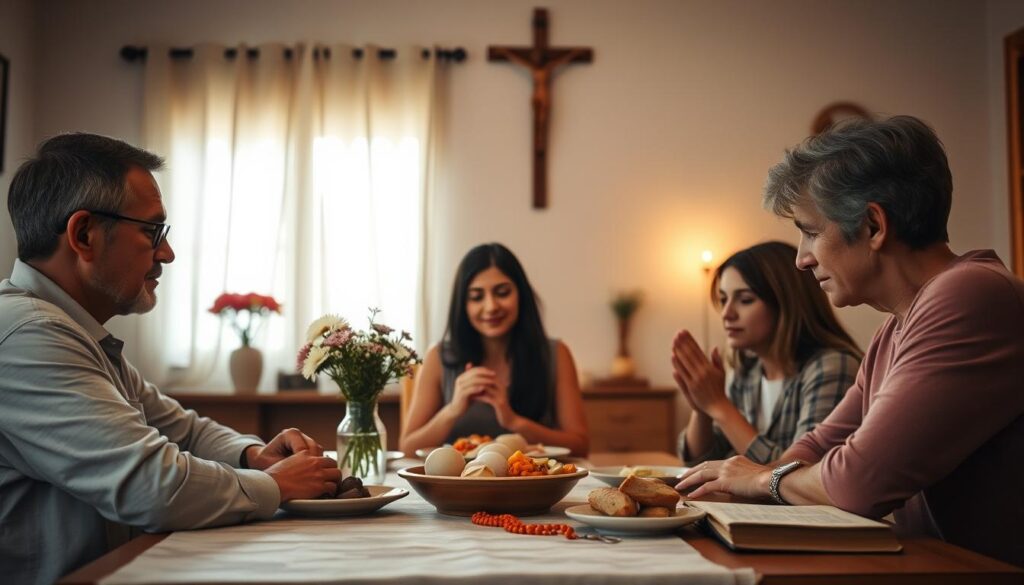
A serene Catholic household, with a family gathered around a table for a humble yet nourishing meal. Warm, muted lighting casts a peaceful glow, highlighting the reverence and gratitude on their faces. In the background, a modest crucifix hangs on the wall, a subtle reminder of their faith. The room is adorned with simple, natural decor - a vase of flowers, a rosary beads, and a well-worn Bible. This scene embodies the quiet, daily practice of living the Catholic faith, where faith is woven into the fabric of everyday life.

Following the Teachings of Jesus Christ

Jesus didn’t just preach – He healed, fed, and listened. Catholics are called to be His hands and feet in three practical ways:

  • Prioritizing prayer before decisions big and small
  • Treating strangers like family members
  • Defending dignity in workplaces and communities

This way of life transforms ordinary routines. Making dinner becomes a chance to thank God for provisions. Commute time turns into prayer space. Even social media feeds can spread hope instead of hate.

Church teachings compare this commitment to family responsibilities. Just as parents care for children without being asked, Catholics serve others because it’s who they’re called to be. As St. Teresa of Calcutta said: “Not all of us can do great things. But we can do small things with great love.”

True Catholic life isn’t about comfort – it’s about courage. It means standing up for the bullied coworker. Donating time when you’re tired. Choosing forgiveness over grudges. Through these choices, believers become living answers to Christ’s command: “Love one another as I have loved you.”

Examining Catholic Morality and Social Teachings

Can centuries-old wisdom guide today’s complex ethical issues? The Church answers with a resounding yes. Its moral framework centers on community over self – a “we” approach that prioritizes the common good. Saints like Mother Teresa and Oscar Romero model this, showing how Christ’s teachings apply to modern struggles.

Ethics and Modern-Day Challenges

Catholic morality tackles everything from climate change to social media ethics. It views human dignity as non-negotiable, defending life from womb to natural death. Economic justice and care for creation aren’t trends – they’re timeless calls to action.

The Church’s 2,000-year dialogue with truth offers surprising relevance. Its teachings on bioethics help navigate IVF debates. Guidance on war and peace informs global conflicts. Even tech dilemmas find answers in principles about respecting human worth.

This isn’t about rigid rules. It’s a roadmap for flourishing through right relationships – with God, others, and our world. By learning from past moral issues, we build futures where everyone thrives.

FAQ

How does Catholicism connect to early Christianity?

The Catholic Church traces its roots directly to Jesus Christ and the Apostles. It maintains continuity through teachings, sacraments, and leadership roles like the papacy, which began with St. Peter. Early Christian practices, such as the Eucharist, remain central today.

Who were key figures in shaping Catholic doctrine?

Saints like Gregory the Great strengthened Church structure and liturgy, while St. Francis of Assisi emphasized humility and service. Charlemagne’s support helped spread Christian education and solidify the Church’s role in medieval Europe.

What is the Deposit of Faith in Catholicism?

The Deposit of Faith includes sacred Scripture and Tradition, which the Church preserves and interprets. These guide beliefs on topics like grace, salvation, and morality, ensuring teachings stay consistent across generations.

Why are the Seven Sacraments important?

Sacraments like Baptism and the Eucharist are visible signs of God’s grace. They mark spiritual milestones, deepen faith, and unite believers with Christ and the Church community. The Eucharist, in particular, celebrates Jesus’ sacrifice and presence.

How do Catholics live out their faith daily?

Daily prayer, acts of charity, and following Jesus’ teachings—like loving others and seeking justice—are key. Many also reflect on Scripture, attend Mass, and apply Catholic social teachings to modern issues like poverty or human dignity.

How does the Church address modern ethical challenges?

Catholic morality combines timeless principles with thoughtful engagement. Issues like bioethics or environmental care are approached through Scripture, reason, and Tradition, emphasizing the sanctity of life and the common good.

What role does the Catechism play?

The Catechism of the Catholic Church summarizes doctrines, sacraments, and moral teachings. It serves as a reliable resource for learning about worship, ethics, and living a life aligned with Christ’s example.

Catholic Quiz Questions and Answers PDF


Looking for a dynamic way to explore faith teachings? This downloadable resource offers structured materials to strengthen religious knowledge through interactive formats. Designed for learners at all levels, it combines foundational doctrines with practical applications for group studies or personal reflection.

The materials draw from trusted sources like Catholic Answers, ensuring alignment with official Church teachings. Covering 130+ topics from sacraments to sacred traditions, the content supports RCIA programs and family faith formation. Its progressive structure helps users build confidence as they advance through theological concepts.

Educators will appreciate the ready-to-use format that simplifies lesson planning. Students gain immediate feedback through answer keys, making self-assessment straightforward. Whether used digitally or printed, these tools adapt to classrooms, study groups, or individual spiritual growth.

Key Takeaways

  • Downloadable format enables offline access and easy printing
  • Covers essential topics from Trinity to Church history
  • Supports multiple learning environments and age groups
  • Includes answer keys for instant self-evaluation
  • Developed using authoritative doctrinal sources

Introduction to Catholic Quiz Interactives

Dynamic tools are revolutionizing how believers engage with religious teachings. These interactive materials turn complex doctrines into approachable lessons, helping users build knowledge through hands-on participation. Unlike static textbooks, they encourage immediate application of concepts like sacraments or prayer traditions.

Purpose and Educational Goals

The core aim is to deepen understanding through active exploration. By presenting theological ideas in game-like formats, learners naturally connect doctrines to daily spiritual life. For example, matching exercises clarify differences between sin types, while multiple-choice questions reinforce key events in Church history.

Reaching Diverse Learning Communities

Designed for varied age groups, these resources serve RCIA participants mastering basics and confirmation students refining their grasp of traditions. Youth ministries find them ideal for group activities, while adult study circles appreciate structured self-assessment. Answer keys enable independent progress tracking, letting users identify growth areas confidently.

Educators report higher retention rates when using interactive methods compared to lectures. One catechist noted, “Students remember 40% more concepts when they actively solve challenges rather than just hear explanations.” This approach meets modern learners where they are – seeking meaningful connections between faith and lived experience.

Historical and Theological Foundations

Seasonal observances shape spiritual rhythms through time-tested practices. These traditions anchor believers in shared stories while inviting personal reflection. From ancient rituals to modern adaptations, each element carries layers of meaning waiting to be explored.

A solemn procession of worshippers, their foreheads marked with the sign of the cross in ash, slowly enters a grand, gothic cathedral. Stained glass windows cast a warm, amber glow, illuminating the vaulted ceilings and ornate altars. In the middle ground, a priest sprinkles ashes on the faithful, reminding them of their mortality. In the background, rows of wooden pews stand ready to receive the congregation, their kneelers worn smooth by generations of penitents. The atmosphere is one of contemplation and reverence, as the faithful prepare their hearts for the Lenten season ahead.

Catholic Traditions and Celebrations

The liturgical calendar acts as a spiritual compass, guiding communities through sacred days. Advent candles mark weeks before Christmas, while Easter’s fifty-day celebration honors resurrection joy. These cycles connect modern worshippers to generations past through symbolic actions and shared prayer.

Understanding Ash Wednesday, Lent, and Holy Week

Ash Wednesday opens a 40-day journey mirroring biblical wilderness experiences. The ashes’ circular placement reminds participants of life’s cyclical nature – “dust to dust” becomes a tactile meditation. This day sets the tone for Lenten disciplines like meatless Fridays and intentional generosity.

Purple vestments during these days signal penitence, while omitted musical elements create reflective silence. Simple foods like pretzels – originally shaped as praying arms – reinforce the season’s focus. As Lent progresses, Holy Week’s Triduum marks Christianity’s central events through candlelit vigils and communal reenactments.

One catechism instructor notes: “These practices aren’t about deprivation, but making space for deeper connection.” From Shrove Tuesday pancakes to Easter’s triumphant alleluias, each tradition weaves personal transformation into collective memory.

Exploring Doctrinal Knowledge Through Quiz Questions

Understanding core beliefs becomes engaging through structured challenges that blend historical context with spiritual truths. These activities help test knowledge while revealing connections between scripture, tradition, and daily practice.

Key Biblical Events and Church History

From Moses receiving commandments to Christ’s resurrection timeline, foundational moments shape religious identity. Learners explore how 40-day floods prefigured baptismal cleansing or why Pentecost occurred 50 days after Easter. Historical milestones like Constantine’s Edict of Milan (313 AD) show faith’s evolving societal role.

Saints, Sacraments, and Sacred Symbols

Figures like Francis of Assisi model humility through service narratives. Seven sacraments form spiritual milestones – baptism erases original sin, while confirmation strengthens through the Holy Spirit’s gifts. Even simple symbols carry weight: purple vestments signal penitence, and INRI inscriptions declare Christ’s kingship.

One catechist observes: “These elements aren’t trivia – they’re living links to 2,000 years of shared belief.” By matching symbols to meanings or sequencing council decisions, users grasp how knowledge catholic traditions remain relevant today.

Interactive formats make abstract concepts tangible. When participants identify Jerusalem’s role in salvation history or name virtues opposing capital sins, they test knowledge while building confidence to discuss faith intelligently.

catholic quiz questions and answers pdf: Features and Benefits

Modern faith education thrives when materials adapt to learners’ needs. This resource combines portability with structured learning tools, offering features that enhance both group studies and personal reflection.

A sleek, modern PDF document featuring a striking Catholic quiz, illuminated by warm, directional lighting. The cover showcases a clean, minimalist design with subtle religious iconography. The pages inside reveal a structured layout with neatly organized questions and answers, complemented by elegant typography. The overall aesthetic conveys a sense of intellectual rigor and spiritual contemplation, inviting the viewer to engage with the content in a thoughtful, reverent manner.

Downloadable Format and Accessibility

The digital-first design works anywhere – classrooms, retreats, or kitchen tables. Users instantly access materials without internet, perfect for rural areas or travel. Printed copies maintain formatting integrity, ensuring clear visuals for visual learners.

Educators save hours with ready-to-print sheets for RCIA sessions or youth groups. One teacher shared: “Having these tools cut my prep time by half while boosting student participation.” Files work across devices, from smartphones to projectors.

Interactive Content and Self-Assessment

Beyond basic testing, materials build critical thinking through:

  • Cross-references to catechism paragraphs
  • Historical context for doctrinal developments
  • Real-life application prompts

Immediate answer checks create teachable moments. Users track progress weekly, identifying patterns like consistently missed sacramental questions. This awareness guides focused study plans.

Platforms like CatechismClass.com enhance these resources with full courses that dive deeper than quizzes. Their structured programs help adults connect teachings to modern challenges through video lessons and mentor support.

Enhancing Your Knowledge with Interactive Digital Tools

Technology bridges ancient wisdom with modern learning styles through thoughtfully designed platforms. These tools transform screen time into meaningful moments of discovery, helping users connect sacred traditions to contemporary life.

A serene, dimly lit sanctuary filled with interactive digital tools for faith exploration. In the foreground, a tablet device displays a visually engaging Catholic quiz, its interface glowing with warm hues. Surrounding it, an array of tactile prayer beads, a smartly designed prayer journal, and a sleek, modern Bible e-reader invite hands-on engagement. In the middle ground, a soft-lit altar with a tactile, illuminated cross stands as the centerpiece, casting a reverent ambiance. The background features a stained glass window, its kaleidoscopic colors filtering ethereal light throughout the space, creating an atmosphere of contemplative wonder.

User-Friendly Design and Navigation

Intuitive layouts make exploring complex topics effortless. Dropdown menus organize content by liturgical seasons or sacraments, while search bars help locate specific prayer practices. Color-coded sections distinguish between scripture study and Church history modules.

Feature Traditional Learning Digital Tools
Accessibility Physical books Any device, any time
Feedback Speed Manual grading Instant results
Engagement Text-only Audio/visual elements
Progress Tracking Paper charts Automated reports

Integrating Quiz Results into Daily Faith Practice

Weekly summaries highlight strengths and growth areas. If someone struggles with mass symbolism, the system suggests reflection questions about sacred vessels. One user shared: “Seeing my progress chart encouraged me to start a morning prayer routine.”

Additional Resources and Further Learning

Platforms connect learners to supplemental materials explaining the meaning behind rituals. Explore why priests wear specific colors on feast days, or how holy water recalls baptismal promises. Catholic Answers’ podcast library offers deep dives into theological questions, perfect for commutes or quiet evenings.

These tools adapt to busy schedules – complete a 5-minute quiz during lunch or watch video explanations while cooking. As one educator noted:

“Digital resources meet people where they are, turning ordinary days into opportunities for growth.”

Conclusion

Faith education thrives when learners engage actively with timeless truths. These downloadable tools have guided countless men and women through structured spiritual growth, turning complex teachings into approachable lessons.

Regular use over many days builds doctrinal confidence. Users gain clarity on why beliefs matter – not just historical facts, but their impact on daily choices. This knowledge becomes armor for modern challenges.

The format’s flexibility meets people where they are. Busy parents review materials during commutes, while study groups debate concepts across kitchen tables. Learning continues through changing times, adapting to screens or printed pages.

True understanding emerges when head and heart connect. These resources do more than teach – they invite reflection on sacred traditions’ living relevance. Over many days of practice, users develop fluency in faith’s language.

In our fast-paced world, such tools preserve wisdom while embracing progress. They honor the Church’s call to lifelong learning, proving ancient truths remain vital across all times and technologies.

FAQ

What’s the purpose of faith-based quizzes?

These interactive tools aim to educate and inspire deeper engagement with spiritual teachings. They blend learning with reflection to strengthen personal faith journeys.

Who benefits most from these resources?

Anyone seeking to grow in their understanding of religious traditions—families, educators, or parish groups—will find value. The content adapts to varying knowledge levels.

How do quizzes explore seasons like Lent?

Questions often focus on themes like repentance, fasting, and renewal tied to Ash Wednesday or Holy Week. This helps users connect rituals to their daily lives.

What topics cover saints and sacraments?

Expect questions about key figures like St. Francis, the meaning behind sacraments like Baptism, and symbols such as the crucifix or Eucharistic elements.

Why choose downloadable formats?

PDFs offer offline access for study groups or personal reflection. They’re designed for easy printing and sharing to support communal learning.

Are these tools suitable for beginners?

Absolutely! Clear navigation and straightforward language make them approachable. Answers often include brief explanations to build foundational knowledge.

Can quiz results improve daily spiritual habits?

Yes! Insights from assessments can guide prayer routines, scripture reading, or participation in community events like Mass or feast days.

Where can I find extra study materials?

Many resources include links to approved articles, videos, or podcasts for deeper dives into topics like Church history or biblical stories.

Discover Meaningful Catholic Quotes About Marriage


Marriage is a lifelong adventure filled with moments of joy, growth, and purpose. For couples seeking guidance, timeless wisdom from faith traditions offers light for the path ahead. This collection brings together powerful words that celebrate the spiritual depth of partnership.

These reflections come from sacred texts, revered thinkers, and voices who understood love’s transformative power. Whether preparing for your wedding day or nurturing a decades-long bond, their insights remind us that relationships thrive when rooted in shared values. Every season of life together becomes an opportunity to reflect grace and commitment.

At its core, a strong union mirrors something greater than itself. It’s a covenant calling partners to uplift one another through life’s twists and turns. Through challenges and triumphs, these carefully chosen words serve as gentle reminders of love’s enduring strength.

Key Takeaways

  • Explore wisdom from spiritual leaders and literary figures on lasting partnerships
  • Find encouragement for weddings, anniversaries, or everyday moments
  • Understand how commitment fosters personal and shared growth
  • Discover how faith traditions view relationships as sacred journeys
  • Gain perspective during both joyful and challenging phases

Embracing the Sacred Journey of Marriage

The union of lives in holy matrimony unfolds as a pilgrimage toward eternal grace. St. John Paul II beautifully described this bond as “the most ancient revelation of God’s plan in the created world”, where partners mirror divine creativity through their commitment. This vocation transforms everyday moments into stepping stones of spiritual growth, inviting couples to view their relationship as a sacred mission.

Daily choices shape this extraordinary path. Choosing patience over frustration, or kindness over pride, becomes a way to reflect Christ’s selfless love. As one theologian noted:

“The sacrament of marriage isn’t a single moment—it’s a lifetime of becoming ‘one flesh’ through shared joys and struggles.”

This journey isn’t about perfection but perseverance. Couples learn that true love means walking together through storms and sunshine, always aiming to uplift rather than outshine. Their shared life becomes a gift to each other and the world—a living testament to faith in action.

Creating a home filled with grace requires intentionality. Simple acts like praying together or serving side by side build a foundation stronger than fleeting emotions. Through these practices, two individuals grow into a united force that radiates hope, proving that ordinary love can achieve extraordinary holiness.

Scriptural Inspirations: Love and Fidelity in Marriage

Sacred texts offer timeless blueprints for relationships built to last. From Genesis to Revelation, scripture reveals how bonds rooted in faith transcend fleeting trends. These passages invite couples to see their union as part of a grander story—one where love becomes an act of worship.

A serene, dimly lit interior with warm, golden lighting casting a soft glow. In the foreground, an ornate, antique wooden frame showcases a beautiful, hand-drawn illustration of a loving married couple, their expressions radiating devotion and tenderness. The middle ground features a vase of delicate white flowers, symbolizing the purity and sanctity of their union. In the background, a large, stained-glass window filters in a kaleidoscope of colors, creating an ethereal, spiritual ambiance. The overall composition evokes a sense of timeless, scriptural inspiration and the profound beauty of a marriage rooted in faith and unwavering love.

Genesis and Psalms: Foundations of Marital Love

Genesis 2:23 paints a vivid picture: “This one, at last, is bone of my bones and flesh of my flesh.” This declaration establishes marriage as God’s original design for unity. Partners aren’t merely companions—they’re woven together like threads in sacred tapestry.

The Psalms add joyful depth. “Let hearts that seek the Lord rejoice!” (Psalm 105:3) reminds couples to center their journey on shared faith. Even Tobit’s prayer for fidelity (Tobit 8:7) transforms physical love into a lifelong promise, not temporary passion.

New Testament Guidance for a Faithful Union

Galatians 5:13 reframes freedom: “Serve one another through love.” Here, love isn’t just emotion—it’s daily action. Revelation 19:7’s wedding imagery ties earthly unions to eternal hope, urging spouses to prepare their hearts like a bride awaiting her groom.

These teachings form a cornerstone. They show that true commitment thrives when grounded in selfless service and spiritual purpose. By embracing this truth, couples unlock the gift of a partnership reflecting divine grace.

Saints’ Wisdom on Love and Relationships

Throughout history, holy men and women have shown how ordinary bonds can reflect divine light. Their lived experiences reveal that true connection thrives when rooted in service and sacrifice. These spiritual guides teach us to see daily interactions as chances to practice radical compassion.

Timeless Teachings for Modern Bonds

St. Faustina’s words cut through life’s noise: “Pure love perseveres in the toilsome and drab life of each day.” Her insight reminds us that real commitment shines in laundry rooms and grocery runs, not just grand gestures. Similarly, St. Josemaria Escrivá’s call to “seek Christ” in every moment turns shared chores into sacred acts.

Consider this table showing how saints reframe common challenges:

Saint Challenge Spiritual Perspective
St. Zélie Martin Daily routines “Make the heroic ordinary”
St. Gianna Molla Sacrifice “Love and light cannot be separated”
St. Teresa of Calcutta Family friction “Charity begins at home”

Small Acts, Eternal Impact

St. John of the Cross describes love as losing oneself in another’s presence. This mirrors St. Gianna’s belief that suffering with purpose deepens bonds. Making coffee becomes holy when done with care. Listening without interrupting transforms into prayer.

These voices remind us: relationships grow strongest when we anchor them in something greater than ourselves. Through dishes and disagreements, we craft love stories that echo beyond our lifetimes.

Inspiring catholic quotes on marriage for Every Couple

Guiding words from spiritual leaders can transform everyday love into a sacred mission. These insights remind partners that their bond holds power beyond what’s visible—a force shaping hearts and communities alike.

a serene, dimly lit catholic church interior with stained glass windows, soft natural lighting filtering through, ornate wooden pews and altar, a sense of tranquility and reverence, in the foreground, elegant calligraphic handwritten marriage quotes on vellum paper placed upon the altar, conveying the sacred and timeless nature of catholic marriage

Key Quotes to Guide Your Journey

“There is no greater force against evil in the world than the love of a man and woman in marriage. After the Holy Eucharist, it has a power beyond anything we can imagine.”

— Cardinal Raymond Burke

“We do not have to become saints by our own power; we have to learn how to let God make us into saints.”

— Jacques Philippe

“Love alone brings a human being to full awareness of personal existence. For it is in love alone that man finds room enough to be what he is.”

— Dietrich von Hildebrand
Thinker Focus Impact
Cardinal Burke Spiritual warfare through unity Elevates partnership to cosmic significance
Jacques Philippe Divine collaboration Relieves pressure through grace
von Hildebrand Self-discovery Shows how love reveals identity

A husband and wife’s daily choices—patience during stress, forgiveness after hurt—become brushstrokes in God’s masterpiece. These quotes aren’t just advice. They’re invitations to see your relationship as holy ground where transformation happens.

Theological Reflections: Insights from Theology of the Body

Human relationships hold a mirror to divine mysteries. St. John Paul II’s revolutionary teachings reveal how our physical existence whispers eternal truths. His Theology of the Body shows that every loving glance between partners carries cosmic significance.

A serene, minimalist composition capturing the essence of "Theology of the Body." In the foreground, a tranquil, silhouetted couple embracing, their bodies forming a symbolic infinity symbol. Soft, warm lighting illuminates their embrace, casting a gentle glow. In the middle ground, delicate, abstract shapes and lines evoke the interconnectedness of the spiritual and physical realms. The background is a muted, ethereal landscape, hinting at the divine mystery that underpins the theology. The overall mood is one of contemplation, reverence, and the profound beauty of the human person.

Divine Imagery and the One-Flesh Union

Man and woman together form a complete reflection of God’s nature. As John Paul taught: “The human body bears the divine image ‘from the beginning’—not just spiritually, but in its very design.” Their differences aren’t divisions but complementary brushstrokes in a sacred portrait.

This unity goes beyond metaphor. When spouses become “one flesh,” they echo the Trinity’s life-giving communion. Their physical bond becomes a language expressing spiritual realities words can’t capture.

Marriage as a Sacramental and Generative Gift

The body’s capacity to love makes the invisible visible. John Paul emphasized: “Through self-giving, we fulfill our deepest purpose—becoming living gifts to one another.” This transforms daily acts of care into holy rituals.

Generativity extends beyond children. Couples co-create through shared service, artistic collaboration, or nurturing community bonds. Their vocation becomes a channel for divine creativity, proving that ordinary love can shape eternity.

“The body alone makes visible what is invisible: the spiritual and divine.”

— St. John Paul II

Literary Perspectives: Celebrating Love Through Words

Great stories teach us how to love. Authors craft sentences that capture relationships in ways we feel but struggle to express. Their words become mirrors, showing us truths about connection that transcend time.

When Prose Becomes Poetry

“Now I have seen the most beloved music living… I have seen the soul and mind of this music, which is you.”

— Michael O’Brien

O’Brien’s metaphor reveals how partners become living art to each other. Like a symphony, their unique qualities create harmony through daily rhythms. This perspective turns ordinary moments into lyrical exchanges.

Author Work Key Theme
Victor Hugo Les Misérables Love conquers isolation
Wendell Berry Hannah Coulter Healing through togetherness
Wallace Stegner Crossing to Safety Relationships shape identity

Hugo’s observation about “never being lonely again” speaks to love’s power to fill emotional voids. His words remind us that true happiness comes from being fully known—flaws and all.

“To be healed we must come with all creatures to the feast of Creation.”

— Wendell Berry

Berry reframes relationships as healing banquets. Partners nourish each other’s character through shared laughter, tears, and quiet companionship. Stegner’s wisdom takes this further—showing how love creates meaning rather than just supporting it.

These literary voices prove that love stories aren’t fairy tales. They’re messy, beautiful journeys where two people rewrite their world through everyday choices. As Evelyn Waugh noted, such bonds become our greatest teachers.

Real-Life Applications: Embracing Catholic Love in Daily Life

True partnership thrives when love becomes action, not just feeling. Small choices—like listening before reacting or choosing gratitude over criticism—shape relationships in lasting ways. These moments let couples build something greater than themselves.

Turning Belief Into Behavior

Venerable Fulton Sheen’s wisdom rings true: “When a man loves a woman, he has to become worthy of her.” This truth applies to all partners. Love challenges us to grow, whether through patience during busy days or forgiveness after misunderstandings.

Family life offers endless chances to practice this. Making meals together becomes teamwork. Scheduling tech-free evenings fosters connection. Even disagreements can teach respect when handled with care.

Men and women strengthen bonds by celebrating each other’s strengths. A husband might support his wife’s career goals. A wife could encourage her husband’s personal growth. Through daily effort, they mirror divine love—one intentional choice at a time.

Everyday holiness lives in these ordinary acts. When partners prioritize truth and kindness, their relationship becomes a light for others. That’s how love transforms the world—starting right at home.

FAQ

How does Scripture define the purpose of marriage?

Biblical texts like Genesis 2:24 emphasize unity, where two become “one flesh.” The Psalms and New Testament highlight love as a reflection of God’s faithfulness, urging couples to mirror divine compassion in their bond.

What do saints say about overcoming challenges in relationships?

Figures like St. Josemaria Escrivá stress daily acts of kindness and patience. St. Faustina’s writings remind couples that grace transforms struggles into opportunities to grow closer to God and each other.

How can couples incorporate faith into everyday life?

Simple practices—praying together, reflecting on sacred texts, or serving others—help align relationships with spiritual values. The Theology of the Body also encourages seeing love as a sacramental gift to nurture.

Why is marriage called a “vocation”?

It’s viewed as a calling to mirror Christ’s sacrificial love. This lifelong journey invites spouses to support each other’s holiness, turning ordinary moments into pathways toward eternal joy.

What role does forgiveness play in a faith-centered union?

Forgiveness heals wounds and renews trust. As St. Paul notes, love “bears all things” (1 Corinthians 13:7). Letting go of grudges fosters peace, mirroring God’s boundless mercy.

How does literature inspire a deeper understanding of love?

Authors like Dante and Jane Austen explore love’s complexities—its trials, triumphs, and transcendent qualities. Their works remind us that true devotion requires courage and selflessness.

Can small gestures strengthen a marriage?

Absolutely. St. Thérèse of Lisieux taught that even minor acts of kindness, done with great love, build intimacy. Listening, gratitude, and shared laughter create lasting bonds.