Recent Posts

Uncover the Roman Catholic Bible: A Comprehensive Guide


For centuries, a sacred collection of texts has guided spiritual practices and teachings within one of the world’s largest faith communities. This compilation stands apart through its distinctive structure—46 ancient writings in the first section and 27 in the second. These works form a foundation that continues to shape worship, ethics, and theology for millions.

What makes this collection unique? Seven additional writings, along with expanded sections in two others, distinguish it from versions used in other Christian traditions. These texts—rooted in early Greek translations—sparked centuries of theological debate before being formally affirmed by church leaders. Their inclusion reflects a rich history of discernment spanning early Christian assemblies to decisive councils.

The process of preserving these texts remains carefully managed today. Every approved edition must meet strict translation standards that honor original meanings while maintaining doctrinal alignment. This attention to detail ensures clarity for modern readers without compromising ancient wisdom.

Key Takeaways

  • Contains 73 sacred writings divided between ancient covenants and newer teachings
  • Includes seven additional texts not found in some other Christian editions
  • Church councils solidified the official list of accepted works over centuries
  • Translation guidelines preserve doctrinal accuracy across languages
  • Directly influences spiritual practices and moral teachings today

Understanding the Historical and Religious Context

Imagine living in faith communities where sacred texts arrived as scattered scrolls and letters. Early Christians faced this reality, navigating spiritual guidance without an official list of approved writings. Their journey to define scripture reveals how authority emerged through lived experience rather than rigid rules.

Tracing Early Christian Scripture Traditions

Fourth-century Greek manuscripts like Vaticanus and Sinaiticus show something surprising. They mixed deuterocanonical books with other Old Testament texts seamlessly. These codices became vital tools for worship, suggesting early believers valued these writings equally.

Leaders relied on practical tests to identify authoritative texts. Did a book align with apostolic teachings? Was it widely used in worship? Communities gradually recognized works that resonated with their shared faith experiences.

Significance of Biblical Authority in the Past

Paul’s acknowledgment that Jews preserved “the oracles of God” (Romans 3:2) shaped many early decisions. Some groups strictly followed Jewish scripture lists. Others embraced additional texts that deepened their spiritual lives.

A two-tier system developed. Core books established church doctrine, while others offered moral support. This flexible approach allowed diverse communities to grow while maintaining unity through key scripture.

Through prayer and debate, these early choices laid groundwork for how history and divine guidance intersect in religious traditions today.

Historical Evolution of the Biblical Canon

How did ancient communities decide which sacred texts held ultimate authority? The answer unfolded through centuries of reflection and debate. Church leaders gradually shaped the canon through councils that responded to theological and cultural challenges.
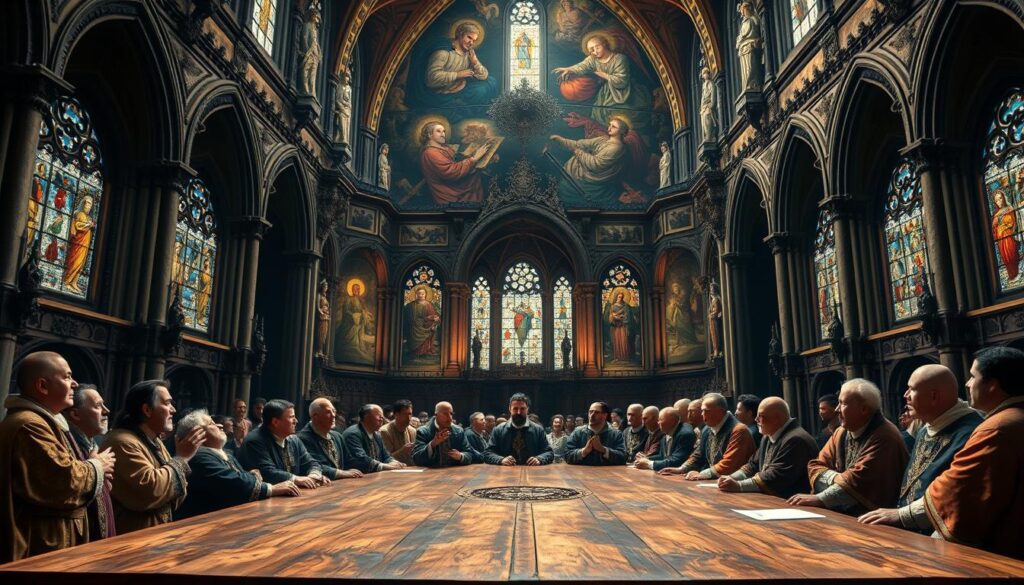
A detailed interior of the Council of Trent, the historic ecumenical council of the Roman Catholic Church in the 16th century. The foreground features a large oak table with ecclesiastical figures in ornate robes engaged in lively debate. The middle ground showcases an intricate Gothic-style cathedral interior, with stained glass windows casting warm, dramatic lighting. The background depicts a vast vaulted ceiling adorned with religious frescoes and statues of saints. The overall atmosphere conveys the gravity and significance of the Council's deliberations on the biblical canon.

Development from Early Church to the Council of Florence

The Council of Rome (382 AD) marked a turning point. It produced the first official list of accepted writings, later reinforced by African synods. By 419 AD, Carthage councils confirmed these texts as essential for worship and teaching.

Debates continued for centuries. The Council of Florence (1431-1449) took a bold step by including deuterocanonical books in its list. Though not final, this decision showed growing consensus about their spiritual value.

The Role of the Council of Trent in Canon Formation

Everything changed during the Protestant Reformation. The Council of Trent (1545-1563) made history by formally declaring the 73-book canon as doctrine. This wasn’t just about numbers—it reaffirmed ancient traditions while addressing new questions.

Records reveal an interesting twist. Many theologians at Trent saw themselves as protecting existing practices rather than creating new rules. Their work bridged Augustine’s inclusive approach with Jerome’s focus on Hebrew texts.

Key Components of the Roman Catholic Bible

The sacred texts form a carefully organized library rather than a random collection. This structure helps readers navigate complex themes while maintaining historical continuity. Let’s explore how these writings are grouped and why certain texts hold special significance.

Structure of the Old and New Testaments

The Old Testament’s 46 books unfold in four clear sections. First comes the Pentateuch—Genesis through Deuteronomy—laying groundwork for laws and early history. Next, 16 historical works track Israel’s journey, including deuterocanonical gems like Tobit’s adventures and the Maccabees’ resistance stories.

Wisdom seekers find rich material in seven poetic books. Alongside Psalms and Proverbs, Wisdom of Solomon offers timeless reflections on virtue. Prophetic voices fill the final 18 works, with Baruch’s messages blending seamlessly with major prophets like Isaiah.

Inclusion of Deuterocanonical Books and Additional Materials

These special texts aren’t sidelined—they’re threaded throughout the Old Testament. You’ll find Judith’s heroism among historical accounts and Sirach’s practical advice beside Proverbs. This integration shows their equal value in teaching and worship.

The New Testament mirrors other Christian traditions with 27 books, from Gospels to Revelation. What makes this collection unique lies in how earlier sections preserve spiritual insights from Judaism’s Hellenistic period—voices that shaped early Christian thought.

Comparing the Canon: roman catholicism bible vs. Protestant Bible

Two Christian traditions share core scriptures but differ in their approach to ancient texts. While both use the same 27 New Testament books, their Old Testament collections reveal distinct paths of spiritual inheritance.
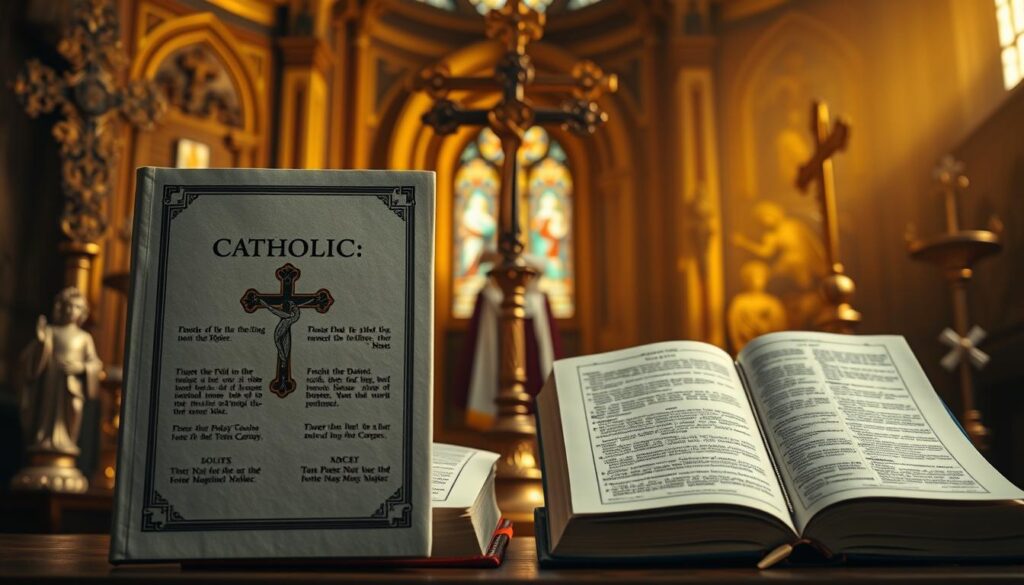
A side-by-side comparison of the Catholic and Protestant Bibles, meticulously captured against a backdrop of ornate religious iconography. The foreground features the two Bibles, their covers and pages distinctly visible, conveying the subtle differences in their canonical contents. The middle ground showcases religious symbols, such as ornate crosses and stained-glass windows, creating a sense of reverence and contemplation. The background is shrouded in a warm, golden light, evoking the timeless traditions and rich history of these divergent Christian faiths. The scene is rendered with a cinematic, high-contrast aesthetic, highlighting the weight and significance of the theological divide.

Differences in the Old Testament of Each Tradition

Catholic Bibles contain 46 Old Testament writings—seven more than Protestant editions. These extra books include Tobit’s journey, Judith’s bravery, and the Maccabees’ resistance stories. Additions to Daniel and Esther expand familiar narratives with new insights.

Protestant Bibles follow the Hebrew Masoretic Text, limiting their Old Testament to 39 books. Works like Wisdom of Solomon and Baruch—preserved in Greek Septuagint manuscripts—appear only in Catholic editions. This difference stems from how early communities valued translation traditions.

Catholic Bibles Protestant Bibles Key Distinction
46 Old Testament books 39 Old Testament books Septuagint vs. Hebrew sources
Deuterocanonical texts Apocrypha (if included) Terminology reflects acceptance
Supports intercessory prayers Rejects purgatory concepts Doctrinal implications

Impact on Doctrinal Authority and Faith Practices

These textual differences shape teachings. Catholic doctrine finds support in 2 Maccabees’ references to praying for the dead. Protestant traditions often view such practices as unsupported by scripture they recognize.

The term “Deuterocanon” (second canon) shows Catholic acceptance of these texts’ spiritual value. “Apocrypha” (hidden writings) reveals Protestant caution. This linguistic divide mirrors deeper debates about authority and tradition.

Both communities share a faith in Christ but navigate their spiritual journeys through different scriptural landscapes. These canonical choices continue to influence worship styles, ethical discussions, and interdenominational dialogues today.

Exploring the Deuterocanonical Books

Ancient texts often spark curiosity and debate. Among these, seven special writings—and additions to Daniel and Esther—hold a unique place in spiritual history. These works bridge Jewish traditions with early Christian thought, offering wisdom that shaped centuries of faith practices.

A grand, ornate library with towering shelves filled with ancient, leather-bound books. Soft, warm lighting casts a golden glow, illuminating the intricate, carved wood details. In the center, a large, ornate table displays several open deuterocanonical books, their pages weathered and illuminated. Stained glass windows filter sunlight, casting a kaleidoscope of colors onto the scene. An atmosphere of reverence and scholarly contemplation pervades the space. The camera angle is slightly elevated, providing a sweeping view of this hallowed, timeless sanctuary of knowledge.

Historical Acceptance and Debates

Third-century Christians began quoting texts like Tobit and Wisdom as scripture. Though not directly cited in the New Testament, subtle nods appear. Hebrews 11:35 echoes 2 Maccabees’ martyrs, showing early familiarity with these stories.

Debates simmered for centuries. In 1566, Sixtus of Sienna coined “Deuterocanonical” to clarify their status. He stressed these books were “second in reception time”—not importance. This term helped defend their value amid Reformation-era disputes.

Their Role in Catholic Worship and Teaching

These texts breathe life into worship and learning. During Lent, Judith’s bravery inspires homilies. Sirach’s practical advice shapes ethical teaching. Maccabees’ accounts of martyrdom fuel discussions about sacrifice.

Doctrinally, they support practices like praying for the departed. Wisdom 3:1-4 and 2 Maccabees 12:45 reinforce beliefs about purification after death. Such passages show how included deuterocanonical works complement core teachings.

From liturgy to personal study, these writings remain vital. They preserve Jewish resilience during Greek rule while deepening Christian understanding of divine justice and mercy.

Translation Principles and Bible Versions

The journey of sacred texts across languages reveals careful stewardship. While the Council of Trent affirmed the Latin Vulgate as official in 1546, it never restricted work with original languages. This balance between tradition and scholarship shapes translation efforts today.

From the Vulgate to the Nova Vulgata

Jerome’s 4th-century Vulgate became the Church’s bedrock for centuries. In 1979, scholars introduced the Nova Vulgata, updating archaic terms while preserving doctrinal accuracy. This modern Latin edition now serves in official documents, bridging ancient wisdom with contemporary needs.

Modern English Translations Approved by the Church

Today’s English translation options blend rigor with readability. The New American Bible (1970) and Revised Standard Version Catholic Edition (1966) lead popular choices. Each follows strict guidelines from Pius XII’s Divino afflante Spiritu, requiring:

  • Expertise in Hebrew, Greek, and Aramaic
  • Analysis of ancient manuscripts
  • Textual criticism techniques

From the poetic Douay-Rheims to the dynamic Jerusalem Bible, these versions help millions connect with sacred writings in their native tongue. Every approved translation honors both historical roots and modern understanding.

FAQ

Why does the Old Testament differ between traditions?

The Old Testament includes additional books like Tobit and Wisdom, recognized by the Church since ancient times. These texts, called Deuterocanonical, were affirmed at the Council of Trent but excluded in later Protestant editions.

How did early councils shape the canon?

Councils like Florence (1442) and Trent (1546) formalized the list of inspired texts. These gatherings resolved debates, ensuring consistency in teachings and worship practices across communities.

What role do Deuterocanonical books play today?

They’re used in liturgy, theology, and personal devotion. Passages like 2 Maccabees 12:45 support doctrines such as prayer for the deceased, highlighting their ongoing spiritual significance.

Are modern translations faithful to original texts?

Approved versions, such as the NABRE or RSV-CE, rely on ancient Hebrew, Greek, and Latin sources. Scholars and Church authorities ensure accuracy while balancing readability for today’s audiences.

How does the New Testament structure align with other traditions?

It mirrors Protestant editions with 27 books, including the Gospels and Pauline letters. Differences arise in Old Testament references, which sometimes cite Deuterocanonical works.

Why was the Vulgate important historically?

St. Jerome’s 4th-century Latin translation became the Church’s official text for over a millennium. Its clarity and widespread use shaped theology, art, and medieval European culture.

Do these differences affect core beliefs?

While shared doctrines like the Resurrection remain central, unique texts inform distinct practices—such as purgatory or intercession of saints—rooted in the Deuterocanonical writings.


What Does the Catholic Church Teach About Birth Control?


When discussing family planning, few topics spark as much curiosity—or confusion—as the Catholic Church’s teachings on contraception. While some assume these guidelines are relics of the past, their roots stretch back through centuries of theological reflection.

For nearly 2,000 years, Christian communities broadly agreed that artificial methods of preventing pregnancy conflicted with divine purpose. This consensus held firm until the 20th century, when many Protestant groups began revising their positions. The Catholic Church, however, maintained its stance—a decision that continues to shape conversations about faith and modern life.

Today, even committed Catholics often wrestle with these teachings. Recent surveys show that many believers find it challenging to reconcile official doctrine with contemporary relationships. This tension makes honest, compassionate dialogue more important than ever.

Our guide explores both the historical context and living reality of these teachings. We’ll break down the Church’s theological foundations, examine why it stands apart from other Christian denominations, and address common questions about practicing faith in today’s world.

Key Takeaways

  • The Catholic Church’s position on contraception reflects nearly two millennia of consistent teaching
  • Most Christian groups shared this stance until the 1900s
  • Theological arguments center on natural law and human dignity
  • Modern Catholics often seek guidance on applying these teachings
  • Cultural shifts have intensified discussions about faith and family planning

Introduction to the Catholic Church’s Teachings on Birth Control

Modern American culture often treats family planning as a practical matter—pick a method, set your timeline, and go. But the Church’s vision for married love asks couples to pause and reflect. This approach feels foreign in a society where 9 out of 10 women use contraception by age 45.

Setting the Context in Modern U.S. Culture

Imagine newlyweds today. Friends might ask, “Which birth control are you using?” not if they’re using it. Most religious communities—even conservative ones—rarely question this norm. As one couple shared, “Our Evangelical small group never discussed whether to prevent pregnancy. Everyone just did.”

The Church’s teaching stands apart by framing intimacy as more than private choice. It connects love’s physical expression to life’s sacred potential. This perspective clashes with modern views that separate pleasure from responsibility.

The Role of Faith and Tradition in Everyday Life

For Catholics, these guidelines aren’t arbitrary rules. They’re threads in a 2,000-year-old tapestry of belief. Natural law arguments suggest our bodies have built-in purposes we shouldn’t override. The Church sees marriage as a path to holiness, not just companionship.

Yet real life complicates ideals. Student loans, career goals, and health concerns make large families daunting. Many believers feel torn between ancient wisdom and today’s pressures. As one mom confessed, “I trust the teaching, but some months, I panic about groceries.”

Historical Perspectives on Contraception in Christianity

The history of contraception in Christianity reveals a once-unified stance across denominations. For nearly nineteen centuries, followers of Christ agreed that artificial methods conflicted with divine design. This consensus began crumbling in the 1900s, reshaping religious landscapes worldwide.

Ancient Foundations and the Onan Account

Early Christian leaders pointed to Genesis 38 as foundational. The story describes Onan’s punishment for “spilling his seed” – a passage theologians interpreted as condemning intentional contraception. Church Fathers like Augustine reinforced this view, teaching that marital intimacy must remain open to life’s possibility.

Twentieth-Century Turning Points

Everything changed at the 1930 Lambeth Conference. After centuries of opposition, the Anglican Church cautiously approved some forms of contraception. As one bishop argued, “We must adapt to modern challenges.” Other Protestant groups soon followed, creating today’s divided landscape.

The Catholic response came swiftly. Pope Pius XI’s 1930 encyclical Casti Connubii doubled down on traditional church teaching. Where others saw progress, Rome saw danger – a position on contraception it maintains as essential to human dignity.

This split reflects deeper questions about tradition’s role in changing times. While most churches embraced widespread use of family planning methods, Catholic leaders framed their stance as protecting timeless truths.

Key Doctrinal Insights on catholicism birth control

At the heart of Catholic doctrine lies a philosophy that reshapes how couples approach intimacy. This framework blends ancient wisdom with theological reasoning, creating a distinctive path through modern debates about relationships.

A tranquil, sun-dappled meadow stretches out, framed by a lush, verdant landscape. In the foreground, a pair of clasped hands emerge, their fingers intertwined, symbolizing the interplay between natural law and human choice. The hands are set against a backdrop of wildflowers, their delicate petals hinting at the beauty and complexity of creation. Soft, diffused lighting casts a warm, contemplative glow, inviting the viewer to ponder the intersection of faith, science, and personal responsibility. The scene evokes a sense of harmony and reflection, mirroring the nuanced discussion of catholicism and birth control.

The Influence of Natural Law in the Church’s Stance

Natural law theology acts as the backbone of Catholic teachings. It suggests our bodies have inherent purposes we shouldn’t override. For marital intimacy, this means respecting two core goals: strengthening bonds and remaining open to life.

The Church views artificial methods as disrupting this balance. Unlike temporary solutions, natural family planning aligns with bodily rhythms. This approach honors what many believers see as divine design.

Approach Focus Church View
Artificial Methods Preventing conception Contrary to natural purpose
Natural Family Planning Understanding fertility Aligns with human dignity
Modern Cultural Norms Personal convenience Risk of reducing intimacy

Magisterial Documents: Humanae Vitae and Beyond

In 1968, Pope Paul VI released Humanae Vitae, a landmark text reaffirming traditional views. The encyclical defined contraception as any action blocking life’s potential before, during, or after intimacy.

This document made bold predictions about societal impacts. It warned that separating pleasure from responsibility could weaken marriages and devalue life. Many Catholic scholars argue recent cultural shifts validate these concerns.

Humanae Vitae remains foundational despite ongoing debates. As one theologian notes, “It challenges us to see love as sacrificial, not transactional.” The text continues guiding couples seeking faith-aligned solutions.

Scripture, Tradition, and Natural Law

Three pillars shape the Church’s approach to marital intimacy: sacred texts, enduring traditions, and observable patterns in creation. These elements work together like threads in a tapestry, creating a consistent moral framework that spans millennia.

Interpreting Biblical Passages and Their Consequences

The story of Onan and his brother’s wife offers critical insights. When commanded to father children for his dead brother, Onan chose instead to “spill his seed” during sex. His death penalty shocked readers—the expected consequence for avoiding this duty was public shame, not execution.

Early Christians saw this as divine disapproval of intentional conception prevention. As one scholar notes, “The severity reveals the act’s gravity.” This example became foundational for understanding marital responsibilities.

The Contribution of Church Fathers and Apostolic Tradition

Ancient leaders built upon this scriptural foundation. Clement of Alexandria (195 AD) warned against “wasting seed vainly,” while Augustine (419 AD) condemned contraceptive practices as “poisons of sterility.” Their writings emphasized that men and women share responsibility for honoring life’s sacred potential.

Even Protestant reformers echoed these views. Martin Luther called Onan’s actions “monstrous,” and John Calvin compared them to grave sins. This cross-denominational consensus lasted until recent centuries, showing deep roots in Christian thought.

Through scripture and tradition, the Church maintains that respecting natural law preserves both human dignity and divine design. As modern debates continue, these ancient voices remind believers that some principles transcend cultural shifts.

Embracing Natural Family Planning Within Marriage

In a culture obsessed with instant solutions, natural family planning offers married couples a different path. This approach combines ancient wisdom with cutting-edge science, helping partners align their family goals with their faith values.

A serene outdoor scene, showcasing the harmony of natural family planning methods. In the foreground, a young couple walks hand-in-hand, their expressions radiating contentment. In the middle ground, a lush garden bursting with vibrant flowers and verdant foliage. Dappled sunlight filters through the canopy, casting a warm, golden glow. In the background, a tranquil pond reflects the surrounding natural beauty. The overall atmosphere exudes a sense of balance, connection, and reverence for the cycles of life.

Understanding Natural Family Planning as Birth Regulation

The Church supports married couples who want to space their children responsibly. Modern NFP uses three key biological markers:

  • Daily basal body temperature
  • Cervical mucus changes
  • Hormone level tracking

When used correctly, these methods prove 98% effective—matching the pill’s success rate. A 2007 study in Human Reproduction confirmed this parity, challenging outdated assumptions about NFP’s reliability.

Benefits for Marital Unity and Health

Couples practicing NFP report unexpected rewards. The required teamwork fosters deeper communication about intimacy and life goals. One husband shared, “Charting cycles together made us better problem-solvers in other areas too.”

Research reveals a stunning statistic: users experience a divorce rate below 1%—far lower than the national average. This approach transforms family planning from a solo decision into a shared spiritual journey.

Traditional Methods NFP Approach
Focus on prevention Focus on understanding
Individual responsibility Shared responsibility
Chemical interventions Body literacy

New technology simplifies tracking with smartphone apps and wearable devices. These tools help couples honor their values while navigating modern life’s complexities—proving faith and science can work hand in hand.

Contemporary Debates and Misconceptions about Birth Control

Modern discussions about contraception reveal unexpected ripple effects. While many hoped the contraceptive pill would simplify relationships, its social consequences continue sparking heated debates. Let’s explore how these changes reshaped family life and cultural values.

A lively debate unfolds, with individuals passionately arguing both sides of the contraception issue. In the foreground, a panel of diverse figures gesticulates emphatically, their expressions ranging from earnest concern to fiery conviction. The middle ground reveals a crowd of onlookers, their faces etched with a mix of thoughtfulness and unease. In the background, a dimly lit setting evokes the gravity of the topic, with shadows and muted tones creating an atmosphere of contemplation. Soft, directional lighting illuminates the faces, adding depth and drama to the scene. The composition captures the complexity and emotional intensity of the contemporary debates surrounding family planning and the impact on modern society.

When Predictions Meet Reality

Pope Paul VI warned in 1968 that widespread use of contraceptives might lead to:

  • Increased objectification in relationships
  • Rising abortion rates despite prevention tools
  • Erosion of marital commitment

Data shows his concerns weren’t unfounded. Abortions in the U.S. jumped from 615,000 (1973) to 1.4 million (1990) – even as contraceptives became more accessible. “The Sexual Revolution promised freedom,” notes sociologist Mary Eberstadt, “but often left women bearing heavier emotional burdens.”

Predicted Outcome Modern Reality
Decline in unplanned pregnancies 45% of pregnancies still unintended
Stronger marriages Divorce rates tripled since 1960
Equal sexual freedom 70% of single parents are mothers

These trends challenge the assumption that preventing pregnancy automatically strengthens relationships. Many couples now face tougher questions about trust, responsibility, and what intimacy truly means.

“Easy access to sex without consequences didn’t liberate women – it let men walk away from commitments.”

Today’s debates often overlook how children became viewed as optional lifestyle accessories rather than gifts. This shift impacts everything from daycare demands to retirement planning, proving that birth control conversations touch far more than personal choices.

The Intersection of Faith and Medical Practice in Catholic Health Care

Navigating healthcare choices becomes uniquely complex when religious values shape institutional policies. Catholic medical centers serve 1 in 7 U.S. patients, creating situations where personal needs collide with institutional guidelines.

Legal and Ethical Challenges in Contraceptive Provision

The Ethical and Religious Directives forbid Catholic hospitals from providing birth control services. This creates tough choices for doctors who must balance their oath to patients with institutional rules. A 2022 study found 23% of OB-GYNs in faith-based settings face moral distress over these limits.

Nearly 9 in 10 Catholic women use contraception despite Church teachings. When care providers can’t offer these methods, patients may feel their needs aren’t fully addressed. Some states now require referrals to outside Catholic clinics—a compromise that sparks ongoing legal debates.

Balancing Medical Needs with Religious Directives

Healthcare workers often seek creative solutions. Some focus on menstrual cycle education as allowed by the catechism Catholic Church teachings. Others partner with secular clinics to ensure patients access comprehensive care while respecting institutional boundaries.

These tensions highlight a modern reality: faith-based medicine thrives when it fosters open dialogue. As one nurse practitioner shared, “Our role isn’t to judge choices—it’s to support women’s health within our mission’s framework.” Finding that balance remains an evolving challenge.

FAQ

What is the Catholic Church’s official stance on contraception?

The Church teaches that artificial methods like pills or devices are morally wrong. It emphasizes Natural Family Planning (NFP) as the only acceptable way to regulate births, aligning with natural law and God’s design for marital love.

Why does the Church oppose artificial birth control in modern times?

Rooted in teachings like Humanae Vitae by Pope Paul VI, the Church believes artificial methods disrupt the unitive and procreative purposes of marriage. It sees them as harmful to relationships, societal stability, and respect for human dignity.

How does natural law influence the Church’s view on marital intimacy?

Natural law philosophy argues that human actions should align with nature’s purpose. The Church teaches that sex must remain open to life, making interventions like sterilization or hormonal contraceptives morally unacceptable.

What role does the document Humanae Vitae play in Catholic teaching?

Published in 1968, Humanae Vitae reaffirmed the Church’s rejection of artificial contraception. It warned of consequences like increased infidelity, societal erosion, and reduced respect for women if such methods became widespread.

Is Natural Family Planning really effective?

When practiced correctly, NFP can be as effective as artificial methods. It relies on tracking a woman’s fertility cycles and fosters communication, mutual respect, and shared responsibility between spouses.

How do Catholic healthcare providers handle requests for contraceptives?

Institutions like Catholic hospitals follow Ethical and Religious Directives, avoiding contraceptive services. They prioritize treatments aligned with Church teachings, though exceptions may apply for medical needs like hormone regulation.

What does the Bible say about contraception?

The story of Onan (Genesis 38:8–10) is often cited, where he was punished for spilling seed. While not a direct ban, the Church interprets this as valuing openness to life, reinforced by tradition and papal encyclicals.

How do Protestant views differ from Catholic teachings on birth control?

After the 1930 Lambeth Conference, many Protestant denominations allowed contraception in marriage. The Catholic Church, however, maintains its stance, viewing artificial methods as contrary to divine and natural law.

Does using NFP strengthen marriages?

Studies suggest couples using NFP report higher communication and mutual respect. The method encourages shared decision-making and aligns with the Church’s vision of marital unity and self-giving love.

How does the Church address concerns about marital instability without contraception?

The Church argues that NFP promotes trust and responsibility, reducing risks of divorce. Critics, however, cite challenges like financial strain or health crises, urging pastoral sensitivity while upholding doctrine.

Comparing Anglicanism and Catholicism: What Sets Them Apart


For centuries, two influential branches of Christianity have shaped spiritual lives across the globe. Though sharing ancient roots, their journeys diverged through history, theology, and practice. This exploration will help clarify how these traditions developed unique identities while maintaining core connections.

The English Reformation sparked lasting debates about identity and belief. Some faith communities blend historical continuity with reform, creating a distinctive spiritual path that honors tradition while embracing change. This balance raises important questions about authority, worship, and community life.

Many wonder how these traditions differ in their approach to scripture, leadership, and sacraments. By examining their historical foundations and modern practices, we uncover both shared values and meaningful contrasts. Whether you’re exploring personal beliefs or simply curious, this comparison offers fresh perspectives on Christian diversity.

Key Takeaways

  • Both traditions share ancient Christian roots but diverged during historical reforms
  • Leadership structures differ significantly in their view of authority
  • Approaches to sacraments reveal distinct theological emphases
  • Cultural adaptation plays unique roles in each tradition’s development
  • Modern expressions balance heritage with contemporary challenges

Historical Foundations of Anglicanism and Catholicism

Long before kings and councils shaped religious identity, ancient communities laid spiritual foundations that still echo today. Both traditions draw from deep wells of history, though their paths diverged through pivotal moments.

Shared Beginnings, Separate Journeys

Christian worship in Britain dates to the second century – centuries before Rome’s full influence. Early believers built local practices around core teachings, creating a distinct spiritual identity. By medieval times, these communities gradually adopted Roman customs while retaining unique elements.

Reformation: Revival More Than Revolution

Henry VIII’s 1530s break from papal authority began as political maneuvering but unlocked lasting change. The Church of England restored its pre-Roman independence, revising ancient liturgies and reducing monastic power. Leaders like Elizabeth I later blended Protestant ideas with Catholic structures, crafting a middle path.

Three key reforms defined this era:

  • Vernacular Bibles replaced Latin texts
  • Traditional ministries continued with local oversight
  • Historic church calendars adapted to new theology

This wasn’t a new church but a renewed version of England’s ancient faith. Parish networks and educational systems remained intact, preserving centuries of tradition while embracing fresh perspectives.

Core Doctrinal Differences between the Two Traditions

At the heart of Christian belief systems lie distinct approaches to theological authority. While sharing foundational faith in Christ, these traditions diverge in how they define essential teachings and interpret divine revelation.

Doctrinal differences comparison: two religious symbols, a Catholic cross and an Anglican cross, standing in a dimly lit cathedral. Soft, dramatic lighting casts long shadows, creating a somber, contemplative atmosphere. The symbols are placed side by side, inviting the viewer to observe their subtle yet significant differences in design and symbolism. The background is hazy, with glimpses of stained-glass windows and ornate architectural details, emphasizing the reverent, historic setting. The image conveys the weight and complexity of the theological divide between the two Christian traditions.

Scripture as the Ultimate Guide

The Roman Catholic Church maintains a comprehensive doctrinal framework. Its detailed catechism spans thousands of pages, addressing everything from moral principles to specific Marian beliefs. Church councils and papal authority shape this evolving system, declaring new dogmas like Mary’s Assumption as binding truths.

Anglican theology takes a different path. The Articles of Religion state clearly: “Holy Scripture contains all things necessary to salvation.” This principle limits required beliefs to biblical foundations and early church creeds. Questions beyond scripture remain open for discussion rather than official decree.

This contrast appears in their teaching materials. Anglican churches use a 20-page catechism focusing on core Christian doctrine, while Roman Catholic resources provide exhaustive guidance. The difference reflects deeper views about tradition’s role – one sees it as developing revelation, the other as secondary to biblical authority.

Both traditions value ancient theology, but their approaches create distinct spiritual identities. Where one establishes detailed systems, the other preserves flexibility, trusting believers to explore unanswered questions through scripture and reason.

Anglicanism vs Catholicism: Exploring Worship and Liturgy

Worship practices breathe life into ancient traditions while reflecting modern priorities. Both communities cherish structured liturgy but approach sacred rituals with distinct flavors. This difference becomes clearest when comparing their primary worship guides.

Two Guides for Sacred Gatherings

The Book of Common Prayer shapes Anglican services with poetic flexibility. First published in 1549, it provides prayers and rites while allowing local adaptation. As one priest noted: “Our strength lies in unity through diversity – same prayers, different expressions.”

Roman Catholics follow the Roman Missal’s precise instructions. This detailed manual ensures identical Mass structures worldwide. From gestures to vestments, every element follows centuries-old patterns refined by Vatican councils.

Element Catholic Practice Anglican Approach
Liturgical Guide Roman Missal (strict rubrics) Book of Common Prayer (flexible framework)
Language Use Latin until 1960s, now vernacular Always in local language
Eucharistic Focus Sacrificial reenactment Communal remembrance

When Words Shape Worship

Language choices reveal deeper theological values. While both traditions now use vernacular, the common prayer tradition began with Cranmer’s insistence that “people should understand what they pray.” This principle fuels Anglican services featuring extended scripture readings and congregational responses.

Modern churches showcase surprising diversity. Some Anglican parishes use incense and chant like Catholic neighbors, while others adopt contemporary music. Catholic Mass maintains greater uniformity, though charismatic movements add new expressions within official guidelines.

Both traditions honor ancient rhythms through liturgical calendars. Advent candles glow and Lenten fasts continue, but local practice determines how communities mark these seasons. This balance between structure and adaptation keeps worship alive across generations.

The Role of Authority and Tradition in Shaping Beliefs

How communities decide what to believe reveals deep differences in spiritual leadership. These choices shape worship practices, moral guidance, and how people connect with sacred texts.

A grand cathedral interior, ornate and majestic, with intricate stained glass windows illuminating the space. In the foreground, a procession of robed clergy, their faces solemn and commanding, carrying ornate crosses and candles, symbolizing the weight of tradition and authority. The middle ground features rows of wooden pews, filled with worshippers in reverent poses, their gaze fixed on the altar. The background showcases the towering, vaulted ceilings, adorned with intricate carvings and religious iconography, conveying a sense of timelessness and the enduring power of the church. The lighting is soft and warm, casting a spiritual ambiance throughout the scene.

Scripture as the Sole Rule vs. Magisterial Tradition

The Roman Catholic Church views itself as the guardian of divine truth through its teaching office. Leaders claim authority to define doctrines beyond scripture, like Mary’s Assumption. As one bishop explained: “Our tradition grows through prayerful reflection guided by the Holy Spirit.”

Anglicans take a different approach. Their Articles of Religion state clearly:

“The Church cannot enforce beliefs unnecessary for salvation.”

This principle limits official teachings to biblical foundations and early church consensus.

Aspect Roman Catholic Practice Anglican Approach
Decision-Making Pope and bishops declare binding doctrines Local churches consult scripture collectively
Tradition’s Role Equal to scripture as revelation source Guided by scripture, open to reform
Believer’s Role Accept all church teachings Interpret non-essentials personally

This contrast affects daily spiritual life. Catholic teachings require agreement on all doctrines, while Anglican communities allow diverse views on issues like saints’ intercession. Both value ancient wisdom but apply it differently in modern contexts.

Early church leaders like Augustine shaped these approaches. Their debates about biblical authority still influence how churches balance tradition with contemporary challenges today.

Differences in Sacramental Practices: The Eucharist and Communion

At the heart of Christian worship lies a sacred meal that unites believers across generations. While sharing this ancient practice, communities developed distinct understandings of what happens during communion services. These differences shape everything from worship styles to personal preparation.

A grand cathedral interior, bathed in soft, golden light streaming through stained glass windows. In the foreground, an ornate altar adorned with gleaming chalices and candlesticks. On the left, an Anglican priest elevates the communion wafer, while on the right, a Catholic priest raises the consecrated host. The rich, liturgical vestments of each faith create a striking visual contrast. The scene conveys the solemnity and reverence of these sacred rites, inviting the viewer to contemplate the nuanced differences between Anglicanism and Catholicism's Eucharistic practices.

Spiritual Nourishment Through Different Lenses

The Roman Catholic Church teaches that communion involves transubstantiation – bread and wine becoming Christ’s actual body and blood. This belief leads to practices like Eucharistic adoration, where consecrated elements receive special reverence. As one catechism states: “The Eucharist is ‘the source and summit of Christian life.'”

Anglican teachings take a different approach. Their Articles of Religion clarify:

“The body of Christ is given, taken, and eaten only after a heavenly and spiritual manner.”

Here, thefaithof participants matters more than physical changes to the elements.

Aspect Catholic Practice Anglican Approach
Eucharistic Belief Literal transformation Spiritual reception
Preparation Confession required for mortal sins Living faith emphasized
Elements After Consecration Worthy of worship Remain ordinary bread/wine
Worship Practices Adoration ceremonies Communal remembrance focus

Both traditions agree communion connects believers to Christ. But where one sees fact in transformed elements, the other finds promise in shared obedience. These views influence how often people participate – weekly Mass obligations for Catholics versus personal choice in many Anglican churches.

Ultimately, both paths affirm that sacred things happen when communities gather around the table. The differences lie in explaining how grace works, not whether it’s present.

Clergy and Priesthood: Marriage, Ordination, and Ministry

Religious leadership takes different forms across Christian communities, reflecting deep convictions about sacred service. While both traditions value ordained ministry, their approaches to clergy life reveal contrasting priorities.

Historical Perspectives on Married Priesthood

Roman Catholic priests typically commit to lifelong celibacy, a practice formalized in the 12th century. Exceptions exist in Eastern Catholic churches, where married men can become priests. However, Latin Rite clergy follow strict rules – once ordained, marriage isn’t permitted.

Anglican leaders take a different path. Their Articles of Religion state:

“Bishops, priests, and deacons aren’t commanded to remain unmarried.”

This principle allows clergy to marry, seeing family life as compatible with spiritual leadership.

These differences shape how churches serve their people. Roman Catholics maintain centralized authority through celibate bishops, while Anglican communities often emphasize shared decision-making. Both systems aim to support believers but through distinct models of ministry.

Modern debates continue about these traditions. Some people see celibacy as a sacred commitment, others view marriage as a practical way to connect with congregations. The fact remains: these choices profoundly impact how clergy live and serve.

FAQ

How did the English Reformation shape Anglican traditions?

The English Reformation, starting under Henry VIII in the 16th century, broke ties with the Roman Catholic Church. This led to the creation of the Church of England, which blended Protestant ideas with older liturgical practices. Over time, this movement emphasized scripture and local governance while retaining elements like bishops and sacraments.

What distinguishes Catholic and Anglican views on salvation?

Catholic teaching emphasizes sacraments and good works as pathways to grace, guided by the Magisterium. The Anglican tradition, influenced by the Reformation, often highlights scripture’s authority and justification by faith, though practices vary across its global communion.

How do worship styles differ between these traditions?

Catholic services often use the Roman Missal with structured Latin Mass elements, even in local languages. Anglicans rely on the Book of Common Prayer, which allows flexibility in liturgy while maintaining traditional creeds and prayers. Both value ritual but approach language and local adaptation differently.

Why does the Catholic Church prioritize papal authority?

Catholics believe the Pope, as St. Peter’s successor, holds ultimate teaching authority under the Magisterium. Anglicans, however, view scripture as the primary guide, with bishops and synods making decisions collectively—a structure rooted in the Elizabethan Settlement’s balance of tradition and reform.

Do both groups believe in the Real Presence during Communion?

Yes, but interpretations differ. Catholicism teaches transubstantiation, where bread and wine become Christ’s body and blood. Anglicans often describe the Eucharist as a spiritual presence, avoiding strict doctrinal definitions to accommodate diverse theological perspectives within their communion.

Can Anglican priests marry, unlike Catholic clergy?

Yes. After the Reformation, Anglican clergy were permitted to marry, reflecting Protestant reforms. The Catholic Church maintains celibacy for priests, viewing it as a commitment to serving God and the Church wholeheartedly, though exceptions exist for certain rites.

How do these traditions approach modern social issues?

The Roman Catholic Church often upholds traditional teachings on topics like marriage and gender roles, guided by papal encyclicals. Anglican churches, however, vary widely—some dioceses ordain women or bless same-sex unions, reflecting decentralized governance and cultural context.

Are Anglican services more flexible than Catholic Mass?

Generally, yes. The Book of Common Prayer provides structure but allows regional adaptations, including contemporary language or music. Catholic liturgy follows stricter rubrics, though post-Vatican II reforms introduced vernacular languages while preserving core rituals.

Do Anglicans recognize saints like Catholics do?

Anglicans honor saints as examples of faith but don’t emphasize intercessory prayer to them as strongly. Catholic tradition includes canonization processes and veneration of saints as mediators, supported by centuries of doctrinal development and papal authority.

Can Anglicans and Catholics receive Communion in each other’s churches?

Officially, the Catholic Church restricts Communion to its members except in rare cases. Anglicans often invite baptized Christians to participate, but practices vary. Dialogue continues, with some local agreements promoting unity while respecting doctrinal differences.

How Many Saints Are There in Catholicism?


For millions of believers, saints represent more than historical figures—they are living connections to divine grace. These holy men and women inspire the faithful through stories of sacrifice, miracles, and unwavering devotion. Their legacy shapes Catholic identity, offering guidance in moments of doubt and celebration.

The Church honors these spiritual champions as intercessors, bridging earthly struggles and heavenly wisdom. While exact numbers remain fluid, scholars estimate over 10,000 recognized holy figures across two millennia. Early Christians used the Latin term sanctus (holy) to honor martyrs who embodied Christ’s teachings through persecution.

Modern canonization processes contrast with ancient traditions, where local communities often declared saints without formal approval. This evolving practice reflects the Church’s enduring mission: to celebrate lives that illuminate paths toward spiritual growth. From apostles to reformers, each saint’s story carries timeless lessons for contemporary believers.

Key Takeaways

  • The Catholic Church recognizes thousands of holy figures but avoids rigid numerical counts
  • Saints serve as spiritual mentors and symbols of hope across generations
  • Early Christian communities honored martyrs as saints before formal processes existed
  • Canonization methods evolved to ensure consistent standards for sainthood
  • These holy figures remain culturally relevant through feast days and personal devotions
  • Understanding sainthood deepens appreciation for Catholic traditions and values

Exploring the Role and Significance of Saints in the Catholic Church

The Catholic Church’s tapestry of faith is richly woven with stories of those who exemplified spiritual dedication. These holy figures became cornerstones of religious practice, shaping both private devotion and communal identity.

Historical Background of Saints

Early Christian communities celebrated martyrs as immediate examples of imitatio Christi – imitation of Christ. By the third century, shrines honoring these heroes of faith dotted the Mediterranean landscape. Local believers freely declared saints through popular acclaim, often gathering at burial sites to seek spiritual favors.

Over twelve centuries, recognition expanded beyond martyrdom. Church leaders began honoring:

  • Confessors who defended doctrine without dying
  • Ascetics pursuing radical spiritual discipline
  • Visionaries demonstrating extraordinary charity
Era Recognition Process Primary Criteria
Early Church Local veneration Martyrdom
Medieval Period Papal approval required Miracles & virtue
Modern Age Scientific scrutiny Documented healings

Saints as Spiritual Role Models

These holy role models demonstrate that sanctity isn’t reserved for the extraordinary. Teresa of Ávila taught, “God walks among the pots and pans” – affirming holiness in daily life. Their stories help people navigate modern challenges while maintaining spiritual integrity.

Contemporary Catholics find particular resonance with:

  • Worker saints like Joseph the Carpenter
  • Social justice advocates such as Óscar Romero
  • Scientists reconciling faith with reason

The History and Process of Canonization

Declaring spiritual exemplars has evolved from grassroots veneration to a meticulous system blending faith and scrutiny. This transformation reflects the Church’s effort to balance tradition with accountability.

a highly detailed, photorealistic illustration of the Catholic canonization process steps, depicted in a series of vignettes arranged in a vertical composition. In the foreground, a close-up view of a bishop examining the evidence and documents related to a potential saint's life and miracles. In the middle ground, a solemn ceremony with robed clergy and the Pope presiding over the canonization ritual. In the background, a grand cathedral interior with ornate architectural features, stained glass windows, and heavenly light filtering through. The overall atmosphere is one of reverence, solemnity, and the weight of spiritual tradition.

Origins of Sainthood Recognition

Early Christian communities honored martyrs through local rituals, often at burial sites. By the 5th century, bishops began approving these devotions informally. The Vatican centralized authority in 1234, requiring papal approval for new sainthood cases.

Pope Sixtus V’s 1588 decree established the Congregation for Saints’ Causes. This body standardized investigations, replacing regional practices with universal criteria. Three key shifts occurred:

  • Martyrs no longer became automatic candidates
  • Written testimonies replaced oral traditions
  • Miracles required documented evidence

The Canonization Process Explained

Modern canonization involves four rigorous phases. First, local dioceses investigate a candidate’s life as a “Servant of God.” If the Vatican confirms heroic virtue, the title “Venerable” follows.

Beatification demands one miracle (except for martyrs), verified by medical and theological experts. Final sainthood requires a second miracle, often taking decades—or centuries—to confirm. Recent reforms streamlined timelines without compromising standards.

Critics question the process’s length and cost, but Church leaders argue thoroughness preserves integrity. As Cardinal Amato noted, “Holiness withstands time’s test—so must our discernment.”

how many saints are there in catholicism: A Detailed Look

Quantifying spiritual legacies presents unique challenges in Catholic tradition. While official records list over 1,700 canonized saints since the 16th century, scholars suggest more than 10,000 holy people have received recognition across two millennia.

Estimations and Official Counts

Modern calculations break down recognized holy figures into four main groups:

  • Martyrs (35% of early cases)
  • Confessors defending doctrine (40%)
  • Doctors of the Church (15%)
  • Modern reformers (10%)

The Vatican’s Martyrologium Romanum lists 7,000 entries, but duplicates and regional variations blur the exact number. Recent decades saw dramatic increases—Pope John Paul II alone declared 482 saints during his 26-year papacy.

Factors Impacting the Numbers

Three key elements complicate accurate counts:

  • Pre-12th century local veneration practices
  • Lost records from medieval conflicts
  • Mass recognitions like the 800 Korean martyrs canonized in 1984

As Pope Francis reminds us, “Sainthood isn’t a math problem—it’s a call to love radically.” This perspective explains why the Church focuses less on totals and more on individual examples of grace. While 21st-century processes accelerate approvals, ancient traditions continue shaping this living tradition.

Notable Catholic Saints and Their Inspirational Legacies

From ancient arenas to digital age classrooms, holy figures continue shaping hearts across generations. Their stories form a spiritual mosaic—ordinary people achieving extraordinary grace through faith-filled lives.

A grand, ornate cathedral with stained glass windows, lit by warm, golden light. In the foreground, a procession of Catholic saints, each with a distinct and reverent expression, their historical garments and iconography meticulously depicted. In the middle ground, a celestial backdrop with clouds and rays of divine light, highlighting the saints' spiritual significance. The background features detailed architectural elements, such as arched doorways, ornate columns, and intricate carvings, creating a sense of grand, timeless tradition. The overall composition conveys a reverent, awe-inspiring atmosphere, honoring the diverse and inspirational legacies of these notable Catholic figures throughout history.

Early Martyrs and Regional Saints

Third-century believers revered heroes like Saint Perpetua, who documented her imprisonment before facing wild beasts. Regional champions later gained global followings:

  • Patrick of Ireland – transformed pagan festivals into Christian traditions
  • Juan Diego – whose tilma miracle reshaped the Americas’ spiritual landscape
  • Kateri Tekakwitha – first Native American saint canonized in 2012

Modern Saints and Recent Canonizations

Pope Francis’ tenure saw groundbreaking recognitions, including 813 Otranto martyrs from a 1480 massacre. Recent standouts include:

  • Óscar Romero (2018) – champion of human rights
  • Carlo Acutis (beatified 2020) – tech-savvy teen documenting Eucharistic miracles

John Paul II revolutionized saint-making by honoring diverse vocations—from queens to factory workers. His 482 canonizations included:

  • Padre Pio – mystic with visible stigmata
  • Josemaría Escrivá – pioneer of workplace spirituality

As L’Osservatore Romano notes, “New saints mirror the Church’s heartbeat—always ancient, always fresh.” These modern candidates prove holiness thrives in skyscrapers and social media feeds alike.

Conclusion

Every generation discovers spiritual companions who reflect their unique challenges. The Catholic Church celebrates over 10,000 holy figures—one inspiring example for every 100,000 believers worldwide. These catholic saints span continents and careers, from desert hermits to software engineers.

New names join this cloud of witnesses regularly. Recent canonization efforts honor teachers, refugees, and scientists. This growing diversity proves holiness blossoms in offices and homes as powerfully as in monasteries.

Vatican II’s message remains clear: all people are called to sainthood. As Thérèse of Lisieux noted, “Miss no single opportunity of making some small sacrifice.” Daily choices—patience with coworkers, kindness to strangers—forge paths to divine connection.

Discovering patron saints or reading their journals makes their journeys relatable. Their role models show sacred living transforms ordinary tasks. This ever-expanding family invites everyone to add their story to faith’s unfolding tapestry.

FAQ

How does the Catholic Church determine the total number of saints?

The Church doesn’t maintain an official count, but historians estimate over 10,000 recognized saints. Many early martyrs and regional holy figures were never formally documented, making exact numbers challenging.

Why are saints considered important in Catholic tradition?

Saints act as spiritual role models, demonstrating lives of faith, sacrifice, and service. Their stories, like those of St. Thérèse of Lisieux or St. Francis of Assisi, inspire believers to pursue holiness.

What steps are involved in becoming a canonized saint?

The process includes investigation, beatification, and canonization. A candidate must have lived virtuously, performed verified miracles, and undergone rigorous review. Pope John Paul II simplified steps in 1983 to prioritize holiness over formal procedures.

Are there differences between early martyrs and modern saints?

Early saints, like St. Peter or St. Agnes, often died for their faith. Modern figures, such as St. Teresa of Calcutta, are celebrated for lifelong service. Both groups reflect the Church’s evolving emphasis on diverse expressions of holiness.

How have recent popes influenced the canonization process?

Pope Francis and Pope John Paul II emphasized global inclusivity. John Paul II canonized 482 saints—more than any predecessor—while Francis prioritizes candidates who championed social justice, like St. Óscar Romero.

Why do estimates of saints vary among historians?

Factors include lost records of early Christian martyrs, unofficial veneration of local holy figures, and shifts in canonization rules. The Church only began centralizing the process in the 12th century.

Who are some recently recognized saints in the Catholic Church?

St. John Henry Newman (2019) and St. Marguerite Bays (2019) were canonized for theological contributions and humble faith. Their legacies highlight the Church’s focus on relatable modern examples.

Fasting in Catholicism: A Spiritual Journey


For nearly two millennia, believers have embraced a transformative spiritual discipline rooted in sacred tradition. This practice, modeled by Jesus during his 40 days in the wilderness, creates a bridge between physical actions and inner renewal. Unlike modern diet trends focused on appearance, it’s about aligning priorities to recognize what truly sustains us.

Early Christians demonstrated this commitment through intentional acts of devotion. The Book of Acts describes disciples praying and abstaining before major decisions—a reminder that spiritual clarity often comes through sacrifice. This tradition isn’t about deprivation but about creating space for growth, echoing Christ’s instruction to focus on eternal “treasures in heaven.”

At its core, this discipline serves multiple purposes. It cultivates humility, strengthens resolve, and fosters solidarity with those who hunger involuntarily. By temporarily setting aside earthly comforts, practitioners open doors to deeper connection and self-awareness. The goal isn’t to earn favor but to prepare hearts for greater communion with the divine.

During Lent, this practice joins prayer and charity as pillars of spiritual preparation. It’s not a test of endurance but a pathway to rediscover life’s essential truths. Through mindful observance, individuals learn to prioritize spiritual nourishment while developing resilience against life’s distractions.

Key Takeaways

  • Rooted in Jesus’ teachings and early Church traditions
  • Focuses on spiritual growth rather than physical results
  • Encourages solidarity with those facing hardship
  • Complements prayer and charitable acts during Lent
  • Designed to deepen humility and self-awareness

Understanding fasting in catholicism: Historical Roots and Biblical Foundations

Biblical texts and early Christian writings reveal a practice woven into faith’s fabric long before formal seasons existed. Jesus’ instruction in Matthew 6 assumes followers would abstain from food, stating “when you fast”—not “if”—while urging sincerity over showmanship. This expectation echoes Daniel’s three-week abstention from rich foods, showing how physical restraint fuels spiritual focus.

Scriptural Patterns That Shaped Belief

The number 40 appears repeatedly as a sacred timeframe. Moses fasted 40 days before receiving commandments. Elijah journeyed 40 days to Mount Horeb. Christ’s desert preparation mirrors these events, linking self-denial to divine purpose. Early believers adopted this pattern, like those in Acts who paused meals before selecting missionaries.

From Personal Devotion to Communal Practice

By the second century, weekly abstinence became common. Church leaders structured these acts around prayer and repentance, shifting from individual gestures to shared rhythms. Over time, Lent emerged as a 40-day journey mirroring Jesus’ wilderness experience—a yearly call to reset priorities through simplicity.

This evolution wasn’t about punishing the body but training the soul. As one early theologian wrote, “Empty hands grasp heaven more easily.” By uniting believers in shared discipline, these traditions turned personal sacrifice into collective renewal.

Practical How-To Guide: Observing Lenten Fasting

Walking through Lent involves more than skipping snacks—it’s about intentional choices that deepen your spiritual journey. Let’s break down the essentials for meaningful observance while respecting Church guidelines.

A solemn church interior, dimly lit by votive candles and stained-glass windows. In the foreground, a worshipper kneels in prayer, hands clasped, head bowed. The middle ground features a simple wooden cross, the focal point of the scene, casting a reverent shadow. In the background, a priest stands before the altar, leading a small congregation through the rituals of Ash Wednesday or Good Friday. The atmosphere is contemplative, the mood introspective, as the faithful observe the penitential practices of the Lenten season.

Mastering Key Days: Ash Wednesday & Good Friday

On these two days, adults aged 18-59 follow specific rules: one full meal plus two smaller meals (combined less than the main meal) and no meat. Fish becomes a go-to protein, honoring early Christian symbolism. Remember, hydration like water or tea is always allowed—prioritize health while honoring tradition.

Smart Meal Strategies for 40 Days

Fridays during Lent require meat abstinence, but creativity thrives here. Try these ideas:

  • Grilled salmon with roasted veggies
  • Lentil soups packed with seasonal greens
  • Vegetarian chili using beans for protein

Prep meals ahead to avoid last-minute compromises. As one parish cookbook notes: “Simple ingredients make space for sacred focus.”

Turning Meals Into Moments of Grace

Before eating, pause to acknowledge the purpose behind your plate. Try this prayer: “Bless this food, and let its simplicity remind me of Your eternal nourishment.” Keep a journal nearby to jot down reflections when hunger arises—it transforms cravings into conversation starters with God.

Remember, these practices aren’t about perfection but progression. As you adjust portions and menus, you’re creating room to grow closer to what truly sustains the soul.

Integrating Spiritual Growth and Physical Self-Discipline

True transformation happens when body and spirit work together. This ancient practice isn’t just about skipping meals—it’s a doorway to reshaping priorities. By pairing physical restraint with intentional reflection, believers create space for lasting change.

Self-Denial as a Path to Renewal

Hunger becomes a teacher when we listen. Those empty moments between meals? They’re invitations to examine what truly feeds us. As theologian Daniel Merz notes: “Real penance starts when we stop feeding our worst impulses.”

This approach turns cravings into catalysts. A growling stomach reminds us to pray for those who hunger daily. Missing your morning coffee? Use that longing to practice gratitude for life’s simple blessings.

Modern Expressions of Ancient Wisdom

Today’s distractions demand creative solutions. Try swapping screen time for Scripture time, or replace streaming marathons with service projects. The key? Choose abstentions that challenge your comfort zones while nurturing compassion.

Accountability partners help maintain focus. Share your goals with a trusted friend, and check in weekly. Remember: The goal isn’t perfection but progress toward loving God and others more fully.

By blending physical discipline with spiritual intention, this practice becomes a mirror—revealing where we’re called to grow. Each small “no” to temporary pleasures plants seeds for eternal joys.

Conclusion

As Lent draws believers toward Easter’s sunrise, this sacred season invites more than temporary changes. Archbishop Fulton Sheen captured its essence: “First comes the fast, then comes the feast.” These 40 days of spiritual discipline prepare hearts to fully embrace Christ’s victory—not through rigid rule-following, but by aligning our deepest desires with divine love.

Meaningful observance transforms meat Fridays and simplified meals into bridges between body and soul. Isaiah’s warning reminds us: Empty plates mean little without repentant hearts. True growth happens when prayer and self-denial work together, turning hunger pangs into whispers of dependence on God.

Don’t fear imperfect efforts. Even stumbled attempts to skip snacks or limit screen time can open doors to grace when done sincerely. What matters isn’t flawless execution but willingness to let daily life reflect eternal priorities.

This journey isn’t about earning joy—it’s about making space to receive it. As Easter dawns, may your acts of sacrifice blossom into deeper communion with the One who fasted, prayed, and conquered death for love of you.

FAQ

Why do Catholics avoid meat on Fridays during Lent?

Avoiding meat, particularly on Ash Wednesday and Good Friday, is a form of penance. It symbolizes solidarity with Christ’s sacrifice and encourages self-discipline. Fish is often permitted as a traditional alternative, reflecting historical practices tied to simplicity.

Can children or those with health concerns participate in fasting?

Yes! Those under 14, over 65, or with medical needs are exempt. The Church emphasizes spiritual practices like prayer or acts of charity as alternatives. Always prioritize well-being while honoring the spirit of repentance.

What’s the difference between fasting and abstinence?

Fasting typically involves limiting food intake (e.g., one full meal plus two smaller meals). Abstinence refers to avoiding specific items, like meat. Both practices aim to deepen reflection and humility, especially during Lent.

How can I make fasting more meaningful beyond just skipping meals?

Pair fasting with prayer, Scripture reading, or volunteering. Consider “fasting” from habits like gossip or screen time. This holistic approach strengthens both spiritual growth and community connections.

Are there exceptions to the Ash Wednesday and Good Friday fasts?

Yes. If these days fall on a non-Lenten period or conflict with major feasts, rules may adjust. However, they’re usually binding. When in doubt, consult your parish priest for guidance tailored to your situation.

Why is fish allowed on days of abstinence?

Historically, fish was seen as a “poor man’s food” and not considered a luxury. This tradition reinforces simplicity and connects to early Christian practices. Today, it remains a symbolic way to observe penitential days without meat.

How does fasting prepare Catholics for Easter?

By embracing self-denial, believers create space to reflect on Christ’s resurrection. It’s a journey from repentance (Ash Wednesday) to renewal (Easter), mirroring His 40 days in the desert and ultimate victory over sin.

Masonry and Catholicism: Exploring the Intersection


For centuries, the relationship between organized spiritual communities has sparked intense discussion. The Catholic Church maintains a clear position on one such debate: membership in groups promoting alternative belief systems directly conflicts with its teachings.

Why does this tension exist? At its core lies differing views on religion itself. Some organizations create structured practices resembling traditional worship – complete with moral codes, symbolic rituals, and concepts of an afterlife. These parallels raise critical questions about spiritual alignment.

The Church emphasizes that faith requires exclusive commitment. When groups promote the idea that all belief systems equally satisfy spiritual needs, it challenges this principle. This “religious indifferentism,” as described by theologians, forms a key part of the disagreement.

This section examines historical precedents, doctrinal conflicts, and modern implications. We’ll explore how specific practices and philosophies create irreconcilable differences, using documented examples from authoritative sources. Our goal? To provide clear answers rooted in factual analysis rather than speculation.

Key Takeaways

  • The Catholic Church explicitly prohibits membership in organizations conflicting with its doctrines
  • Philosophical differences center on concepts of religious truth and exclusivity
  • Structural similarities between groups create perceived competition in spiritual matters
  • Indifferentism – the belief that all religions are equal – contradicts core Catholic teachings
  • Historical documents reveal consistent opposition spanning multiple centuries

Historical Context of masonry and catholicism

Understanding the Church’s stance requires examining pivotal moments in history. Two key papal documents shaped centuries of dialogue and doctrine. Let’s explore how official teachings evolved in response to shifting cultural landscapes.

Early Church Proclamations and Papal Bulls

In 1738, Pope Clement XII issued In Eminenti, the first formal prohibition against secret societies. The decree banned membership in groups requiring hidden oaths, citing risks to both society and spiritual life. Concerns grew as lodges spread across Europe, challenging religious authority through private rituals.

Evolution of Church Teachings Through the Centuries

Over 150 years later, Pope Leo XIII deepened this stance in Humanum Genus. His 1884 encyclical argued that Masonic principles promoted naturalism – the idea that nature alone explains existence. This clashed with Catholic beliefs in divine revelation and sacramental grace.

Papal Document Year Key Focus Impact
In Eminenti 1738 Secret oaths & loyalty conflicts Initial membership ban
Humanum Genus 1884 Religious indifferentism Theological opposition solidified

Political tensions amplified these religious disputes. As nations embraced secular governance, Church leaders saw lodges as rivals shaping cultural values. This historical friction reveals why reconciliation remains challenging even today.

Church Teachings and Canon Law on Freemasonry

The Vatican’s legal framework addresses membership conflicts directly through canon law. Two pivotal revisions – the 1917 and 1983 Codes – reveal evolving approaches to maintaining doctrinal integrity.

A grand cathedral interior, illuminated by soft, warm lighting. The ornate altar and stained glass windows stand in the foreground, casting a reverent ambiance. In the middle ground, a group of robed figures, their faces obscured, engage in a solemn ritual. The background reveals a massive, ornate book, its pages open, symbolizing the canon law that governs the Catholic Church's relationship with the secretive world of Freemasonry. The scene evokes a sense of tension and introspection, reflecting the complex interplay between the sacred and the esoteric.

Insights from the 1917 and 1983 Code of Canon Law

The 1917 code canon law left no room for doubt. Canon 2335 imposed automatic excommunication on Catholics joining Masonic groups. This penalty required papal intervention to reverse, emphasizing the gravity of the issue.

Code Version Key Canon Membership Consequence Authority to Lift Penalty
1917 2335 Excommunication Holy See Only
1983 1374 “Just Penalty” Local Bishops

The 1983 revision removed direct references but kept core prohibitions. Canon 1374 now applies broadly to groups opposing Church teachings. Despite this change, the doctrine faith office clarified in 1983: Masonic membership still bars Catholics from Communion.

Secret Rituals, Oaths, and Their Impact on Faith

Masonic ceremonies often involve binding oaths and symbolic gestures. The Church views these as incompatible with sacramental practices. Hidden rituals create loyalty conflicts, while naturalistic philosophies in lodges promote indifferentism – the idea that all religions hold equal value.

This clashes with Catholic teachings about Christ’s unique role in salvation. As canon law expert Dr. Edward Peters notes: “The Church can’t coexist with systems undermining its sacramental worldview.” This reason explains why prohibitions persist despite modern social changes.

Contemporary Implications for Catholics and Masons

Modern believers face complex choices when spiritual commitments clash with community ties. Recent Vatican guidance clarifies how these tensions play out in daily life.

Excommunication, Membership Concerns, and Religious Identity

The 2023 statement from the Dicastery for the Doctrine of the Faith left no room for doubt. Cardinal Fernández emphasized:

“Active membership in Freemasonry by a member of the faithful is forbidden.”

This response to Bishop Cortes’ inquiry affects many Filipino Catholics. Over 500,000 men in the Philippines belong to lodges, often unaware of doctrinal conflicts. The Church requires former Masons to:

  • Leave their group permanently
  • Seek confession for reconciliation
  • Join approved organizations like the Knights of Columbus
Aspect Masonic Membership Catholic Alternative
Doctrinal Alignment Naturalist philosophy Christ-centered teachings
Required Oaths Secret rituals Public sacraments
Charitable Focus Community projects Church-led ministries
View of Salvation Multiple paths Through Jesus Christ

Dialogue, Social Implications, and Future Perspectives

Some bishops advocate for open conversations with lodge members. However, the Church maintains that indifferentism in Masonic teachings contradicts core beliefs. As one priest notes: “You can’t serve two masters when their truth claims collide.”

For families navigating this issue, experts suggest:

  • Focusing on shared values like charity
  • Explaining Church teachings with patience
  • Recommending faith-based alternatives

While dialogue continues, the 1917 and 1983 canon laws remain firm. This stance preserves the Church’s vision of spiritual unity amid changing social landscapes.

Conclusion

Navigating spiritual commitments requires clarity about core principles. The Church’s position remains unchanged because it protects the truth of Christ’s unique role in salvation. This stance isn’t about rivalry – it safeguards faith from systems promoting religious indifferentism.

For current members of conflicting groups, reconciliation involves two steps. First, formally leave the organization. Second, seek sacramental healing through confession. These actions restore full communion with the Church.

Alternative fraternal groups like the Knights of Columbus offer community without compromising beliefs. They combine charitable service with Christ-centered teachings, aligning with Church law and tradition.

Understanding this issue through theological reason fosters compassionate dialogue. While respecting individuals, the Church maintains its role as guardian of divine revelation. This balance preserves both truth and unity in spiritual journeys.

FAQ

What is the Catholic Church’s current stance on Freemasonry?

The Church maintains that membership in Masonic groups is incompatible with its teachings. The Dicastery for the Doctrine of the Faith reaffirmed this in 1983, citing concerns over conflicting principles like religious indifferentism.

Does joining a Masonic lodge result in automatic excommunication?

While the 1983 Code of Canon Law removed explicit penalties, the Church still prohibits participation. Earlier editions, like the 1917 Code, imposed automatic excommunication, but today, formal penalties are rare unless defiance persists.

Can Catholics attend events hosted by Masonic organizations?

The Church advises against involvement in activities promoting ideals contrary to its doctrines. Engaging in rituals or oaths that compromise faith could strain one’s religious identity and spiritual commitments.

Why does the Church oppose secret societies like Freemasonry?

Teachings emphasize that such groups often promote relativism or naturalism, undermining the centrality of Jesus Christ and sacramental life. Secrecy and exclusive loyalty to non-religious principles conflict with Catholic truth.

Are Catholic groups like the Knights of Columbus similar to Masonic lodges?

No. Organizations like the Knights of Columbus are explicitly Catholic, support Church teachings, and prioritize charitable work aligned with faith. They lack the secretive rituals or conflicting ideologies found in Masonic groups.

How can a Catholic reconcile if they were once a Freemason?

Seeking guidance through the sacrament of Reconciliation is encouraged. Open dialogue with a priest or bishop can help address concerns and reaffirm commitment to Church teachings.