Recent Posts

Catholic 14 Stations of the Cross: A Meaningful Devotion


For centuries, believers around the world have embraced a powerful spiritual practice that brings the final moments of Jesus’ journey to life. Rooted in ancient traditions, this devotional walk combines prayer, reflection, and vivid imagery to create a bridge between past and present faith experiences.

The practice originated with early Christians retracing Christ’s path in Jerusalem. Today, it guides participants through 14 pivotal moments – from trial to burial – using artwork or symbolic markers. Each step invites personal connection with themes of sacrifice, love, and redemption.

What makes this tradition special is its ability to transform quiet meditation into an active participation in sacred history. As you move from station to station, you’re not just remembering events – you’re walking alongside the Savior in His ultimate act of love. This journey offers fresh perspectives on suffering, forgiveness, and hope that resonate deeply in modern life.

Key Takeaways

  • Connects believers with Christ’s sacrifice through physical and spiritual engagement
  • Uses visual elements to make biblical events feel immediate and personal
  • Offers structured reflection points for spiritual growth
  • Blends historical tradition with contemporary worship practices
  • Creates meaningful parallels between ancient suffering and modern challenges

Introduction to the Devotional Journey

This meditative practice turns quiet reflection into an active dialogue with sacred history. Many find it especially meaningful during Lent or on Fridays, moments when believers seek deeper connections with their faith roots. Whether alone or with others, participants walk through pivotal scenes that reshape their understanding of divine love.

Why This Practice Transforms Hearts

Regular engagement nurtures empathy and spiritual resilience. By contemplating Christ’s suffering, you develop fresh perspectives on personal challenges. The rhythm of moving between moments creates space for heart-changing insights that linger long after the prayer ends.

A Journey Through Sacred Moments

Fourteen markers guide participants from trial to tomb. Each stop invites reflection on themes like forgiveness, perseverance, and sacrifice. Here’s a glimpse at key stages:

Theme Focus Impact
Compassion Helping others carry burdens Strengthens community bonds
Sacrifice Ultimate act of love Deepens gratitude
Renewal Empty tomb promise Inspires hope

This structured approach helps believers slow down amid busy days. Many discover their prayer life becoming richer and more focused through regular practice.

Historical Background and Evolution

The roots of this sacred devotion stretch back to believers walking Jerusalem’s dusty paths. Early followers journeyed across the ancient world to visit sites linked to Jesus’ final hours. Their footsteps laid the groundwork for a practice that would span continents and centuries.

From Holy Land to Hometowns

Ancient tradition suggests Mary marked her own prayer route near Jerusalem. These stone memorials let her relive her son’s sacrifice. When medieval conflicts made Holy Land trips dangerous, creative solutions emerged. European communities built local versions of Jerusalem’s sacred path, keeping the tradition alive.

Standardizing Sacred Steps

The Franciscans became key players in shaping this practice. Their work reached a milestone in 1505 Belgium, where Leuven’s landmark installation established the 14-step format we recognize today. By the 1700s, they’d brought this structure back to Jerusalem itself, creating consistency across the Christian world.

“A living bridge between eras – that’s what these markers became.”

Period Development Significance
1st-4th C. Pilgrims visit Jerusalem sites Physical connection to events
Middle Ages Local replicas in Europe Democratized access
16th-18th C. Franciscan standardization Global uniformity

This evolution shows how faith traditions adapt while preserving core meaning. What began as risky pilgrimages became accessible spiritual tools, meeting believers’ needs through changing times.

Understanding the Symbolism Behind Each Station

Hidden within this devotional path lie powerful lessons about human connection and divine purpose. Ordinary individuals became part of salvation history through simple acts of courage and kindness.
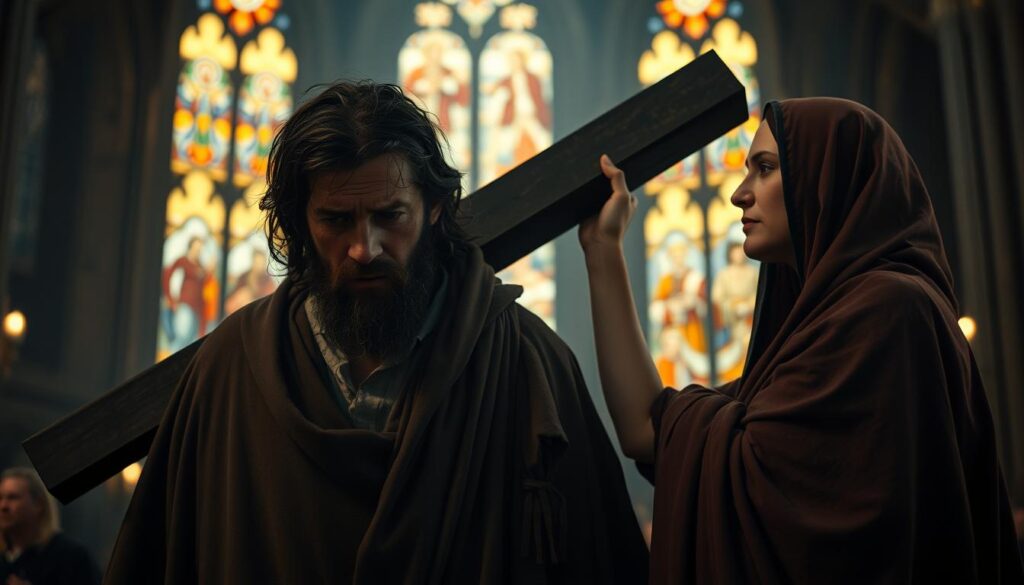
A dimly lit cathedral interior, stained glass windows casting a warm glow. In the foreground, two figures stand solemnly - Simon, a weathered man, and Veronica, a woman with a pained yet compassionate expression. Simon carries a heavy cross, his face etched with exhaustion, while Veronica tenderly wipes the sweat and blood from his brow with a cloth. The scene is captured with a shallow depth of field, emphasizing the intimate, emotional moment between the two. Subtle, atmospheric lighting and muted tones evoke a sense of reverence and contemplation, as if the viewer is bearing witness to a sacred, transformative event.

When Strangers Become Sacred Helpers

Simon Cyrene’s story teaches us about reluctant service. Though forced to carry the cross, his assistance became a transformative act of solidarity. This moment reminds us that grace often appears through unexpected partnerships.

Small Acts With Eternal Impact

Veronica’s choice to wipe a bleeding face shows how brief actions create lasting meaning. Her towel became a canvas for Christ’s image – proof that compassion leaves imprints beyond momentary suffering. This encounter challenges us to engage actively with others’ pain.

Figure Action Symbolic Meaning
Simon Carrying the cross Shared burdens strengthen community
Veronica Wiping Jesus’ face Kindness preserves dignity
Women Weeping together Collective grief fuels hope

The mother of Jesus appears throughout these moments as a model of quiet strength. Her presence underscores how love endures even when words fail. Together, these figures show faith’s power to transform bystanders into active participants.

Exploring the Religious Significance

At the heart of this spiritual journey lies a profound truth that reshapes how believers view suffering and redemption. Every step reveals layers of meaning that go beyond retelling events – they unlock understanding of divine love’s transformative power.

Linking the Stations to the Passion Narrative

The sequence of events mirrors Gospel accounts of Christ’s final hours. When Jesus extended his hands on the cross, this wasn’t just physical suffering – it symbolized embracing humanity’s brokenness. His words “Father, into your hands I commit my spirit” show perfect trust even in agony.

Three hours of anguish on the wooden beam carried cosmic weight. Each moment fulfilled ancient prophecies while bridging heaven and earth. As believers walk through these scenes, they see how every choice Jesus made – from trial to final breath – served a greater purpose.

Meditation on these events helps people grasp their role in the story. The weight that caused the Savior’s collapse wasn’t just wood – it represented the spiritual burden of human failings. This realization turns abstract concepts like forgiveness into personal encounters.

Gospel Event Spiritual Lesson Modern Impact
Condemnation Unjust suffering Builds empathy
Carrying the cross Accepting life’s burdens Strengthens resilience
Final breath Ultimate surrender Inspires trust

Through this lens, the cross transforms from ancient torture tool to enduring hope symbol. It challenges believers to see their struggles as part of a larger tapestry woven by the Father’s love. What once meant death now offers endless life.

How to Practice the catholic 14 stations of the cross

To truly benefit from this journey, one must approach it with intentionality and openness. The practice becomes most meaningful when you create space for both structured guidance and personal reflection.
A detailed close-up illustration of a Catholic prayer guide for the 14 Stations of the Cross. The guide features elegant calligraphic text and ornate religious imagery, with a vignette design and a tactile, parchment-like texture. The lighting is soft and warm, casting subtle shadows that accentuate the depth and dimensionality of the guide's surface. The angle is slightly angled, providing a sense of depth and drawing the viewer's eye towards the center of the composition. The overall mood is contemplative and reverent, befitting the devotional nature of the subject matter.

Preparing Mentally and Spiritually

Begin by choosing a calm environment – perhaps a chapel with artwork or a quiet corner at home. Settle your thoughts with deep breaths, inviting focus on the sacred story you’re about to walk through. Many find lighting a candle helpful to symbolize Christ’s enduring presence.

Step-by-Step Guide to the Devotion

Each marker follows a rhythm of prayer and contemplation. Start with the traditional words: “We adore you, O Christ…” to center your heart. Follow with scripture passages that make ancient events feel immediate.

When meditating on moments like Jesus falls, imagine the weight he carried – both physical and spiritual. As St. Alphonsus wrote:

“In every stumble, see the strength to rise again.”

Step Action Purpose
1 Opening prayer Focus the heart
2 Scripture reading Ground in truth
3 Silent reflection Personal connection
4 Hail Mary/Our Father Communal unity

Most complete the journey in 30-45 minutes, but don’t rush. If time is limited, focus on 3-4 markers deeply. The prayer format adapts – some whisper rote words, others journal responses. What matters is authentic engagement with each sacred moment.

Incorporating Daily Prayer and Reflection

Weaving sacred moments into ordinary days creates a rhythm of spiritual connection. Morning routines transform when paired with intentional meditation, turning coffee sips into communion with divine purpose.

A serene, contemplative daily prayer reflection cross, bathed in soft, warm lighting. In the foreground, the intricate wooden cross stands tall, its surface weathered and worn, exuding a sense of time-honored tradition. The middle ground features a tranquil, dimly lit background, hinting at a place of quiet contemplation, perhaps a chapel or meditation space. The lighting casts gentle shadows, creating a reverent atmosphere, inviting the viewer to pause and reflect. The overall mood is one of solemnity, introspection, and a deep connection to the spiritual journey.

Small Steps With Big Impact

Start by linking brief reflections to existing habits. Pair your first cup of tea with a moment from Christ’s journey. These micro-meditations plant seeds of grace that blossom through your day.

Struggling with a difficult task? Recall Simon’s unexpected role in salvation history. As one pastor notes:

“Our daily crosses become lighter when carried in solidarity with the Savior.”

Time Practice Benefit
Morning Reflect on one station Sets spiritual tone
Noon Silent gratitude prayer Renews perspective
Evening Examen with station theme Deepens self-awareness

Combine traditional prayers like the Hail Mary with station themes for layered meaning. A whispered “Holy Mary” while waiting in traffic becomes an anchor to sacred story.

Your heart becomes the true chapel. No need for elaborate rituals – just willingness to pause and connect. Over time, these moments rewire how you experience both joy and struggle, revealing hidden grace in ordinary life.

Connecting the Devotion to Holy Week Observances

Among the most solemn days in the Christian calendar, Good Friday stands apart as a time of profound reflection. This sacred observance transforms ancient traditions into living acts of remembrance, inviting participants to walk with renewed awareness of divine love’s ultimate expression.

The Spiritual Importance of Good Friday

Many communities gather on this holy day to retrace the path of sacrifice through shared prayer. As voices unite in hymns and whispered petitions, the cross Jesus carried becomes more than historical artifact – it mirrors the burdens we help carry through compassionate action.

Consider the moment when Jesus falls first under the crushing weight. A pastor recently shared:

“That initial stumble cracks open our hearts – it shows God entering fully into human frailty to redeem it.”

Special services often blend traditional elements with modern touches:

Element Purpose Impact
Communal hymns Unite voices Strengthens shared purpose
Extended silence Personal reflection Deepens self-awareness
Symbolic gestures Physical engagement Makes prayer tangible

Through these practices, believers discover fresh meaning in ancient truths. The falls first moment becomes a mirror – revealing how daily choices contribute to collective healing or brokenness. This sacred day offers space to grieve imperfections while embracing transformative grace.

Modern Reflections on an Ancient Tradition

Across changing eras, this spiritual pathway continues finding fresh resonance. New expressions honor its roots while speaking to current realities. A 20th-century innovation called Via Lucis now walks alongside the traditional journey, shifting focus to resurrection hope.

Personal Meditations and Contemporary Relevance

Today’s practitioners blend time-honored patterns with personal creativity. Some visualize modern parallels – seeing Christ’s body in refugee struggles or environmental crises. Others find the weight of daily challenges mirrored in the sacred narrative.

The Via Lucis expansion highlights Easter’s transformative power. Its 14 resurrection moments remind believers that light always conquers darkness. This dual approach – honoring pain while celebrating victory – meets our world’s complex spiritual needs.

Personal journals reveal surprising connections. A nurse wrote: “Wiping patients’ brows becomes my Veronica moment.” A teacher shares how helping students carry life’s burdens echoes Simon’s story. These lived experiences keep the tradition beating in modern hearts.

As our world evolves, so does this practice. Yet its core remains – a timeless invitation to walk with love through suffering into hope. Whether using apps or rosaries, believers keep finding their hearts reshaped by this enduring journey.

FAQ

What’s the significance of the 14 stations?

Each station represents a pivotal moment in Jesus’ final journey, from condemnation to burial. These stops invite reflection on sacrifice, love, and resilience, deepening one’s connection to His Passion.

How do figures like Simon of Cyrene and Veronica enhance the devotion?

Simon’s act of carrying the cross and Veronica wiping Jesus’ face highlight compassion amid suffering. Their roles remind us to serve others selflessly, even in challenging times.

Can this practice be done outside of Lent?

Absolutely! While often linked to Lent and Good Friday, the devotion offers year-round spiritual growth. Many find daily prayer with the stations fosters peace and mindfulness.

Why is Good Friday central to this tradition?

Good Friday marks Jesus’ crucifixion, making it a focal point for meditating on His sacrifice. The stations guide believers through His suffering, enriching Holy Week observances.

How can beginners start incorporating this devotion?

Begin with short prayers at one or two stations, focusing on their meaning. Use simple reflections or artwork to visualize each moment. Gradually build consistency as comfort grows.

What moments from Jesus’ journey are emphasized?

Key events include His three falls, meeting His mother, and being nailed to the cross. These moments emphasize humanity, endurance, and the weight of sacrifice.

Are there modern ways to engage with this ancient practice?

Yes! Many use digital guides, community walks, or artistic interpretations. Personal meditations on overcoming struggles today can also bridge the ancient and contemporary.


Inspiring Catholic Quotes for Strength


When life feels overwhelming, many turn to trusted sources of guidance that have uplifted generations. The teachings of revered spiritual figures offer more than comfort—they provide practical tools to navigate modern challenges while staying rooted in enduring truths.

Historical voices like St. Philip Neri and St. John Henry Newman understood human struggles deeply. Their insights, forged through personal trials, continue to resonate because they address universal needs: hope during uncertainty, perseverance through pain, and clarity amid confusion.

These sacred words create bridges between daily life and eternal truths. They remind us that true resilience grows not from self-sufficiency, but from trusting a higher purpose. This perspective helps reframe difficulties as opportunities for growth rather than insurmountable obstacles.

Key Takeaways

  • Timeless wisdom from spiritual mentors offers guidance relevant to today’s challenges
  • Sacred teachings provide actionable strategies for maintaining hope during hardships
  • Authentic insights come from figures who experienced profound personal struggles
  • Enduring messages emphasize trust in divine care over temporary circumstances
  • Historical perspectives help reframe modern problems through eternal truths
  • Spiritual resources remain accessible anytime, offering immediate encouragement

Embracing Faith Through Inspirational Wisdom

Navigating daily challenges becomes easier when we lean on time-tested truths. Spiritual mentors across generations have shown how active trust in divine guidance shapes our responses to life’s ups and downs.

Reflecting on Life and Love

Ordinary moments gain deeper meaning through faith. Making dinner or commuting to work can become acts of devotion when approached with intentionality. This perspective helps us see grace in routine tasks and relationships.

Source of Wisdom Key Teaching Modern Application
St. Thérèse of Lisieux “Love proves itself by deeds” Prioritize acts of kindness over grand gestures
St. Francis de Sales “Have patience with all things” Practice mindfulness during stressful workdays
St. Augustine “Our hearts are restless until they rest in You” Create daily quiet time for reflection

The Role of Saints in Guiding Our Journey

These spiritual trailblazers left roadmaps for modern believers. Their writings address timeless struggles – doubt, loneliness, burnout – with practical solutions. By studying their lives, we gain actionable strategies for maintaining hope.

Finding Spiritual Anchors in Tough Times

When storms hit, sacred teachings offer stability. They remind us that pain often precedes growth. As one modern teacher notes: “Crisis becomes catalyst when met with courageous faith.”

This approach transforms challenges into stepping stones rather than stumbling blocks. It helps us build resilience while keeping our ultimate purpose in clear view.

Essential Catholic Quotes for Strength

Spiritual mentors across centuries have lit pathways through life’s darkest valleys with enduring wisdom. Their words continue to guide seekers toward hope, offering practical tools to transform challenges into stepping stones.

Uplifting Words from Mother Teresa and St. Teresa Avila

Mother Teresa’s teachings reveal power in compassionate action:

“Love begins at home… how much love we put in that action.”

This perspective turns ordinary tasks into sacred service. St. Teresa Avila counters fear with divine assurance:

“Who has God, lacks nothing. God alone is enough.”

A serene, hyper-realistic portrait of Mother Teresa and Saint Teresa of Avila, their faces illuminated by soft, warm lighting that casts a contemplative, reverent atmosphere. The two women are depicted gazing intently, their expressions conveying a profound sense of spiritual wisdom and inner strength. The background is subtly blurred, placing the focus entirely on their visages and the potent, inspirational energy they emanate. Meticulous attention to detail captures the texture of their skin, the folds of their habits, and the depth of their eyes, creating a visually striking and emotionally resonant image that embodies the essence of Catholic faith and resilience.

Insights on Forgiveness, Mercy, and Prayer

Mother Angelica’s bold advice cuts through resentment: “You can’t go to heaven hating somebody.” Letting go becomes spiritual strength-building. Saint Faustina’s method for tough moments – fixing one’s gaze on Christ’s heart – transforms isolation into connection.

Padre Pio’s counsel addresses modern loneliness: “When your heart feels life’s solitude, pray.” This daily practice builds resilience through intentional communion rather than passive endurance.

Empowering Messages for Daily Renewal

These saints demonstrate that spiritual vitality grows through consistent habits. Small acts of mercy, brief prayer pauses, and conscious gratitude create compounding effects. As St. Teresa Avila reminds us: “To have courage for whatever comes – everything lies in that.”

Their wisdom offers immediate applications: smile at a stranger, breathe deeply during stress, or journal one blessing nightly. Such practices root us in timeless truth while navigating modern complexities.

Learning Life Lessons from the Words of Saints

Every generation discovers fresh wisdom in ancient truths. Spiritual mentors like St. Augustine and St. Francis of Assisi left roadmaps for transforming struggles into stepping stones. Their teachings reveal how ordinary people can navigate extraordinary challenges through simple, actionable faith.

Practical Guidance for Overcoming Life’s Challenges

St. Augustine’s insight cuts through modern anxiety:

“God always gives what we need for salvation, not just what we want.”

This truth reframes setbacks as divine redirection. When facing uncertainty, his prayer –“Watch over each step and guide me”– models how to embrace seeking as spiritual strength.

Saint Francis of Assisi found purpose in pain:

“Every sorrow becomes dear when I think of heaven’s joy.”

His words teach us to view hardships through eternity’s lens. Thomas Merton’s reassurance –“You will never face perils alone”– turns fear into fuel for courageous action.

How Faith Inspires Acts of Service and Love

Fulton Sheen’s advice reshapes priorities:

“Happiness comes from wanting what God wills.”

This shift transforms self-focused goals into service-driven purpose. Saints demonstrate that love thrives throughconsistent small actions– feeding the hungry, listening patiently, or smiling at strangers.

Their lives prove faith isn’t passive. As we walk our unique path, their examples remind us: serving others heals our own wounds. Whether helping a neighbor or donating time, every act of love echoes divine care in tangible ways.

Conclusion

Sacred words from spiritual mentors remain vital in modern life. By carrying these truths into daily routines – morning reflections, whispered prayer pauses, or posting meaningful phrases where they catch your eye – we build bridges between ancient wisdom and today’s challenges.

These practices anchor us when storms hit. Saints like Teresa and Augustine show how ordinary moments gain eternal significance through intentional living. Their experiences prove that grace often arrives disguised as difficulties, reshaping our hearts through perseverance.

Keeping these teachings close transforms how we engage the world. Shared kindness becomes our language. Quiet trust replaces anxiety. Each day becomes an opportunity to choose hope over despair, knowing our ultimate home lies beyond earthly struggles.

Let these spiritual insights guide your journey. Their power lies not in perfect execution, but in consistent engagement. As you walk this path, you’ll discover what countless others have – true joy blooms when we align daily choices with heaven’s timeless rhythm.

FAQ

How can quotes from saints provide strength during difficult moments?

Words from figures like St. Teresa of Ávila or Mother Teresa often focus on trust, perseverance, and surrendering worries to a higher purpose. Their insights remind us we’re never alone, fostering courage through faith-centered perspectives.

What themes do Mother Teresa’s teachings emphasize for daily renewal?

Her messages highlight compassion, humility, and finding joy in serving others. Quotes like “Not all of us can do great things, but we can do small things with great love” encourage purposeful actions rooted in kindness.

Why are forgiveness and mercy recurring topics in spiritual wisdom?

Letting go of resentment frees the heart to embrace peace. Saints like Thérèse of Lisieux stressed mercy as a path to healing, urging individuals to mirror divine grace in their relationships.

How do saints’ words inspire acts of service?

Many teachings connect faith with tangible love—feeding the hungry, comforting the lonely, or praying for those in need. These calls to action reinforce that true spirituality thrives through selfless deeds.

Can reflecting on spiritual quotes improve mental resilience?

Yes. Phrases like St. Teresa of Ávila’s “Let nothing disturb you” redirect focus from fear to trust. Such mantras anchor the mind, offering clarity and calm amid life’s storms.

What role do saints play in guiding personal journeys?

Their lived examples—overcoming doubt, persecution, or hardship—serve as roadmaps. Their words often provide practical advice for nurturing hope, patience, and unwavering confidence in divine timing.

Understanding the Catholic Perspective on Abortion


Exploring moral questions about life and human dignity often leads to complex conversations. The Catholic Church approaches these discussions by blending faith with philosophical reasoning. At its core lies a simple yet profound question: When does human life begin?

Medical science plays a role in this dialogue. Leading embryology texts confirm that fertilization creates a genetically unique human organism. This biological reality forms part of the Church’s moral framework. Teachings emphasize that every person holds inherent value, regardless of developmental stage or physical dependence.

While debates continue worldwide, Catholic ethics maintain consistent principles. The Church’s position stems from natural law theory – the idea that moral truths exist within human nature itself. This perspective integrates religious beliefs with observable realities about human development.

Key Takeaways

  • The Church views life as beginning at conception through scientific and theological lenses
  • Moral teachings combine faith traditions with natural law philosophy
  • Human dignity remains central to ethical considerations
  • Medical definitions influence religious interpretations of personhood
  • Contemporary discussions balance ancient wisdom with modern challenges

Historical and Theological Foundations

Ancient texts reveal how early Christians grappled with questions of life’s origins. The Didache, a first-century manual for believers, bluntly instructed: “You shall not kill the embryo by abortion”. By 314 AD, the Council of Ancyra enforced strict penalties for ending pregnancies, showing the church’s longstanding ethical stance.

Early Church Teachings on Life and Ensoulment

Church leaders like Tertullian argued against harming life at any stage: “What is to become a person already exists as one”. St. Basil later removed any ambiguity, declaring abortion equivalent to murder regardless of fetal development. These voices shaped a moral framework protecting the unborn through centuries.

Evolution of Church Teaching Through the Centuries

While medieval thinkers debated when souls entered bodies, the church hierarchy never wavered on abortion’s immorality. The Catechism today echoes fourth-century councils, proving two millennia of consistent church teaching. Even philosophical debates about ensoulment never justified ending pregnancies early.

The Intersection of Science, Conscience, and Religious Belief

Modern breakthroughs in biology have reshaped age-old ethical debates. Researchers now track human development with unprecedented clarity, revealing how unique genetic identity emerges at conception. This scientific reality intersects with spiritual values, creating a dynamic space for reflection.

A detailed close-up of the sequential stages of human embryo development, rendered in a scientifically accurate and visually striking manner. Crisp, high-resolution imagery showcasing the gradual cellular division and growth, captured through a macro lens with soft, diffused lighting that highlights the delicate structures. The embryo forms appear to float in a serene, minimalist background, conveying a sense of reverence and contemplation around the origins of human life. The composition and color palette evoke a meditative, almost sacred atmosphere, suitable for illustrating the intersection of science, conscience, and religious belief.

Scientific Insights on Human Development and the Embryo

Genetics confirms what microscopes show: a fertilized egg contains 46 distinct chromosomes – the biological signature of human life. Within days, embryonic cells organize into complex systems. By week five, neural activity begins. These milestones reinforce the Church’s view that personhood starts early.

Developmental biology also explains why no two embryos are alike. Even identical twins have epigenetic differences. Such discoveries challenge casual assumptions about early-stage pregnancies.

The Role of Individual Conscience in Moral Decision-Making

While science informs beliefs, choices often involve personal judgment. The Catechism teaches that “conscience is a law of the mind” – but not infallible. Like a muscle, it requires training through:

  • Study of moral principles
  • Reflection on actions
  • Guidance from community wisdom

This approach differs from “follow your heart” individualism. Properly formed conscience considers both objective truths and specific situations. As St. John Henry Newman noted, it’s “the aboriginal Vicar of Christ” – a guide needing education, not replacement.

Expert Roundup: Embracing catholicism on abortion in Modern Debates

Catholic intellectuals today navigate complex terrain when addressing life’s beginnings. While core teachings remain steadfast, scholars explore new ways to engage with evolving ethical questions.

Diverse Interpretations Among Catholic Scholars

Some groups propose that supporting legal abortion aligns with Catholic values through personal conscience. “Moral decisions ultimately rest with individuals,” argues one organization’s statement. However, most theologians emphasize that conscience must align with objective moral truths.

Philosophers like Dombrowski suggest consciousness defines personhood. Critics counter that this reasoning risks devaluing vulnerable populations. As one ethicist notes: “Newborns don’t debate philosophy either.”

Balancing Faith with Contemporary Moral and Legal Challenges

Modern debates often center on three key questions:

  • How science impacts definitions of human life
  • Whether religious ethics influence secular laws
  • How to address difficult pregnancy scenarios

Church documents like Evangelium Vitae reaffirm the right to life while encouraging compassionate support for struggling mothers. Scholars stress that Catholic teachings aim to protect both people and principles in complex situations.

This ongoing dialogue shows how ancient wisdom adapts to new challenges without abandoning core truths. Through respectful debate, Catholic thought continues shaping global conversations about human dignity.

Societal and Legal Implications in the United States

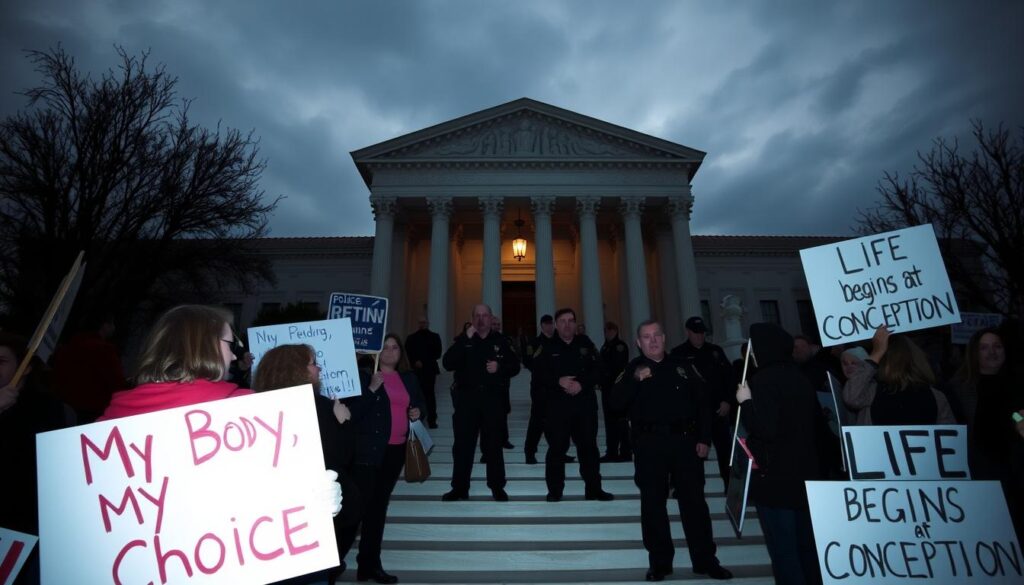
A dimly lit courthouse steps, protesters on both sides of the legal abortion debate passionately voicing their views. In the foreground, a group holding signs with slogans like "My Body, My Choice" and "Life Begins at Conception". In the middle, police officers maintaining order, their uniforms casting long shadows. In the background, the grand façade of the courthouse, its columns and pediments evoking the weight of the law. Overhead, a moody, overcast sky, the natural light filtered and muted, creating a palpable sense of tension and gravity. The scene conveys the societal and legal complexities surrounding the abortion issue in the United States.

The relationship between religious values and civil laws remains a defining conversation in American society. Catholic teachings on human dignity often spark debates about how faith intersects with public policy. Former presidential candidate John Kerry once stated he wouldn’t impose Church views on voters. Yet Catholic leaders argue that protecting life aligns with universal ethics, not just religious doctrine.

Impact of Religious Teachings on Public Policy

Legal battles often center on whether faith-based arguments belong in lawmaking. The Supreme Court’s 1879 Reynolds decision limited religious practices harming others, while 1944’s Prince case upheld child welfare laws. These rulings shape how courts evaluate:

  • Laws restricting access to certain medical procedures
  • Mandates requiring government funding alternatives
  • Regulations balancing individual rights with communal values

Political Discourse and Legal Perspectives on Abortion

Harvard’s Laurence Tribe notes religious groups have always participated in policy debates. As he explains: “Theological beliefs don’t invalidate laws if secular reasoning supports them.” This principle guides Catholic organizations advocating for life protections through:

  • Education campaigns about fetal development
  • Support services for pregnant women
  • Legal challenges to expand right to life arguments

Current laws recognize birth as the start of legal personhood, creating tension with religious views on earlier life beginnings. Voters and lawmakers continue wrestling with how people of faith engage in pluralistic democracy while honoring their convictions.

Conclusion

Building bridges in difficult conversations requires both conviction and compassion. Catholic teachings blend moral clarity with care for those facing tough choices. This approach values dialogue rooted in respect for life and individual circumstances.

Scientific evidence shows unborn children are distinct human beings. Yet discussions need gentleness, especially with those affected by abortion. Church communities offer post-abortion healing programs and reconciliation, helping people rebuild through “radical hospitality”.

Supporting women means addressing both emotional needs and practical help. Crisis pregnancy centers and parish programs provide essentials while upholding the dignity of both parent and child. These efforts reflect a commitment to life-affirming solutions.

When differences arise, focus on common ground. Many agree society should protect vulnerable lives. Focusing on shared values can turn debates into constructive conversations about supporting families.

At its core, Catholic ethics champion every person’s worth. This belief drives efforts to create a world where difficult choices don’t require sacrificing fundamental rights. Through hope and solidarity, communities can address complex issues while honoring human dignity.

FAQ

What is the Catholic Church’s official position on abortion?

The Church teaches that life begins at conception and opposes abortion as a violation of the unborn child’s right to life. This stance is rooted in moral teachings, scripture, and natural law, emphasizing the sacredness of all human life.

How does individual conscience play a role in Catholic teachings about abortion?

While the Church strongly condemns abortion, it acknowledges that individuals must follow their conscience in moral decisions. However, it urges believers to form their conscience through prayer, reflection, and alignment with Church doctrine to avoid harmful actions.

Has the Church’s view on abortion changed over time?

Core teachings about the sanctity of life have remained consistent, but discussions around medical exceptions or complex pregnancies have evolved. Modern debates often address how to apply timeless principles to new scientific or ethical challenges.

How do Catholic teachings influence laws about abortion in the U.S.?

Many Catholic leaders advocate for policies that restrict abortion access, citing moral responsibility. However, legal debates often balance religious beliefs with constitutional rights, leading to varied political and social responses across states.

What does the Church say about abortions in cases of health risks or rape?

The Church opposes abortion even in difficult circumstances but emphasizes support for mothers through counseling, healthcare, and community aid. It encourages alternatives like adoption while prioritizing compassion for those facing trauma.

How do Catholic scholars address disagreements about abortion within the faith?

While most scholars uphold official teachings, some explore nuanced perspectives on topics like early pregnancy or maternal health. Open dialogue aims to reconcile tradition with modern realities while respecting human dignity.

Why does the Church prioritize the embryo’s rights over the mother’s choice?

The Church views the embryo as a person with inherent value from conception. This belief leads to prioritizing protection for both mother and child, rejecting actions that intentionally end a life, even in challenging situations.

Can Catholics support legal abortion while personally opposing it?

Church leaders discourage endorsing laws permitting abortion, arguing it contradicts moral duty. However, some Catholics advocate for reducing abortions through social support rather than bans, reflecting diverse approaches to pro-life advocacy.

The 2nd Catholic Commandment: What It Means


Many people wonder why discussions about the Ten Commandments vary across Christian traditions. The answer lies in how different groups organize these ancient laws. While the Bible doesn’t number them, faith communities have developed distinct systems over centuries.

In the Catholic tradition, the first commandment covers both exclusive worship of God and prohibitions against idolatry. This differs from Protestant interpretations that separate these concepts into two directives. The Church’s approach emphasizes complete devotion to divine authority rather than focusing solely on physical representations.

Historical context helps explain this difference. Early Christian leaders grouped commandments to highlight theological priorities. This structure reinforces that worship belongs solely to God, with imagery serving as tools for devotion rather than objects of worship themselves.

Understanding this distinction clarifies why religious art and statues hold significance in Catholic practice. These elements aren’t worshipped but help focus attention during prayer and reflection. The Church maintains its teachings align fully with biblical principles, despite organizational variations.

Key Takeaways

  • Christian traditions number commandments differently due to biblical text organization
  • The Catholic Church combines worship directives Protestants separate
  • Commandment numbering reflects theological emphasis, not content removal
  • Religious imagery serves devotional purposes rather than idolatrous ones
  • Historical context shapes how faith groups interpret ancient laws

Biblical Foundations and Historical Context

Ancient texts often reveal deeper meanings when we explore their original settings. The Ten Commandments gain clarity when studied through their cultural and literary background. Let’s examine how these directives developed across centuries of sacred history.

Exodus and Deuteronomy Insights

Exodus 20:4’s famous warning against making “any likeness of what’s in heaven above or the earth beneath” connects directly to verse 3’s command against serving “gods” besides Yahweh. This pairing shows the Old Testament primarily targets idol worship rather than artistic expression.

Deuteronomy’s restatement introduces subtle shifts. Where Exodus groups “house” and “wife” together, Deuteronomy 5:21 separates them. This progression reveals how words evolved to address community needs more precisely over time.

Progressive Revelation in the Old Testament

Scripture unfolded across 1,500 years like a slow sunrise. Early permissions for divorce (Deuteronomy 24:1) later face divine criticism (Malachi 2:16) before Jesus’ final clarification (Matthew 19:8). This pattern applies to understanding images too.

Hebrews 1:1-2 captures this concept perfectly: “God spoke to our fathers in many ways.” Each generation received clearer insights as people grew ready to grasp deeper truths. What began as strict rules against Canaanite idol worship matured into nuanced spiritual principles.

The Role of Images and Idolatry in Scripture

Scripture contains surprising examples where divine instructions require artistic creations. These passages challenge modern assumptions about religious symbols. Let’s explore how sacred texts distinguish between meaningful imagery and forbidden idolatry.

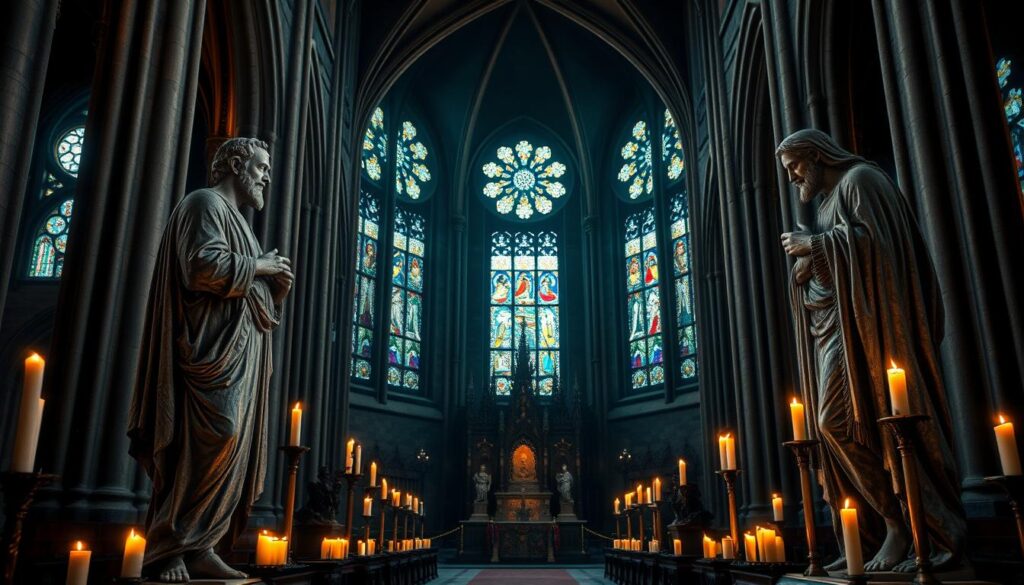
A grand cathedral's interior, dimly lit by flickering candles. In the foreground, imposing stone statues of biblical figures stand in reverence, their weathered features capturing a sense of ancient divinity. Ornate altars and ornaments adorn the middle ground, hinting at the rich symbolism and ritual of religious worship. In the background, stained glass windows cast kaleidoscopic patterns of colored light, creating an atmospheric, almost ethereal ambiance. The scene conveys a potent blend of reverence, mysticism, and the potential for idolatry, reflecting the complex role of religious imagery in Scripture.

Statues, Cherubim, and Commanded Images

God directly ordered Moses to craft golden cherubim statues for the Ark’s lid (Exodus 25:18-22). These winged figures served as visual reminders of heavenly realities. Centuries later, Solomon’s Temple featured massive angelic statues – 15-foot-tall cherubim with olivewood bodies and gold overlay.

The bronze serpent story reveals another layer. When venomous snakes plagued Israel, God told Moses to “make a snake and put it on a pole” (Numbers 21:8). This healing symbol later became misused, showing how context determines an object’s purpose.

Biblical Examples of Image Worship

Ancient Israel struggled with confusing holy symbols and idols. The golden calf incident (Exodus 32) demonstrates worship gone wrong – people danced around a statue while calling it their deliverer. Contrast this with the Ark’s cherubim, which pointed beyond themselves to God’s presence.

King Hezekiah’s reform makes this distinction clear. He destroyed Moses’ bronze serpent because people burned incense to it (2 Kings 18:4). The object wasn’t evil – its misuse as an idol demanded removal.

Approved Images Forbidden Idols Key Difference
Ark cherubim Golden calf Divine instruction vs human invention
Bronze serpent Nehushtan worship Healing tool vs worshiped object
Temple carvings Baal statues Artistic decoration vs deity replacement

These examples show biblical faith values intent over objects. Sacred art becomes problematic only when people confuse representation with reality. Properly used images direct hearts toward spiritual truths rather than replacing them.

Understanding the Catholic 2nd Commandment: Faith in Tradition

Throughout history, religious practices have sparked intense debates about proper devotion. The Church addressed these discussions head-on during the 16th-century Council of Trent. This pivotal meeting shaped how believers interact with sacred art today.

The Council of Trent’s Clarification

Facing Reformation-era criticisms, Church leaders made bold declarations about religious symbols. Their 1563 decree stated: “Images of Christ, the Virgin, and saints should be kept in churches.” This ruling affirmed visual aids as spiritual tools rather than idols.

The council drew clear lines between veneration and worship. Latria (divine adoration) belongs solely to God. Dulia (honorary respect) applies to holy figures. This distinction prevents confusion between honoring heroes and worshipping deities.

Approved Practice Forbidden Action Key Principle
Displaying Mary and saints’ images Bowing to statues as divine Honor passes to the person, not the object
Lighting candles before icons Asking images for miracles Art inspires prayer but doesn’t answer it
Processions with sacred statues Believing statues hold power Focus remains on heavenly realities

Modern churches follow these guidelines through updated catechism teachings. While statues fill sacred spaces, members aren’t required to use them. The Church emphasizes that plaster and paint hold no magic – they simply point toward higher truths.

This balanced approach maintains tradition while avoiding superstition. As one theologian noted: “We don’t kiss family photos because they’re magical – we kiss them because they remind us of love.” Sacred art works similarly in faith communities.

Contrast in Commandment Numbering and Interpretations

Religious traditions sometimes differ in ways that surprise casual observers. The Ten Commandments present a fascinating case study – identical texts interpreted through distinct organizational lenses. Scripture’s original lack of numbering created space for meaningful variations in understanding divine law.

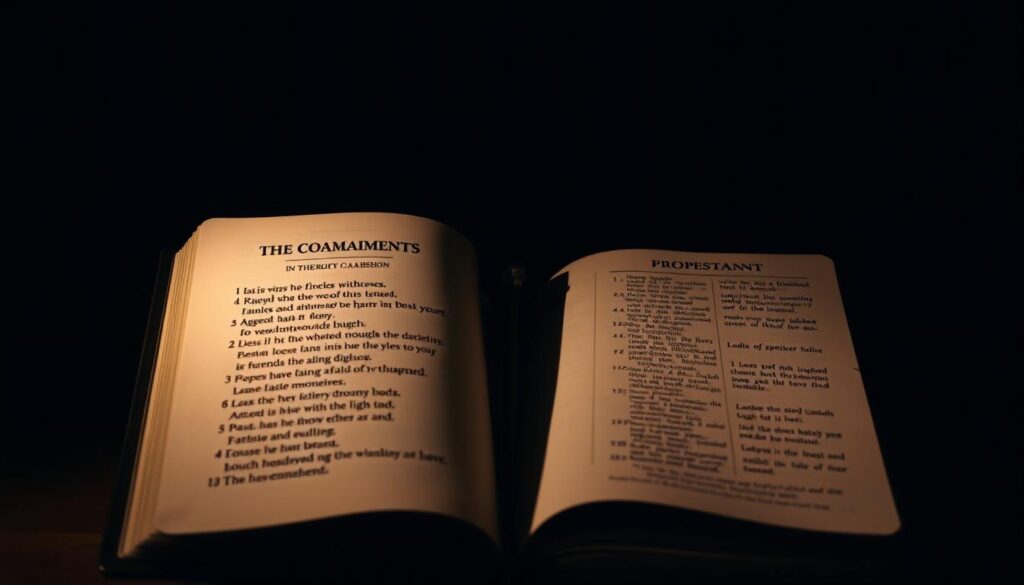
A dimly lit room with two open holy books, one Catholic and one Protestant, their pages illuminated by a soft, warm glow. The Catholic book displays the traditional 10 commandments, while the Protestant book shows a different numbering and interpretation. In the background, a shadowy figure ponders the contrast, creating an atmosphere of contemplation and theological inquiry. The scene is shot with a shallow depth of field, emphasizing the focus on the open books and the subtle differences between them.

Historical Divisions of the Commandments

Ancient Hebrew texts contain 13 distinct directives where we now count ten. Faith communities condensed these into memorable groupings. One system combines warnings against false gods and idol-making into a single first commandment, while another treats them separately.

This organizational choice impacts how believers prioritize spiritual dangers. When grouped together, the focus shifts to complete rejection of anything competing with divine authority. Separated commands highlight specific risks like physical idol creation versus misplaced allegiances.

Implications for Worship and Practice

Numbering differences shape devotional approaches. Communities combining the initial directives often emphasize internal motivations over external actions. Those separating them might create specific rules about religious art and symbolic gestures.

The final commandments reveal another contrast. Some traditions distinguish between coveting relationships and possessions, while others treat all desire equally. This affects teachings about marriage, property rights, and personal contentment.

Catholic System Protestant System Practical Impact
Combined worship commands Separate deity/image rules Art usage guidelines differ
Split coveting rules Single coveting command Marriage vs property ethics
Honor parents as #4 Honor parents as #5 Family role prioritization

These variations remind us that love keep commandments matters more than numbering systems. As one scholar noted: “The law’s spirit outlives its organizational structure.” Both approaches aim to guide believers toward righteous living through different pedagogical paths.

Modern Implications and Debates on Idolatry

Modern discussions about religious symbols often spark heated debates. Many misunderstand practices involving sacred art, confusing respectful honor with divine worship. Let’s explore how ancient principles apply to today’s spiritual landscape.

A heated debate on religious symbols, with a central figure holding a large cross standing amidst a swirling tempest of clashing symbols - crescent moons, stars, geometric patterns, and other iconography. The lighting is dramatic, with beams of light piercing through the turbulent atmosphere, casting intense shadows and highlights. The scene conveys a sense of passionate discourse, where deeply held beliefs and cultural traditions collide, creating an atmosphere of tension and intellectual fervor. The composition is balanced, with the central figure serving as a focal point, drawing the viewer's eye amidst the chaos of the surrounding symbols.

Contemporary Challenges and Misconceptions

Some critics claim churches use statues and images improperly. They point to saints’ depictions or communion rituals as potential idolatry. However, these practices follow specific guidelines established over centuries.

Biblical examples show people showing respect to leaders without worshipping them. The prophet Elijah received deep reverence, just as many honor historical figures today. Sacred art serves similar purposes – reminding believers of virtuous lives rather than replacing divine focus.

Modern confusion often stems from different definitions of honor. While God commands exclusive worship, showing respect to holy people appears throughout Scripture. The key difference lies in intention: Are we glorifying created things or the Creator?

Common Practice Misconception Reality
Lighting candles before icons “Worshipping statues” Honoring the person depicted
Praying to saints “Replacing God” Seeking heavenly support
Eucharistic adoration “Bread worship” Celebrating divine presence

Recent surveys show 62% of Americans misunderstand these distinctions. Clear communication helps bridge gaps between traditions. As one theologian notes: “Symbols speak louder than words – but only when we understand their language.”

Interfaith dialogue benefits from recognizing shared values. Most traditions agree that ultimate reverence belongs to the divine. How communities express this truth simply varies based on cultural and historical contexts.

Conclusion

Understanding sacred texts requires looking beyond surface-level differences. The debate over divine laws centers on how communities organize principles, not their essence. Both major Christian traditions preserve all biblical directives—they simply highlight various aspects of spiritual truth.

Pope Leo XIII’s teachings remind us that “the Old Testament prepares the way for salvation.” This perspective helps explain why some groups merge warnings against idolatry with calls for exclusive devotion. What matters most isn’t numbering, but whether our hearts turn toward heaven.

Scripture’s warning against creating “likenesses of anything in heaven” targets misplaced worship, not artistic expression. Modern believers face similar challenges—distinguishing between tools for connection and objects demanding loyalty.

Ultimately, the commandments guide people toward loving God and neighbor. Whether carved in stone or written on the heart, their power lies in shaping lives that reflect divine goodness on earth.

FAQ

Why do some Christian traditions split the Ten Commandments differently?

The division of the commandments stems from ancient Jewish and Christian interpretations. The Catholic Church follows Augustine’s tradition, combining prohibitions against idolatry into the first commandment and splitting coveting into two. Other traditions, like Lutheranism, follow a different numbering system rooted in earlier Hebrew texts.

How does the Church reconcile statues with Exodus 20’s warning against graven images?

The Catechism distinguishes between idolatrous worship and veneration of sacred art. For example, God commanded Moses to craft cherubim for the Ark (Exodus 25:18–20). Statues of saints or Mary are seen as reminders of faith, not objects of worship, aligning with Pope Leo III’s defense of icons in the 8th century.

Are there biblical examples of images being used positively?

Yes! The bronze serpent (Numbers 21:8–9) and the Ark’s cherubim (Exodus 37:7–9) were God-commanded images. These served as tools for teaching or worship aids, not idols. The key distinction lies in intent—whether the image directs hearts toward God or replaces Him.

How do modern believers avoid idolatry in a materialistic world?

The Catechism teaches that idolatry extends beyond statues to prioritizing wealth, power, or ideologies over God. It’s about the heart’s posture—guarding against letting anything, even good things, overshadow one’s devotion to the Divine.

Why does tradition play a role in interpreting commandments?

The Church views Scripture and Apostolic Tradition as intertwined. Councils like Nicaea II (787 AD) clarified that honoring sacred images isn’t worship but a way to deepen reverence for God’s work through holy figures, ensuring teachings remain consistent across generations.

Catholic Insights into 1 Corinthians 13: Love Defined


What makes some teachings endure for millennia while others fade? Paul’s profound reflection on love in his letter to early believers offers a masterclass in prioritizing what truly matters. This passage, often recited at weddings, originally served a deeper purpose: reorienting spiritual practices toward lasting values.

Scholars note how this text contrasts flashy talents with heart-centered living. While extraordinary abilities might impress crowds, Paul argues they become meaningless noise without compassion. The real magic happens when we pair our gifts with patience, kindness, and humility.

Modern readers might be surprised to learn this famous passage connects to practical community issues. It wasn’t written as abstract poetry but as guidance for balancing spiritual enthusiasm with enduring virtues. Like a skilled conductor, Paul shows how love harmonizes individual talents into collective purpose.

Key Takeaways

  • Lasting impact comes from character, not temporary abilities
  • True spiritual growth requires balancing gifts with compassion
  • Love outshines even the most impressive talents
  • Community harmony depends on selfless care for others
  • Enduring faith roots itself in everyday kindness

This exploration reveals why these ancient words still resonate. They remind us that our highest calling isn’t about personal achievements, but how we show up for others. As we unpack this text, you’ll discover practical ways to apply its wisdom in modern relationships and spiritual practice.

Understanding the Divine Definition of Love

The secret to lasting impact lies not in power but in tenderness. Paul’s famous passage peels back layers of religious performance to reveal love as faith’s beating heart. He begins by listing impressive spiritual abilities—speaking in tongues, prophetic knowledge, even martyrdom—only to declare them hollow without compassion’s warmth.

The Biblical Context of 1 Corinthians 13

Early believers in Corinth prized flashy spiritual displays, creating rivalries that fractured their community. Paul redirects their focus using three masterful arguments. First, he compares love-starved gifts to clanging cymbals. Next, he paints love’s portrait through active verbs like “patience” and “kindness.” Finally, he contrasts temporary talents with love’s eternal nature.

Interpreting Paul’s Persona and Language in the Passage

The apostle shares a personal metaphor to drive his point home: “When I was a child, I used to talk as a child, think as a child. This growth imagery challenges readers to mature beyond surface-level spirituality. His fifteen descriptors of love form a blueprint for community healing—addressing jealousy and division through practical care rather than dramatic displays.

Paul’s choice to frame love as action rather than emotion remains revolutionary. By replacing competition with selfless service, he transforms spiritual gifts from status symbols into tools for collective thriving. The man who once persecuted Christians now defines faith through radical compassion.

Exploring catholic 1 corinthians 13 and Its Spiritual Gifts

Why do some divine tools fade while others remain essential? Paul’s comparison of spiritual abilities with enduring compassion offers fresh perspective. Temporary talents serve specific purposes, but love operates on an eternal frequency that outlasts every circumstance.

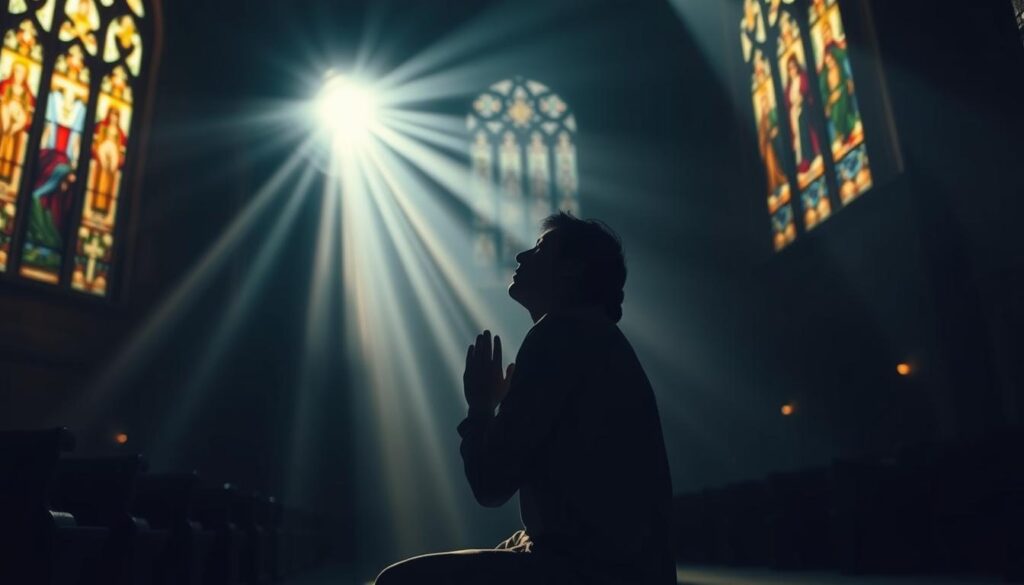
A dimly lit cathedral interior, stained glass windows casting a warm, ethereal glow. In the foreground, a figure kneeling in reverent prayer, hands clasped, expression serene. Shafts of heavenly light illuminate a halo-like aura around their head, symbolizing the spiritual gifts of the Holy Spirit. In the middle ground, two intertwined hands emerge from the shadows, palms facing upwards, representing the eternal, divine love described in 1 Corinthians 13. The background is hazy, with a sense of timelessness and the infinite nature of God's love. Soft, diffused lighting creates a contemplative, sacred atmosphere, inviting the viewer to meditate on the spiritual gifts and eternal love at the heart of the Catholic faith.

The Relationship Between Spiritual Gifts and Love

Think of extraordinary abilities like prophecy or speaking in tongues as specialized tools. They help build communities during specific seasons. However, love acts as the blueprint guiding their proper use. Without this foundation, even impressive displays become disconnected from their true purpose.

Contrast Between Temporary Gifts and Eternal Love

Paul uses striking contrasts to show why love matters most. Spiritual gifts address partial needs, while compassion addresses the whole person. Consider this comparison:

Element Purpose Duration
Prophecies Guidance for now Until fulfillment
Knowledge Understanding mysteries Until completion
Tongues Prayer expression Until perfection comes
Love Unifying force Never ends

This table reveals why love remains central. While other gifts solve temporary puzzles, compassion builds lasting connections.

Insights from Biblical Commentaries

Scholars emphasize that spiritual gifts become unnecessary when we experience divine completeness. As one commentary notes: “What’s partial fades when wholeness arrives.” Love persists because it reflects God’s unchanging nature rather than human needs.

The four-fold description of love’s resilience—bearing, believing, hoping, and enduring—shows its comprehensive power. Unlike temporary talents that address specific gaps, love strengthens every relationship dimension. This understanding helps communities value gifts without idolizing them, keeping compassion as their north star.

Practical Applications of Love in Daily Christian Living

What does living out divine love look like in real time? Paul’s blueprint transforms poetic ideals into actionable habits. Let’s explore how his timeless wisdom reshapes ordinary moments into extraordinary opportunities for growth.

Implementing Patience and Kindness in Everyday Interactions

“Love is patient, love is kind” becomes tangible when we pause before reacting. Try this: When tensions rise, ask: “Will my response build bridges or walls?” Small choices—like listening fully before speaking—turn abstract virtues into concrete acts.

Paul’s warning that we “gain nothing” without love challenges us to check motives. Are we serving to impress others or to genuinely uplift them? A simple table clarifies mature versus immature approaches:

Behavior Immature Response Mature Response
Criticism received Defensiveness Curiosity (“What can I learn?”)
Others’ success Jealousy Celebration
Personal offense Brooding over injury Prompt forgiveness

Overcoming Personal Shortcomings Through Love’s Example

Paul’s call to “put aside childish things” invites self-reflection. Do we demand attention like toddlers or serve quietly like mature believers? The Daily Lectio Divina question pierces hearts: “What aspect of love is God asking me to grow?”

Remember: We currently “see indistinctly, as in a mirror”. This humility helps us extend grace—to others and ourselves—during growth phases. Each act of patience today prepares us for that future moment when we’ll know fully, “face to face”.

Conclusion

Paul’s closing words remind us that while spiritual gifts fade, three virtues endure. Faith, hope, and love form Christianity’s foundation, but love remains supreme. Why? Because it outlasts every human achievement and connects us to eternity.

The apostle compares our current understanding to seeing “indistinctly, as in a mirror”. One day, we’ll know fully—face to face. Until then, love guides us through life’s uncertainties. It’s why this passage features prominently in liturgical readings, inviting believers to center their worship on compassion.

Unlike temporary gifts that “pass away”, love never fails. It matures us beyond childish self-interest into selfless service. As we grow, we exchange partial knowledge for deeper connection—with others and the divine.

Let this truth shape your spiritual walk. When rituals feel empty or talents seem insufficient, remember: the greatest love transforms ordinary moments into eternal significance. That’s the journey from mirror glimpses to radiant clarity.

FAQ

How does 1 Corinthians 13 explain the connection between love and spiritual gifts?

The passage teaches that gifts like prophecy or speaking in tongues are temporary, while love is eternal. Without love, even the most impressive gifts hold no value. This highlights love’s role as the foundation of all spiritual practices.

Why does Paul describe love as "greater" than faith or hope?

Paul emphasizes that faith and hope rely on what is unseen or future, but love is active and enduring in the present. Love binds believers together and reflects God’s nature, making it the ultimate virtue that outlasts all else.

What does it mean that we will one day see God "face to face"?

This phrase points to the fulfillment of eternal life, where believers will experience God’s presence directly. Unlike our current limited understanding, divine love will be fully revealed, replacing partial knowledge with perfect clarity.

How do Catholic teachings apply Paul’s definition of love to daily life?

Catholic tradition encourages embodying patience, humility, and selflessness in relationships. By avoiding envy or pride and forgiving injuries, believers mirror Christ’s sacrificial love, transforming ordinary interactions into acts of grace.

Why does Paul compare childish thinking to spiritual maturity?

Just as a child’s perspective evolves with age, spiritual growth requires prioritizing love over temporary desires. Letting go of selfishness or grudges aligns believers with God’s timeless purpose, fostering deeper unity and wisdom.

How can believers balance spiritual gifts with love’s calling?

Gifts like teaching or healing serve others best when rooted in love. By focusing on kindness and endurance, Christians avoid pride and ensure their actions reflect God’s unchanging character rather than personal ambition.

Catholic 12 Fruits of the Holy Spirit: A Spiritual Guide


Walking a faith-filled path means growing in ways that reflect divine grace. Many believers focus on virtues taught through scripture, but fewer recognize how these qualities actively shape daily choices. This guide explores a foundational yet often overlooked aspect of spiritual growth rooted in sacred tradition.

The concept originates from Saint Paul’s teachings in Galatians, where he describes traits that emerge from living in alignment with God. While earlier translations list nine qualities, the Catholic Church recognizes twelve through Saint Jerome’s Latin Vulgate. This distinction highlights how scripture interpretation shapes spiritual practice.

Unlike the seven gifts received through sacraments like baptism, these fruits develop over time as responses to God’s grace. They aren’t passive traits but visible actions—evidence of an inner transformation. Think of them as spiritual habits that mirror Christ’s love in practical ways.

Understanding this difference matters. Gifts equip believers with strength and wisdom, while fruits demonstrate that guidance at work. Together, they create a roadmap for living with purpose, humility, and joy. Let’s explore how these principles can deepen your connection to faith and community.

Key Takeaways

  • Twelve spiritual qualities recognized by the Catholic Church stem from biblical teachings in Galatians
  • Distinct from sacramental gifts, these traits manifest through daily actions and choices
  • Saint Jerome’s Latin translation expanded the original list to twelve fruits
  • Fruits develop gradually as responses to divine grace rather than instant blessings
  • Serve as practical markers of spiritual growth and Christ-centered living

Understanding the Fruits and Gifts of the Holy Spirit

Spiritual growth blossoms through both divine gifts and lived actions. While sacred teachings provide a foundation, daily choices reveal how deeply those principles take root. Let’s unpack how sacred tradition differentiates between enduring virtues and their visible outcomes.

https://www.youtube.com/watch?v=v88TP_B42mg&pp=0gcJCdgAo7VqN5tD

Overview of the 12 Fruits in Sacred Tradition

Early Christian writings highlight qualities that emerge from a grace-filled life. Saint Paul’s letter to the Galatians originally listed nine traits, but later translations expanded this. Saint Jerome’s Latin Vulgate—the Church’s official text—added three more, shaping the twelve we recognize today.

How Gifts and Fruits Work Together

Seven spiritual gifts, like wisdom and courage, are received through sacraments. These act as inner strengths guiding decisions. Fruits, however, are outward expressions—patience during hardship or kindness toward strangers. Think of gifts as seeds planted, and fruits as the harvest they produce.

This distinction matters because one fuels the other. Gifts equip believers; fruits demonstrate that guidance in motion. Together, they form a cycle where faith deepens through both receiving and giving.

Unpacking the catholic 12 fruits of the holy spirit

These spiritual markers transform ordinary moments into opportunities for growth. They don’t demand perfection—just a willingness to let grace shape how we think, speak, and act.

A lush, vibrant garden filled with an abundance of spiritual fruits - ripe pomegranates, golden citrus, and bursting clusters of grapes. Diffused, warm lighting bathes the scene, casting a serene, contemplative atmosphere. In the foreground, the fruits are arranged elegantly, their rich colors and textures symbolic of the nourishment and growth that comes from tending to one's spiritual life. The middle ground features a verdant backdrop of flourishing foliage, hinting at the verdant, thriving nature of a life in harmony with the Holy Spirit. In the distance, a peaceful, ethereal landscape sets the stage, conveying a sense of transcendence and the boundless possibilities of spiritual fulfillment.

Exploring the Significance of Charity, Joy, and Peace

Charity moves beyond fleeting emotions. It’s choosing to serve others even when inconvenient—like helping a neighbor despite a hectic schedule. This love mirrors divine compassion without expecting applause.

Joy thrives in life’s storms. Unlike temporary happiness, it anchors us during setbacks. Imagine facing job loss yet feeling steadied by faith—that’s joy in motion.

Peace isn’t about calm circumstances. It’s the quiet confidence that comes from trusting God’s plan. Think of it as spiritual shock absorption for life’s bumpy roads.

Examining Patience, Kindness, and Goodness in Action

Patience sees people as works in progress. When a coworker repeats mistakes, respond with understanding—not frustration. We’re all learning.

Kindness notices hidden needs. It’s paying for a stranger’s groceries or listening when others rush by. These small acts create ripples of hope.

Goodness takes courage. It means speaking truth gently or walking away from gossip. Like a compass, it points toward integrity when shortcuts tempt us.

The Importance of Longanimity, Mildness, and Modesty Today

Longanimity is patience on steroids. When criticized unfairly, it’s staying calm instead of retaliating. Picture enduring daily traffic without road rage—that’s spiritual stamina.

Mildness disarms conflict. Someone cuts you off? Respond with a prayer instead of honking. It’s strength wearing gentle gloves.

Modesty celebrates quietly. Got promoted? Thank God privately before updating LinkedIn. True success grows best in humble soil.

Practical Ways to Manifest the Fruits in Daily Life

Daily actions become spiritual stepping stones when aligned with sacred virtues. Modern distractions might pull us toward quick fixes, but lasting growth happens through intentional, consistent choices. Let’s explore how small efforts can ripple outward, shaping both personal behavior and community connections.

Cultivating Spiritual Habits through Prayer and Reflection

Start mornings with five minutes of quiet gratitude. This simple practice anchors your awareness of divine presence. Pair scripture reading with real-life application—ask, “How does this passage guide my choices today?”

Weekly faith journals track progress without judgment. Note moments when patience felt natural or kindness flowed freely. Over time, patterns reveal where virtues thrive and where grace is needed.

Living Out Acts of Love and Compassion in Your Community

Transform grocery runs into opportunities. Smile at stressed parents. Let someone with fewer items go ahead. These micro-acts of compassion build spiritual muscles for bigger challenges.

Volunteer roles needn’t be grand. Tutor a neighborhood child. Share garden harvests. When we meet tangible needs, abstract virtues become visible. As one food bank regular notes: “Helping others reminds me who I’m called to be.”

Workplace ethics matter too. Return incorrect change. Credit colleagues’ ideas. Such choices create cultures where goodness flourishes. Remember—every action plants seeds, even if you never see the harvest.

Conclusion

Growing spiritually happens through daily choices that mirror Christ’s teachings. The virtues we nurture—like compassion and patience—don’t bloom overnight. They take root when we use the gifts given through sacraments like baptism and confirmation, shaping how we engage with challenges and joys alike.

These qualities transform ordinary moments. Holding back harsh words during stress or sharing resources quietly creates ripples of peace. Your actions become living proof of faith’s transformative power, inspiring others to explore their own spiritual paths.

Trust the process. The journey toward virtue isn’t about perfection but persistence. As you lean into divine guidance, your life naturally reflects more goodness—making neighborhoods kinder and hearts lighter. After all, as scripture reminds us, healthy trees bear lasting fruit that nourishes everyone around them.

FAQ

How do the fruits differ from the seven gifts?

While the gifts empower believers with divine abilities like wisdom or courage, the fruits reflect outward behaviors shaped by those gifts. Think of gifts as tools received and fruits as visible results grown through using them.

Why are joy and peace considered spiritual fruits?

True joy and peace come from trusting a higher purpose, even during challenges. They’re not fleeting emotions but steady states rooted in faith, showing resilience against life’s chaos.

Can kindness impact modern relationships?

Absolutely. Kindness builds bridges in divided spaces by prioritizing empathy over judgment. Small acts—like listening without interrupting—create trust and reflect inner spiritual growth.

What’s the role of patience in personal growth?

Patience teaches perseverance, helping people navigate setbacks without bitterness. It fosters humility, reminding us growth takes time—like a tree bearing fruit only after seasons of care.

How can communities practice goodness today?

Start by addressing local needs collaboratively. Food drives, mentorship programs, or simply checking on neighbors turn abstract virtues into tangible acts that uplift everyone involved.

Does modesty still matter in a digital age?

Yes—it’s about authenticity over attention. Modesty encourages valuing quiet integrity rather than chasing validation, helping people stay grounded amid social media pressures.