Recent Posts

What Are the 7 Catholic Sacraments?


Faith in the Catholic Church revolves around sacred rituals that bridge the divine and everyday life. These practices, deeply rooted in tradition, act as visible expressions of spiritual truths. For centuries, they’ve guided believers through life’s milestones while nurturing their relationship with God.

These holy rites fall into three groups. The first—Sacraments of Initiation—includes Baptism, Eucharist, and Confirmation. These mark a person’s entry into the faith community. Next, the Sacraments of Healing address spiritual renewal through Reconciliation and Anointing of the Sick. Finally, Sacraments of Service focus on lifelong commitments like Marriage and Holy Orders.

Each ritual combines physical actions—like water in Baptism or oil in Anointing—with deeper meaning. This blend reflects teachings believed to originate with Christ. By participating, Catholics worldwide share moments of grace, unity, and purpose.

Key Takeaways

  • Sacraments are divided into initiation, healing, and service categories.
  • Every sacrament uses tangible elements to symbolize spiritual realities.
  • These practices trace their origins to Jesus’ teachings and actions.
  • They unify Catholics globally through shared spiritual experiences.
  • Understanding them offers insight into core Catholic beliefs.

Introduction: Discovering the Sacred Sacraments

At the heart of Catholic tradition lies a profound mystery: ordinary materials become doorways to divine connection. These sacred rituals do more than symbolize ideas—they actively transmit grace, transforming participants through tangible encounters. Rooted in Christ’s teachings, they shape both personal spirituality and communal identity.

Overview of Catholic Sacramental Theology

Catholic theology views these rites as visible encounters with the invisible God. Unlike generic religious customs, they’re believed to carry Christ’s own promise of spiritual renewal. Water, oil, bread, and wine aren’t props—they’re vehicles through which believers receive strength and healing.

This approach reflects Christianity’s core truth: God entered human history as flesh and blood. Just as Jesus used physical touch to heal, sacraments employ earthly elements to renew souls. They make grace accessible, not abstract.

The Role of Sacraments in Faith and Life

These practices anchor spiritual growth at every stage. From infancy to old age, they mark pivotal moments with divine partnership. A baptized child joins the faith family. A couple’s marriage vows become a covenant blessed by God.

Regular participation fosters resilience. The Eucharist nourishes like daily bread, while Reconciliation offers restorative honesty. Far from optional traditions, sacraments act as spiritual lifelines—tools for building lasting relationships with God and community.

Understanding what are the seven sacraments of catholicism

Catholic spiritual life centers around three pillars of sacred practice. These groupings—Christian Initiation, Healing, and Service—map the believer’s journey from spiritual birth to purposeful living.
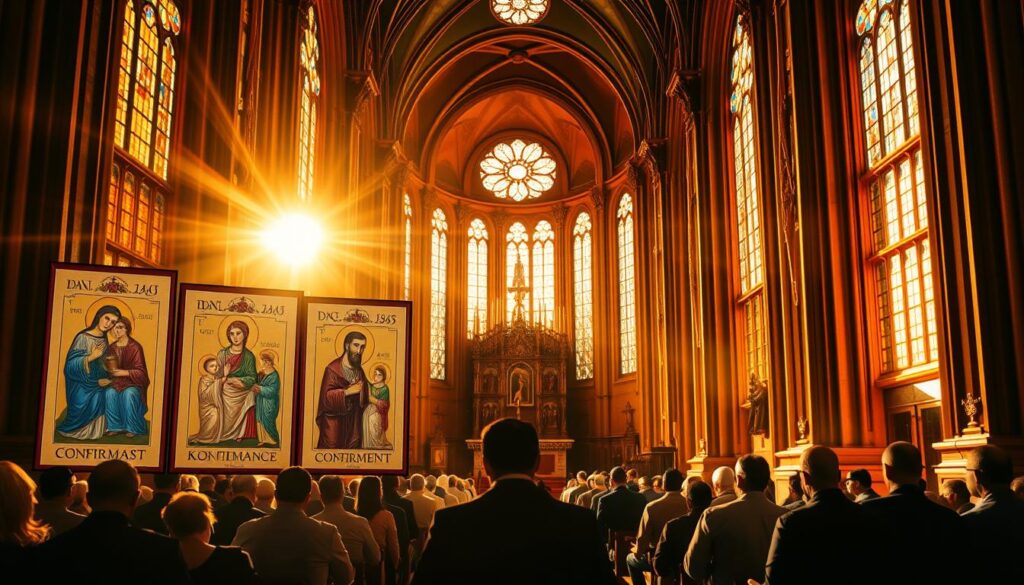
A grand, ornate cathedral interior bathed in warm, golden light. In the foreground, a set of seven sacramental icons arranged in a symmetrical composition - baptism, confirmation, eucharist, penance, anointing of the sick, holy orders, and matrimony. The icons are rendered in a traditional Catholic style, with intricate details and rich, symbolic imagery. In the middle ground, shadowy figures of worshippers kneel in prayer, their faces turned upwards towards the heavenly light. The background features towering Gothic arches, stained glass windows, and the ornate altar, conveying a sense of reverence and divine presence. The overall atmosphere is one of solemnity, spirituality, and the timeless traditions of the Catholic faith.

The first pillar welcomes individuals into faith through Baptism, Eucharist, and Confirmation. Together, they form a foundation for lifelong growth. Baptism washes away original sin, while Confirmation deepens one’s bond with the Holy Spirit.

When challenges arise, the second pillar offers renewal. Reconciliation mends broken relationships with God, and Anointing brings comfort during illness. These rites acknowledge our need for grace amid life’s struggles.

Group Focus Ceremonies
Initiation Spiritual birth & growth Baptism, Eucharist, Confirmation
Healing Renewal & comfort Reconciliation, Anointing
Service Commitment & purpose Matrimony, Holy Orders

The final pillar calls members to serve others. Marriage unites couples in sacred partnership, while Holy Orders dedicates leaders to guide the community. Each choice reflects a response to God’s unique invitation.

This threefold structure mirrors human needs: belonging, restoration, and meaning. Through these channels, Catholics find both personal transformation and shared identity.

Baptism: The Gateway to a New Life

From ancient rituals to modern practice, Baptism remains the cornerstone of Catholic spiritual identity. This initiation ritual welcomes individuals into the faith community through water and sacred words. It’s more than a ceremony—it’s a spiritual rebirth that leaves an indelible mark on the soul.

Symbolism of Water and Spirit Renewal

Water’s dual role—cleansing and giving life—anchors this sacrament baptism. As holy water flows over the head, it echoes Christ’s resurrection: the old self “drowns” in sin, while a renewed person emerges. A priest declares, “I baptize you in the name of the Father, Son, and Holy Spirit,” linking the baptized to God’s triune nature.

Infant Baptism Versus Adult Baptism

Most Catholics experience this ritual as infants, with parents pledging to nurture their child’s faith. Adults joining the Church undergo preparation through the RCIA program before receiving the same sacrament baptism. Both forms share the Trinitarian formula, creating a lifelong bond as a member of God’s family.

Whether received in infancy or adulthood, this sacrament can’t be repeated. Its grace permanently marks the person, offering forgiveness and a fresh start. Through this sacred act, believers join a global community united in divine love.

Eucharist: The Heart of Catholic Worship

In every Catholic Mass, a profound transformation occurs at the altar. This sacred meal isn’t just a symbol—it’s the living heartbeat of faith. Through bread and wine, believers encounter Christ in a way that unites past, present, and eternity.
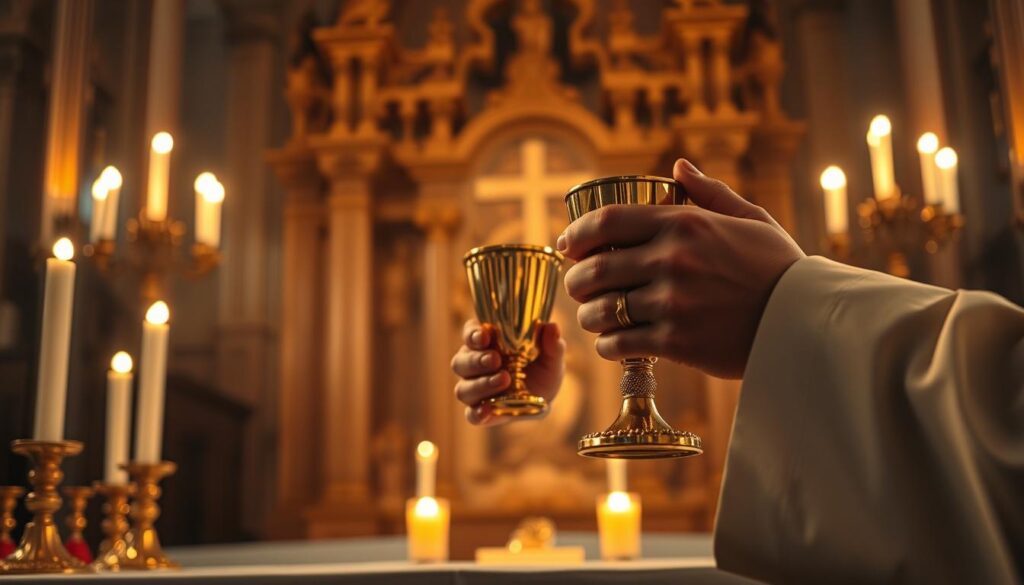
A close-up view of a holy communion service, with the priest's hands reverently holding the consecrated host and chalice against a dimly lit altar. The scene is bathed in warm, golden light from candles, creating a solemn, sacred atmosphere. The background features ornate religious architecture, hinting at the grand scale and historical significance of the Catholic Eucharistic celebration. The composition emphasizes the central act of transubstantiation, the belief that the bread and wine become the body and blood of Christ, conveying the profound spiritual significance of this sacrament at the heart of Catholic worship.

The Significance of Holy Communion

Called the “Source and Summit” of spiritual life, this sacrament nourishes Catholics like supernatural food. During Holy Communion, ordinary elements become divine sustenance. Many describe it as receiving a piece of heaven itself—a taste of eternal belonging.

Understanding Transubstantiation

At Mass, the priest speaks Christ’s words from the Last Supper. Though bread and wine keep their appearance, their essence changes completely. This mystery—called transubstantiation—lets believers experience God’s tangible presence.

Daily Spiritual Nourishment through the Mass

Children typically receive their First Communion around age seven after learning about this gift. Adults can partake daily, finding strength for life’s challenges. Each visit to the altar deepens unity with Christ and the global Church.

Whether received at a grand cathedral or a quiet weekday service, this sacrament remains timeless. It’s not just a ritual—it’s an invitation to carry divine love into every moment of life.

Confirmation: Sealing with the Gift of the Holy Spirit

Young Catholics stand at a crossroads of faith during their early teens—a moment marked by sacred oil and empowered choices. This sacrament confirmation completes their initiation into the Church, building on baptismal promises with personal commitment. Unlike childhood rituals, it invites active participation in spiritual growth.
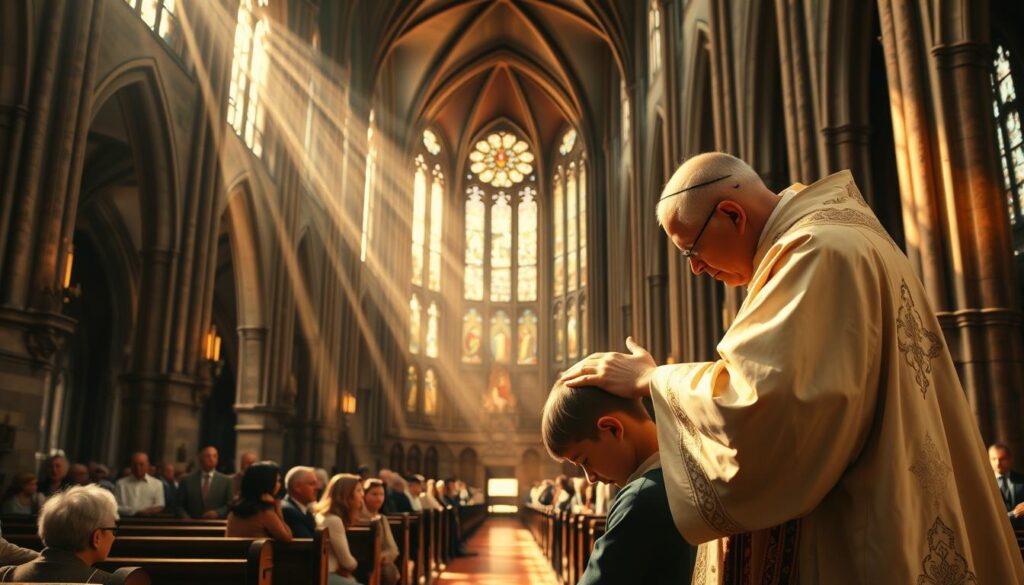
A solemn confirmation ritual unfolds within a grand cathedral. In the foreground, a bishop in ornate vestments lays his hands upon the bowed head of a young confirmand, their face serene with reverence. Streams of warm, golden light filter through stained glass windows, casting a reverential glow upon the scene. In the middle ground, rows of pews hold families and congregants, their expressions reflecting the gravity of the sacrament. The background is dominated by the cathedral's towering architecture, with intricate stone arches and columns reaching skyward, creating a sense of the divine. An atmosphere of solemnity, tradition, and the guiding presence of the Holy Spirit pervades the space.

Rite of Confirmation and Spiritual Empowerment

A bishop typically presides over this ancient ceremony. Candidates renew baptismal vows as hands rest gently on their heads—a practice echoing apostolic traditions. Chrism oil, blessed during Holy Week, is traced in cross-shaped patterns on foreheads. “Be sealed with the gifts of the Holy Spirit,” the minister declares, awakening spiritual potential.

Most receive this sacrament confirmation around age thirteen after years of faith formation. Teens explore scripture, Church teachings, and service projects to prepare. Adults joining Catholicism often experience it immediately after baptism, linking initiation stages.

This sacred seal creates lifelong resilience. It equips believers to defend their beliefs and serve others courageously. Through this rite, the Holy Spirit transforms passive faith into vibrant discipleship—a journey beginning in childhood and flowering through mature dedication.

Reconciliation: The Path to Forgiveness and Renewal

In quiet moments of reflection, Catholics find a sacred space to heal broken bonds with God and others. The Sacrament of Reconciliation—also called Confession—offers more than forgiveness. It restores spiritual vitality through honest self-assessment and divine mercy.

Steps Toward Spiritual Healing

During confession, believers privately name their sins to a priest, who serves as both guide and witness. This process isn’t about shame—it’s liberation. The priest offers counsel and assigns prayers or acts of kindness to nurture growth.

Some attend weekly before receiving Communion; others seek it during Lent or Advent. What matters is heartfelt remorse. An examination of conscience helps identify areas needing grace.

Through this sacrament reconciliation, Catholics rebuild trust with God and community. It transforms guilt into strength, proving no sins are beyond redemption. Each confession becomes a fresh start—a chance to walk lighter in faith.

FAQ

At what age do children typically receive First Communion?

Most Catholic children receive their First Holy Communion around age seven or eight. This follows preparation through religious education, emphasizing understanding the Eucharist as the body and blood of Christ.

How does Confirmation strengthen a person’s faith?

A: Confirmation deepens spiritual growth by sealing believers with the Holy Spirit. It empowers individuals to live out their baptismal promises courageously and share their faith actively within their communities.

What happens during the Anointing of the Sick?

This sacrament of healing involves prayers, laying on of hands, and anointing with oil. It offers physical, emotional, and spiritual strength to those facing illness or surgery, uniting them with Christ’s suffering.

Can someone remarry after a divorce in the Catholic Church?

The Church views marriage as a lifelong covenant. Remarriage without an annulment isn’t permitted. However, pastors can guide individuals through reconciliation processes or clarify annulment eligibility.

Why is Reconciliation important for Catholics?

Through confession, believers receive God’s forgiveness, repair relationships, and renew their commitment to holiness. It restores grace and provides clarity to avoid future sins.

What role do Holy Orders play in the Church?

A: Holy Orders ordain men as deacons, priests, or bishops to serve the Church. They lead worship, administer sacraments, and shepherd communities, continuing Christ’s mission of love and service.

How does Baptism connect to joining the Church?

A: Baptism cleanses original sin, initiates individuals into the Church, and marks them as children of God. It’s the first step in a lifelong journey of faith and discipleship.
Exploring Mysticism in Catholicism: A Spiritual Journey


What if your faith could feel less like a routine and more like a vibrant conversation with the Divine? Many believers think mystical experiences belong only to saints or visionaries. Yet the Church teaches that everyone is invited to cultivate a deeper bond with God through simple, daily practices.

This journey isn’t about supernatural visions. It’s about opening your heart to grace in ordinary moments—whether during prayer, serving others, or reflecting on life’s challenges. The Catechism calls this path an “intimate union” with Christ, nurtured through sacraments and contemplation.

Over time, small steps can transform how you perceive God’s presence. A quiet walk, a shared meal, or even moments of suffering become sacred spaces where love and mercy shine through. You don’t need special talents—just a willingness to let grace shape your soul.

Key Takeaways

  • Every Catholic is called to grow closer to God through prayer and sacraments.
  • Mystical experiences often arise in everyday moments, not dramatic visions.
  • Historical saints offer practical examples of living with spiritual awareness.
  • Deepening your faith requires patience, not perfection.
  • God’s grace is a free gift available to all believers.

Understanding Mysticism in Catholicism

How have centuries of faith shaped how believers experience divine closeness? Spiritual practices didn’t emerge overnight—they grew from ancient traditions refined by holy men and women. St. John of the Cross described this journey as a “dark night,” where God purifies hearts through temporary spiritual dryness.

Foundations Built by Saints

Early spiritual guides created roadmaps for union with God. Their writings show how prayer and sacrifice prepare the soul for grace. For example:

Saint Contribution Key Concept
Teresa of Ávila Stages of prayer Interior castles
John of the Cross Dark night phases Purification
Ignatius Loyola Discernment methods Spiritual exercises

Culture Meets Worship

Local customs often blend with Church rituals. Mediterranean processions, Celtic blessings, and Hispanic ofrendas all express devotion uniquely. These traditions remind us that sacred moments happen within community—not just private prayer.

Liturgy anchors mystical experiences in tangible actions. Receiving the Eucharist or lighting candles becomes a dialogue between personal longing and eternal truths. As one 16th-century director wrote: “The sacraments are God’s love made touchable.”

Embracing “mysticism in catholicism” in Daily Life

Have you ever noticed how washing dishes or waiting in traffic can become moments of unexpected grace? Spiritual awakening often blooms not in grand gestures, but through small openings we create for the sacred. As St. Teresa of Ávila observed: “God walks among the pots and pans.”

A serene, dimly lit sanctuary. In the foreground, a person kneels in quiet contemplation, hands clasped, eyes closed. Soft, warm lighting filters through stained glass windows, casting a gentle glow. The middle ground features wooden pews, subtle shadows, and the outline of a simple, ornate altar. The background is shrouded in a hazy, atmospheric depth, evoking a sense of sacred, timeless space. The overall mood is one of profound stillness, introspection, and a deep connection to the divine.

Contemplative Prayer and Union with the Divine

Contemplative prayer works like sunrise – you prepare your heart, but the light comes when ready. Many find these three approaches helpful:

Practice Purpose Outcome
Lectio Divina Scripture meditation Hearing God’s voice
Eucharistic Adoration Silent presence Heart transformation
Rosary Mystery reflection Peace in suffering

These methods aren’t about perfect technique. A teacher once told me: “Prayer is less about speaking, more about letting Love rewrite your story.”

Experiencing God’s Presence and Sacred Traditions

Sacred moments hide in plain sight. That rush of gratitude while holding a friend’s hand. The sudden clarity during a walk. These become doorways when we pause and whisper: “Here I am.”

Ancient traditions anchor us. Lighting candles mirrors our desire for divine light. Breaking bread echoes heavenly nourishment. Over time, these actions reshape our hearts into living tabernacles – places where ordinary life meets eternal love.

Mystical Encounters and the Role of the Saints

What do 20th-century secretaries and 16th-century poets teach us about divine connection? Saints like St. Maria Faustina Kowalska and St. John of the Cross left roadmaps showing how ordinary lives become extraordinary through openness to grace.

Saints as Guides on the Spiritual Journey

Faustina’s diary reveals how God’s presence transformed her daily work into sacred encounters. She wrote: “The Three Divine Persons… make all creation happy.” Her experiences birthed the Divine Mercy devotion, answering modern questions about suffering with hope.

Saint Key Teaching Impact
St. Faustina Divine Mercy revelations Global hourly chaplet prayers
St. John of the Cross Dark night purification Framework for spiritual growth
St. Thérèse of Lisieux Little Way simplicity Accessible holiness for all

The Dark Night and the Bright Dawn of the Soul

St. John’s “dark night” describes God’s gentle work in hearts during dry spells. Like winter preparing soil for spring, these seasons create space for deeper union. A priest once advised: “Emptiness isn’t abandonment—it’s an invitation to trust.”

Transformative Moments and Lasting Impact

When saints experienced divine love, their lives became channels of mercy. Faustina’s visions inspired Pope John Paul II’s prayer: “Help us bear witness to mercy.” Centuries later, their stories still awaken awareness that God dwells within everyone’s daily journey.

Conclusion

What if the key to spiritual depth isn’t found in grand gestures but in daily attentiveness? The path to divine connection thrives in ordinary moments—a shared smile, silent prayer, or acts of kindness. Every believer carries this potential, not just historical saints or visionaries.

Simple practices like meditating on sacred mysteries or noticing God’s presence in relationships can awaken profound awareness. As St. Thérèse of Lisieux showed, holiness grows through small, loving choices—not dramatic signs.

These spiritual friends remind us that dry seasons and joys alike shape our hearts. Their wisdom helps us persist when prayer feels challenging, trusting that grace works beneath the surface.

Begin by pausing to acknowledge the Trinity’s presence during routine tasks. Seek guidance from trusted mentors. Over time, this openness reshapes priorities—from self-focus to becoming channels of mercy.

God’s desire for union with each soul unfolds gently. Like dawn breaking after night, patience and trust reveal love’s quiet work within and around us.

FAQ

How does contemplative spirituality align with Catholic teachings?

Rooted in Scripture and centuries of tradition, practices like silent prayer and meditation aim to deepen one’s relationship with God. The Church recognizes this as a path to holiness, emphasizing humility and guidance from trusted spiritual mentors.

Can ordinary people experience deep spiritual connection through prayer?

Absolutely. While mystical graces are gifts from God, everyone is invited to seek closeness through daily prayer, sacraments, and acts of love. Even small moments of awareness can nurture a sense of divine presence in ordinary life.

What role do saints play in personal spiritual growth?

Saints like Teresa of Ávila and Thérèse of Lisieux exemplify how to live in union with God. Their writings and intercession offer wisdom, encouragement, and companionship, helping believers navigate challenges and stay focused on eternal truths.

How do I navigate periods of spiritual dryness or doubt?

St. John of the Cross called this the “dark night”—a time when God purifies the soul. Persisting in prayer, seeking sacraments, and leaning on community can sustain hope. Trust that these seasons often lead to renewed faith and deeper trust.

Are sacred traditions still relevant for modern believers?

Yes. Rituals like the Eucharist, Adoration, or the Rosary anchor faith in tangible ways. They connect us to a living heritage while inviting personal reflection, helping hearts remain open to grace amid life’s distractions.

How to Pronounce Catholicism: A Beginner’s Guide


Mastering complex terms like “Catholicism” can feel intimidating at first. Many English speakers rate its pronunciation as moderately to very challenging, but with focused practice, anyone can learn to say it clearly. This guide breaks down the process into simple, actionable steps designed for learners at every level.

You’ll explore both British and American English variations, giving you flexibility based on your location or audience. The differences between /kəˈθɒl.ɪ.sɪ.zəm/ (UK) and /kəˈθɑː.lə.sɪ.zəm/ (US) might seem subtle, but they matter in formal discussions about religious traditions. We focus on practical tools—like phonetic breakdowns and audio examples—to build your confidence.

Whether you’re preparing for academic presentations or everyday conversations, this resource adapts to your needs. By the end, you’ll not only pronounce the word accurately but also understand its cultural significance. Let’s turn this linguistic challenge into an opportunity for growth!

Key Takeaways

  • Learn both British and American pronunciations for versatility
  • Access phonetic guides and audio examples for accurate practice
  • Discover techniques to boost confidence in formal and casual settings
  • Understand why this term’s pronunciation matters in cultural contexts
  • Gain strategies tailored for students, professionals, and lifelong learners

Understanding the Basics of Catholicism

Exploring religious terms requires more than memorization—it demands cultural awareness. The faith we’re discussing connects 1.3 billion people through shared practices spanning two thousand years. Its universal nature stems from the Greek “katholikos”, meaning “worldwide”, reflecting its mission across languages and borders.

What Defines This Global Faith?

This branch of Christianity maintains unique practices while upholding core Christian teachings. Seven sacraments, papal leadership, and saint veneration distinguish it from other denominations. The term itself acts as a bridge between ancient roots and modern communities.

Why Historical Continuity Matters

Traditions here aren’t just rituals—they’re living links to past generations. From liturgical ceremonies to scripture interpretations, each practice carries centuries of meaning. Properly articulating the word shows respect for this unbroken chain of belief transmission.

English explanations often struggle to capture the full depth of these concepts. Natural written and spoken English resources help learners grasp both pronunciation and context. By understanding what the term represents, you engage more meaningfully with interfaith dialogues and historical studies.

How to “pronounce catholicism” Correctly

A close-up shot of Catholic pronunciation symbols, rendered in a classical and scholarly style. In the foreground, distinct vowel and consonant markers hover against a softly blurred background, their shapes and lines elegant and precise. Warm lighting from the side casts subtle shadows, emphasizing the three-dimensional quality of the symbols. The overall mood is one of erudition and attention to detail, inviting the viewer to closely examine the intricacies of proper Catholic pronunciation.

Getting pronunciation right shows respect in both casual talks and formal settings. Let’s explore the building blocks through phonetic symbols and regional variations.

Phonics Made Simple

The word splits into four parts: Ca-thol-i-cism. Each sound matches common English words:

Symbol Example Word Position
/k/ cat First syllable
/θ/ think Second syllable
/ɒ/ or /ɑː/ sock (UK) vs father (US) Middle section
/zəm/ zoo + criticism Final syllable

American vs British Approaches

North Americans stretch the middle vowel (/ɑː/), like in “calm.” Brits use a shorter /ɒ/, as in “lot.” Both versions keep the th sound from “thin” – a common stumbling block.

Hearing Makes Perfect

Try this trick: record yourself saying “kuh-THOL-uh-siz-um” and compare it to dictionary audio. Notice how stress lands on the second syllable, creating the rhythm thol-i-cism. Apps like Forvo or Merriam-Webster offer clear examples to mimic.

Mastering Pronunciation with Tools and Resources

Modern technology makes learning complex terms easier than ever. Let’s explore digital helpers that turn practice into progress.

Interactive Audio Recording and Feedback

Voice recording apps act like personal coaches. They let you compare your speech to expert examples instantly. Platforms like Forvo highlight where your /θ/ or /zəm/ sounds need tweaking.

Tool Key Feature Best For
Cambridge Dictionary Slow-motion audio Mastering syllable stress
Merriam-Webster Side-by-side comparisons US/UK variations
YouGlish Real-world video examples Contextual learning

Utilizing Online Dictionaries and Thesauruses

Top learner dictionaries do more than define words. They show how terms function in sentences through grammar notes and synonyms. Build custom word lists to group related religious vocabulary for focused practice.

Many platforms now offer pronunciation games. Earn badges for perfecting tricky sounds or beating speed challenges. These features keep learning fresh while reinforcing proper technique.

Practical Tips for Improving Your Pronunciation

A classroom setting with a chalkboard in the background, displaying helpful pronunciation tips. In the foreground, a group of diverse students engaged in interactive learning, gesturing and practicing various sounds and phonemes. Warm, natural lighting illuminates the scene, creating a welcoming and educational atmosphere. The students are dressed in casual, everyday attire, reflecting a casual, informal learning environment. The composition is balanced, with the chalkboard and students occupying the frame in a visually appealing way. The overall mood is one of active learning, collaboration, and a focus on improving pronunciation skills.

Building clear pronunciation skills requires smart strategies, not just repetition. Many learners find that combining focused exercises with real-world application creates lasting improvement. Let’s explore methods that transform awkward sounds into confident speech patterns.

Effective Practice Techniques

Start by isolating tricky sounds in slow motion. Break the word into chunks: “Cath-ol-ic-ism.” Repeat each segment 5 times, then blend them gradually. This builds muscle memory without overwhelming your tongue.

Create sentences that use the term naturally. Try different grammatical roles: “Catholicism shaped European history” (subject) or “Her research focuses on Catholicism” (object). Varying usage helps your mouth adapt to different sentence rhythms.

Common Challenges and How to Overcome Them

The /θ/ sound trips up many speakers. Practice with simpler words like “think” first—place your tongue against upper teeth and exhale. Once comfortable, insert this sound into the full word.

Stress patterns matter more than you think. Say “ca-THOL-i-cism” while tapping the second syllable louder. Record yourself and compare to native speakers—apps like YouGlish show real-world usage in movies and lectures.

Blend syllables smoothly by pretending they’re connected. Think “Cathol” + “icism” instead of four separate parts. Link them like musical notes, maintaining airflow between sounds.

Strengthen weak spots through word associations. Connect the ending to “criticism” and the middle sounds to “ship.” These mental shortcuts make complex terms feel familiar in spoken English.

Conclusion

Learning to articulate religious terms clearly bridges language skills and cultural understanding. The methods you’ve explored here—from phonetic breakdowns to interactive tools—build abilities that extend far beyond a single word. Consistent practice with stress patterns and audio comparisons helps cement these skills naturally.

Whether using American or British variants, focus on smooth transitions between syllables. Create word lists with related terms like “tradition” or “doctrine” to reinforce context. This approach strengthens both your spoken English and comprehension of complex ideas.

Apply these strategies to other challenging vocabulary in your studies or work. Record yourself weekly, noting improvements in flow and confidence. With time, even intricate terms will feel like familiar parts of your natural written and spoken English toolkit.

Every mastered pronunciation opens doors to richer conversations. Keep exploring English grammar resources and cultural explanations to deepen your communication skills. Your dedication today shapes tomorrow’s ability to engage meaningfully with diverse perspectives.

FAQ

What tools can help me practice pronunciation effectively?

Online dictionaries like Merriam-Webster or Cambridge Dictionary offer audio guides. Apps like Forvo provide native speaker examples, while platforms like YouTube feature tutorials for visual and auditory learners.

Are there differences between British and American pronunciations?

Yes! In American English, the stress often falls on the second syllable (kuh-THOL-uh-siz-um). British speakers might emphasize the first syllable slightly more (KATH-uh-luh-siz-um). Listen to regional examples to catch nuances.

How do traditions influence Catholic practices?

Rituals like Mass, sacraments, and liturgical calendars are rooted in centuries-old teachings. These customs unite communities and reflect core beliefs, such as the importance of communion and prayer.

What are common challenges when learning to say religious terms?

Unfamiliar syllables (like “thol” in kuh-THOL-uh-siz-um) or silent letters can trip learners. Breaking words into smaller parts and repeating them slowly helps build confidence and accuracy.

Can I get feedback on my pronunciation remotely?

Absolutely! Apps like Speechling or language-exchange forums let you submit recordings. Many online tutors also offer personalized coaching to refine your accent and clarity.

Why is understanding phonetic symbols useful?

Symbols like /kəˈθɑlɪˌsɪzəm/ provide a visual guide to stress points and vowel sounds. They’re especially handy if audio isn’t available, helping you decode complex terms independently.

Catholicism in the Philippines: Exploring the Faith’s Rich History


Walk through any town in this Southeast Asian nation, and you’ll find churches filled with worshippers, lively fiestas honoring saints, and families gathering for weekly Mass. With over 85 million followers, the local religious community forms one of the largest Catholic populations globally. This spiritual legacy began over 400 years ago, blending European influences with native customs to create traditions unlike anywhere else.

Across more than 2,000 islands, vibrant practices thrive. Some regions host processions where devotees walk barefoot for miles, while others celebrate with street dances and floral offerings. These rituals reflect a deep connection to faith that shapes daily life, community bonds, and even national identity.

The country’s devotion extends beyond its shores. Missionaries and overseas workers carry their traditions worldwide, making local customs a familiar sight in global cities. Yet the heart of this spiritual tapestry remains rooted in homegrown celebrations that honor both ancient beliefs and colonial history.

Key Takeaways

  • Home to the third-largest Catholic community globally, with over 85 million followers
  • Unique blend of Spanish colonial traditions and indigenous cultural practices
  • Notable for physical expressions of faith, including processions and festivals
  • Diverse regional customs across thousands of islands
  • Significant influence on global Catholic practices through diaspora communities

Historical Roots and Colonial Influence

The archipelago’s spiritual landscape once thrived with diverse beliefs rooted in nature and ancestor veneration. For over 1,000 years, communities practiced rituals honoring spirits in mountains, rivers, and sacred trees. These traditions coexisted with Hindu and Buddhist influences from neighboring Asian cultures, creating layered spiritual identities.

Pre-Colonial Spiritual Foundations

Early societies saw the divine in everyday life. Shamans mediated between humans and nature spirits, while harvest festivals celebrated earth’s bounty. This animistic worldview shaped beliefs practices that survived despite foreign influences.

A New Religious Era Begins

Ferdinand Magellan’s 1521 arrival changed everything. Spanish colonizers used religion to consolidate power, building churches where indigenous shrines once stood. By the 16th century, missionaries had established the first Catholic settlements.

Aspect Indigenous Practices Spanish Influence
Deities Nature spirits & ancestral gods Saints & Holy Trinity
Worship Spaces Sacred groves & home altars Stone churches & cathedrals
Education Oral traditions Church-run schools

Over 400 years, this fusion created unique traditions. Farmers still bless crops using both Latin prayers and ancient chants. Such blends show how early beliefs adapted rather than vanished under colonial rule.

The Emergence of Filipino Catholic Culture

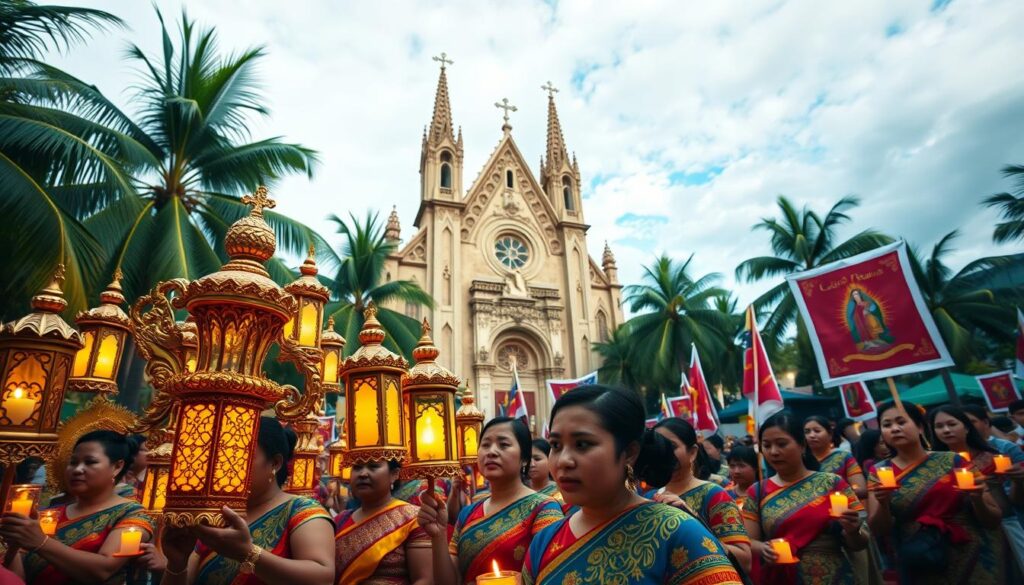
Vivid colors swirl through crowded streets as drumbeats sync with chanted prayers—a signature blend of faith and festivity defines spiritual life here. This culture thrives through rituals that turn belief into tangible experiences, connecting communities across islands and generations.

A vibrant procession of Filipino Catholics, adorned in colorful traditional garments, carrying ornate religious icons and banners. The foreground is filled with intricate, hand-crafted lanterns and candles, their warm glow illuminating the solemn faces of the faithful. In the middle ground, a grand church façade with intricate carvings and ornate architecture rises, its towering spires reaching towards the heavens. The background is a lush, tropical landscape, with swaying palm trees and a vibrant, azure sky, creating a sense of warmth and serenity. The scene is captured with a wide-angle lens, emphasizing the scale and grandeur of the event, while the soft, diffused lighting lends a reverent, atmospheric quality to the image.

Devotional Feasts and Pilgrimages

January transforms Manila into a sea of devotees during the Black Nazarene procession. Over 2 million participants brave the chaos to touch the statue’s robe, believing in its healing power. “It’s not just a tradition—it’s our heartbeat,” shares a lifelong participant.

Holy Week reveals even deeper expressions. In Pampanga, penitents reenact Christ’s suffering through self-flagellation—a practice blending medieval Spanish customs with local interpretations of sacrifice.

Marian Devotion and Santo Niño Traditions

May flowers carpet churches during Flores de Mayo, where children present bouquets to Mary. This youth-centered celebration contrasts with September’s Peñafrancia Festival, where a Marian image glides down rivers on flower-decked boats.

The Santo Niño (Holy Child) inspires year-round joy. Cebu’s Sinulog Festival erupts each January with dancers in radiant costumes mimicking the child-king’s swaying motions. These events show how Spanish-era symbols gained new life through indigenous movement and music.

Tradition Unique Feature Cultural Blend
Black Nazarene Mass participation Spanish icon + urban Filipino resilience
Flores de Mayo Youth involvement Marian devotion + floral harvest rites
Sinulog Warrior dances Holy Child veneration + pre-colonial rhythm

catholicism in philippines as a Cultural Force

When yellow confetti rained on Manila’s streets in 1986, millions stood united not just by politics—but by shared prayers. This spiritual solidarity has repeatedly shaped the nation’s story, blending religion with collective action. From village fiestas to constitutional reforms, belief systems influence how people live, celebrate, and govern.

Shaping National Identity Through Faith

Cardinal Jaime Sin’s radio call during the People Power Revolution shows how spiritual leaders steer history. His plea brought citizens to EDSA Highway, creating a human barricade that toppled dictatorship without violence. “The cross and the rosary became our weapons,” recalls a protester from that time.

Family life mirrors this unity. Sunday meals follow Mass, while grandparents pass down devotional practices. The country’s ban on divorce—shared only with Vatican City—reveals how deeply religious values shape laws. Yet traditions evolve: young couples now personalize wedding vows while keeping sacramental roots.

Regional festivals also share this adaptive spirit. In Cebu, street parades mix saints’ processions with pre-colonial dance steps. These fusions create a culture where candlelit prayers feel as natural as karaoke parties. As one scholar notes: “Our faith isn’t just practiced—it’s lived through every joy and struggle.”

Today, the country balances ancient rituals with modern challenges. Youth groups address climate change through eco-friendly Lenten projects, proving tradition fuels progress. This enduring blend keeps spiritual identity central to what it means to belong here.

Demographics and Social Influence

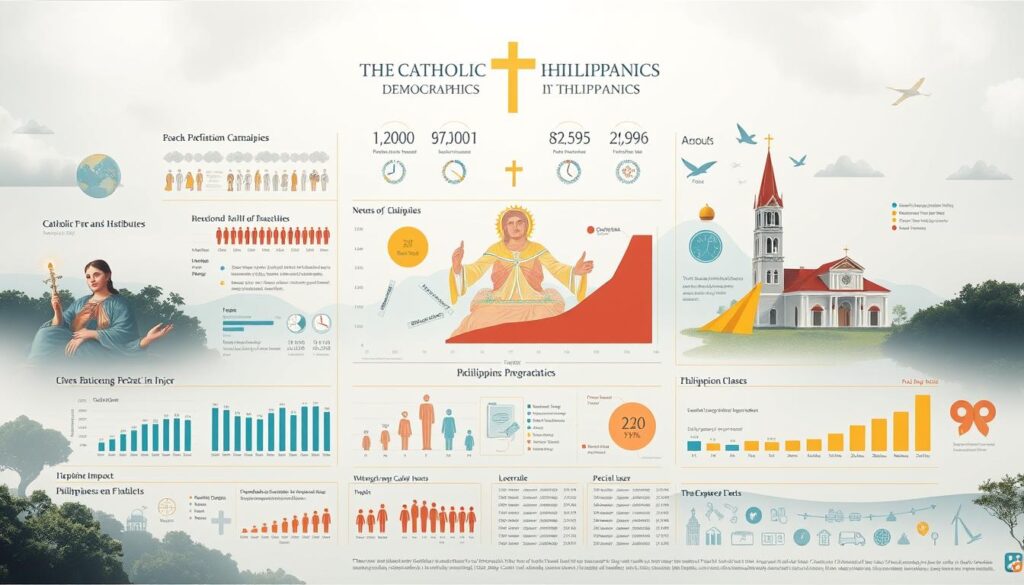
Numbers tell a compelling story about faith’s role in shaping communities. Recent data reveals 78.8% of the population—over 85 million people—identify with this religious tradition. This figure has remained remarkably stable, dipping only slightly from 85% in 1990 despite societal changes.

A detailed statistical visualization of Catholic demographics, showcasing the rich diversity and influence of the faith in the Philippines. A serene, well-lit scene, with a central chart or infographic presenting key data points, such as population distribution, growth trends, and social impact. Surrounding the central focus, subtle visual elements allude to the cultural and historical context, such as religious iconography, architectural details, or natural landscapes. The overall impression should be one of authoritative, yet visually compelling data presentation, conveying the significance of Catholicism within the Philippine social fabric.

Statistical Insights and Catholic Population Metrics

Religious infrastructure supports this massive following. Over 10,400 priests serve 3,694 parishes nationwide—each clergy member shepherding nearly 8,900 believers. Urban centers like Metro Manila and Cebu Province show particularly strong engagement, with more than 90% participation rates.

Education forms a cornerstone of community impact:

Institution Type Enrollment Social Impact
Primary Schools 318,554 students Foundational values education
Secondary Schools 829,567 students Youth leadership development
Universities 611,964 students Professional training with ethical focus

Beyond classrooms, 48 specialized hospitals and 95 care facilities address public health needs. “These institutions don’t just heal bodies—they nourish souls,” notes a Manila-based social worker. This network complements government programs while maintaining distinct spiritual dimensions.

Such statistics highlight how religious groups share responsibility for societal well-being. From education to healthcare, these numbers prove faith remains woven into the country’s social fabric.

Catholicism and Political Influence in the Philippines

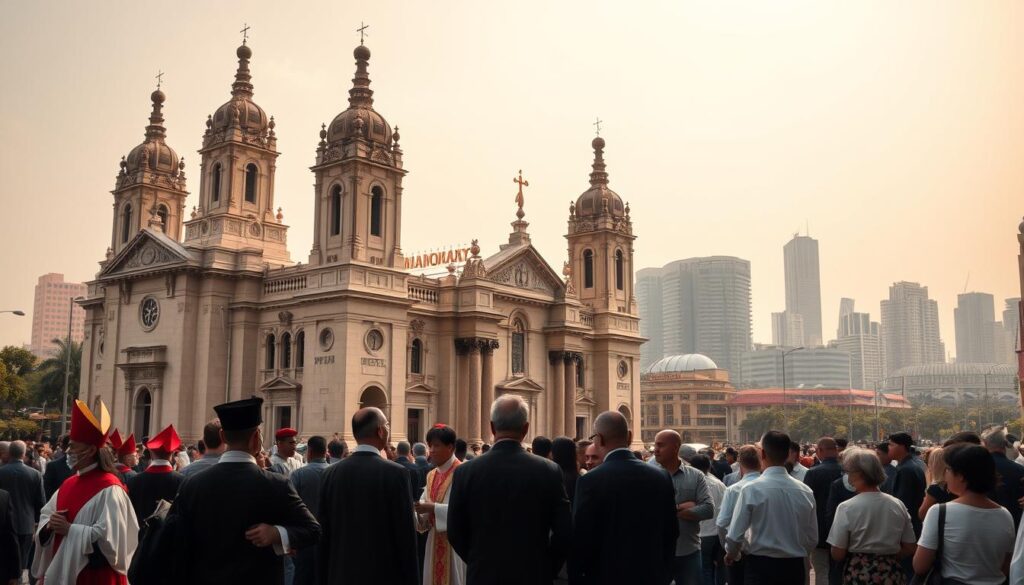
A grand cathedral in the heart of Manila, its ornate spires and domed roofs casting long shadows over the bustling streets below. In the foreground, a procession of clergy and faithful, their robes and vestments swaying gently in the warm breeze. In the middle ground, political leaders and government officials mingle, deep in discussion, the power and influence of the Catholic Church woven into the fabric of the nation. The background is a hazy cityscape, skyscrapers and modern buildings juxtaposed with the timeless elegance of the cathedral, a testament to the enduring relationship between church and state in the Philippines.

How does a nation balance spiritual authority with democratic governance? The answer lies in a unique partnership where religious groups and the government collaborate while maintaining separate roles. This relationship has shaped laws, toppled dictators, and sparked ongoing debates about freedom and power.

Church-State Relationships and Political Engagement

The constitution strictly separates religion and state affairs. Yet schools and hospitals run by religious groups receive public funding—a system called “benevolent secularism.” This cooperation became vital during the 20th century when church leaders sheltered activists opposing martial law.

Constitutional Principle Real-World Practice
No state religion Religious symbols in government buildings
Separation of powers Joint social programs
Secular legislation Faith-based laws on marriage

Cardinal Jaime Sin’s 1986 radio broadcast mobilized millions to overthrow a regime through peaceful protests. “We proved faith could dismantle tanks,” recalls a protest organizer. This event showed how moral authority could reshape the country‘s destiny without violence.

Modern challenges persist. Security forces sometimes accuse clergy of supporting rebel groups—a practice called “red-tagging.” These claims create risks for religious workers advocating social justice. Meanwhile, the nation remains divorce-free, reflecting ongoing church influence on government policies affecting family life.

The Modern Face of Filipino Catholicism

From living rooms to foreign cities, spiritual expressions evolve while keeping tradition alive. Today’s practices blend time-honored rituals with fresh approaches, reflecting how communities adapt faith to modern life.

Charismatic Movements and Home Altars

Groups like El Shaddai energize worship with stadium rallies and TV broadcasts. This movement—followed by millions—mixes gospel teachings with financial advice, drawing crowds seeking both spiritual and practical guidance. “We feel God’s presence differently here,” shares a Manila-based member.

Home shrines remain central to daily devotion. Families arrange Santo Niño statues beside wifi routers, creating sacred spaces where technology meets tradition. These altars serve as reminders of heritage, especially for younger generations navigating global influences.

Impact of the Filipino Diaspora on Faith Practices

Overseas workers carry customs worldwide, transforming local parishes from Rome to Dubai. In Hong Kong, where Filipina migrants boost Catholic numbers, El Shaddai’s prayer warriors host weekend gatherings. Their joyful services contrast with the city’s fast-paced lifestyle.

Adaptations continue as communities face new challenges. Virtual pilgrimages now connect devotees across time zones, while social media groups share daily reflections. This global network ensures traditions thrive beyond the country’s shores, uniting people through shared beliefs.

FAQ

How did Spanish colonization shape religious practices in the islands?

Spanish missionaries introduced Roman Catholicism in the 16th century, blending it with local traditions. Churches became community hubs, and festivals like Pahiyas and Sinulog merged indigenous rituals with Christian themes.

What role does Marian devotion play in Filipino spiritual life?

Many communities revere figures like Our Lady of Peñafrancia and Our Lady of Manaoag. Annual pilgrimages and processions reflect deep connections to Mary, often seen as a unifying symbol of hope and resilience.

How has the faith influenced national identity?

Shared traditions like Simbang Gabi (night Masses) and Barrio Fiestas foster cultural unity. Religious icons, such as the Santo Niño de Cebú, are celebrated as symbols of both faith and Filipino heritage.

What modern trends are reshaping worship today?

Charismatic groups emphasize lively prayer sessions and healing ministries. Overseas Filipino workers also spread hybrid practices, blending global influences with homegrown customs like home altars and family-led rosaries.

How does the Church engage with political issues locally?

Clergy often advocate for social justice, disaster relief, and ethical governance. Historic events like the 1986 EDSA Revolution highlight the Church’s role in mobilizing public action during crises.

Are indigenous beliefs still part of religious life today?

Yes! Practices like animism and ancestor veneration coexist with Christian rituals. For example, some communities honor nature spirits during harvest festivals while attending Mass for blessings.

What percentage of the population identifies with this faith?

Roughly 80% of Filipinos are affiliated with the religion, making it one of the largest Catholic-majority nations globally. Youth participation remains strong, with many attending weekly services or campus ministries.

Catholicism vs. Christianity: Key Differences Explained


Many people wonder how Catholic traditions relate to the broader Christian faith. While Catholics make up over 60% of global Christian followers, confusion often arises when comparing their practices to other denominations. This stems from Christianity’s diverse branches, including Orthodox and Protestant groups like Baptists or Evangelicals.

At its core, Christianity refers to all believers in Jesus Christ. The Roman Catholic Church represents the oldest and largest organized denomination. However, historical splits—like the Protestant Reformation—created distinct interpretations of scripture and worship styles. These divisions explain why theological debates persist today.

This guide clarifies how denominational distinctions developed over centuries. You’ll learn why Catholics emphasize papal authority and sacraments, while many Protestant groups prioritize individual Bible study. We’ll also explore shared beliefs that unite all Christians despite these variations.

Key Takeaways

  • Catholicism is the largest Christian denomination worldwide, with 1.3 billion followers
  • Christianity includes multiple branches: Catholic, Orthodox, and Protestant
  • Most comparisons focus on Catholic vs. Protestant practices rather than Christianity as a whole
  • The Protestant Reformation in 1517 created major theological divisions
  • All Christian groups share core beliefs in Jesus Christ’s teachings

Foundations of Catholicism and Broader Christianity

Christianity’s roots stretch back to ancient communities gathering in Jesus’ name. The Catholic Church anchors its identity in Christ’s words to Peter: “You are Peter, and on this rock I will build my church” (Matthew 16:18). This moment became the cornerstone for claims of unbroken leadership from the first apostles to modern popes.

Historical Origins and Development

Early believers formed tight-knit groups centered on Jesus Christ’s teachings. By the 4th century, Roman Emperor Constantine’s conversion boosted Christianity’s growth. The Catholic structure emerged with bishops overseeing regional churches, while Rome’s bishop gained prominence as Peter’s successor.

Key developments shaped modern Christian denominations:

  • Apostolic succession claims linking priests to original disciples
  • Councils like Nicaea (325 AD) defining core doctrines
  • Monastic movements preserving New Testament scholarship

Divergent Interpretations of Early Christianity

Not all followers agreed on church authority. Eastern Orthodox groups split in 1054 over papal power disputes. Sixteenth-century reformers like Luther argued Scripture alone—not tradition—should guide faith. These clashes birthed Protestant denominations with varied worship styles.

Despite divisions, all groups share baptism rituals and Christ-focused prayers. This common ground reminds us that multiple paths can lead to the same spiritual home.

Core Beliefs and Doctrinal Distinctions

Exploring spiritual paths reveals both unity and diversity among believers. While 85% of teachings align across major denominations, how communities live out their faith tells a deeper story. These distinctions shape worship styles, community practices, and personal spiritual journeys.

Understanding Faith, Teachings, and Salvation

Catholics and Protestants share core beliefs in Jesus’ resurrection and the Trinity. Where they diverge is the roadmap to eternal life. Most Protestants view salvation as a sealed gift received through belief alone. “For by grace you have been saved through faith,” explains Ephesians 2:8-9.

Catholic doctrine presents a collaborative approach. Followers believe one must nurture initial faith through sacraments and moral actions. As James 2:26 notes, “Faith apart from works is dead.” This creates different spiritual rhythms:

Aspect Catholic View Protestant View
Salvation Process Lifelong journey Instant assurance
Grace & Works Partnership Grace alone
Sacraments 7 essential rites 2 ordinances
Scripture Authority Church + Bible Bible alone

Interpretations of the Bible and Sacred Tradition

Here’s where truth claims get interesting. Catholics value church traditions dating to early Christians, while Protestants prioritize scripture’s plain meaning. This affects everything from Mary’s role to how often communion is served.

Both approaches aim to honor Christ’s message. The variations remind us that faith communities can walk different paths while sharing the same destination.

what is the difference between catholicism and christianity

At the core of denominational distinctions lies a fundamental question: who holds the keys to spiritual truth? This debate shapes how communities engage with sacred texts and leadership structures.

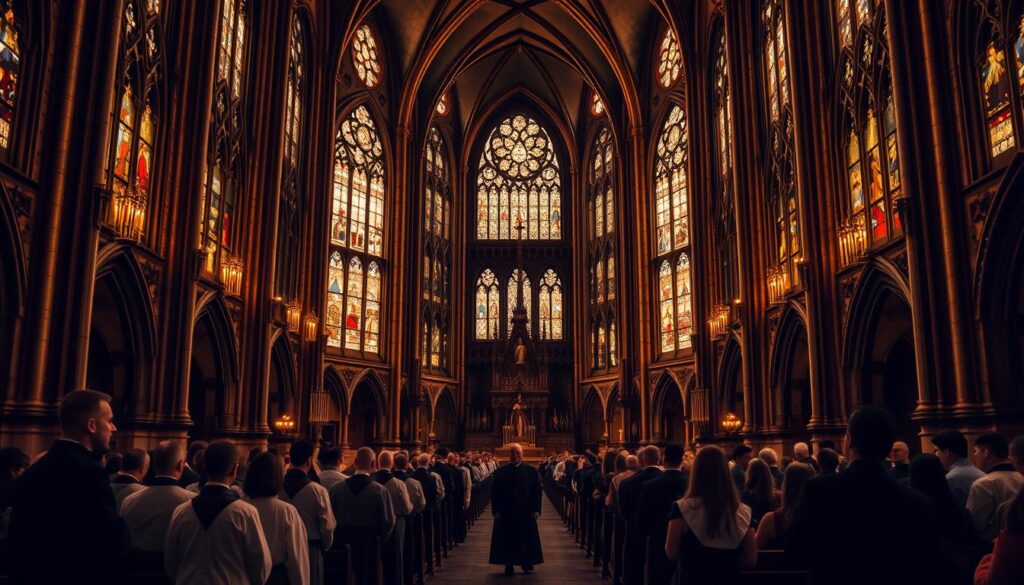
a grand cathedral with ornate architecture, intricate stained glass windows, and soaring Gothic spires, bathed in warm, golden light from stained glass windows. In the foreground, a group of robed and mitered clergy members gather, radiating an aura of authority and reverence. In the middle ground, pews filled with worshippers in pious contemplation. The background is shrouded in a sense of sacred mystery, with shadows and architectural details creating a sense of grandeur and tradition. The overall scene conveys the weight and significance of Christian authority and tradition.

Comparative Analysis of Scripture and Tradition

Catholics view faith through two lenses: biblical texts and centuries-old traditions. Church teachings, papal decrees, and ancient practices carry equal weight with scripture. For example, concepts like purgatory or Mary’s assumption derive from tradition rather than explicit Bible verses.

Protestant groups take a streamlined approach. They champion sola scriptura—the belief that the Bible alone guides Christian life. As reformer John Calvin argued, “The word of God is the test by which… all doctrines must be tried.”

Different Views on Authority and Church Leadership

Hierarchy plays contrasting roles across denominations. The Catholic Church operates through a top-down structure:

Aspect Catholic Approach Protestant Approach
Ultimate Authority Pope + Magisterium Scripture
Tradition Binding Informative
Interpretation Church-guided Individual/communal

This table highlights why Christians from various traditions might approach prayer or sacraments differently. While catholics christians follow structured rituals, many Protestants embrace flexible worship styles shaped by personal Bible study.

Sacred Scriptures and the Canon Debate

Bible translations reveal one of Christianity’s most visible divides. While all groups revere the New Testament, disagreements over the Old Testament’s contents spark ongoing dialogue. These differences trace back to sixteenth-century debates about divine inspiration.

Catholic Canon Versus Protestant Bible

Catholic Bibles include seven additional books compared to Protestant versions. Martin Luther excluded texts like Tobit and Maccabees during the Reformation, calling them “apocryphal.” This decision reduced Protestant scriptures to 66 books, while Catholics kept 73.

Luther also questioned four New Testament books, though most Protestants later reinstated them. Catholics view their longer canon as preserving early Christian traditions. As theologian Augustine noted, “The canon is measured by the authority of the churches”—a stance many Catholics still uphold.

The Role of Sola Scriptura

Protestants champion sola scriptura, believing the word of God alone guides faith. Luther declared, “Scripture alone is the true lord over all earthly good.” This principle rejects non-biblical traditions as binding.

Catholics counter that scripture emerged from Church teachings. They argue proper interpretation requires apostolic guidance. These contrasting views shape practices—like whether to pray for the dead, which appears in Catholic-approved texts but not Protestant Bibles.

The Role of Church Authority and Hierarchy

Church leadership structures reveal one of the most striking contrasts between Christian traditions. The Catholic Church operates through a sacred chain of command, while many Protestant groups favor decentralized decision-making. This distinction shapes everything from worship styles to doctrinal interpretations.

a grand cathedral interior with a towering altar and intricate religious iconography in the foreground, depicting the hierarchy and authority of the Catholic church. the middle ground features rows of wooden pews and worshippers in traditional religious attire, while the background showcases stained glass windows bathed in soft, ethereal lighting. the overall atmosphere is one of reverence, solemnity, and the awe-inspiring power of the ecclesiastical institution.

Papal Infallibility and Apostolic Succession

Catholics trace their spiritual lineage directly to Jesus’ apostles. They believe Christ granted Peter special authority, creating an unbroken line of succession through modern popes. As Vatican I declared: “The Roman Pontiff… has full and supreme power of jurisdiction over the whole Church.”

This concept of papal infallibility applies only when speaking officially on faith matters. Most Protestant denominations reject this teaching, arguing all believers share equal access to divine truth through scripture.

Priesthood and the Concept of Holy Orders

The Catholic Church maintains seven sacraments administered through ordained clergy. Holy orders create three distinct ranks:

  • Bishops (successors to apostles)
  • Priests (sacramental ministers)
  • Deacons (service-oriented roles)

Protestant churches typically affirm Martin Luther’s “priesthood of all believers.” Many employ pastors as teachers rather than mediators, reflecting different views on spiritual authority. This table highlights key contrasts:

Aspect Catholic Protestant
Leadership Source Apostolic succession Congregational call
Sacramental Power Exclusive to clergy Shared among believers
Decision Making Centralized hierarchy Local or regional

These structural differences explain why Catholic worship feels more uniform globally, while Protestant services vary widely between denominations.

Worship Practices and Sacramental Life

Sunday mornings look strikingly different in Catholic and Protestant congregations, reflecting centuries-old theological priorities. These worship styles embody distinct understandings of sacred encounters and community connection.

A grand cathedral interior, dimly lit by flickering candles and stained glass. At the center, an ornate altar with a golden chalice and host, the focus of Catholic Eucharistic worship. In the foreground, worshippers kneel reverently, heads bowed in solemn contemplation. The mood is one of profound spiritual devotion, the air thick with incense and the weight of ancient tradition. Soft beams of light pierce the shadows, illuminating the sacred rite unfolding before the congregation. A sense of timelessness pervades the scene, as if this ritual has been enacted countless times throughout the centuries.

The Eucharist: Transubstantiation vs. Symbolism

Catholics approach communion with profound reverence, believing the body and blood of Christ become physically present through transubstantiation. The Catechism states, “In the Eucharist Christ gives us the very body which he gave up for us on the cross” (1374). This miracle occurs during Mass when priests consecrate bread and wine.

Most Protestant services treat communion as symbolic remembrance. A Baptist pastor might explain, “The bread represents Christ’s sacrifice, helping us reflect on his love.” This table shows key contrasts:

Element Catholic Practice Protestant Practice
Eucharist Actual presence Symbolic meaning
Frequency Daily Mass Monthly/Sunday
Sacraments Seven total Two ordinances
Worship Focus Liturgical ritual Scripture teaching

Mass, Rituals, and the Use of Icons

Catholic worship revolves around the Mass structure developed over 1,500 years. Followers participate in call-and-response prayers, incense rituals, and veneration of saints through statues. The seven sacraments mark spiritual milestones from birth to death.

Many Protestant churches prioritize accessible services. Contemporary bands lead worship songs, while pastors deliver practical sermons. As one Lutheran explained, “We keep decorations simple to avoid distracting from God’s word.”

These approaches reflect different paths to spiritual life—one embracing tangible holiness through ritual, another seeking divine connection through scripture and song.

Views on Sin, Salvation, and Afterlife

Beliefs about moral failures and eternal destinations shape daily spiritual practices across Christian traditions. Catholics and Protestants agree that sin separates humans from God, but their roadmaps for reconciliation diverge significantly.

Mortal and Venial Sins

Catholic teachings sort sins into two categories. Mortal sins—like murder or adultery—require confession to a priest. Venial sins, such as gossip, can be forgiven through personal prayer. This system emphasizes accountability through structured sacraments.

Most Protestant groups reject this hierarchy. They view all sins as equally separating people from God. A Lutheran pastor might explain, “Every wrong act needs Christ’s grace, not just the big ones.”

Aspect Catholic View Protestant View
Sin Classification Mortal/Venial No categories
Forgiveness Path Confession + Penance Direct repentance
Original Sin Impact Weakened goodness Total corruption

Concepts of Purgatory, Heaven, and Hell

Catholics envision heaven as the final destination after possible purification in purgatory. This interim state allows souls to achieve holiness through divine grace. Many Protestants consider this unbiblical, teaching immediate entry into paradise or damnation.

Both groups agree Christ’s sacrifice opens the door to eternal life. However, Catholics see salvation as a lifelong process requiring faith and actions. Most Protestants believe assurance comes instantly through belief alone.

These perspectives influence how believers approach daily life. Catholics might focus on sacraments to maintain grace, while Protestants emphasize personal Bible study to nurture their relationship with God.

Cultural and Social Impacts in the United States

Religious beliefs often shape societal values in profound ways. Across American communities, faiths influence debates about ethics, laws, and personal life choices. These discussions reveal how theological differences translate into real-world actions.

Influence on Faith and Community Life

Catholic and Protestant denominations frequently diverge on social policies. Catholic teachings align with Vatican positions, even when they clash with U.S. laws. For example, 68% of Catholic hospitals follow Church bans on procedures like sterilization.

Protestant groups show greater diversity. Some Baptist congregations oppose same-sex marriage, while Episcopalians perform LGBTQ+ weddings. This spectrum reflects varied biblical interpretations across faiths.

Aspect Catholic Approach Protestant Approach
Authority Source Papal decrees Local consensus
Social Issues Stance Consistent globally Regionally adaptive
Community Engagement Centralized programs Grassroots initiatives

Interfaith Dialogue and Modern Interpretations

Recent decades have seen warmer relationships between traditions. Joint projects address poverty and climate change, proving shared goals can bridge doctrinal gaps. As one ecumenical leader noted, “Our common ground grows when we serve others together.”

Younger Christians believe interfaith cooperation strengthens communal life. Many participate in interdenominational Bible studies or social justice campaigns. These efforts reshape how denominations interact in a pluralistic world.

Through dialogue and action, U.S. faiths demonstrate that unity needn’t erase distinct identities. This dynamic continues to enrich America’s spiritual landscape.

Conclusion

Christian traditions share more common ground than many realize. All denominations unite through core beliefs in Jesus Christ as savior and the Holy Spirit’s guidance. Yet distinct practices reveal unique spiritual priorities across groups.

The Catholic Church emphasizes structured sacraments and sacred traditions passed through centuries. Other Christian groups often prioritize personal Bible study and flexible worship styles. These approaches reflect different ways to honor the same divine message.

Understanding these distinctions helps believers appreciate global faith diversity. While Catholics follow papal authority and seven sacraments, many Protestants focus on individual relationships with scripture. Both paths aim to deepen connections with God and community.

Respectful dialogue about teachings fosters unity among believers. Whether through ancient rituals or modern praise music, all Christians seek to live out Christ’s love in our complex world.

FAQ

How does Catholic authority differ from other Christian denominations?

The Catholic Church emphasizes the Pope’s authority as successor to Saint Peter and upholds Sacred Tradition alongside Scripture. Many Protestant groups prioritize Sola Scriptura (Scripture alone) and reject papal infallibility, relying on individual or congregational interpretation.

Why do Catholics venerate Mary and saints?

Catholics believe Mary and saints act as intercessors between humanity and God, honoring their holy lives. Most Protestant denominations avoid this practice, viewing it as detracting from Christ’s role as the sole mediator.

Are Catholic and Protestant Bibles the same?

The Catholic Bible includes seven additional books in the Old Testament, known as the Deuterocanonical texts. Protestant Bibles exclude these, adhering to a shorter canon established during the Reformation.

Do Catholics and Protestants view salvation differently?

Catholicism teaches salvation through faith, sacraments, and good works, while many Protestants emphasize salvation by faith alone (Sola Fide). Concepts like purgatory and indulgences also uniquely shape Catholic views on redemption.

What role do sacraments play in Catholic worship?

Catholics recognize seven sacraments, including Eucharist, Baptism, and Holy Orders, as channels of God’s grace. Most Protestant groups observe fewer rites, often viewing them as symbolic rather than transformative.

How do beliefs about the afterlife differ?

Catholics believe in purgatory—a temporary state of purification—before heaven. Many Protestants reject this, teaching direct entry to heaven or hell based on faith in Christ’s sacrifice.

Why is the Pope central to Catholicism?

The Pope is considered the spiritual successor to Saint Peter, entrusted with guiding the Church. This concept of apostolic succession is absent in Protestantism, where leadership is often decentralized.

How does the Eucharist differ between traditions?

Catholics believe in transubstantiation, where bread and wine become Christ’s body and blood. Many Protestants view communion as a memorial or symbolic act.

Do Catholics emphasize original sin more than other Christians?

Both groups acknowledge original sin, but Catholics stress baptism’s role in cleansing it. Some Protestant denominations focus more on personal repentance and Christ’s atonement.

How do these faiths coexist in modern America?

While theological differences remain, shared beliefs in Christ’s resurrection and moral teachings foster collaboration. Interfaith dialogue and cultural adaptations continue to shape their evolving roles in society.

Catholicism’s View on Jesus: What You Need to Know


Welcome to a journey through one of history’s most enduring spiritual relationships. For over 2,000 years, the Church has centered its teachings on the profound connection between divine truth and human experience. This article breaks down complex ideas into approachable insights, perfect for curious minds seeking clarity.

At the heart of this tradition lies a figure who reshaped the world—both as a historical person and a living spiritual force. We’ll explore how ancient texts, sacraments, and modern practices keep this legacy vibrant. You’ll see why millions find meaning in teachings that blend timeless wisdom with everyday relevance.

What makes this perspective unique? It’s not just about events from the past. The focus extends to how belief shapes identity, community, and personal growth today. From prayer to social justice, the influence reaches far beyond Sunday services.

Key Takeaways

  • The Church views Jesus as fully human and fully divine, a core teaching for spiritual growth
  • Sacraments like Communion maintain a direct connection to sacred events
  • Modern teachings build on centuries of scripture and tradition
  • Faith practices aim to transform both individual lives and society
  • Questions about identity and purpose find answers in this framework

Introduction to Catholicism’s Understanding of Jesus

What does it mean to follow a faith rooted in ancient teachings yet alive today? Central to this tradition is a figure who bridges heaven and earth—a teacher, healer, and guide whose influence spans millennia.

Defining the Mission and Message

Early followers recognized three vital roles in one person: prophet, king, and priest. These roles weren’t separate jobs but different ways of serving humanity. Through teachings and actions, this figure revealed divine love while challenging social norms.

Role Purpose Scriptural Basis
Prophet Spokesperson for divine truth Deuteronomy 18:15
King Servant leadership model John 18:36
Priest Bridge between people and holiness Hebrews 4:14

The Role of Tradition and Scripture

Sacred texts and lived practices work like two lenses in binoculars—each clarifies the other. Communities preserved stories through oral traditions long before they were written down. This living memory helps believers grasp deeper meanings over time.

The authority to interpret these sources rests with leaders trained in ancient methods. They ensure core ideas remain consistent while applying them to modern challenges. This balance keeps teachings fresh yet rooted in timeless wisdom.

Through sacraments and prayer, followers experience the word made tangible. These practices turn abstract beliefs into daily habits that shape character and choices. It’s not just about ideas—it’s about transformation.

The Historical Context of Jesus’ Life

Uncovering ancient records sheds light on pivotal moments in faith. Three types of sources—pagan, Jewish, and Christian—form a mosaic of evidence about a figure who changed history. Each group viewed events through distinct cultural lenses, yet their accounts overlap in surprising ways.

A grand, sweeping landscape of ancient Judea, bathed in warm, golden light. In the foreground, a busy marketplace bustles with activity - merchants haggling, craftsmen at work, and a crowd of people going about their daily lives. In the middle ground, the iconic silhouette of the Temple of Jerusalem rises majestically, its ornate architecture a testament to the cultural and religious significance of the time. In the distance, rolling hills and olive groves stretch out, framing the scene with a sense of timeless tranquility. The overall atmosphere evokes a palpable sense of historical context, setting the stage for the life and ministry of Jesus Christ.

Pagan, Jewish, and Christian Testimonies

Roman writers like Tacitus and Pliny the Younger documented early believers. Though skeptical, they confirmed key details:

  • Tacitus noted executions under Pontius Pilate during Tiberius’ reign
  • Suetonius linked unrest to followers of “Chrestus” in Rome
  • Pliny described worship practices to Emperor Trajan

These non-Christian sources prove the movement’s rapid growth. Hostile observers unintentionally validated its historical roots.

The Impact of Roman and Jewish Historians

First-century Jewish historian Josephus mentioned religious leaders of the time. His writings, though debated, align with Gospel timelines. Roman records show how faith spread across the empire despite persecution.

This convergence matters. When sources from rival cultures agree on core events, it strengthens their credibility. People across the ancient world witnessed changes that still shape our modern era.

The Evolution of Jesus as a Religious Figure

How did a first-century teacher become the cornerstone of a global faith? This transformation didn’t happen overnight. Early followers grappled with understanding how one person could fulfill ancient hopes while reshaping spiritual identity.

Three Roles, One Revolutionary Figure

Jewish tradition assigned distinct religious duties. Prophets spoke truth to power. Kings governed nations. Priests mediated between people and the divine. The law kept these roles separate—until one figure unified them all.

Role Ancient Practice New Understanding
Prophet Criticized injustice Taught eternal truths
King Ruled territories Led through service
Priest Offered sacrifices Became the sacrifice

Eyes Across Cultures Saw Change

Roman historians noted the rapid spread of “Christos” followers. Jewish texts, even critical ones, admitted his influence. What made this movement stick? People recognized something new—a bridge between heaven and earth.

The title “Christ” shifted from job description to personal name. This wasn’t just wordplay. It signaled belief in the son god who fulfilled the kingdom god promises. Opponents couldn’t ignore his impact, even when disputing his claims.

Scrutinizing Non-Christian Historical Records

What do ancient critics reveal about foundational beliefs? Surprisingly, even hostile writers confirm key events. Roman historians documented early followers of a man whose death sparked a movement shaking their empire.

Tacitus, writing around 116 CE, called believers “a class hated for their abominations.” Yet his Annals admit Nero blamed Christians for Rome’s fire. This unintentionally proves two facts: the man existed, and his followers multiplied rapidly.

“Nero fastened the guilt… on a class hated for their abominations, called Christians by the populace. Christus… suffered the extreme penalty during Tiberius’ reign.”

Tacitus, Annals 15.44

Check this table comparing Roman accounts:

Historian Work Key Detail
Tacitus Annals Notes crucifixion under Pilate
Suetonius Lives of the Caesars Mentions Jewish unrest over “Chrestus”
Pliny the Younger Letters to Trajan Describes Christian worship practices

These sources don’t aim to praise. But their grudging details align with core Gospel claims. A real man lived, taught, and faced execution. His death didn’t end his influence—it fueled growth across time.

Even biased accounts highlight history’s twists. Persecutors like Nero became unwitnesses to faith’s resilience. Today, these records remind us how truth often hides in plain sight.

Analyzing Jewish Historical Testimonies

History often hides its most crucial clues in unexpected places. A first-century Jewish scholar’s writings offer surprising confirmation of events that shaped spiritual history. His records provide a bridge between ancient accounts and modern understanding.

A dimly lit, old-fashioned study, adorned with ornate bookcases and antique furniture. A lone scholar, dressed in traditional Jewish attire, sits hunched over a weathered tome, deep in contemplation. Dusty shafts of light filter in through a stained-glass window, casting a warm, reverent glow on the scene. The scholar's brow is furrowed, suggesting the weight of the historical testimonies they are poring over - accounts that offer a unique Jewish perspective on the life and teachings of Jesus. The atmosphere is one of solemn reflection, a testament to the gravity and significance of these ancient documents.

Insights from Flavius Josephus

Flavius Josephus documented pivotal figures like John the Baptist and James, calling them central to religious disputes. His Antiquities of the Jews notes Herod’s execution of John and criticizes James’s unfair trial. One passage stands out:

“At this time there was a wise man called Jesus… For he was a doer of startling deeds, a teacher of people who receive the truth with pleasure.”

Antiquities 18.3.3

Scholars debate whether later editors altered this text. Yet even critics agree Josephus confirms key facts: a influential teacher lived, gathered followers, and faced opposition. His writings match timelines found in other sources.

Controversies and Critical Perspectives

Some argue Christian scribes added phrases to Josephus’ work centuries later. But three details remain untouched across manuscripts:

  • The death of John the Baptist
  • James’s identity as brother of “the called Christ”
  • Jesus’ reputation as a miracle-working teacher

Why does this matter? A Jewish historian with no loyalty to Christian beliefs accidentally validated their claims. His records show how one man’s life sparked movements that outlasted empires.

For modern believers, these accounts reinforce confidence in historical roots. They remind us that faith often grows where skepticism once stood.

Insights from Christian Sources

Building a portrait of a historical figure requires multiple lenses. For spiritual seekers, four accounts stand out—each offering unique angles on events that shaped communities worldwide. These texts blend eyewitness reports with transformative teachings.

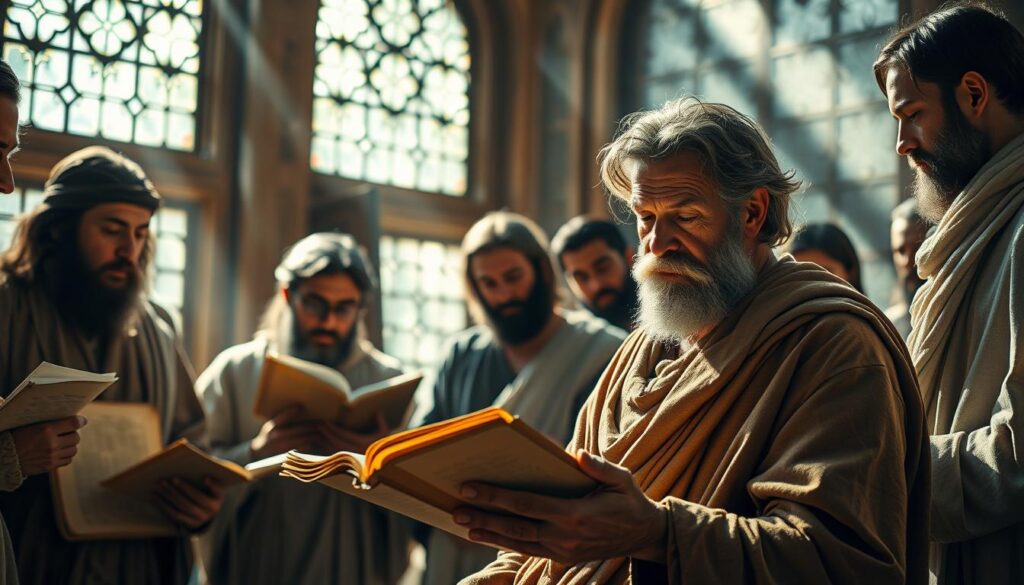
A group of apostles and disciples gathered in a sun-dappled room, deep in contemplation of ancient scrolls and parchments. Soft, natural lighting filters through leaded glass windows, casting a warm, reverent glow. In the foreground, a weathered, pensive man in flowing robes examines a text, his face etched with years of scholarly devotion. Surrounding him, his companions - each lost in their own study, their expressions reflecting a profound reverence for the sacred sources before them. The scene evokes a timeless, meditative atmosphere, hinting at the profound insights into the life and teachings of Jesus that these disciples are uncovering from the gospel accounts.

The Four Gospels and Pauline Epistles

Matthew, Mark, Luke, and John form the bedrock of Christian testimony. Written by disciples or their close allies, these works preserve direct experiences. They detail teachings, miracles, and pivotal moments with raw authenticity.

Paul’s letters add striking depth. Written years before the Gospels, they come from a former critic turned devoted messenger. His writings confirm key details:

  • Davidic ancestry of the central figure
  • Miraculous acts and resurrection claims
  • Establishment of sacred rituals

As someone who once opposed the movement, Paul’s shift carries weight. His intellectual rigor—combined with firsthand encounters—makes his words uniquely persuasive.

The Value of Agrapha and Apocrypha

Uncanonical texts like the Gospel of Thomas show how early communities wrestled with meaning. While intriguing, their stories often lack the clarity of scripture. One scholar notes:

“Comparing these works is like holding quartz next to diamond—both sparkle, but only one endures pressure.”

This contrast highlights why sacred writings remain central. Their life-changing power continues to inspire modern articles of faith, bridging ancient wisdom with today’s questions.

Core Teachings on Jesus in Catholic Doctrine

At the heart of Church teachings lies a divine mystery that has shaped centuries of worship—the belief that ultimate truth exists in relationship. This framework answers life’s deepest questions through interconnected truths about identity, purpose, and connection.

Messiahship and Redemption

Early followers expected a political liberator. Instead, they encountered a person who redefined power through sacrifice. The crucifixion wasn’t defeat—it became the ultimate act of love, offering redemption to all humanity. As one scholar notes:

“The cross turns suffering into a bridge—where human limits meet divine mercy.”

The Trinity and Incarnation Explained

Imagine three distinct notes forming one perfect chord. The Trinity—Father, son god, and Holy Spirit—works similarly. Each person maintains unique roles while sharing one divine essence. The Nicene Creed, central to faith, captures this paradox:

  • “True God from true God” affirms divine nature
  • “Born of the Virgin Mary” confirms human experience

This statement anchors worship practices worldwide. Through sacraments like baptism, believers participate in a story bigger than themselves—one where jesus god’s dual nature makes transformation possible.

Understanding the Sacramental Presence of Jesus

Sacred rituals shape more than Sunday mornings—they transform everyday moments into encounters with the divine. Through seven tangible practices, believers experience grace that fuels spiritual growth at every life stage. These sacraments aren’t symbols but channels where sacred promises become real.

In baptism, water becomes a doorway. Individuals join Christ’s body, sharing in his death and rebirth. This first step launches a lifelong journey where sin loses its grip, and community ties strengthen.

Other sacraments mark key milestones. From marriage vows to healing prayers, each ritual mirrors eternal truths. They remind us that holiness isn’t distant—it’s woven into our life story. The Church becomes a living network, dispensing hope where it’s needed most.

This system shows how ancient wisdom meets modern needs. Every sacrament whispers the same message: you’re never alone. The same power that walked Galilee now walks beside you, turning ordinary days into sacred ground.

FAQ

How does Catholic tradition interpret Jesus’ role as both human and divine?

Catholic teaching emphasizes the Incarnation, affirming that Jesus is fully God and fully human. This duality allows him to bridge humanity and divinity, offering redemption through his life, death, and resurrection.

What historical sources outside the Bible mention Jesus?

Non-Christian writers like Flavius Josephus and Roman historians such as Tacitus reference Jesus. These accounts highlight his existence, execution under Pontius Pilate, and the early growth of his followers.

Why are the Gospels central to understanding Jesus’ mission?

The Gospels provide firsthand accounts of his teachings, miracles, and resurrection. They reveal his focus on the Kingdom of God, forgiveness of sins, and call to love God and neighbor unconditionally.

How do sacraments connect believers to Jesus today?

Sacraments like the Eucharist embody his ongoing presence. Catholics believe he is truly present in the bread and wine, uniting the faithful to his sacrifice and offering grace for daily living.

What distinguishes Catholic views on the Trinity from other Christian traditions?

While all Christians affirm the Trinity, Catholicism stresses the mystery of one God in three Persons. The Son’s eternal relationship with the Father and Holy Spirit shapes doctrines like redemption and prayer.

Did early Jewish writings acknowledge Jesus’ significance?

Some Jewish texts, like the Talmud, briefly mention him but reject his divinity. Flavius Josephus’ Antiquities notes his influence, though later edits complicate interpretations of these records.

How does the concept of sin relate to Jesus’ purpose?

His mission centered on overcoming sin’s power through forgiveness. By his death and resurrection, believers are freed from sin’s grip and invited into eternal life with God.