Recent Posts

Catholicism 101: Understanding the Fundamentals


Exploring a spiritual journey that has shaped lives for centuries can feel overwhelming. This guide breaks down the core principles of a global faith that connects over a billion people through shared beliefs and traditions. At its heart, this way of life centers on restoring humanity’s relationship with God—a bond strengthened through community, prayer, and service.

Rooted in Jesus Christ’s teachings, believers view the Church as a source of grace and guidance. Sacraments like baptism and communion offer strength to practice love and kindness daily. As Bishop Erik Pohlmeier explains, these practices prepare individuals for eternal unity with God while fostering harmony on Earth.

Why does this matter today? In a fast-paced world, these timeless values provide stability and purpose. Whether you’re seeking spiritual growth or simply curious, understanding these foundations helps explain why this tradition remains vital across generations.

Key Takeaways

  • Centers on restoring humanity’s relationship with God through Jesus’ sacrifice
  • Sacraments serve as channels for spiritual strength and growth
  • Emphasizes community, charity, and preparing for eternal life
  • Combines ancient traditions with modern-day relevance
  • Offers a structured path for personal and collective spiritual development

Introduction to Catholicism and Its Relevance Today

In a world filled with diverse beliefs, one tradition continues to unite millions through its message of hope and belonging. The Catholic Church spans cultures and generations, offering a spiritual home to 1.3 billion people worldwide. Its enduring appeal lies in addressing life’s biggest questions while nurturing a global family rooted in faith.

What Inspired the Journey of Faith

Many find inspiration in the Church’s universal call to love. The word “Catholic” literally means “for everyone,” reflecting Jesus’ invitation to all people. This faith isn’t about rules—it’s a gift of grace that transforms hearts and connects believers across the world.

An Overview of Catholic Beliefs

Central to this tradition is the belief that God entered human history through Jesus Christ. Followers see life as a sacred journey toward eternal unity with God, supported by:

  • Sacraments that mark key moments in spiritual growth
  • Teachings promoting justice, mercy, and human dignity
  • A living connection to saints and believers across time

In modern society, these principles guide ethical decisions and foster communities where people find purpose. As one priest notes, “The Church remains relevant because it answers our deepest hunger—for truth, love, and lasting peace.”

Catholicism 101: Core Beliefs and Practices

Believers find their foundation in a triune God who actively guides their spiritual path. This core teaching—one divine being existing as Father, Son, and Holy Spirit—shapes every aspect of faith and daily living.

Understanding the Nature of God and the Holy Spirit

The Holy Spirit serves as God’s living presence within believers. This divine helper strengthens people to live with compassion and courage. Through sacraments like baptism, Catholics receive grace—a spiritual boost to grow closer to God.

Daily prayer becomes a two-way conversation. As one nun explains, “We speak to God through words, but listen through quiet reflection on scripture.” This practice helps align actions with divine purpose.

The Role of Sacred Scripture and Tradition

Catholic teachings draw from two complementary sources:

  • The Bible as God’s written word
  • Sacred traditions passed down through generations

Together, they form a complete guide for living in truth. The Church’s teaching authority ensures these sources remain relevant across centuries. Regular participation in sacraments and acts of service keeps faith vibrant and practical.

“These practices aren’t ancient history—they’re tools for modern holiness.”

The Seven Sacraments: Channels of Divine Grace

Sacred moments shape our lives in ways words often can’t capture. The seven sacraments act as spiritual milestones where believers experience God’s direct intervention. These rituals transform ordinary moments into encounters with divine grace, offering strength for life’s journey.

A lush, ornate cathedral interior bathed in warm, golden light. In the foreground, seven sacramental objects - a baptismal font, communion chalice, priestly stole, consecrated host, holy oil, wedding rings, and rosary beads - are arranged in a reverential tableau. The middle ground features richly carved wooden pews and intricate stained glass windows depicting holy figures. In the background, an ornate high altar stands as the focal point, its tabernacle and crucifix casting an ethereal glow. The overall scene conveys the gravity and sanctity of the seven sacraments, which serve as the conduits of divine grace in the Catholic faith.

Baptism, Confirmation, and Eucharist

Baptism marks the beginning of faith—water and prayer wash away sin and welcome new members into God’s family. Confirmation follows, deepening this bond through the Holy Spirit’s gifts like wisdom and courage. The Eucharist, celebrated at every Mass, nourishes believers with Christ’s presence. One parishioner shares, “Receiving communion feels like a hug from heaven.”

Penance, Anointing, Marriage, and Holy Orders

When mistakes weigh heavy, Penance offers healing through forgiveness. The Anointing of the Sick brings comfort during illness, reminding us we’re never alone. Marriage elevates love into a sacred promise mirroring Christ’s devotion. Holy Orders sets apart leaders who guide communities with compassion.

Together, these practices form a roadmap for spiritual growth. They meet us in joy, struggle, and everyday moments—proof that grace isn’t distant but alive in our world.

The Role of the Catholic Church: History and Global Impact

Throughout centuries, one institution has quietly shaped the course of human progress while nurturing souls across continents. The Church operates as a spiritual family spanning three interconnected realms: believers on earth (Church Militant), souls being purified (Church Suffering), and saints in heaven (Church Triumphant). This bond transcends time, creating a living network where prayers uplift both the living and departed.

From preserving ancient texts during Europe’s dark ages to building 140,000 schools worldwide today, the Church’s work impacts daily life. Its hospitals serve over 30 million patients annually, while food banks feed millions more. One bishop remarked, “We’re called to heal bodies and souls—that’s how love becomes action.”

Beyond charity, this global community influences art, science, and human rights. Gothic cathedrals inspired engineering breakthroughs, while Jesuit scholars advanced astronomy. Modern efforts focus on refugee aid and climate justice, proving ancient wisdom meets modern needs.

What makes this enduring? A faith that sees every person as sacred—worthy of care today and hope for eternity. As the world changes, this mission remains: building bridges between heaven and earth through service and prayer.

Papacy and Apostolic Succession in the Modern World

At the heart of Catholic governance lies a two-millennia-old practice ensuring continuity of sacred teachings. This unbroken chain of leadership began when Jesus named Peter the “rock” of His Church, entrusting him with spiritual authority. Today’s popes inherit this mission through apostolic succession—a sacred hand-to-hand tradition preserving divine truth across generations.
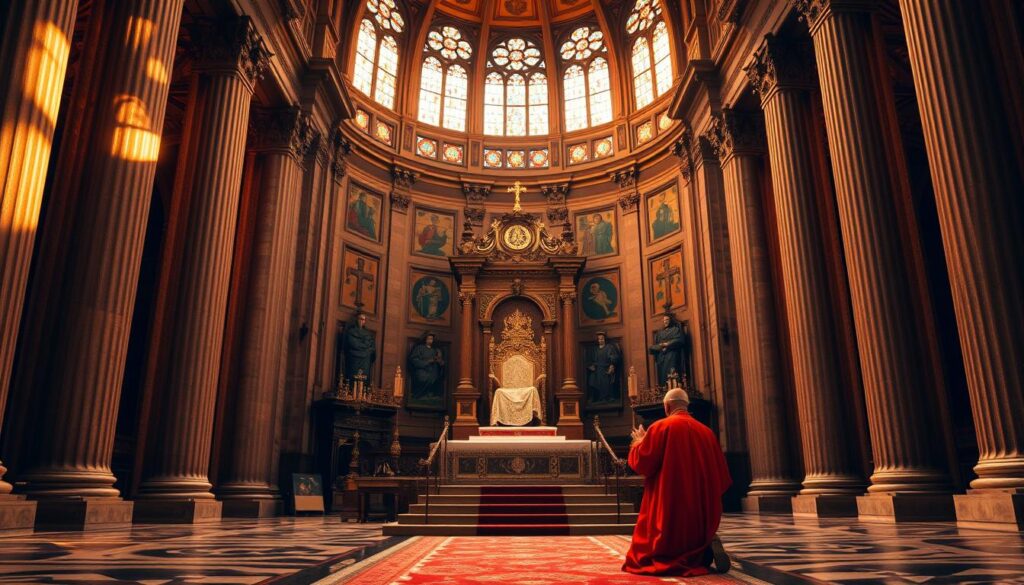
A grand cathedral interior, illuminated by warm, golden light filtering through stained-glass windows. At the center, an ornate throne stands elevated on a dais, symbolizing the seat of papal authority. The throne is flanked by towering columns and intricate religious iconography, conveying the power and majesty of the Catholic Church. In the foreground, a cardinal in crimson robes kneels before the throne, hands clasped in reverence. The atmosphere is one of solemn reverence and the weight of centuries-old tradition. The camera angle is low, looking up at the throne, emphasizing the hierarchical nature of the papacy and its enduring influence in the modern world.

The Concept of Papal Infallibility

Many wonder how a human leader could claim error-free guidance. The answer lies in specific conditions: infallibility applies only when popes formally define matters of faith or morals ex cathedra (from Peter’s chair). As one theologian notes, “It’s not about personal perfection—it’s divine protection for core teaching.”

This power safeguards essential beliefs like the Trinity or Mary’s role. Outside these rare declarations, popes remain fallible individuals with personal views on politics or science. Modern leaders use this teaching authority to address issues like climate change while upholding timeless doctrines.

Apostolic succession extends beyond Rome. Every bishop and priest shares in this lineage through ordination rituals tracing back to Christ’s apostles. This structure creates a global network preserving authentic faith practices—from bustling cities to remote villages.

“Our unity isn’t rooted in opinion polls, but in Christ’s promise to guide His Church.”

The Power of Prayer in Strengthening Faith

Imagine having coffee with a close friend—the easy back-and-forth, the shared silence. This mirrors how prayer works in spiritual life. It’s not a monologue but a dynamic exchange where hearts align with divine purpose.
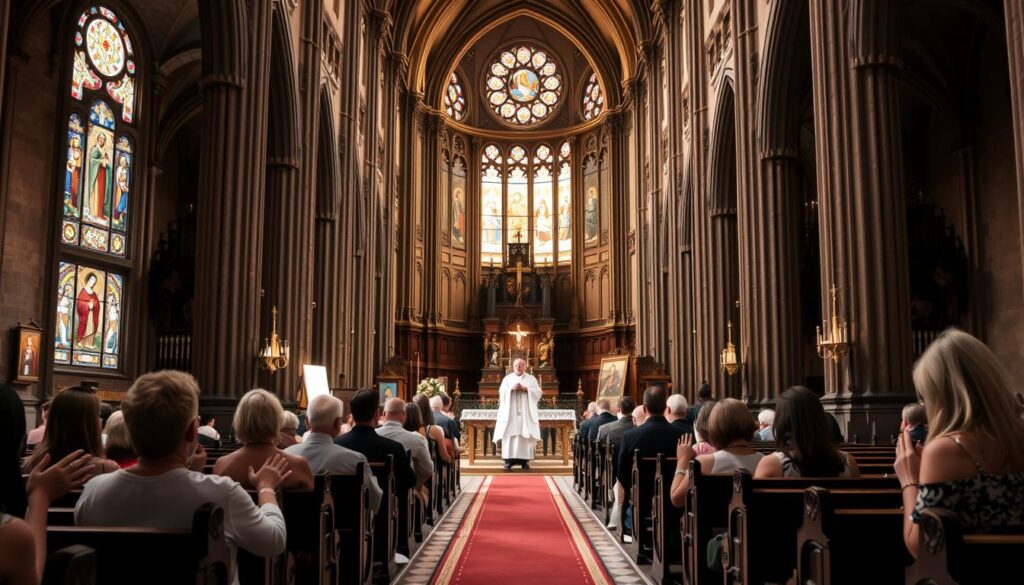
a serene Catholic church interior, with ornate wooden pews, stained glass windows casting warm light, and a central altar adorned with intricate religious iconography. In the foreground, a group of worshippers kneeling in prayer, their hands clasped and heads bowed, expressions of deep contemplation and devotion. The middle ground features a priest leading a solemn ceremony, his robes flowing gracefully. The background showcases the grand architectural details of the cathedral, with towering columns and a vaulted ceiling that seems to reach towards the heavens, creating an atmosphere of reverence and spiritual transcendence.

Prayer as a Conversation with God

True prayer begins by seeing life through God’s compassionate lens. As Jesuit wisdom teaches, it’s about “taking a long, loving look at the real.” This means acknowledging both joys and struggles while trusting in sacred guidance.

Three approaches help believers connect:

  • Vocal prayers like the Our Father
  • Meditation on scripture passages
  • Contemplative silence to sense God’s presence

Listening and Speaking in Prayer

Many focus on asking for help but forget to pause. A parish volunteer shares: “I’ve learned to sit quietly after speaking my words. That’s when I feel God’s answer—sometimes as peace, sometimes as nudges to act.”

This balance transforms faith. Listening might mean noticing patterns in daily life or sudden clarity during Mass. Like any relationship, consistency deepens the bond—one honest chat at a time.

“Prayer isn’t about changing God’s mind. It’s about letting Him change our hearts.”

Experiencing Spiritual Grace: Mercy, Love, and Salvation

Life’s most profound moments often involve receiving something we didn’t earn. In faith, this unearned gift is called grace—God’s limitless love poured into human hearts. It’s not a reward for good behavior but a divine spark that awakens our capacity to live truthfully.

This grace comes in different forms. Sanctifying grace makes us holy, while actual grace guides daily choices. Sacramental grace flows through rituals like Reconciliation, where mercy becomes tangible. “Confession isn’t about shame,” a priest explains. “It’s about healing through God’s forgiveness.”

Salvation begins with this gift. While God initiates it, we participate through acts of kindness and faith. Think of grace as sunlight—it’s always there, but we must open the curtains to let it in.

Love fuels this process. When we serve others or pray sincerely, we mirror Christ’s compassion. This collaboration between heaven and earth shapes our eternal journey. As one believer shares, “Grace turns ordinary moments into steps toward salvation.”

“We don’t earn God’s love—we simply receive it and let it change us.”

Encountering Christ: Life, Death, and Resurrection

At the heart of Christian belief lies a story that reshaped history—a divine rescue mission through love’s ultimate price. Jesus Christ, both fully God and human, lived among us to show how heaven meets earth. His death wasn’t tragic defeat but deliberate victory—a bridge built across humanity’s brokenness.

Why did this sacrifice matter? Because holiness and human weakness couldn’t coexist. God’s justice demanded repair, while His mercy provided the solution. On the cross, Christ absorbed every wrong, turning pain into hope. As one theologian puts it, “Love paid the bill we couldn’t afford.”

The resurrection changed everything. When Jesus walked out of the tomb, He proved death holds no power over those who follow Him. This miracle fuels believers’ confidence in eternal life—not just someday, but starting now through acts of compassion.

Today, Catholics meet the risen Christ most intimately in the Eucharist. Bread and wine become His living presence, renewing hearts weekly. Like the first disciples, we’re invited to recognize Him—in sacred meals, quiet prayers, and hands serving others.

This story isn’t frozen in time. Through the Holy Spirit, Jesus Christ continues guiding His people, turning ordinary moments into encounters with divine love that transforms worlds.

FAQ

How does the Holy Spirit influence daily Catholic life?

The Holy Spirit guides believers through prayer, sacraments, and conscience. It strengthens faith, offers wisdom, and unites the Church as a spiritual family. Many feel its presence in moments of peace, forgiveness, or clarity during challenges.

Why are the Seven Sacraments central to Catholic practice?

Sacraments like Baptism, Eucharist, and Marriage are visible signs of God’s grace. They mark key moments in a believer’s journey, offering spiritual nourishment and deepening their relationship with Christ and the Church community.

What role does sacred tradition play alongside Scripture?

Sacred tradition preserves teachings passed down from the apostles. Alongside the Bible, it helps interpret God’s word through centuries of Church guidance, liturgy, and the lived faith of believers worldwide.

How does prayer strengthen a Catholic’s connection to God?

Prayer is a two-way conversation—sharing hopes, fears, and gratitude while listening for God’s voice. Regular prayer builds trust, invites divine mercy, and aligns hearts with Christ’s teachings, even in difficult times.

What is the significance of Christ’s Resurrection for believers today?

The Resurrection offers hope in eternal life and affirms God’s power over sin and death. It reminds Catholics that suffering has purpose and that Christ’s love remains a living force in their daily struggles and joys.

How does the Church address modern challenges while preserving its teachings?

Through apostolic succession, the Church adapts pastoral approaches without altering core truths. It emphasizes mercy, engages with global issues, and invites dialogue while upholding Scripture and tradition as timeless guides.

Why is the Eucharist called the “source and summit” of faith?

The Eucharist unites believers with Christ’s sacrifice and resurrection. Receiving His body and blood in Communion renews grace, strengthens communal bonds, and directs hearts toward heavenly union with God.
Catholicism and Praying to Saints: What You Need to Know


For centuries, many Christians have turned to holy figures who lived exemplary lives for guidance and support. This tradition, deeply rooted in faith, reflects a belief in spiritual unity that transcends time and space. It’s not about worship but about seeking companionship from those who’ve walked the path of devotion before us.

Historical records show this practice began in the early church. Followers saw these revered individuals as powerful allies, capable of bringing their needs closer to God. Eastern Orthodox, Anglicans, and other Christian groups still share this view today, though interpretations vary.

Central to this concept is the idea of the Communion of Saints—a bond linking believers across heaven and earth. Think of it like asking a trusted friend to pray for you, but on a cosmic scale. This connection emphasizes community rather than isolation in one’s spiritual journey.

Some modern Christian traditions question this approach, often due to misunderstandings. However, Catholic teaching clearly distinguishes between honoring saints and worshiping God. The latter remains reserved solely for the Divine Trinity.

Key Takeaways

  • This tradition spans nearly 2,000 years and unites multiple Christian denominations
  • Seeking saintly intercession differs fundamentally from divine worship
  • The Communion of Saints doctrine supports spiritual connections between believers
  • Common concerns often stem from misinterpretations of Catholic teachings
  • Many find this practice deepens their relationship with God through communal prayer

Historical Foundations of Praying to the Saints

Long before grand cathedrals or formal liturgies, followers of Christ found strength in community—both earthly and heavenly. This spiritual bond with holy figures traces back to ancient traditions, blending Jewish roots with emerging Christian beliefs.

Seeds of a Spiritual Tradition

The practice of seeking heavenly allies began with those who died for their faith. Early believers saw martyrs as living bridges to God, their sacrifice granting unique spiritual access. Third-century writings reveal prayers like: “Holy Perpetua, intercede for us in our struggles.”

“Their prayers now achieve more than their words ever could.”

Gregory of Nazianzus on martyrs’ intercession

From Tombs to Theology

As Christianity spread, believers gathered at burial sites seeking connection. By the 300s, thinkers like Jerome systematized these traditions, creating frameworks still used today. The table below shows key developments:

Time Period Development Impact
1st Century Jewish angelic intercession beliefs Laid groundwork for saintly prayer concepts
3rd Century First written prayers to martyrs Established documented tradition
4th Century Church Fathers’ theological works Solidified doctrinal foundations

This evolution wasn’t about inventing new ideas but nurturing an unbroken chain of spiritual kinship. What began as whispered requests at gravesides became a timeless expression of communal faith.

Biblical References and Scriptural Evidence

The Bible offers vivid imagery that shapes our understanding of spiritual connections between believers. Its pages reveal how those in heaven remain actively engaged with earthly prayers, creating a tapestry of divine communication.

A serene heavenly scene, bathed in a warm, golden light. In the foreground, a divine figure with outstretched arms, radiating a celestial glow, interceding on behalf of the faithful. In the middle ground, a crowd of worshippers gazing upwards in reverence, their faces illuminated by the celestial light. In the background, wispy clouds part to reveal a brilliant, azure sky, signifying the divine's presence and intervention. The composition is balanced, with a sense of awe and wonder permeating the scene. Subtle, ethereal details and a soft, dreamy atmosphere evoke a sense of biblical wonder and spiritual transcendence.

Revelation’s Golden Bowls

John’s vision in Revelation 5:8 shows twenty-four elders holding golden bowls filled with incense—explicitly called “the prayers of the saints.” This symbolic scene demonstrates how heavenly figures present our petitions to God. Later, Revelation 8:3-4 describes an angel mixing incense with prayers at heaven’s golden altar.

Ancient Patterns of Intercession

Scripture contains early examples of seeking spiritual support:

Scripture Intercession Example Significance
Genesis 20:7 God tells Abimelech to seek Abraham’s prayer Shows value of righteous intercessors
Job 42:8 God instructs Job to pray for friends Affirms mutual prayer responsibility
1 Timothy 2:1 Paul urges prayers for all people Establishes communal prayer practice

These passages reveal a consistent pattern. From Old Testament patriarchs to New Testament apostles, seeking intercession appears as natural as asking a neighbor for help. As Paul writes: “Help us by your prayers” (2 Corinthians 1:11), modeling how spiritual support transcends earthly limits.

Jesus Himself emphasized praying for others, even enemies. This foundation makes seeking heavenly allies’ prayers an extension of biblical community—not a departure from it. The practice mirrors how early Christians understood their connection to heaven’s faithful.

Understanding catholicism praying to saints

At the heart of Catholic spiritual practice lies a profound connection that bridges heaven and earth. This bond isn’t limited by physical existence but thrives through shared faith in Christ’s eternal promise. The Communion of Saints doctrine illuminates how believers—past and present—form one spiritual family.

The Doctrine of the Communion of Saints

The Catholic Church teaches that baptism unites all Christians into a single mystical Body. This includes those who’ve passed into eternal life. As St. Paul wrote: “Whether we live or die, we belong to the Lord” (Romans 14:8). Saints remain active members of this spiritual network, capable of supporting earthly believers through prayer.

Key aspects clarify this teaching:

  • Intercession differs completely from worship, which honors God alone
  • Asking saints for help mirrors requesting prayers from friends
  • Eternal life in Christ Jesus ensures saints stay connected to the Church

“The communion of saints is the Church’s spiritual solidarity… between pilgrims on earth and those entering heavenly glory.”

Catechism of the Catholic Church 962

This perspective transforms grief into hope. Death becomes a doorway to deeper unity rather than permanent separation. When Catholics seek a saint’s intercession, they’re tapping into a living network of faith that transcends time and space.

The Role of Christ as the Sole Mediator

At the center of Christian belief stands a truth that shapes every spiritual practice: Christ Jesus alone bridges heaven and earth. This foundational concept anchors how believers understand their relationship with God and each other.

Scriptural Argument: 1 Timothy 2:5 and Related Texts

Paul’s letter cuts through confusion: “There is one God, and one mediator between God and men, the man Christ Jesus” (1 Timothy 2:5). Yet in the same breath, the apostle urges believers to offer prayers for everyone—showing these ideas aren’t rivals but partners.

Consider the context:

  • Four verses earlier, Paul calls intercession “good and pleasing to God”
  • Christ’s unique role stems from being fully divine and human
  • Asking others to pray mirrors how early churches operated

“The saints’ intercession is their highest service to God’s plan. We do not obscure Christ’s mediation but proclaim it.”

Vatican II Document Lumen Gentium

Clarifying Misconceptions About Mediation

Some worry seeking heavenly help undermines Christ’s position. But think of it like teamwork—one mediator leads while others assist. Jesus remains the only bridge between mediator God and humanity because He alone conquered sin through His sacrifice.

Key distinctions:

  • Saints present requests to Christ, not instead of Him
  • All grace flows through Jesus’ mediation
  • This practice echoes biblical patterns of communal prayer

Understanding this stops false either/or choices. Honoring Christ Jesus as mediator God men need doesn’t exclude asking friends—earthly or heavenly—to join your prayers.

Intercession of Saints: Faith Practice vs. Superstition

Understanding the line between spiritual devotion and forbidden practices requires clarity. Many wonder how asking heavenly allies for help differs from occult activities. The answer lies in intention, theology, and the nature of eternal life.

A soaring cathedral interior, stained glass windows casting warm hues. In the foreground, a figure kneeling in prayer, hands clasped, conveying profound faith and devotion. In the middle ground, a group of people gathered, some with uplifted hands, others with skeptical expressions - the contrast of intercession and superstition. The background fades into shadowy recesses, a sense of mystery and the weight of centuries-old tradition. Soft, directional lighting illuminates the scene, creating a reverent, contemplative atmosphere. The composition balances the spiritual and the worldly, inviting the viewer to ponder the nuances of Catholic belief and practice.

What True Intercession Looks Like

Authentic spiritual support mirrors everyday friendships. Just as you might text a friend for prayers, believers ask saints to bring needs to God. The Church emphasizes this is about collaboration, not control.

Key markers distinguish healthy practice:

  • Focus remains on God’s will, not personal demands
  • No rituals or tools required beyond simple requests
  • Trust in saints’ ongoing care replaces need for signs

“Superstition is by its nature a mortal sin.”

Baltimore Catechism

Separating Fact From Fiction

Common myths confuse holy intercession with forbidden acts. The table below clarifies differences:

Practice Purpose Church Stance
Asking saints for prayers Seeking spiritual support Encouraged
Conjuring spirits Forcing communication Condemned
Visiting relics Honoring holy lives Approved
Seances Contacting the dead Forbidden

Believers don’t need visions to feel heard. As one theologian noted: “Faith bridges the gap where senses fail.” This trust in eternal bonds keeps the practice grounded in hope, not fear.

The Significance of Relics and Images in Devotion

Sacred objects have always helped people connect with what they hold dear. From weathered statues to centuries-old bones, these items aren’t magic—they’re memory keepers. The Church teaches that such objects point beyond themselves to greater spiritual truths.

A dimly lit interior, the soft glow of candlelight casting a warm, reverent atmosphere. In the foreground, a collection of sacred relics - fragments of bone, cloth, and wood, each encased in ornate reliquaries of gold and silver. Their surfaces reflect the flickering flames, imbuing them with a sense of otherworldly significance. In the middle ground, a series of religious icons, their painted faces transfixed in expressions of deep devotion. The background fades into a hazy, atmospheric space, hinting at the spiritual realm beyond. The entire scene evokes a feeling of profound reverence and connection to the divine.

Historical Use and Spiritual Meaning

The Council of Trent (1545-63) made it clear: “Honor shown to images refers to their prototypes.” This built on biblical precedents like Moses’ bronze serpent and Solomon’s temple carvings. As the Baltimore Catechism explains: “We honor saints through symbols, not the symbols themselves.”

Object Type Spiritual Purpose Biblical Parallel
Relics Connect to holy lives Elijah’s mantle (2 Kings 2:14)
Icons Focus prayer Ark cherubim (Exodus 25:18)
Statues Inspire imitation Bronze serpent (Numbers 21:9)

Modern Perspectives on Devotional Art

Today’s Catholics use religious art like photo albums—to remember spiritual family. A pocket saint medal or home altar isn’t about worship but presence. As one believer noted: “My grandmother’s rosary helps me feel connected to her faith journey.”

“Sacred images are like windows—they let light in but aren’t the source of light.”

Modern Catholic Artist

These traditions balance devotion with clarity. They use physical form to touch eternal realities, much like hugging a loved one’s sweater brings comfort. The key lies in looking through the artwork, not at it.

Comparative Perspectives Across Denominations

Christian unity and diversity collide in debates over saintly intercession. While some see it as a cherished tradition, others view it through theological caution. This tension reveals how different groups interpret scripture and spiritual community.

Catholic, Orthodox, and Anglican Interpretations

The Catholic Church shares this practice with Eastern Orthodox and some Anglican communities. These groups see saints as living links in a timeless chain of faith. As one Orthodox theologian notes: “The departed remain active members of Christ’s body—death can’t silence their love.”

Anglican views have shifted over time. Early documents supported honoring holy figures, but later reforms discouraged direct requests. Today, some Anglicans light candles at shrines, while others avoid the practice entirely.

Protestant Critiques and Their Counterarguments

Reformers like John Calvin argued that seeking saintsprayers distracts from Christ’s sole mediation. The table below shows key denominational stances:

Tradition Position Scriptural Basis
Lutheran Saints pray for the Church but shouldn’t be addressed 1 Timothy 2:5
Reformed Forbidden as idolatry Exodus 20:3
Methodist No biblical support for intercession Hebrews 4:16

“Christ alone is the advocate—we need no other helpers.”

John Wesley’s Sermon on Mediation

These differences remind people that shared beliefs often come with diverse expressions. While practices vary, the desire to connect with divine love remains universal.

Practical Guidelines for Praying to Saints

Connecting with spiritual mentors doesn’t require grand gestures—just an open heart. Start by focusing on intention rather than perfection. Many find that simple, consistent habits create meaningful connections across the veil of eternity.

How to Request Intercession in Daily Life

Choose a holy figure whose story resonates with your journey. Keep requests natural, like “St. Francis, guide me in caring for creation today.” Some light candles as visual reminders of their faith legacy.

Pair these moments with Scripture reading to ground your practice. Journaling reflections helps track how these interactions shape your spiritual growth. Remember, it’s about building relationship, not reciting rigid formulas.

For those new to this tradition, start small. A morning whisper for courage or an evening thank-you note fosters devotion without overwhelm. As one believer shared: “It’s like adding friends to my prayer group—just ones who’ve already finished the race.”

FAQ

Why do some Christians ask saints in heaven to pray for them?

Believers view saints as part of the spiritual family, alive in God’s presence. Just as you might ask a friend to pray for you, requesting a saint’s intercession reflects trust in their closeness to Christ. This practice aligns with the Communion of Saints, a bond uniting all followers of Jesus across time and space.

Doesn’t the Bible say Jesus is the only mediator?

Yes! Scripture clearly states Christ is the one mediator between God and humanity (1 Timothy 2:5). Catholics affirm this truth. Asking saints to pray with you doesn’t replace Christ’s role but acknowledges that all believers—on earth and in heaven—can support one another through prayer.

Is praying to saints considered worship?

No. Worship is reserved for God alone. Honoring saints is like showing respect to a hero of the faith. Prayers to saints are requests for their help, not acts of adoration. The distinction mirrors how early Christians venerated martyrs without confusing them with divine beings.

How do relics or images connect to this practice?

Relics (like bones or belongings of saints) and art serve as tangible reminders of holy lives. They’re not magical but point to God’s work through ordinary people. Think of them like family photos—tools to inspire gratitude and focus during prayer.

Do other Christian groups share this belief?

Orthodox and Anglican traditions also honor saints, though practices vary. Many Protestant denominations emphasize direct prayer to God, viewing saintly intercession as unnecessary. These differences often stem from how groups interpret Scripture’s teachings about the afterlife and community.

Can anyone become a saint?

In Catholic teaching, all believers are called to holiness. Official canonization recognizes individuals who lived extraordinary faith. This process ensures their example aligns with Church doctrine, offering trustworthy models for others to follow.

How do I start incorporating saintly intercession into prayer?

Begin by learning about a saint whose life resonates with yours. Simply talk to them, asking for guidance or prayers. Many use phrases like, “St. Francis, pray for me as I care for creation.” It’s about building relationships, not rituals.

Catholicism for Beginners: Understanding the Basics


Welcome to a spiritual path followed by over 1.1 billion people globally. This guide simplifies core principles of the Roman Catholic Church, offering clarity for those new to its traditions. Whether you’re curious or committed, you’ll find a clear roadmap here.

The Church’s teachings are organized into four pillars: core beliefs, moral guidance, worship practices, and prayer. These elements work together to create a meaningful connection with God and community. You don’t need prior knowledge—we’ll start from the ground up.

Many wonder how this faith differs from other Christian traditions. Key distinctions include the Pope’s role as spiritual leader and the balance between Scripture and sacred tradition. These unique aspects shape daily life for believers worldwide.

Far more than rules, Catholic doctrine provides tools for finding purpose and joy. Through sacraments like Communion and practices like Lent, followers build a relationship with the divine. This living tradition adapts to modern life while honoring ancient wisdom.

Key Takeaways

  • Discover a 2,000-year-old tradition practiced by over 1.1 billion people
  • Learn through four structured pillars: beliefs, morality, worship, and prayer
  • Understand unique features like papal authority and sacred traditions
  • Find practical tools for spiritual growth and daily meaning
  • Explore sacraments that deepen connection to God and community

Introduction to the Catholic Faith

Have you ever wondered what unites over a billion people across continents and cultures? At its heart, this spiritual tradition combines ancient wisdom with modern relevance. The term “Catholic” stems from the Greek word katholikos, meaning “universal”—a perfect description of its worldwide embrace.

What Is This Global Tradition?

Rooted in the teachings of Jesus Christ and his apostles, the Catholic Church forms the largest Christian community. Unlike other denominations, it maintains unbroken leadership tracing back to Saint Peter. This connection between past and present gives the faith its unique continuity.

Two pillars uphold Catholic teachings: the Bible and Sacred Tradition. While Scripture forms the foundation, Tradition preserves interpretations passed through generations. As one bishop noted,

“We don’t read the Word alone—we celebrate it through living practice.”

Walking Through History

From Roman catacombs to Gothic cathedrals, this 2,000-year journey shaped civilizations. The Church established Europe’s first universities and inspired masterpieces like Michelangelo’s Sistine Chapel. Yet its core mission remains unchanged—sharing God’s love through service and sacraments.

Vatican City serves as the spiritual headquarters, where the Pope guides 1.1 billion members. Whether through weekly Mass or works of mercy, Catholics worldwide express their faith in action. This blend of prayer and practicality makes the tradition thrive in changing times.

Foundational Beliefs in Catholicism

Central to the Catholic experience are timeless truths that have guided generations. These principles form a spiritual compass, helping believers navigate life’s challenges while staying rooted in divine truth. Let’s explore the tools that preserve this wisdom across centuries.

A grand cathedral interior, illuminated by soft, warm lighting filtering through stained glass windows. In the foreground, an ornate altar adorned with religious iconography - a golden cross, flickering candles, and a leather-bound book of Catholic catechism and creeds. In the middle ground, rows of sturdy wooden pews facing the altar, conveying a sense of reverence and devotion. The background features towering stone columns and arched ceilings, creating an atmosphere of grandeur and spirituality. The overall mood is one of solemn contemplation, inviting the viewer to reflect on the foundations of the Catholic faith.

Core Doctrines and the Catechism

The Catechism of the Catholic Church acts like a spiritual encyclopedia. This 900-page guide organizes teachings into four parts: beliefs, sacraments, moral living, and prayer. As the Catechism states:

“It is the privileged place where the Church’s constant Tradition is kept alive.”

Newcomers often find its clear structure helpful for understanding complex ideas. The book explains everything from the Trinity to social justice, showing how ancient wisdom applies today. Many parishes use it for study groups, making theology accessible to everyone.

The Role of Creeds in Defining Faith

Imagine memorizing a 2,000-year history lesson. That’s what creeds accomplish through poetic simplicity. The Apostles’ Creed packs core beliefs into twelve short lines. Catholics recite it during Mass, baptism, and personal prayer.

The Nicene Creed goes deeper, clarifying Jesus’ divine nature. Both statements unite believers in proclaiming one God through Father, Son, and Holy Spirit. As living documents, they bridge ancient word and modern faith, keeping essential truths fresh across generations.

catholicism basics: Core Principles for Beginners

At the heart of Catholic identity lies a 12-line statement recited for nearly 1,700 years. The Apostles’ Creed serves as both a spiritual roadmap and a unifying force across generations. Let’s explore how these ancient words shape modern belief.

The Apostles Creed and Its Significance

The creed opens with “I believe in God”—a bold declaration of trust in one supreme being. This foundation supports every Catholic teaching, from creation to eternal life. As the Catechism notes:

“The creed summarizes the gifts God gives through baptism.”

Three divine persons emerge in its lines: the Father as creator, Jesus as redeemer, and the Holy Spirit as guide. This Trinity concept isn’t math—it’s a mystery revealing God’s nature as love. The creed’s middle section focuses on Christ’s humanity, stating he was “born of the Virgin Mary” and “suffered under Pontius Pilate.”

Why does this matter today? Reciting these words connects modern believers to early Christians hiding in Roman catacombs. Each phrase answers vital questions: Who made us? Why do we suffer? What happens after death?

Newcomers often find the creed’s structure helpful. It moves from God’s power to Christ’s sacrifice to our eternal hope. This pattern mirrors the spiritual journey—from seeking truth to living it. Memorizing these lines creates a portable faith toolkit for daily challenges.

The closing lines about communion and everlasting life remind believers they’re part of something bigger. Whether whispered in prayer or proclaimed at Mass, these words unite 1.1 billion people across time and space.

Living the Catholic Life: Practices and Sacraments

Daily rhythms shape Catholic spirituality through sacred actions that connect belief to behavior. Seven sacraments form the backbone of this journey, offering tangible ways to experience divine grace. Let’s explore how these practices transform faith from concept to lived reality.

A majestic cathedral interior bathed in warm, golden light. In the foreground, an ornate altar adorned with religious symbols - a gleaming cross, flickering candles, and delicate stained glass. In the middle ground, worshippers kneel in reverent prayer, hands clasped. The background reveals soaring arched ceilings, intricate murals, and rows of wooden pews. The atmosphere is one of sacred solemnity, inviting contemplation of the Catholic faith's timeless rituals and traditions.

Weekly Worship and Spiritual Nourishment

Sunday Mass stands as the Christian life‘s heartbeat. Catholics gather to relive Christ’s sacrifice through the Eucharistic prayer. When the priest consecrates bread and wine, believers witness what the Catechism calls:

“The source and summit of the whole Christian life.”

Receiving Holy Communion strengthens one’s bond with Jesus and the global Church. Many parishes encourage weekly participation, though Easter and Christmas remain minimum requirements. This meal isn’t symbolic—it’s considered soul food for life’s challenges.

Renewal Through Sacraments

The Confession booth offers fresh starts. By admitting sins to a priest, Catholics believe they hear Christ’s forgiveness spoken aloud. Most parishes require annual participation, though many visit monthly for spiritual clarity.

Fasting traditions teach self-control. During Lent’s 40 days, adults skip meat on Fridays and limit food intake on Ash Wednesday. These acts redirect focus from physical cravings to prayer and charity.

Practice Purpose Frequency
Sunday Mass Communal worship Weekly
Holy Communion Spiritual nourishment Weekly encouraged
Confession Sins forgiveness Annual minimum
Fasting Spiritual focus Lent + holy days

These living traditions bridge ancient wisdom with modern work schedules. By weaving sacraments into daily routines, Catholics create a seamless flow between Sunday reverence and weekday service.

Understanding the Ten Commandments and Divine Law

What if ancient wisdom could solve modern problems? Carved into stone tablets millennia ago, the Ten Commandments remain humanity’s oldest moral operating system. These directives form a spiritual blueprint for balancing divine connection with human relationships.

A grand marble structure, illuminated by warm, golden light, stands as a testament to the Ten Commandments. In the foreground, ten stone tablets, etched with the sacred laws, are displayed with reverence. The middle ground features sculpted figures, embodying the moral principles, their expressions serene and resolute. In the background, a breathtaking landscape unfolds, with rolling hills and a clear, azure sky, symbolizing the divine nature of these timeless tenets. The scene exudes a sense of timelessness, evoking the enduring significance of the Ten Commandments as the foundation of Catholic moral teachings.

The Commandments as Foundations for Moral Living

Moses received these commandments on Mount Sinai as part of God’s covenant—a sacred agreement promising guidance for those who follow thy God. The Catechism explains:

“They express humanity’s fundamental duties toward God and neighbor.”

The first three rules focus on divine relationship. “I am the Lord thy God—you shall have no other gods before me” establishes exclusive devotion. Honoring God’s name and keeping the Sabbath holy complete this triad of reverence.

Seven principles then govern human interactions. From honoring parents to rejecting envy, these laws protect life, truth, and dignity. They’re not restrictions but guardrails preventing spiritual crashes.

Focus Area Commandments Modern Application
Divine Relationship 1-3 Prioritize spiritual growth
Family & Life 4-5 Strengthen community bonds
Social Harmony 6-10 Promote justice and honesty

When Catholics examine their conscience, they use these commandments as a checklist for spiritual health. “Thou shalt not steal” applies to both shoplifters and tax evaders. “Thou shalt not covet” challenges social media envy.

These timeless principles adapt to new contexts while keeping their core intact. They remind man that true freedom comes from living in harmony with divine wisdom—not chasing endless desires.

Works of Mercy: Corporal and Spiritual Acts

Imagine transforming faith into action through simple, powerful deeds. The Church’s fourteen Works of Mercy turn belief into living service—seven for the body, seven for the soul. These timeless practices help anyone make a real difference in others’ lives.

Hands-On Compassion

The Corporal Works address basic human needs. Feeding the hungry and sheltering the homeless aren’t just nice ideas—they’re Jesus’ direct commands. From soup kitchens to disaster relief, Catholics put work into easing physical suffering. Visiting prisoners and burying the dead show dignity matters even in dark times.

Heart-Centered Support

Spiritual Works heal invisible wounds. Sharing knowledge lights paths through confusion. Forgiving hurts—even small ones—breaks chains of bitterness. As the Catechism notes:

“Mercy nourishes hope in man‘s heart more than justice alone.”

Praying for others bridges earthly struggles with eternal hope. These acts create ripples of justice that uplift entire communities.

Whether tutoring children or comforting grief, both works express love through action. They remind us faith grows strongest when shared—one merciful work at a time.

FAQ

What is Catholicism?

Catholicism is the Christian faith rooted in Jesus Christ’s teachings and preserved by the Catholic Church. It focuses on sacraments, community, and following God’s will through prayer, service, and moral living.

How did the Catholic Church begin?

The Church traces its origins to Jesus and His Apostles, with St. Peter as the first Pope. Over centuries, it grew through missionary work, councils, and reforms, shaping Christian history and global culture.

What are the core beliefs of Catholicism?

Central beliefs include the Trinity, Christ’s Resurrection, and the sacraments. The Catechism guides Catholics in faith and morals, emphasizing love for God and neighbor as the path to holiness.

Why are creeds like the Nicene Creed important?

Creeds summarize essential truths, uniting Catholics worldwide. They affirm shared beliefs about God, Christ, and the Church, providing clarity and strength in living the faith.

What role does the Apostles’ Creed play?

The Apostles’ Creed outlines core teachings, such as creation and eternal life. Used in Baptism and Mass, it connects believers to the early Church’s witness and unity.

How do Catholics participate in Mass?

Mass includes prayer, Scripture, and Holy Communion. Receiving the Eucharist unites believers with Christ, while active participation renews their commitment to the Gospel.

Why are Confession and fasting practiced?

Confession offers forgiveness and healing, restoring one’s relationship with God. Fasting cultivates humility and solidarity with the poor, deepening reliance on divine grace.

How do the Ten Commandments guide daily life?

The Commandments provide divine laws for honoring God and respecting others. They shape choices about justice, honesty, and love, aligning life with God’s plan.

What are the Corporal Works of Mercy?

These are acts like feeding the hungry or sheltering the homeless. They reflect Jesus’ call to serve others’ physical needs, showing compassion and upholding human dignity.

What are the Spiritual Works of Mercy?

These include forgiving others and praying for those in need. They address spiritual struggles, guiding people toward God’s mercy and fostering peace in communities.

Understanding the Fundamental Beliefs of Catholicism


For over 2,000 years, sacred traditions have shaped how millions find meaning in their spiritual journeys. This guide walks you through timeless principles that answer life’s deepest questions – from humanity’s purpose to our eternal destiny. Whether you’re exploring your roots or discovering new perspectives, we’ll break down complex ideas into relatable insights.

The foundation of this faith traces back to Jesus’ words to Peter: “You are the rock.” This moment birthed a global community united by shared values. At its heart lies the Nicene Creed, a concise summary of divine truths about God’s nature and humanity’s relationship with the divine.

You’ll see how ancient scriptures connect to modern life in American parishes. We’ll explore how grace influences daily choices and why rituals like communion remain central to worship. Each concept is presented with warmth, respecting personal journeys while celebrating universal connections.

By the end, you’ll grasp how these teachings influence everything from family traditions to social outreach. This isn’t just about memorizing doctrines – it’s about discovering a living framework that guides actions, relationships, and hope.

Key Takeaways

  • The Nicene Creed outlines essential truths about God’s triune nature
  • Jesus’ commission to Peter established the Church’s spiritual authority
  • Teachings emphasize both divine grace and human cooperation
  • Sacred rituals bridge historical events with modern practice
  • Core principles address contemporary ethical and social questions
  • Faith journeys are personal yet connected to global traditions

Introduction to Catholic Faith and Beliefs

At the heart of spiritual practice lies a structure that blends ancient wisdom with modern life. The four interconnected dimensions – understanding truth, ethical living, sacred worship, and personal prayer – form a roadmap for those seeking deeper connection. These elements work like puzzle pieces, fitting together to reveal a complete picture of spiritual growth.

Overview of Core Principles

The Church’s teachings flow from a simple truth: “God meets us where we are.” Sacred texts and traditions act as guideposts, helping believers navigate life’s challenges. Through sacraments and community, individuals find practical ways to live out their convictions while staying rooted in historical continuity.

Consider the Catechism, which organizes teachings into clear categories. It’s not just a rulebook – it’s a love letter from generations past, offering timeless answers to contemporary questions about purpose and belonging.

Purpose of the Ultimate Guide

This resource bridges centuries-old traditions with today’s fast-paced world. You’ll discover how Sunday rituals connect to Monday decisions, and why ancient prayers still resonate in smartphone-filled lives. The Church’s role as guardian of divine revelation becomes clearer through real-world examples.

Whether you’re curious about sacraments or social justice, this guide illuminates connections between doctrine and daily choices. It’s designed to help you see faith not as a static set of rules, but as a living relationship that grows richer with understanding.

Foundations in Scripture and Sacred Tradition

Imagine two rivers flowing from the same spring – one carved into stone tablets, the other carried through generations. This partnership between written revelation and living wisdom forms the bedrock of spiritual understanding. Together, they create a complete picture of divine truth that’s stood firm through changing times.

A dimly lit cathedral interior, stained glass windows casting warm hues across a wooden pulpit. On the pulpit, an ornate Bible and a parchment scroll, representing the interplay of scripture and sacred tradition. Rays of light stream through the windows, illuminating the scene with a reverent, contemplative atmosphere. The scene conveys a sense of the timeless, enduring nature of Catholic faith, grounded in both the written Word and the living, evolving tradition of the Church.

The Role of the Bible

The Church treasures sacred books as God’s love letter to humanity. Early Christians faced a puzzle – with countless writings circulating, which ones truly carried divine authority? Through prayer and guidance, leaders identified 73 texts that form today’s Bible. This careful selection process ensured every book aligns with apostolic teaching.

Value of Sacred Tradition

Not everything Jesus taught made it into print. Oral teachings passed from apostles to bishops preserved essential truths about worship and community life. Think of Tradition as a family recipe shared through demonstration – its power lies in lived experience. This source of wisdom helps interpret Scripture within changing cultural contexts.

Aspect Scripture Tradition
Source Written texts Oral teachings
Transmission Preserved texts Lived practices
Role Divine authority Practical guidance
Preservation Monastic libraries Church leadership

This dual foundation explains why personal Bible study and Church guidance work together. When facing modern ethical questions, believers draw from both history’s written record and timeless communal wisdom. The result? A faith that’s deeply rooted yet vibrantly alive.

Exploring catholicism core beliefs

Two ancient declarations unite millions in worship worldwide. These concise summaries of shared conviction help believers articulate their deepest spiritual commitments. Let’s explore how these texts shape both personal devotion and communal identity.

Nicene Creed Explained

Developed in 325 AD, this statement clarifies essential truths about one God in three persons. Its famous opening lines declare:

“I believe in one God, the Father almighty, maker of heaven and earth…”

This creed addresses early misunderstandings about Christ’s divine nature. You’ll hear it recited at Sunday Mass, connecting modern worshippers to fourth-century Christians.

Apostles’ Creed Overview

Shorter and older, this version anchors baptismal promises. Parents and godparents affirm:

“I believe in God, the Father almighty, creator of heaven and earth…”

Its simplicity makes it ideal for teaching children and newcomers. Both texts work like spiritual anchors – memorizable yet profound.

Feature Nicene Creed Apostles’ Creed
Length Detailed Concise
Focus Divine Trinity Basic Teachings
Usage Sunday Mass Baptisms
Origin 4th Century 2nd Century

These declarations remain vital because they balance clarity with depth. Whether whispered in hospital rooms or proclaimed in cathedrals, they give voice to faith that transcends time and culture.

The Central Role of Jesus Christ in Catholic Doctrine

The story of a humble birth in Bethlehem echoes through centuries as a cornerstone of spiritual identity. At the center stands Jesus Christ – understood as both fully divine and genuinely human. This dual nature forms the heartbeat of spiritual practice, offering believers a relatable guide who walked earth’s dust yet reigns in heaven’s glory.

A serene, ethereal portrait of Jesus Christ, the central figure of Catholic doctrine, bathed in a warm, heavenly glow. His face radiates a divine, benevolent expression, with eyes that convey wisdom and compassion. He is depicted in a close-up, mid-body shot, wearing a flowing, off-white robe. The background is a softly blurred, celestial scene, with hints of clouds and a subtle, golden light suffusing the entire composition. The lighting is carefully crafted to create a sense of reverence and spiritual transcendence, placing Jesus Christ in a position of primacy and importance within the Catholic faith.

The Incarnation and Redemption

When “the Word became man”, divinity embraced human frailty. This act wasn’t symbolic – it meant God experienced hunger, joy, and sorrow firsthand. Through his suffering, Jesus transformed pain into a pathway for salvation, proving love’s power to redeem even the darkest situations.

His crucifixion wasn’t defeat but victory. By taking humanity’s brokenness upon himself, he bridged the gap between people and their Creator. This sacrifice offers hope that no mistake is beyond healing when met with genuine faith.

Resurrection and Ascension

The empty tomb changed everything. Christ’s resurrection wasn’t a metaphor but a physical reality witnessed by hundreds. It confirms that death has no final say, giving believers courage to face life’s toughest challenges.

Forty days later, Jesus ascended – not to abandon humanity but to prepare an eternal home. He remains present through sacraments and prayer, a constant companion in daily struggles. As the Son of God, he intercedes for all who seek truth, proving divine care never fades.

Understanding this central doctrine helps believers see their worth through heaven’s eyes. Every teaching ultimately points back to Christ’s example – inviting all to live with purpose, compassion, and unshakable hope.

Experiencing the Holy Spirit in Daily Life

A beam of ethereal light descends from a heavenly sky, illuminating a serene landscape. In the foreground, a devout individual kneels in reverence, their face upturned, bathed in the warm glow of the Holy Spirit's guidance. Swirling wisps of celestial energy emanate from the luminous source, creating a sense of divine connection and spiritual awakening. The middle ground features a tranquil, grassy meadow, with delicate wildflowers dotting the scene. In the background, a majestic, snow-capped mountain range stands as a symbolic representation of the grandeur and majesty of the Lord. The overall atmosphere conveys a profound sense of spiritual enlightenment and the comforting presence of the Holy Spirit in one's daily life.

Like a gentle breeze shaping a sailboat’s course, the Holy Spirit moves through ordinary moments with quiet power. This divine presence isn’t confined to grand miracles – it whispers through daily choices, relationships, and quiet reflections. Believers discover guidance in unexpected places, from workplace dilemmas to family conversations.

Gifts That Transform Ordinary Moments

The Spirit offers seven gifts that act like spiritual tools. Wisdom helps prioritize what matters most, while counsel clarifies tough decisions. These gifts aren’t mystical superpowers – they’re practical aids for modern life.

Gift Purpose Daily Application
Understanding Grasp deeper truths Resolving conflicts
Fortitude Courage in trials Facing health challenges
Piety Deepen worship Finding joy in prayer
Fear of the Lord Respect divine love Making ethical choices

Through sacraments like Confirmation, the Catholic Church invites members to embrace these gifts fully. Water in baptism and wine in communion become channels of grace, making sacred moments tangible.

Ever feel nudged to call a friend or help a stranger? That’s the Spirit’s quiet voice. By learning to recognize these prompts, faith becomes an active partnership. Over time, this awareness reshapes routines into journeys of spiritual growth.

Understanding the Sacraments in Catholicism

Seven sacred practices bridge the gap between divine grace and everyday life. These encounters use simple elements like water, bread, and words to make spiritual truths tangible. From newborn babies to aging grandparents, they mark life’s pivotal moments with sacred meaning.

Baptism and Reconciliation

Baptism acts as a spiritual reset button. Water washes away original sins, welcoming individuals into a global family. Later, reconciliation offers ongoing renewal – like a heart-to-heart talk with a trusted friend who offers both forgiveness and practical advice for growth.

The Eucharist and Other Sacraments

At Sunday Mass, ordinary wheat and grapes become extraordinary nourishment. The Eucharist isn’t symbolic – it’s considered Christ’s real presence. Five other sacraments address life’s needs: healing the sick, uniting couples, and empowering leaders. Each practice works through God’s power, not human perfection.

These sacraments transform routine actions into divine encounters. They answer our deepest needs – for belonging, healing, and purpose – proving sacred moments aren’t confined to ancient history.

FAQ

What role does the Bible play in Catholic teachings?

The Bible is central to the Catholic faith as God’s inspired Word. It guides worship, moral decisions, and understanding salvation history. Catholics also rely on Sacred Tradition to interpret Scripture within the Church’s teachings.

Why are the Nicene and Apostles’ Creeds important?

Both creeds summarize essential truths, like belief in the Trinity, Jesus’ resurrection, and the Church’s mission. They unite Catholics globally during Mass and affirm shared faith in God’s promises.

How do sacraments like Baptism shape a Catholic’s life?

Baptism cleanses original sin and initiates a person into the Church. Sacraments like Reconciliation and the Eucharist offer grace, healing, and deeper connection to Christ’s sacrifice for spiritual growth.

What does the Resurrection mean for Catholics today?

Jesus’ victory over death offers hope for eternal life. It reassures believers that suffering and death are not final, inspiring courage to live with love and purpose.

How does the Holy Spirit influence daily choices?

The Holy Spirit provides wisdom, strength, and discernment through gifts like fortitude and piety. Catholics pray for guidance to act with charity and align their lives with God’s will.

Why is the Eucharist called the "source and summit" of faith?

The Eucharist brings Catholics closest to Jesus through His Body and Blood. It nourishes souls, unites communities, and strengthens commitment to serve others as Christ taught.

Daily Catholic Quotes to Uplift Your Spirit


Welcome to a journey through sacred wisdom that has guided generations. Spiritual insights from faith leaders offer timeless encouragement, helping us navigate life’s challenges with grace. These words act like anchors, grounding us in hope when we feel lost or overwhelmed.

In today’s busy world, pausing to reflect on meaningful messages can create space for peace. Our curated selection features insights from revered figures who devoted their lives to serving others. Their teachings remain deeply relevant, offering clarity and strength for modern struggles.

Whether you’re facing uncertainty or seeking motivation, these words provide gentle reminders of what matters most. They encourage kindness, resilience, and trust in divine timing. Let them spark joy, foster gratitude, and deepen your connection to something greater than yourself.

Key Takeaways

  • Find daily inspiration from saints and faith leaders
  • Use spiritual wisdom to navigate modern challenges
  • Discover comfort during difficult moments
  • Strengthen your connection to timeless truths
  • Transform perspectives through mindful reflection

Introduction: Embracing Daily Spiritual Inspiration

Each morning offers a fresh chance to align our hearts with enduring truths. Small moments of reflection can turn routine into sacred practice, helping us face life’s twists with courage. Let’s explore how intentional spiritual habits shape our days.

Starting Strong: Morning Rituals That Matter

Morning routines rooted in faith create ripples of peace throughout busy hours. Consider the wisdom of St. Thérèse of Lisieux: “Miss no single opportunity of making some small sacrifice.” These words remind us to seek meaning in ordinary acts, transforming chores into acts of love.

Light for Life’s Shadows

When challenges arise, spiritual insights act like lanterns in the dark. They restore hope when we feel drained, offering strength through connection to something greater. A simple prayer or meaningful phrase can recalibrate perspectives during stressful moments.

Routine Element Without Inspiration With Inspiration
Morning Focus Scattered thoughts Purposeful direction
Stress Response Anxiety spikes Calm reflection
Evening Reflection Regretful analysis Grateful perspective

This table shows how spiritual practices influence daily rhythms. By weaving sacred wisdom into our lives, we build resilience that outlasts temporary storms. The result? Hearts stay open to love, even when life feels heavy.

What Makes a Catholic Quote of the Day Special

Sacred sayings carry weight because they’re forged through real struggles. Saints didn’t just speak ideals—they lived them. Their words become lanterns guiding us through modern chaos.

A serene, dimly lit interior with an ornate religious altar in the foreground, adorned with intricate carvings and glowing candles. In the middle ground, a stained glass window casts a warm, ethereal light, illuminating a collection of inspirational Catholic quotes handwritten on antique parchment pages. The background features a vaulted cathedral ceiling with ornate stonework, creating a sense of reverence and reflection. The overall mood is one of tranquility, contemplation, and spiritual upliftment.

Legacy of Lightbearers

Historical figures like St. Agatha faced persecution yet declared:

“Possess all that I am—you alone.”

This raw surrender shaped spiritual legacies. Their trials became textbooks for later generations seekingpeaceamid life’s storms.

Consider St. Aloysius Gonzaga’s choice. He abandoned wealth, whispering: “Better to be God’s child than rule the earth.” Such priorities challenge our chase for status. Their sacrifices make their advice unforgettable.

Ancient Wisdom, New Applications

St. Alphonsus Liguori’s simple prayer—“My God help me!”—fits perfectly in rushed mornings. It turns traffic jams into prayer sessions. These phrases help us love God through daily grit.

Modern stress meets ancient solutions. A saint’s counsel about carrying your cross transforms office politics into patience practice. Their words aren’t relics—they’re roadmaps for finding joy in serving others.

catholic quote of the day and Its Transformative Power

Sacred words carry transformative energy when we let them shape our days. Like sunlight breaking through clouds, they reveal hidden paths toward mercy and connection. This practice turns fleeting moments into encounters with enduring truth.

Harnessing Divine Mercy and Love

Daily spiritual reflections act as mirrors, showing us where love can grow. St. Faustina’s words echo this: “Let every soul trust in the Passion of Jesus.” Her message transforms self-doubt into courage, reminding us we’re never alone.

Morning routines gain depth when paired with wisdom from saints. A single phrase like “Lord, make me an instrument of peace” reshapes commutes into compassion exercises. These grace-filled moments help us respond to stress with patience instead of frustration.

Consistent engagement builds spiritual resilience. Over time, ancient teachings become personal guides—helping us forgive quickly, serve joyfully, and see challenges as growth opportunities. Our souls learn to recognize sacred patterns in ordinary hours.

Inspiring Words from Saints and Spiritual Leaders

Throughout history, voices of wisdom have echoed truths that transcend time. Their messages cut through cultural noise, offering practical guidance for modern seekers. Let’s explore how their insights continue shaping lives today.

Echoes of Courage From St. John Paul II

St. John Paul’s famous plea—“Be not afraid”—still stirs hearts worldwide. This call to bold faith reminds us that fear loses power when met with trust. His words inspire action, urging us to build bridges in a divided world.

Foundations for Meaningful Living

Figures like St. Francis taught that true peace grows through service. “Start by doing what’s necessary,” he advised, “then do what’s possible.” This approach turns overwhelming tasks into joyful steps forward.

St. Catherine’s fiery devotion shows how love transforms ordinary moments. Her focus on charity challenges us to see neighbors as family. These teachings aren’t relics—they’re blueprints for living with purpose.

Whether facing personal struggles or global crises, their wisdom lights the way. As we apply these lessons, we discover that holiness isn’t distant—it’s woven into daily choices that honor life’s sacredness.

FAQ

How can daily spiritual quotes strengthen my faith?

Reflecting on inspiring words from saints and leaders like St. John Paul II helps align your heart with timeless truths. These reminders of God’s love, mercy, and purpose can deepen your prayer life and renew your commitment to serving others.

Why are quotes from saints still relevant today?

Figures like Mother Teresa and St. Francis of Assisi addressed universal struggles—loneliness, suffering, and finding joy. Their wisdom transcends time, offering practical guidance for modern challenges while pointing to eternal hope through Christ.

How do these quotes inspire acts of charity?

Teachings on selfless love and service remind us that true happiness comes from giving. For example, St. Catherine of Siena emphasized seeing Christ in others, motivating us to act with compassion in daily interactions.

Can short quotes really make a difference in tough times?

Yes! Simple phrases like “Be not afraid” (St. John Paul II) or “All is grace” (St. Thérèse) anchor the soul during trials. They redirect focus to God’s promises, offering peace and strength when life feels overwhelming.

What role does mercy play in these daily reflections?

Mercy is central to the Gospel. Quotes highlighting forgiveness—like those from St. Faustina—encourage humility and healing. They remind us to extend grace to others, just as Christ endlessly offers it to us.

Catholicism Demographics: Insights into the Faith


What does it mean to be part of a religious community spanning over a billion people? For over a century, the global Catholic population has grown alongside worldwide demographic shifts, creating a fascinating story of faith and numbers. From 291 million followers in 1910 to 1.4 billion today, this growth reflects both tradition and adaptation.

Surprisingly, the proportion of Catholics worldwide has stayed steady at 16-17% since the early 1900s. This balance shows how the faith expands even as Earth’s total population skyrockets. Modern tools like Pew Research studies and Vatican yearbooks help track these patterns, revealing where growth thrives and where challenges emerge.

Regional shifts tell their own stories. While some areas see declining participation, others experience rapid growth. Migration, cultural changes, and birth rates all play roles in shaping today’s religious landscape. Understanding these trends offers clues about how communities adapt while staying rooted in tradition.

Key Takeaways

  • The Catholic community has tripled in size since 1910, reaching 1.4 billion members worldwide
  • Faith representation remains stable at 16-17% of Earth’s population for over a century
  • Regional growth patterns vary dramatically, with declines in traditional areas and surges elsewhere
  • Demographic data sources include Pew Research studies and Vatican-published statistics
  • Cultural shifts and migration significantly influence participation rates across continents

The Evolution of Global Catholic Population Distribution

Over the past century, the map of religious affiliation has redrawn itself in surprising ways. While total numbers grew steadily, where people practice their faith shifted dramatically across continents. This transformation reveals how cultural and social forces reshape spiritual landscapes.

Historical Growth and Regional Shifts

In 1910, Europe claimed 65% of the global faithful, with Latin America hosting another 24%. By 2010, Europe’s share dropped to 24%, while Latin America surged to 39%. This flip reflects broader changes in population growth and cultural influence worldwide.

Sub-Saharan Africa’s story stands out. Starting with under 1% of followers in 1910, it now accounts for 16% – a 170-fold increase. The Asia-Pacific region similarly expanded its share from 5% to 12%, showing how new centers of influence emerged.

Key Influences: Migration, Birth Rates, and Secularization

Three main forces drive these changes. First, migration patterns moved millions from traditional strongholds to new areas. Second, higher birth rates in developing nations fueled rapid growth. Finally, secularization in wealthy countries reduced active participation despite stable numbers.

Economic factors also play a role. As regions develop, education and prosperity often lead to different engagement with traditional practices. These trends continue shaping where and how communities grow, creating dynamic patterns for future generations.

Catholicism Demographics: Current Trends and Regional Analysis

Modern demographic shifts are reshaping the global distribution of religious adherents. Fresh data from trusted sources shows how regional patterns influence faith communities worldwide.

Data Insights from Pew Research and Vatican Reports

The 2023 Annuario Pontificio reveals striking contrasts. Africa’s growth rate leads globally at 3.31%, adding 9 million followers in one year. Pew Research Center studies confirm this trend through migration patterns and birth rate analysis.

A detailed map of the global distribution of Catholic populations, showcasing the relative densities and regional concentrations. The foreground displays vibrant color-coded regions, with the largest Catholic communities standing out prominently. The middle ground features stylized country outlines and borders, allowing for a clear spatial analysis. The background incorporates a subtle, muted world map, providing geographical context. The lighting is soft and diffused, creating a sense of depth and atmosphere. The overall composition strikes a balance between informative clarity and aesthetic appeal, capturing the essence of the "Catholicism Demographics: Current Trends and Regional Analysis" section.

Vatican reports highlight Brazil’s unique position – 182 million followers make it home to 13% of the world’s Catholic population. This data underscores Latin America’s enduring influence despite slower expansion rates than African nations.

Notable Regional Trends in Latin America, Africa, and Europe

Latin America remains the faith’s stronghold with 47.8% of global adherents. Countries like Mexico and Colombia show steady engagement, though Protestant movements create new challenges.

Africa’s surge contrasts sharply with Europe’s 0.2% growth. Nations like Nigeria and Kenya drive this momentum, while European countries face aging populations and secular attitudes. These shifts suggest future leadership roles may tilt toward developing regions.

Regional analysis confirms the Americas still hold the largest numbers, but Africa’s explosive growth hints at coming transformations. As reports from both secular and religious sources agree, these trends will shape spiritual landscapes for generations.

Insights into Future Population Projections and Challenges

Tomorrow’s faithful will look dramatically different from today’s. By 2050, population projections suggest nearly 500 million new believers will join the church – with 9 out of 10 coming from developing countries. This seismic shift promises to redefine leadership roles and cultural priorities within the faith.

Projected Growth in the Developing World

Africa’s growth story stuns analysts. With a 146% surge expected by 2050, nations like Nigeria could soon rival Brazil’s current Catholic numbers. The Democratic Republic of Congo alone might add 40 million believers – equivalent to Spain’s entire population.

Asia’s 63% expansion reveals untapped potential. The Philippines already hosts the world’s third-largest community, while India’s small but growing Catholic populations could reshape regional dynamics. Even North America’s 38% projected increase leans heavily on migration patterns from Latin America.

Implications for Traditional Catholic Power Centers

Europe faces a double challenge – a 6% membership decline and aging congregations. This shift could reduce European influence in global church decisions as African and Asian voices grow louder.

Three key changes emerge:

  • Leadership structures may prioritize multilingual capabilities
  • Resource allocation could favor education initiatives over heritage preservation
  • Social justice focus might shift toward poverty reduction in growing regions

These population projections don’t just change numbers – they signal a transformation in how the faith engages with the world. The coming decades will test traditions while creating new opportunities for connection.

Impact of Immigration and Changing Public Life in the United States

American parishes tell a story of cultural fusion. Nearly 1 in 4 U.S. residents identifies with this faith community, making the United States home to 7% of the world’s believers. This vibrant mix stems from generations of newcomers reshaping spiritual landscapes.

A bustling city street, illuminated by warm, golden sunlight filtering through towering cathedrals and ornate churches. In the foreground, a diverse crowd of immigrants – men, women, and children from various cultural backgrounds – navigate the sidewalks, carrying suitcases and sharing lively conversations. The middle ground showcases a vibrant mix of architectural styles, blending traditional Catholic influences with modern elements, reflecting the evolving nature of the urban landscape. In the background, skyscrapers and modern high-rises rise up, symbolizing the integration of the new and the old, as the Catholic faith continues to shape the public life and cultural fabric of the United States.

Latino communities drive this transformation. Three-quarters of foreign-born believers hail from Latin America and the Caribbean, bringing traditions that energize local congregations. Over half of all migrants to America share this faith, creating steady renewal despite some members leaving.

The Role of Latino Immigrants and U.S. Demographic Shifts

Today’s Catholic population reflects shifting borders. Thirty percent of America’s 75 million believers were born elsewhere – equivalent to the entire population of Florida. These numbers shape everything from Sunday services to community outreach programs.

Public spaces now mirror this diversity. Spanish-language masses outnumber English ones in many urban areas. Advocacy groups increasingly focus on migrant rights and bilingual education, reflecting members’ priorities. This cultural shift influences policy debates nationwide.

Future growth hinges on continued connections with Latin America and the Caribbean. As immigration policies evolve, so will the character of local congregations. These changes ensure America remains a dynamic chapter in the global Catholic story.

Conclusion

The changing face of global faith communities presents both opportunities and tests for religious institutions. Recent data reveals striking contrasts: Africa and Asia now produce 61% of seminarians worldwide, while Europe struggles with priest shortages. This shift mirrors broader population growth patterns, where countries like the Democratic Republic of Congo add believers faster than traditional strongholds can retain them.

Leadership trends tell a compelling story. Bishop numbers grew 1.4% last year – mostly in developing countries – even as priest counts dipped globally. These changes suggest future church decisions might prioritize regions with booming Catholic populations over areas facing membership decline.

Immigration continues reshaping communities, particularly in the U.S., where cultural fusion creates vibrant parishes. Meanwhile, projections indicate 75% of believers will soon call developing nations home. This transformation challenges institutions to balance resource allocation between rapid expansion zones and established Catholic countries.

The road ahead demands creative adaptation. From multilingual leadership training to reimagined social programs, the faith’s future hinges on embracing change while honoring tradition. As numbers shift and priorities evolve, one truth remains – spiritual communities thrive when they grow with their people.

FAQ

How has the global distribution of Catholics changed over time?

Over the past century, growth has shifted from Europe and North America to Latin America, Africa, and Asia. Today, nearly 40% of Catholics live in Latin America, while Europe’s share has declined due to lower birth rates and secularization.

What factors influence Catholic population trends today?

Migration, birth rates, and religious practice levels play key roles. For example, Africa’s high fertility rates drive growth, while secularization in Europe contributes to declining participation in public life and sacraments.

Which regions are projected to see the most growth by 2050?

Sub-Saharan Africa and Asia are expected to lead, with countries like the Democratic Republic of Congo and the Philippines expanding their Catholic populations. Meanwhile, Europe may see further declines in its share of the global total.

How does immigration affect Catholic communities in the United States?

Latino immigrants have helped stabilize U.S. numbers, offsetting declines among non-Hispanic groups. Over 50% of American Catholics under 30 now identify as Hispanic, reshaping parish dynamics and cultural practices.

What challenges do traditional Catholic power centers face?

Countries like Italy and Spain now grapple with aging congregations and reduced vocations. The Vatican’s Annuario Pontificio reports slower growth in priest numbers compared to regions like Africa, where seminaries are thriving.

How reliable are current Catholic demographic reports?

Organizations like Pew Research Center and the Vatican provide robust data, but challenges remain. Some countries lack precise counts, and self-identification (rather than active practice) can skew reported numbers.