Recent Posts

Discover Catholicism with Robert Barron’s Book


Many seekers today crave meaningful ways to connect with ancient wisdom. A prominent voice in contemporary religious thought offers fresh perspectives through written works that blend scholarly insight with practical spirituality.

This influential leader combines decades of ministerial experience with advanced theological training. Ordained in Chicago and educated at institutions like the Institut Catholique de Paris, he brings rare depth to discussions about spiritual growth. His approach makes complex ideas feel relatable, whether discussing sacraments or sacred art.

What sets these writings apart is their ability to bridge intellectual rigor and heartfelt devotion. Readers discover how timeless truths intersect with modern life through clear explanations and cultural references. The materials serve as valuable tools for both newcomers and lifelong practitioners seeking renewed understanding.

Key Takeaways

  • Modern spiritual guides merge academic expertise with real-world application
  • Complex theological concepts become accessible through relatable language
  • Cultural connections deepen engagement with traditional practices
  • Written works support personal growth at every faith journey stage
  • Multimedia resources complement textual study for holistic learning

A Journey into Catholicism with Robert Barron

Rooted in Midwestern values, a spiritual guide emerged to reshape modern faith outreach. His life path unfolded through cities that shaped his worldview—Chicago’s neighborhoods, Detroit’s resilience, and Paris’ intellectual rigor.

https://www.youtube.com/watch?v=NuZBc3M5pao

From Humble Beginnings to Global Impact

Early years studying with Dominican educators laid the groundwork for a unique calling. Academic pursuits at Notre Dame and Paris’ Institut Catholique sharpened his ability to translate ancient truths into modern language. Mentors like Cardinal George recognized his gift for bridging tradition and innovation.

The Evolution of a Ministry Icon

What began as local seminary teaching blossomed into a worldwide mission. Collaborations with thinkers like Fr. Steve Grunow sparked creative approaches to sharing faith. By blending theology with digital tools, Bishop Barron’s work now reaches millions through documentaries and online platforms.

This journey heart of service shows how ordinary roots can yield extraordinary fruit. Through shifting from parish work to multimedia ministry, he proves timeless messages thrive in new formats when delivered with clarity and passion.

Spotlight on the catholicism book robert barron

Exploring faith through a global lens transforms abstract ideas into vivid experiences. This multimedia project combines written and visual storytelling to reveal timeless truths across continents and cultures.
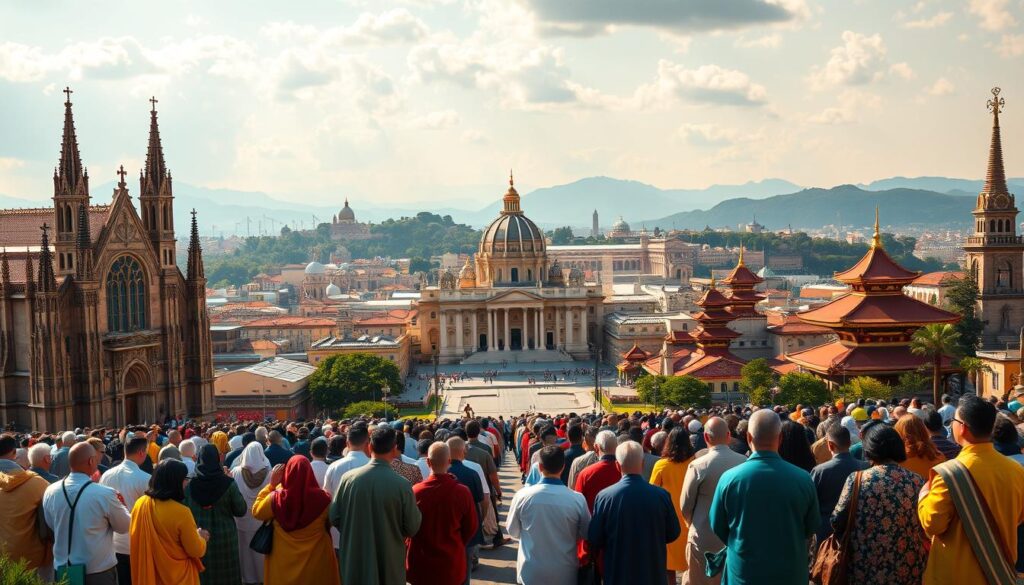
A lush, vibrant panorama showcasing the global diversity of Catholic traditions. In the foreground, a grand cathedral stands tall, its intricate Gothic architecture and stained glass windows capturing the timeless elegance of the faith. In the middle ground, worshippers from various cultures and ethnicities kneel in reverence, their robes and garments reflecting the rich tapestry of the Catholic experience. The background is a sweeping vista, with landmarks and landmarks from around the world - from the iconic St. Peter's Basilica in Rome to the serene Buddhist temples of Asia, all united in the embrace of the Catholic tradition. The scene is bathed in warm, golden light, conveying a sense of spiritual enlightenment and the universal reach of the Catholic Church.

Overview of the Book’s Purpose and Vision

The acclaimed documentary series serves as both travelogue and theological compass. Viewers journey from Mexican shrines to Italian cathedrals, discovering how sacred spaces shape spiritual understanding. Core teachings come alive through masterpieces by Michelangelo and stories of modern saints.

Rather than persuasive arguments, the work lets beauty speak first. Ancient rituals and modern worship practices appear side by side, showing continuity across generations. This approach makes complex doctrines feel as natural as sunlight through stained glass.

As a standalone guide, the text helps readers connect historical roots to personal faith. Chapters explore how sacraments intersect with daily life and why tradition remains vital in our fast-paced world. Cultural examples from six continents prove spiritual hunger exists everywhere.

The project’s success lies in its balance of depth and accessibility. Whether discussing medieval philosophy or Ugandan martyrs, it maintains a conversational tone that welcomes curious explorers. This blend of intellectual rigor and visual wonder creates new pathways for spiritual discovery.

Unpacking the Themes and Theology

Faith and reason often seem at odds in modern discussions—but what if they’re meant to dance together? This section explores how spiritual wisdom thrives when paired with thoughtful reflection.

Integrating Faith with Intellectual Inquiry

A groundbreaking work like Vibrant Paradoxes shows why truth-seeking needs both heart and mind. Through themes like Mercy vs. Sin and Freedom vs. Discipline, readers discover how ancient teachings solve modern puzzles. Did you know Thomas Aquinas’ ideas about matter still influence debates about artificial intelligence?

The real magic happens when complex ideas become practical tools. For example, the book links medieval philosophy to workplace ethics or family dynamics. This approach helps anyone exploring Catholic teachings see their relevance in today’s tech-driven world.

Theological Theme Historical Root Modern Application
Reason & Faith 13th-century scholasticism Navigating science-religion conflicts
Suffering & Joy Early martyr stories Coping with chronic illness
Freedom & Discipline Monastic traditions Digital detox strategies

What makes this theology stand out? It never shies from tough questions about pain or doubt. Instead, it frames them as stepping stones to deeper faith. The writing style feels like chatting with a wise friend—clear, warm, and occasionally surprising.

By connecting classic wisdom to current issues, these teachings become living guides rather than dusty rules. Whether you’re wrestling with ethical dilemmas or seeking purpose, the ideas here offer fresh lenses for viewing life’s complexities.

The Intersection of Faith, Art, and Tradition

Beauty has always been the Church’s silent ambassador—a universal language that transcends time. Creative masterpieces and sacred rituals work together to make spiritual truths tangible. This fusion of aesthetics and belief forms a bridge between ancient practices and modern seekers.

Sacraments, Saints, and Aesthetics

Sacred rituals like baptism or communion transform ordinary moments into divine encounters. Through physical elements—water, bread, oil—participants experience grace in everyday life. This is faith made visible, connecting our world to something greater.

Historic figures like Francis of Assisi or Teresa of Ávila show how holiness takes shape in action. Their stories inspire through courage and compassion, not just abstract ideals. Artistic treasures—from Gothic cathedrals to Mozart’s masses—echo this pattern of making truth beautiful.

Sacred Art Form Historical Purpose Contemporary Impact
Stained Glass Teach Bible stories Inspire digital media visuals
Gregorian Chant Enhance worship Shape modern hymn melodies
Iconography Visual theology Guide meditation practices

The Role of Church Tradition in Modern Evangelization

Ancient practices gain new life through technology and fresh perspectives. A 14th-century hymn might soundtrack a viral video, while Renaissance paintings inform app designs. This blend honors roots while speaking to today’s needs.

Young adults especially resonate with this approach. They crave authenticity but distrust empty trends. By presenting timeless truths through art and music, the faith meets them where they are—without compromise.

Insights into Bishop Barron’s Evangelization Approach

In an age where screens dominate daily life, one spiritual leader reimagines ancient practices for the digital frontier. Bishop Barron’s team at Word Fire launched a groundbreaking strategy that honors tradition while embracing innovation. Their work spans early-morning TV slots to viral social campaigns, proving faith thrives in modern spaces.
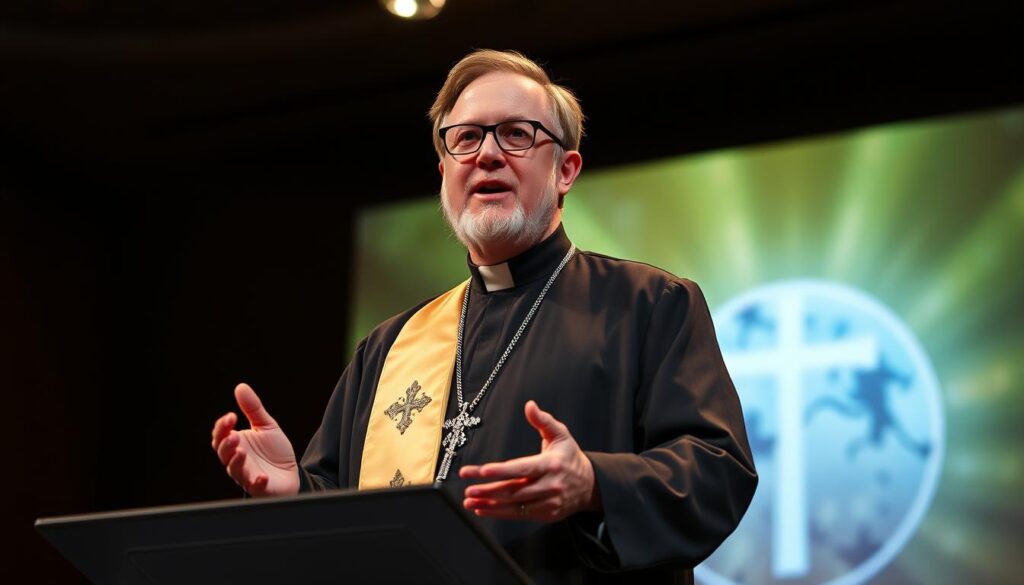
A digital portrait of Bishop Robert Barron, a prominent Catholic evangelist, standing at a podium against a backdrop of a large digital screen displaying his signature visuals. The lighting is warm and focused, casting a contemplative, authoritative aura. The bishop's expression is one of passion and conviction as he delivers his message of faith and reason to a virtual audience. The scene conveys a sense of modern, tech-savvy evangelization, where traditional Catholic teachings are skillfully communicated through the power of digital media.

Digital Outreach and Multimedia Engagement

What began as a 15-minute morning program on WGN exploded into a cross-platform revolution. The team harnessed YouTube debates, Instagram stories, and documentary films to spark global conversations. By blending Aquinas’ wisdom with meme culture, they meet people where they scroll.

Collaborators like Brandon Vogt and Jared Zimmerer helped craft content that feels both smart and relatable. From analyzing Marvel movies to discussing AI ethics, the approach makes theology accessible. This isn’t about watering down ideas—it’s about creative translation.

Television and Documentary Influence

Bishop Barron’s documentaries continue Fulton Sheen’s legacy with a 21st-century twist. High-production films explore faith through art, history, and personal stories. These projects don’t preach—they invite viewers to wonder.

Platform Traditional Use Modern Adaptation
Television Sermon broadcasts Cinematic documentaries
Social Media Announcements Interactive Q&As
Live Events Church services Virtual conferences

The strategy works because it respects both the message and the medium. Whether through a smartphone screen or a theater projector, the focus remains on beauty and truth. It’s evangelization that feels less like a lecture and more like a shared discovery.

Comparing Catholic Literature: Word on Fire vs. Classic Works

Religious writing evolves like a living conversation—honoring roots while embracing new voices. The Word on Fire initiative reimagines sacred texts for smartphone-toting seekers, blending time-tested truths with modern storytelling. Think of it as a bridge between Augustine’s Confessions and today’s faith explorers.
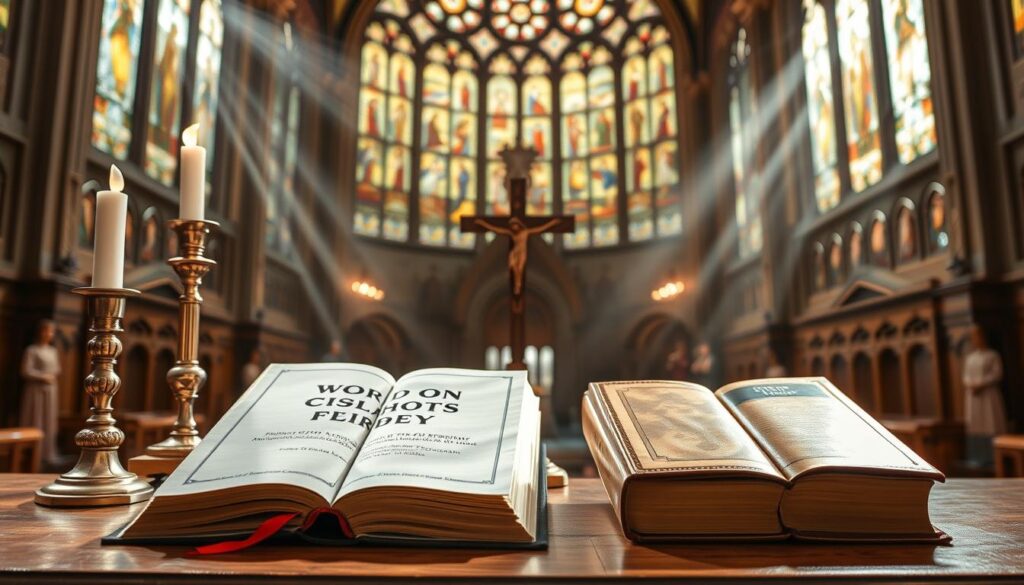
A grand cathedral's stained glass windows cast a warm, reverent glow onto a table displaying two books - one a modern volume with a bold title, the other a leather-bound classic. Elegant candlesticks and a crucifix adorn the scene, creating an atmosphere of scholarly contemplation. Rays of light illuminate the pages, inviting the viewer to explore the rich tapestry of Catholic literature, both contemporary and time-honored. The composition balances the contrast between the new and the old, the innovative and the traditional, capturing the essence of the section's theme - a thoughtful comparison of Word on Fire and classic Catholic works.

Classic works laid the groundwork with deep theological insights, but some feel like museum pieces to modern readers. Books like Vibrant Paradoxes keep the richness while using relatable examples—comparing sacraments to family meals or linking saints’ lives to workplace ethics. This approach makes ancient wisdom feel like a friend’s advice over coffee.

Collaborative projects show the Catholic Church’s adaptive spirit. Take To Light a Fire on Earth, where diverse perspectives unite under shared truths. Unlike older texts that often spoke from solitary scholars, these works thrive on dialogue—like a group chat across centuries.

“Truth isn’t fragile—it can handle new packaging.”

What truly sets this work apart? It respects readers’ intelligence without drowning them in jargon. Digital extras like video discussions or interactive guides complement the text, proving books aren’t relics but launchpads for deeper exploration. The result? A bookshelf that speaks both to the mind and the Instagram generation.

Narrative Structure and Engaging Storytelling

Stories shape souls long before arguments convince minds. John Allen’s work masterfully weaves lived experiences with spiritual truths, showing how ordinary moments become chapters in a greater story. This approach turns abstract ideas into relatable journeys anyone can follow.

Biographical Elements and Anecdotal Narratives

The biography format reveals how divine guidance works through human imperfection. Readers encounter a relatable figure who stumbles, questions, and grows—not a flawless hero. Childhood memories blend with pivotal career choices, proving holiness thrives in everyday life.

One chapter might explore a tense seminary debate, while another shares quiet prayer moments. These snapshots make theology feel like shared memories rather than textbook lessons. Through this lens, even complex concepts like grace become as tangible as a friend’s advice.

Personal Touches that Bridge Faith and Life

What makes these narratives stick? Heart-centered details—like describing morning coffee rituals before writing sermons. Such glimpses show how spiritual practices anchor busy lives without demanding perfection.

“God’s fingerprints appear clearest in life’s messy drafts, not just the final masterpiece.”

The text time-travels between past struggles and present wisdom, inviting readers to see their own journeys differently. It’s not about copying someone else’s path—it’s recognizing sacred sparks in your own ordinary days.

The Role of Tradition in Shaping Catholic Faith

Ancient practices aren’t relics—they’re living bridges connecting past wisdom to present needs. The Catholic Church thrives by anchoring modern spiritual journeys in time-tested rituals. This balance preserves identity while inviting fresh understanding.

Historical Context and Sacramental Foundations

Sacraments act like spiritual fingerprints—unique markers shaping individual and communal faith. Baptism’s water or communion’s bread aren’t symbols but encounters. They transform ordinary moments into divine conversations.

When exploring Catholic heritage, we find answers to modern questions in ancient patterns. Early believers faced similar struggles with doubt and cultural shifts. Their solutions—prayer rhythms, service traditions—still guide today’s seekers.

The beauty of tradition lies in its flexibility within faithfulness. Like a river deepening its bed over centuries, practices adapt while carrying timeless grace. This dynamic continuity helps believers navigate moral complexities without losing their compass.

FAQ

How does Bishop Barron’s work blend faith with intellectual exploration?

His writing invites readers to connect spiritual teachings with philosophy, science, and culture, fostering a deeper understanding of divine truth through reasoned dialogue.

What role do art and beauty play in communicating theological ideas?

Visual masterpieces, sacred music, and architectural wonders serve as gateways to encountering God’s presence, making complex doctrines accessible and emotionally resonant.

Why is digital outreach central to modern evangelization efforts?

Platforms like podcasts, social media, and documentaries allow timeless messages to reach global audiences, meeting people where they already engage spiritually.

How does this publication differ from classic Catholic literature?

While honoring foundational texts, it emphasizes contemporary language and multimedia integration, bridging ancient wisdom with today’s cultural questions.

Can you explain the importance of sacraments in daily spiritual life?

Sacraments like the Eucharist act as tangible encounters with grace, grounding believers in Christ’s love through rituals that transcend time and culture.

What makes storytelling vital for sharing religious experiences?

Personal anecdotes and historical narratives humanize theology, helping readers see their own journeys reflected in the lives of saints and everyday faithful.

How does tradition remain relevant in a rapidly changing world?

By rooting practices in historical continuity, the Church offers stability while adapting methods to address modern challenges without compromising core truths.

What impact have documentaries had on spreading spiritual teachings?

Films and series visually unpack complex ideas, making theology engaging for viewers who might not connect with traditional written formats alone.

The 8 Beatitudes: A Guide for Catholic Believers


For centuries, these profound teachings have shaped the spiritual foundation of countless believers. Rooted in Jesus’ Sermon on the Mount, they offer a blueprint for living with purpose and humility. Their timeless wisdom continues to inspire those seeking deeper connections to their faith and community.

The teachings originate from Matthew 5:3-10, where Christ outlines blessings for qualities like meekness, mercy, and purity of heart. Unlike earthly rewards, these promises focus on eternal fulfillment through alignment with God’s will. Many scholars note how they reinterpret Old Testament ideals, shifting emphasis from land to spiritual inheritance.

Today, these principles remain central to moral guidance within the faith. They challenge believers to prioritize compassion over power and inner peace over material gain. By embracing them, individuals find practical ways to navigate modern ethical dilemmas while strengthening their relationship with the divine.

Key Takeaways

  • Originate from Jesus’ teachings in the Gospels of Matthew and Luke
  • Provide a framework for ethical living and spiritual growth
  • Shift focus from physical rewards to eternal blessings
  • Integral to faith formation and community values
  • Offer actionable guidance for contemporary challenges

Introduction: The Spiritual Treasure of the Beatitudes

In a world hungry for meaning, ancient wisdom offers unexpected keys to modern fulfillment. These teachings act as a compass for those navigating life’s complexities, revealing how timeless truths can reshape our priorities and relationships.

Why They Matter in Today’s World

Imagine a blueprint for living that turns society’s values upside down. This spiritual roadmap prioritizes generosity over greed and peace over conflict. Disciples throughout history have found it transforms how they approach challenges—from personal struggles to systemic injustice.

Today’s fast-paced culture often leaves people feeling disconnected. Yet these blessings bridge ancient wisdom with contemporary needs. They encourage us to nurture our spirit rather than chase temporary comforts, creating ripples of hope in families and neighborhoods.

“The Beatitudes are the ‘synthesis’ of Christ’s teaching,” notes the Pontifical Biblical Commission. “They sustain hope even during trials.”

Consider how these principles address modern dilemmas:

Worldly Focus Spiritual Focus Outcome
Self-Promotion Humility Inner Peace
Material Gain Generosity Community Bonds
Instant Gratification Patience Lasting Joy

By embracing this countercultural path, we discover what it means to build the kingdom heaven invisions—one compassionate choice at a time. It’s not about perfection, but progress toward a more meaningful life.

Exploring the History and Biblical Foundations

Ancient texts often hold keys to understanding modern faith journeys. The teachings we cherish today emerged from specific cultural moments, revealing how Jesus Christ tailored his message for diverse audiences. Let’s explore their roots and how early believers preserved their transformative power.

A serene, biblical scene depicting the foundations of Catholic teachings. In the foreground, a group of disciples gathered around a wise, robed figure, their faces illuminated by a soft, heavenly light. In the middle ground, ornate, ancient architecture evokes the grandeur of a temple or church. The background features a lush, verdant landscape, with rolling hills and a tranquil, azure sky. The overall mood is one of reverence, contemplation, and the timeless wisdom of sacred scripture. Rendered in a classic, Renaissance-inspired style with a muted, earthy color palette.

Scriptural Origins in Matthew and Luke

Two Gospel accounts frame these blessings differently. Matthew’s Sermon on the Mount details nine declarations, blending spiritual humility with promises of the kingdom heaven offers. Luke’s shorter Sermon on the Plain pairs four blessings with warnings, emphasizing care for the marginalized.

Scholars note Matthew’s focus on inner transformation, while Luke highlights economic justice. Both versions urge disciples to prioritize eternal reward over temporary gains. The ninth blessing in Matthew 5:11-12, referencing Isaiah 51:7, specifically addresses enduring persecution—a reality for early followers facing evil opposition.

Early Church Interpretations and Traditions

By the 4th century, Latin translations solidified the term “Beatitudes” using Cicero’s concept of blessedness. Church leaders like Augustine saw these teachings as core to Christian identity. They became baptismal guides, shaping how communities lived out mercy and peace.

Gospel Focus Audience
Matthew Spiritual qualities Broad crowds
Luke Social justice Disciples

Manuscript discoveries show how carefully these words were copied across generations. Their endurance proves their role in uniting believers through trials, always pointing toward heaven’s promise.

Understanding Each Beatitude: Meaning and Promise

Daily life challenges find unexpected answers in age-old spiritual declarations. These blessings reveal how God’s favor rests on qualities often overlooked—or even mocked—by society. Let’s explore their transformative power and the promises they hold.

A Breakdown of the Eight Blessings

The journey begins with recognizing our need for divine guidance. Blessed poor spirit describes those who approach life with spiritual humility, like A.W. Tozer’s beggar metaphor. They understand true strength comes from relying on God, not self-sufficiency.

Grief becomes sacred ground for those who blessed mourn. This includes both personal loss and sharing others’ pain. Comfort arrives through community support and eternal hope.

Blessed meek embody quiet strength, rejecting force to uplift others. Their reward? Inheriting a world renewed by love. Next, hunger thirst righteousness drives people to combat injustice—feeding both bodies and souls.

Mercy shines through actions. When we blessed merciful forgive freely and serve generously, we create cycles of compassion. Purity of heart cuts through distractions, letting believers see god in everyday moments.

Peacemakers build bridges where others see walls. As blessed peacemakers, they reflect God’s reconciling nature. Finally, staying faithful amid opposition brings the ultimate promise: belonging to kingdom heaven.

“Poverty of spirit is the foundation stone for all other graces,” writes Tozer. “Only the empty soul can be filled.”

Living the Beatitudes: Daily Practice and Social Justice

Faith becomes action when principles meet pavement. Across borders and barriers, ordinary people show how spiritual ideals transform lives through hands-on service. Meet educators who turn classrooms into launchpads for mercy.

Embodying Mercy, Meekness, and Compassion

At Lourdes Catholic School in Nogales, Arizona, Sisters Esther Hugues and Barbara Mosegur redefine meekness. Their border ministry welcomes students from both sides of the US-Mexico divide. “We teach that God sees no human-made boundaries,” says Sr. Esther.

Their work with deported migrants at the Comedor soup kitchen turns abstract virtues into meals served with dignity. Students learn that mercy means seeing strangers as siblings. Critics question their approach, but the sisters persist—proving meekness isn’t weakness.

Community Outreach and Service Initiatives

Through the Kino Border Initiative, these educators bridge immediate needs with systemic change. Feeding hungry people matters, but so does advocating for fair immigration policies. Their programs make social justice part of life, not just theory.

“Service isn’t optional—it’s our baptism call,” explains Sr. Barbara. “Love grows when we share it.”

By integrating outreach into school curricula, they shape young hearts to value compassion over comfort. This work creates ripples—one act of love inspiring countless others across generations.

Applying the catholic 8 beatitudes in Daily Life

Faith grows when beliefs meet action. Through baptism, every believer receives a sacred call to weave spiritual values into ordinary moments. This means seeing grocery store conversations and office emails as chances to reflect divine love.

A serene indoor setting with soft, warm lighting casting a peaceful glow. In the foreground, a person sitting cross-legged on a plush, natural-fiber rug, eyes closed in meditation, hands resting gently on their lap. The middle ground features a small altar or shrine with a lit candle, a simple religious icon, and perhaps a few meaningful objects. The background depicts a minimalist, soothing space, with natural elements like potted plants, a simple wooden shelf, or a neutral-toned wall. The overall atmosphere conveys a sense of tranquility, introspection, and spiritual connection.

Practical Steps for Faithful Living

Start each morning by asking: “How can my heart align with God’s today?” This simple habit shifts focus from checking tasks to nurturing righteousness. Pope Francis suggests we become “salt and light” by letting kindness flavor interactions.

“With holy life, we defend communities from decay,” he reminds us. “Genuine charity illuminates dark corners.”

Three ways to live this out:

  • Choose listening over lecturing during disagreements
  • Share resources quietly, without seeking praise
  • Pause before reacting to frustrating situations

Poverty spirit reshapes priorities. It means admitting we need grace more than gadgets. At work, this might look like celebrating others’ successes instead of self-promotion. In families, it could mean apologizing first after arguments.

Baptism isn’t just a ceremony—it’s a lifelong way of carrying Christ’s light. Whether brewing coffee or leading meetings, each person can mirror divine compassion through small, consistent choices.

Beatitudes in Catholic Education and Faith Formation

Classrooms become sacred spaces when textbooks meet real-world compassion. Schools across America are discovering how spiritual values shape not just minds, but hearts ready to serve. Through innovative programs, students learn that faith isn’t confined to chapel walls—it thrives in soup kitchens and legislative halls.

A peaceful classroom scene, sunlight streaming through large windows, casting a warm glow. In the foreground, a group of diverse students, ages 8-12, gathered in a circle, their faces radiating kindness and compassion as they practice active listening and conflict resolution. Seated on plush, colorful cushions, they engage in thoughtful discussion, guided by a gentle, caring teacher. In the middle ground, student artwork and inspirational quotes adorn the walls, reflecting the school's emphasis on Catholic values and social-emotional learning. The background features a serene, park-like setting visible through the windows, reinforcing the sense of tranquility and harmony. The overall mood is one of harmony, understanding, and the power of community to nurture the beatitudes.

Integrating Spiritual Teachings in School Curriculums

At Lourdes Catholic School, algebra lessons share time with immigration advocacy. Sister Esther Hugues reminds students: “Our final exam asks ‘I was hungry—did you feed me?’” This philosophy transforms classrooms into training grounds for peacemakers.

Students don’t just study social justice—they live it. Through border ministry work, teens walk desert paths migrants travel. They share meals with deported people, discovering Christ in wrinkled hands and hopeful eyes. Part of their education includes lobbying lawmakers for fair policies.

“After eating with migrants, I see everything differently,” shares a senior. “Compassion isn’t optional—it’s how we build God’s kingdom.”

Learning Method Focus Outcome
Traditional Lectures Facts & Theories Knowledge Retention
Experiential Service Empathy & Action Lifelong Discipleship
Advocacy Training Systemic Change Community Transformation

These programs prepare men and women to carry gospel values into careers. By blending study with service, schools create disciples who understand their baptism calls them to act. As one teacher notes: “Education isn’t about filling heads—it’s about igniting hearts.”

Through such blessings, students learn that faith requires getting their hands dirty. Their time in school becomes preparation for a lifetime of healing broken systems—one merciful choice at a part.

Modern Perspectives and Contemporary Interpretations

Timeless principles meet modern challenges as communities reinterpret sacred wisdom. Leaders like Pope Francis emphasize applying these teachings to address inequality, environmental crises, and digital-age isolation. His focus on mercy as “the Church’s heartbeat” inspires fresh approaches to age-old truths.

Reflecting on New Insights and Challenges

Today’s believers navigate complexities Jesus Christ never faced—social media divides, global conflicts, and shifting moral landscapes. Yet the call to cultivate a pure heart remains vital. A Philadelphia youth group recently demonstrated this by using TikTok to spread messages of unity, proving ancient values can thrive in new spaces.

Peacemakers now tackle systemic evil through policy advocacy and interfaith dialogue. The Catholic Church’s renewed emphasis on communion encourages collaboration across denominations. As Pope Francis reminds us: “True love always seeks the reward of shared dignity, not personal gain.”

Living these ideals requires courage. From classrooms to boardrooms, people discover that a pure heart isn’t weakness—it’s revolutionary strength. Their efforts prove sacred wisdom still lights the path forward, one compassionate choice at a time.

FAQ

Where do the Beatitudes appear in the Bible?

They’re found in Matthew 5:3-12 during the Sermon on the Mount. A shorter version also appears in Luke 6:20-23, highlighting themes like humility and justice.

How can I practice mercy in everyday life?

Small acts matter! Listen without judgment, forgive others, or volunteer with groups like Catholic Charities. Mercy builds bridges and reflects divine love.

Why is “meekness” considered a strength?

Being meek means trusting God over force. It’s about patience and gentleness, like St. Francis of Assisi, who embraced peace even in hardship.

Do the Beatitudes connect to social justice?

Absolutely. Hunger for righteousness drives action. Pope Francis emphasizes caring for migrants and the poor, urging believers to fight inequality through service.

Can these teachings fit into school programs?

Yes! Many schools use role-playing or projects to explore themes like peacemaking. For example, students might organize food drives to live out “blessed are the merciful.”

What does “pure in heart” mean today?

It’s about sincerity. Avoid hypocrisy by aligning actions with values. Praying or meditating helps nurture inner clarity, letting you “see God” in others.

How do the Beatitudes address modern struggles?

They offer hope amid chaos. For instance, “blessed are the peacemakers” inspires dialogue in divided communities, while mourning loss together fosters healing.

Are the rewards promised meant for heaven alone?

While the “kingdom of heaven” is eternal, living these values also brings joy now. Building a fairer, kinder world starts today—one step at a time.

Inspiring Catholic Quotes About Love


Throughout history, faith’s most revered voices have shared profound insights into the nature of love. These sacred words remind us that genuine affection isn’t merely an emotion—it’s a reflection of divine grace working within us. As St. Francis of Assisi prayed, “Where there is hatred, let me sow love,” we’re called to embody compassion in every action.

Many spiritual teachers emphasize that love begins with God’s gift to humanity. St. Augustine captured this truth beautifully: “We cannot love unless someone has loved us first.” This idea echoes Scripture, such as 1 John 4:10, which reveals how God’s mercy paved the way for human connection.

These timeless teachings offer more than comfort—they guide us toward deeper relationships and purposeful living. St. Thérèse of Lisieux found her life’s mission in love, declaring it her true calling. Such wisdom continues to inspire those seeking meaning in today’s fast-paced world.

Key Takeaways

  • Love’s divine origin shapes how we give and receive it
  • Saints’ teachings provide practical ways to live compassionately
  • Scripture and sacred texts highlight grace as love’s foundation
  • Universal themes connect faith with everyday experiences
  • Spiritual quotes nurture both personal growth and community bonds

Exploring the Spirit of Love in Catholic Teachings

The essence of compassion flows through spiritual wisdom like a river shaping its banks. Early thinkers showed how divine affection isn’t just a feeling—it’s a blueprint for living. “Love transforms ordinary acts into sacred offerings,” one might say, echoing timeless truths.

The Spiritual Call to Love and Compassion

St. Fulgentius called love an “impregnable defense” and a path to heaven. This mirrors the belief that grace fuels our capacity to care. When we act with kindness, we mirror a higher truth—one that connects souls across generations.

St. Polycarp’s words reinforce this: “Those rooted in love naturally avoid wrongdoing.” It’s not about rules but alignment with goodness. Like sunlight melts ice, genuine affection dissolves barriers between people.

How Saints Inspire Our Understanding of Love

St. Gregory the Great taught that hatred vanishes where love grows. His insight reveals how inner light crowds out darkness. Similarly, St. Basil urged focusing on others’ needs rather than personal gain—a gift that enriches both giver and receiver.

Saint Core Teaching Impact
St. Fulgentius Love as spiritual armor Guides toward eternal peace
St. Polycarp Love prevents sin Strengthens moral clarity
St. Gregory Goodness displaces hatred Fosters inner harmony

These lessons remind us that every compassionate choice ripples through the world. Whether through small gestures or lifelong commitments, we walk the way of grace—one step at a time.

Embracing catholic quotes about love: Timeless Expression

Spiritual insights on affection have shaped hearts across millennia, adapting to eras while keeping their core truth. From Rome’s collapse to modern challenges, these teachings remain vital guides for living with purpose.

A serene, Renaissance-inspired scene of a Catholic sanctuary, bathed in soft, warm lighting. In the foreground, two figures dressed in ornate, religious robes kneel in a prayerful embrace, their expressions conveying a deep, spiritual love. The middle ground features intricate, carved wooden pews and stained-glass windows that cast a kaleidoscope of colors across the scene. In the background, a towering, ornate altar stands as a testament to the rich tradition and timeless nature of Catholic teachings on love and devotion.

Historical Context and Enduring Wisdom

St. Augustine witnessed empires fall yet declared: “The greater one’s love is, the easier is the work.” His words reveal how divine care turns burdens into blessings. Centuries later, St. Bernard called affection humanity’s unique response to the Creator—a bond stronger than time.

St. Thérèse of Lisieux simplified this truth: “Love is the vocation that includes all others.” Her words bridge medieval mysticism and modern life, showing how daily acts become sacred when rooted in compassion.

Thinker Era Core Idea Modern Relevance
St. Augustine 4th-5th Century Affection lightens life’s load Finding meaning in challenges
St. Bernard 12th Century Love connects humans to divinity Spiritual fulfillment in relationships
St. Thérèse 19th Century Every role serves through care Purpose in ordinary moments

These visionaries teach that true strength grows from valuing others. Whether facing ancient wars or modern stress, their wisdom helps us build kinder worlds—one choice at a time.

Saints’ Wisdom on Love: Diverse Perspectives

Sacred writings across centuries reveal love’s dual nature as both divine devotion and human connection. This harmony forms the heartbeat of spiritual growth—where reverence fuels service, and surrender sparks compassion.

Love for God: Devotion and Surrender

St. Alphonsus Liguori called loving God the “supreme good” shaping our souls. His words remind us that spiritual depth begins here: “All holiness lies in our love for Jesus Christ.” This foundation transforms ordinary lives into extraordinary journeys.

St. John Baptist de la Salle echoed this truth, urging believers to let Christ’s sacrifice inspire daily choices. When we anchor ourselves in this grace, even challenging tasks become acts of worship.

Love for Neighbor: Compassion in Action

St. Anthony Mary Claret made it clear: “The man who truly loves God also loves his neighbor.” Service becomes our natural response—feeding the hungry or forgiving enemies as St. Aelred taught.

St. Augustine revealed a beautiful paradox: Caring for others sharpens our vision of the divine. Every kind word or helping hand reflects sacred truths, binding communities through shared humanity.

Godly Love in Relationships and Daily Living

Divine affection becomes tangible when lived through ordinary actions. From morning coffee with a spouse to helping neighbors in need, sacred connections thrive where intention meets practice.

A serene, contemplative scene of a saintly figure offering gentle guidance on relationships. In the foreground, a tranquil figure, robed in flowing white garments, stands with an expression of compassion, their hands outstretched in a welcoming gesture. The middle ground features a lush, verdant landscape, with soft, diffused lighting casting a warm, divine glow. In the background, a magnificent cathedral, its ornate architecture and stained glass windows evoking a sense of sacred reverence. The overall atmosphere is one of solace, wisdom, and the calming presence of divine love, inspiring a deeper understanding of godly love in relationships and daily living.

Nurturing Love in Family and Marriage

St. John Paul II reshaped modern views by calling marriage “a daily task requiring courage.” His wisdom challenges couples to see struggles as chances to grow stronger together. True love blooms through small sacrifices—like listening patiently or choosing kindness after long days.

Mother Teresa highlighted a paradox: “We find it simpler to serve strangers than cherish our own kin.” Her words remind us that homes become holy when we embrace imperfections. Venerable Fulton Sheen added, “A man elevates himself by aspiring to match his partner’s virtue.”

Teacher Key Insight Practical Tip
St. John Paul II Love demands daily work Turn conflicts into connection opportunities
Mother Teresa Start with household kindness Practice gratitude during tense moments
Fulton Sheen Virtue inspires mutual growth Celebrate your partner’s strengths weekly

Living Out Love in Community and Friendship

Friendships rooted in faith mirror Christ’s example. St. John Chrysostom taught that “a friend’s soul reflects divine light.” This truth encourages us to build bonds that nurture eternal life.

Simple acts create ripples: bringing meals to sick neighbors or forgiving misunderstandings. As St. Thérèse showed, every interaction holds power to reveal grace. When we see others as mirrors of the sacred, ordinary moments become extraordinary.

Conclusion

Across ages, the call to love resounds as humanity’s highest purpose and deepest joy. St. Fulgentius envisioned it as “a stairway lifting souls to heaven”—each compassionate choice ascending toward divine light. These teachings aren’t just words; they’re blueprints for building grace-filled lives.

St. Augustine’s promise rings true: When we practice kindness, we create space for sacred presence. Daily acts—holding a friend’s hand or listening without judgment—become pathways where heaven touches earth. St. Bernard reminds us that love grows through action, not theory.

Modern challenges demand timeless wisdom. Balancing screens and schedules, we can still choose virtue over convenience. See coworkers as neighbors. Turn rushed moments into chances to uplift others.

Let these truths move from page to practice. As St. Columban taught, “Loving renews our divine image.” Start small. Today, let one decision reflect that radiant truth.

FAQ

How do Catholic teachings define love?

The faith emphasizes love as a selfless gift rooted in sacrifice and service. It’s seen as reflecting divine grace, where caring for others mirrors Christ’s compassion. This includes acts of mercy, forgiveness, and prioritizing others’ needs.

Why are saints often quoted in discussions about love?

Figures like St. John Paul II and St. Teresa of Calcutta lived out radical compassion, offering practical examples. Their words highlight virtues like humility and perseverance, showing how devotion to God and neighbor transforms lives.

How can I apply these teachings to daily relationships?

Start by seeing others as reflections of the divine. Small acts of kindness, patience in conflicts, and fostering trust in marriages align with timeless wisdom. Even challenges become chances to grow in generosity.

What role does love play in Catholic marriage?

Marriage is viewed as a sacred bond mirroring Christ’s commitment to humanity. Couples are called to nurture mutual respect, forgiveness, and self-giving—turning everyday moments into opportunities for grace.

How does loving one’s neighbor connect to loving God?

Serving those in need—whether through charity or simple presence—is seen as direct service to the divine. This duality is central, as acts of mercy reveal the heart’s alignment with eternal truths.

Can non-religious people find value in these quotes?

Absolutely. Themes like empathy, justice, and selflessness resonate universally. The emphasis on human dignity and meaningful connections offers guidance for anyone seeking purpose beyond themselves.

Catholicism by State: A Comprehensive Look at Faith Across the US


Let’s explore how faith shapes communities from California to Maine. With over 77 million members, the United States is home to the fourth-largest Catholic community globally. This vibrant tradition weaves through cities, suburbs, and rural towns, creating a spiritual mosaic as diverse as America itself.

Why do patterns of belief vary so widely between regions? The answer lies in history, migration, and cultural shifts. Early Spanish missions in the Southwest tell different stories than French-founded parishes in Louisiana. Industrial-era immigrants built iconic cathedrals in Northeast cities, while recent arrivals continue reshaping worship spaces today.

This guide makes sense of complex demographic data through clear maps and insights. You’ll discover how Texas and New York became modern hubs, why the Midwest maintains deep roots, and what surprises emerge in fast-growing states. We’ll also examine how leadership through the US Conference of Catholic Bishops unites these regional identities.

Key Takeaways

  • The US ranks fourth globally in Catholic population size
  • Regional differences reflect unique historical and cultural influences
  • Modern demographic shifts continue reshaping communities
  • National leadership coordinates 77+ million members nationwide
  • State-level analysis reveals unexpected trends and growth areas

Overview of U.S. Catholic Demographics

America’s spiritual fabric took shape through centuries of cultural exchange. Early European settlers brought more than goods across the Atlantic—they carried traditions that would redefine a continent.

Historical Roots of U.S. Catholicism

Spanish missionaries built the first permanent Catholic settlements in the 1500s. Their adobe chapels dotted the Southwest, while French colonial settlements clustered around the Mississippi Delta. These outposts became spiritual anchors for future generations.

The 1800s transformed the religious landscape. Territorial expansions added 1.2 million square miles with existing Catholic communities. Waves of European immigrants later tripled the faithful population between 1850-1900. Irish dockworkers, German farmers, and Italian artisans all shaped local worship styles.

Statistical Highlights and Data Sources

Modern surveys reveal fascinating patterns. The U.S. Religion Census tracks membership in over 17,000 congregations nationwide. Recent findings show:

  • 6 states account for 45% of all Catholic adherents
  • Urban centers host 68% of parish communities
  • 22% of members live in rural areas

Researchers combine census data with church records for accuracy. This blended approach helps explain regional variations while maintaining a national perspective. As demographics shift, these tools remain vital for understanding America’s evolving faith communities.

Regional Insights: Shifts Across the Nation

The U.S. Religion Census reveals a stunning reversal in America’s spiritual geography. Where historic parishes once defined religious life, new patterns now emerge through domestic migration and cultural blending. This transformation reshapes everything from Sunday services to community outreach programs.

A detailed, data-driven map depicting the shifting demographics of the Catholic population across the United States. In the foreground, a vivid topographical representation of the contiguous states, with state borders clearly delineated. The middle ground showcases a gradient-based visualization, with regions of varying shades of red and blue, representing the relative concentration of Catholic adherents. In the background, a subtle overlay of geographical features, such as major rivers and mountain ranges, provides contextual depth. The lighting is soft and muted, conveying a sense of analytical objectivity. The camera angle is slightly elevated, offering an expansive, bird's-eye view that emphasizes the national scope of the data. The overall mood is one of informative clarity, guiding the viewer through the regional nuances of Catholic faith across the United States.

Northeast and Midwest: Established Traditions

New England’s brick cathedrals still anchor neighborhoods, but their influence spreads beyond Sunday pews. In Rhode Island and Connecticut, Catholic traditions color local festivals, education systems, and even seafood festivals. “These communities built America’s social fabric,” notes a researcher from the Association of Statisticians of American Religious Bodies.

Despite declining percentages, these regions maintain deep cultural roots. Boston’s St. Patrick’s Day parade draws half a million visitors annually, while Chicago’s Polish masses continue generations-old customs. Urban parishes adapt by hosting ESL classes and immigrant support groups.

South and West: Emerging Trends

Sunbelt states tell a different story. Texas added more Catholic congregants last decade than any other state – enough to fill 50 new mid-sized parishes. Arizona and Georgia follow closely, with growth fueled by both relocation and new conversions.

County-level data shows particular strength along cultural crossroads. Eight Rio Grande counties report Catholic majorities, blending Mexican traditions with Texan identity. Meanwhile, Nevada’s congregations doubled since 2010, matching the state’s overall population boom.

This geographic shift creates fresh opportunities. Churches in Atlanta now offer Mass in six languages, while Phoenix parishes partner with solar companies to reduce energy costs. As one Louisiana priest observes: “We’re not just keeping traditions – we’re writing new chapters.”

In-Depth Analysis: catholicism by state and Its Demographic Trends

Mapping America’s religious landscape reveals fascinating patterns hidden in plain sight. The latest U.S. Religion Census offers a treasure trove of insights for those curious about how spiritual communities evolve.

Top States with the Highest Catholic Populations

Rhode Island stands unchallenged as the nation’s most Catholic stronghold. With 42% of residents identifying with this tradition, the Ocean State’s cultural fabric reflects waves of immigration. “Our parishes tell the story of French-Canadian mill workers, Irish dockhands, and Portuguese fishermen,” notes a local historian.

Massachusetts and New Jersey tie at 34%, each showcasing unique demographic blends. Boston’s historic churches now host Polish and Brazilian festivals, while Newark’s archdiocese serves half a million members across 200 parishes. Southern states like Mississippi (4%) highlight striking regional contrasts.

Interpreting Change Over Time

The Association of Statisticians of American Religious Bodies tracks 373 faith groups through meticulous surveys. Their 2020 report shows:

  • 19 states gained Catholic adherents since 2010
  • 8 counties along cultural borders report majority-Catholic populations
  • Urban centers drive 73% of membership growth

These shifts aren’t just numbers—they reshape community resources and cultural traditions. As one researcher explains: “Where people worship influences everything from food pantries to youth programs.” Understanding these trends helps predict which areas might need new parishes or multilingual services next decade.

Conclusion

The story of faith in America keeps rewriting itself. Recent surveys show 61.9 million people participate in Catholic congregations nationwide – nearly 1 in 5 residents. This makes the Catholic Church the largest single religious group when counting denominations separately.

Numbers tell a compelling story. Over the past decade, 2 million new adherents joined these communities despite regional shifts. While traditional strongholds see gradual changes, 36 states now recognize Catholic groups as their largest religious body.

Growth patterns reveal surprising momentum. Southern and Western regions added more members than any other area since 2010. This expansion influences everything from multilingual services to youth programs in fast-growing counties.

Understanding these trends helps leaders make smart choices. Data from the U.S. Religion Census guides decisions about new parishes and outreach efforts. As communities evolve, this information becomes vital for maintaining connections.

The future looks bright for diverse worship communities. With adaptable approaches and fresh energy in growing regions, Catholic traditions continue shaping American society in meaningful ways.

FAQ

Which U.S. states have the largest Catholic populations?

California, Texas, and New York consistently rank as the top three states by Catholic population. These regions reflect historical migration patterns, cultural diversity, and established diocesan networks. Detailed data is available through the U.S. Religion Census.

How does the U.S. Religion Census track Catholic demographics?

The Association of Statisticians of American Religious Bodies collaborates with dioceses to collect congregation counts and self-reported adherence rates. This data is compiled every decade, offering insights into regional growth or decline.

Are Catholic populations growing faster in certain regions?

The South and West show notable growth due to immigration, younger demographics, and outreach efforts. Meanwhile, the Northeast and Midwest maintain strong historical ties but face slower growth rates.

What factors influence shifts in Catholic adherence over time?

Migration, generational trends, interfaith marriages, and secularization play key roles. States with robust immigrant communities often see steadier engagement, while others experience gradual declines.

How reliable are Catholic population estimates at the county level?

County-level data from the U.S. Religion Census provides a general overview but may undercount non-affiliated or culturally identifying Catholics. Local parish records often supplement these figures for accuracy.

Which organizations contribute to Catholic demographic research?

The Center for Applied Research in the Apostolate (CARA) and the National Catholic Educational Association frequently analyze trends. Their reports complement broader surveys like the Pew Research Center’s religious landscape studies.

Discover the Heart of Catholicism: A Spiritual Journey


What if religious teachings could reshape how you experience daily life? Bishop Robert Barron’s acclaimed book offers more than historical facts—it invites readers into a dynamic encounter with sacred truths. This exploration moves beyond rituals and doctrines, revealing how ancient wisdom pulses through modern practices.

The Church isn’t a relic of the past but a vibrant channel for divine connection. Through sacraments, art, and community, believers experience what Barron describes as God’s “enfleshment” in our world. This perspective transforms routine actions into moments of profound meaning.

Unlike standard religious guides, this approach acts as a compass for spiritual growth. It doesn’t just explain beliefs—it shows how they fuel personal transformation. Readers discover connections between theology and everyday life, from stained-glass windows to acts of service.

Key Takeaways

  • Barron’s work redefines religious education as an immersive experience
  • Catholic teachings extend God’s presence through tangible practices
  • Spiritual formation outweighs mere intellectual understanding
  • The Church sustains sacred mysteries across generations
  • Art and liturgy make divine truths accessible today

Introduction to the Spiritual Journey

Modern culture often celebrates individualism, yet many feel disconnected. Bishop Robert Barron’s book challenges this trend by framing faith as a unifying force. His insights reveal how ancient teachings address today’s deepest hungers for belonging and purpose.

Setting the Stage for a Transformative Experience

Barron contrasts God’s unifying nature with societal forces that fragment communities. “If God is a great gathering force,” he writes, “sin is a scattering power.” This idea reshapes how we view conflicts—from family divisions to global tensions.

The book positions Catholic spirituality as an antidote to modern isolation. While algorithms divide and ideologies polarize, sacraments and service create bridges. This approach doesn’t just explain beliefs—it offers tools for rebuilding fractured relationships.

Contextualizing Catholicism in Today’s World

Amid rising mental health crises and cultural cynicism, the Church stands as a beacon of hope. Barron argues that Christianity’s vision for human destiny—eternal communion with God—outshines fleeting political or philosophical promises.

Consider how Catholic practices counter modern despair. Weekly Mass gathers strangers into a family. Confession heals invisible wounds. These traditions affirm life’s sacredness in a world that often reduces people to data points.

“No program in history has ever made claims as extravagant as Christianity’s.”

Bishop Robert Barron

This book invites readers to see beauty in commitment. In an age of swipe-left relationships and disposable careers, Catholic teachings offer stability. They remind us that every person carries divine worth—a truth that transforms how we live.

Understanding the Core Tenets of Catholicism

How do ordinary objects become pathways to the divine? This question lies at the center of Catholic teachings. Unlike other Christian traditions that focus on singular aspects, the church weaves together sacraments, scholarship, and service into one tapestry.

Key Beliefs and Doctrines

At its core, the catholic faith sees God’s presence in material nature. Water in baptism, oil in anointing, and bread in communion carry spiritual power. As Bishop Barron’s book notes: “Grace doesn’t float above us—it works through created things.”

Seven sacraments structure Catholic life from birth to death. Each uses physical elements to mark spiritual milestones. This approach honors both body and soul, rejecting divisions between sacred and secular.

Traditions and Practices in Daily Life

Weekly Mass transforms routine into ritual. Incense engages smell, chant stirs hearing, and stained glass delights sight. These multisensory experiences make abstract truths tangible.

Practice Purpose Modern Impact
Eucharist Communal unity Counteracts digital isolation
Confession Personal renewal Addresses mental health needs
Saints’ feasts Historical connection Inspires social activism

From Gothic cathedrals to parish food banks, Catholic traditions bridge heaven and earth. They remind believers that faith isn’t just believed—it’s lived, touched, and shared.

Embracing catholicism a journey to the heart of the faith

What transforms ancient teachings into a living path? Bishop Robert Barron’s book answers this by framing faith as an intimate relationship. Unlike dry textbooks, his work pulses with invitations to encounter Christ personally—not just study ideas about Him.

An In-Depth Look at the Title

The phrase “journey to the heart” isn’t poetic fluff. Barron uses it to signal a shift from head knowledge to heart transformation. As he writes: “Christianity isn’t a philosophy to master—it’s a Person to meet.” This approach turns sacraments into divine handshakes rather than empty rituals.

A serene Catholic church interior, bathed in warm, golden light filtering through stained glass windows. In the foreground, a kneeling figure in prayer, their face reflecting a sense of profound devotion and spiritual connection. The middle ground features ornate wooden pews, intricately carved altars, and religious iconography that evoke the rich traditions of the faith. The background showcases a majestic altar and a towering crucifix, conveying the grandeur and reverence of the Catholic spiritual journey. Shallow depth of field creates a sense of focus and intimacy, drawing the viewer into the contemplative atmosphere.

Barron digs into Greek terms to reveal hidden depths. Take euangelion (gospel)—originally meaning imperial victory announcements. Early Christians hijacked this word to declare Jesus’ resurrection as history’s true turning point. Similarly, calling Christ Kyrios (Lord) directly challenged Caesar’s authority.

These linguistic insights aren’t academic trivia. They show how the author makes faith visceral. The book argues that real spirituality happens when we let Christ’s presence reshape our priorities, relationships, and politics—just as His first followers did.

“To say ‘Jesus is Lord’ was to dethrone every other power. That’s why it got people killed.”

Bishop Robert Barron

This journey isn’t about collecting beliefs. It’s about letting divine love rewire your life. Through Mass, prayer, and service, believers don’t just learn about God—they meet Him face-to-face.

Bishop Robert Barron’s Influence and Insights

How does a 2,000-year-old faith resonate in our screen-driven age? Bishop Robert Barron answers through groundbreaking multimedia storytelling. His series combines theological depth with cinematic brilliance, making timeless truths feel urgently modern.

Perspectives on the Incarnation and Liturgy

Bishop Barron’s book and films reveal sacraments as divine encounters. “The liturgy isn’t human invention,” he explains. “It’s our participation in heaven’s rhythm.” This vision comes alive through Mike Leonard’s lens—from Jerusalem’s ancient streets to Mexico City’s bustling parishes.

Visual Storytelling and Multimedia Integration

The series spans 15 countries, showing faith’s universal language. High-definition shots contrast Uganda’s vibrant processions with New York’s silent adoration chapels. These visuals prove Catholic teachings adapt without compromising core truths.

Location Cultural Significance Visual Highlight
Israel Biblical roots Sunrise over Sea of Galilee
France Gothic architecture Chartres Cathedral’s stained glass
Kolkata Modern service Mother Teresa’s missionaries

Bishop Barron’s collaboration with NBC veteran Mike Leonard ensures professional polish. Their work transforms abstract concepts into relatable stories. As the bishop notes: “Beauty disarms—it makes truth irresistible.”

“We’re not just explaining doctrines—we’re inviting people into wonder.”

Bishop Robert Barron

This multimedia approach meets viewers where they are. Through sights, sounds, and stories, Robert Barron’s book and films make spiritual exploration accessible—and unforgettable.

The Historical and Theological Backdrop of the Faith

How do ancient debates shape today’s beliefs? The Catholic tradition roots its teachings in centuries of careful thought. Early councils tackled big questions about God’s nature and Christ’s identity, creating a foundation that still guides modern practice.

A grand cathedral, its towering spires reaching skyward, stands as a testament to the enduring legacy of Catholic theological history. Sunlight filters through stained glass windows, casting a warm, reverent glow upon the ornate, gilded interior. Elegant columns and intricate carvings adorn the walls, each detail a manifestation of centuries of faith, contemplation, and spiritual exploration. In the center, an altar serves as the focal point, a sacred space where the mysteries of the faith are celebrated. The scene evokes a sense of timelessness, a connection to the rich tapestry of Catholic tradition that has shaped the spiritual and intellectual landscape for generations.

From Early Church Councils to Modern Interpretations

The Council of Ephesus (AD 431) made a bold claim: Mary is Theotokos, meaning “God-bearer.” This wasn’t just about honoring Mary—it protected Jesus’ divine and human unity. As Bishop Barron’s book notes, “Language matters when defining sacred mysteries.”

Thomas Aquinas took a different approach. He taught that we understand God by what He isn’t—a method called negative theology. Instead of boxing God into human ideas, this approach honors His limitless nature.

Catholic thinkers still use these tools. They engage tough arguments about science, suffering, and free will. Through it all, the faith maintains that God’s omnipotence and omniscience work together—like a parent who knows a child’s needs before they’re spoken.

This living tradition keeps theology fresh. As the book shows, ancient councils and medieval scholars aren’t history lessons. They’re maps helping believers navigate modern spiritual questions with timeless wisdom.

Unveiling the Beauty and Mystery of the Liturgy

Have you ever wondered how ancient rituals shape modern spiritual connections? The book reveals how Catholic worship bridges time and space, turning ordinary moments into divine encounters.

A grand cathedral interior, dimly lit by flickering candles and stained glass windows. The altar is adorned with intricate religious symbols - a crucifix, chalices, and ornate vestments. Swirling clouds of incense drift through the air, creating an atmosphere of reverence and mystery. In the foreground, a priest performs the solemn rituals of the Catholic Mass, his movements graceful and deliberate. The congregants, their faces transfixed, kneel in quiet contemplation, immersed in the timeless beauty and spiritual resonance of the liturgy.

The Role of Sacraments and Rituals

Church architecture whispers hidden truths. Many sanctuaries resemble ships, symbolizing the “vessel” carrying believers through life’s storms. This design mirrors the holy spirit’s guidance—steady, purposeful, and life-giving.

Liturgy unfolds like sacred theater. Every gesture and response pulls worshippers into salvation’s story. When congregants say “And with your spirit,” they acknowledge Christ working through the priest, not human effort alone.

“You are indeed holy, O Lord… through your Son our Lord Jesus Christ, by the power of the holy spirit, you give life to all things.”

Eucharistic Prayer

The Eucharist’s transformation—transubstantiation—shows words’ divine power. Just as God spoke creation into being, Christ’s words at Mass change bread and wine. This mystical union connects believers to His sacrifice intimately.

Rituals also heal body and soul. The Latin sanctus (holy) shares roots with sanus (healthy). Catholic practice rejects splitting physical and spiritual wellness. Through sacraments, both find restoration.

Bishop Barron’s book frames liturgy as heaven touching earth. Every Mass replays salvation’s drama, inviting participants into union christ offers—a bond sealed by the Spirit’s flame.

The Role of Saints and Mystical Figures

Why do certain lives become compasses for millions? Bishop Barron’s book reveals saints as God’s masterpieces—ordinary people transformed by divine love into guides for the faithful. Their stories aren’t ancient history but living proof of holiness thriving in every era.

Profiles of Inspirational Lives

Mother Teresa redefined service by kneeling in Calcutta’s gutters. Her Missionaries of Charity didn’t just feed bodies—they honored Christ in “the distressing disguise of the poor.” This radical charity reshaped global views on human dignity.

Edith Stein’s journey from Jewish philosopher to Carmelite nun shows truth’s unifying power. Her writings fused intellectual rigor with mystical prayer, proving faith and reason dance together. Even in Auschwitz’s darkness, she embodied unshakable hope.

Thomas Merton bridged cloistered prayer and civil rights activism. His journals reveal how silence fuels social change: “Contemplation is life itself, fully awake, fully active.” This monk’s voice still inspires peacebuilders worldwide.

The Impact of Female Saints and Modern Voices

Katharine Drexel’s $20 million inheritance funded schools for marginalized communities—a 19th-century #GirlBoss move. Thérèse of Lisieux’s “Little Way” taught that holiness thrives in daily kindnesses, not grand gestures.

“Saints are God’s answer to the world’s cry for authenticity.”

Bishop Robert Barron

These women shaped Catholic spirituality through action and example. Their legacies prove sainthood isn’t about perfection—it’s letting divine love rewrite your story, one courageous “yes” at a time.

Multimedia and Global Perspectives on Catholicism

From Jerusalem’s ancient streets to New York’s bustling neighborhoods, Bishop Barron’s series captures faith’s universal heartbeat. This visual odyssey spans six continents, revealing how divine truths take root in diverse soils. Over 1 billion people worldwide share this spiritual heritage—yet each culture adds unique brushstrokes to the masterpiece.

Exploring Diverse Locations and Cultural Stories

Uganda’s vibrant processions pulse with drumbeats echoing medieval European pilgrimages. Mexico City’s street murals mirror Italian Renaissance art’s sacred storytelling. The book connects these dots, showing how local traditions breathe fresh life into ancient practices.

Kolkata’s bustling markets and France’s silent cathedrals both whisper the same truth: divine love speaks every language. Through HD cinematography and personal testimonies, the series proves Catholicism isn’t confined to one place—it’s a living conversation across the world.

Barron’s book serves as a field guide for this expedition. It invites readers to see their own stories within humanity’s grand spiritual mosaic—where every culture’s gifts enrich the whole world.

FAQ

What makes Bishop Robert Barron’s approach to explaining the faith unique?

Bishop Barron combines rich theological insights with relatable storytelling, weaving art, history, and global cultures into his teachings. His work, like the Catholicism series, uses visual media to highlight the faith’s beauty and intellectual depth.

How does the book address the role of saints in spiritual growth?

It profiles figures like Teresa of Ávila and Edith Stein, showing how their lives exemplify virtues like courage and love. Their stories inspire readers to seek deeper connections with God through prayer and service.

Why does Barron emphasize the Incarnation and liturgy?

He views the Incarnation—God becoming human—as central to understanding divine love. Liturgy, through sacraments like the Eucharist, invites believers into a tangible encounter with Christ’s presence.

How does the book tackle modern challenges to religious belief?

By blending timeless teachings with contemporary questions, Barron addresses topics like suffering and science. He argues that faith and reason coexist, offering a compelling vision for meaning in today’s world.

What historical events shape the theological ideas discussed?

From early councils like Nicaea to thinkers like Thomas Aquinas, the book traces how doctrines developed. It highlights how these foundations remain relevant in guiding spiritual practice today.

Are global cultural perspectives included in this exploration?

Yes! Barron’s work visits sacred sites worldwide, showcasing diverse traditions. This global lens reveals how the faith adapts while maintaining unity across cultures and eras.

How does the author present the concept of mystical union with God?

Through figures like St. John of the Cross, Barron illustrates how prayer and self-giving lead to divine intimacy. He frames this union not as abstract but as a transformative, lived experience.

Why are female saints highlighted as influential voices?

Women like Thérèse of Lisieux and Mother Teresa embody the Church’s mission with radical love. Their lives challenge stereotypes and prove holiness transcends cultural or gender boundaries.

Catholicism Series: Uncover the Mysteries


Welcome to a journey through one of humanity’s most enduring spiritual traditions. This groundbreaking documentary invites you to explore timeless teachings through vivid storytelling and awe-inspiring visuals. Hosted by Bishop Robert Barron, a respected theologian, it bridges ancient wisdom with modern curiosity.

Bishop Barron travels to 15 countries, visiting sacred sites from Jerusalem to Mexico City. Each location reveals layers of history and meaning. The series’ cinematic brilliance captures intricate details—from stained-glass windows to bustling pilgrimage sites—making complex ideas feel tangible.

With over 500 minutes of content, the project dives deep into art, theology, and global traditions. Executive Producer Mike Leonard ensures every episode balances education with emotional resonance. You’ll see how faith has shaped cultures while meeting real people living its principles today.

What sets this apart? It’s not just facts—it’s an experience. Bishop Barron’s warmth turns dense topics into relatable conversations. Whether you’re new to spirituality or deepening your practice, the series offers fresh perspectives without oversimplifying.

Key Takeaways

  • Travel across 50+ global locations with stunning visuals
  • Learn from Bishop Barron’s accessible teaching style
  • Explore 500+ minutes of richly detailed episodes
  • Discover connections between art, history, and belief
  • Experience faith as a living, worldwide tradition

Discover the Global Journey Behind the Series

Embark on a visual pilgrimage spanning six continents with Bishop Robert Barron. This ambitious project covers 50+ sacred spots in 15 countries, revealing how spiritual traditions unite diverse cultures. From Jerusalem’s ancient streets to Uganda’s vibrant communities, each location offers fresh insights into shared human experiences.

Breathtaking Cinematography and Sacred Sites

Witness drone shots soaring over Lourdes’ healing waters and close-ups of Guadalupe’s revered image. The crew spent months capturing golden-hour light on European shrines and natural landscapes in Africa. Every frame celebrates artistry – whether in Rome’s mosaics or Mexico City’s bustling processions.

Cultural Immersion Across 15 Countries

Walk crowded markets near Kolkata’s Missionaries of Charity headquarters. Feel the energy of New York’s St. Patrick’s Cathedral during midnight Mass. The series contrasts quiet Spanish monasteries with joyful Ugandan choirs, proving faith adapts while keeping its core. You’ll see how local foods, music, and architecture shape unique expressions of devotion.

Through these journeys, Robert Barron highlights connections between places thousands of miles apart. A farmer praying in France mirrors a teacher’s devotion in the Philippines. These moments remind us that sacred spaces exist wherever people carry hope.

Experience the Catholicism Series: Deep Insights and Episodes

Dive into profound spiritual explorations with Bishop Robert Barron as your guide. This groundbreaking documentary tackles age-old questions while addressing modern spiritual hunger. Each episode blends historical context with vivid storytelling, making complex ideas feel personal and urgent.

A thoughtful Catholic priest, Bishop Barron, stands at a podium, delivering a captivating theological lecture. Warm, natural lighting illuminates his face, creating a contemplative, insightful atmosphere. The background features a grand cathedral interior, with ornate stained-glass windows and intricate architectural details, hinting at the depth and richness of the Catholic faith. The priest's gestures are animated, his expression earnest, as he shares profound spiritual insights that captivate the audience. The scene evokes a sense of spiritual enlightenment and the power of Catholicism to unveil mysteries and inspire deeper understanding.

Exploring Controversial Questions and Key Episodes

The opening episode grabs attention by examining the shocking nature of Jesus’ identity. Bishop Barron unpacks debates about Christ’s divine mission through ancient texts and modern scholarship. Viewers travel from Galilean fishing villages to Jerusalem’s holy sites, seeing how revolutionary teachings challenged societal norms.

Later episodes balance depth with accessibility. The fourth installment visits Marian shrines worldwide to explain doctrines like the Immaculate Conception. Through drone shots of Nazareth and close-ups of sacred art, viewers grasp why Mary’s role as Mother of God remains central to devotion.

Insights from Bishop Robert Barron on Faith and Tradition

What makes this series stand out? Bishop Barron presents theology as living wisdom rather than dry facts. During the beatitudes episode, he links Jesus’ parables to contemporary issues like income inequality and climate action. His warm delivery turns abstract concepts into actionable insights.

The fifth episode showcases this approach beautifully. Following Paul’s missionary routes, Barron highlights how early believers spread hope across cultures. “Faith isn’t about memorizing rules,” he notes, “but discovering love that transforms everything.” These moments remind viewers that spiritual traditions grow through real people’s courage.

Explore Multimedia Resources and Study Guides

Discover resources that transform viewing into an interactive learning experience. Whether you’re hosting a group study or exploring solo, these tools help unpack complex ideas with clarity.

Available Formats: DVD, Blu-ray, and Digital Study Materials

Own the entire collection in crisp DVD or Blu-ray formats for $99.95. Both options include bonus features like behind-the-scenes footage and director commentary. Digital access lets you stream episodes anytime, perfect for modern viewers.

Deepen your understanding with three core guides:

  • Study Guide.pdf (10.7 MB): Breaks down themes like the mystical union of Christ and liturgy’s central role with reflection questions
  • Leader Guide.pdf (13.1 MB): Offers discussion prompts for groups exploring prayer practices or arguments for divine existence
  • Pilgrim Journals: Teacher and student editions provide structured activities linking episodes to daily spiritual life

These materials make abstract concepts tangible. For example, the mystery of the Eucharist becomes relatable through art analysis and personal journaling exercises. Philosophical proofs for God’s existence pair with real-world applications, strengthening both mind and heart.

Conclusion

The final episodes offer more than just closure—they invite reflection on a decade of spiritual storytelling. Bishop Barron’s landmark project concludes with powerful anniversary content, including Episode 11’s retrospective analysis and Episode 12’s uncut behind-the-scenes footage. These additions reveal how the documentary’s visual language and theological depth continue to inspire new generations.

Available in Spanish and German editions, the program breaks language barriers while preserving its core message. Educators find ready-to-use materials, while seekers discover accessible entry points into rich traditions. From Mexico City to Munich, viewers experience how timeless truths adapt to local cultures without losing their essence.

More than 500 minutes of content serve as both mirror and window—reflecting personal faith journeys while revealing global connections. Whether you’re revisiting favorite episodes or exploring them for the first time, this work remains an essential companion for understanding spirituality’s role in our modern world.

FAQ

What locations are featured in the global journey of the series?

The series showcases sacred sites across 15 countries, including iconic shrines in New York, historic churches in Europe, and lesser-known spiritual landmarks. Each location highlights the universal reach of the faith and its cultural diversity.

How does Bishop Robert Barron contribute to the exploration of tradition?

Bishop Barron offers deep insights into controversial questions, liturgical practices, and the mystical union of Christ and the Church. His commentary bridges ancient teachings with modern spiritual challenges.

Does the series address topics like the Eucharist or prayer life?

Yes! Episodes dive into the mystery of the Eucharist, the role of liturgy, and how prayer shapes the believer’s relationship with God. These themes are explored through scripture, history, and personal testimonies.

Are study guides available for group discussions?

Absolutely. Digital study materials, including a 13.1 MB leader guide.pdf and 10.7 MB study guide.pdf, provide discussion prompts, reflection questions, and links to episodes for deeper engagement.

Does the content tackle philosophical arguments for God’s existence?

Bishop Barron unpacks classical arguments for God’s existence alongside modern perspectives. The series also examines Jesus’ radical teachings, like the Beatitudes, to reveal their transformative power today.

Can I watch the series in different formats?

Yes! It’s available on DVD, Blu-ray, and digital platforms. High-definition cinematography ensures viewers experience the beauty of sacred art, architecture, and global landscapes in vivid detail.