Recent Posts

Discover the 12 Apostles of Catholicism


Imagine a group of ordinary men chosen to carry an extraordinary mission. Fishermen, tax collectors, and everyday believers became the foundation of a movement that shaped spiritual history. These trusted followers of Jesus Christ embraced radical change, leaving behind their old lives to spread teachings of hope and redemption.

Their backgrounds couldn’t have been more diverse. Some worked with nets and boats, while others handled money or political debates. Yet each brought unique strengths to their shared purpose. Through their collective efforts, they established practices and traditions that still guide millions today.

One figure stands out: Peter, a fisherman turned leader. He received special authority, symbolized by keys representing spiritual stewardship. This moment marked the beginning of an unbroken line of leadership within the Church, rooted in faith and service.

The legacy of these individuals stretches far beyond ancient texts. Their courage in facing persecution and their commitment to sharing transformative truths created a blueprint for modern Christianity. From healing the sick to forgiving sins, their actions reflected the compassion they learned from their teacher.

Ready to explore how these pioneers shaped beliefs across centuries? Let’s step into their stories and uncover how ordinary lives became extraordinary vessels of faith.

Key Takeaways

  • Twelve diverse individuals formed the bedrock of early Christian leadership.
  • Peter’s symbolic keys represent ongoing spiritual authority in Church tradition.
  • Occupations ranged from fishing to tax collection, showing inclusive calling.
  • Teachings and practices established centuries ago still influence modern worship.
  • Sacrifices made by these figures helped Christianity survive early challenges.

Overview of the catholic 12 apostles

What does it mean to be sent forth with purpose? The Greek term apostello – meaning “to dispatch” – shaped the identity of those chosen to lead. These individuals weren’t just students of teachings; they became living messengers.

Identifying the Chosen Disciples

Names like Peter, James, and John appear in Matthew, Mark, and Luke with remarkable consistency. While minor order variations exist between Gospel accounts, the core list remains stable. This reliability helped early communities verify leadership lineages.

Gospel List Details Unique Aspects Symbolism
Matthew Pairs workers by trade Emphasizes teamwork Unity in diversity
Mark Groups by regional ties Highlights local roots Cultural adaptability
Luke Includes healing focus Notes miraculous gifts Spiritual empowerment

Key Traditions and Scriptures

Three Gospel writers detail the moment Jesus granted authority to heal and teach. This commissioning in Matthew 10:1-4 became Christianity’s first leadership manual. Later, St. Paul would expand this mission beyond Jewish communities.

Traditions developed around their travels, like Thomas reaching India. These stories reinforced their role as bridge-builders between cultures. Their shared experiences created templates for modern outreach programs.

Historical Context and Biblical Foundations

How do ancient texts shape our understanding of early leadership structures? The answer lies in meticulous documentation across sacred writings. Three key Gospel accounts preserve nearly identical records of a transformative event that changed spiritual governance forever.

Scriptural Narratives from the New Testament

Mark, Matthew, and Luke describe the same pivotal moment with striking similarity. Their shared wording suggests eyewitness accounts or common sources, creating what scholars call the “triple tradition”. This overlap strengthens confidence in the historical core of the narratives.
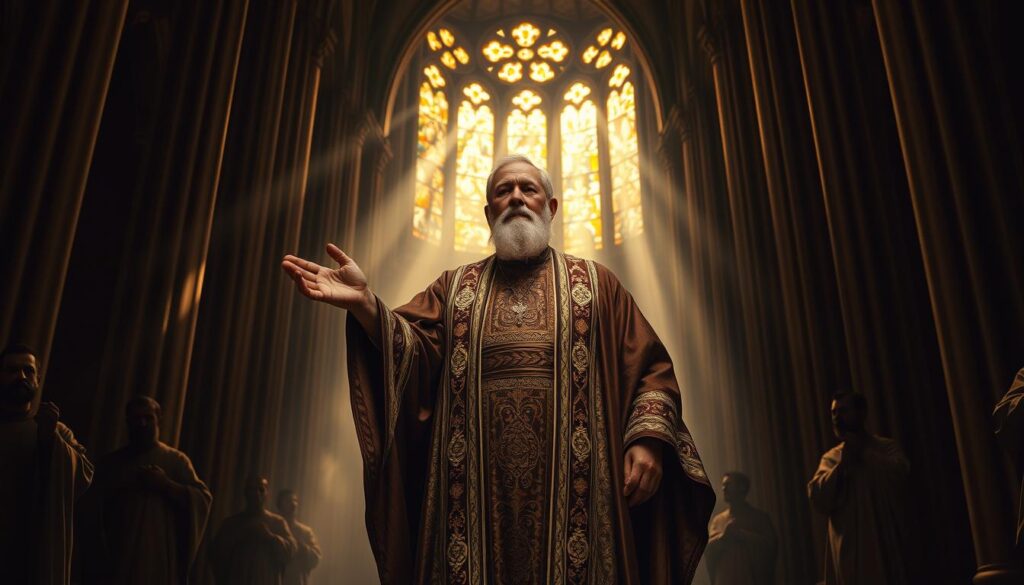
A grand cathedral interior, dimly lit by shafts of golden light streaming through stained glass windows. At the center, an elderly apostle stands in a pose of authority, his outstretched hand and solemn expression commanding attention. Ornate, ecclesiastical robes flow around him, their intricate patterns and textures evocative of the church's historical legacy. Shadowy figures of other apostles flank him, their faces obscured, conveying a sense of reverence and sacred tradition. The architecture looms imposingly, with towering arches and columns that evoke the weight of centuries of Christian faith and doctrine. An atmosphere of solemnity and spiritual gravitas permeates the scene, hinting at the profound historical and biblical foundations of apostolic authority.

The Apostolic Selection Process

Jesus didn’t rush this decision. After a night of prayer, he deliberately called individuals who met specific criteria:

  • Personal instruction during his ministry
  • Direct encounter with his resurrection

As Acts 1:21-22 confirms, these qualifications became non-negotiable for leadership roles. The number twelve carried deep symbolism – mirroring Israel’s tribes and signaling a renewed covenant community.

This careful selection process answered a critical question about continuity. By establishing clear authority structures, it ensured teachings would survive cultural shifts and persecution. Modern tradition holds that this biblical framework still informs church governance models today.

Personal Journeys and Martyrdom Stories

What does ultimate dedication look like? For these early leaders, faith meant embracing paths that often ended in violence. Their stories of sacrifice became cornerstones of spiritual resilience, showing how conviction could outlast even brutal opposition.

Experiences of Faith and Sacrifice

James, son of Zebedee, faced the sword under Herod Agrippa I – the first to suffer martyrdom around 44 AD. His brother John would follow a different path, living decades longer to guide communities in Ephesus. This contrast reveals how divine purpose took varied forms.

Twenty years after James’ death, Peter met his end in Rome during Nero’s persecution. Tradition holds that he requested crucifixion upside down, feeling unworthy to die like his teacher. Meanwhile, James the Lesser – son of Alphaeus – faced stoning in Jerusalem, targeted by those threatened by growing Christian influence.

From India’s shores to Middle Eastern deserts, these messengers carried hope into hostile lands. Thomas’ mission work ended with spears in Chennai, while Andrew’s X-shaped cross became a lasting symbol. Even Bartholomew’s grisly fate – flayed skin or severed head – couldn’t erase his impact.

Only John avoided violent death, his long life bridging eras. Yet his exile and hardships proved that survival could test faith as severely as sudden martyrdom. Together, their journeys remind us that courage wears many faces.

The Role of Tradition in Shaping Apostolic Legacy

How do communities keep ancient stories alive? Through careful preservation and shared practices. Early believers passed down accounts of spiritual pioneers long before printing presses existed. This oral tradition became the glue holding their legacy together.
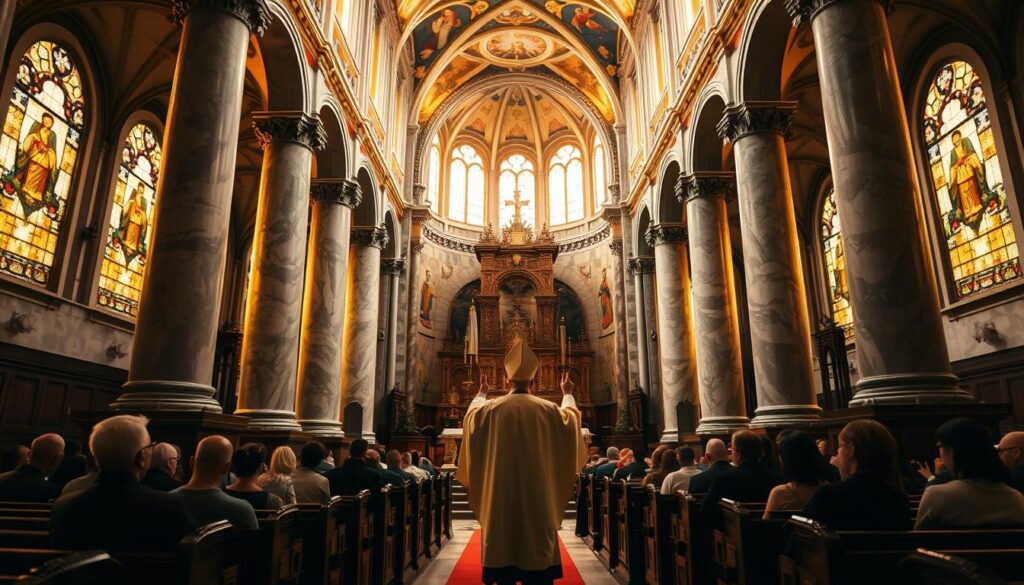
A grand cathedral interior, illuminated by warm, golden light filtering through stained glass windows. Towering marble columns support a lofty ceiling adorned with intricate religious frescoes. In the foreground, a scene of ecclesiastical authority - a bishop, resplendent in ornate vestments, stands at an ornate, gilded altar, his hands raised in benediction. Flanking him, rows of wooden pews filled with kneeling figures, their expressions solemn and reverent. The atmosphere is one of profound spiritual significance, a tangible embodiment of the weight and gravitas of Catholic tradition.

Development of Ecclesiastical Authority

By the second century, leadership structures took clear shape. Three roles emerged: bishop, priest, and deacon. Tradition holds that bishops inherited the apostles’ full authority to teach and govern. This unbroken chain answers the question of how spiritual leadership endures across generations.

The Roman Martyrology later documented these connections. It lists figures like St. Simon and St. Jude, showing how communities honored their memory. Modern bishops still mirror early practices – guiding congregations as living links to foundational teachings.

Evolution of Liturgical Feasts

Formal celebrations developed slower than many realize. Fourth-century believers began marking specific days to honor spiritual ancestors. These feasts helped cement their names in collective memory through rituals and readings.

The Roman Martyrology became crucial for standardizing these observances. By recording feast dates and patronages, it turned local traditions into universal practices. Today, these celebrations remind communities that faith grows from roots planted centuries ago.

The Apostolic Impact on Modern Church Structure

Leadership transitions often determine an organization’s survival. The blueprint for spiritual governance established two millennia ago remains strikingly relevant today. At its core lies a chain of stewardship stretching from ancient shores to modern cathedrals.
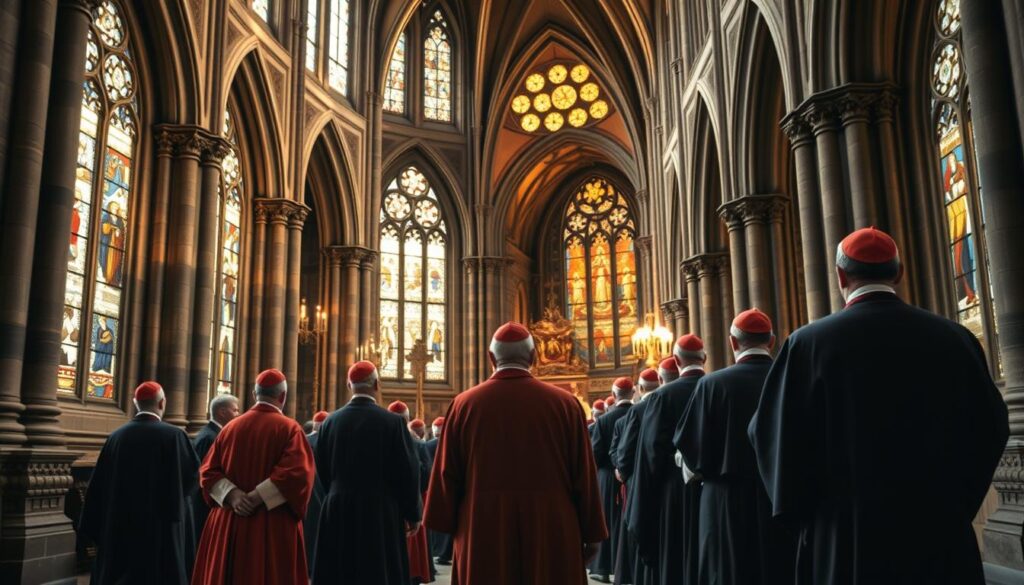
a highly detailed, realistic, photographic image of a visual representation of the concept of apostolic succession, showcasing a solemn procession of robed and mitred figures, likely bishops or cardinals, solemnly passing through an ornate, gothic cathedral interior with stained glass windows and intricate stone arches, creating a sense of tradition, spiritual authority, and the unbroken lineage of the Catholic Church from the original twelve apostles, lit by warm, natural lighting from the windows and creating an atmosphere of reverence and historical significance

From Apostles to Bishops: Succession Explained

When Jesus told St. Peter, “I will give you the keys to the kingdom of heaven” (Matthew 16:19), he launched a leadership model still in use. These symbolic keys represent more than ancient history – they’re active tools guiding today’s church st. Peter helped establish.

Modern bishops inherit their spiritual authority through unbroken lines tracing back to original messengers. This succession ensures teachings stay consistent across generations. Like relay runners passing a baton, each leader preserves essential truths while addressing contemporary challenges.

The kingdom of heaven concept remains central to this structure. It reminds communities that earthly institutions serve higher purposes. Through councils and collaborations, today’s bishops mirror the teamwork shown by apostles peter and his companions.

This system’s endurance proves its design. Threats to unity have come and gone, yet the framework persists. From selecting leaders to resolving disputes, modern practices still echo decisions made around campfires and fishing boats long ago.

Insights from Historical Sources and Church Writings

Historical records offer a fascinating window into early Christian leadership. The Acts of the Apostles stands as our most detailed roadmap, chronicling pivotal moments after Jesus’ ascension. Early believers preserved these accounts through oral traditions before they became part of the New Testament canon.

Analyzing Primary Source Data

Pope Emeritus Benedict XVI highlighted ongoing debates about figures like James son of Alphaeus. Scholars still discuss whether he’s the same person as James “the brother of the Lord.” Such questions remind us how history shapes spiritual understanding.

St. John’s unique role emerges clearly in scripture. As the son of Zebedee, he became guardian to Jesus’ mother – a responsibility noted in John 19:25-27. This intimate connection shows how personal relationships influenced early Church growth.

Martyrdom accounts reveal deep commitment. From St. Andrew’s X-shaped cross to St. Thomas’ mission in India, these stories traveled through generations. Feast days and local traditions keep their memories alive, blending history with living faith practices.

FAQ

Who were the original followers of Jesus known as the Twelve?

The Twelve were chosen by Jesus to spread His teachings. Key figures include Peter, Andrew, James, John, and Matthew. Their roles are detailed in the Gospels and Acts.

How were these disciples selected?

According to the New Testament, Jesus personally called each disciple, often during everyday activities like fishing or tax collecting. Their selection emphasized humility and devotion.

What sources describe their lives and missions?

The Gospels, Acts of the Apostles, and early church writings like Eusebius’ Ecclesiastical History provide accounts. Traditions passed down by communities also shape their stories.

Did any of them face persecution for their faith?

Yes, many endured martyrdom. For example, tradition holds that Peter was crucified upside down, while Paul, though not one of the original Twelve, was beheaded in Rome.

How did their work influence today’s church leadership?

They established early Christian communities, laying the groundwork for bishops and pastoral roles. This succession is central to many denominations’ governance.

Are there feasts celebrating specific followers?

Liturgical calendars honor figures like St. James on July 25 and St. Thomas on July 3. These feasts often reflect local customs and historical reverence.

Why is Paul included in discussions about the Twelve?

Though not part of the original group, Paul’s conversion and missionary journeys in Acts made him pivotal. His letters shaped early theology and church structure.

How reliable are historical accounts of their deaths?

While details vary, sources like the Roman Martyrology and early Christian texts offer insights. Archaeological findings, such as Peter’s tomb, also support traditions.
Catholic Unscripted: Exploring Faith Beyond the Script


Welcome to a space where honest conversations about faith thrive. In an age of soundbites and hot takes, we’re here to cut through the noise with clarity and warmth. Our mission? To offer thoughtful reflections that honor timeless wisdom while addressing real-life questions.

You won’t find academic jargon or watered-down platitudes here. We write like we’re chatting over coffee—direct, heartfelt, and grounded in truth. Whether you’re new to exploring spiritual ideas or deeply rooted in tradition, our content meets you where you are.

Modern life throws complex challenges at believers. Our team bridges ancient teachings with contemporary struggles, creating resources that inform without overwhelming. From personal essays to practical guides, every piece aims to nourish both mind and soul.

We believe beauty and truth belong to everyone. That’s why we avoid insider language and focus on ideas that resonate across experience levels. Expect fresh perspectives on enduring principles—and maybe even a spirited debate or two along the way.

Key Takeaways

  • Prioritizes clear communication over technical religious terms
  • Connects historical teachings to modern believers’ daily lives
  • Welcomes readers at all stages of spiritual exploration
  • Balances depth with approachable storytelling techniques
  • Features diverse content formats united by shared values

Our Story and Mission

Three distinct lives converged to create a platform where faith meets real-world grit. Our founders’ diverse journeys—from rural simplicity to courtroom battles—shape every conversation we host.

Foundations in Faith and Tradition

Katherine Bennett’s childhood in a hand-built home taught her that spiritual wealth outshines material lack. Her theology degree and years teaching political philosophy fuel her unique take on feminine dignity in modern discussions. “Truth isn’t fragile,” she often says. “It thrives when we ask hard questions.”

Dr. Gavin Ashenden’s path took unexpected turns—from law school to Anglican clergy, then finally to Catholicism. His decades of pastoral work give him rare insight into Protestant-Catholic dialogues. Mark Lambert’s theological studies at Maryvale Institute (where Newman once lived) prepared him for years of bold blogging that exposed institutional corruption.

Embracing Plain Speaking and Authentic Reflection

Our team rejects ivory-tower jargon. Katherine breaks down complex teachings about gender roles using everyday examples. Gavin’s legal training helps him dissect moral dilemmas with surgical precision. Mark’s writing cuts through church politics like a flashlight in a dusty attic.

Founder Expertise Years Active Key Contribution
Katherine Bennett Theology & Gender Studies 15+ Clarifies feminine dignity in modern culture
Dr. Gavin Ashenden Interfaith Dialogue 40+ Bridges Protestant-Catholic understanding
Mark Lambert Ecclesial Journalism 10+ Exposes corruption through investigative writing

Together, we’ve attended thousands of Mass services, weathered personal storms, and found that authentic faith grows strongest when rooted in honest dialogue. Whether you’re exploring basic questions or deep doctrines, we meet you where you are—no prerequisites required.

Exploring catholic unscripted Perspectives

Faith thrives in honest dialogue where varied experiences shape understanding. Our team brings decades of real-world wisdom to timeless truths, blending expertise with relatable storytelling.

A serene cathedral interior, the soft glow of candlelight casting a warm, contemplative ambiance. In the foreground, a worshipper kneeling in quiet reflection, their face illuminated by the flickering flames. Stained glass windows in the middle ground depict scenes of faith, their muted colors imbuing the space with a sense of timeless spirituality. The background features ornate architectural details, vaulted ceilings, and wooden pews, conveying the grandeur and solemnity of the Catholic tradition. Subtle natural light filters through, creating a sense of transcendence and the divine.

Voices That Illuminate Truth

Katherine Bennett turns complex teachings into engaging conversations. Her 15+ years defending feminine dignity mix theological depth with humor from her comedy days. “Laughter opens hearts to truth,” she notes while explaining why male priesthood strengthens community bonds.

Dr. Gavin Ashenden bridges worlds through media-savvy insights. With 40+ years in Anglican and Catholic circles, he disarms Protestant objections like a seasoned diplomat. His quirky style—even sharing royal last words—makes doctrine stick in modern minds.

Tradition Meets Today’s Challenges

Mark Lambert’s network of contacts uncovers hidden stories shaping believers’ lives. From parish classrooms to global conferences, he connects dots others miss. This investigative approach helps readers see how ancient practices solve new problems.

Together, these voices create a vibrant tapestry. They show how faith transforms daily routines—whether parenting struggles or workplace ethics. Their collective experience proves tradition isn’t dusty history, but living wisdom for our chaotic age.

Community Engagement and Impact

Meaningful connections form the heartbeat of spiritual growth. Our work thrives in shared spaces—physical classrooms, chapel pews, and digital platforms alike. Every interaction aims to spark reflection while honoring tradition.

Connecting Through Daily Mass, School, and Campus Life

Freshman orientations at partner schools blend practical guidance with sacred moments. Welcome Masses bookend orientation days, setting intentions for new beginnings. These gatherings remind students that faith walks with them—from first-day jitters to final exams.

Daily celebrations at the Pope John Paul II Chapel anchor campus life. Morning rituals become touchstones for busy schedules. Over years, these consistent practices build rhythms that sustain students through academic pressures.

Sharing News, Blogs, and Reflective Essays

Our blog mirrors the pulse of real-world faith journeys. Some posts dissect current events through timeless teachings. Others offer quiet meditations for hectic days. This mix ensures readers find nourishment matching their needs.

Weekly newsletters highlight school initiatives alongside global Church news. A parent’s question about teen social media use might inspire next month’s essay series. By listening first, we create resources that meet people where they live.

Years of community feedback shape our approach. Whether explaining complex doctrines or sharing campus success stories, we prioritize clarity over cleverness. Because authentic growth happens one conversation—and one Mass—at a time.

Conclusion

Conversations that matter begin with listening. Our platform thrives where deep scholarship meets warm, everyday language. We blend rigorous thinking with stories that feel like kitchen-table talks—because truth deserves both respect and relatability.

Every article and discussion here honors timeless truths while addressing modern questions. Our team’s diverse backgrounds unite in one purpose: serving seekers and believers alike. Lawyers, teachers, and storytellers collaborate to make wisdom accessible, not academic.

This work grows richer through reader engagement. Your experiences shape our content’s direction, ensuring we address real spiritual needs. While methods adapt, our foundation remains firm—anchored in sacred tradition and genuine care for souls.

Consider this your invitation to explore faith with curious companions. Whether you’re wrestling with doubts or deepening your practice, we walk beside you. Together, let’s build a community where questions spark growth and truth shines brighter through shared discovery.

FAQ

What makes Gavin Ashenden’s approach to faith discussions unique?

Gavin Ashenden combines decades of theological insight with plainspoken honesty, fostering open dialogue that bridges tradition and modern challenges. His work emphasizes authenticity over rigid formulas.

How does the platform address current events or social issues?

Through news analysis, reflective essays, and blog posts, contributors connect timeless teachings to today’s cultural shifts—offering perspectives on topics like school policies, family life, and ethical debates.

Can I participate in daily Mass or community events through this initiative?

Yes! The community hosts virtual and in-person gatherings, including daily Mass streams, campus discussions, and school-focused programs designed to deepen spiritual engagement.

Are younger generations a focus for these faith-based conversations?

Absolutely. By integrating campus outreach, youth-oriented blogs, and relatable storytelling, the platform meets younger audiences where they are—balancing ancient wisdom with contemporary relevance.

How do contributors balance tradition with evolving cultural norms?

Writers and speakers explore this tension thoughtfully, emphasizing continuity while addressing modern questions. Essays often highlight personal journeys of adapting faith to daily life without losing core values.

Where can I find updates on new content or events?

Newsletters, social media channels, and the website’s blog section provide regular updates on Mass schedules, school partnerships, essays, and guest speaker announcements.

Catholicism and Predestination: Exploring the Debate


What shapes our eternal destiny? This question lies at the heart of a centuries-old discussion about God’s plan and human freedom. While Scripture affirms that salvation comes through divine grace, believers often wrestle with how this truth interacts with personal responsibility.

The Apostle Paul’s words in Romans 8:29-30 reveal a profound mystery: God’s foreknowledge and our journey toward holiness. These verses have sparked rich theological exploration across Christian traditions. Though interpretations vary, all agree that our ultimate hope rests in God’s love and desire to bring humanity closer to heaven.

This debate isn’t confined to ancient texts. It influences how we pray, make moral choices, and understand our relationship with the divine. Different views on this doctrine have shaped church history, from early councils to Reformation-era dialogues. Yet beneath these complexities lies a simple truth: our Creator invites cooperation, not coercion, in the work of redemption.

Key Takeaways

  • Christian theology grapples with balancing God’s sovereignty and human free will
  • Biblical teachings inspire diverse interpretations across denominations
  • Historical debates continue to influence modern spiritual practices
  • Divine mercy and personal responsibility coexist in salvation narratives
  • Understanding these concepts deepens one’s relationship with faith

Introduction: Unpacking the Debate on Catholic Predestination

At its core, Catholic teaching presents divine guidance as a loving roadmap rather than a fixed script. The Church views God’s eternal design as inseparable from His mercy, inviting people to walk freely toward heaven while providing every spiritual tool needed for the journey.

Overview of Predestination in Catholic Thought

Central to this doctrine is the belief that God actively desires salvation for all. Unlike theories suggesting arbitrary selection, Catholic theology emphasizes that grace flows abundantly to everyone. As the Catechism states:

“God predestines no one to go to hell; for this, a willful turning away from God is necessary.”

CCC 1037

This perspective rejects the idea of “double predestination” while acknowledging human freedom. The sacraments, prayer, and charity become stepping stones in cooperating with divine grace – not earning salvation, but embracing it.

Scope and Significance in Modern Belief

Today’s believers often ask: “How do I know I’m on the right path?” The Church answers through Scripture and tradition, offering assurance that God’s plan includes both the destination (heaven) and the means to get there. Current pastoral guidance focuses on:

Divine Initiative Human Response Assurance
Unlimited grace Receiving sacraments Trust in mercy
Eternal hope Practicing virtue Daily conversion

This framework transforms anxiety about the future into active participation in God’s love. By viewing life as a dynamic partnership with the divine, Catholics find both purpose and peace in their spiritual walk.

Historical Perspectives on Predestination

From ancient texts to Reformation-era upheavals, humanity’s struggle to balance destiny and choice has shaped spiritual thought. This journey through time reveals how different cultures wrestled with life’s ultimate questions.

A grand cathedral interior, illuminated by warm candlelight and stained glass windows. In the foreground, a panel of theologians engrossed in a heated debate, gesturing animatedly as they delve into the intricacies of predestination. The middle ground features ornate wooden pews, where scholars and clerics listen intently, their faces etched with contemplation. In the background, towering columns and arches lend an air of solemnity and grandeur, hinting at the rich historical tapestry of this theological discourse. The scene evokes a sense of intellectual rigor and spiritual gravitas, capturing the essence of the "Historical Perspectives on Predestination".

Jewish Roots and Early Christian Adaptations

During Jesus’ time, Jewish groups held contrasting views:

  • Essenes saw life as divinely scripted
  • Sadducees championed complete human freedom
  • Pharisees blended both concepts

Early Christians rejected extreme fatalism but kept exploring this tension. Saint Augustine later wrote:

“The will of God is the necessity of all things.”

City of God, Book V

His teachings became foundational, emphasizing divine guidance without erasing human responsibility.

Reformation Ripples Through Theology

The 16th century brought seismic shifts. Reformers like Calvin argued for unconditional election, claiming God selects souls regardless of merit. Luther famously compared human will to a passive animal steered by higher powers.

These ideas clashed with traditional teachings about:

  • Universal access to grace
  • The role of sacraments
  • Moral accountability

This debate wasn’t just academic—it shaped how ordinary people viewed their spiritual worth and daily choices.

Scriptural Foundations and Theological Debates

The Bible’s letters reveal a roadmap for spiritual transformation. St. Paul outlines this journey in Romans 8:29-30, mapping five divine actions: foreknowledge, calling, justification, and glorification. Each step emphasizes God’s desire to shape believers into the image of his Son – not as robotic followers, but as radiant reflections of Christ’s love.

Pauline Teachings on Divine Election and Grace

In Ephesians 1:4-11, St. Paul deepens this vision. He describes believers as “chosen before creation” to receive adoption through Christ. This divine plan centers on grace, freely given to guide humanity toward heaven. The apostle’s words challenge modern readers: Are we passive recipients or active partners in this sacred process?

Council Decrees and Patristic Explanations

The Council of Trent called predestination a “hidden mystery,” balancing God’s sovereignty with human freedom. Church Fathers like Augustine clarified that divine election flows from God’s foreknowledge of how beings respond to grace. As he wrote:

“Predestination is nothing else than the foreknowledge and foreordaining of those gracious gifts.”

Augustine of Hippo

Later thinkers like Aquinas expanded this view, showing how salvation harmonizes divine initiative with daily choices. These teachings remind us that theology isn’t about solving puzzles – it’s about embracing a love that transforms.

Catholic Versus Protestant Views on Predestination

How do different Christian traditions reconcile divine sovereignty with human freedom? This question sparks one of Christianity’s most enduring dialogues. While both traditions affirm God’s authority, their approaches to grace and human response reveal distinct spiritual landscapes.

Calvinist Theories and Criticisms

John Calvin’s teachings introduced unconditional election – the belief that God chooses specific individuals for salvation regardless of merit. This “irresistible grace” theory suggests the chosen cannot reject divine favor, while others face eternal separation. The controversial double predestination concept claims God actively destines some souls to hell.

Catholic thought strongly opposes this view. As the Catechism clarifies:

“God predestines no one to go to hell; for this, a willful turning away from God is necessary.”

Catholic Clarifications and Doctrinal Nuances

The Church teaches that freedom remains central to God’s plan. Divine election considers how individuals respond to grace over lifetimes. This perspective avoids fatalism while honoring both divine wisdom and human dignity.

Key differences emerge in this comparison:

Aspect Calvinist View Catholic View
Divine Choice Unconditional selection Based on foreknown response
Human Role Passive recipients Active cooperation
Outcome for Others Predestined to hell Rejection through free will

By emphasizing God’s desire to save all people (1 Timothy 2:4), Catholic teaching fosters hope without diminishing personal responsibility. This balance helps believers avoid spiritual anxiety while pursuing holiness.

The Role of Free Will in Divine Salvation

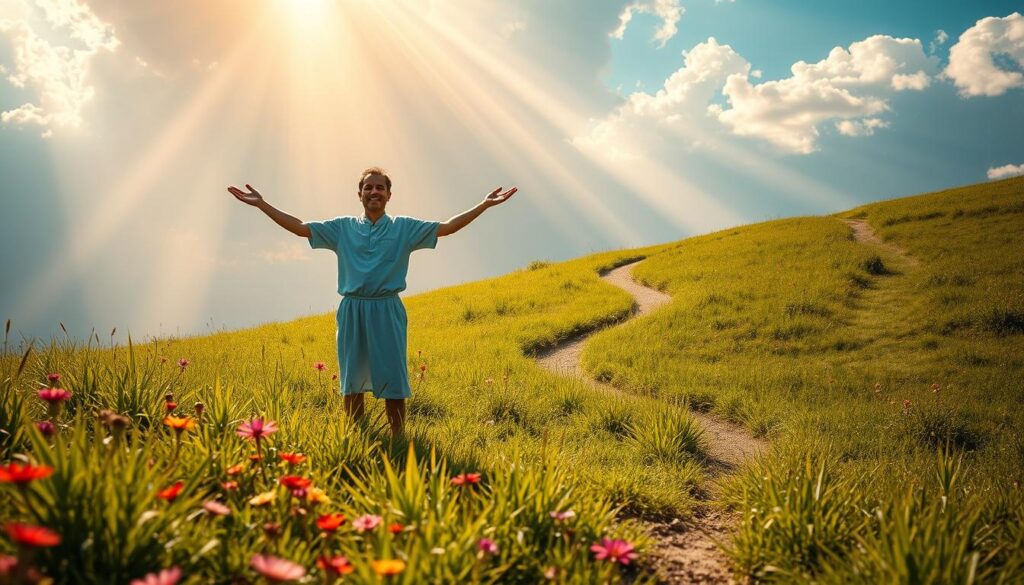
A serene, sun-dappled meadow, with lush, verdant grass and vibrant wildflowers. In the foreground, a figure representing free will stands tall, arms outstretched, their expression radiating a sense of agency and determination. Behind them, a celestial scene unfolds, with shafts of golden light streaming down from above, symbolizing divine grace. The middle ground features a winding path, inviting the viewer to contemplate the interplay between human choice and divine providence. The overall atmosphere is one of tranquility, harmony, and the profound mystery of salvation.

Can true freedom coexist with divine guidance? Catholic teaching answers with a resounding yes. Authentic free will means more than avoiding external pressure – it’s the power to shape eternal outcomes through daily choices. As the Catechism explains, humans possess “the God-given capacity to direct themselves toward genuine good.”

This understanding resolves common tensions:

Divine Knowledge Human Action Spiritual Outcome
God foresees responses Daily cooperation with grace Growth in holiness
No forced outcomes Receiving sacraments freely Deepened relationship with God

Unlike systems suggesting predetermined desires, Catholic thought celebrates meaningful man free agency. A parent knowing their child’s future choices doesn’t remove the child’s freedom – similarly, God’s foreknowledge preserves human responsibility.

Practical examples abound:

  • Choosing prayer over distraction
  • Embracing forgiveness after failure
  • Volunteering despite personal cost

This balance avoids two errors: denying God’s initiative (Pelagianism) or human participation (fatalism). As St. Augustine noted, “God created us without us, but won’t save us without us.” Through this lens, divine sovereignty shines brightest when man freely mirrors Christ’s love in action.

Grace, Sin, and Redemption in Catholic Theology

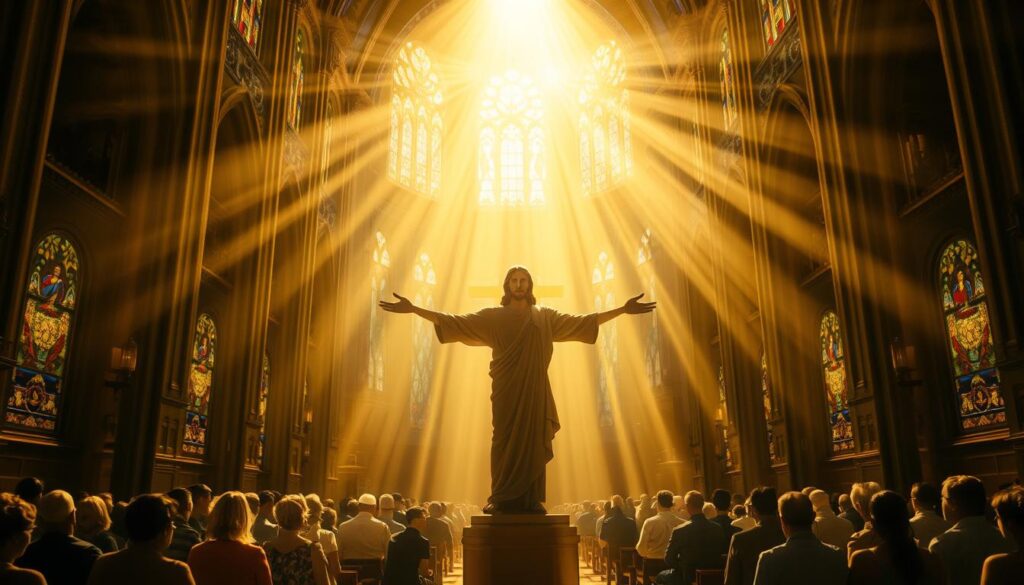
A grand cathedral interior, illuminated by soft, warm light filtering through stained glass windows. In the foreground, a figure of Christ stands, his arms outstretched in a gesture of grace and redemption. Swirling around him, golden rays of sanctifying grace descend from above, radiating a sense of divine presence. In the middle ground, kneeling worshippers bask in the glow, their faces reflecting a mixture of reverence and gratitude. The background is filled with ornate architectural details, evoking the rich tradition and history of Catholic theology. The overall scene conveys a profound sense of spiritual transformation, where sin is vanquished, and the soul is restored through the power of God's grace.

Divine assistance comes in different forms, each designed to guide us toward heaven. Catholic teaching reveals two vital expressions of God’s help: actual grace and sanctifying grace. While both flow from divine love, they serve distinct roles in our spiritual journey.

The Distinction Between Actual and Sanctifying Grace

Actual grace acts like a spiritual nudge. It’s God’s immediate help to choose good, resist sin, or pray when life feels heavy. This temporary boost works like a friend whispering encouragement – available to everyone, regardless of their current relationship with God.

Sanctifying grace transforms us at the core. Received through sacraments like Baptism, it makes us “children of God” (1 John 3:1). Unlike fleeting prompts, this grace becomes part of our spiritual DNA – a stable gift that heals and elevates the soul.

Type Nature Source
Actual Grace Momentary divine help Prayer, life circumstances
Sanctifying Grace Lasting transformation Sacraments, holy living

Mortal sin severs this life-giving connection. Like unplugging a lamp from its power source, it leaves souls in darkness. But hope remains: Confession restores sanctifying grace instantly. As the Catechism teaches, “God never tires of forgiving” (CCC 1859).

Growing in grace involves daily choices. Receiving Communion, serving others, and avoiding sins strengthen our divine bond. Each act of love makes us more receptive to God’s plan – a journey where mercy always outshines our stumbles.

Understanding catholicism predestination in the Context of Grace and Free Will

Navigating life’s spiritual journey involves balancing divine guidance with personal choice. This delicate dance between grace and freedom shapes how believers approach their ultimate hope: communion with God in heaven. Let’s explore how this tension plays out in daily faith.

Unconditional Election Versus Human Agency

Some Christian traditions teach that God selects souls for salvation regardless of their choices. Catholic thought rejects this view, emphasizing that divine love never overrides human dignity. As the Catechism states, eternal separation from God requires deliberate rejection – not divine decree.

Living the Balance: Daily Faith in Action

How does this theology impact ordinary life? Consider three practical takeaways:

1. Works matter as responses to grace, not attempts to earn favor
2. Prayer and sacraments strengthen our capacity to choose good
3. Trust in God’s mercy replaces anxiety about the end

This approach transforms abstract theology into a roadmap for holiness. By cooperating with grace through works of love, believers step closer to heaven one intentional choice at a time. The journey isn’t about solving mysteries – it’s about living in hopeful partnership with divine love.

FAQ

How does Catholic teaching on divine election differ from Calvinist predestination?

Catholic theology emphasizes cooperation between grace and human freedom, while Calvinism teaches unconditional election. The Church rejects the idea that God predestines some to heaven or hell without regard to free will, stressing instead that salvation is offered to all.

What does St. Paul say about grace and human responsibility?

St. Paul’s letters highlight God’s initiative in offering grace but also call believers to live faithfully. For example, he writes that we are “called according to His purpose” (Romans 8:28) but urges perseverance in doing good works as a response to divine love.

Can someone lose their salvation after receiving grace?

Catholic teaching acknowledges that mortal sin can separate a person from God’s grace. However, through repentance and sacraments like Confession, believers can restore their relationship with Him, reflecting the dynamic interplay between mercy and free choice.

How did the Reformation shape Catholic views on predestination?

The Council of Trent clarified doctrines in response to Protestant claims, reaffirming that grace empowers—but doesn’t override—free will. This countered Calvinist ideas of irresistible grace, ensuring Catholic teachings emphasized human cooperation with divine love.

Are human works important for salvation, or is grace enough?

The Church teaches that grace is foundational, but works matter as a response to God’s gift. As James 2:26 states, “Faith without works is dead.” Sanctifying grace transforms the soul, enabling actions that align with His will.

Why does the Church reject the idea of “double predestination”?

Double predestination suggests God actively wills some to damnation, which conflicts with His nature as all-loving and just. Catholicism holds that hell results from freely rejecting grace, not divine coercion, preserving both God’s mercy and human accountability.

How does the concept of original sin relate to predestination?

Original sin explains humanity’s inherited brokenness, making grace necessary for salvation. However, baptism restores access to divine life, showing God’s desire to redeem all people. This underscores hope rather than fatalism in Catholic thought.

What practical steps can believers take to align with God’s grace?

Prayer, sacraments, and acts of charity help individuals grow in holiness. By cultivating virtue and avoiding sin, believers actively participate in the journey toward eternal life, trusting in God’s guidance while exercising their freedom.

Catholicism Growing: Understanding the Trend


In a world where many institutions face decline, one ancient faith is defying expectations. Recent reports show surprising growth across continents, with over 1.4 billion members worldwide—a 1.15% increase since 2022. From Texas to London, communities are witnessing renewed interest in traditional spiritual practices.

U.S. dioceses like Fort Worth saw a remarkable 72% rise in converts last year. Meanwhile, England’s Catholic congregations now outnumber Anglican worshippers for the first time in 500 years. This shift isn’t just about numbers—it reflects deeper cultural changes.

What’s driving this trend? Experts point to several factors. Many people seek stability in uncertain times, while others are drawn to rich traditions and community ties. Young adults, especially, are exploring faith through digital platforms and personal connections.

Key Takeaways

  • Global Catholic membership surpassed 1.4 billion in 2023
  • U.S. regions report conversion spikes up to 72% annually
  • England’s Catholic attendance now exceeds Anglican participation
  • Cultural stability and community appeal attract new members
  • Young adults fuel growth through digital engagement
  • Traditional practices gain relevance in modern society

Overview of Catholicism in America: Facts and Figures

Modern faith communities display surprising geographic diversity. The Americas host 47.8% of the global Catholic population, with South America alone accounting for over a quarter. Brazil leads this charge—182 million believers make up 13% of the world’s total.

Continental Shifts in Religious Practice

Africa’s 3.31% growth rate outpaces all other regions, adding 9 million members last year. Meanwhile, Europe’s 287 million Catholics saw minimal change. This distribution highlights how economic conditions and cultural history shape spiritual landscapes.

Numbers That Tell a Story

Recent data reveals unexpected patterns. While Central America holds 13.8% of the global Catholic population, North America’s 6.6% includes thriving urban hubs. Cities like Chicago and Houston show how institutional networks—schools, charities, hospitals—maintain relevance across communities.

Asia’s steady 0.6% increase and Oceania’s 1.9% rise complete the picture. These numbers aren’t just statistics—they reflect lived experiences in an ever-changing world.

FAQ

Is the Catholic Church growing in the United States?

While the U.S. sees stable participation in some regions, overall numbers face challenges due to cultural shifts and declining engagement among younger generations. However, immigrant communities often bring vibrant faith practices that contribute to local growth.

Which regions globally show the strongest Catholic growth?

Africa and Asia report significant increases, driven by high birth rates, missionary work, and community-focused outreach. Countries like Nigeria, the Democratic Republic of Congo, and the Philippines highlight this trend.

How does Vatican data explain changes in Catholic demographics?

Recent reports from the Pontifical Yearbook emphasize growth in developing nations, while Europe and North America face priest shortages and aging congregations. The Church prioritizes evangelization efforts to address these imbalances.

Why do some countries experience a decline in Catholic membership?

Secularization, scandals, and generational disconnection from traditional institutions play roles. In places like Germany or Canada, debates over social issues also influence participation rates.

How does the Church support areas with declining numbers?

Initiatives like World Youth Day, digital evangelization, and lay leadership programs aim to reinvigorate faith. Dioceses often focus on multicultural ministries to reflect changing community needs.

Are more young people joining the Catholic Church today?

While some are drawn to its timeless traditions and social justice teachings, overall youth engagement remains a challenge. Parishes with active youth ministries or dynamic leaders, like Pope Francis, often see stronger interest.

Catholicism Map: Uncover the Worldwide Presence of the Faith


How has the global religious landscape changed in the last 100 years? A Pew Research Center study reveals striking shifts. In 1910, 291 million people identified with the Catholic Church. By 2010, that number soared to 1.1 billion – tripling worldwide followers.

This growth tells a story of cultural transformation. While Europe once housed most adherents, Latin America and Africa now drive expansion. The United States remains a key hub, with diverse communities shaping local practices. Yet the faith’s share of the global population stayed steady at 16-17%, showing balanced growth alongside world demographics.

Our interactive tools help you explore these patterns visually. See how migration, historical events, and societal changes influenced regional devotion levels. We’ll also explain how researchers verify data through sources like the CIA Factbook – ensuring accuracy without dry statistics.

Key Takeaways

  • Global Catholic followers tripled since 1910, reaching 1.1 billion
  • Latin America and Africa now lead in growth, surpassing Europe
  • Pew Research Center provides trusted demographic insights
  • Historical events deeply shaped today’s religious geography
  • Multiple organizations collaborate to ensure data reliability

Understanding the Global Catholic Landscape

How do you track a faith followed by over a billion people? Current estimates show 1.3 billion Catholics worldwide – nearly 17% of humanity. This spiritual community spans continents, cultures, and languages, creating a vibrant mosaic of traditions.

https://www.youtube.com/watch?v=HC-ItniAeys

Overview of Catholic Demographics

The Pew Research Center reveals fascinating patterns. While Europe remains historically significant, Latin America now hosts 40% of all Catholics. Africa’s share grew from 1% to 16% since 1910 – the fastest regional increase.

Three key sources shape our understanding:

  • Vatican yearbooks tracking baptized members
  • National census records
  • The Religion & Public Life project’s surveys

Key Statistical Insights from Global Data

Despite world population growth, Catholics maintained a steady 16-17% global share for decades. The Pew Research Center attributes this balance to two factors:

  1. Rapid growth in developing nations
  2. Declining numbers in traditional strongholds

Asia-Pacific regions show surprising vitality. Countries like the Philippines and South Korea report increasing church participation, while European nations see gradual secularization.

Historical Growth and Expansion of Catholicism

The story of religious expansion reveals surprising twists over 11 decades. Colonial ships carried more than spices and settlers – they transported belief systems that reshaped continents.

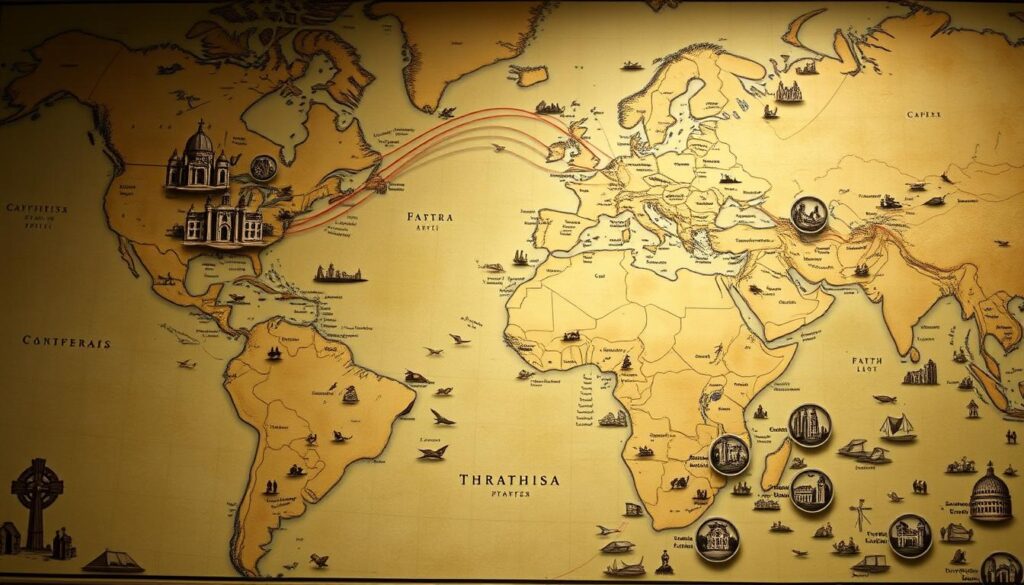
A detailed, historically accurate map of the global expansion of Catholicism over time. The foreground depicts the gradual spread of Catholic influence across continents, marked by the emergence of cathedrals, monasteries, and missionary outposts. The middle ground showcases the dynamic flow of pilgrims, traders, and evangelists traversing sea and land routes. In the background, a tapestry of cultural and religious diversity unfolds, hinting at the complex interplay between Catholicism and local traditions. The scene is rendered in a muted, earthy palette, conveying a sense of timeless grandeur and the weight of historical legacy. Soft, directional lighting casts subtle shadows, imbuing the map with a sense of depth and solemnity befitting the subject matter.

Colonial Beginnings and Early Developments

Spanish and Portuguese explorers planted the seeds of their faith across new territories. Missionaries built Catholic churches alongside trading posts, blending spiritual and economic goals. By 1600, 90% of Mexico’s total population practiced this religion.

French colonies took different approaches. Their North American settlements focused on cultural integration rather than mass conversion. This strategy created lasting communities in Quebec and Louisiana that still thrive today.

Region 1910 Share 2010 Share
Europe 65% 24%
Latin America 24% 39%
North America 5% 8%
Africa 1% 16%

Modern Trends and Shifting Populations

The United States now hosts the fourth-largest Catholic community globally. Urban centers like Chicago and Los Angeles showcase diverse practices blending old traditions with new cultural influences.

Africa’s dramatic growth stands out. From 1 million adherents in 1900 to 230 million today, the continent represents faith’s future. The Forum on Religion & Public Life notes this shift mirrors broader demographic changes in developing regions.

These transformations continue shaping global religious landscapes. As birth rates and migration patterns evolve, so does the geography of spiritual practice.

Exploring the catholicism map

Modern tools transform raw statistics into compelling stories. Our interactive visualization reveals how spiritual communities form unique patterns across borders. You’ll see clusters where historical events and migration shaped today’s religious landscape.

Interpreting Data Points and Visual Trends

Color gradients show concentration levels – from Brazil’s deep hues representing 123 million adherents to lighter shades in regions with smaller communities. The United States appears as a mosaic, reflecting its diverse population distribution.

Three key insights emerge from the Pew Research data:

  • 90% of Filipinos identify with the Catholic Church
  • Democratic Republic of Congo shows rapid growth since 2000
  • Mexico maintains 82% adherence despite secular pressures
Country Catholic Population % of Total
Brazil 123 million 58%
Mexico 98 million 82%
Philippines 85 million 90%
United States 72 million 22%
DR Congo 44 million 51%

The Forum on Religion & Public Life helps explain why coastal West Africa shows higher concentrations than inland areas. Colonial trade routes and missionary activities left lasting imprints visible in today’s churches.

Eastern Catholic Churches add fascinating complexity. These communities maintain unique traditions while remaining part of the global faith network. Their presence creates vibrant pockets in regions like Eastern Europe and the Middle East.

Updated weekly using Pew Research and CIA Factbook data, our tools let you track changes over decades. Watch how urbanization affects spiritual practices or explore pandemic-era shifts in community participation.

Regional Impact in Latin America

Latin America’s religious identity remains deeply tied to its spiritual roots. While 39% of global adherents live here, recent shifts reveal changing attitudes. The percentage of Catholics dropped from 90% in 1910 to 72% by 2010 – a gradual decline masked by overall population growth.

Demographic Trends and Cultural Influence

Brazil and Mexico showcase this dual reality. Both countries lead in absolute number Catholics but face declining participation rates. Urban youth increasingly explore alternative faiths or secular lifestyles.

Country 2000 Catholic % 2010 Catholic %
Brazil 74% 65%
Mexico 89% 85%
Argentina 83% 76%

Cultural imprints endure despite these changes. Catholic traditions shape holidays, education systems, and community values across the country landscapes. Over 500 hospitals and 120 universities in the region still operate under church guidance.

The United States connection matters too. Migration patterns create cultural bridges, with Latino communities influencing North American practices. This exchange keeps Latin American traditions relevant in global dialogues about faith’s future.

Catholicism Across Europe

A detailed map of Europe illuminating the geographic distribution of Catholic adherents, captured in a realistic, high-resolution rendering. The foreground depicts a topographical landscape with distinct national borders, major cities, and landmarks. The middle ground showcases Catholic cathedrals, basilicas, and other places of worship, their spires and domes rising prominently across the continent. In the background, a vibrant heatmap visualizes the density of Catholic populations, with regions of greater concentration highlighted in deeper shades. The image is rendered with a warm, subdued color palette, evoking a sense of tradition and reverence, and is captured from a slight aerial perspective to provide a comprehensive, panoramic view of Catholicism's expansive presence across Europe.

Europe’s religious landscape tells two stories at once. While historic cathedrals still dot the skyline, weekly church attendance tells a different tale. The research center data shows a 9% drop in Catholic affiliation since 1910 – from 44% to 35% of Europe’s population.

Changing Demographics and Regional Variability

Germany’s unique tracking system reveals hidden patterns. The government collects a church tax from registered members, creating precise records. This contrasts with Spain’s self-reported surveys showing 52.9%-70% adherence.

Country Catholic % Data Source
Poland 71.1% National Census
Ireland 69% Research Center
Italy 66.7-81.7% Multiple Surveys
Germany 26% Tax Records

Eastern Catholic communities add rich diversity. Ukraine and Romania maintain vibrant Byzantine traditions within the global Catholic Church. These groups account for 4% of Europe’s faithful according to recent studies.

The United States connection brings new energy. Immigrants from Latin America and Africa fill pews in cities like Madrid and Rome. Meanwhile, France reports rising secularism – only 8% of young adults attend weekly services.

Urbanization reshapes practices across regions. Younger generations often blend traditional rituals with modern values. The research center notes this creates unique local expressions of faith within the universal church.

Analyzing Catholic Presence in Africa and the Middle East

Two contrasting narratives emerge when examining spiritual communities across these regions. Sub-Saharan Africa’s faith communities have multiplied 170 times since 1910 – a transformation reshaping global Catholic demographics.

A detailed map of Africa, showcasing the growth and spread of Catholicism across the continent. The foreground depicts a vibrant, hand-drawn overlay with church symbols, congregation sizes, and population percentages in a warm, earthy color palette. The middle ground features a topographical map of Africa, with borders and major cities delineated in muted tones. In the background, a soft, atmospheric rendering of the African landscape, with lush greenery, rolling hills, and a hazy, sun-drenched sky. The overall composition conveys a sense of reverence, cultural richness, and the ongoing spiritual journey of the Catholic faith in this diverse and dynamic region.

African Growth Redefines Religious Geography

The Pew Research Center reports stunning numbers: Africa’s Catholic population exploded from 1 million to 171 million in a century. This 21% regional adherence rate makes Africa crucial for understanding future growth.

Three factors drive this expansion:

  • Vibrant community rituals blending local traditions
  • High birth rates in developing countries
  • Grassroots missionary strategies

Middle Eastern Stability Through Challenges

Despite being Christianity’s birthplace, the Middle East hosts under 1% of global Catholic followers. Political conflicts and emigration maintain this contrast with African growth.

Eastern Catholic communities persist as living history. Lebanon’s Maronite Church and Iraq’s Chaldeans demonstrate resilience, though their numbers remain small. The Pew Research Center notes these groups preserve ancient traditions amid modern challenges.

The Role of Catholic Institutions in Asia-Pacific

The Asia-Pacific region writes a new chapter in faith’s global story. Over 131 million people here now identify with this tradition – up from just 14 million in 100 years. The Philippines leads this growth, with 89 million adherents making it the world’s third-largest community.

Catholic organizations shape daily life across the region. In Manila, church-run universities educate future leaders. Seoul’s hospitals blend modern medicine with spiritual care. These institutions create lasting bonds with local populations while preserving cultural heritage.

New Patterns in Spiritual Engagement

According to Pew Research, Asia-Pacific’s Catholic share tripled to 3% since 1910. India shows unique growth – ancient Eastern traditions merge with global practices through Eastern Catholic communities. Youth programs and digital outreach help maintain relevance in tech-savvy nations.

The church faces both opportunities and challenges here. Urbanization tests traditional practices, while social services build trust. As demographics shift, this vibrant region could redefine what global faith communities look like in coming decades.

FAQ

Where is the Catholic faith most concentrated globally?

Latin America has the largest share of Catholics, followed by Europe and sub-Saharan Africa. Brazil, Mexico, and the Philippines rank among the top countries by membership, according to Pew Research Center.

How has history shaped the distribution of Catholics worldwide?

Colonial-era missionary work, trade routes, and migration patterns laid the foundation for growth. Today, regions like Africa and Asia-Pacific show rapid increases, while Europe’s share declines.

What tools help visualize the faith’s geographic spread?

Interactive maps and census data highlight membership density, institutional presence, and regional trends. For example, 40% of the global Catholic population resides in Latin America.

Why does Latin America dominate in Catholic demographics?

Spanish and Portuguese colonization introduced the faith centuries ago. Cultural traditions, festivals, and societal norms still reflect its deep-rooted influence across the region.

Is Europe’s Catholic population shrinking?

Yes. While countries like Italy and Poland retain strong ties, secularization and lower birth rates have reduced membership. Contrast this with growth in Germany’s immigrant communities.

Which African countries report significant Catholic growth?

Nigeria, Uganda, and the Democratic Republic of Congo are seeing surges. Youthful populations and active evangelization contribute to this trend, per recent surveys.

How does the Middle East’s Catholic presence compare?

Smaller communities exist in Lebanon, Syria, and Iraq, often linked to Eastern Catholic Churches in full communion with Rome. Political instability affects long-term stability.

What role do institutions play in Asia-Pacific regions?

Schools, hospitals, and charities run by religious groups bolster engagement. South Korea and India report rising membership, driven by social outreach and conversions.

Are Eastern Catholic Churches included in global data?

Yes. Groups like the Maronite Church or Ukrainian Greek Catholics are counted in reports, though they maintain distinct liturgical traditions under the pope’s authority.

How reliable are current Catholic population estimates?

Pew Research Center and Vatican yearbooks provide detailed insights, but variations exist due to census methods, self-identification, and regional survey limitations.

Catholics Kneeling: A Reverent Tradition


In places of worship worldwide, a simple posture speaks volumes. For many, kneeling during prayer isn’t just a habit—it’s a bridge between the physical and spiritual worlds. This practice, deeply rooted in tradition, reflects humility and devotion in ways words often can’t.

Kneeling has been called “the ultimate posture of surrender” in sacred spaces. It unites the body and soul, offering a tangible way to honor what many believe is the real presence of the divine. While some view it as outdated, others see it as a timeless act of reverence that connects modern worshippers to ancient faith traditions.

This gesture isn’t just symbolic. It serves practical purposes too, providing moments of rest during lengthy services. More importantly, it invites participants to engage fully—mind, heart, and body—in their spiritual journey. As debates arise about its role in contemporary settings, understanding its significance becomes key to preserving its place in communal worship.

Key Takeaways

  • Kneeling symbolizes humility and devotion in spiritual practices
  • Combines physical action with inward reflection during worship
  • Rooted in historical traditions of reverence and submission
  • Provides practical benefits alongside spiritual meaning
  • Faces modern challenges but retains deep theological value
  • Strengthens connection to sacred rituals and community

Understanding the Roots of Catholics Kneeling

Across centuries, physical gestures have shaped spiritual encounters. The act of lowering one’s body during sacred moments isn’t accidental—it’s woven into humanity’s oldest stories of reverence. Ancient cultures saw prostration as the ultimate way to honor divine power and earthly authority alike.

The Historical and Liturgical Context

Biblical languages reveal a clear link between worship and posture. Hebrew’s “awa” and Greek’s “proskuneo” both mean “to bow down”—actions seen when Jacob met Esau or the Magi greeted Jesus. Early believers carried this practice into gatherings, adapting it over time for communal prayer.

By the medieval era, kneeling became central to Western liturgy. The Catholic Church formalized it as part of key rituals, especially during Mass. Today, guidelines in the General Instruction of the Roman Missal remind worshippers when to adopt this posture, blending ancient tradition with modern practice.

Scriptural Foundations and Tradition

The New Testament uses proskuneo 24 times, showing its dual role in honoring God and respected leaders. This flexibility allowed the Church to preserve kneeling as both a spiritual expression and communal discipline. As one scholar notes, “Our bodies pray before our minds catch up.”

In the United States, bishops specify kneeling from the Sanctus through the Eucharistic Prayer’s closing. This rule anchors the congregation in unity during Christianity’s most sacred story—the transformation of bread and wine. Such intentional postures help believers embody their faith, not just think about it.

Exploring the Physical Postures in Catholic Worship

Movement shapes meaning in sacred spaces. Three intentional positions guide participants through different parts of the liturgy, each carrying its own spiritual weight. These postures transform the body into a living prayer book, where every gesture tells part of a greater story.

The Meaning Behind Standing, Sitting, and Kneeling

Standing marks moments of active engagement. Worshippers rise during the Gospel reading, showing respect for Christ’s words. It also unites the community when reciting shared beliefs like the Creed.

Sitting creates space for listening. This posture helps focus attention during Scripture readings and homilies. As one priest explains, “When we sit, we open our hearts to receive wisdom.”

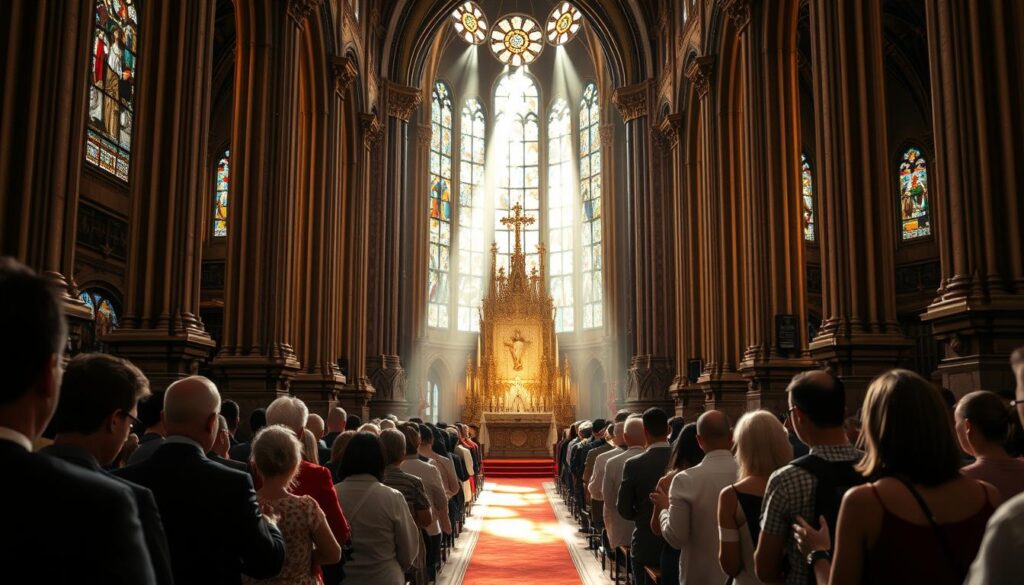
A grand cathedral interior, sunlight streaming through stained glass windows. In the foreground, a congregation of worshippers kneeling reverently, their hands clasped in prayer. Their expressions convey a sense of deep devotion. In the middle ground, altar servers and clergy perform the sacred rites, their vestments and movements elegant and solemn. The background showcases the grandeur of the architecture, with ornate columns, vaulted ceilings, and intricate religious iconography. The scene is bathed in a warm, ethereal light, evoking a profound and contemplative atmosphere.

Kneeling expresses adoration, particularly during the Eucharistic Prayer. This position acknowledges the sacred moment when bread and wine become holy. The physical act of lowering oneself mirrors an inward surrender.

Genuflection as a Sign of Reverence

Touching one knee to the ground upon entering a church serves two purposes. It honors Christ’s presence in the tabernacle and prepares the mind for worship. This brief gesture acts as a spiritual “reset button” before joining communal prayer.

Posture Liturgical Time Spiritual Meaning
Standing Gospel reading Active participation
Sitting Scripture readings Receptive listening
Kneeling Eucharistic Prayer Humble adoration

These movements create a rhythm that prevents physical fatigue while deepening spiritual connection. They turn the worship space into a dance floor where faith comes alive through motion.

Liturgical Significance and Spiritual Expression

Our bodies speak a language deeper than words during sacred moments. The positions we adopt in worship aren’t just routines—they’re physical prayers that shape our inner world. Like a smile lifting spirits or folded arms showing resolve, liturgical gestures create conversations between flesh and faith.

How Posture Reflects the Heart and Faith

Standing during Gospel readings becomes a declaration of readiness to follow teachings. Sitting transforms into active listening, palms open to receive wisdom. As one theologian observes, “The pew becomes a school desk where heaven’s lessons unfold.”

Kneeling during the Eucharistic Prayer turns bones and muscles into living witnesses. This posture whispers what lips sometimes struggle to say: “You are God, and I am yours.” Churches preserving these traditions offer more than nostalgia—they provide tools for hearts to catch up with holy mysteries.

Intentionality fuels the power of these actions. Going through motions without focus is like writing love letters with empty phrases. But when mind and movement align, simple gestures become bridges between earth and eternity. As one worshiper shares, “My knees touch the floor, and suddenly my soul remembers its true home.”

Cultural Perspectives and Debates on Worship Postures

Cultural shifts reshape how communities express devotion. The way people position themselves during sacred rituals now sparks conversations about tradition versus progress. These discussions reveal deeper questions about identity, authority, and what it means to honor the divine.

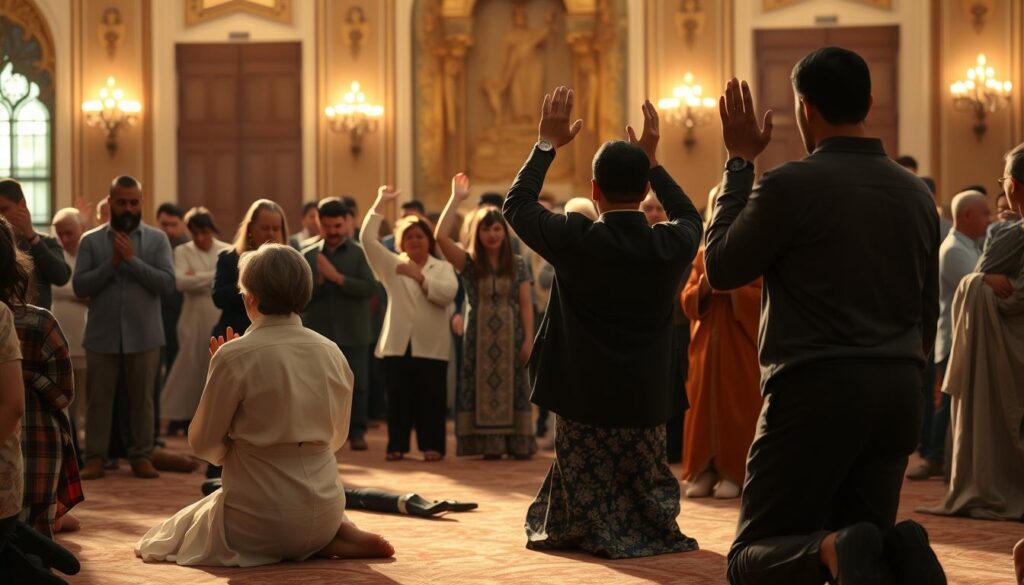
A solemn gathering of individuals in diverse worship postures - some kneeling reverently, others standing with hands raised in adoration. The scene is bathed in warm, soft lighting, creating an atmosphere of profound contemplation. In the background, ornate architectural elements suggest a sacred space, while the middle ground features a mix of traditional and contemporary attire, hinting at the cultural diversity of the participants. The overall composition conveys a sense of thoughtful discourse and respectful exchange of perspectives on the significance and appropriateness of various worship postures.

Modern Views Versus Traditional Practices

Some parishes have removed kneelers, calling the change a “refresh” for modern worshippers. Supporters argue it creates a welcoming environment for newcomers. One pastor notes, “We want our space to feel accessible, not intimidating.”

Critics see this as losing something vital. A liturgical scholar counters: “When we abandon physical expressions of reverence, we risk flattening spiritual experiences into mere intellectual exercises.” This tension shows how worship practices mirror society’s evolving values.

The Impact of Western Individualism

In the United States and similar cultures, self-expression often trumps communal traditions. Many now view acts of submission as outdated. As one commentator observes, “We’ve swapped humility for self-assertion in our search for authenticity.”

This shift creates practical challenges. Churches balancing tradition with modern expectations sometimes face divided congregations. The table below highlights key differences in approach:

Traditional Focus Modern Adaptation Community Impact
Preserved postures Flexible positions Cultural relevance debates
Emphasis on unity Personal comfort priority Generational divides
Historical continuity Contemporary interpretations Worship style variations

These differences aren’t just about physical posture. They reflect larger questions about how faith communities navigate change while honoring their roots. As debates continue, many seek middle ground that respects both tradition and personal spiritual journeys.

Practical Insights: How Catholics Kneel During Mass

Every movement in Catholic worship follows a sacred roadmap. The Roman Missal outlines specific moments when physical posture becomes a collective prayer. These guidelines help transform individual actions into a unified expression of faith.

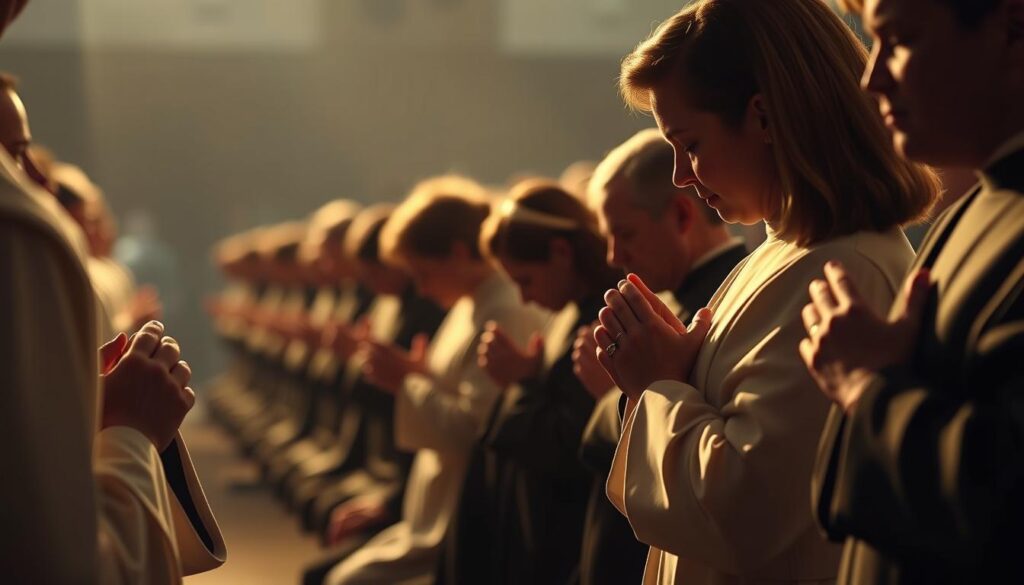
A solemn congregation of Catholic worshippers kneeling in reverence, their heads bowed in prayer. The scene is bathed in soft, warm lighting, casting a gentle glow on the devout faces and elegant folds of their robes. The foreground is a detailed close-up of hands clasped in devotion, while the middle ground showcases the orderly rows of kneeling figures, their silhouettes creating a mesmerizing pattern. The background blurs into a hazy, atmospheric setting, hinting at the grandeur of the sacred space. The overall mood is one of deep solemnity, evoking the timeless tradition of Catholic Mass.

Step-by-Step Look at Postures in the Mass

When entering the sanctuary, many touch one knee to the floor—a gesture honoring the tabernacle’s sacred contents. This brief act sets the tone for what’s to come. As the Eucharistic Prayer begins, congregations kneel together, creating waves of bowed heads during the “Holy, Holy, Holy” chant.

The consecration of bread wine marks the liturgy’s peak moment. Worshippers maintain their posture until the priest’s final “Amen”. One parishioner shares: “Kneeling helps my heart catch up with the mystery happening before my eyes.”

Comparing Practices Across Different Churches

Not all sanctuaries look alike. Some feature padded kneelers, while others use simple chairs. Urban churches with limited space might shorten kneeling periods, whereas traditional parishes often preserve full postures.

Local adaptations show how communities balance practicality with reverence. A Chicago priest explains: “We keep kneelers because they remind us this isn’t just another meeting—it’s holy ground.” These variations highlight the Church’s ability to maintain core meanings while adjusting forms.

Understanding these patterns turns routine motions into meaningful dialogue. Whether through ancient gestures or modern adaptations, each posture becomes a wordless prayer written in flesh and bone.

Conclusion

Sacred gestures create bridges between heaven and earth. In worship spaces across America, physical postures like standing or kneeling become silent prayers. These actions connect individuals to greater things, blending personal devotion with shared tradition.

Some find deep meaning in familiar rituals, while others seek new expressions of faith. Both approaches honor sacred moments through intentional presence. As one worshiper notes, “How we move shapes how we encounter the divine.”

Modern challenges remind communities that reverence takes many forms. Whether through traditional postures or contemporary adaptations, the heart’s posture matters most. These practices endure as invitations to engage fully with spiritual truths.

In a changing world, such gestures offer grounding. They transform ordinary spaces into places where people meet the extraordinary, one meaningful movement at a time.

FAQ

Why do some churches emphasize kneeling more than others?

Differences often stem from cultural traditions, local guidelines, or interpretations of the Roman Missal. For example, dioceses in the United States might prioritize standing during certain prayers, while others focus on kneeling as a sign of humility.

Is there a biblical basis for kneeling during prayer?

Yes! Passages like Philippians 2:10 highlight kneeling as an act of reverence. Early Christians also adopted this posture from Jewish customs, linking it to moments of awe before God’s presence.

How does posture affect spiritual focus during Mass?

Physical gestures—like standing for the Gospel or bowing before receiving Communion—help unite the body and mind in worship. These actions remind believers to engage their whole selves, not just their thoughts.

Why do some parishes encourage standing instead of kneeling after Communion?

This practice varies by region. In places like the United States, standing is seen as a communal expression of readiness to serve. It reflects unity while still honoring the sacredness of the moment.

What’s the purpose of genuflecting before entering a pew?

Genuflecting—a quick bend of the knee—acknowledges Jesus’ presence in the tabernacle. It’s a simple yet profound way to show respect before settling into prayer or reflection.

Are debates about posture a recent issue in the Church?

Not exactly. Discussions about worship styles have existed for centuries! However, modern conversations often explore how cultural shifts, like individualism, influence communal expressions of faith.

Can personal health needs override traditional postures?

Absolutely. The Church encourages adapting gestures for physical limitations. A heartfelt intention matters more than perfect form—prayer is about the heart’s posture, too!