Recent Posts

Catholicism Classes: Deepen Your Faith and Knowledge


Growing in your spiritual walk shouldn’t feel like a balancing act. Whether you’re a parent guiding children through sacraments or an adult seeking to reconnect with timeless truths, flexible online programs now make religious education accessible to everyone. Designed by clergy, educators, and everyday believers, these resources honor tradition while fitting modern lifestyles.

Imagine learning at your own pace—between work shifts, during naptime, or on weekends. This approach removes barriers for those in rural areas, caregivers, or professionals with packed calendars. No prior experience? No problem. Courses adapt to beginners and seasoned learners alike.

From First Communion prep to adult RCIA programs, the curriculum meets diverse needs. Parents gain tools to teach children confidently, while lifelong Catholics discover fresh perspectives on familiar teachings. Interactive materials blend Scripture, catechism, and real-life applications.

What sets these programs apart? They’re built on authentic Church doctrine but delivered through user-friendly technology. Video lessons, downloadable guides, and discussion forums create a supportive community. Parish leaders often recommend them as supplements to in-person instruction.

Key Takeaways

  • Online religious education adapts to busy schedules and remote learning needs
  • Created collaboratively by clergy and laypeople for doctrinal accuracy
  • Serves all ages—from sacramental prep to adult faith formation
  • Self-paced courses work on phones, tablets, or computers
  • Maintains traditional teachings while using modern teaching methods

Introduction to Our Catholic Education Services

Connecting with timeless teachings shouldn’t be confined by location or time. Our programs began with a simple question: How can we make faith formation as engaging as Sunday Mass yet as convenient as streaming your favorite show? The answer became a bridge between centuries-old traditions and today’s on-the-go lifestyles.

Who We Are and Our Mission

Founded by a team of priests, educators, and parents, we create accessible Catholic education that meets you where you are. Whether you’re a parish volunteer training new catechists or a grandparent explaining sacraments to grandchildren, our resources adapt to your role. Every lesson reflects official Church teachings, reviewed by diocesan experts to ensure clarity and accuracy.

The Importance of Faith-Based Learning

Consistent religious education strengthens both personal belief and community bonds. Studies show structured learning increases long-term engagement with spiritual practices by up to 40%. Our platform supports this growth through:

  • Video lessons that simplify complex doctrines
  • Downloadable discussion guides for family conversations
  • Self-paced modules that respect busy schedules

One parish director recently shared:

“This content has become our secret weapon for keeping families connected between Mass Sundays.”

From military families moving overseas to shift workers juggling irregular hours, we remove barriers sofaithcan flourish anywhere.

Course Offerings and Structured Lessons

Building faith requires structure, not just inspiration. Our programs blend organized learning with interactive tools to help you grow spiritually. Each course breaks complex teachings into bite-sized lessons that fit any schedule.
A grand cathedral's interior, sunlight streaming through stained glass windows, casting a warm glow on ornate wooden pews arranged in orderly rows. In the foreground, a teacher stands at a lectern, gesturing as they present to a small class of attentive students. On the walls, religious artwork and tapestries depict important Catholic teachings and symbols. The atmosphere is one of reverence, scholarship, and spiritual enlightenment, perfectly capturing the essence of a structured Catholic educational course.

Overview of Lesson Components

Every program contains six to eight modules, each packed with diverse learning materials. You’ll find:

Component Format Purpose
Core Instruction 30-minute videos Teach key concepts clearly
Professor Support Short Q&A videos Clarify tricky topics
Progress Checks Interactive quizzes Reinforce understanding
Deep Dives Saint writings & modern articles Connect teachings to life

Video Instruction, Quizzes, and Supplementary Resources

The video content keeps lessons engaging without overwhelming learners. Professors explain doctrines using everyday examples—like discussing forgiveness through family scenarios. After each session, short quizzes highlight what to review.

Need extra help? Office hour clips answer common questions. One teacher recently explained the Trinity using coffee analogies: “Three forms—beans, grounds, and brew—yet one essential nature.”

Subscribers get bonus materials from trusted sources like Formed.org and classic spiritual texts. Many classes include free companion books—just cover shipping. These physical resources pair perfectly with digital learning.

This step-by-step approach helps learners connect ideas across lessons. You’ll finish each course with practical ways to live your faith, not just facts to remember.

Flexible Learning for All Ages

Faith milestones arrive at different stages of life, and our programs meet learners exactly where they are. Whether guiding a child through their first Reconciliation or helping adults embrace Church teachings, we create pathways that honor each person’s spiritual journey.

Catering to Unique Learning Needs

Our age-specific classes simplify complex teachings through relatable methods:

  • Interactive storybooks for children approaching First Communion
  • Video discussions tackling teen questions about Confirmation
  • Adult modules exploring theological foundations

One parent recently shared: “My seventh grader finally understands why we pray—not just how!”

Sacramental Readiness Made Accessible

From baptism prep to Eucharist understanding, our preparation programs adapt to individual backgrounds. The RCIC process helps children new to faith build foundations through:

  • Weekly interactive lessons
  • Family discussion guides
  • Virtual parish connections

Those already baptized in other traditions find welcoming resources to bridge denominational differences. Our self-paced format lets military families and busy households manage multiple confirmation schedules without stress.

Every program maintains the sacredness of these life-changing moments while fitting modern realities. As one catechist notes:

“The online tools don’t replace community—they help families arrive prepared to fully participate.”

Enhancing Your Journey with catholicism classes

Modern life demands flexibility, even in spiritual growth. Families across America are discovering how tailored faith programs meet them exactly where they are—without compromising depth or tradition.

Real Success Stories and Testimonials

Cindy, a mother of four, shares: “These courses became our lifeline during soccer season. We explored Scripture during carpool waits and discussed sacraments over dinner.” Her family completed their faith education while managing multiple schedules.
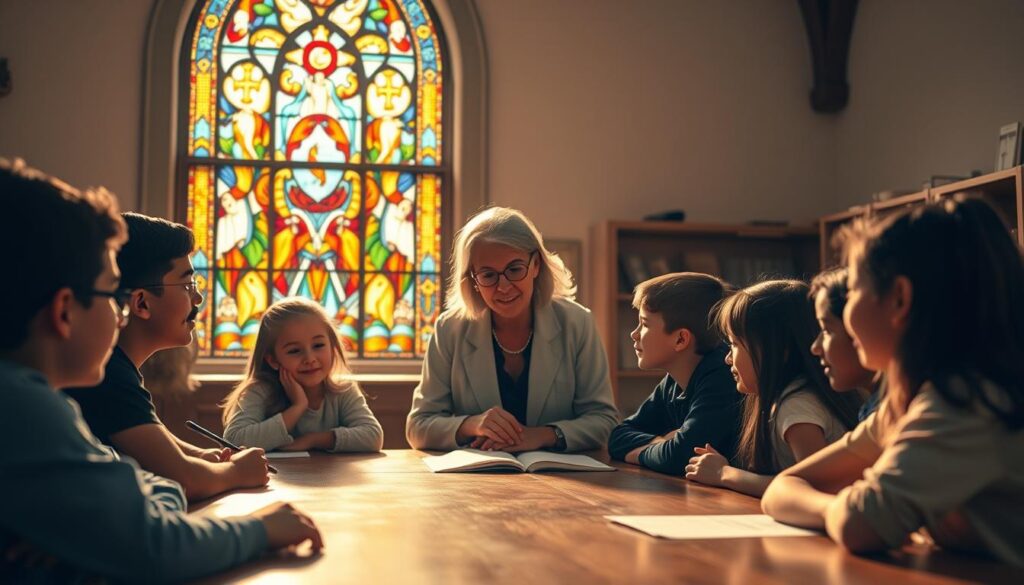
A serene Catholic school setting, bathed in warm, golden light. In the foreground, a group of students of diverse ages and backgrounds, engaged in lively discussion around a wooden table, their faces alight with curiosity and understanding. In the middle ground, a teacher, radiating wisdom and compassion, guides the students, encouraging their intellectual and spiritual growth. In the background, a stained-glass window casts a kaleidoscope of colors, symbolizing the rich tradition and transcendent beauty of the Catholic faith. The overall atmosphere conveys a sense of intellectual stimulation, community, and a deep connection to the enduring values of Catholicism.

“After our divorce, getting three boys to traditional classes felt impossible. This program made their Confirmation and First Communion achievable.”

The self-paced format allowed her teens to engage during weekends with their father.

Adapting to Modern Schedules

Karl compared his experience: “Unlike my childhood CCD classes, this course let me pause videos during busy work weeks. I finally grasped concepts that confused me for years.”

These programs thrive where rigid schedules fail:

  • Military families access materials during deployments
  • Shift workers study after midnight if needed
  • Grandparents guide grandchildren remotely

By blending timeless Catholic faith teachings with modern tech, learners find their perfect rhythm. As one parent noted: “Our kitchen table became the classroom—no rushing across town after work.”

Conclusion

Your spiritual journey deserves a foundation that grows with you. Our faith education programs bridge ancient wisdom and modern life, offering structured courses that adapt to soccer practices, work shifts, and family dinners. When military mom Teresa struggled with her son’s baptism preparation during deployment, our self-paced modules became their sacred meeting place across time zones.

These resources thrive through collaboration—parish leaders guide content creation while families shape delivery methods. “We finally found harmony between Sunday Mass and Tuesday night softball,” shares dad-of-three Marco. Whether deepening personal belief or preparing teens for sacraments, every lesson builds community connections.

Geographic barriers dissolve when quality Catholic faith instruction fits in your pocket. Grandparents mentor grandchildren through video chats. Shift workers study after midnight. Our approach proves timeless teachings flourish in nontraditional schedules.

Ready to reimagine spiritual growth? Explore how accessible education strengthens both individual journeys and collective understanding. Your next step toward lifelong faith development begins here—where tradition meets flexibility.

FAQ

How does faith-based learning differ from regular education?

Faith-based learning integrates spiritual growth with academic content, helping you connect teachings to daily life. Our programs emphasize community, sacraments like baptism or confirmation, and building a personal relationship with God.

Can adults join these courses, or are they only for children?

Our courses are designed for all ages! Whether you’re a teen preparing for confirmation, an adult deepening your Catholic faith, or a parent seeking baptism preparation for your child, we offer flexible options to fit your journey.

What resources are included in the structured lessons?

Lessons feature video instruction, quizzes to reinforce key concepts, and supplementary materials like prayer guides. These tools help you engage with content at your own pace while staying connected to parish life.

How do you accommodate busy schedules?

We prioritize flexibility! Courses are available online with on-demand access, allowing you to balance faith education with work, family, or other commitments. Live sessions are also recorded for later viewing.

Are there success stories from past participants?

Absolutely! Many share how courses strengthened their understanding of sacraments, brought clarity to their spiritual journey, or helped them feel more connected to their parish community. Testimonials highlight transformative experiences across all age groups.

What sacraments do your programs prepare individuals for?

We offer preparation for baptism, first communion, confirmation, and marriage. Each course blends theological teachings with practical guidance, ensuring you feel spiritually ready and informed.

Do I need prior knowledge of the Catholic faith to enroll?

Not at all! Our content welcomes everyone, from lifelong parish members to those new to the faith. Lessons start with foundational teachings and build from there, making them accessible and enriching.
Catholicism Explained: A Friendly Guide


Whether you grew up attending Mass every Sunday or are simply curious about one of the world’s oldest faiths, this guide is here to help. Many people have questions about Catholic teachings, traditions, and how they shape daily life. You’re not alone—and the doors of understanding are always open.

Some might wonder why rituals like Communion matter or how the Church views modern social issues. Others may have heard the phrase “Once a Catholic, always a Catholic” and want to know what that truly means. This journey isn’t just about facts—it’s about connecting with a spiritual heritage that has inspired art, shaped laws, and comforted billions.

No prior knowledge is needed here. We’ll explore everything from core beliefs to cultural influences in plain language. If you’re returning after years away or stepping into this world for the first time, consider this your welcome back—or your warm introduction.

Key Takeaways

  • Designed for both lifelong members and newcomers seeking clarity
  • Addresses common misunderstandings with compassion
  • Connects ancient traditions to their modern-day impact
  • Explains complex ideas using everyday language
  • Highlights the Church’s role as a spiritual home for all

Foundations of Catholic Belief and History

What makes the Catholic Church’s story unique? It begins with a bold claim: this global community of faith traces its roots to a single moment when Jesus told his disciple Peter, “You are the rock on which I will build my church.” This promise, recorded in Matthew’s Gospel, forms the bedrock of Catholic identity.

The Origins of the Catholic Church

Peter’s leadership didn’t end with his death. Catholics believe each pope inherits that same spiritual authority through apostolic succession—a chain linking every bishop back to the original twelve Apostles. Imagine a family tree stretching across 2,000 years, connecting modern parishes to those first gatherings in Jerusalem.

The early church faced Roman persecution, internal debates, and cultural shifts. Yet it grew from house churches to grand cathedrals. Key to this survival? Three pillars established by leaders like St. Irenaeus:

  • Scripture (the New Testament)
  • Oral teachings passed through generations
  • Regional centers led by apostolic successors

The Role of the Apostles and Peter

Peter wasn’t just the first pope—he was part of a team. The Apostles spread Jesus’ message across continents, planting seeds that became dioceses. Their successors still guide the church today, blending ancient tradition with modern challenges.

This living history explains why Catholic practices feel both timeless and adaptable. From Roman catacombs to streaming Masses, the core remains: a community built on that original rock.

Core Doctrines and Sacred Traditions

How does a global community spanning 2,000 years maintain unity in belief? The answer lies in two pillars: concise doctrinal statements and a living chain of spiritual wisdom.

A grand cathedral interior, illuminated by warm, soft lighting filtering through stained glass windows. In the foreground, an ornate altar with intricate carvings and a large, central crucifix. On the altar, a golden chalice and holy scriptures, symbolic of the Eucharist and the teachings of the Nicene Creed. In the middle ground, rows of wooden pews and kneeling worshippers, heads bowed in reverent contemplation. The background features towering stone columns, arched ceilings, and a sense of timeless, sacred grandeur, evoking the rich tradition and enduring faith of the Catholic Church.

Understanding the Nicene Creed

Recited weekly at Mass worldwide, this fourth-century statement remains Christianity’s most universal summary of faith. Let’s unpack its key declarations:

Phrase Meaning
“One God, the Father Almighty” Affirms monotheism
“Only Begotten Son… born of the Father” Jesus’ divine nature
“He rose again on the third day” Core resurrection belief
“One holy, catholic church” Universal community vision

As St. Athanasius noted: “The Creed is like a fence—it keeps error out and truth secure.” This ancient text grounds modern worship while allowing fresh insights.

The Significance of Sacred Tradition

Sacred Tradition isn’t about folklore or customs. It’s the authority to interpret Scripture, passed from Apostles to bishops through generations. Consider these distinctions:

  • Divine Origin: Rooted in Jesus’ direct teachings
  • Living Transmission: Adapts methods, not core truths
  • Scripture’s Partner: The New Testament itself emerged from Tradition

The Catholic Church views Tradition and Scripture as twin streams flowing from the same spring. As Vatican II taught: “Tradition hands on everything necessary for holy living.” This dynamic process ensures teachings remain consistent yet responsive to new questions.

catholicism explained: Exploring Key Teachings

At the heart of Catholic teaching lies a profound mystery: the belief that God became human to bridge heaven and earth. This truth shapes how followers understand their purpose, relationships, and ultimate destiny.

The Divine-Human Connection

Jesus Christ stands central as both fully divine and fully human—a concept called the Incarnation. Catholics see this dual nature as essential: His divinity confirms He’s the Son God promised, while His humanity allows Him to fully share our struggles. As St. Paul wrote, “In Him, all things hold together.”

His death and resurrection aren’t just historical events. They’re seen as the turning point in human history, offering salvation through faith and sacraments like Baptism. This gift isn’t earned but freely given—a cornerstone of Catholic spirituality.

Mary’s Unique Role in Faith

The Virgin Mary holds a special place as the only person besides Jesus called “full of grace” in Scripture. Catholics believe God prepared her from conception (Immaculate Conception) to bear the Savior without sin’s shadow. Her “yes” to becoming Christ’s mother models perfect trust.

Four key Marian beliefs shape devotion:

  • Perpetual Virginity: Mary remained a virgin before, during, and after Christ’s birth
  • Assumption: Taken body and soul into heaven after her earthly life
  • Intercession: Asks Jesus to aid those who seek her help
  • Honor vs. Worship: Veneration differs from adoration given to God alone

Prayers like the Rosary aren’t about repeating words. They’re tools to reflect on Jesus’ life while leaning on His mother’s guidance—like holding a spiritual compass in challenging times.

Insights into Sacraments and Church Practices

Sacraments act as spiritual milestones in Catholic life, marking key moments from birth to eternal life. These sacred rituals bridge divine grace and daily living, offering tangible ways to experience God’s presence. Let’s explore how these practices shape faith journeys.

A grand cathedral interior, illuminated by warm, soft lighting filtering through stained glass windows. In the foreground, a communion service unfolds - a priest elevating the Eucharist, communicants receiving the sacrament. To the side, a confessional booth stands, a symbol of the sacrament of reconciliation. The middle ground features ornate, carved wooden pews and intricate architectural details, while the background fades into a sense of reverence and contemplation. The scene conveys the solemnity and significance of the seven sacraments, particularly the Eucharist and reconciliation, central to Catholic faith and practice.

The Seven Sacraments and Their Meanings

Each sacrament serves a unique purpose:

  • Baptism: Washes away original sin, welcoming believers into the Church
  • Confirmation: Strengthens faith with the Holy Spirit’s gifts
  • Eucharist: Nourishes through Christ’s real presence in consecrated bread and wine
  • Reconciliation: Restores relationships through confession and forgiveness
  • Marriage: Unites couples with Christ-like commitment
  • Holy Orders: Sets apart clergy for sacred service
  • Anointing of the Sick: Brings comfort and healing in times of crisis

The Importance of the Eucharist and Reconciliation

The Eucharist stands as the “source and summit” of Catholic worship. During Mass, bread and wine become Christ’s body and blood through transubstantiation. As St. Augustine wrote: “What you see is the bread and the cup… but your faith sees much more.”

Reconciliation (or confession) offers a fresh start. Catholics believe Jesus empowered priests to forgive sins through His authority. This sacrament heals spiritual wounds and renews community bonds. As James 5:16 teaches: “Confess your sins to one another… that you may be healed.”

Sacrament Key Impact
Baptism Spiritual rebirth
Eucharist Divine nourishment
Reconciliation Moral renewal
Holy Orders Leadership consecration

Historical Influences and Social Teachings

How did a faith born in Roman persecution become a global force shaping art, law, and social justice? The answer lies in centuries of adaptation guided by timeless principles.

A dimly lit cathedral interior, stained glass windows casting kaleidoscopic patterns on ornate stone walls. In the foreground, a group of Catholic clergy in traditional robes, deep in discussion, their expressions solemn as they ponder the church's social teachings throughout history. In the middle ground, a large, intricately carved crucifix stands as a symbol of the faith's central focus on charity and justice. The background is shrouded in a warm, contemplative atmosphere, hinting at the rich tapestry of Catholic social thought that has influenced the world for centuries.

From Early Church to Medieval Influence

The early church transformed from underground gatherings to Europe’s spiritual backbone. When Emperor Constantine legalized Christianity in 313 AD, believers emerged from catacombs to build basilicas. Monasteries became hubs of learning, preserving ancient texts while advancing agriculture and medicine.

Key moments reshaped the church’s path:

Event Impact
Great Schism (1054) Split with Orthodox Christians over papal authority
Protestant Reformation (1517) Led to new Christian denominations
Council of Trent (1545-63) Strengthened Catholic identity through reforms

The Impact of the Second Vatican Council

The Second Vatican Council (1962-65) revolutionized modern Catholic life. Mass switched from Latin to local languages, making worship more accessible. The church acknowledged truth in other faiths while reaffirming its core teachings.

Three lasting changes emerged:

  • Laypeople gained active roles in liturgy and ministries
  • Interfaith dialogue replaced hostile debates
  • Social justice became central to mission work

From supporting labor rights to fighting climate change, Catholic social doctrine continues evolving. As Pope Francis notes: “A good Catholic meddles in politics, offering the best of themselves to help leaders serve.”

Distinctive Doctrines and Organizational Structure

Structure and compassion form twin pillars supporting the Catholic Church’s global mission. This unique blend of organization and outreach shapes how over a billion people experience their faith daily.

Clerical Hierarchy and Papal Authority

The Church’s leadership mirrors a spiritual family tree. At its apex stands the pope, seen as Peter’s successor and the chief teacher of faith. Cardinals and bishops support this vision, governing regions while preserving unity through apostolic succession.

Priests serve as local shepherds, ordained through sacramental authority passed down from the Apostles. Celibacy reflects Christ’s example of undivided devotion. The Roman Curia assists the papacy in matters like liturgy and doctrine, ensuring global coherence.

Catholic Social Teaching and Modern Challenges

Catholic social teaching applies ancient wisdom to today’s struggles. It champions human dignity in debates about poverty, immigration, and environmental care. These principles urge believers to see policy through a moral lens.

While holding firm on issues like marriage and life ethics, the Church adapts its methods. Outreach programs and interfaith partnerships demonstrate how timeless teaching meets 21st-century needs. As Pope Francis reminds us: “Real power is service—nothing else.”

FAQ

How did the Catholic Church begin?

The Catholic Church traces its roots to Jesus Christ, who appointed the apostles to spread His teachings. After Christ’s resurrection, the apostles established communities that grew into the Church. Saint Peter, recognized as the first pope, played a central role in unifying early believers.

Why is the Nicene Creed important?

The Nicene Creed summarizes core Christian beliefs, like the Trinity and Christ’s divinity. It was created in 325 AD to address misunderstandings about faith. Catholics recite it during Mass to affirm shared beliefs with other Christian churches.

What role does Virgin Mary play in Catholicism?

Mary is honored as the Mother of God for her “yes” to bearing Jesus. Catholics believe she intercedes for believers and remains a model of faith. While she’s not worshipped, devotion to her reflects deep respect for her unique relationship with Christ.

Why are sacraments like Baptism and Eucharist essential?

Sacraments are visible signs of God’s grace. Baptism cleanses original sin and initiates one into the Church. The Eucharist, celebrated at every Mass, allows Catholics to receive Christ’s body and blood, strengthening their spiritual life.

How did the Second Vatican Council change the Church?

Vatican II (1962–1965) modernized practices, like allowing Mass in local languages instead of Latin. It emphasized lay participation, interfaith dialogue, and social justice. Pope John XXIII and Pope Paul VI led efforts to make the Church more accessible.

What is the pope’s authority based on?

Catholics believe the pope inherits Saint Peter’s role as Christ’s earthly representative. This papal authority, called apostolic succession, ensures unity in teachings. The pope guides doctrine but works with bishops worldwide on pastoral decisions.

How does Catholic social teaching address modern issues?

It applies Gospel values to challenges like poverty, immigration, and climate change. Principles like human dignity and care for creation inspire action. Pope Francis’s encyclical Laudato Si’, for example, urges environmental responsibility.

What’s the purpose of Reconciliation?

Also called Confession, this sacrament offers forgiveness for sins through a priest’s absolution. Catholics examine their conscience, express sorrow, and commit to change. It’s seen as a healing encounter with God’s mercy.

Catholicism Website: Dive into the Depth of the Faith


Welcome to a space where timeless traditions meet modern spiritual exploration. Whether you’re new to the Church or looking to strengthen your connection, this platform offers tools to enrich your journey. Discover teachings that have guided generations while finding fresh perspectives for today’s challenges.

Our carefully designed hub connects you to historical roots and current practices. From Vatican updates to prayer guides, every resource is crafted to foster understanding. Engage with content that adapts to your learning style, whether through articles, videos, or interactive tools.

Millions globally share this spiritual path, and our platform reflects that diversity. Explore how different cultures express their devotion while staying united in core beliefs. Real stories from fellow seekers remind us that growth happens through both study and community.

Key Takeaways

  • Access a wealth of historical and modern spiritual resources
  • Find content tailored for all knowledge levels and backgrounds
  • Stay updated with global Church news and cultural practices
  • Enjoy an intuitive design that simplifies learning
  • Connect with a worldwide community of believers
  • Deepen prayer life through guided reflections

Exploring the Depth of Catholic Tradition

Uncover the living legacy of faith that spans millennia. The Catholic Church’s story stretches across continents and centuries, blending ancient wisdom with fresh perspectives. This journey reveals how core teachings remain steady while embracing new ways to connect with believers.

Historical Roots and Evolution

From humble beginnings in the Roman Empire to becoming a global force, the Church has navigated wars, reforms, and cultural shifts. Early Christians gathered in catacombs—today, over 1.3 billion people share sacraments worldwide. Key traditions like the Eucharist and baptism have united generations, even as local customs added unique flavors.

Celebrations of major anniversaries highlight pivotal moments. The 500th anniversary of the Reformation dialogue and 60th anniversary of Vatican II show how challenges spark growth. These milestones remind us that faith evolves without losing its essence.

Event Year Significance
Council of Nicaea 325 CE Established core doctrines
Vatican II 1962-1965 Modernized worship practices
St. Augustine’s Canonization 1298 Shaped theological thought

Modern Practices and Interpretations

Today’s believers balance ancient rituals with digital prayer apps and social justice initiatives. The rosary remains popular, while environmental stewardship becomes a new expression of care for creation. Young adults find meaning in adoration chapels and service trips alike.

Current debates about ethics show how 2,000-year-old teachings address AI ethics and bioethics. This living tradition doesn’t just survive—it thrives by answering real questions in every age.

Navigating Our catholicism website Features

Our platform simplifies access to sacred knowledge with smart design. Three-click navigation lets you jump between saints’ stories, feast days, and modern ethical guides. Whether you’re researching confirmation saints or prepping for Lent, everything stays organized.

A serene Catholic faith platform, bathed in warm, natural lighting and soft shadows. In the foreground, a simple yet elegant altar with a crucifix and candlesticks, conveying a sense of reverence and devotion. The middle ground features ornate, carved wooden pews, inviting worshippers to sit and reflect. In the background, stained glass windows cast a kaleidoscope of colored light, creating an atmosphere of tranquility and spiritual contemplation. The overall scene exudes a sense of timeless, sacred tradition, inspiring a deeper connection to the Catholic faith.

Got specific questions? The search bar acts like a digital librarian. Type keywords like “rosary origins” or “social justice teachings” for instant answers. Filter results by content type – articles, videos, or downloadable PDFs.

Connect globally through prayer forums and live chat groups. Share intentions or join virtual novenas with believers from Manila to Milwaukee. One user recently shared: “I found my parish’s mission partner here – it felt like divine timing.”

Feature Benefit Access
Search Tool Answers complex questions fast Top-right corner
Discussion Forums Build global connections Community tab
Mobile Design Study on-the-go Auto-adjusts screens

Never miss updates – our email alerts notify you about new Vatican documents or local retreats. Bookmark articles during morning coffee and share them later via social media. We’ve made spiritual growth as easy as checking your phone.

Your feedback shapes what we add next. Recent suggestions brought us the sacraments calendar widget and youth group resources. Together, we’re building a hub that grows with your journey.

Catholic Faith and Community Life

At the heart of every vibrant parish lies a tapestry of relationships that transcend Sunday services. These spiritual hubs become second homes where friendship blossoms over shared meals and collaborative service. A parishioner in Texas recently shared: “Our potluck dinners turned strangers into family – we now babysit each other’s kids and drive elders to doctor appointments.”

Building Spiritual Communities

The Catholic Church thrives through intentional connections. Parishes host neighborhood barbecues alongside Bible studies, creating spaces where people bond through both laughter and deep reflection. Youth groups pair confirmation candidates with senior prayer partners, bridging generational gaps.

Family life gets special attention through parenting workshops and marriage enrichment retreats. One Ohio parish offers “Faith & Playdates” where toddlers explore Bible stories while parents discuss relational spirituality. These initiatives mirror Christ’s example of meeting practical and spiritual needs simultaneously.

Seasonal traditions like Advent service projects and summer mission trips reinforce communal ties. “We rebuilt a hurricane-damaged home last summer,” recalls a Florida teen. “Hammers in hands, we learned more about God’s love than any textbook could teach.”

Small groups provide intimate settings for growth. Prayer circles and social justice teams allow members to share struggles and celebrate breakthroughs. This blend of ancient traditions and modern outreach creates communities where everyone – from cradle Catholics to curious visitors – finds belonging.

In-Depth Articles on Catholic Beliefs

Ever wondered how ancient teachings shape modern faith? Our library breaks down complex theology into bite-sized insights. Explore the Trinity’s mystery through art analysis or grasp Redemption’s promise using real-life stories. No PhD required – just curiosity.

A grand cathedral interior bathed in warm, golden light. Ornate stained glass windows cast kaleidoscopic patterns across the polished marble floors. Intricate carvings and statues of religious figures line the walls, their expressions serene and contemplative. In the center, a massive altar stands as the focal point, its ornate tabernacle and candlesticks gleaming. Kneeling worshippers pay reverent homage, their faces uplifted in quiet contemplation. The atmosphere is one of profound spirituality, inviting the viewer to explore the depth and richness of Catholic beliefs.

Seven sacraments come alive in articles pairing historical context with practical guidance. Learn why baptism isn’t just “holy water” but a lifelong identity. One reader shared: “The Eucharist explanation transformed my Sunday Mass experience – I finally get the symbolism!”

Modern ethical dilemmas meet timeless principles in our morality section. Articles address AI ethics using papal encyclicals and climate action through saintly examples. Discover how 4th-century wisdom informs debates about genetic engineering.

  • Side-by-side comparisons show Catholic-Protestant belief differences
  • Timelines trace Marian devotion from early Church to today
  • Infographics simplify Scripture-Tradition connections

Social justice pieces go beyond theory. Learn how parishes combat homelessness and why fair wages reflect divine justice. Young adults especially appreciate the “Faith in Action” guides linking prayer to community service.

Pilgrimage articles blend travel tips with spiritual prep. Walk Spain’s Camino routes virtually before booking flights. Whether you’re debating free will or prepping for confession, these resources meet you where you are.

Current Catholic News and Global Updates

Stay connected to the pulse of global faith movements through real-time updates that matter. Our team tracks official announcements and grassroots initiatives, helping you see how ancient wisdom meets modern challenges.

Breaking Developments from Rome

The Holy See recently shared Pope Leo’s heartfelt message to young pilgrims in Medjugorje: “Let your journey be a living prayer – feet moving toward hope, hands building peace.” This comes as Vatican officials announce new guidelines for digital evangelization, blending traditional teachings with social media outreach.

African bishops received special attention this week during closed-door meetings. Discussions focused on fostering deeper spiritual experiences through community-led worship. Vatican news outlets highlight growing partnerships between European and African dioceses addressing refugee crises.

Faith in Action Worldwide

US bishops issued a joint statement supporting climate change initiatives, quoting Laudato Si’: “Creation care isn’t optional – it’s our sacred duty.” Meanwhile, Filipino Catholics launched mobile confession booths reaching remote villages, proving innovation thrives in daily practice.

Key global updates include:

  • Canada’s first Indigenous-led parish council elections
  • New archaeological finds near St. Peter’s Basilica
  • Upcoming changes to Lenten fasting guidelines

Our analysis section breaks down complex policies into practical insights. Learn how the Pope’s latest encyclical impacts healthcare ethics, or why Brazilian bishops prioritize youth mentorship programs. Stay informed, stay inspired – one day at a time.

Spotlight on Young Catholics and the Journey of Faith

Young believers are redefining spiritual commitment through bold action and innovative expressions of devotion. Over 2 million young people attended last year’s Jubilee Youth events, proving ancient traditions resonate with digital natives. “Carry hope like your favorite playlist – let it shape your daily rhythm,” Pope Leo recently told pilgrims in Medjugorje.

A peaceful, sun-dappled churchyard, with a group of young Catholics gathered in contemplation. Soft light filters through the stained-glass windows, casting a warm glow on their faces as they sit in quiet reflection, their expressions serene and introspective. In the foreground, a young woman kneels, rosary beads in hand, her gaze uplifted, while her peers stand or sit nearby, each lost in their own spiritual journey. The backdrop is a majestic stone church, its Gothic architecture a testament to the enduring faith that binds this community. The scene evokes a sense of reverence, tradition, and the quiet power of shared belief.

Creative ministries meet Gen Z where they live. TikTok rosary challenges and eco-friendly votive candles show how youth blend tradition with modern tools. One Denver teen group raised $20k for clean water projects by streaming virtual prayer marathons – faith meeting crowdfunding.

Global gatherings forge unity across borders. World Youth Day preparations reveal:

Event Location Focus
2025 Jubilee Rome Mercy & Renewal
2024 Regional Nairobi Social Justice

Parish programs tackle real-world struggles. Boston’s youth ministry runs “Faith & Algorithms” workshops exploring AI ethics through Church teachings. Meanwhile, campus groups use meme culture to explain sacraments – confirmation prep meets viral content.

These efforts bear fruit. A recent survey shows 68% of young Catholics under 25 volunteer monthly. From leading food drives to designing prayer apps, their energy revitalizes communities. As one leader noted: “Our youth aren’t tomorrow’s Church – they’re building God’s kingdom today.”

Understanding Papal Influence and Leadership

Papal leadership has shaped global faith communities for centuries, blending spiritual guidance with cultural insight. Recent developments highlight how this enduring role addresses modern challenges while honoring tradition.

Modern Visionaries: Leo and Leo XIV

Pope Leo transformed global engagement through interfaith summits and climate action encyclicals. His 2024 address to the UN emphasized: “True peace grows when we see Earth as our shared sanctuary.” This approach reshaped how the Church interacts with secular governments.

Pope Leo XIV left a lasting mark through liturgical reforms. His 1990 document Sacred Rhythms simplified Mass structures while preserving sacred traditions. These changes helped congregations feel more connected to ancient rituals.

Leader Focus Legacy
Pope Leo Global Diplomacy Interfaith partnerships
Pope Leo XIV Worship Renewal Accessible liturgy
John Henry Newman Intellectual Bridge Faith-reason dialogue

Newman’s Enduring Wisdom

Last year’s declaration of John Henry Newman as a Doctor of the Church confirmed his timeless relevance. His writings on conscience help believers navigate ethical dilemmas in technology and bioethics. “To grow is to change,” he famously wrote – a principle guiding today’s faith discussions.

Newman’s journey from Anglican scholar to Catholic cardinal inspires converts worldwide. His educational philosophies still influence parish schools and university ministries. Young adults particularly resonate with his emphasis on personal spiritual discovery.

Interviews and Insights from Church Leaders

Church leaders share wisdom through candid conversations about modern challenges. Recent discussions with prominent bishops reveal how faith communities address complex issues while staying rooted in core values. These dialogues offer hope and practical guidance for believers navigating today’s spiritual landscape.

Discussions with Bishops and Key Figures

Mrs. Suzanne Healy, Chair of the National Review Board, recently spoke with Bishop James Johnston and Bishop Barry Knestout about safeguarding young people. Their exchange highlighted the Church’s ongoing work to create safer environments through updated policies and training programs. “Protection isn’t just rules—it’s loving accountability,” noted Bishop Johnston.

Bishop Knestout emphasized transparency as key to rebuilding trust. “Truth heals when we listen first,” he shared during the interview. Both leaders stressed collaboration between parishes and families to support vulnerable members.

These insights align with the Pope’s call for compassionate leadership. By learning from these bishops, believers gain tools to strengthen their communities. Such open dialogues remind us that faith grows through honest reflection and collective action.

FAQ

How can I stay updated on Vatican news and global Catholic events?

Our platform offers breaking news from the Holy See, including papal addresses, international perspectives, and analysis of key issues like peace, justice, and human trafficking. Check the “Current Catholic News” section for daily updates.

What resources are available for young Catholics exploring their faith?

The “Spotlight on Young Catholics” section shares stories of Jubilee Youth initiatives, missionary work, and reflections on topics like friendship and discernment. You’ll also find interviews with peers navigating faith in modern life.

Why is Pope Leo XIV mentioned alongside figures like John Henry Newman?

Both exemplify leadership and theological depth. Pope Leo XIV’s legacy includes advancing interfaith dialogue, while John Henry Newman’s writings on conscience and education remain pivotal. Explore their impacts in the “Papal Influence” section.

How does the Catholic Church address social issues like immigration today?

Bishops and leaders emphasize human dignity and service, guided by papal encyclicals and grassroots efforts. Our “Interviews with Church Leaders” section highlights practical responses and calls to action.

Are there guides for building stronger parish communities?

Yes! The “Community Life” section offers tools for spiritual growth, family devotion, and collaborative projects. Learn how to foster connections through prayer groups, charity work, and faith-based events.

What historical milestones shaped modern Catholic practices?

From early Church traditions to reforms by figures like Pope Leo XIII, our “Historical Roots” articles trace the evolution of sacraments, liturgy, and teachings on social justice. Dive into 2,000 years of rich heritage.

How can I participate in global Catholic initiatives or anniversaries?

Visit the “Global Updates” page for details on upcoming jubilees, missionary programs, and campaigns against human trafficking. Many events welcome volunteers or digital participation through prayer and advocacy.

Understanding the Main Beliefs of Catholicism


Welcome to a fresh look at one of Christianity’s oldest traditions. For nearly 2,000 years, the Roman Catholic tradition has shaped lives through its rich spiritual framework. At its heart lies a profound connection to Jesus Christ, viewed as both divine teacher and savior.

Central to this faith is the Bible, considered God’s inspired word without error. Followers turn to its teachings for moral direction, including timeless principles like the Ten Commandments. These guidelines help believers navigate life’s challenges while staying rooted in their spiritual identity.

Another key concept is original sin—a belief that everyone inherits a need for redemption. Through baptism, Catholics believe this spiritual burden is lifted, opening the door to salvation. This sacrament marks the beginning of a lifelong journey fueled by God’s freely given grace.

The idea of the Holy Trinity—one God as Father, Son, and Holy Spirit—adds depth to Catholic worship. This mystery underscores how divine love flows through creation, prayer, and community. Together, these elements form a tapestry of beliefs that continue to inspire millions worldwide.

Key Takeaways

  • Jesus Christ serves as the foundation of Catholic teachings and practices
  • The Bible is regarded as God’s perfect and authoritative word
  • Original sin creates a universal need for spiritual cleansing through baptism
  • The Holy Trinity defines God as three distinct persons in one divine being
  • Grace is seen as an unearned gift central to salvation and daily faith

Overview of Catholicism and Its Historical Context

Imagine a time when all Christians worshipped as one family. For nearly 1,000 years, followers of Jesus shared common practices under a unified church. This unity began fracturing in 1054 during the Great Schism, splitting Christianity into Eastern Orthodox and Roman Catholicism over debates about papal authority.

Roots in Early Christianity

The 16th century brought another seismic shift. Martin Luther’s protests sparked the Reformation, creating Protestant groups that questioned traditional teachings. These divisions reshaped the religious map of Europe and beyond.

Influence of the Second Vatican Council

Everything changed with the Second Vatican Council (1962-65). Leaders modernized worship practices and acknowledged truth in other faiths. “The Church recognizes that in other religions there exists a ray of that truth which enlightens all people,” declared Vatican II documents.

This groundbreaking period dropped the idea that only Catholics could achieve salvation. It opened dialogue with other Christians and faiths, creating today’s collaborative religious landscape. The Second Vatican reforms continue shaping how the church interacts with modern society.

Exploring Catholicism Main Beliefs

At the heart of Catholic practice lies a powerful statement of faith recited during baptisms. Parents and godparents affirm the Apostles’ Creed, a 2,000-year-old summary of essential teachings. This ancient text binds generations through shared spiritual truths.

a detailed digital painting of the Apostles' Creed, the foundational statement of Catholic beliefs, depicted as a large ornate stone carving or stained glass window against a somber, dimly lit cathedral interior. The carving is richly detailed, with intricate gothic tracery and symbolic imagery representing the key tenets of the creed, such as the Holy Trinity, the life of Christ, and the promise of eternal life. The lighting casts dramatic shadows, creating a solemn, reverent atmosphere befitting the weight and importance of the Catholic faith's core beliefs.

The Basis of the Catholic Creed

The Creed centers on Jesus Christ as both human and divine—the Son of God who walked among us. His incarnation represents God becoming flesh to heal humanity’s broken relationship with the divine. This radical love story forms Christianity’s bedrock.

Central to the text is the Holy Trinity—one God existing as three persons working in perfect harmony. Early Christians struggled to explain this mystery, yet it remains fundamental to worship and prayer practices today.

The Creed’s climax celebrates Christ’s death resurrection, seen as history’s turning point. Through this sacrifice, believers find hope for eternal life beyond earthly struggles. The text concludes with anticipation of Jesus’ return and final reconciliation.

This concise declaration shapes how Catholics understand their purpose and destiny. By repeating these words at baptisms, families commit to living out these truths across generations.

Understanding the Sacraments and Their Significance

Through visible signs, Catholics experience invisible grace daily. These sacred rites, called sacraments, act like spiritual bridges connecting believers to divine life. Church teachings identify seven formal practices established by Jesus Christ himself.

Baptism, Confirmation, and Eucharist

Baptism washes away original sin using water as its central sign. This initiation rite welcomes individuals into the faith community. Later, confirmation strengthens this bond through sacred oils and prayer.

The Eucharist stands as Christianity’s most cherished meal. Catholics believe ordinary bread and wine transform into Christ’s actual presence during Mass. This sacrament nourishes souls while uniting worshippers across generations.

The Role of Reconciliation and Holy Orders

When mistakes happen, reconciliation offers healing. Through confession, believers receive forgiveness and practical steps to rebuild relationships. This process mirrors Jesus’ instruction to “forgive seventy times seven.”

Holy orders set apart leaders through ancient rituals. Men receiving this sacrament become deacons, priests, or bishops—servants guiding others toward spiritual growth. Like all sacraments, its power flows from Christ’s promise, not human perfection.

These sacred acts work ex opere operato, meaning their effectiveness depends on divine action rather than personal worthiness. Together, they shape a rhythm of grace marking life’s key moments from birth to eternal rest.

The Doctrines, Traditions, and Authority of the Church

Picture a living library where ancient wisdom meets modern practice. The Catholic Church bases its doctrine on two pillars: biblical texts and centuries of sacred tradition. Together, these form a spiritual roadmap guiding 1.3 billion followers worldwide.

Interpretation of Sacred Scriptures and Apostolic Tradition

Church leaders teach that God’s revelation flows through both Scripture and Tradition. The Magisterium—the Pope and bishops—acts as guardian of these truths. This teaching authority ensures interpretations align with apostolic roots while addressing contemporary questions.

The Hierarchical Structure and Papal Authority

From Vatican corridors to neighborhood parishes, the Roman Catholic structure resembles an inverted pyramid. At its peak stands the Pope, viewed as Peter’s successor and Christ’s earthly representative. Cardinals and bishops extend this authority regionally, while priests directly serve local communities.

Celibacy requirements for clergy trace back to Jesus’ example and practical church history. Though debated, this discipline underscores a priest’s total commitment to spiritual service. Through this organized system, the Catholic Church maintains doctrinal unity while allowing cultural adaptations in worship styles.

Social Teaching and Moral Guidelines in Catholicism

Guiding both pews and policy debates, the Catholic Church believes every person deserves respect from womb to tomb. This conviction fuels its advocacy for fair labor practices, environmental care, and protection for vulnerable groups worldwide.

A grand cathedral's stained glass windows cast a warm, reverent glow over a gathering of parishioners engaged in thoughtful discussion. In the foreground, a group of diverse individuals - young and old, men and women - sit in a semicircle, their faces alight with compassion as they consider the principles of Catholic social teaching. The middle ground features a majestic altar adorned with symbols of faith, flanked by ornate columns supporting the vaulted ceiling. In the background, a sense of tranquility pervades, with sunlight streaming through the windows, illuminating the sacred space and the faithful's dedication to living out the church's moral guidelines.

Dignity of the Human Person and Social Justice

The church teaches that economic systems must serve people—not profits. It champions workers’ rights to living wages and safe conditions. Global trade reforms and debt relief for developing nations remain key priorities.

From soup kitchens to international summits, Catholics work to close gaps between rich and poor. “Every economic decision has moral consequences,” reminds one Vatican document. This principle shapes efforts to build a more just world.

Stances on Abortion, Contraception, and Sexual Morality

The church believes human life begins at conception, making abortion morally unacceptable. This stance connects to broader teachings about the sacredness of the human body and sexuality’s role in creating life.

Artificial contraception remains prohibited under 1968’s Humanae Vitae. Yet studies show over half of U.S. Catholics use birth control. This gap between teaching and practice sparks ongoing conversations about conscience and modern relationships.

While upholding traditional views, many American parishes now address these topics with more pastoral sensitivity. The church continues urging followers to see sexuality as a gift—not just a personal choice—within marriage’s lifelong commitment.

Contemporary Challenges and Evolving Practices

The Catholic Church stands at a crossroads in the 21st century, balancing ancient traditions with urgent modern questions. While maintaining its core teachings, the institution faces shifting demographics and pressing ethical concerns that shape its global mission.

A vibrant gathering of young Catholics in a sun-dappled church courtyard, engaged in lively discussions and activities. In the foreground, a group of teenagers animatedly conversing, their faces alight with enthusiasm. In the middle ground, a circle of children participating in a religious arts and crafts session, their hands skillfully molding clay figures. In the background, a towering gothic-style cathedral casts a warm, welcoming glow, its stained-glass windows reflecting the colors of the setting sun. The scene conveys a sense of community, faith, and the evolving role of the church in engaging younger generations.

Modern Adaptations and the Role of Catholic Youth

Pope Leo XIV recently electrified one million young believers by declaring: “You are the sign a different world is possible.” This rallying cry reflects efforts to empower younger generations through digital ministries and climate justice initiatives. Global membership trends reveal stark contrasts—vibrant growth in Africa and Asia contrasts with empty pews in Europe and North America.

Addressing Scandals and Declining Church Membership

The church confronts twin crises: a 75% drop in priests since 1970 and abuse scandals eroding public trust. Over 6,800 U.S. parishes now struggle to staff schools and hospitals once run by religious orders. Many facilities have transitioned to lay leadership or closed entirely.

Recent reforms include:

  • Strict background checks for clergy and volunteers
  • New transparency protocols in financial operations
  • Expanded roles for women in parish administration

While challenges persist, many congregations find hope in hybrid worship models blending online access with in-person rites. As one young activist notes: “Our faith isn’t about preserving the past—it’s about building God’s kingdom here and now.”

Conclusion

At the intersection of time and eternity, the Roman Catholic faith offers a vision embracing our deepest human questions. This tradition sees every person as both physical and spiritual—a sacred blend of body and soul meant to reflect divine love.

The concept of original sin acknowledges our shared struggle while pointing to hope. Through Jesus’ death and resurrection, believers find freedom from brokenness. This transformative act isn’t earned but given freely as grace, reshaping lives across generations.

Central to this worldview is the Holy Spirit, active in daily life and communal worship. The Trinity—Father, Son, and Spirit—reveals a God intimately involved in creation. This mystery fuels Catholic practices from private prayer to global justice efforts.

From ancient rituals to modern challenges, these teachings remain vibrant. They honor our tangible needs while nurturing eternal life’s promise. For millions, this rich tapestry of faith continues to inspire purpose, connection, and renewal in an ever-changing world.

FAQ

What are the core teachings of the Catholic faith?

Central teachings include belief in the Holy Trinity (Father, Son, Holy Spirit), the resurrection of Jesus Christ, and the authority of the Church. Catholics also emphasize sacraments like Baptism and Eucharist as pathways to grace and salvation.

How does the Second Vatican Council impact modern practices?

The Second Vatican Council (1962–1965) modernized traditions, such as allowing Mass in local languages instead of Latin. It promoted interfaith dialogue and emphasized the role of laypeople in Church life.

Why are sacraments like Baptism and Eucharist important?

Baptism cleanses original sin and initiates membership in the Church. The Eucharist, representing Christ’s body and blood, strengthens spiritual unity with God and the community during Mass.

What role does the Pope play in Catholic doctrine?

The Pope, as Bishop of Rome, is considered the successor of Saint Peter. He holds ultimate authority in matters of faith, morals, and Church governance, guided by apostolic tradition and scripture.

How does the Church address social justice issues?

Catholic social teaching prioritizes human dignity, care for the poor, and peace. It advocates for fair labor practices, immigration rights, and protection of life from conception to natural death.

What is the Catholic stance on controversial topics like abortion?

The Church opposes abortion, contraception, and euthanasia, viewing them as violations of human life. It teaches that sexuality should align with marriage and natural law principles.

How is the Bible interpreted within Catholicism?

Scripture is read through apostolic tradition and the Magisterium (teaching authority). The Church emphasizes context, historical analysis, and alignment with doctrines like the Nicene Creed.

Are Catholic practices evolving with modern culture?

While core beliefs remain unchanged, practices like youth outreach and digital ministries adapt to engage younger generations. The Church also addresses clergy scandals through transparency reforms.

What distinguishes Holy Orders from other sacraments?

Holy Orders ordains men as deacons, priests, or bishops, granting authority to lead worship and administer sacraments. It’s seen as a lifelong commitment to serve the Church’s spiritual needs.

Catholicism and the Rapture: What You Need to Know


Many Christians today encounter conflicting ideas about the end times. While some denominations emphasize a dramatic event where believers vanish before global turmoil, this concept isn’t part of traditional Catholic teaching. The rapture—a belief popularized through modern books and films—originated in 19th-century American Protestant circles and remains absent from 2,000 years of Church doctrine.

This guide clarifies why the Catholic Church maintains a different perspective. Unlike newer interpretations, Catholic eschatology focuses on Christ’s Second Coming as a unified event tied to final judgment and resurrection. You’ll learn how cultural influences like the “Left Behind” series have shaped public perceptions, even among some Catholic communities.

We’ll explore historical roots, scriptural interpretations, and common misunderstandings. By the end, you’ll understand how ancient traditions differ from recent theological developments and why dialogue about these topics matters for modern believers.

Key Takeaways

  • The rapture concept emerged in 1800s America and isn’t part of Catholic tradition
  • Catholic teachings emphasize Christ’s Second Coming, not a pre-tribulation event
  • Popular media has spread rapture ideas beyond Protestant circles
  • Church doctrine remains consistent with early Christian beliefs
  • Understanding these differences fosters respectful interfaith conversations

Foundations of Catholic Eschatology

How did early Christians envision humanity’s final chapter? For nearly two thousand years, the Church has approached this question through a unique blend of scriptural wisdom and sacred tradition. Unlike modern adaptations, its teachings remain anchored in ancient practices passed down through generations.

Historical Context and Doctrinal Roots

Before the 19th century, Christian groups shared a unified view about end-time events. They believed the faithful would face trials before Christ’s return—a period often called the “post-tribulational” perspective. This changed when 1800s thinkers proposed new timelines, creating divisions that still exist today.

The Church maintains teachings rooted in early Christian writings and councils. Figures like Augustine shaped its approach, emphasizing spiritual growth through challenges rather than escape from them. This belief system values continuity, linking modern practices to apostolic times.

Understanding End Times Through Church Tradition

Three pillars guide Catholic eschatology: Scripture, Tradition, and teaching authority. These elements work together to prevent abrupt doctrinal shifts. While some denominations revise interpretations, the Church prioritizes consistency across years of theological reflection.

This stability offers clarity amid changing cultural trends. By focusing on Christ’s singular return rather than multiple events, believers find meaning in earthly struggles. The emphasis remains on faithful endurance, not predicting timelines or avoiding hardship.

Perspectives on catholicism rapture

Many people find end-time teachings confusing due to conflicting modern interpretations. While the word “rapture” appears in popular culture, its usage differs significantly from traditional Christian teachings. Let’s clarify what actually appears in Church doctrine.

A grand cathedral's stained glass windows cast a warm, reverent glow upon a priest standing at the altar, his hands raised in a gesture of benediction. Celestial rays of light stream through the vaulted ceilings, illuminating the pious congregation below. In the foreground, an open Bible lies upon a lectern, its pages fluttering as if touched by unseen spiritual forces. The atmosphere is one of solemn contemplation, as the faithful ponder the mysteries of the rapture and Catholic teachings on the end times.

Defining the Concept Within Catholic Teaching

Catholics believe in a future gathering with Christ, rooted in 1 Thessalonians 4:17. This event coincides with Christ’s Second Coming, not a secret disappearance. The focus remains on resurrection hope rather than escaping hardship.

How the Term Differs From Catholic Beliefs

Though the word originates from the Latin Vulgate’s “rapiemur” (caught up), it’s rarely used officially. The Church teaches this coming unites believers in heaven through transformation, not evacuation. Ancient customs of greeting dignitaries inspire this view—believers meet Christ as He arrives, not vanish beforehand.

Aspect Protestant View Catholic View
Terminology Uses “rapture” frequently Prefers “Parousia” or “Second Coming”
Timing Often pre-tribulation Single event at world’s end
Focus Escape from trials Transformation through trials

This distinction helps maintain unity with early Christian belief. Instead of debating timelines, the emphasis stays on living faithfully amid life’s challenges.

Comparing Catholic and Protestant Views

Debates about humanity’s final days often reveal striking differences between Christian traditions. While some groups focus on escaping earthly struggles, others emphasize enduring them as part of spiritual growth. Let’s explore how scriptural interpretations shape these perspectives.

Key Biblical Passages in Debate

Matthew 24:29-31 clearly states: “Immediately after the tribulation… they will see the Son of Man coming on the clouds.” Catholics view this passage as definitive proof that Christ’s return follows global trials. Similarly, 2 Thessalonians 2:1-12 warns against believing in a premature second coming, urging vigilance instead.

Contrasting Pre-Tribulation and Post-Tribulation Interpretations

Many Protestant teachings suggest believers will vanish before the tribulation. Catholic doctrine rejects this, arguing Scripture never separates Christ’s return into multiple events. The table below highlights core differences:

Aspect Pre-Tribulation View Post-Tribulation View
Timing Before global crisis After final trials
Believers’ Role Removed from earth Present during challenges
Biblical Support Symbolic readings Direct Gospel quotes

The second coming in Catholic teaching isn’t an escape hatch—it’s the culmination of human history. This view encourages faithfulness amid adversity rather than anticipating early rescue. As cultures evolve, these distinctions remain vital for understanding Christian unity and diversity.

Scriptural Interpretations and Common Misconceptions

Biblical passages about humanity’s destiny often spark curiosity and confusion. Let’s unpack key texts that shape end-time discussions while addressing modern misunderstandings.

A serene, ethereal scene of the Rapture, captured in stunning detail. In the foreground, a group of believers stand in awestruck reverence, gazing upwards as they are lifted towards the heavens. Bathed in a soft, golden light, their faces express a profound sense of hope and tranquility. In the middle ground, wisps of cloud part to reveal the silhouette of the resurrected Christ, His outstretched arms beckoning the faithful. The background is a panorama of a vibrant, otherworldly sky, hues of pink and lavender swirling in an elegant dance. The overall atmosphere is one of profound spiritual wonder, a sublime moment of divine intervention captured in a single, breathtaking image.

Analysis of 1 Thessalonians 4:13-18

Paul’s description of believers being “caught up together in the clouds to meet the Lord in the air” draws from ancient customs. Important visitors were greeted outside cities—like when crowds welcomed Jesus during Palm Sunday. This meet the Lord imagery signifies escorting Christ to earth, not vanishing from it.

The phrase “Christ rise first” points to resurrection, not evacuation. Both living and deceased believers reunite through transformation at His Second Coming. Trumpet blasts and angelic voices in the passage emphasize this as a public event witnessed by all.

Contextual Readings from the Gospels

Jesus’ comparison of end times to Noah’s flood clarifies who gets “taken.” In Matthew 24:37-40, the taken individuals parallel those swept away by the flood—the unprepared. The faithful remain, just as Noah’s family survived in the ark.

This New Testament context reshapes popular rapture theories. Being “caught together” with Christ means joining Him as He establishes God’s kingdom on earth. It’s about active participation, not passive escape from challenges.

Contemporary Catholic Perspectives on End Times

How does the Catholic Church address modern questions about humanity’s ultimate destiny? Current teachings maintain a clear stance shaped by centuries of reflection. While pop culture often promotes dramatic end times scenarios, official doctrine focuses on hope rooted in resurrection.

A grand cathedral's interior, dimly lit by stained glass windows casting an ethereal glow. In the foreground, a solemn priest stands before a congregation, hands raised in a gesture of somber contemplation. Behind him, massive stone columns rise, supporting a vaulted ceiling adorned with intricate religious iconography. In the background, a massive mural depicts a dramatic scene of heavenly figures and apocalyptic imagery, hinting at Catholic end times teachings. The atmosphere is one of reverence, solemnity, and a sense of impending spiritual reckoning.

Modern Interpretations and Church Statements

The Catholic Church today firmly rejects theories about a future earthly millennium. As the Catechism states: “The kingdom will be fulfilled… beyond history through God’s final judgment” (CCC 676). This view contrasts with ideas of political or social utopias before Christ’s return.

Since 1944, Church authorities have cautioned against premillennial teachings. The Holy Office advised these ideas “cannot safely be taught” due to conflicts with core beliefs. Instead, Catholics focus on spiritual preparation for eternal life.

Perspective Premillennial View Catholic Teaching
Timing 1,000-year earthly reign Eternal kingdom after judgment
Focus Earthly transformation Heavenly fulfillment
Scriptural Approach Literal timelines Symbolic meanings

Modern leaders encourage believers to live faithfully rather than predict dates. As one bishop recently noted: “Our task isn’t decoding timelines but bearing witness through daily love.” This approach helps people find purpose amid life’s challenges.

The Church also addresses cultural influences from popular series and films. Parish programs often explain differences between entertainment plots and authentic doctrine. Through prayer and service, Catholics believe they prepare for Christ’s final coming while building God’s kingdom today.

Conclusion

The Church’s enduring teachings offer stability in speculative times. While some Christian groups anticipate dramatic escapes from hardship, Catholic tradition focuses on hope rooted in Christ’s return. This second coming isn’t a secret event—it’s the glorious climax where all creation meets its redeemer.

Believers across the world share one ultimate destiny: union with God through resurrection. Trials aren’t obstacles to avoid but opportunities to grow closer to Christ. As Scripture reminds us, “we shall always be with the Lord” (1 Thess 4:17)—not by fleeing earth, but through transformed existence.

For nearly two thousand years, this vision has guided faithful living. Instead of decoding timelines, Catholics prepare through prayer, service, and trust. Modern anxieties about the end times fade when grounded in ancient wisdom.

Whether chatting with neighbors or exploring personal questions, remember this: Christian faith thrives not in fear but joyful expectation. Let’s build bridges through shared hope, leaving division behind as we await the fullness of God’s promise.

FAQ

Does the Catholic Church teach about a “rapture” event?

No, the Catholic Church does not formally endorse the idea of a pre-tribulation “rapture” as some Protestant groups do. Instead, teachings focus on Christ’s second coming, resurrection of the dead, and final judgment, rooted in Scripture and Tradition.

How do Catholic beliefs about the end times differ from Protestant views?

Catholics emphasize a unified return of Christ for judgment and renewal, rather than a multi-phase event. The Church interprets passages like 1 Thessalonians 4:13-18 as symbolic of hope in resurrection, not a literal “snatching away” of believers before tribulation.

What role does the Book of Revelation play in Catholic eschatology?

Revelation is read liturgically and understood allegorically, highlighting God’s ultimate victory over evil. The Church avoids speculative timelines, focusing instead on living faithfully amid earthly struggles while awaiting Christ’s return.

Are there official Church documents addressing the end of the world?

The Catechism of the Catholic Church (paragraphs 668-682) outlines teachings on Christ’s return, resurrection, and judgment. Popes like St. John Paul II also emphasized preparedness through prayer and sacraments rather than fear-based predictions.

Do Catholics believe in a future “great tribulation”?

While Scripture mentions trials before Christ’s return, the Church teaches that suffering has always been part of human history. Trust in God’s providence—not fear of specific events—guides Catholic understanding of challenges before the final renewal.

How should Catholics approach popular “end times” theories today?

The Church encourages focus on spiritual readiness through repentance, charity, and sacramental life. Speculative theories often distract from Jesus’ call to “watch and pray,” as taught in Matthew 24:42-44.

What Does Catholicism Teach About Heaven?


Many wonder about life’s ultimate destination. The Catholic Church offers a timeless perspective on eternal joy rooted in scripture and sacred tradition. This guide explores core beliefs that shape one of Christianity’s most hopeful doctrines.

You’ll learn how official teachings differ from movie portrayals or casual assumptions. Unlike fleeting cultural ideas, Catholic doctrine describes heaven as perfect communion with God – not just clouds or harps. This vision comes from biblical foundations and thinkers like Aquinas, who called it the “beatific vision.”

We’ll break down what this means practically. Is heaven a physical space? What happens to our bodies? How do we prepare? These questions matter because they shape how we live today. The answers provide comfort while inviting deeper faith.

Key Takeaways

  • Heaven represents eternal union with God, not just a symbolic paradise
  • Official teachings emphasize the “beatific vision” – seeing God face-to-face
  • Concepts differ significantly from pop culture depictions
  • Scripture and theologians like Aquinas form the doctrine’s foundation
  • Bodily resurrection plays a key role in Catholic understanding
  • Preparation involves faith, sacraments, and living virtuously

Introduction: Exploring Catholicism’s Perspective on Heaven

Human hearts have always yearned for something beyond this world. The Church’s teachings answer this deep longing with clarity and hope. At its core, this vision transforms how believers view their purpose and daily choices.

Overview of Core Beliefs

Central to the faith is the idea that eternal joy comes from complete unity with God. As the Catechism states:

“Heaven is the ultimate end and fulfillment of the deepest human longings.”

This isn’t a distant reward but the fullness of salvation achieved through Christ’s sacrifice.

Believers hold that Jesus’ resurrection removed barriers between humanity and divine love. Earthly struggles gain meaning when seen as steps toward lasting peace. The promise isn’t about escaping life but fulfilling it.

The Significance of the Afterlife in Catholic Faith

Hope in eternity shapes how Catholics face suffering and celebrate sacraments. It turns ordinary moments into opportunities to grow closer to God. Moral decisions become pathways rather than obstacles.

This belief also comforts those grieving loved ones. Funerals focus on resurrection hope, not final goodbyes. Such perspectives influence prayers, worship songs, and even how families discuss death with children.

Ultimately, the Church’s teachings invite people to live with purpose. Every act of kindness or prayer becomes part of a larger story – one that doesn’t end at the grave.

Understanding the Beatific Vision and Union with God

At the core of eternal life lies a transformative encounter with the divine. This experience, called the beatific vision, reshapes how believers understand fulfillment. It’s not about floating on clouds but directly knowing God beyond earthly limits.

A serene, ethereal landscape bathed in soft, heavenly light. In the foreground, a figure kneels in reverent contemplation, their face radiant with a beatific expression as they gaze upwards. Shimmering rays of light emanate from above, illuminating the scene with a transcendent glow. In the middle ground, wisps of ethereal mist swirl, creating a sense of otherworldly mystery. The background features a vast, celestial expanse, hinting at the sublime wonder of the afterlife. The overall atmosphere is one of profound spiritual peace and the profound connection between the human soul and the divine.

Defining the Beatific Vision

The beatific vision means “seeing” God through spiritual understanding, not physical eyes. As the Catechism of the Catholic Church explains:

“This mystery of blessed communion with God… surpasses all understanding.”

Imagine grasping truths instantly that took years to learn on earth. Divine light lifts the mind to comprehend love’s source without barriers or confusion.

Experiencing an Intellectual and Spiritual Union

This union with God satisfies every longing. Joy flows from knowing Him completely – like finally solving a puzzle that once seemed impossible. Each person’s capacity grows through their earthly choices and openness to grace.

Think of it as friendship perfected. Where earthly relationships fade or disappoint, this connection deepens endlessly. Every moment brings fresh discoveries about goodness and beauty rooted in divine truth.

Biblical Foundations of Heaven

Ancient texts paint vivid pictures of divine promise. The Bible uses rich symbols to convey truths about eternal joy – ideas shaped by God’s revelation rather than human imagination. Let’s explore how scripture lays the groundwork for understanding life beyond earthly limits.

Scriptural References and Imagery

Key passages describe direct encounters with the divine. Revelation 22:4 states believers will “see his face,” while 1 Corinthians 13:12 contrasts our limited earthly perspective with future clarity. These texts use tangible metaphors:

Book Key Passage Symbolic Image Spiritual Meaning
Revelation 21:2 New Jerusalem God’s perfected community
John 14:2 Father’s house Eternal belonging
1 Corinthians 2:9 “Eye has not seen” Transcendent reality
Matthew 5:8 Pure heart Preparedness for vision

Jesus’ promise of prepared dwelling places (John 14:2) offers comfort. The “wedding feast” imagery illustrates celebration, while “paradise” suggests restored harmony. These symbols help us grasp what no ear has heard in full detail.

Interpreting Passages from Revelation and Corinthians

Revelation’s throne room scenes reveal worship as heaven’s heartbeat. Crystal rivers and golden streets symbolize God’s radiant purity. Paul’s letters emphasize growth – “now we know in part” but will soon understand completely.

The phrase “face to face” (1 Cor. 13:12) captures spiritual awakening. Like dawn breaking after night, believers gain perfect knowledge. This vision fulfills our deepest need to see God as source and purpose.

Scripture balances mystery with assurance. While symbols point to realities beyond words, they confirm one truth: eternal life means dwelling in light that never fades.

Church Teachings Versus Earthly Expectations

Modern imaginations often reshape eternal realities into familiar forms. While movies show paradise as endless leisure, faith offers a radically different vision – one that transforms how we understand fulfillment.

A tranquil heavenly realm, bathed in a warm, ethereal glow. In the foreground, fluffy white clouds part to reveal a serene, pastoral landscape, dotted with lush greenery and gently flowing streams. Amidst this idyllic scene, spectral angelic figures, their features obscured, hover and glide gracefully. The middle ground showcases a grand, ornate cathedral, its towering spires and intricate architecture a stark contrast to the natural setting. In the background, the sky gradually fades from a brilliant azure to a softer, hazy palette, hinting at the boundless expanse of the celestial realm. The overall atmosphere conveys a sense of tranquility, wonder, and the gap between earthly expectations and the true nature of the divine.

Traditional Depictions Versus Contemporary Views

Cardinal Ratzinger once challenged common ideas about the afterlife:

“Eternal picnics with docile lions reduce heaven to a improved Earth – this ignores humanity’s deepest spiritual hunger.”

In the United States, where material comfort shapes expectations, people might picture paradise as upgraded versions of vacations or entertainment. But Church teachings emphasize something beyond physical things.

Traditional art didn’t help. Paintings of harps and fluffy clouds suggested heavenly rewards resembled earthly luxuries. These images miss the core truth: eternal joy flows from perfect communion, not enhanced comforts.

Today’s culture struggles to grasp this. Social media feeds and streaming services condition us to seek constant novelty. How could any experience satisfy for eternity? The answer lies not in more, but in transformed understanding.

True fulfillment comes through divine connection that reshapes our very being. This promise meets deeper needs than any earthly pleasure ever could.

Catechism Insights on the Blessed Afterlife

What happens when we die? The Catechism of the Catholic Church answers this with clarity, drawing from 2,000 years of sacred tradition. Its teachings reveal a stunning truth: eternal life begins immediately for souls purified through God’s grace.

Papal Declarations and Apostolic Constitutions

In 1336, Pope Benedict XII settled centuries of debate through Benedictus Deus. This apostolic constitution declared:

“Souls of the saints see the divine essence face-to-face… even before resurrection day.”

This infallible teaching confirms purified souls join angels in perfect communion. No waiting. No delays. Just direct vision of God’s essence.

The Roman Catechism adds depth. While all experience divine joy, individual rewards reflect earthly choices. Think of it like sunlight – everyone feels warmth, but some bask in brighter rays based on their spiritual journey.

Three key truths emerge:

  • Death opens the door to immediate union for those in God’s friendship
  • Purification (here or in purgatory) prepares us for the beatific vision
  • Saints enjoy this reality now – no final judgment required

These teachings balance certainty with mystery. We know heaven’s essence – seeing God as He is. Yet its fullness remains beyond earthly comprehension, inviting wonder rather than simple explanations.

Catholicism Heaven: State or Place?

Where exactly is eternal joy found? Church teachings offer a nuanced answer that challenges common assumptions. While physical metaphors help us grasp spiritual realities, the core truth transcends maps and coordinates.

A vast, ethereal landscape depicting the contrast between the "state" and "place" concepts of Catholic heaven. In the foreground, a tranquil, luminous realm with serene figures and celestial architecture, representing the "state" of heaven. In the middle ground, a more defined, tangible landscape with gates, gardens, and a sense of physical presence, symbolizing the "place" of heaven. The background fades into an expansive, glowing sky, hinting at the transcendent, spiritual nature of the afterlife. Soft, diffused lighting creates an atmosphere of wonder and reverence, while a slight sense of depth and perspective draws the viewer into the scene. The image should convey the paradoxical nature of Catholic teachings on heaven as both a state of being and a physical destination.

The Heart of Divine Relationship

Catholic theology emphasizes state of being over geography. As Pope John Paul II clarified:

“This reality is neither abstraction nor cloud-bound realm, but vibrant relationship with the Trinity.”

Imagine friendship perfected beyond time and space. The blessed experience unbroken awareness of God’s presence – a transformative condition reshaping their entire existence.

Bodily Existence in Renewed Creation

While primarily spiritual, resurrection brings physical dimensions. Glorified bodies will interact in ways surpassing current limits. This location aspect reflects:

  • Humanity’s dual nature (spirit and matter)
  • Christ’s promise to renew creation
  • Capacity for meaningful connection with others

Think of it like sunlight – both energy (state) and rays touching surfaces (place). The Church’s balanced view honors our complexity while pointing toward mysteries words can’t fully capture.

The Four Bodily Gifts of Heaven

Resurrection brings more than spiritual renewal – it transforms our physical existence. Drawing from Thomas Aquinas and the Council of Trent, Church teachings describe four remarkable qualities awaiting glorified bodies. These gifts reveal how divine grace perfects human nature while preserving its essence.

Subtility and Agility Explained

Subtility lets the body obey the soul completely, like Jesus passing through walls after His resurrection. Matter becomes as responsive as thought. Agility removes physical limits – imagine visiting distant stars in an instant, your presence flowing where love directs.

Impassibility and Glory in the Blessed State

Impassibility means no pain, aging, or death. Bodies become unstoppable vessels of joy. Glory shines brightest – believers will radiate divine light “like the sun,” as seen in Christ’s Transfiguration. This brilliance reflects God’s perfection so intensely that earthly eyes couldn’t bear it.

Aquinas saw these gifts as natural extensions of beatific vision fulfillment. They show how resurrection transforms without erasing our humanity. As scripture promises: “What is sown in weakness is raised in power” (1 Cor. 15:43).

The Beatific Vision: Intellectual Illumination and Divine Love

True fulfillment lies not in what we possess but in how we are known. The beatific vision offers both dazzling clarity and tender intimacy – a reality where seeing God means being fully seen. Saints describe this encounter as truth and affection merged into one eternal moment.

This vision transforms human understanding. Like sunlight dissolving shadows, divine love reveals answers to questions we’ve carried for lifetimes. As 1 John 3:2 notes, “We shall be like Him, for we shall see Him as He is.” Knowledge becomes communion, and curiosity melts into awe.

Love fuels this transformation. The saints’ radiant joy flows from receiving – and reflecting – God’s boundless affection. Earthly relationships hint at this depth but fade like candles before dawn. Here, every soul becomes a mirror of divine beauty, perfected through grace.

For modern believers, the beatific vision reshapes priorities. Chasing temporary comforts loses its grip when eternal connection awaits. This promise meets our deepest need: to be known completely and loved relentlessly – not just in theory, but face-to-face.

FAQ

What is the Beatific Vision?

The Beatific Vision is the direct encounter with God’s essence, where believers experience profound joy through an intellectual and spiritual union. This teaching, rooted in Scripture and affirmed by St. Thomas Aquinas, emphasizes seeing God “face to face” (1 Corinthians 13:12).

How does the Bible describe eternal life?

Scripture uses metaphors like light, banquets, and a “new Jerusalem” (Revelation 21) to illustrate eternal life. St. Paul speaks of a glorified body in 1 Corinthians 15, highlighting resurrection and transformation beyond earthly limits.

Is heaven a physical place or a spiritual state?

Catholic teaching describes it as both a state of perfect union with God and a renewed creation. The Catechism notes that after the Final Judgment, the resurrected body will dwell in a cosmos freed from sin and suffering.

What are the Four Bodily Gifts of heaven?

These gifts—subtility, agility, impassibility, and glory—reflect the body’s transformation. For example, “agility” allows movement unrestricted by time or space, while “impassibility” means freedom from pain or decay.

How do saints experience divine love in heaven?

Saints are fully immersed in God’s love, which illuminates their intellects and fulfills their deepest desires. Pope Benedict XVI described this as a “firestorm of light” where every heart finds eternal peace.

Does the Church teach about rewards in the afterlife?

Yes. The Roman Catechism explains that souls purified by grace share in Christ’s victory. This includes participation in divine life, often symbolized as a wedding feast (Matthew 22:2) or a kingdom prepared since “the foundation of the world” (Matthew 25:34).

How does the resurrection of the body fit into Catholic belief?

The Nicene Creed affirms belief in bodily resurrection. At the end of time, all will rise in glorified forms, free from suffering, as Christ did—uniting soul and body in eternal harmony.

Are angels part of heaven’s reality?

Angels, as pure spirits, worship God and assist humanity. The Church teaches they join the saints in praising the Trinity, reflecting the communal joy of the blessed.