Recent Posts

Catholicism Founded: Exploring the Roots of the Faith


What transformed a small group of believers into the world’s largest Christian community? The story begins with early followers of Jesus in 1st-century Palestine. Their teachings spread across continents, blending spiritual ideals with cultural influences.

This faith tradition grew through centuries of change. Leaders shaped its practices, while political shifts influenced its structure. By the 4th century, it became central to Western civilization’s development.

Historical records show gradual growth rather than a single founding moment. Key events like the Council of Nicaea (325 CE) helped standardize beliefs. The papacy emerged as a unifying force during Rome’s decline.

Today, over 1.3 billion people identify with this global religion. Its teachings combine ancient traditions with modern interpretations. Understanding its origins helps explain its enduring impact on art, law, and society.

Key Takeaways

  • Origins trace back to Jesus’ teachings and early Christian communities
  • Developed organizational structure over several centuries
  • Major councils shaped core doctrines and practices
  • Cultural adaptation helped spread the faith globally
  • Maintains continuity with ancient traditions while evolving
  • Second-largest religious group worldwide after Islam

Understanding the Origins of Catholicism

The roots of the world’s largest Christian community stretch back to a transformative era in ancient history. Following Jesus Christ’s teachings, early believers formed tight-knit groups that prioritized shared meals and spiritual guidance. These gatherings laid the groundwork for organized worship practices still observed today.

From Followers to Faith Leaders

New Testament writings reveal how Jesus’ disciples evolved into church builders. Letters like Paul’s epistle to Rome show leaders addressing practical concerns – from meal disputes to leadership roles. By AD 100, bishops emerged as regional organizers, maintaining connections between scattered congregations.

Pillars of Early Belief

Three core elements defined these pioneering communities:

  • Communal meals evolving into Eucharist rituals
  • Oral traditions becoming written scriptures
  • Apostolic leadership chains creating continuity
Early Center Key Figure Contribution
Rome St. Peter Administrative hub development
Antioch St. Paul Outreach to non-Jewish populations
Alexandria St. Mark Theological education systems

Archaeological finds confirm active house churches in Roman cities by AD 50. These spaces hosted mixed groups – wealthy patrons and slaves sharing faith equally. Such radical inclusivity helped the church survive persecution and spread rapidly.

Exploring the Historical Timeline

Centuries of change shaped one of history’s most enduring institutions. Through persecution and political shifts, the church adapted while preserving its core identity. Let’s explore pivotal moments that defined its development.
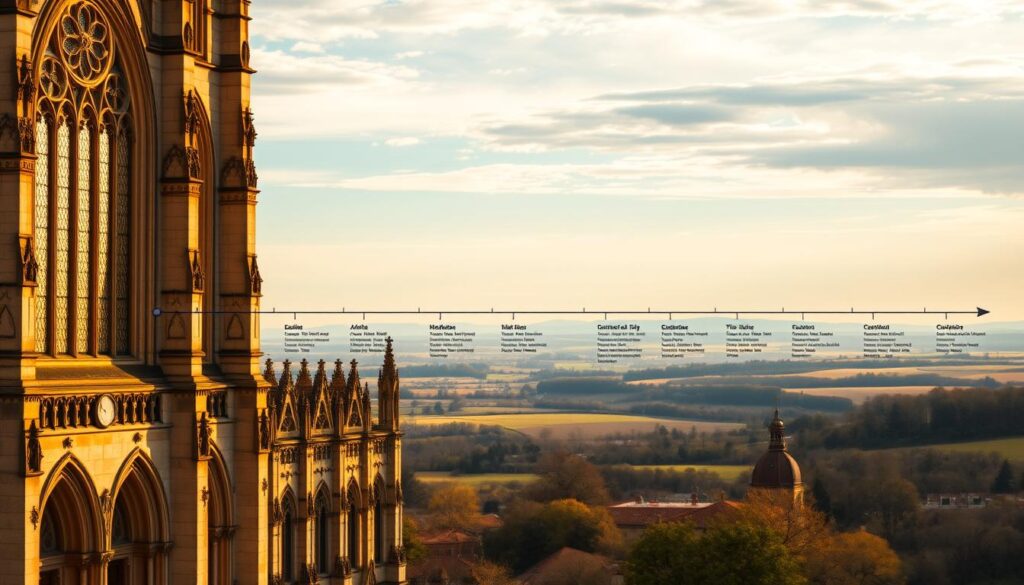
A majestic cathedral in the foreground, its grand Gothic architecture and stained glass windows bathed in warm, golden light. In the middle ground, a timeline unfurls, chronicling the key events and milestones in the history of Catholicism, from its founding to the present day. The background features a serene, expansive landscape, with rolling hills and a distant horizon, symbolizing the enduring legacy and global reach of the faith. The scene exudes a sense of reverence, history, and spiritual contemplation, perfectly capturing the essence of "Exploring the Historical Timeline" of Catholicism.

Key Milestones Across Centuries

The year 313 marked a turning point with the Edict of Milan. This agreement ended Christian persecution in Rome. Emperor Constantine’s support transformed underground communities into public institutions, though he delayed baptism until 337.

By 380, Emperor Theodosius made Christianity Rome’s official religion. This decision blended spiritual authority with political power. Church leaders gained influence over laws and education systems.

“The cross which had been a sign of shame became a symbol of triumph.”

Medieval times brought both unity and division. Monks preserved ancient texts while architects built soaring cathedrals. The 1054 split with Eastern Orthodox churches highlighted growing cultural differences.

Event Year Impact
Edict of Milan 313 Legalized Christian worship
Theodosian Decree 380 Established state religion
Great Schism 1054 Permanent east-west divide
Vatican II Council 1962-1965 Modernized practices

These historical facts show how challenges often spurred growth. From Reformation debates to 20th-century reforms, the church continues evolving while honoring ancient traditions.

How “catholicism founded” Developed Over Centuries

How did scattered congregations unite under a shared spiritual framework? Visionary thinkers and evolving structures transformed early Christian practices into a cohesive global community. This growth relied on intellectual rigor and organizational innovation.

Role of Early Church Fathers

Scholars like Irenaeus of Lyon shaped core beliefs through passionate debates. They defended teachings against competing ideas, establishing foundational concepts like Christ’s divine-human nature. Their writings became reference points during doctrinal crises.

Three methods solidified their impact:

  • Hosting councils to resolve theological disputes
  • Writing detailed explanations of complex beliefs
  • Training future leaders in emerging church centers

The Evolution of Church Authority

Leadership structures developed to maintain unity across regions. Irenaeus proposed a three-part system still used today:

Source Function Example
Scripture Guided moral decisions New Testament letters
Bishops Preserved apostolic teachings Roman episcopal line
Tradition Maintained ritual continuity Eucharist practices

This framework allowed local flexibility while preventing fragmentation. By 200 CE, major cities had bishop networks coordinating doctrine and discipline. Over time, Rome’s bishops gained prominence as final arbiters in disputes.

“Truth is the light of the soul, preserved through unbroken teaching.”

Canon law and liturgical standards emerged from these efforts. Leaders balanced ancient customs with new challenges, creating a system adaptable yet rooted in its origins.

The Influence of the Roman Catholic Church on Western Civilization

The Roman Catholic Church’s fingerprints appear across Western civilization’s most iconic achievements. Its teachings shaped laws, inspired artists, and guided communities through centuries of change. This enduring impact continues to influence modern life in surprising ways.
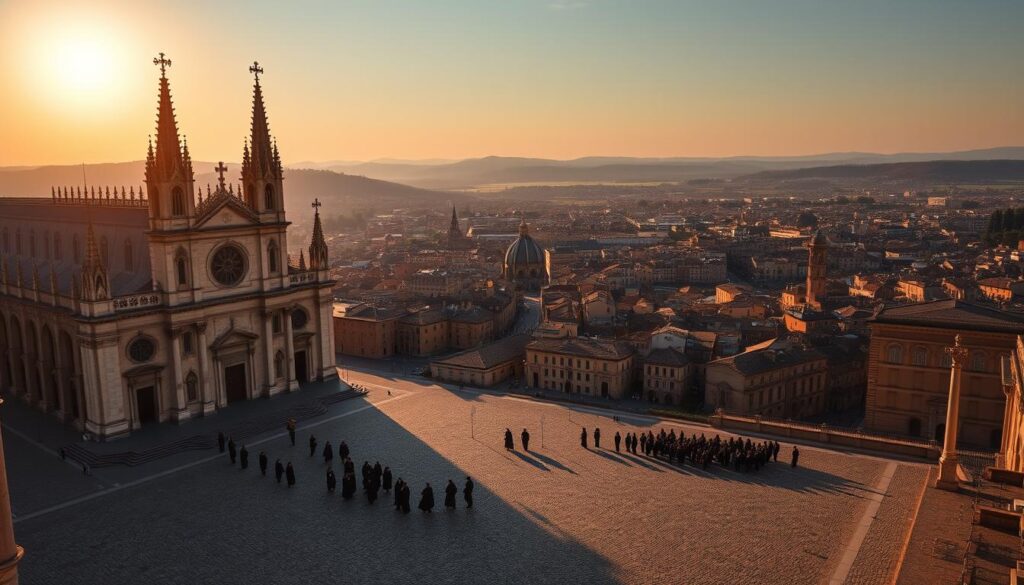
A grand cathedral stands in the foreground, its towering spires and ornate façade casting long shadows across a cobbled square. Ornate stained glass windows glimmer in the soft, golden light of a setting sun, while a procession of robed figures move solemnly along the square's perimeter. In the middle ground, a sprawling city of weathered stone buildings and winding streets stretches out, hinting at the church's far-reaching influence. The background is dominated by rolling hills and a distant horizon, suggesting the expansive reach of the Roman Catholic faith across the European landscape. The scene evokes a sense of timeless tradition, spiritual power, and the enduring legacy of the Catholic Church's impact on Western civilization.

Cultural and Social Impacts

Monasteries became knowledge hubs during Europe’s turbulent Middle Ages. Monks preserved ancient texts while creating new works on philosophy and science. These efforts kept learning alive when few could read or write.

The church established Europe’s first universities, setting the course for modern education. Schools like Paris’ Sorbonne taught critical thinking skills to generations of scholars. Their methods still shape classrooms today.

Social Contribution Historical Example Modern Legacy
Healthcare Systems Medieval hospital networks Nonprofit medical centers
Legal Principles Canon law courts Human rights frameworks
Community Support Monastic food banks Food pantry models

Legacy in Art and Architecture

Gothic cathedrals like Notre-Dame showcase the church’s architectural ambition. These stone marvels united entire communities through decades of construction. Their stained glass windows taught biblical stories to people through color and light.

Renaissance masters found both patrons and purpose in church projects. Michelangelo’s Sistine Chapel ceiling remains one of humanity’s greatest artworks. Such creations blended spiritual themes with technical innovation.

“Beauty leads us to the divine through the work of human hands.”

From Gregorian chants to Mozart’s masses, sacred music shaped Western musical traditions. These compositions still fill concert halls and inspire new generations of artists.

Key Figures in Catholic History

Throughout history, visionary leaders have shaped the Roman Catholic Church’s journey through times of growth and challenge. Their actions established patterns of leadership still visible today, blending spiritual authority with practical governance.

Charlemagne and St. Gregory the Great

St. Gregory the Great redefined the pope’s role during his 14-year leadership. He organized Rome’s first food distribution system during a famine and standardized liturgical music. His reforms created templates still used in Roman Catholic worship services.

Charlemagne partnered with Church leaders to unify Western Europe. Crowned emperor by Pope Leo III in 800 CE, he blended military power with religious mission. His support helped bishops establish schools and preserve ancient texts across his realm.

Other Influential Leaders

Early bishops like St. Clement of Rome maintained unity among scattered churches. Their letters settled disputes about leadership roles and worship practices. Three pioneers stand out:

  • St. Francis of Assisi: Revived spiritual passion through poverty-focused ministry
  • St. John XXIII: Modernized practices through Vatican II reforms
  • St. Ignatius of Antioch: Defined church hierarchy in persecution-era writings

These leaders balanced tradition with innovation. From managing crises to inspiring movements, their legacies prove how individual vision shapes institutional growth. Their stories remind us that faith communities thrive through dedicated stewardship.

The Role of Constantine and Early Church Controversies

A grand cathedral stands tall, its intricate Gothic architecture casting long shadows across the cobblestone streets. In the foreground, the imposing figure of Emperor Constantine gazes pensively, clad in robes of regal purple. Beside him, religious scholars debate animatedly, their gestures punctuating the air as they discuss the controversial doctrines that would shape the early foundations of the Catholic Church. The scene is bathed in a warm, golden light, evoking a sense of historical gravitas and the weight of momentous decisions. Towering stained-glass windows cast kaleidoscopic hues, reflecting the complex interplay of faith, power, and the birth of a lasting religious tradition.

Many myths surround Emperor Constantine’s relationship with the Roman Catholic Church. Contrary to popular belief, he never served as pope or established the religion. Historical records show Christian communities existed centuries before his reign.

Constantine’s 313 Edict of Milan changed everything. This decree ended persecution and allowed public worship. While not converting immediately, he saw value in unifying his empire through religious tolerance.

Three key facts clarify his actual role:

  • Baptized on his deathbed in 337 – 24 years after legalizing Christianity
  • Supported church projects but left doctrine to bishops
  • Funded buildings but didn’t control theological debates

The Council of Nicaea (325 CE) reveals how church authority operated independently. Constantine organized the meeting but didn’t dictate outcomes. Bishops resolved the Arian controversy by affirming Christ’s divinity through collective decision-making.

“The emperor provided the meeting hall, not the conclusions.”

Christianity became Rome’s state religion 55 years after Constantine’s death through Emperor Theodosius. This gradual shift shows how political support and spiritual growth developed separately. Understanding this history helps dispel modern misconceptions about the church’s origins.

From Acts to Apostolic Tradition

Early Christian writings and practices merged to create lasting spiritual frameworks. This blend of scripture and lived experience formed a bridge between diverse communities. Three elements proved vital: shared rituals, leadership networks, and adaptable teachings.

Scriptural Foundations in the New Testament

The Book of Acts shows believers organizing meals and choosing leaders. Paul’s letters to young churches addressed practical needs – from fundraisers to leadership disputes. These texts became guidebooks for maintaining unity across regions.

Key patterns emerged:

  • Baptism rituals marking spiritual commitment
  • Communal meals reinforcing social bonds
  • Letter exchanges solving doctrinal questions

Developing a Unified Tradition

Oral teachings gradually became standardized practices. Leaders preserved Jesus Christ’s message through repeated storytelling and symbolic actions. By 150 CE, most churches followed similar worship patterns despite local variations.

Four factors strengthened continuity:

  • Traveling teachers sharing best practices
  • Persecution creating urgent need for cohesion
  • Common Greek language enabling communication
  • Shared opposition to competing belief systems

This organic process created a resilient global community. Today’s church still draws strength from these early efforts to balance flexibility with core truths.

FAQ

How did the Roman Catholic Church begin?

The roots trace back to Jesus Christ and His apostles. Early followers spread teachings through communities, with the bishop of Rome gaining prominence as a unifying figure. This structure solidified over time through tradition and doctrinal clarity.

What role did Constantine play in Catholic history?

Constantine’s Edict of Milan (313 CE) ended Christian persecution. His support allowed the faith to grow publicly, shaping its institutional framework. However, theological debates like Arianism emerged during his reign.

How does apostolic tradition influence Catholic beliefs?

The Church views tradition as equal to Scripture in authority. Teachings passed down from the apostles—through writings, liturgy, and leadership—ensure continuity with Christ’s original message.

Why is the New Testament central to Catholic doctrine?

It documents Jesus’ life, teachings, and resurrection, forming the core of the faith. The Church interprets these texts through its episcopal authority, maintaining consistency across generations.

How did Charlemagne impact Western Christianity?

Charlemagne promoted education, liturgy, and Church reforms. His partnership with the papacy strengthened the Roman Catholic Church’s political and cultural influence in medieval Europe.

What controversies shaped early Church authority?

Disputes over Christ’s divinity, papal primacy, and jurisdictional claims led to councils like Nicaea. These events clarified doctrine and reinforced hierarchical structures under bishops.

How did Catholic teachings affect art and architecture?

Cathedrals, frescoes, and sculptures visualized biblical stories for worshippers. Gothic architecture, like Notre-Dame, symbolized theological ideals—light as divine truth, verticality as heavenly ascent.

What distinguishes Catholic views from other denominations?

Emphasis on sacraments, Marian devotion, and papal infallibility set it apart. The Church also integrates faith with reason, drawing from theologians like Augustine and Aquinas.
Catholicism’s Impact on Philippine Culture and Society


Over 500 years ago, Spanish colonizers arrived with crosses and cannons, forever changing Southeast Asia’s island communities. Today, this nation stands as Asia’s largest Christian stronghold, with 8 out of 10 residents practicing the faith brought by European missionaries. The fusion of imported beliefs and local traditions created a unique spiritual identity that defines daily life.

Early evangelization efforts transformed villages through religious art, fiesta celebrations, and reconstructed social structures. Missionaries established schools and hospitals alongside churches, creating lasting institutions that still serve communities. This spiritual framework became so deeply rooted that it survived revolutions, wars, and shifting political landscapes.

The church’s role evolved from colonial authority to social advocate, notably supporting pro-democracy movements in the 1980s. Modern challenges include balancing traditional values with progressive reforms, while maintaining relevance among younger generations. Religious festivals now blend centuries-old rituals with contemporary expressions of faith.

Key Takeaways

  • Spanish colonization established lasting religious institutions starting in 1521
  • 80% of citizens maintain Catholic affiliation today
  • Local traditions merged with Christian practices create unique festivals
  • Churches historically provided education and healthcare services
  • Religious leaders helped overthrow a dictatorship in 1986
  • Modernization tests traditional values in urban areas

Historical Foundations of Catholicism in the Philippines

Pope Alexander VI’s 1493 Inter Caetera decree authorized Spain’s religious expansion into Asian territories. This papal blessing paved the way for Ferdinand Magellan’s 1521 expedition, which arrived during Easter celebrations on an island called Mazaua. Chronicler Antonio Pigafetta documented the first Catholic mass there, attended by local leaders Rajah Colambu and Siaui.

Arrival of Spanish Missionaries and Early Conversions

The Augustinian friars became Spain’s frontline evangelizers, establishing their first official mission in 1564. Coastal communities like Cebu served as strategic bases for spreading Christian teachings. Missionaries learned local dialects to communicate core doctrines, though linguistic diversity across 7,000 islands complicated their efforts.

Establishment of the Encomienda System

Spain’s colonial government introduced a land management scheme requiring natives to pay tributes. In exchange, encomenderos promised military protection and religious instruction. This system helped fund church-building projects but often exploited local populations.

Early converts blended Christian rituals with ancestral practices, creating unique worship styles. Resistance emerged from Islamic communities in the south and animist groups in mountain regions. Despite challenges, the Augustinians laid groundwork for what would become Asia’s largest Christian population.

The Spanish Era: Transformation Through Faith

In 1565, a pivotal maritime journey reshaped spiritual landscapes across Southeast Asia. Miguel López de Legazpi’s expedition from Mexico established Cebu as Christianity’s gateway to the islands. This marked the start of a three-century period where faith became central to community building.

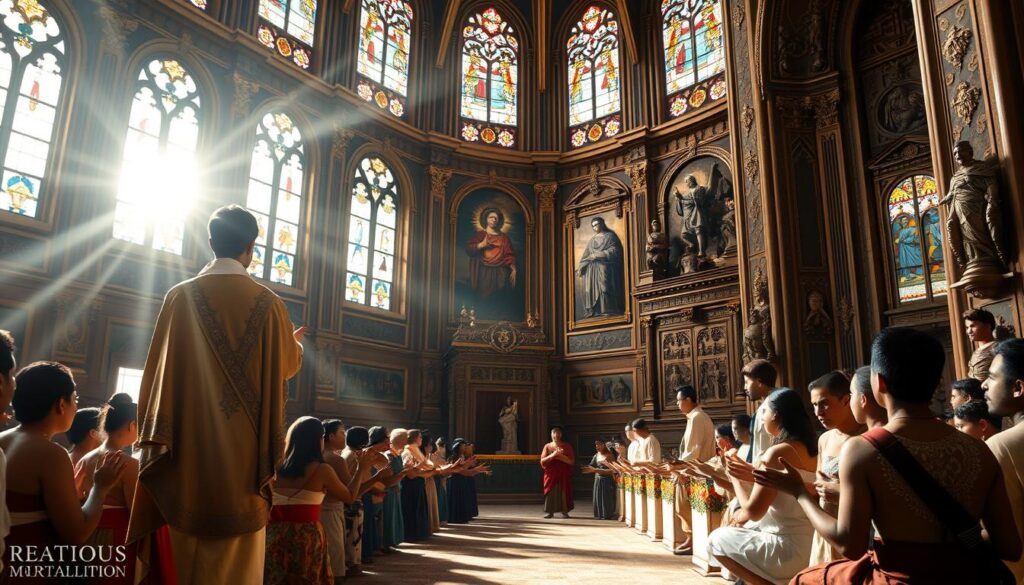
A grand cathedral interior, sunlight streaming through stained glass windows. In the foreground, Spanish missionaries in ornate robes stand before kneeling native Filipinos, hands outstretched in conversion. Intricate religious iconography adorns the walls, while indigenous symbols and motifs blend with Christian imagery. The scene conveys a sense of reverence and cultural transformation, as the light filters down to illuminate the profound moment of spiritual exchange. Realistic, cinematic, hyper-detailed.

Evangelization Strategies and Conversion Efforts

Religious orders adopted distinct approaches to spread their message. Franciscans focused on rural areas, while Dominicans concentrated on urban centers. Missionaries learned Visayan and Tagalog to teach doctrine through local stories and songs.

A clever tactic involved merging Christian symbols with familiar traditions. Anito spirit statues were replaced with saints, while harvest festivals became religious feasts. Noble families received special attention – converting leaders often meant entire villages followed.

Religious Order Arrival Year Key Region Unique Approach
Franciscans 1577 Luzon Agricultural mission schools
Jesuits 1581 Mindanao Interfaith dialogues
Dominicans 1587 Manila University education
Augustinian Recollects 1606 Visayas Coastal parish networks

These efforts faced challenges. Islamic communities in the south resisted conversion, while mountain tribes blended old practices with new rituals. Yet by the 17th century, the church had become the archipelago’s most stable institution, influencing 90% of the population.

Understanding catholicism in the philippines: A Historical Perspective

The Catholic Church here operates through a unique dual identity – tied to Rome’s authority yet shaped by local traditions. Its governing body, the Catholic Bishops’ Conference of the Philippines (CBCP), oversees 86 dioceses while respecting community-specific practices. This balance maintains unity with global beliefs while allowing cultural adaptations.

Three key developments transformed the church’s role:

  • Shift from state-sponsored religion to voluntary faith community
  • Integration of indigenous healing rituals into sacraments
  • Expansion beyond worship into education and social justice

Local parishes became community hubs where fiestas mix prayer processions with traditional dances. Families often maintain home altars beside images of saints, blending pre-colonial ancestor veneration with Christian devotion. These practices show how global beliefs took root through familiar cultural forms.

Level Institution Primary Role Example
National CBCP Policy-making Manila Archdiocese
Regional Ecclesiastical Provinces Regional Coordination Cebu Province
Local Parishes Community Services Barangay Chapels

This structure helps the Catholic Church remain a vital part of daily life. From organizing flood relief to mediating land disputes, religious leaders continue shaping society beyond Sunday masses. The fusion of imported traditions and homegrown customs created a faith experience unlike any other.

American Colonial Period: Reshaping Religious Practices

When U.S. forces raised their flag in 1898, they brought more than new leadership – they introduced ideas that would redefine spiritual life. This era saw faith transition from state mandate to personal choice, creating ripple effects still felt today.

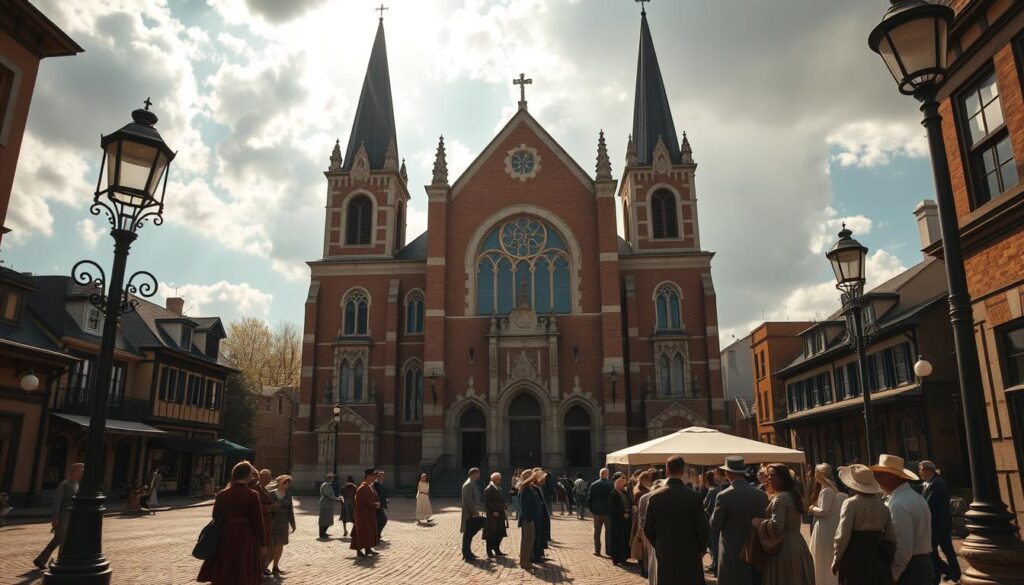
a grand colonial-era church, its spires reaching skyward, standing amidst a quaint town square with cobblestone paths and ornate lampposts. The building's facade features elegant arched windows and intricate stone carvings, conveying a sense of historical grandeur. Sunlight filters through the clouds, casting a warm, golden glow over the scene. In the foreground, a group of people in period-accurate clothing gather, engaged in lively discussion, hinting at the complex social dynamics of the era. The overall atmosphere suggests a time of transition, where the separation of church and state is emerging as a topic of discourse.

New Rules for Religion and Governance

American administrators rewrote the rulebook, declaring “no law respecting an establishment of religion” in the 1935 Constitution. This First Amendment-inspired policy stripped the church of its official status. Religious institutions suddenly operated in a marketplace of ideas.

The sudden departure of Spanish priests left communities scrambling. Only 1 in 10 clergy members were locals when the 20th century began. U.S. officials established seminaries to train Filipino leaders, paving the way for historic firsts like Bishop Jorge Barlin’s 1906 appointment.

“The church must stand separate but cooperative – a partner in progress, not a ruler.”

1902 Colonial Governance Report
Religious Shifts During American Rule
Group 1900 Presence 1941 Presence Key Contribution
Catholic 85% 76% Local clergy training
Protestant 0.5% 12% English-language schools
Independent 2% 8% Nationalist movements

Protestant groups seized the opportunity, building 300+ schools by 1920. Their medical missions and social programs offered alternatives to traditional institutions. This competition forced Catholic leaders to modernize their approach.

The government’s balanced approach created lasting change. By keeping faith out of lawbooks but welcoming its social role, they set patterns for modern spiritual diversity. Today’s vibrant mix of beliefs owes much to this transformative period.

Catholicism and Political Activism in the Philippines

Religious institutions shaped national politics during critical moments of social upheaval. The 1980s saw faith communities transform into powerful forces for democratic change, challenging authoritarian rule through organized resistance.

The People Power Revolution and Church Leadership

Cardinal Jaime Sin became the face of peaceful resistance during Ferdinand Marcos’s dictatorship. His historic radio broadcast in February 1986 urged citizens to protect rebel soldiers along EDSA highway. Millions responded, creating a human barrier that halted military tanks.

Church networks documented over 3,000 human rights violations during martial law. Religious orders sheltered activists while parishes distributed food to protesters. This moral authority united opposition groups across economic classes.

Key Figure Role Impact
Cardinal Sin Mobilized supporters 2 million gathered at EDSA
Nuns/Priests Documented abuses 1,200 case files submitted
Parish Councils Organized protests 85% of dioceses participated

The revolution’s success cemented religious leaders as political mediators. Cardinal Sin later helped stabilize Corazon Aquino’s presidency during coup attempts. His actions proved faith communities could drive social change without violence.

“We are not politicians, but we cannot ignore suffering.”

Cardinal Sin, 1986

This chapter shows how moral leadership can reshape nations. The EDSA uprising remains a global model for peaceful transitions of power.

The Church’s Role in Social and Community Development

For generations, faith-based organizations have shaped lives beyond Sunday services. Their work touches classrooms, hospitals, and village squares, creating networks that uplift millions.

A grand Catholic church stands tall, its ornate architecture and stained glass windows casting a warm, reverent glow. In the foreground, people of all ages gather for educational and community services, their faces alight with purpose and fellowship. The middle ground reveals a bustling healthcare clinic, its staff tending to the needs of the faithful. In the background, a lush, verdant landscape frames the scene, conveying a sense of harmony and connection between the church, its congregation, and the broader community. Soft, natural lighting illuminates the entire composition, creating a serene and inviting atmosphere.

Contributions to Education and Healthcare

Top schools like Ateneo de Manila and De La Salle train future leaders while serving all economic groups. These institutions blend academic rigor with values-based learning. Over 1,200 church-run schools operate nationwide.

Medical missions reach areas where clinics are scarce. Sisters of Charity hospitals treat 500,000 patients yearly. Their neonatal units save babies in regions with high infant mortality rates.

Institution Founded Specialty
University of Santo Tomas 1611 Law & Medicine
De La Salle University 1911 Business & Engineering
Ateneo de Manila 1859 Liberal Arts

Social Justice and Community Outreach Initiatives

Religious groups run 80% of orphanages and 65% of elder care homes. During typhoons, church volunteers often arrive first with food packs and rebuilding teams.

Recent projects focus on sustainable change:

  • Micro-loans for women-led businesses
  • Land rights workshops for farmers
  • Solar power installations in off-grid villages

“True service means walking beside people, not just handing out aid.”

Sister Maria Tan, Disaster Response Coordinator

These efforts show how spiritual mission meets practical needs. From classroom desks to rice fields, communities grow stronger through shared action.

Cultural Syncretism: Blending Indigenous Traditions with Catholic Beliefs

Centuries before European contact, vibrant spiritual systems thrived across the archipelago’s diverse communities. Islanders honored creator deities like Bathala in Luzon and Laon in the Visayas, while maintaining deep connections to ancestral spirits through rituals and nature worship.

Spanish missionaries cleverly wove these beliefs into Christian teachings. Saints became guardians of specific activities, mirroring pre-colonial nature spirits. Ancestral altars transformed into home shrines featuring holy figures, blending old practices with new traditions.

This fusion birthed unique celebrations unseen elsewhere. The Santo Niño festival mixes childlike divinity with harvest dances. Black Nazarene processions echo ancient healing rituals, drawing millions seeking miracles.

Family-centered spirituality remains central, reflecting pre-Christian values of community bonds. Today’s culture carries this rich legacy through village fiestas and urban processions that honor both imported doctrines and homegrown heritage.

The seamless blend explains why foreign faith took root deeply across the islands. Creative adaptation shaped a people’s identity while preserving essential spiritual connections to land and lineage.

FAQ

How did Spanish missionaries shape early religious practices?

Spanish missionaries arrived in the 16th century, blending Roman Catholic teachings with local customs. They used festivals, art, and native languages to spread their message, creating a foundation for widespread conversions during the colonial period.

What was the encomienda system’s role in spreading faith?

The encomienda system granted Spanish authorities control over land and labor. While it exploited indigenous communities, it also required settlers to protect and evangelize locals, linking colonial rule to religious conversion efforts.

How did the American colonial period change church-state relations?

After the United States took control in 1898, they introduced the separation of church and state. This reduced the Roman Catholic Church’s political power, allowing Protestant groups and public schools to grow, though bishops still influenced social issues.

What role did religious leaders play in the People Power Revolution?

Manila Cardinal Jaime Sin publicly supported the 1986 uprising against Ferdinand Marcos. Churches became safe havens, and clergy led nonviolent protests, showing the church’s commitment to social justice and democracy.

How does the Church support education and healthcare today?

Jesuit-run universities like Ateneo de Manila and institutions like Caritas provide education, healthcare, and disaster relief. These efforts reflect the Church’s focus on community development and human rights advocacy.

Are indigenous traditions still part of Catholic practices?

Yes! Festivals like Sinulog in Cebu City mix pre-colonial rituals with saints’ feast days. This cultural syncretism shows how Filipino spirituality adapts Catholic beliefs to local heritage.

Catholicism’s 7 Deadly Sins Explained


For centuries, spiritual traditions have guided believers in navigating right and wrong. One key framework helps identify behaviors that harm personal growth and connection to the divine. This system classifies moral missteps by their severity, offering clarity for those seeking to align their lives with sacred principles.

The Catholic Church distinguishes between two levels of wrongdoing. Minor errors, called venial sins, weaken spiritual bonds but don’t sever them. Grave violations, known as mortal sins, require intentionality and cause deeper separation from divine grace. Recognizing these differences helps believers prioritize their moral focus.

Historical roots of this teaching stretch back to early Christian thinkers. Monastic leaders in the 4th century began organizing harmful behaviors into categories. Over time, these evolved into the seven deadly sins we recognize today—pride, greed, wrath, envy, lust, gluttony, and sloth.

Why does this ancient system still matter? It serves as a mirror for self-reflection, revealing patterns that block spiritual progress. By understanding these concepts, modern followers gain tools for personal transformation. Let’s explore how this wisdom applies to daily life and strengthens one’s relationship with sacred values.

Key Takeaways

  • Christian teachings categorize wrongdoing based on spiritual impact
  • Mortal sins involve serious violations requiring conscious choice
  • Historical development spans Scripture and early church traditions
  • Seven core behaviors highlight recurring moral challenges
  • Self-awareness of these patterns supports spiritual growth
  • Practical applications help maintain healthy faith practices

Understanding Mortal and Venial Sins in Catholic Teachings

Catholic doctrine categorizes moral failures to aid in spiritual reflection. This system helps believers recognize how choices affect their connection to divine principles. Let’s break down the two types of wrongdoings and their implications.

Defining Mortal Sins and Their Consequences

Mortal sins represent the gravest violations in Christian ethics. Three conditions must align: serious wrongdoing, full awareness of its nature, and deliberate choice. Examples include murder or blasphemy—actions that sever one’s bond with divine grace.

Losing sanctifying grace means losing the spiritual vitality received during baptism. Without repentance through confession, teachings suggest eternal separation from God after death. This underscores why addressing such actions quickly matters.

Venial Sins: Lesser Offenses and Their Impact

Smaller missteps like gossip or minor dishonesty fall into the venial sin category. These weaken—but don’t destroy—one’s spiritual relationship. They often stem from habit or partial understanding rather than outright rebellion.

While less severe, venial wrongs still require attention. Prayer, charitable acts, or attending Mass can restore harmony without formal confession. The table below clarifies key differences:

Criteria Mortal Sin Venial Sin
Severity Grave matter Minor offense
Consent Full intention Partial awareness
Resolution Confession required Personal prayer suffices

Knowing this distinction helps believers prioritize their moral growth. It turns abstract concepts into practical tools for daily spiritual care.

Historical Evolution of the Seven Deadly Sins

Ancient theologians laid the groundwork for understanding human flaws systematically. Their work transformed vague spiritual concerns into clear moral guidelines. This process took centuries of reflection across different cultures and eras.

A majestic cathedral interior, dimly lit by stained glass windows. In the foreground, seven allegorical figures representing the seven deadly sins - Pride, Greed, Lust, Envy, Gluttony, Wrath, and Sloth - each depicted with vivid, symbolic imagery. The figures are positioned in a semicircle, casting long, dramatic shadows across the ornate stone floor. In the middle ground, a series of historical paintings and frescoes line the walls, depicting the evolution of these moral concepts throughout the ages. The background is shrouded in a sense of mystery and reverence, as if the viewer is witnessing a solemn, timeless ceremony.

Origins in Early Christian Thought

Tertullian of Carthage pioneered the concept of seven core moral dangers around 220 AD. His approach used the number seven to symbolize completeness in spiritual matters. After Christianity gained legal status in 313 AD, leaders focused on helping believers pursue holiness through structured teachings.

Evagrius Ponticus expanded this work in 399 AD with his book Praktikos. He identified eight destructive thoughts blocking divine connection:

Evagrius’ 8 Thoughts Gregory’s 7 Sins
Gluttony Gluttony
Lust
Greed Avarice (Greed)
Sadness Sloth
Wrath
Vainglory Pride
Pride Envy
Boasting

Influence of Church Fathers and Medieval Theology

Pope Gregory the Great reshaped these ideas in 590 AD. He merged similar concepts like vainglory into pride, creating the PEWSAGL list we know today. This system helped people navigate a three-step path:

  • Purgation: Overcoming basic wrongdoings
  • Illumination: Growing in spiritual understanding
  • Union: Achieving deeper divine connection

Gregory’s work became the foundation for moral teaching across medieval Europe. His seven deadly sins offered believers a clear roadmap for spiritual growth that remains relevant 14 centuries later.

Exploring “catholicism sins” and Their Significance

Moral choices shape spiritual journeys like weather patterns shape landscapes. The Catholic perspective sees wrongdoings as both barriers and growth opportunities. This understanding transforms daily decisions into moments of divine connection.

Daily Choices and Divine Connection

Every action either strengthens or weakens one’s spiritual bond. Believers face constant tests—from workplace ethics to family interactions. Regular self-reflection helps identify patterns needing improvement.

Sanctifying grace acts as spiritual oxygen for Catholics. Losing it through serious wrongdoings creates immediate urgency for restoration. Smaller missteps still require attention, like tending a garden daily.

Aspect Personal Impact Communal Impact
Prayer Life Deepens honesty with God Strengthens group worship
Moral Decisions Builds conscience clarity Models faith values
Sacraments Restores divine connection Maintains church unity

Community relationships thrive when members pursue holiness together. Gossip or dishonesty erodes trust, while forgiveness repairs bonds. Social justice efforts grow from addressing both personal and systemic wrongs.

The path forward combines self-awareness with mercy. As one theologian noted, “Recognizing flaws makes room for grace to work.” This balance keeps faith vibrant and relevant in modern life.

A Closer Look at Each of the Deadly Sins

Human struggles with moral failings reveal fascinating patterns when examined individually. The seven deadly sins form a spectrum—from self-focused arrogance to misguided desires for connection. Let’s explore how these behaviors disrupt harmony with divine principles and human relationships.

A detailed, cinematic scene of the seven deadly sins embodied in symbolic forms. In the foreground, seven distinct figures - each representing one of the sins - stand in a dramatic pose, illuminated by warm, dramatic lighting that casts deep shadows. In the middle ground, a vast, ornate cathedral-like structure looms, its gothic architecture and stained glass windows casting an air of religious grandeur. The background is shrouded in a moody, atmospheric haze, adding depth and a sense of mystery. The overall composition conveys a sense of weight, temptation, and the eternal struggle between good and evil.

Pride, Wrath, and Envy: The Internal Struggles

Pride tops the list as the most destructive failure. Thomas Aquinas described four dangerous forms: pretending to virtues we lack, crediting ourselves for divine gifts, demanding special treatment, or hoarding blessings meant to share. As one theologian noted, “Pride builds walls where love should build bridges.”

Wrath carries a strange paradox. While harmful, anger shows people still care about relationships. Envy poisons joy in others’ success—it whispers that life’s blessings were unfairly divided. These “cold sins” freeze hearts against genuine connection.

Sloth, Avarice, Gluttony, and Lust: External Practices

Material-world missteps often begin as natural desires gone wrong. Lust, though considered least severe, still warps healthy human bonds. It reaches for intimacy but grasps emptiness instead. Gluttony and greed misuse resources meant for sharing, while sloth neglects life’s sacred responsibilities.

These “warm sins” share a common thread—they engage the world but lack balance. Avarice clings too tightly, gluttony consumes mindlessly, and sloth avoids necessary effort. Each distorts our role as stewards of creation and community.

Real-Life Reflections and Contemporary Interpretations

Modern life creates moral puzzles our ancestors never imagined. Smartphones buzz with temptations, while cultural shifts challenge traditional boundaries. How do timeless teachings about wrongdoing apply to dating apps, crypto trading, or bioengineering?

Modern Controversies and Interpretations in the Church

Many believers struggle with teachings on mortal sins like contraception. Surveys show 76% of U.S. Catholics consider birth control acceptable, despite official prohibitions. Some priests now emphasize personal conscience over strict rules, creating confusion.

Digital life reshapes classic struggles. Scrolling through Instagram feeds can fuel envy faster than medieval villagers comparing crop yields. A 2022 study found social media users experience comparison guilt 43% more frequently than offline interactions.

New forms of sloth emerge too. Endless streaming replaces physical laziness, while spiritual neglect hides behind “too busy” excuses. As one youth minister noted: “We’ve swapped haystacks for hashtags, but the heart issues remain.”

Church leaders debate how to address these shifts. While some advocate updating language around sin, others stress preserving core principles. The challenge? Helping people apply ancient wisdom to modern problems without diluting truth.

The Role of Confession and Sanctifying Grace

In moments of moral failure, a sacred process offers believers a chance to reset their spiritual compass. This restorative practice combines human honesty with divine mercy, creating pathways for renewal even after grave mistakes.

A serene Catholic church interior bathed in warm, diffused lighting. At the center, a kneeling penitent earnestly confessing their sins to a priest, whose face is filled with compassion and grace. Behind them, stained glass windows cast kaleidoscopic patterns on the polished floors. Intricate stone arches and wooden pews create a sense of grandeur and solemnity. The air is thick with the scent of incense, adding to the reverent atmosphere. A soft, golden glow emanates from the altar, symbolizing the transformative power of divine forgiveness and the sanctifying grace of the sacrament.

Understanding the Sacrament of Confession

Confession acts as a spiritual reset button grounded in Jesus’ words: “Receive the Holy Spirit. If you forgive anyone’s sins, they are forgiven” (John 20:22-23). Priests serve as channels for this forgiveness, offering absolution that restores what mortal sin destroys. A complete confession leaves believers “as clean and as strong as a baby on the day of its baptism,” according to traditional teachings.

The process requires three steps: heartfelt sorrow, truthful admission of wrongs, and commitment to change. This isn’t about shame—it’s about reclaiming one’s spiritual identity through Christ’s sacrifice.

How Grace Restores the Relationship with God

Sanctifying grace functions like divine DNA, enabling people to share in God’s life. When serious wrongdoings sever this connection, confession rebuilds it using merits from Jesus’ crucifixion. Think of it as supernatural CPR—administered through priestly authority—that jumpstarts the soul.

Regular practice strengthens spiritual resilience. Even minor missteps addressed in confession deepen humility and sharpen moral clarity. As one believer shared: “Every honest confession feels like sunlight breaking through storm clouds.”

Common Misconceptions and Clarifications About Sin

Misunderstandings about moral failures often cloud spiritual growth. Let’s clear up confusion by examining widespread myths through the lens of church teachings.

Truths Behind the Confusion

Many assume all wrongdoings hold equal weight. Yet Jesus himself noted varying severity in moral failures (John 19:11). The Church’s distinction between mortal sin and venial offenses reflects this truth—not every act carries identical consequences.

A dangerous myth claims ignorance always excuses wrong choices. Church doctrine clarifies that willful neglect of moral truth increases responsibility. The Catechism states: “Ignorance can often be imputed to personal responsibility” (CCC 1791).

Contrary to popular belief, grave matters aren’t limited to extreme acts. Common behaviors like gossip or dishonesty can become mortal sins if done intentionally with full knowledge. While no official list exists, Scripture and tradition identify patterns harming divine connection.

Understanding these clarifications helps believers avoid spiritual pitfalls. It transforms abstract fears into practical wisdom for daily faith journeys.

FAQ

What’s the difference between mortal and venial sins?

Mortal sins sever your relationship with God through grave acts committed with full intent, like murder or adultery. Venial sins harm spiritual growth but don’t break that bond, such as gossip or minor dishonesty. Both require repentance, but mortal sins demand confession.

How do the seven deadly sins affect daily life?

Pride, envy, wrath, sloth, greed, gluttony, and lust distort virtues into vices. For example, pride can lead to arrogance, while greed fuels materialism. Recognizing these helps Catholics align choices with humility, charity, and self-control through prayer and sacraments.

Why is confession important for overcoming sin?

The sacrament of confession offers forgiveness and grace to heal the soul. By admitting faults, Catholics take responsibility, receive guidance, and renew their commitment to holiness. It’s a path to restore unity with God and the Church community.

Are all sins considered equally evil?

No. The Church teaches that sins vary in gravity. Mortal sins destroy divine love and lead to eternal separation if unrepented. Venial sins weaken faith but don’t cut off grace. Both require amendment, yet only mortal sins necessitate sacramental absolution.

How did the seven deadly sins develop historically?

Early Christian thinkers like Evagrius Ponticus listed eight “evil thoughts,” later refined by St. Gregory the Great into seven. Medieval theologians, including Thomas Aquinas, linked them to virtues, shaping Catholic moral teaching on combating spiritual corruption.

Can habits like laziness or overeating be sinful?

Yes, if they reflect sloth or gluttony. Sloth rejects God’s gifts through apathy, while gluttony abuses creation’s goodness. The Church urges moderation, seeing self-discipline as a way to honor the body and focus on spiritual priorities.

Does the Church still view lust as a deadly sin today?

Lust remains a sin because it reduces others to objects of desire. However, modern teachings emphasize chastity as a positive call to love authentically. The Catechism guides Catholics to integrate sexuality with respect and self-giving, not repression.

How does grace help in overcoming sin?

Sanctifying grace, received through sacraments, heals the soul and strengthens resolve against temptation. It’s God’s free gift empowering believers to live virtuously, transforming hearts to reflect Christ’s love even amid weakness.

Catholicism: Discover the Meaning and Beliefs of the Religion


What shapes a global community of over 1.3 billion people? For centuries, this faith has guided art, ethics, and daily life across continents. Let’s explore how its teachings continue to inspire individuals and societies today.

Rooted in ancient traditions, this religion blends spiritual practices with a rich cultural legacy. Its influence appears in everything from Renaissance masterpieces to modern social justice movements. You’ll find its impact in hospital systems, education networks, and humanitarian efforts worldwide.

At its heart lie seven sacraments and a shared connection to sacred rituals. These practices unite diverse communities under common values like compassion and service. Through Scripture and tradition, followers find guidance for life’s biggest questions.

Modern challenges haven’t diminished its relevance. The Church still addresses contemporary issues while maintaining timeless principles. This balance between tradition and adaptation keeps it vital in our changing world.

Key Takeaways

  • Global community spanning 2,000 years of history
  • Seven sacraments form core spiritual practices
  • Combines ancient traditions with modern social engagement
  • Significant cultural influence through art and education
  • Guiding principles include charity and human dignity

Introduction to Catholicism and Its Global Significance

With 1.4 billion followers across 3,500 dioceses, the Catholic Church unites diverse cultures through shared traditions. Its 24 autonomous branches – including vibrant Eastern communities – create a spiritual network touching every inhabited continent.

This ancient institution shaped our modern world in surprising ways. Medieval monks preserved Greek philosophy texts, while Renaissance artists like Michelangelo found inspiration in biblical stories. Today, the Church’s 140,000+ schools and 5,300 hospitals continue this legacy of service.

Three key factors explain its enduring impact:

  • Historical preservation of knowledge during Europe’s turbulent Middle Ages
  • Pioneering role in developing universities and scientific methods
  • Active participation in 21st-century diplomacy and human rights advocacy

From food banks in Chicago to peace talks in war zones, Catholic organizations address both local needs and global challenges. Recent surveys show 68% of Americans recognize the Church’s humanitarian work, even if they don’t share its beliefs.

Understanding “catholicism meaning”

The term “Catholic” carries profound significance rooted in ancient language. Originating from the Greek katholikos, it combines kata (“concerning”) and holos (“whole”). This definition reveals a core truth – the faith’s universal nature meant to include all people.

A grand cathedral interior, bathed in warm, golden light filtering through stained glass windows. In the foreground, an ornate, antique tome lies open, its pages illuminating the definition and origins of the term "Catholicism" - a detailed illustration showcasing the rich history and symbolism of the faith. In the middle ground, a priest stands in contemplation, his robes flowing gracefully. The background reveals the grandeur of the church architecture, with towering columns, intricate carvings, and a sense of reverence and solemnity. The scene evokes a feeling of spiritual contemplation and the weight of centuries-old tradition.

Early Christians used this word to describe their worldwide mission. Ignatius of Antioch first wrote in 110 AD: “Wherever Jesus Christ is, there is the Catholic Church.” This vision shaped communities from Rome to Ethiopia.

Greek Word Meaning Contribution
Kata Concerning Scope of belief
Holos Whole Inclusive approach
Katholikos Universal Global identity

This beautiful concept isn’t just historical. Today, it drives outreach programs and interfaith dialogues. The term reminds believers that no one gets excluded based on borders or backgrounds.

Understanding this definition helps explain why Catholic charities serve refugees worldwide. It’s not about converting – it’s about embracing our shared humanity. The truth of that ancient Greek word still guides modern actions.

Historical Roots and Evolution of Catholicism

A journey through time reveals how a small group transformed into one of history’s most enduring institutions. The church began with twelve followers in ancient Judea, facing Roman persecution while spreading radical ideas of love and community.

Foundations in Apostolic Traditions

The early church wasn’t a unified movement at first. Diverse groups interpreted teachings differently, as seen in the Acts of the Apostles. By 100 AD, leaders established core practices to maintain unity across growing communities.

Three pillars emerged during this formative century:

  • Apostolic succession ensuring leadership continuity
  • Shared rituals like baptism and Eucharist
  • Scriptural canon development

Transformations Through Time

Over centuries, the church adapted while preserving its essence. The 4th-century Edict of Milan ended persecutions, allowing public worship. Medieval monasteries became centers of learning, safeguarding classical knowledge.

By the 16th century, new challenges arose. The Reformation sparked internal reforms while explorers carried tradition across oceans. Each era added layers to the church’s story without erasing its origins.

This living history shows how faith evolves while staying rooted. From catacomb meetings to global councils, the church continually reinterprets its mission for changing worlds.

The Role of the Catholic Church and Papal Authority

How does a single leader guide over a billion followers across diverse cultures? The answer lies in a unique blend of spiritual stewardship and diplomatic strategy. At the heart of this system stands the Bishop of Rome, who balances ancient traditions with modern global engagement.

Insights on the Bishop of Rome and the Holy See

The Pope’s role extends far beyond religious ceremonies. As head of the Church and sovereign of Vatican City – the world’s smallest independent state – he oversees both sacraments and international relations. This dual responsibility creates a bridge between faith and practical governance.

Three key structures support papal authority:

  • The Roman Curia manages daily operations through specialized departments
  • Diplomatic ties with 183 nations enable humanitarian advocacy
  • Apostolic succession links modern leadership to Saint Peter’s legacy

“The Pope is called to serve, not to be served – this truth shapes every decision.”

Pope John Paul II (1978-2005)
Role Function Global Impact
Spiritual Leader Guides doctrine and worship Unites 1.4 billion members
Head of State Manages Vatican affairs Engages in UN initiatives
Successor of Peter Maintains apostolic continuity Strengthens historical ties

This structure allows local parishes to celebrate cultural traditions while staying connected to Rome. From ordaining priests to addressing climate change, the Bishop of Rome’s influence touches both sacred and secular realms.

Influential Figures and Key Personalities in Catholic History

History comes alive through those who shaped it. The Church’s story unfolds through visionary leaders who transformed spiritual practice and society. Their legacies reveal how faith intersects with culture, politics, and human connection.

A majestic cathedral interior, dimly lit by stained glass windows, casting a warm, reverent glow. In the foreground, a gathering of Catholic historical figures - popes, saints, scholars, and theologians - standing solemnly, their robes and vestments meticulously detailed. In the middle ground, religious iconography and artwork adorn the walls, while in the background, a grand, ornate altar stands as the centerpiece, exuding a sense of spiritual grandeur. The scene conveys a profound reverence for the rich history and enduring influence of Catholicism, captured through a cinematic, high-contrast lens.

Architects of Spiritual and Social Change

Charlemagne’s 9th-century reign reshaped Europe’s landscape. As Holy Roman Emperor, he partnered with the Church to unify fractured kingdoms through education reforms and religious unity. His crowning by Pope Leo III set precedents for church-state relations that lasted centuries.

St. Francis of Assisi chose a different path two hundred years later. He traded wealth for radical simplicity, preaching to birds and rebuilding ruined chapels. “Start by doing what’s necessary,” he advised, “then do what’s possible – suddenly you’re achieving the impossible.”

Figure Contribution Lasting Impact
Charlemagne Political-religious alliances Shaped medieval Europe
St. Francis Poverty-centered spirituality Inspired eco-consciousness
St. John XXIII Modernized practices Opened interfaith dialogue

These people faced intense challenges. Henry IV stood barefoot in snow for three days seeking papal forgiveness. St. Gregory the Great reformed worship practices during plague outbreaks. Their stories prove that conviction outlives death – their ideas still guide 21st-century believers.

From emperors to friars, these figures show how individual courage shapes collective history. Their choices remind us that lasting change often begins with one person’s bold step.

Core Doctrines and Beliefs of the Catholic Faith

At the heart of Catholic identity lies a set of timeless principles expressed in the Nicene Creed. This ancient statement summarizes beliefs held since the first Christian communities, declaring God as Trinity and affirming Christ’s resurrection. Over 17 million Americans recite these words weekly, connecting modern worshippers to centuries of spiritual heritage.

The Catholic Church teaches that Jesus embodies both divine and human natures perfectly united. This foundational truth shapes understanding of salvation – God becoming human to redeem humanity. Through apostolic succession, leaders preserve this doctrine while addressing new ethical questions.

Pillar Source Role
Scripture Bible texts Divinely inspired writings
Tradition Ancient practices Living transmission of faith
Magisterium Teaching authority Guides interpretation

Three essential practices flow from these teachings: weekly Eucharist, compassionate service, and lifelong spiritual growth. The Catholic Church emphasizes that grace isn’t earned but received through active participation in sacramental life.

Recent surveys show 63% of U.S. Catholics view these doctrines as personally meaningful. From baptismal fonts to hospital chapels, these teachings provide stability in changing times while inviting deeper exploration of life’s ultimate questions.

Sacred Texts: The New Testament and Catholic Scripture

How do ancient writings guide modern spiritual journeys? For Catholics, the New Testament forms the heart of sacred texts, chronicling Jesus’ life and the early Church. St. Irenaeus of Lyon outlined this vision in 180 AD, linking Scripture to apostolic authority and living tradition.

A serene cathedral interior, bathed in warm, soft lighting. Intricate stained glass windows cast kaleidoscopic patterns on the ornate marble floors. In the foreground, an open Bible rests on a carved wooden lectern, its pages gently illuminated. The middle ground features ornate religious iconography, from gilded crucifixes to statues of revered saints. In the background, rows of wooden pews lead the eye towards a grand, towering altar, the focal point of Catholic New Testament teachings.

The Church teaches that biblical texts work like puzzle pieces. Old Testament prophecies connect to New Testament events, revealing a complete salvation story. Early leaders carefully selected which books made the final cut, ensuring alignment with Christ’s core teachings.

Three pillars shape Catholic engagement with Scripture:

  • Written Word: 27 New Testament books detailing Jesus’ ministry
  • Teaching Authority: Bishops preserving original meanings
  • Living Tradition: Practices passed through generations

“Scripture breathes through the Church,” noted a 3rd-century theologian. This idea explains why Catholics don’t interpret texts alone. Communities gather to discuss passages, guided by 2,000 years of collective wisdom.

Source Role Connection
New Testament Records Jesus’ words Foundation of faith
Apostolic Sees Guard doctrinal truth Ensures consistency
Oral Tradition Clarifies meanings Links past & present

Today, these texts remain alive in daily prayers and global outreach. Over 75% of U.S. parishes host Bible studies, blending ancient teachings with modern questions. This approach keeps the New Testament relevant – not just history, but a roadmap for spiritual growth.

Catholic Rituals and Practices

How do ancient rituals shape modern spiritual lives? For millions, these sacred acts form a bridge between daily routines and divine connection. Seven core practices structure Catholic life, each marking key moments from birth to eternal rest.

Sacraments: Pathways to Grace

Baptism opens the door to spiritual life, washing away original sin through water and prayer. Many receive this rite as infants, though adults join through programs like RCIA. The Church sees it as the first step toward eternal promises.

At Mass, believers encounter the Eucharist – bread and wine transformed into Christ’s presence. This meal connects modern worshippers to Jesus’ Last Supper. Over 60% of U.S. Catholics attend weekly, finding strength in this shared practice.

Living Faith Through Action

Daily habits keep spirituality alive between Sundays. Morning prayers, rosary beads, and saint celebrations fill homes and phones. Seasonal traditions like Lenten sacrifices or Advent calendars help families grow closer through shared faith.

Three elements define Catholic devotion:

  • Communal worship at Sunday Mass
  • Personal reflection through Scripture
  • Service projects honoring Mary’s compassion

These practices aren’t just routines – they’re love letters to God written in actions. From baptismal fonts to funeral rites, the Catholic Church weaves sacred moments into life’s ordinary fabric.

The Development of Doctrine and Doctrinal Language

Doctrinal growth acts like a living conversation across centuries. While often linked to the Church, this process appears in many faiths. Protestants refine beliefs through scripture study, while Catholic thinkers build on ancient tradition and new insights.

Take the Trinity concept – never named in Scripture but central to Christian teaching. Early believers wrestled with Jesus’ divine-human nature through prayer and debate. By the 4th century, councils crafted precise language like “three persons, one God” to protect this mystery.

The Church views doctrinal development as uncovering deeper truths, not inventing them. Like polishing a diamond, each generation examines faith’s core from fresh angles. This careful balance preserves original revelations while addressing modern questions.

Key tools drive this evolution:

  • Theological vocabulary clarifying complex ideas
  • Councils resolving disputes through collective wisdom
  • Scholars linking ancient texts to contemporary life

This dynamic process keeps teachings vibrant yet anchored. As cultures change, the Church’s guided development ensures timeless truths speak to every age. It’s faith growing wiser while staying true to its roots.

FAQ

What does the term "Catholicism" mean?

The word comes from the Greek katholikos, meaning “universal.” It reflects the belief that the Catholic Church is a global community united by shared teachings, sacraments, and traditions rooted in Jesus Christ’s mission.

How did the Catholic Church begin?

Its origins trace back to the early Church founded by Jesus’ apostles. Over time, it grew through missionary work, councils, and the leadership of bishops, evolving into a structured institution centered on Rome.

Why is the Pope important in Catholicism?

The Pope, as the Bishop of Rome, is seen as the successor of St. Peter. He holds spiritual authority to guide doctrine, maintain unity among dioceses, and represent the Church’s teachings worldwide.

What are the core beliefs of the Catholic faith?

Central doctrines include the Trinity, the Resurrection, and the sacraments. The Nicene Creed summarizes these beliefs, emphasizing salvation through Christ and the Church’s role as a vessel of grace.

How does the New Testament influence Catholic practices?

It serves as a foundation for teachings about Jesus’ life, parables, and commandments. Catholics also view scripture through Tradition, guided by the Church’s interpretation over centuries.

What role do sacraments like baptism play?

Sacraments are sacred rituals believed to convey God’s grace. Baptism initiates membership in the Church, while others, like the Eucharist, deepen spiritual connection throughout a believer’s life.

How have Catholic teachings evolved over time?

While core doctrines remain unchanged, interpretations adapt through ecumenical councils (e.g., Vatican II) and papal encyclicals. This balances ancient traditions with modern pastoral needs.

Who are some key figures in Catholic history?

Saints like Augustine of Hippo and Thomas Aquinas shaped theology, while leaders like Charlemagne influenced the Church’s political role. Modern figures include Pope John Paul II and Mother Teresa.

Catholicism and Purgatory: Understanding the Afterlife


What happens after we die? This question has captivated humanity for centuries. For many believers, the answer lies in a purification process that prepares imperfect souls for eternal joy. Though often misrepresented, this concept offers hope through divine mercy rather than fear.

The Catholic Church teaches that God’s love doesn’t abandon us at death. Instead, those who die in friendship with Him but need final cleansing enter a temporary state. As Scripture says, “nothing impure” can enter heaven. This process isn’t punishment—it’s grace helping us shed earthly attachments.

Think of it like washing muddy boots before stepping into a pristine home. Venial sins, unresolved hurts, or selfish habits might linger even after forgiveness. The purification addresses these flaws, ensuring total readiness for divine union. Prayer and love from the living can support this journey.

This teaching dates back to early Christian practices of praying for the departed. It reflects both God’s justice and compassion, acknowledging human imperfection while offering a path to holiness. Far from being gloomy, it celebrates the promise that eternal life awaits all who seek truth.

Key Takeaways

  • Final purification prepares souls for heaven’s perfection
  • Rooted in Scripture and 2,000 years of tradition
  • Focuses on mercy, not punishment
  • Connects the living and deceased through prayer
  • Addresses humanity’s universal struggle with imperfection

An Introduction to Catholic Teachings on Purgatory

Many wonder about the journey souls undertake after life’s final breath. The Church’s teaching offers a compassionate view—a final cleansing that refines imperfect hearts for divine union. This concept isn’t about punishment but love’s transformative work.

Definition and Theological Significance

At its core, this process addresses humanity’s universal struggle—being good but not yet holy. As the Catechism of the Catholic Church states, it’s “a cleansing fire” for those who die in God’s friendship but need spiritual maturity. Here’s what sets it apart:

Concept Purpose Duration
Heaven Eternal joy Forever
Hell Separation from God Forever
Purification Preparation for holiness Temporary

The table above shows how this belief fits within broader Christian teachings. It answers a heartfelt question: “What becomes of kind people who still carry flaws?”

Historical Context of the Belief

Early Christians etched prayers for the dead in Roman catacombs—proof this idea predates medieval times. By the 5th century, St. Augustine wrote about post-death cleansing, building on scriptural roots. Today’s memorial Mass practices continue this tradition.

Contrary to myths about wealth, U.S. parishes typically request $5 stipends for Mass intentions—less than a coffee shop visit. Needy families contribute nothing. This system supports clergy while maintaining ancient spiritual bonds between living and departed souls.

The Biblical Basis for Purification after Death

A dimly lit chapel interior, with stained glass windows casting a warm, ethereal glow. In the foreground, an ornate altar adorned with religious iconography - candles, crucifixes, and swirling incense. Behind the altar, a large, imposing mural depicting a biblical scene of purification, with souls ascending through flames towards a heavenly realm. The walls are lined with intricate carved reliefs, conveying a sense of sacred history and tradition. The atmosphere is one of solemn reverence, inviting contemplation on the spiritual journey of the afterlife.

For centuries, seekers have turned to sacred texts to understand life’s greatest mystery—what follows our earthly journey. Scripture offers profound insights through carefully chosen metaphors and historical accounts.

Key Scriptural References

Three passages stand as pillars supporting this spiritual concept. Jesus’ words in Matthew 12:32 reveal a crucial detail: some sins can be addressed “in the age to come.” Paul’s first letter to the Corinthians adds vivid imagery, describing believers being “saved, but only as through fire.”

Book Passage Key Insight
2 Maccabees 12:43-45 Prayers aid departed souls
Matthew 12:32 Post-death forgiveness possible
1 Corinthians 3:15 Purification through divine fire

Interpretations From the Testaments

The Old Testament story of Judas Maccabeus ordering prayers for fallen soldiers shows ancient Jewish belief in helping the dead. “He made atonement for the dead that they might be freed from sin,” the text explains—a practice meaningless if souls needed no assistance.

Early Christians continued this tradition, gathering to honor martyrs and support the faithful departed. As Paul notes, even righteous people’s works may need refining—like gold tested in flames. These texts weave together into a tapestry showing God’s plan to perfect love in every heart.

“Each one’s work will become manifest, for the Day will disclose it, because it will be revealed by fire.”

1 Corinthians 3:13

Exploring the Core Concepts of catholicism purgatory

Spiritual growth doesn’t end at death—it enters a crucial phase of refinement. This final cleansing addresses both forgiven missteps and their lingering effects, ensuring complete readiness for divine communion.

The Nature of Temporal Consequences

Imagine accidentally staining a borrowed book. The owner forgives you, but the ink marks remain. Temporal punishment works similarly—it’s not about anger but restoring what’s damaged. Even after forgiveness, our actions leave spiritual imprints needing resolution.

Aspect Earthly Penance Post-Death Purification
Choice Voluntary acts Divinely directed
Merit Builds spiritual credit No merit gained
Duration Lifetime opportunities Until completion

Final Stage of Spiritual Refinement

This process resembles a master jeweler polishing diamonds. Venial sins and unresolved attachments get gently removed. Souls undergo transformation passively, like metal purified in a crucible, emerging radiantly prepared for eternal joy.

Key distinctions mark this journey:

  • No self-directed efforts—purification follows divine wisdom
  • Suffering brings completion, not punishment
  • Guaranteed progression toward perfect holiness

The Process of Sanctification and the Journey Toward Holiness

The path to spiritual perfection doesn’t conclude with our last breath—it finds its fulfillment through divine refinement. As the Catechism teaches, souls “achieve the holiness necessary to enter the joy of heaven” through this sacred process. This final transformation isn’t about earning love but becoming fully receptive to it.

A serene, ethereal scene of the divine refinement process. In the foreground, a luminous, ethereal figure representing the soul ascends, bathed in a soft, heavenly glow. The middle ground depicts a shimmering portal, a gateway to the afterlife, surrounded by wisps of celestial energy. In the background, a majestic, cathedral-like structure rises, its intricate architecture and stained-glass windows reflecting the sacred nature of the journey toward holiness. Warm, diffused lighting bathes the scene, creating a sense of transcendent peace and reverence. Soft, muted tones and a sense of weightlessness convey the sacred, transformative nature of the sanctification process.

Suffering as a Path to Purification

Imagine a sculptor removing marble chips to reveal a masterpiece. The fire of purification works similarly, burning away imperfections without harming the soul’s essence. Pope Benedict XVI captures this beautifully: “Love continues beyond death, transforming relationships through eternal growth.”

Stage Process Outcome
Recognition Souls see their flaws clearly Deep desire for healing
Purification Divine love removes attachments Increased spiritual clarity
Completion Total readiness for divine union Eternal joy in heaven

The Transformative Power of Grace

Unlike earthly efforts where we cooperate with grace, this final stage involves complete surrender. Think of it like spiritual chemotherapy—temporary discomfort leading to lasting wholeness. As 1 Corinthians 3:15 notes, believers emerge “saved, but only as through fire.”

“God’s mercy doesn’t abandon us to our imperfections. His refining love ensures we can enter joy fully prepared.”

This journey offers hope: our loving Creator finishes what we couldn’t complete. Through prayer and trust, we embrace this truth—that holiness isn’t our achievement, but God’s gift.

The Role of Prayers and Sacrifices for the Departed

Our connection to loved ones continues beyond earthly life through spiritual bonds. The living actively support souls in need through sacred practices called suffrages. These acts of love—from simple prayers to formal rituals—help refine spirits preparing for eternal joy.

Memorial Mass Practices and Offerings

Memorial Masses stand as the Church’s most powerful intercession. By offering Christ’s sacrifice anew, believers share divine mercy with departed souls. Many parishes suggest small stipends ($5-10) to request Mass intentions, though no one gets turned away for financial hardship.

These gatherings unite communities across generations. A grandmother’s rosary and a stranger’s kind deed both become bridges of hope. As 2 Maccabees teaches, prayer for the dead remains “a holy and pious thought.”

Intercession by Saints and Angels

Heavenly helpers amplify our efforts. Saints and angels petition God for souls through pure love—not personal merit. Their involvement shows how all creation collaborates in divine mercy.

Even non-Catholics can participate. Anyone seeking truth can light candles, perform kind works, or whisper heartfelt requests. This ancient practice reminds us: no soul journeys alone toward perfection.

FAQ

What is the Catholic Church’s teaching on purgatory?

The Church teaches that purgatory is a state of purification for souls who die in God’s grace but still need cleansing from sin’s effects. This process prepares them to enter heaven, where nothing imperfect can dwell. The Catechism of the Catholic Church describes it as a final purification to achieve holiness.

Does the Bible mention purgatory?

While the term “purgatory” isn’t in Scripture, the Church points to passages like 2 Maccabees 12:45 (prayers for the dead) and 1 Corinthians 3:15 (purification through fire). These texts support the idea of post-death cleansing, interpreted through sacred Tradition and theology.

How do prayers help souls in purgatory?

Catholics believe prayers, Mass offerings, and sacrifices can aid those undergoing purification. These acts of love express solidarity with the departed and ask God to shorten their journey toward full union with Him. The faithful also seek intercession from saints and angels.

Is purgatory a physical place or a spiritual process?

The Church emphasizes it’s a spiritual state rather than a location. It’s a transformative experience where souls are purified through God’s mercy and grace, shedding attachment to sin before entering heaven’s joy.

Why does temporal punishment exist after sin is forgiven?

Even after forgiveness, sin leaves wounds that hinder holiness. Temporal punishment addresses these effects, healing the soul’s imperfections. This purification can occur in life through penance or after death in purgatory.

Do all Catholics undergo purification in purgatory?

Only those who die in God’s friendship but aren’t fully purified face this process. Saints, who’ve achieved perfect holiness, enter heaven immediately. The Church teaches that God’s mercy and justice work together to restore each soul’s wholeness.

How does suffering relate to purification?

Suffering, when united with Christ’s sacrifice, can heal spiritual wounds and deepen reliance on grace. The Church views trials as opportunities to grow in holiness, whether in life or during final purification.

Celebrate the Catholic Jubilee: A Guide


Every generation has a chance to experience a unique spiritual milestone rooted in ancient traditions. Beginning December 24, 2024, a special holy year offers believers worldwide opportunities for renewal, forgiveness, and deeper faith. This period, lasting through January 6, 2026, invites participants to reflect, reconnect, and embrace hope through sacred practices.

The 2025 theme, “Pilgrims of Hope,” highlights Pope Francis’s vision for unity and spiritual growth. It encourages Catholics to engage in pilgrimages, prayers, and sacraments while seeking indulgences—a central aspect of this Jubilee Year. These acts aren’t just rituals; they’re pathways to personal and communal transformation.

Whether you’re planning a trip to Rome or participating locally, this guide simplifies how to prepare. Discover how centuries-old traditions meet modern needs, offering clarity and purpose in uncertain times. Let’s explore what makes this year a once-in-a-lifetime opportunity to strengthen your faith.

Key Takeaways

  • Occurs every 25 years, blending ancient traditions with modern spiritual practices
  • Focuses on renewal, forgiveness, and hope through sacraments and pilgrimages
  • Runs from December 24, 2024, to January 6, 2026
  • Theme “Pilgrims of Hope” emphasizes unity and spiritual growth
  • Plenary indulgences available through specific prayers and actions
  • Rome remains a key pilgrimage destination for participants

Overview of the Catholic Jubilee

Marking a quarter-century cycle, the holy year offers believers rare moments to reset their spiritual lives. These special periods, rooted in centuries-old traditions, create pathways for forgiveness and renewal. The upcoming celebration in 2025 follows a pattern last seen in 2000 – a rhythm designed to help communities grow closer to their faith.

What makes this Pilgrims of Hope theme unique? Pope Francis emphasizes its focus on unity and forward-looking faith. Unlike regular years, participants gain access to exclusive sacraments and blessings tied to ancient practices. Many will journey to sacred sites, following paths walked by generations before them.

This event also honors a historic milestone: the 1,700th anniversary of the First Council of Nicaea. That gathering shaped core beliefs about Jesus’ divine and human nature. While Extraordinary Jubilees address urgent issues, Ordinary ones like 2025 stick to the traditional 25-year schedule set by church leaders.

Key features of this spiritual season include:

  • Special prayers only available during holy years
  • Opportunities to receive plenary indulgences
  • Pilgrimages to Rome’s four major basilicas

Biblical Origins and Historical Foundations

The foundations of sacred celebrations trace back to ancient commandments of liberation and mercy. Scripture reveals how early communities practiced radical social renewal through divinely inspired cycles.

Roots in Sacred Texts

Leviticus 25:8-55 details God’s instruction for a 50-year reset. Lands lay fallow, debts vanished, and enslaved people regained freedom. “Proclaim liberty throughout the land,” declares verse 10—a call echoing through time.

A grand, ornate scene of biblical jubilee origins. In the foreground, a group of jubilant figures dressed in flowing robes and headdresses, celebrating with instruments and joyous gestures. In the middle ground, a magnificent temple structure with intricate architectural details, bathed in warm, golden light. In the background, rolling hills and a clear, azure sky. The composition exudes a sense of reverence, spirituality, and historical significance, capturing the essence of the biblical origins of the Catholic Jubilee.

Prophecies and Practices

Isaiah 61:1-2 expands this vision, announcing “the year of the Lord’s favor.” Centuries later, Jesus quoted these words in Luke 4:18-19, linking his mission to this tradition of liberation. The ram’s horn blast (yōbēl) marked fresh starts every half-century.

Ancient observances restored balance to community life. Families reclaimed ancestral lands. Workers rested from endless labor. This rhythm reminded people that true freedom comes through divine mercy, not human effort alone.

These practices addressed both material needs and spiritual sins. By forgiving debts and freeing captives, communities embodied God’s desire for holistic restoration—a blueprint still shaping holy years today.

Evolution of Jubilee Celebrations Over the Centuries

Sacred traditions often transform to meet changing spiritual needs while preserving their core purpose. The rhythm of special religious observances has shifted dramatically since their formal organization in medieval Europe.

Historical Milestones and Shifts

In 1300, Pope Boniface VIII made history by declaring the first official Holy Year. He originally set these events every 100 years, but public enthusiasm forced quick revisions. “The faithful deserve more frequent moments of grace,” argued Roman citizens, leading Pope Clement VI to halve the interval to 50 years by 1342.

Later leaders experimented with symbolic cycles. Urban VI’s 33-year pattern (1389) honored Christ’s lifespan but proved impractical. The game-changer came in 1475 when Paul II established our modern 25-year cycle – balancing tradition with accessibility.

From Biblical Roots to Church Traditions

While ancient Hebrew practices inspired early concepts, Christian leaders added unique elements. Martin V’s 1425 opening of St. John Lateran’s holy door created a powerful new ritual. Nicholas V’s 1450 celebration marked the last 50-year cycle before Sixtus IV embraced the quarter-century pattern we know today.

This evolution shows how spiritual practices adapt without losing their essence. As one historian notes: “What began as biblical debt forgiveness became a living tradition of renewal – always changing, yet always the same.”

The Significance of the Catholic Jubilee in the Catholic Church

Spiritual rhythms shape lives like seasons shape landscapes. The holy year stands out as a unique spiritual springtime—a period when ancient practices meet modern hearts seeking transformation. Unlike ordinary years, this season unlocks special graces through sacred rituals and communal experiences.

A grand cathedral's interior, bathed in warm, reverent light. At the center, a solemn procession of clergy and worshippers, their robes and vestments flowing gracefully, conveying the solemnity and significance of the Catholic Jubilee celebration. In the background, stained glass windows cast kaleidoscopic patterns, adding to the transcendent atmosphere. The scene exudes a sense of timelessness, connecting the present moment to the rich tradition and history of the Catholic Church.

At its core, this celebration breathes life into timeless truths about mercy and second chances. Believers find fresh opportunities to release burdens through reconciliation while strengthening their bond with God. The theme “Pilgrims of Hope” reminds everyone that faith isn’t static—it’s a journey requiring trust and courage.

What makes this time extraordinary? It’s not just about personal renewal. Millions of pilgrims worldwide unite through shared prayers and traditions, creating invisible threads connecting cathedrals to kitchen tables. As one priest noted: “Hope becomes contagious when we walk together.”

This sacred season also highlights practical spirituality. Simple acts like visiting holy sites or serving others become doorways to deeper faith. These moments remind us that divine love isn’t abstract—it’s woven into daily choices and relationships.

Through intentional prayer and acts of kindness, participants rediscover their purpose. They learn to see challenges through hope’s lens, becoming living reminders that light always outshines darkness. That’s the true gift of this special year—it turns ordinary lives into extraordinary testimonies.

Pope Francis and the Vision for Jubilee 2025

Guiding the faithful through turbulent times, Pope Francis invites believers to become torchbearers of hope. His Jubilee 2025 vision centers on transforming personal faith into collective action. “May the light of Christian hope illumine every man and woman,” he urges, framing this period as a global call to share love through practical deeds.

Papal Messages and the Theme “Pilgrims of Hope”

The Pilgrims of Hope theme reimagines spiritual growth as an active journey. Unlike passive observance, Francis encourages carrying hope into workplaces, homes, and communities. This approach connects ancient traditions with modern struggles—like combating loneliness or environmental crises.

His message breaks barriers between sacred rituals and daily life. Visiting soup kitchens holds equal weight to pilgrimage walks. Sharing encouraging words becomes as vital as formal prayers. This democratized spirituality empowers everyone to participate, regardless of location or resources.

Ordinary Versus Extraordinary Jubilees

While Ordinary Jubilees follow the 25-year rhythm, Extraordinary ones address urgent needs. Francis’ 2015 Mercy Jubilee responded to global conflicts and inequality. The 2025 event, however, focuses on long-term spiritual renewal—a steady flame rather than emergency flare.

This distinction matters. Scheduled celebrations maintain tradition, while surprise ones tackle crises. Both types share core elements: reconciliation practices, door-opening ceremonies, and emphasis on charity. Yet their timing shapes how communities engage with these timeless principles.

“Hope becomes contagious when we walk together.”

Pope Francis

Preparing for the Holy Year: A Spiritual Checklist

Ready to make this sacred season count? A thoughtful approach helps turn intentions into lasting spiritual growth. Let’s break down practical steps to align your heart with this transformative journey.

A serene, dimly lit cathedral interior with stained glass windows casting warm, ethereal light. In the foreground, an ornate, carved wooden table holds a selection of religious objects - a rosary, a candle, a small cross, and a leather-bound book. The background features rows of wooden pews and the distant altar, shrouded in a contemplative haze. The atmosphere evokes a sense of sacred contemplation and spiritual introspection, perfect for a "Holy Year Spiritual Checklist."

Sacramental Practices and Reconciliation

Start by embracing the Sacrament of Reconciliation. This act cleanses the soul, creating space for grace. Pair it with regular Eucharist participation—both are essential for receiving a plenary indulgence during this special year.

Remember, indulgences require more than rituals. You’ll need to pray for the Pope’s intentions and perform acts like pilgrimages or charity work. These conditions turn routine practices into powerful spiritual tools.

Embracing Acts of Mercy and Charity

Feed the hungry. Visit the lonely. Forgive old grudges. These works of mercy become spiritual superfood during the holy year. They’re not just tasks—they’re ways to mirror divine compassion in daily life.

Pair action with reflection. Spend 10 minutes daily reading Scripture or journaling. This balance between doing and being helps faith take deeper root. As one pilgrim noted: “Service without prayer burns out—prayer without service grows stale.”

Pilgrimage Routes and the Symbolism of Holy Doors

Doors aren’t just entrances—they’re invitations to deeper faith. During special spiritual seasons, certain thresholds become powerful symbols of renewal. Four Roman basilicas hold holy doors that remain sealed except during these sacred periods, drawing pilgrims seeking transformation.

Where Sacred Journeys Converge

St. Peter’s Basilica in Vatican City tops most travel lists, but three other sites matter equally. St. John Lateran’s holy door bears intricate carvings showing biblical stories of mercy. At St. Mary Major, pilgrims find mosaics depicting ancient salvation promises. St. Paul Outside the Walls completes the quartet, its bronze door framing a path walked by millions since medieval times.

More Than Physical Passage

Passing a holy door mirrors Jesus’ words: “I am the door” (John 10:9). This act symbolizes leaving old burdens behind and embracing grace. Many feel lighter afterward, as if stepping into a new chapter of their spiritual journey.

The ritual connects to plenary indulgences too. To receive this gift, pilgrims pair the physical walk with prayer and confession. It’s not about the destination—it’s about letting the door become a bridge between human longing and divine love.

FAQ

What is the Holy Year, and how often is it celebrated?

The Holy Year, also called a Jubilee, is a time of spiritual renewal. It’s typically celebrated every 25–50 years, though popes can call “extraordinary” ones for urgent needs. The tradition dates back to 1300 with Pope Boniface VIII.

What does passing through a Holy Door symbolize?

Walking through a Holy Door, like the one at St. Peter’s Basilica, represents leaving sin behind and embracing forgiveness. It’s a physical act tied to receiving a plenary indulgence when combined with prayer and sacraments.

Which basilicas are essential for pilgrims in Rome?

The four major papal basilicas are St. Peter’s, St. John Lateran, St. Paul Outside the Walls, and Santa Maria Maggiore. Visiting these sites during the Jubilee is a cherished tradition for many.

How did Pope Francis define the 2025 Jubilee theme?

The theme “Pilgrims of Hope” encourages unity and active faith. Pope Francis emphasizes reaching out to marginalized communities and fostering global solidarity through prayer and service.

What’s the difference between ordinary and extraordinary Jubilees?

Ordinary Jubilees follow a set schedule, like every 25 years. Extraordinary ones, such as the 2016 Mercy Jubilee, are called for specific reasons—often to address crises or urgent spiritual needs.

How can I prepare spiritually for the Holy Year?

Focus on sacraments like confession, attend Mass regularly, and practice acts of mercy. Many also choose to fast, donate to charity, or join pilgrimages to deepen their connection to faith.

Why is the Jubilee linked to ancient Jewish traditions?

The concept originates from Leviticus, where every 50th year involved freeing slaves, forgiving debts, and letting land rest. This idea of restoration inspired later Christian Jubilees.

What role do indulgences play during the Jubilee?

Indulgences reduce temporal punishment for sins. During the Holy Year, fulfilling specific requirements—like visiting basilicas and praying—can grant a plenary indulgence, symbolizing a fresh start.