Recent Posts

Discover the Catholic Mascot: Representing Faith and Spirit


Meet Luce—a cheerful, light-filled character designed to inspire connection and joy during the Catholic Church’s 2025 Jubilee Year. Named after the Italian word for “light,” this friendly figure represents more than tradition. She’s a fresh symbol of hope, crafted to guide younger generations through spiritual journeys in a relatable way.

Archbishop Rino Fisichella, leading the Jubilee preparations, emphasizes Luce’s role in bridging ancient teachings with modern culture. Her design reflects careful thought: approachable yet meaningful, playful yet purposeful. By speaking the visual language of today’s youth, she makes timeless values feel accessible in our fast-paced world.

What makes Luce stand out? She’s not just a symbol—she’s a companion. Whether through events, digital content, or pilgrimages, her presence aims to spark curiosity about faith while fostering unity. This innovative approach shows how institutions can evolve without losing their core identity.

Key Takeaways

  • Luce, meaning “light,” serves as the official mascot for the 2025 Jubilee Year
  • Represents a creative effort to engage younger audiences with spiritual teachings
  • Combines traditional symbolism with modern visual storytelling techniques
  • Acts as a welcoming guide for exploring Catholic traditions and values
  • Demonstrates the Church’s adaptation to contemporary communication styles

The Emergence of the Catholic Mascot for the 2025 Jubilee

This week marks a bold step in faith-based outreach as Luce steps onto the global stage. The official mascot for the 2025 Jubilee Year will make her first appearance at Italy’s Lucca Comics & Games festival – a vibrant hub for pop culture enthusiasts.

Official Reveal at Lucca Comics & Games

https://www.youtube.com/watch?v=rsFQVm3Pcyo

For the first time, a Vatican department joins a major comics convention. The Dicastery for Evangelization created a special zone called “Luce and Friends” at the event. This space blends spiritual themes with fantasy elements, inviting younger visitors to explore hope through interactive displays.

The strategic choice of Lucca Comics & Games shows a clear understanding of modern youth culture. With over 300,000 annual attendees, the convention provides direct access to generations raised on anime and digital storytelling.

Insights from Archbishop Rino Fisichella

Leading this historic initiative, Archbishop Rino Fisichella sees pop culture as fertile ground for spiritual dialogue. “When we speak through shared symbols,” he notes, “we build bridges between ancient truths and contemporary questions.”

“Participating in this convention lets us discuss hope – the beating heart of our message – in spaces where young people feel at home.”

Archbishop Rino Fisichella

The timing aligns perfectly with preparations for the 2025 Jubilee Year. Fisichella’s team designed Luce’s debut to spark curiosity about forgiveness and renewal months before the holy year begins. Media outlets worldwide have praised this creative approach to sharing timeless values.

Visual Symbolism and Iconography

Every stitch and symbol in Luce’s design carries hidden meaning. Her playful appearance blends centuries-old traditions with modern art trends, creating a visual bridge between generations.

A pilgrim kneeling in a grassy field, wearing a long hooded raincoat with intricate patterns and symbols representing their religious faith. The coat's fabric has a shimmering, almost iridescent quality, catching the warm, golden light of the afternoon sun. In the pilgrim's hands, a simple wooden staff, a symbol of their journey. Behind them, a rolling landscape with a distant church steeple, hinting at the sacred destination. The scene conveys a sense of reverence, solemnity, and the visual language of Catholic iconography.

Design Elements: Raincoat, Muddy Boots, and Pilgrim’s Cross

The bright yellow raincoat isn’t just cute – it’s armor against life’s storms. Those muddy boots? They show real journeys, not clean paths. “Worn soles prove you’ve walked the walk,” says designer Simone Legno.

Look closer at her eyes. Scallop shells glint like hidden treasure, nodding to the Camino de Santiago pilgrimage. The rosary around her neck and weathered pilgrim’s cross make faith feel tangible, not abstract.

Anime Inspirations and Artistic Influences

Legno’s tokidoki style bursts through in Luce’s blue hair – a modern twist on sacred art. The vibrant hue echoes the Virgin Mary’s traditional veil but shouts “21st century” through its anime flair.

Santino the dog adds warmth without words. This furry sidekick keeps the character grounded while maintaining the journey’s spiritual heart. It’s street-smart symbols meeting stained-glass wisdom.

From graffiti-inspired textures to manga-style expressions, every choice speaks to digital natives. The design doesn’t just borrow from anime – it converses in its visual language, making ancient truths feel fresh.

Public Reception and Digital Culture Impact

Luce’s debut ignited passionate conversations across generations. While some celebrated her fresh approach, others questioned blending sacred themes with playful visuals. This cultural moment revealed how institutions can spark both creativity and controversy in the digital age.

Fan Art, Memes, and Social Media Buzz

The internet transformed into a canvas overnight. Artists reimagined the blue-haired figure as everything from Renaissance-style portraits to pixelated video game sprites. One viral piece depicted her holding a glowing smartphone instead of a lantern – a nod to modern spiritual searching.

Memes brought unexpected levity to faith discussions. A popular image showed Luce saying, “Forgiveness is coming… but first, coffee.” These humorous takes made religious themes feel approachable for young people scrolling through feeds.

Appeal to Youth and Pop Culture Engagement

Teens and youth groups embraced the design’s anime influences. “She looks like someone you’d want to text with,” remarked college student Maria Torres. Physical meetups saw fans wearing handmade replicas of her signature raincoat, proving pop culture’s power beyond screens.

The character’s adaptability surprised even creators. From TikTok dance challenges to prayer journal designs, fan art became a bridge between devotion and self-expression. Independent makers sold over 2,000 Luce-themed pins within weeks of her reveal.

Traditionalist Critiques and Cultural Divide

Some critics called the design “theological fast food.” Bloggers argued that simplifying complex teachings through a cartoon mascot risked diluting their meaning. One traditional website published a satirical article titled “When Saints Become Stickers.”

Yet many supporters counter that culture evolves. As digital creator @FaithInPixels tweeted: “If stained glass windows were medieval memes, Luce is our generation’s sacred art.” This debate continues shaping how communities balance tradition with innovation.

Conclusion

Luce’s journey extends beyond comic conventions to global stages. This vibrant character will next shine at Expo 2025 Osaka, representing the Vatican’s pavilion theme “Beauty Brings Hope.” Alongside Caravaggio’s masterpiece on loan from the Vatican Museums, she’ll bridge Renaissance art with contemporary design.

Her debut at Lucca Comics & Games marks just the beginning. By appearing at both niche conventions and world expos, this approachable guide shows how timeless messages can adapt to new spaces. Vatican staff confirm her role in making spiritual exploration feel welcoming rather than intimidating.

The Expo 2025 appearance highlights a smart strategy. Mixing classic masterpieces with modern visuals creates fresh pathways for sharing hope. Young visitors might first connect with Luce’s anime-inspired style before discovering deeper truths in centuries-old artworks nearby.

This innovative blend of old and new proves institutions can honor tradition while speaking today’s cultural language. As Luce travels from Italy to Japan, she carries a simple truth – faith grows brightest when meeting people where they live, play, and dream.

FAQ

What is the significance of the 2025 Jubilee mascot?

The character symbolizes hope, pilgrimage, and unity for the faithful. Designed with elements like a raincoat and muddy boots, it reflects the journey of faith while bridging modern pop culture with tradition.

Where was the mascot officially unveiled?

It debuted at Lucca Comics & Games, Italy’s largest pop culture convention. This choice highlights the Church’s effort to engage younger audiences through anime-inspired art and digital trends.

How did Archbishop Rino Fisichella contribute to the project?

As President of the Pontifical Council for New Evangelization, he emphasized connecting with youth. His support ensured the design balanced reverence with contemporary styles, like those seen in Tokidoki or fan art communities.

Why does the mascot include a pilgrim’s cross and rosary?

These symbols represent spiritual journeys and prayer. The cross nods to historical traditions, while the rosary ties to devotional practices, creating a visual link between heritage and modern storytelling.

How has social media reacted to the character?

Platforms like Instagram and TikTok exploded with memes, fan art, and debates. While many praise its fresh approach, some traditionalists question blending sacred themes with anime aesthetics.

Will the mascot appear at Expo 2025 Osaka?

Yes! It’s set to feature in global events like Expo 2025, showcasing how faith can intersect with creativity. This aligns with broader goals to inspire dialogue across generations and cultures.
Catholicism in China: Uncovering the Faith’s Unique Journey


Discover the remarkable story of a spiritual tradition that has weathered dynastic changes, cultural shifts, and modern transformations. This exploration traces how a global religion established deep roots in East Asia, blending ancient traditions with local customs. Through centuries of adaptation, it has created a distinctive identity that continues to evolve.

From early missionary efforts to today’s vibrant communities, the narrative reveals both struggle and resilience. Leadership transitions from foreign influence to local stewardship mark critical turning points, reflecting broader societal changes. These shifts demonstrate how spiritual practices adapt while preserving core values.

Modern followers navigate complex realities, balancing devotion with contemporary pressures. Their experiences highlight universal themes of perseverance and cultural integration. This ongoing journey offers insights into how belief systems thrive in diverse environments.

Key Takeaways

  • Centuries of adaptation shaped a unique spiritual identity in East Asia
  • Leadership evolved from foreign missionaries to local community stewardship
  • Distinct church groups coexist while maintaining shared traditions
  • Cultural integration plays a crucial role in preserving ancient practices
  • Resilience remains central to the community’s modern experience
  • Current practices reflect balancing acts between tradition and modernity

Historical Foundations and Early Missionary Influence

Spiritual traditions often travel unexpected paths, shaped by shifting politics and cultural exchanges. One pivotal moment arrived with the 1842 Treaty of Nanjing, which transformed religious landscapes by granting missionaries legal protections. This agreement opened coastal cities like Shanghai, creating gateways for faith communities to grow.

Colonial Encounters and Treaty of Nanjing Impact

Foreign missionaries seized new opportunities after the treaty. Within six decades, their efforts helped the faithful multiply sevenfold to over 740,000. Churches and schools sprouted nationwide, blending European traditions with local customs.

Violent opposition emerged too. The Boxer Rebellion claimed dozens of clergy lives between 1899-1901. Yet communities rebuilt swiftly, proving their resilience. By 1900, nearly 500 Chinese priests worked alongside 900 foreign missionaries—a partnership that reshaped leadership dynamics.

Key Councils and the Modern Inculturation of the Faith

A landmark 1924 meeting in Shanghai sparked lasting change. Church leaders gathered for a month to address cultural integration. Their decisions emphasized adapting practices while preserving core teachings.

This council marked a turning point. It encouraged blending rituals with Chinese heritage, from ancestor veneration to festival celebrations. Such efforts laid groundwork for today’s unique spiritual identity, balancing ancient roots with modern realities.

Evolution of Catholic Leadership in China

The transformation of religious leadership often mirrors broader societal shifts. In the early 20th century, visionary reforms reshaped ecclesiastical structures, creating space for local voices to guide spiritual communities.

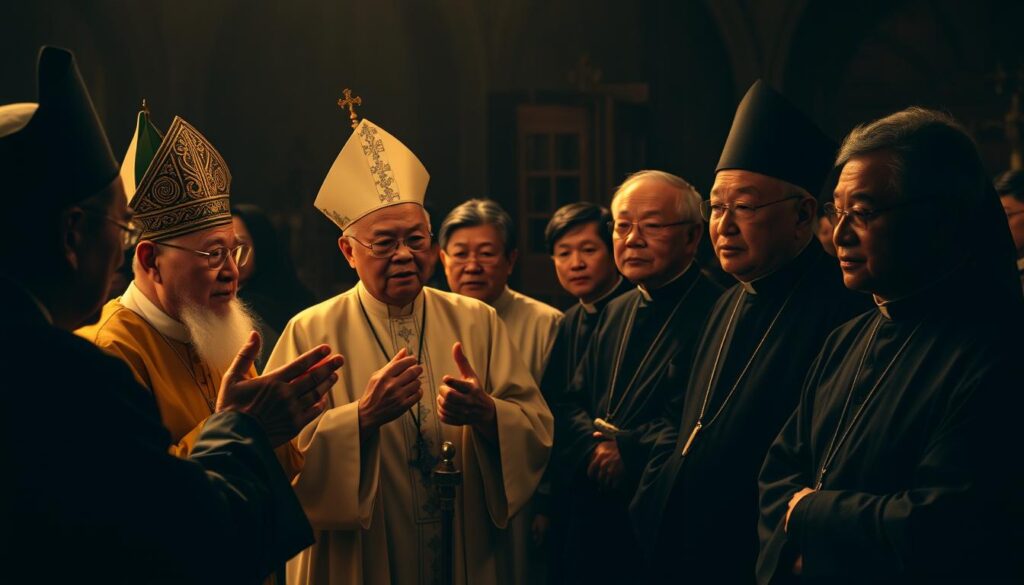
A solemn gathering of Catholic leaders in a dimly lit chamber, their faces cast in soft, warm light, conveying a sense of reverence and contemplation. In the foreground, a group of elders in traditional robes and headdresses, deep in discussion, their hands gesturing with measured movements. In the middle ground, a younger generation of clergy listening intently, their expressions a mix of respect and anticipation. The background is shrouded in shadow, hinting at the weight of history and the significance of this transitional moment in the church's presence in China.

Transition from Foreign Missionaries to Indigenous Clergy

Pope Benedict XV’s 1919 encyclical “Maximum Illud” sparked revolutionary change. It declared:

“Becoming Christian does not imply abandoning loyalty to one’s people.”

This directive empowered theHoly Seeto prioritize training localpriestsover relying solely on foreignmissionaries.

Archbishop Celso Costantini arrived in 1922 as the first apostolic delegate. His bold moves included:

  • Promoting Chinese clergy to leadership roles by 1924
  • Advocating Chinese-language liturgy over Latin
  • Organizing Rome’s first ordination of Chinese bishops in 1926

Papal Initiatives and the Role of Apostolic Delegates

The table below shows key milestones in leadership development:

Year Initiative Impact
1919 “Maximum Illud” encyclical Launched indigenous clergy training
1926 Six Chinese bishops ordained First native hierarchy established
1946 Cardinal Tien Ken-sin appointed Local leadership reached highest rank

By 1946, Chinese clergy comprised nearly 25% of bishops. This strategic shift proved vital when foreign missionaries later faced expulsion. The Holy See‘s commitment to local ordination created lasting infrastructure for spiritual guidance.

Contemporary Perspectives on Catholicism in China

Modern spiritual communities navigate a delicate balance between devotion and state oversight. Two parallel systems coexist: one operating under strict government supervision, the other preserving ancient traditions through hidden networks.

Government Policies, Surveillance, and Religious Freedom

The Chinese authorities recognize only the state-sanctioned Catholic Patriotic Association. This group operates independently from Rome, with leaders appointed by the communist party. Surveillance cameras monitor every corner of approved worship spaces, tracking attendance and activities.

Religious Affairs Bureau officials:

  • Approve sermon topics weekly
  • Restrict youth participation in services
  • Remove crosses from church rooftops

The 2018 agreement between Beijing and the Vatican attempted to bridge divides. Yet tensions persist—police still block church entrances when crowds grow “too large.”

Underground Church vs. State-Sanctioned Church Dynamics

This table shows key differences between the two communities:

Aspect State-Sanctioned Underground
Leadership Government-appointed Papal-recognized
Surveillance Camera-monitored Secret locations
Religious Materials Censored Smuggled
Youth Programs Banned Home-based

Underground members face harsh penalties but maintain creative resilience. Some priests deliver hour-long homilies to compensate for banned religious education. Foreign worshippers report officials photographing attendees during Mass—a reminder that religion remains tightly controlled.

Impact of Sociopolitical Changes on Religious Life

Political shifts have dramatically reshaped spiritual landscapes across generations. Since 1949, the Chinese Communist Party has implemented policies to assert control over religious institutions, creating deep divisions that persist today.

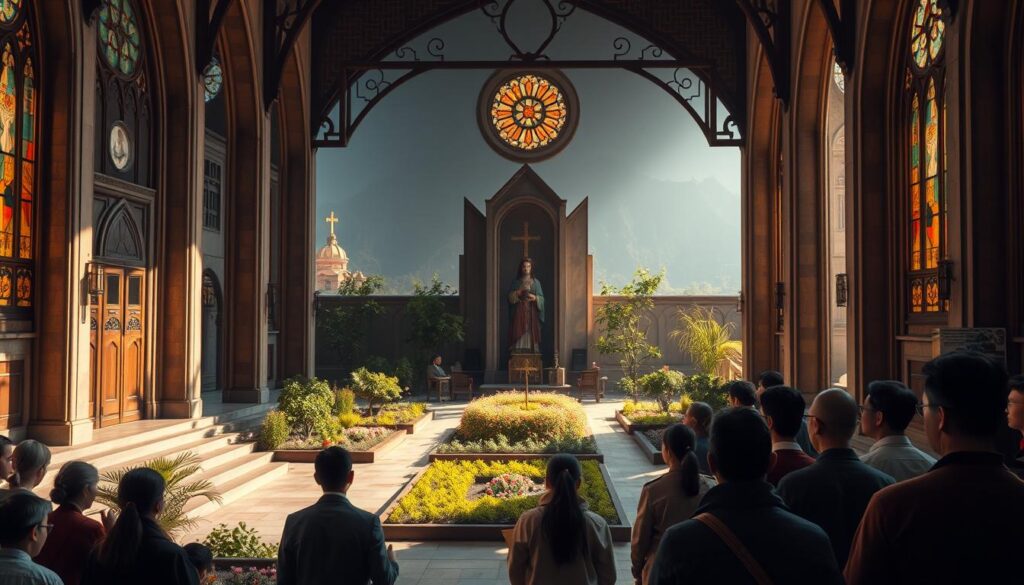
A tranquil yet resilient scene of a Catholic church in China, its intricate architecture and stained glass windows casting warm hues across the courtyard. In the foreground, a group of worshippers gather reverently, their faces radiating a quiet determination, weathered by years of persecution yet unbroken in their faith. The middle ground reveals a lush garden, a symbol of growth and renewal, while in the distance, the backdrop of towering mountains suggests the enduring nature of this spiritual haven. The lighting is soft and diffuse, creating an atmosphere of contemplation and inner strength. The overall impression is one of steadfast devotion, a testament to the unwavering spirit of Catholicism in the face of sociopolitical adversity.

The Influence of the Communist Party on Religious Practices

The 1951 expulsion of Vatican diplomat Archbishop Riberi marked a turning point. Authorities launched the Three Autonomies Movement, demanding clergy sever ties with Rome. This policy targeted the church’s hierarchy, aiming to replace papal authority with state oversight.

By 1955, over 200 clergy faced arrest in coordinated raids. Among them was Bishop Ignatius Kung, imprisoned for rejecting state-mandated independence. These actions revealed a pattern: religious persecution became a tool for political consolidation.

Case Studies: Persecution and Resilience in the Field

Modern examples show evolving tactics against dissent:

  • Bishop SU Zhimin vanished in 1997 after criticizing state interference
  • Bishop SHI Enxiang, now 102, remains under house arrest since 2001
  • Bishop Ma Daqin lost his title in 2012 for leaving the state-sanctioned association

Despite these challenges, underground communities thrive through coded messages and secret gatherings. Over 25 Chinese bishops currently face restrictions, yet their followers maintain rituals in homes and rural hideouts. This resilience demonstrates how faith adapts to survive under intense pressure.

Cultural and Global Influences Shaping the Faith’s Journey

Cultural exchange often sparks unexpected transformations in spiritual practices. Visitors to Beijing’s churches notice something surprising—Santa Claus figurines standing beside traditional nativity scenes. This blend of global symbols reflects how communities adapt traditions while maintaining core beliefs.

Western Encounters and Comparative Reflections

Chinese Catholics creatively reinterpret Western holiday symbols. A worshipper in Wuhan explained: “Frosty the Snowman isn’t just decoration—he represents our joy in celebrating Christ’s birth openly.” This perspective turns commercial icons into meaningful faith expressions.

Government efforts to hide historic churches reveal another layer of adaptation. St. Joseph’s Church in Wangfujing now sits behind towering office blocks—a visual metaphor for ongoing tensions. Yet inside, vibrant services continue, blending ancient rituals with modern touches.

Global Tradition Chinese Adaptation Significance
Christmas Eve Mass Elaborate nativity displays with local motifs Cultural resistance through celebration
Church Architecture Hidden structures with active underground networks Perseverance amid suppression
Religious Symbols Santa Claus as freedom metaphor Reclaiming secular icons

Western observers note unique worship styles that balance doctrine with local realities. One expat described midnight Mass where carols blended with traditional instruments—a soundscape embodying cultural fusion.

These adaptations show how global religious communities maintain unity through diverse expressions. The Chinese Catholic experience demonstrates faith’s power to evolve without losing its essence, creating bridges between worlds.

Future Outlook and Trend Analysis of the Church in China

Global dialogue continues shaping spiritual communities across borders. Recent gatherings like May’s Rome conference highlight this trend, where scholars examined the 1924 Council’s lasting impact. Pope Francis emphasized in his video message: “True growth springs from mutual understanding, not imposed structures.”

Bridging Divides Through Shared Wisdom

Cardinal Parolin’s keynote address stressed the Holy See‘s commitment to peaceful coexistence. The recognition of Bishop Joseph Shen Bin in 2023 shows progress—local leaders now gain papal approval while respecting regional dynamics. Such moves hint at thawing tensions between global institutions and national policies.

Collaborative Horizons Emerging

Three potential growth areas stand out:

  • Expanding the 2018 provisional agreement between Rome and Beijing
  • Increasing youth engagement through digital ministry tools
  • Developing seminary programs blending tradition with cultural context

As these efforts unfold, communities demonstrate remarkable adaptability. The church in China enters a new era where respectful dialogue could redefine ancient practices for modern realities. Through patience and creativity, shared spiritual goals might yet overcome historical divides.

FAQ

How did colonial history shape the Catholic Church’s presence in China?

The Treaty of Nanjing (1842) opened ports to foreign influence, allowing missionaries to expand their work. However, ties to colonial powers later fueled mistrust among local communities and authorities, complicating the faith’s integration.

What role does the Chinese Communist Party play in religious practices today?

The government enforces strict regulations through bodies like the State Administration for Religious Affairs. Worship must align with state policies, and clergy in the state-sanctioned Catholic Patriotic Association are required to reject Vatican authority.

How does the underground Church differ from the state-sanctioned Church?

The underground Church remains loyal to the Holy See, operating outside government control. In contrast, the state-sanctioned Church follows Communist Party directives, including appointing bishops approved by Beijing rather than the Pope.

What was the significance of the 2018 provisional agreement between China and the Vatican?

This deal allowed Pope Francis to recognize seven government-appointed bishops while granting Beijing a role in their selection. Critics argue it risks legitimizing state control, but supporters see it as a step toward unity.

How have indigenous clergy influenced the Church’s growth in China?

After foreign missionaries were expelled in the 1950s, local leaders like Bishop Ignatius Kung Pin-Mei preserved traditions secretly. Today, homegrown clergy navigate dual loyalties to their faith and state demands.

What challenges do Catholics face under China’s religious policies?

Authorities monitor services, restrict youth participation, and demolish unauthorized churches. Recent campaigns, such as replacing crosses with government symbols on buildings, highlight ongoing tensions between faith and policy.

How does Chinese Catholicism compare to other Asian Catholic communities?

Unlike nations like the Philippines or South Korea, China’s Church operates under unique political constraints. Its survival relies on balancing inculturation with resistance to state interference, creating a distinct identity.

Are there signs of reconciliation between the Vatican and Beijing?

While dialogue continues, issues like Taiwan’s diplomatic status and bishop appointments remain hurdles. Pope Francis has prioritized diplomacy, but lasting unity depends on mutual concessions from both sides.

Catholicism and Marriage: What You Need to Know


Planning a religious union in the Catholic Church involves more than choosing flowers or a reception menu. For those preparing to get engaged, understanding the sacramental significance of this lifelong promise is essential. The Church sees this bond as a sacred covenant, rooted in faith and supported by grace.

In the United States, Catholic weddings blend spiritual and legal elements seamlessly. Priests or deacons officiate ceremonies recognized by both the Church and state. This means couples don’t need separate civil paperwork—a unique convenience many appreciate.

Preparation often takes six months or longer. Family and friends might be surprised by the required steps: pre-marriage courses, spiritual counseling, and document verification. These ensure couples grasp the depth of their commitment and align their values with Church teachings.

The ceremony itself reflects centuries of tradition. Vows are exchanged within Mass or a standalone liturgy, emphasizing God’s role in the partnership. This approach helps members of the faith community witness and support the couple’s journey from day one.

Key Takeaways

  • Catholic weddings are both legally binding and spiritually significant in the United States
  • Preparation includes mandatory courses and documentation filed months in advance
  • Ceremonies emphasize faith traditions over personal or cultural preferences
  • Priests or deacons officiate, eliminating the need for separate civil proceedings
  • The sacrament requires couples to prioritize spiritual readiness

Planning Your catholicism marriage: First Steps

Your journey to a sacred union begins with one critical step: contacting your parish before making any other arrangements. Many excited couples rush to book venues or send invitations, but Church guidelines require prioritizing spiritual preparation over logistics.

Setting Your Wedding Date and Venue Priorities

Popular churches often fill their calendars 2-3 years ahead, especially for summer ceremonies. Don’t be surprised if your desired wedding date isn’t available—flexibility helps secure a meaningful location. Some parishes only host ceremonies for registered members, so verify requirements early.

Most churches mandate at least six months of preparation, mirroring the care taken in priestly training. This timeframe allows for prenuptial interviews, document collection, and spiritual courses. View this as an investment in your future spouse relationship rather than a bureaucratic hurdle.

Putting God First in Your Planning Process

The Church’s process emphasizes spiritual readiness over reception details. While florists and caterers operate on your schedule, sacramental preparation follows divine timing. Many couples find this shift in priorities strengthens their bond before exchanging vows.

Family expectations might clash with parish guidelines, like limited decoration options or music restrictions. Approach these differences as opportunities to deepen your shared faith. Remember: the wedding ceremony’s sacred purpose outweighs temporary aesthetic preferences.

Contacting Your Church and Scheduling a Meeting

The moment you decide to get married in the Catholic Church, your phone becomes your most important tool. Unlike booking secular venues, securing a wedding date requires direct communication with parish staff. Start this process early—some popular churches book events 3 years ahead.

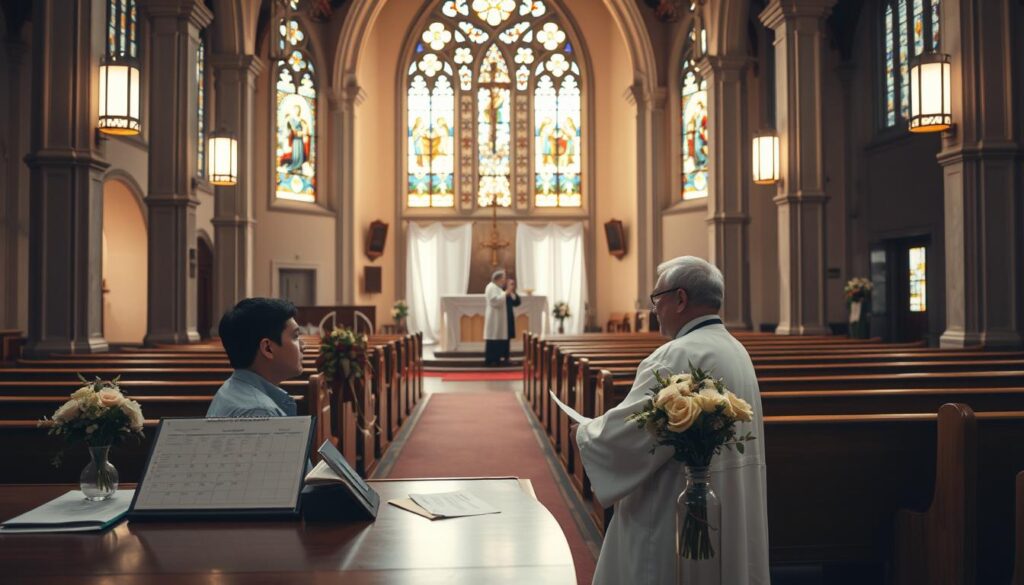
A sunlit Catholic church interior, the altar draped in elegant white linens. In the foreground, a couple sits at a wooden desk, discussing wedding plans with a kindly priest. Stained glass windows cast warm hues, illuminating their faces. On the desk, a calendar, a list of readings, and a vase of fresh flowers. In the background, rows of polished oak pews await the ceremony. The atmosphere is one of reverence, tradition, and joyful anticipation.

Why Early Church Contact Matters

Parishes often limit ceremonies during peak seasons like June. If you want get married on a Saturday afternoon, act fast. Many require at least six months notice for sacramental preparation. This timeframe lets you complete required courses while handling paperwork.

Choosing the Right Church for Your Wedding

You might prepare at one parish but get married at another. This helps couples living far from family churches. Always confirm with the priest overseeing your ceremony—they’ll transfer documents between locations.

Factor Home Parish Destination Church
Preparation Location Local courses Remote options
Ceremony Flexibility Priority dates Limited availability
Communication Style In-person meetings Phone/email preferred

Persistent calls work better than emails for scheduling. Treat each meeting request like visiting relatives—respect their house rules while sharing your hopes. Some churches restrict decorations or music choices, so ask about guidelines upfront.

Understanding Church Requirements and Sacramental Preparation

Navigating the path to a sacramental union requires careful attention to administrative and spiritual details. The Church prioritizes both practical readiness and faith formation, creating a balanced approach to lifelong commitment.

Documentation Needs: Baptismal Certificates and More

Your parish will request updated baptismal certificates issued within six months of your ceremony. This rule ensures accurate records of sacramental status. Childhood certificates won’t work—contact your baptism parish directly for fresh copies.

“Proper documentation isn’t about bureaucracy—it’s about honoring sacramental truth,” explains Father Mark, a Chicago-based priest.

Some dioceses require additional steps:

Requirement Purpose Timeline
Confirmation records Verify sacramental completion Submit with initial paperwork
Witness affidavits Assess relationship stability 6-8 weeks before wedding
Pre-Cana completion Ensure spiritual preparedness 3-4 months prior

The Importance of Confirmation and Other Sacraments

While confirmation isn’t mandatory, most priests encourage completing this sacrament first. It strengthens your spiritual foundation and unlocks full sacramental graces. Couples often discover new insights during preparation programs:

  • Engaged Encounter weekends foster communication skills
  • Online courses adapt to busy schedules
  • Parish-based workshops build community connections

These programs help couples align their expectations with Church teachings. Remember: the process isn’t about jumping through hoops—it’s about building unshakable foundations.

Navigating Interfaith and Non-Catholic Spouse Considerations

Building a life together across faith traditions requires open hearts and clear communication. The Church welcomes getting married catholic with partners of other beliefs, focusing on shared values rather than uniformity.

Addressing Conversion Myths and Responsibilities

Your future spouse doesn’t need to change their faith to marry you. Conversion only matters if it’s a personal response to God’s calling—not family pressure. Baptized non-Catholics still create sacramental unions filled with grace.

Couples often choose a Liturgy of the Word ceremony instead of Mass. This thoughtful option lets both partners fully participate without communion conflicts. Your priest will guide this process during planning meetings.

Raising Children in the Catholic Faith

The Catholic partner makes a solemn promise to nurture children’s faith through baptism and religious education. This doesn’t erase the other parent’s role. Many families blend traditions, celebrating holidays from both faiths.

Open discussions about spiritual life create stronger bonds. Your parish can suggest resources for interfaith households, helping kids appreciate diverse beliefs while grounding them in Catholic teachings.

FAQ

How early should we contact our church before the wedding?

Reach out to your parish at least 6–12 months in advance. This allows time for sacramental prep, paperwork, and scheduling. Many churches have busy calendars, especially during popular seasons like spring or fall.

What documents do we need for a Catholic ceremony?

You’ll need updated baptismal certificates, confirmation records, and a marriage license. If either partner was previously married, additional annulment or divorce paperwork may be required. Your priest or deacon will guide you.

Can we marry in the Church if one of us isn’t Catholic?

Yes! Interfaith weddings are possible with a dispensation from Canon Law. The non-Catholic partner doesn’t need to convert, but both must agree to raise future children in the Catholic faith. Open communication with your priest is key.

Do we need to attend marriage prep programs?

Most dioceses require couples to complete a pre-Cana course or retreat. These programs focus on communication, faith, and lifelong commitment. Some churches also offer mentoring with married couples.

What if we’re already civilly married?

The Church offers a convalidation ceremony to bless your union sacramentally. This process involves meetings with a priest and fulfilling standard sacramental requirements, like baptismal records.

Can we personalize our Catholic wedding Mass?

While the liturgy follows a set structure, you can choose readings, hymns, and cultural traditions (with approval). Discuss options like unity candles or ethnic rituals with your priest early in the planning process.

Understanding the Catholic Church’s Views on Birth Control


When friends learn I’ve joined the Catholic Church, their questions often reveal two big curiosities: “Why do Catholics honor Mary so much?” and “Why can’t you use birth control?” These aren’t just casual inquiries—they reflect deeper misunderstandings about teachings many view as restrictive. Even among Catholics, these doctrines spark debate, blending ancient theology with modern family life.

The Church’s position on contraception isn’t about limiting freedom but upholding a vision of marriage rooted in 2,000 years of reflection. While most Christian groups revised their stances after the 1930 Lambeth Conference, Catholic leaders doubled down, arguing that artificial methods disrupt the sacred link between love and life.

This guide explores how that conviction developed—from early Christian writers to papal documents like Humanae Vitae. You’ll hear from converts who struggled to accept these teachings and learn why natural family planning isn’t just “Catholic birth control” but a philosophy of shared responsibility.

We’ll also tackle myths. Contrary to popular belief, the Church encourages thoughtful family spacing—it simply rejects methods that separate intimacy from procreation. By the end, you’ll see why these teachings remain unchanged despite cultural pressure and how they connect to broader ideas about human dignity.

Key Takeaways

  • The Catholic Church’s teachings on contraception stem from centuries of theological reflection on marriage and human dignity
  • Modern disagreements trace back to 1930, when other Christian groups began approving artificial birth control
  • Natural family planning methods align with Church doctrine while allowing responsible family spacing
  • Many converts face significant personal challenges when adopting Catholic teachings on this issue
  • Church documents emphasize marital unity over strict rules about family size

Historical Overview of Catholic Teachings on Birth Control

For most of Christian history, leaders across denominations agreed: artificial methods to prevent pregnancy conflicted with divine purpose. This consensus held firm until modern times, shaping marital ethics through centuries of theological debate.

Early Church Fathers and Traditional Stances

Prominent thinkers like Augustine and Jerome set the foundation. Augustine claimed couples using “sterilizing drugs” created false marriages—veils for selfish desires rather than sacred unions. Jerome went further, comparing herbal contraceptives to “murdering humans before conception.”

Other voices reinforced this stance:

Theologian Contribution Impact
John Chrysostom Linked contraception to greed Emphasized family responsibility
Clement of Alexandria Called it “against nature” Connected ethics to natural law
Hippolytus of Rome Condemned potion use Established early precedents

Evolution of Doctrinal Interpretations

The 20th century brought seismic shifts. While Protestant groups revised their positions post-1930, Catholic leaders reaffirmed traditional views. This created a unique dynamic: what was once universal Christian doctrine became distinctly Catholic teaching.

Modern debates often overlook this shared history. The Church’s current stance reflects not rigid tradition, but 2,000 years of consistent ethical reasoning about love, responsibility, and human dignity.

Understanding Humanae Vitae and Its Impact

A solemn, contemplative scene of the Humanae Vitae encyclical and its impact on the Catholic Church. In the foreground, an open book with the encyclical's cover prominently displayed, its pages casting soft, diffused light. Behind it, a group of Catholic figures - priests, theologians, and laypeople - engaged in thoughtful discussion, their faces reflecting the gravity and complexity of the document's teachings. The background is a hazy, muted palette, suggestive of the historical and spiritual weight of the encyclical's influence. Subtle, directional lighting casts dramatic shadows, emphasizing the sense of reverence and contemplation. The overall mood is one of thoughtful introspection, capturing the lasting impact of Humanae Vitae on the Catholic faithful.

In 1968, a 7,000-word document reshaped global conversations about intimacy and morality. Pope Paul VI’s Humanae Vitae became the Catholic Church’s clearest modern statement on marital ethics. Its release during the Sexual Revolution created shockwaves, challenging cultural shifts while reaffirming ancient principles.

Pope Paul VI’s Encyclical and Its Legacy

The encyclical made two bold declarations: artificial contraception was “intrinsically evil,” while natural methods aligned with moral law. Paul VI warned that separating intimacy from procreation would degrade relationships. He predicted societies where men viewed women as objects—a concern echoing through today’s #MeToo era.

Timing intensified reactions. Many expected reforms after Vatican II’s progressive tone. Instead, Humanae Vitae doubled down on tradition. As one theologian noted, “It wasn’t about rules—it was about protecting love’s deepest meaning.”

Reactions Within the Catholic Community

Responses ranged from devotion to dissent. Over 600 theologians publicly criticized the document. Canadian bishops issued the Winnipeg Statement, acknowledging many found the teachings “impossible” to follow. Yet converts like Kimberly Hahn credit it with revitalizing their marriages through natural family planning.

This divide persists. A 2019 Pew study showed 62% of U.S. Catholics believe artificial birth control is morally acceptable. Still, the encyclical’s warnings about societal decay fuel ongoing debates about ethics and personal choice.

The Evolution of Contraceptive Methods Within Catholicism

The 1930s marked a turning point in how couples approached family planning while respecting Church teachings. What began as calendar calculations grew into sophisticated systems aligning biology with theology.

From Calendar Tracking to Biological Markers

Dr. John Rock made history twice—first by opening America’s first Rhythm Clinic in 1932, then later helping develop the contraceptive pill. His clinic taught couples to track menstrual cycles using a mathematical formula published two years earlier. “This isn’t just about avoiding pregnancy,” he noted, “but understanding God’s design for marriage.”

Pope Pius XII formally approved these natural methods in 1951, calling them “morally permissible for grave reasons.” This endorsement transformed the rhythm method into what we now call natural family planning (NFP).

Method Key Features Effectiveness
1930s Rhythm Calendar tracking 76-88%
Modern NFP Temperature + mucus analysis 98-99%*

*When practiced correctly (Human Reproduction, 2007)

Today’s NFP uses three fertility indicators: waking body temperature, cervical mucus changes, and hormone levels. These methods require daily tracking but offer effectiveness matching oral contraceptives without side effects.

Challenges remain. Many couples find NFP demands more communication than artificial contraceptives. Dioceses now offer training programs, helping partners master these family planning techniques while deepening mutual understanding.

Examining Natural Family Planning and the Rhythm Method

A serene, natural scene depicting the rhythm method of natural family planning. In the foreground, a woman tracks her menstrual cycle on a calendar, using a pen with a soft, warm light casting a glow. The middle ground features a couple embracing, their expressions conveying affection and intimacy. In the background, a lush, verdant landscape with rolling hills and a tranquil stream, symbolizing the harmony of natural rhythms. The lighting is soft and diffused, creating a calming, contemplative atmosphere. The image captures the essence of the rhythm method - a natural, holistic approach to family planning rooted in observation and mutual understanding between partners.

Couples practicing natural family planning experience a divorce rate under 1%—a figure that makes relationship experts take notice. This statistic from the University of Chicago reveals more than just numbers—it hints at how shared responsibility transforms marriages.

Scientific Advances and Practical Applications

Modern family planning tools have evolved far beyond calendar charts. Handheld devices now analyze hormonal shifts through temperature spikes or saliva patterns. “These innovations make fertility awareness as precise as prescription contraceptives,” explains Dr. Mary Davenport, a leading NFP educator.

The Catechism supports this approach, stating spouses may “space the births of their children” through biological observation. Unlike artificial methods, these techniques work with natural cycles rather than overriding them. Partners collaborate daily, tracking subtle bodily changes that dictate their fertility window.

The Unitive and Procreative Purposes

At its core, this method honors two non-negotiable aspects of intimacy: bonding and potential life creation. Marriage becomes a dance of mutual understanding—couples either embrace fertility or abstain during fertile periods based on shared goals.

This philosophy fosters communication. “You can’t just set an alarm for romance,” shares Sarah, a mother of three using NFP. “We’re constantly discussing our hopes, fears, and physical cues.” Such dialogue builds trust that transcends bedroom conversations, creating what researchers call “relationship armor” against life’s stresses.

While requiring discipline, this approach aligns with a broader vision—that spouses aren’t just life partners but co-stewards of their shared future. As technology simplifies tracking, more couples discover that working with nature often strengthens bonds better than working against it.

Debates Between Evangelical and Catholic Perspectives

When discussing family planning, Evangelicals and Catholics often find themselves on opposite sides of a theological divide. While one group emphasizes personal choice, the other prioritizes adherence to doctrinal principles—a contrast that shapes millions of marital decisions.

Moral and Theological Landmines

Most Evangelical churches treat contraception as a private matter. “Our pastor never mentioned it during premarital counseling,” shares Mark, a former youth minister. This hands-off approach contrasts sharply with Catholic teachings that label artificial methods as morally unacceptable.

Evangelicals frequently frame birth control use as responsible stewardship. Many argue that limiting family size through modern methods allows better resource management—a practical outlook rooted in Genesis’s “be fruitful and multiply” mandate. Catholics counter that separating sex from procreation violates natural law, creating what one theologian calls “a rupture in God’s design for marriage.”

Scriptural Interpretations and Comparisons

The Genesis 38 account of Onan sparks heated debates. Catholic scholars highlight his punishment after “spilling his seed” as divine disapproval of contraception. Evangelicals counter that Onan’s sin was refusing levirate duties—not preventing pregnancy.

These differing views reveal deeper divides:

  • Natural law vs. practical stewardship principles
  • Church authority vs. individual conscience
  • Traditional interpretations vs. modern applications

While 72% of Evangelical couples report using artificial methods, Catholic teaching continues challenging cultural norms. As debates about marriage and ethics evolve, these contrasting approaches highlight religion’s complex role in personal choices.

Implications of Contraception on Marriage and Family Dynamics

A middle-aged couple sits at a table, engaged in a thoughtful discussion. The man, dressed in a button-down shirt, leans forward, his brow furrowed, as the woman, wearing a modest blouse, listens intently, her hands clasped. The lighting is soft and warm, casting a contemplative glow on their faces. The background is blurred, placing the focus on their intimate conversation. The atmosphere is one of careful consideration, as they weigh the implications of their family planning decisions within the context of their religious beliefs.

Research reveals a surprising link between family planning methods and marital stability. Recent surveys show both men and women credit method choice with reshaping their partnerships. While modern solutions promise convenience, studies suggest they may weaken the very bonds they aim to protect.

Impact on Marital Relationships

Women switching to natural methods often report transformative effects, with many men noting improved emotional intimacy. “It forced us to really talk—not just about schedules, but our hopes,” shares one mother of four. The required cooperation fosters mutual respect, turning daily decisions into shared commitments that strengthen marriage foundations.

Statistical Insights and Family Studies

Multiple studies show natural method users experience divorce rates below 1%—compared to nearly 50% nationally. Researchers note children in larger families frequently develop stronger conflict-resolution skills through sibling interactions. These findings challenge assumptions that fewer children automatically create happier homes.

As couples weigh options, many discover intentional approaches to marriage yield unexpected benefits. The discipline required for natural methods often builds relationship resilience—proving that short-term convenience rarely outweighs lasting connection.

FAQ

What is the Catholic Church’s official stance on preventing pregnancy?

The Church teaches that spouses should remain open to life while respecting the natural design of sexuality. Artificial methods like pills or condoms are prohibited, but natural family planning (NFP) is permitted when used for serious reasons.

Why does the Church oppose contraceptives despite modern health concerns?

Catholic doctrine emphasizes that separating sex from its procreative purpose disrupts God’s plan for love and life. Health risks or societal challenges don’t override this moral principle, though NFP is seen as a responsible alternative.

How has the Church’s teaching on fertility evolved over time?

While core beliefs about marriage and procreation remain unchanged, advances in science led to acceptance of NFP as a licit method. Earlier teachings focused on abstinence, but modern interpretations emphasize informed, prayerful discernment for couples.

What role does Humanae Vitae play in current debates about family planning?

Pope Paul VI’s 1968 encyclical reaffirmed the ban on artificial contraception, sparking both reverence and dissent. Many Catholics today grapple with its teachings, especially amid rising support for reproductive rights and gender equality.

Are there exceptions for using contraceptives in medical emergencies?

The Church permits treatments that indirectly affect fertility, like hormonal therapy for endometriosis, provided the primary goal isn’t to prevent pregnancy. Direct contraceptive use, even for health reasons, remains forbidden.

How do Evangelical views on birth control differ from Catholic teachings?

Many Protestant denominations allow contraceptives, focusing on stewardship and marital harmony. Catholicism uniquely ties sexual acts to potential life creation, viewing artificial methods as morally distinct from NFP.

Does natural family planning effectively strengthen marriages?

Studies show mixed results. Advocates argue NFP fosters communication and mutual respect, while critics note stress from avoiding pregnancy. Success often depends on a couple’s shared faith and commitment to Church teachings.

How do global Catholics reconcile doctrine with limited access to healthcare?

In regions with high maternal mortality or poverty, some clergy emphasize compassion while upholding NFP. However, official doctrine still rejects contraceptives, urging societies to address systemic issues without compromising morality.

Catholicism’s Impact on Mexican Society


Nearly eight out of ten people in the country identify with the Roman Catholic faith, according to recent national surveys. This spiritual connection stretches back over five centuries, weaving itself into the fabric of daily life and national celebrations. From vibrant festivals honoring local saints to community-driven social programs, the Church’s presence remains a cornerstone of cultural identity.

The relationship between religious institutions and public life has evolved dramatically since colonial times. Early missionaries blended European traditions with indigenous practices, forming unique rituals still celebrated today. Modern congregations continue adapting ancient customs to address contemporary needs, creating a living tradition that bridges generations.

Local parishes and dioceses form an extensive network supporting communities across the nation. Over 90 regional church districts coordinate efforts ranging from education initiatives to disaster relief programs. This organized structure enables rapid response to social challenges while maintaining deep local roots.

Key Takeaways

  • Over three-quarters of the population identifies with the dominant faith tradition
  • Historical blending of European and native practices created distinct cultural expressions
  • Church networks provide essential community services nationwide
  • Ongoing adaptation maintains relevance in modern social contexts
  • Balancing tradition with contemporary issues shapes current religious dynamics

Introduction to Catholicism’s Influence in Mexico

With over 15,700 priests and 46,000 religious workers nationwide, the Catholic Church maintains one of Mexico’s most extensive community networks. This spiritual organization operates through 90 regional districts, creating a web of support that touches education, healthcare, and neighborhood initiatives. Its presence can be seen in the cobblestone plazas of small towns and the grand cathedrals lining Mexico City’s historic center.

What This Guide Reveals

Our exploration uncovers how religious traditions became embedded in local culture over centuries. You’ll discover how Sunday masses interweave with mariachi music, and why street processions transform cities into open-air celebrations. We’ll show how family values and community ethics stem from centuries-old teachings.

Your Journey Through Faith and Culture

Expect to uncover surprising connections between historic events and modern practices. From revolutionary-era church reforms to today’s youth programs, you’ll see how adaptation keeps this religion relevant. We’ll examine architectural marvels built by early missionaries and explore how digital tools now spread spiritual messages.

This guide doesn’t just recount history – it highlights living traditions shaping modern life. You’ll gain insights into how festivals unite neighborhoods and why home altars remain central to family routines. Through vivid examples, we reveal the enduring influence shaping Mexico’s social fabric.

Historical Origins and Colonial Beginnings

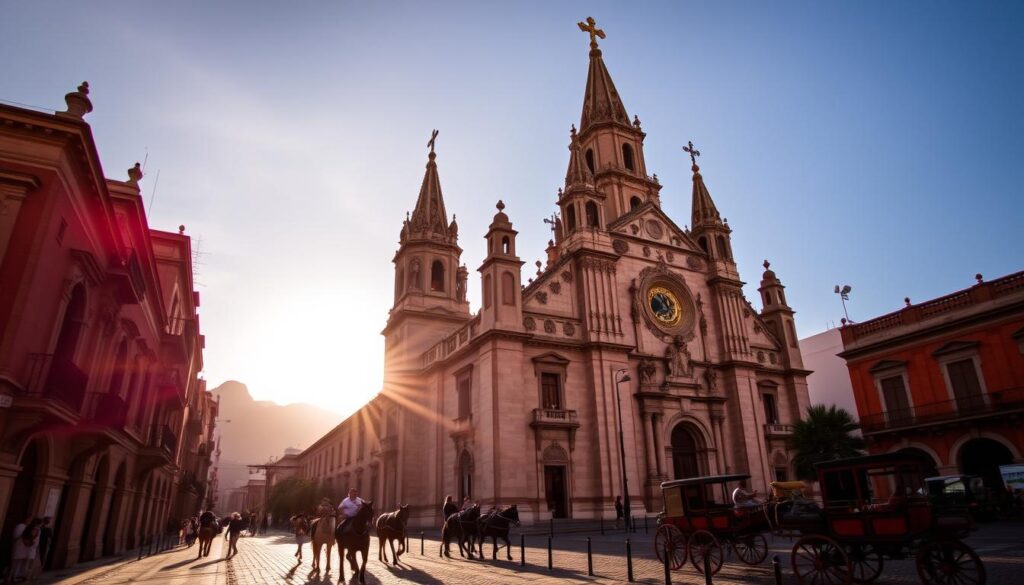
A majestic colonial church stands tall, its towering spires and ornate facades reflecting the Spanish conquest's lasting influence on Mexican architecture. Sunlight filters through stained glass windows, casting warm hues across the intricate stone carvings and ornate altars within. The church's grand scale and European-inspired design symbolize the deep roots of Catholicism in this once-colonized land. In the foreground, cobblestone streets and horse-drawn carriages evoke the historical atmosphere, while in the background, the silhouettes of distant mountains hint at the vast and diverse landscape that witnessed this cultural transformation.

Spanish authorities quickly realized that converting indigenous groups required more than military might – it demanded cultural adaptation. The 16th-century arrival of European missionaries marked a seismic shift, blending spiritual goals with government agendas. Conquistadors and priests worked side by side, using both swords and crosses to establish colonial control.

The Arrival of Catholicism with the Spanish Conquest

Spain’s Patronato Real system granted monarchs direct power over religious affairs. This arrangement let the crown appoint bishops and fund clergy while expanding political influence. Early church leaders like Bishop Juan de Zumárraga became key figures in reshaping local traditions through converted temples and new rituals.

The Role of Early Missionaries and Orders

Franciscan friars pioneered conversion efforts starting in 1524, followed by Dominicans and Augustinians. These priests learned native languages and created hybrid practices – mixing European teachings with local customs. Their institutions formed networks of doctrinas that served as spiritual and community hubs for centuries.

This transformative period established patterns still visible today. By building worship spaces atop sacred sites and blending belief systems, missionaries laid foundations for a unique religious identity. Their work during this critical century shaped how communities balance tradition with external influences.

The Spiritual Conquest and Evangelization Efforts

A pioneering group of twelve Franciscan priests landed in 1524, marking the start of organized religious transformation. Known as the Twelve Apostles of Mexico, these friars launched what historians call the “spiritual conquest” – a cultural reshaping through faith and education.

Strategies of Three Major Orders

The Franciscans, Dominicans, and Augustinians received strong government support to establish churches across New Spain. Royal authorities understood that converting indigenous people strengthened political control. Missionaries learned local languages and redesigned sacred spaces, often building new chapels where temples once stood.

Bernardino de Sahagún set a powerful example by documenting Aztec traditions while creating Nahuatl-language catechisms. This bilingual approach helped priests bridge cultural gaps. Beyond spiritual work, the orders founded 120 hospitals within a century, showing their commitment to community support.

Each group claimed specific regions – Franciscans worked crowded central areas, Dominicans moved south, and Augustinians headed north. Their coordinated efforts created lasting networks of churches, schools, and social services that still influence community structures today.

Transformation Through the Colonial Era

Colonial-era stone buildings still dot urban landscapes, silent witnesses to a foundational chapter in societal development. Between 1550 and 1800, religious organizations built networks that shaped daily routines and community bonds. These structures weren’t just places of worship – they became hubs for education, healthcare, and civic record-keeping.

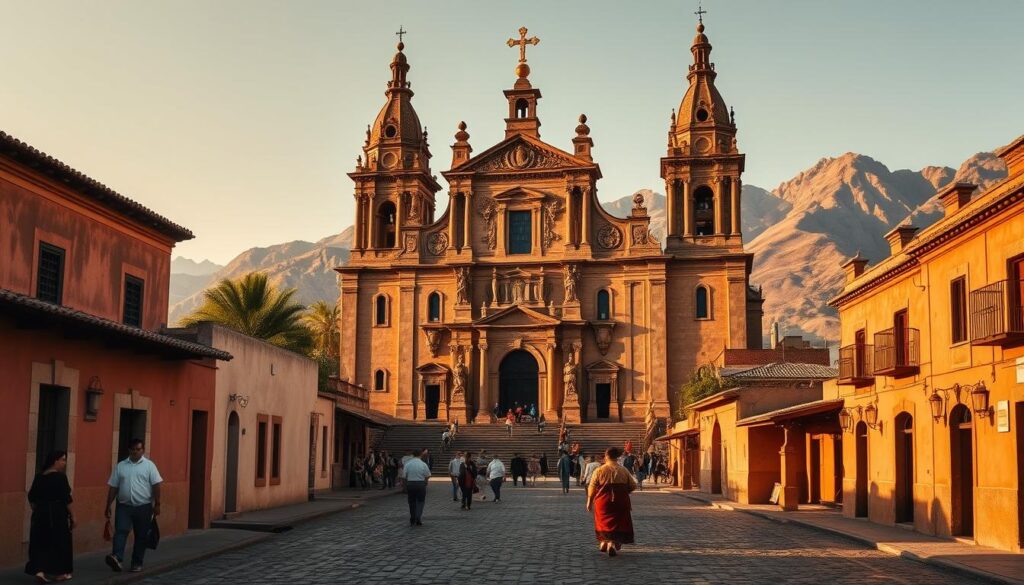
A grand colonial church stands tall, its ornate facade adorned with intricate carvings and towering spires. In the foreground, cobblestone streets and adobe buildings hint at the bustling Mexican town surrounding it. Mid-ground features worshippers entering the church, their traditional garments casting long shadows. The background showcases a mountainous landscape, bathed in warm, golden light from the setting sun. The scene exudes a sense of historical significance, conveying the transformation of Mexican society through the colonial era as Catholicism became deeply embedded within the culture.

Establishment of Church Institutions

Mexico City emerged as the nerve center of this transformation. The Royal Indian Hospital, operating from 1553 to 1822, exemplified the church’s growing role in public welfare. “The colonial church became the spine of society – it educated, healed, and documented lives,” notes historian Elena Martínez.

Pedro Moya de Contreras’ 1573 appointment as archbishop marked a turning point. As the first non-mendicant leader, he symbolized the shift from temporary missions to permanent systems. Diocesan priests now managed:

Institution Services Provided Duration
Royal Indian Hospital Healthcare for indigenous communities 269 years
Monastery Schools Basic education & religious training 1540s-1821
Parish Networks Birth/death records, marriage counseling Ongoing

By 1600, religious orders controlled 30% of urban properties. Spanish-born and local priests formed a powerful class influencing politics and land management. Their legacy lives on through fiesta traditions and neighborhood solidarity practices still common today.

Liberal Reforms and Church-State Conflicts

Mid-19th century Mexico witnessed a dramatic clash between progress and tradition as liberal leaders reshaped national governance. The 1857 Constitution sparked heated debates by stripping religious groups of land ownership rights and special legal protections. This bold move aimed to modernize society but triggered decades of political tension.

Impact of the Reform Laws on Church Privileges

New regulations hit religious institutions like a thunderbolt. The government seized control of marriage records and banned clergy from running schools. Special church courts vanished overnight, leaving legal matters entirely in state hands. By 1860, over 25% of national property had shifted from religious to public management.

The Shift in Power Dynamics

These changes flipped centuries-old power structures. Conservatives fought fiercely to protect traditional church-state relations, even supporting armed rebellions. The Reform War (1857-1861) saw clergy backing military groups against President Benito Juárez’s administration.

Aspect Pre-Reform Era Post-Reform Era
Property Ownership Churches held 40% of land State-controlled property sales
Education Religious schools dominant Secular public schools created
Legal Authority Separate church courts Unified civil court system

This conflict set patterns for future clashes between religious and secular leaders. Though tensions eased eventually, the reforms established clear boundaries that still shape modern governance. As historian Carlos Fuentes noted, “The 1857 Constitution didn’t just change laws – it redefined what it meant to be a Mexican citizen.”

Mexican Catholic Traditions and Folk Customs

Colorful altars in homes blend ancient symbols with sacred icons, telling stories of cultural fusion. This blending of worlds creates living traditions where faith wears local dress and speaks in regional dialects. Communities celebrate spiritual connections through rituals that honor both ancestral roots and adopted teachings.

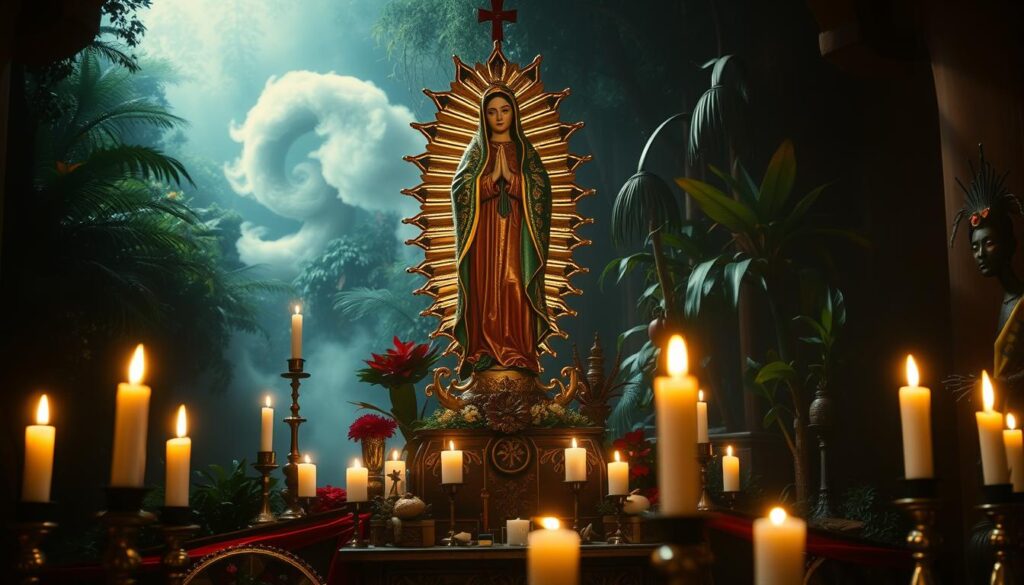
A serene, candlelit sanctuary where the Virgin of Guadalupe, draped in a shimmering, brocade cloak, stands atop a crescent moon, surrounded by a halo of golden rays. In the middle ground, indigenous symbols and offerings adorn an ornate, wooden altar, while the background features a lush, tropical landscape with swirling mists and vibrant flora, blending Catholic and Mesoamerican iconography. The scene is bathed in a warm, soft light, creating an atmosphere of reverence and cultural syncretism.

Syncretism with Indigenous Beliefs

The Lady of Guadalupe embodies this cultural merger like no other symbol. Her 1531 appearance to Juan Diego transformed a hillside into a national shrine, merging Nahua cosmology with Marian devotion. Today, her image graces everything from taxi dashboards to concert halls, uniting Mexican people across generations.

Local churches showcase this blend through architecture and art. Carved stone facades often feature corn motifs beside crosses, while interior murals might depict saints wearing traditional textiles. “These spaces aren’t just buildings – they’re visual dialogues between worlds,” observes cultural anthropologist Dr. Isabel Ríos.

Element Pre-Columbian Origin Modern Practice
Day of the Dead Miccailhuitontli festival All Saints’ Day altars with marigolds
Healing Rituals Temazcal sweat lodges Blessings with holy water & herbs
Harvest Celebrations Offerings to Tlaloc Saint Isidore processions

Family traditions keep this fusion alive. Children learn to arrange marigold petals around saint statues while elders recount origin stories. Seasonal festivals pulse with pre-Hispanic drum rhythms beneath church bell carillons, creating soundscapes that defy simple categorization.

“Our spirituality flows like two rivers merging – you can’t separate the waters once they’ve joined.”

– Elena Martínez, Cultural Historian

This dynamic interplay continues evolving. Young artists reimagine the Lady of Guadalupe in street murals, while urban people adapt ancestral rituals for apartment living. The result remains unmistakably Mexican – a testament to enduring cultural creativity.

Organizational Structure of the Catholic Church in Mexico

At the heart of Mexico’s religious framework lies a hierarchical organization spanning from bustling cities to remote villages. Eighteen ecclesiastical provinces form the backbone of this system, each containing multiple dioceses that serve distinct cultural regions. This structure allows both centralized coordination and local adaptability.

Dioceses, Archdioceses, and Local Parishes

Mexico City serves as the spiritual capital, home to the country’s primary archdiocese led by the archbishop of Mexico. Over 6,000 parishes operate nationwide, staffed by more than 15,000 active priests. These local churches act as community anchors, hosting events from Sunday masses to neighborhood festivals.

Eastern and Regular Jurisdictions

Special jurisdictions accommodate unique traditions within the Catholic Church. The Armenian Catholic Apostolic Exarchate and Maronite Catholic Eparchy preserve Eastern rites in Mexico City and beyond. Military ordinariates separately serve armed forces members, demonstrating the church’s flexible approach to diverse needs.

This multilayered system balances ancient traditions with modern demands. Young priests train alongside digital outreach teams, while historic cathedrals share streets with contemporary worship spaces. Through this adaptive structure, the church maintains its vital role in communities across the nation.

FAQ

How did the Catholic Church first arrive in Mexico?

The Church came with Spanish conquistadors like Hernán Cortés in the 16th century. Missionaries followed, aiming to convert Indigenous populations through evangelization efforts.

Which religious orders played key roles in early evangelization?

Franciscans, Dominicans, and Augustinians led the spiritual conquest. They built missions, schools, and churches while blending European traditions with local customs.

How did Indigenous beliefs mix with Catholic practices?

Syncretism emerged as communities merged pre-Hispanic rituals with Christian symbols. For example, Our Lady of Guadalupe became a unifying figure tied to Indigenous identity.

What caused conflicts between the Church and Mexican government?

The 19th-century Reform Laws stripped the Church of land and political power. Tensions peaked during the Cristero War (1926–1929) over anti-clerical policies.

How is the Church organized in Mexico today?

It’s structured into dioceses and archdioceses, like Mexico City’s Metropolitan Archdiocese. Local parishes and Eastern Catholic jurisdictions also serve diverse communities.

Why is Our Lady of Guadalupe significant in Mexican culture?

Her 1531 apparition symbolizes unity between faith and Indigenous heritage. Millions celebrate her feast on December 12, reflecting deep cultural and spiritual pride.

Catholicism vs. Protestantism: Understanding the Differences


Over 2.4 billion people worldwide follow one of two major Christian traditions rooted in shared beliefs about Jesus Christ and the Trinity. These faith groups, though united in worshiping one God, developed unique practices after a historic split in the 16th century. Today, they represent distinct paths within the Christian faith that continue to shape cultures and communities.

The term “Roman Catholic” originates from the Greek word for “universal,” reflecting its global reach. The other tradition emerged when reformers protested specific church practices, sparking a religious revolution. Both groups affirm core teachings like Christ’s crucifixion and resurrection but differ in how they interpret scripture and structure worship.

This guide explores their historical roots, theological contrasts, and modern-day practices. You’ll learn why these differences matter and how both traditions strive to honor their understanding of biblical truth. Whether you’re exploring your own beliefs or seeking clarity, this comparison offers valuable insights into two influential expressions of Christianity.

Key Takeaways

  • Over 2.4 billion people follow these two major branches of Christianity worldwide
  • Both share core beliefs in the Trinity and Jesus as divine Savior
  • The Protestant Reformation reshaped religious practices in the 1500s
  • Differences center on authority structures and worship traditions
  • Understanding these distinctions fosters better interfaith dialogue

Historical Background and Origins

From ancient creeds to revolutionary protests, Christian history is marked by pivotal moments that reshaped worship practices. The early church’s journey from a unified movement to divided traditions reveals how interpretations of Jesus Christ’s teachings evolved over centuries.

Early Christianity and the Formation of Traditions

The Apostles’ Creed, written around 150 CE, first described the “one holy, catholic church.” This phrase reflected the early believers’ commitment to preserving faith as taught by Christ’s original followers. By the 4th century, the Roman Catholic Church emerged as Western Europe’s dominant religious force, blending local customs with biblical teachings.

Latin became its official language, and traditions like papal authority took root. Leaders claimed direct succession from Saint Peter, whom they viewed as the first Pope. These structures created a unified identity that lasted through the Middle Ages.

The Impact of the Reformation and Schism

In 1517, Martin Luther’s Ninety-five Theses ignited a spiritual revolution. He challenged the sale of indulgences—payments believed to reduce punishment for sins—arguing salvation came through faith alone. Other reformers like Calvin and Zwingli joined this movement, questioning church hierarchy and ritual practices.

Though aiming to reform Christianity from within, their ideas clashed with Rome’s authority. The resulting split created new church models across Northern Europe. The Catholic Church later launched its own reforms but maintained core traditions, cementing the divide that still shapes Christian worship today.

Core Beliefs and Doctrinal Differences

At the heart of Christian theology lies a pivotal question: How do people connect with God? While sharing foundational beliefs about Jesus Christ, these traditions answer differently through their teachings about grace and human nature.

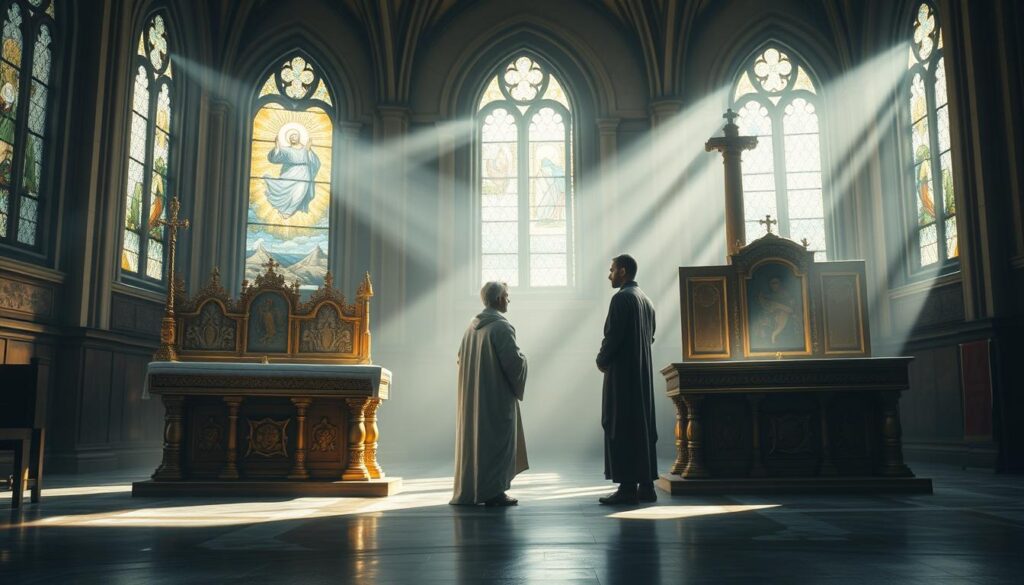
A serene, cathedral-like interior with diffused natural lighting filtering through stained glass windows. In the foreground, two contrasting altars stand side-by-side, one ornate and gilded, the other simple and wooden. Above each, a heavenly scene of salvation, depicted with masterful brushstrokes. The middle ground is occupied by two figures, one in a flowing robe, the other in modest attire, engaged in thoughtful discussion. The background fades into a contemplative haze, conveying the gravity and complexity of the theological differences between the two belief systems. Subtle chromatic shifts and a sense of reverence permeate the scene, inviting the viewer to ponder the nuances of these divergent paths to salvation.

Salvation, Grace, and the Role of Faith

Catholics believe salvation grows through sacraments like baptism and communion. They view grace as spiritual fuel earned through prayer, confession, and good works. Regular Mass attendance helps maintain this connection.

Protestants believe grace flows freely to those who accept Christ through faith alone. Many teach that salvation can’t be lost once truly received. This “sola fide” approach simplifies the path to redemption.

Original Sin and the Concept of Redemption

Both groups agree humanity inherited original sin from Adam. Catholics address this through infant baptism, seeing newborns as needing purification. Most Protestant churches wait until children understand right from wrong.

While Protestants and Catholics agree Christ’s sacrifice covers human sins, they differ on daily practice. One emphasizes personal prayer, the other sacramental rituals. Yet both aim to honor the same Savior through their distinct beliefs.

Structures, Leadership, and Worship Practices

How communities organize their spiritual lives reveals much about their core values. From towering cathedrals to modest chapels, physical spaces and leadership models reflect distinct approaches to connecting with the divine.

Clergy Roles and Hierarchical Organization

The Roman Catholic Church operates like a spiritual pyramid. At its peak sits the Pope, considered Christ’s representative on earth. Cardinals and bishops manage regional authority, while priests lead local parishes. This chain of command ensures uniform teachings across 1.3 billion members.

Protestant churches favor flatter structures. Pastors often answer to elected boards rather than distant hierarchies. Many denominations let congregations choose their leaders, reflecting Reformation-era pushes for localized authority.

Places of Worship and Liturgical Rituals

Catholic Mass transforms ordinary bread and wine into the body blood Christ through transubstantiation. Services follow ancient patterns: incense swirls, choirs chant, and rituals repeat weekly. Stained glass windows tell biblical stories to worshippers.

Protestant gatherings prioritize scripture over ceremony. Sermons dissect Bible passages, while hymns invite crowd participation. Communion bread remains symbolic—a memorial meal rather than sacred mystery.

Sacramental Life and Ritual Practices

Seven sacraments shape Catholic spiritual growth, from baptism to last rites. Each ritual marks life’s milestones with holy practices. Confession offers forgiveness through priestly mediation.

Most Protestant groups recognize two sacraments: baptism and communion. Personal prayer replaces formal confession. These differences show how traditions balance structure with individual faith journeys.

Exploring catholicism protestantism in Daily Faith

How believers live out their faith each day reveals much about their deepest convictions. Morning rituals, prayer habits, and moments of reflection shape spiritual growth in unique ways. These routines bridge ancient teachings with modern life.

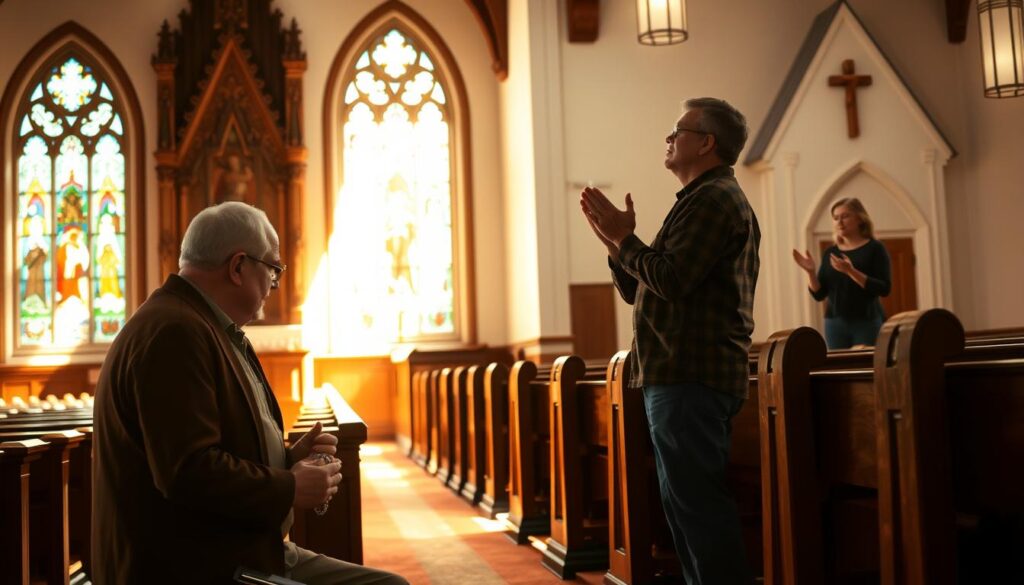
A serene Catholic chapel interior, sunlight filtering through stained glass windows, casting a warm glow on the wooden pews and ornate altar. In the foreground, a worshipper kneels in prayer, rosary beads in hand. In the middle ground, a Protestant congregant stands, hands raised, eyes closed, engrossed in a hymn. The background showcases a modest Protestant church, its clean lines and minimalist decor a stark contrast to the richly decorated Catholic space. The scene captures the diversity of daily faith practices, the quiet contemplation of Catholicism juxtaposed with the spirited worship of Protestantism.

Daily Devotions and Prayer Practices

Catholic spiritual life often includes structured practices like the Rosary—a meditative prayer honoring the Virgin Mother. Many light candles before statues of saints, seeking their heavenly support. Some attend daily Mass, viewing communion as spiritual nourishment.

Protestant routines focus on personal Bible study and spontaneous prayer. Quiet time with scripture helps believers apply teachings to today’s challenges. Worship songs and journaling often complement these moments of reflection.

The way followers handle mistakes shows key differences. Catholics confess sins to priests during Reconciliation, receiving guidance and penance. Protestants share struggles directly with God through Jesus, valuing unmediated forgiveness.

Both traditions encourage serving others as an expression of faith. Whether through church food drives or neighborhood help, acts of kindness remain central. These habits keep beliefs alive beyond Sunday services.

Iconography, Tradition, and Scriptural Interpretations

Visual symbols and sacred texts shape spiritual understanding in distinct ways across Christian traditions. These differences reveal how communities balance artistic expression with scriptural teachings while maintaining their core identities.

The Use of Statues, Icons, and Visual Symbols

Catholic worship spaces often feature statues of saints and biblical scenes. These traditions aim to inspire prayer and connect believers with holy figures. Stained glass windows and frescoes serve as visual sermons, especially historically for those unable to read.

Many Protestant churches avoid religious imagery, citing concerns about idolatry. Plain walls and simple crosses reflect their view that God deserves undivided attention. This contrast stems from differing interpretations of the Second Commandment about graven images.

Interpreting the Scriptures: Bible Versions and Teachings

Catholic doctrine draws authority from three sources: Scripture, Church tradition, and papal teachings. The Douay-Rheims Bible includes books Protestants consider apocrypha. Church leaders provide official interpretations through the Magisterium.

Protestants follow sola scriptura—the belief that the Bible alone holds ultimate authority. The King James Version dominates many congregations, and believers are encouraged to study Scripture personally. This approach reflects their view of early church simplicity before later traditions developed.

Aspect Catholic Practice Protestant Practice
Religious Art Statues and icons used devotionally Minimal decoration to avoid distraction
Scriptural Authority Bible + Tradition + Magisterium Bible alone (sola scriptura)
Tradition’s Role Equal to Scripture Secondary to Scripture

These differences trace back to the rock build debate—whether Jesus founded his church specifically through Peter (as Catholics teach) or through all believers. Such distinct beliefs practices continue to define each tradition’s identity today.

Cultural Influence and Global Impact

The footprints of faith traditions extend far beyond church walls, shaping continents and creative expression alike. Roman Catholics and various Protestant groups have molded societies through sacred art, music festivals, and community values. Their global reach shows how spiritual beliefs transform cultures over generations.

Where Faith Meets Geography

Nearly 1 in 3 people worldwide identify with the catholic church, concentrated in Latin America and Southern Europe. The mother church remains central to life in places like Mexico and the Philippines, where festivals blend faith with local traditions. Protestant communities thrive in North America and Africa, with diverse denominations adapting to regional needs.

Creative Legacies That Endure

Michelangelo’s Sistine Chapel frescoes showcase roman catholicism’s artistic legacy, while Protestant hymns like “Amazing Grace” shaped musical history. Both traditions influenced education—Catholic universities and Protestant colleges dot landscapes globally. Holiday customs reveal shared roots: protestants catholics worldwide celebrate Jesus Christ’s birth at Christmas, though observances differ.

From Bach’s cantatas to today’s gospel music, these groups continue inspiring creativity. Their shared focus on Jesus Christ unites them, even as distinct practices enrich global culture. Understanding these impacts helps explain why faith remains woven into humanity’s story.

FAQ

What caused the split between the Roman Catholic Church and Protestant groups?

The Reformation in the 16th century, led by figures like Martin Luther, challenged Catholic teachings on authority, salvation, and practices. Disagreements over papal authority, indulgences, and scriptural interpretation led to a lasting schism.

How do Catholics and Protestants view salvation differently?

Catholics emphasize faith combined with sacraments and good works for salvation. Protestants stress justification by faith alone, believing grace comes through Christ’s sacrifice, not human effort.

Why do Roman Catholics venerate Mary and saints, while most Protestants don’t?

Catholics see Mary and saints as intercessors who pray to God on believers’ behalf. Protestants typically reject this, focusing solely on Christ as the mediator between humanity and God.

What’s the difference between the Eucharist and Communion?

Catholics believe in transubstantiation, where bread and wine become Christ’s body and blood. Protestants view Communion as symbolic or spiritual, not a literal transformation.

Do both groups use the same Bible?

Catholic Bibles include seven additional books (Deuterocanonical) not found in Protestant versions. Protestants follow the 66-book canon, prioritizing scripture’s authority over tradition.

How do worship styles differ between the two traditions?

Catholic services are liturgical, with rituals like the Mass and sacraments. Protestant worship varies—some follow structured liturgies, while others favor sermons, hymns, and spontaneous prayer.

Why does the Catholic Church have a pope, but Protestant churches don’t?

Catholics believe the pope is Peter’s successor and Christ’s representative on Earth. Protestants reject papal authority, favoring local church leadership or congregational governance.

How have these traditions influenced global culture?

Catholic art, architecture, and festivals (like Lent) shaped Europe and Latin America. Protestant values, like individualism and literacy, influenced education and social reforms in places like the U.S. and Northern Europe.

Can someone switch between these faiths today?

Yes, though it often involves formal steps. Converts to Catholicism undergo rites like Confirmation, while Protestants might reaffirm beliefs through baptism or a statement of faith.

Do Catholics and Protestants agree on any core teachings?

Both affirm the Trinity, Christ’s divinity, and the Resurrection. They share the Nicene Creed and focus on spreading the Gospel, despite differences in practice.