Recent Posts

Exploring the Significance of Mary in Catholicism


Welcome to a journey through one of the most cherished aspects of Christian spirituality. Many wonder about the role of Mary, the mother of Jesus, and how she fits into religious practice. This article tackles common questions, like whether she is worshipped, with clarity and warmth.

Central to this discussion is understanding how devotion to Mary strengthens rather than overshadows the focus on Christ. Her position in faith traditions reflects deep respect, not replacement. We’ll explore teachings, history, and modern practices to clarify misconceptions.

From ancient doctrines to today’s cultural expressions, this guide offers insights for everyone. Whether you’re new to the topic or seeking deeper understanding, the goal is to foster meaningful dialogue across beliefs.

Key Takeaways

  • Mary’s importance in Christian tradition centers on her unique relationship with Jesus.
  • Devotion to Mary is rooted in reverence, not worship, according to official teachings.
  • Historical and theological contexts help explain her enduring spiritual role.
  • Modern expressions of Marian devotion remain vibrant in communities worldwide.
  • Understanding this topic bridges gaps in interfaith conversations.

Introducing Mary’s Role in the Catholic Faith

From ancient catacombs to modern cities, one maternal presence unites believers across eras. Marian devotions have blossomed organically within Christian communities, reflecting local cultures while maintaining core spiritual truths. These traditions reveal how faith adapts to different times and places without losing its essence.

Historical Roots of Devotional Practices

Early Christians honored Jesus’ mother through prayers and art, laying foundations for global traditions. By the 4th century, Church councils clarified her role in salvation history. From Mexico’s Our Lady of Guadalupe to France’s Lourdes apparitions, these encounters shaped unique cultural expressions of reverence.

During wars and social crises, believers turned to Marian shrines for hope. The Basilica of Nuestra Señora de Chiquinquirá in Colombia became a beacon of resilience. Such sites still witness annual pilgrimages, blending ancient rituals with contemporary needs.

Living Traditions in Modern Faith

Today’s celebrations like La Natividad de Maria pulse with local music and vibrant processions. In El Salvador, Nuestra Señora de la Paz inspires community reconciliation efforts. These practices aren’t relics—they’re living bridges between generations.

Many find in Mary a mother who simplifies their spiritual journey. As one pilgrim shared, “She shows us the way to live with purpose and peace.” This enduring connection fuels service projects and intergenerational dialogues worldwide, proving ancient devotions remain relevant in modern life.

Debunking Myths: Do Catholics Worship Mary?

One persistent question echoes through interfaith discussions: Does honoring Jesus’ mother cross into worship? Let’s unpack this with care and clarity.

Clarifying Marian Veneration vs. Worship

The Church draws a bright line between latria (worship reserved for God) and dulia (honor given to saints). As the Catechism states, “The problem of confusion arises when visible signs of respect are misunderstood” (CC 971). Kneeling before a statue isn’t idolatry—it’s like keeping family photos to remember loved ones.
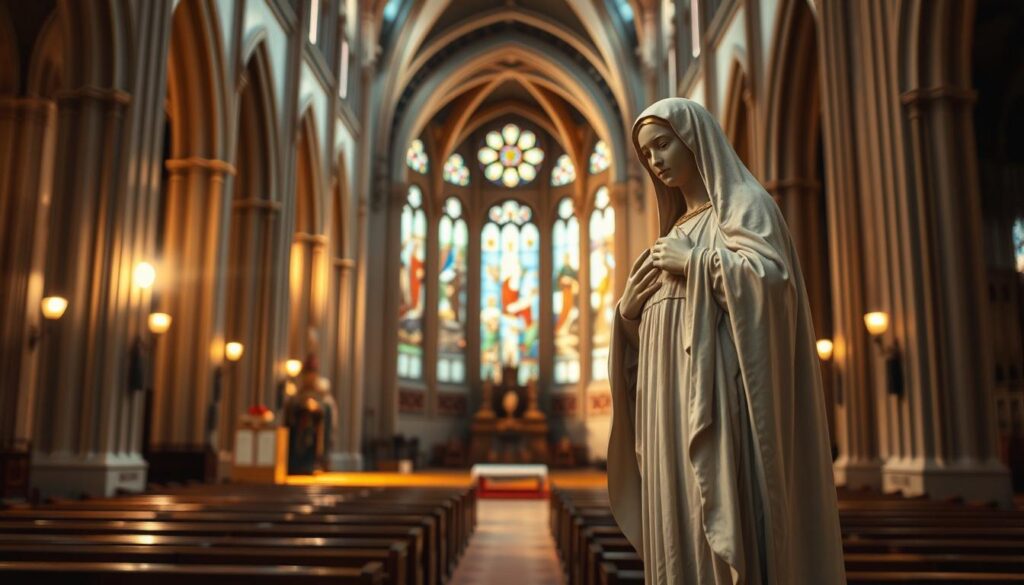
A grand cathedral interior, bathed in soft, warm lighting. In the foreground, a majestic statue of the Virgin Mary, her serene expression and gentle pose conveying a sense of reverence and devotion. The midground features ornate stained glass windows, casting multicolored hues across the scene. In the background, rows of wooden pews stretch out, suggesting a space for contemplation and prayer. The overall atmosphere is one of solemn beauty, inviting the viewer to reflect on the significance of Marian veneration in Catholic tradition, rather than worship.

Cultural Perspectives and Misunderstandings

In Mexico’s Basilica of Guadalupe, vibrant celebrations might seem overwhelming to visitors. Yet these traditions mirror how cultures express love through art and ritual. As one parishioner shared, “She helps focus my mind on Christ’s teachings—like a friend reminding you of what matters.”

When critics ask why churches display more Marian images than crosses, the answer lies in understanding symbolism. Saints’ images point to God’s work through people, not replacements for divine glory. Next time someone questions these practices, share these words: “We honor heroes in history books—why not spiritual heroes too?”

catholicism mary: Role of Mary in Shaping Faith

The story of Jesus’ family life offers profound insights into how parental influence shapes destiny. From teaching ancient prayers to modeling compassion, His mother’s role formed the bedrock of His human experience. Her example shows how everyday faithfulness prepares ordinary people for extraordinary purposes.

Foundations of Faith in Daily Life

In Nazareth’s humble home, Jewish traditions came alive through shared meals and festivals. A mother’s hands guided her son in memorizing Scripture long before His public ministry began. This domestic training became the way He later connected with diverse audiences through parables and teachings.

Scripture highlights pivotal moments where maternal presence mattered most. At Cana’s wedding feast, her attentive care sparked Jesus’ first miracle. Decades later, her steadfast part in His mission culminated beneath the cross—a scene etching eternal truths about love’s cost.

Life Stage Maternal Influence Spiritual Impact
Childhood Teaching prayers & traditions Shaped Messianic identity
Ministry Beginnings Encouraging first miracle Revealed divine authority
Crucifixion Witnessing sacrifice Established universal motherhood

Jesus’ final act of entrusting His mother to John carries layered meaning. Beyond practical care, it symbolized her spiritual embrace of all believers. As Pope Francis notes, “She walks with us always—a companion in hope.”

Today, this legacy inspires parents and mentors worldwide. Just as one woman’s “yes” changed history, ordinary acts of faith continue shaping souls in quiet, transformative ways.

The Marian Dogmas: Divine Motherhood and Immaculate Conception

At the heart of Christian doctrine lie two profound truths about Jesus’ mother. These teachings safeguard essential beliefs about Christ’s nature while honoring her unique role in salvation history.
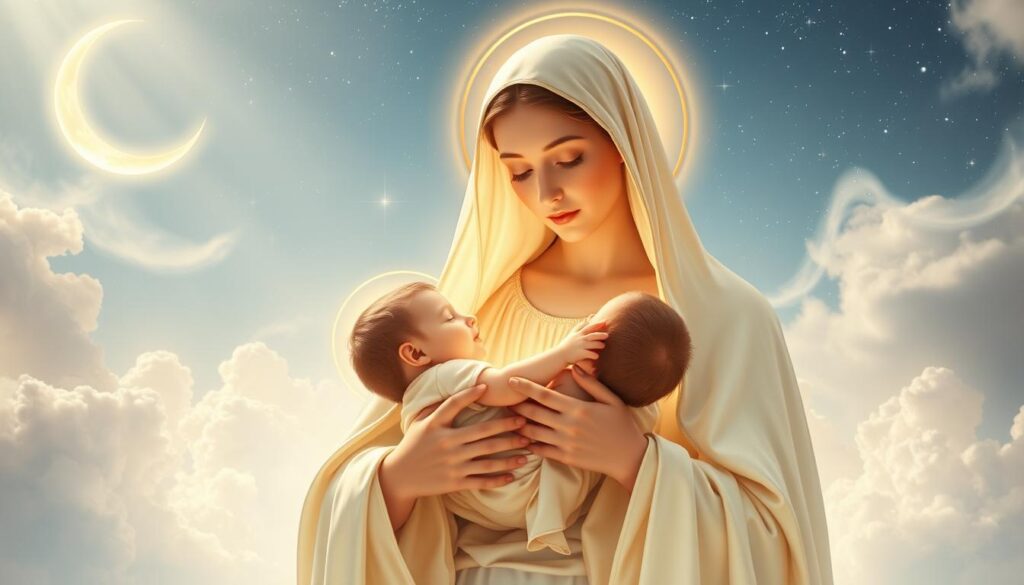
A majestic, ethereal vision of divine motherhood and immaculate conception. In the foreground, a serene and radiant Madonna, her features suffused with a heavenly glow, holds the infant Jesus tenderly in her arms. Delicate robes of pure white cascade around her, evoking a sense of purity and grace. The middle ground is bathed in a soft, heavenly light, with wispy clouds parting to reveal a celestial backdrop of shimmering stars and a luminous crescent moon. A halo of golden light encircles the Madonna, signifying her sacred status. The overall atmosphere is one of reverence, contemplation, and the profound mystery of the Incarnation.

Explaining Mary’s Divine Motherhood (Theotokos)

The Council of Ephesus settled a fiery debate in 431 AD. Church leaders declared: “If anyone does not confess… the Holy Virgin is the Mother of God… let him be anathema.” This title—Theotokos or “God-bearer”—protects Jesus’ dual nature as fully human and divine.

Calling her Mother of God doesn’t suggest she created divinity. Rather, it confirms the person born in Bethlehem was God incarnate. Early heresies tried splitting Christ’s humanity from His divinity—this dogma slammed that door shut.

Understanding the Immaculate Conception

Pope Pius IX’s 1854 declaration clarified a long-held belief. Mary was “preserved free from all stain of original sin” from her conception. This special grace prepared her to carry the Savior—like choosing pure soil for a sacred seed.

Three key points often get missed:

  • She needed redemption like everyone else—just through prevention rather than cure
  • Her sinlessness highlights God’s power, not her divinity
  • This privilege flowed from Christ’s future sacrifice on the cross

Together, these dogmas show how one person’s birth changed history. They remind believers that God works through ordinary people who say “yes” to extraordinary calls.

Perpetual Virginity and the Assumption: Beyond Human Motherhood

Two profound teachings illuminate how spiritual motherhood transcends physical limits. These doctrines reveal divine truths about human dignity and God’s power to reshape nature through grace.

Historical Roots of Sacred Beliefs

The Second Council of Constantinople (553 AD) affirmed Mary as Aeiparthenos“Perpetual Virgin”. This meant her virginity remained intact before, during, and after Jesus’ birth. Early theologians compared this miracle to “light passing through glass”, leaving no mark.

Centuries later, Pope Pius XII declared the Assumption dogma in 1950. It states she was taken “body and soul into heaven” at life’s end. Unlike others, her body avoided decay—a fitting honor for the mother of God.

Dogma Year Defined Core Belief
Perpetual Virginity 553 AD Virgin before, during, after birth
Assumption 1950 Body & soul ascended to heaven

Relevance in Contemporary Spirituality

These teachings aren’t ancient curiosities. They inspire believers to see their own bodies as temples of grace. Just as the mother of God mirrored divine purity, ordinary people can reflect holiness through daily choices.

Modern artists often depict her Assumption as a dance between earth and heaven. One mural in Chicago shows her rising amid diverse faces—a reminder that sacred truths unite all generations.

Scriptural Foundations and Old Testament Types of Mary

Biblical texts weave intricate connections between ancient symbols and New Testament figures. These patterns reveal how God’s plan unfolds across generations, linking sacred objects to living revelation. Let’s explore how Scripture frames the mother of Jesus through prophetic echoes.

Insights from Luke 1:43 and Biblical Parallels

Elizabeth’s joyful cry—“Why is this granted me, that the mother of my Lord should come to me?”—holds deeper meaning. Her words mirror David’s awe when the Ark approached: “How can the ark of the Lord come to me?” (2 Samuel 6:9). Both moments show human wonder at divine presence breaking into daily life.
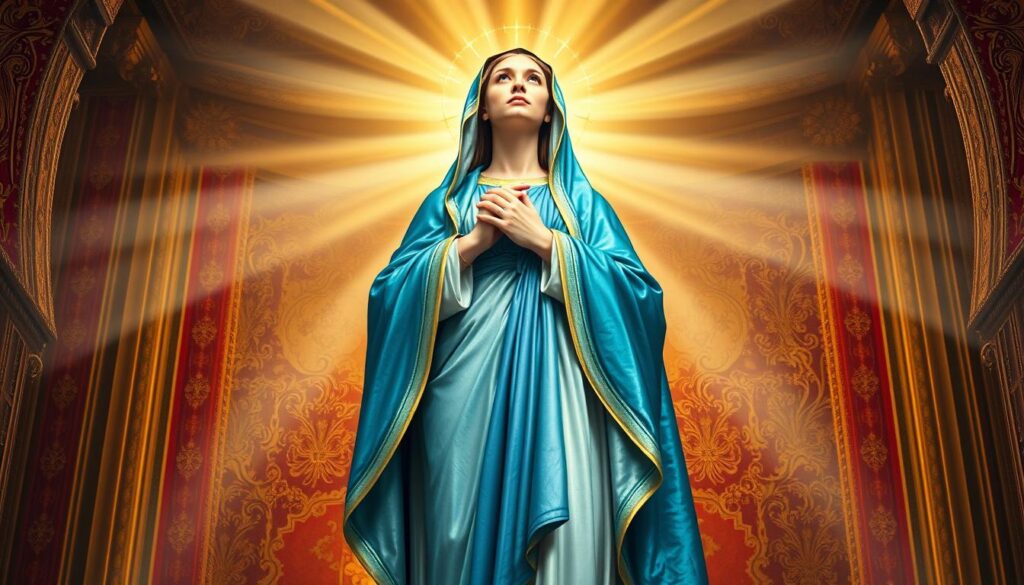
A majestic, full-length portrait of the Blessed Virgin Mary, standing tall and radiant, depicted as the New Testament Ark of the Covenant. She is swathed in a shimmering blue robe, her hands reverently clasped, gazing heavenward with a serene, contemplative expression. Beams of heavenly light emanate from behind her, casting a warm, ethereal glow upon her figure. In the background, a rich, ornate tapestry of gold and crimson hues evokes the grandeur of the ancient temple. The composition is balanced and symmetrical, emphasizing Mary's central role as the vessel chosen to carry the Divine Word made flesh. The overall tone is one of profound reverence and spiritual contemplation.

Mary as the New Testament Ark of the Covenant

Just as the Ark held God’s word etched in stone, Mary carried the living Word made fleshJesus Christ. The parallels run deeper than surface comparisons:

Old Testament Ark New Testament Figure Divine Connection
Contained manna & commandments Bore the Bread of Life Nourishes spiritual hunger
Brought victory to Israel Delivered the Savior Secures eternal triumph
Dwelt among people 3 months Stayed with Elizabeth 3 months Extended blessings through presence

John’s leap in Elizabeth’s womb mirrors David’s dance—both responses to sacred encounters. This pattern shows how God uses physical signs to awaken spiritual revelation. As the original Ark radiated holiness, so the mother of the Lord becomes a living sanctuary bearing God’s ultimate gift.

Cultural Impact: Marian Devotions in Modern Catholic Life

Across bustling cities and quiet villages, a shared spiritual heritage comes alive through vibrant traditions. These practices bridge generations while adapting to local rhythms—proof that timeless truths thrive in every time and place.

Where Global Faith Meets Local Flavor

In Guadalajara, schools close for the day as thousands march to la Basilica de Nuestra Señora de Zapopan. The air thrums with mariachi hymns during La Natividad de Maria—a festival blending pre-Hispanic dances with Eucharistic processions. Meanwhile, Polish communities honor the Black Madonna of Czestochowa through folk art and family storytelling.

These expressions share a common thread: devotion to Jesus’ mother inspires acts of unity. Rival gangs in El Salvador lay down weapons to decorate her shrines. Filipino fishermen weave floral floats for coastal parades. Each tradition becomes a way to live faith through culture.

The fruits? Renewed commitment to charity, healed relationships, and doors opening for society’s forgotten. As one organizer notes, “When we honor her, we rediscover what matters—life becomes about serving others.” From rosary groups to grand processions, these living traditions keep ancient love burning bright.

FAQ

Why is Mary called the "Mother of God"?

This title reflects her role as the mother of Jesus Christ, who is fully divine and human. Early Church councils affirmed it to emphasize that Christ’s divine and human natures are inseparable, making her motherhood central to Christian faith.

Do Catholics worship Mary like God?

No. Catholics honor her as the greatest saint and model of faith, but worship is reserved for God alone. Prayers to her ask for intercession, not divine power—similar to asking a friend to pray for you.

What does the Immaculate Conception mean?

It refers to the belief that Mary was preserved from original sin from the moment of her conception. This prepared her to bear Jesus, the Savior, while affirming her humanity and reliance on God’s grace.

How does Mary’s Assumption relate to believers today?

Her bodily ascent to heaven symbolizes hope for eternal life. It reminds believers that God’s promises extend beyond earthly struggles, offering a glimpse of redemption for both soul and body.

Why is Mary called the "New Ark of the Covenant"?

Just as the Ark held sacred items in the Old Testament, she carried Christ—the Word made flesh. This parallel highlights her unique role in salvation history as a bearer of divine presence.

Are Marian devotions required in Catholic practice?

While not mandatory, many find prayers like the Rosary or feast days enriching. These practices deepen reflection on Christ’s life through her witness, fostering spiritual growth and community connection.

How do different cultures celebrate Mary’s role?

From processions in Latin America to Marian hymns in Africa, local traditions blend universal teachings with cultural expressions. These celebrations highlight her enduring relevance across diverse communities.
Catholicism in India: Exploring the Faith’s Rich History


India’s vibrant spiritual landscape thrives on diversity. Though officially secular, over 80% of its people practice Hinduism, while countless other faiths coexist. Among them, a centuries-old Christian tradition has grown into one of Asia’s most dynamic communities. With over 23 million followers, this branch of Christianity forms the second-largest such population on the continent.

What makes this group stand out? Their practices blend global traditions with local customs. Roadside shrines glow with marigold garlands, while processions burst with music and color. These displays reflect a devotional energy rarely seen in Western churches. Nearly 11,000 parishes operate nationwide, organized into 174 dioceses that bridge ancient and modern ways of worship.

Southern states like Kerala and Goa serve as cultural hubs. Here, Christian populations reach up to 26%, creating pockets where faith shapes daily life. Yet even as a minority, believers influence education, healthcare, and social services nationwide. Their story isn’t about isolation but integration—a living example of how religious pluralism can enrich both society and spiritual practice.

Key Takeaways

  • India’s secular framework supports diverse faiths, including a thriving Christian community with over 23 million members
  • Catholic traditions here emphasize public devotion through festivals, shrines, and community events
  • Southern regions like Kerala and Goa have the highest concentration of believers, shaping local culture
  • The church maintains 10,701 parishes nationwide, showcasing its organizational reach
  • Indian Catholicism uniquely blends global religious practices with regional customs
  • Despite being 1.57% of the population, Catholics significantly impact education and social services

Historical Evolution and Early Influences

Apostle Thomas’s journey in the first century laid the groundwork for one of the world’s oldest Christian communities. By 52 AD, he reportedly landed on southern India‘s Malabar Coast, establishing seven churches that still trace origins to his missionary work. His martyrdom two decades later sparked a spiritual legacy thriving today.

These early believers, called Nasrani, blended Middle Eastern traditions with local culture. When Persian bishops began overseeing the community in the 300s, they brought East Syriac liturgy—creating worship styles distinct from European Christianity. This fusion birthed an unbroken chain of faith lasting nineteen centuries.

Origins of Christianity and the Impact of Apostle Thomas

Thomas’s arrival predates most European Christian movements by 1,500 years. The churches he founded became hubs for trade and spirituality along spice routes. Followers maintained their identity through oral histories and Syriac scriptures, even as Hindu kingdoms ruled the land.

Early Eastern and Syriac Liturgical Traditions

Persian influence shaped unique practices still seen today. Local priests adopted East Syriac chants while incorporating native languages. Palm-leaf manuscripts preserved prayers, showing how early believers balanced global religion with regional devotion.

FAQ

How did Christianity first arrive in the country?

Tradition holds that the Apostle Thomas brought the faith to southern regions in 52 CE. His missionary work established early communities, particularly in Kerala, blending local customs with Syriac Christian practices.

What makes the Syro-Malabar Church distinct?

This ancient community follows East Syriac rites, preserving traditions like the Qurbana liturgy. Its practices reflect centuries of cultural exchange while maintaining unity with Rome.

Are there legal protections for religious minorities?

Yes, the constitution guarantees freedom of worship. However, some states enforce anti-conversion laws, requiring permits for public expressions of faith to prevent coerced changes in religion.

How does local culture influence devotional practices?

Vibrant festivals like St. Sebastian’s feast in Mumbai blend processions, floral offerings, and traditional music. Many shrines, such as Velankanni’s Basilica, attract interfaith pilgrims seeking healing.

Which regions have significant follower populations?

Kerala and Tamil Nadu host over 60% of adherents. Communities also thrive in Goa, Mangaluru, and parts of Uttar Pradesh, often centered around historic Portuguese-era churches.

What role did St. Francis Xavier play locally?

The Jesuit missionary revitalized coastal communities in the 16th century. His tomb in Goa remains a major pilgrimage site, symbolizing the Counter-Reformation’s global reach.

Do modern challenges affect these communities?

Urbanization and emigration impact rural parishes. Debates continue about inculturating rituals while preserving ancient traditions, alongside interdenominational dialogues addressing social justice issues.

Catholic 1st Communion: A Meaningful Milestone


For many families, witnessing a young person participate in their initial Eucharistic celebration stands as one of the most cherished moments in their spiritual growth. This sacred tradition symbolizes a child’s growing connection to their religious community and deeper understanding of shared beliefs.

The ceremony typically occurs when children reach the age of reason, usually around seven or eight years old. During this event, they publicly affirm their commitment to values taught through family and faith education. Preparation often involves months of learning through catechism classes, where participants explore the symbolism behind rituals and prayers.

Families frequently mark the occasion with intimate gatherings and meaningful tokens of support. White garments worn during the service represent purity, while gifts like rosaries or religious keepsakes serve as lasting reminders of this pivotal day. These customs help create lasting memories while reinforcing the individual’s role within their spiritual community.

Key Takeaways

  • Celebrates a child’s first reception of the Eucharist in Catholic tradition
  • Requires preparation through religious education and spiritual reflection
  • Features symbolic white clothing representing spiritual purity
  • Often accompanied by family celebrations and meaningful gift exchanges
  • Strengthens connection to faith community through shared rituals

The Sacred Meaning Behind First Holy Communion

At the heart of this sacred rite lies a connection to Jesus’ final meal with his followers. The moment when a child receives the Eucharist for the first time echoes events described in scripture, creating a bridge between ancient traditions and modern faith practices.

Historical Roots in Scripture

The practice traces back to the Last Supper, where Jesus shared bread and wine with his disciples. According to Luke 22:19-20, he called these elements his “body given for you” and “blood poured out for many.” This act established what would become a central ritual for believers worldwide.

Element Last Supper Modern Practice
Bread Unleavened loaf Consecrated host
Wine Shared cup Sacramental chalice
Significance Memorial of sacrifice Living remembrance

Spiritual Sustenance Today

Through transubstantiation, ordinary bread and wine become sacred symbols of divine love. The Catechism describes this sacrament as the “source and summit of Christian life”, emphasizing its role in spiritual growth. Participants don’t just remember history – they join a chain of faith stretching back generations.

Families often find deeper meaning in the ceremony when understanding its biblical roots. The shared meal creates unity, reminding everyone present of their connection to something greater than themselves.

Preparing for the Sacrament: Steps and Traditions

Families embark on a structured journey to prepare young members for their inaugural participation in the Eucharist. This process blends formal education with personal spiritual growth, creating a foundation for lifelong faith practices.

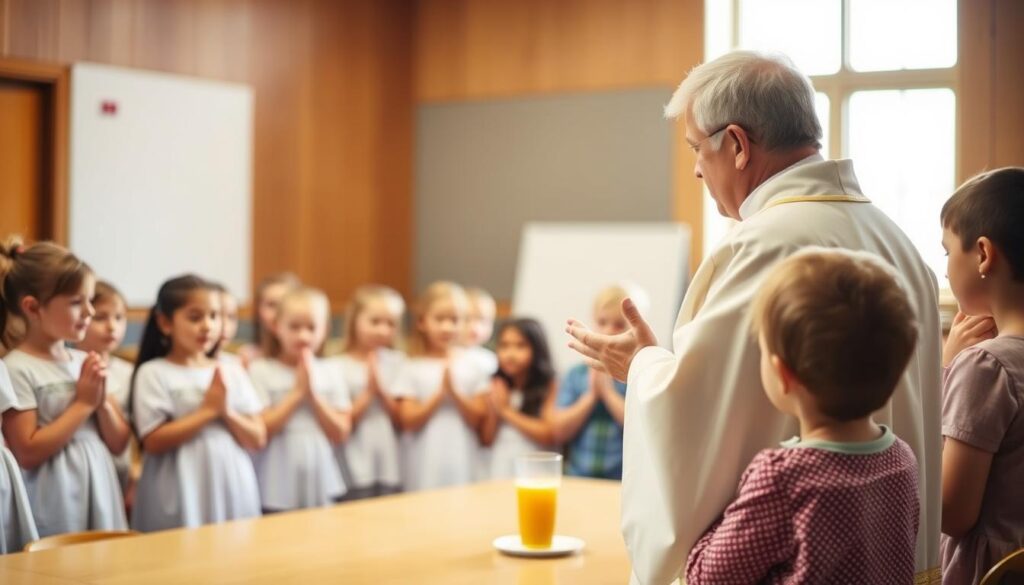
A serene classroom setting, with a group of children gathered around a table, their hands clasped, and their faces filled with reverence. The lighting is soft and warm, casting a gentle glow over the scene. In the foreground, a priest or teacher stands, guiding the children through the steps and traditions of their first holy communion, their robes flowing gracefully as they speak. The background is blurred, allowing the focus to remain on the sacred moment unfolding before us, a testament to the significance of this important milestone in a young Catholic's life.

Spiritual Preparation and Catechism Classes

Weekly faith education sessions form the backbone of preparation. These gatherings typically run from September through May, aligning with the school calendar. Children explore core beliefs through interactive lessons and age-appropriate activities.

Parents partner with instructors to reinforce concepts at home. Discussions about sacramental symbolism help young participants grasp the difference between everyday meals and sacred rituals. Many programs include hands-on experiences like mock ceremonies to build comfort and understanding.

Class Element Purpose Frequency
Scripture Study Build biblical knowledge Weekly
Prayer Practice Develop spiritual habits Daily
Sacrament Review Clarify ritual meanings Monthly

The Importance of Confession and State of Grace

Before receiving the Eucharist, children complete their first reconciliation. This sacrament emphasizes personal accountability and spiritual renewal. Instructors gently guide participants through the process, explaining how forgiveness strengthens their connection to divine love.

The age requirement traces back to 1910 church reforms, making the sacrament accessible to younger believers. Local parishes adapt national guidelines to meet community needs while maintaining essential traditions. Most programs conclude with spring ceremonies that unite families in celebration and reflection.

Traditions and Celebrations: From Mass to Family Gatherings

The day a child participates in their inaugural Eucharistic celebration weaves together time-honored customs and heartfelt community connections. From the carefully chosen garments to the shared meals afterward, every detail carries layers of meaning that transcend generations.

Ceremonial Elements and Symbolism

White garments dominate the ceremony, reflecting spiritual renewal. Girls often wear lace-trimmed dresses with floral headpieces, while boys sport crisp suits or traditional cultural attire. As they approach the altar, many carry candles symbolizing their growing faith – a moment families frequently preserve through photography.

Churches enhance the sacred atmosphere with fresh lilies or roses near the cross. Religious medals gifted by godparents often glint beneath chapel lights during the service. These visual elements transform the space into a living tapestry of belief and heritage.

Cultural Variations in Communal Celebrations

Global interpretations add vibrant diversity to this milestone. In Mexico and Argentina, boys march in miniature military regalia with gold-trimmed sashes. German and Spanish girls process in bridal-inspired gowns, their veils fluttering like whispered prayers.

Post-ceremony gatherings burst with regional flavors. Filipino families might serve bibingka rice cakes after December services, while Italian relatives toast with spumante. Whether hosting backyard barbecues or banquet hall receptions, these celebrations unite extended family and friends in joyful affirmation of a child’s spiritual journey.

Planning Your First Communion Event: Attire, Gift Ideas, and More

Creating memorable moments for this spiritual milestone involves thoughtful preparation. Balancing tradition with personal touches ensures the day remains focused on its sacred purpose while celebrating the individual’s journey.

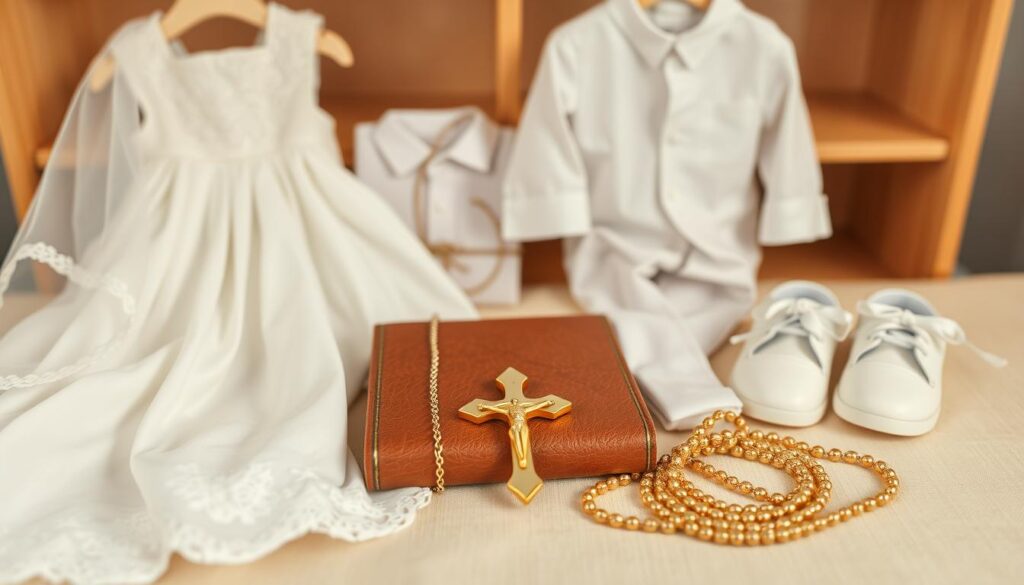
A neatly arranged display of first communion attire and gifts. In the foreground, a crisp white dress with delicate lace accents and a flowing veil cascades gracefully. Alongside, a pristine white suit with a pressed shirt and polished shoes. In the middle ground, a shimmering gold cross pendant on a simple chain, a leather-bound prayer book, and a rosary with gleaming beads. The background features a soft, warm-toned setting, perhaps a wooden table or shelves, creating a reverent, spiritual atmosphere. The lighting is soft and diffused, highlighting the elegance and significance of these sacred communion accessories.

Choosing the Right Dress and Suit

White garments carry deep symbolism, reflecting spiritual renewal. Girls often select dresses with delicate lace or embroidered accents, while boys opt for tailored suits in classic colors. Comfort remains key – itchy fabrics or tight collars can distract from the ceremony’s meaning.

Many families incorporate heirloom pieces like a grandmother’s veil or a cousin’s tie. This connects generations while honoring tradition. “The most important thing is that they’re prepared spiritually,” reminds one parish guide, emphasizing substance over style.

Thoughtful Gift Ideas and Card Messages

Meaningful presents support ongoing faith development. Consider items that grow with the child:

Gift Type Traditional Options Modern Alternatives
Religious Items Engraved rosaries Interactive prayer journals
Keepsakes Scripture plaques Personalized blessing rings
Financial Gifts Savings bonds Donation to faith-based charity

Card messages should celebrate both the person and their commitment. Try: “May this special time strengthen your connection to God’s love every day.” Pair written blessings with practical gifts that encourage daily spiritual practice at home.

Deep Dive into catholic 1st communion Rituals

The journey toward spiritual milestones involves both physical actions and heartfelt intentions. This combination shines through in the careful preparation and execution of sacred rituals surrounding the Eucharistic celebration.

Understanding the Rituals of Receiving the Eucharist

Approaching the altar requires specific etiquette taught during preparation. Children learn to walk with folded hands while joining the congregation in song, creating a unified movement toward spiritual nourishment.

The pivotal moment comes when the priest presents the consecrated host, declaring: “The body of Christ.” A confident “Amen” affirms the child’s belief in this sacred mystery. Many families practice this response using unconsecrated bread at home to build comfort.

Incorporating Parish and Family Traditions

Local customs add unique flavors to this universal sacrament. Some parishes offer both bread and wine, while others focus solely on the host. These variations highlight different theological emphases within shared beliefs.

Family participation often includes:

  • Special blessings from grandparents before the ceremony
  • Heirloom prayer books carried to the altar
  • Post-Mass gatherings featuring faith-themed decorations

Photography sessions after services help preserve memories of this transformative experience. These images often become treasured reminders of a child’s growing connection to their spiritual community through shared sacred meals.

Conclusion

Marking a pivotal step in spiritual growth, this sacred event bridges generations through shared belief. Young participants, typically aged seven or eight, prepare through months of learning and reflection. Their journey culminates in a ceremony where they join their faith community in receiving the Eucharist for the first time.

Families and parishes come together to honor this milestone. The shared experience reinforces a child’s role within their spiritual family. Lessons about commitment and belonging take root during preparation, shaping lifelong connections to tradition.

Memories created through white garments, special gifts, and family gatherings become touchstones of faith. These moments remind everyone present of love’s enduring power within their community. May each participant carry this sacred connection forward, guided by the light of shared beliefs.

FAQ

What is the significance of receiving the Eucharist for the first time?

This sacrament marks a child’s initiation into full participation in the Church. It symbolizes their acceptance of Jesus’ body and blood, reinforcing their bond with the faith community.

How do families typically prepare for this sacrament?

Preparation often includes catechism classes, attending Mass regularly, and participating in confession. Many parishes require children to complete a faith formation program before the ceremony.

Are there specific clothing traditions for the occasion?

Girls often wear white dresses or gowns, while boys may wear suits or dress shirts with ties. These outfits symbolize purity and reverence, though styles can vary based on cultural or regional customs.

What are meaningful gift ideas for this milestone?

Popular choices include personalized Bibles, rosaries, crosses, or religious jewelry. Keepsakes like engraved photo frames or faith-themed books from brands like Hallmark or Eternal Gift also make heartfelt presents.

How do parishes incorporate family traditions into the ceremony?

Some churches allow families to present symbolic items, like candles or prayer books, during Mass. Others invite relatives to participate in readings or blessings, blending personal rituals with the official liturgy.

Why is confession important before receiving the Eucharist?

Catholics believe being in a state of grace—free from serious sin—is essential to receiving the sacrament. Confession helps children spiritually prepare and reflect on their commitment to faith.

How do cultural celebrations differ for this event?

In some communities, large family feasts follow the Mass, while others host smaller gatherings. For example, Hispanic families might include padrinos (godparents) in rituals, highlighting cultural heritage alongside religious practices.

Inspiring Catholic Quotes to Uplift Your Day


Words of faith have a unique way of lighting up even ordinary days. For centuries, spiritual wisdom from holy figures has guided people through life’s ups and downs. As Mother Teresa once shared: “If we have no peace, it is because we have forgotten that we belong to each other.” These timeless messages continue to bring comfort and clarity today.

Sacred sayings act like mirrors for the soul. They help us pause and reflect during busy routines. St. Jerome’s advice – “Be at peace with your own soul” – shows how inner calm shapes our view of the world. Such phrases become companions for modern life, fitting naturally into morning coffee breaks or commutes.

What makes these teachings special? They speak directly to universal experiences. Whether facing challenges or celebrating joy, the right words can reframe our perspective. This spiritual toolkit helps believers stay grounded while navigating today’s fast-paced world.

Key Takeaways

  • Ancient wisdom offers practical guidance for modern daily life
  • Short spiritual sayings fit easily into busy schedules
  • Sacred texts address universal emotions like hope and belonging
  • Regular reflection builds inner peace and resilience
  • Historical figures’ experiences remain relevant today

Diving into Inspiring catholic quotes

Guiding lights from holy figures often become anchors in life’s storms. St. Francis de Sales once advised: “Do not lose your inner peace for anything whatsoever… lead your heart back to Him quietly.” This blend of practicality and devotion shows how spiritual wisdom bridges daily struggles and eternal truths.

Reflecting on Faith and Love

Sacred teachings remind us that love grows through small, consistent acts. St. Paul of the Cross linked humility to peace: “From gentle hearts flow serenity and every good.” These words transform abstract concepts into roadmaps for handling conflicts or showing kindness.

When faith feels distant, such insights act like compasses. They don’t demand grand gestures – just sincere efforts to reconnect. A morning prayer or mindful pause can realign priorities with deeper values.

Words That Encourage Daily Meditation

Brief spiritual phrases fit naturally into hectic routines. Repeating meaningful words during chores or commutes turns mundane moments into conversations with the Divine. This practice builds resilience against life’s chaos.

Over time, these reflections reshape perspectives. What once felt like burdens become chances to extend mercy – both to others and ourselves. That’s the quiet power of weaving sacred wisdom into ordinary days.

Quotes for Every Moment: Faith, Love, and Charity

Timeless words from spiritual guides turn ordinary actions into sacred opportunities. Venerable Fulton Sheen’s bold challenge – “Waste yourself, give yourself to others!” – sparks a fire in the heart. St. Vincent de Paul sharpens our focus: “Our business is to gain heaven, everything else is a sheer waste of time.” These voices remind us that true purpose lives in serving others.

A serene, dimly lit interior with warm, glowing candlelight casting a soft, reverent ambiance. In the foreground, a collection of Catholic religious iconography and symbolic objects - a crucifix, rosary beads, a Bible, and a small statue of the Virgin Mary. In the middle ground, handwritten calligraphic quotes on parchment paper expressing themes of charity, compassion, and faith, delicately illuminated. The background fades into a hazy, ethereal atmosphere, suggesting a sense of transcendence and the divine. Lensed with a shallow depth of field to emphasize the focal elements and create a contemplative, meditative mood.

Motivational Sayings for the Heart

Great teachers show how love reshapes priorities. When we pour energy into helping people, we mirror divine generosity. Simple acts – a listening ear or shared meal – become bridges connecting souls.

This mindset transforms daily routines. Holding doors open or donating unused clothes stops feeling trivial. Instead, these gestures radiate compassion in a world craving connection.

Inspiring Thoughts on Charity and Compassion

Authentic service starts by seeing value in everyone. As Mother Teresa demonstrated, recognizing shared humanity fuels meaningful action. It’s not about grand plans but consistent care for others’ needs.

True charity thrives in practical steps. Packing groceries for neighbors or writing encouragement notes plants seeds of hope. These efforts don’t just help people – they awaken our own hearts to life’s deeper joys.

Timeless Wisdom from Saints and Leaders

Spiritual giants across generations show how ordinary lives become extraordinary through devotion. Their words and actions create blueprints for living with purpose.

Mother Teresa and Her Legacy

Mother Teresa redefined holiness as “faith in action”. Her call to serve the poorest wasn’t about grand gestures. “If you can’t feed a hundred people, feed just one,” she advised. This practical approach makes sainthood feel achievable for busy modern lives.

Teachings from Padre Pio and Maximilian Kolbe

Padre Pio challenged comfort zones: “We must humble ourselves… we love comfort too much.” His emphasis on small sacrifices – like skipping dessert or holding sharp words – builds spiritual muscle.

Maximilian Kolbe took this further. Preparing for Auschwitz, he wrote: “For Jesus Christ I am prepared to suffer still more.” His life proves courage grows when we frame hardships as gifts to heaven.

Insights from Pope St. John Paul and St. Vincent de Paul

Pope St. John Paul II transformed pain’s meaning. He taught that suffering, when united with Christ’s, becomes “a channel for grace”. This perspective helps people endure chemo sessions or job losses with hope.

St. Vincent de Paul balanced zeal with wisdom. “Perfection consists in persevering,” he noted. His focus on steady growth – not overnight sainthood – prevents burnout in spiritual journeys.

The Role of Suffering in Spiritual Growth

Life’s toughest trials often hide unexpected gifts. Spiritual teachers remind us that pain, when carried with purpose, becomes a bridge to deeper understanding. A serene, contemplative figure kneeling in a dimly lit chapel, rays of soft, golden light streaming through stained glass windows, casting a warm, ethereal glow. In the foreground, a crucifix stands as a symbol of redemptive suffering, while the figure's expression reflects a profound inner journey of spiritual growth and transformation. The background is hazy, with a sense of timelessness, emphasizing the meditative, introspective nature of the scene. The overall atmosphere conveys a sense of reverence, solace, and the transcendent power of faith to find meaning in life's challenges.

Understanding Redemptive Suffering

St. Rose of Lima put it plainly: “Apart from the cross, there’s no ladder to heaven.” This truth reshapes how we view hardships. When united with Jesus Christ‘s passion, our struggles gain eternal meaning.

St. Maximilian Kolbe showed this during dark times. He taught that suffering becomes holy ground – a place to receive grace. It’s not about seeking pain, but using it to help souls.

Embracing the Lessons of the Cross

St. Augustine noticed something vital: “God’s sinless son still faced suffering.” The cross teaches us to transform agony into love. Like St. Faustina’s vision shows – pleasure fades, but purposeful pain leads upward.

How does this work daily? Aching joints during prayer become offerings. Harsh words swallowed quietly help heal the world. Each small “yes” to hardship fans spiritual fire within.

Conclusion

The wisdom of saints lights our path through modern life’s twists. St. Francis showed how daily choices become stepping stones to heaven, while St. Peter’s journey reminds us that imperfect efforts still move souls. Their words aren’t relics – they’re roadmaps for finding joy in laundry piles and traffic jams.

Simple habits make this wisdom stick. A morning prayer reshapes hectic days. Holding the door for strangers becomes mercy in motion. These small yeses to love God and neighbor transform ordinary moments into eternal milestones.

True happiness blooms when we stop chasing perfect conditions. As the saints proved, radiant faith grows through steady acts – not grand gestures. Their collected quotes invite us to build heaven’s kingdom right here, one compassionate choice at a time.

Carry these lessons forward. Let them soften your heart during conflicts and fuel hope when the world feels heavy. That’s how ordinary lives become extraordinary – by scattering light wherever we walk.

FAQ

How can reflecting on faith and love through quotes deepen daily meditation?

Focusing on themes like grace, mercy, and the heart in spiritual sayings helps quiet the mind. This creates space to connect with God’s presence in ordinary moments, turning routine into prayer.

Why are saints like Mother Teresa and Padre Pio often quoted in discussions about charity?

Their lives embodied selflessness. Mother Teresa’s call to “do small things with great love” and Padre Pio’s emphasis on serving others highlight how compassion transforms both giver and receiver.

What role does suffering play in spiritual growth according to these teachings?

Figures like Maximilian Kolbe saw suffering as a way to unite with Christ’s sacrifice. Embracing life’s crosses with trust can refine the soul and inspire hope amid trials.

How do motivational sayings from leaders like Pope St. John Paul II apply to modern life?

His message to “be not afraid” encourages courage in uncertainty. Such wisdom reminds us that joy and purpose come from living authentically, even in a fast-paced world.

Can quotes about joy and mercy truly uplift someone during difficult times?

Yes. Words like St. Francis de Sales’ “Nothing is so strong as gentleness” act as anchors. They redirect focus from despair to God’s unwavering love, renewing inner peace.

Catholicism in England: Tracing Its Remarkable Journey


Imagine a faith surviving centuries of turmoil to become one of England’s most vibrant religious forces. That’s the extraordinary story unfolding across this nation, where ancient traditions meet modern vitality.

Recent reports reveal a stunning shift: Roman Catholic services now draw more regular attendees than Anglican ones. Young people particularly favor this revived church community, with London leading this cultural transformation. This reversal would astonish Henry VIII, whose 16th-century break with Rome shaped England’s religious identity.

How did a marginalized faith regain such influence? The answer lies in dramatic historical turns – from Reformation-era persecution to today’s multicultural cities. While the country grows more secular overall, Catholic communities thrive through immigration and renewed spiritual interest.

This resurgence defies expectations. As the birthplace of Anglicanism, England’s evolving religious landscape shows how deep-rooted traditions can adapt. Our exploration will uncover pivotal moments that preserved Catholic identity and examine what this shift means for society today.

Key Takeaways

  • England’s Catholic community now outnumbers Anglican worshippers in weekly attendance
  • Younger generations drive this religious shift, particularly in urban centers like London
  • The faith’s revival contrasts with its centuries of suppression after the Reformation
  • Modern growth stems from immigration and renewed interest in traditional practices
  • This transformation challenges assumptions about secularization in Western societies

Historical Roots and Transformations

Hidden beneath modern cities lie echoes of a spiritual past waiting to be uncovered. Visitors exploring the church england network often stumble upon medieval treasures – priestly robes in display cases, faded frescoes peeking through plaster, and altars repurposed during turbulent times.

Ancient Foundations That Shaped a Nation

For over 1,000 years, early Christian communities built stone monasteries that became hubs of learning. These sites housed illuminated manuscripts and trained scholars who shaped England’s religion and culture. Gothic cathedrals like Canterbury became pilgrimage destinations, their walls echoing with prayers to saints like Thomas Becket.

Aspect Pre-Reformation Influence Post-Reformation Changes
Religious Sites 1,200+ monasteries 80% destroyed/dissolved
Education Church-run universities State-controlled colleges
Art Vibrant wall paintings Whitewashed surfaces
Land Ownership 25% church-held Crown redistribution

Reformation’s Enduring Mark

The 16th-century religious upheaval left visible scars. At Stratford-Upon-Avon’s Guildhall, clever preservation saved Catholic artworks beneath Protestant paint. Bath Abbey’s current structure stands where a catholic church once hosted pilgrims. These physical reminders show how England’s spiritual roots survived suppression.

Westminster Abbey’s Shrine of St. Edward reveals another layer. Though modified over years, its medieval carvings still draw those seeking connections to the past. Such sites prove that history never fully disappears – it simply waits to be rediscovered.

Modern Trends: catholicism in england and its Renewed Conviction

A quiet revolution is reshaping Sunday mornings across Britain. Recent attendance reports reveal a stunning reversal: Catholic worshippers now regularly outnumber Anglicans during weekly services. This marks the first time since the Reformation that the nation’s religious majority has shifted so dramatically.

A serene church interior, bathed in warm, soft lighting. In the foreground, a group of young adults - men and women, some in casual attire, others in modest religious garb - seated attentively, their faces reflecting a sense of reverence and contemplation. The middle ground reveals the ornate architectural details of the church - intricate stained glass windows, carved wooden pews, and a grand altar adorned with religious symbols. In the background, a sense of community and togetherness, as more parishioners file in, their expressions conveying a renewed spiritual conviction and dedication to their faith.

The Shift in Church Attendance and Active Participation

Young adults drive this transformation. Among 18-24 year-olds, Catholics outnumber Anglicans by more than double – 41% versus 20% in recent surveys. Even more surprising? Young men lead the charge, with 21% attending monthly services compared to 12% of women their age.

What’s drawing them in? Many cite the appeal of time-honored rituals and clear doctrinal guidance. As one London university student shared: “The ancient traditions feel grounding in our fast-paced world.” This contrasts with declining Anglican numbers, where flexible approaches seem less compelling to younger generations.

While pandemic impacts linger, Catholic mass attendance shows steady growth. Anglican services, meanwhile, continue their decades-long slide. Experts predict this trend will accelerate as older Anglican congregants dwindle and youthful Catholic communities expand.

Generational Shifts and Changing Church Demographics

A surprising spiritual awakening is reshaping religious life across Britain’s cities. Recent studies reveal young people aged 18-24 now rank as the nation’s second most committed church attendees – trailing only seniors over 65.

The Rise of Young Catholics and Increased Engagement

Sixteen percent of 18-to-24-year-olds attend services monthly compared to 19% among pensioners. What makes this group unique? Thirty-three percent express strong belief in divine power – 10% higher than the general population. Nearly a quarter pray daily, forming deep spiritual connections early in life.

Age Group Monthly Attendance Daily Prayer Belief in Higher Power
18-24 16% 23% 33%
25-64 12% 15% 27%
65+ 19% 18% 29%

Gender Dynamics and Evolving Patterns of Mass Attendance

Traditional patterns have flipped completely. Young men now outpace women in religious participation – 21% versus 12% attend monthly services. This reversal suggests many young people crave structured communities amid modern uncertainties.

These shifts reveal more than temporary trends. As one theology student noted: “We’re not checking boxes – we’re building lives around faith.” With fresh energy transforming ancient traditions, England’s religious landscape enters an unexpected new chapter.

Cultural Impact on Community and Society

England’s ancient stones whisper stories of faith to modern seekers. Historic churches now serve dual roles as spiritual centers and cultural landmarks, drawing both worshippers and curious visitors. These living monuments bridge past and present through preserved rituals and restored architecture.

A grand cathedral stands tall, its intricate Gothic architecture adorned with centuries-old stonework. Sunlight filters through stained glass windows, casting a warm, reverent glow upon the ornate interior. Wooden pews and ornate altars bear witness to the rich cultural heritage of Catholicism in England. In the foreground, worshippers kneel in quiet contemplation, their faces illuminated by the soft light. The scene evokes a sense of timelessness, where the past and present intertwine, reflecting the enduring influence of Catholic traditions on the community and society.

Heritage Sites, Pilgrimages, and the Revival of Tradition

Pilgrimage routes see renewed interest as travelers seek meaning beyond guidebooks. At Bath Abbey – nicknamed “the lantern of the West” – sunlight streams through stained glass onto visitors attending mass where medieval believers once prayed. Similar transformations occur at Westminster Abbey, where St. Edward’s shrine attracts historians and devotees alike.

Site Historical Significance Modern Use
Bath Abbey Medieval pilgrimage center Active worship & tourism hub
Tower of London Martyrs’ execution site Commemorative services
Stratford-Upon-Avon Shakespeare’s Catholic school Art preservation studies
Westminster Abbey Royal coronations Ecumenical events

Thought leaders increasingly embrace this spiritual legacy. Writers like Paul Kingsnorth and J.D. Vance find inspiration in Catholic teachings, while scholars uncover hidden influences in literature. “Shakespeare’s work breathes with Catholic imagery,” notes Oxford researcher Dr. Eleanor Marston. “His school’s preserved artwork proves this history wasn’t erased – just waiting to be rediscovered.”

Modern churches extend their reach beyond Sunday services. Many host language classes, food banks, and concerts – becoming vital community places. As one London priest observes: “We’re not just keeping traditions alive. We’re showing how they solve modern problems.”

This cultural resurgence even draws global attention. When the pope visited in 2022, over 50,000 gathered at Wembley Stadium – a testament to faith’s enduring pull in secular times. From ancient stones to bustling city parishes, England’s spiritual landscape keeps rewriting its surprising story.

Conclusion

England’s religious revival offers lessons far beyond its shores. The Catholic Church now draws more weekly worshippers than the Church of England – a historic shift fueled by young adults and immigrant communities. Scholars like Stephen Bullivant note thriving university groups and adult conversions breathing new life into ancient traditions.

Recent reports show resilience despite challenges. While abuse scandals impacted attendance, over 800,000 still gather weekly for Mass nationwide. This persistence reveals a deeper truth: people crave authentic spiritual anchors in uncertain times.

What makes this growth remarkable? Young intellectuals and cultural figures increasingly embrace structured faith. Clear moral guidance and time-tested rituals provide meaning that flexible modern alternatives often lack. London’s vibrant parishes now rival New York’s in diversity and energy.

For communities worldwide, England’s story proves tradition can thrive when rooted in conviction. As the United States faces similar spiritual questions, these cross-cultural insights light pathways forward – showing how ancient wisdom meets contemporary hunger for truth and belonging.

FAQ

How has church attendance changed in England recently?

Recent reports show a shift in participation, with Catholic congregations growing in some areas. Young adults and families are increasingly drawn to traditional practices, while other denominations see slower engagement.

Why are young people returning to Catholic traditions?

Many find connection through community-driven events, social justice initiatives, and a renewed focus on spiritual depth. Figures like Pope Francis also inspire younger generations to explore their faith roots.

What role do heritage sites play in modern faith practices?

Historic locations like Walsingham and Westminster Cathedral attract pilgrims and tourists alike. These sites blend spirituality with cultural identity, reviving interest in England’s religious past.

How did the Reformation shape today’s religious landscape?

The 16th-century reforms led to centuries of conflict but also forged resilience among believers. Today, this history informs ecumenical dialogues and mutual respect between Anglican and Catholic communities.

Are there gender differences in mass participation?

Women often lead grassroots ministries and educational programs, though leadership roles remain uneven. Recent years show more balanced engagement, especially in youth-focused activities.

Do Catholics outnumber Anglicans in England now?

While exact numbers vary, some surveys suggest Catholics may outnumber Church of England attendees at weekly services. This reflects broader societal shifts toward diverse expressions of faith.

A Comprehensive Guide to the History of Catholicism


Welcome to an exploration of one of humanity’s most enduring spiritual traditions. With over 1.4 billion followers globally, this faith has shaped art, laws, and societies for two millennia. Let’s uncover how a humble movement grew into a cornerstone of global culture.

Born in the ancient Mediterranean world, this religious institution began as a tight-knit community. Through centuries of change, it became a unifying force across continents. Its teachings influenced everything from medieval kingdoms to modern human rights frameworks.

Why does this matter today? Understanding its evolution helps explain everything from Renaissance masterpieces to current social debates. We’ll spotlight pivotal moments and people who turned challenges into opportunities for growth.

Key Takeaways

  • Global membership exceeds 1.4 billion across diverse cultures
  • Origins trace back to 1st-century spiritual movements
  • Played central role in shaping Western legal systems and arts
  • Doctrinal developments responded to historical challenges
  • Modern influence extends beyond religious practice into global diplomacy

From underground meetings in Roman catacombs to soaring Gothic cathedrals, this journey reveals how adaptability became key to lasting relevance. Let’s discover how ancient traditions continue guiding millions in our rapidly changing world.

Origins and Apostolic Foundations

Imagine the dusty roads of first-century Palestine, where a teacher gathered twelve devoted students. This group would spark a movement documented in the New Testament, shaping communities across continents. Their mission? To share teachings about compassion, redemption, and a new covenant.

New Testament Beginnings

Jesus Christ chose fishermen, tax collectors, and ordinary people as his closest followers. After his resurrection, he instructed them: “Go and make disciples of all nations”. Fifty days later, flames danced above their heads at Pentecost. This event marked the church‘s birth – now empowered to spread their message fearlessly.

Early Church Formation

Small gatherings in homes grew into organized networks. Key cities like Rome became hubs for believers. Leaders called bishops emerged, seen as successors to the original apostles. Paul’s letters reveal how these groups solved disputes and maintained unity.

Event Timeframe Key Figures
Ministry of Jesus 1st Century CE Twelve Apostles
Pentecost 30 CE Peter, John
First House Churches 30-70 CE Paul of Tarsus

By the century’s end, these communities developed clear structures. The New Testament writings became guidebooks for worship and leadership. Through shared meals and letters, the church planted roots that would outlast empires.

Exploring catholicism history: Key Milestones

Four seismic shifts transformed spiritual practice across continents. Each pivot point reshaped how communities worshipped and governed themselves. Let’s unpack these game-changing moments.

Roman Catholic Church milestones

Emperor Constantine’s Edict of Milan (313 CE) flipped the script. After brutal crackdowns, believers could finally gather openly. This freedom let the faith grow roots in cities from Alexandria to York.

Theodosius I’s 380 CE decree took things further. By making Nicene Christianity Rome’s official religion, temples became power centers. Bishops gained influence in politics, blending spiritual and earthly authority.

Medieval Europe saw explosive growth. Monks preserved knowledge while crusaders marched east. Universities like Paris and Oxford became institution builders, training clergy and scholars.

1054’s Great Schism split Christianity permanently. Disputes over leadership and rituals created two branches. The western Roman Catholic Church solidified papal supremacy during this rupture.

When Martin Luther nailed his protests in 1517, change accelerated. The Reformation forced renewal efforts through councils and new religious orders. This course correction reshaped global spiritual landscapes.

Each milestone shows adaptability. From persecuted sect to cultural force, these turning points made the Roman Catholic Church a central part of world history’s fabric.

The Role of Rome and the Papacy

At the crossroads of spiritual vision and earthly governance stands Rome – a city that became Christianity’s beating heart. How did this ancient metropolis shape religious leadership for centuries?

Peter’s Legacy in Rome

Early leaders like Clement of Rome left clues about Peter’s work in the empire’s capital. Ignatius of Antioch called Rome’s community “presiding in love” – a nod to its growing influence. Irenaeus of Lyons later documented Peter’s leadership as foundational.

Jesus’ words in Matthew 16:18 became central: “You are Peter, and on this rock I will build my church.” This passage shaped the belief that each pope inherits Peter’s spiritual authority.

Early Witness Documentation Key Contribution
Clement of Rome 1st Century Confirmed Peter’s ministry
Ignatius of Antioch 107 CE Praised Roman church’s authority
Irenaeus of Lyons 180 CE Listed Peter as first bishop

Imperial Influence and the Holy See

As the Roman Empire crumbled, bishops filled leadership gaps. Rome’s status grew from dual martyrdoms – Peter and Paul both died there. By 500 CE, the pope began overseeing city repairs and food distribution.

Political vacuums turned religious leaders into power brokers. Councils affirmed Rome’s primacy, though Eastern churches sometimes resisted. Through diplomacy and doctrine, the Holy See became Europe’s moral compass.

Development of Doctrinal Authority and Tradition

How does a global faith maintain unity across centuries? The answer lies in a three-legged stool of spiritual guidance that emerged in the faith’s formative years. Early leaders built frameworks to preserve core teachings while addressing new challenges.

Scripture and Sacred Tradition

Second-century thinker Irenaeus of Lyons crafted a revolutionary model. He identified three pillars of truth: Scripture, apostolic succession, and sacred tradition. This system became the “rule of faith” – a measuring stick against heresies.

Pillar Description Purpose
New Testament 27 approved writings Foundation of teachings
Apostolic Succession Unbroken bishop lineage Ensure teaching continuity
Sacred Tradition Oral apostolic wisdom Interpret Scripture accurately

Church leaders spent centuries determining which writings belonged in the New Testament. They sought texts with clear ties to Jesus’ original followers. Disputed books like Revelation faced intense scrutiny before acceptance.

“The Church, having received this preaching and this faith… guards it with care, as dwelling in one house.”

St. Irenaeus

Official Roman Catholic teaching holds that Scripture needs Tradition’s lens. Bishops in key cities became authority figures, resolving doctrinal matters through councils. This system ensures ancient truths remain relevant for modern things.

Influence of Ecclesiastical Councils

Gathering in ancient halls and basilicas, leaders shaped beliefs that still guide millions today. These meetings became the church‘s compass – steering through storms of disagreement while anchoring core teachings.

ecclesiastical councils

From Nicaea to Chalcedon

Emperor Constantine stunned the world in 325 CE. He summoned 300 bishops to Nicaea, demanding unity. Their solution? The Nicene Creed – a bold statement affirming Christ’s divinity against Arian claims. “We believe in one Lord Jesus Christ… true God from true God” became rallying words.

Chalcedon’s council in 451 CE tackled another puzzle. How could Jesus be both human and divine? After heated debates, leaders agreed: “Two natures, without confusion”. This definition remains central to Christian thought worldwide.

Council Year Key Decision
Nicaea I 325 Nicene Creed established
Constantinople I 381 Holy Spirit’s divinity affirmed
Ephesus 431 Mary declared Theotokos
Chalcedon 451 Christ’s dual nature defined

Shaping Church Doctrine

Seven major councils built Christianity’s foundation. Leaders from Rome to Jerusalem formed a leadership network called the pentarchy. Together, they guarded what they saw as truth – rejecting ideas that strayed from apostolic roots.

These gatherings did more than debate theology. They created systems for resolving conflicts, setting patterns still used today. When new questions arise, the church body looks back to these landmark decisions as guideposts.

“The council’s decisions shine like beacons through the mists of history.”

Church Historian Eusebius

The Great Schism: Eastern and Western Divides

A single excommunication in 1054 CE shattered Christianity’s unity. What began as mutual distrust between Greek and Latin churches became permanent division. Language barriers and cultural pride turned theological debates into fractures that still exist today.

Great Schism division

Doctrinal Conflicts and Cultural Divergence

Two explosive disagreements fueled the split. The filioque clause – Latin for “and the Son” – became a flashpoint. Western churches added this phrase to the Nicene Creed, claiming the Holy Spirit proceeds from both Father and Son. Eastern leaders called this change unauthorized.

Rome’s claim to universal authority sparked equal resistance. When the pope declared supremacy over all bishops, Constantinople’s patriarch refused. “You cannot set Rome’s throne above Christ’s own chair,” argued Eastern clergy.

Issue Roman Catholic Position Eastern Orthodox Position
Papal Authority Universal jurisdiction First among equals
Filioque Clause Essential to doctrine Unauthorized addition
Liturgical Language Latin Greek
Political Alignment Western Europe Byzantine Empire

Political tensions worsened religious disputes. Constantinople’s rise as the “New Rome” challenged Western dominance. When crusaders sacked the city in 1204, distrust turned to bitterness.

Even years later, attempts at reconciliation falter. The Roman Catholic and Orthodox churches maintain separate structures. Yet recent gestures – like Pope Francis meeting Patriarch Bartholomew – show hope for healed divisions.

Reformation and Counter-Reformation Movements

The 16th century shook Christianity to its core. A German monk’s bold critique sparked debates that reshaped Roman Catholicism forever. Let’s explore how protests became revolutions – and how tradition answered with renewal.

Clashing Visions of Faith

Martin Luther’s 95 Theses exposed deep rifts. He challenged Roman Catholic practices like indulgence sales and papal authority. “Why should Scripture be locked in Latin?” reformers demanded. They wanted everyday believers to access God’s word directly.

Key disagreements split Western Christianity:

  • Salvation: Faith alone vs. sacraments and works
  • Authority: Bible vs. Church tradition
  • Worship: Vernacular vs. Latin liturgy

The Council of Trent (1545-63) became Roman Catholicism’s game-changing response. It banned corrupt practices while reaffirming doctrines. Priests received better training, and the Roman Missal standardized Mass worldwide.

These reforms revitalized spiritual life. New orders like the Jesuits spread Roman Catholic teachings globally. Though divisions remained, both movements showed how faith adapts to changing times while preserving core truths.

FAQ

How did the Roman Catholic Church establish its leadership structure?

Early leaders like bishops, including the Bishop of Rome, gained influence through teachings and unity efforts. Figures such as Ignatius of Antioch emphasized the bishop’s role, while Rome’s connection to Peter (Matthew 16:18) solidified its spiritual authority over time.

What role did ecumenical councils play in shaping doctrine?

Councils like Nicaea (325 CE) and Chalcedon (451 CE) addressed critical debates, such as the nature of Christ. These gatherings clarified teachings, affirmed creeds, and unified the church amid cultural and theological challenges.

Why did the Great Schism split Eastern and Western Christianity?

Disputes over papal authority, liturgical practices, and cultural differences—like the filioque clause in the Nicene Creed—led to the 1054 divide. Political tensions between Constantinople and Rome deepened the rift.

How did the Reformation impact the Roman Catholic Church?

Reformers like Martin Luther challenged practices such as indulgences, prompting the Counter-Reformation. The Council of Trent (1545–1563) reaffirmed doctrines like sacraments and tradition while addressing corruption.

What distinguishes Sacred Tradition from Scripture in Catholic teaching?

The church views both as complementary: Scripture is divinely inspired, while Tradition encompasses teachings passed down through councils, papal decrees, and liturgical practices. Together, they guide faith and morals.

How did Rome become central to Christianity’s development?

As the empire’s capital, Rome hosted early martyrs like Peter and Paul. By the 4th century, emperors like Constantine supported the faith, enabling the Bishop of Rome to expand administrative and spiritual influence.

What doctrinal shifts emerged after the Council of Nicaea?

Nicaea’s Creed (325 CE) rejected Arianism, affirming Jesus’ divinity. Later councils, like Ephesus (431 CE), addressed Marian theology, shaping core beliefs still upheld in Roman Catholic doctrine today.