Recent Posts

The Catholic Cross: Symbol of Faith and Devotion


For centuries, this sacred emblem has stood as a universal sign of hope and spiritual connection. More than just a historical artifact, it bridges the gap between divine mystery and human experience, inviting believers to reflect on its layered meanings.

At its core, the symbol represents transformation – turning pain into purpose and despair into renewal. Its shape tells a story of sacrificial love that reshapes how communities understand suffering. Through theological teachings, it becomes a doorway to understanding how ordinary moments hold extraordinary spiritual content.

Modern believers continue to find relevance in this ancient form. From church altars to personal jewelry, its presence in daily life reminds people of enduring truths. It’s not about dwelling on loss but celebrating the victory that emerges from it – a truth that resonates across generations.

Key Takeaways

  • Represents spiritual transformation and the power of sacrificial love
  • Connects historical events to modern spiritual practices
  • Transcends cultural boundaries as a universal emblem of hope
  • Encourages personal reflection on life’s challenges and purpose
  • Integrates seamlessly into both communal worship and private devotion

History and Origins of the Catholicism Cross

What began as a brutal execution tool became Christianity’s most hopeful emblem. Early followers saw past its grim origins, reshaping it into a beacon of spiritual triumph. This shift didn’t happen overnight—it unfolded through centuries of cultural adaptation and theological reflection.

The Early Beginnings and Theological Roots

First-century believers cautiously used symbols like the Staurogram, a clever blend of Greek letters representing Christ’s sacrifice. Manuscripts from ancient times reveal this mark in sacred texts, showing its quiet role in early worship. Another favorite, the Chi Rho, combined letters spelling “Christos,” offering coded hope during times of persecution.

Transition from Ancient Symbols to Medieval Iconography

By the 4th century, the simple Latin shape dominated churches. Its clean lines mirrored Christianity’s growing openness after Emperor Constantine’s conversion. Medieval artisans then added layers of meaning—like the stepped cross’s three tiers symbolizing virtues every believer cultivates over time.

Cross Type Unique Feature Historical Period
Latin Simple vertical beam 4th century onward
Stepped Three-tiered base Byzantine Era (610-641 AD)
Patriarchal Double crossbars Medieval Church
Papal Three horizontal bars Developed post-12th century
Byzantine Flared ends Eastern Empire influence

These designs did more than decorate churches—they taught salvation stories visually. A Patriarchal cross’s extra bar might represent Christ’s title plaque, while triple bars on papal versions mirrored church hierarchy. Each adaptation kept the symbol fresh yet faithful to its core message about the son of God’s redeeming act.

Symbolism and Spiritual Meanings Behind the Cross

A simple shape holds layers of meaning for millions worldwide. This sacred symbol doesn’t just mark historical events—it reveals how suffering and triumph intertwine in spiritual growth. Believers see it as a map showing the path from earthly struggles to divine connection.

The Role of Sacrifice and Resurrection in Catholic Thought

The crucifix tells a story in two acts. First, it shows sacrifice—a divine response to human brokenness. Christ’s choice to embrace suffering transforms pain into purpose, proving love stronger than death.
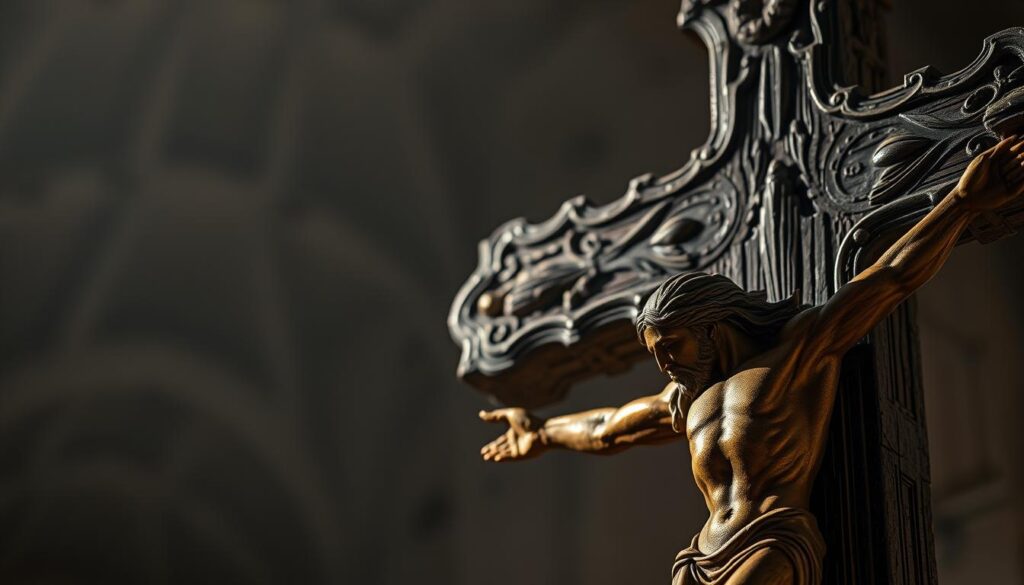
A close-up view of a weathered, ornate crucifix against a dimly lit, atmospheric background. The cross is carved from intricate, textured wood, with a faint golden patina shimmering in the soft, directional lighting. The figure of Christ is sculpted in detailed realism, conveying a sense of profound suffering and sacrifice. Shadows and highlights accentuate the three-dimensional form, creating a powerful, contemplative mood. The background is hazy and muted, with hints of a vaulted, ecclesiastical setting, emphasizing the sacred, spiritual nature of the subject.

Resurrection completes the narrative. Empty tombs and folded burial cloths turn despair into hope. This dual focus shapes Catholic worship: “We preach Christ crucified… the power of God,” as scripture says. Every Mass celebrates this victory over sin.

Comparing the Crucifix with the Plain Cross in Worship

Why do Catholics favor the crucifix over empty crosses? The answer lies in their view of worship. The body on the cross makes Christ’s sacrifice tangible during Mass. It’s not about ignoring resurrection—it’s about honoring the cost of redemption.

Protestant churches often use plain crosses to highlight Easter’s triumph. But Catholic tradition stretches Easter joy across 50 days, with weekly “mini-resurrections” in Sunday services. The crucifix becomes a year-round reminder: new life springs from selfless love.

Art, Architecture, and Cultural Impact of the Catholicism Cross

This sacred symbol shapes both grand cathedrals and quiet moments of prayer. Architects have turned stone and glass into living sermons—like St. Paul’s Cathedral, where the Latin floor plan forms a giant cross under visitors’ feet. These designs invite people to walk through sacred space literally shaped by faith.

Liturgical Art and Its Reflection of Faith

In worship spaces, the crucifix does more than decorate walls. It acts as a spiritual compass. Medieval carvers once said, “We don’t make crosses—we reveal what’s already in the wood.” This philosophy still guides artists today who balance tradition with fresh perspectives.

Personal devotion items carry this power into daily life. A grandmother’s rosary or a hiker’s summit cross on Mount Royal—each becomes a bridge between earthly struggles and heavenly hope. These small signs whisper big truths about love conquering death.

Modern creators keep reinventing this ancient symbol. One sculptor recently described her steel crucifix as “a collision of suffering and glory.” Whether in cemeteries or digital art, the message remains: what looks like an end can become the start of new life.

Conclusion

In every generation, believers find new meaning in this ancient sign. The crucifix isn’t just a reminder of pain—it’s a map showing how love rewrites endings. Through Christ’s sacrifice, what looked like defeat became humanity’s path to salvation.

This symbol teaches that true power god shows up in weakness. When couples exchange vows saying “With my body, I thee worship,” they echo the self-giving love displayed on that first Good Friday. It’s a pattern for how we treat one another daily.

The empty cross of Easter morning completes the story. Resurrection assures us that no suffering is wasted when offered with faith. Whether in grand cathedrals or quiet prayers at home, this truth shapes how millions live with purpose today.

As dawn breaks each day, the cross invites us to see our struggles through heaven’s eyes. Here, mercy meets justice, and death becomes the doorway to life unending. That’s the lasting promise etched in wood and worn close to the heart—a story of glory written in scars.

FAQ

Why does the crucifix include a figure of Christ while other crosses don’t?

The crucifix emphasizes sacrifice and the resurrection, central to Catholic teachings. It visually reminds believers of Christ’s suffering and victory over death. Plain crosses often symbolize hope and faith without focusing directly on the crucifixion event.

How did early Christians adopt the cross as a symbol of faith?

Early believers initially used discreet signs like fish or anchors to avoid persecution. After Emperor Constantine’s vision of a cross in 312 AD, it became a public emblem of divine power and redemption, merging ancient spiritual ideas with Christian worship.

What role does the cross play in Catholic liturgy and art?

In liturgical art, the cross bridges humanity with divine love. It’s woven into rituals, church designs, and sacraments to reflect Christ’s presence. From stained glass to altar carvings, it serves as a focal point for prayer and reflection on salvation.

Is the cross seen differently in other Christian traditions?

Yes! Some denominations prefer empty crosses to highlight the resurrection, while Catholics often use the crucifix to honor Christ’s sacrifice. Both forms share a common foundation in faith but express theological nuances in worship practices.

How does the cross connect to justice and mercy in Catholic teaching?

The cross embodies God’s justice—addressing sin—and His boundless love. It reminds believers to live humbly, serve others, and seek forgiveness, mirroring Christ’s ultimate act of mercy for humanity’s sake.
Catholicism and the Bible: A Comprehensive Guide


Welcome to a journey exploring how sacred texts shape faith and community. For over two millennia, the Catholic Church has cherished Scripture as more than ancient writings—it’s seen as a timeless guide for daily life. This introduction offers a friendly starting point for anyone curious about its teachings.

The Church views these books as divine wisdom that grows richer with reflection. Unlike historical artifacts, they’re treated as living conversations between God and believers. Through rituals, teachings, and personal prayer, Scripture remains central to spiritual growth.

You’ll learn how tradition and text work together. The Church acts as a trusted interpreter, helping followers apply age-old truths to modern challenges. This harmony ensures teachings stay relevant without losing their core meaning.

Key Takeaways

  • Scripture is viewed as an active guide, not just historical text
  • The Church has preserved biblical wisdom for 2,000+ years
  • Teachings adapt to modern contexts while keeping core truths
  • Community and personal study complement each other
  • Beginners can start exploring through structured approaches

Overview of Catholicism and the Bible

Understanding the relationship between sacred texts and faith communities starts with one core idea: the books we read today emerged from centuries of prayerful discernment. As the Catholic Encyclopedia explains, these writings were “solemnly recognized as inspired” through the Catholic Church‘s guidance. This isn’t just about ancient pages—it’s about living wisdom passed down like a family heirloom.

Central to this view is the belief that human authors wrote under divine influence, creating what’s called the Word of God. But here’s what makes Catholic teaching unique: Scripture and Tradition form twin pillars of truth. While some groups focus only on biblical texts, Catholics see Church practices and teachings as equally vital for grasping God’s message.

Three key principles shape this approach:

  • Interpretation happens within the faith community, not isolation
  • The Holy Spirit guides understanding across generations
  • Teachings balance historical context with modern needs
Aspect Scripture Tradition
Source Divinely inspired texts Lived practices & teachings
Role Reveals God’s message Preserves & clarifies meaning
Interpretation Requires Church guidance Develops through centuries

This framework explains why Catholics turn to both books and community wisdom when facing life’s questions. The Church’s authority ensures interpretations stay true to their roots while speaking to today’s world—like having a trusted translator for time-tested truths.

Understanding the Historical Formation of the Catholic Bible

Imagine piecing together a spiritual puzzle over 400 years. That’s how the books bible came to form the sacred collection we know today. Early Christian communities didn’t have a single rulebook—they carefully tested writings against apostolic roots and divine inspiration.

By the late 300s, clarity emerged. Church councils at Hippo (393 AD) and Carthage (397 AD) made historic decisions. Leaders officially recognized 73 texts as authentic Scripture, later confirmed by Rome. This process wasn’t quick—it reflected centuries of prayerful debate.

Not every text made the cut. Works like the Shepherd of Hermas, though popular, were excluded after scrutiny. The table below shows how choices were made:

Included Texts Excluded Texts Key Criteria
Gospels Epistle of Clement Apostolic connection
Paul’s Letters Gospel of Thomas Doctrinal consistency
Psalms Didache Widespread acceptance

This history reveals something vital: the early church saw Scripture as a living project. As one scholar notes, “The canon wasn’t closed—it was discovered through communal wisdom.”

Why does this matter now? The same discernment that shaped the books bible still guides interpretation today. Trusting this time-tested process helps believers engage texts with both curiosity and confidence.

The Role of the Church in Establishing Biblical Authority

Why does the Catholic Church hold final say in biblical matters? The answer lies in a simple timeline: the Christian community existed decades before a single New Testament book was written. As Jesus told Peter, “You are Peter, and on this rock I will build church” (Matthew 16:18), establishing leadership before Scripture’s completion.

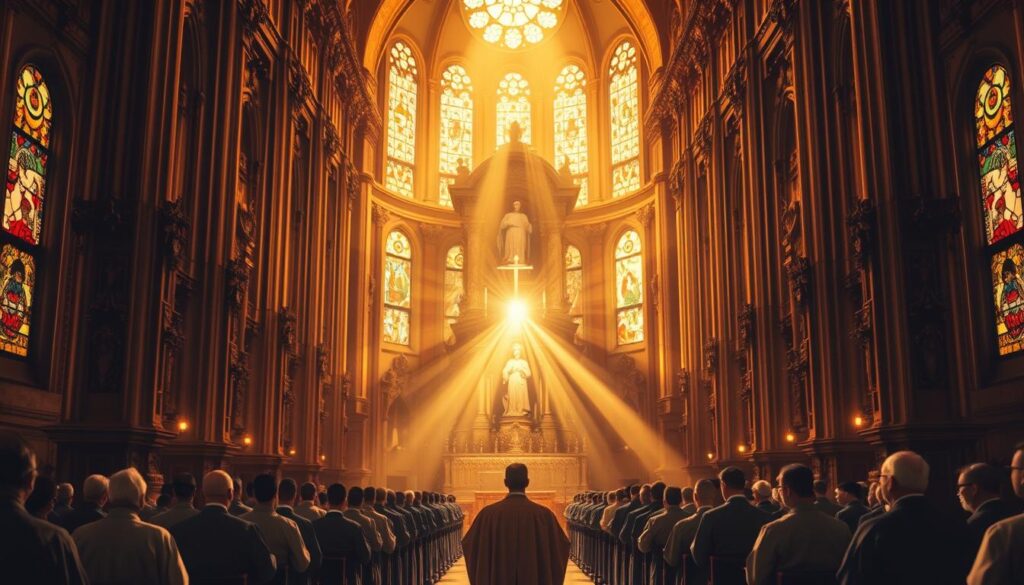
A grand cathedral interior, bathed in warm, golden light filtering through stained glass windows. In the foreground, a bishop in resplendent robes stands at a podium, his hands raised in authoritative gesture as he addresses a congregation. Surrounding him, rows of wooden pews filled with devout parishioners, their faces upturned in reverence. In the background, towering arched ceilings and ornate ecclesiastical decor evoke a sense of timeless tradition and divine authority. The scene conveys the solemn weight of the Church's role in interpreting and preserving the sacred Scriptures.

This sequence matters. The apostles—appointed by Christ—first spread teachings orally. Later, their letters and gospels became sacred texts under the Church’s guidance. As one theologian notes: “You can’t have a book without first having authors—and Christ made the Church His living pen.”

Three pillars prevent confusion:

  • Direct apostolic succession maintains teaching authority
  • Community discernment avoids private interpretations
  • The Holy Spirit ensures continuity across centuries

This framework solves the “chicken-or-egg” dilemma. Rather than circular logic (“The Bible proves the Church, which proves the Bible”), Catholics root truth in Christ’s original mandate. The Catholic Church acts as steward, not inventor—preserving what was received while applying timeless wisdom to new questions.

“Scripture grows in the soil of Tradition—you can’t uproot it without losing nourishment.”

Through councils, creeds, and catechisms, this living authority helps believers navigate modern challenges while staying anchored to ancient foundations.

Exploring the Old Testament in Catholic Tradition

What do ancient stories whispered around campfires have to do with modern faith? The Old Testament offers more than dusty history—it’s a vibrant tapestry woven through centuries of tradition. Let’s explore how these sacred books came to life and why their literary styles matter today.

From Campfires to Codices

Many stories first traveled by word of mouth for generations. Abraham’s journey (2000-1700 BC) wasn’t written until centuries later. Communities perfected oral retellings—correcting errors like strict editors. This careful preservation allowed truths to survive until inspired authors put them to parchment.

Aspect Oral Tradition Written Texts
Preservation Community memory Physical scrolls/codices
Timeframe 1400-1000 BC origins Completed over 1,000 years
Role in Faith Shared identity Enduring reference

Reading Between the Genres

The Old Testament contains legal codes, poetry, and prophetic visions. Catholics approach each style differently:

  • Genesis’ creation accounts reveal theological truths
  • Psalms use metaphor to express raw human emotion
  • Deuteronomy’s laws reflect ancient societal needs

This interpretation method helps modern readers separate cultural context from eternal messages. As one scholar notes: “The burning bush wasn’t botany class—it was God’s invitation to relationship.”

Through this lens, even complex books like Leviticus become guides for loving God and neighbor. The Church’s tradition helps bridge gaps between ancient ink and today’s questions.

Diving into the New Testament: Gospels and Epistles

What makes four accounts of one man’s life so compelling? The New Testament offers vibrant portraits of Jesus through distinct lenses. Written between 50-100 AD, these books capture eyewitness testimonies and urgent messages to growing faith communities.

A stack of leather-bound books, the covers emblazoned with gold lettering, arranged in a neat row against a warm, wooden backdrop. The books are illuminated by soft, diffused lighting, casting gentle shadows and highlights that accentuate their intricate details. In the foreground, a subtle vignette draws the viewer's attention to the central subjects, while the background is subtly blurred, creating a sense of depth and focus. The overall composition evokes a sense of reverence and scholarly contemplation, perfectly suited to illustrate the "Diving into the New Testament: Gospels and Epistles" section of the article.

Gospel Narratives and Their Teachings

Matthew, Mark, Luke, and John each highlight different facets of the Son of God. While Matthew and Luke begin with birth stories, Mark jumps straight to adult ministry. John’s Gospel stands out with symbolic language—like calling Jesus the “Word made flesh.”

These differences create a fuller picture. As one scholar notes: “Four Gospels mean four invitations to encounter Christ.” Catholics see this diversity as strength, not contradiction.

The Acts of the Apostles and Epistles Explained

After the Gospels, Acts shows how the early church spread like wildfire. Written by Luke’s author, it follows Peter and Paul’s missions—from Jerusalem to Rome. Then come 21 letters addressing practical faith issues.

Text Type Key Focus Example
Gospels Jesus’ life & teachings John’s Last Supper account
Epistles Community guidance 1 Corinthians on love
Acts Church expansion Pentecost event

Paul’s letters to cities like Corinth tackle real problems—divisions, ethics, and grace. Though some letters might come from his students, their wisdom still shapes modern worship. This quick writing timeframe (50 years) shows how urgently believers wanted to share hope.

Interpreting Scripture: Divine Inspiration and Human Involvement

How can ancient texts speak to modern hearts while maintaining divine truth? The answer lies in a remarkable balance. As the Vatican Council teaches, sacred writings “have God for their author” yet were penned by human hands. This dual nature makes Scripture both timeless and culturally shaped—like sunlight filtered through stained glass.

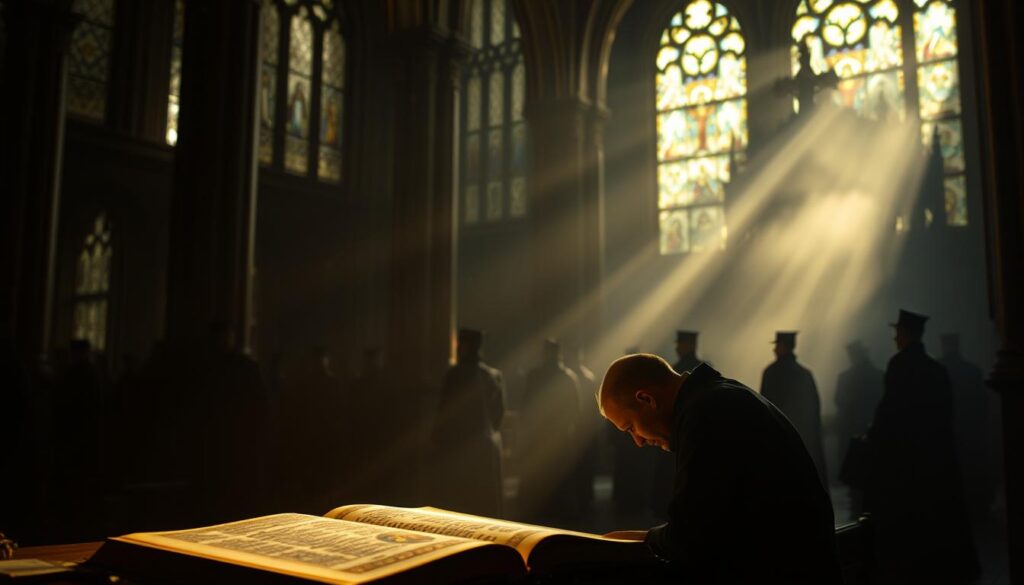
A serene, dimly lit cathedral interior, sunlight filtering through stained glass windows, casting a warm, ethereal glow. In the foreground, a lone figure, a scribe or scholar, hunched over an illuminated manuscript, deep in contemplation. The manuscript's pages seem to emanate a divine luminescence, as if imbued with a celestial power. In the middle ground, shadowy silhouettes of other scholars, each lost in their own study of sacred texts. The background fades into a mysterious, almost mystical, haze, suggesting the interplay of the mortal and the divine. The overall atmosphere evokes a sense of profound spiritual contemplation and the synthesis of human effort and divine inspiration.

The Dual Nature of Scripture

Imagine forty different artists painting the same sunset. Each uses unique colors and brushstrokes, yet all capture the same radiant beauty. This mirrors how the holy spirit worked through biblical writers. Their personalities and contexts shaped their accounts, but core truths remained without error in matters of faith.

The Church avoids two extremes. Literalists might treat poetry as science manuals, while skeptics dismiss divine origins. Instead, Catholics see:

Divine Aspect Human Aspect
Eternal truths Ancient idioms
Salvation message Cultural references
Spiritual authority Literary styles

As one scholar notes: “God didn’t dictate words—He ignited hearts.” This approach lets modern readers honor both the word and its human messengers.

Hermeneutics and the Church’s Guidance

Interpreting Scripture isn’t a solo project. Like learning a family recipe, it requires tradition and fresh ingredients. The holy spirit guides this process through:

  • Scholarly analysis of historical contexts
  • Prayerful reflection on spiritual meanings
  • Communal wisdom passed through generations

This method prevents error from private guesses or rigid literalism. A farmer’s parable about seeds isn’t botany class—it’s an invitation to nurture faith. By blending study with spiritual insight, believers discover truths that resonate across centuries.

“Scripture must be read in the spirit by which it was written.”

Vatican II Document

This balanced interpretation helps modern seekers find relevance without losing reverence—proving ancient texts still breathe with life.

Practical Guidance on Reading the Bible for Beginners

Starting your journey with sacred texts can feel overwhelming. The Church offers time-tested tools to help people engage meaningfully. Think of these resources as spiritual training wheels—they provide structure while letting truth shine through.

Your First Steps With Sacred Texts

New readers should begin with the missal. This worship companion contains key passages used during Mass. It’s like having a highlight reel of essential books, curated by centuries of prayerful practice.

The breviary takes things deeper. Used primarily by clergy, this multi-volume work weaves Scripture with saints’ writings and prayers. As Pope Benedict XVI noted: “The Church breathes through both lungs—liturgy and personal reflection.”

Tool Purpose Time Commitment Best For
Missal Mass preparation 10-15 minutes/day Newcomers
Breviary Full prayer cycle 90+ minutes/day Advanced study

Follow the liturgical calendar to see how readings connect to holidays and seasons. Advent passages differ from Lenten ones—this rhythm helps people experience Scripture as a living conversation.

Approach texts devotionally rather than academically. As one priest advises: “Don’t just read bible verses—let them read you.” Even 15 minutes daily can transform your way of seeing the world.

Modern believers aren’t alone in this journey. Over 50% of American parishes now offer guided study programs—proof that ancient wisdom still speaks to today’s seekers.

Balancing Faith, Tradition, and Biblical Truth

Guiding principles often come from more than just pages. For centuries, communities have preserved wisdom through both spoken stories and sacred texts. This blend of tradition and written word forms the bedrock of spiritual practice.

Two Streams, One Source

Jesus taught through actions and parables—none were transcribed in real time. His followers later shared these lessons through letters and oral accounts. The Church calls this dual transmission Sacred Tradition and Scripture.

Three elements work together like a tripod:

  • Written texts preserve core messages
  • Oral traditions carry unwritten practices
  • Teaching authority maintains consistency
Element Form Role
Tradition Lived practices Preserves apostolic wisdom
Scripture Written texts Anchors divine revelation
Magisterium Teaching office Ensures accurate interpretation

This system prevents confusion. When new questions arise—like modern bioethics—the Church draws from both sources. Catholic Social Teaching on workers’ rights, for example, blends biblical justice with centuries of philosophical reflection.

“Tradition is the living faith of the dead, not the dead faith of the living.”

Vatican II Documents

By honoring this balance, believers connect with ancient faith while addressing contemporary needs. The result? A spiritual path that feels both timeless and urgently relevant.

Key Doctrinal Controversies and Their Biblical Foundations

Debates about sacred teachings have shaped the faith community for centuries. Many modern questions—like salvation through grace versus works—find roots in New Testament letters. Paul’s emphasis on divine gift (Ephesians 2:8) and James’ call for active faith (James 2:26) show how texts spark dialogue.

The sacraments’ biblical basis often draws scrutiny. Passages like John 6’s Bread of Life discourse fuel discussions about communion’s meaning. While some see symbolic language, others point to early Church practices described in Acts.

Mary’s role remains a touchstone issue. Her titles—from “Mother of God” to “New Eve”—connect to Revelation’s imagery and Luke’s Gospel. These interpretations rely on Tradition to bridge textual gaps.

Such debates aren’t academic exercises. They reveal how the faith community wrestles with sacred texts’ depth. Through councils and creeds, the Church maintains unity while honoring Scripture’s living voice—proving ancient words still ignite fresh understanding.

FAQ

How did the Catholic Church determine which books belong in the Bible?

Early Church leaders prayerfully evaluated texts based on apostolic origin, consistency with sacred tradition, and widespread use in worship. The formal canon was affirmed at councils like Hippo (393 AD) and Trent (1546 AD), guided by the Holy Spirit’s role in preserving truth.

Why does the Old Testament include additional books in Catholic Bibles?

These texts, called Deuterocanonical books, were part of the Greek Septuagint used by early Christians. They remain vital for understanding Jewish history and theology before Christ, reflecting the Church’s reverence for tradition alongside Scripture.

What role does the Magisterium play in interpreting Scripture?

The Magisterium—the Church’s teaching authority—ensures interpretations align with apostolic faith. It clarifies ambiguities, addresses modern challenges, and safeguards against errors, as seen in documents like Vatican II’s Dei Verbum.

How do Catholics approach apparent contradictions in the Gospels?

Differences in details (e.g., Resurrection accounts) highlight unique theological emphases, not errors. The Church encourages studying literary styles, historical context, and the unified message of Christ’s life and salvation.

Can individuals interpret the Bible without Church guidance?

While personal prayer with Scripture is encouraged, the Church emphasizes communal discernment. Tradition and the Magisterium prevent subjective readings, ensuring fidelity to Christ’s teachings as handed down through centuries.

Why does Catholicism emphasize tradition alongside the written Word?

Jesus entrusted teachings orally to the apostles before the New Testament was written. Tradition preserves practices like the Eucharist and Marian doctrines, which are rooted in apostolic witness but not explicitly detailed in Scripture.

How do the Acts of the Apostles shape Catholic understanding of the Church?

Acts reveals the Holy Spirit’s work in guiding early Christians through challenges. It models unity, evangelization, and reliance on apostolic authority—principles still central to Catholic ecclesiology and mission.

What’s the Catholic response to “sola scriptura” debates?

The Church teaches that Scripture and tradition are inseparable, as both flow from divine revelation. Luther’s Reformation-era view is seen as incomplete, since the Bible itself emerged from the Church’s lived faith and discernment.

Are newer Bible translations endorsed by the Church?

Translations must align with the original texts and Church teaching. Approved versions like the NABRE or RSV-2CE include footnotes explaining theological nuances, helping readers avoid misinterpretations.

How can beginners start reading the Bible effectively?

Start with the Gospels to encounter Christ’s life, then explore the Psalms or Acts. Tools like the Liturgy of the Hours or Sunday Mass readings provide structured immersion, linking Scripture to prayer and sacraments.

Defining Catholicism: Understanding the Faith


Imagine a spiritual tradition that has shaped art, laws, and daily life for billions over two millennia. The Catholic Church stands as a cornerstone of Christianity, serving 1.4 billion members across 3,500 dioceses worldwide. Its teachings blend ancient rituals with modern outreach, creating a living bridge between past and present.

Rooted in apostolic teachings, this global institution operates through 24 self-governing churches united under shared beliefs. From Rome to rural communities, its structure balances central guidance with local traditions. The Trinity, sacraments, and papal leadership form the bedrock of its doctrine, while social justice initiatives reflect its evolving role in society.

Why does this faith remain influential after 2,000 years? Its ability to preserve core values while adapting to cultural shifts offers part of the answer. Through universities, charities, and artistic patronage, the Church continues shaping education and humanitarian efforts worldwide.

Key Takeaways

  • Global spiritual community serving 1.4 billion members
  • Operates through 24 autonomous churches and 3,500 dioceses
  • Combines ancient traditions with modern social initiatives
  • Core teachings include sacraments and papal authority
  • Significant historical impact on Western culture and values

Introduction to Catholicism

The story of the Catholic Church begins with twelve ordinary men chosen for an extraordinary mission. In first-century Palestine, Jesus of Nazareth selected his apostles, tasking them with spreading his teachings to all nations. This “Great Commission” launched a spiritual movement that would reshape civilizations.

Origins and Early Church Foundations

Fifty days after Jesus’ resurrection, a transformative event occurred. At Pentecost, the apostles received the Holy Spirit, empowering them to lead the growing Christian community. The Book of Acts records how this small Jerusalem group became the seed of a global church.

Event Time Period Impact
Appointment of Apostles 30 AD Established leadership structure
Pentecost 30 AD Marked official ministry launch
Roman Empire Expansion 1st-4th Century Spread teachings across continents

Purpose of the Ultimate Guide

This resource illuminates how ancient practices evolved into modern faith traditions. You’ll discover:

  • How apostolic teachings survived persecution
  • The Church’s role in preserving Western history
  • Connections between early rituals and today’s sacraments

Whether you’re exploring spiritual paths or studying religious history, this guide offers clear insights into one of humanity’s most enduring institutions.

Understanding the catholicism definition

The roots of the term “Catholic” stretch back to ancient linguistic crossroads. Originating from the Greek katholikos, it blends kata (“concerning”) and holos (“whole”) to mean “universal”. This simple phrase became a revolutionary idea shaping religious identity across continents.

Meaning of “Catholic” in Historical Context

Early Christians used this term to describe their vision of unity. Saint Ignatius of Antioch made history around 110 AD by declaring:

“Wherever Jesus Christ is, there is the Catholic Church.”

This wasn’t just geography – it declared a community transcending borders and cultures.

The church’s universal nature solved practical challenges. As Christianity spread through Roman trade routes, believers needed shared identity markers. Calling themselves katholikos emphasized their connection to global believers while maintaining local practices.

Three key aspects defined this early understanding:

  • Unity across diverse communities
  • Shared core beliefs despite cultural adaptations
  • Commitment to preserving apostolic teachings

This historical context explains why Catholic tradition still values global outreach. From 1st-century house churches to modern megacities, the principle remains: one faith embracing humanity’s rich tapestry.

Historical Evolution of the Catholic Church

The transformation of a small sect into a worldwide institution reveals pivotal moments in religious history. This journey spans two millennia, marked by spiritual growth and challenging divisions.

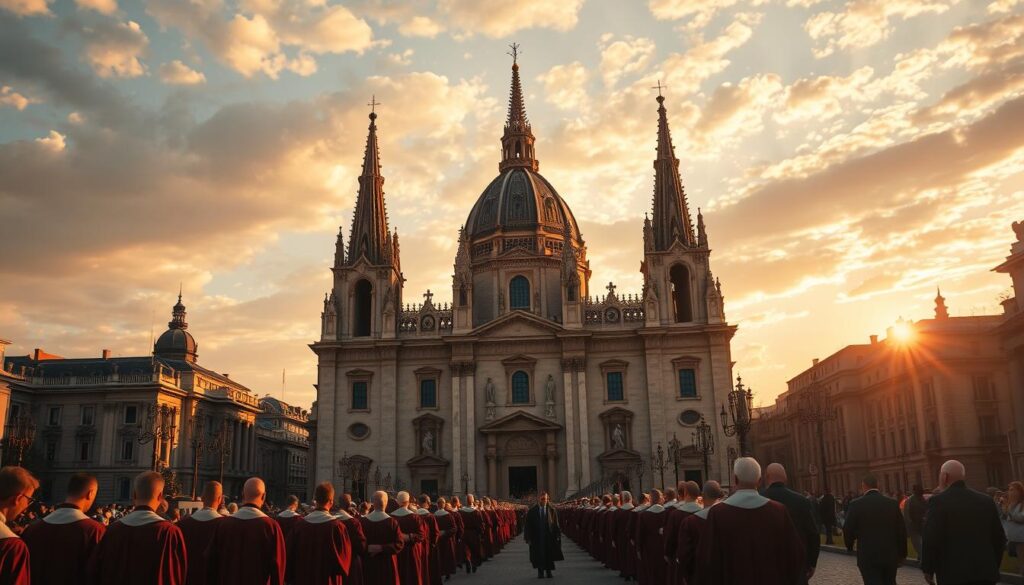
A grand cathedral stands in the foreground, its spires reaching skyward, illuminated by warm, golden light. In the middle ground, a procession of robed figures moves through the streets, representing the historical journey of the Catholic Church. In the background, a tapestry of historical events and significant moments unfolds, from the life of Jesus to the Crusades, the Reformation, and beyond. The scene conveys a sense of reverence, tradition, and the enduring influence of the Catholic faith over the centuries.

Apostolic Beginnings and Papal Roots

Jesus’ declaration to Peter – “You are Peter, and on this rock I will build my church – set the foundation. The bishop of Rome gradually became Christianity’s central figure. By 313 AD, Emperor Constantine’s Edict of Milan ended persecutions, allowing public worship.

Between 350-500 AD, Roman bishops strengthened their authority. They settled theological disputes and standardized practices. This period solidified Rome’s role as the primary seat of Christian leadership.

Key Milestones and Schisms

The church faced its first major split in 1054. Differences in leadership styles and theological debates caused the East-West Schism. Eastern Orthodox Christians formed their own tradition, though both branches kept core beliefs.

Sixteenth-century reformers like Luther challenged practices they saw as outdated. The Protestant Reformation reshaped Europe’s religious landscape. Despite these divisions, the church adapted while preserving ancient rituals.

Three patterns emerge across centuries:

  • Centralized leadership under the bishop of Rome
  • Balancing tradition with cultural changes
  • Maintaining unity through shared sacraments

Through plagues, wars, and social revolutions, this institution demonstrated remarkable resilience. Its history shows how faith communities evolve while keeping core values intact.

The Role of Jesus Christ in Catholic Tradition

At the core of Catholic belief stands a figure who transformed human history through radical love and sacrifice. The church views Jesus Christ not merely as a teacher, but as God incarnate – the living foundation of its spiritual identity.

Life, Teachings, and the Great Commission

Jesus’ three-year ministry reshaped religious understanding. The New Testament Gospels show him healing, preaching, and forming disciples. His final instruction became Christianity’s marching orders:

“Go therefore and make disciples of all nations.”

This command launched global missionary efforts. The Twelve Apostles became the first leaders, laying groundwork for today’s bishops. Their work continues through sacraments like baptism, which initiates believers into the church community.

Jesus’ Influence on Church Doctrine

Catholic teachings draw directly from Christ’s words and actions. Belief in his dual nature – fully human and fully divine – shapes key practices. The Eucharist, for example, celebrates his ongoing presence among followers.

Modern church leaders see themselves continuing Jesus’ mission. They interpret his teachings for contemporary issues, from social justice to bioethics. This living tradition keeps the New Testament message relevant across generations.

Through prayer and scripture study, Catholics maintain personal connections to Christ. This relationship fuels their participation in the church‘s sacramental life and worldwide outreach.

Exploring Key Catholic Doctrines

Three pillars uphold the spiritual framework of Catholic belief. These core doctrines form a roadmap for understanding humanity’s relationship with the divine. At their heart lies the Nicene Creed’s declaration:

“We believe in one God, the Father Almighty… and in one Lord Jesus Christ… and in the Holy Spirit.”

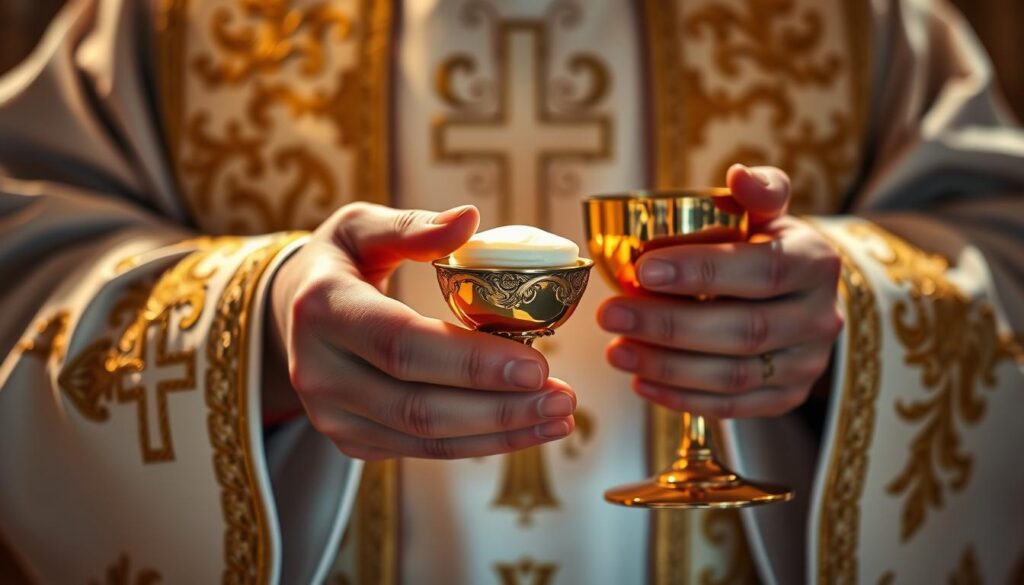
A serene, close-up view of a Catholic priest's hands holding the consecrated host and chalice during the Eucharistic celebration. The ornate gold and white vestments and sacred vessels are illuminated by soft, warm lighting, casting a reverent, ethereal glow. The background is blurred, focusing the viewer's attention on the central sacramental elements. The composition emphasizes the solemnity and spiritual significance of the Eucharistic rite, a core tenet of Catholic doctrine.

The Trinity, Sacraments, and Redemption

The Trinity reveals God’s nature as three distinct persons sharing one divine essence. This teaching shapes prayers, liturgies, and how believers perceive sacred mysteries. Sunday Mass often begins with the Sign of the Cross – a physical reminder of this triune reality.

Seven sacraments anchor spiritual growth from birth to eternal life. Baptism washes away original sin, while the Eucharist – called the “source and summit” of faith – renews Christ’s sacrifice. During Mass, bread and wine transform completely into his body and blood through transubstantiation.

Redemption flows from Jesus’ crucifixion, offering salvation to all who embrace his teachings. Mary’s veneration as Mother of God underscores her role in this divine plan. Her immaculate conception and assumption into heaven highlight unique privileges within Catholic truth.

Together, these doctrines create a tapestry of belief. They guide personal devotion and collective worship, blending ancient wisdom with enduring relevance for modern seekers.

The Development of Doctrinal Interpretations

Religious teachings aren’t frozen in time—they grow as communities wrestle with life’s big questions. This natural process occurs across faiths, from Buddhism to Baptist congregations. The church approaches doctrinal development like a jeweler polishing a diamond: revealing new facets while preserving its core essence.

A grand cathedral interior, bathed in warm, golden light filtering through stained glass windows. At the center, a majestic altar flanked by ornate columns and intricate carvings, symbolizing the Trinity doctrine. In the foreground, three distinct yet interconnected figures, representing the Father, Son, and Holy Spirit, radiate an ethereal, celestial presence. The middle ground showcases a procession of robed clergy, deep in contemplation, as they reverently approach the altar. The background recedes into a hazy, reverential atmosphere, heightening the sense of sacred mystery. The composition evokes a timeless, iconic representation of the development and interpretation of Catholic doctrine.

How Language Shapes Belief

Take the term “Trinity”—you won’t find it in Scripture, yet it’s central to Christian identity. Early believers needed precise language to describe their experiences of God. Over centuries, theologians crafted definitions that balanced biblical truths with philosophical clarity.

Doctrinal Term Century Developed Impact
Trinity 4th United diverse Christian groups
Transubstantiation 13th Clarified Eucharist theology
Immaculate Conception 19th Deepened Marian devotion

This evolution follows clear patterns. As St. Vincent of Lérins noted in 434 AD:

“True progress means growing in understanding, not changing the message.”

The church uses three safeguards in doctrinal development:

  • Scripture as primary foundation
  • Consistency with apostolic tradition
  • Guidance from authorized teachers

Modern challenges like bioethics show this process in action. By building on ancient wisdom, the church addresses new questions while keeping faith rooted in eternal truths. This living tradition helps believers navigate an ever-changing world.

The Ecclesiastical Structure and Authority

Every thriving organization needs clear leadership – and the world’s oldest continuous institution perfected this over centuries. The Church’s structure combines spiritual authority with practical governance, creating a unique blend of tradition and adaptability.

Guiding Hands: Leadership Roles

The pope serves as both spiritual leader and administrative head. As Bishop of Rome, he succeeds Peter as first among equals in the global bishops’ community. Local bishops govern dioceses – geographic regions averaging 530,000 members each.

This system balances centralized guidance with regional flexibility. The Magisterium (teaching authority) ensures doctrinal consistency across 3,500 dioceses. Bishops collaborate through synods while maintaining autonomy in daily operations.

Decision-Making Through the Ages

Major changes often begin at ecumenical councils. These gatherings of bishops have shaped Church policy since 325 AD. The Roman Curia – essentially the Vatican’s executive branch – implements these decisions through specialized departments:

Vatican Department Role Established
Congregation for Doctrine Preserves theological integrity 1542
Dicastery for Laity Supports lay ministries 2016
Council for Economy Manages financial oversight 2014

This shared authority model lets the current Bishop of Rome maintain unity while dioceses address local needs. From approving saints to funding hospitals, the structure supports both timeless rituals and modern humanitarian work.

Rituals and Sacramental Life in Catholicism

From birth to eternal rest, sacred acts mark key moments in a believer’s journey. These rituals create a spiritual roadmap, blending ancient traditions with personal faith experiences. They transform ordinary actions into encounters with the divine, connecting individuals to a global community.

Overview of the Seven Sacraments

The Church recognizes seven sacraments as channels of divine grace. Baptism welcomes newborns, while Confirmation strengthens teenage commitments. Marriage unites couples, and Anointing supports the ill.

The Eucharist remains central, celebrated weekly as communal nourishment. Through these sacraments, ordinary materials like water and oil become vessels of spiritual transformation.

Liturgical Practices

Seasonal rhythms shape worship through Advent wreaths and Lenten fasts. Sunday Mass follows a structured pattern of readings, prayers, and communion. These liturgical traditions create unity across cultures and generations.

From incense swirls to Easter vigils, sensory elements deepen spiritual connections. This living heritage continues adapting while preserving its core purpose – drawing hearts closer to sacred mysteries.

FAQ

What does "Catholic" mean in historical context?

The term “Catholic” comes from the Greek word katholikos, meaning “universal.” It reflects the belief that the Church, founded by Jesus Christ, is meant for all people and spans across cultures and time. Early followers used it to distinguish their unified faith from regional or splinter groups.

How did the Catholic Church begin?

The Church traces its roots to Jesus’ apostles, particularly Peter, whom Catholics consider the first pope. After Jesus’ resurrection, apostles like Paul spread His teachings across the Roman Empire. Over centuries, councils like Nicaea (AD 325) shaped doctrines, and Rome became a central hub for leadership.

Why is Jesus Christ central to Catholic teachings?

Catholics believe Jesus is both fully divine and human, whose life, death, and resurrection offer salvation. His teachings, like the Sermon on the Mount, and sacraments such as the Eucharist form the foundation of Church practices. His “Great Commission” also inspires evangelization worldwide.

What are core Catholic doctrines?

Key beliefs include the Trinity (Father, Son, Holy Spirit), redemption through Christ’s sacrifice, and the seven sacraments—like Baptism and Communion. The Church also emphasizes Mary’s role as Jesus’ mother and teachings on mercy, justice, and eternal life.

How does the Church handle changes in doctrine?

While core teachings (e.g., the Resurrection) remain unchanged, the Church clarifies doctrines over time through councils, papal encyclicals, and bishops’ guidance. For example, Vatican II (1962–1965) modernized practices like liturgy while preserving tradition.

What role do the pope and bishops play?

The pope, as Bishop of Rome, is seen as Peter’s successor and a unifying leader. Bishops oversee dioceses and work with the pope to uphold teachings. Together with the Magisterium (teaching authority), they ensure doctrinal consistency and address spiritual needs.

Why are sacraments important in Catholic life?

Sacraments like Confirmation and Matrimony are viewed as visible signs of God’s grace. They mark key moments in a believer’s journey, fostering a deeper connection to Christ and the community. The Eucharist, in particular, is central to weekly worship.

How did the Great Commission shape Catholic missions?

Jesus’ command to “make disciples of all nations” (Matthew 28:19) drove early missionaries to spread the Gospel. Today, global outreach—through education, charity, and interfaith dialogue—continues to reflect this mission of sharing faith and serving others.

Exploring the Catholic Ten Commandments: Principles for Faithful Living


How do ancient spiritual guidelines remain relevant in today’s fast-paced world? For centuries, sacred directives rooted in biblical tradition have shaped ethical frameworks across cultures. These teachings offer more than religious rules—they provide a moral compass for balancing faith with modern challenges.

Many recognize these principles as foundational to Western legal systems and personal ethics. The Catechism emphasizes their universal nature, calling them “valid for all people” through natural law. Early theologians like Irenaeus saw them as tools to foster harmony with others and closeness to the divine.

This exploration will unpack their historical roots while highlighting practical applications. We’ll examine how specific interpretations within one faith tradition differ from others, revealing unique approaches to spiritual growth. You’ll discover how these age-old truths address contemporary issues like digital ethics and social responsibility.

Key Takeaways

  • Ancient moral codes remain vital for modern ethical decision-making
  • Universal principles apply beyond specific belief systems
  • Historical context shapes current spiritual practices
  • Practical guidance bridges faith and daily challenges
  • Distinct interpretations reflect theological priorities

Historical Foundations and Biblical Interpretation

Ancient scriptures hold surprising clues about how societies developed core ethical standards. These sacred texts show how divine guidance shaped human behavior through evolving traditions. Their layered meanings continue to influence spiritual practices today.

Scriptural Roots in Exodus and Deuteronomy

Two key biblical accounts reveal how moral laws developed over time. Exodus 20 describes fire-covered Mount Sinai, where Moses received stone tablets. Deuteronomy 5 repeats these directives but adds fresh perspectives on human dignity.

Scholars highlight intriguing differences between the versions. The Sabbath commandment shows contrasting reasons for observance:

Commandment Exodus 20:11 Deuteronomy 5:15
Sabbath Rationale God’s creation rest Freedom from Egyptian slavery
Coveting Scope Household as single category Wife listed separately

This distinction elevates marriage and women’s status in Deuteronomy. As the Catechism notes, this foreshadows New Testament teachings about mutual respect.

Influence of Church Fathers and Early Christian Thought

Early theologians transformed how communities applied these ancient laws. Augustine organized them into the format still used today. His work helped believers see Old Testament rules through Christ’s message of love.

These thinkers emphasized the Lord God’s desire for heart-based obedience. Their interpretations bridged strict justice with merciful understanding. This balance remains central to modern spiritual growth.

Differing Numberings and Traditions in the Decalogue

Numbering systems in sacred texts often reveal more than organizational preferences—they reflect theological priorities. Early Christian scholars developed distinct frameworks for organizing moral principles, creating variations still visible across denominations today.

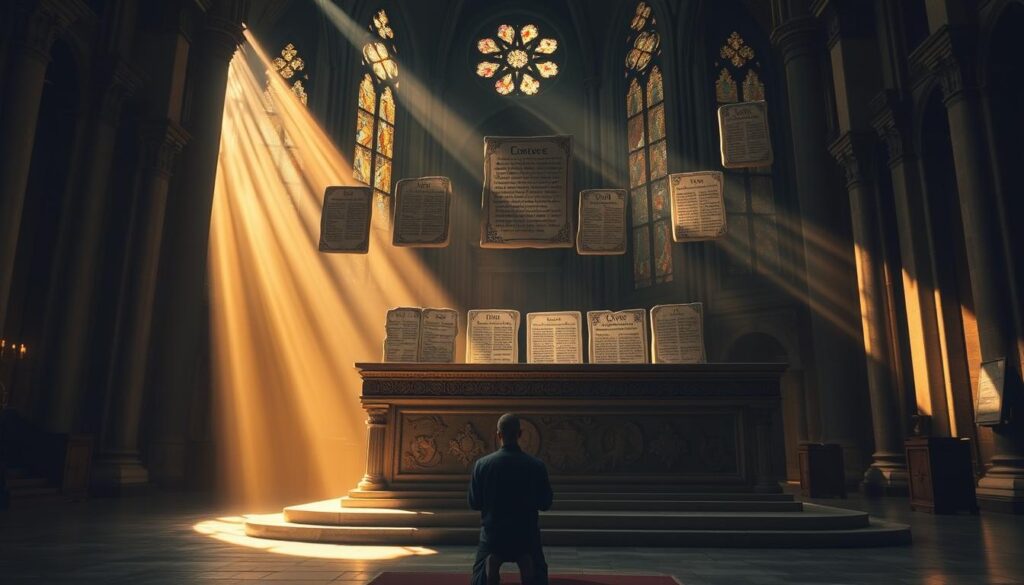
A grand, ornate stone altar stands in a dimly lit, cavernous cathedral. Atop the altar, ancient stone tablets with intricate etchings float, each depicting a different interpretation of the Ten Commandments. Shafts of warm, golden light pour in through stained glass windows, casting an ethereal glow over the scene. In the foreground, a lone worshipper kneels in reverence, contemplating the varying traditions represented by the floating tablets. The atmosphere is one of solemn contemplation, inviting the viewer to ponder the diverse ways in which the Decalogue has been understood and expressed throughout history.

Augustine Versus Origen: Perspectives on Numbering

Two influential thinkers shaped how communities structured these divine directives. Augustine merged the prohibitions against worshiping other gods and creating idols into a single first commandment, emphasizing unified devotion. His approach matched Deuteronomy’s flowing text, where these concepts appear in one continuous passage.

Origen, however, saw them as separate instructions. This Greek theologian’s system created distinct rules about divine loyalty and material representations. These differing views still influence how churches present ethical guidance to their followers.

Comparative Analysis of Catholic and Protestant Lists

Modern traditions showcase these historical divides. Many Protestant groups follow Origen’s structure, splitting the initial directives while combining coveting rules about neighbors’ possessions. Catholic and Lutheran traditions typically use Augustine’s model, preserving different boundaries for desire-related principles.

Tradition First Directive Coveting Rules
Catholic/Lutheran One commandment Two separate rules
Protestant Two commandments Single combined rule

These variations show how numbering shapes moral emphasis without altering core values. As one theologian noted: “The structure serves the substance—what matters most remains loving gods and neighbors well.”

Living the “catholic ten commandments” in Modern Society

Ancient wisdom meets modern life through intentional practice. Spiritual guidelines become meaningful when woven into daily routines, creating bridges between tradition and contemporary challenges.

From Ritual to Relationship

Pope Francis reframes these teachings as “loving words” fostering dialogue. This perspective transforms obligations into opportunities for connection. Mindful language use exemplifies this shift—avoiding empty religious phrases while maintaining reverence in speech.

Sunday observance illustrates practical adaptation. The Catechism describes it as “the Lord’s Day”—a time for:

Traditional Practice Modern Application
Church attendance Family spiritual activities
Physical rest Digital detox practices
Communal worship Neighborhood service projects

Honoring parents takes new forms in aging societies. Adult children balance caregiving with respecting autonomy, while preserving family stories becomes vital. As with memorials to historical figures, admiration differs from worship—a distinction clear in American culture.

“A command is a communication that doesn’t require dialogue. A word builds relationship.”

Pope Francis

These principles address modern dilemmas. Protecting life extends to environmental stewardship. Workplace integrity combats false witness in digital communication. Gratitude practices counter society’s “always wanting more” mentality.

Modern Relevance: Public Display and Cultural Impact

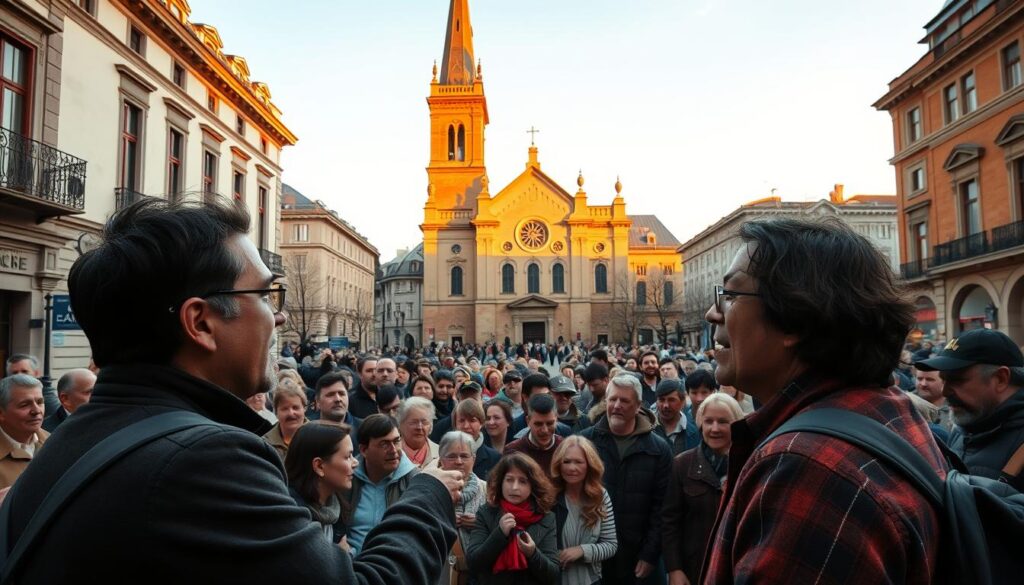
A bustling town square, the center of a lively public debate. In the foreground, two individuals passionately argue their viewpoints, gesticulating animatedly as onlookers gather around. The middle ground is filled with a diverse crowd, some nodding in agreement, others shaking their heads in dissent. In the background, the stately architecture of a historic church stands as a silent witness, its towering spire casting a warm, golden glow over the scene. The lighting is soft and natural, highlighting the intensity of the discussion and the sense of community. The overall atmosphere conveys the importance of open dialogue and the clash of ideas in a modern, pluralistic society.

Monuments in courthouses spark more than architectural admiration—they ignite national conversations. The 2001 Alabama courthouse controversy revealed how stone carvings become cultural flashpoints. When Chief Justice Roy Moore installed a granite display, its Protestant numbering surprised many observers, highlighting how small differences shape public perception.

The Role in American Public Life and Legal Debates

Legal battles over these displays often center on their perceived universal value. As Jerry Falwell noted, “Variations between traditions matter less than their shared moral foundation.” Modern courts balance historical significance with constitutional principles, creating tension between preservation and pluralism.

Recent popes reframe these debates through timeless wisdom. John Paul II called the principles “etched in human hearts,” while Benedict XVI warned that dismissing them leads to spiritual emptiness. Their insights help communities navigate clashes between tradition and evolving social norms.

From Scriptural Memorization to Contemporary Reflection

Teaching methods have evolved from rote learning to interactive dialogue. Medieval monks used rhyming couplets; today’s educators employ apps and community projects. Pope Francis captures this shift perfectly: “Ancient words become bridges when spoken with love, not recited as cold rules.”

“These precepts aren’t shackles—they’re signposts pointing toward human flourishing.”

Pope Pius XII

Interfaith initiatives now use these guidelines to find common ground. A Jewish-Muslim-Christian coalition recently created art installations showing parallel values across traditions. Such efforts honor the spirit of “loving your neighbor” while respecting diverse interpretations.

Conclusion

A serene figure embarking on a modern spiritual journey, surrounded by ethereal light and cosmic energy. In the foreground, a person sits cross-legged, eyes closed, hands in a meditative pose, radiating an aura of inner peace. In the middle ground, a glowing portal or dimensional rift opens, revealing a hypnotic display of celestial phenomena - swirling nebulae, glimmering stars, and shimmering energy fields. The background is a hazy, dreamlike landscape, blending natural and abstract elements, conveying a sense of transcendence and the interconnectedness of the physical and spiritual realms. Soft, warm lighting bathes the scene, creating an atmosphere of contemplation and enlightenment.

Foundational truths transcend time, offering clarity in an ever-changing world. The moral code given through Moses finds its fullest expression in Christ’s call to love completely. As the Catechism notes, these ancient “ten words” become life-giving when seen through the lens of selfless devotion.

Jesus simplified divine expectations into two relational priorities: wholehearted love for the Lord God and compassionate care for others. This dual focus transforms rules into pathways for spiritual growth. Whether honoring sacred names or respecting marital bonds, each principle strengthens communities when lived authentically.

Different Christian traditions may number these guidelines uniquely, but their ethical core remains unchanged. They address universal human needs—from seeking truth to building trust. Modern believers find freedom in viewing them not as restrictions, but as a way to cultivate deeper connections with God and neighbor.

These timeless standards continue shaping societies because they reflect natural law principles accessible to all. By embracing their wisdom, we create foundations for justice, integrity, and lasting peace. The journey begins when ancient words become daily actions that honor life’s sacredness.

FAQ

Where do the core principles of the commandments originate?

They’re rooted in Exodus 20:1–17 and Deuteronomy 5:6–21, where divine guidance was given to Moses. Early thinkers like Augustine and Aquinas later shaped their interpretation within Christian theology.

How do Catholic and Protestant traditions differ in listing these teachings?

Catholics follow Augustine’s structure, combining coveting clauses into one commandment. Many Protestant groups adopt Origen’s approach, separating idolatry and worship into distinct rules.

Why is honoring parents emphasized as a foundational value?

This principle strengthens family bonds and societal stability. It reflects respect for authority and intergenerational wisdom, aligning with teachings in Ephesians 6:1–3.

What role do these guidelines play in legal discussions today?

While not directly enforceable, concepts like truth-telling and protecting life influence ethical frameworks in justice systems. Debates often arise around public displays in civic spaces.

How can ancient rules remain meaningful in a digital age?

Modern applications include ethical tech use, social media integrity, and environmental stewardship. Many communities use apps or study groups to explore timeless principles through contemporary issues.

Why do some churches prioritize memorization over deeper analysis?

Memorization creates mental anchors for quick recall during moral decisions. However, leaders like Pope Francis encourage reflective practices to understand cultural and personal contexts behind each teaching.

Catholicism Tattoos: Understanding the Relationship


For centuries, people have used body art to express spiritual identity. Today, this practice sparks fresh conversations about how ancient beliefs meet modern self-expression. In France alone, 1 in 3 young adults chooses body ink – a trend reflecting global shifts in personal spirituality.

Religious leaders have taken notice. While no official rules exist about body art in major faith groups, recent statements encourage open dialogue. One prominent figure noted: “Don’t fear meaningful symbols on skin – believers have worn sacred marks for generations.”

This growing acceptance creates new questions. How do personal choices align with traditional teachings? What matters most – the design’s meaning or its permanence? Our exploration balances historical context with current perspectives.

Key Takeaways

  • Body art continues ancient faith practices in modern forms
  • Religious leaders emphasize intention over appearance
  • Personal expression and tradition can coexist meaningfully
  • Cultural shifts influence spiritual self-expression methods
  • Informed decisions require understanding historical context

The Historical and Religious Context of Catholicism Tattoos

Ancient civilizations etched sacred symbols onto skin long before modern ink techniques emerged. These permanent marks served as spiritual armor, tribal identifiers, and connections to divine forces. Early Christian communities inherited this complex legacy of body modification practices.

Ancient Traditions and Biblical Insights

The Old Testament contains specific guidance about body markings in Leviticus 19:28. Scholars clarify this ceremonial law targeted pagan mourning rituals involving self-cutting and idol worship. As one theologian explains: “Ancient Egyptians used tattoos to honor false gods – the prohibition protected Jewish identity.”

Early Christians faced similar challenges distinguishing their practices from surrounding cultures. Body art became associated with:

  • Pagan initiation rites
  • Magical protection symbols
  • Slave ownership markings

From Prohibition to Purposeful Expression

The 787 Council of Northumberland made a groundbreaking distinction:

“When marked for faith and love of God, these signs become commendable. Superstitious markings hold no spiritual value.”

This decision paved the way for evolving perspectives. Medieval pilgrims often received Jerusalem cross tattoos as devotion markers. Modern interpretations focus on intention rather than the act itself – a shift reflecting deeper understanding of ancient texts.

Today’s religious leaders emphasize context when discussing body modifications. As cultural attitudes evolve, so does the conversation about permanent spiritual expressions.

Exploring Faith and Ink: Personal Narratives and Cultural Impact

In Manila’s bustling streets, a young woman displays a rose-covered cross on her forearm. Across the globe in Mexico City, a construction worker bears the Sacred Heart over his chest. These stories reflect a growing movement where spiritual symbols merge with skin art.

A detailed close-up shot of religiously-inspired tattoo designs, featuring intricate Catholic iconography and symbolism. The foreground showcases a large cross or crucifix tattoo, its lines crisp and shadows sculpting the contours of the skin. Surrounding it, a delicate, interwoven pattern of rosary beads, angels, and other religious motifs cascade across the canvas of the body. The middle ground blurs slightly, emphasizing the personal, intimate nature of these permanent marks of faith. In the background, a soft, diffused light casts a warm, reverent glow, as if illuminating the wearer's spiritual journey captured in ink.

Stories Behind the Ink

Maria, a nurse from Cebu, chose a rosary design after surviving cancer. “Every bead reminds me to pray, even during 12-hour shifts,” she shares. Like many Filipinos, her ink serves as both personal armor and public testimony.

Latin American communities show similar trends. Diego from Guadalajara explains his Christ portrait: “It’s not decoration – it’s my life’s compass.” Such narratives reveal how body art becomes living scripture for modern believers.

Tattoos as a Manifestation of Devotion

Popular designs carry layered meanings:

Symbol Meaning Common Placement
Sacred Heart Divine compassion Chest/Upper arm
Marian Cross Protection Neck/Wrist
St. Michael Spiritual warfare Back/Shoulder
Chi-Rho Christ’s authority Hand/Forearm

Women often opt for subtle placements – ankle chains of tiny crosses or collarbone scripts of favorite verses. These choices balance visibility with personal significance. As ink becomes mainstream, it sparks new dialogues about faith in public spaces.

Catholicism Tattoos: Meaning, Guidelines, and Church Perspectives

Modern faith expressions through body art now spark fresh debates about sacred symbolism. The Vatican recently set workplace rules requiring St. Peter’s Basilica staff to cover visible ink – a policy that doesn’t apply to visitors. This distinction highlights how religious institutions balance tradition with evolving cultural norms.

Religious Symbolism and Design Choices

Popular cross designs range from Celtic knots symbolizing nature’s elements to gothic arches showing medieval influences. The Sydney Archdiocese advises selecting images that “uplift rather than offend,” steering clear of violent or suggestive themes. Common placements include:

Design Meaning Typical Placement
Flowery cross Growth through faith Forearm
Dove & cross Peace with Christ Upper back
Rosary chain Prayer commitment Wrist/Hand
Ankh cross Eternal life Ankle/Neck

Smaller symbols like Marian stars often appear behind ears or on fingers. Larger pieces might feature detailed faces of saints across the chest or arm. “Your skin becomes a living testimony,” shares tattoo artist Marco Ricci, who specializes in religious artwork.

The Role of Church Regulations and Social Perceptions

While no universal law bans body art, some parishes discourage facial or highly visible placements. Younger generations often view ink as valid faith expression – 68% of U.S. Catholics under 35 support religious tattoos according to recent surveys.

Church leaders emphasize intention over appearance. As one priest notes: “A sacred image on your arm isn’t sinful if it deepens your spiritual journey.” However, designs promoting harmful ideologies or mocking beliefs remain controversial.

Practical tips for believers considering ink include researching artists skilled in religious imagery and avoiding impulse decisions. The key lies in choosing designs that honor tradition while reflecting personal devotion.

Conclusion

Choosing meaningful body art requires careful thought and respect for its lasting impact. Many religious leaders suggest waiting several months before committing to permanent designs. This reflection period helps ensure your choice aligns with both personal faith and respect for sacred symbols.

Modern perspectives emphasize “honoring the body as a divine gift” through proper hygiene and skilled artists. While religious imagery like crosses remains popular, the focus stays on intention over decoration. A well-chosen design can spark spiritual conversations, but doesn’t replace prayer or sacraments.

Ultimately, this personal decision balances self-expression with tradition. Some find visible symbols strengthen their spiritual journey, while others prefer private devotion. What matters most is approaching the choice with discernment, recognizing both cultural shifts and timeless truths about human dignity.

FAQ

Does the Catholic Church allow tattoos?

The Catholic Church doesn’t officially forbid body art, but emphasizes respecting the body as sacred. Many believers choose designs like the cross or sacred heart to express faith, as long as the intent aligns with reverence.

Are there biblical references about tattoos?

Leviticus 19:28 mentions avoiding marks for the dead, which some interpret as a restriction. However, New Testament teachings focus on internal devotion over external rules, leading many to view ink as a personal expression of belief.

What symbols are popular in Catholic-inspired designs?

Common choices include the rosary, saints, Scripture verses, or the Sacred Heart. These often reflect personal stories, cultural heritage, or milestones, blending traditional imagery with modern artistry.

How do cultural views affect acceptance of religious ink?

Attitudes vary globally. In some regions, visible placements like the arm or neck are embraced as acts of devotion. Others may still associate body art with rebellion, though this perception is shifting, especially among younger generations.

Can tattoos deepen one’s spiritual connection?

For many, permanent symbols serve as daily reminders of faith, healing, or answered prayers. Stories of inked tributes to loved ones or spiritual journeys highlight how art can anchor personal beliefs.

Are there guidelines for choosing faith-based designs?

While the Church doesn’t enforce rules, believers often prioritize meaning over trends. Consulting clergy or artists familiar with religious iconography ensures designs honor tradition while reflecting individual significance.

Inspiring Stories of Catholic Saints


Welcome to a journey through lives marked by extraordinary faith and spiritual courage. Across centuries, holy men and women have shaped religious tradition through their unwavering devotion. These figures, recognized for their virtues, serve as bridges between humanity and the divine.

Their stories aren’t just historical accounts—they’re living examples of how ordinary people achieved remarkable holiness. From healing the sick to defending justice, their legacies continue to guide modern believers. Many find comfort in seeking their intercession during personal challenges.

It’s essential to clarify: honoring these holy figures differs from worship. Respect and veneration celebrate their connection to God, while worship belongs solely to the Creator. This distinction keeps spiritual focus rooted in divine grace.

Key Takeaways

  • Holy figures act as intercessors, praying to God on behalf of believers
  • Each saint’s life reflects unique virtues relevant to modern struggles
  • Veneration honors their legacy without equating to worship
  • Patronages link saints to specific causes or professions
  • Their stories demonstrate achievable holiness through faith

Discover the Lives of Remarkable Catholic Saints

Explore the transformative lives of three beloved figures whose virtues shaped religious history. Their stories reveal how ordinary people achieved extraordinary holiness through faith-driven actions.

Paths of Devotion and Wonder

Joseph, a humble carpenter, embraced his role as guardian of the holy family. His quiet obedience made him a symbol of protection for parents and workers. Though rarely quoted in scripture, his legacy speaks through centuries of prayers for family stability.

Anthony of Padua traded nobility for Franciscan robes, becoming a preacher with miraculous influence. Followers still seek his assistance when items vanish, trusting his legendary knack for recovery. “Lost things find their way through faith,” he once taught during a sermon.

Francis of Assisi kissed lepers and preached to birds, redefining Christian service. His radical love for nature earned him the title patron of ecology. Over 800 years later, animal blessings on his feast day honor this legacy.

Sacred Connections Through Time

Patronages developed from lived experiences. Joseph’s carpentry tools made him a natural advocate for laborers. Anthony’s recovered scriptures led to his link with lost objects. Francis’ nature sermons created lasting ties to environmental causes.

Holy Figure Patronages Notable Miracles
Joseph Families, Workers Home protection, Happy death
Anthony Lost items, Travelers Recovery miracles, Poverty relief
Francis Animals, Ecology Nature healing, Peace advocacy

These spiritual mentors show diverse roads to grace. Whether through craftsmanship, teaching, or environmental care, their lives remind us that holiness grows from daily acts of love.

Historical Journey Through Sainthood

How did holy figures become officially recognized over time? The answer lies in a fascinating evolution from grassroots devotion to formalized procedures. Let’s explore how sainthood transformed across eras.

The Canonization Process Explained

Early believers needed no paperwork to honor spiritual heroes. For five centuries, communities declared holy individuals through popular acclaim—the vox populi, vox Dei principle. Martyrs and healers gained followings through word-of-mouth reverence.

Everything changed in the sixth century. Bishops began reviewing candidates’ lives, adding oversight to public enthusiasm. This shift balanced heartfelt devotion with institutional accountability.

  • Stage 1: Servant of God – Initial investigation begins
  • Stage 2: Venerable – Heroic virtues confirmed
  • Stage 3: Blessed – One miracle verified
  • Final Step: Saint – Second miracle authenticated

A landmark moment arrived in 993. Pope John XV formally canonized Ulrich of Augsburg, marking the first papal-led sainthood declaration. This set the stage for today’s meticulous process involving theologians, medical experts, and historians.

Modern canonization demands rigorous documentation. Teams scrutinize miracles, writings, and witness accounts. Two confirmed miracles—usually healings—are required after death. This system preserves tradition while ensuring thorough vetting.

Exploring Saints’ Legacies in the Catholic Church

The enduring influence of holy figures weaves through every layer of religious practice. Their lives didn’t just shape history—they built frameworks for living with purpose. From founding hospitals to inspiring social reforms, their fingerprints remain on modern expressions of faith.

Impact on Faith and Tradition

These spiritual pioneers transformed the Catholic Church through radical compassion. Teresa of Ávila’s writings still guide contemplative prayer, while Vincent de Paul’s charity networks feed millions annually. Their teachings became cornerstones of tradition, proving timeless truths adapt to any era.

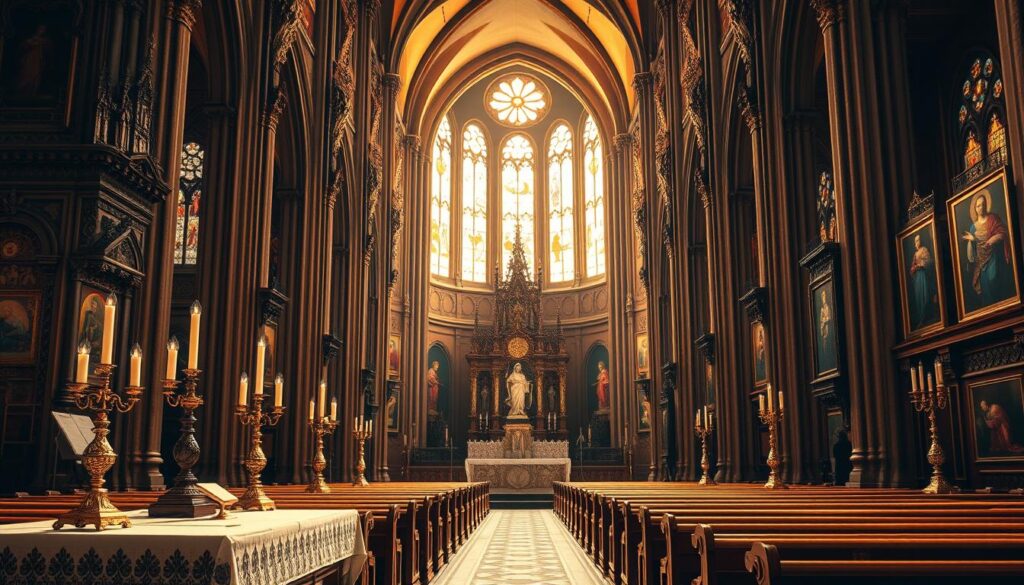
A majestic cathedral interior, bathed in warm, golden light from stained glass windows. In the foreground, an ornate altar adorned with intricate carvings and religious statues. Antique reliquaries and candelabras flank the altar, casting a serene, reverent atmosphere. The middle ground features rows of wooden pews, leading the eye towards a grand, vaulted ceiling. Alcoves along the walls display religious artifacts and paintings depicting the lives of Catholic saints. The scene conveys a sense of timeless spiritual grandeur and the enduring legacy of the Catholic faith.

  • Educational systems modeled after Jesuit principles
  • Feast days that mark cultural calendars worldwide
  • Social justice movements rooted in Franciscan values

Art and Relics in Devotional Practices

Masterpieces in stained glass and sculpture keep their stories alive. Caravaggio’s dramatic lighting immortalized Matthew’s conversion. Relics like bone fragments or personal items create physical connections to their journey of virtue.

This blend of art and veneration does more than decorate churches. It turns stone and pigment into invitations—urging believers to mirror that love in daily life. As one medieval artisan carved into a chapel wall: “They walked where we walk. Why not follow?”

Real-Life Tales: Saints Who Overcame Adversity

Human history sparkles with accounts of radical transformation. These holy figures faced hardships—from personal failings to societal persecution—yet emerged as beacons of hope. Their journeys prove that strength often blooms in life’s darkest soils.

Conversion Stories That Inspire

Augustine’s early years brimmed with wild parties and philosophical doubts. His mother Monica’s relentless prayers finally cracked his hardened heart. “Late have I loved you,” he later wrote, describing his shift from pleasure-seeking to divine truth-seeking.

Saul of Tarsus hunted followers of Christ until a blinding light changed everything. Renamed Paul, he became Christianity’s fiercest advocate. His letters still shape teachings about grace and redemption centuries later.

Rita of Cascia survived an abusive marriage before joining a convent. When her sons planned revenge against their father’s killers, she famously prayed: “Let them die rather than commit murder.” Both fell ill and passed peacefully, sparing their souls.

At 17, Joan of Arc led armies while illiterate peasants dismissed her. Her wisdom in military strategy—attributed to divine voices—reversed France’s fortunes in war. Though burned as a heretic, her legend now symbolizes courage against impossible odds.

These stories whisper a timeless truth: No past defines your future. Whether battling addiction like Augustine or injustice like Joan, their lives shout—hope survives. As Rita showed abuse victims, heaven hears even silent cries for help.

The Role of Catholic Saints in Modern Spirituality

In today’s fast-paced world, spiritual companions offer guidance rooted in timeless wisdom. These holy figures form a living network called the communion of saints—a family spanning generations. They become mentors for navigating modern struggles while keeping ancient faith alive.

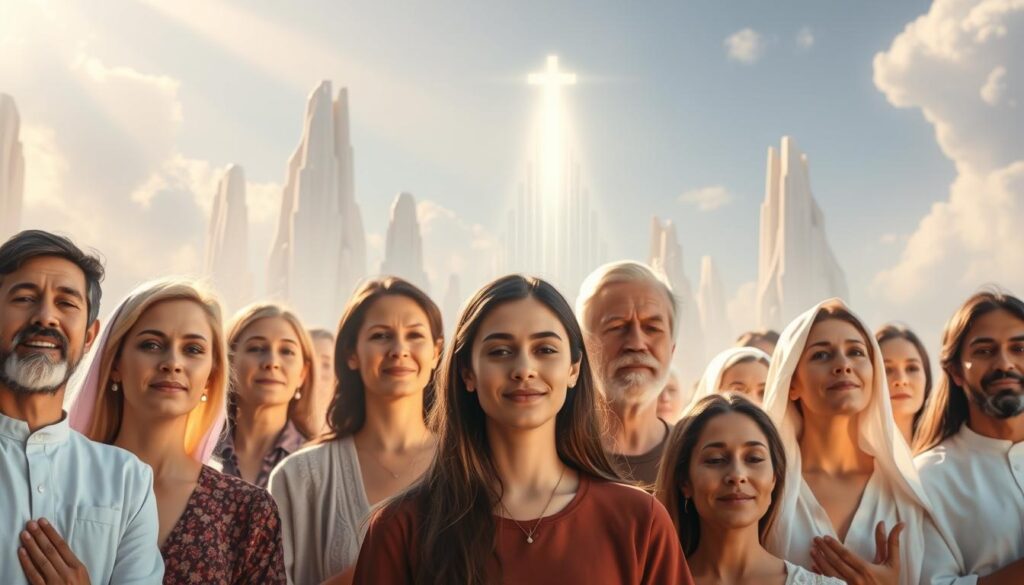
A serene, ethereal scene of modern spiritual saints, bathed in soft, heavenly light. In the foreground, a diverse group of individuals, their faces radiant with inner peace and wisdom, each embodying the qualities of compassion, humility, and devotion. Behind them, a dreamlike landscape unfolds, with towering, luminous structures and floating, translucent forms that evoke a sense of the divine. The overall atmosphere is one of tranquility, contemplation, and a deep connection to the spiritual realm, capturing the essence of the role of Catholic saints in the contemporary spiritual landscape.

Choosing a Confirmation saint isn’t just checking a box. It’s inviting a friend who’s walked similar paths. As one believer shared: “My patron’s story helped me face college stress—her courage became mine.” This bond turns historical figures into personal allies for life’s journey.

Modern Challenge Holy Guide Relevant Virtue
Career uncertainty Joseph the Worker Trust in divine timing
Relationship struggles Rita of Cascia Perseverance in love
Environmental concerns Francis of Assisi Stewardship of creation

Daily prayer keeps these connections vibrant. Many light candles while job hunting, echoing Anthony’s search for lost things. Others text prayer requests to saint-themed social media groups. This blend of old and new makes divine intercession feel personal and practical.

From medieval martyrs to 20th-century healers, these companions prove holiness transcends eras. Their lives remind us: we’re never truly alone. As the sun sets on busy days, whispered prayers bridge centuries—linking human hearts across time.

Unique Patronages and Miraculous Intercessions

Specific needs find specialized advocates through spiritual patronages. These holy guides connect with particular causes based on their earthly journeys, offering tailored assistance to those who seek their help.

A majestic cathedral interior with stained glass windows casting warm, reverent light. In the foreground, a kneeling figure gazes upwards, hands clasped in fervent prayer. Floating above, ethereal images of Catholic saints appear, their faces radiating divine grace and interceding on behalf of the supplicant. Ornate altars and religious iconography adorn the middle ground, creating a sense of sacred, mystical atmosphere. In the background, rows of wooden pews recede into the distance, evoking a profound, contemplative mood. A serene, cinematic lighting illuminates the scene, capturing the essence of Catholic devotion and the power of saintly intercession.

How Saints Advocate for Specific Causes

Saint Jude became the go-to for impossible situations after early believers witnessed his intercession in dire crises. Travelers carry Saint Christopher medals because his legend includes carrying strangers across raging rivers—a symbol of safe passage.

Saint Dymphna’s patronage for mental health stems from her courageous escape from abuse. Her story gives hope to those battling anxiety or trauma. Even Santa’s origin, Saint Nicholas, protects children and sailors through acts of secret generosity recorded centuries ago.

Invoking Saints in Daily Prayer

Start by naming the holy figure you’re addressing. A simple prayer might begin: “Saint Jude, friend of the hopeless, please present my request to God.” Share your need plainly, then close with gratitude and an “Amen.”

Many keep prayer cards handy for quick moments of connection. Others light candles as visual reminders of their petitions. These practices create bridges between daily struggles and divine protection, turning ordinary moments into opportunities for grace.

Whether facing lost keys or lost hope, these patronages remind us: no struggle is too small—or too big—for heavenly intercession.

Influential Saints and Their Enduring Teachings

Throughout history, certain individuals have shaped spiritual thought through their unwavering commitment to truth. Two figures stand out for merging intellectual rigor with heartfelt service—their virtues offering blueprints for meaningful living.

Lessons from Saints’ Virtues and Wisdom

Thomas Aquinas reshaped theology by bridging faith and reason. His Summa Theologica remains a cornerstone of religious writings, proving that curiosity and devotion can coexist. Students still pray to this patron of academics when facing tough exams.

Catherine of Siena used fiery letters to heal a divided Church. Her boldness moved popes and peasants alike, showing how wisdom thrives in action. “Be who God meant you to be,” she urged, inspiring others to embrace their purpose fearlessly.

Both teachers modeled a way of life where love fuels progress. Aquinas’s logical frameworks and Catherine’s diplomatic courage remind us: true virtue isn’t passive. It meets the world’s needs with head and heart united.

Their legacies challenge modern believers. How will we use our gifts? Like these spiritual fathers and mothers, our daily choices can echo beyond lifetimes—one act of integrity at a time.

FAQ

How do saints’ stories inspire people today?

Stories of figures like St. Augustine or St. Josephine Bakhita show resilience through personal struggles, offering hope and demonstrating how faith can transform lives. Their journeys highlight courage, love, and perseverance in adversity.

What determines a saint’s patronage?

Patronages often tie to a saint’s life or miracles. For example, St. Lucy, who faced persecution, is invoked for eye health due to legends about her vision. These connections arise from tradition and community devotion over time.

What steps are involved in becoming a saint?

The process includes investigation by a bishop, verification of virtues or miracles, beatification, and canonization. For instance, St. John Paul II’s rapid canonization followed scrutiny of his impact and two confirmed miracles.

Why are relics significant in devotional practices?

Relics, like those of St. Peter or St. Thérèse of Lisieux, serve as tangible connections to holy figures. They remind believers of the saint’s earthly journey and are often venerated as symbols of divine intercession.

Which saints are known for powerful conversion stories?

St. Paul’s transformation from persecutor to apostle and St. Monica’s prayers for her son Augustine’s conversion are celebrated examples. Their stories emphasize redemption and the impact of steadfast faith.

How do saints influence modern spirituality?

Teachings from figures like St. Francis of Assisi or Mother Teresa encourage compassion and justice. Many turn to their wisdom for guidance on issues like poverty, peace, or environmental care.

How can someone invoke a saint’s intercession in daily life?

Prayers, novenas, or meditating on their writings—like St. Ignatius of Loyola’s spiritual exercises—are common methods. Specific requests, such as asking St. Anthony for help finding lost items, align with their patronages.

What virtues do saints exemplify for believers today?

Humility (St. Teresa of Calcutta), courage (St. Joan of Arc), and forgiveness (St. Maria Goretti) are central. Their lives model how to navigate challenges while staying rooted in love and service.