For millions of believers, sacred rituals form the heartbeat of spiritual life. The Catholic Church recognizes seven unique celebrations that bridge heaven and earth. These practices aren’t ancient traditions alone—they’re living encounters designed to deepen our connection with God.
Each sacrament combines physical actions with divine purpose. Water, oil, and words become channels of grace, reflecting how Jesus Christ embraced both body and spirit during His earthly ministry. This incarnational approach reminds us that faith thrives through tangible experiences.
Some misunderstand these rites as mere symbols or luck-based customs. In reality, they’re transformative encounters rooted in biblical foundations. From baptism to marriage, every sacrament marks a pivotal moment in a believer’s journey.
This guide will unpack their historical roots, spiritual meanings, and modern relevance. You’ll discover how these sacred acts nourish faith, strengthen communities, and mirror God’s love in action.
Key Takeaways
Seven sacraments serve as direct connections to divine grace through physical rituals
Each practice combines visible elements with invisible spiritual realities
Sacraments are transformative encounters, not symbolic gestures or superstitions
Rooted in Jesus’ teachings, they address key moments in spiritual growth
Understanding sacraments enhances appreciation for Catholic worship traditions
Understanding the 7 Sacraments in Catholicism
At the heart of Christian practice lie seven sacred acts that mark life’s pivotal moments. These rituals, organized into three groups, create a roadmap for spiritual growth:
Initiation: Baptism, Eucharist, Confirmation
Healing: Reconciliation, Anointing of the Sick
Service: Marriage, Holy Orders
Historical Background and Spiritual Significance
Early Christians developed these practices from Jesus’ teachings. The Church Fathers later refined them, ensuring each ritual maintained its power to transform lives. Unlike ordinary symbols, sacraments make real what they represent—grace becomes tangible through water, oil, or vows.
How Sacraments Reflect God’s Love
Through these sacred means, believers experience divine presence in daily life. A baptismal blessing isn’t just words—it’s an embrace. Communion bread isn’t a snack—it’s nourishment for the soul. This active love meets people where they are, offering strength for every season.
Baptism: Initiation into the Catholic Faith
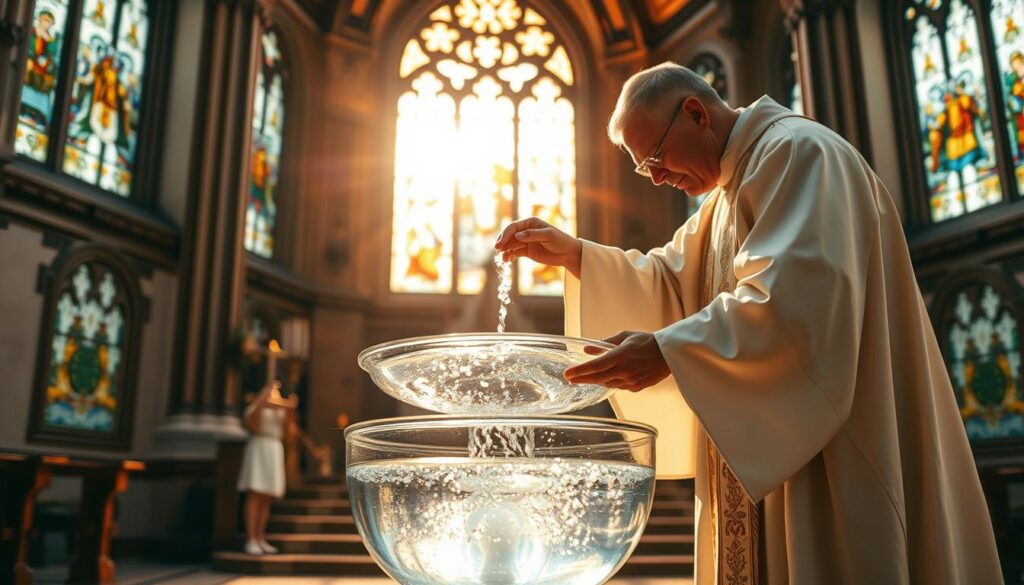
New beginnings hold special power in faith journeys. Baptism serves as the gateway sacrament, washing away original sin while welcoming individuals into God’s family. Through water and sacred words, this transformative ritual marks the start of lifelong spiritual growth.
Infant Baptism vs. Adult Baptism
Most Catholic families baptize infants, trusting God’s grace to guide their child’s future. Parents and godparents promise to nurture the baby’s faith until they can choose for themselves. Adults joining the Church often experience baptism through the RCIA program—a months-long journey of study and reflection.
Symbols and Meaning of Holy Water
The pouring of blessed water symbolizes rebirth, echoing Jesus’ resurrection. As the priest speaks the Trinitarian formula, the person being baptized receives an indelible spiritual mark. This single, unrepeatable act unites all Christians, regardless of age or denomination.
Whether received as a child or adult, baptism creates lasting bonds. It’s not just about joining a community—it’s about awakening to divine love that shapes every chapter of life.
Eucharist: The Heart of Catholic Worship
Gathering around a shared table forms the core of countless family memories. In Catholic practice, this simple act becomes something extraordinary through the Eucharist. More than a symbolic meal, it’s considered the source and summit of spiritual life—a daily opportunity to encounter divine love.
Transubstantiation and the Real Presence
At every Mass, ordinary bread and wine undergo a profound change. Through transubstantiation, these elements become Christ’s living body and blood while keeping their appearance. This mystery transforms the altar into a place of intimate connection. As St. Thomas Aquinas noted, “What you see is the bread, but what it truly is becomes the presence of Christ.”
Celebrating First Holy Communion
Children typically receive their first communion around age seven. Preparation includes learning prayers and making their initial confession. Many families mark this milestone with white garments and festive gatherings. The experience often becomes a cherished memory that shapes a lifelong relationship with faith.
Preparation Step
Purpose
Typical Age
Religious Education Classes
Teach core beliefs
6-7 years
First Confession
Spiritual cleansing
7-8 years
Communion Practice
Learn rituals
7-8 years
Regular participation requires simple preparations. Catholics fast for one hour before receiving the sacrament, focusing their hearts on this sacred time. Many find that frequent communion strengthens their daily walk, offering nourishment for life’s challenges.
Confirmation: Sealing with the Holy Spirit
What transforms a quiet faith into bold spiritual courage? For many believers, this sacrament answers that question through sacred oil and ancient promises. Often called a “spiritual coming-of-age,” confirmation strengthens the grace first received at baptism.
The Power of Chrism Oil
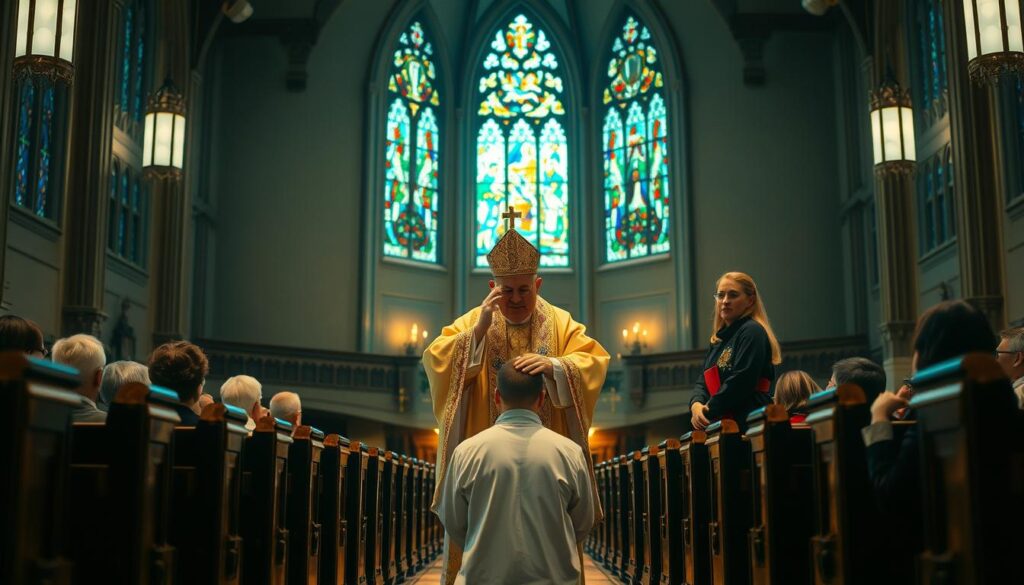
During the ceremony, bishops bless chrism oil—a fragrant mix of olive oil and balsam. This sacred blend represents the Holy Spirit‘s lasting presence. As the minister traces a cross on the candidate’s forehead, they declare: “Be sealed with gifts of the Spirit.”
The oil’s sweet aroma lingers as a physical reminder. “Like a signature on the soul,” one priest explains, “this anointing marks believers as Christ’s lifelong ambassadors.”
Choosing Heavenly Allies
Many select a saint’s name during preparation—a tradition connecting past and present. Teens might pick Francis for his love of nature, or Teresa for her compassionate service. Adults often choose mentors from Church history.
This practice creates bridges across generations. As St. Augustine wrote:
“The saints are our companions, not distant statues.”
Most children receive confirmation after years of faith formation, typically around age 13. Adult converts experience it alongside baptism—a powerful one-two embrace of divine faith. Both paths lead to the same destination: a heart ready to shine.
Reconciliation: Healing Through Confession
What lifts the weight of guilt and restores inner peace? For many believers, this sacrament offers a fresh start through honest self-reflection. Known as Confession or Penance, it transforms brokenness into hope.
The Journey to Forgiveness and Renewal
Individuals confess sins privately to a priest, who serves as a spiritual guide. The process isn’t about shame—it’s about reclaiming healing through accountability. Some visit weekly; others come during Lent or Advent.
The priest assigns penance, like prayers or acts of kindness, to nurture growth. Though he speaks the words, forgiveness flows from divine power, not human authority. This sacred exchange mends relationships with God and community.
Regular practice builds resilience against repeating sins. As one believer shared: “Leaving the confessional feels like breathing clean air after years underwater.” Through Reconciliation, burdens lift, and hearts find wings.
FAQ
Why does the Church emphasize infant baptism?
Infant baptism highlights God’s grace freely given before personal choice, welcoming children into the faith community. Parents and godparents pledge to nurture the child’s spiritual growth until they can affirm their beliefs.
What makes the Eucharist central to Catholic worship?
The Eucharist is considered the “source and summit” of faith because Catholics believe in the Real Presence of Jesus Christ. Through transubstantiation, bread and wine become His Body and Blood, offering spiritual nourishment and unity with believers.
How does Confirmation strengthen a person’s faith?
Confirmation deepens the gifts of the Holy Spirit received at baptism. The anointing with chrism oil symbolizes strength to live as witnesses to Christ, while choosing a patron saint provides a model for virtue and discipleship.
Can someone receive Reconciliation without confessing to a priest?
The sacrament requires confessing sins to a priest, who acts in Christ’s name to offer absolution. This practice reflects Jesus’ command to His apostles: “Whose sins you forgive are forgiven” (John 20:23).
Why is holy water used in rituals like baptism?
Holy water signifies purification, renewal, and life. It recalls Jesus’ baptism in the Jordan River and serves as a tangible reminder of God’s cleansing grace and the believer’s call to holiness.
What role do sponsors play in Confirmation?
Sponsors guide candidates in living their faith, much like godparents at baptism. They often share wisdom, pray for the candidate, and encourage a lifelong commitment to the Church’s mission.
Welcome to your trusted source for faith-focused updates shaping communities worldwide. This week brings significant developments affecting millions of believers, from papal activities to grassroots responses in challenging regions.
Pope Leo’s return to Vatican City after his stay at Castel Gandolfo highlights leadership movements within the Church. Meanwhile, Catholic families in Gaza face unprecedented hardships amid ongoing conflicts, drawing international attention to their resilience.
In the United States, Florida’s new religious liberty protections offer hope for worshippers. These policies aim to safeguard traditions while addressing modern challenges. Globally, investigations into Church-related matters continue to spark dialogue about accountability and reform.
Every decision from Rome ripples through parishes, altering how people practice their faith daily. Whether it’s liturgical changes or community-led initiatives, these stories reveal how ancient traditions adapt to today’s realities.
Key Takeaways
Track Pope Leo’s recent return to Vatican City and its symbolic importance
Explore how conflicts impact Catholic communities in crisis zones like Gaza
Understand new religious freedom laws in Florida and their national implications
Stay updated on global Church investigations shaping its future direction
Learn how Vatican decisions directly influence local worship practices
Breaking Developments in the Catholic Church
This week’s headlines reveal how global events test the Church’s role as both spiritual guide and diplomatic force. From war zones to policy shifts, leaders are balancing ancient traditions with urgent modern crises.
Recent Headlines and Global Reach
The Latin Patriarch of Jerusalem made waves by calling the Gaza conflict “inexcusable” during a press conference. His statement aligns with growing calls for peace from clergy in conflict areas. Meanwhile, African bishops criticized Western nations for exploiting resources while ignoring humanitarian needs.
In Bangladesh, Cardinal Patrick D’Rozario mourned victims of a military plane crash. He urged governments to prioritize civilian safety. These responses show how Church figures address both sudden tragedies and systemic issues.
Updates from Vatican City
The Holy See hosted tense talks between Israel’s ambassador and Catholic diplomats. Discussions focused on protecting places of worship in war zones. New policies also emerged about financial transparency – a direct response to past criticism.
Vatican offices now coordinate aid deliveries to Gaza through partner organizations. This effort highlights how decisions made in Rome ripple outward. As one official noted: “Our work starts here but belongs to every parish.”
From urgent diplomacy to quiet policy shifts, these updates shape how millions practice their faith today.
Pope Leo’s Recent Movements and Reflections
Papal traditions came into focus as Pope Leo returned to Vatican City after a 16-day retreat at Castel Gandolfo. The lakeside town, used by church leaders since the 1600s, offers quiet spaces for prayer and strategic planning. This summer’s stay followed a centuries-old pattern of balancing public duties with private reflection.
Insights from Castel Gandolfo to Vatican City
Pope Leo XIV’s time at the summer residence included meetings with advisors and drafting plans for youth outreach programs. A Vatican spokesperson noted: “These retreats allow leaders to see challenges through a spiritual lens.” The pope’s return signals renewed activity, including finalizing guidelines for global parish initiatives.
Era
Papal Retreat Focus
Modern Impact
17th Century
Agricultural management
Environmental advocacy
21st Century
Digital evangelization
Social media outreach
Impact on Church Traditions
Castel Gandolfo’s role extends beyond being a scenic getaway. Historical records show 12 popes used the estate to develop major teachings. Today, its gardens host interfaith dialogues while maintaining areas for silent meditation.
Pope Leo’s July retreat influenced his recent call for “compassionate leadership in divided times.” Observers note his refreshed approach to balancing tradition with modern social challenges. These patterns show how papal movements shape both Vatican operations and local parish activities worldwide.
Reporting from Castel Gandolfo and Its Surroundings
Nestled 15 miles southeast of Rome, Castel Gandolfo offers a rare blend of papal history and Italian charm. The town’s cobblestone streets wind past centuries-old buildings, leading visitors to the Apostolic Palace overlooking Lake Albano. This serene retreat has hosted popes since the 1600s, providing quiet spaces for reflection amid its volcanic lake views.
Local businesses thrive when papal visits occur, though residents balance tourism with reverence. A café owner shared: “We welcome travelers year-round, but when the palace gates open, the town feels sacred again.” Security measures intensify during these periods, with discreet coordination between Vatican guards and Italian authorities.
Activity
Papal Visit Period
Regular Season
Tourist Traffic
Controlled access zones
Open exploration
Local Events
Interfaith gatherings
Cultural festivals
Economic Impact
Surge in religious tourism
Steady regional visitors
Lake Albano’s tranquil waters remain central to the area’s appeal. Boating restrictions during papal stays ensure quiet mornings perfect for meditation. Over 23 popes have sought inspiration here, leaving behind gardens now open for public tours. Today, the town preserves its dual identity through careful preservation of both spiritual and historical landmarks.
Global Religious Affairs Shaping the Church
Global diplomacy and spiritual guidance intersect as religious figures navigate modern conflicts. Recent exchanges highlight how international relations shape the Church’s approach to humanitarian crises and peacebuilding efforts.
Comments from International Leaders
Israel’s envoy to the Holy See recently defended military actions in Gaza, stating: “No nation can tolerate attacks on its citizens.” Meanwhile, African bishops challenged Western governments during a UN meeting, accusing them of prioritizing resource extraction over human dignity.
Vatican diplomats work discreetly to balance these perspectives. One envoy noted: “Our role isn’t to take sides but to protect vulnerable communities.” This approach faces challenges as Catholic leaders in developing nations demand stronger advocacy against economic exploitation.
The Church’s global network enables unique mediation opportunities. Last month, Vatican representatives facilitated talks between European envoys and South Sudanese officials. These discussions focused on ensuring religious freedom amid political tensions.
As faith intersects with geopolitics, the world watches how spiritual leaders address complex realities. Their words carry weight in both prayer circles and policy debates, shaping responses to conflicts from Gaza to the Sahel.
Catholicism News: Key Stories Today
A wave of inquiries is reshaping how religious institutions address operational transparency. Recent findings from a federal investigation revealed that at least 28 patients may have been alive during organ procurement procedures at faith-based hospitals. This report has sparked urgent discussions about ethical standards in healthcare systems.
Updates on Allegations, Investigations, and Official Reports
Church leaders face mounting pressure to address multiple allegations across their networks. Legal experts note a 40% increase in active cases compared to 2022, ranging from financial audits to care protocol violations. “We’re committed to full cooperation with authorities,” stated a diocesan spokesperson during a recent press briefing.
The Department of Health and Human Services (HHS investigation) continues examining 15 medical facilities tied to religious orders. Their preliminary findings suggest possible breaches in patient consent protocols. These probes have already influenced policy changes at six major Catholic healthcare institutions.
Investigation Focus
Current Status
Impact
HHS Organ Procurement
Ongoing federal review
Suspended transplants at 3 hospitals
Legal Cases (Abuse Claims)
12 active lawsuits
Revised youth protection policies
Internal Audits (Financial)
85% completion rate
New donation tracking systems
Transparency initiatives now include public dashboards showing complaint resolutions. While some parishioners praise these efforts, others demand faster action. “Accountability strengthens faith communities,” remarked a theology professor during a conference panel last week.
Exploring Religious Heritage and Tourist Attractions
Travelers seeking meaningful journeys find rich experiences where sacred sites meet stunning landscapes. Four organized circuits now connect 22 destinations, blending religious heritage with cultural discovery and natural beauty.
These routes let visitors explore centuries-old traditions while enjoying local ecosystems. “We designed these paths to show how faith and nature inspire each other,” shares a regional tour coordinator.
Tours of Historic Churches and Cathedrals
St. Mary’s Cathedral anchors one circuit, drawing pilgrims with its Gothic arches and hand-carved altars. Nearby, the Cross of Motupe stands atop a hill, offering panoramic views that deepen reflective moments. Guided tours explain architectural styles and their spiritual symbolism.
Cultural and Natural Circuits in Religious Sites
The Pómac Forest surprises travelers with ancient chapels nestled among ironwood trees. Coastal routes lead to Pimentel Beach, where fishermen’s processions honor patron saints. Modern amenities like trail markers and visitor centers make these journeys accessible to all.
Local economies thrive as tourist numbers grow – shops sell artisan crafts, and hotels preserve historic buildings. These circuits prove that exploring church heritage can also support community growth and environmental care.
In-Depth Coverage of Investigations and Reports
A series of reports has brought to light serious issues in organ procurement processes at Catholic hospitals. Federal investigators found evidence suggesting 28 patients might have been alive during organ removal procedures. These findings have ignited urgent debates about medical ethics oversight.
The Department of Health and Human Services (HHS) identified gaps in patient consent verification across 15 facilities. “We’re implementing stricter monitoring systems,” shared a hospital administrator during recent testimony. New protocols now require three independent death confirmations before organ procurement begins.
Focus Area
Key Findings
Corrective Actions
Organ Procurement
Consent form discrepancies
Mandatory ethics training
Abuse Claims
12 active lawsuits
24/7 reporting hotlines
Financial Audits
Donation tracking gaps
Blockchain ledger systems
Church leaders have partnered with legal experts to create accountability frameworks. Public dashboards now display investigation updates in real time. Allegations of rushed procedures have prompted calls for interfaith ethics panels.
These developments are reshaping trust in faith-based healthcare. While some question institutional transparency, others praise the swift policy changes. Ongoing reviews aim to balance medical needs with unwavering ethical standards.
The Fight for Religious Liberty and Justice
Recent legal advancements highlight growing efforts to defend spiritual expression worldwide. Florida stands at the forefront of this movement, setting benchmarks for safeguarding sacred practices.
Florida’s Role in Protecting Faith
The Sunshine State passed three landmark bills last year strengthening religious liberty protections. These laws prevent discrimination against faith-based organizations in public contracts and protect clergy from performing ceremonies conflicting with their beliefs.
Governor Ron DeSantis remarked: “True freedom means honoring diverse traditions while ensuring equal treatment.” Legal experts praise Florida’s approach for balancing individual rights with institutional safeguards.
Florida Law
Key Provision
National Impact
HB 403
Shields religious gatherings during emergencies
Adopted by 7 states
SB 1382
Protects faith-based adoption agencies
Inspired federal proposals
HB 7055
Expands school prayer rights
Challenged in 3 courts
Perspectives on Global Religious Rights
While Florida thrives, 34 countries saw increased persecution of faith groups last year. Catholic leaders collaborate with Islamic councils and Jewish federations to draft universal protection standards. “Liberty grows through shared commitment,” notes Imam Khalid Rahman of the Interfaith Alliance.
Successful models now guide reforms in Brazil and Kenya. Challenges remain in regions restricting worship, but Florida’s blueprint offers adaptable solutions. These efforts prove that defending sacred spaces strengthens both communities and justice systems.
Profiles of Catholic Leaders and Influential Clergy
Behind every thriving parish stand leaders whose dedication shapes spiritual journeys. This week, we highlight those guiding communities through innovation and compassion.
Spotlights on Priests, Bishops, and Community Figures
Father Marko Ivančić transformed his Detroit parish by launching mobile food pantries during factory closures. “We meet people where they are,” he explains. His team now serves 300 families weekly through rotating neighborhood stops.
Leader
Role
Initiative
Impact
Sr. Angela Martin
Youth Minister
Tech mentorship program
63% increase in teen participation
Bishop Carlos Mendez
Diocesan Leader
Rural clinic partnerships
12 new healthcare sites
Fr. Elijah Thompson
Urban Parish Priest
24/7 prayer hotline
4,200 calls monthly
Bishop Mendez recently addressed migration challenges along the Texas border. “Our duty transcends politics,” he stated during a interfaith shelter opening. His diocese now trains volunteers in crisis counseling and legal advocacy.
Cardinal Patrick D’Rozario’s response to Bangladesh’s military plane crash showed leadership in crisis. He organized memorial services while coordinating trauma support for victims’ families. Such actions reveal how clergy balance ancient traditions with modern needs.
From digital outreach to disaster response, these leaders prove faith thrives through adaptable service. Their work inspires both parishioners and future clergy across generations.
Community Impact and Responses to Church News
Families across America are reshaping daily spiritual routines to align with recent Church updates. Many households now blend traditional prayers with new guidance during family meals and bedtime rituals. “We’re finding creative ways to keep our home altar relevant,” shares Maria Gonzalez, a mother of three from Texas.
Parish communities have become hubs for processing major developments. St. Anthony’s in Chicago hosts weekly discussion groups where people explore how leadership decisions affect local traditions. Similar gatherings in Ohio parishes help families navigate changes through shared reflection.
Grassroots efforts flourish as lay members lead food drives and mental health workshops. These initiatives address both spiritual and practical needs. In Florida, a youth-led program connects elderly parishioners with tech-savvy teens for virtual worship access.
Home practices evolve too – many families now stream diocesan teachings during Sunday gatherings. This adaptation helps households stay informed while maintaining cherished customs. Support networks grow stronger through these shared efforts, proving communities thrive when people unite around faith.
How Global Events Affect the Daily Lives of the Faithful
Violence in conflict zones continues reshaping how communities practice their faith under fire. Last week’s accidental strike on Holy Family Church in Gaza left three dead and dozens injured, spotlighting the vulnerability of sacred spaces in war zones. This tragedy underscores how global tensions ripple through local parishes, altering worship and safety.
Analysis of Recent Strikes and Their Consequences
The attack damaged one of Gaza’s few remaining Catholic gathering points, disrupting weekly Mass and community meals. Families now weigh safety against spiritual needs – some avoid church visits entirely. “We pray at home, but it’s not the same,” shared a parishioner via encrypted message.
International groups like Caritas mobilize medical aid while clergy coordinate trauma counseling. Over 12 global dioceses have funded emergency shelters near conflict areas. Yet rebuilding trust proves harder than repairing walls – many fear repeated attacks could erase generations of Catholic presence in Gaza.
Ongoing warfare forces creative adaptations. Mobile chapels now serve displaced families, while encrypted apps share scripture readings. These efforts show resilience but highlight urgent needs: safer spaces for worship and stronger international protections for religious sites.
Engaging Stories from the Heart of the Church
Everyday lives become extraordinary when faith intersects with action. Meet those whose journeys reveal how spiritual commitment transforms communities and renews purpose.
Personal Accounts and Testimonials
After battling addiction for 12 years, Michael Torres credits his recovery to a parish support group. “They showed me hope wasn’t just a word,” he shares. Today, he mentors teens using art therapy programs at St. Vincent’s Church in Albuquerque.
Retired teacher Clara Nguyen answered unexpected calls during the pandemic. She organized grocery deliveries for 80 families through her Milwaukee parish. “Service became my daily prayer,” she reflects.
Name
Role
Years Involved
Community Impact
Fr. Andre Baptiste
Homeless Outreach
7
Built 3 transitional homes
Maria Gutierrez
Youth Coordinator
5
Doubled teen participation
Samuel Kwon
Music Minister
15
Launched interfaith choir
In Detroit, former engineer Lila Patel found new hope after joining a women’s spirituality circle. Their fundraising efforts provided school supplies for 300 children last fall. Stories like hers prove ordinary people create lasting change through simple acts.
These accounts show how faith journeys evolve over years, blending personal growth with community needs. From quiet prayers to bold calls to action, they remind us that every life holds potential for renewal.
A Closer Look at the Life and Work within Parishes
Parishes hum with quiet dedication as priests balance ancient rituals with modern needs. Morning Masses flow into food pantry shifts, while afternoons bring counseling sessions and school visits. One Chicago church even hosts pop-up confession booths at farmers markets – meeting communities where they gather.
Creative outreach fuels connections with young people. Detroit parishes pair teens with elder members for tech tutoring, blending intergenerational bonding with faith discussions. “We’re building bridges, not just giving sermons,” shares Father Paul Rivera, whose youth-led podcast reaches 5,000 monthly listeners.
Milwaukee’s St. Anne’s church just celebrated its 125th anniversary by launching a mentorship program. Teens design service projects addressing local homelessness – a fresh take on traditional charity work. These efforts show how priests and lay leaders adapt timeless values to today’s challenges.
From baptism prep classes to anniversary festivals, parishes remain vibrant hubs where faith meets action. As young people reshape worship through music ministries and eco-projects, they prove ancient traditions thrive through reinvention.
FAQ
What recent updates has Pope Leo XIV shared from Castel Gandolfo?
During his stay at Castel Gandolfo, Pope Leo XIV emphasized peace-building efforts and interfaith dialogue. He also reflected on balancing modern challenges with Church traditions, addressing topics like climate action and youth engagement.
How is the Vatican responding to allegations of clergy misconduct?
The Vatican has launched an independent investigation led by Cardinal Pietro Parolin. Updates are shared through official reports, stressing transparency and accountability while urging prayers for affected communities.
What role does Florida play in religious liberty discussions?
Florida recently passed legislation strengthening protections for faith-based organizations. Bishops like Archbishop Thomas Wenski have praised the move, calling it a model for safeguarding worship and conscience rights globally.
Are there guided tours available at historic Catholic sites?
Yes! Destinations like St. Peter’s Basilica and Chartres Cathedral offer tours blending art, history, and spirituality. Local parishes, such as Holy Family Parish in Gaza, also host cultural circuits for pilgrims.
How has the war in Gaza impacted Catholic communities there?
The Latin Patriarchate of Jerusalem reports intensified outreach to support displaced families. Pope Leo XIV’s envoy, Archbishop Pierbattista Pizzaballa, continues advocating for ceasefires and humanitarian aid access.
What are the latest reforms in parish leadership structures?
Dioceses worldwide are integrating more lay leaders, especially women, into administrative roles. For example, the Archdiocese of Chicago recently appointed Maria Sanchez as its first female chancellor.
How do global strikes affect Catholic social teaching advocacy?
The U.S. Conference of Catholic Bishops released a statement supporting fair labor practices during recent strikes. They highlighted Pope Francis’ calls for dignity in work and equitable wages.
What’s the Vatican’s stance on the HHS contraceptive mandate investigation?
The Holy See reaffirmed its opposition to mandates conflicting with religious beliefs. A recent court filing stressed the need for exemptions to protect conscience rights under the First Amendment.
How can young people engage with Church initiatives today?
Programs like World Youth Day and the Synod on Synodality prioritize youth voices. Local parishes also host mentorship opportunities, connecting teens with clergy and community leaders.
What’s the significance of the Holy Family’s 200th anniversary celebration?
The anniversary highlights the Church’s focus on family unity and faith formation. Special Masses, retreats, and charity drives are underway, with Pope Leo XIV calling families “the heart of evangelization.”
Have you ever felt weighed down by life’s challenges, longing for a fresh start? Many find unexpected comfort through a time-honored spiritual practice rooted in grace and compassion. This ancient tradition offers more than ritual—it’s a bridge to emotional freedom and inner peace.
Communities worldwide celebrate this transformative experience, where individuals reconnect with their beliefs. Participants often describe overwhelming relief, as if burdens they’ve carried for years suddenly lift. One person shared, “It felt like coming home after a long journey.”
The beauty lies in its accessibility. Whether it’s been months or decades, the door remains open. Leaders emphasize that perfection isn’t required—only sincerity. As one guide puts it, “This isn’t about judgment; it’s about healing through divine mercy.”
Known by several names—from Reconciliation to Penance—each title reveals different facets of its purpose. At its core, it fosters personal growth while strengthening bonds with others. Regular practice helps many maintain clarity and purpose in their daily lives.
Key Takeaways
This spiritual practice provides emotional relief and renewed perspective
Communities welcome all participants, regardless of time since last involvement
Multiple names reflect its focus on healing, forgiveness, and connection
Regular engagement supports ongoing personal and spiritual development
Emphasis on compassion over perfection creates safe space for growth
Preparing for a Meaningful Confession
Finding clarity in our spiritual lives begins with intentional preparation. Like tending a garden, nurturing your inner life requires attention and care before moments of renewal.
Preparing Your Heart and Mind
Start by creating quiet space to reflect. A simple prayer like “Come, Holy Spirit” invites divine guidance to reveal what needs healing. This practice helps untangle complex emotions and sharpens self-awareness.
Many find it helpful to journal thoughts or revisit key moments from their day. As one spiritual guide notes:
“Grace grows where humility takes root.”
This mindset shift transforms preparation from obligation to opportunity.
Examination of Conscience and Spiritual Readiness
Daily reflection builds spiritual muscle memory. Before sleep, spend five minutes reviewing:
Kind acts performed
Missed chances to show love
Patterns needing improvement
Modern distractions make it easy to overlook small choices. Regular examination of conscience acts like a compass, keeping us aligned with our values. Over time, this habit reveals growth areas while celebrating progress.
Remember—this isn’t about perfection. It’s about showing up honestly and trusting the process. With consistent practice, what feels challenging today becomes tomorrow’s path to peace.
Understanding catholicism confession and Its Significance
At the heart of this sacred practice lies a dual gift: divine mercy and communal healing. It bridges personal renewal with collective spiritual health, offering more than individual relief.
Definition and Sacred Purpose
This sacrament confession serves two vital roles. First, it restores one’s bond with God through pardon. Second, it repairs relationships within the faith community. As one leader explains:
“We’re not just addressing wrongs—we’re rebuilding connections.”
The process mirrors the prodigal son’s return—sincere repentance opens doors to grace. Participants acknowledge their sins not to dwell on failure, but to embrace transformative forgiveness.
The Role of the Priest in the Sacrament
Priests act as both guides and channels in this sacred exchange. They don’t judge but instead offer Christ’s healing words:
Listen with compassion
Provide spiritual counsel
Pronounce absolution using divine authority
When a priest says, “I absolve you from your sins”, it’s more than ritual—it’s a restoration of spiritual wholeness. This unique role balances human understanding with holy purpose.
Aspect
Personal Impact
Community Impact
Divine Forgiveness
Clears conscience
Strengthens unity
Priest’s Guidance
Offers clarity
Maintains tradition
Words of Absolution
Restores grace
Renews collective faith
Through this sacrament, individuals find peace while contributing to their community’s spiritual vitality. It’s a way to grow personally and strengthen bonds that transcend individual experience.
The Process and Steps to Make a Good Confession
Taking steps toward spiritual renewal can feel daunting, but knowing what to expect transforms anxiety into hope. This sacred exchange follows a rhythm of honesty, guidance, and commitment—a path walked by millions seeking peace.
Steps to Approach the Confessional
Begin by choosing between speaking through a screen or face-to-face—both options offer grace. Start with the sign of the cross and say: “Bless me Father, for I have sinned. It has been [time period] since my last confession.” Share your sins simply, including situations that shaped your choices. One priest advises:
“Details help us address patterns, not just actions.”
Utilizing Prayers and Acts of Contrition
After sharing, listen to the priest’s counsel. Then recite the Act of Contrition:
“Oh my God, I am sorry for my sins with all my heart… I firmly intend to avoid whatever leads me to sin.”
These words express both sorrow and resolve, creating space for healing.
Following Penances and Spiritual Guidance
Accept your penance—like prayers or kind acts—with openness. Complete it soon as possible to seal your renewal. The priest concludes with: “Give thanks to the Lord, for He is good.” Respond “For His mercy endures forever,” then leave with the assurance: “Go in peace.”
Though formal at first, this process becomes a lifeline. As one participant shared: “Every step felt like shedding heavy armor.”
Embracing the Benefits and Experiencing Spiritual Renewal
Imagine carrying a heavy backpack that suddenly lightens—this is the relief many feel after spiritual renewal. Through this sacred practice, people discover freedom from hidden burdens and rediscover their capacity for joy.
Finding Peace, Forgiveness, and Healing
Guilt acts like static noise in the soul, disrupting inner harmony. The sacrament’s mercy silences this chaos, replacing it with clarity. As one participant shared: “It’s like finally exhaling after holding your breath for years.”
Five key benefits transform lives:
Benefit
Impact
Self-Knowledge
Reveals growth areas with compassion
Grace-Powered Change
Breaks stubborn habits
Inner Peace
Restores emotional balance
Christ-Like Growth
Develops virtue and love
Stronger Will
Resists temptations effectively
Transforming Your Life through Regular Practice
Monthly participation works like spiritual exercise—strengthening your conscience muscle. Unlike yearly check-ins, regular practice helps spot patterns early. Married couples often focus on:
Honoring commitment to their spouse
Respecting boundaries in relationships
Practicing kindness in daily actions
Understanding sin types matters too. Mortal sin severs divine connection through serious wrongs done knowingly. Venial sins weaken bonds but respond quickly to correction. As a spiritual coach notes:
“Frequent renewal keeps your soul’s windshield clean.”
This journey isn’t about perfection—it’s about progress. Each visit builds resilience, making wise choices feel more natural over time. The power to change grows when we show up consistently.
Conclusion
Every moment offers a new chance to embrace healing. This sacrament welcomes every sinner with open arms—no perfect résumé required. Jesus waits patiently, ready to replace guilt with grace when we simply ask.
Don’t let another day pass without experiencing this liberation. Regular practice reshapes your life, turning small steps into lasting change. God’s forgiveness isn’t just a one-time gift—it fuels daily growth in peace and joy.
Make good use of your time by weaving this practice into your routine. Let it refine your thoughts and actions, guiding you toward deeper love for others. The help you receive becomes a light to share, inviting friends to discover the same renewal.
Through consistent participation, you’ll grow as God’s cherished son or daughter. Each visit strengthens your faith, transforming not just your heart—but your entire world. Why wait? Your fresh start begins now.
FAQ
Why do I need to confess to a priest instead of praying directly to God?
The priest acts as a guide and mediator, offering Christ’s forgiveness through the sacrament. This practice reflects Jesus’ teaching to His apostles: “Whose sins you forgive are forgiven them” (John 20:23). It also provides accountability and spiritual healing through tangible grace.
What’s the difference between mortal and venial sins?
Mortal sins sever your relationship with God through grave actions committed with full knowledge and consent. Venial sins weaken that bond but don’t destroy it. Both require repentance, but mortal sins must be confessed for full reconciliation.
How do I prepare my heart before entering the confessional?
Start with prayer, asking the Holy Spirit for honesty and humility. Reflect on your actions using an examination of conscience—a tool to review moral choices. Sincere sorrow and a desire to change are key to a meaningful experience.
What if I forget to mention a sin during confession?
If unintentionally forgotten, the sin is still forgiven. Simply mention it in your next confession. Honesty matters, but God’s mercy covers human imperfection. Focus on sincerity rather than perfection.
Why is penance assigned after confessing?
Penance repairs harm caused by wrongs and strengthens spiritual growth. It might include prayers, acts of kindness, or other steps to renew your heart. Completing it shows commitment to healing and transformation.
Can I receive absolution if I’m not ready to change a sinful habit?
Absolution requires genuine sorrow and a firm purpose of amendment—even if progress is gradual. If you’re unwilling to try, the sacrament’s grace may not fully take root. Discuss struggles with the priest for guidance.
How does regular confession improve daily life?
It fosters self-awareness, humility, and reliance on God’s mercy. Over time, this practice deepens virtues like patience and love, helping you respond to challenges with grace. Many find lasting peace through this spiritual reset.
Welcome to an exploration of the world’s largest Christian denomination, a spiritual institution with over 1.4 billion followers across every continent. This global community blends ancient traditions with modern practices, creating a unique tapestry of faith that has shaped societies for nearly 2,000 years.
From its roots in early Christianity, this organization has grown into a network of 24 self-governing branches. The best-known is the Latin tradition, but 23 Eastern branches preserve equally rich cultural practices. Together, they form a spiritual mosaic united by shared beliefs.
Nearly 3,500 local districts worldwide keep this faith vibrant and accessible. These communities do more than host services—they run schools, hospitals, and charity programs. In fact, this group operates the biggest non-government network of social services on Earth.
Key Takeaways
Serves 1.4+ billion members globally as Christianity’s largest branch
Shaped Western culture through art, education, and ethics
Combines 24 self-governing traditions under one spiritual umbrella
Maintains 3,500+ local districts for community support
Leads in global education and healthcare through non-profit work
History and Origins of the Catholic Church
The story begins with a small group of followers who witnessed Jesus Christ’s resurrection. Their mission? To share his message of love and redemption. This movement gained momentum after Pentecost, when believers experienced a spiritual awakening that fueled their evangelical efforts.
Apostolic Foundations and Early Christianity
Saint Peter became central to this growing community. According to tradition, Christ named him the foundation of their spiritual family. His leadership laid the groundwork for a line of successors that continues today.
Early followers faced intense challenges. Roman authorities persecuted those who rejected pagan rituals. Yet these trials strengthened their resolve. Secret gatherings in homes and catacombs kept their faith alive during dangerous times.
Influence of the Roman Empire
Ironically, Rome’s infrastructure helped Christianity thrive. Well-maintained roads let missionaries travel safely. Common languages like Greek and Latin made spreading teachings easier across diverse regions.
Everything changed in 313 AD. Emperor Constantine legalized the faith through the Edict of Milan. By 380 AD, it became Rome’s official religion. This shift transformed a grassroots movement into a powerful cultural force.
Core Beliefs and Teachings
One ancient declaration binds believers across continents in shared conviction. This faith community roots its identity in teachings preserved since the apostles, blending scriptural truth with time-honored practices. At the center stands a fourth-century statement that continues guiding millions today.
The Nicene Creed and Sacred Tradition
The words “We believe in one God” open Christianity’s most universal profession of faith. First formulated in 325 AD, this creed defines essential teachings about Christ’s divinity and humanity. It serves as both a spiritual compass and a unifying force for diverse congregations.
Through apostolic succession, leaders maintain continuity with early Christian witnesses. Bishops trace their authority to the original apostles, while the pope continues Saint Peter’s role as unifying figure. Together with sacred tradition, they safeguard teachings unchanged by cultural shifts.
Sacraments and Liturgical Practices
Seven sacred rituals mark life’s key spiritual milestones. Baptism welcomes new members, while Holy Orders dedicates clergy to service. The Eucharist remains central, celebrated as Christ’s ongoing presence among followers.
Shared rituals create global unity despite local customs. Whether in bustling cities or remote villages, the same prayers and symbolic actions connect worshippers. This consistency reflects a 2,000-year commitment to preserving faith essentials through generations.
The Role of the Catholic Church in Western Civilization
Western civilization’s artistic and intellectual legacy owes much to a global faith community. For centuries, monastic networks safeguarded ancient wisdom while fostering new breakthroughs. This stewardship shaped Europe’s cultural identity during times of upheaval and renewal.
Impact on Art, Culture, and Science
Monastic scriptoriums became lifelines for classical knowledge. Teams of scribes preserved Aristotle’s philosophy and Roman legal texts while Europe rebuilt after the fall of Rome. Benedictine communities developed structured learning systems that evolved into modern universities.
Creative expression flourished under spiritual patronage. Master builders designed soaring cathedrals like Notre-Dame, blending faith with architectural innovation. Renaissance artists like Michelangelo transformed chapels into timeless galleries, merging biblical themes with humanist ideals.
Field
Contribution
Lasting Influence
Literature
Dante’s Divine Comedy
Shaped Italian language
Music
Gregorian chant notation
Basis for modern sheet music
Science
Monastic astronomical studies
Paved way for Galileo’s work
Educational traditions continue today through thousands of schools worldwide. These institutions blend moral teachings with academic rigor, maintaining a 900-year commitment to holistic learning. From medieval manuscripts to modern labs, this spiritual heritage remains woven into society’s fabric.
Structure and Organization
Like a living network of ancient roots and modern branches, this global faith community thrives through a carefully designed framework. Its structure balances centralized leadership with local flexibility, creating unity across 1.4 billion members.
Papal Leadership and Global Governance
The bishop of Rome serves dual roles as spiritual guide and administrative leader. Leading the world’s largest religious body, he oversees both local parishes and international policies. The Holy See—headquartered in Vatican City—acts as the central hub, coordinating efforts through departments like the Roman Curia.
Regional Coordination and Local Care
Nearly 5,500 bishops manage spiritual needs across defined territories called dioceses. Each oversees priests and deacons who serve neighborhoods through:
Weekly worship services
Sacramental preparation programs
Community outreach initiatives
Role
Global Count
Primary Responsibility
Bishops
5,430
Diocese leadership
Priests
406,996
Parish ministry
Deacons
51,433
Community service
This system maintains consistent teachings while adapting to local cultures. Bishops collaborate through regional conferences, ensuring decisions reflect both global unity and neighborhood realities. From Rome’s historic halls to village chapels, this structure connects believers through shared purpose.
Global Community and Membership Trends
A rainbow of cultures gathers weekly in over a million worship spaces worldwide. This faith community spans 197 countries, with Sunday services conducted in 3,500 languages. Members from Nairobi to Manila share ancient rituals while embracing local musical traditions and art forms.
Demographic changes have reshaped membership maps since 1970. Africa’s vibrant congregations now account for 24% of global followers—up from 2% a century ago. Latin America remains home to 40% of members, while European participation continues gradual decline.
Mission initiatives drive growth through practical compassion. Over 300,000 schools and 5,500 hospitals serve communities regardless of religious affiliation. In South Sudan, mobile clinics provide vaccines alongside literacy programs. Philippine typhoon survivors receive food packages and rebuilding assistance.
Region
Growth Trend
Key Fact
Africa
+238% since 1980
23 million new members since 2010
Asia
+20% last decade
70% of Filipino population participates
Europe
-15% since 2000
Historic cathedrals now multicultural hubs
Urban centers like Houston and Sydney showcase evolving membership. Vietnamese Eucharistic festivals color Australian suburbs, while Polish-language masses thrive in Chicago. These blended parishes prove ancient traditions adapt to modern mobility.
As digital tools connect dispersed members, this global network maintains its educational leadership. One in seven U.S. students attends faith-based schools, continuing an 800-year commitment to accessible learning. From Brazilian favelas to Tokyo high-rises, shared values bridge continental divides.
Understanding the Mass and Liturgical Celebrations
The Mass stands as the cornerstone of spiritual life for believers worldwide. This sacred gathering transforms ordinary bread and wine into what followers consider divine nourishment through ancient prayers.
Latin Rite and Eastern Liturgies
Two main traditions shape worship practices. The Roman Rite—used by most communities—features recognizable elements like the Eucharistic Prayer. Eastern traditions maintain older customs, including incense processions and intricate icon displays.
Tradition
Language
Musical Style
Regions
Roman Rite
Local vernacular
Hymns & organ
Global
Byzantine
Greek/Slavonic
Chant harmonies
Eastern Europe
Alexandrian
Coptic/Arabic
Drum rhythms
North Africa
Modern Worship Practices
Recent decades brought fresh approaches to ancient rituals. Many parishes now project song lyrics on screens or host youth-focused services with guitars. These changes aim to make timeless truths relatable in busy urban settings.
Sunday gatherings might feature Spanish-language coros in Texas or Kinyarwanda hymns in Minnesota. Yet all services follow the same four-part structure: gathering, storytelling, meal-sharing, and sending forth. This balance of unity and diversity keeps worship vibrant across generations.
Catholic Church Services and Social Outreach
Compassion in action defines one of humanity’s largest networks of care and learning. This faith-based organization runs more health centers than most countries, with 18,000 clinics offering free checkups in remote villages and urban neighborhoods alike. Its 5,500 hospitals handle emergencies from war zones to pandemic hotspots, while 16,000 senior care homes provide dignity in life’s final chapters.
Transforming Lives Through Action
Education forms another pillar of community support. Over 139,000 schools worldwide teach reading and life skills to children in slums and farming towns. These learning centers often become hubs for food programs and job training—proving education opens doors beyond the classroom.
Local volunteers put teachings into practice through food pantries and disaster response teams. Organizations like Caritas Internationalis coordinate global aid, while groups such as St. Vincent de Paul tackle neighborhood poverty. One Texas parish recently distributed 12,000 meals during floods, showing how grassroots efforts create ripples of hope.
This approach blends practical help with spiritual growth. Free medical checkups come with emotional support. School lunches include lessons on shared values. By addressing body and soul together, these programs build stronger communities brick by brick.
The Significance of Sacraments in Daily Life
From birth to final moments, sacraments mark life’s milestones with divine grace. These seven sacred practices anchor believers in their spiritual journey, offering connection through every season. At the heart lies the Eucharist, celebrated as the source and summit of Christian life—a sacred meal uniting communities across generations.
New beginnings start with Baptism, welcoming infants into the faith family. Teens strengthen their commitment through Confirmation, receiving spiritual gifts for adult discipleship. Couples bond eternally in Matrimony, while Holy Orders dedicates leaders to serve the broader community.
The sacrament of Reconciliation renews hearts through forgiveness, creating space for growth. When illness strikes, Anointing brings comfort and healing. Together, these rituals form a spiritual roadmap—visible signs of invisible grace guiding daily choices.
Veneration of Mary as God-bearer complements sacramental life, inspiring believers through her example. From first cries to final breaths, the Catholic Church’s sacramental tradition transforms ordinary moments into encounters with the eternal.
FAQ
What role does apostolic succession play in leadership?
Leaders trace authority back to early followers of Jesus, ensuring continuity with teachings passed down through generations. This unbroken line emphasizes unity and doctrinal consistency.
How do teachings from the Nicene Creed shape daily practices?
The Creed outlines core beliefs like the Trinity and resurrection, guiding prayer, sacraments, and ethical decisions. It serves as a foundation for communal worship and personal faith.
Why are sacraments central to spiritual growth?
Sacraments like baptism and communion mark key moments in a believer’s journey, offering grace and deepening their connection to the community. They blend ritual with personal transformation.
How has the Vatican influenced art and education?
Historic patronage supported Renaissance masters like Michelangelo, while universities such as the Gregorian advanced scholarship. Today, institutions globally promote cultural and intellectual heritage.
What distinguishes Latin Rite from Eastern liturgies?
Latin Rite often uses local languages and modern formats, while Eastern traditions retain ancient chants and rituals. Both emphasize reverence but reflect diverse cultural expressions.
How does outreach address poverty and crises?
Organizations like Caritas provide food, healthcare, and disaster relief worldwide. Partnerships with local groups ensure aid reaches marginalized communities effectively.
Why is the Pope considered a unifying figure?
As the Bishop of Rome, he symbolizes global unity and doctrinal authority. His teachings and visits, like Pope Francis’ environmental advocacy, inspire collective action.
Where is membership growing most rapidly today?
Regions in Africa and Asia report significant growth due to evangelization and cultural engagement. This shift reflects dynamic demographic changes within the global community.
Looking for honest insights about medical care in Warsaw, Indiana? You’ve come to the right place. This guide shares real patient experiences from a trusted healthcare facility on East Dubois Drive. Discover what makes this center stand out for emergency visits, routine checkups, and specialized treatments.
Open 24/7, the facility ensures care is always available when you need it most. Patients appreciate its convenient location and round-the-clock support, whether for minor injuries or complex health needs. Their commitment to accessibility reflects a deep understanding of community needs.
Transparent feedback helps you make confident decisions. We’ve compiled firsthand accounts about wait times, staff attitudes, and treatment outcomes. These details offer a clear picture of what to expect before scheduling an appointment.
Key Takeaways
Access genuine patient perspectives about care quality and service.
Learn about the facility’s 24/7 availability for urgent and non-urgent needs.
Explore its Warsaw location for easy access to emergency services.
Gain confidence through transparent, unfiltered insights from real visitors.
Find practical details to simplify your healthcare decision-making process.
Introduction to Patient Testimonials at Lutheran Kosciusko Hospital
Nothing beats hearing directly from those who’ve been treated. Real stories from people who walked the halls and interacted with staff offer unfiltered insights into care quality. These accounts act as a compass, guiding others through healthcare decisions with relatable details.
Understanding Patient Perspectives
Every voice adds depth to the bigger picture. Some describe swift emergency responses, while others highlight compassionate specialists. One visitor shared, “The team listened like family, not just case numbers.”
Stories span routine checkups to complex procedures. They reveal how staff explain diagnoses or ease anxieties during recovery. You’ll find patterns in praise for clear communication and timely follow-ups.
What to Expect from These Reviews
Firsthand accounts detail everything from parking convenience to post-treatment support. Many mention how nurses anticipated needs before they were voiced. Others note how clean facilities contributed to their comfort.
You’ll gain practical insights about wait times and billing clarity. A recent user emphasized, “Knowing others’ experiences helped me ask better questions during my visit.” These reviews prepare you mentally while highlighting consistent strengths.
Transparent ratings and service breakdowns let you compare expectations with reality. Whether seeking urgent care or long-term treatment plans, these narratives build confidence in your choices.
Overview of the Hospital Facility and Services
Finding reliable care starts with knowing where to go and what’s available. The medical center at 2101 East Dubois Drive serves as a vital hub for Warsaw residents and neighboring communities. Its strategic placement near major roads simplifies travel for those needing immediate attention or scheduled appointments.
Facility Location and Accessibility
This healthcare provider never closes its doors. Open every day, all day, it ensures help arrives fast during crises. Clear signage guides visitors from parking areas to treatment zones, reducing stress during urgent situations.
Services span from basic wellness checks to advanced interventions. Same-day appointments ease scheduling for busy families, while specialists handle complex cases with precision. One patient noted, “They treated my injury quickly and explained follow-up steps in plain English.”
Service Type
Availability
Notes
Emergency Care
24/7
No appointment needed
Diagnostic Imaging
Mon-Sat: 7 AM–9 PM
Same-day results often available
Specialist Consultations
By appointment
Multiple disciplines on-site
Extended hours mean you won’t wait until morning for sudden fevers or injuries. Staff coordinate care across departments, streamlining treatment plans. Whether managing chronic conditions or addressing acute issues, this center adapts to diverse needs efficiently.
Success Stories: Real Patient Experiences
Personal journeys often reveal what statistics can’t. Those who’ve walked through challenging health situations share powerful accounts of resilience and care. Their stories paint a vivid picture of healing journeys shaped by expertise and empathy.
Heartfelt Testimonials and Positive Outcomes
One individual described how specialists tailored their treatment after multiple failed attempts elsewhere. “They didn’t just treat my condition—they rebuilt my confidence,” the person noted. Another praised how staff eased anxiety during a complex procedure with clear explanations.
Story Type
Key Elements
Outcome
Chronic Condition
Personalized care plan
Restored mobility
Emergency Surgery
24/7 availability
Full recovery
Rehabilitation
Daily progress checks
Faster return home
Impact on Recovery and Comfort
Healing extends beyond medical charts. Many highlight how quiet rooms and thoughtful amenities reduced stress. Family involvement in care decisions helped patients feel supported during vulnerable moments.
Nutritional support teams adapted meals to dietary needs, while therapists scheduled sessions around energy levels. One family member shared, “Seeing smiles from staff made tough days bearable.”
These narratives show how attention to emotional and physical needs accelerates healing. Patients frequently mention feeling heard—a simple yet profound factor in their recovery journeys.
Evaluating Service Quality and Patient Comfort
Service excellence in healthcare isn’t just about treatment—it’s about consistent support. Independent evaluations highlight how this facility balances clinical expertise with compassionate care. Recent assessments show considerable achievement in health equity, ensuring fair treatment across diverse patient groups.
The center meets national standards for addressing serious incidents, covering costs when rare errors occur. “They took full responsibility and updated my care plan immediately,” shared one visitor. Transparent communication helps rebuild trust even during challenging situations.
Insight into Medical Professionals and Staff
While medical professionals follow strict safety protocols, staffing ratios remain an area for growth. Nurses with advanced degrees enhance care quality, though recruitment efforts continue to meet community needs. Daily safety checks and patient feedback loops drive ongoing improvements.
Comfort measures include noise-reducing layouts and rapid response systems. Staff training ensures concerns get resolved through clear channels. A family member noted, “Every question was answered within hours, not days.”
From infection control to cultural sensitivity training, the team prioritizes both physical and emotional well-being. Their approach demonstrates how service quality evolves through listening and adapting to patient needs.
In-Depth Lutheran Kosciusko Hospital Reviews
Understanding healthcare quality requires more than brochures—it demands data-backed insights. Independent evaluations like Leapfrog ratings reveal how this facility performs across critical safety and care standards. Categories range from infection prevention to emergency response protocols, giving you measurable benchmarks.
Ratings, Feedback, and Detailed Reports
Recent reports highlight strengths in health equity initiatives and medication safety. For example, the center earned “Considerable Achievement” in addressing care disparities. One staff member shared, “Patient surveys directly shape our training programs—we listen to improve.”
Category
Rating
Notes
Patient Safety
Considerable Achievement
Top 35% nationally
Infection Control
Achieved Standard
Zero outbreaks last quarter
Specialized Care
Limited Achievement
Expanding neurology staff
Feedback collection happens through post-visit surveys and community forums. These detailed reports track progress monthly, addressing gaps like wait times in urgent care. Transparency remains key—even areas needing work get openly discussed.
Quality metrics show rapid improvements in fall prevention and surgical safety. While some specialties still develop, the focus on ethical care shines through. As one regional health director noted, “Their accountability sets a benchmark for rural healthcare.”
Patient Safety and Care Standards
Trust forms the foundation of quality healthcare. This facility prioritizes safety protocols that protect visitors while addressing their unique needs. From emergency responses to daily check-ins, every process aims to create secure environments for healing.
Families play a vital role in care here. Unique programs let loved ones activate rapid response teams if they notice worrying changes. “Knowing we could call for help immediately gave us peace of mind,” shared a recent visitor.
Core Safety Features Explained
Transparency guides how the center handles rare errors. If serious incidents occur, they cover treatment costs and adjust care plans openly. Staff also track outcomes across different groups to ensure fair access to quality services.
Safety Measure
Function
Status
Never Event Policies
Financial protection & communication
Fully implemented
Rapid Response Teams
24/7 patient-activated support
Active since 2021
Equity Monitoring
Outcome analysis by demographics
Ongoing audits
Infection Control
Prevention strategy updates
Data review needed
While most safety metrics meet national standards, some infection rates require clearer reporting. Teams address this through daily checks and updated prevention training. Monthly reviews identify areas needing attention, like sterilization practices.
Continuous improvement keeps protocols effective. Care standards evolve using feedback from families and staff. As one nurse noted, “We treat every concern as a chance to do better.” This mindset helps maintain trust while adapting to new challenges.
Expert Insights into Doctor and Nurse Interactions
Effective teamwork between doctors and nurses shapes patient experiences. At this Warsaw facility, medical professionals prioritize clear communication despite staffing challenges. Their collaborative approach ensures care plans stay consistent, even when resources stretch thin.
Communication and Compassion in Care
Nurses work tirelessly to maintain quality service. One patient shared, “My nurse explained every medication change like we were old friends.” Though nurse-to-patient ratios remain below ideal levels, staff adapt through shared responsibilities and overtime shifts.
Staffing Metric
Current Status
Improvement Goal
RNs with BSN Degrees
58%
75% by 2025
Critical Care Coverage
14 hrs/day
24/7 intensivists
Bedside Care Hours
4.2 daily
5.5 target
Doctors emphasize availability during critical moments. A recent visitor noted, “The surgeon checked on me three times post-op without me asking.” Training programs now focus on compassionate communication techniques to bridge staffing gaps.
Recruitment efforts aim to attract more bachelor-trained nurses while retaining experienced staff. Though challenges persist, the team’s dedication shines through night shifts and busy weekends. Their shared mission? Keeping patient needs central to every decision.
Streamlining the Registration and Patient Onboarding Process
First impressions matter in healthcare settings. The initial steps of check-in and documentation set the tone for care experiences. This medical center prioritizes time-sensitive processes that respect visitors’ needs while maintaining thorough records.
Ease of Registration and Timely Care
Walk-ins and scheduled patients alike benefit from organized workflows. One recent visitor shared, “I expected paperwork chaos but finished check-in before my coffee cooled.” Staff verify insurance details electronically, reducing manual errors and waiting periods.
Process Feature
Benefit
Availability
Digital Check-In
Reduces front desk crowding
24/7 via mobile app
Insurance Pre-Verification
Prevents billing surprises
Business hours + emergencies
Multilingual Support
Clear policy explanations
On-call translators
Emergency cases bypass standard steps through priority coding. Nurses receive instant alerts when critical patients arrive, ensuring treatment begins within minutes. Night shift workers appreciate midnight registrations handled as smoothly as midday visits.
Comfort starts at the front office. Staff training emphasizes calming techniques for anxious visitors. Timely care depends on this behind-the-scenes efficiency—every streamlined form translates to faster lab orders or specialist consults.
Additional Patient Testimonials and Service Reports
New parents and medical experts alike share valuable perspectives on maternal care. The facility’s maternity department welcomed 478 newborns last year, supported by certified nurse-midwives and lactation specialists. User reviews frequently mention how staff accommodate personal preferences, like allowing patients to bring their own doulas.
One mother shared, “The nurse-midwife stayed past her shift to ensure I felt ready for discharge.” This hands-on approach extends to outpatient lactation support, available even after families return home. Service reports highlight tubal ligation options during delivery admissions, though VBAC procedures aren’t offered here.
User Reviews and Overall Service Ratings
Feedback shows appreciation for policies preventing early elective deliveries. Ratings in obstetrics often reflect this commitment to infant health timing. Parents also praise clear explanations about surgical options, even when certain specialized treatments aren’t available.
Service Area
User Satisfaction
Notes
Labor & Delivery
94% Positive
Doula-friendly environment
Postpartum Care
89% Positive
24/7 lactation support
Surgical Options
82% Positive
No VBAC availability noted
These reports help families compare care standards across departments. While some surgical services show limited availability, transparency remains a strength. As one user stated, “Knowing what to expect made all the difference in our birth plan.”
Conclusion
When choosing healthcare, firsthand experiences guide better decisions. This overview of services near Warsaw highlights how emergency readiness and compassionate care intersect. With round-the-clock hours, the facility prioritizes accessibility while maintaining clear communication.
Patients value the website for up-to-date information on specialties and location specifics. Many share that transparent details about wait times and treatment plans eased their visits. Recent reports confirm improvements in care coordination and staff responsiveness.
Your voice matters too. Consider leaving feedback to help future users make informed choices. Together, these insights create a roadmap for quality care in Indiana—one story at a time.
FAQ
How do reviews describe interactions with medical staff?
Many testimonials highlight the compassion and clear communication from doctors and nurses. Patients often mention feeling heard and respected during consultations.
Is the facility easy to access for those with mobility needs?
Yes, the location offers wheelchair-friendly entrances, ample parking, and clear signage. Public transport routes nearby also improve accessibility.
Are there shared stories about successful recoveries?
Numerous reviews celebrate positive outcomes, from emergency care to planned surgeries. Patients frequently credit the team’s expertise for their healing journeys.
What safety protocols are prioritized here?
The center follows strict hygiene standards, regular equipment checks, and updated infection control measures to protect both patients and staff.
How long does registration typically take?
Most users report a streamlined process, often completed in under 15 minutes. Digital pre-registration options help reduce wait times further.
Do feedback reports mention emergency service wait times?
While experiences vary, many note efficient triage systems during peak hours. Wait times are often comparable to regional averages for similar facilities.
Can I find detailed ratings about specific departments?
Yes, third-party review platforms break down scores for specialties like cardiology, orthopedics, and maternity care, along with overall service quality insights.
Which insurance providers work with this medical center?
Major regional and national plans are accepted, including Medicare and Medicaid. The billing department assists with coverage verification before appointments.
How do testimonials address comfort during extended stays?
Patients appreciate private rooms, adjustable bedding, and staff responsiveness to pain management needs. Noise reduction efforts also enhance rest quality.
Are there weekend or after-hours care options?
The emergency department operates 24/7, while urgent care services extend into evenings. Specialty clinics may have limited weekend availability—check online for details.
What shapes a religious movement that’s endured for five centuries? This guide explores the traditions rooted in the 16th-century Reformation, sparked by Martin Luther’s bold call for change. His ideas reshaped how millions connect with their faith, emphasizing grace and direct engagement with Scripture.
At its heart, this tradition values simplicity and accessibility. Core teachings are drawn from historic Christian creeds and the Book of Concord, a collection of doctrinal statements still used today. These texts guide worship styles, community rituals, and personal spiritual growth within local church communities.
While sharing roots with other Christian denominations, this branch stands out through its focus on salvation by faith alone. Worship often blends ancient rituals with modern relevance—hymns, sermons, and sacraments create a bridge between past and present.
From small German towns to vibrant global congregations, this movement has influenced education, social justice, and cultural identity. Its teachings continue to adapt while staying anchored in timeless principles, proving that ancient wisdom can thrive in today’s world.
Key Takeaways
Martin Luther’s 1517 Reformation reshaped Christian theology and community life
The Book of Concord remains central to doctrinal teachings
Distinctive worship styles blend tradition with accessibility
Global growth spans six continents, impacting education and culture
Emphasis on grace and Scripture shapes personal spiritual journeys
Introduction to Lutheranism Practices and Traditions
Imagine a Sunday morning where hymns echo in Swahili, Swedish, and Spanish across three continents. This vibrant reality reflects how Lutheran traditions thrive globally while keeping core teachings intact. Nearly 15 million African Lutherans now outnumber Germany’s 13 million, showing how this church family grows beyond its European roots.
“Our shared liturgy feels like home, whether you’re in Nairobi or Nebraska.”
Communities blend local customs with centuries-old rituals. Tanzanian choirs mix traditional drums with Reformation-era hymns. Minnesota congregations host “lutefisk dinners” alongside immigrant-led Bible studies. These adaptations show how faith expressions evolve without losing their essence.
Region
Lutheran Population
Cultural Adaptations
Africa
15 million
Drum-led worship services
Asia/Middle East
7.4 million
Local language liturgies
North America
8.1 million
Multicultural youth programs
Germany
13 million
Historic cathedral traditions
This worldwide network maintains unity through key elements:
Weekly communion services
Emphasis on Scripture study
Commitment to social outreach
From Finnish sauna baptisms to Bolivian harvest festivals, Lutherans prove traditions can be both ancient and alive. The church’s growth stems from balancing historical roots with fresh ways to share God’s grace.
Foundations of Lutheran Belief and Theology
What if the key to spiritual freedom lay in receiving rather than achieving? This question fuels Lutheran theology, built on two game-changing ideas that reshaped Christianity. At its core, this belief system offers both profound comfort and a call to action.
Justification by Grace and Faith
Martin Luther’s “aha moment” changed everything. He realized salvation comes through God’s unconditional gift, not human effort. The Augsburg Confession puts it plainly: “We receive forgiveness through faith alone.”
This doctrine of justification flips religious anxiety upside down. As one modern pastor explains: “You don’t climb to heaven – heaven reaches down to you.” It’s why Lutherans emphasize weekly communion – a tangible reminder of grace served freely.
The Priesthood of All Believers
Here’s where faith gets hands-on. Every Christian becomes a minister through baptism. “This isn’t about personal hotlines to God,” clarifies theologian Maria Thompson. “It’s mutual care – we all carry each other’s prayers.”
This belief sparks remarkable outcomes. Lay leaders teach Sunday school. Factory workers bless coworkers. Retirees visit hospitals. Through this shared priesthood, the gospel moves beyond church walls into daily life.
“A farmer milking cows serves God as truly as a pastor preaching sermons.” – 16th-century Lutheran proverb
Together, these theology pillars create dynamic communities. They comfort strugglers with divine love while mobilizing everyone to spread kindness. It’s a faith that fits both pews and parking lots.
Historical Roots: From Reformation to Modernity
A single monk’s pen sparked a wildfire of change across 16th-century Europe. Martin Luther’s critiques of the Western church weren’t meant to start a revolution – but his ideas spread faster than medieval gossip. By 1521, printed copies of his works reached Paris, Rome, and London, reshaping how millions understood faith.
The Reformation and Early Doctrinal Debates
Those famous Ninety-five Theses? Originally just discussion starters for university classrooms. But when common folks read Luther’s plain-language arguments, something unexpected happened. Farmers debated salvation at marketplaces. Nobles argued about indulgences over dinner. This grassroots movement forced leaders to pick sides, fracturing European Christianity.
Key conflicts shaped the new tradition:
Year
Event
Impact
1517
Ninety-five Theses posted
Spark for reform
1530
Augsburg Confession presented
First unified statement
1580
Book of Concord published
Doctrinal standard
The Role of the Book of Concord
Imagine trying to unify a movement spanning kingdoms and cultures. That’s what 86 leaders achieved in 1580 by signing the Book of Concord. This collection of confessions became the theological glue holding Lutheran communities together – from Swedish fishing villages to German city-states.
Why does this 444-year-old document still matter? It settled fiery debates about:
Christ’s presence in communion
Human free will
Church authority
Today, over 70 million Lutherans worldwide trace their spiritual roots to these Reformation-era decisions. The church’s ability to honor its history while engaging modern challenges proves ancient wisdom still speaks clearly.
Martin Luther’s Role in Shaping the Reform Movement
A restless monk’s midnight ink stains changed Christianity forever. Martin Luther never sought fame, yet his work ignited a spiritual revolution. His personal struggles with divine justice led to groundbreaking insights about grace – ideas that still shape millions of lives today.
Luther rejected the label “Lutheran,” preferring “evangelical” – from the Greek word for good news. “I simply taught God’s Word,” he insisted. “The Gospel did everything.” This humility defined his approach: Scripture, not human effort, transforms hearts.
“The true treasure of the church is the Holy Gospel of God’s glory and grace.”
His German Bible translation broke religious authority barriers. For the first time, farmers read Scripture while milking cows. Shopkeepers debated Paul’s letters. This work empowered ordinary people to engage faith directly, without mediators.
Luther’s Law-Gospel framework became vital for teaching. He showed how God’s commands reveal human flaws, while Christ’s sacrifice offers healing. This balance keeps Lutheran preaching both challenging and hopeful.
Though he criticized corrupt church leaders, Luther valued the church’s role in sharing grace. His reforms sought renewal, not destruction – a delicate dance between challenging authority and preserving community.
Essential Documents: Augsburg Confession and Book of Concord
How do 16th-century writings remain vital for modern believers? The answer lies in two landmark texts that defined a movement while leaving room for growth. These documents serve as both anchor and compass for communities worldwide.
Insights from the Augsburg Confession
Philipp Melanchthon’s 1530 Augsburg Confession revolutionized religious diplomacy. Crafted during political tensions, this 28-article statement presented Lutheran teachings as firmly rooted in Christian tradition. “We dissent in no article from the Church Catholic,” Melanchthon insisted, seeking reconciliation without compromising truth.
Seven princes and two city councils risked their lives by signing it. Their bold act created a template for faith communities – clear convictions expressed with respect. The document’s Article IV on justification remains central to Lutheran identity today.
Confessional Subscription and Doctrinal Clarity
Modern leaders still pledge allegiance to these texts through confessional subscription. This promise ensures sermons and teachings align with historic confessions while addressing contemporary issues. As one seminary professor notes: “We’re not signing museum plaques – we’re joining a living conversation.”
The 1580 Book of Concord collects these foundational writings. It provides guardrails for complex theological debates, yet allows flexibility in local customs. This balance keeps global Lutherans united in essentials while diverse in cultural expressions – from Zambian village churches to Chicago storefront congregations.
Role of Scripture and the Reformation Ethos
What happens when ancient texts become everyone’s handbook for life? The Reformation answered this by placing God’s Word at the center of faith. This shift redefined religious authority, empowering ordinary people to engage directly with divine truth.
Sola Scriptura and Its Impact
Martin Luther’s “Scripture alone” principle broke chains of institutional control. His German Bible translation turned kitchen tables into theology classrooms. Farmers debated Psalms while shepherds shared Gospel stories – faith became a living conversation, not a priestly lecture.
This democratization of knowledge sparked lasting changes:
Church teaching required biblical backing
Personal Bible study became a spiritual priority
Hymns and sermons focused on scriptural messages
Interpreting the Bible in Lutheran Theology
Lutherans approach Scripture like skilled chefs – honoring the recipe while adapting to modern tastes.
“We let the text speak first, then ask how it feeds God’s people today,” explains Pastor Emma Gonzalez.
Key principles guide this balance:
Law passages reveal human need
Gospel texts announce divine grace
Historical context informs teaching
While valuing tradition’s wisdom, the Word remains supreme. This approach keeps communities anchored in truth yet responsive to contemporary challenges – proving ancient Scripture still writes new stories.
Liturgical Practices: Worship, Baptism, and the Lord’s Supper
Step into a Lutheran sanctuary, and you’ll find ancient rhythms meeting modern hearts. These gatherings blend medieval chants with electric guitars, formal prayers with spontaneous hugs – all centered on God’s tangible gifts. At their core, these rituals celebrate grace through physical elements like water, words, and shared meals.
The Significance of the Eucharist
Communion tables become wonder-filled spaces in Lutheran worship. The sacrament of the Lord’s Supper isn’t symbolic theater – it’s where believers taste forgiveness. As one pastor describes: “The bread and wine don’t change, but we do.” This meal connects participants to Christ’s sacrifice and each other through what’s called sacramental union.
Denomination
View on Eucharist
Key Emphasis
Lutheran
Real presence in elements
Christ’s promise in bread wine
Reformed
Spiritual presence
Memorial aspect
Roman Catholic
Transubstantiation
Priestly consecration
Baptism and Confession in Worship
Water splashes mark new beginnings in Lutheran communities. Baptism isn’t human dedication but divine action – “God’s wet signature on our lives,” as a theologian quips. This sacrament launches lifelong renewal through the Spirit’s power.
Weekly services often include corporate confession. Members voice failures together, then hear freeing words: “Your sins are forgiven.” This rhythm mirrors the Law-Gospel dynamic – naming brokenness before embracing mercy.
“We leave worship carrying grace in our ears and on our tongues.”
From ornate cathedrals to storefront chapels, these worship patterns create unity. The Lord’s Supper remains central, baptismal fonts stay filled, and absolution echoes – proving old rituals still spark fresh hope.
Cultural and Educational Influence of the Lutheran Church
How does a 500-year-old faith tradition shape modern classrooms and concert halls? Lutheran churches have quietly transformed societies through education and artistic expression. Their work in these fields stems from a simple Reformation-era truth: knowledge empowers people to serve others.
Martin Luther championed literacy so everyone could read Scripture. Today, over 2,300 schools across 70 countries continue this mission. From Tanzanian preschools to American universities like St. Olaf College, these institutions blend academic rigor with ethical formation.
Region
Institution Type
Impact
Africa
Healthcare Centers
1.2 million annual patients served
North America
Universities
85% graduate placement rate
Europe
Music Academies
600+ classical works preserved
Asia
Vocational Schools
40,000 skilled workers trained yearly
Hymnody became a teaching tool in churches. Bach’s cantatas and modern worship bands both trace their roots to Lutheran musical traditions. “When schools flourish, all flourishes,” Luther wrote, linking education to societal health.
“Teach the children well – their voices will carry the Gospel further than our own.”
Healthcare initiatives complete this holistic approach. Lutheran-affiliated hospitals in 30 countries treat patients regardless of faith. This blend of learning, artistry, and service shows how churches can nurture both minds and communities.
Comparative Overview: Lutheran vs. Catholic Church Practices
The formal split between the Catholic Church and Lutheran communities crystallized in 1555 with the Peace of Augsburg. This agreement let German states choose their religious alignment, creating distinct approaches to spiritual leadership and community life.
Differences in Authority and Tradition
Catholic teaching centers on the Pope’s supreme authority as Christ’s earthly representative. Lutherans instead emphasize congregational leadership and shared responsibility among believers. This contrast shapes how each group interprets Scripture and makes decisions.
Traditions also diverge significantly. The Catholic Church maintains centuries-old rituals like Latin Mass and priestly celibacy. Lutheran communities often adapt worship styles to local cultures while preserving core sacraments.
Both value ancient roots but apply them differently in modern contexts. Their ongoing dialogue enriches global Christianity through respectful differences in tradition and church governance.
FAQ
What is the core belief behind "justification by grace through faith"?
Lutherans teach that salvation comes solely through God’s grace, received by faith in Jesus Christ. Good works matter but don’t earn salvation—they’re a response to God’s gift.
How did the Reformation shape Lutheran identity?
The Reformation, led by Martin Luther, challenged Catholic doctrines like indulgences. It emphasized Scripture’s authority, leading to key Lutheran teachings like sola fide (faith alone) and sola scriptura (Scripture alone).
Why is the Augsburg Confession important?
Written in 1530, it outlined Lutheran beliefs to resolve disputes with the Catholic Church. It remains a foundational text, clarifying teachings on sacraments, sin, and the role of the Church.
How do Lutheran and Catholic views on Communion differ?
Lutherans believe Christ is truly present “in, with, and under” the bread and wine (sacramental union). Catholics teach transubstantiation, where the elements become Christ’s body and blood.
What role does the Book of Concord play today?
It’s a collection of Lutheran doctrinal statements, including the Augsburg Confession. Churches use it to maintain theological consistency and teach core beliefs.
How does "sola scriptura" influence Lutheran practices?
Scripture is the ultimate authority, shaping worship, teaching, and ethics. Traditions are valued but must align with the Bible’s message.
What is the "priesthood of all believers"?
This teaching emphasizes that all Christians have direct access to God through Christ. It rejects hierarchical mediation, empowering laypeople in worship and ministry.
How has Lutheranism impacted education?
Early Lutherans prioritized literacy to read Scripture, leading to public schools and universities. Many Lutheran institutions still blend faith with academic rigor.
Do Lutherans recognize Catholic sacraments?
Lutherans affirm baptism and the Lord’s Supper as sacraments but view Catholic practices through a doctrinal lens, focusing on differences like papal authority.
Why is baptism central in Lutheran worship?
Baptism marks entry into the Christian community and God’s promise of forgiveness. It’s seen as a lifelong covenant, not just a ritual.