Recent Posts

Exploring the Structure of Catholicism


Welcome to your guide to one of history’s most enduring institutions. For nearly 2,000 years, the global community of Catholic believers has thrived under a carefully designed leadership model. This system connects parishes worldwide while preserving core traditions.

Many assume religious groups form through shared beliefs alone. But Jesus Christ himself established this faith with a clear organizational blueprint. From local priests to the Pope, each role serves specific purposes in maintaining unity and spiritual guidance.

The Church’s framework traces back to biblical times. Early leaders like Peter and the Apostles laid foundations for today’s governance through apostolic succession. Modern bishops and clergy continue this chain of responsibility.

You’ll discover how this structure balances earthly administration with sacred symbolism. Catholics view their community as both a practical organization and the living expression of Christ’s mission. This dual nature explains its resilience through centuries of change.

Key Takeaways

  • The Church’s leadership model dates back to Jesus and the Apostles
  • Roles range from parish priests to the Pope in Rome
  • Apostolic succession validates modern leaders’ authority
  • Over 1 billion members follow this unified system
  • Balances practical governance with spiritual symbolism
  • Maintains core traditions while adapting to modern needs

Overview of the Catholic Church Structure

What keeps 1.3 billion people connected across continents and centuries? The answer lies in two core concepts shaping Catholic identity: historical continuity and spiritual unity.

Roots in Early Christianity

Bishop Clement of Rome made a groundbreaking claim in 95 CE. He argued that local leaders directly inherited authority from Christ’s apostles. This idea of apostolic succession became the Church’s backbone. By the 2nd century, Irenaeus used this concept to defend against false teachings, showing how truth flows through ordained leaders.

Modern theologians like Marie-Joseph Le Guillou describe the Church as “God’s living sacrament.” This means every baptism and Eucharist ties members to Jesus’ original mission. The structure isn’t just administrative – it’s how divine life reaches believers today.

More Than an Organization

Pope Pius XII’s 1943 letter Mystici Corporis Christi revealed a stunning truth. The Church isn’t merely a human group – it’s Christ’s mystical body. Here’s what this means:

  • Believers form interconnected parts like organs
  • Jesus guides as the head through sacraments
  • Service becomes spiritual nourishment

This vision transforms how Catholics see priests and bishops. Their roles aren’t just about management – they maintain vital connections in a living spiritual organism. Through this structure, ordinary people participate in something eternal.

The Catholicism Hierarchy: Understanding Key Roles

The Catholic Church’s leadership framework operates like a spiritual relay race. Each role passes sacred responsibilities through generations while addressing modern needs. Let’s explore how these positions work together to serve communities worldwide.
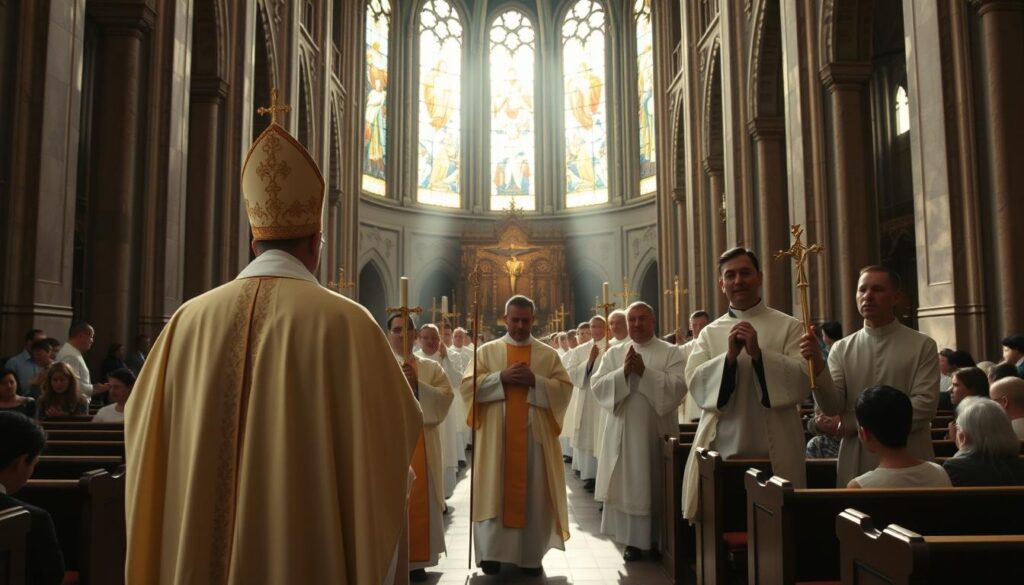
A grand cathedral interior, sunlight streaming through stained glass windows, illuminating the solemn procession of Catholic clergy. In the foreground, a bishop clad in ornate vestments and a tall mitre, leading a group of priests in flowing robes. In the middle ground, deacons and altar servers carrying candles and crosses, their movements graceful and reverent. In the background, pews filled with the faithful, heads bowed in prayer. The atmosphere is one of reverence and solemnity, the lighting casting a warm, sacred glow over the scene.

Roles of Deacons, Priests, and Bishops

Deacons form the foundation of clerical service. These transitional ministers spend twelve months preparing for priesthood. During this period, they perform baptisms, officiate weddings, and lead funeral rites. Their hands-on training keeps parishes running smoothly.

Priests gain expanded spiritual authority through the Rite of Ordination. This ceremony allows them to celebrate Mass, hear confessions, and administer sacraments. Most work directly with local communities, acting as spiritual guides and organizational leaders.

Bishops must meet rigorous standards:

  • Minimum age of 35
  • Five years of priestly experience
  • Advanced theology degrees

These leaders oversee dioceses – geographic regions containing multiple parishes. Their role combines administrative oversight with teaching sacred traditions. When bishops retire at 75, new leaders continue their work.

Role Key Responsibilities Special Requirements
Deacon Baptisms, weddings, funerals 12-month transitional period
Priest Mass, confessions, sacraments Rite of Ordination
Bishop Diocese management, teachings Doctorate in theology

Archbishops manage larger regions called archdioceses. Cardinals – senior bishops under 80 – elect new Popes. The Pope serves dual roles as spiritual leader and head of Vatican City, blending ancient traditions with modern governance.

Roles and Responsibilities within the Catholic Church

Two paths shape Catholic ministry worldwide. While all priests share sacramental duties, their daily lives reveal striking contrasts. These differences help the church address both local needs and global missions.

Diocesan vs Religious Priests

Diocesan priests anchor community life. They lead individual parishes, focusing on specific neighborhoods or towns. Unlike their religious counterparts, they don’t take vows of poverty. Many drive regular cars and wear civilian clothes when not conducting services.

In the United States, 60% of priests follow this path. Their parishes provide housing and a modest salary. This setup helps them connect with modern families facing everyday challenges.

Type Vows Lifestyle Ministry Focus
Diocesan Celibacy only Independent living Local community
Religious Poverty, obedience Communal housing Specialized missions

Religious priests join specific orders like Jesuits or Franciscans. They surrender personal possessions and live in group houses. Their work often involves education, scientific research, or global outreach programs.

Both roles maintain the body of Christ through different approaches. Diocesan priests offer stability, while religious orders pioneer new ways to serve. Together, they create a dynamic spiritual network spanning 6 continents.

The Evolution and Significance of Church Governance

Guiding 1.3 billion members requires balancing ancient traditions with contemporary needs. The Church’s framework draws strength from two pillars: sacred customs and structured legal systems. This blend allows communities to stay rooted while addressing modern challenges.

The Impact of Tradition on Modern Church Authority

Pius XII’s 1943 document Mystici Corporis reshaped how believers view leadership. It described the community as a “mystical body” with Christ as its head. This idea reinforces that authority flows from spiritual unity, not just administrative roles.

Ancient practices like apostolic succession still validate leaders today. When bishops retire, new ones continue unbroken chains of responsibility dating to St. Peter. This system maintains trust across generations.

Canon Law and the Papal Office

The Bishop of Rome oversees a legal code refined over 1,700 years. Canon Law governs everything from sacraments to property management. Updated regularly, it ensures consistency across 3,000 dioceses worldwide.

Papal decisions carry weight because they’re seen as extensions of early teachings. Modern leaders reference texts like Mystici Corporis Christi when addressing new issues. This approach keeps the nature of the Church both timeless and adaptable.

FAQ

What is the Mystical Body of Christ?

The Mystical Body of Christ refers to the belief that all baptized believers, united through faith and sacraments, form a spiritual community with Jesus as its head. This concept emphasizes unity, shared purpose, and the Church’s divine mission.

How does Apostolic Succession shape Church authority?

Apostolic Succession ensures that bishops, through an unbroken lineage tracing back to the original apostles, carry forward the teachings and sacramental authority of Jesus. This continuity preserves doctrinal integrity across generations.

What distinguishes deacons from priests and bishops?

Deacons assist in liturgy and charitable work but cannot celebrate Mass. Priests lead parishes and administer sacraments, while bishops oversee dioceses, ordain clergy, and uphold Church unity under the Pope.

How do diocesan priests differ from religious priests?

Diocesan priests serve specific geographic regions under a bishop, focusing on parish ministry. Religious priests take vows of poverty, chastity, and obedience within orders like the Jesuits, often prioritizing missions, education, or specialized ministries.

Why is Canon Law important in Church governance?

Canon Law provides a legal framework for sacraments, clergy conduct, and administrative processes. It ensures consistency in practices worldwide while aligning with spiritual teachings and papal directives.

How does tradition influence modern Catholic leadership?

Tradition, rooted in Scripture and centuries of ecumenical councils, guides decisions on liturgy, ethics, and doctrine. It balances historical wisdom with contemporary challenges, as seen in Vatican City’s global outreach under Pope Francis.

Exploring the Catholicism Symbol: Meaning and Significance


Sacred imagery has shaped spiritual practices for nearly two millennia, acting as a bridge between earthly life and divine truth. These visual elements first emerged in ancient times when early believers needed discreet ways to express their faith. Over centuries, they evolved into a shared language that unites millions across continents and cultures.

From the fish emblem to intricate stained-glass designs, these representations serve multiple roles in religious life. They appear in worship spaces, personal prayer items, and community celebrations. Many designs connect to specific figures like saints or events from scripture, creating layered meanings that deepen with study.

The power of these icons lies in their ability to communicate complex ideas through simple forms. A single image can reference entire biblical stories or theological concepts. This visual approach helps people grasp abstract teachings while fostering personal connections to sacred narratives.

Key Takeaways

  • Sacred imagery forms a visual language developed over 2,000 years
  • Early designs helped believers identify safe gathering places
  • Modern symbols maintain ties to ancient traditions while adapting to new contexts
  • Visual elements teach faith principles through accessible formats
  • Common designs unite global communities across language barriers

Introduction to Catholic Symbols and Their Impact

From stained glass to personal medallions, these images bridge daily life with sacred truths. They turn ordinary objects into reminders of spiritual realities, helping people grasp complex ideas through familiar shapes and patterns.

Many often used designs carry layered meanings. A simple cross might represent sacrifice, hope, and eternal life all at once. These visuals work like spiritual shortcuts, triggering memories of biblical stories or teachings during prayer or reflection.

Shared symbols create unity across cultures. A Mexican grandmother and Filipino teenager might both find comfort in the same Marian emblem. This common language strengthens community bonds while respecting local traditions.

Visual Element Spiritual Meaning Common Use
Dove Holy Spirit’s presence Baptism ceremonies
Lily Purity and resurrection Easter celebrations
Chi-Rho Christ’s authority Church decorations

The educational significance of these markers shines in religious classes. Children remember theological concepts better when paired with vivid illustrations. Adults too find deeper faith connections through symbolic art in worship spaces.

These timeless images do more than decorate – they inspire action. A crucifix might motivate charity work, while a fish emblem could encourage sharing one’s beliefs. Their power lies in speaking directly to the heart, bypassing language barriers.

Historical Origins of the Catholicism Symbol

Hidden markings in ancient tunnels tell stories of faith under pressure. Early believers developed coded visuals during Roman persecution, using everyday objects to share spiritual truths safely.

A dimly lit cathedral interior, sunlight filtering through stained glass windows, casting a warm glow upon ancient Christian symbols etched into the stone walls. In the foreground, a weathered crucifix stands tall, its intricate carvings casting delicate shadows. Surrounding it, a collection of early Christian iconography: the Chi-Rho, the Ichthys, the Lamb of God, each detail meticulously rendered. The middle ground reveals ornate altars and ornaments, hinting at the rich history and traditions of the Catholic faith. In the background, a sense of timelessness, as if the viewer has been transported to a bygone era, when these symbols first emerged and began to shape the visual language of Christianity.

Early Christian Adoption and Catacomb Imagery

Second-century followers left clues in burial chambers near Rome. The fish outline (Ichthys) served dual purposes – identifying safe spaces and spelling “Jesus Christ” in Greek letters. Archaeologists found these markings in sites like Santi Sebastiano, often paired with anchors representing hope.

Constantine’s 4th-century vision changed everything. His soldiers carried shields marked with ΧΡ, the first two letters of “Christos” in Greek. This Chi-Rho emblem became symbol of imperial approval, moving faith expressions from shadows to public spaces.

Evolution Through the Medieval Period

Monastic artists transformed simple designs into teaching tools. By the 9th century, stained glass windows used color-coded imagery to explain Bible stories to non-readers. Gold leaf in manuscripts highlighted sacred moments, making complex ideas accessible.

Element Original Purpose Medieval Adaptation
Fish Secret identifier Communion references
Chi-Rho Military standard Altar decorations
Vine Patterns Natural camouflage Church architecture

These visual tools helped unify growing communities across Europe. Local craftsmen added regional touches while keeping core meanings intact, creating a shared spiritual language that lasts today.

Role of Symbols in Modern Catholic Faith Practices

Visual markers remain vital in daily spiritual routines, connecting ancient tradition to modern believers. During Mass, elements like candles and incense engage multiple senses, creating immersive worship experiences. These tools help focus attention during sacred moments, from baptismal fonts to communion rituals.

Many individuals use portable icons for personal reflection. Pocket rosaries or phone wallpapers featuring sacred art provide quick access to spiritual grounding. A teacher might touch a cross necklace before class, while a nurse could glance at a St. Luke medal during shifts.

Religious education programs leverage these visuals to simplify complex ideas. Color-coded liturgical calendars and saint figurines make abstract concepts tangible for young learners. Adults rediscover faith through symbolic art exhibits that blend classic motifs with modern designs.

Element Modern Application Purpose
Oil Lamp Home prayer spaces Divine presence reminder
Dove Confirmation certificates Holy Spirit representation
Alpha-Omega Youth group logos Timeless faith connection

New churches creatively adapt tradition through materials like laser-cut metal or LED-lit altars. These updates maintain core meanings while resonating with tech-savvy congregations. Intergenerational Bible studies often use comparison exercises between ancient and contemporary designs.

Therapeutic practices incorporate symbolic meditation for stress relief. Coloring pages of stained glass patterns or arranging floral emblems helps people process emotions through sacred geometry. This approach bridges devotional life with mental wellness strategies.

Artistic Interpretations in Catholic Iconography

Light filters through vibrant glass panels, casting stories in color across stone floors. For centuries, artists have transformed sacred concepts into tangible art that educates and inspires. These creations turn abstract ideas into visual lessons accessible to all.

Stained Glass and Ecclesiastical Artworks

Medieval craftsmen perfected the often depicted practice of turning sunlight into sermons. Windows at Chartres Cathedral show biblical scenes through jewel-toned glass, their patterns teaching scripture to those who couldn’t read. Modern churches continue this tradition with abstract designs that spark personal reflection.

Three key elements define these luminous works:

  • Color symbolism: Blue for divinity, red for sacrifice
  • Narrative sequencing: Multiple panels showing story progression
  • Architectural integration: Shapes matching building structures

Sculptures and Religious Frescoes

Carved stone and painted plaster bring sacred figures into three-dimensional form. Bernini’s dramatic marble works capture emotional moments, like Saint Teresa’s ecstatic vision. Fresco artists like Giotto used wet plaster techniques to create durable wall paintings that survived centuries.

Medium Famous Example Teaching Purpose
Stained Glass Rose Window, Notre Dame Apocalypse symbolism
Sculpture Pietà, Michelangelo Compassion through form
Fresco Sistine Chapel Ceiling Creation narrative

Contemporary artists reimagine these traditions using new materials. Laser-cut metal screens and digital projections now join classic christian art forms, proving ancient symbols remain relevant across changing creative landscapes.

Iconography and Religious Imagery in Catholicism

Golden halos and scarlet robes speak a silent language in sacred spaces. These visual rules help believers recognize holy figures instantly, whether in Mexican murals or Polish chapels. A saint holding keys always means Peter, while a woman with lilies points to Mary – this coded system crosses language barriers.

A serene cathedral interior, bathed in warm, soft lighting. The ornate altar is the focal point, adorned with intricate religious iconography - gilded crosses, statues of saints, and stained glass depictions of biblical scenes. Sunlight streams through the stained glass windows, casting a kaleidoscope of colors across the marble floors. The atmosphere is one of reverence and contemplation, inviting the viewer to pause and reflect on the rich symbolism and spiritual significance of Catholic imagery.

Artists follow strict guidelines to maintain significance across centuries. Blue garments denote heavenly grace, while three fingers raised together symbolize the Trinity. “Iconography isn’t about creativity,” explains art historian Lydia Miller. “It’s about preserving truth through carefully guarded visual formulas.”

Churches use these images like spiritual storyboards. Wall paintings might show Creation to Resurrection in sequence, guiding viewers through salvation history. Stained glass windows often pair Old Testament scenes with New Testament fulfillments, creating dialogue between ancient texts.

Figure Attribute Meaning
St. Paul Sword Martyrdom & Scripture
St. Agnes Lamb Innocence & Sacrifice
St. Luke Ox Gospel Strength

This visual tradition prevents confusion in teaching core beliefs. A 15th-century Italian farmer and modern Texan student both understand Christ’s kingship through crown imagery. Color-coded liturgical items – purple for penance, white for joy – reinforce lessons through repeated exposure.

For communities with limited literacy, these images became living textbooks. Carved Stations of the Cross let worshippers walk Jesus’ final hours. Statue gestures – blessing hands versus praying palms – teach different types of divine interaction. Even today, confirmation classes use symbolic flashcards to explain complex doctrines.

The system’s significance shines in global consistency. Philippine processions and French tapestries both depict Matthew with angel wings, proving shared visual roots. This unified approach keeps theological messages clear while allowing local artistic flavors to enhance, not obscure, sacred truths.

The Cross and Its Many Representations

What began as a Roman execution tool transformed into humanity’s most recognized emblem of hope. After Emperor Constantine’s 313 AD Edict of Milan, the cross emerged from secrecy to become Christianity’s defining marker. Its evolution reflects deep spiritual truths about sacrifice and redemption.

A serene, dimly lit cathedral interior with an ornate, gilded cross towering at the center. Beams of warm, ethereal light filter through stained glass windows, casting a soft, reverent glow upon the cross's intricate, symbolic design. Surrounding the central cross are smaller, diverse cross representations - simple wooden crosses, ornate Byzantine crosses, Celtic crosses, and other ancient cross motifs etched into the stone walls. The overall atmosphere evokes a sense of timeless spirituality and the rich, multifaceted nature of Christian cross symbolism.

Crucifix and Sacred Heart

Catholic spaces uniquely feature the crucifix – a cross bearing Jesus Christ’s body. This vivid reminder of sacrifice differs from empty crosses used elsewhere. “The corpus keeps our focus on Christ’s physical suffering and victory,” explains liturgical scholar Dr. Maria Torres.

Seventeenth-century France birthed another profound devotion. Saint Margaret Mary Alacoque’s visions popularized the Sacred Heart image – Christ pointing to a heart encircled by thorns. This symbol emphasizes divine compassion, with flames representing endless love.

Feature Crucifix Sacred Heart
Origin Early Christian era 1670s visions
Key Elements Corpus, INRI inscription Radiant heart, crown of thorns
Modern Use Altars, rosaries Home shrines, medallions

Churches use processional crosses during important rituals, while families display miniature versions in living spaces. Many believers touch these cross representations during prayer, physically connecting to their faith’s central mystery.

The crucifixion story comes alive through these visual tools. From Gothic cathedral carvings to hospital chapel prints, they adapt to new settings while preserving core meanings. This flexibility ensures the cross remains relevant across changing generations.

Marian Symbols: Lily, Fleur-de-lis, and Rosary

White petals unfurl in sacred art, whispering tales of spiritual devotion. The lily stands as nature’s perfect metaphor for purity, its unblemished form mirroring the Virgin Mary‘s sinless nature. Medieval painters often showed Gabriel holding this flower during Annunciation scenes, linking divine messages to floral beauty.

French artisans transformed the lily into the regal fleur-de-lis. This three-petaled design honors Mary’s title as Queen of Heaven while subtly nodding to the Trinity. You’ll spot it in cathedral stonework and royal banners, blending earthly majesty with heavenly grace.

Prayer beads become botanical metaphors through the rosary. Thirteenth-century tradition says Mary gave St. Dominic this “garland of roses” – each prayer blooming like fragrant petals. Modern versions range from simple wood beads to military-grade cord wraps, adapting ancient practice to contemporary life.

Element Meaning Cultural Adaptation
Lily Innocence Mexican altar designs
Fleur-de-lis Royal devotion New Orleans architecture
Rosary Contemplative prayer Filipino festival jewelry

These emblems teach through beauty rather than words. A Korean mother and Italian nun both understand Mary’s purity through lily imagery. Summer processions in Spain drape statues in floral mantles, making theology tangible through scent and color.

Churches celebrate Mary’s Assumption with lily arrangements each August. Home shrines feature the Virgin Mary surrounded by carved roses, inviting personal reflection. These living traditions prove ancient symbols still breathe fresh meaning into modern faith journeys.

Symbols of Jesus Christ and His Passion

Ancient believers crafted coded messages to share their devotion safely. Two designs in particular carried hidden references to Jesus Christ while avoiding detection during times of persecution.

Secret Signs to Sacred Emblems

The fish outline, called Ichthys, served as more than a simple drawing. Its Greek word origin spells out “Jesus Christ, Son of God, Savior” through its first letters. Early followers used this mark to identify safe meeting spots, scratching it into walls or dirt as a silent invitation.

Another powerful emblem emerged from military history. The Chi-Rho combines the first two Greek word characters for “Christos.” After Emperor Constantine’s vision, this symbol christ appeared on shields and banners, transforming from secret code to public declaration.

These designs connect Jesus Christ‘s story to daily life. The fish references his miracle of multiplication, while the Chi-Rho echoes his triumph over death. Both point to the resurrection, using geometric simplicity to convey profound hope.

Modern believers still use these emblems as conversation starters. A car bumper sticker or necklace becomes a quiet testimony, continuing the ancient practice of sharing faith through visual language.

FAQ

Why is the cross central to Catholic traditions?

The cross represents Christ’s sacrifice and victory over death. It’s a universal sign of hope, redemption, and eternal life, deeply woven into prayers, rituals, and church architecture.

What does the lily symbolize in religious art?

Often linked to the Virgin Mary, the lily signifies purity, innocence, and divine grace. It’s featured in artworks, feast days, and rituals honoring her role in Christian teachings.

How did early Christians use symbols like the fish (Ichthys)?

The fish, from the Greek “Ichthys,” served as a secret code during persecution. It affirmed beliefs in Jesus’ divinity and united believers through shared faith under Roman rule.

What role do stained-glass windows play in churches?

These vibrant artworks illustrate biblical stories and saints, creating a visual connection to sacred teachings. Light passing through them symbolizes God’s presence illuminating spiritual truths.

Why is the Chi-Rho symbol significant?

Combining the first two Greek letters of “Christ,” the Chi-Rho represents Jesus’ authority and resurrection. It’s used in liturgy, art, and celebrations like Easter to honor His triumph.

How did medieval art shape Catholic iconography?

Medieval artists blended scripture with symbolism, using motifs like the lamb (for Christ) and the dove (for the Holy Spirit). These designs deepened spiritual reflection in churches and manuscripts.

What does the Fleur-de-lis represent in Marian devotion?

Linked to Mary’s purity and the Holy Trinity, this stylized lily appears in statues, prayers, and French Catholic heritage—emphasizing her role as a guiding figure in faith.

Attend Catholic Mass: A Spiritual Journey


Discover a sacred tradition that strengthens faith and connects people through shared prayer and reflection. Whether you’re new to this practice or deepening your commitment, participating in these gatherings offers comfort and clarity. Communities across the U.S. welcome everyone seeking spiritual growth—no matter where they are on their journey.

Modern options make it easier than ever to join. Many now stream services online, letting you engage from home or while traveling. If you’re using Apple Safari and face issues viewing broadcasts, switching to Chrome often resolves this—churches are working to improve compatibility.

This guide covers everything you need: schedules, donation options, and tips to enrich your experience. You’ll learn how both in-person and digital participation foster meaningful connections with others and a higher purpose.

Key Takeaways

  • Strengthen your spiritual life through communal prayer and reflection
  • Access services easily via in-person attendance or online streaming
  • Use Chrome browser for smoother viewing if Safari has issues
  • Find updated schedules and donation details to plan your participation
  • Experience a welcoming environment designed for personal growth

Discover Daily and Sunday Mass Schedules

Finding time for spiritual reflection has never been more accessible. Modern worship schedules blend traditional gatherings with digital convenience, letting you join services that fit your routine. Whether you prefer early morning participation or midday breaks, diverse options exist to keep your practice consistent.

Live Streaming and Recorded Services

The Cathedral of St. Joseph in Burlington streams its Sunday Mass at 10 a.m. live every week. Can’t tune in? Recorded versions let you watch later—ideal for busy weekends. For early risers, WCAX Channel 3 airs televised services Sundays at 5:30 a.m.

Prefer online platforms? Catholic TV Boston and Notre Dame both offer streams. These let you experience renowned liturgies from home. When joining remotely, consider this heartfelt prayer:

“My Jesus, I believe that you are present… Never permit me to be separated from you. Amen.”

Weekday and Weekend Mass Timings

Daily gatherings occur Monday-Thursday at 12:05 p.m. via the Diocese of Burlington Chancery stream. Friday options shift to alternative platforms, ensuring continuous access. Check this table for key timings:

Day Time Location/Platform
Sunday 10:00 a.m. Cathedral of St. Joseph (Live)
Mon-Thu 12:05 p.m. Diocese Chancery Stream
Friday Varies Online Alternatives
Sunday 5:30 a.m. WCAX Channel 3

These flexible schedules help maintain spiritual habits even during travel or hectic weeks. Recorded masses preserve sacred moments for later viewing, blending tradition with today’s technology.

Experience a catholic mass: Service and Donation Details

Modern technology brings sacred gatherings into homes through professional broadcasts that honor tradition. These services maintain their spiritual depth while adapting to modern needs, creating meaningful connections for participants everywhere.

A serene church interior, soft lighting filtering through stained glass windows, casting a warm glow on the pews. In the foreground, a wooden collection plate is prominently placed, its simple design inviting worshipers to make their donation. Parishioners, their faces focused and reverent, carefully place their offerings, contributing to the ongoing support of the Catholic ministry. The altar in the background stands as a reminder of the spiritual significance of this moment, the act of giving a physical manifestation of one's faith. The atmosphere is solemn yet uplifting, a sense of community and shared purpose permeating the space.

Broadcast Options for the Holy Mass

High-quality streams deliver every part of the liturgy—readings, homilies, and sacred rituals—with crystal-clear audio and visuals. Many communities use licensed music through platforms like OneLicense A-726765, ensuring both quality and legal compliance. As one parish leader shared:

“Our broadcasts aren’t just convenience—they’re lifelines for those seeking connection.”

Popular options include:

  • Live Sunday services from the Diocese of Burlington Chancery
  • On-demand recordings for flexible viewing
  • Specialized faith programs on Catholic TV Boston

Supporting Ministries Through Donations

Contributions power essential outreach programs and broadcast operations. The Bishop’s Appeal funds initiatives like food banks and youth ministries across the region. Here’s how to help:

Method Details
Online Diocese website portal
Mail 55 Joy Drive, S. Burlington, 05403

Every gift sustains technical costs for streaming equipment and production teams. Over 40% of recent donations directly supported creating accessible services for homebound members.

Locate Your Local Catholic Church

Finding spiritual communities has become simpler with modern tools. Online directories and parish networks help you connect with welcoming congregations nearby or across the country. Start by exploring regional resources like the Archdiocese of Milwaukee’s Mass finder, which lists schedules from 6:15 AM to 6:30 PM at locations like St. Charles Borromeo.

Mass Locations Across the United States

From historic urban churches to suburban parishes, diverse options suit every preference. Milwaukee’s Old St. Mary on Broadway offers morning services, while West Bend’s Immaculate Conception hosts early gatherings. Use masstimes.org when traveling—it shows national schedules updated daily.

Location Time Language
St. Charles Borromeo 6:30 PM English
Immaculate Conception 6:15 AM Spanish
Old St. Mary 8:00 AM English

Diverse Mass Types and Languages Offered

Communities celebrate in multiple languages and styles. Spanish-language “Entre Amigos” services foster cultural connections, while School Masses blend education with worship. Television options like WVTV/My24 Channel 24 air Sunday broadcasts for home participation:

Channel Time Type
WVTV/My24 7:00 AM Sunday Mass
WITI/Fox 6 5:30 AM Traditional

These choices ensure everyone finds meaningful ways to engage. Whether you prefer sunrise services or evening reflections, options exist to strengthen your practice today and beyond.

Conclusion

Your path to spiritual connection remains open through multiple pathways. Whether joining neighbors at a local parish or participating via livestream from home, sacred gatherings offer consistent opportunities for reflection and growth. Modern solutions meet traditional practices, ensuring everyone can engage in ways that fit their daily rhythms.

Regular participation strengthens personal faith while building bonds within communities. Explore morning broadcasts, multilingual services, or evening liturgies—each format carries the same meaningful traditions. Diverse schedules remove barriers, making spiritual nourishment accessible regardless of location or routine.

Supporting these efforts through donations helps sustain essential programs. Contributions fund outreach initiatives and technical upgrades, ensuring services remain available to all. Every gift directly impacts those seeking guidance and connection.

Take the next step using this guide’s practical tools. Find a time, platform, or community that aligns with your journey. Shared worship experiences await, ready to deepen your practice and enrich your life’s purpose.

FAQ

How can I find daily or weekend service schedules?

Most parishes share updated timings on their websites or social media. You can also use platforms like MassTimes.org or apps like Hallow to search by location.

What’s the best way to support church ministries?

Many communities offer online donation portals, text-to-give options, or in-person collection baskets. Funds often go toward outreach programs, facility upkeep, and global missions.

Are services available in languages other than English?

Yes! Parishes in diverse regions often host gatherings in Spanish, Vietnamese, Tagalog, or other languages. Check your local church’s bulletin for details.

Can I participate in services online?

Absolutely. Platforms like EWTN, YouTube, or parish websites frequently livestream events. Some even provide recorded sessions for later viewing.

What kinds of worship gatherings are offered?

Beyond traditional weekend services, many churches host youth-focused events, multicultural celebrations, or quiet weekday reflections. Explore your parish’s calendar for specifics.

Catholicism Beliefs: A Comprehensive Guide


Welcome to an exploration of one of the world’s most enduring spiritual traditions. For nearly 2,000 years, this global faith community has shaped art, laws, and cultural values across continents. At its heart lies a remarkable connection to ancient roots – a direct lineage tracing back to Jesus’ original followers.

What makes this religious tradition unique? Unlike other Christian branches, it maintains a centralized structure led by the Pope in Rome. This living institution balances timeless rituals with modern social teachings, addressing issues from climate change to economic justice.

You’ll discover how shared practices create unity among 1.3 billion members worldwide. From Sunday Mass in Chicago to street processions in Manila, common threads weave through diverse cultures. These traditions aren’t just historical artifacts – they actively guide personal decisions and community actions today.

Key Takeaways

  • World’s largest Christian denomination with 1.3 billion followers
  • Central leadership through the Pope and Vatican City
  • Blends ancient rituals with modern social teachings
  • Significant influence on Western art and culture
  • Practical guidance for daily life and global issues
  • Connects believers across 200+ countries through shared practices

Our guide breaks down complex ideas into clear, relatable concepts. Whether you’re curious about sacraments or social justice teachings, we’ll walk through each aspect step by step. You’ll gain new appreciation for how this vibrant faith continues shaping lives in our modern world.

Overview of catholicism beliefs

At the heart of Roman Catholic teachings lies a vibrant fusion of ancient wisdom and modern application. This global church maintains its identity through foundational principles while adapting to contemporary challenges.

Key Tenets and Modern Interpretations

Central to Roman Catholic doctrine is the Holy Trinity – one God expressed through three persons. Followers celebrate Christ’s dual nature as divine and human, reflected in sacraments like the Eucharist where bread and wine become sacred through transubstantiation.

The Second Vatican Council reshaped modern perspectives, encouraging dialogue with other Christian groups. While maintaining core traditions, this shift acknowledged diverse paths to spiritual life beyond the church’s formal structure.

Cultural Impact and Global Relevance

Roman Catholic teachings influence everything from Renaissance art to urban food banks. Seven sacraments guide major life events, creating shared rituals across 200+ countries.

Social justice initiatives address pressing world issues like climate change and income inequality. Through schools, hospitals, and community programs, the church demonstrates how age-old faith principles meet 21st-century needs.

Historical Evolution of the Catholic Church

From humble beginnings in Jerusalem, the Roman Catholic Church grew into a global institution through centuries of evolution. Its story starts with Jesus Christ and twelve followers who spread his teachings across the Roman Empire. Early believers faced persecution but built tight-knit communities that kept their message alive.

A sweeping historical scene of the Roman Catholic Church's evolution, bathed in a warm, golden light. In the foreground, a grand cathedral with ornate, Gothic architecture stands tall, its stained glass windows glowing. In the middle ground, robed figures gather, representing the clergy and faithful. In the background, rolling hills and a distant skyline hint at the expansion of the Church across Europe over the centuries. The composition conveys a sense of grandeur, tradition, and the enduring influence of Catholicism.

From Apostolic Origins to Medieval Power

By the second century, church leaders like St. Irenaeus shaped Roman Catholic identity. He established three pillars of authority: New Testament writings, bishops tracing lineage to apostles, and sacred tradition. This framework helped unify scattered Christian groups into one church structure.

The phrase “And thus we came to Rome” from Acts marked a turning point. It signaled the faith’s expansion beyond Jewish roots, embracing diverse cultures. By 300 CE, Roman Catholicism became the empire’s official religion, blending spiritual mission with political influence.

The Emergence of Catholic Christianity

Persecution and debates over doctrine actually strengthened the church’s identity. Leaders clarified teachings about Christ’s nature and standardized worship practices. The emergence of Catholic Christianity as a distinct tradition became clear through:

  • Established hierarchies with bishops overseeing regions
  • Uniform sacraments like baptism and Eucharist
  • Shared liturgical calendars across continents

This period laid foundations for medieval Europe’s religious landscape. The Roman Catholic Church preserved knowledge through monasteries while shaping laws and art – proving ancient roots could nurture new growth.

Foundational Doctrines and Distinctive Teachings

Central to Roman Catholic identity are sacred texts and time-honored practices passed down through generations. These elements form a spiritual blueprint guiding everything from Sunday services to life’s biggest decisions.

Scriptural Foundations and Apostolic Tradition

The Roman Catholic Church views scripture and tradition as twin pillars of divine revelation. While the Bible remains primary, oral teachings from early church leaders carry equal authority. This dual approach ensures continuity with the original apostles’ message.

Seven sacraments demonstrate this balance. Baptism rituals still use the Apostles’ Creed – an ancient summary of core teachings. Parents and godparents renew these promises during infant ceremonies, linking modern families to 2,000 years of practice.

Understanding Transubstantiation and Doctrinal Nuances

During Mass, Catholics experience one of their most mysterious doctrines. When the priest speaks Jesus Christ’s words from the Last Supper, believers affirm the bread and wine become his body and blood. This change – called transubstantiation – maintains physical appearances while transforming spiritual reality.

Mary’s special role highlights another unique aspect. The Roman Catholic tradition honors her as both mother and model of faith. These teachings about her sinless conception and heavenly intercession shape personal devotions worldwide.

From baptismal vows to communion rituals, these practices create shared spiritual DNA. They help millions navigate modern life while staying rooted in ancient wisdom.

Organizational Structure and Hierarchy

The Roman Catholic Church maintains a distinctive organizational framework that has guided its global community for centuries. This structure combines spiritual leadership with administrative precision, creating a unified system across diverse cultures and nations.

A majestic Roman Catholic church hierarchy, captured in a grand, sweeping composition. In the foreground, a detailed depiction of the papal tiara, symbolic of the supreme authority of the Pope. The middle ground features robed cardinals, bishops, and priests, arrayed in a stately procession, their faces conveying a sense of reverence and devotion. In the background, the towering spires and ornate facades of a grand cathedral, bathed in warm, golden light, casting an aura of sacred grandeur. The scene evokes a profound sense of tradition, spiritual power, and the hierarchical structure that defines the organization of the Roman Catholic Church.

The Papacy, Roman Curia, and Ecclesiastical Leadership

At the structure’s peak stands the Pope, considered the successor to St. Peter and holder of supreme teaching authority. Cardinals – appointed by the Pope – form a sacred college responsible for electing new leaders during papal conclaves. Their distinctive red attire symbolizes willingness to defend the church “even to the shedding of blood.”

The Roman Curia acts as the Vatican’s operational engine, with departments like the Dicastery for Evangelization overseeing global missions. This administrative body ensures consistent application of church teachings across 3,000 ecclesiastical territories worldwide.

Roles of Clergy, Priests, and the Laity

Three holy orders shape ministerial service:

  • Deacons assist in sacraments and community outreach
  • Priests lead parishes and celebrate Mass
  • Bishops shepherd dioceses and maintain apostolic succession

Since the Second Vatican Council, laypeople have played expanded roles in education and social ministries. However, the priesthood remains reserved for celibate men, reflecting Jesus’ model of total dedication to spiritual service.

This carefully maintained hierarchy enables the Roman Catholic Church to address modern challenges while preserving continuity with ancient traditions. From papal encyclicals to parish food drives, every level contributes to the faith’s living legacy.

The Role of Sacraments and Traditions

Sacred rituals form the heartbeat of spiritual practice in Roman Catholicism. These tangible acts bridge daily life with divine connection, creating moments where ordinary materials like water or oil become channels for extraordinary grace.

A serene, majestic interior of a Roman Catholic cathedral, bathed in warm, diffused lighting from stained glass windows. In the foreground, a grand, ornate altar adorned with sacred chalices, candles, and religious symbols. Rows of wooden pews fill the middle ground, leading the viewer's gaze towards the ornate altar and the ornate, vaulted ceiling above. In the background, intricate stained glass windows and intricate stone arches frame the sacred space, creating a reverent, contemplative atmosphere.

Exploring the Seven Sacraments

Seven transformative ceremonies guide Catholics through life’s milestones. Baptism welcomes infants with water and sacred oils, while confirmation strengthens teens through the Holy Spirit’s gifts. The Eucharist – celebrated at every Mass – renews believers as they receive what Roman Catholicism teaches is Christ’s actual presence.

Adults encounter reconciliation’s healing power through confession, and couples exchange lifelong vows in marriage rites. Holy orders set apart clergy for service, and anointing brings comfort during illness. Each sacrament follows Jesus’ teaching to make spiritual realities physically present.

Marian Devotion and Liturgical Rites

Mary’s unique role shines through practices like May crownings and rosary recitations. Pilgrims flock to sites like Lourdes, seeking her intercession. The liturgical calendar structures worship with seasons:

  • Advent’s hopeful waiting
  • Lent’s reflective fasting
  • Easter’s joyful celebrations

These rites unite global communities through shared rhythms. From baptismal fonts to wedding altars, Roman Catholicism’s sacramental vision transforms everyday moments into encounters with the sacred.

Contemporary Social Teachings and Modern Challenges

Modern Roman Catholic communities tackle today’s pressing issues while honoring centuries-old principles. This dynamic approach helps bridge timeless values with urgent world needs, creating meaningful action across diverse societies.

Social Justice, Ethical Practices, and Global Outreach

Church leaders champion climate action and migrant support through Second Vatican renewal principles. Food security programs and fair wage campaigns reflect core teachings about human dignity. Over 140,000 schools worldwide demonstrate how education drives social change.

Global partnerships address healthcare gaps and conflict resolution. These efforts show how faith communities can influence policy while maintaining spiritual foundations. Ethical investment guidelines now steer church finances toward sustainable life practices.

Balancing Tradition with Modernity in the United States

American parishes navigate complex debates on technology and bioethics. Many United States dioceses blend traditional liturgy with contemporary outreach like addiction recovery networks. Youth ministries use digital tools while preserving sacramental roots.

The Roman Catholic Church in America faces unique tests – from immigration reforms to shifting family structures. Through dialogue and Second Vatican insights, communities find fresh ways to honor heritage while serving modern life realities.

FAQ

What are the core teachings that define Roman Catholicism?

Central teachings include faith in Jesus Christ’s resurrection, the authority of the papacy, and the seven sacraments. These practices emphasize grace, community, and continuity with apostolic tradition.

How does the papacy influence the Church’s global operations?

The pope, as the successor of Saint Peter, guides doctrine and unity. The Roman Curia supports administrative tasks, while bishops oversee regional dioceses, creating a structured yet adaptable hierarchy.

Why are sacraments like Communion and Baptism essential?

Sacraments symbolize spiritual milestones, such as initiation (Baptism) and unity (Eucharist). They reflect Jesus’ teachings and strengthen believers’ connection to divine grace through tangible rituals.

How does the Church address modern social issues in the United States?

Catholic social teaching promotes human dignity, charity, and justice. Efforts include advocating for immigrants, opposing abortion, and balancing traditional values with contemporary ethical debates.

What role does Mary play in liturgical practices?

Marian devotion honors her as the Mother of God through prayers like the Rosary and feast days. These traditions highlight her intercessory role and model of faith in global Catholic culture.

How did the Second Vatican Council change Catholic practices?

Vatican II modernized liturgy, allowing vernacular languages instead of Latin. It encouraged lay participation and interfaith dialogue, reshaping the Church’s approach to global engagement.

What distinguishes transubstantiation from other Christian beliefs?

Roman Catholicism teaches that during Mass, bread and wine become Christ’s body and blood while retaining their appearance. This differs from symbolic interpretations in some Protestant traditions.

How do clergy and laity collaborate in parish life?

Priests lead sacraments and spiritual guidance, while laypeople participate in ministries, education, and outreach. This partnership fosters vibrant, service-oriented communities worldwide.

Understanding the Meaning of Catholicism Baptism


Every spiritual journey begins with a single step. For millions worldwide, that first step unfolds through a sacred rite that marks both a beginning and a profound transformation. This foundational sacrament opens doors to divine grace while creating an unbreakable bond with a faith community.

Unlike ordinary ceremonies, this one-time sacrament leaves an eternal imprint on the soul. Through flowing water and sacred words, participants receive more than symbolic cleansing – they gain spiritual rebirth. The ritual serves as both personal awakening and formal entry into a 2,000-year-old tradition.

Central to this experience is the belief in divine transformation. Recipients aren’t just welcomed into a church – they’re believed to receive sanctifying grace that reshapes their relationship with the divine. This grace, coupled with the Holy Spirit’s presence, forms the cornerstone of Christian spiritual growth.

Key Takeaways

  • Serves as the first and essential sacrament in Christian initiation
  • Creates permanent spiritual change through sanctifying grace
  • Marks official entry into the global faith community
  • Involves the Holy Spirit’s indwelling presence
  • Required for salvation according to church teachings
  • Transcends symbolism through actual divine action

Introduction to Catholicism Baptism

The moment of spiritual birth in the Catholic tradition sparks lasting change. More than water rituals, this sacrament rewrites spiritual DNA. Participants become God’s actual children, not just symbolic followers—claimed by divine love through Christ’s promise.

https://www.youtube.com/watch?v=ZJt92SgTRYg

Setting the Stage for Faith and Tradition

Imagine joining a family tree stretching back two millennia. Through sacred waters, the Holy Spirit binds individuals to a global community. Biological ties fade next to these eternal connections. Faith becomes the shared language across cultures and generations.

Overview of Baptism’s Role in the Catholic Church

Membership in the Church brings both honor and duty. The newly baptized carry torchlight passed through centuries, charged with keeping it burning bright. Spiritual growth becomes daily bread, not optional garnish.

Life Aspect Before After
Divine Connection Seeking God Living in God’s family
Community Role Observer Active participant
Spiritual Growth Personal effort Grace-fueled journey

Like saplings planted in rich soil, the baptized need nurturing. Regular prayer and service become sunlight and water for this new life. The journey starts at the font but stretches into eternity.

Historical Roots and Biblical Foundations

From covenant signs to living waters, faith’s markers evolve across centuries. Ancient practices laid groundwork for sacred rituals still shaping spiritual lives today.

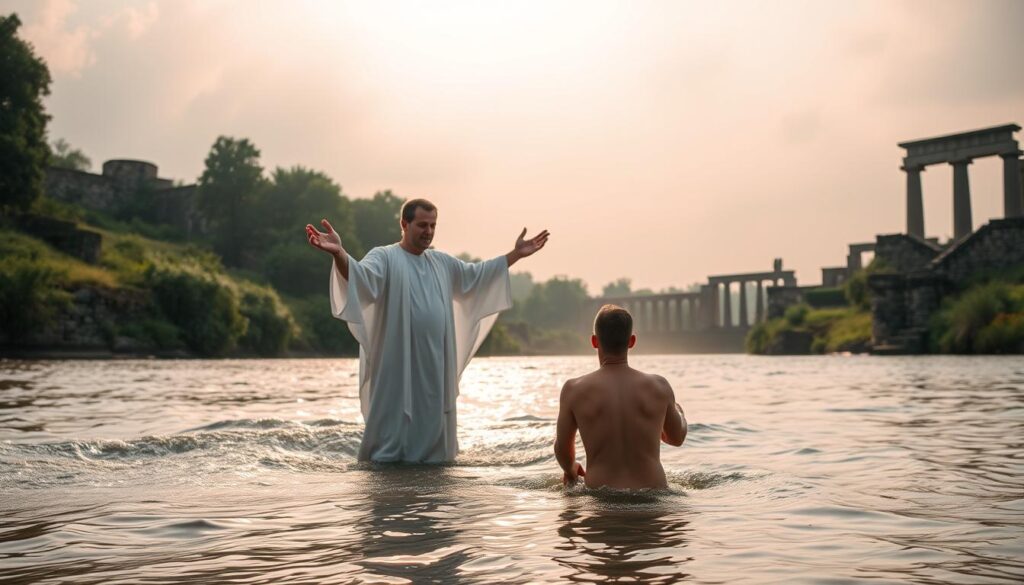
A serene river scene with a man in a white robe standing waist-deep in the flowing waters, his arms outstretched as he baptizes a person kneeling before him. The sky is filled with soft, diffused light, casting a warm glow over the tranquil setting. In the background, lush greenery and ancient stone structures evoke a timeless, biblical atmosphere. The composition emphasizes the sacred and reverent nature of the ritual, with a sense of spiritual connection and historical significance.

Old Testament Connections and Early Church Practices

Long before water immersion, God’s people marked covenant membership through physical signs. Abraham’s descendants entered divine promises through circumcision – a practice performed on infants through parental faith. This ritual became the blueprint for incorporating children into God’s family.

Early Christians transformed this tradition. St. Paul declared in the New Testament:

“In Christ Jesus, neither circumcision nor uncircumcision counts for anything” (Galatians 5:6)

. Baptism emerged as the new covenant marker, washing awaysininstead of shedding blood.

New Testament Teachings on Baptism

Jesus’ words to Nicodemus revolutionized spiritual rebirth: “No one can enter God’s kingdom without being born of water and Spirit” (John 3:5). The apostles acted swiftly, baptizing entire households after conversions. St. Augustine later confirmed this wasn’t innovation but apostolic tradition.

Romans 6 reveals baptism’s deepest meaning: union with Christ. Believers symbolically die and rise with Him, receiving salvation through divine grace. This transformative act fulfills Jesus’ final command:

“Go make disciples of all nations, baptizing them” (Matthew 28:19)

.

Three key shifts occurred across Scripture:

  • Physical sign (circumcision) → Spiritual cleansing (water baptism)
  • National identity → Global community
  • Blood covenant → Resurrection power

The Sacramental Structure of Baptism

Sacraments follow a divine blueprint – precise elements working together to channel grace. At their core lie three pillars: form, matter, and intent. These ensure every ritual carries both human meaning and heavenly power.

Understanding Form, Matter, and Intent

The baptismal formula acts like a spiritual key. When spoken over flowing water – “I baptize you in the name of the Father, Son, and Holy Spirit” – it unlocks Christ’s promise. This combination mirrors Jesus’ own command, linking each sacrament to the Trinity.

Water’s role goes beyond symbolism. As essential matter, it represents both cleansing and rebirth. Even a few drops fulfill the requirement, making grace accessible in emergencies or remote areas.

Element Requirement Example
Form Trinitarian formula Spoken clearly during pouring
Matter Natural water Font, river, or hospital sink
Intent Church’s purpose Rejecting superstition

Validity, Licitness, and Canon Law Aspects

A valid sacrament meets God’s criteria. An illicit one breaks Church rules. Imagine a nurse baptizing a dying baby – valid but illicit if done without parish approval. Canon Law prioritizes salvation while maintaining order.

Three common scenarios show this balance:

  • Layperson performing emergency rites (valid + illicit)
  • Deacon baptizing without permission (valid + illicit)
  • Priest using wrong words (invalid + illicit)

These distinctions help Catholics trust the sacrament’s power while respecting its sacred administration. Through proper form and intent, ordinary water becomes a conduit for eternal life.

Exploring the Symbolism in Catholic Baptism

Sacred symbols transform ordinary elements into divine messages. Every object in the ritual acts like a spiritual translator, turning physical actions into eternal truths. These visible signs help believers grasp invisible transformations happening through the sacrament.

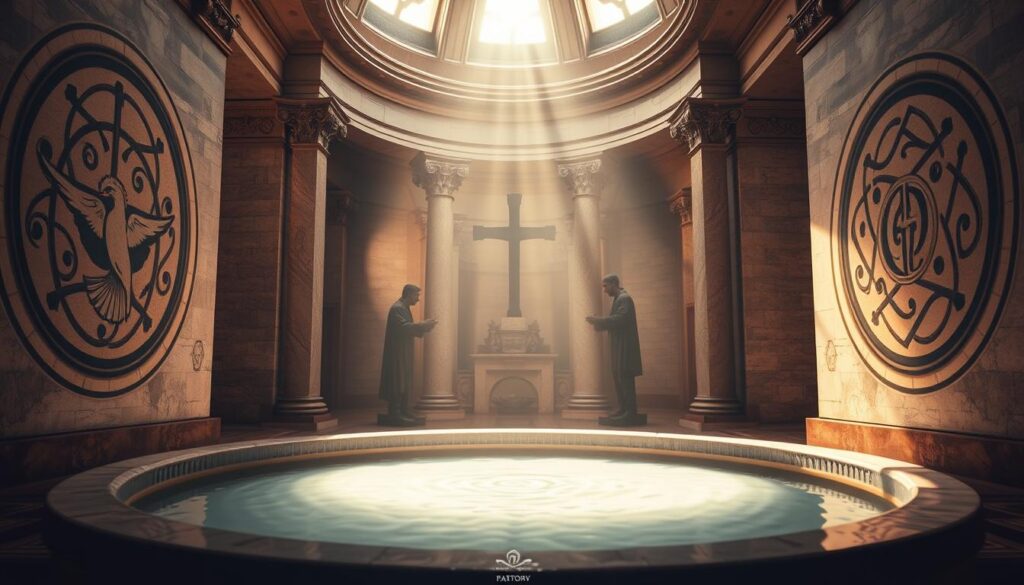
A serene baptistery filled with symbolic elements. In the foreground, a tranquil pool of holy water, its surface reflecting the heavenly light. Surrounding it, intricate religious iconography - a cross, a dove, and swirling patterns evocative of the Holy Spirit. The middle ground features elegant stone columns supporting a domed ceiling, creating an atmosphere of contemplation and reverence. The background is bathed in a warm, diffused glow, casting a spiritual ambiance over the scene. Subtle textures and muted tones imbue the image with a sense of timelessness, inviting the viewer to meditate on the profound meaning of Catholic baptism.

Water, Baptismal Fonts, and the Immersion Process

The font’s design carries echoes of ancient rivers where early believers were fully immersed. Modern vessels maintain this connection through flowing shapes and placement near church entrances. This reminds participants they’re entering new life through living water – a symbol Jesus used to describe spiritual renewal.

Three layers of meaning flow through the water:

  • Cleansing from past burdens
  • Birth into spiritual family
  • Connection to Christ’s resurrection

The Significance of the White Gown and Baptismal Candle

New members emerge from the font wrapped in spotless white. This tradition mirrors St. Paul’s teaching about “putting on Christ.” The garment shouts without words: “Something sacred has changed here.”

The lit candle does double duty. Its flame represents personal faith needing constant care, while the wax reminds believers of Christ’s promise:

“I am the light of the world” (John 8:12)

. Together, these symbols create a spiritual roadmap for the journey ahead.

Sacred oils add final touches to this symbolic language. The Oil of Catechumens strengthens for spiritual battles, while Chrism consecrates the recipient as God’s special ambassador. Each element works together like puzzle pieces revealing God’s grace.

The Role of Family and Community in the Baptismal Journey

In the Catholic tradition, spiritual growth thrives within a network of support. Parents and godparents form the first circle of guidance, while the wider faith community provides lasting encouragement. Together, they create a safety net for the child’s religious development.

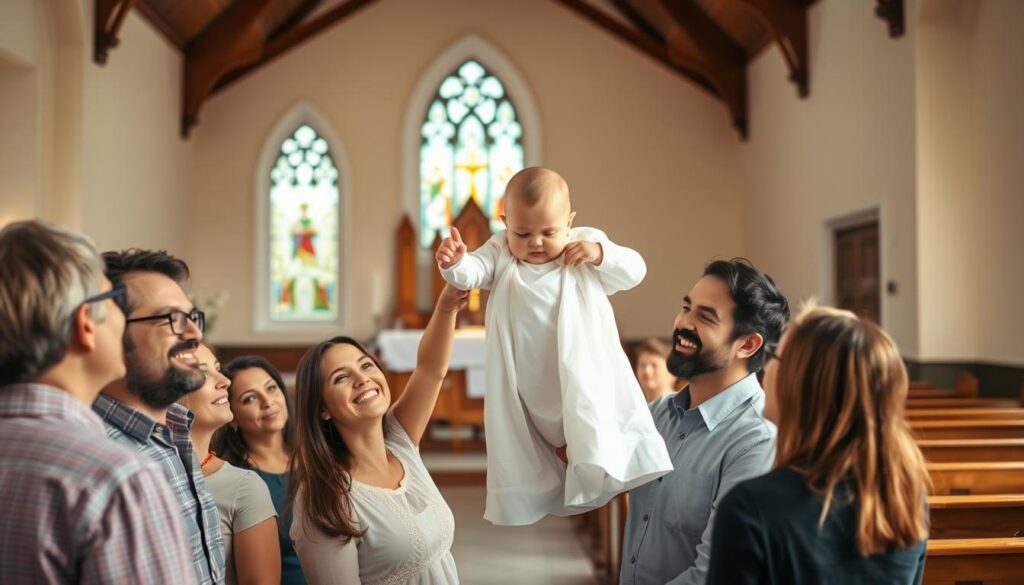
A warm, inviting scene of a family community baptism unfolds. In the foreground, a young child dressed in a pristine white gown is held aloft by loving parents, their faces beaming with joy and reverence. Around them, a circle of family members and close friends gather, their expressions conveying a sense of togetherness and shared spiritual journey. The middle ground features the elegant altar of a modest church, its stained-glass windows casting a soft, ethereal glow. In the background, rows of wooden pews suggest a sanctuary filled with the hushed anticipation of this sacred moment. The lighting is natural and gentle, evoking a sense of timelessness and the profound significance of this rite of passage.

Parental Responsibilities and Faith Promises

When parents bring their children to the font, they make three core commitments:

  • Regular participation in Mass and sacraments
  • Daily prayer within the family
  • Religious education through formal programs

These promises turn homes into miniature churches. Parents become first teachers, showing through actions how faith shapes decisions and relationships.

Godparents as Spiritual Guides and Witnesses

Chosen godparents must meet strict criteria to ensure strong mentorship:

Requirement Purpose
Confirmed Catholic Deep understanding of teachings
Age 16+ Maturity for lifelong role
Eucharist recipient Active participation in sacraments

Beyond attending ceremonies, godparents serve as living examples. They’re prepared to step in if unforeseen circumstances prevent parents from fulfilling their duties. This dual support system helps the baptized person navigate faith challenges at every life stage.

Practical Steps for Baptism Preparation

Embarking on this spiritual milestone starts with organization and understanding. While the ceremony marks a sacred beginning, thoughtful planning ensures its deeper meaning shines through. These practical steps help families create lasting memories while honoring tradition.

Starting the Conversation With Your Church

Reach out to your local parish office early – many communities request 3-6 months’ notice. Bring birth certificates and complete basic paperwork to secure your date. Ask about witness requirements when choosing godparents, as parishes often verify their eligibility.

Engaging With Preparation Programs

Most churches require parents and sponsors to attend educational sessions. These meetings explore the sacrament’s significance and practical ceremony details. You’ll discuss ways to nurture faith in children through daily rituals and community involvement.

Preparation classes often cover:

  • The role of sacred symbols like water and oil
  • Responsibilities after the ceremony
  • Connecting the rite to other sacraments

Many families find these sessions strengthen their own spiritual journey. By investing time beforehand, you ensure the event becomes more than tradition – it becomes a foundation for years of growth.

FAQ

Why is baptism considered essential in the Catholic faith?

Baptism marks the beginning of a person’s journey into the Church, cleansing original sin and uniting them with the risen Christ. The Catechism of the Catholic Church teaches it’s necessary for salvation, opening the door to grace and eternal life.

Can someone be baptized without water?

While water is the primary symbol, extraordinary circumstances allow for “baptism of desire” (yearning for the sacrament) or “baptism of blood” (dying for the faith). These are recognized by the Church when water isn’t accessible.

What role do godparents play in the ceremony?

Godparents serve as spiritual mentors, pledging to support the child’s growth in faith. They must be practicing Catholics, confirmed, and living in alignment with Church teachings to fulfill this sacred duty.

How do parents prepare for their child’s baptism?

Parents typically attend preparation sessions at their parish, reflecting on their own faith commitments. They also choose godparents and collaborate with the priest to plan the ceremony’s details.

Is adult baptism different from infant baptism?

Adults receive the sacrament after a period of formation (RCIA), professing their own faith. Infants rely on their parents’ and godparents’ promises, with the expectation they’ll later affirm their beliefs at confirmation.

Why is the white gown used during the rite?

The white garment symbolizes purity and the new life received through Christ. It echoes St. Paul’s teaching about being “clothed in Christ” and visually represents the soul’s transformation.

What if a family isn’t active in a parish?

The Church encourages families to reconnect with their local parish community. Pastors often guide them in renewing their faith practice to ensure the child’s spiritual upbringing aligns with baptismal promises.

Can non-Catholics attend a baptism ceremony?

Absolutely! The Church welcomes all to witness this joyful celebration. It’s a beautiful opportunity to share the faith and highlight the communal aspect of sacraments.

Catholicism: A Comprehensive Guide


Welcome to a journey through one of humanity’s most enduring institutions. The Catholic Church spans continents and cultures, connecting over 1.4 billion people through shared beliefs and traditions. From ancient cathedrals to modern parishes, this global community shapes lives in 3,500 dioceses across 24 distinct branches.

Why does this matter today? Understanding the Church’s structure helps explain its influence on art, education, and social movements. Its teachings continue shaping debates about ethics, healthcare, and human rights worldwide. You’ll find its fingerprints on everything from medieval philosophy to today’s charity networks.

The Church’s unique blend of unity and diversity stands out. While united under papal leadership, Eastern Catholic traditions maintain their own liturgical practices. This balance between central authority and cultural adaptation has fueled growth across six continents.

Key Takeaways

  • Global community of 1.4+ billion members across 24 autonomous churches
  • Historical influence on Western law, art, and education systems
  • Operates through 3,500 dioceses with Vatican City as its spiritual center
  • Maintains unity while respecting diverse cultural traditions
  • Active in modern discussions about ethics and social justice

Introduction to Catholicism

Uncover the legacy of a religious tradition that has profoundly influenced global culture and thought. Roman Catholicism stands as Christianity’s largest branch, with over a billion followers worldwide. Alongside Eastern Orthodoxy and Protestantism, it forms the core of Christian practice today.

The Roman Catholic Church traces its roots to Jesus Christ and the apostles. Early followers spread their message across the Roman Empire, laying foundations for a faith that would shape laws, art, and education. Over centuries, theologians built a detailed system of beliefs addressing life’s biggest questions – from moral choices to humanity’s purpose.

Central to this tradition is the papacy, a leadership role tracing back to Saint Peter. Vatican City serves as its spiritual headquarters, blending ancient rituals with modern governance. This unique structure makes the Catholic Church both a religious institution and a historical force.

Why does this matter now? From Renaissance masterpieces to social justice movements, Roman Catholicism’s impact echoes through Western society. Its teachings continue inspiring debates about ethics, community, and human dignity in our rapidly changing world.

Understanding catholicism: A Brief Overview

Exploring the building blocks of Catholic identity starts with language. The term “Catholic” comes from the Greek katholikos, meaning “universal.” This idea of worldwide embrace shaped the Church’s mission from its earliest days. Saint Ignatius of Antioch first called it “the catholic church” in AD 110 – a name still used after 1,900 years.

Defining Key Terms and Concepts

Three pillars define Catholic teaching: apostolic succession (unbroken leadership from Christ’s apostles), magisterium (teaching authority), and papal primacy. These concepts create a unique structure among Christian groups. The Church distinguishes between unchanging dogma and adaptable discipline, allowing traditions to evolve while keeping core truths intact.

Core Beliefs and Practices

At the heart lies the Nicene Creed, established in 325 AD. This statement affirms beliefs in the Trinity, Christ’s resurrection, and baptismal salvation. Seven sacraments guide spiritual life, from Eucharist to marriage. Catholic doctrine also addresses social justice, emphasizing community support and ethical decision-making.

Special terms like transubstantiation (bread/wine becoming Christ’s body) show theology’s depth. These ideas developed through centuries of philosophical debate, creating a rich tapestry of faith practices still vibrant today.

Historical Foundations of the Catholic Church

How did a small group of followers transform into a global faith? The answer lies in ancient events that shaped the Catholic Church‘s early growth. Two forces worked together: spiritual conviction and practical geography.

From Galilee to Global Reach

Jesus Christ’s teachings in the New Testament Gospels sparked a movement. He chose twelve apostles to continue his work, instructing them to “make disciples of all nations.” After his resurrection, these followers faced their biggest test.

Pentecost changed everything. Fifty days after Easter, believers say the Holy Spirit empowered the apostles to preach boldly. This event marks the Catholic Church’s official public launch. Suddenly, fishermen became missionaries.

A detailed map of the extensive road network of the Roman Empire, showcasing the intricate system of paved highways and trade routes that connected the far-reaching corners of the ancient Mediterranean world. The image should depict the roads in a muted, sepia-toned color palette, evoking a sense of historical significance and the passage of time. The map should be rendered with a high level of detail, highlighting the winding paths, bridges, and key cities that were vital to the movement of goods, people, and ideas during the height of the Roman civilization. The overall tone should convey the grandeur and engineering prowess of the Roman road system, which served as the foundation for the spread of Catholicism and the growth of the early Christian Church.

When Politics Met Faith

The Roman Empire’s infrastructure became Christianity’s unexpected ally. Well-built roads let missionaries travel farther than ever before. Safe seas under Pax Romana helped ideas cross borders quickly.

But it wasn’t all smooth sailing. Early Christians faced persecution for rejecting Roman gods. Yet shared Greek language helped their message stick. Common cultural references made complex ideas relatable across regions.

Factor Impact Biblical Reference Historical Evidence
Roman Roads Enabled rapid travel Acts 16:9-10 Via Appia excavations
Common Greek Unified communication Luke’s Gospel Septuagint manuscripts
Pax Romana Safe trade routes Romans 15:24 Imperial edicts

This unique mix of challenges and opportunities defined the Catholic Church’s early history. From Jerusalem’s streets to Rome’s highways, the New Testament vision took root in surprising ways.

The Rise of Papal Authority

How did a humble fisherman become the cornerstone of the Church’s leadership? The answer lies in a blend of scripture, history, and evolving governance that shaped one of Christianity’s most distinctive features.

Peter’s Legacy and the Diocese of Rome

Jesus’ declaration to Peter in Matthew 16:18 – “You are Peter, and on this rock I will build my church” – became the bedrock of papal claims. Early Christians honored Rome’s bishop as Peter’s successor, partly because both Peter and Paul died there. This connection turned the city into a spiritual magnet for pilgrims.

By the 3rd century, the bishop of Rome began asserting special authority over other churches. The Diocese of Rome served as his local flock, while the Holy See (the pope’s global office) gradually became Christianity’s administrative hub. Letters from early popes like Clement I show Rome settling disputes between distant congregations.

Development of the Papacy Over Centuries

Medieval popes transformed their role from spiritual leaders to power brokers. Gregory VII’s 1075 Dictatus Papae declared the pope could depose emperors – a bold claim that sparked centuries of church-state conflicts. By 1300, the papacy controlled territories across Italy through the Papal States.

Era Key Development Significance
Early Church Recognition of Roman primacy Established biblical basis for leadership
Medieval Period Claims of universal jurisdiction Expanded political influence
Modern Era 1870 loss of Papal States Shifted focus to spiritual sovereignty

Today’s Roman Catholic Church maintains this legacy through Vatican City’s unique status. The pope now leads 1.4 billion Catholics as both a religious figure and head of state – a dual role unmatched in modern governance.

Understanding the Church’s Organizational Structure

Imagine a spiritual institution running like a well-oiled global enterprise. The Church balances sacred traditions with administrative precision through three key elements: centralized leadership, local governance, and timeless legal frameworks.

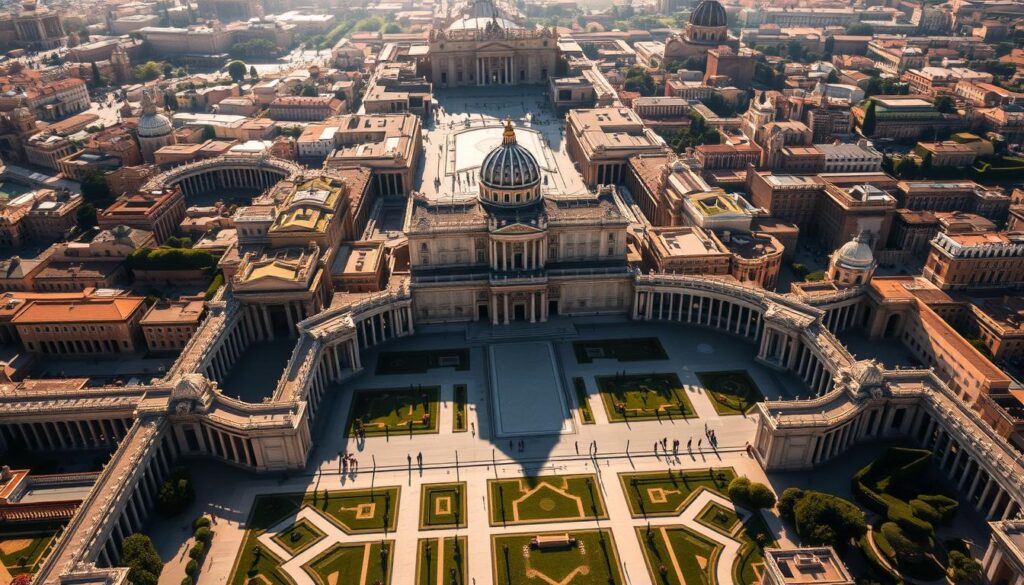
A sprawling, grand administrative complex of the Vatican City, with its iconic domed basilicas, ornate facades, and manicured gardens. The scene is captured from an elevated perspective, highlighting the intricate layout and organizational hierarchy of the Church's governing structures. Warm, golden lighting filters through the archways, casting dramatic shadows and emphasizing the grandeur of the architecture. The image conveys a sense of authority, tradition, and the far-reaching influence of the Catholic Church's administrative center.

The Holy See and Roman Curia

At the heart of operations lies the Holy See, the Church’s central governing body. Think of the Roman Curia as its executive team – 26 departments handling everything from doctrinal debates to missionary work. Key divisions include:

  • The Dicastery for Evangelization (global outreach)
  • Congregation for the Doctrine of Faith (theology oversight)
  • Administration of Vatican City State (daily operations)

These offices work within the world’s smallest sovereign nation. Vatican City isn’t just the pope’s home – it’s a functioning city-state with its own postal service, bank, and media outlets.

Canonical Governance and Episcopal Polity

Local leadership thrives through 5,000+ bishops worldwide. Each oversees a diocese while maintaining unity with Rome through:

  • Regular ad limina visits to the Vatican
  • Implementation of canon law standards
  • Collaboration with regional bishops’ conferences

The governance system blends ancient codes with modern needs. Canon law courts still handle marriage annulments, while newer tribunals address digital privacy concerns. Cardinals – those red-hatted advisors – play dual roles as papal electors and department heads within the Curia.

Key Teachings and Doctrines

What binds over a billion believers across continents? A shared framework of Catholic doctrine rooted in ancient wisdom and lived practice. At its core lies the Nicene Creed – a 4th-century statement of faith – and seven sacred rituals believed to channel divine grace.

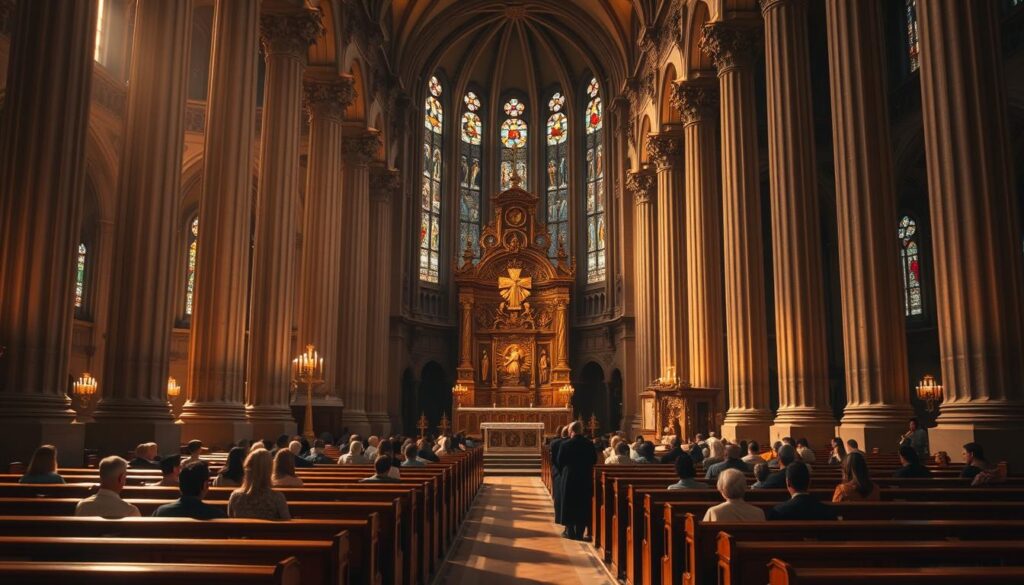
A grand cathedral interior, illuminated by warm, soft lighting that filters through stained glass windows. In the foreground, a raised altar adorned with intricate religious symbols and ornaments, casting a reverent atmosphere. In the middle ground, rows of wooden pews facing the altar, with parishioners kneeling in solemn prayer. The background is filled with towering, ornate columns supporting a vaulted ceiling, creating a sense of awe and spiritual grandeur. The scene evokes the core sacraments and doctrines of the Catholic faith, including communion, baptism, and the veneration of saints, all brought to life through masterful chiaroscuro and elegant, classical composition.

The Creed That Built a Community

Formulated in 325 AD, the Nicene Creed remains Christianity’s most widely accepted doctrinal statement. It outlines essential beliefs like the Trinity and Christ’s resurrection. Apostolic succession ensures these teachings stay consistent – bishops trace their authority directly to Jesus’ original apostles through an unbroken chain of ordination.

Sacraments: Faith in Action

Catholics experience God’s presence through seven sacraments. The Eucharist stands central, where believers affirm that consecrated bread and wine become Christ’s body and blood (transubstantiation). Other rituals mark life’s milestones, from baptismal rebirth to marriage vows.

Sacrament Purpose Biblical Basis
Baptism Spiritual rebirth John 3:5
Confirmation Strengthening faith Acts 8:14-17
Eucharist Communion with Christ Luke 22:19-20
Penance Moral renewal John 20:22-23

These practices flow from sacred tradition, preserving teachings not fully detailed in Scripture. The Church’s magisterium (teaching authority) guides interpretation, balancing ancient texts with modern challenges. This living doctrine also inspires social action – feeding the hungry and visiting prisoners remain vital expressions of faith today.

The Role of Scripture and Sacred Tradition

How does a 2nd-century bishop shape modern faith? Saint Irenaeus of Lyons answered this by defining three anchors of Christian authority: Scripture, apostolic leadership, and sacred tradition. This framework still guides the Church today, blending written and oral teachings into a cohesive whole.

The Bible, Magisterium, and Oral Tradition

Catholics view the New Testament as part of a larger divine revelation. The Bible works alongside practices passed down through generations. For example, Sunday worship and Marian devotions stem from tradition rather than explicit biblical commands.

The magisterium – the Church’s teaching office – acts as a guardian of truth. Bishops and theologians interpret Scripture using methods refined over centuries. As Irenaeus wrote: “Where the Church is, there is the Spirit of God.”

Catholic Bible Feature Protestant View Key Difference
73 Books 66 Books Deuterocanonical texts
Tobit, Wisdom Apocrypha Inclusion status
Tradition as equal Sola Scriptura Authority sources

Oral teachings fill gaps in biblical accounts. Details about infant baptism and purgatory developed through apostolic tradition. This living heritage allows the Church to address modern issues while maintaining ancient roots.

Unlike Protestant “Scripture alone” approaches, Catholic theology sees Bible and tradition as twin streams from one divine source. The magisterium ensures neither contradicts the other, creating stability amid cultural shifts.

The Impact of the Great Schism

The year 1054 marked a turning point in Christian history. What began as theological debates became a permanent divide between two ancient traditions. This split reshaped religious practice across Europe and the Mediterranean.

Separations and Divergent Paths

Mutual excommunications between Rome and Constantinople formalized the Great Schism. The Catholic Church maintained Latin traditions, while the Eastern Orthodox developed Greek-based practices. Both branches kept core Christian beliefs but diverged in governance styles.

Papal authority became the main sticking point. Western leaders insisted on Rome’s supreme jurisdiction, while Eastern bishops favored collective decision-making. This tension reflected deeper cultural divides between Mediterranean regions.

East-West Differences in Belief

The filioque clause debate revealed contrasting approaches to doctrine. Western churches added “and the Son” to the Nicene Creed’s description of the Holy Spirit. Eastern theologians saw this as unauthorized innovation.

Despite attempts at reconciliation, the Great Schism created lasting divisions. Today, the Catholic Church and Eastern Orthodox communities maintain distinct identities while seeking common ground through dialogue.

FAQ

What distinguishes the Roman Catholic Church from other Christian denominations?

The Roman Catholic Church emphasizes apostolic succession, recognizing the Pope as St. Peter’s successor and the ultimate authority in matters of faith. It also upholds seven sacraments, devotion to the Virgin Mary, and teachings shaped by both Scripture and Sacred Tradition.

How does apostolic succession influence church governance?

Apostolic succession ensures bishops trace their spiritual lineage back to Jesus’ apostles. This continuity grants them authority to teach, administer sacraments, and guide dioceses in communion with the Pope.

What role does the Pope play in modern Catholicism?

As Bishop of Rome and head of the global church, the Pope oversees doctrine, unity, and pastoral care. Pope Francis, for example, emphasizes social justice while upholding traditional teachings like the sanctity of life.

Why are sacraments central to Catholic practice?

Sacraments like Baptism and Eucharist are seen as visible signs of God’s grace. They mark key spiritual moments, from birth (Baptism) to healing (Anointing of the Sick), deepening believers’ connection to Christ.

What caused the Great Schism between East and West?

The 1054 split arose from disputes over papal authority, liturgical practices, and theological differences like the Filioque clause in the Nicene Creed. This led to separate Orthodox and Catholic traditions.

How does Sacred Tradition relate to the Bible?

The Catholic Church views Sacred Tradition and Scripture as complementary. Tradition includes teachings passed down orally by the apostles, interpreted by the Magisterium, ensuring consistency in doctrine across centuries.

What is the Nicene Creed’s significance?

Written in 325 CE, this creed summarizes core beliefs like the Trinity and Christ’s divinity. It’s recited during Mass, uniting Catholics globally in shared faith.

How is the Vatican’s structure organized?

The Holy See, led by the Pope, governs through the Roman Curia—departments like the Congregation for the Doctrine of the Faith. Bishops oversee dioceses, working with priests and deacons in local ministries.