Recent Posts

Cheer on Lutheran East Football: Game Recaps and News


Welcome to your go-to hub for everything related to the Falcons’ thrilling 2024 season! This year, the team has soared to new heights with a 9-1 record, securing their spot as one of Ohio’s most exciting high school squads. Whether you’re a longtime supporter or new to the community, here’s where you’ll find game breakdowns, standout moments, and behind-the-scenes insights.

From nail-biting fourth-quarter plays to strategic coaching decisions, we cover the details that make every matchup memorable. The Falcons’ success isn’t just about wins—it’s about teamwork, perseverance, and the unwavering support of fans like you. Families, alumni, and local supporters all play a role in fueling this program’s spirit.

Looking to join the action? Stay updated on upcoming games and learn how to cheer alongside fellow fans. Beyond the field, discover how the program shapes athletes into leaders, blending athletic excellence with character development. Let’s celebrate the traditions and future of a team that unites our community.

Key Takeaways

  • The Falcons hold an impressive 9-1 record this season
  • Stay connected with game summaries and player highlights
  • Learn how coaching strategies drive the team’s success
  • Explore opportunities to attend games and show support
  • Discover the program’s focus on developing well-rounded athletes

Lutheran East Football: Recent Game Recaps and Results

This season’s action-packed matchups have kept fans on the edge of their seats. The Falcons’ 9-1 campaign featured heart-stopping comebacks and dominant performances, proving their ability to adapt under pressure. Every quarter brought new opportunities to witness athleticism and grit.

Exciting Game Moments and Highlights

One unforgettable play saw the team rally from a 14-point deficit in the final minutes. A perfectly executed fake punt shifted momentum, leading to a game-winning touchdown drive. Defensive stands in critical red-zone situations became a recurring theme, with players swarming to the ball like a well-oiled machine.

“Our athletes thrive when the stakes are highest – that’s where preparation meets opportunity.”

Key Performances on the Field

Several players emerged as difference-makers this season. A junior receiver’s acrobatic catches in traffic became must-see highlights, while a senior linebacker’s leadership anchored the defense. The coaching staff’s play-calling creativity – like using triple-option formations against larger opponents – maximized the roster’s strengths.

  • Clutch fourth-down conversions that broke rivals’ spirits
  • Special teams touchdowns shifting game dynamics
  • Quarterback composure during two-minute drills

These collective efforts showcase why the program continues earning statewide recognition. With playoffs approaching, the foundation built through these games could lead to historic achievements.

Season Performance Analysis and Rankings

The Falcons’ 2024 campaign stands as a testament to strategic growth and competitive grit. With a 9-1 record, they’ve climbed to 33rd in Ohio’s rankings – a position earned through disciplined execution and adaptability.

High school football stadium at dusk, with players in uniform running onto the field. Overhead lights casting a warm glow, stadium seating filled with cheering fans. In the foreground, a large scoreboard displays team names and rankings, data visualizations showing season performance metrics. On the sidelines, coaches and staff review game analytics on digital tablets. The atmosphere is electric, capturing the excitement and competitive spirit of this local high school football rivalry.

Reviewing Scores and Standings

Facing opponents like Bishop Hartley and Maumee, the squad proved its mettle in high-pressure scenarios. Their lone loss came early, sparking adjustments that fueled an eight-game win streak. Defensive efficiency (allowing just 14 points per game) and a balanced offense (320+ rushing yards weekly) became defining traits.

Team Record State Rank
Lutheran East 9-1 33
Bishop Hartley 6-4 47
Maumee 8-2 29
Archbishop McNicholas 7-3 38

Insights from the Latest Matchups

October’s clash against a top-25 program showcased their resilience. Trailing by 10 at halftime, the team rallied with three unanswered touchdowns. A sophomore running back’s breakout 150-yard game highlighted the roster’s depth.

“Adversity reveals character – our players respond best when challenged,” shared a coaching staff member.

With playoff seeding secured, focus shifts to maintaining momentum. Their ability to control possession time (averaging 32 minutes per game) could prove decisive in upcoming contests.

Coach and Team Spirit Spotlight

Behind every great team stands leaders who inspire both plays and purpose. This season’s success stems from mentors who prioritize growth beyond the scoreboard, blending strategy with life lessons that resonate long after Friday nights.

Meet the Coach and Leadership

The coaching staff’s player-first philosophy turns raw talent into disciplined squads. “We build athletes who excel in helmets and hoodies,” shares one coach, referencing classroom performance. Weekly leadership workshops and film study sessions create thinkers who anticipate plays – and life challenges.

Coaches update stats and rosters through an exclusive portal, ensuring fans get real-time insights. This transparency mirrors their sideline approach: clear communication fuels trust between players and mentors.

Celebrating School Pride and Community

Game days unite generations through traditions like the pre-game alumni handshake line. Students paint banners celebrating academic milestones alongside athletic wins, proving school pride isn’t confined to the field.

“Our athletes represent something bigger – they carry our community’s heartbeat in every huddle.”

Local businesses host watch parties, while youth teams mimic plays during halftime scrimmages. This synergy between program and supporters turns touchdowns into shared victories that ripple through neighborhoods.

Fan Engagement and Update Opportunities

Building a winning team takes more than players on the field—it’s a community effort. Coaches and supporters work together to keep information fresh and energy high. Through a streamlined online system, leaders ensure everyone stays informed and connected.

A lively football stadium filled with energetic fans waving Lutheran East flags and banners. In the foreground, a group of enthusiastic supporters leading cheers and chants, their faces animated with school spirit. In the middle ground, families and friends gather in the stands, engaged in friendly banter and bonding over their shared love of the game. The background showcases the vibrant atmosphere, with the stadium's architecture and lighting creating a warm, inviting ambiance. Overhead, a crisp, clear sky adds a sense of openness and possibility. The scene conveys the power of fan engagement, capturing the excitement, camaraderie, and unwavering support that fuels the Lutheran East football team.

How Coaches and Fans Can Contribute

Coaches play a key role by managing team profiles. They update rosters, adjust schedules, and share stats through a secure portal. This keeps fans in the loop with real-time data, from player milestones to game-day changes.

Supporters fuel the team’s momentum in many ways. Attending games remains the top method, but sharing social media posts or volunteering at school fundraisers makes a difference too. Local businesses often sponsor events, while alumni mentor current athletes.

Digital tools help bridge gaps between practices and pep rallies. Follow official accounts for live updates, behind-the-scenes clips, and community spotlights. Whether you’re organizing watch parties or cheering from home, every action strengthens the program’s foundation.

Conclusion

As the Falcons’ remarkable season unfolds, their 9-1 record and 33rd state ranking shine as proof of relentless effort. This success story isn’t just about stats – it’s a mosaic of late-night practices, roaring crowds, and leaders who turn potential into progress.

Every touchdown celebrated under Friday night lights reflects hours of teamwork. Coaches craft strategies while players push limits, creating moments that unite classrooms and neighborhoods. Families wave banners, alumni share stories, and local businesses fuel the energy that makes game days unforgettable.

Supporters keep this momentum alive. Attend games to witness rising stars, or follow social updates to catch clutch plays. Behind each victory lies a lesson in perseverance – qualities that shape students long after seasons end.

The program’s legacy grows stronger with every huddle. Young athletes watch today’s heroes, dreaming of their future under those stadium lights. Together, we build more than a team – we nurture leaders who’ll soar beyond the field.

FAQ

Where can I find highlights and recaps of recent games?

Visit the school’s official athletics website or follow local sports networks for detailed game summaries, video clips, and standout plays.

How can I check the team’s current rankings?

Regional sports platforms like MaxPreps or the Ohio High School Athletic Association (OHSAA) website provide updated standings and conference stats.

Who is leading the coaching staff this season?

The program is guided by a seasoned head coach with a focus on player development, teamwork, and building a culture of resilience.

How can fans support the players and community?

Attend home games, participate in fundraising events, or share positive coverage on social media to boost morale and visibility.

Are there opportunities to contribute stats or updates?

Coaches and team managers often welcome fan-submitted photos or stats—reach out via the athletic department’s contact page for guidelines.

What’s the best way to stay informed about schedule changes?

Subscribe to email alerts through the school’s sports portal or follow verified social media accounts for real-time announcements.
Lutheranism: A Comprehensive Look at Its Origins


What began as one man’s bold stand in 16th-century Germany grew into a movement that transformed Christianity. A German monk’s call for reform sparked changes that reshaped worship, theology, and daily faith practices. This movement, rooted in scripture and grace, spread rapidly across Europe—challenging traditions while building new communities.

By focusing on accessible teachings, reformers created a vibrant spiritual path that connected with everyday people. Over years, their ideas crossed oceans, establishing thriving churches worldwide. Today, these communities continue to honor their origins while adapting to modern life.

From its early days, this tradition emphasized education and music, leaving lasting marks on culture. Its influence even shaped social reforms, proving that church teachings could extend beyond Sunday services. Let’s explore how a single moment in Wittenberg became a global story of faith.

Key Takeaways

  • A 16th-century reform movement started by Martin Luther reshaped Christian practices across Europe
  • Core beliefs focus on scripture, grace, and accessible worship for all believers
  • Early Lutheran communities prioritized education and cultural contributions like hymnody
  • The tradition spread globally, establishing churches on every continent
  • Modern Lutheran teachings balance historical roots with contemporary social engagement
  • Key documents like the Book of Concord help maintain theological consistency

Introduction to Lutheranism and Its Significance

When a monk’s critique of church practices went viral, it birthed a global faith community. Today, the evangelical lutheran church unites over 60 million members through shared beliefs about grace and scripture. This tradition began as Martin Luther challenged the sale of indulgences in 1517, sparking reforms that redefined Christian worship.

Lutheran churches blend ancient rituals with fresh perspectives. They keep candlelit services and communion tables while emphasizing God’s free gift of grace. Every congregation celebrates two sacraments – baptism and the Eucharist – as visible expressions of divine love.

Practice Lutheran Churches Other Protestant Churches
Sacraments Baptism & Eucharist Varies, often fewer
Core Document Augsburg Confession Denominational specifics
Scripture Focus Sola Scriptura Similar emphasis

The Augsburg Confession, written in 1530, remains central to their identity. This document explains how churches can honor tradition while embracing reform. It shows why Lutheran teachings resonate across cultures – from Scandinavian chapels to American storefront churches.

Modern members find balance between ancient hymns and community service. Through food banks and youth programs, they live their faith beyond Sunday services. This active spirituality helps people connect centuries-old truths to daily life challenges.

Origins of the Reformation and the Birth of Lutheran Thought

The spark that lit the Reformation began with a list of concerns nailed to a church door. Martin Luther, a German monk, hoped to spark debate about Roman Catholic practices like selling indulgences. Instead, his Ninety-five Theses became the catalyst for a spiritual revolution that reshaped European Christianity, laying groundwork for the Lutheran Church.

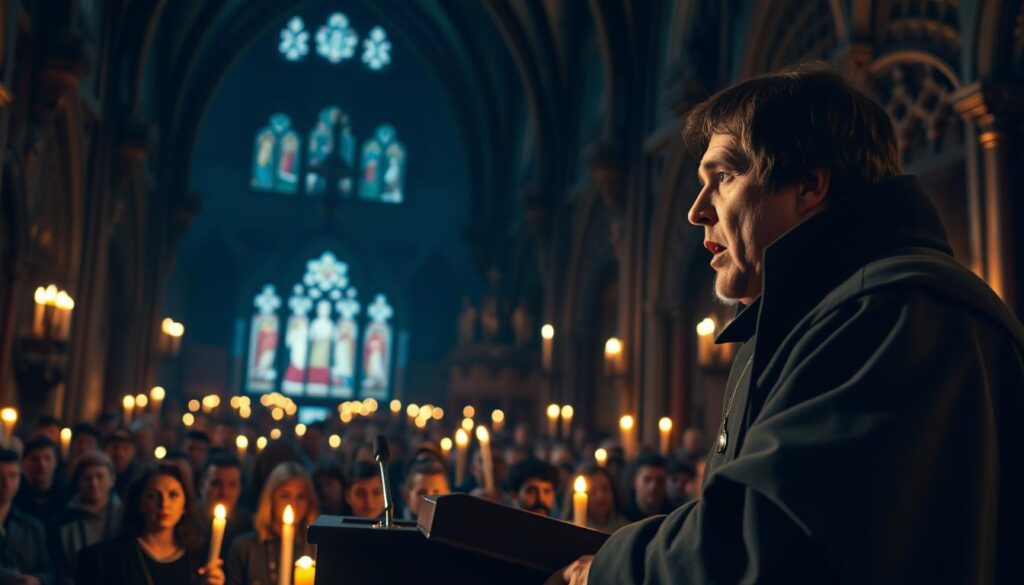
A close-up portrait of Martin Luther, the father of the Protestant Reformation, standing at a podium and delivering a passionate speech. The lighting is dramatic, casting sharp shadows across his intense, determined expression. In the middle ground, a crowd of his followers listens intently, their faces illuminated by the glow of candles and torches. The background is a dimly lit church interior, with ornate Gothic architecture and stained glass windows casting a somber, reverent atmosphere. The scene conveys the pivotal moment when Luther's revolutionary ideas began to reshape the course of Western Christianity.

The Role of Martin Luther

Luther’s bold stance came at great personal risk. He faced excommunication and potential death for challenging church authority. His core belief—that salvation comes through faith alone, not deeds—directly contradicted established teachings. The printing press helped spread his writings faster than ever before.

The Context of the Pre-Reformation Church

Many Christians felt uneasy about corruption in 16th-century religious institutions. The sale of church positions and forgiveness certificates created widespread frustration. For example, indulgences were marketed as spiritual shortcuts rather than genuine repentance. Luther’s ideas offered a return to scriptural roots, resonating with churches and individuals seeking authentic faith experiences.

Key Figures and Their Impact on Lutheranism

While Martin Luther ignited the Reformation, his colleagues turned sparks into lasting flames. Visionary thinkers built frameworks for churches to thrive, blending bold ideas with practical faith practices.

Influential Theologians and Reformers

Philip Melanchthon, called “Luther’s other half,” crafted systematic theology even skeptics could grasp. His work became essential reading for pastors training new congregation members. Martin Chemnitz later defended these teachings, writing:

“Scripture alone lights our path, but wise guides keep us steady.”

Jakob Andreae tackled division within the church, negotiating the Formula of Concord. This 1577 document settled disputes about God’s role in salvation—a compromise strengthening Lutheran unity.

Contributions from the Book of Concord

Published in 1580, the Book of Concord became the Lutheran Church’s doctrinal foundation. It merged Luther’s catechisms with Melanchthon’s Augsburg Confession and Andreae’s Formula into one body of truth.

  • Standardized teachings across German churches
  • Clarified baptism’s purpose for doubting members
  • Established training programs for clergy

These efforts ensured that whether in grand cathedrals or rural chapels, churches shared core beliefs. Through collaboration, reformers gave Luther’s ideas staying power—proving movements need both firestarters and builders.

Core Doctrines and Beliefs in Lutheran Theology

At the center of Lutheran churches lies a radical idea: God’s love isn’t earned—it’s freely given. These teachings transformed how millions experience faith, grounding spirituality in grace rather than rules.

Justification by Faith Alone

Imagine forgiveness as a gift, not a reward. That’s the heart of “faith alone”—the belief that trust in Christ, not good deeds, connects people to divine mercy. This idea reshaped worship, turning rituals into celebrations of God’s promise.

Sola Scriptura and Scriptural Authority

For evangelical Lutheran communities, the Bible lights the way. Sola Scriptura means every teaching passes one test: alignment with scripture. The Augsburg Confession cemented this principle, uniting churches under shared truths.

These doctrines live beyond Sunday sermons. They inspire food pantries, youth programs, and care for neighbors—proof that ancient beliefs still fuel modern service. Through the Holy Spirit’s guidance, these church communities keep grace at the center of daily life.

FAQ

How did the evangelical Lutheran church begin?

The movement traces its roots to Martin Luther’s 16th-century reforms. His critiques of Roman Catholic practices, like the sale of indulgences, sparked the Reformation. This led to new theological ideas and the establishment of communities centered on faith and scripture.

What role did the Augsburg Confession play?

Written in 1530, the Augsburg Confession outlined core beliefs of Lutheran thought. It became a foundational text for the Lutheran World Federation and other groups, clarifying teachings like justification by grace through faith.

Why is Sola Scriptura important in Lutheran theology?

Sola Scriptura emphasizes the Bible as the ultimate authority for Christian faith. This principle, central to Lutheran churches, contrasts with traditions that prioritize church hierarchy or additional teachings outside scripture.

How do Lutheran congregations approach worship today?

Many follow liturgies blending traditional hymns with modern practices. Services often focus on preaching, sacraments like baptism, and communal prayer, reflecting the evangelical Lutheran emphasis on grace and community.

What distinguishes the Lutheran view of salvation?

Lutherans teach that salvation comes through faith alone, not deeds. This idea, called justification by faith, reshaped Christian theology during the Reformation and remains a pillar of Lutheran doctrine worldwide.

How did the Book of Concord unify Lutheran thought?

Compiled in 1580, the Book of Concord gathered key texts like the Augsburg Confession and Luther’s catechisms. It provided clarity and unity for Lutheran churches amid theological debates, ensuring consistency in teachings.

What challenges did early reformers face?

Early leaders faced opposition from the Roman Catholic Church and political rulers. Figures like Philipp Melanchthon worked to defend Lutheran ideas while navigating persecution, leading to the spread of reforms across Europe.

Lutheran Devotions for Meetings: Inspiring Reflections


Starting a gathering with purpose can transform ordinary agendas into moments of connection. Many groups find value in opening with reflections that align faith and daily life. Trusted organizations like the LWML (Lutheran Women’s Missionary League) create structured resources designed to nurture spiritual focus during shared time.

These materials blend scripture, prayer, and relatable themes to support communities. For example, their “Immanuel — God With Us” series explores how divine presence shapes personal journeys. Such content helps groups navigate challenges while celebrating hope together.

Modern formats like podcasts and printable PDFs make these tools accessible for every day. Whether your team prefers quiet reflection or lively discussion, adaptable options meet diverse needs. This flexibility ensures meaningful engagement, no matter the setting.

Key Takeaways

  • Trusted organizations provide ready-to-use reflections that blend theology with real-life situations
  • Multiple formats (audio, print, digital) accommodate different group preferences
  • Structured devotions help transform routine meetings into spiritually enriching experiences
  • Universal themes like hope and community resonate across diverse participants
  • Easy-to-share resources maintain denominational consistency while encouraging personal connections

Discovering Lutheran Devotions for Meetings

Meetings become meaningful when centered around shared faith and reflection. These moments offer more than agenda reviews—they create space to align life’s challenges with timeless wisdom. Many groups find that starting with a brief spiritual focus helps participants approach tasks with renewed purpose.

Understanding the Importance of Devotional Reflection

Taking time for reflection turns ordinary discussions into sacred exchanges. The LWML’s “Unknown Number” study illustrates this beautifully. Like Samuel learning to recognize God’s voice, participants practice listening beyond surface-level conversations.

This approach builds relationships through vulnerability. When teams pause to share struggles or hopes, they often discover common ground. As 2 Timothy 1:7 reminds us, fear fades when we trust divine guidance in our daily ways.

Exploring the Role of Prayer and Biblical Guidance in Meetings

Prayer acts like a compass during decision-making. It helps groups balance practical needs with spiritual values. Many find that inviting scriptural words into discussions brings clarity to complex issues.

Regular practice strengthens community bonds over years. Whether resolving conflicts or planning projects, biblical principles offer stability. This method transforms routine gatherings into opportunities for collective growth—one day at a time.

Inspiring Themes and Biblical Reflections

Gatherings gain depth when anchored in timeless truths. Three powerful themes – God’s presence, divine knowledge, and enduring peace – help groups find meaning beyond agendas. These narratives draw from scripture to address modern struggles while strengthening collective purpose.

A serene, contemplative scene of biblical reflections for a small group gathering. In the foreground, an open Bible rests on a wooden table, its pages gently illuminated by soft, warm lighting. In the middle ground, a group of people sit in a circle, their faces thoughtful and engaged as they discuss the scripture. The background depicts a cozy, inviting space, perhaps a church meeting room or a quiet, peaceful corner, with muted tones and subtle textures creating a sense of tranquility. The overall atmosphere is one of reverence, introspection, and shared spiritual exploration.

Embracing “Immanuel — God With Us”

Matthew 1:23’s promise of divine companionship transforms boardroom dynamics. When teams face budget cuts or strategic pivots, this theme whispers: “You’re not alone.” One church council used this reflection during staffing changes, discovering renewed trust in shared leadership.

Navigating Life’s Seasons Through Faith

Psalm 139’s assurance that “You know me” comforts those balancing work and caregiving. The “Guaranteed!” study tackles John 16:33’s honest take on trials. As one volunteer coordinator shared: “It helped our team reframe setbacks as stepping stones.”

These resources, part of the 2023-2025 Equipping Saints to Serve planner, adapt to various needs. Available through the 2025 3:00 system, they offer flexible formats for busy people. Whether facing personal loss or organizational shifts, such reflections turn meeting time into sacred space.

Practical Integration of Devotions into Meeting Agendas

Blending spiritual practices with organizational workflows creates space for both productivity and purpose. Groups can access ready-made resources like the LWML’s reproducible PDFs or the Lutheran Church of Australia’s daily archives. These tools help teams weave faith into schedules without adding planning stress.

Incorporating Daily Devotions for Spiritual Growth

Strategic timing amplifies impact. A five-minute reflection at the meeting’s start centers minds, while mid-session pauses allow personal application. One system administrator shared: “Using the ‘April 2025’ study during tech upgrades kept our team grounded in bigger-picture goals.”

Utilizing Printable Devotions and Resource Guides

Tangible materials make consistency easier. The LCA’s 2024 collection, crafted by pastors and volunteers, offers themes matching seasonal challenges. Their “May 2025” guide includes discussion prompts about balancing work and life – perfect for spring planning sessions.

Enhancing Group Connection and Relationship with God

Shared reflection builds bridges. When teams use the “2025 3:00” prayer format, they often discover overlapping struggles and hopes. As one member noted: “Hearing others’ stories helped me see God’s hand in my ordinary day.” Structured guides provide safe spaces for vulnerability while maintaining focus.

Lutheran Devotions for Meetings Resource Hub

Finding reliable spiritual tools shouldn’t feel like searching for hidden treasure. The Mustard Seed archives offer a trusted system for groups seeking depth without extra prep work. With materials developed by pastors like Rev. Larry Krueger and writers like Marcia Gomulka, these resources blend wisdom with real-world relevance.

A serene, well-organized Lutheran devotions resource hub, bathed in warm, natural lighting. The foreground features a wooden desk with a leather-bound devotional book, a candlestick, and a minimalist cross sculpture. In the middle ground, bookshelves line the walls, filled with an assortment of devotional materials, Bibles, and inspirational texts. The background depicts a tranquil, chapel-like setting with stained glass windows, casting a soft, reverent glow throughout the space. The overall atmosphere conveys a sense of contemplation, spiritual nourishment, and a dedication to fostering a deeper connection with the divine.

Leveraging Mustard Seed Devotion Archives and Trusted Resources

Seasonal collections like “In Times of Need” provide comfort during loss, while “The Word: Wisdom for Living” helps navigate life’s twists. One team leader shared: “The ‘unchanging God’ theme stabilized our group during office relocations.” These ready-to-use reflections save hours while maintaining theological integrity.

Flexible formats meet modern needs. Email subscriptions deliver daily content straight to inboxes – perfect for busy days. Audio versions through the LWML podcast let commuters engage during drives. Printable PDFs work well for hands-on learners who underline key passages.

By connecting relationship god principles with practical challenges, these archives help groups grow together. As one administrator noted: “Our June 2025 budget meeting felt lighter after discussing God’s peace.” Whether facing shock or change, these tools turn ordinary agendas into moments of shared hope.

Conclusion

Meaningful gatherings leave lasting imprints when rooted in shared purpose. Trusted frameworks like “Walking with my Lord” prayers help groups carry insights into daily life. These tools blend scriptural wisdom with modern challenges, offering stability in shifting seasons.

Available through email subscriptions or printable guides, the resources adapt to any schedule. Themes of grace and hope remind participants that divine power outlasts temporary struggles. As Philippians 4:13 (ESV) affirms, strength comes through Christ Jesus.

Clear permission guidelines make sharing safe and simple. Whether using the April 2025 study on leadership or June 2025 materials about community care, each word aims to deepen relationships – with others and with God.

By weaving reflection into agendas, ordinary days become threads in a larger story. The true gift lies not in perfect plans, but in hearts united through timeless faith. What begins around a table often ripples outward, shaping homes and workplaces with renewed purpose.

FAQ

How can Lutheran devotions enhance the purpose of team meetings?

Reflecting on Scripture and prayer during meetings fosters unity, clarity, and a shared focus on faith. It invites God’s presence into discussions, helping teams align their goals with biblical values like humility and service.

What themes work well for devotions in professional or church group settings?

Themes like “God With Us,” trusting in divine timing, or finding hope in trials resonate deeply. These narratives connect faith to everyday challenges, encouraging participants to lean on God’s promises in their work and relationships.

Are there practical tools to integrate devotions into busy meeting schedules?

Yes! Printable devotion guides, short Scripture readings, or curated prayers from resources like the Mustard Seed Devotion Archives save time. Even 5–10 minutes of reflection can center a group’s mindset and priorities.

How do devotions address personal struggles during group gatherings?

By sharing stories of biblical figures who overcame adversity, devotions remind attendees they’re not alone. This builds empathy and trust, creating space for vulnerability while pointing to Christ’s redeeming love as a source of strength.

Where can I find trusted Lutheran devotion resources for diverse groups?

The Mustard Seed Devotion Archives offer free, biblically grounded materials. Websites like Lutheran Hour Ministries or Concordia Publishing House also provide themed guides for workplaces, families, and church teams.

Can short devotions truly impact a group’s spiritual growth over time?

Absolutely. Consistency matters more than length. Regular reflection on God’s Word nurtures collective faith, deepens relationships, and transforms routine meetings into moments of worship and mutual encouragement.

Lutheranism’s Legacy in Germany: Beliefs, Practices, and More


Imagine a single document reshaping an entire nation’s spiritual landscape. That’s exactly what happened when Martin Luther’s ideas sparked a religious revolution in the 16th century. Today, over 19 million people belong to the Evangelical Church in Germany (EKD), a federation that preserves this transformative legacy while adapting to modern life.

The EKD unites regional Protestant churches under one umbrella, blending tradition with contemporary values. Its structure reflects centuries of evolution—from Luther’s early reforms to surviving world wars and political shifts. You’ll find its influence everywhere, from Sunday services to debates about social justice.

What makes this faith tradition unique? Unlike other Christian denominations, Lutheran theology emphasizes grace through faith alone. This principle shaped not just worship practices but also education systems and cultural norms. Regional churches maintain local customs while sharing core beliefs, creating a tapestry of traditions across the country.

Key Takeaways

  • The EKD represents 22.7% of Germany’s population through 20 regional churches
  • Lutheran teachings revolutionized Christian theology with concepts like sola fide (faith alone)
  • Church-state relationships evolved through major historical events since the Reformation
  • Modern challenges include declining membership and adapting to societal changes
  • Regional variations showcase diverse worship styles within shared theological foundations

Historical Foundations of the Lutheran Reformation

A single meeting in 1530 changed religious history forever. Emperor Charles V called leaders to Augsburg hoping to unify Christians. Instead, this council became the birthplace of organized Lutheran identity.

The Diet of Augsburg and Early Confessions

Philip Melanchthon stepped forward with a groundbreaking document at the Diet of Augsburg. His Augsburg Confession outlined core beliefs while seeking common ground with Roman Catholic leaders. Seven princes and two cities immediately endorsed it, creating the first legal framework for Lutheran churches.

Key Reformers and Their Influences

While Luther sparked the movement, Melanchthon shaped its future. His diplomatic approach helped Lutheran ideas gain political support from regional rulers. This alliance with princes proved crucial during decades of religious conflicts.

The 1557 Concord Formula settled heated debates about communion practices. Over two-thirds of German Protestants accepted these guidelines, creating unity across diverse congregations. These agreements didn’t just define theology—they built structures that lasted centuries.

The Evolution of Church Structures and Governance

Power shifts often leave lasting marks on religious institutions. For Protestant churches, this meant transforming from political tools to self-governed communities. The journey reshaped how congregations organize worship and engage with society.

A grand cathedral interior with stained glass windows casting warm, golden light throughout. In the foreground, ornate wooden pews and an elegant pulpit, symbolizing the central role of preaching. In the middle ground, rows of robed clergy seated in orderly rows, representing the hierarchical structure of church governance. In the background, an intricate network of hallways and side chambers, hinting at the complex administrative framework that supports the church's operations. The scene conveys a sense of reverence, tradition, and well-organized authority.

From State Churches to the EKD

For nearly four centuries, regional rulers held dual roles as political leaders and church heads. The 1555 Peace of Augsburg let princes decide their territory’s faith. This created state-controlled churches where governance blended spiritual and political power.

Everything changed after World War I. The Weimar Constitution of 1919 cut official ties between churches and states. Though no longer state-run, these organizations kept public corporation status. This shift paved the way for today’s Evangelical Church in Germany (EKD), founded in 1948.

Federal Principles and Regional Churches

The EKD operates like a religious version of federalism. Twenty regional churches manage local affairs while sharing resources nationally. Some use bishops, others elected councils—each reflects its history and theology.

Boundaries often mirror old German states, preserving unique traditions. A Lutheran congregation in Bavaria might celebrate differently than one in Saxony. Yet all cooperate on social programs and theological education through the EKD framework.

lutheranism in germany: Beliefs and Theological Debates

What holds greater power—faith or deeds? This question fueled fiery debates that shaped the Protestant Church’s identity. At the Diet of Augsburg in 1530, reformers presented a groundbreaking document: the Augsburg Confession. Its 28 articles redefined Christianity’s core principles while seeking common ground with Catholic leaders.

Central to these discussions was justification by faith alone. Philip Melanchthon argued that human efforts couldn’t earn salvation—only divine grace could. Yet he balanced this radical idea with practical wisdom: “Every believer serves God through their daily work.” This belief transformed ordinary jobs into sacred callings.

The Augsburg Confession initially aimed to bridge religious divides. But when Catholic theologians rejected it, the Lutheran Church solidified its distinct identity. Disagreements about communion practices led to the Concord Formula—a compromise that unified most German congregations by 1577.

Core Concept Lutheran View Catholic Response
Salvation Grace through faith Faith + good works
Scripture Sole authority Church tradition matters
Communion Christ’s spiritual presence Physical transformation

These debates did more than shape worship—they influenced German work ethics and social values. While Calvinists focused on predestination and Anglicans blended traditions, the Evangelical Church emphasized personal conviction within community structures. This unique blend explains why Protestant practices vary from Bavaria’s ornate services to Saxony’s simpler gatherings.

Political Influence and the Church-State Relationship

How much power should rulers have over faith? This question defined German politics for three centuries. Religious identity became inseparable from governance, creating patterns that still influence modern society.

A grand cathedral stands tall, its imposing Gothic architecture casting long shadows across a cobblestone square. In the foreground, two figures - one in clerical robes, the other in a tailored suit - engage in a thoughtful discussion, their gestures and expressions hinting at the delicate balance between church and state. The scene is illuminated by warm, golden light filtering through stained glass windows, creating an atmosphere of reverence and contemplation. In the background, citizens go about their daily lives, their faces reflecting the complex interplay between spiritual and political power that has long defined the church-state relationship.

The Principle of “Cujus regio, ejus religio”

The 1555 Peace of Augsburg let princes decide their territory’s faith. Subjects faced a brutal choice: adopt their ruler’s religion or leave. Over 100,000 people relocated in the first decade alone.

Princes served as spiritual leaders, controlling church appointments and finances. This system made Protestant churches extensions of state power. As one Saxon duke declared: “A stable realm requires one altar and one law.”

Impact of Wars and Political Realignment

The Thirty Years War began as a religious clash but became Europe’s deadliest conflict. By 1648, Germany lost 20% of its population. The Peace of Westphalia preserved the Augsburg principle but added Calvinism as an option.

Aspect Pre-1555 Post-1648
Religious Authority Pope & Emperor Local Rulers
Population Impact Limited Migration Mass Relocations
Church-State Ties Centralized Control Territorial Systems

This arrangement lasted until 1918. Even today, the Evangelical Church maintains unique ties to regional governments. Tax collection systems and public holidays still reflect these historic bonds.

The Role and Organization of the Evangelical Church in Germany (EKD)

How do 20 distinct faith communities speak with one voice? The Evangelical Church in Germany (EKD) answers this through a unique blend of unity and local autonomy. This federation connects regional churches across the country while respecting their historical traditions.

Historical Formation and Modern Structure

Born from postwar collaboration in 1948, the EKD united Lutheran churches with Reformed and United branches. Today’s structure balances centralized leadership through a council with self-governance by member churches. Regional bodies handle worship styles and community programs, while national offices coordinate social initiatives.

The Evangelische Kirche in Deutschland maintains ties to the state through tax collection systems and public dialogue. Yet its true strength lies in grassroots networks – over 13,000 parishes address local needs while sharing resources nationally. This flexible organization helps preserve Protestant heritage amid modern challenges like membership declines.

From Hamburg’s urban centers to Bavaria’s villages, the EKD proves collaboration thrives without uniformity. Its framework lets ancient cathedrals and contemporary ministries coexist under one spiritual umbrella.

FAQ

What role did the Diet of Augsburg play in shaping Protestant identity?

The 1530 Diet of Augsburg marked a turning point, where Lutheran reformers presented the Augsburg Confession. This document outlined core beliefs, creating a unified identity for Protestant territories and challenging Roman Catholic authority.

How does the Evangelical Church in Germany (EKD) operate today?

The EKD unites 20 regional Protestant churches under a federal structure. It balances regional traditions with national coordination, handling theology, social outreach, and interfaith dialogue while respecting local governance.

How did "cuius regio, ejus religio" impact German religious life?

This 1555 principle let regional rulers choose their territory’s religion—Lutheran or Catholic. It fragmented Germany into confessional states but also stabilized tensions after the Reformation until the Thirty Years’ War reignited conflicts.

Did political reunification in 1990 affect Protestant churches?

Yes. After reunification, the EKD integrated churches from East and West Germany. This merger addressed differing post-WWII experiences, like state control in the GDR, and revitalized collaborative efforts in modern society.

What theological debates persist within German Lutheranism?

Debates focus on biblical interpretation, social justice, and ecumenism. Topics like LGBTQ+ inclusion and climate action divide conservatives emphasizing tradition and progressives advocating adaptive engagement with modern issues.

How did the Thirty Years’ War reshape Protestant influence?

The war (1618–1648) weakened Lutheran political power but solidified legal recognition through the Peace of Westphalia. It reduced the church’s territorial control but ensured coexistence with Catholicism in the Holy Roman Empire.

Lutheran General Pediatrics: Expert Care for Your Family


Welcome to a trusted healthcare partner for families seeking compassionate support for their children’s needs. Our practice focuses on delivering personalized care that grows with your child, from their first checkup to teenage years. We combine medical expertise with a warm, supportive environment to make every visit stress-free for parents and kids alike.

Every family deserves access to high-quality healthcare that fits their schedule. That’s why we offer flexible appointment times and locations designed for busy households. Our team listens carefully to your concerns, ensuring your child receives tailored solutions for their unique health journey.

Building long-term relationships is at the core of our approach. We prioritize preventive care, routine checkups, and timely treatments to keep young patients thriving. Whether managing allergies, infections, or developmental milestones, our providers blend experience with genuine compassion.

Key Takeaways

  • Personalized care plans adapt to children’s needs as they grow
  • Convenient scheduling options for families with busy routines
  • Preventive health strategies to support long-term wellness
  • Experienced team focused on child-friendly treatment methods
  • Continuity of care through every stage of development

Expert Pediatric Services at lutheran general pediatrics

Every child deserves complete healthcare solutions that evolve with their needs. Our practice offers everything from routine checkups to advanced treatments, ensuring seamless support through every life stage. When specialized care becomes necessary, we connect families with top-tier partners through our unique network.

Collaborative Care Through Leading Networks

We work closely with Endeavor Health and Comer Children’s Hospital specialists. This partnership gives access to groundbreaking programs in cancer care, heart health, and surgical services. Families receive coordinated support without traveling far from home.

Specialized Programs for Complex Needs

As part of the Chicagoland Children’s Health Alliance, we tap into expertise from top institutions like NorthShore University HealthSystem. Our shared resources include:

Program Focus Area Partner Institutions
Blood Disorders & Cancer Care Hematology/Oncology Comer Children’s Hospital
Heart Health Solutions Cardiology/Surgery Endeavor Health Network
Surgical Excellence General & Specialty Procedures Advocate Children’s Hospital

Our team handles preventive services like vaccines and developmental screenings in-office. For specialized needs, we simplify referrals to trusted partners. This approach keeps kids healthy while providing advanced care options when challenges arise.

Convenient Access and Locations for Your Family’s Health

Getting quality primary care shouldn’t feel like solving a puzzle. We’ve designed our services to fit seamlessly into your daily life, with multiple ways to connect with expert providers.

A well-lit and inviting pediatric clinic, with a warm and welcoming atmosphere. In the foreground, a modern reception desk with signage showcasing "Pediatric Access Options". Behind it, a group of children in the waiting area, playing with age-appropriate toys and interacting with their parents. The middle ground features examination rooms with large windows, allowing natural light to flood the space. In the background, a map displaying the clinic's various convenient locations throughout the community. The overall mood conveys a sense of professionalism, accessibility, and a focus on providing exceptional care for families.

Care Where You Need It Most

Visit us at our Oak Lawn campus (4440 W. 95th St.) or Park Ridge location (1675 Dempster St.). With 20+ clinics across Chicagoland, our team of 80+ pediatricians brings expert care closer to your neighborhood.

Need same-day help for ear infections or rashes? We keep appointment slots open daily for urgent needs. Our offices offer extended evening and weekend hours – because kids don’t follow business hours.

Modern Care Solutions

Video visits let your child consult their regular doctor from home. Our telehealth options work great for medication checks, follow-ups, or initial assessments. Need advice at 2 AM? Our 24/7 phone line connects you to real providers.

Manage everything through LiveWell – our secure online portal. Schedule checkups, view test results, or message your care team between visits. It’s like having a pediatric office in your pocket.

  • Same-day appointments for sudden illnesses
  • Virtual visits with familiar providers
  • After-hours support for urgent concerns
  • Easy-to-use digital health tools

Whether you prefer in-person visits or virtual check-ins, we make quality care work around your family’s rhythm. No compromise – just smart solutions that keep kids healthy.

Innovative Pediatric Care and Prevention

Healthy kids start with smart prevention. Our approach combines cutting-edge solutions with time-tested methods to protect your family’s well-being. We focus on building strong foundations through routine care while staying ready for life’s unexpected moments.

Well-Child Exams, Immunizations, and Acute Care

Regular checkups form the backbone of effective primary care. Annual well-child visits track height, weight, and developmental milestones. These appointments let us spot potential concerns early – often before they become serious issues.

Service Frequency Key Benefits
Well-Child Exams Yearly + milestone visits Growth tracking & early issue detection
Vaccinations CDC-recommended schedule Disease prevention & community protection
Same-Day Care As needed Quick relief for fevers, injuries, rashes
School Physicals Annually or per program Sports clearance & health documentation

When sniffles or scrapes happen, our same-day appointments get kids back to play quickly. We treat ear infections, allergic reactions, and minor wounds with child-friendly techniques. For complex cases, we partner with top specialists across the country.

Our team also guides nutrition choices and behavior patterns. We help families create healthy routines that reduce future health risks. From picky eaters to sleep challenges, we offer practical solutions that work.

Through partnerships with leading hospitals nationwide, we bring national research breakthroughs to your neighborhood. Whether updating vaccine protocols or refining growth charts, we stay ahead to give your child every advantage.

Conclusion

Our team takes pride in delivering nationally recognized care, recently ranked 13th in the country for pediatric cardiology and heart surgery programs by U.S. News & World Report. As part of one of Illinois’ largest networks, we serve families through 20+ locations while maintaining top-10 national status for pediatric expertise.

Through the Chicagoland Children’s Health Alliance and Advocate Children’s Hospital partnerships, we connect families to groundbreaking treatments close to home. From routine checkups to complex cardiac care, our services span every need – making us a trusted children’s hospital for families across the region.

Your support helps us maintain this standard of excellence. Consider donating toys, joining fundraising events, or contributing directly. Together, we can keep building healthier futures through children’s hospital initiatives that put families first.

FAQ

What pediatric services does Advocate Children’s Hospital offer?

Advocate Children’s Hospital provides comprehensive care, including well-child exams, immunizations, acute care, and access to specialists in pediatric cardiology, surgery, and more. Their programs focus on prevention and innovative treatments for kids of all ages.

How can I schedule an appointment with a pediatrician?

You can easily find a doctor online or call their offices to book in-person or virtual visits. Many locations offer extended hours and same-day appointments for urgent needs.

Does Advocate Children’s Hospital partner with pediatric specialists?

Yes! They collaborate with top pediatric specialists nationwide to ensure advanced care for complex conditions. Their partnerships include nationally ranked programs recognized by U.S. News & World Report.

Are virtual visits available for children’s health concerns?

Absolutely. Virtual visits let families consult experts from home for non-emergency issues. This option is ideal for follow-ups, minor illnesses, or discussing ongoing care plans.

What makes Advocate Children’s Hospital unique in Chicagoland?

As a leader in children’s health, they combine cutting-edge research, family-centered care, and community outreach. Their focus on prevention and education helps families stay proactive about wellness.

Do they provide care for children with chronic conditions?

Yes. Their team creates personalized care plans for kids with chronic illnesses, coordinating with specialists to ensure seamless treatment and support for families.

Lutheran Theological Southern Seminary: Inspiring Faith-Based Education


For nearly two centuries, one institution has stood as a beacon of spiritual learning in the American South. Rooted in tradition yet focused on modern ministry needs, this faith-centered school prepares individuals for lives of purpose and service.

Since joining forces with Lenoir-Rhyne University in 2012, the seminary has strengthened its academic foundation. This partnership allows students to access expanded resources while maintaining a close-knit learning environment. Three specialized degree programs help learners tailor their education to specific vocational goals.

The institution’s dual accreditation ensures rigorous standards across all courses. Faculty members combine scholarly expertise with real-world experience, mentoring future leaders who value both intellectual growth and compassionate action.

Key Takeaways

  • Nearly 200-year legacy of faith-based education
  • Affiliated with the Evangelical Lutheran Church in America
  • Offers three specialized graduate degree programs
  • Enhanced learning through university partnership
  • Dually accredited by respected educational organizations
  • Focuses on developing community-focused leaders

Historical Legacy and Milestones of LTSS

John Bachman’s 1830 initiative laid the groundwork for a resilient educational institution focused on ministry. Originally established in Pomaria, South Carolina, this school answered the Carolina Synod‘s call to train church leaders. Early graduates like Fredrick F. Harris set a precedent—though not receiving formal degrees initially, they became ordained ministers who shaped communities.

Founding and Early Beginnings

The first official degrees went to William Berly, Elijah Hawkins, and P.A. Strobel in 1836. These pioneers demonstrated the institution’s growing influence. By 1834, classes had already moved to Lexington, marking the start of an extraordinary journey across six states.

Adapting Through Challenges

During the Civil War, all three students enlisted in the Confederate Army. Only Jefferson A. Sligh returned alive—a sobering moment that tested the school’s survival. Yet faculty and supporters rebuilt, relocating eight times before settling permanently in Columbia by 1911.

Location Years Active Key Significance
Pomaria, SC 1830-1834 Original founding site
Lexington, SC 1834-1856 First relocation
Columbia, SC 1911-present Beam Hall construction

Each move strengthened the institution’s mission. The 1911 establishment of Beam Hall on Seminary Ridge symbolized stability after decades of change. Today, this legacy informs modern programs while honoring its enduring purpose.

Evolution of lutheran theological southern seminary: Campus Relocation & Future Vision

A new chapter unfolds as faith-based education takes a bold step forward. In March 2024, leaders revealed plans to relocate operations to Lenoir-Rhyne University in Hickory, North Carolina by January 2025. This strategic shift strengthens partnerships while honoring nearly two centuries of tradition.

A sprawling university campus nestled amidst lush greenery, with stately brick buildings and towering spires casting long shadows in the golden hour light. In the foreground, a group of students stroll along a winding path, engaged in lively discussion. The middle ground showcases a grand, neoclassical-style administrative building, its facade adorned with intricate architectural details. In the background, a new state-of-the-art academic facility rises, its modern glass and steel structure blending seamlessly with the traditional campus aesthetic. The scene conveys a sense of progress and evolution, as the Lutheran Theological Southern Seminary adapts to meet the needs of a changing world while honoring its rich heritage.

Announcement and Transition Milestones

The decision followed months of collaborative planning. Regular video updates and virtual Q&A sessions helped community members understand the move’s benefits. Key dates outline this transformative journey:

Milestone Date Significance
Relocation Announcement March 1, 2024 Official public reveal
Columbia Campus Closure December 2024 Final services held
Hickory Operations Start January 2025 New facilities open

Impacts on Academic Programs and Student Life

Learners gain access to modern libraries and cross-disciplinary programs at the North Carolina campus. Housing assistance and tech upgrades ensure continuity for current students. Faculty will lead hybrid courses during the transition year.

Community events bridge past and future. A farewell ceremony in Columbia celebrated memories, while Hickory’s welcome service highlighted fresh opportunities. This view of growth ensures theological education remains vibrant for coming generations.

Theological Vision, Leadership, and Community Impact

At the heart of faith-based leadership development lies a commitment to bridging traditions while nurturing tomorrow’s change-makers. This institution thrives as a meeting ground where diverse perspectives strengthen shared spiritual goals.

Commitment to Faith-Based Education and Service

Nearly half of learners come from non-Lutheran backgrounds, creating vibrant classroom exchanges. Specialized programs in Baptist and Methodist studies equip students to serve multiple denominations effectively. “Our strength comes from honoring differences while building common purpose,” notes Rev. Dr. Chad Rimmer, the institution’s rector dean.

Student Denominations Program Focus Areas Career Outcomes
ELCA (52%) Pastoral Ministry Church Leadership
United Methodist (28%) Community Service Nonprofit Management
Baptist (15%) Interfaith Studies Ecumenical Advocacy

Leadership Insights from Rev. Dr. Chad Rimmer

Dr. Rimmer’s guidance during the Lenoir-Rhyne University partnership showcases adaptive leadership. His team redesigned hybrid learning formats while preserving hands-on service requirements. “Great ministers balance ancient wisdom with modern realities,” he emphasizes.

Faculty mentorship remains central to student success. Weekly small-group sessions help learners apply classroom theory to real congregational challenges. This practical focus prepares graduates to lead diverse communities with confidence and compassion.

Conclusion

As doors prepare to open in a new state, this historic institution carries forward its mission of shaping compassionate leaders. Through eight relocations and societal shifts, it has maintained an unbroken commitment to forming community-focused ministers. Graduates across two centuries testify to its enduring impact on congregations and service organizations.

The upcoming move to North Carolina marks a strategic evolution, not just a change of campus. By January 2025, learners will access expanded resources while preserving the close mentorship that defines their experience. Partnerships with regional universities create fresh pathways for interdenominational collaboration.

Challenges like Civil War disruptions and funding crises only strengthened its resolve. Today’s leaders inherit this legacy of adaptability – ready to address modern needs while rooted in timeless values. This next chapter promises to deepen its role as a crucible for faith-driven service and ethical leadership.

FAQ

When was the seminary originally founded?

The institution traces its roots back to 1830, making it one of the oldest faith-based graduate schools in the Southeastern U.S.

Why is the campus moving to Hickory, North Carolina?

Relocating to Hickory in January 2025 strengthens partnerships with Lenoir-Rhyne University and expands access to interdisciplinary resources while maintaining its core mission.

How will academic programs change after the relocation?

Students can expect enhanced hybrid learning options, new community engagement opportunities, and continued emphasis on theological education tailored to modern ministry needs.

What role does Rev. Dr. Chad Rimmer play in this transition?

As rector and dean, Dr. Rimmer guides the seminary’s vision, ensuring its commitment to service, leadership development, and ecumenical collaboration remains central during this transformative period.

Are current students required to move to the new campus?

No—the institution will support both in-person and remote learners through flexible formats, allowing students to continue their studies regardless of location.

How does the seminary engage with local communities?

Through partnerships with organizations like the North Carolina Synod, students gain hands-on experience in outreach, social justice initiatives, and interfaith dialogue.

What makes this institution unique among theological schools?

Its blend of historic Lutheran traditions, adaptive learning models, and focus on real-world service prepares graduates to address contemporary spiritual and societal challenges.