Recent Posts

Exploring the Tenets of Protestant Baptists


What makes certain Christian communities stand out while staying true to their roots? Let’s dive into a group that blends historical Reformation principles with bold, modern-day practices. These believers prioritize personal spiritual journeys and a deep connection to scripture, shaping worship styles that resonate globally.

Emerging during the 16th-century religious reforms, this denomination shares foundational Christian values like salvation through faith and the Bible as life’s guidebook. Yet their approach to baptism, local governance, and individual accountability creates a unique identity. Many align with broader Protestant movements, but some emphasize distinctions rooted in centuries of evolving practice.

You’ll notice their churches often focus on community-driven worship and teaching straight from biblical texts. Unlike denominations with centralized leadership, congregations here make independent choices—a trait tied to their historical push for religious freedom. This self-governance allows flexibility while maintaining core theological pillars.

Key Takeaways

  • Rooted in Reformation-era ideas but developed distinct practices over time
  • Emphasizes personal faith experiences and scripture as ultimate authority
  • Operates through self-governing congregations rather than top-down structures
  • Shares many Protestant beliefs but maintains unique identity markers
  • Modern communities balance historical traditions with contemporary relevance

Introduction and Overview of Baptist Beliefs

What drives a spiritual movement to evolve yet keep its foundational values intact? For communities shaped by Baptist teachings, the answer lies in balancing timeless principles with adaptable practices. These groups trace their roots to 17th-century England, where early advocates championed religious freedom against rigid state-church systems.

Historical Background and Context

Emerging during Europe’s era of religious upheaval, Baptist ideas gained traction as people sought direct access to scripture. Unlike state-controlled churches of the time, early congregations operated independently. This decentralized approach let believers interpret biblical teachings without external mandates.

Core Distinctions in Baptist Practices

Three features define these communities. First, baptism follows a personal declaration of faith—typically through full-body immersion. Second, each congregation governs itself, choosing leaders and shaping worship styles. Third, they advocate for clear boundaries between religious institutions and government systems.

These principles created a faith experience centered on individual accountability. Modern churches maintain this spirit through participatory services and scripture-focused teaching. The blend of historical depth and practical flexibility explains their enduring influence across multiple centuries.

Historical Roots and the Reformation Influence

How did a small group of reformers plant seeds that grew into a global movement? The story begins in early 17th-century Europe, where religious freedom became a battleground for people seeking authentic faith. This era’s turbulence created ideal conditions for new spiritual communities to take root.

17th century church history

Breaking Ground in Amsterdam and Beyond

John Smyth’s 1609 Amsterdam congregation marked a turning point. Unlike state-controlled churches, this group practiced believer’s baptism by immersion. When Thomas Helwys returned to England in 1611, he brought these ideas home—founding what many consider the first English-speaking church of this tradition.

Persecution followed immediately. Authorities saw self-governing congregations as threats to social order. Yet these communities thrived, proving grassroots movements could reshape religious landscapes.

Branching Out Through Conviction

By the 1630s, new streams emerged with distinct theological flavors. The Particular Baptists emphasized Calvinist teachings about salvation, while others held broader views. Both groups shared core commitments:

  • Scripture as ultimate authority
  • Local decision-making
  • Baptism after personal faith confession

This decentralized approach let churches adapt while keeping biblical principles central. Their resilience turned a radical 17th-century idea into an enduring tradition that remains vital today.

The Distinct Practice of Believer’s Baptism

Few rituals carry as much symbolic weight as the act of baptism. Rooted in the Greek word baptízō (“to immerse”), this practice embodies a spiritual rebirth through complete submersion in water. Unlike traditions that baptize infants, adherents here wait until individuals can consciously affirm their faith—a choice reflecting deep respect for personal spiritual journeys.

Immersion as a Public Declaration of Faith

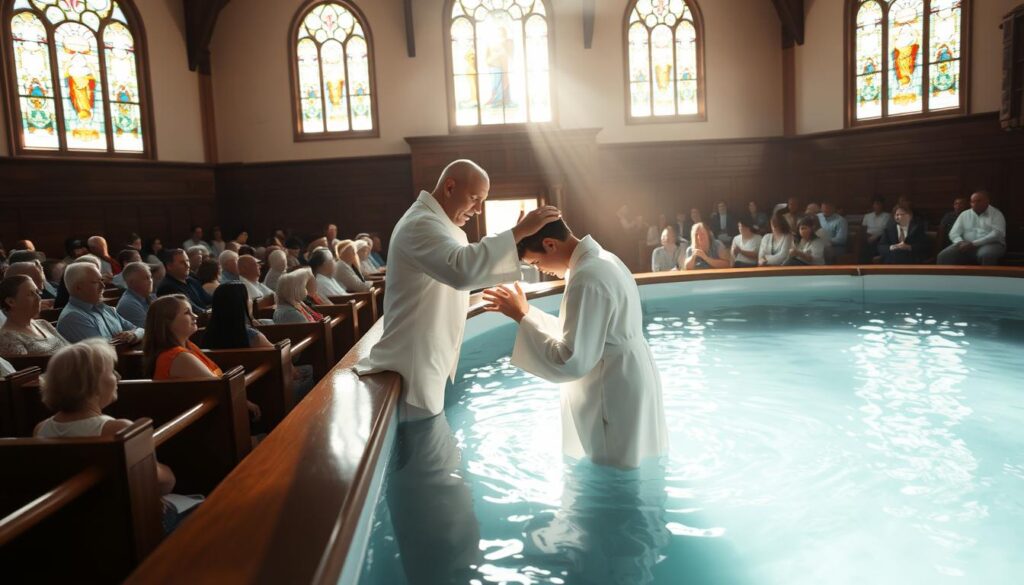
Full-body immersion isn’t just tradition—it’s theater for the soul. When someone steps into the water, they reenact Christ’s burial and resurrection. The candidate shares their faith story first, turning a private belief into communal testimony. This approach mirrors early Christian practices described in the New Testament.

Churches that practice sprinkling or pouring often focus on family heritage. But immersion-focused groups prioritize individual accountability. One pastor explains: “You don’t inherit faith like a family recipe. You claim it as your own.”

Denomination Baptism Method Typical Age Scriptural Basis
Baptist Full immersion Adolescent/Adult Romans 6:3-4
Lutheran Sprinkling Infant Acts 2:38-39
Methodist Pouring Any age Matthew 28:19

This table shows why immersion stands out. The physical act becomes a visual parable—going under water represents dying to old ways, rising up signals new life. It’s faith made visible, demanding courage and conviction from each participant.

Understanding the Lord’s Supper in Baptist Tradition

Why does a simple meal hold such deep spiritual meaning across generations? For many congregations, the Lord’s Supper serves as a powerful bridge between ancient events and modern faith. This practice, often called communion, transforms ordinary bread and wine into vivid reminders of sacrifice and hope.

Symbolism of Bread and Wine

Unleavened bread represents Christ’s sinless life—broken but never corrupted. Grape juice or wine becomes a liquid memorial of blood spilled for humanity’s redemption. “We taste grace in every crumb,” shares a church leader from Texas. These elements stay symbolic, focusing minds on spiritual truths rather than physical transformation.

Services often feature quiet reflection during communion. Members examine their hearts while passing trays—a tactile reminder that faith requires both personal commitment and community connection. This ritual renews dedication to living out Christ’s teachings daily.

Comparison with Sacramental Practices

While Catholic churches teach the bread becomes Christ’s actual body (transubstantiation), Baptist churches view communion as purely commemorative. The table below shows key differences:

Tradition Elements Become… Required Frequency
Baptist Symbolic reminders Varies by church
Catholic Literal body/blood Weekly obligation
Lutheran Christ’s presence “in, with, under” Monthly common

This flexibility lets each church decide how often to serve communion—some monthly, others quarterly. The focus remains fixed on Jesus Christ’s death and resurrection, not ritual mechanics. Through shared cups and broken bread, believers reconnect with Christianity’s central story while strengthening their local church family.

Authority of Scripture and Theological Foundations

Imagine building a house where every brick comes from one trusted source. That’s how many faith communities view their relationship with scripture. The Bible isn’t just a book—it’s the blueprint for faith, worship, and daily life.
Bible authority theological foundations

Emphasis on Bible-Only Doctrine

These groups treat scripture as God’s direct message, needing no extra layers of interpretation. “If it’s not in the Bible, it doesn’t bind our conscience,” explains a Tennessee pastor. This approach shapes everything from church policies to how families resolve conflicts.

Historical creeds or denominational traditions hold less weight here. Leaders often say, “We’re people of one book.” This focus keeps theology grounded in ancient texts while addressing modern questions.

The Role of Inspired Scripture in Daily Life

You won’t find dusty Bibles on shelves in these homes. Many believers carry highlighted copies to workplaces or soccer games. Verses guide decisions about finances, friendships, and even screen time.

Weekly small groups dig into scripture together, asking:

  • What did this mean to its original readers?
  • How does it apply to my life today?
  • What changes does God want me to make?

This hands-on approach turns ancient words into living wisdom. It’s not about rules—it’s about relationship. As one teenager put it, “The Bible’s like God’s text messages—short, powerful, and always relevant.”

Church Governance and Congregational Autonomy

Local leadership shapes spiritual communities in unexpected ways. Picture a system where every voice matters—from teenagers to retirees. This approach transforms how groups make decisions while staying anchored to shared values.
Church governance congregational autonomy

Local Church Leadership and Decision-Making

Members gather regularly to chart their community’s course. Imagine town hall meetings where attendees vote on budgets, mission projects, and pastoral appointments. One Georgia church member shares: “We pray together, debate respectfully, then let majority rule guide us.”

Key decisions flow through democratic processes:

  • Pastors are chosen through congregational votes
  • Financial plans require member approval
  • Ministry teams form based on community needs
Tradition Governance Style Decision-Makers
Baptist Congregational All voting members
Catholic Hierarchical Diocesan bishops
Methodist Connectional Regional conferences

Separation from Centralized Hierarchies

No distant board dictates sermon topics here. Each church answers directly to its understanding of scripture. This independence allows creative solutions—like a Texas congregation converting their parking lot into a farmers’ market.

Historical roots explain this stance. Early leaders fought state-controlled religion, valuing local wisdom over external mandates. Today, this means:

  • Customized outreach programs
  • Flexible worship styles
  • Rapid response to community crises

While networks exist for resource sharing, final authority stays with local members. As one pastor notes: “Our people own the vision—they’re not just following someone else’s plan.”

Comparing Protestant Baptist Beliefs with Other Traditions

When exploring Christian denominations, where do shared foundations end and unique identities begin? Communities rooted in similar Reformation principles often develop distinct expressions of faith. Let’s examine how certain groups maintain core values while carving out their own spiritual paths.

Where Paths Diverge and Converge

Many churches agree on essentials like salvation through faith but differ in application. For example, some emphasize eternal security—the belief that salvation can’t be lost. Others allow for more flexibility in interpreting this doctrine. These differences often shape how communities approach spiritual growth.

Leadership roles reveal another contrast. While some denominations ordain women as pastors, certain congregations maintain traditional gender roles. A Minnesota church member notes: “Our practices reflect how we read Scripture, not cultural trends.” This diversity exists even within the same broader tradition.

Practice Common Protestant Approach Distinct Emphasis
Baptism Infant sprinkling common Adult immersion standard
Governance Regional oversight Local decision-making
Worship Style Liturgical formats Flexible contemporary services

These variations stem from differing views on authority. Some groups prioritize historical traditions, while others focus strictly on biblical texts. This creates rich diversity within shared faith frameworks—like multiple recipes using the same core ingredients.

The Role of Religious Liberty and Separation of Church and State

Freedom to worship without fear remains a revolutionary idea—one forged through centuries of struggle. Communities valuing this principle often trace their resolve to historical clashes between church and state. Their story reveals how conviction can reshape societies.

Historical Context of Persecution and Freedom

Early advocates faced fines, imprisonment, and social rejection for rejecting state-controlled religion. In 17th-century England, believers chose jail time over compromising their views on baptism and self-governance. This defiance planted seeds for modern religious liberty.

Colonial America became a testing ground for these ideals. Leaders argued that faith loses its meaning when mandated by law. Their efforts helped shape the First Amendment, ensuring no single tradition could dominate through government power.

Today, this legacy lives in congregations that champion diverse worship styles. The hard-won truth? Authentic belief thrives when individuals follow conscience—not coercion. As one historian notes: “Liberty isn’t given. It’s claimed by courageous hearts.”

FAQ

Why do Baptist churches practice immersion for baptism?

Immersion symbolizes a believer’s identification with Jesus’ death, burial, and resurrection. It reflects a personal commitment to faith rather than a ritual tied to infancy.

How does the Lord’s Supper differ in Baptist churches compared to other denominations?

Unlike sacramental traditions, the bread and wine are seen as symbolic reminders of Christ’s sacrifice, not as elements that convey grace. Participation is open to all professing believers.

What role does the Bible play in shaping Baptist theology?

Scripture is the ultimate authority, guiding doctrine and daily life. This “Bible-only” approach emphasizes personal study and application of inspired teachings.

How are decisions made within Baptist congregations?

Local churches operate autonomously, with leadership and members collaborating on decisions. This avoids reliance on external hierarchies, fostering community-driven governance.

What historical events influenced Baptist views on religious freedom?

Early persecution during the Reformation era led to strong advocacy for separation of church and state. This legacy continues to shape their commitment to individual conscience.

Are children allowed to participate in communion?

Typically, only those who have made a personal profession of faith partake, regardless of age. This aligns with the emphasis on believer’s baptism and conscious commitment.

How do Baptist traditions compare to mainstream Protestant practices?

While sharing core Christian beliefs, distinctions include congregational autonomy, believer’s baptism, and symbolic communion. These set them apart from more hierarchical or sacramental groups.

What organizations represent Baptist churches in the U.S.?

Groups like the Southern Baptist Convention and American Baptist Churches USA provide fellowship and resources while respecting each congregation’s independence.

Discover the Protestant Home: A Comprehensive Guide


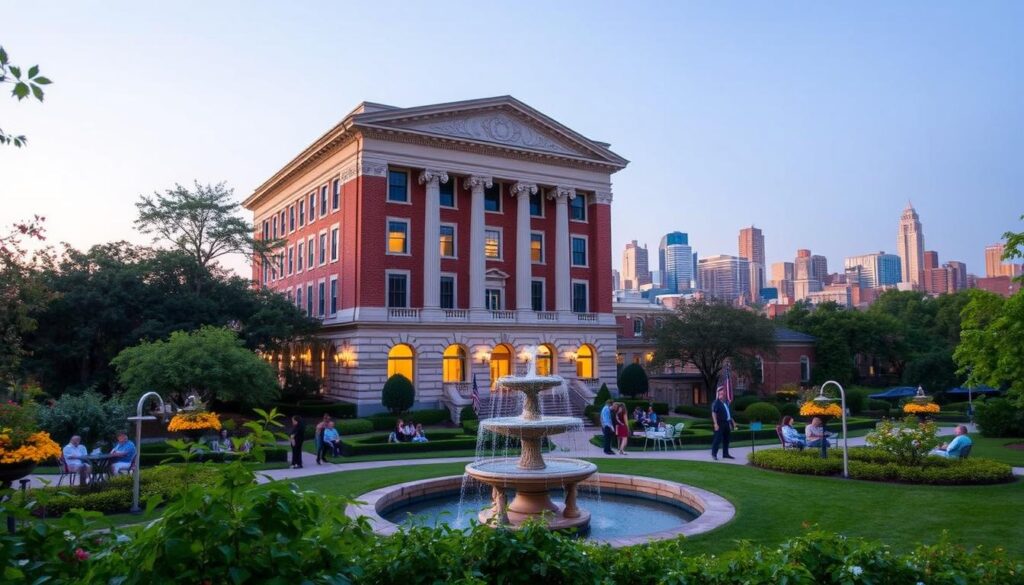
Welcome to your essential resource for exploring faith-based senior living communities. For over 130 years, one organization has stood out in Philadelphia: the Philadelphia Protestant Home. Nestled in Northeast Philadelphia’s Lawndale neighborhood, this community has dedicated itself to enriching the lives of adults aged 62+ since 1890.

What makes this nonprofit unique? Instead of prioritizing profits, it reinvests directly into modern amenities, updated residences, and programs that foster connection. Residents enjoy a vibrant lifestyle with lifelong learning opportunities, wellness services, and social activities designed to build meaningful relationships.

This guide will walk you through everything from care options to resident stories. Whether you’re planning for yourself or a loved one, we’ll help you understand how faith-based values create a warm, supportive environment. You’ll also learn how communities like this balance tradition with modern senior living needs.

Key Takeaways

  • Over a century of experience in faith-based senior care
  • Nonprofit structure ensures funds improve resident services
  • Focus on modern amenities and social connections
  • Personal stories highlight day-to-day life
  • Resources for families exploring Philadelphia options

Introduction to a Warm and Inviting Community

Step into a community where energy and creativity flow as freely as morning coffee. The Philadelphia Protestant Home buzzes with residents who defy stereotypes – theater enthusiasts swap play recommendations, amateur painters host gallery walks, and lifelong learners debate current events over chef-prepared meals.

Most residents share a common thread: they’re city people at heart. These urban explorers appreciate easy access to Philadelphia’s museums and restaurants while enjoying their private oasis. As one resident notes: “I get cultural stimulation without the hassle – like having a backstage pass to the city.”

Diversity thrives here. The community celebrates:

  • Multiple faith traditions coexisting peacefully
  • LGBTQ+ couples hosting game nights
  • Intergenerational friendships with staff

What truly sets this community apart? Its ability to balance sophistication with warmth. Residents enjoy wine tastings in elegant common areas, then gather for fireside chats under towering oaks. Staff members know everyone’s favorite desserts – and dietary needs.

This isn’t just senior living – it’s relational living. Neighbors become chosen family, united by shared values and mutual respect. As the community’s motto goes: “We don’t just share space – we share lives.”

History and Legacy of the Philadelphia Protestant Home

March 4, 1890, marked a turning point for senior care in Pennsylvania. On that day, ministers transformed their vision into reality by creating a sanctuary for aging parishioners. Their first resident, Maria Magdalena Seitz, became the cornerstone of a legacy spanning three centuries.

historic senior community

Founding Mission and 130 Years of Excellence

Originally designed as a faith-based refuge, the organization prioritized compassion over profit. Early records show residents enjoyed home-cooked meals and shared prayers – traditions that still shape daily life today. Over 130 years, this commitment has grown into a full spectrum of services supporting independence and dignity.

Era Milestone Impact
1890-1920 Founding years Established core values
1970s First major expansion Doubled resident capacity
2020s Life Plan Community launch 600+ residents served

Modernization and Continuing Traditions

While preserving its Protestant roots, the community now offers memory care suites and rehab gyms. Recent renovations added chef-driven dining spaces without losing the cozy charm of original parlors. As one staff member explains: “We honor history while writing new chapters.”

The nonprofit model fuels this progress. Funds flow directly into upgraded apartments and wellness programs rather than shareholder pockets. This approach ensures every generation experiences improved quality care while maintaining the close-knit atmosphere Maria Seitz first enjoyed.

Living Options and Personalized Care Services

Choosing the right living arrangement becomes easier with flexible plans that adapt to changing needs. This community provides five distinct tiers of support, ensuring every resident receives tailored assistance while preserving their independence.

Independent Living, Personal Care, and Skilled Nursing

Independent Living apartments cater to active seniors seeking maintenance-free lifestyles. Studios and one-bedroom units feature full kitchens and emergency call systems. Current availability favors these smaller layouts, with two-bedroom apartments facing high demand.

Personal Care bridges independence and assistance. Trained staff help with medication management and daily tasks while encouraging social engagement. One resident shares: “I get help tying my shoes but still run the book club.”

Living Option Key Features Availability
Independent Private kitchens, social events Studios/1BR open
Personal Care Daily assistance, housekeeping Immediate openings
Skilled Nursing 24/7 medical care, rehab Short-term stays

Memory Care and Respite Services

The Memory Care neighborhood uses color-coded pathways and sensory activities to support cognitive health. Specially trained staff lead music therapy sessions and reminiscence groups.

Short-term Respite Care offers temporary relief for caregivers. Guests enjoy full access to amenities during recovery periods or trial stays. Monthly costs start at $1,066, covering meals, fitness classes, and cultural programs – a value exceeding à la carte alternatives.

This tiered approach lets residents transition smoothly between care levels. As needs evolve, familiar faces and surroundings remain constant – a comfort families describe as “priceless.”

Exceptional Amenities and Lifestyle Offerings

Life here feels like a perpetual vacation with purpose. The campus bursts with opportunities to savor, create, and connect through thoughtfully designed spaces that cater to diverse interests. From culinary adventures to artistic pursuits, every corner invites exploration.

Dining, Recreation, and Social Activities

Food lovers rejoice with five distinct venues. The Bistro @ 6500 serves restaurant-quality meals, while The Café dishes up comfort food in a retro setting. “I order the turkey club every Thursday – it’s become my tradition,” shares a resident. Grab-and-go options at Main at Martins Mill keep busy schedules fueled, and Scoops Ice-cream Shop satisfies sweet cravings.

Creative spirits thrive in the art studio and greenhouse. Bookworms swap novels in the resident-run library, while billiard sharks challenge neighbors to friendly games. The Fountain Room hosts everything from jazz nights to grandkids’ birthday parties.

Health, Wellness, and Security Features

The indoor pool sparkles for morning laps, while the fitness center buzzes with group classes led by enthusiastic trainers. A wellness nurse tracks vitals during weekly check-ins. Secure pathways wind through gardens and past a koi pond, offering safe strolls day or night.

Practical perks elevate daily life. Tabor Market stocks pantry essentials, eliminating grocery runs. Monthly fees cover all amenities, letting residents focus on enjoying their active lifestyle rather than budgeting extras. As one member notes: “I’ve taken up watercolor painting and book clubs – things I never had time for before.”

Community, Connection, and Resident Support

Creativity and companionship flourish in spaces designed for connection. At the heart of this environment lies a thriving network of social programs and shared experiences that unite neighbors through purpose and passion.

community support network

Engaging Social Clubs and Cultural Events

Art studios buzz with residents painting landscapes and crafting mosaics. Writing clubs meet weekly to workshop memoirs, while gardening groups tend raised flower beds bursting with color. “Our poetry nights turn into impromptu comedy hours,” laughs one member of the writers’ circle.

Cultural celebrations fill the calendar with music festivals and holiday markets. Happy hours feature local musicians, and themed dinners transport taste buds across continents. These activities create natural opportunities for friendships to blossom over shared interests.

Inclusive, Family-Oriented Environment

Social workers bridge generations by coordinating family game nights and grandparent mentorship programs. They also help residents navigate healthcare decisions and connect with community resources. “It’s like having a trusted guide for life’s transitions,” notes a recent independent living resident.

Support groups address everything from grief to tech literacy, fostering emotional resilience. Many participants form family-like bonds, celebrating birthdays and anniversaries together. The security team’s visible presence allows everyone to focus on building relationships rather than worries.

This approach to community living ensures no one faces challenges alone. Whether collaborating on art projects or sharing stories over coffee, residents discover daily moments of joy and mutual support.

Benefits of a Protestant Home Community

Choosing a faith-based senior community offers more than comfort—it builds lasting value. Unlike corporate-run facilities, nonprofit models prioritize people over profits. Funds flow directly into upgraded apartments, engaging programs, and chef-prepared meals rather than investor dividends.

nonprofit senior community

  • Financial clarity: One-time entrance fees start 30% below market rates
  • Future-ready care: Seamless transitions between independent living and skilled nursing
  • Shared values: Neighbors bond over mutual respect and life experiences

Lifelong learning thrives through partnerships with local colleges. Recent workshops covered smartphone photography and jazz history. “I’ve taken more classes here than during my working years,” shares a 10-year resident.

Holistic wellness programs address body and spirit. Yoga classes meet in chapels, while discussion groups explore faith and philosophy. Nurses coordinate with therapists to create personalized care plans that evolve with changing needs.

This approach delivers exceptional value. Comparative studies show 22% lower annual costs than for-profit communities offering similar amenities. The 130-year legacy provides stability—residents know their needs will be met through economic shifts and healthcare changes.

Friendships form naturally among those valuing service and connection. As one newcomer notes: “It feels like joining a family that’s been waiting for you.”

Convenient Services and Practical Benefits

Everyday tasks become effortless with thoughtful support systems designed for convenience. The community streamlines daily life through reliable services that maintain independence while reducing stress.

Transportation and Moving Assistance

Residents stay connected through free supermarket shuttles and low-cost rides to medical appointments within five miles. “I haven’t missed a book club meeting since moving here,” shares a member who uses the transportation weekly. A dedicated moving coordinator provides personalized assistance, connecting newcomers with trusted local movers familiar with the facility layout.

On-Site Conveniences and Secure Access

Essential amenities sit steps from every apartment. The concierge desk handles package deliveries while the salon keeps haircuts convenient. Secure keycard access and emergency call systems operate 24/7, monitored by attentive staff.

Housekeeping and laundry services free up time for social activities. On-site banking and postal service eliminate errand runs. These practical touches let residents focus on what matters most – enjoying their vibrant lifestyle.

FAQ

What types of care services are available?

Residents can choose from independent living, personal care, skilled nursing, and specialized memory care. Respite services are also offered for short-term needs, ensuring tailored support at every stage.

How does the community prioritize safety and wellness?

Secure access, 24/7 emergency response systems, and on-site health services are standard. Wellness programs include fitness classes, therapy options, and regular health screenings to promote active lifestyles.

Are family members encouraged to participate in activities?

Absolutely! Cultural events, holiday celebrations, and social clubs welcome families. The inclusive environment fosters connections between residents, loved ones, and staff through shared experiences.

What amenities make daily life enjoyable?

Chef-prepared meals, landscaped grounds, art studios, and fitness centers are just a few perks. Scheduled transportation, housekeeping, and engaging activities simplify life while encouraging creativity and socializing.

Is there assistance for transitioning to the community?

Yes! Moving coordination, downsizing support, and personalized tours ease the process. Teams work closely with families to ensure a smooth adjustment to apartment living or care services.

How does the community honor its legacy while staying modern?

Traditions like intergenerational programs and faith-based values remain core, while updates include renovated spaces, advanced healthcare technology, and adaptive activities for today’s seniors.

Protestantism Branches: Understanding the Diversity


Christianity’s landscape holds a vibrant tapestry of beliefs, and nowhere is this more visible than in its Protestant traditions. Born from the 16th-century Reformation, these faith groups share core principles like scripture-based teaching—yet their interpretations vary widely. This freedom to explore biblical meaning independently has fueled centuries of spiritual innovation.

Unlike traditions with centralized leadership, many Protestant churches let individuals and communities shape their practices. This approach created hundreds of denominations, from Lutherans to Baptists, each with unique customs. Despite differences, most agree on belonging to a universal spiritual family—the “Invisible Church“—unseen by humans but known to God.

Today’s religious scene also features rising numbers of non-denominational churches. These groups often blend modern worship styles with classic Reformation values, appealing to believers seeking simplicity. Their growth reflects how Protestantism continues adapting to new cultures and generations.

Key Takeaways

  • Protestant Christianity includes hundreds of groups with distinct beliefs, all tracing back to the Reformation
  • Personal scripture interpretation fuels ongoing diversity in teachings and practices
  • Most denominations view themselves as part of a universal spiritual community beyond earthly labels
  • Non-denominational churches are growing rapidly, often focusing on core principles over traditional structures
  • Cultural influences and historical events continue shaping these faith traditions worldwide

Overview of Protestantism: A Historical Perspective

The 16th century sparked a religious revolution that reshaped Europe’s spiritual history. At its heart stood figures like Martin Luther, a monk who questioned the Roman Catholic Church’s teachings on forgiveness and leadership. His bold questions lit a fuse that would forever change how people practiced faith.

Roots of the Reformation

When Martin Luther nailed his 95 Theses to a church door in 1517, he didn’t plan to start a new movement. He simply wanted honest talks about practices like selling forgiveness certificates. But the newly invented printing press spread his ideas faster than anyone expected.

This technology let ordinary people read the Bible in their own languages for the first time. No longer dependent on priests for interpretation, many began embracing the Five Solas—core beliefs like “Scripture Alone” as God’s true authority. These ideas directly challenged the Roman Catholic doctrine of the time.

Emergence of Diverse Denominations

As reformers like John Calvin and Ulrich Zwingli joined the conversation, regional differences emerged. German states adopted Lutheran teachings, while Switzerland favored Reformed ideas. England’s break from papal rule created yet another path—the Anglican tradition.

Local rulers often supported these changes for both spiritual and political reasons. By rejecting Rome’s control, they gained power over religious and civic life. This mix of faith and governance helped new Christian communities take root across the continent.

Defining Protestantism Branches

At the heart of Christian diversity lies a network of faith communities shaped by shared convictions and individual exploration. Nine major traditions—from Anabaptists to Reformed groups—each maintain distinct doctrinal frameworks while upholding Reformation essentials like scripture’s supreme authority.

Core Doctrinal Beliefs

All these traditions agree salvation comes through faith in Christ alone, not human effort. “By grace you’ve been saved,” wrote Paul—a verse that anchors their theology. Yet interpretations vary widely:

  • Lutherans emphasize God’s unmerited favor
  • Methodists focus on personal holiness
  • Baptists prioritize believer’s baptism

Questions about communion’s meaning or church leadership models further distinguish denominations. These differences show how one belief system can nurture multiple expressions.

Private Interpretation and Faith

The Reformation’s “priesthood of all believers” concept empowers individuals to study scripture independently. This freedom lets local congregations adapt teachings to their context without hierarchical approval. A Quaker meeting might emphasize silent reflection, while Pentecostals celebrate spirited worship.

Despite variations, all groups unite around scripture’s sufficiency and Christ-centered salvation. As Martin Luther declared: “The Bible is the cradle wherein Christ lies.” This shared foundation keeps diverse communities connected across centuries and continents.

Anglican Communion: Tradition and Transformation

Imagine a spiritual bridge connecting centuries-old rituals with modern cultural shifts. This balance defines the Anglican Communion, a global family of churches rooted in the Church of England’s legacy. With 70 million members worldwide, it blends ancient traditions with local adaptations—a living example of faith evolving across borders.

Anglican Communion tradition transformation

Historical Formation and the Church of England

King Henry VIII’s 1534 split from Rome wasn’t about theology—it was personal. When Pope Clement VII refused his divorce, Henry declared himself head of England’s church. This political move birthed the Church of England, retaining Catholic-style bishops while embracing Protestant ideas like scripture’s supreme authority.

Archbishop Thomas Cranmer shaped Anglican identity through the Book of Common Prayer. His elegant services created a “middle way”—respecting tradition yet prioritizing accessible worship. Today, this approach still guides Anglican practices from Nairobi to New York.

The Role of the Episcopal Churches

In America, Anglicans became Episcopalians after independence. They kept core elements like bishops overseeing dioceses but adapted governance to democratic values. Similar adaptations occurred globally—African churches often emphasize biblical literalism, while European provinces lean into social justice.

The Archbishop of Canterbury remains a unifying figure, though his role is symbolic. “We walk together even when we disagree,” explains Justin Welby, current holder of the title. This flexibility helps the Anglican Communion navigate modern debates on gender roles and ethics while maintaining shared heritage.

Lutheran Churches: Faith Through the Lens of Martin Luther

When a German monk challenged religious norms in 1517, he ignited a movement that still shapes millions of lives today. Lutheran churches carry forward Martin Luther’s revolutionary ideas about faith and scripture, creating one of Christianity’s most enduring traditions.

The Augsburg Confession and Key Doctrines

In 1530, Lutheran leaders presented their defining document to the Holy Roman Emperor. The Augsburg Confession declared: “Our churches teach that people cannot be justified before God by their own strength.” This bold statement cemented God’s grace as Christianity’s cornerstone for 80 million Lutherans worldwide.

Three pillars support Lutheran theology:

  • Scripture alone as ultimate authority
  • Salvation through faith, not deeds
  • Christ’s real presence in communion

The Book of Concord collects these teachings, guiding congregations from Minnesota to Madagascar. American Lutherans show particular diversity:

Denomination Members Key Position
Evangelical Lutheran Church in America 3.3 million Ordains women & LGBTQ+ clergy
Lutheran Church-Missouri Synod 1.8 million Traditional biblical interpretation
Wisconsin Evangelical Lutheran Synod 350,000 Strict communion practices

While governance styles vary, all Lutheran churches agree on Luther’s core insight: “The heart of Christianity is Christ’s promise of forgiveness.” This shared conviction unites them across cultures and centuries.

Baptist Churches: Believer’s Baptism and Independent Congregations

Picture a river where adults step into swirling waters to publicly declare their faith. This vivid ritual lies at the heart of Baptist churches, one of Christianity’s most influential movements. Born in 1609 Amsterdam through English exile John Smyth, these communities transformed baptism from infant sprinkling to conscious adult commitment.

Baptist church baptism immersion

Emphasis on Full Immersion Baptism

Baptists see water immersion as more than tradition—it’s a spiritual rebirth marker. “We bury the old self and rise to new life,” explains Pastor Michael Chen from Texas. Unlike denominations baptizing babies, they wait until individuals can personally affirm belief, usually during teenage years or adulthood.

Variations Within Baptist Traditions

While united on baptism, Baptist congregations display striking diversity. The Southern Baptist Convention, America’s largest network with 14 million members, partners with churches on missions while respecting their independence. Other groups like American Baptists often adopt more progressive stances.

Key differences emerge in theology and practice:

  • Some embrace Calvinist predestination; others champion free will
  • Urban churches may use contemporary music; rural ones prefer hymns
  • A few ordain women pastors; many maintain male-only leadership

Despite variations, all share core commitments: scripture’s authority, local church autonomy, and baptism as a believer’s voluntary act. As Smyth declared: “Faith alone makes the Christian—not rituals or bishops.” This principle continues shaping 40 million Baptists worldwide.

Methodist Movements: From John Wesley to Modern Practices

Picture Oxford University in the 1720s, where two brothers met with friends to study scripture and serve the poor. John and Charles Wesley’s Holy Club became the seedbed for a movement that would reshape spiritual life across continents. Their methodical prayers and community service earned them a nickname that stuck: “Methodists.”

Methodist movement origins

The Origins of the Holy Club

John Wesley’s life changed forever on May 24, 1738. At a London prayer meeting, he described feeling his “heart strangely warmed”—a moment that ignited his passion for personal faith. This experience fueled his teaching that everyone could encounter God directly, not just through church rituals.

The Wesleys organized small groups called “class meetings,” where members shared spiritual struggles. These gatherings became laboratories for their tradition of practical Christianity—combining Bible study with social action.

Evolution of Methodist Connexionalism

Wesley designed a flexible system to manage growing congregations. His connexional polity linked local churches into regional circuits overseen by traveling preachers. Imagine horseback ministers rotating between rural chapels and urban missions!

This structure proved perfect for America’s frontier era. Circuit riders like Francis Asbury spread Methodist theology through camp meetings, often attracting thousands. Today, groups like the United Methodist Church maintain this network while addressing modern issues like racial justice and climate change.

Charles Wesley’s hymns still echo in sanctuaries worldwide, reminding believers of his brother’s vision: “Do all the good you can, by all the means you can.” From Oxford study groups to global humanitarian efforts, this movement keeps evolving while staying rooted in its revolutionary past.

Congregational Churches: Autonomy and Community Worship

What happens when a church lets every member help steer its course? Congregational churches answer this through radical self-governance. These communities make decisions collectively—from hiring pastors to budgeting—without bishops or regional oversight.

Historical Pilgrim Influences

The roots trace back to England’s 16th-century Separatists, who rejected Anglican hierarchy. Fleeing persecution, they sailed on the Mayflower in 1620. Their Plymouth Colony became a laboratory for self-governance, blending town meetings with worship decisions.

Early Congregationalists like Robert Browne argued that “church covenants” between believers mattered more than institutional approval. This ideal flourished in New England’s soil. The 1648 Cambridge Platform formalized their approach: each congregation as autonomous, yet voluntarily connected to others.

Today, this legacy lives in white-steepled meetinghouses where members vote on spiritual matters. “We’re keepers of a 400-year-old experiment,” says Rev. Sarah Ellis from Massachusetts. While styles vary, all honor that original vision—faith shaped by community worship, not distant authorities.

FAQ

What started the Protestant movement?

The movement began in the 16th century when reformers like Martin Luther challenged Roman Catholic teachings. Luther’s 95 Theses in 1517 sparked debates over authority, grace, and scripture, leading to new Christian traditions.

How does the Anglican Church differ from other groups?

The Church of England, part of the Anglican Communion, blends Catholic rituals with Reformed theology. Episcopal churches, like the U.S.-based Episcopal Church, emphasize liturgy while allowing flexibility in doctrine.

Why do Lutheran churches focus on the Augsburg Confession?

Written in 1530, the Augsburg Confession outlines key Lutheran beliefs, such as salvation by faith alone. It remains a unifying document for groups like the Evangelical Lutheran Church in America.

What makes Baptist churches unique?

Baptist traditions, including the Southern Baptist Convention, stress believer’s baptism by full immersion. They also prioritize congregational autonomy, letting individual churches govern themselves.

How did Methodism evolve over time?

John Wesley’s Holy Club laid the groundwork for Methodism, emphasizing personal holiness. Today, groups like the United Methodist Church balance Wesleyan teachings with modern social engagement.

What defines Congregational churches?

Congregationalists, influenced by Pilgrim settlers, emphasize local church independence. The United Church of Christ, for example, allows congregations to adapt worship styles and policies.

Are all Protestant groups similar in structure?

No—polity varies widely. For instance, the Presbyterian Church (USA) uses elder-led governance, while the Anglican Communion relies on bishops. Many Baptist churches reject hierarchical structures entirely.

Do Protestant denominations share core beliefs?

Most affirm salvation through faith, scripture’s authority, and Jesus’ centrality. However, views on sacraments, the Holy Spirit, and church leadership often differ sharply between traditions.

Exploring the History of Protestantism in France


A powerful religious movement began reshaping Europe in the 1500s, and its ideas quickly took root west of the Rhine. French thinkers like John Calvin pioneered new theological perspectives that challenged traditional practices. Their work sparked spiritual debates that would eventually ripple across continents.

This transformation wasn’t just about faith—it became woven into politics and society. Noble families often supported these reforms, creating tensions with royal authority. Over time, these conflicts shaped laws, wars, and even national identity.

Today, about 3% of the population identifies with this branch of Christianity. While older denominations face challenges, newer evangelical groups are gaining traction. This shift reflects changing attitudes toward organized religion in modern times.

What makes this story remarkable is its endurance. Communities weathered persecution and upheaval for generations, preserving traditions against steep odds. Their legacy continues to inspire discussions about freedom of belief and cultural diversity.

Key Takeaways

  • Roots trace back to 16th-century reformers like Calvin who reshaped European religious thought
  • Early growth tied to political alliances with nobility and urban centers
  • Faced centuries of challenges including wars of religion and limited rights until 1789
  • Modern communities balance shrinking traditional groups with rising evangelical movements
  • Cultural impact seen in education, civil liberties, and regional identities

Historical Context and Early Beginnings

The 1520s sparked a spiritual revolution that divided religious thinkers into two camps. One group sought to refresh traditions from within, while others embraced radical breaks with Rome. This tension created fertile ground for lasting change across the kingdom.

The Roots of Reformation

Humanist scholars like Erasmus ignited curiosity about biblical origins. By studying ancient Greek texts, they questioned rituals that had grown distant from early Christian practices. Their work reached educated circles and even influenced King François I’s court through his sister Marguerite d’Angoulême.

Bishop Guillaume Briçonnet took these ideas further. He launched reforms in Meaux, inviting scholars to translate scriptures into French. “The truth lives in original texts,” argued Jacques Lefèvre d’Etaples, whose Bible translations became tools for grassroots spiritual renewal.

Ideas Meet Resistance

Not everyone welcomed these changes. The Sorbonne university condemned reformers as threats to the Catholic Church. Meanwhile, Luther’s writings from Germany secretly circulated, appealing to those wanting complete separation from Rome.

By 1525, the movement faced a critical choice: adapt traditions or build new ones. This debate would shape religious identity for generations, proving that ideas could be as powerful as armies in reshaping a nation.

Key Figures and Milestone Events

Behind every great movement stand remarkable individuals who turn ideas into action. Two queens and a network of daring reformers shaped this religious transformation through courage and strategy.

French Protestant leaders

Queens Steering Change

Jeanne d’Albret’s conversion in 1560 changed everything. As Queen of Navarre, she turned her lands into safe havens, declaring “I’d rather lose everything than betray my conscience.” Her son Henri IV would later become king, blending political savvy with religious compromise.

Catherine de Médicis faced a tighter rope. The Italian-born regent balanced Catholic hardliners against growing Protestant influence. Her 1562 Edict of Saint-Germain granted limited worship rights—a risky peace offering that temporarily eased tensions.

Reformers Forging Paths

Guillaume Farel’s story shows how ideas spread. After fleeing persecution, he helped establish Reformed communities in Switzerland. Back home, nobles like Gaspard de Coligny became military defenders of the faith, proving power often followed belief.

Antoine de Bourbon’s family ties mattered most. His brother Louis led Protestant armies, while his wife Jeanne d’Albret funded churches. Together, they turned religious dissent into a political force that kings couldn’t ignore.

Evolution of protestantism france: From Evangelical Trends to Lutheran Legacies

Geneva’s intellectual energy sparked a revolution across French communities starting in 1540. Jean Calvin’s writings flowed westward, offering clear guidelines for organizing congregations. His systematic theology gave structure to reformers who previously relied on scattered ideas.

The Dual Paths of Humanist and Lutheran Evangelical Ideas

Two streams shaped early Protestant thought. Scholars inspired by Erasmus focused on refining traditions through education. Meanwhile, Luther’s followers pushed for bold breaks with established worship customs. This tension created vibrant debates about spiritual renewal.

Aspect Humanist Approach Lutheran Influence
Theology Emphasized scripture study Stressed faith over works
Worship Style Preserved some rituals Simplified services
Social Reach Appealed to educated elites Connected with tradespeople

Meaux became the testing ground for these ideas. The town’s first church under Bishop Meaux’s oversight blended Calvinist discipline with local traditions. By 1555, similar communities emerged in Paris and southern regions.

Printing presses changed everything. Artisans could now access translated Bibles and pamphlets. This shift helped Protestant teachings move beyond wealthy circles into daily life. The 1559 Paris synod sealed this growth, creating national unity through shared confession of faith.

Political Intrigues and Noble Influence

Royal courts buzzed with tension after 1559. When King Henri II died unexpectedly, ambitious nobles saw their chance. Protestant leaders wanted more than religious freedom—they sought political power in a kingdom traditionally ruled by Catholics.

Conspiracy Amboise

Secrets at Château d’Amboise

The 1560 Conspiracy of Amboise changed everything. Protestant nobles planned to kidnap young King François II. Their goal? Free him from the House of Guise, Catholic relatives controlling the throne. “We act to save the prince,” one conspirator declared—but the plot failed spectacularly.

Faction Leader Key Action
Protestants Gaspard Coligny Organized resistance
Catholics Duke Guise Ordered executions
Royal Court Queen Mother Balanced factions

Courtrooms Become Battlefields

After the failed attempt, violence spiraled. The Guise family executed hundreds, while Protestants occupied churches. Gaspard Coligny emerged as a key strategist, blending faith with politics. These clashes proved religion couldn’t be separated from power struggles in royal circles.

Nobles learned hard lessons. Military strength became as vital as theological arguments. This shift laid groundwork for decades of conflict—and eventual reforms.

From Persecution to Toleration

Smoke rose from burning stakes across the kingdom as religious dissenters faced brutal consequences. Authorities escalated punishments starting in 1523, branding reformers as threats to social order. Amid this turmoil, visionary leaders began planting seeds of compromise that would eventually bear unexpected fruit.

religious persecution edict nantes

The Road to Legal Recognition

Michel de l’Hospital emerged as an unlikely peacemaker during the wars of religion. As royal chancellor, he convinced Catherine de Médicis to sign the 1562 Edict of January. This groundbreaking law permitted Protestant services outside city walls—a small but vital step toward coexistence.

Earlier crackdowns had reached terrifying heights. After 1534 posters criticizing Catholic practices appeared in Paris, mass arrests followed. “We walk on nothing but heretics here,” one witness wrote, describing charred remains in public squares.

Turning Points That Changed History

August 24, 1572, became known as the St. Bartholomew’s Day massacre. What began as targeted killings in Paris spread to provincial towns, leaving thousands dead. This horrific violence shocked Europe but ultimately strengthened Protestant resolve.

Henry of Navarre’s political pragmatism reshaped the conflict. After converting to Catholicism for the throne, he issued the landmark Edict of Nantes in 1598. The decree granted Huguenots fortified towns and civil rights—a fragile truce that lasted nearly a century before its revocation.

Socio-Cultural Impact and Modern Reflections

Hidden church services in barns and coded hymns defined spiritual life for generations after 1685. When Louis XIV revoked religious freedoms, communities adapted by creating secret networks. “We sang psalms while working looms,” one descendant recalled, showing how worship blended into daily routines to avoid detection.

Shifts in Worship, Community, and Identity Over the Centuries

The 1685 exodus scattered nearly 200,000 Huguenots worldwide. Many settled in America, shaping industries like textiles and silverwork. Those who stayed developed tight-knit communities—a survival strategy that still influences their group identity today.

Legal changes in 1789 brought relief but didn’t erase scars. For over a century, Protestants rebuilt institutions while maintaining low visibility. This caution shaped their approach to public religion, favoring quiet service over bold declarations.

Modern congregations balance old and new. Traditional Calvinist churches merged in 2013 to strengthen resources, while evangelical groups attract younger crowds with contemporary music. One pastor noted: “Our worship styles differ, but our core values unite us.”

François Mitterrand’s 1985 apology marked a turning point. By acknowledging past wrongs, it helped heal divisions that lingered for 300 years. Today, 3% of the population identifies with these faith traditions—proof that resilience can outlast persecution.

Comparative Analyses and Supplementary Perspectives

Religious transformations in 16th-century Europe took diverse paths shaped by local cultures. While reformers shared core beliefs, their strategies and outcomes varied dramatically across regions. This contrast helps explain why some movements thrived while others faced steeper challenges.

Insights from the French Reformation Versus Other European Movements

French reformers faced unique hurdles compared to German or English counterparts. Centralized royal power limited their political leverage, unlike German princes who protected Lutherans. England’s state-controlled church model differed sharply from grassroots Calvinist networks that relied on noble support.

Geneva’s influence proved stronger in France than elsewhere. Calvinist communities prioritized education and lay leadership—a structure that helped them survive persecution. Meanwhile, Dutch reformers blended religious change with national independence efforts, creating distinct motivations.

Evaluation of Modern Evangelical Trends

Today’s evangelical groups adapt to secular societies through community outreach and contemporary worship styles. Unlike older denominations, they often avoid historical labels while keeping core Reformation principles. Younger generations gravitate toward flexible service formats and social justice initiatives.

Growth challenges remain. Urban areas see rising attendance, but rural congregations shrink. Leaders balance tradition with innovation—streaming services while preserving small-group Bible studies. This duality mirrors early reformers’ efforts to make faith accessible across social divides.

FAQ

How did humanist ideas contribute to early reform movements?

Humanist thinkers like Jacques Lefèvre d’Étaples emphasized returning to original biblical texts, inspiring critiques of traditional practices. Their focus on education and scripture laid groundwork for evangelical ideas to spread, blending with Lutheran teachings by the 1520s.

What role did Jeanne d’Albret play in advancing Reformed beliefs?

As Queen of Navarre, Jeanne d’Albret openly supported Reformed theology, promoting Calvinist teachings in her territories. Her leadership strengthened Huguenot networks and influenced her son, Henry IV, who later issued the Edict of Nantes.

Why was the Conspiracy of Amboise significant?

In 1560, this failed plot by Huguenot nobles aimed to remove Catholic advisors from King Francis II’s court. It intensified tensions, leading to stricter crackdowns and setting the stage for decades of religious conflict.

How did the St. Bartholomew’s Day Massacre change the Reformation’s trajectory?

The 1572 massacre, ordered by Catherine de Médicis, saw thousands of Huguenots killed in Paris. This event deepened divisions, fueled wars, and delayed efforts toward religious coexistence until Henry IV’s reign.

What differentiated French evangelical movements from others in Europe?

Unlike Germany’s Lutheran focus, French reformers blended humanist scholarship with Calvinist discipline. Local synods and noble patronage created decentralized structures, shaping a unique identity distinct from neighboring regions.

How did Michel de l’Hospital influence religious policies?

As chancellor, l’Hospital advocated for provisional tolerance through the 1562 Edict of Saint-Germain. His push for dialogue between factions temporarily eased hostilities, though political rivalries soon reignited violence.

Why did the Edict of Nantes face challenges after Henry IV’s death?

Later monarchs, influenced by Catholic hardliners, viewed the edict as a threat to royal authority. Its revocation in 1685 under Louis XIV forced many Huguenots into exile, weakening Reformed communities until the French Revolution.

Protestant Prayer Beads: A Spiritual Practice Explored


For many, spiritual tools create a bridge between ancient traditions and modern faith. The use of beads in devotional practices stretches back centuries, but one adaptation emerged more recently. In the 1980s, a group of Episcopalians in Texas reimagined traditional methods to craft a new approach for focused meditation.

This innovation resulted in a 33-bead set, each piece symbolizing the years of Christ’s life. Unlike older models, the design emphasizes flexibility, allowing users to personalize their experience. The term “bead” itself traces to the Anglo-Saxon word “bede”, meaning prayer—a fitting origin for objects meant to deepen connection.

Today, these tools are embraced across denominations like Methodist and Anglican communities. They serve as physical anchors during reflection, blending touch with contemplation. Far from rigid rituals, they invite creativity while honoring core beliefs.

Key Takeaways

  • Modern bead-based practices originated in 1980s Episcopal communities seeking adaptable spiritual tools
  • The 33-bead structure directly references Jesus Christ’s age at crucifixion
  • Beads help combine physical engagement with mental focus during devotion
  • Multiple Protestant denominations now incorporate these sets into personal worship
  • Etymology links “bead” to the Anglo-Saxon term for prayer, reinforcing historical connections

The Historical Roots and Spiritual Significance of Prayer Beads

Physical tools in worship trace back to ancient scriptures, where simple objects became sacred anchors. In Numbers 15, God instructed the Israelites to grasp their garments’ fringes during moments of doubt—a tactile reminder of divine presence. This principle evolved as early believers sought ways to fulfill Paul’s call to “pray continually.”

Biblical Foundations and Early Use in Worship

Ancient communities turned to pebbles, knotted ropes, and later beads to maintain spiritual focus. Desert monks carried stones in pouches, releasing one after each supplication. These methods transformed over centuries into organized strings of beads used across faiths—from Buddhist malas to Islamic tasbihs.

Christian traditions adapted these tools while adding theological meaning. By the Middle Ages, the catholic rosary became a structured meditation aid. Yet Protestant reformers often rejected rigid formulas, preferring direct engagement with scripture.

Transition from Catholic Rosary to Protestant Practice

In the 1980s, Episcopal leaders reimagined prayer tools to blend flexibility with tradition. Their 33-bead set referenced Christ’s lifespan while allowing personalized use. Unlike rosaries requiring specific recitations, this design encouraged free-form reflection on psalms or personal gratitude.

This innovation honored historical roots while respecting Protestant values. It bridged Eastern Orthodox prayer ropes and Catholic practices without doctrinal conflict. Today, these adaptable tools help many faith communities merge physical rhythm with spiritual intention.

Exploring How to Use Protestant Prayer Beads

Personal spiritual practices often thrive when given both structure and freedom. Unlike many traditional methods, modern devotional tools adapt to individual needs while maintaining core symbolism. This balance makes them accessible for diverse worship styles and schedules.

using prayer beads for meditation

Structural Flexibility in Modern Devotion

While traditional rosaries follow strict patterns, contemporary sets prioritize adaptability. Most feature four groups of seven beads—a design reflecting creation’s completeness rather than lengthy recitations. This streamlined approach helps users avoid feeling overwhelmed during prayer time.

Users craft personal sequences, choosing phrases or scriptures that resonate. One might recite Psalms on certain beads while reserving others for silent reflection. This freedom transforms routine into meaningful spiritual dialogue.

Daily Benefits of Tactile Meditation

Holding physical objects during devotion anchors wandering thoughts. Moving fingers across smooth surfaces creates rhythm, slowing mental chatter. Many find this tactile practice especially helpful when facing stress or decision-making.

Portability allows discreet use anywhere—during commutes or coffee breaks. Regular engagement builds consistent habits, even with limited time. As one worshiper shared: “The beads remind me to pause and listen, not just speak.”

Over weeks, this practice often deepens awareness of sacred moments in ordinary life. It turns distracted minutes into opportunities for connection, blending ancient wisdom with modern needs.

Crafting and Incorporating DIY Prayer Beads in Your Devotion

Creating spiritual tools with your hands adds depth to daily worship. Imagine holding something you shaped, each piece reflecting your unique journey. This process blends creativity with contemplation, turning simple materials into sacred companions.

Creative Steps for Making Your Own Prayer Beads

Start by gathering 33 elements: one special charm, four cruciform beads, and 28 smaller pieces. Choose stones or wood that feel comforting—maybe blue for peace or smooth lava rock for resilience. Many crafters add a cross pendant, but any symbol resonating with your faith works beautifully.

Assemble them in this order:

  • Begin with the charm as your anchor
  • Add the single invitatory bead
  • Place four larger cruciform pieces to form a cross shape
  • Separate these with seven smaller beads in four groups

A Step-by-Step Guide to Using Your Prayer Beads

Hold your handmade set and start at the charm. Whisper an opening phrase like “Guide my heart.” Move to the invitatory bead to set your intention—perhaps Psalm 46:10. As you reach each cruciform piece, repeat a simple affirmation about forgiveness or gratitude.

The week beads offer space for specific requests. Try this pattern:

  1. First seven: Praise for life’s blessings
  2. Next seven: Requests for loved ones
  3. Third group: Personal growth hopes
  4. Final set: Quiet listening time

One user shared: “My homemade set helps me pause when stress hits. The physical rhythm grounds me.” Over weeks, this practice becomes a cherished dialogue, weaving your story into every bead.

Conclusion

The journey of faith grows richer when we engage both hands and heart. Crafted in the 1980s, these spiritual tools blend ancient traditions with modern needs. Their flexible design invites personal themes—gratitude, healing, or quiet listening—without rigid formulas.

Many discover that holding physical objects during meditation brings focus to busy minds. A simple circle of beads becomes a portable anchor, turning commutes or coffee breaks into sacred moments. As more communities embrace this practice, they’re finding it complements existing worship styles rather than replacing them.

What began four decades ago continues gaining momentum. Early adopters paved the way for others seeking tactile practices that deepen connection. Whether using store-bought sets or handmade creations, the rhythm of moving through each piece transforms distracted thoughts into mindful reflection.

This modern adaptation proves ancient wisdom still resonates. It offers a bridge between historical roots and contemporary life, one bead at a time.

FAQ

How do these spiritual tools differ from the Catholic rosary?

While both involve meditative repetition, the structure often includes a cross and four sets of seven beads. Themes like gratitude or scripture replace traditional Marian prayers, reflecting unique faith emphases.

What benefits come from incorporating them into daily routines?

They create rhythm, reduce distractions, and anchor the mind during reflection. Many find they deepen focus on themes like forgiveness or grace, fostering calm and intentionality.

Can I personalize my own set?

Absolutely! Crafting allows creativity—choose colors, materials, or charms that hold personal meaning. Some add a cross or symbolic bead to mark the start of their meditation.

Are there guidelines for beginners?

Start simple. Hold the first bead, breathe deeply, and recite a short phrase or verse. Move through each section at your pace, letting the rhythm guide your heart.

How long should a session last?

Even 5–10 minutes can nurture mindfulness. It’s less about duration and more about consistency—regular use builds a habit of centered reflection.

Do I need formal training to begin?

No prior experience is required. Many resources, like step-by-step guides or community groups, offer support. The practice adapts to your spiritual journey.

Discover the Artistic Expressions of Protestantism


When the 16th-century religious movement reshaped Europe, creativity found unexpected paths to thrive. Reformers sought to simplify worship, but this didn’t erase beauty—it redefined it. Instead of grand church sculptures, artists turned to everyday life, nature, and personal spirituality to reflect their deepened connection to faith.

This shift began with Martin Luther’s bold critiques in 1517. His ideas sparked debates about idolatry, pushing creators to explore new subjects. Portraits, landscapes, and even household objects became canvases for expressing devotion. Northern European painters like Rembrandt mastered light and emotion, proving sacred stories could live beyond ornate altarpieces.

Contrary to myths, this era didn’t reject artistry—it expanded its horizons. Writers like John Milton wove biblical themes into epic poetry, while composers like Bach transformed hymns into timeless masterpieces. These works bridged ancient traditions with fresh perspectives, showing how belief could inspire innovation.

Key Takeaways

  • The Reformation challenged artists to rethink sacred storytelling without traditional religious imagery
  • Everyday scenes and personal faith became central themes in Protestant-inspired works
  • Master creators like Rembrandt and Bach redefined spiritual expression through their mediums
  • Literary achievements complemented visual arts in shaping Protestant cultural identity
  • This movement broadened artistic scope rather than limiting creative output

Introduction: Unveiling the Fusion of Faith and Creativity

Creativity found new life through radical religious transformations. The Reformation didn’t just change church practices—it rewrote society’s relationship with imagination. Personal spirituality became the canvas for expressing devotion, blending ancient traditions with fresh perspectives.

The Purpose and Scope of This Ultimate Guide

This guide walks you through five centuries of cultural evolution. We’ll explore how beliefs shaped paintings, literature, and music across continents. From Luther’s revolutionary ideas to modern worship songs, discover how creators balanced divine inspiration with human expression.

Aspect Medieval Art Protestant Art
Primary Focus Church authority Personal faith
Subject Matter Saints & miracles Daily life & nature
Audience Clergy & nobility Common people

Understanding the Intersection of Art and Belief

Religion once dictated every creative choice. After the Reformation, artists painted ordinary moments as sacred. A family meal could symbolize communion, while landscapes reflected God’s craftsmanship.

This shift required clever problem-solving. How do you show spiritual depth without angels or saints? The answer lay in cultural adaptation—using familiar scenes to convey timeless truths. Writers turned parables into poems, while musicians crafted hymns anyone could sing.

Historical Context of the Protestant Reformation and Its Artistic Impact

Northwestern Europe became the epicenter of a religious revolution in the 16th century. The Catholic Church faced growing criticism over practices like selling indulgences—certificates promising reduced punishment for sins. This system, active since the 3rd century, had turned into a profitable business that fueled public outrage.

Origins and Religious Shifts

Martin Luther’s 1517 protests ignited the Protestant Reformation, challenging centuries of tradition. Reformers demanded simpler worship and direct access to scripture. Artists suddenly lost their main patron when Protestant leaders stopped commissioning church altarpieces.

protestant reformation historical context

The Printing Press Revolution

Gutenberg’s invention supercharged the movement. Luther’s German Bible translation spread like wildfire across the Holy Roman Empire. For the first time, ordinary people could read scripture themselves—no Latin required.

Medieval Tradition Reformation Shift
Art funded by church Patrons became merchants
Latin-only texts Vernacular translations
Saints as subjects Everyday life scenes

This cultural earthquake forced artists to adapt. Some turned to portrait painting, while others illustrated mass-printed Bibles. The development of new art forms showed how creativity thrives even in times of upheaval.

Understanding Protestantism Art: Themes, Styles, and Techniques

Sixteenth-century creators faced a puzzle: how to visualize faith without traditional religious symbols. Their solution transformed storytelling through everyday scenes and symbolic details. A basket of bread might hint at communion, while sunlight through windows symbolized divine presence.

Core Themes and Visual Narratives

Painters swapped golden halos for kitchen tables. Biblical stories appeared in humble settings—fishermen mending nets became disciples, and village gatherings mirrored the Last Supper. This shift made sacred stories feel immediate and relatable.

Aspect Traditional Approach Reformed Innovation
Key Subjects Saints & miracles Family life & nature
Symbolism Obvious icons Hidden meanings
Audience Church elites Working families

Innovative Techniques and Cultural Relevance

Artists developed clever workarounds to satisfy both theological rules and creative ambitions. Rembrandt used light to spotlight moral choices in tavern scenes. Dutch still-life painters turned flowers into reminders of life’s brevity.

These techniques served dual purposes. They taught scripture through visual parables while celebrating ordinary beauty. A portrait of a merchant’s wife might showcase modesty—a virtue prized by reformers—through her simple dress and posture.

This approach changed who engaged with creative works. Now farmers could discuss a painting’s message as easily as scholars. Art became a shared language for exploring faith’s role in daily living.

Influential Artists and Their Legacies

Amidst Europe’s religious turbulence, two painters redefined creative expression through skill and adaptability. Their journeys show how talent thrived when church commissions dwindled, proving artistry could flourish in unexpected ways.

Hans Holbein the Younger: Portraits of Change

Born into a family of artists, Holbein mastered both Northern precision and Italian flair. When Protestant reforms reduced religious commissions in Basel, he pivoted to portraits. His detailed paintings captured England’s royal court, including Henry VIII’s imposing figure.

Aspect Early Work Protestant Era
Primary Subjects Altarpieces Royal portraits
Technique Gold leaf details Realistic textures
Symbolism Biblical scenes Hidden meanings

Holbein’s genius lay in showing human complexity beyond religious labels. A Catholic merchant and Protestant reformer could both appear dignified through his brushstrokes.

Lucas Cranach the Elder: Propagating New Doctrines

Martin Luther’s close friend became Protestantism’s visual storyteller. Cranach designed woodcuts that simplified complex ideas for everyday people. His Bible illustrations made scripture accessible to farmers and shopkeepers alike.

These painters proved creativity adapts to survive. Holbein navigated political shifts while Cranach shaped cultural narratives. Their work established blueprints for artists balancing belief with practical demands.

Iconoclasm and the Transformation of Religious Visuals

In 1566, a wave of destruction swept through churches across the Low Countries. Crowds stripped altars and smashed statues, believing elaborate religious art distracted from true worship. This radical cleansing reshaped how communities engaged with sacred spaces.

iconoclasm religious transformation

Protestant Iconoclasm: Destruction and Redefinition

Reformers saw images in Catholic churches as dangerous idols. They pointed to Exodus 20:4—”You shall not make any graven image”—as divine command. The Beeldenstorm (“Image Storm”) of 1566 saw mobs destroy:

  • Carved saints in Dutch cathedrals
  • Painted altarpieces in French chapels
  • Gilded relics across German towns
Pre-Iconoclasm Church Post-Iconoclasm Space
Colorful frescoes Whitewashed walls
Golden statues Plain wooden pulpits
Scented incense Open Bibles

The Shift from Decorative to Didactic Imagery

Surviving artworks gained new purposes. Dutch families used printed Bible illustrations as teaching tools. A 1573 Geneva Psalter showed King David playing harp—not for veneration, but to spark discussions about worship through music.

Even destruction had surprises. When radicals targeted the Ghent Altarpiece in 1566, local guards hid Van Eyck’s masterpiece behind a false wall. This act preserved one of Europe’s most complex depictions of biblical narratives for future generations.

Decorative Art Didactic Art
Inspire awe Teach scripture
Show saints Illustrate parables
Promote donations Encourage literacy

Beyond the Sacred: Secularization and Daily Life in Art

A quiet revolution unfolded in 17th-century Dutch kitchens and German marketplaces. Painters began framing ordinary moments—a mother peeling potatoes or blacksmiths shaping iron—as windows into divine purpose. This shift turned daily routines into subjects worthy of canvas and contemplation.

everyday life art

Depiction of Everyday Scenes and Cultural Mandates

Reformed thinkers taught that all work honors God when done with integrity. Artists responded by capturing bakers, seamstresses, and fishermen mid-task. A 1635 painting of a Haarlem weaver didn’t just show labor—it celebrated human partnership in creation’s ongoing story.

Catholic Tradition Protestant Innovation
Saints in golden light Farmers in field sunlight
Church-funded altarpieces Home-displayed genre scenes
Miracles as focus Meals as sacred acts

Still lifes held hidden sermons. A lavish table might feature rotting fruit beside fresh bread—a reminder that earthly wealth fades. Artists tucked symbols like hourglasses into compositions to whisper about life’s brevity without preaching.

Portraits gained new depth. A 1612 family scene showed children playing with a spinning top, their laughter echoing Protestant beliefs about childhood’s innocence. Landscapes flourished too, with rolling hills painted as God’s unsigned masterpiece.

This artistic democratization made every home a gallery. Shopkeepers could now own works that mirrored their lives, finding spiritual meaning in shared human experiences rather than distant saints.

Conclusion

From soaring hymns to gripping literature, the Reformation’s creative spirit reshaped how we experience faith in daily life. Visionaries like Bach turned church music into soul-stirring conversations, while Milton’s poetry gave biblical stories new wings. These makers proved sacred expression thrives beyond stone cathedrals.

Luther’s Bible translation did more than spread ideas—it sparked a cultural quake. By valuing ordinary people as divine image-bearers, this movement empowered farmers and queens alike to find holiness in humble moments. Rembrandt’s light-dappled paintings and Bunyan’s allegories became mirrors reflecting shared human struggles.

This legacy endures wherever creativity honors both tradition and innovation. Whether through vibrant worship songs or community murals, the Reformation reminds us that true religious art isn’t about perfection—it’s about connection. Its greatest masterpiece? A world where beauty serves everyone, not just the privileged few.

FAQ

How did the Protestant Reformation influence artistic themes?

The Reformation shifted focus from elaborate religious visuals to simpler, narrative-driven works. Artists emphasized biblical stories and moral lessons, reflecting new beliefs about faith and worship. This led to fewer saints in paintings and more scenes of everyday life tied to spiritual values.

What role did iconoclasm play in reshaping religious imagery?

Iconoclasm—the rejection of ornate church decorations—pushed creators to prioritize teaching over decoration. Statues and stained glass were replaced with woodcuts and prints that made ideas accessible. This movement redefined how communities engaged with visual expressions of belief.

Which artists were pivotal in spreading Reformation ideas through their work?

Hans Holbein the Younger’s detailed portraits humanized leaders like Henry VIII, blending realism with symbolism. Lucas Cranach the Elder collaborated with Martin Luther, creating bold imagery that simplified complex doctrines for wider audiences. Both shaped how new beliefs were visually communicated.

How did secular themes emerge in Protestant-inspired creations?

As emphasis moved away from saints, everyday moments became central. Families, labor, and community interactions were depicted to highlight virtues like humility and charity. This shift mirrored the belief that faith should permeate daily life, not just rituals.

Why did the printing press matter for Protestant visual culture?

The press allowed mass production of illustrated pamphlets, Bibles, and woodcuts. This democratized access to religious texts and imagery, spreading Reformation ideals rapidly. Artists adapted by designing clear, impactful visuals that worked well in print formats.

How did Protestant and Catholic artistic styles differ during this period?

Catholic works often featured grand altarpieces and symbolic icons to inspire awe. Protestant pieces leaned toward subdued colors and relatable scenes, avoiding idolatry. The contrast highlighted differing views on worship, with one prioritizing grandeur and the other practicality.